
Phytosterol Complex 667 mg Ingredients & Drug Interactions
What is this page for?
First and foremost: checking Phytosterol Complex 667 mg against your medications. The heart of this page is the interaction checker and the full interaction report — how this product’s ingredients may interact with prescription and over-the-counter medicines you may be taking.
Around that, we add a pharmacist’s high-level view of the product as a whole — what’s inside, the evidence for its stated use, how transparent the label is, and what safety data exists — so you can see the full picture in one place. It’s educational information from our licensed clinical databases and the clinical staff at HelloPharmacist — not medical advice — and we don’t sell or endorse products. Our editorial policy
Phytosterol Complex 667 mg is a dietary supplement by Wonder Laboratories with 7 active ingredients. Its ingredients are commonly taken for diarrhea relief, constipation and digestive health, cholesterol support.Based on those ingredients, 23 medications have a known interaction with it, the most serious rated moderate. The ingredients most likely to interact are Citrus Pectin. Use the checker below to test your specific medication, or read the full HelloPharmacist Interaction Report.
Check Your Meds Against Phytosterol Complex 667 mg by Wonder Laboratories
Ask about any prescription or over-the-counter medication and we check it for interactions with Phytosterol Complex 667 mg by Wonder Laboratories — and tell you which ingredient is responsible.
AI summaries are generated from our interaction database for education only — always confirm with your pharmacist. How we use AI
Ask the Pharmacist
A licensed pharmacist will answer your question by email — free, usually within 24 hours.
Got it — thank you!
A licensed pharmacist will answer within 24 hours. Keep an eye on your email (worth checking spam, just in case).
HelloPharmacist Scorecard of Phytosterol Complex 667 mg by Wonder Laboratories
Our pharmacy team’s full take, with four database checks built into the cards below — a summary of what is known, not a grade of the product itself.
What’s inside
Partial disclosure
This product contains 7 ingredients, mostly plant-derived sterols. Beta-sitosterol is the main active ingredient — it's a plant compound that may help with prostate health and cholesterol.
The others — ergostanols, campesterol, stigmasterol, brassicasterol, stigmastanol, and citrus pectin — work alongside it. Citrus pectin is a fiber from citrus fruit that can help lower cholesterol.
The inactive ingredients (calcium carbonate, cellulose, magnesium stearate, and silica) are fillers and binders that hold the tablet together.
Does it work?
Strong evidence
Beta-sitosterol is likely effective for benign prostatic hyperplasia (an enlarged prostate), and possibly effective for high cholesterol and heart disease. Citrus pectin in this product is possibly effective for high cholesterol as well.
For prediabetes and radiation exposure, there's not enough reliable evidence yet to know whether pectin helps.
How safe is it?
Well-documented data
Beta-sitosterol is generally well tolerated when taken short-term, though digestive side effects like constipation, diarrhea, gas, indigestion, and nausea can happen. A very small number of people have reported worsened acne or, in rare cases, reduced appetite.
Citrus pectin is well tolerated at food and typical supplement amounts; mild digestive upset (gas, loose stools, mild cramps) can occur, and allergic reactions are rare but possible in people sensitive to pectin. For pregnancy, beta-sitosterol has not been well studied, so it's best to avoid it during pregnancy.
Pectin from food is likely safe in pregnancy, but concentrated supplement amounts haven't been well studied — talk to your doctor. During breastfeeding, pectin at dietary amounts is likely fine, but supplement safety is unclear; check with your healthcare provider.
Meds to double-check
Moderate interaction found
Before you take this supplement, double-check with your doctor or pharmacist if you're on digoxin (a heart medication), lovastatin or other cholesterol-lowering statins, or tetracycline antibiotics — pectin in this product may reduce how well they work. No other interactions are documented for the ingredients we could check.
The bottom line
Scorecard at a glancePartially disclosed formula with strong clinical evidence behind its ingredients' uses. Moderate medication interactions have been identified, and safety information is well characterized.
This phytosterol blend may help with prostate health and high cholesterol, and it's generally well tolerated by most people. If you take digoxin, lovastatin, tetracycline antibiotics, or any other regular medications, check them against the interaction tool on this page before you start, and then talk it over with your doctor or pharmacist.
They can help you decide if this product works for you and whether timing or spacing doses makes sense.
Educational only — not medical advice; always confirm with your pharmacist. Our editorial policy · How we use AI
Assessment coverage: 2 of 7 active ingredients matched to our full ingredient reviews (monographs). Based on the product label dated Dec 18, 2021.
This Scorecard evaluates available label information, ingredient evidence, and known medication-safety considerations. It does not independently verify product identity, purity, potency, contamination, or manufacturing quality. How these ratings are computed
General information
Key facts about Phytosterol Complex 667 mg, straight from the product label.
| Brand | Wonder Laboratories |
|---|---|
| Net contents | 250 Tablet(s) |
| Market status | On market |
| Date entered into DSLD | Dec 18, 2021 |
| DSLD ID | 262657 |
| Product type | Other Combinations |
| Supplement form | Tablet Or Pill |
| Dietary claims / uses | All Other, Structure/Function |
| Intended target group(s) | Adult Male (18-50 Years), Seniors/Mature (>50 Years) - Men ONLY, Gluten Free |
Everything in this section is reproduced from the manufacturer’s own product label — it’s the label speaking, not HelloPharmacist. We show it so you can see exactly what the maker states; we don’t verify or endorse those statements.
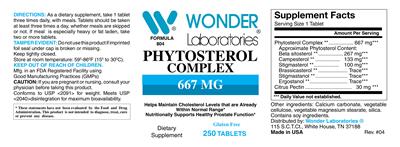
Supplement Facts
The label details for Phytosterol Complex 667 mg by Wonder Laboratories, sourced from the NIH Dietary Supplement Label Database.
Supplement Facts
| Ingredient | Amount | % DV |
|---|---|---|
| Beta Sitosterol | 267 mg | -- |
| Ergostanols | 0 NP | -- |
| Campesterol | 133 mg | -- |
| Citrus Pectin | 30 mg | -- |
| Stigmasterol | 100 mg | -- |
| Phytosterol Complex | 667 mg | -- |
| Brassicasterol | 0 NP | -- |
| Stigmastanol | 0 NP | -- |
Other ingredients: Calcium Carbonate, Cellulose, Magnesium Stearate, Silica
Tap any ingredient to jump to its full detail below.
These statements are the manufacturer’s wording, reproduced from the product label — the label is saying it, not HelloPharmacist. We don’t verify or endorse them.
Suggested/Recommended/Usage/Directions
Directions: As a dietary supplement, take 1 tablet three times daily, with meals. Tablets should be taken at least three times a day, whether meals are skipped or not. If meal is especially heavy or fat laden, take two or more tablets.
Precautions
Tamper Evident: Do not use this product if imprinted foil seal under cap is broken or missing.
Keep out of reach of children.
Caution: If you are pregnant or nursing, consult your physician before taking this product.
Contains soy ingredients
Storage
Keep tightly closed. Store at room temperature: 59 degrees-86 degrees F (15 degrees to 30 degrees C).
Formulation
Mfg. in an FDA Registered Facility using Good Manufacturing Practices (GMPs)
Conforms to USP <2091> for weight. Meets USP <2040> disintegration for maximum bioavailability.
Helps maintain cholesterol levels that are already within normal range Nutritionally supports healthy prostate function
Gluten Free
Made in USA
FDA Disclaimer Statement
This statement has not been evaluated by the Food and Drug Administration. This product is not intended to diagnose, treat, cure or prevent any disease.
General Statements
Formula 804
FDA Statement of Identity
Dietary Supplement
Is this label outdated? Report a formula or label change and our pharmacy team will review it.
Phytosterol Complex 667 mg by Wonder Laboratories label
The label scan from the NIH Dietary Supplement Label Database. Tap to enlarge.
Label images are published by the NIH Dietary Supplement Label Database for the version of this product on file. Always read your actual product label.
View the full label (PDF)The Ingredients in Phytosterol Complex 667 mg by Wonder Laboratories
These are the 7 active ingredients this product is made of. Select any to open its full monograph.
Serving size1 Tablet(s) Dosage formTablet Or Pill Amounts shown are per serving.
Most supplement products combine several ingredients, and a medication can interact with the product through any one of them. Each ingredient below shows whether it has known drug interactions.
Citrus Pectin
Interacts with23 drugs
Pectin is a natural soluble fiber found in fruits like apples and citrus, and it is widely used in foods and as a fiber supplement. It may modestly he...
Citrus Pectin monograph & interactionsPhytosterol Complex
- › Beta Sitosterol
- › Ergostanols
- › Campesterol
- › Stigmasterol
- › Brassicasterol
- › Stigmastanol
Other (inactive) ingredients: Calcium Carbonate, Cellulose, Magnesium Stearate, Silica. These complete the product’s ingredient list but are not active constituents.
Phytosterol Complex 667 mg by Wonder Laboratories Drug Interactions
HelloPharmacist Interaction Report
Phytosterol Complex 667 mg by Wonder Laboratories does interact with some medications, primarily through its citrus pectin content.
The most serious concern is with digoxin (Lanoxin), a heart medication — pectin may reduce how much digoxin your body absorbs, potentially weakening its effect on your heart rhythm.
Read the full breakdown — every affected drug type, severity by severity
Pectin in this product may also interact with cholesterol-lowering statins like lovastatin and with tetracycline antibiotics (used for infections), reducing how well your body absorbs either drug. All three of these are Moderate severity interactions, meaning the medication might not work as well as intended.
We could not check several other ingredients in this product — ergostanols, campesterol, stigmasterol, brassicasterol, and stigmastanol — because we hold no interaction data for them. Altogether, these interactions span 23 individual medications.
If you take digoxin, lovastatin, or tetracycline antibiotics, run them through the medication checker below before you start this supplement. That way you and your doctor or pharmacist can decide together whether timing your doses apart or choosing a different supplement makes sense for you.
Check your own medications below · Editorial policy · How we use AI
Want to check YOUR meds against Phytosterol Complex 667 mg?
Ask about interactions with your drugs in plain English — “Can I take it with lisinopril?” — and we find you the answer in seconds, ingredient by ingredient.
Go to the checkerIngredients driving the most interactions
Individual Drug Interactions
The ingredients in Phytosterol Complex 667 mg interact with 23 drugs. Click any drug to see the details.
1 of the 7 ingredients in Phytosterol Complex 667 mg interact with drugs. Each result below shows which ingredient is responsible. Citrus Pectin
Amphotericin, TetracyclineMysteclin-F
How Amphotericin, Tetracycline interacts with Phytosterol Complex 667 mg — through 1 ingredient. Tap an ingredient for the detail:
Citrus PectinTetracycline Antibiotics Moderate
Interaction Summary
Theoretically, pectin might reduce the absorption of tetracycline antibiotics, potentially decreasing their effectiveness.
Read the full Citrus Pectin + Amphotericin, Tetracycline interactionBismuth Subsalicylate, Metronidazole, TetracyclineHelidac
How Bismuth Subsalicylate, Metronidazole, Tetracycline interacts with Phytosterol Complex 667 mg — through 1 ingredient. Tap an ingredient for the detail:
Citrus PectinTetracycline Antibiotics Moderate
Interaction Summary
Theoretically, pectin might reduce the absorption of tetracycline antibiotics, potentially decreasing their effectiveness.
Read the full Citrus Pectin + Bismuth Subsalicylate, Metronidazole, Tetracycline interactionChlortetracyclineAureomycin
How Chlortetracycline interacts with Phytosterol Complex 667 mg — through 1 ingredient. Tap an ingredient for the detail:
Citrus PectinTetracycline Antibiotics Moderate
Interaction Summary
Theoretically, pectin might reduce the absorption of tetracycline antibiotics, potentially decreasing their effectiveness.
Read the full Citrus Pectin + Chlortetracycline interactionDemeclocyclineDeclomycin
How Demeclocycline interacts with Phytosterol Complex 667 mg — through 1 ingredient. Tap an ingredient for the detail:
Citrus PectinTetracycline Antibiotics Moderate
Interaction Summary
Theoretically, pectin might reduce the absorption of tetracycline antibiotics, potentially decreasing their effectiveness.
Read the full Citrus Pectin + Demeclocycline interactionDigoxinDigitek, Lanoxicaps, Lanoxin
How Digoxin interacts with Phytosterol Complex 667 mg — through 1 ingredient. Tap an ingredient for the detail:
Citrus PectinDigoxin (lanoxin) Moderate
Interaction Summary
Theoretically, pectin might reduce the absorption of digoxin, potentially decreasing its effectiveness.
Read the full Citrus Pectin + Digoxin interactionDoripenemDoribax
How Doripenem interacts with Phytosterol Complex 667 mg — through 1 ingredient. Tap an ingredient for the detail:
Citrus PectinTetracycline Antibiotics Moderate
Interaction Summary
Theoretically, pectin might reduce the absorption of tetracycline antibiotics, potentially decreasing their effectiveness.
Read the full Citrus Pectin + Doripenem interactionDoxycyclineDoryx, Doxy, Doxy-D, Doxycin, Doxycycline Injection, Doxylin +6 more
How Doxycycline interacts with Phytosterol Complex 667 mg — through 1 ingredient. Tap an ingredient for the detail:
Citrus PectinTetracycline Antibiotics Moderate
Interaction Summary
Theoretically, pectin might reduce the absorption of tetracycline antibiotics, potentially decreasing their effectiveness.
Read the full Citrus Pectin + Doxycycline interactionDoxycycline HyclateActiclate, Acticlate Cap, Lymepak
How Doxycycline Hyclate interacts with Phytosterol Complex 667 mg — through 1 ingredient. Tap an ingredient for the detail:
Citrus PectinTetracycline Antibiotics Moderate
Interaction Summary
Theoretically, pectin might reduce the absorption of tetracycline antibiotics, potentially decreasing their effectiveness.
Read the full Citrus Pectin + Doxycycline Hyclate interactionDoxycycline MonohydrateErfacea
How Doxycycline Monohydrate interacts with Phytosterol Complex 667 mg — through 1 ingredient. Tap an ingredient for the detail:
Citrus PectinTetracycline Antibiotics Moderate
Interaction Summary
Theoretically, pectin might reduce the absorption of tetracycline antibiotics, potentially decreasing their effectiveness.
Read the full Citrus Pectin + Doxycycline Monohydrate interactionDoxycylineDoxychel
How Doxycyline interacts with Phytosterol Complex 667 mg — through 1 ingredient. Tap an ingredient for the detail:
Citrus PectinTetracycline Antibiotics Moderate
Interaction Summary
Theoretically, pectin might reduce the absorption of tetracycline antibiotics, potentially decreasing their effectiveness.
Read the full Citrus Pectin + Doxycyline interactionEravacyclineXerava
How Eravacycline interacts with Phytosterol Complex 667 mg — through 1 ingredient. Tap an ingredient for the detail:
Citrus PectinTetracycline Antibiotics Moderate
Interaction Summary
Theoretically, pectin might reduce the absorption of tetracycline antibiotics, potentially decreasing their effectiveness.
Read the full Citrus Pectin + Eravacycline interactionLovastatinAltocor, Mevacor
How Lovastatin interacts with Phytosterol Complex 667 mg — through 1 ingredient. Tap an ingredient for the detail:
Citrus PectinLovastatin (mevacor) Moderate
Interaction Summary
Theoretically, pectin might reduce the absorption of lovastatin, potentially decreasing its effectiveness.
Read the full Citrus Pectin + Lovastatin interactionMetronidazole, Tetracyline, Bismuth Subcitrate PotassiumPylera
How Metronidazole, Tetracyline, Bismuth Subcitrate Potassium interacts with Phytosterol Complex 667 mg — through 1 ingredient. Tap an ingredient for the detail:
Citrus PectinTetracycline Antibiotics Moderate
Interaction Summary
Theoretically, pectin might reduce the absorption of tetracycline antibiotics, potentially decreasing their effectiveness.
Read the full Citrus Pectin + Metronidazole, Tetracyline, Bismuth Subcitrate Potassium interactionMinocyclineAcnamino MR, Aknemin, Amzeeq, Arestin Miscrosperes, Dynacin, Minocin +6 more
How Minocycline interacts with Phytosterol Complex 667 mg — through 1 ingredient. Tap an ingredient for the detail:
Citrus PectinTetracycline Antibiotics Moderate
Interaction Summary
Theoretically, pectin might reduce the absorption of tetracycline antibiotics, potentially decreasing their effectiveness.
Read the full Citrus Pectin + Minocycline interactionMinocycline HydrochlorideMinolira, Ximino
How Minocycline Hydrochloride interacts with Phytosterol Complex 667 mg — through 1 ingredient. Tap an ingredient for the detail:
Citrus PectinTetracycline Antibiotics Moderate
Interaction Summary
Theoretically, pectin might reduce the absorption of tetracycline antibiotics, potentially decreasing their effectiveness.
Read the full Citrus Pectin + Minocycline Hydrochloride interactionNiacin, LovastatinAdvicor
How Niacin, Lovastatin interacts with Phytosterol Complex 667 mg — through 1 ingredient. Tap an ingredient for the detail:
Citrus PectinLovastatin (mevacor) Moderate
Interaction Summary
Theoretically, pectin might reduce the absorption of lovastatin, potentially decreasing its effectiveness.
Read the full Citrus Pectin + Niacin, Lovastatin interactionOmadacycline (iv)Nuzyra
How Omadacycline (iv) interacts with Phytosterol Complex 667 mg — through 1 ingredient. Tap an ingredient for the detail:
Citrus PectinTetracycline Antibiotics Moderate
Interaction Summary
Theoretically, pectin might reduce the absorption of tetracycline antibiotics, potentially decreasing their effectiveness.
Read the full Citrus Pectin + Omadacycline (iv) interactionOmadacycline (oral)Nuzyra
How Omadacycline (oral) interacts with Phytosterol Complex 667 mg — through 1 ingredient. Tap an ingredient for the detail:
Citrus PectinTetracycline Antibiotics Moderate
Interaction Summary
Theoretically, pectin might reduce the absorption of tetracycline antibiotics, potentially decreasing their effectiveness.
Read the full Citrus Pectin + Omadacycline (oral) interactionOxytetracyclineTerramycin
How Oxytetracycline interacts with Phytosterol Complex 667 mg — through 1 ingredient. Tap an ingredient for the detail:
Citrus PectinTetracycline Antibiotics Moderate
Interaction Summary
Theoretically, pectin might reduce the absorption of tetracycline antibiotics, potentially decreasing their effectiveness.
Read the full Citrus Pectin + Oxytetracycline interactionOxytetracycline, Phenazopyridine, SulfamethizoleUrobiotic
How Oxytetracycline, Phenazopyridine, Sulfamethizole interacts with Phytosterol Complex 667 mg — through 1 ingredient. Tap an ingredient for the detail:
Citrus PectinTetracycline Antibiotics Moderate
Interaction Summary
Theoretically, pectin might reduce the absorption of tetracycline antibiotics, potentially decreasing their effectiveness.
Read the full Citrus Pectin + Oxytetracycline, Phenazopyridine, Sulfamethizole interactionRetapamulinAltabax, Altargo
How Retapamulin interacts with Phytosterol Complex 667 mg — through 1 ingredient. Tap an ingredient for the detail:
Citrus PectinTetracycline Antibiotics Moderate
Interaction Summary
Theoretically, pectin might reduce the absorption of tetracycline antibiotics, potentially decreasing their effectiveness.
Read the full Citrus Pectin + Retapamulin interactionTetracyclineAchromycin, Achromycin V, Nor-Tet, Robitet, Sumycin, Sumycin 250 +6 more
How Tetracycline interacts with Phytosterol Complex 667 mg — through 1 ingredient. Tap an ingredient for the detail:
Citrus PectinTetracycline Antibiotics Moderate
Interaction Summary
Theoretically, pectin might reduce the absorption of tetracycline antibiotics, potentially decreasing their effectiveness.
Read the full Citrus Pectin + Tetracycline interactionTigecyclineTygacil
How Tigecycline interacts with Phytosterol Complex 667 mg — through 1 ingredient. Tap an ingredient for the detail:
Citrus PectinTetracycline Antibiotics Moderate
Interaction Summary
Theoretically, pectin might reduce the absorption of tetracycline antibiotics, potentially decreasing their effectiveness.
Read the full Citrus Pectin + Tigecycline interactionEach ingredient & the kinds of drugs it affects
For each ingredient in Phytosterol Complex 667 mg with known interactions, here are the types of medications it can affect. Open any type for the detail — or search your exact drug in the checker above.
Citrus Pectin
Digoxin (Lanoxin)
Theoretically, pectin might reduce the absorption of digoxin, potentially decreasing its effectiveness.
A small clinical study shows that taking digoxin with a kaolin-pectin suspension reduces the absorption of digoxin by about 62%. It is unclear if these effects are due to pectin, kaolin, or the combination.
Lovastatin (Mevacor)
Theoretically, pectin might reduce the absorption of lovastatin, potentially decreasing its effectiveness.
Case reports suggest that concomitant use of pectin and lovastatin might reduce the cholesterol-lowering effect of lovastatin, possibly due to reduced intestinal absorption of lovastatin.
Tetracycline Antibiotics
Theoretically, pectin might reduce the absorption of tetracycline antibiotics, potentially decreasing their effectiveness.
A small clinical study shows that taking tetracycline with bismuth subsalicylate in a kaolin-pectin suspension reduces the absorption of tetracycline by about 34%. It is unclear if these effects are due to pectin, kaolin, bismuth subsalicylate, or the combination.
Brand information
Manufacturer and brand details for Phytosterol Complex 667 mg, from the product label.
Wonder Laboratories
See all Wonder Laboratories products- Name
- Wonder Laboratories
- Street Address
- 115 S.C.T. Ct.
- City
- White House
- State
- TN
- ZipCode
- 37188
Phytosterol Complex 667 mg by Wonder Laboratories: Common Questions
Does Phytosterol Complex 667 mg by Wonder Laboratories interact with any medications?
How can one product interact with so many drugs?
Where does this information come from?
Will this help my prostate or cholesterol?
What side effects should I watch for?
Is it safe to take this while pregnant or breastfeeding?
Why does this interact with digoxin and antibiotics?
Can I take this with my statins?
Written and reviewed by the HelloPharmacist editorial staff. Our editorial policy
Not sure if Phytosterol Complex 667 mg is safe with your meds?
Our pharmacists answer your medication & supplement questions — free.
Label information is sourced from the NIH Dietary Supplement Label Database and reflects the product version on file; always read your actual product label. This page is for education only and is not a substitute for professional medical advice. Confirm with your pharmacist or doctor before combining supplements and medications.
The Full Monographs Behind Phytosterol Complex 667 mg’s Ingredients
Every ingredient we hold a full HelloPharmacist monograph for — uses, evidence, safety, and the complete interaction list.
Pectin
Interacts with 23 drugsPectin is a natural soluble fiber found in fruits like apples and citrus, and it is widely used in foods and as a fiber supplement. It may modestly help with cholesterol, blood sugar, and di...
Read the full Pectin monograph → Herb & supplement monographBeta-sitosterol
Beta-sitosterol is a plant sterol that may modestly lower LDL ('bad') cholesterol and may help ease urinary symptoms from an enlarged prostate. Evidence is moderate for these uses and weaker...
Read the full Beta-sitosterol monograph →Sources & How We Checked
Phytosterol Complex 667 mg's label data comes from the NIH Dietary Supplement Label Database; the ingredient interaction data is from the Natural Medicines database, reviewed by our pharmacists.
- NIH Dietary Supplement Label Database (DSLD) — The official product label on file for this supplement.
- Natural Medicines (Therapeutic Research Center) — Evidence-graded clinical reference behind the ingredient interaction data.
Content is written and reviewed by licensed HelloPharmacist pharmacists. See our data sources and editorial standards for how this information is built and checked.
The 18 references behind this product’s interaction data
Every citation that drives the interaction findings for this product’s ingredients, from the evidence-graded Natural Medicines (TRC Healthcare) database. Open an ingredient to browse its citations — links open the study on PubMed or the publisher’s site.
Beta-sitosterol 7 references
- Berges RR, Windeler J, Trampisch HJ, et al. Randomised, placebo-controlled, double-blind clinical trial of beta-sitosterol in patients with benign prostatic hyperplasia. Beta-sitosterol Study Group. Lancet 1995;345:1529-32.
- Klippel KF, Hiltl DM, Schipp B. A multicentric, placebo-controlled, double-blind clinical trial of beta-sitosterol (phytosterol) for the treatment of benign prostatic hyperplasia. Br J Urol 1997;80:427-32.
- Wilt TJ, MacDonald R, Ishani A. beta-sitosterol for the treatment of benign prostatic hyperplasia: a systematic review. BJU Int 1999;83:976-83. PubMed
- Oster P, Schlierf G, Heuck CC, et al. [Sitosterol in familial hyperlipoproteinemia type II. A randomized, double-blind, cross-over study]. Dtsch Med Wochenschr 1976;101:1308-11.
- Becker M, Staab D, Von Bergman K. Long-term treatment of severe familial hypercholesterolemia in children: effect of sitosterol and bezafibrate. Pediatrics 1992;89:138-42. DOI
- Prager N, Bickett K, French N, Marcovici G. A randomized, double-blind, placebo-controlled trial to determine the effectiveness of botanically derived inhibitors of 5-alpha-reductase in the treatment of androgenetic alopecia. J Altern Complement Med 2002
- Lorenze A, Hsueh W, Nasr J. Beta-sitosterol-induced acute pancreatitis: A case report and review of the literature. Cureus. 2020;12(3):e7407. PubMed
Pectin 11 references
- Jaakkola MS, et al. Asthma caused by occupational exposure to pectin. J Allergy Clin Immunol 1997;100:575-6. PubMed
- Westphal W, et al. [Exogenous allergic asthma following pectin exposure-a new occupational allergen]. Pneumologie 1990;44(Suppl 1):337-8.
- Baldwin JL, et al. Pectin-induced occupational asthma. Chest 1993;104:1936-7. PubMed
- Cohen AJ, Forse MS, Tarlo SM. Occupational asthma caused by pectin inhalation during the manufacture of jam. Chest 1993;103:309-11.
- Kraut A, et al. Christmas candy maker's asthma. IgG4-mediated pectin allergy. Chest 1992;102:1605-7. PubMed
- Richter WO, Jacob BG, Schwandt P. Interaction between fibre and lovastatin. Lancet 1991;338:706.
- Albert KS, Ayres JW, DiSanto AR, et al. Influence of kaolin-pectin suspension on digoxin bioavailability. J Pharm Sci 1978;67:1582-6. PubMed
- Albert KS, Welch RD, DeSante KA, et al. Decreased tetracycline bioavailability caused by a bismuth subsalicylate antidiarrheal mixture. J Pharm Sci 1979;68:586-8. PubMed
- Electronic Code of Federal Regulations. Title 21. Part 182 -- Substances Generally Recognized As Safe. Available at: https://www.accessdata.fda.gov/scripts/cdrh/cfdocs/cfcfr/CFRSearch.cfm?CFRPart=182
- Federal Register April 17,2003. Anti-Diarrheal Products for over-the-counter human use; final monograph. Available at: http://www.fda.gov/OHRMS/DOCKETS/98fr/03-9380.pdf (Accessed 27 December 2004).
- Washio K, Nakamura M, Sato N, et al. Anaphylaxis in a pectin- and cashew nut-allergic child caused by a citrus bath. Allergol Int 2022;71(1):155-157. PubMed
Parts of this content are provided by the Therapeutic Research Center, LLC.
DISCLAIMER: Currently this does not check for drug-drug interactions. This is not an all-inclusive comprehensive list of potential interactions and is for informational purposes only. Not all interactions are known or well-reported in the scientific literature, and new interactions are continually being reported. Input is needed from a qualified healthcare provider including a pharmacist before starting any therapy. Application of clinical judgment is necessary.
© 2021 Therapeutic Research Center, LLC