
Potassium Iodide Tablets 130 mg Ingredients & Drug Interactions
What is this page for?
First and foremost: checking Potassium Iodide Tablets 130 mg against your medications. The heart of this page is the interaction checker and the full interaction report — how this product’s ingredients may interact with prescription and over-the-counter medicines you may be taking.
Around that, we add a pharmacist’s high-level view of the product as a whole — what’s inside, the evidence for its stated use, how transparent the label is, and what safety data exists — so you can see the full picture in one place. It’s educational information from our licensed clinical databases and the clinical staff at HelloPharmacist — not medical advice — and we don’t sell or endorse products. Our editorial policy
Potassium Iodide Tablets 130 mg is a dietary supplement by Double Wood Supplements with 1 active ingredient. Its ingredients are commonly taken for preventing or treating low potassium (hypokalemia), supporting healthy blood pressure, muscle cramps.Based on those ingredients, 62 medications have a known interaction with it, the most serious rated moderate. The ingredients most likely to interact are Potassium Iodide. Use the checker below to test your specific medication, or read the full HelloPharmacist Interaction Report.
Check Your Meds Against Potassium Iodide Tablets 130 mg by Double Wood Supplements
Ask about any prescription or over-the-counter medication and we check it for interactions with Potassium Iodide Tablets 130 mg by Double Wood Supplements — and tell you which ingredient is responsible.
AI summaries are generated from our interaction database for education only — always confirm with your pharmacist. How we use AI
Ask the Pharmacist
A licensed pharmacist will answer your question by email — free, usually within 24 hours.
Got it — thank you!
A licensed pharmacist will answer within 24 hours. Keep an eye on your email (worth checking spam, just in case).
HelloPharmacist Scorecard of Potassium Iodide Tablets 130 mg by Double Wood Supplements
Our pharmacy team’s full take, with four database checks built into the cards below — a summary of what is known, not a grade of the product itself.
What’s inside
Full disclosure
This product contains one active ingredient: potassium iodide at 130 mg per tablet. Potassium is an essential mineral your body needs for nerve and muscle function, including heart rhythm.
The tablet also includes inactive ingredients — microcrystalline cellulose, magnesium stearate, dicalcium phosphate, croscarmellose sodium, and silicon dioxide — which serve as binders, fillers, and flow agents.
Does it work?
Strong evidence
The product facts we hold do not include effectiveness ratings for potassium iodide. We cannot tell you from our data whether this supplement works for its intended purpose.
How safe is it?
Well-documented data
Potassium from food is safe for most people, but supplements can push your blood levels dangerously high — especially if you have kidney disease or take certain medications. Most people tolerate oral potassium reasonably well, though abdominal pain, nausea, vomiting, diarrhea, and gas are common.
In rare cases, high potassium can cause irregular heartbeats, heart block, low blood pressure, and confusion. The facts show potassium is likely safe during pregnancy and breastfeeding, but supplements should only be used under medical guidance in these situations — dietary potassium is fine on its own.
Check with your doctor or pharmacist before starting a potassium supplement if you are pregnant or breastfeeding.
Meds to double-check
Moderate interaction found
Double-check this product with your doctor or pharmacist if you take potassium-sparing diuretics, ACE inhibitors, or ARBs — all carry Moderate risk of dangerously high potassium levels when combined with this supplement. These are common blood pressure and heart medications, so run your exact prescriptions through the checker on this page or ask your pharmacist to review them.
The bottom line
Scorecard at a glanceFully disclosed formula with strong clinical evidence behind its ingredients' uses. Moderate medication interactions have been identified, and safety information is well characterized.
Potassium supplements make sense for people with documented low levels or certain medical conditions — but only if a doctor has recommended it. If you take a blood pressure or heart medication, especially an ACE inhibitor, ARB, or potassium-sparing diuretic, you need to talk this through with your doctor or pharmacist before starting.
Kidney disease is another red flag. Get personalized advice from your own healthcare provider before you add this product.
Educational only — not medical advice; always confirm with your pharmacist. Our editorial policy · How we use AI
Assessment coverage: 1 of 1 active ingredient matched to our full ingredient reviews (monographs). Based on the product label dated Sep 25, 2024.
This Scorecard evaluates available label information, ingredient evidence, and known medication-safety considerations. It does not independently verify product identity, purity, potency, contamination, or manufacturing quality. How these ratings are computed
General information
Key facts about Potassium Iodide Tablets 130 mg, straight from the product label.
| Brand | Double Wood Supplements |
|---|---|
| Barcode (UPC) | 050033272697 |
| Net contents | 180 Tablet(s) |
| Market status | On market |
| Date entered into DSLD | Sep 25, 2024 |
| DSLD ID | 315691 |
| Product type | Mineral |
| Supplement form | Tablet Or Pill |
| Dietary claims / uses | Nutrient, All Other, Structure/Function |
| Intended target group(s) | Adult (18 - 50 Years), Women (not pregnant or lactating) |
Everything in this section is reproduced from the manufacturer’s own product label — it’s the label speaking, not HelloPharmacist. We show it so you can see exactly what the maker states; we don’t verify or endorse those statements.
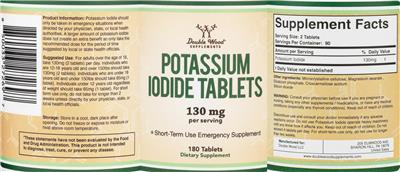
Supplement Facts
The label details for Potassium Iodide Tablets 130 mg by Double Wood Supplements, sourced from the NIH Dietary Supplement Label Database.
Supplement Facts
| Ingredient | Amount | % DV |
|---|---|---|
| Potassium Iodide | 130 mg | -- |
Other ingredients: Microcrystalline Cellulose, Magnesium Stearate, Dicalcium Phosphate, Croscarmellose Sodium, Silicon Dioxide
Tap any ingredient to jump to its full detail below.
These statements are the manufacturer’s wording, reproduced from the product label — the label is saying it, not HelloPharmacist. We don’t verify or endorse them.
Precautions
Product Information: Potassium Iodide should only be taken in emergency situations when directed by your physician, state, or local health authorities. A larger amount of Potassium Iodide does not create an extra benefit so only take the recommended dose for the period of time suggested by local or state health officials.
For short term use only, do not take for longer than 2 weeks unless directly by your physician, state, or local health officials.
Warning: Consult your physician before use if you are pregnant or nursing, taking any other supplements/medications, or have any medical conditions (especially any thyroid conditions).
Keep out of reach of children.
Discontinue use and consult your doctor immediately if any adverse reactions occur. Do not use Potassium Iodide and operate heavy machinery until you know how it affects you.
Keep out of reach of children.
Do not exceed 4 tablets per day.
For short-term use only, do not use for longer than two weeks.
Suggested/Recommended/Usage/Directions
Suggested Use: For adults over the age of 18, take 130 mg (2 tablets) per day. Individuals who are 12-18 years old and over 150 lbs should take 130 mg (2 tablets). Individuals who are under 18 years old and under 150 pounds should take 65 mg (1 tablet). Individuals under 12 years old regardless of weight should take 65 mg (1 tablet). For short term use only, do not take for longer than 2 weeks unless directly by your physician, state, or local health officials.
Storage
Storage: Store in a cool, dark place after opening. Do not freeze or expose to moisture or heat above room temperature.
FDA Disclaimer Statement
These statements have not been evaluated by the Food and Drug Administration. This product is not intended to diagnose, treat, cure, or prevent any disease.
Formula
Potassium Iodide Tablets 130 mg per serving
Formulation
Short-Term Use Emergency Supplement
FDA Statement of Identity
Dietary Supplement
Is this label outdated? Report a formula or label change and our pharmacy team will review it.
Potassium Iodide Tablets 130 mg by Double Wood Supplements label
The label scan from the NIH Dietary Supplement Label Database. Tap to enlarge.
Label images are published by the NIH Dietary Supplement Label Database for the version of this product on file. Always read your actual product label.
View the full label (PDF)The Ingredients in Potassium Iodide Tablets 130 mg by Double Wood Supplements
This is the 1 active ingredient this product is made of. Select it to open its full monograph.
Serving size2 Tablet(s) Dosage formTablet Or Pill Servings per container90 Amounts shown are per serving.
Potassium Iodide
Interacts with62 drugs
Potassium is an essential mineral your body needs for nerve signals, muscle function, and a steady heartbeat, and most people get enough from a balanc...
Potassium Iodide monograph & interactionsOther (inactive) ingredients: Microcrystalline Cellulose, Magnesium Stearate, Dicalcium Phosphate, Croscarmellose Sodium, Silicon Dioxide. These complete the product’s ingredient list but are not active constituents.
Potassium Iodide Tablets 130 mg by Double Wood Supplements Drug Interactions
HelloPharmacist Interaction Report
Double Wood Supplements' Potassium Iodide Tablets interact with several blood pressure and heart medications through their potassium content.
The most serious concern is with potassium-sparing diuretics (water pills that preserve potassium), ACE inhibitors, and ARBs — all can raise your potassium to dangerous levels when combined with this supplement. This risk is especially real if you have kidney disease, which prevents your body from clearing excess potassium efficiently.
Read the full breakdown — every affected drug type, severity by severity
All three drug types — potassium-sparing diuretics, ACE inhibitors, and ARBs — carry the same Moderate severity rating. These medications work by changing how your kidneys handle potassium, and adding a potassium supplement on top pushes levels into the danger zone.
High potassium (hyperkalemia) can trigger abnormal heartbeats, heart block, low blood pressure, and confusion.
Additionally, side effects from the supplement itself include abdominal pain, nausea, vomiting, diarrhea, and bloating — and in rare cases, bleeding ulcers from slow-release tablets. Altogether, these interactions span 62 individual medications.
Before you start this product, run your exact medications through the checker below, especially if you take any blood pressure or heart medicine.
Check your own medications below · Editorial policy · How we use AI
Want to check YOUR meds against Potassium Iodide Tablets 130 mg?
Ask about interactions with your drugs in plain English — “Can I take it with lisinopril?” — and we find you the answer in seconds, ingredient by ingredient.
Go to the checkerIngredients driving the most interactions
Individual Drug Interactions
The ingredients in Potassium Iodide Tablets 130 mg interact with 62 drugs. Click any drug to see the details.
1 of the 1 ingredient in Potassium Iodide Tablets 130 mg interact with drugs. Each result below shows which ingredient is responsible. Potassium Iodide
AmilorideAmilamont, Midamor
How Amiloride interacts with Potassium Iodide Tablets 130 mg — through 1 ingredient. Tap an ingredient for the detail:
Potassium IodidePotassium-sparing Diuretics Moderate
Interaction Summary
Concomitant use increases the risk of hyperkalemia.
Read the full Potassium Iodide + Amiloride interactionAmiloride, HydrochlorothiazideAmil-Co, Amilzide, Moduret 25, Moduretic
How Amiloride, Hydrochlorothiazide interacts with Potassium Iodide Tablets 130 mg — through 1 ingredient. Tap an ingredient for the detail:
Potassium IodidePotassium-sparing Diuretics Moderate
Interaction Summary
Concomitant use increases the risk of hyperkalemia.
Read the full Potassium Iodide + Amiloride, Hydrochlorothiazide interactionAmlodipine Besylate, BenazeprilLotrel
How Amlodipine Besylate, Benazepril interacts with Potassium Iodide Tablets 130 mg — through 1 ingredient. Tap an ingredient for the detail:
Potassium IodideAce Inhibitors (aceis) Moderate
Interaction Summary
Using ACEIs with high doses of potassium increases the risk of hyperkalemia.
Read the full Potassium Iodide + Amlodipine Besylate, Benazepril interactionAzilsartanEdarbi
How Azilsartan interacts with Potassium Iodide Tablets 130 mg — through 1 ingredient. Tap an ingredient for the detail:
Potassium IodideAngiotensin Receptor Blockers (arbs) Moderate
Interaction Summary
Using ARBs with high doses of potassium increases the risk of hyperkalemia.
Read the full Potassium Iodide + Azilsartan interactionAzilsartan, ChlorthalidoneEdarbyclor
How Azilsartan, Chlorthalidone interacts with Potassium Iodide Tablets 130 mg — through 1 ingredient. Tap an ingredient for the detail:
Potassium IodideAngiotensin Receptor Blockers (arbs) Moderate
Interaction Summary
Using ARBs with high doses of potassium increases the risk of hyperkalemia.
Read the full Potassium Iodide + Azilsartan, Chlorthalidone interactionBenazeprilLotensin
How Benazepril interacts with Potassium Iodide Tablets 130 mg — through 1 ingredient. Tap an ingredient for the detail:
Potassium IodideAce Inhibitors (aceis) Moderate
Interaction Summary
Using ACEIs with high doses of potassium increases the risk of hyperkalemia.
Read the full Potassium Iodide + Benazepril interactionBenazepril, HydrochlorothiazideLotensin HCT
How Benazepril, Hydrochlorothiazide interacts with Potassium Iodide Tablets 130 mg — through 1 ingredient. Tap an ingredient for the detail:
Potassium IodideAce Inhibitors (aceis) Moderate
Interaction Summary
Using ACEIs with high doses of potassium increases the risk of hyperkalemia.
Read the full Potassium Iodide + Benazepril, Hydrochlorothiazide interactionBendroflumethiazide, PotassiumCentyl K, Neo-NaClex-K
How Bendroflumethiazide, Potassium interacts with Potassium Iodide Tablets 130 mg — through 1 ingredient. Tap an ingredient for the detail:
Potassium IodidePotassium-sparing Diuretics Moderate
Interaction Summary
Concomitant use increases the risk of hyperkalemia.
Read the full Potassium Iodide + Bendroflumethiazide, Potassium interactionBumetanide, PotassiumBurinex K
How Bumetanide, Potassium interacts with Potassium Iodide Tablets 130 mg — through 1 ingredient. Tap an ingredient for the detail:
Potassium IodidePotassium-sparing Diuretics Moderate
Interaction Summary
Concomitant use increases the risk of hyperkalemia.
Read the full Potassium Iodide + Bumetanide, Potassium interactionCandesartan CilexetilAmias, Atacand
How Candesartan Cilexetil interacts with Potassium Iodide Tablets 130 mg — through 1 ingredient. Tap an ingredient for the detail:
Potassium IodideAngiotensin Receptor Blockers (arbs) Moderate
Interaction Summary
Using ARBs with high doses of potassium increases the risk of hyperkalemia.
Read the full Potassium Iodide + Candesartan Cilexetil interactionCandesartan Cilexetil, HydrochlorothiazideAtacand HCT
How Candesartan Cilexetil, Hydrochlorothiazide interacts with Potassium Iodide Tablets 130 mg — through 1 ingredient. Tap an ingredient for the detail:
Potassium IodideAngiotensin Receptor Blockers (arbs) Moderate
Interaction Summary
Using ARBs with high doses of potassium increases the risk of hyperkalemia.
Read the full Potassium Iodide + Candesartan Cilexetil, Hydrochlorothiazide interactionCaptoprilAcepril, Capoten
How Captopril interacts with Potassium Iodide Tablets 130 mg — through 1 ingredient. Tap an ingredient for the detail:
Potassium IodideAce Inhibitors (aceis) Moderate
Interaction Summary
Using ACEIs with high doses of potassium increases the risk of hyperkalemia.
Read the full Potassium Iodide + Captopril interactionCaptopril, HydrochlorothiazideAcezide, Capozide
How Captopril, Hydrochlorothiazide interacts with Potassium Iodide Tablets 130 mg — through 1 ingredient. Tap an ingredient for the detail:
Potassium IodideAce Inhibitors (aceis) Moderate
Interaction Summary
Using ACEIs with high doses of potassium increases the risk of hyperkalemia.
Read the full Potassium Iodide + Captopril, Hydrochlorothiazide interactionCilazaprilInhibace
How Cilazapril interacts with Potassium Iodide Tablets 130 mg — through 1 ingredient. Tap an ingredient for the detail:
Potassium IodideAce Inhibitors (aceis) Moderate
Interaction Summary
Using ACEIs with high doses of potassium increases the risk of hyperkalemia.
Read the full Potassium Iodide + Cilazapril interactionDibasic Sodium Phosphate, Monobasic Potassium Phosphate, Monobasic Sodium Phosphate Monohydrate (prescription Drug)K-Phos Neutral
How Dibasic Sodium Phosphate, Monobasic Potassium Phosphate, Monobasic Sodium Phosphate Monohydrate (prescription Drug) interacts with Potassium Iodide Tablets 130 mg — through 1 ingredient. Tap an ingredient for the detail:
Potassium IodidePotassium-sparing Diuretics Moderate
Interaction Summary
Concomitant use increases the risk of hyperkalemia.
Read the full Potassium Iodide + Dibasic Sodium Phosphate, Monobasic Potassium Phosphate, Monobasic Sodium Phosphate Monohydrate (prescription Drug) interactionDiltiazem, EnalaprilTeczem
How Diltiazem, Enalapril interacts with Potassium Iodide Tablets 130 mg — through 1 ingredient. Tap an ingredient for the detail:
Potassium IodideAce Inhibitors (aceis) Moderate
Interaction Summary
Using ACEIs with high doses of potassium increases the risk of hyperkalemia.
Read the full Potassium Iodide + Diltiazem, Enalapril interactionDrospirenoneDrospirenone
How Drospirenone interacts with Potassium Iodide Tablets 130 mg — through 1 ingredient. Tap an ingredient for the detail:
Potassium IodidePotassium-sparing Diuretics Moderate
Interaction Summary
Concomitant use increases the risk of hyperkalemia.
Read the full Potassium Iodide + Drospirenone interactionDrospirenone, EstetrolNextstellis
How Drospirenone, Estetrol interacts with Potassium Iodide Tablets 130 mg — through 1 ingredient. Tap an ingredient for the detail:
Potassium IodidePotassium-sparing Diuretics Moderate
Interaction Summary
Concomitant use increases the risk of hyperkalemia.
Read the full Potassium Iodide + Drospirenone, Estetrol interactionDrospirenone, Ethinyl EstradiolAngeliq, Gianvi, Yasmin
How Drospirenone, Ethinyl Estradiol interacts with Potassium Iodide Tablets 130 mg — through 1 ingredient. Tap an ingredient for the detail:
Potassium IodidePotassium-sparing Diuretics Moderate
Interaction Summary
Concomitant use increases the risk of hyperkalemia.
Read the full Potassium Iodide + Drospirenone, Ethinyl Estradiol interactionEnalapril MaleateEpaned, Vasotec
How Enalapril Maleate interacts with Potassium Iodide Tablets 130 mg — through 1 ingredient. Tap an ingredient for the detail:
Potassium IodideAce Inhibitors (aceis) Moderate
Interaction Summary
Using ACEIs with high doses of potassium increases the risk of hyperkalemia.
Read the full Potassium Iodide + Enalapril Maleate interactionEnalapril Maleate, FelodipineLexxel
How Enalapril Maleate, Felodipine interacts with Potassium Iodide Tablets 130 mg — through 1 ingredient. Tap an ingredient for the detail:
Potassium IodideAce Inhibitors (aceis) Moderate
Interaction Summary
Using ACEIs with high doses of potassium increases the risk of hyperkalemia.
Read the full Potassium Iodide + Enalapril Maleate, Felodipine interactionEnalapril Maleate, HydrochlorothiazideVaseretic
How Enalapril Maleate, Hydrochlorothiazide interacts with Potassium Iodide Tablets 130 mg — through 1 ingredient. Tap an ingredient for the detail:
Potassium IodideAce Inhibitors (aceis) Moderate
Interaction Summary
Using ACEIs with high doses of potassium increases the risk of hyperkalemia.
Read the full Potassium Iodide + Enalapril Maleate, Hydrochlorothiazide interactionEprosartanTeveten
How Eprosartan interacts with Potassium Iodide Tablets 130 mg — through 1 ingredient. Tap an ingredient for the detail:
Potassium IodideAngiotensin Receptor Blockers (arbs) Moderate
Interaction Summary
Using ARBs with high doses of potassium increases the risk of hyperkalemia.
Read the full Potassium Iodide + Eprosartan interactionEthinyl Estradiol, DrospirenoneYaz
How Ethinyl Estradiol, Drospirenone interacts with Potassium Iodide Tablets 130 mg — through 1 ingredient. Tap an ingredient for the detail:
Potassium IodidePotassium-sparing Diuretics Moderate
Interaction Summary
Concomitant use increases the risk of hyperkalemia.
Read the full Potassium Iodide + Ethinyl Estradiol, Drospirenone interactionFinerenoneKerendia
How Finerenone interacts with Potassium Iodide Tablets 130 mg — through 1 ingredient. Tap an ingredient for the detail:
Potassium IodidePotassium-sparing Diuretics Moderate
Interaction Summary
Concomitant use increases the risk of hyperkalemia.
Read the full Potassium Iodide + Finerenone interactionFosinoprilMonopril
How Fosinopril interacts with Potassium Iodide Tablets 130 mg — through 1 ingredient. Tap an ingredient for the detail:
Potassium IodideAce Inhibitors (aceis) Moderate
Interaction Summary
Using ACEIs with high doses of potassium increases the risk of hyperkalemia.
Read the full Potassium Iodide + Fosinopril interactionFosinopril, HydrochlorothiazideMonopril HCT
How Fosinopril, Hydrochlorothiazide interacts with Potassium Iodide Tablets 130 mg — through 1 ingredient. Tap an ingredient for the detail:
Potassium IodideAce Inhibitors (aceis) Moderate
Interaction Summary
Using ACEIs with high doses of potassium increases the risk of hyperkalemia.
Read the full Potassium Iodide + Fosinopril, Hydrochlorothiazide interactionFurosemide, PotassiumDiumide-K Continus, Lasikal
How Furosemide, Potassium interacts with Potassium Iodide Tablets 130 mg — through 1 ingredient. Tap an ingredient for the detail:
Potassium IodidePotassium-sparing Diuretics Moderate
Interaction Summary
Concomitant use increases the risk of hyperkalemia.
Read the full Potassium Iodide + Furosemide, Potassium interactionHydrochlorothiazide, IrbesartanAvalide
How Hydrochlorothiazide, Irbesartan interacts with Potassium Iodide Tablets 130 mg — through 1 ingredient. Tap an ingredient for the detail:
Potassium IodideAngiotensin Receptor Blockers (arbs) Moderate
Interaction Summary
Using ARBs with high doses of potassium increases the risk of hyperkalemia.
Read the full Potassium Iodide + Hydrochlorothiazide, Irbesartan interactionHydrochlorothiazide, LisinoprilPrinzide, Zestoretic
How Hydrochlorothiazide, Lisinopril interacts with Potassium Iodide Tablets 130 mg — through 1 ingredient. Tap an ingredient for the detail:
Potassium IodideAce Inhibitors (aceis) Moderate
Interaction Summary
Using ACEIs with high doses of potassium increases the risk of hyperkalemia.
Read the full Potassium Iodide + Hydrochlorothiazide, Lisinopril interactionEach ingredient & the kinds of drugs it affects
For each ingredient in Potassium Iodide Tablets 130 mg with known interactions, here are the types of medications it can affect. Open any type for the detail — or search your exact drug in the checker above.
Potassium Iodide
Ace Inhibitors (Aceis)
Using ACEIs with high doses of potassium increases the risk of hyperkalemia.
ACEIs block the actions of the renin-angiotensin-aldosterone system and reduce potassium excretion. Concomitant use of these drugs with potassium supplements increases the risk of hyperkalemia. However, concomitant use of these drugs with moderate dietary potassium intake (about 3775-5200 mg daily) does not increase serum potassium levels.
Angiotensin Receptor Blockers (Arbs)
Using ARBs with high doses of potassium increases the risk of hyperkalemia.
ARBs block the actions of the renin-angiotensin-aldosterone system and reduce potassium excretion. Concomitant use of these drugs with potassium supplements increases the risk of hyperkalemia. However, concomitant use of these drugs with moderate dietary potassium intake (about 3775-5200 mg daily) does not increase serum potassium levels.
Potassium-Sparing Diuretics
Concomitant use increases the risk of hyperkalemia.
Using potassium-sparing diuretics with potassium supplements increases the risk of hyperkalemia.
Brand information
Manufacturer and brand details for Potassium Iodide Tablets 130 mg, from the product label.
Double Wood Supplements
See all Double Wood Supplements products- Name
- Double Wood LLC
- Street Address
- 205 Elmwood Ave
- City
- Sharon Hill
- State
- PA
- ZipCode
- 19079
- Web Address
- www.doublewoodsupplements.com
Potassium Iodide Tablets 130 mg by Double Wood Supplements: Common Questions
Does Potassium Iodide Tablets 130 mg by Double Wood Supplements interact with any medications?
How can one product interact with so many drugs?
Where does this information come from?
What is potassium iodide and what does it do?
Can I take this if I'm pregnant or breastfeeding?
What are the common side effects?
Is potassium safe if I have kidney disease?
What's in the tablet besides potassium?
Written and reviewed by the HelloPharmacist editorial staff. Our editorial policy
Not sure if Potassium Iodide Tablets 130 mg is safe with your meds?
Our pharmacists answer your medication & supplement questions — free.
Label information is sourced from the NIH Dietary Supplement Label Database and reflects the product version on file; always read your actual product label. This page is for education only and is not a substitute for professional medical advice. Confirm with your pharmacist or doctor before combining supplements and medications.
The Full Monographs Behind Potassium Iodide Tablets 130 mg’s Ingredients
Every ingredient we hold a full HelloPharmacist monograph for — uses, evidence, safety, and the complete interaction list.
Sources & How We Checked
Potassium Iodide Tablets 130 mg's label data comes from the NIH Dietary Supplement Label Database; the ingredient interaction data is from the Natural Medicines database, reviewed by our pharmacists.
- NIH Dietary Supplement Label Database (DSLD) — The official product label on file for this supplement.
- Natural Medicines (Therapeutic Research Center) — Evidence-graded clinical reference behind the ingredient interaction data.
Content is written and reviewed by licensed HelloPharmacist pharmacists. See our data sources and editorial standards for how this information is built and checked.
The 12 references behind this product’s interaction data
Every citation that drives the interaction findings for this product’s ingredients, from the evidence-graded Natural Medicines (TRC Healthcare) database. Open an ingredient to browse its citations — links open the study on PubMed or the publisher’s site.
Potassium 12 references
- McEvoy GK, ed. AHFS Drug Information. Bethesda, MD: American Society of Health-System Pharmacists, 1998.
- Gennaro A. Remington: The Science and Practice of Pharmacy. 19th ed. Lippincott: Williams & Wilkins, 1996.
- Whelton PK, He J, Cutler JA, et al. Effects of oral potassium on blood pressure. Meta-analysis of randomized controlled clinical trials. JAMA 1997;277:1624-32. PubMed
- Phillips, C. O., Kashani, A., Ko, D. K., Francis, G., and Krumholz, H. M. Adverse effects of combination angiotensin II receptor blockers plus angiotensin-converting enzyme inhibitors for left ventricular dysfunction: a quantitative review of data from ra DOI
- Altieri, P. I., Herrero, C., Suero, R., and Ortiz, A. Bleeding duodenal ulcer in a patient taking slow-releasing potassium tablets. Bol.Asoc.Med P.R. 1977;69(8):276.
- Raf, L. E. Enteric-coated potassium chloride tablets and ulcer of the small intestine. Acta Chir Scand Suppl 1967;(374):1-87.
- Potassium chloride oral solution [package insert]. Allentown, PA: Lehigh Valley Technologies, Inc.; 2014.
- Potassium chloride injection [package insert]. Lake Forest, IL: Hospira Inc.; 2009.
- Patel RB, Tannenbaum S, Viana-Tejedor A, et al. Serum potassium levels, cardiac arrhythmias, and mortality following non-ST-elevation myocardial infarction or unstable angina: insights from MERLIN-TIMI 36. Eur Heart J Acute Cardiovasc Care 2017 Feb;6(1):1 PubMed
- Malta D, Arcand J, Ravindran A, Floras V, Allard JP, Newton GE. Adequate intake of potassium does not cause hyperkalemia in hypertensive individuals taking medications that antagonize the renin angiotensin aldosterone system. Am J Clin Nutr 2016 Oct;104(4 PubMed
- Keskin M, Kaya A, Tatlisu MA, et al. The effect of serum potassium level on in-hospital and long-term mortality in ST elevation myocardial infarction. Int J cardiol. 2016 Oct 15;221:505-10.
- Stallings VA, Harrison M, Oria M; Committee to Review the Dietary Reference Intakes for Sodium and Potassium, Food and Nutrition Board, Health and Medicine Division, National Academies of Sciences, Engineering, and Medicine. Washington (DC): National Acad
Parts of this content are provided by the Therapeutic Research Center, LLC.
DISCLAIMER: Currently this does not check for drug-drug interactions. This is not an all-inclusive comprehensive list of potential interactions and is for informational purposes only. Not all interactions are known or well-reported in the scientific literature, and new interactions are continually being reported. Input is needed from a qualified healthcare provider including a pharmacist before starting any therapy. Application of clinical judgment is necessary.
© 2021 Therapeutic Research Center, LLC