
Rhodiola Alcohol Free Ingredients & Drug Interactions
by Herbal Terra
What is this page for?
First and foremost: checking Rhodiola Alcohol Free against your medications. The heart of this page is the interaction checker and the full interaction report — how this product’s ingredients may interact with prescription and over-the-counter medicines you may be taking.
Around that, we add a pharmacist’s high-level view of the product as a whole — what’s inside, the evidence for its stated use, how transparent the label is, and what safety data exists — so you can see the full picture in one place. It’s educational information from our licensed clinical databases and the clinical staff at HelloPharmacist — not medical advice — and we don’t sell or endorse products. Our editorial policy
Rhodiola Alcohol Free is a dietary supplement by Herbal Terra with 1 active ingredient. Its ingredients are commonly taken for fatigue and low energy, stress and coping (adaptogen), mental performance and focus.Based on those ingredients, 1,271 medications have a known interaction with it, the most serious rated moderate. The ingredients most likely to interact are Rhodiola Root Extract, Dry. Use the checker below to test your specific medication, or read the full HelloPharmacist Interaction Report.
Check Your Meds Against Rhodiola Alcohol Free by Herbal Terra
Ask about any prescription or over-the-counter medication and we check it for interactions with Rhodiola Alcohol Free by Herbal Terra — and tell you which ingredient is responsible.
AI summaries are generated from our interaction database for education only — always confirm with your pharmacist. How we use AI
Ask the Pharmacist
A licensed pharmacist will answer your question by email — free, usually within 24 hours.
Got it — thank you!
A licensed pharmacist will answer within 24 hours. Keep an eye on your email (worth checking spam, just in case).
HelloPharmacist Scorecard of Rhodiola Alcohol Free by Herbal Terra
Our pharmacy team’s full take, with four database checks built into the cards below — a summary of what is known, not a grade of the product itself.
What’s inside
Full disclosure
This product contains a single active ingredient: Rhodiola Root Extract in dry form. The liquid also includes glycerin and water as inactive ingredients — they're there to deliver the extract, not to add active benefit.
Does it work?
Not established
The evidence we hold for rhodiola doesn't establish whether it works for the conditions listed — altitude sickness, generalized anxiety, arrhythmia, athletic performance, and bladder cancer. The data show insufficient reliable evidence to rate it for any of these uses.
If you're considering it for a specific reason, talk with your pharmacist about what the current research actually shows.
How safe is it?
Well-documented data
Rhodiola appears to be generally well tolerated for short-term use, though we don't have solid long-term safety data. The most common side effects reported are dizziness and changes in saliva production (either dry mouth or excessive saliva).
The safety data advises against use during pregnancy and while breastfeeding — there simply isn't enough information to know whether it's safe at those times.
Meds to double-check
Moderate interaction found
Check your medications against this product if you take blood pressure drugs, diabetes medications, losartan (Cozaar), immunosuppressants, or any drug that's metabolized by your liver through CYP2C9, P-glycoprotein, CYP1A2, or CYP3A4 pathways. Your pharmacist can look these up for you — the names aren't always obvious from a prescription label.
The bottom line
Scorecard at a glanceFully disclosed formula with no established evidence rating for its marketed use. Moderate medication interactions have been identified, and safety information is well characterized.
If you take blood pressure or diabetes medications, you'll need to check with your pharmacist before adding this product. Rhodiola may lower blood pressure and blood sugar on its own, which could tip the balance if you're already on a drug that does the same.
It's also generally well tolerated short-term, but long-term use isn't well studied.
Educational only — not medical advice; always confirm with your pharmacist. Our editorial policy · How we use AI
Assessment coverage: 1 of 1 active ingredient matched to our full ingredient reviews (monographs). Based on the product label dated Nov 22, 2024.
This Scorecard evaluates available label information, ingredient evidence, and known medication-safety considerations. It does not independently verify product identity, purity, potency, contamination, or manufacturing quality. How these ratings are computed
General information
Key facts about Rhodiola Alcohol Free, straight from the product label.
| Brand | Herbal Terra |
|---|---|
| Barcode (UPC) | 7439500262275 |
| Net contents | 2 Fluid Ounce(s); 60 mL |
| Market status | On market |
| Date entered into DSLD | Nov 22, 2024 |
| DSLD ID | 324500 |
| Product type | Botanical |
| Supplement form | Liquid |
| Dietary claims / uses | All Other, Structure/Function |
| Intended target group(s) | Adult (18 - 50 Years), Gluten Free, Sugar Free |
Everything in this section is reproduced from the manufacturer’s own product label — it’s the label speaking, not HelloPharmacist. We show it so you can see exactly what the maker states; we don’t verify or endorse those statements.
Supplement Facts
The label details for Rhodiola Alcohol Free by Herbal Terra, sourced from the NIH Dietary Supplement Label Database.
Supplement Facts
| Ingredient | Amount | % DV |
|---|---|---|
| Rhodiola Root Extract, Dry | 1156 mg | -- |
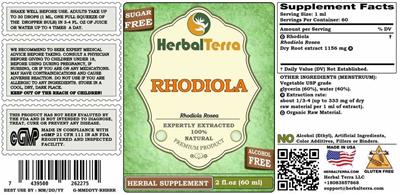
Other ingredients: Glycerin, Water
Tap any ingredient to jump to its full detail below.
These statements are the manufacturer’s wording, reproduced from the product label — the label is saying it, not HelloPharmacist. We don’t verify or endorse them.
Suggested/Recommended/Usage/Directions
Shake well before use. Adults take up to 30 drops (1 mL, one full squeeze of the dropper bulb) in 3-4 fl. oz. of juice or water up to 4 times a day.
Precautions
We recommend to seek expert medical advice before taking. May have contraindications and cause adverse reaction.
Consult a physician before giving to children under 18, before using during pregnancy, if nursing, or if you are on any medications.
Consult a physician before giving to children under 18, before using during pregnancy, if nursing, or if you are on any medications. Keep out of the reach of children!
Do not use if you are allergic to any ingredients.
Storage
Store in a cool, dry, dark place.
FDA Disclaimer Statement
This product has not been evaluated by the FDA and is not intended to diagnose, treat, cure or prevent any disease.
Formulation
cGMP Made in compliance with cGMP 21 CFR 111 in an FDA registered and inspected facility.
Sugar free
Expertly extracted 100% natural Premium product
No alcohol (ethyl), artificial ingredients, color additives, fillers or binders.
Natural Gluten free
Formula
Rhodiola rosea
FDA Statement of Identity
Herbal Supplement
Seals/Symbols
Made in USA
Is this label outdated? Report a formula or label change and our pharmacy team will review it.
Rhodiola Alcohol Free by Herbal Terra label
The label scan from the NIH Dietary Supplement Label Database. Tap to enlarge.
Label images are published by the NIH Dietary Supplement Label Database for the version of this product on file. Always read your actual product label.
View the full label (PDF)The Ingredients in Rhodiola Alcohol Free by Herbal Terra
This is the 1 active ingredient this product is made of. Select it to open its full monograph.
Serving size1 mL Dosage formLiquid Servings per container60 Amounts shown are per serving.
Rhodiola Root Extract, Dry
Interacts with1,271 drugs
Rhodiola is an herb traditionally used to fight fatigue and help the body cope with stress. Some small studies suggest it may modestly reduce fatigue...
Rhodiola Root Extract, Dry monograph & interactionsOther (inactive) ingredients: Glycerin, Water. These complete the product’s ingredient list but are not active constituents.
Rhodiola Alcohol Free by Herbal Terra Drug Interactions
HelloPharmacist Interaction Report
Herbal Terra's Rhodiola Alcohol Free contains one active ingredient — Rhodiola Root Extract — that does interact with several medication types.
The most serious concern is with blood pressure medications (antihypertensives). Rhodiola may lower blood pressure on its own, so combining it with drugs that do the same could push your pressure too low.
Read the full breakdown — every affected drug type, severity by severity
Rhodiola also interacts with diabetes medications in a similar way — it may lower blood sugar, and pairing it with diabetes drugs could increase the risk of low blood sugar (hypoglycemia). It affects how your liver breaks down certain medications, including losartan (Cozaar), a blood pressure drug, by slowing their clearance and potentially raising their levels in your body.
Other drugs processed through the same liver pathways — including some P-glycoprotein substrates and immunosuppressants — may also accumulate to higher levels. Minor interactions are possible with a few other drug-metabolizing pathways, though clinical evidence here is limited.
Rhodiola also has immunostimulatory effects that could theoretically interfere with immunosuppressive therapy. Altogether, these interactions span 1,253 individual medications.
Before you start, use the medication checker below to look up your exact prescriptions.
Check your own medications below · Editorial policy · How we use AI
Want to check YOUR meds against Rhodiola Alcohol Free?
Ask about interactions with your drugs in plain English — “Can I take it with lisinopril?” — and we find you the answer in seconds, ingredient by ingredient.
Go to the checkerIngredients driving the most interactions
Individual Drug Interactions
The ingredients in Rhodiola Alcohol Free interact with 1,271 drugs. Click any drug to see the details.
1 of the 1 ingredient in Rhodiola Alcohol Free interact with drugs. Each result below shows which ingredient is responsible. Rhodiola Root Extract, Dry
6-mercaptopurinePurinethol
How 6-mercaptopurine interacts with Rhodiola Alcohol Free — through 1 ingredient. Tap an ingredient for the detail:
Rhodiola Root Extract, DryImmunosuppressants Moderate
Interaction Summary
Theoretically, rhodiola use might interfere with immunosuppressive therapy.
Read the full Rhodiola Root Extract, Dry + 6-mercaptopurine interactionAbrocitinibCibinqo
How Abrocitinib interacts with Rhodiola Alcohol Free — through 1 ingredient. Tap an ingredient for the detail:
Rhodiola Root Extract, DryCytochrome P450 2c9 (cyp2c9) Substrates, Immunosuppressants Moderate
Interaction Summary
Theoretically, rhodiola might increase levels of drugs metabolized by CYP2C9.
Read the full Rhodiola Root Extract, Dry + Abrocitinib interactionAcalabrutinibCalquence
How Acalabrutinib interacts with Rhodiola Alcohol Free — through 1 ingredient. Tap an ingredient for the detail:
Rhodiola Root Extract, DryP-glycoprotein Substrates, Cytochrome P450 3a4 (cyp3a4) Substrates Moderate
Interaction Summary
Theoretically, rhodiola might increase levels of P-glycoprotein substrates.
Read the full Rhodiola Root Extract, Dry + Acalabrutinib interactionAcarboseGlucobay, Prandase, Precose
How Acarbose interacts with Rhodiola Alcohol Free — through 1 ingredient. Tap an ingredient for the detail:
Rhodiola Root Extract, DryAntidiabetes Drugs Moderate
Interaction Summary
Theoretically, taking rhodiola with antidiabetes drugs might increase the risk of hypoglycemia.
Read the full Rhodiola Root Extract, Dry + Acarbose interactionAcebutololRhotral, Sectral
How Acebutolol interacts with Rhodiola Alcohol Free — through 1 ingredient. Tap an ingredient for the detail:
Rhodiola Root Extract, DryAntihypertensive Drugs Moderate
Interaction Summary
Theoretically, taking rhodiola with antihypertensive drugs might increase the risk of hypotension.
Read the full Rhodiola Root Extract, Dry + Acebutolol interactionAcetaminophen, IbuprofenCombogesic
How Acetaminophen, Ibuprofen interacts with Rhodiola Alcohol Free — through 1 ingredient. Tap an ingredient for the detail:
Rhodiola Root Extract, DryCytochrome P450 2c9 (cyp2c9) Substrates, Cytochrome P450 1a2 (cyp1a2) Substrates Moderate
Interaction Summary
Theoretically, rhodiola might increase levels of drugs metabolized by CYP2C9.
Read the full Rhodiola Root Extract, Dry + Acetaminophen, Ibuprofen interactionAcetazolamideAk-Zol, Diamox
How Acetazolamide interacts with Rhodiola Alcohol Free — through 1 ingredient. Tap an ingredient for the detail:
Rhodiola Root Extract, DryAntihypertensive Drugs, Cns Depressants Moderate
Interaction Summary
Theoretically, taking rhodiola with antihypertensive drugs might increase the risk of hypotension.
Read the full Rhodiola Root Extract, Dry + Acetazolamide interactionAcetohexamideDymelor
How Acetohexamide interacts with Rhodiola Alcohol Free — through 1 ingredient. Tap an ingredient for the detail:
Rhodiola Root Extract, DryAntidiabetes Drugs Moderate
Interaction Summary
Theoretically, taking rhodiola with antidiabetes drugs might increase the risk of hypoglycemia.
Read the full Rhodiola Root Extract, Dry + Acetohexamide interactionAdalimumabHumira
How Adalimumab interacts with Rhodiola Alcohol Free — through 1 ingredient. Tap an ingredient for the detail:
Rhodiola Root Extract, DryImmunosuppressants Moderate
Interaction Summary
Theoretically, rhodiola use might interfere with immunosuppressive therapy.
Read the full Rhodiola Root Extract, Dry + Adalimumab interactionAdalimumab-adazHyrimoz
How Adalimumab-adaz interacts with Rhodiola Alcohol Free — through 1 ingredient. Tap an ingredient for the detail:
Rhodiola Root Extract, DryImmunosuppressants Moderate
Interaction Summary
Theoretically, rhodiola use might interfere with immunosuppressive therapy.
Read the full Rhodiola Root Extract, Dry + Adalimumab-adaz interactionAdalimumab-adbmCyltezo
How Adalimumab-adbm interacts with Rhodiola Alcohol Free — through 1 ingredient. Tap an ingredient for the detail:
Rhodiola Root Extract, DryImmunosuppressants Moderate
Interaction Summary
Theoretically, rhodiola use might interfere with immunosuppressive therapy.
Read the full Rhodiola Root Extract, Dry + Adalimumab-adbm interactionAdalimumab-afzbAbrilada
How Adalimumab-afzb interacts with Rhodiola Alcohol Free — through 1 ingredient. Tap an ingredient for the detail:
Rhodiola Root Extract, DryImmunosuppressants Moderate
Interaction Summary
Theoretically, rhodiola use might interfere with immunosuppressive therapy.
Read the full Rhodiola Root Extract, Dry + Adalimumab-afzb interactionAdalimumab-attoAmjevita
How Adalimumab-atto interacts with Rhodiola Alcohol Free — through 1 ingredient. Tap an ingredient for the detail:
Rhodiola Root Extract, DryImmunosuppressants Moderate
Interaction Summary
Theoretically, rhodiola use might interfere with immunosuppressive therapy.
Read the full Rhodiola Root Extract, Dry + Adalimumab-atto interactionAdalimumab-bwwdHadlima
How Adalimumab-bwwd interacts with Rhodiola Alcohol Free — through 1 ingredient. Tap an ingredient for the detail:
Rhodiola Root Extract, DryImmunosuppressants Moderate
Interaction Summary
Theoretically, rhodiola use might interfere with immunosuppressive therapy.
Read the full Rhodiola Root Extract, Dry + Adalimumab-bwwd interactionAdalimumab-fkjpHulio
How Adalimumab-fkjp interacts with Rhodiola Alcohol Free — through 1 ingredient. Tap an ingredient for the detail:
Rhodiola Root Extract, DryImmunosuppressants Moderate
Interaction Summary
Theoretically, rhodiola use might interfere with immunosuppressive therapy.
Read the full Rhodiola Root Extract, Dry + Adalimumab-fkjp interactionAerosphere Budesonide, Formoterol Fumarate, GlycopyrrolateBreztri
How Aerosphere Budesonide, Formoterol Fumarate, Glycopyrrolate interacts with Rhodiola Alcohol Free — through 1 ingredient. Tap an ingredient for the detail:
Rhodiola Root Extract, DryCytochrome P450 2c9 (cyp2c9) Substrates Moderate
Interaction Summary
Theoretically, rhodiola might increase levels of drugs metabolized by CYP2C9.
Read the full Rhodiola Root Extract, Dry + Aerosphere Budesonide, Formoterol Fumarate, Glycopyrrolate interactionAfatinib DimaleateGilotrif
How Afatinib Dimaleate interacts with Rhodiola Alcohol Free — through 1 ingredient. Tap an ingredient for the detail:
Rhodiola Root Extract, DryP-glycoprotein Substrates Moderate
Interaction Summary
Theoretically, rhodiola might increase levels of P-glycoprotein substrates.
Read the full Rhodiola Root Extract, Dry + Afatinib Dimaleate interactionAgomelatineValdoxan
How Agomelatine interacts with Rhodiola Alcohol Free — through 1 ingredient. Tap an ingredient for the detail:
Rhodiola Root Extract, DryCytochrome P450 1a2 (cyp1a2) Substrates, Cytochrome P450 2c9 (cyp2c9) Substrates +1 Moderate
Interaction Summary
Theoretically, rhodiola might increase levels of drugs metabolized by CYP1A2.
Read the full Rhodiola Root Extract, Dry + Agomelatine interactionAlbiglutideTanzeum
How Albiglutide interacts with Rhodiola Alcohol Free — through 1 ingredient. Tap an ingredient for the detail:
Rhodiola Root Extract, DryAntidiabetes Drugs Moderate
Interaction Summary
Theoretically, taking rhodiola with antidiabetes drugs might increase the risk of hypoglycemia.
Read the full Rhodiola Root Extract, Dry + Albiglutide interactionAlefaceptAmevive
How Alefacept interacts with Rhodiola Alcohol Free — through 1 ingredient. Tap an ingredient for the detail:
Rhodiola Root Extract, DryImmunosuppressants Moderate
Interaction Summary
Theoretically, rhodiola use might interfere with immunosuppressive therapy.
Read the full Rhodiola Root Extract, Dry + Alefacept interactionAlemtuzumabCampath
How Alemtuzumab interacts with Rhodiola Alcohol Free — through 1 ingredient. Tap an ingredient for the detail:
Rhodiola Root Extract, DryImmunosuppressants Moderate
Interaction Summary
Theoretically, rhodiola use might interfere with immunosuppressive therapy.
Read the full Rhodiola Root Extract, Dry + Alemtuzumab interactionAliskirenTekturna
How Aliskiren interacts with Rhodiola Alcohol Free — through 1 ingredient. Tap an ingredient for the detail:
Rhodiola Root Extract, DryCytochrome P450 3a4 (cyp3a4) Substrates, Antihypertensive Drugs Moderate
Interaction Summary
Theoretically, rhodiola might increase levels of drugs metabolized by CYP3A4.
Read the full Rhodiola Root Extract, Dry + Aliskiren interactionAlogliptinNesina
How Alogliptin interacts with Rhodiola Alcohol Free — through 1 ingredient. Tap an ingredient for the detail:
Rhodiola Root Extract, DryAntidiabetes Drugs, Cytochrome P450 3a4 (cyp3a4) Substrates Moderate
Interaction Summary
Theoretically, taking rhodiola with antidiabetes drugs might increase the risk of hypoglycemia.
Read the full Rhodiola Root Extract, Dry + Alogliptin interactionAlogliptin, MetforminKazano
How Alogliptin, Metformin interacts with Rhodiola Alcohol Free — through 1 ingredient. Tap an ingredient for the detail:
Rhodiola Root Extract, DryAntidiabetes Drugs Moderate
Interaction Summary
Theoretically, taking rhodiola with antidiabetes drugs might increase the risk of hypoglycemia.
Read the full Rhodiola Root Extract, Dry + Alogliptin, Metformin interactionAlogliptin, PioglitazoneOseni
How Alogliptin, Pioglitazone interacts with Rhodiola Alcohol Free — through 1 ingredient. Tap an ingredient for the detail:
Rhodiola Root Extract, DryAntidiabetes Drugs, Cytochrome P450 3a4 (cyp3a4) Substrates Moderate
Interaction Summary
Theoretically, taking rhodiola with antidiabetes drugs might increase the risk of hypoglycemia.
Read the full Rhodiola Root Extract, Dry + Alogliptin, Pioglitazone interactionAlvimopanEntereg
How Alvimopan interacts with Rhodiola Alcohol Free — through 1 ingredient. Tap an ingredient for the detail:
Rhodiola Root Extract, DryP-glycoprotein Substrates Moderate
Interaction Summary
Theoretically, rhodiola might increase levels of P-glycoprotein substrates.
Read the full Rhodiola Root Extract, Dry + Alvimopan interactionAmbrisentanLetairis, Volibris
How Ambrisentan interacts with Rhodiola Alcohol Free — through 1 ingredient. Tap an ingredient for the detail:
Rhodiola Root Extract, DryP-glycoprotein Substrates, Antihypertensive Drugs +1 Moderate
Interaction Summary
Theoretically, rhodiola might increase levels of P-glycoprotein substrates.
Read the full Rhodiola Root Extract, Dry + Ambrisentan interactionAmilorideAmilamont, Midamor
How Amiloride interacts with Rhodiola Alcohol Free — through 1 ingredient. Tap an ingredient for the detail:
Rhodiola Root Extract, DryAntihypertensive Drugs Moderate
Interaction Summary
Theoretically, taking rhodiola with antihypertensive drugs might increase the risk of hypotension.
Read the full Rhodiola Root Extract, Dry + Amiloride interactionAmiloride, HydrochlorothiazideAmil-Co, Amilzide, Moduret 25, Moduretic
How Amiloride, Hydrochlorothiazide interacts with Rhodiola Alcohol Free — through 1 ingredient. Tap an ingredient for the detail:
Rhodiola Root Extract, DryAntihypertensive Drugs Moderate
Interaction Summary
Theoretically, taking rhodiola with antihypertensive drugs might increase the risk of hypotension.
Read the full Rhodiola Root Extract, Dry + Amiloride, Hydrochlorothiazide interactionAmitriptylineElavil
How Amitriptyline interacts with Rhodiola Alcohol Free — through 1 ingredient. Tap an ingredient for the detail:
Rhodiola Root Extract, DryCytochrome P450 3a4 (cyp3a4) Substrates, Antidepressant Drugs +3 Moderate
Interaction Summary
Theoretically, rhodiola might increase levels of drugs metabolized by CYP3A4.
Read the full Rhodiola Root Extract, Dry + Amitriptyline interactionEach ingredient & the kinds of drugs it affects
For each ingredient in Rhodiola Alcohol Free with known interactions, here are the types of medications it can affect. Open any type for the detail — or search your exact drug in the checker above.
Rhodiola Root Extract, Dry
Antidiabetes Drugs
Theoretically, taking rhodiola with antidiabetes drugs might increase the risk of hypoglycemia.
In vitro and animal research shows that rhodiola extract can decrease blood glucose due to alpha-glucosidase activity.
Antihypertensive Drugs
Theoretically, taking rhodiola with antihypertensive drugs might increase the risk of hypotension.
In vitro and animal research shows that rhodiola extract inhibits angiotensin-converting enzyme (ACE) and might lower blood pressure.
Cytochrome P450 2C9 (Cyp2C9) Substrates
Theoretically, rhodiola might increase levels of drugs metabolized by CYP2C9.
In vitro research shows that rhodiola inhibits CYP2C9. This effect is highly variable and appears to be dependent on the rhodiola product studied. Also, a clinical study in healthy young males found that taking rhodiola extract 290 mg daily for 14 days reduces the metabolism of losartan, a CYP2C9 substrate, by 21% after 4 hours.
Immunosuppressants
Theoretically, rhodiola use might interfere with immunosuppressive therapy.
In vitro and animal research show that rhodiola has immunostimulatory effects.
Losartan (Cozaar)
Rhodiola might increase the levels and adverse effects of losartan.
A clinical study in healthy young males found that taking rhodiola extract 290 mg daily for 14 days reduces the metabolism of losartan, a CYP2C9 substrate, by 21% after 4 hours.
P-Glycoprotein Substrates
Theoretically, rhodiola might increase levels of P-glycoprotein substrates.
In vitro research shows that rhodiola inhibits P-glycoprotein. Theoretically, using rhodiola with P-glycoprotein substrates might increase drug levels and potentially increase the risk of adverse effects.
Antidepressant Drugs
Theoretically, rhodiola might increase the risk of adverse effects when taken with antidepressants.
A review of adverse event reports in Poland identified cases of tachyarrhythmias, myalgia, arthralgia, gum pain, restless leg syndrome, swallowing disorders, and changes in consciousness when rhodiola was taken in combination with paroxetine, escitalopram, fluoxetine, sertraline, trazodone, and/or duloxetine.
Cns Depressants
Theoretically, rhodiola might increase the risk of adverse effects when taken with CNS depressants.
A review of adverse event reports in Poland identified cases of excessive sedation, myoclonus, hypotension, and hallucinations when rhodiola was taken with haloperidol, diazepam, or alprazolam.
Cytochrome P450 1A2 (Cyp1A2) Substrates
Theoretically, rhodiola might increase levels of drugs metabolized by CYP1A2.
In vitro research shows that rhodiola inhibits CYP1A2. This effect is highly variable and appears to be dependent on the rhodiola product studied. However, a clinical study in healthy young males found that taking rhodiola extract 290 mg daily for 14 days does not inhibit the metabolism of caffeine, a CYP1A2 substrate.
Cytochrome P450 3A4 (Cyp3A4) Substrates
Theoretically, rhodiola might increase levels of drugs metabolized by CYP3A4.
In vitro research shows that rhodiola inhibits CYP3A4. This effect is highly variable and appears to be dependent on the rhodiola product studied. However, a clinical study in healthy young males found that taking rhodiola extract 290 mg daily for 14 days does not inhibit the metabolism of midazolam, a CYP3A4 substrate.
Brand information
Manufacturer and brand details for Rhodiola Alcohol Free, from the product label.
Herbal Terra
See all Herbal Terra products- Name
- Herbal Terra LLC
- Phone Number
- +18083857868
- Web Address
- herbalterra.com
Rhodiola Alcohol Free by Herbal Terra: Common Questions
Does Rhodiola Alcohol Free by Herbal Terra interact with any medications?
How can one product interact with so many drugs?
Where does this information come from?
Is it safe to take this while I'm pregnant or nursing?
What side effects should I watch for?
How long can I take this safely?
Does this actually work for anxiety or athletic performance?
Why is there an 'Alcohol Free' label on this?
Written and reviewed by the HelloPharmacist editorial staff. Our editorial policy
Not sure if Rhodiola Alcohol Free is safe with your meds?
Our pharmacists answer your medication & supplement questions — free.
Label information is sourced from the NIH Dietary Supplement Label Database and reflects the product version on file; always read your actual product label. This page is for education only and is not a substitute for professional medical advice. Confirm with your pharmacist or doctor before combining supplements and medications.
The Full Monographs Behind Rhodiola Alcohol Free’s Ingredients
Every ingredient we hold a full HelloPharmacist monograph for — uses, evidence, safety, and the complete interaction list.
Sources & How We Checked
Rhodiola Alcohol Free's label data comes from the NIH Dietary Supplement Label Database; the ingredient interaction data is from the Natural Medicines database, reviewed by our pharmacists.
- NIH Dietary Supplement Label Database (DSLD) — The official product label on file for this supplement.
- Natural Medicines (Therapeutic Research Center) — Evidence-graded clinical reference behind the ingredient interaction data.
Content is written and reviewed by licensed HelloPharmacist pharmacists. See our data sources and editorial standards for how this information is built and checked.
The 13 references behind this product’s interaction data
Every citation that drives the interaction findings for this product’s ingredients, from the evidence-graded Natural Medicines (TRC Healthcare) database. Open an ingredient to browse its citations — links open the study on PubMed or the publisher’s site.
Rhodiola 13 references
- Kim SH, Hyun SH, Choung SY. Antioxidative effects of Cinnamomi cassiae and Rhodiola rosea extracts in liver of diabetic mice. Biofactors 2006;26:209-19.
- Kwon YI, Jang HD, Shetty K. Evaluation of Rhodiola crenulata and Rhodiola rosea for management of type II diabetes and hypertension. Asia Pac J Clin Nutr 2006;15:425-32.
- Bystritsky A, Kerwin L, Feusner JD. A pilot study of Rhodiola rosea (Rhodax) for generalized anxiety disorder (GAD). J Altern Complement Med 2008;14:175-80.
- Shevtsov VA, Zholus BI, Shervarly VI, et al. A randomized trial of two different doses of a SHR-5 Rhodiola rosea extract versus placebo and control of capacity for mental work. Phytomedicine 2003;10:95-105. PubMed
- Apostolidis E, Kwon YI, Shetty K. Potential of cranberry-based herbal synergies for diabetes and hypertension management. Asia Pac J Clin Nutr 2006;15:433-41.
- Hellum BH, Tosse A, Hoybakk K, et al. Potent in vitro inhibition of CYP3A4 and P-glycoprotein by Rhodiola rosea. Planta Med 2010;76:331-8.
- Skopriska-Rozewska E, Wojcik R, Siwicki AK, et al. The effect of Rhodiola quadrifida extracts on cellular immunity in mice and rats. Pol J Vet Sci 2008;11:105-11.
- Mishra KP, Chanda S, Shukla K, Ganju L. Adjuvant effect of aqueous extract of Rhodiola imbricate rhizome on the immune responses to tetanus toxoid and ovalbumin in rats. Immunopharmacol Immunotoxicol 2010;32:141-6.
- Li HX, Sze SC, Tong Y, Ng TB. Production of Th1- and Th2-dependent cytokines induced by the Chinese medicine herb, Rhodiola algida, on human peripheral blood monocytes. J Ethnopharmacol 2009;123:257-66. PubMed
- Mishra KP, Ganju L, Chanda S, et al. Aqueous extract of Rhodiola imbricate rhizome stimulates Toll-like receptor 4, granzyme-B and Th1 cytokines in vitro. Immunobiology 2009;214:27-31.
- Thu OK, Nilsen OG, Hellum B. In vitro inhibition of cytochrome P-450 activities and quantification of constituents in a selection of commercial Rhodiola rosea products. Pharm Bio. 2016 Dec;54(12):3249-3256.
- Thu OK, Spigset O, Nilsen OG, Hellum B. Effect of commercial Rhodiola rosea on CYP enzyme activity in humans. Eur J Clin Pharmacol. 2016 Mar;72(3):295-300. PubMed
- Woron J, Siwek M. Unwanted effects of psychotropic drug interactions with medicinal products and diet supplements containing plant extracts. Psychiatr Pol 2018;52(6):983-96. PubMed
Parts of this content are provided by the Therapeutic Research Center, LLC.
DISCLAIMER: Currently this does not check for drug-drug interactions. This is not an all-inclusive comprehensive list of potential interactions and is for informational purposes only. Not all interactions are known or well-reported in the scientific literature, and new interactions are continually being reported. Input is needed from a qualified healthcare provider including a pharmacist before starting any therapy. Application of clinical judgment is necessary.
© 2021 Therapeutic Research Center, LLC