
SAMe 400 Ingredients & Drug Interactions
What is this page for?
First and foremost: checking SAMe 400 against your medications. The heart of this page is the interaction checker and the full interaction report — how this product’s ingredients may interact with prescription and over-the-counter medicines you may be taking.
Around that, we add a pharmacist’s high-level view of the product as a whole — what’s inside, the evidence for its stated use, how transparent the label is, and what safety data exists — so you can see the full picture in one place. It’s educational information from our licensed clinical databases and the clinical staff at HelloPharmacist — not medical advice — and we don’t sell or endorse products. Our editorial policy
SAMe 400 is a dietary supplement by Jarrow Formulas with 1 active ingredient. Its ingredients are commonly taken for depression, osteoarthritis joint pain, liver conditions.Based on those ingredients, 189 medications have a known interaction with it, the most serious rated moderate. The ingredients most likely to interact are S-Adenosyl Methionine. Use the checker below to test your specific medication, or read the full HelloPharmacist Interaction Report.
Check Your Meds Against SAMe 400 by Jarrow Formulas
Ask about any prescription or over-the-counter medication and we check it for interactions with SAMe 400 by Jarrow Formulas — and tell you which ingredient is responsible.
AI summaries are generated from our interaction database for education only — always confirm with your pharmacist. How we use AI
Ask the Pharmacist
A licensed pharmacist will answer your question by email — free, usually within 24 hours.
Got it — thank you!
A licensed pharmacist will answer within 24 hours. Keep an eye on your email (worth checking spam, just in case).
HelloPharmacist Scorecard of SAMe 400 by Jarrow Formulas
Our pharmacy team’s full take, with four database checks built into the cards below — a summary of what is known, not a grade of the product itself.
What’s inside
Full disclosure
SAMe 400 contains one active ingredient: SAMe Tosylate Disulfate, a form of S-Adenosyl Methionine, a compound your body makes naturally and uses in many chemical reactions. Each tablet delivers 400 mg of this ingredient.
The product also includes several inactive ingredients—microcrystalline cellulose, hypromellose acetate succinate, stearic acid, triethyl citrate, riboflavin, glyceryl behenate, magnesium stearate, silicon dioxide, mannitol, and sodium starch glycolate—that help form and preserve the tablet.
Does it work?
Strong evidence
The evidence for SAMe is strongest for osteoarthritis, where it's rated as likely effective—meaning solid scientific support exists for its use. For depression, the data shows it's possibly effective, so it may help some people, but the evidence is less complete.
There's also possibly effective evidence for cholestasis, a liver condition. For Alzheimer disease and ADHD, we have insufficient reliable evidence to rate its effectiveness, so we can't yet say whether it works for those purposes based on the data we hold.
How safe is it?
Well-documented data
SAMe is generally well tolerated when you take it at normal doses, though side effects become more common at higher doses. The most frequent ones are stomach upset—nausea, diarrhea, constipation, vomiting, flatulence—plus dizziness, headache, dry mouth, insomnia, and nervousness.
Some people report rash, itching, or transient hair loss. An important caution: SAMe may trigger mania in people with bipolar disorder, so if you have bipolar disorder, use it only under your doctor's or pharmacist's supervision.
Safety data overall is limited, so professional guidance is important.
Meds to double-check
Moderate interaction found
Before taking SAMe 400, double-check any serotonergic drugs you're on—antidepressants, anti-anxiety medications, migraine drugs like triptans, and certain pain relievers. Also check if you take levodopa for Parkinson disease.
These are Moderate-severity interactions. Run your full medication list through the search tool on this page to be sure.
The bottom line
Scorecard at a glanceFully disclosed formula with clinical evidence supporting its stated purpose. Moderate medication interactions have been identified, and safety information is well characterized.
If you have osteoarthritis, SAMe has solid evidence behind it. If you're considering it for depression, the evidence is less established—talk with your pharmacist about whether it fits your situation.
Anyone taking serotonergic medications (antidepressants, migraine drugs) or levodopa should check with a pharmacist before starting, because the interaction risk is real. If you have bipolar disorder, get professional guidance before using this product.
Educational only — not medical advice; always confirm with your pharmacist. Our editorial policy · How we use AI
Assessment coverage: 1 of 1 active ingredient matched to our full ingredient reviews (monographs). Based on the product label dated May 23, 2024.
This Scorecard evaluates available label information, ingredient evidence, and known medication-safety considerations. It does not independently verify product identity, purity, potency, contamination, or manufacturing quality. How these ratings are computed
General information
Key facts about SAMe 400, straight from the product label.
| Brand | Jarrow Formulas |
|---|---|
| Barcode (UPC) | 790011200420 |
| Net contents | 60 Tablet(s) |
| Market status | On market |
| Date entered into DSLD | May 23, 2024 |
| DSLD ID | 307732 |
| Product type | Non-nutrient/non-botanical |
| Supplement form | Tablet Or Pill |
| Dietary claims / uses | All Other, Structure/Function |
| Intended target group(s) | Vegan, Vegetarian, Adult (18 - 50 Years), Women (not pregnant or lactating), No Allergies, Gluten Free |
Everything in this section is reproduced from the manufacturer’s own product label — it’s the label speaking, not HelloPharmacist. We show it so you can see exactly what the maker states; we don’t verify or endorse those statements.
Supplement Facts
The label details for SAMe 400 by Jarrow Formulas, sourced from the NIH Dietary Supplement Label Database.
Supplement Facts
| Ingredient | Amount | % DV |
|---|---|---|
| S-Adenosyl Methionine | 400 mg | -- |
| SAMe Tosylate Disulfate | 800 mg | -- |
Other ingredients: Microcrystalline Cellulose, Hypromellose Acetate Succinate, Stearic Acid, Triethyl Citrate, Riboflavin, Glyceryl Behenate, Magnesium Stearate, Silicon Dioxide, Mannitol, Sodium Starch Glycolate
Tap any ingredient to jump to its full detail below.
These statements are the manufacturer’s wording, reproduced from the product label — the label is saying it, not HelloPharmacist. We don’t verify or endorse them.
Formula
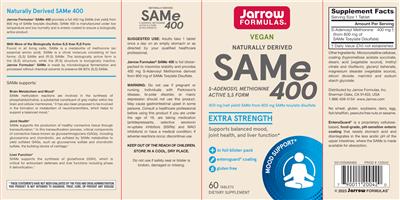
Naturally Derived SAMe 400 Jarrow Formulas SAMe 400 provides a full 400 mg SAMe (net yield) from 800 mg of SAMe tosylate disulfate.
With more of the Biologically Active S,S than R,S Form Found in all living cells, SAMe is a metabolite of methionine (an essential amino acid). SAMe is a chiral molecule consisting of two forms: (S,S) SAMe and (R,S) SAMe. The biologically active form is the (S,S) structure, while the (R,S) structure is biologically inactive. SAMe supports: Brain Metabolism and Mood SAMe methylation reactions are involved in the synthesis of phosphatidylcholine, a substantial constituent of grey matter within the brain and cellular membranes. It has also been proposed to be involved in the formation or metabolism of neurotransmitters, which helps to support a balanced mood. Joint Health SAMe supports the production of healthy connective tissue through transsulfuration. In this transsulfuration process, critical components of connective tissue known as glycosaminoglycans (GAGs), including glucosamine and chondroitin, are sulfated by SAMe metabolites to yield sulfated GAGs, such as glucosamine sulfate and chondroitin sulfate, the building blocks of cartilage. Liver Function SAMe supports the synthesis of glutathione (GSH), which is critical for antioxidant defenses and liver functions including phase II detoxification.
Naturally derived SAMe 400 S-adenosyl methionine Active S,S form Extra strength
Jarrow Formulas SAMe 400 is foil blister-packed to maximize stability and provides 400 mg S-Adenosyl Methionine derived from 800 mg of SAMe Tosylate Disulfate.
400 mg (net yield) SAMe from 800 mg SAMe tosylate disulfate Enteroguard coating
EnteroGuard is a proprietary cellulose-based, food-grade, pH-sensitive enteric coating that resists stomach acid and disintegrates in the less acidic pH of the upper intestines, where the SAMe is made available for absorption.
Formulation
SAMe 400 is manufactured under low temperature and low humidity and is enteric-coated to ensure a biologically active product.
Jarrow Formulas SAMe is made by microbiological fermentation and processed without chemical solvents to preserve 68-80% (S,S) SAMe.
Vegan
Extra strength Supports balanced mood, joint health, and liver function In foil blister pack
Gluten free
No wheat, gluten, soybeans, dairy, egg, fish/shellfish, peanuts/tree nuts or sesame.
FDA Disclaimer Statement
These statements have not been evaluated by the Food and Drug Administration. This product is not intended to diagnose, treat, cure, or prevent any disease.
Suggested/Recommended/Usage/Directions
Suggested Use: Adults take 1 tablet once a day on an empty stomach or as directed by your qualified healthcare professional.
Precautions
Warning: Do not use if pregnant or nursing.
Individuals with Parkinson’s disease, bi-polar disorder, or manic depression should not use this product. May cause gastrointestinal upset in some persons.
Consult a healthcare professional before using this product if you are under the age of 18, are taking medication (antidepressants, selective serotonin re-uptake inhibitors (SSRIs) and MAO inhibitors) or have a medical condition; if adverse reactions occur, discontinue use. Keep out of the reach of children.
Consult a healthcare professional before using this product if you are under the age of 18, are taking medication (antidepressants, selective serotonin re-uptake inhibitors (SSRIs) and MAO inhibitors) or have a medical condition; if adverse reactions occur, discontinue use.
Do not use if safety seal or blister is broken, damaged or missing.
Storage
Store in a cool, dry place.
FDA Statement of Identity
Dietary Supplement
Brand IP Statement(s)
Copyright 2023 Jarrow Formulas
General Statements
Mood support
Is this label outdated? Report a formula or label change and our pharmacy team will review it.
SAMe 400 by Jarrow Formulas label
The label scan from the NIH Dietary Supplement Label Database. Tap to enlarge.
Label images are published by the NIH Dietary Supplement Label Database for the version of this product on file. Always read your actual product label.
View the full label (PDF)The Ingredients in SAMe 400 by Jarrow Formulas
This is the 1 active ingredient this product is made of. Select it to open its full monograph.
Serving size1 Tablet(s) Dosage formTablet Or Pill Servings per container60 Amounts shown are per serving.
S-Adenosyl Methionine
Interacts with189 drugs
SAM-e is a compound your body makes naturally that is sold as a supplement, most often for depression and osteoarthritis. Some research suggests it ma...
S-Adenosyl Methionine monograph & interactionsOther (inactive) ingredients: Microcrystalline Cellulose, Hypromellose Acetate Succinate, Stearic Acid, Triethyl Citrate, Riboflavin, Glyceryl Behenate, Magnesium Stearate, Silicon Dioxide, Mannitol, Sodium Starch Glycolate. These complete the product’s ingredient list but are not active constituents.
SAMe 400 by Jarrow Formulas Drug Interactions
HelloPharmacist Interaction Report
Jarrow Formulas SAMe 400 does interact with some medications.
The most serious concern is with serotonergic drugs—medications that affect serotonin in your brain, like certain antidepressants (SSRIs, SNRIs, tricyclics), migraine drugs (triptans), and others. SAMe itself has serotonergic activity, so combining it with these drugs carries a Moderate risk of serotonin syndrome, a potentially serious condition marked by agitation, confusion, rapid heart rate, high blood pressure, and muscle rigidity.
Read the full breakdown — every affected drug type, severity by severity
SAMe also has a Moderate interaction with levodopa, a medication for Parkinson disease. SAMe can chemically alter levodopa in your body in a way that may reduce how well it works.
Altogether, these interactions span 189 individual medications. Before you start SAMe, check your exact medications with the search tool on this page—especially anything for depression, anxiety, migraines, or Parkinson disease.
Check your own medications below · Editorial policy · How we use AI
Want to check YOUR meds against SAMe 400?
Ask about interactions with your drugs in plain English — “Can I take it with lisinopril?” — and we find you the answer in seconds, ingredient by ingredient.
Go to the checkerIngredients driving the most interactions
Individual Drug Interactions
The ingredients in SAMe 400 interact with 189 drugs. Click any drug to see the details.
1 of the 1 ingredient in SAMe 400 interact with drugs. Each result below shows which ingredient is responsible. S-Adenosyl Methionine
VilazodoneViibryd
How Vilazodone interacts with SAMe 400 — through 1 ingredient. Tap an ingredient for the detail:
Same Tosylate DisulfateSerotonergic Drugs Moderate
Interaction Summary
Taking SAMe with serotonergic drugs might increase the risk of serotonin syndrome and other serotonergic side effects.
Read the full Same Tosylate Disulfate + Vilazodone interactionVortioxetineBrintellix, Sehippy, Trintellix
How Vortioxetine interacts with SAMe 400 — through 1 ingredient. Tap an ingredient for the detail:
Same Tosylate DisulfateSerotonergic Drugs Moderate
Interaction Summary
Taking SAMe with serotonergic drugs might increase the risk of serotonin syndrome and other serotonergic side effects.
Read the full Same Tosylate Disulfate + Vortioxetine interactionZiprasidoneGeodon
How Ziprasidone interacts with SAMe 400 — through 1 ingredient. Tap an ingredient for the detail:
Same Tosylate DisulfateSerotonergic Drugs Moderate
Interaction Summary
Taking SAMe with serotonergic drugs might increase the risk of serotonin syndrome and other serotonergic side effects.
Read the full Same Tosylate Disulfate + Ziprasidone interactionZolmitriptanZomig
How Zolmitriptan interacts with SAMe 400 — through 1 ingredient. Tap an ingredient for the detail:
Same Tosylate DisulfateSerotonergic Drugs Moderate
Interaction Summary
Taking SAMe with serotonergic drugs might increase the risk of serotonin syndrome and other serotonergic side effects.
Read the full Same Tosylate Disulfate + Zolmitriptan interactionZuclopenthizolClopixol
How Zuclopenthizol interacts with SAMe 400 — through 1 ingredient. Tap an ingredient for the detail:
Same Tosylate DisulfateSerotonergic Drugs Moderate
Interaction Summary
Taking SAMe with serotonergic drugs might increase the risk of serotonin syndrome and other serotonergic side effects.
Read the full Same Tosylate Disulfate + Zuclopenthizol interactionHydrocortisone, Pyrilamine, ChlorpheniramineHC Derma-Pax Liquid
How Hydrocortisone, Pyrilamine, Chlorpheniramine interacts with SAMe 400 — through 1 ingredient. Tap an ingredient for the detail:
Same Tosylate DisulfateSerotonergic Drugs Moderate
Interaction Summary
Taking SAMe with serotonergic drugs might increase the risk of serotonin syndrome and other serotonergic side effects.
Read the full Same Tosylate Disulfate + Hydrocortisone, Pyrilamine, Chlorpheniramine interactionMethylphenidate Transdermal SystemDaytrana
How Methylphenidate Transdermal System interacts with SAMe 400 — through 1 ingredient. Tap an ingredient for the detail:
Same Tosylate DisulfateSerotonergic Drugs Moderate
Interaction Summary
Taking SAMe with serotonergic drugs might increase the risk of serotonin syndrome and other serotonergic side effects.
Read the full Same Tosylate Disulfate + Methylphenidate Transdermal System interactionNefazodoneSerzone
How Nefazodone interacts with SAMe 400 — through 1 ingredient. Tap an ingredient for the detail:
Same Tosylate DisulfateSerotonergic Drugs Moderate
Interaction Summary
Taking SAMe with serotonergic drugs might increase the risk of serotonin syndrome and other serotonergic side effects.
Read the full Same Tosylate Disulfate + Nefazodone interactionPyrilamine, ChlorpheniramineDerma-Pax
How Pyrilamine, Chlorpheniramine interacts with SAMe 400 — through 1 ingredient. Tap an ingredient for the detail:
Same Tosylate DisulfateSerotonergic Drugs Moderate
Interaction Summary
Taking SAMe with serotonergic drugs might increase the risk of serotonin syndrome and other serotonergic side effects.
Read the full Same Tosylate Disulfate + Pyrilamine, Chlorpheniramine interactionEach ingredient & the kinds of drugs it affects
For each ingredient in SAMe 400 with known interactions, here are the types of medications it can affect. Open any type for the detail — or search your exact drug in the checker above.
S-Adenosyl Methionine
Levodopa
SAMe might reduce the effectiveness of levodopa.
SAMe methylates levodopa, which might reduce its effectiveness for treating Parkinson disease.
Serotonergic Drugs
Taking SAMe with serotonergic drugs might increase the risk of serotonin syndrome and other serotonergic side effects.
SAMe has serotonergic effects. Theoretically, combining serotonergic drugs with SAMe might increase the risk of serotonergic side effects, including serotonin syndrome and cerebral vasoconstrictive disorders. In one case report, SAMe 100 mg intramuscularly was given daily with clomipramine (Anafranil) 25 mg per day. When the clomipramine dose was increased to 75 mg per day the patient experienced serotonin syndrome about 48-72 hours later, requiring hospitalization.
Brand information
Manufacturer and brand details for SAMe 400, from the product label.
Jarrow Formulas
See all Jarrow Formulas products- Name
- Jarrow Formulas, Inc.
- City
- Sherman Oaks
- State
- CA
- ZipCode
- 91403
- Phone Number
- 1-866-459-4154
- Web Address
- www.Jarrow.com
SAMe 400 by Jarrow Formulas: Common Questions
Does SAMe 400 by Jarrow Formulas interact with any medications?
How can one product interact with so many drugs?
Where does this information come from?
What is SAMe and why would I take it?
Can I take this if I'm on an antidepressant?
What side effects might I get?
How much SAMe is in each tablet?
Is it safe to take during pregnancy or while breastfeeding?
Does this product have fillers?
Written and reviewed by the HelloPharmacist editorial staff. Our editorial policy
Not sure if SAMe 400 is safe with your meds?
Our pharmacists answer your medication & supplement questions — free.
Label information is sourced from the NIH Dietary Supplement Label Database and reflects the product version on file; always read your actual product label. This page is for education only and is not a substitute for professional medical advice. Confirm with your pharmacist or doctor before combining supplements and medications.
The Full Monographs Behind SAMe 400’s Ingredients
Every ingredient we hold a full HelloPharmacist monograph for — uses, evidence, safety, and the complete interaction list.
Sources & How We Checked
SAMe 400's label data comes from the NIH Dietary Supplement Label Database; the ingredient interaction data is from the Natural Medicines database, reviewed by our pharmacists.
- NIH Dietary Supplement Label Database (DSLD) — The official product label on file for this supplement.
- Natural Medicines (Therapeutic Research Center) — Evidence-graded clinical reference behind the ingredient interaction data.
Content is written and reviewed by licensed HelloPharmacist pharmacists. See our data sources and editorial standards for how this information is built and checked.
The 31 references behind this product’s interaction data
Every citation that drives the interaction findings for this product’s ingredients, from the evidence-graded Natural Medicines (TRC Healthcare) database. Open an ingredient to browse its citations — links open the study on PubMed or the publisher’s site.
Same 31 references
- Perna AF, Castaldo P, Ingrosso D, et al. Homocysteine, a new cardiovascular risk factor, is also a powerful uremic toxin. J Nephrol 1999;12:230-40.
- Mato JM, Camara J, Fernandez de Paz J, et al. S-adenosylmethionine in alcoholic liver cirrhosis: a randomized, placebo-controlled, double-blind, multicenter clinical trial. J Hepatol 1999;30:1081-9. PubMed
- Iruela LM, Minguez L, Merino J, Monedero G. Toxic interaction of S-adenosylmethionine and clomipramine. Am J Psychiatry 1993;150:522. PubMed
- Bradley JD, Flusser D, Katz BP, et al. A randomized, double blind, placebo controlled trial of intravenous loading with S-adenosylmethionine (SAM) followed by oral SAM therapy in patients with knee osteoarthritis. J Rheumatol 1994;21:905-11.
- Berlanga C, Ortega-Soto HA, Ontiveros M, Senties H. Efficacy of S-adenosyl-L-methionine in speeding the onset of action of imipramine. Psychiatry Res 1992;44:257-62. PubMed
- Kagan BL, Sultzer DL, Rosenlicht N, Gerner RH. Oral S-adenosylmethionine in depression: a randomized, double-blind, placebo-controlled trial. Am J Psychiatry 1990;147:591-5. PubMed
- Rosenbaum JF, Fava M, Falk WE, et al. The antidepressant potential of oral S-adenosyl-l-methionine. Acta Psychiatr Scand 1990;81:432-6. PubMed
- Domljan Z, Vrhovac B, Durrigl T, Pucar I. A double-blind trial of ademetionine vs naproxen in activated gonarthrosis. Int J Clin Pharmacol Ther Toxicol 1989;27:329-33.
- Konig B. A long-term (two years) clinical trial with S-adenosylmethionine for the treatment of osteoarthritis. Am J Med 1987;83:89-94. PubMed
- Lipinski JF, Cohen BM, Frankenburg F, et al. Open trial of S-adenosylmethionine for treatment of depression. Am J Psychiatry 1984;141:448-50.
- Almasio P, Bortolini M, Pagliaro L, Coltorti M. Role of S-adenosyl-L-methionine in the treatment of intrahepatic cholestasis. Drugs 1990;40:111-23. PubMed
- Friedel HA, Goa KL, Benfield P. S-adenosyl-L-methionine. A review of its pharmacological properties and therapeutic potential in liver dysfunction and affective disorders in relation to its physiological role in cell metabolism. Drugs 1989;38:389-416. PubMed
- Bottiglieri T, Hyland K, Reynolds EH. The clinical potential of ademetionine (S-adenosylmethionine) in neurological disorders. Drugs 1994;48:137-52. PubMed
- Frezza M, Centini G, Cammareri G, et al. S-adenosylmethionine for the treatment of intrahepatic cholestasis of pregnancy. Results of a controlled clinical trial. Hepatogastroenterology 1990;37:122-5.
- Singhal AB, Caviness VS, Begleiter AF, et al. Cerebral vasoconstriction and stroke after use of serotonergic drugs. Neurology 2002;58:130-3. PubMed
- Charlton CG, Crowell B Jr. Parkinson's disease-like effects of S-adenosyl-L-methionine: effects of L-dopa. Pharmacol Biochem Behav 1992;43:423-31..
- Goren JL, Stoll AL, Damico KE, et al. Bioavailability and lack of toxicity of S-adenosyl-L-methionine (SAMe) in humans. Pharmacotherapy 2004;24:1501-7. PubMed
- Arnold O, Saletu B, Anderer P, et al. Double-blind, placebo-controlled pharmacodynamic studies with a nutraceutical and a pharmaceutical dose of ademetionine (SAMe) in elderly subjects, utilizing EEG mapping and psychometry. Eur Neuropsychopharmacol 2005; PubMed
- Nelson JC. S-adenosyl methionine (SAMe) augmentation in major depressive disorder. (Editorial). Am J Psychiatry 2010;167:889-91.
- Kim J, Lee EY, Koh EM, et al. Comparative clinical trial of S-adenosylmethionine versus nabumetone for the treatment of knee osteoarthritis: an 8-week, multicenter, randomized, double-blind, double-dummy, Phase IV study in Korean patients. Clin Ther 2009; PubMed
- Manzillo G, Piccinino F, Surrenti C, et al. Multicentre double-blind placebo-controlled study of intravenous and oral S-adenosyl-L-methionine (SAMe) in cholestatic patients with liver disease. Drug Invest 1992;4 (Suppl 4):90-100. DOI
- Carrieri PB, Indaco A, Gentile S, et al. S-adenosylmethionine treatment of depressioin in patients with Parkinson's disease: a double-blind, crossover study versus placebo. Curr Ther Res 1990;48(1):154-60.
- Pancheri P, Scapicchio P, Delle Chiaie R. A double-blind, randomized parallel-group, efficacy and safety study of intramuscular S-adenosyl-L-methionine 1,4-butanedisulphonate (SAMe) versus imipramine in patients with major depressive disorder. Int J Neuro PubMed
- Medici V., Virata M. C., Peerson J. M., Stabler S. P., French S. W., Gregory J. F. III, Albanese A., Bowlus C. L., Devaraj S., Panacek E. A., Richards J. R., Halsted C. H. S-adenosyl-L-methionine treatment for alcoholic liver disease: a double-blinded, ra
- Chitiva, H., Audivert, F., and Alvarez, C. Suicide attempt by self-burning associated with ingestion of S-adenosylmethionine: a review of the literature and case report. J.Nerv.Ment.Dis. 2012;200(1):99-101. PubMed
- Carney, M. W., Edeh, J., Bottiglieri, T., Reynolds, E. M., and Toone, B. K. Affective illness and S-adenosyl methionine: a preliminary report. Clin Neuropharmacol. 1986;9(4):379-385. PubMed
- Miccoli, L., Porro, V., and Bertolino, A. Comparison between the antidepressant activity and of S- adenosylmethionine (SAMe) and that of some tricyclic drugs. Acta Neurol (Napoli) 1978;33 (3):243-255.
- Bacci, Ballerini F., Lopez, Anguera A., Alcaraz, P., and Hernandez, Reyes N. [SAMe in the management of postconcussional syndrome]. Medicina Clinica (Barc.) 1983;80(4):161-164.
- Muscettola G, Galzenati M, Balbi A. SAMe versus placebo: a double blind comparison in major depressive disorders. Advances in Biochemical Psychopharmacology 1982;32:151-6.
- Capretto C, Cremona C, and Canaparo L. A double-blind controlled study of S-adenosylmethionine (SAMe) v. ibuprofen in gonarthrosis, coxarthrosis and spondylarthrosis. Clin Trials J 1985;22(1):15-24.
- Ancarani E, Biondi B, Bolletta A, et al. Major depression complicating hemodialysis in patients with chronic renal failure: a multicenter, double-blind, controlled clinical trial of S-adenosyl-L-methionine versus placebo. Curr Ther Res 1993;54(6):680-6. DOI
Parts of this content are provided by the Therapeutic Research Center, LLC.
DISCLAIMER: Currently this does not check for drug-drug interactions. This is not an all-inclusive comprehensive list of potential interactions and is for informational purposes only. Not all interactions are known or well-reported in the scientific literature, and new interactions are continually being reported. Input is needed from a qualified healthcare provider including a pharmacist before starting any therapy. Application of clinical judgment is necessary.
© 2021 Therapeutic Research Center, LLC