
San Qi Ingredients & Drug Interactions
by Herbal Terra
What is this page for?
First and foremost: checking San Qi against your medications. The heart of this page is the interaction checker and the full interaction report — how this product’s ingredients may interact with prescription and over-the-counter medicines you may be taking.
Around that, we add a pharmacist’s high-level view of the product as a whole — what’s inside, the evidence for its stated use, how transparent the label is, and what safety data exists — so you can see the full picture in one place. It’s educational information from our licensed clinical databases and the clinical staff at HelloPharmacist — not medical advice — and we don’t sell or endorse products. Our editorial policy
San Qi is a dietary supplement by Herbal Terra with 1 active ingredient. Its ingredients are commonly taken for bleeding and bruising, heart and circulation health, high blood pressure.Based on those ingredients, 207 medications have a known interaction with it, the most serious rated moderate. The ingredients most likely to interact are Panax notoginseng Root Extract, Dry. Use the checker below to test your specific medication, or read the full HelloPharmacist Interaction Report.
Check Your Meds Against San Qi by Herbal Terra
Ask about any prescription or over-the-counter medication and we check it for interactions with San Qi by Herbal Terra — and tell you which ingredient is responsible.
AI summaries are generated from our interaction database for education only — always confirm with your pharmacist. How we use AI
Ask the Pharmacist
A licensed pharmacist will answer your question by email — free, usually within 24 hours.
Got it — thank you!
A licensed pharmacist will answer within 24 hours. Keep an eye on your email (worth checking spam, just in case).
HelloPharmacist Scorecard of San Qi by Herbal Terra
Our pharmacy team’s full take, with four database checks built into the cards below — a summary of what is known, not a grade of the product itself.
What’s inside
Full disclosure
San Qi is a single-ingredient liquid supplement containing Panax notoginseng root extract, also known as Tienchi ginseng. The inactive ingredients are alcohol, water, and glycerin.
Does it work?
Moderate evidence
The evidence for San Qi shows mixed results. Research suggests it may be possibly effective for angina (chest pain), stroke, and intracranial hemorrhage (bleeding in the brain).
However, for heart attack (myocardial infarction), the evidence suggests it's possibly ineffective. For nonalcoholic fatty liver disease (NASH), we don't have enough reliable evidence to say one way or another.
How safe is it?
Well-documented data
Panax notoginseng seems to be generally well tolerated when taken by mouth. Common side effects include dry mouth, flushed skin, trouble sleeping, nausea, nervousness, rash, and vomiting.
However, the safety data for long-term use in healthy people is limited, so we don't know much about what happens if you take it regularly for extended periods. This product should not be used during pregnancy or while breastfeeding — there isn't enough safety information, and traditional concerns about effects on bleeding make it inadvisable.
Meds to double-check
Moderate interaction found
Before taking San Qi, check if you're on blood thinners like warfarin (Coumadin) — the most serious concern. Also double-check aspirin use, caffeine-containing medications, and any drugs your liver breaks down (your pharmacist can identify these).
Moderate interactions are documented across all of these drug types.
The bottom line
Scorecard at a glanceFully disclosed formula with some supporting evidence for its stated purpose. Moderate medication interactions have been identified, and safety information is well characterized.
San Qi is a traditional herbal product that may help with certain circulatory conditions, but it interacts with a large number of medications — especially blood thinners, aspirin, and caffeine. If you take any prescription drugs, check them against this supplement before starting.
Pregnant or nursing? Skip this one.
Talk to your pharmacist about whether it's right for you.
Educational only — not medical advice; always confirm with your pharmacist. Our editorial policy · How we use AI
Assessment coverage: 1 of 1 active ingredient matched to our full ingredient reviews (monographs). Based on the product label dated Aug 22, 2025.
This Scorecard evaluates available label information, ingredient evidence, and known medication-safety considerations. It does not independently verify product identity, purity, potency, contamination, or manufacturing quality. How these ratings are computed
General information
Key facts about San Qi, straight from the product label.
| Brand | Herbal Terra |
|---|---|
| Barcode (UPC) | 7238360573374 |
| Net contents | 2 Fluid Ounce(s); 60 mL |
| Market status | On market |
| Date entered into DSLD | Aug 22, 2025 |
| DSLD ID | 325357 |
| Product type | Botanical |
| Supplement form | Liquid |
| Dietary claims / uses | All Other, Structure/Function |
| Intended target group(s) | Adult (18 - 50 Years), Gluten Free, Sugar Free |
Everything in this section is reproduced from the manufacturer’s own product label — it’s the label speaking, not HelloPharmacist. We show it so you can see exactly what the maker states; we don’t verify or endorse those statements.
Supplement Facts
The label details for San Qi by Herbal Terra, sourced from the NIH Dietary Supplement Label Database.
Supplement Facts
| Ingredient | Amount | % DV |
|---|---|---|
| Panax notoginseng Root Extract, Dry | 983 mg | -- |
Other ingredients: Alcohol, Water, Glycerin
Tap any ingredient to jump to its full detail below.
These statements are the manufacturer’s wording, reproduced from the product label — the label is saying it, not HelloPharmacist. We don’t verify or endorse them.
Suggested/Recommended/Usage/Directions
Shake well before use. Adults take up to 30 drops (1 mL, one full squeeze of the dropper bulb) in 3-4 fl. oz. of juice or water up to 4 times a day.
Precautions
We recommend to seek expert medical advice before taking. May have contraindications and cause adverse reaction.
Consult a physician before giving to children under 18, before using during pregnancy, if nursing, or if you are on any medications.
Consult a physician before giving to children under 18, before using during pregnancy, if nursing, or if you are on any medications. Keep out of the reach of children!
Do not use if you are allergic to any ingredients.
Storage
Store in a cool, dry, dark place.
FDA Disclaimer Statement
This product has not been evaluated by the FDA and is not intended to diagnose, treat, cure or prevent any disease.
Formulation
cGMP Made in compliance with cGMP 21 CFR 111 in an FDA registered and inspected facility.
Sugar free
Expertly extracted 100% natural Premium product
Organic alcohol
No artificial ingredients, color additives, fillers or binders.
Natural Gluten free
Formula
Panax notoginseng
Organic alcohol
FDA Statement of Identity
Herbal Supplement
Seals/Symbols
Made in USA
General Statements
Organic raw material
Is this label outdated? Report a formula or label change and our pharmacy team will review it.
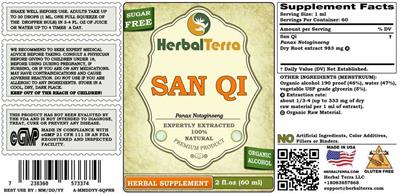
San Qi by Herbal Terra label
The label scan from the NIH Dietary Supplement Label Database. Tap to enlarge.
Label images are published by the NIH Dietary Supplement Label Database for the version of this product on file. Always read your actual product label.
View the full label (PDF)The Ingredients in San Qi by Herbal Terra
This is the 1 active ingredient this product is made of. Select it to open its full monograph.
Serving size1 mL Dosage formLiquid Servings per container60 Amounts shown are per serving.
Panax notoginseng Root Extract, Dry
Interacts with207 drugs
Panax notoginseng (sanqi or tienchi ginseng) is a traditional Chinese herb most often used to help with bleeding, bruising, and circulation. Human evi...
Panax notoginseng Root Extract, Dry monograph & interactionsOther (inactive) ingredients: Alcohol, Water, Glycerin. These complete the product’s ingredient list but are not active constituents.
San Qi by Herbal Terra Drug Interactions
HelloPharmacist Interaction Report
San Qi by Herbal Terra contains Panax notoginseng root extract, which interacts with a significant number of medications.
The most serious concern is with blood thinners (anticoagulants) like warfarin — taking this product alongside warfarin may increase your bleeding risk by raising blood thinner levels in your body.
Read the full breakdown — every affected drug type, severity by severity
You'll also want to be careful combining this with aspirin. Animal research shows the combination can raise blood levels of the pain reliever by about 50% and boost the herb's levels even more, which increases the risk of side effects from both.
Similarly, this extract may reduce how well caffeine works in your body — research found it can lower caffeine levels by as much as 37% — and it might also affect other medications that your liver breaks down using an enzyme called CYP1A2.
Altogether, these interactions span 207 individual medications. Before you start San Qi, use the medication checker on this page to see if any of your prescriptions or over-the-counter drugs are affected.
Check your own medications below · Editorial policy · How we use AI
Want to check YOUR meds against San Qi?
Ask about interactions with your drugs in plain English — “Can I take it with lisinopril?” — and we find you the answer in seconds, ingredient by ingredient.
Go to the checkerIngredients driving the most interactions
Individual Drug Interactions
The ingredients in San Qi interact with 207 drugs. Click any drug to see the details.
1 of the 1 ingredient in San Qi interact with drugs. Each result below shows which ingredient is responsible. Panax notoginseng Root Extract, Dry
AcetaminophenChildren's Tylenol, Children's Tylenol Meltaways, Tylenol, Tylenol Ex Strength
How Acetaminophen interacts with San Qi — through 1 ingredient. Tap an ingredient for the detail:
Panax Notoginseng Root Extract, DryCytochrome P450 1a2 (cyp1a2) Substrates Moderate
Interaction Summary
Theoretically, taking Panax notoginseng might reduce the levels and clinical effects of CYP1A2 substrates.
Read the full Panax Notoginseng Root Extract, Dry + Acetaminophen interactionAcetaminophen, AspirinGemnisyn
How Acetaminophen, Aspirin interacts with San Qi — through 1 ingredient. Tap an ingredient for the detail:
Panax Notoginseng Root Extract, DryCytochrome P450 1a2 (cyp1a2) Substrates, Aspirin Moderate
Interaction Summary
Theoretically, taking Panax notoginseng might reduce the levels and clinical effects of CYP1A2 substrates.
Read the full Panax Notoginseng Root Extract, Dry + Acetaminophen, Aspirin interactionAcetaminophen, Aspirin, CaffeineExcedrin, Excedrin Extra Strength, Excedrin Migraine
How Acetaminophen, Aspirin, Caffeine interacts with San Qi — through 1 ingredient. Tap an ingredient for the detail:
Panax Notoginseng Root Extract, DryCytochrome P450 1a2 (cyp1a2) Substrates, Aspirin +1 Moderate
Interaction Summary
Theoretically, taking Panax notoginseng might reduce the levels and clinical effects of CYP1A2 substrates.
Read the full Panax Notoginseng Root Extract, Dry + Acetaminophen, Aspirin, Caffeine interactionAcetaminophen, Brompheniramine, PhenylpropanolamineDimetapp Cold and Flu
How Acetaminophen, Brompheniramine, Phenylpropanolamine interacts with San Qi — through 1 ingredient. Tap an ingredient for the detail:
Panax Notoginseng Root Extract, DryCytochrome P450 1a2 (cyp1a2) Substrates Moderate
Interaction Summary
Theoretically, taking Panax notoginseng might reduce the levels and clinical effects of CYP1A2 substrates.
Read the full Panax Notoginseng Root Extract, Dry + Acetaminophen, Brompheniramine, Phenylpropanolamine interactionAcetaminophen, ButalbitalAxocet, Bancap, Bucet, Butex Forte, Esgic CF, Orbivan CF +5 more
How Acetaminophen, Butalbital interacts with San Qi — through 1 ingredient. Tap an ingredient for the detail:
Panax Notoginseng Root Extract, DryCytochrome P450 1a2 (cyp1a2) Substrates Moderate
Interaction Summary
Theoretically, taking Panax notoginseng might reduce the levels and clinical effects of CYP1A2 substrates.
Read the full Panax Notoginseng Root Extract, Dry + Acetaminophen, Butalbital interactionAcetaminophen, Butalbital, CaffeineEsgic, Esgic Plus, Fiogesic, Fioricet, Repan, Tecnal +1 more
How Acetaminophen, Butalbital, Caffeine interacts with San Qi — through 1 ingredient. Tap an ingredient for the detail:
Panax Notoginseng Root Extract, DryCytochrome P450 1a2 (cyp1a2) Substrates, Caffeine Moderate
Interaction Summary
Theoretically, taking Panax notoginseng might reduce the levels and clinical effects of CYP1A2 substrates.
Read the full Panax Notoginseng Root Extract, Dry + Acetaminophen, Butalbital, Caffeine interactionAcetaminophen, Butalbital, Caffeine, CodeineEsgic with Codeine, Fioricet w/ Codeine
How Acetaminophen, Butalbital, Caffeine, Codeine interacts with San Qi — through 1 ingredient. Tap an ingredient for the detail:
Panax Notoginseng Root Extract, DryCytochrome P450 1a2 (cyp1a2) Substrates, Caffeine Moderate
Interaction Summary
Theoretically, taking Panax notoginseng might reduce the levels and clinical effects of CYP1A2 substrates.
Read the full Panax Notoginseng Root Extract, Dry + Acetaminophen, Butalbital, Caffeine, Codeine interactionAcetaminophen, Butalbital, CodeineBancap w/ Codeine
How Acetaminophen, Butalbital, Codeine interacts with San Qi — through 1 ingredient. Tap an ingredient for the detail:
Panax Notoginseng Root Extract, DryCytochrome P450 1a2 (cyp1a2) Substrates Moderate
Interaction Summary
Theoretically, taking Panax notoginseng might reduce the levels and clinical effects of CYP1A2 substrates.
Read the full Panax Notoginseng Root Extract, Dry + Acetaminophen, Butalbital, Codeine interactionAcetaminophen, Butalbital, Codeine PhosphatePhrenilin #3
How Acetaminophen, Butalbital, Codeine Phosphate interacts with San Qi — through 1 ingredient. Tap an ingredient for the detail:
Panax Notoginseng Root Extract, DryCytochrome P450 1a2 (cyp1a2) Substrates Moderate
Interaction Summary
Theoretically, taking Panax notoginseng might reduce the levels and clinical effects of CYP1A2 substrates.
Read the full Panax Notoginseng Root Extract, Dry + Acetaminophen, Butalbital, Codeine Phosphate interactionAcetaminophen, Caffeine, Chlorpheniramine, Hydrocodone, PhenylephrineHycomine Compound
How Acetaminophen, Caffeine, Chlorpheniramine, Hydrocodone, Phenylephrine interacts with San Qi — through 1 ingredient. Tap an ingredient for the detail:
Panax Notoginseng Root Extract, DryCytochrome P450 1a2 (cyp1a2) Substrates, Caffeine Moderate
Interaction Summary
Theoretically, taking Panax notoginseng might reduce the levels and clinical effects of CYP1A2 substrates.
Read the full Panax Notoginseng Root Extract, Dry + Acetaminophen, Caffeine, Chlorpheniramine, Hydrocodone, Phenylephrine interactionAcetaminophen, Caffeine, CodeineGesic C15, Gesic C30, Gesic C8, Lenoltec 1, Lenoltec 2, Lenoltec 3 +1 more
How Acetaminophen, Caffeine, Codeine interacts with San Qi — through 1 ingredient. Tap an ingredient for the detail:
Panax Notoginseng Root Extract, DryCytochrome P450 1a2 (cyp1a2) Substrates, Caffeine Moderate
Interaction Summary
Theoretically, taking Panax notoginseng might reduce the levels and clinical effects of CYP1A2 substrates.
Read the full Panax Notoginseng Root Extract, Dry + Acetaminophen, Caffeine, Codeine interactionAcetaminophen, Caffeine, Codeine, SalicylamideCodalan No.1, Codalan No.2, Codalan No.3
How Acetaminophen, Caffeine, Codeine, Salicylamide interacts with San Qi — through 1 ingredient. Tap an ingredient for the detail:
Panax Notoginseng Root Extract, DryCytochrome P450 1a2 (cyp1a2) Substrates, Caffeine Moderate
Interaction Summary
Theoretically, taking Panax notoginseng might reduce the levels and clinical effects of CYP1A2 substrates.
Read the full Panax Notoginseng Root Extract, Dry + Acetaminophen, Caffeine, Codeine, Salicylamide interactionAcetaminophen, Caffeine, DihydrocodeineDHC Plus, Panlor DC, Panlor SS
How Acetaminophen, Caffeine, Dihydrocodeine interacts with San Qi — through 1 ingredient. Tap an ingredient for the detail:
Panax Notoginseng Root Extract, DryCaffeine, Cytochrome P450 1a2 (cyp1a2) Substrates Moderate
Interaction Summary
Theoretically, taking Panax notoginseng may decrease the levels and clinical effects of caffeine.
Read the full Panax Notoginseng Root Extract, Dry + Acetaminophen, Caffeine, Dihydrocodeine interactionAcetaminophen, Caffeine, IsomethepteneMigralam
How Acetaminophen, Caffeine, Isometheptene interacts with San Qi — through 1 ingredient. Tap an ingredient for the detail:
Panax Notoginseng Root Extract, DryCytochrome P450 1a2 (cyp1a2) Substrates, Caffeine Moderate
Interaction Summary
Theoretically, taking Panax notoginseng might reduce the levels and clinical effects of CYP1A2 substrates.
Read the full Panax Notoginseng Root Extract, Dry + Acetaminophen, Caffeine, Isometheptene interactionAcetaminophen, Caffeine, PyrilamineMidol Max Strength Menstrual
How Acetaminophen, Caffeine, Pyrilamine interacts with San Qi — through 1 ingredient. Tap an ingredient for the detail:
Panax Notoginseng Root Extract, DryCytochrome P450 1a2 (cyp1a2) Substrates, Caffeine Moderate
Interaction Summary
Theoretically, taking Panax notoginseng might reduce the levels and clinical effects of CYP1A2 substrates.
Read the full Panax Notoginseng Root Extract, Dry + Acetaminophen, Caffeine, Pyrilamine interactionAcetaminophen, Chlorpheniramine Maleate, Dextromethorphan HbrVicks Formula 44M Cough, Cold & Flu Relief
How Acetaminophen, Chlorpheniramine Maleate, Dextromethorphan Hbr interacts with San Qi — through 1 ingredient. Tap an ingredient for the detail:
Panax Notoginseng Root Extract, DryCytochrome P450 1a2 (cyp1a2) Substrates Moderate
Interaction Summary
Theoretically, taking Panax notoginseng might reduce the levels and clinical effects of CYP1A2 substrates.
Read the full Panax Notoginseng Root Extract, Dry + Acetaminophen, Chlorpheniramine Maleate, Dextromethorphan Hbr interactionAcetaminophen, Chlorpheniramine, Codeine, PhenylephrineColrex
How Acetaminophen, Chlorpheniramine, Codeine, Phenylephrine interacts with San Qi — through 1 ingredient. Tap an ingredient for the detail:
Panax Notoginseng Root Extract, DryCytochrome P450 1a2 (cyp1a2) Substrates Moderate
Interaction Summary
Theoretically, taking Panax notoginseng might reduce the levels and clinical effects of CYP1A2 substrates.
Read the full Panax Notoginseng Root Extract, Dry + Acetaminophen, Chlorpheniramine, Codeine, Phenylephrine interactionAcetaminophen, Chlorpheniramine, DextromethorphanCoricidin II Extra Strength Cold and Flu
How Acetaminophen, Chlorpheniramine, Dextromethorphan interacts with San Qi — through 1 ingredient. Tap an ingredient for the detail:
Panax Notoginseng Root Extract, DryCytochrome P450 1a2 (cyp1a2) Substrates Moderate
Interaction Summary
Theoretically, taking Panax notoginseng might reduce the levels and clinical effects of CYP1A2 substrates.
Read the full Panax Notoginseng Root Extract, Dry + Acetaminophen, Chlorpheniramine, Dextromethorphan interactionAcetaminophen, Chlorpheniramine, Dextromethorphan HydrobromideCoricidin HBP Maximum Strength Flu
How Acetaminophen, Chlorpheniramine, Dextromethorphan Hydrobromide interacts with San Qi — through 1 ingredient. Tap an ingredient for the detail:
Panax Notoginseng Root Extract, DryCytochrome P450 1a2 (cyp1a2) Substrates Moderate
Interaction Summary
Theoretically, taking Panax notoginseng might reduce the levels and clinical effects of CYP1A2 substrates.
Read the full Panax Notoginseng Root Extract, Dry + Acetaminophen, Chlorpheniramine, Dextromethorphan Hydrobromide interactionAcetaminophen, Chlorpheniramine, Dextromethorphan, PhenylpropanolamineMulti Symptom Cold Relief
How Acetaminophen, Chlorpheniramine, Dextromethorphan, Phenylpropanolamine interacts with San Qi — through 1 ingredient. Tap an ingredient for the detail:
Panax Notoginseng Root Extract, DryCytochrome P450 1a2 (cyp1a2) Substrates Moderate
Interaction Summary
Theoretically, taking Panax notoginseng might reduce the levels and clinical effects of CYP1A2 substrates.
Read the full Panax Notoginseng Root Extract, Dry + Acetaminophen, Chlorpheniramine, Dextromethorphan, Phenylpropanolamine interactionAcetaminophen, Chlorpheniramine, Dextromethorphan, PseudoephedrineChildren's Tylenol Cold Plus Cough, Tylenol Cold Ex Strength
How Acetaminophen, Chlorpheniramine, Dextromethorphan, Pseudoephedrine interacts with San Qi — through 1 ingredient. Tap an ingredient for the detail:
Panax Notoginseng Root Extract, DryCytochrome P450 1a2 (cyp1a2) Substrates Moderate
Interaction Summary
Theoretically, taking Panax notoginseng might reduce the levels and clinical effects of CYP1A2 substrates.
Read the full Panax Notoginseng Root Extract, Dry + Acetaminophen, Chlorpheniramine, Dextromethorphan, Pseudoephedrine interactionAcetaminophen, Chlorpheniramine, Guaifenesin, Phenylephrine, SalicylamideRhinogesic GG
How Acetaminophen, Chlorpheniramine, Guaifenesin, Phenylephrine, Salicylamide interacts with San Qi — through 1 ingredient. Tap an ingredient for the detail:
Panax Notoginseng Root Extract, DryCytochrome P450 1a2 (cyp1a2) Substrates Moderate
Interaction Summary
Theoretically, taking Panax notoginseng might reduce the levels and clinical effects of CYP1A2 substrates.
Read the full Panax Notoginseng Root Extract, Dry + Acetaminophen, Chlorpheniramine, Guaifenesin, Phenylephrine, Salicylamide interactionAcetaminophen, Chlorpheniramine, PhenylephrineAlka-Seltzer PLUS, Histex SR, Protid
How Acetaminophen, Chlorpheniramine, Phenylephrine interacts with San Qi — through 1 ingredient. Tap an ingredient for the detail:
Panax Notoginseng Root Extract, DryCytochrome P450 1a2 (cyp1a2) Substrates Moderate
Interaction Summary
Theoretically, taking Panax notoginseng might reduce the levels and clinical effects of CYP1A2 substrates.
Read the full Panax Notoginseng Root Extract, Dry + Acetaminophen, Chlorpheniramine, Phenylephrine interactionAcetaminophen, Chlorpheniramine, Phenylephrine, SalicylamideRhinogesic, Rhinogesic JR
How Acetaminophen, Chlorpheniramine, Phenylephrine, Salicylamide interacts with San Qi — through 1 ingredient. Tap an ingredient for the detail:
Panax Notoginseng Root Extract, DryCytochrome P450 1a2 (cyp1a2) Substrates Moderate
Interaction Summary
Theoretically, taking Panax notoginseng might reduce the levels and clinical effects of CYP1A2 substrates.
Read the full Panax Notoginseng Root Extract, Dry + Acetaminophen, Chlorpheniramine, Phenylephrine, Salicylamide interactionAcetaminophen, Chlorpheniramine, PhenylpropanolamineAlumadrine, Conex, Sinadrin Max Strength, Sinulin
How Acetaminophen, Chlorpheniramine, Phenylpropanolamine interacts with San Qi — through 1 ingredient. Tap an ingredient for the detail:
Panax Notoginseng Root Extract, DryCytochrome P450 1a2 (cyp1a2) Substrates Moderate
Interaction Summary
Theoretically, taking Panax notoginseng might reduce the levels and clinical effects of CYP1A2 substrates.
Read the full Panax Notoginseng Root Extract, Dry + Acetaminophen, Chlorpheniramine, Phenylpropanolamine interactionAcetaminophen, Chlorpheniramine, Phenylpropanolamine, OpiumHista-Derfule
How Acetaminophen, Chlorpheniramine, Phenylpropanolamine, Opium interacts with San Qi — through 1 ingredient. Tap an ingredient for the detail:
Panax Notoginseng Root Extract, DryCytochrome P450 1a2 (cyp1a2) Substrates Moderate
Interaction Summary
Theoretically, taking Panax notoginseng might reduce the levels and clinical effects of CYP1A2 substrates.
Read the full Panax Notoginseng Root Extract, Dry + Acetaminophen, Chlorpheniramine, Phenylpropanolamine, Opium interactionAcetaminophen, Chlorpheniramine, Phenylpropanolamine, PhenyltoloxamineNorel Plus
How Acetaminophen, Chlorpheniramine, Phenylpropanolamine, Phenyltoloxamine interacts with San Qi — through 1 ingredient. Tap an ingredient for the detail:
Panax Notoginseng Root Extract, DryCytochrome P450 1a2 (cyp1a2) Substrates Moderate
Interaction Summary
Theoretically, taking Panax notoginseng might reduce the levels and clinical effects of CYP1A2 substrates.
Read the full Panax Notoginseng Root Extract, Dry + Acetaminophen, Chlorpheniramine, Phenylpropanolamine, Phenyltoloxamine interactionAcetaminophen, Chlorpheniramine, PseudoephedrineAlka-Seltzer PLUS Liquid Gels, Children's Tylenol Cold, Codimal, Comtrex, Extra Strength Tylenol Allergy Sinus, Lorsin +3 more
How Acetaminophen, Chlorpheniramine, Pseudoephedrine interacts with San Qi — through 1 ingredient. Tap an ingredient for the detail:
Panax Notoginseng Root Extract, DryCytochrome P450 1a2 (cyp1a2) Substrates Moderate
Interaction Summary
Theoretically, taking Panax notoginseng might reduce the levels and clinical effects of CYP1A2 substrates.
Read the full Panax Notoginseng Root Extract, Dry + Acetaminophen, Chlorpheniramine, Pseudoephedrine interactionAcetaminophen, ChlorzoxazoneAcetazone Forte, Extra Strength Tylenol Aches & Strains, Parafon Forte
How Acetaminophen, Chlorzoxazone interacts with San Qi — through 1 ingredient. Tap an ingredient for the detail:
Panax Notoginseng Root Extract, DryCytochrome P450 1a2 (cyp1a2) Substrates Moderate
Interaction Summary
Theoretically, taking Panax notoginseng might reduce the levels and clinical effects of CYP1A2 substrates.
Read the full Panax Notoginseng Root Extract, Dry + Acetaminophen, Chlorzoxazone interactionAcetaminophen, Chlorzoxazone, CodeineAcetazone Forte C8, Parafon Forte C8
How Acetaminophen, Chlorzoxazone, Codeine interacts with San Qi — through 1 ingredient. Tap an ingredient for the detail:
Panax Notoginseng Root Extract, DryCytochrome P450 1a2 (cyp1a2) Substrates Moderate
Interaction Summary
Theoretically, taking Panax notoginseng might reduce the levels and clinical effects of CYP1A2 substrates.
Read the full Panax Notoginseng Root Extract, Dry + Acetaminophen, Chlorzoxazone, Codeine interactionEach ingredient & the kinds of drugs it affects
For each ingredient in San Qi with known interactions, here are the types of medications it can affect. Open any type for the detail — or search your exact drug in the checker above.
Panax notoginseng Root Extract, Dry
Aspirin
Theoretically, taking Panax notoginseng concomitantly with aspirin may increase the risk of adverse effects from both products.
Animal research shows that taking Panax notoginseng extract with aspirin increases blood levels of salicylic acid by approximately 50% and blood levels of Panax notoginseng by 75% to 196%. This effect may be due to increased absorption of both products.
Caffeine
Theoretically, taking Panax notoginseng may decrease the levels and clinical effects of caffeine.
Animal research shows that administering Panax notoginseng intravenously for 7 days before intraperitoneal injection of caffeine can decrease maximal blood levels of caffeine by 37%. This interaction is attributed to the ability of Panax notoginseng to increase the activity of cytochrome P450 1A2 (CYP1A2) enzymes.
Cytochrome P450 1A2 (Cyp1A2) Substrates
Theoretically, taking Panax notoginseng might reduce the levels and clinical effects of CYP1A2 substrates.
Animal research shows that administering Panax notoginseng intravenously for 7 days before intraperitoneal injection of caffeine can decrease maximal blood levels of caffeine by 37%. This interaction was attributed to the ability of Panax notoginseng to increase the activity of CYP1A2.
Warfarin (Coumadin)
Theoretically, taking Panax notoginseng concomitantly with warfarin may increase the risk of bleeding.
Animal research shows that taking Panax notoginseng concomitantly with warfarin increases plasma warfarin levels, prothrombin time, and international normalized ratio when compared with control. In vitro research also suggests that Panax notoginseng may downregulate expression of cytochrome P450 3A4 enzymes, which may affect warfarin metabolism.
Brand information
Manufacturer and brand details for San Qi, from the product label.
Herbal Terra
See all Herbal Terra products- Name
- Herbal Terra LLC
- Phone Number
- +18083857868
- Web Address
- herbalterra.com
San Qi by Herbal Terra: Common Questions
Does San Qi by Herbal Terra interact with any medications?
How can one product interact with so many drugs?
Where does this information come from?
Is San Qi safe to take while I'm pregnant or breastfeeding?
What are the most common side effects of taking San Qi?
Can San Qi help with heart attack (myocardial infarction)?
Why does San Qi interact with so many medications?
What's in this liquid supplement besides the active ingredient?
Written and reviewed by the HelloPharmacist editorial staff. Our editorial policy
Not sure if San Qi is safe with your meds?
Our pharmacists answer your medication & supplement questions — free.
Label information is sourced from the NIH Dietary Supplement Label Database and reflects the product version on file; always read your actual product label. This page is for education only and is not a substitute for professional medical advice. Confirm with your pharmacist or doctor before combining supplements and medications.
The Full Monographs Behind San Qi’s Ingredients
Every ingredient we hold a full HelloPharmacist monograph for — uses, evidence, safety, and the complete interaction list.
Sources & How We Checked
San Qi's label data comes from the NIH Dietary Supplement Label Database; the ingredient interaction data is from the Natural Medicines database, reviewed by our pharmacists.
- NIH Dietary Supplement Label Database (DSLD) — The official product label on file for this supplement.
- Natural Medicines (Therapeutic Research Center) — Evidence-graded clinical reference behind the ingredient interaction data.
Content is written and reviewed by licensed HelloPharmacist pharmacists. See our data sources and editorial standards for how this information is built and checked.
The 15 references behind this product’s interaction data
Every citation that drives the interaction findings for this product’s ingredients, from the evidence-graded Natural Medicines (TRC Healthcare) database. Open an ingredient to browse its citations — links open the study on PubMed or the publisher’s site.
Panax Notoginseng 15 references
- Huang KC. The Pharmacology of Chinese Herbs. 2nd ed. New York, NY: CRC Press, LLC 1999:101-102.
- Bensky D, Gamble A, Kaptchuk T. Chinese Herbal Medicine Materia Medica. Seattle, WA: Eastland Press, 1996:359-60.
- Chan LY, Chiu PY, Lau TK. An in-vitro study of ginsenoside Rb(1)-induced teratogenicity using a whole rat embryo culture model. Hum Reprod 2003;18:2166-8..
- Du XF, Yin XP, Zhang GL, Shi HJ, Shao MH. Interstitial granulomatous drug reaction to a Chinese herb extract. Eur J Dermatol. 2012 May-Jun;22(3):419-20. PubMed
- Liu R, Qin M, Hang P, Liu Y, Zhang Z, Liu G. Effects of Panax notoginseng saponins on the activities of CYP1A2, CYP2C9, CYP2D6 and CYP3A4 in rats in vivo. Phytother Res. 2012 Aug;26(8):1113-8.
- Shang Q, Xu H, Liu Z, Chen K, Liu J. Oral Panax notoginseng Preparation for Coronary Heart Disease: A Systematic Review of Randomized Controlled Trials. Evid Based Complement Alternat Med. 2013;2013:940125.
- Tian Z, Pang H, Du S, Lu Y, Zhang L, Wu H, Guo S, Wang M, Zhang Q. Effect of Panax notoginseng saponins on the pharmacokinetics of aspirin in rats. J Chromatogr B Analyt Technol Biomed Life Sci. 2017 Jan 1;1040:136-143. PubMed
- Xu D, Huang P, Yu Z, Xing DH, Ouyang S, Xing G. Efficacy and Safety of Panax notoginseng Saponin Therapy for Acute Intracerebral Hemorrhage, Meta-Analysis, and Mini Review of Potential Mechanisms of Action. Front Neurol. 2015 Jan 7;5:274. PubMed
- Yang X, Xiong X, Wang J. Sanqi panax notoginseng injection for angina pectoris. Evid Based Complement Alternat Med. 2014;2014:963208. PubMed
- Yin Z, Ma L, Xu J, Xia J, Luo D. Pustular drug eruption due to Panax notoginseng saponins. Drug Des Devel Ther. 2014 Jul 16;8:957-61. PubMed
- Song H, Wang P, Liu J, Wang C. Panax notoginseng Preparations for Unstable Angina Pectoris: A Systematic Review and Meta-Analysis. Phytother Res. 2017 Jun 20.
- Tian Z, Pang H, Zhang Q, et al. Effect of aspirin on the pharmacokinetics and absorption of panax notoginsengsaponins. J Chromatogr B Analyt Technol Biomed Life Sci. 2018 Jan 2;1074-75.
- Li C, Xu T, Zhou P, et al. Post-marketing safety surveillance and re-evaluation of Xueshuantong injection. BMC Complement Altern Med. 2018;18(1):277. PubMed
- Liu L, Shen XJ, Xue LJ, Yao SK, Zhu JY. Submucosal hematoma with a wide range of lesions, severe condition and atypical clinical symptoms: A case report. World J Clin Cases 2021;9(20):5683-5688. PubMed
- Qian J, Chen W, Wu J, et al. Effects and Mechanism of Action of Panax notoginseng Saponins on the Pharmacokinetics of Warfarin. Eur J Drug Metab Pharmacokinet 2022;47(3):331-342. PubMed
Parts of this content are provided by the Therapeutic Research Center, LLC.
DISCLAIMER: Currently this does not check for drug-drug interactions. This is not an all-inclusive comprehensive list of potential interactions and is for informational purposes only. Not all interactions are known or well-reported in the scientific literature, and new interactions are continually being reported. Input is needed from a qualified healthcare provider including a pharmacist before starting any therapy. Application of clinical judgment is necessary.
© 2021 Therapeutic Research Center, LLC