
Saw Palmetto Complex 125 mg Ingredients & Drug Interactions
What is this page for?
First and foremost: checking Saw Palmetto Complex 125 mg against your medications. The heart of this page is the interaction checker and the full interaction report — how this product’s ingredients may interact with prescription and over-the-counter medicines you may be taking.
Around that, we add a pharmacist’s high-level view of the product as a whole — what’s inside, the evidence for its stated use, how transparent the label is, and what safety data exists — so you can see the full picture in one place. It’s educational information from our licensed clinical databases and the clinical staff at HelloPharmacist — not medical advice — and we don’t sell or endorse products. Our editorial policy
Saw Palmetto Complex 125 mg is a dietary supplement by NewtonEverett with 3 active ingredients. Its ingredients are commonly taken for benign prostatic hyperplasia (bph) symptoms, overactive bladder, eye and skin health (vitamin a source).Based on those ingredients, 887 medications have a known interaction with it, the most serious rated moderate. The ingredients most likely to interact are Uva-Ursi Leaf Extract, Saw Palmetto Berry Extract, Pumpkin Seed Oil. Use the checker below to test your specific medication, or read the full HelloPharmacist Interaction Report.
Check Your Meds Against Saw Palmetto Complex 125 mg by NewtonEverett
Ask about any prescription or over-the-counter medication and we check it for interactions with Saw Palmetto Complex 125 mg by NewtonEverett — and tell you which ingredient is responsible.
AI summaries are generated from our interaction database for education only — always confirm with your pharmacist. How we use AI
Ask the Pharmacist
A licensed pharmacist will answer your question by email — free, usually within 24 hours.
Got it — thank you!
A licensed pharmacist will answer within 24 hours. Keep an eye on your email (worth checking spam, just in case).
HelloPharmacist Scorecard of Saw Palmetto Complex 125 mg by NewtonEverett
Our pharmacy team’s full take, with four database checks built into the cards below — a summary of what is known, not a grade of the product itself.
What’s inside
Full disclosure
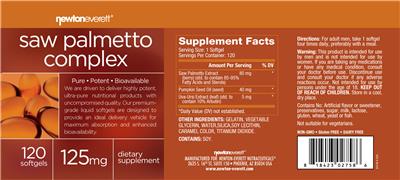
Saw Palmetto Complex contains 3 active ingredients: pumpkin seed oil, saw palmetto berry extract, and uva-ursi leaf extract. Pumpkin seed oil is used for prostate and urinary support; saw palmetto berry extract is traditionally used for benign prostate enlargement; and uva-ursi leaf extract is used to support urinary tract health.
The softgel capsule also contains several inactive ingredients — gelatin, glycerin, water, silica, soy lecithin, caramel color, and titanium dioxide — which help form and color the capsule.
Does it work?
Moderate evidence
The evidence is mixed. Pumpkin seed oil is possibly effective for benign prostate enlargement (BPH), but there isn't enough reliable data to rate it for hair loss, bladder inflammation, parasites, or urinary tract infections.
Saw palmetto berry extract is possibly effective for a specific prostate procedure (TURP) but possibly ineffective for general benign prostate enlargement — the evidence doesn't support the common claim that it shrinks an enlarged prostate. There also isn't enough data to rate it for cough, hair loss, or lower urinary tract symptoms.
Uva-ursi is possibly ineffective for urinary tract infections and lacks sufficient evidence for cough or prostate issues. In short, the scientific backing for this combination is limited, and the main ingredient (saw palmetto) may not work the way many people expect.
How safe is it?
Well-documented data
Pumpkin seed oil is generally well tolerated. The most common side effects reported are mild — abdominal discomfort, diarrhea, nausea, and vomiting — though anaphylaxis (a serious allergic reaction) has been rarely reported.
Two case reports describe hair loss after consuming bitter pumpkin products, which was attributed to a toxin called cucurbitacin found in wild pumpkins. Saw palmetto is well tolerated with mild, infrequent side effects including abdominal pain, constipation, decreased sex drive, diarrhea, dizziness, fatigue, headache, nausea, and nasal irritation.
Rarely, it can cause a skin rash with blisters or worsen acne. Very rarely, heart problems including irregular heartbeats, high or low blood pressure, chest pain, and even heart attacks have been reported.
Uva-ursi is generally well tolerated at low doses for short-term use only — stomach upset, nausea, vomiting, and diarrhea are the most common side effects. At very high doses (20 grams or more), it can cause serious toxicity including seizures, confusion, shortness of breath, and low oxygen.
Doses of 30 grams or higher may be fatal. All three ingredients are not advised during pregnancy.
Saw palmetto is likely unsafe in pregnancy due to hormonal effects and lack of safety data; pumpkin and uva-ursi should be avoided because of insufficient data. None of the three have adequate safety information for breastfeeding, so they should be avoided while nursing.
Meds to double-check
Moderate interaction found
Before taking this product, double-check with your pharmacist if you're on birth control pills or estrogen therapy (saw palmetto may reduce how well they work — Moderate risk). Also check if you take blood thinners or antiplatelet drugs like warfarin or aspirin (Moderate risk of increased bleeding).
If you're on lithium for mood disorder, flag it — both pumpkin seed oil and uva-ursi may raise lithium levels (Moderate risk). If you take medications broken down by your liver — a very large category that includes many common drugs — uva-ursi may slow their clearance (Moderate risk).
And if you're on medications that acidify your urine, uva-ursi won't work as intended.
The bottom line
Scorecard at a glanceFully disclosed formula with some supporting evidence for its stated purpose. Moderate medication interactions have been identified, and safety information is well characterized.
This product might be worth considering if you're dealing with prostate or urinary symptoms and want to explore herbal options — but the evidence for it is limited, especially for saw palmetto. If you take hormonal medications (including birth control), blood thinners, lithium, or any medications that are heavily broken down by your liver, you need to run them through our interaction checker before starting.
Talk to your pharmacist or doctor first, particularly if you're pregnant, breastfeeding, or have a heart condition.
Educational only — not medical advice; always confirm with your pharmacist. Our editorial policy · How we use AI
Assessment coverage: 3 of 3 active ingredients matched to our full ingredient reviews (monographs). Based on the product label dated Sep 25, 2025.
This Scorecard evaluates available label information, ingredient evidence, and known medication-safety considerations. It does not independently verify product identity, purity, potency, contamination, or manufacturing quality. How these ratings are computed
General information
Key facts about Saw Palmetto Complex 125 mg, straight from the product label.
| Brand | NewtonEverett |
|---|---|
| Barcode (UPC) | 818423027586 |
| Net contents | 120 Softgel(s) |
| Market status | On market |
| Date entered into DSLD | Sep 25, 2025 |
| DSLD ID | 335143 |
| Product type | Botanical With Nutrients |
| Supplement form | Softgel Capsule |
| Dietary claims / uses | All Other, Structure/Function |
| Intended target group(s) | Adult Male (18-50 Years), Seniors/Mature (>50 Years) - Men ONLY, Gluten Free, Dairy Free, Sugar Free |
Everything in this section is reproduced from the manufacturer’s own product label — it’s the label speaking, not HelloPharmacist. We show it so you can see exactly what the maker states; we don’t verify or endorse those statements.
Supplement Facts
The label details for Saw Palmetto Complex 125 mg by NewtonEverett, sourced from the NIH Dietary Supplement Label Database.
Supplement Facts
| Ingredient | Amount | % DV |
|---|---|---|
| Pumpkin Seed Oil | 40 mg | -- |
| Saw Palmetto Berry Extract | 80 mg | -- |
| Uva-Ursi Leaf Extract | 5 mg | -- |
Other ingredients: Gelatin, Glycerin, Water, Silica, Soy Lecithin, Caramel color, Titanium Dioxide
Tap any ingredient to jump to its full detail below.
These statements are the manufacturer’s wording, reproduced from the product label — the label is saying it, not HelloPharmacist. We don’t verify or endorse them.
Formulation
Pure Potent Bioavailable We are driven to deliver highly potent, ultra-pure nutritional products with uncompromised quality. Our premium-grade liquid softgels are designed to provide an ideal delivery vehicle for maximum absorption and enhanced bioavailability.
Contains no: Artificial flavor or sweetener, preservatives, sugar, milk, lactose, gluten, wheat, yeast or fish. Non-GMO Gluten free Dairy free
FDA Statement of Identity
Dietary Supplement
Precautions
Contains: Soy.
Warning: This product is intended for use by men and is not intended for use by women.
If you are taking any medications or have any medical condition, consult your doctor before use.
Discontinue use and consult your doctor if any adverse reactions occur.
Not intended for use by persons under the age of 18. Keep out of reach of children.
Not suitable for vegetarians.
Suggested/Recommended/Usage/Directions
Directions: For adult men, take 1 softgel four times daily, preferably with a meal.
Storage
Store in a cool, dry place.
Is this label outdated? Report a formula or label change and our pharmacy team will review it.
Saw Palmetto Complex 125 mg by NewtonEverett label
The label scan from the NIH Dietary Supplement Label Database. Tap to enlarge.
Label images are published by the NIH Dietary Supplement Label Database for the version of this product on file. Always read your actual product label.
View the full label (PDF)The Ingredients in Saw Palmetto Complex 125 mg by NewtonEverett
These are the 3 active ingredients this product is made of. Select any to open its full monograph.
Serving size1 Softgel(s) Dosage formSoftgel Capsule Servings per container120 Amounts shown are per serving.
Most supplement products combine several ingredients, and a medication can interact with the product through any one of them. Each ingredient below shows whether it has known drug interactions.
Pumpkin Seed Oil
Interacts with1 drug
Pumpkin is a nutritious squash, and its seeds and seed oil are the parts most often used as supplements, mainly for urinary and prostate symptoms. The...
Pumpkin Seed Oil monograph & interactionsSaw Palmetto Berry Extract
Interacts with174 drugs
Saw palmetto is a plant extract most often used for urinary symptoms linked to an enlarged prostate (BPH). The best research suggests it works no bett...
Saw Palmetto Berry Extract monograph & interactionsUva-Ursi Leaf Extract
Interacts with803 drugs
Uva ursi is a traditional herb used mainly for urinary tract infections, and its leaves contain a compound called arbutin that may have antimicrobial...
Uva-Ursi Leaf Extract monograph & interactionsOther (inactive) ingredients: Gelatin, Glycerin, Water, Silica, Soy Lecithin, Caramel color, Titanium Dioxide. These complete the product’s ingredient list but are not active constituents.
Saw Palmetto Complex 125 mg by NewtonEverett Drug Interactions
HelloPharmacist Interaction Report
Saw Palmetto Complex by NewtonEverett does interact with a number of medications.
The most serious concern is saw palmetto's effect on hormonal drugs — it may reduce how well estrogens and birth control pills work, since saw palmetto can block estrogen activity. This is a Moderate severity interaction and something you'll want to discuss with your doctor if you're on either type of medication.
Read the full breakdown — every affected drug type, severity by severity
The product also contains pumpkin seed oil and uva-ursi leaf extract, both of which can affect how your body clears certain medications. Pumpkin seed oil may increase lithium levels if you take that for mood disorders.
Uva-ursi interacts with several drug categories: it may slow the breakdown of medications metabolized by your liver (including many common drugs processed through CYP2C19 and CYP3A4 pathways), potentially increase levels of drugs your body eliminates through glucuronidation, raise lithium levels, and theoretically affect drugs transported by a cellular pump called P-glycoprotein. Additionally, uva-ursi may reduce its own effectiveness if you're taking medications that acidify your urine.
Saw palmetto itself may increase bleeding risk if you're on blood thinners (anticoagulants) or antiplatelet drugs like aspirin.
Altogether, these interactions span 874 individual medications. Check your exact prescriptions with the search tool on this page before you start.
Check your own medications below · Editorial policy · How we use AI
Want to check YOUR meds against Saw Palmetto Complex 125 mg?
Ask about interactions with your drugs in plain English — “Can I take it with lisinopril?” — and we find you the answer in seconds, ingredient by ingredient.
Go to the checkerIngredients driving the most interactions
Individual Drug Interactions
The ingredients in Saw Palmetto Complex 125 mg interact with 887 drugs. Click any drug to see the details.
3 of the 3 ingredients in Saw Palmetto Complex 125 mg interact with drugs. Each result below shows which ingredient is responsible. Uva-Ursi Leaf Extract Saw Palmetto Berry Extract Pumpkin Seed Oil
Ado-trastuzumab EmtansineKadcyla
How Ado-trastuzumab Emtansine interacts with Saw Palmetto Complex 125 mg — through 1 ingredient. Tap an ingredient for the detail:
Uva-ursi Leaf ExtractCytochrome P450 3a4 (cyp3a4) Substrates Moderate
Interaction Summary
Theoretically, uva ursi may decrease the metabolism of CYP3A4 substrates.
Read the full Uva-ursi Leaf Extract + Ado-trastuzumab Emtansine interactionAbciximabReoPro
How Abciximab interacts with Saw Palmetto Complex 125 mg — through 1 ingredient. Tap an ingredient for the detail:
Saw Palmetto Berry ExtractAnticoagulant/antiplatelet Drugs Moderate
Interaction Summary
Saw palmetto might increase the risk of bleeding with anticoagulant or antiplatelet drugs.
Read the full Saw Palmetto Berry Extract + Abciximab interactionAbemaciclibVerzenio
How Abemaciclib interacts with Saw Palmetto Complex 125 mg — through 1 ingredient. Tap an ingredient for the detail:
Uva-ursi Leaf ExtractCytochrome P450 3a4 (cyp3a4) Substrates Moderate
Interaction Summary
Theoretically, uva ursi may decrease the metabolism of CYP3A4 substrates.
Read the full Uva-ursi Leaf Extract + Abemaciclib interactionAbiraterone
How Abiraterone interacts with Saw Palmetto Complex 125 mg — through 1 ingredient. Tap an ingredient for the detail:
Uva-ursi Leaf ExtractCytochrome P450 3a4 (cyp3a4) Substrates Moderate
Interaction Summary
Theoretically, uva ursi may decrease the metabolism of CYP3A4 substrates.
Read the full Uva-ursi Leaf Extract + Abiraterone interactionAbiraterone AcetateYonsa, Zytiga
How Abiraterone Acetate interacts with Saw Palmetto Complex 125 mg — through 1 ingredient. Tap an ingredient for the detail:
Uva-ursi Leaf ExtractCytochrome P450 3a4 (cyp3a4) Substrates Moderate
Interaction Summary
Theoretically, uva ursi may decrease the metabolism of CYP3A4 substrates.
Read the full Uva-ursi Leaf Extract + Abiraterone Acetate interactionAbrocitinibCibinqo
How Abrocitinib interacts with Saw Palmetto Complex 125 mg — through 2 ingredients. Tap an ingredient for the detail:
Saw Palmetto Berry ExtractAnticoagulant/antiplatelet Drugs Moderate
Interaction Summary
Saw palmetto might increase the risk of bleeding with anticoagulant or antiplatelet drugs.
Read the full Saw Palmetto Berry Extract + Abrocitinib interactionUva-ursi Leaf ExtractCytochrome P450 2c19 (cyp2c19) Substrates Moderate
Interaction Summary
Theoretically, uva ursi may decrease the metabolism of CYP2C19 substrates.
Read the full Uva-ursi Leaf Extract + Abrocitinib interactionAcalabrutinibCalquence
How Acalabrutinib interacts with Saw Palmetto Complex 125 mg — through 1 ingredient. Tap an ingredient for the detail:
Uva-ursi Leaf ExtractP-glycoprotein Substrates, Cytochrome P450 3a4 (cyp3a4) Substrates Moderate
Interaction Summary
Theoretically, uva ursi may alter the levels of drugs transported by P-glycoprotein.
Read the full Uva-ursi Leaf Extract + Acalabrutinib interactionAcenocoumarolSintrom
How Acenocoumarol interacts with Saw Palmetto Complex 125 mg — through 1 ingredient. Tap an ingredient for the detail:
Saw Palmetto Berry ExtractAnticoagulant/antiplatelet Drugs Moderate
Interaction Summary
Saw palmetto might increase the risk of bleeding with anticoagulant or antiplatelet drugs.
Read the full Saw Palmetto Berry Extract + Acenocoumarol interactionAcetaminophenChildren's Tylenol, Children's Tylenol Meltaways, Tylenol, Tylenol Ex Strength
How Acetaminophen interacts with Saw Palmetto Complex 125 mg — through 1 ingredient. Tap an ingredient for the detail:
Uva-ursi Leaf ExtractGlucuronidated Drugs Moderate
Interaction Summary
Theoretically, uva ursi may increase levels of drugs metabolized by glucuronidation.
Read the full Uva-ursi Leaf Extract + Acetaminophen interactionAcetaminophen, AspirinGemnisyn
How Acetaminophen, Aspirin interacts with Saw Palmetto Complex 125 mg — through 2 ingredients. Tap an ingredient for the detail:
Uva-ursi Leaf ExtractGlucuronidated Drugs Moderate
Interaction Summary
Theoretically, uva ursi may increase levels of drugs metabolized by glucuronidation.
Read the full Uva-ursi Leaf Extract + Acetaminophen, Aspirin interactionSaw Palmetto Berry ExtractAnticoagulant/antiplatelet Drugs Moderate
Interaction Summary
Saw palmetto might increase the risk of bleeding with anticoagulant or antiplatelet drugs.
Read the full Saw Palmetto Berry Extract + Acetaminophen, Aspirin interactionAcetaminophen, Aspirin, CaffeineExcedrin, Excedrin Extra Strength, Excedrin Migraine
How Acetaminophen, Aspirin, Caffeine interacts with Saw Palmetto Complex 125 mg — through 2 ingredients. Tap an ingredient for the detail:
Saw Palmetto Berry ExtractAnticoagulant/antiplatelet Drugs Moderate
Interaction Summary
Saw palmetto might increase the risk of bleeding with anticoagulant or antiplatelet drugs.
Read the full Saw Palmetto Berry Extract + Acetaminophen, Aspirin, Caffeine interactionUva-ursi Leaf ExtractGlucuronidated Drugs, Cytochrome P450 3a4 (cyp3a4) Substrates Moderate
Interaction Summary
Theoretically, uva ursi may increase levels of drugs metabolized by glucuronidation.
Read the full Uva-ursi Leaf Extract + Acetaminophen, Aspirin, Caffeine interactionAcetaminophen, Brompheniramine, PhenylpropanolamineDimetapp Cold and Flu
How Acetaminophen, Brompheniramine, Phenylpropanolamine interacts with Saw Palmetto Complex 125 mg — through 1 ingredient. Tap an ingredient for the detail:
Uva-ursi Leaf ExtractGlucuronidated Drugs Moderate
Interaction Summary
Theoretically, uva ursi may increase levels of drugs metabolized by glucuronidation.
Read the full Uva-ursi Leaf Extract + Acetaminophen, Brompheniramine, Phenylpropanolamine interactionAcetaminophen, ButalbitalAxocet, Bancap, Bucet, Butex Forte, Esgic CF, Orbivan CF +5 more
How Acetaminophen, Butalbital interacts with Saw Palmetto Complex 125 mg — through 1 ingredient. Tap an ingredient for the detail:
Uva-ursi Leaf ExtractGlucuronidated Drugs Moderate
Interaction Summary
Theoretically, uva ursi may increase levels of drugs metabolized by glucuronidation.
Read the full Uva-ursi Leaf Extract + Acetaminophen, Butalbital interactionAcetaminophen, Butalbital, CaffeineEsgic, Esgic Plus, Fiogesic, Fioricet, Repan, Tecnal +1 more
How Acetaminophen, Butalbital, Caffeine interacts with Saw Palmetto Complex 125 mg — through 1 ingredient. Tap an ingredient for the detail:
Uva-ursi Leaf ExtractGlucuronidated Drugs, Cytochrome P450 3a4 (cyp3a4) Substrates Moderate
Interaction Summary
Theoretically, uva ursi may increase levels of drugs metabolized by glucuronidation.
Read the full Uva-ursi Leaf Extract + Acetaminophen, Butalbital, Caffeine interactionAcetaminophen, Butalbital, Caffeine, CodeineEsgic with Codeine, Fioricet w/ Codeine
How Acetaminophen, Butalbital, Caffeine, Codeine interacts with Saw Palmetto Complex 125 mg — through 1 ingredient. Tap an ingredient for the detail:
Uva-ursi Leaf ExtractCytochrome P450 3a4 (cyp3a4) Substrates, Glucuronidated Drugs Moderate
Interaction Summary
Theoretically, uva ursi may decrease the metabolism of CYP3A4 substrates.
Read the full Uva-ursi Leaf Extract + Acetaminophen, Butalbital, Caffeine, Codeine interactionAcetaminophen, Butalbital, CodeineBancap w/ Codeine
How Acetaminophen, Butalbital, Codeine interacts with Saw Palmetto Complex 125 mg — through 1 ingredient. Tap an ingredient for the detail:
Uva-ursi Leaf ExtractGlucuronidated Drugs Moderate
Interaction Summary
Theoretically, uva ursi may increase levels of drugs metabolized by glucuronidation.
Read the full Uva-ursi Leaf Extract + Acetaminophen, Butalbital, Codeine interactionAcetaminophen, Butalbital, Codeine PhosphatePhrenilin #3
How Acetaminophen, Butalbital, Codeine Phosphate interacts with Saw Palmetto Complex 125 mg — through 1 ingredient. Tap an ingredient for the detail:
Uva-ursi Leaf ExtractGlucuronidated Drugs Moderate
Interaction Summary
Theoretically, uva ursi may increase levels of drugs metabolized by glucuronidation.
Read the full Uva-ursi Leaf Extract + Acetaminophen, Butalbital, Codeine Phosphate interactionAcetaminophen, Caffeine, Chlorpheniramine, Hydrocodone, PhenylephrineHycomine Compound
How Acetaminophen, Caffeine, Chlorpheniramine, Hydrocodone, Phenylephrine interacts with Saw Palmetto Complex 125 mg — through 1 ingredient. Tap an ingredient for the detail:
Uva-ursi Leaf ExtractGlucuronidated Drugs, Cytochrome P450 3a4 (cyp3a4) Substrates Moderate
Interaction Summary
Theoretically, uva ursi may increase levels of drugs metabolized by glucuronidation.
Read the full Uva-ursi Leaf Extract + Acetaminophen, Caffeine, Chlorpheniramine, Hydrocodone, Phenylephrine interactionAcetaminophen, Caffeine, CodeineGesic C15, Gesic C30, Gesic C8, Lenoltec 1, Lenoltec 2, Lenoltec 3 +1 more
How Acetaminophen, Caffeine, Codeine interacts with Saw Palmetto Complex 125 mg — through 1 ingredient. Tap an ingredient for the detail:
Uva-ursi Leaf ExtractCytochrome P450 3a4 (cyp3a4) Substrates, Glucuronidated Drugs Moderate
Interaction Summary
Theoretically, uva ursi may decrease the metabolism of CYP3A4 substrates.
Read the full Uva-ursi Leaf Extract + Acetaminophen, Caffeine, Codeine interactionAcetaminophen, Caffeine, Codeine, SalicylamideCodalan No.1, Codalan No.2, Codalan No.3
How Acetaminophen, Caffeine, Codeine, Salicylamide interacts with Saw Palmetto Complex 125 mg — through 1 ingredient. Tap an ingredient for the detail:
Uva-ursi Leaf ExtractGlucuronidated Drugs, Cytochrome P450 3a4 (cyp3a4) Substrates Moderate
Interaction Summary
Theoretically, uva ursi may increase levels of drugs metabolized by glucuronidation.
Read the full Uva-ursi Leaf Extract + Acetaminophen, Caffeine, Codeine, Salicylamide interactionAcetaminophen, Caffeine, DihydrocodeineDHC Plus, Panlor DC, Panlor SS
How Acetaminophen, Caffeine, Dihydrocodeine interacts with Saw Palmetto Complex 125 mg — through 1 ingredient. Tap an ingredient for the detail:
Uva-ursi Leaf ExtractCytochrome P450 3a4 (cyp3a4) Substrates, Glucuronidated Drugs Moderate
Interaction Summary
Theoretically, uva ursi may decrease the metabolism of CYP3A4 substrates.
Read the full Uva-ursi Leaf Extract + Acetaminophen, Caffeine, Dihydrocodeine interactionAcetaminophen, Caffeine, IsomethepteneMigralam
How Acetaminophen, Caffeine, Isometheptene interacts with Saw Palmetto Complex 125 mg — through 1 ingredient. Tap an ingredient for the detail:
Uva-ursi Leaf ExtractGlucuronidated Drugs, Cytochrome P450 3a4 (cyp3a4) Substrates Moderate
Interaction Summary
Theoretically, uva ursi may increase levels of drugs metabolized by glucuronidation.
Read the full Uva-ursi Leaf Extract + Acetaminophen, Caffeine, Isometheptene interactionAcetaminophen, Caffeine, PyrilamineMidol Max Strength Menstrual
How Acetaminophen, Caffeine, Pyrilamine interacts with Saw Palmetto Complex 125 mg — through 1 ingredient. Tap an ingredient for the detail:
Uva-ursi Leaf ExtractCytochrome P450 3a4 (cyp3a4) Substrates, Glucuronidated Drugs Moderate
Interaction Summary
Theoretically, uva ursi may decrease the metabolism of CYP3A4 substrates.
Read the full Uva-ursi Leaf Extract + Acetaminophen, Caffeine, Pyrilamine interactionAcetaminophen, Chlorpheniramine Maleate, Dextromethorphan HbrVicks Formula 44M Cough, Cold & Flu Relief
How Acetaminophen, Chlorpheniramine Maleate, Dextromethorphan Hbr interacts with Saw Palmetto Complex 125 mg — through 1 ingredient. Tap an ingredient for the detail:
Uva-ursi Leaf ExtractGlucuronidated Drugs, Cytochrome P450 3a4 (cyp3a4) Substrates Moderate
Interaction Summary
Theoretically, uva ursi may increase levels of drugs metabolized by glucuronidation.
Read the full Uva-ursi Leaf Extract + Acetaminophen, Chlorpheniramine Maleate, Dextromethorphan Hbr interactionAcetaminophen, Chlorpheniramine, Codeine, PhenylephrineColrex
How Acetaminophen, Chlorpheniramine, Codeine, Phenylephrine interacts with Saw Palmetto Complex 125 mg — through 1 ingredient. Tap an ingredient for the detail:
Uva-ursi Leaf ExtractGlucuronidated Drugs, Cytochrome P450 3a4 (cyp3a4) Substrates Moderate
Interaction Summary
Theoretically, uva ursi may increase levels of drugs metabolized by glucuronidation.
Read the full Uva-ursi Leaf Extract + Acetaminophen, Chlorpheniramine, Codeine, Phenylephrine interactionAcetaminophen, Chlorpheniramine, DextromethorphanCoricidin II Extra Strength Cold and Flu
How Acetaminophen, Chlorpheniramine, Dextromethorphan interacts with Saw Palmetto Complex 125 mg — through 1 ingredient. Tap an ingredient for the detail:
Uva-ursi Leaf ExtractGlucuronidated Drugs, Cytochrome P450 3a4 (cyp3a4) Substrates Moderate
Interaction Summary
Theoretically, uva ursi may increase levels of drugs metabolized by glucuronidation.
Read the full Uva-ursi Leaf Extract + Acetaminophen, Chlorpheniramine, Dextromethorphan interactionAcetaminophen, Chlorpheniramine, Dextromethorphan HydrobromideCoricidin HBP Maximum Strength Flu
How Acetaminophen, Chlorpheniramine, Dextromethorphan Hydrobromide interacts with Saw Palmetto Complex 125 mg — through 1 ingredient. Tap an ingredient for the detail:
Uva-ursi Leaf ExtractCytochrome P450 3a4 (cyp3a4) Substrates, Glucuronidated Drugs Moderate
Interaction Summary
Theoretically, uva ursi may decrease the metabolism of CYP3A4 substrates.
Read the full Uva-ursi Leaf Extract + Acetaminophen, Chlorpheniramine, Dextromethorphan Hydrobromide interactionAcetaminophen, Chlorpheniramine, Dextromethorphan, PhenylpropanolamineMulti Symptom Cold Relief
How Acetaminophen, Chlorpheniramine, Dextromethorphan, Phenylpropanolamine interacts with Saw Palmetto Complex 125 mg — through 1 ingredient. Tap an ingredient for the detail:
Uva-ursi Leaf ExtractGlucuronidated Drugs, Cytochrome P450 3a4 (cyp3a4) Substrates Moderate
Interaction Summary
Theoretically, uva ursi may increase levels of drugs metabolized by glucuronidation.
Read the full Uva-ursi Leaf Extract + Acetaminophen, Chlorpheniramine, Dextromethorphan, Phenylpropanolamine interactionAcetaminophen, Chlorpheniramine, Dextromethorphan, PseudoephedrineChildren's Tylenol Cold Plus Cough, Tylenol Cold Ex Strength
How Acetaminophen, Chlorpheniramine, Dextromethorphan, Pseudoephedrine interacts with Saw Palmetto Complex 125 mg — through 1 ingredient. Tap an ingredient for the detail:
Uva-ursi Leaf ExtractCytochrome P450 3a4 (cyp3a4) Substrates, Glucuronidated Drugs Moderate
Interaction Summary
Theoretically, uva ursi may decrease the metabolism of CYP3A4 substrates.
Read the full Uva-ursi Leaf Extract + Acetaminophen, Chlorpheniramine, Dextromethorphan, Pseudoephedrine interactionAcetaminophen, Chlorpheniramine, Guaifenesin, Phenylephrine, SalicylamideRhinogesic GG
How Acetaminophen, Chlorpheniramine, Guaifenesin, Phenylephrine, Salicylamide interacts with Saw Palmetto Complex 125 mg — through 1 ingredient. Tap an ingredient for the detail:
Uva-ursi Leaf ExtractGlucuronidated Drugs, Cytochrome P450 3a4 (cyp3a4) Substrates Moderate
Interaction Summary
Theoretically, uva ursi may increase levels of drugs metabolized by glucuronidation.
Read the full Uva-ursi Leaf Extract + Acetaminophen, Chlorpheniramine, Guaifenesin, Phenylephrine, Salicylamide interactionEach ingredient & the kinds of drugs it affects
For each ingredient in Saw Palmetto Complex 125 mg with known interactions, here are the types of medications they can affect. Open any type for the detail — or search your exact drug in the checker above.
Uva-Ursi Leaf Extract
Cytochrome P450 2C19 (Cyp2C19) Substrates
Theoretically, uva ursi may decrease the metabolism of CYP2C19 substrates.
In vitro, uva ursi appears to inhibit cytochrome CYP2C19. This effect has not been reported in humans.
Cytochrome P450 3A4 (Cyp3A4) Substrates
Theoretically, uva ursi may decrease the metabolism of CYP3A4 substrates.
In vitro, uva ursi appears to inhibit CYP3A4. This effect has not been reported in humans.
Glucuronidated Drugs
Theoretically, uva ursi may increase levels of drugs metabolized by glucuronidation.
In vitro, uva ursi extract appears to strongly inhibit UDP-glucuronosyltransferase (UGT) 1A1 (UGT1A1). However, uva ursi extract does not appear to inhibit UGT1A1 in animal models. This effect has not been reported in humans.
Lithium
Theoretically, uva ursi may increase lithium levels, necessitating a decrease in dose.
Uva ursi may have diuretic properties. Diuretics may increase lithium reabsorption with sodium in the proximal tubule of the kidney. Theoretically, uva ursi might reduce excretion and increase levels of lithium.
Urinary Acidifying Agents
Effects of uva ursi in the urinary tract may be reduced by urinary acidifying agents.
Uva ursi seems to work best in alkaline urine. Theoretically, taking uva ursi with medications known to acidify the urine may decrease any effects of uva ursi on the urinary tract.
P-Glycoprotein Substrates
Theoretically, uva ursi may alter the levels of drugs transported by P-glycoprotein.
In vitro, uva ursi appears to inhibit the multi-drug transporter protein, P-glycoprotein. This effect has not been reported in humans.
Saw Palmetto Berry Extract
Anticoagulant/Antiplatelet Drugs
Saw palmetto might increase the risk of bleeding with anticoagulant or antiplatelet drugs.
Saw palmetto is reported to prolong bleeding time. Theoretically, it might increase the risk of bleeding when used concomitantly with anticoagulant or antiplatelet drugs.
Contraceptive Drugs
Saw palmetto might reduce the effectiveness of contraceptive drugs.
Saw palmetto might have antiestrogenic effects. Theoretically, it might interfere with contraceptive drugs taken concomitantly.
Estrogens
Saw palmetto might reduce the effectiveness of estrogens.
Saw palmetto might have antiestrogenic effects. Theoretically, it might interfere with estrogens taken concomitantly.
Pumpkin Seed Oil
Lithium
Pumpkin might reduce excretion and increase levels of lithium.
Pumpkin is thought to have diuretic properties. Theoretically, this might reduce excretion and increase levels of lithium. The dose of lithium might need to be decreased.
Brand information
Manufacturer and brand details for Saw Palmetto Complex 125 mg, from the product label.
NewtonEverett
See all NewtonEverett products- Name
- Newton-Everett Nutraceuticals
- Street Address
- 2675 S. 16th St
- City
- Phoenix
- State
- AZ
- ZipCode
- 85034
- Web Address
- www.newton-everett.com
Saw Palmetto Complex 125 mg by NewtonEverett: Common Questions
Does Saw Palmetto Complex 125 mg by NewtonEverett interact with any medications?
How can one product interact with so many drugs?
Where does this information come from?
Can I take this while I'm on birth control?
What are the most common side effects I might notice?
Is this safe to take if I'm pregnant?
Is this safe while breastfeeding?
How long can I safely take uva-ursi in this product?
Does saw palmetto actually shrink an enlarged prostate?
Written and reviewed by the HelloPharmacist editorial staff. Our editorial policy
Not sure if Saw Palmetto Complex 125 mg is safe with your meds?
Our pharmacists answer your medication & supplement questions — free.
Label information is sourced from the NIH Dietary Supplement Label Database and reflects the product version on file; always read your actual product label. This page is for education only and is not a substitute for professional medical advice. Confirm with your pharmacist or doctor before combining supplements and medications.
The Full Monographs Behind Saw Palmetto Complex 125 mg’s Ingredients
Every ingredient we hold a full HelloPharmacist monograph for — uses, evidence, safety, and the complete interaction list.
Pumpkin
Interacts with 1 drugPumpkin is a nutritious squash, and its seeds and seed oil are the parts most often used as supplements, mainly for urinary and prostate symptoms. The evidence for these uses is limited and...
Read the full Pumpkin monograph → Herb & supplement monographSaw Palmetto
Interacts with 174 drugsSaw palmetto is a plant extract most often used for urinary symptoms linked to an enlarged prostate (BPH). The best research suggests it works no better than a placebo for most men, though i...
Read the full Saw Palmetto monograph → Herb & supplement monographUva Ursi
Interacts with 803 drugsUva ursi is a traditional herb used mainly for urinary tract infections, and its leaves contain a compound called arbutin that may have antimicrobial effects in the urine. Evidence in people...
Read the full Uva Ursi monograph →Sources & How We Checked
Saw Palmetto Complex 125 mg's label data comes from the NIH Dietary Supplement Label Database; the ingredient interaction data is from the Natural Medicines database, reviewed by our pharmacists.
- NIH Dietary Supplement Label Database (DSLD) — The official product label on file for this supplement.
- Natural Medicines (Therapeutic Research Center) — Evidence-graded clinical reference behind the ingredient interaction data.
Content is written and reviewed by licensed HelloPharmacist pharmacists. See our data sources and editorial standards for how this information is built and checked.
The 35 references behind this product’s interaction data
Every citation that drives the interaction findings for this product’s ingredients, from the evidence-graded Natural Medicines (TRC Healthcare) database. Open an ingredient to browse its citations — links open the study on PubMed or the publisher’s site.
Pumpkin 5 references
- Marks L, Partin AW, Epstein JI, et al. Effects of a saw palmetto herbal blend in men with symptomatic benign prostatic hyperplasia. J Urol 2000;163:1451-6. DOI
- Cho YH, Lee SY, Jeong DW, et al. Effect of pumpkin seed oil on hair growth in men with androgenetic alopecia: a randomized, double-blind, placebo-controlled trial. Evid Based Complement Alternat Med 2014;2014:549721. PubMed
- Vahlensieck W, Theurer C, Pfitzer E, Patz B, Banik N, Engelmann U. Effects of pumpkin seed in men with lower urinary tract symptoms due to benign prostatic hyperplasia in the one-year, randomized, placebo-controlled GRANU study. Urol Int 2015;94(3):286-95 PubMed
- Assouly P. Hair loss associated with cucurbit poisoning. JAMA Dermatol. 2018 May 1;154(5):617-618. PubMed
- Gawryjolek J, Ludwig H, Zbikowska-Götz M, Bartuzi Z, Krogulska A. Anaphylaxis after consumption of pumpkin seeds in a 2-y-old child tolerant to its pulp: A case study. Nutrition 2021;89:111272. PubMed
Saw Palmetto 22 references
- Wilt TJ, Ishani A, Stark G, et al. Saw palmetto extracts for treatment of benign prostatic hyperplasia: a systematic review. JAMA 1998;280:1604-9. PubMed
- Carraro JC, Raynaud JP, Koch G, et al. Comparison of phytotherapy (Permixon) with finasteride in the treatment of benign prostate hyperplasia: a randomized international study of 1,098 patients. Prostate 1996;29:231-40. DOI
- Di Silverio F, D'Eramo G, Lubrano C, et al. Evidence that Serenoa repens extract displays an antiestrogenic activity in prostatic tissue of benign prostatic hypertrophy patients. Eur Urol 1992;21:309-14. PubMed
- Stepanov VN, Siniakova LA, Sarrazin B, Raynaud JP. Efficacy and tolerability of the lipidosterolic extract of Serenoa repens (Permixon) in benign prostatic hyperplasia: a double-blind comparison of two dosage regimens. Adv Ther 1999;16:231-41.
- Cheema P, El-Mefty O, Jazieh AR. Intraoperative haemorrhage associated with the use of extract of Saw Palmetto herb: a case report and review of literature. J Intern Med 2001;250:167-9. PubMed
- Jibrin I, Erinle A, Saidi A, Aliyu ZY. Saw palmetto-induced pancreatitis. South Med J 2006;99:611-2. PubMed
- Prager N, Bickett K, French N, Marcovici G. A randomized, double-blind, placebo-controlled trial to determine the effectiveness of botanically derived inhibitors of 5-alpha-reductase in the treatment of androgenetic alopecia. J Altern Complement Med 2002
- Avins AL, Bent S, Staccone S, et al. A detailed safety assessment of a saw palmetto extract. Complement Ther Med 2008;16:147-54. PubMed
- Morgia, G., Mucciardi, G., Gali, A., Madonia, M., Marchese, F., Di, Benedetto A., Romano, G., Bonvissuto, G., Castelli, T., Macchione, L., and Magno, C. Treatment of chronic prostatitis/chronic pelvic pain syndrome category IIIA with Serenoa repens plus
- Aliaev, IuG, Vinarov, A. Z., Lokshin, K. L., and Spivak, L. G. [Efficiency and safety of prostamol-Uno in patients with chronic abacterial prostatitis]. Urologiia. 2006;(1):47-50.
- Agbabiaka, T. B., Pittler, M. H., Wider, B., and Ernst, E. Serenoa repens (saw palmetto): a systematic review of adverse events. Drug Saf 2009;32(8):637-647. PubMed
- Wargo, K. A., Allman, E., and Ibrahim, F. A possible case of saw palmetto-induced pancreatitis. South.Med.J. 2010;103(7):683-685. PubMed
- Lapi, F., Gallo, E., Giocaliere, E., Vietri, M., Baronti, R., Pieraccini, G., Tafi, A., Menniti-Ippolito, F., Mugelli, A., Firenzuoli, F., and Vannacci, A. Acute liver damage due to Serenoa repens: a case report. Br.J.Clin.Pharmacol. 2010;69(5):558-560.
- Mantovani, F. Serenoa repens in benign prostatic hypertrophy: analysis of 2 Italian studies. Minerva Urol.Nefrol. 2010;62(4):335-340.
- Hanaka, M., Yoshii, C., Yatera, K., Ito, C., Chojin, Y., Nagata, S., Yamasaki, K., Nishida, C., Kawanami, T., Kawanami, Y., Ishimoto, H., and Mukae, H. [A case of rhabdomyolysis caused by saw palmetto of healthy foods]. J.UOEH. 6-1-2012;34(2):193-199. PubMed
- Miroddi, M., Carni, A., Mannucci, C., Moleti, M., Navarra, M., and Calapai, G. Hot flashes in a young girl: a wake-up call concerning Serenoa repens use in children. Pediatrics 2012;130(5):e1374-e1376.
- Braeckman J. The extract of Serenoa repens in the treatment of benign prostatic hyperplasia: a multicenter open study. Current Therapeutic Research 1994;55(7):776-785. DOI
- Jipescu D, Patel A, Bohra H, Pientka A. Rare case of saw palmetto induced heart block. JACC 2017;69(11) supplement:2310.
- Morabito P, Miroddi M, Giovinazzo S, Spina E, Calapai G. Serenoa repens as an endocrine disruptor in a 10-year-Old young girl: a new case report. Pharmacology. 2015;96(1-2):41-3. doi: 10.1159/000431327.
- Gammoudi R, Ameur K, Ouni B, et al. Fixed drug eruption to Serenoa repens: first case report and consideration of the use of herbal medicine. Dermatol Ther 2020 Aug 29:e14247.
- Paulis G, Paulis A, Perletti G. Serenoa repens and its effects on male sexual function. A systematic review and meta-analysis of clinical trials. Arch Ital Urol Androl 2021;93(4):475-480. PubMed
- Venkateswaran S, Declet-Bauzo R, Shodeinde M, Gilford P. Postoperative Retroperitoneal Hematoma: A Case of Saw Palmetto and the Importance of Primary Care Intervention. HCA Healthc J Med 2020;1(5):279-282. PubMed
Uva Ursi 8 references
- Newall CA, Anderson LA, Philpson JD. Herbal Medicine: A Guide for Healthcare Professionals. London, UK: The Pharmaceutical Press, 1996.
- Schulz V, Hansel R, Tyler VE. Rational Phytotherapy: A Physician's Guide to Herbal Medicine. Terry C. Telger, transl. 3rd ed. Berlin, GER: Springer, 1998.
- Brinker F. Herb Contraindications and Drug Interactions. 2nd ed. Sandy, OR: Eclectic Medical Publications, 1998.
- Wang L, Del Priore LV. Bull's-eye maculopathy secondary to herbal toxicity from uva ursi. Am J Ophthalmol 2004;137:1135-7. PubMed
- Beaux, D., Fleurentin, J., and Mortier, F. Effect of extracts of Orthosiphon stamineus Benth, Hieracium pilosella L., Sambucus nigra L. and Arctostaphylos uva-ursi (L.) Spreng. in rats. Phytother.Res 1999;13(3):222-225.
- de Arriba SG, Naser B, Nolte KU. Risk assessment of free hydroquinone derived from Arctostaphylos Uva-ursi folium herbal preparations. Int J Toxicol. 2013;32(6):442-453.
- Park JB, Kim D, Min JS, et al. Identification and characterization of in vitro inhibitors against UDP-glucuronosyltransferase 1A1 in uva-ursi extracts and evaluation of in vivo uva-ursi-drug interactions. Food Chem Toxicol. 2018;120:651-661. PubMed
- Chauhan B, Yu C, Krantis A, et al. In vitro activity of uva-ursi against cytochrome P450 isoenzymes and P-glycoprotein. Can J Physiol Pharmacol. 2007;85(11):1099-107.
Parts of this content are provided by the Therapeutic Research Center, LLC.
DISCLAIMER: Currently this does not check for drug-drug interactions. This is not an all-inclusive comprehensive list of potential interactions and is for informational purposes only. Not all interactions are known or well-reported in the scientific literature, and new interactions are continually being reported. Input is needed from a qualified healthcare provider including a pharmacist before starting any therapy. Application of clinical judgment is necessary.
© 2021 Therapeutic Research Center, LLC