
Triple Action Cruciferous Vegetable Extract and Resveratrol Ingredients & Drug Interactions
What is this page for?
First and foremost: checking Triple Action Cruciferous Vegetable Extract and Resveratrol against your medications. The heart of this page is the interaction checker and the full interaction report — how this product’s ingredients may interact with prescription and over-the-counter medicines you may be taking.
Around that, we add a pharmacist’s high-level view of the product as a whole — what’s inside, the evidence for its stated use, how transparent the label is, and what safety data exists — so you can see the full picture in one place. It’s educational information from our licensed clinical databases and the clinical staff at HelloPharmacist — not medical advice — and we don’t sell or endorse products. Our editorial policy
Triple Action Cruciferous Vegetable Extract and Resveratrol is a dietary supplement by Life Extension with 9 active ingredients. Its ingredients are commonly taken for osteoarthritis and rheumatoid arthritis, inflammation, immune support.Based on those ingredients, 1,171 medications have a known interaction with it, the most serious rated moderate. The ingredients most likely to interact are Cat's Claw Bark Extract, Trans-Resveratrol, Rosemary Leaf Extract. Use the checker below to test your specific medication, or read the full HelloPharmacist Interaction Report.
Check Your Meds Against Triple Action Cruciferous Vegetable Extract and Resveratrol by Life Extension
Ask about any prescription or over-the-counter medication and we check it for interactions with Triple Action Cruciferous Vegetable Extract and Resveratrol by Life Extension — and tell you which ingredient is responsible.
AI summaries are generated from our interaction database for education only — always confirm with your pharmacist. How we use AI
Ask the Pharmacist
A licensed pharmacist will answer your question by email — free, usually within 24 hours.
Got it — thank you!
A licensed pharmacist will answer within 24 hours. Keep an eye on your email (worth checking spam, just in case).
HelloPharmacist Scorecard of Triple Action Cruciferous Vegetable Extract and Resveratrol by Life Extension
Our pharmacy team’s full take, with four database checks built into the cards below — a summary of what is known, not a grade of the product itself.
What’s inside
Full disclosure
This product contains 9 active ingredients: apigenin, cat's claw bark extract, diindolylmethane (3,3'-diindolymethane), indole-3-carbinol (I3C), watercress whole herb extract, rosemary leaf extract, cabbage leaf extract, trans-resveratrol, and broccoli plant seed extract concentrate. Most are from cruciferous vegetables (broccoli, cabbage) or plant extracts chosen for their phytochemical content.
The inactive ingredients are cellulose, maltodextrin, vegetable stearate, and silica — standard capsule fillers and binders.
Does it work?
Moderate evidence
The evidence for this product's claimed uses is limited. Rosemary leaf extract is rated possibly effective for memory support.
Resveratrol carries a possibly effective rating for obesity and allergic rhinitis (hay fever), though it's rated possibly ineffective for cardiovascular disease and high cholesterol. Cabbage leaf extract is possibly effective for breast engorgement.
Broccoli is possibly effective for colorectal cancer prevention. For the other ingredients and most other uses — including cancer, Alzheimer's disease, asthma, and various hormone-related conditions — the evidence we hold is insufficient to rate their effectiveness.
How safe is it?
Well-documented data
Cat's claw is generally well tolerated short-term in healthy adults, but long-term safety isn't well studied. Serious adverse effects, though rare, have included anemia, low white blood cell counts, low platelets, and kidney injury in case reports.
Resveratrol, diindolylmethane, and broccoli are rated likely safe in pregnancy and lactation. However, cat's claw and indole-3-carbinol should be avoided during pregnancy due to traditional use as an abortifacient or insufficient safety data, and avoided while breastfeeding.
Watercress, rosemary, and cabbage carry insufficient data during pregnancy and lactation — discuss with your doctor. Most ingredients cause mild gastrointestinal upset (diarrhea, nausea, gas) at typical doses.
Indole-3-carbinol at higher doses has caused imbalance and tremor. Raw watercress can carry parasitic contamination if not properly sourced.
Meds to double-check
Moderate interaction found
Check your blood pressure medications and calcium channel blockers (moderate risk of low blood pressure with cat's claw), blood thinners and antiplatelet drugs like warfarin or aspirin (moderate bleeding risk from multiple ingredients), diabetes medications (moderate risk of low blood sugar), medications metabolized by liver enzymes CYP1A2, CYP2C19, CYP3A4, or CYP2E1 (moderate risk of altered drug levels), immune-suppressing drugs, and nirmatrelvir/ritonavir (Paxlovid). Also check hormone therapies (estrogens), diuretics, lithium, chlorzoxazone, oxazepam, and acetaminophen.
Use the medication search tool on this page with your exact prescriptions.
The bottom line
Scorecard at a glanceFully disclosed formula with some supporting evidence behind its ingredients' uses. Moderate medication interactions have been identified, and safety information is well characterized.
This product is designed for people interested in phytonutrients from cruciferous vegetables and resveratrol, but it comes with notable drug interactions — especially if you take blood pressure medications, blood thinners, diabetes drugs, or medications metabolized by liver enzymes. Before starting, run your medications through the interaction checker on this page.
If you're pregnant, breastfeeding, have kidney disease, or take multiple prescription medications, talk to your pharmacist or doctor first.
Educational only — not medical advice; always confirm with your pharmacist. Our editorial policy · How we use AI
Assessment coverage: 8 of 9 active ingredients matched to our full ingredient reviews (monographs). Based on the product label dated Jun 25, 2025.
This Scorecard evaluates available label information, ingredient evidence, and known medication-safety considerations. It does not independently verify product identity, purity, potency, contamination, or manufacturing quality. How these ratings are computed
General information
Key facts about Triple Action Cruciferous Vegetable Extract and Resveratrol, straight from the product label.
| Brand | Life Extension |
|---|---|
| Barcode (UPC) | 737870146964 |
| Net contents | 60 Vegetarian Capsule(s) |
| Market status | On market |
| Date entered into DSLD | Jun 25, 2025 |
| DSLD ID | 328750 |
| Product type | Other Combinations |
| Supplement form | Capsule |
| Dietary claims / uses | All Other, Structure/Function |
| Intended target group(s) | Adult (18 - 50 Years), Gluten Free |
Everything in this section is reproduced from the manufacturer’s own product label — it’s the label speaking, not HelloPharmacist. We show it so you can see exactly what the maker states; we don’t verify or endorse those statements.
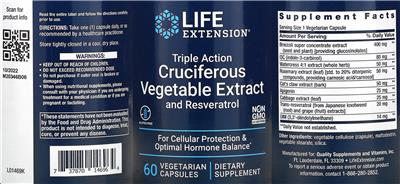
Supplement Facts
The label details for Triple Action Cruciferous Vegetable Extract and Resveratrol by Life Extension, sourced from the NIH Dietary Supplement Label Database.
Supplement Facts
| Ingredient | Amount | % DV |
|---|---|---|
| Apigenin | 25 mg | -- |
| Cat's Claw Bark Extract | 50 mg | -- |
| 3,3'-Diindolymethane | 14 mg | -- |
| l3C | 80 mg | -- |
| Watercress Whole Herb Extract | 50 mg | -- |
| Rosemary Leaf Extract | 50 mg | -- |
| Cabbage Leaf Extract | 25 mg | -- |
| Trans-Resveratrol | 20 mg | -- |
| Broccoli Plant, Seed Extract Concentrate | 400 mg | -- |
Other ingredients: Cellulose, Maltodextrin, Vegetable Stearate, Silica
Tap any ingredient to jump to its full detail below.
These statements are the manufacturer’s wording, reproduced from the product label — the label is saying it, not HelloPharmacist. We don’t verify or endorse them.
General Statements
Scan for product info
Precautions
Read the entire label and follow the directions carefully prior to use.
Warnings: Keep out of reach of children.
Do not exceed recommended dose. Do not purchase if outer seal is broken or damaged.
When using nutritional supplements, please consult with your physician if you are undergoing treatment for a medical condition or if you are pregnant or lactating.
To report a serious adverse event or obtain product information, contact 1-866-280-2852.
Suggested/Recommended/Usage/Directions
Directions: Take one (1) capsule daily, or as recommended by a healthcare practitioner.
Storage
Store tightly closed in a cool, dry place.
FDA Disclaimer Statement
These statements have not been evaluated by the Food and Drug Administration. This product is not intended to diagnose, treat, cure, or prevent any disease.
Formulation
Gluten free Non GMO LE Certified
For cellular protection & optimal hormone balance
Seals/Symbols
Non GMO LE Certified
FDA Statement of Identity
Dietary Supplement
Is this label outdated? Report a formula or label change and our pharmacy team will review it.
Triple Action Cruciferous Vegetable Extract and Resveratrol by Life Extension label
The label scan from the NIH Dietary Supplement Label Database. Tap to enlarge.
Label images are published by the NIH Dietary Supplement Label Database for the version of this product on file. Always read your actual product label.
View the full label (PDF)The Ingredients in Triple Action Cruciferous Vegetable Extract and Resveratrol by Life Extension
These are the 9 active ingredients this product is made of. Select any to open its full monograph.
Serving size1 Vegetarian Capsule(s) Dosage formCapsule Servings per container60 Amounts shown are per serving.
Most supplement products combine several ingredients, and a medication can interact with the product through any one of them. Each ingredient below shows whether it has known drug interactions.
Apigenin
Cat's Claw Bark Extract
Interacts with964 drugs
Cat's claw is a South American vine traditionally used for inflammation, joint pain, and immune support. Some small studies hint it may help with arth...
Cat's Claw Bark Extract monograph & interactions3,3'-Diindolymethane
Interacts with269 drugs
Diindolylmethane (DIM) is a compound made when your body digests cruciferous vegetables, and it is sold as a supplement mainly for hormone balance and...
3,3'-Diindolymethane monograph & interactionsL3C
Interacts with294 drugs
Indole-3-carbinol (I3C) is a compound formed when you eat cruciferous vegetables like broccoli and cabbage, and it is sold as a supplement mainly for...
L3C monograph & interactionsWatercress Whole Herb Extract
Interacts with6 drugs
Watercress is a nutrient-rich leafy green that provides vitamins A, C, and K plus minerals and antioxidant plant compounds. Eaten as a food it is gene...
Watercress Whole Herb Extract monograph & interactionsRosemary Leaf Extract
Interacts with372 drugs
Rosemary is a fragrant Mediterranean herb that is safe and flavorful in normal food amounts. Some early research suggests possible benefits for memory...
Rosemary Leaf Extract monograph & interactionsCabbage Leaf Extract
Interacts with325 drugs
Cabbage is a nutritious, low-calorie vegetable that is safe to eat as food and is sometimes applied to the skin as a leaf wrap for breast engorgement...
Cabbage Leaf Extract monograph & interactionsTrans-Resveratrol
Interacts with824 drugs
Resveratrol is a plant compound found in red grapes, berries, and peanuts that is popular for heart health, anti-aging, and antioxidant support. While...
Trans-Resveratrol monograph & interactionsBroccoli Plant, Seed Extract Concentrate
Interacts with187 drugs
Broccoli is a nutritious cruciferous vegetable rich in fiber, vitamins, and plant compounds like sulforaphane that have drawn scientific interest for...
Broccoli Plant, Seed Extract Concentrate monograph & interactionsOther (inactive) ingredients: Cellulose, Maltodextrin, Vegetable Stearate, Silica. These complete the product’s ingredient list but are not active constituents.
Triple Action Cruciferous Vegetable Extract and Resveratrol by Life Extension Drug Interactions
HelloPharmacist Interaction Report
Life Extension's Triple Action Cruciferous Vegetable Extract and Resveratrol contains several ingredients that interact with medications.
The most serious concerns involve cat's claw bark extract, which can theoretically increase the risk of low blood pressure (hypotension) when combined with blood pressure medications (antihypertensive drugs) or calcium channel blockers — both documented as Moderate severity interactions.
Read the full breakdown — every affected drug type, severity by severity
Cat's claw also interacts with blood thinners and antiplatelet drugs (increasing bleeding risk), drugs metabolized by CYP3A4 liver enzymes (which may affect drug levels), immune-suppressing medications, and nirmatrelvir/ritonavir (Paxlovid), potentially reducing its effectiveness. Resveratrol, indole-3-carbinol (I3C), and broccoli extract can all slow the metabolism of drugs processed by various liver enzymes (CYP1A2, CYP2C19, CYP3A4, and CYP2E1), theoretically raising drug levels.
Indole-3-carbinol, I3C, rosemary leaf extract, and resveratrol may increase bleeding risk with blood thinners. Additionally, diindolylmethane may interfere with hormone therapies (estrogens) and sodium-depleting water pills (diuretics).
Cabbage leaf extract can reduce the effectiveness of blood thinners (warfarin), diabetes drugs, and certain sedatives and pain relievers through enzyme induction or vitamin K content. Rosemary leaf extract may lower blood sugar with diabetes medications and has additive effects with aspirin-type drugs.
Watercress extract can increase lithium levels, interact with a muscle relaxer (chlorzoxazone), and antagonize warfarin's blood-thinning effects due to its vitamin K content.
We could not check apigenin for interactions because no data is held for it. Altogether, these interactions span 1,153 individual medications.
Use the medication checker on this page to verify your specific prescriptions before starting this product.
Check your own medications below · Editorial policy · How we use AI
Want to check YOUR meds against Triple Action Cruciferous Vegetable Extract and Resveratrol?
Ask about interactions with your drugs in plain English — “Can I take it with lisinopril?” — and we find you the answer in seconds, ingredient by ingredient.
Go to the checkerIngredients driving the most interactions
Individual Drug Interactions
The ingredients in Triple Action Cruciferous Vegetable Extract and Resveratrol interact with 1,171 drugs. Click any drug to see the details.
8 of the 9 ingredients in Triple Action Cruciferous Vegetable Extract and Resveratrol interact with drugs. Each result below shows which ingredient is responsible. Cat's Claw Bark Extract Trans-Resveratrol Rosemary Leaf Extract Cabbage Leaf Extract l3C 3,3'-Diindolymethane Broccoli Plant, Seed Extract Concentrate Watercress Whole Herb Extract
6-mercaptopurinePurinethol
How 6-mercaptopurine interacts with Triple Action Cruciferous Vegetable Extract and Resveratrol — through 1 ingredient. Tap an ingredient for the detail:
Cat's Claw Bark ExtractImmunosuppressants Moderate
Interaction Summary
Theoretically, cat's claw might interfere with immunosuppressive therapy.
Read the full Cat's Claw Bark Extract + 6-mercaptopurine interactionAdo-trastuzumab EmtansineKadcyla
How Ado-trastuzumab Emtansine interacts with Triple Action Cruciferous Vegetable Extract and Resveratrol — through 2 ingredients. Tap an ingredient for the detail:
Cat's Claw Bark ExtractCytochrome P450 3a4 (cyp3a4) Substrates Moderate
Interaction Summary
Theoretically, cat's claw might increase or decrease the levels and effects of drugs metabolized by CYP3A4.
Read the full Cat's Claw Bark Extract + Ado-trastuzumab Emtansine interactionTrans-resveratrolCytochrome P450 3a4 (cyp3a4) Substrates Moderate
Interaction Summary
Theoretically, resveratrol might increase levels of drugs metabolized by CYP3A4.
Read the full Trans-resveratrol + Ado-trastuzumab Emtansine interactionAbciximabReoPro
How Abciximab interacts with Triple Action Cruciferous Vegetable Extract and Resveratrol — through 4 ingredients. Tap an ingredient for the detail:
Cat's Claw Bark ExtractAnticoagulant/antiplatelet Drugs Moderate
Interaction Summary
Theoretically, cat's claw may increase the risk of bleeding if used with anticoagulant or antiplatelet drugs.
Read the full Cat's Claw Bark Extract + Abciximab interactionTrans-resveratrolAnticoagulant/antiplatelet Drugs Moderate
Interaction Summary
Resveratrol may have antiplatelet effects and may increase the risk of bleeding if used with anticoagulant or antiplatelet drugs.
Read the full Trans-resveratrol + Abciximab interactionRosemary Leaf ExtractAnticoagulant/antiplatelet Drugs Moderate
Interaction Summary
Theoretically, rosemary may increase the risk of bleeding if used with anticoagulant or antiplatelet drugs.
Read the full Rosemary Leaf Extract + Abciximab interactionL3cAnticoagulant/antiplatelet Drugs Moderate
Interaction Summary
Theoretically, indole-3-carbinol might increase the risk of bleeding when used with antiplatelet or anticoagulant drugs.
Read the full L3c + Abciximab interactionAbemaciclibVerzenio
How Abemaciclib interacts with Triple Action Cruciferous Vegetable Extract and Resveratrol — through 2 ingredients. Tap an ingredient for the detail:
Cat's Claw Bark ExtractCytochrome P450 3a4 (cyp3a4) Substrates Moderate
Interaction Summary
Theoretically, cat's claw might increase or decrease the levels and effects of drugs metabolized by CYP3A4.
Read the full Cat's Claw Bark Extract + Abemaciclib interactionTrans-resveratrolCytochrome P450 3a4 (cyp3a4) Substrates Moderate
Interaction Summary
Theoretically, resveratrol might increase levels of drugs metabolized by CYP3A4.
Read the full Trans-resveratrol + Abemaciclib interactionAbiraterone
How Abiraterone interacts with Triple Action Cruciferous Vegetable Extract and Resveratrol — through 2 ingredients. Tap an ingredient for the detail:
Trans-resveratrolCytochrome P450 3a4 (cyp3a4) Substrates Moderate
Interaction Summary
Theoretically, resveratrol might increase levels of drugs metabolized by CYP3A4.
Read the full Trans-resveratrol + Abiraterone interactionCat's Claw Bark ExtractCytochrome P450 3a4 (cyp3a4) Substrates Moderate
Interaction Summary
Theoretically, cat's claw might increase or decrease the levels and effects of drugs metabolized by CYP3A4.
Read the full Cat's Claw Bark Extract + Abiraterone interactionAbiraterone AcetateYonsa, Zytiga
How Abiraterone Acetate interacts with Triple Action Cruciferous Vegetable Extract and Resveratrol — through 2 ingredients. Tap an ingredient for the detail:
Cat's Claw Bark ExtractCytochrome P450 3a4 (cyp3a4) Substrates Moderate
Interaction Summary
Theoretically, cat's claw might increase or decrease the levels and effects of drugs metabolized by CYP3A4.
Read the full Cat's Claw Bark Extract + Abiraterone Acetate interactionTrans-resveratrolCytochrome P450 3a4 (cyp3a4) Substrates Moderate
Interaction Summary
Theoretically, resveratrol might increase levels of drugs metabolized by CYP3A4.
Read the full Trans-resveratrol + Abiraterone Acetate interactionAbrocitinibCibinqo
How Abrocitinib interacts with Triple Action Cruciferous Vegetable Extract and Resveratrol — through 4 ingredients. Tap an ingredient for the detail:
Trans-resveratrolAnticoagulant/antiplatelet Drugs, Cytochrome P450 2c19 (cyp2c19) Substrates Moderate
Interaction Summary
Resveratrol may have antiplatelet effects and may increase the risk of bleeding if used with anticoagulant or antiplatelet drugs.
Read the full Trans-resveratrol + Abrocitinib interactionCat's Claw Bark ExtractAnticoagulant/antiplatelet Drugs, Immunosuppressants Moderate
Interaction Summary
Theoretically, cat's claw may increase the risk of bleeding if used with anticoagulant or antiplatelet drugs.
Read the full Cat's Claw Bark Extract + Abrocitinib interactionL3cAnticoagulant/antiplatelet Drugs Moderate
Interaction Summary
Theoretically, indole-3-carbinol might increase the risk of bleeding when used with antiplatelet or anticoagulant drugs.
Read the full L3c + Abrocitinib interactionRosemary Leaf ExtractAnticoagulant/antiplatelet Drugs Moderate
Interaction Summary
Theoretically, rosemary may increase the risk of bleeding if used with anticoagulant or antiplatelet drugs.
Read the full Rosemary Leaf Extract + Abrocitinib interactionAcalabrutinibCalquence
How Acalabrutinib interacts with Triple Action Cruciferous Vegetable Extract and Resveratrol — through 2 ingredients. Tap an ingredient for the detail:
Trans-resveratrolCytochrome P450 3a4 (cyp3a4) Substrates Moderate
Interaction Summary
Theoretically, resveratrol might increase levels of drugs metabolized by CYP3A4.
Read the full Trans-resveratrol + Acalabrutinib interactionCat's Claw Bark ExtractCytochrome P450 3a4 (cyp3a4) Substrates Moderate
Interaction Summary
Theoretically, cat's claw might increase or decrease the levels and effects of drugs metabolized by CYP3A4.
Read the full Cat's Claw Bark Extract + Acalabrutinib interactionAcarboseGlucobay, Prandase, Precose
How Acarbose interacts with Triple Action Cruciferous Vegetable Extract and Resveratrol — through 2 ingredients. Tap an ingredient for the detail:
Rosemary Leaf ExtractAntidiabetes Drugs Moderate
Interaction Summary
Theoretically, taking rosemary with antidiabetes drugs might increase the risk of hypoglycemia.
Read the full Rosemary Leaf Extract + Acarbose interactionCabbage Leaf ExtractAntidiabetes Drugs Moderate
Interaction Summary
Theoretically, cabbage might increase the risk of hypoglycemia when taken with antidiabetes drugs.
Read the full Cabbage Leaf Extract + Acarbose interactionAcebutololRhotral, Sectral
How Acebutolol interacts with Triple Action Cruciferous Vegetable Extract and Resveratrol — through 1 ingredient. Tap an ingredient for the detail:
Cat's Claw Bark ExtractAntihypertensive Drugs Moderate
Interaction Summary
Theoretically, taking cat's claw with antihypertensive drugs might increase the risk of hypotension.
Read the full Cat's Claw Bark Extract + Acebutolol interactionAcenocoumarolSintrom
How Acenocoumarol interacts with Triple Action Cruciferous Vegetable Extract and Resveratrol — through 4 ingredients. Tap an ingredient for the detail:
Cat's Claw Bark ExtractAnticoagulant/antiplatelet Drugs Moderate
Interaction Summary
Theoretically, cat's claw may increase the risk of bleeding if used with anticoagulant or antiplatelet drugs.
Read the full Cat's Claw Bark Extract + Acenocoumarol interactionTrans-resveratrolAnticoagulant/antiplatelet Drugs Moderate
Interaction Summary
Resveratrol may have antiplatelet effects and may increase the risk of bleeding if used with anticoagulant or antiplatelet drugs.
Read the full Trans-resveratrol + Acenocoumarol interactionRosemary Leaf ExtractAnticoagulant/antiplatelet Drugs Moderate
Interaction Summary
Theoretically, rosemary may increase the risk of bleeding if used with anticoagulant or antiplatelet drugs.
Read the full Rosemary Leaf Extract + Acenocoumarol interactionL3cAnticoagulant/antiplatelet Drugs Moderate
Interaction Summary
Theoretically, indole-3-carbinol might increase the risk of bleeding when used with antiplatelet or anticoagulant drugs.
Read the full L3c + Acenocoumarol interactionAcetaminophenChildren's Tylenol, Children's Tylenol Meltaways, Tylenol, Tylenol Ex Strength
How Acetaminophen interacts with Triple Action Cruciferous Vegetable Extract and Resveratrol — through 6 ingredients. Tap an ingredient for the detail:
Broccoli Plant, Seed Extract ConcentrateCytochrome P450 1a2 (cyp1a2) Substrates Moderate
Interaction Summary
Theoretically, broccoli might reduce the levels and effects of drugs metabolized by CYP1A2.
Read the full Broccoli Plant, Seed Extract Concentrate + Acetaminophen interactionTrans-resveratrolCytochrome P450 2e1 (cyp2e1) Substrates, Cytochrome P450 1a2 (cyp1a2) Substrates Moderate
Interaction Summary
Resveratrol might increase levels of drugs metabolized by CYP2E1.
Read the full Trans-resveratrol + Acetaminophen interactionL3cCytochrome P450 1a2 (cyp1a2) Substrates Moderate
Interaction Summary
Theoretically, indole-3-carbinol might increase the metabolism of CYP1A2 substrates and lower serum concentrations.
Read the full L3c + Acetaminophen interactionCabbage Leaf ExtractCytochrome P450 1a2 (cyp1a2) Substrates, Glucuronidated Drugs +1 Moderate
Interaction Summary
Theoretically, cabbage might decrease levels of drugs metabolized by CYP1A2.
Read the full Cabbage Leaf Extract + Acetaminophen interaction3,3'-diindolymethaneCytochrome P450 1a2 (cyp1a2) Substrates Minor
Interaction Summary
Theoretically, diindolylmethane might lower serum levels of CYP1A2 substrates.
Read the full 3,3'-diindolymethane + Acetaminophen interactionRosemary Leaf ExtractCytochrome P450 1a2 (cyp1a2) Substrates Minor
Interaction Summary
Theoretically, rosemary might decrease the levels and clinical effects of CYP1A2 substrates.
Read the full Rosemary Leaf Extract + Acetaminophen interactionAcetaminophen, AspirinGemnisyn
How Acetaminophen, Aspirin interacts with Triple Action Cruciferous Vegetable Extract and Resveratrol — through 7 ingredients. Tap an ingredient for the detail:
Cabbage Leaf ExtractGlucuronidated Drugs, Acetaminophen (tylenol, Others) +1 Moderate
Interaction Summary
Theoretically, cabbage might increase clearance and decrease the effects of drugs metabolized through glucuronide conjugation.
Read the full Cabbage Leaf Extract + Acetaminophen, Aspirin interactionRosemary Leaf ExtractCytochrome P450 1a2 (cyp1a2) Substrates, Anticoagulant/antiplatelet Drugs +1 Moderate
Interaction Summary
Theoretically, rosemary might decrease the levels and clinical effects of CYP1A2 substrates.
Read the full Rosemary Leaf Extract + Acetaminophen, Aspirin interactionTrans-resveratrolCytochrome P450 1a2 (cyp1a2) Substrates, Anticoagulant/antiplatelet Drugs +1 Moderate
Interaction Summary
Theoretically, resveratrol might increase levels of drugs metabolized by CYP1A2.
Read the full Trans-resveratrol + Acetaminophen, Aspirin interactionBroccoli Plant, Seed Extract ConcentrateCytochrome P450 1a2 (cyp1a2) Substrates Moderate
Interaction Summary
Theoretically, broccoli might reduce the levels and effects of drugs metabolized by CYP1A2.
Read the full Broccoli Plant, Seed Extract Concentrate + Acetaminophen, Aspirin interactionL3cCytochrome P450 1a2 (cyp1a2) Substrates, Anticoagulant/antiplatelet Drugs Moderate
Interaction Summary
Theoretically, indole-3-carbinol might increase the metabolism of CYP1A2 substrates and lower serum concentrations.
Read the full L3c + Acetaminophen, Aspirin interactionCat's Claw Bark ExtractAnticoagulant/antiplatelet Drugs Moderate
Interaction Summary
Theoretically, cat's claw may increase the risk of bleeding if used with anticoagulant or antiplatelet drugs.
Read the full Cat's Claw Bark Extract + Acetaminophen, Aspirin interaction3,3'-diindolymethaneCytochrome P450 1a2 (cyp1a2) Substrates Minor
Interaction Summary
Theoretically, diindolylmethane might lower serum levels of CYP1A2 substrates.
Read the full 3,3'-diindolymethane + Acetaminophen, Aspirin interactionAcetaminophen, Aspirin, CaffeineExcedrin, Excedrin Extra Strength, Excedrin Migraine
How Acetaminophen, Aspirin, Caffeine interacts with Triple Action Cruciferous Vegetable Extract and Resveratrol — through 7 ingredients. Tap an ingredient for the detail:
Cat's Claw Bark ExtractAnticoagulant/antiplatelet Drugs, Cytochrome P450 3a4 (cyp3a4) Substrates Moderate
Interaction Summary
Theoretically, cat's claw may increase the risk of bleeding if used with anticoagulant or antiplatelet drugs.
Read the full Cat's Claw Bark Extract + Acetaminophen, Aspirin, Caffeine interactionL3cCytochrome P450 1a2 (cyp1a2) Substrates, Anticoagulant/antiplatelet Drugs Moderate
Interaction Summary
Theoretically, indole-3-carbinol might increase the metabolism of CYP1A2 substrates and lower serum concentrations.
Read the full L3c + Acetaminophen, Aspirin, Caffeine interactionTrans-resveratrolAnticoagulant/antiplatelet Drugs, Cytochrome P450 2e1 (cyp2e1) Substrates +2 Moderate
Interaction Summary
Resveratrol may have antiplatelet effects and may increase the risk of bleeding if used with anticoagulant or antiplatelet drugs.
Read the full Trans-resveratrol + Acetaminophen, Aspirin, Caffeine interactionCabbage Leaf ExtractCytochrome P450 1a2 (cyp1a2) Substrates, Glucuronidated Drugs +1 Moderate
Interaction Summary
Theoretically, cabbage might decrease levels of drugs metabolized by CYP1A2.
Read the full Cabbage Leaf Extract + Acetaminophen, Aspirin, Caffeine interactionRosemary Leaf ExtractAspirin, Cytochrome P450 1a2 (cyp1a2) Substrates +1 Moderate
Interaction Summary
Theoretically, rosemary might have additive effects with salicylate-containing drugs such as aspirin.
Read the full Rosemary Leaf Extract + Acetaminophen, Aspirin, Caffeine interactionBroccoli Plant, Seed Extract ConcentrateCytochrome P450 1a2 (cyp1a2) Substrates Moderate
Interaction Summary
Theoretically, broccoli might reduce the levels and effects of drugs metabolized by CYP1A2.
Read the full Broccoli Plant, Seed Extract Concentrate + Acetaminophen, Aspirin, Caffeine interaction3,3'-diindolymethaneCytochrome P450 1a2 (cyp1a2) Substrates Minor
Interaction Summary
Theoretically, diindolylmethane might lower serum levels of CYP1A2 substrates.
Read the full 3,3'-diindolymethane + Acetaminophen, Aspirin, Caffeine interactionAcetaminophen, Brompheniramine, PhenylpropanolamineDimetapp Cold and Flu
How Acetaminophen, Brompheniramine, Phenylpropanolamine interacts with Triple Action Cruciferous Vegetable Extract and Resveratrol — through 6 ingredients. Tap an ingredient for the detail:
L3cCytochrome P450 1a2 (cyp1a2) Substrates Moderate
Interaction Summary
Theoretically, indole-3-carbinol might increase the metabolism of CYP1A2 substrates and lower serum concentrations.
Read the full L3c + Acetaminophen, Brompheniramine, Phenylpropanolamine interactionBroccoli Plant, Seed Extract ConcentrateCytochrome P450 1a2 (cyp1a2) Substrates Moderate
Interaction Summary
Theoretically, broccoli might reduce the levels and effects of drugs metabolized by CYP1A2.
Read the full Broccoli Plant, Seed Extract Concentrate + Acetaminophen, Brompheniramine, Phenylpropanolamine interactionTrans-resveratrolCytochrome P450 2e1 (cyp2e1) Substrates, Cytochrome P450 1a2 (cyp1a2) Substrates Moderate
Interaction Summary
Resveratrol might increase levels of drugs metabolized by CYP2E1.
Read the full Trans-resveratrol + Acetaminophen, Brompheniramine, Phenylpropanolamine interactionCabbage Leaf ExtractGlucuronidated Drugs, Acetaminophen (tylenol, Others) +1 Moderate
Interaction Summary
Theoretically, cabbage might increase clearance and decrease the effects of drugs metabolized through glucuronide conjugation.
Read the full Cabbage Leaf Extract + Acetaminophen, Brompheniramine, Phenylpropanolamine interaction3,3'-diindolymethaneCytochrome P450 1a2 (cyp1a2) Substrates Minor
Interaction Summary
Theoretically, diindolylmethane might lower serum levels of CYP1A2 substrates.
Read the full 3,3'-diindolymethane + Acetaminophen, Brompheniramine, Phenylpropanolamine interactionRosemary Leaf ExtractCytochrome P450 1a2 (cyp1a2) Substrates Minor
Interaction Summary
Theoretically, rosemary might decrease the levels and clinical effects of CYP1A2 substrates.
Read the full Rosemary Leaf Extract + Acetaminophen, Brompheniramine, Phenylpropanolamine interactionAcetaminophen, ButalbitalAxocet, Bancap, Bucet, Butex Forte, Esgic CF, Orbivan CF +5 more
How Acetaminophen, Butalbital interacts with Triple Action Cruciferous Vegetable Extract and Resveratrol — through 6 ingredients. Tap an ingredient for the detail:
Cabbage Leaf ExtractGlucuronidated Drugs, Acetaminophen (tylenol, Others) +1 Moderate
Interaction Summary
Theoretically, cabbage might increase clearance and decrease the effects of drugs metabolized through glucuronide conjugation.
Read the full Cabbage Leaf Extract + Acetaminophen, Butalbital interactionTrans-resveratrolCytochrome P450 1a2 (cyp1a2) Substrates, Cytochrome P450 2e1 (cyp2e1) Substrates Moderate
Interaction Summary
Theoretically, resveratrol might increase levels of drugs metabolized by CYP1A2.
Read the full Trans-resveratrol + Acetaminophen, Butalbital interactionBroccoli Plant, Seed Extract ConcentrateCytochrome P450 1a2 (cyp1a2) Substrates Moderate
Interaction Summary
Theoretically, broccoli might reduce the levels and effects of drugs metabolized by CYP1A2.
Read the full Broccoli Plant, Seed Extract Concentrate + Acetaminophen, Butalbital interactionL3cCytochrome P450 1a2 (cyp1a2) Substrates Moderate
Interaction Summary
Theoretically, indole-3-carbinol might increase the metabolism of CYP1A2 substrates and lower serum concentrations.
Read the full L3c + Acetaminophen, Butalbital interactionRosemary Leaf ExtractCytochrome P450 1a2 (cyp1a2) Substrates Minor
Interaction Summary
Theoretically, rosemary might decrease the levels and clinical effects of CYP1A2 substrates.
Read the full Rosemary Leaf Extract + Acetaminophen, Butalbital interaction3,3'-diindolymethaneCytochrome P450 1a2 (cyp1a2) Substrates Minor
Interaction Summary
Theoretically, diindolylmethane might lower serum levels of CYP1A2 substrates.
Read the full 3,3'-diindolymethane + Acetaminophen, Butalbital interactionAcetaminophen, Butalbital, CaffeineEsgic, Esgic Plus, Fiogesic, Fioricet, Repan, Tecnal +1 more
How Acetaminophen, Butalbital, Caffeine interacts with Triple Action Cruciferous Vegetable Extract and Resveratrol — through 7 ingredients. Tap an ingredient for the detail:
Trans-resveratrolCytochrome P450 2e1 (cyp2e1) Substrates, Cytochrome P450 1a2 (cyp1a2) Substrates +1 Moderate
Interaction Summary
Resveratrol might increase levels of drugs metabolized by CYP2E1.
Read the full Trans-resveratrol + Acetaminophen, Butalbital, Caffeine interactionCat's Claw Bark ExtractCytochrome P450 3a4 (cyp3a4) Substrates Moderate
Interaction Summary
Theoretically, cat's claw might increase or decrease the levels and effects of drugs metabolized by CYP3A4.
Read the full Cat's Claw Bark Extract + Acetaminophen, Butalbital, Caffeine interactionCabbage Leaf ExtractGlucuronidated Drugs, Acetaminophen (tylenol, Others) +1 Moderate
Interaction Summary
Theoretically, cabbage might increase clearance and decrease the effects of drugs metabolized through glucuronide conjugation.
Read the full Cabbage Leaf Extract + Acetaminophen, Butalbital, Caffeine interactionL3cCytochrome P450 1a2 (cyp1a2) Substrates Moderate
Interaction Summary
Theoretically, indole-3-carbinol might increase the metabolism of CYP1A2 substrates and lower serum concentrations.
Read the full L3c + Acetaminophen, Butalbital, Caffeine interactionBroccoli Plant, Seed Extract ConcentrateCytochrome P450 1a2 (cyp1a2) Substrates Moderate
Interaction Summary
Theoretically, broccoli might reduce the levels and effects of drugs metabolized by CYP1A2.
Read the full Broccoli Plant, Seed Extract Concentrate + Acetaminophen, Butalbital, Caffeine interactionRosemary Leaf ExtractCytochrome P450 1a2 (cyp1a2) Substrates Minor
Interaction Summary
Theoretically, rosemary might decrease the levels and clinical effects of CYP1A2 substrates.
Read the full Rosemary Leaf Extract + Acetaminophen, Butalbital, Caffeine interaction3,3'-diindolymethaneCytochrome P450 1a2 (cyp1a2) Substrates Minor
Interaction Summary
Theoretically, diindolylmethane might lower serum levels of CYP1A2 substrates.
Read the full 3,3'-diindolymethane + Acetaminophen, Butalbital, Caffeine interactionAcetaminophen, Butalbital, Caffeine, CodeineEsgic with Codeine, Fioricet w/ Codeine
How Acetaminophen, Butalbital, Caffeine, Codeine interacts with Triple Action Cruciferous Vegetable Extract and Resveratrol — through 7 ingredients. Tap an ingredient for the detail:
Broccoli Plant, Seed Extract ConcentrateCytochrome P450 1a2 (cyp1a2) Substrates Moderate
Interaction Summary
Theoretically, broccoli might reduce the levels and effects of drugs metabolized by CYP1A2.
Read the full Broccoli Plant, Seed Extract Concentrate + Acetaminophen, Butalbital, Caffeine, Codeine interactionL3cCytochrome P450 1a2 (cyp1a2) Substrates Moderate
Interaction Summary
Theoretically, indole-3-carbinol might increase the metabolism of CYP1A2 substrates and lower serum concentrations.
Read the full L3c + Acetaminophen, Butalbital, Caffeine, Codeine interactionCat's Claw Bark ExtractCytochrome P450 3a4 (cyp3a4) Substrates Moderate
Interaction Summary
Theoretically, cat's claw might increase or decrease the levels and effects of drugs metabolized by CYP3A4.
Read the full Cat's Claw Bark Extract + Acetaminophen, Butalbital, Caffeine, Codeine interactionTrans-resveratrolCytochrome P450 2e1 (cyp2e1) Substrates, Cytochrome P450 3a4 (cyp3a4) Substrates +1 Moderate
Interaction Summary
Resveratrol might increase levels of drugs metabolized by CYP2E1.
Read the full Trans-resveratrol + Acetaminophen, Butalbital, Caffeine, Codeine interactionCabbage Leaf ExtractCytochrome P450 1a2 (cyp1a2) Substrates, Glucuronidated Drugs +1 Moderate
Interaction Summary
Theoretically, cabbage might decrease levels of drugs metabolized by CYP1A2.
Read the full Cabbage Leaf Extract + Acetaminophen, Butalbital, Caffeine, Codeine interaction3,3'-diindolymethaneCytochrome P450 1a2 (cyp1a2) Substrates Minor
Interaction Summary
Theoretically, diindolylmethane might lower serum levels of CYP1A2 substrates.
Read the full 3,3'-diindolymethane + Acetaminophen, Butalbital, Caffeine, Codeine interactionRosemary Leaf ExtractCytochrome P450 1a2 (cyp1a2) Substrates Minor
Interaction Summary
Theoretically, rosemary might decrease the levels and clinical effects of CYP1A2 substrates.
Read the full Rosemary Leaf Extract + Acetaminophen, Butalbital, Caffeine, Codeine interactionAcetaminophen, Butalbital, CodeineBancap w/ Codeine
How Acetaminophen, Butalbital, Codeine interacts with Triple Action Cruciferous Vegetable Extract and Resveratrol — through 6 ingredients. Tap an ingredient for the detail:
Trans-resveratrolCytochrome P450 1a2 (cyp1a2) Substrates, Cytochrome P450 2e1 (cyp2e1) Substrates Moderate
Interaction Summary
Theoretically, resveratrol might increase levels of drugs metabolized by CYP1A2.
Read the full Trans-resveratrol + Acetaminophen, Butalbital, Codeine interactionCabbage Leaf ExtractCytochrome P450 1a2 (cyp1a2) Substrates, Glucuronidated Drugs +1 Moderate
Interaction Summary
Theoretically, cabbage might decrease levels of drugs metabolized by CYP1A2.
Read the full Cabbage Leaf Extract + Acetaminophen, Butalbital, Codeine interactionBroccoli Plant, Seed Extract ConcentrateCytochrome P450 1a2 (cyp1a2) Substrates Moderate
Interaction Summary
Theoretically, broccoli might reduce the levels and effects of drugs metabolized by CYP1A2.
Read the full Broccoli Plant, Seed Extract Concentrate + Acetaminophen, Butalbital, Codeine interactionL3cCytochrome P450 1a2 (cyp1a2) Substrates Moderate
Interaction Summary
Theoretically, indole-3-carbinol might increase the metabolism of CYP1A2 substrates and lower serum concentrations.
Read the full L3c + Acetaminophen, Butalbital, Codeine interactionRosemary Leaf ExtractCytochrome P450 1a2 (cyp1a2) Substrates Minor
Interaction Summary
Theoretically, rosemary might decrease the levels and clinical effects of CYP1A2 substrates.
Read the full Rosemary Leaf Extract + Acetaminophen, Butalbital, Codeine interaction3,3'-diindolymethaneCytochrome P450 1a2 (cyp1a2) Substrates Minor
Interaction Summary
Theoretically, diindolylmethane might lower serum levels of CYP1A2 substrates.
Read the full 3,3'-diindolymethane + Acetaminophen, Butalbital, Codeine interactionAcetaminophen, Butalbital, Codeine PhosphatePhrenilin #3
How Acetaminophen, Butalbital, Codeine Phosphate interacts with Triple Action Cruciferous Vegetable Extract and Resveratrol — through 6 ingredients. Tap an ingredient for the detail:
Trans-resveratrolCytochrome P450 2e1 (cyp2e1) Substrates, Cytochrome P450 1a2 (cyp1a2) Substrates Moderate
Interaction Summary
Resveratrol might increase levels of drugs metabolized by CYP2E1.
Read the full Trans-resveratrol + Acetaminophen, Butalbital, Codeine Phosphate interactionCabbage Leaf ExtractGlucuronidated Drugs, Acetaminophen (tylenol, Others) +1 Moderate
Interaction Summary
Theoretically, cabbage might increase clearance and decrease the effects of drugs metabolized through glucuronide conjugation.
Read the full Cabbage Leaf Extract + Acetaminophen, Butalbital, Codeine Phosphate interactionL3cCytochrome P450 1a2 (cyp1a2) Substrates Moderate
Interaction Summary
Theoretically, indole-3-carbinol might increase the metabolism of CYP1A2 substrates and lower serum concentrations.
Read the full L3c + Acetaminophen, Butalbital, Codeine Phosphate interactionBroccoli Plant, Seed Extract ConcentrateCytochrome P450 1a2 (cyp1a2) Substrates Moderate
Interaction Summary
Theoretically, broccoli might reduce the levels and effects of drugs metabolized by CYP1A2.
Read the full Broccoli Plant, Seed Extract Concentrate + Acetaminophen, Butalbital, Codeine Phosphate interactionRosemary Leaf ExtractCytochrome P450 1a2 (cyp1a2) Substrates Minor
Interaction Summary
Theoretically, rosemary might decrease the levels and clinical effects of CYP1A2 substrates.
Read the full Rosemary Leaf Extract + Acetaminophen, Butalbital, Codeine Phosphate interaction3,3'-diindolymethaneCytochrome P450 1a2 (cyp1a2) Substrates Minor
Interaction Summary
Theoretically, diindolylmethane might lower serum levels of CYP1A2 substrates.
Read the full 3,3'-diindolymethane + Acetaminophen, Butalbital, Codeine Phosphate interactionAcetaminophen, Caffeine, Chlorpheniramine, Hydrocodone, PhenylephrineHycomine Compound
How Acetaminophen, Caffeine, Chlorpheniramine, Hydrocodone, Phenylephrine interacts with Triple Action Cruciferous Vegetable Extract and Resveratrol — through 7 ingredients. Tap an ingredient for the detail:
Broccoli Plant, Seed Extract ConcentrateCytochrome P450 1a2 (cyp1a2) Substrates Moderate
Interaction Summary
Theoretically, broccoli might reduce the levels and effects of drugs metabolized by CYP1A2.
Read the full Broccoli Plant, Seed Extract Concentrate + Acetaminophen, Caffeine, Chlorpheniramine, Hydrocodone, Phenylephrine interactionTrans-resveratrolCytochrome P450 2e1 (cyp2e1) Substrates, Cytochrome P450 1a2 (cyp1a2) Substrates +1 Moderate
Interaction Summary
Resveratrol might increase levels of drugs metabolized by CYP2E1.
Read the full Trans-resveratrol + Acetaminophen, Caffeine, Chlorpheniramine, Hydrocodone, Phenylephrine interactionL3cCytochrome P450 1a2 (cyp1a2) Substrates Moderate
Interaction Summary
Theoretically, indole-3-carbinol might increase the metabolism of CYP1A2 substrates and lower serum concentrations.
Read the full L3c + Acetaminophen, Caffeine, Chlorpheniramine, Hydrocodone, Phenylephrine interactionCat's Claw Bark ExtractCytochrome P450 3a4 (cyp3a4) Substrates Moderate
Interaction Summary
Theoretically, cat's claw might increase or decrease the levels and effects of drugs metabolized by CYP3A4.
Read the full Cat's Claw Bark Extract + Acetaminophen, Caffeine, Chlorpheniramine, Hydrocodone, Phenylephrine interactionCabbage Leaf ExtractCytochrome P450 1a2 (cyp1a2) Substrates, Glucuronidated Drugs +1 Moderate
Interaction Summary
Theoretically, cabbage might decrease levels of drugs metabolized by CYP1A2.
Read the full Cabbage Leaf Extract + Acetaminophen, Caffeine, Chlorpheniramine, Hydrocodone, Phenylephrine interaction3,3'-diindolymethaneCytochrome P450 1a2 (cyp1a2) Substrates Minor
Interaction Summary
Theoretically, diindolylmethane might lower serum levels of CYP1A2 substrates.
Read the full 3,3'-diindolymethane + Acetaminophen, Caffeine, Chlorpheniramine, Hydrocodone, Phenylephrine interactionRosemary Leaf ExtractCytochrome P450 1a2 (cyp1a2) Substrates Minor
Interaction Summary
Theoretically, rosemary might decrease the levels and clinical effects of CYP1A2 substrates.
Read the full Rosemary Leaf Extract + Acetaminophen, Caffeine, Chlorpheniramine, Hydrocodone, Phenylephrine interactionAcetaminophen, Caffeine, CodeineGesic C15, Gesic C30, Gesic C8, Lenoltec 1, Lenoltec 2, Lenoltec 3 +1 more
How Acetaminophen, Caffeine, Codeine interacts with Triple Action Cruciferous Vegetable Extract and Resveratrol — through 7 ingredients. Tap an ingredient for the detail:
Cabbage Leaf ExtractGlucuronidated Drugs, Acetaminophen (tylenol, Others) +1 Moderate
Interaction Summary
Theoretically, cabbage might increase clearance and decrease the effects of drugs metabolized through glucuronide conjugation.
Read the full Cabbage Leaf Extract + Acetaminophen, Caffeine, Codeine interactionTrans-resveratrolCytochrome P450 1a2 (cyp1a2) Substrates, Cytochrome P450 3a4 (cyp3a4) Substrates +1 Moderate
Interaction Summary
Theoretically, resveratrol might increase levels of drugs metabolized by CYP1A2.
Read the full Trans-resveratrol + Acetaminophen, Caffeine, Codeine interactionBroccoli Plant, Seed Extract ConcentrateCytochrome P450 1a2 (cyp1a2) Substrates Moderate
Interaction Summary
Theoretically, broccoli might reduce the levels and effects of drugs metabolized by CYP1A2.
Read the full Broccoli Plant, Seed Extract Concentrate + Acetaminophen, Caffeine, Codeine interactionCat's Claw Bark ExtractCytochrome P450 3a4 (cyp3a4) Substrates Moderate
Interaction Summary
Theoretically, cat's claw might increase or decrease the levels and effects of drugs metabolized by CYP3A4.
Read the full Cat's Claw Bark Extract + Acetaminophen, Caffeine, Codeine interactionL3cCytochrome P450 1a2 (cyp1a2) Substrates Moderate
Interaction Summary
Theoretically, indole-3-carbinol might increase the metabolism of CYP1A2 substrates and lower serum concentrations.
Read the full L3c + Acetaminophen, Caffeine, Codeine interactionRosemary Leaf ExtractCytochrome P450 1a2 (cyp1a2) Substrates Minor
Interaction Summary
Theoretically, rosemary might decrease the levels and clinical effects of CYP1A2 substrates.
Read the full Rosemary Leaf Extract + Acetaminophen, Caffeine, Codeine interaction3,3'-diindolymethaneCytochrome P450 1a2 (cyp1a2) Substrates Minor
Interaction Summary
Theoretically, diindolylmethane might lower serum levels of CYP1A2 substrates.
Read the full 3,3'-diindolymethane + Acetaminophen, Caffeine, Codeine interactionAcetaminophen, Caffeine, Codeine, SalicylamideCodalan No.1, Codalan No.2, Codalan No.3
How Acetaminophen, Caffeine, Codeine, Salicylamide interacts with Triple Action Cruciferous Vegetable Extract and Resveratrol — through 7 ingredients. Tap an ingredient for the detail:
Trans-resveratrolCytochrome P450 2e1 (cyp2e1) Substrates, Cytochrome P450 3a4 (cyp3a4) Substrates +1 Moderate
Interaction Summary
Resveratrol might increase levels of drugs metabolized by CYP2E1.
Read the full Trans-resveratrol + Acetaminophen, Caffeine, Codeine, Salicylamide interactionCat's Claw Bark ExtractCytochrome P450 3a4 (cyp3a4) Substrates Moderate
Interaction Summary
Theoretically, cat's claw might increase or decrease the levels and effects of drugs metabolized by CYP3A4.
Read the full Cat's Claw Bark Extract + Acetaminophen, Caffeine, Codeine, Salicylamide interactionCabbage Leaf ExtractCytochrome P450 1a2 (cyp1a2) Substrates, Glucuronidated Drugs +1 Moderate
Interaction Summary
Theoretically, cabbage might decrease levels of drugs metabolized by CYP1A2.
Read the full Cabbage Leaf Extract + Acetaminophen, Caffeine, Codeine, Salicylamide interactionBroccoli Plant, Seed Extract ConcentrateCytochrome P450 1a2 (cyp1a2) Substrates Moderate
Interaction Summary
Theoretically, broccoli might reduce the levels and effects of drugs metabolized by CYP1A2.
Read the full Broccoli Plant, Seed Extract Concentrate + Acetaminophen, Caffeine, Codeine, Salicylamide interactionL3cCytochrome P450 1a2 (cyp1a2) Substrates Moderate
Interaction Summary
Theoretically, indole-3-carbinol might increase the metabolism of CYP1A2 substrates and lower serum concentrations.
Read the full L3c + Acetaminophen, Caffeine, Codeine, Salicylamide interactionRosemary Leaf ExtractCytochrome P450 1a2 (cyp1a2) Substrates Minor
Interaction Summary
Theoretically, rosemary might decrease the levels and clinical effects of CYP1A2 substrates.
Read the full Rosemary Leaf Extract + Acetaminophen, Caffeine, Codeine, Salicylamide interaction3,3'-diindolymethaneCytochrome P450 1a2 (cyp1a2) Substrates Minor
Interaction Summary
Theoretically, diindolylmethane might lower serum levels of CYP1A2 substrates.
Read the full 3,3'-diindolymethane + Acetaminophen, Caffeine, Codeine, Salicylamide interactionAcetaminophen, Caffeine, DihydrocodeineDHC Plus, Panlor DC, Panlor SS
How Acetaminophen, Caffeine, Dihydrocodeine interacts with Triple Action Cruciferous Vegetable Extract and Resveratrol — through 7 ingredients. Tap an ingredient for the detail:
L3cCytochrome P450 1a2 (cyp1a2) Substrates Moderate
Interaction Summary
Theoretically, indole-3-carbinol might increase the metabolism of CYP1A2 substrates and lower serum concentrations.
Read the full L3c + Acetaminophen, Caffeine, Dihydrocodeine interactionBroccoli Plant, Seed Extract ConcentrateCytochrome P450 1a2 (cyp1a2) Substrates Moderate
Interaction Summary
Theoretically, broccoli might reduce the levels and effects of drugs metabolized by CYP1A2.
Read the full Broccoli Plant, Seed Extract Concentrate + Acetaminophen, Caffeine, Dihydrocodeine interactionCat's Claw Bark ExtractCytochrome P450 3a4 (cyp3a4) Substrates Moderate
Interaction Summary
Theoretically, cat's claw might increase or decrease the levels and effects of drugs metabolized by CYP3A4.
Read the full Cat's Claw Bark Extract + Acetaminophen, Caffeine, Dihydrocodeine interactionTrans-resveratrolCytochrome P450 2e1 (cyp2e1) Substrates, Cytochrome P450 1a2 (cyp1a2) Substrates +1 Moderate
Interaction Summary
Resveratrol might increase levels of drugs metabolized by CYP2E1.
Read the full Trans-resveratrol + Acetaminophen, Caffeine, Dihydrocodeine interactionCabbage Leaf ExtractCytochrome P450 1a2 (cyp1a2) Substrates, Glucuronidated Drugs +1 Moderate
Interaction Summary
Theoretically, cabbage might decrease levels of drugs metabolized by CYP1A2.
Read the full Cabbage Leaf Extract + Acetaminophen, Caffeine, Dihydrocodeine interaction3,3'-diindolymethaneCytochrome P450 1a2 (cyp1a2) Substrates Minor
Interaction Summary
Theoretically, diindolylmethane might lower serum levels of CYP1A2 substrates.
Read the full 3,3'-diindolymethane + Acetaminophen, Caffeine, Dihydrocodeine interactionRosemary Leaf ExtractCytochrome P450 1a2 (cyp1a2) Substrates Minor
Interaction Summary
Theoretically, rosemary might decrease the levels and clinical effects of CYP1A2 substrates.
Read the full Rosemary Leaf Extract + Acetaminophen, Caffeine, Dihydrocodeine interactionAcetaminophen, Caffeine, IsomethepteneMigralam
How Acetaminophen, Caffeine, Isometheptene interacts with Triple Action Cruciferous Vegetable Extract and Resveratrol — through 7 ingredients. Tap an ingredient for the detail:
Cabbage Leaf ExtractGlucuronidated Drugs, Acetaminophen (tylenol, Others) +1 Moderate
Interaction Summary
Theoretically, cabbage might increase clearance and decrease the effects of drugs metabolized through glucuronide conjugation.
Read the full Cabbage Leaf Extract + Acetaminophen, Caffeine, Isometheptene interactionTrans-resveratrolCytochrome P450 3a4 (cyp3a4) Substrates, Cytochrome P450 1a2 (cyp1a2) Substrates +1 Moderate
Interaction Summary
Theoretically, resveratrol might increase levels of drugs metabolized by CYP3A4.
Read the full Trans-resveratrol + Acetaminophen, Caffeine, Isometheptene interactionBroccoli Plant, Seed Extract ConcentrateCytochrome P450 1a2 (cyp1a2) Substrates Moderate
Interaction Summary
Theoretically, broccoli might reduce the levels and effects of drugs metabolized by CYP1A2.
Read the full Broccoli Plant, Seed Extract Concentrate + Acetaminophen, Caffeine, Isometheptene interactionL3cCytochrome P450 1a2 (cyp1a2) Substrates Moderate
Interaction Summary
Theoretically, indole-3-carbinol might increase the metabolism of CYP1A2 substrates and lower serum concentrations.
Read the full L3c + Acetaminophen, Caffeine, Isometheptene interactionCat's Claw Bark ExtractCytochrome P450 3a4 (cyp3a4) Substrates Moderate
Interaction Summary
Theoretically, cat's claw might increase or decrease the levels and effects of drugs metabolized by CYP3A4.
Read the full Cat's Claw Bark Extract + Acetaminophen, Caffeine, Isometheptene interactionRosemary Leaf ExtractCytochrome P450 1a2 (cyp1a2) Substrates Minor
Interaction Summary
Theoretically, rosemary might decrease the levels and clinical effects of CYP1A2 substrates.
Read the full Rosemary Leaf Extract + Acetaminophen, Caffeine, Isometheptene interaction3,3'-diindolymethaneCytochrome P450 1a2 (cyp1a2) Substrates Minor
Interaction Summary
Theoretically, diindolylmethane might lower serum levels of CYP1A2 substrates.
Read the full 3,3'-diindolymethane + Acetaminophen, Caffeine, Isometheptene interactionAcetaminophen, Caffeine, PyrilamineMidol Max Strength Menstrual
How Acetaminophen, Caffeine, Pyrilamine interacts with Triple Action Cruciferous Vegetable Extract and Resveratrol — through 7 ingredients. Tap an ingredient for the detail:
Cat's Claw Bark ExtractCytochrome P450 3a4 (cyp3a4) Substrates Moderate
Interaction Summary
Theoretically, cat's claw might increase or decrease the levels and effects of drugs metabolized by CYP3A4.
Read the full Cat's Claw Bark Extract + Acetaminophen, Caffeine, Pyrilamine interactionTrans-resveratrolCytochrome P450 2e1 (cyp2e1) Substrates, Cytochrome P450 1a2 (cyp1a2) Substrates +1 Moderate
Interaction Summary
Resveratrol might increase levels of drugs metabolized by CYP2E1.
Read the full Trans-resveratrol + Acetaminophen, Caffeine, Pyrilamine interactionCabbage Leaf ExtractCytochrome P450 1a2 (cyp1a2) Substrates, Glucuronidated Drugs +1 Moderate
Interaction Summary
Theoretically, cabbage might decrease levels of drugs metabolized by CYP1A2.
Read the full Cabbage Leaf Extract + Acetaminophen, Caffeine, Pyrilamine interaction3,3'-diindolymethaneCytochrome P450 1a2 (cyp1a2) Substrates, Diuretic Drugs Moderate
Interaction Summary
Theoretically, diindolylmethane might lower serum levels of CYP1A2 substrates.
Read the full 3,3'-diindolymethane + Acetaminophen, Caffeine, Pyrilamine interactionBroccoli Plant, Seed Extract ConcentrateCytochrome P450 1a2 (cyp1a2) Substrates Moderate
Interaction Summary
Theoretically, broccoli might reduce the levels and effects of drugs metabolized by CYP1A2.
Read the full Broccoli Plant, Seed Extract Concentrate + Acetaminophen, Caffeine, Pyrilamine interactionL3cCytochrome P450 1a2 (cyp1a2) Substrates Moderate
Interaction Summary
Theoretically, indole-3-carbinol might increase the metabolism of CYP1A2 substrates and lower serum concentrations.
Read the full L3c + Acetaminophen, Caffeine, Pyrilamine interactionRosemary Leaf ExtractCytochrome P450 1a2 (cyp1a2) Substrates Minor
Interaction Summary
Theoretically, rosemary might decrease the levels and clinical effects of CYP1A2 substrates.
Read the full Rosemary Leaf Extract + Acetaminophen, Caffeine, Pyrilamine interactionAcetaminophen, Chlorpheniramine Maleate, Dextromethorphan HbrVicks Formula 44M Cough, Cold & Flu Relief
How Acetaminophen, Chlorpheniramine Maleate, Dextromethorphan Hbr interacts with Triple Action Cruciferous Vegetable Extract and Resveratrol — through 7 ingredients. Tap an ingredient for the detail:
L3cCytochrome P450 1a2 (cyp1a2) Substrates Moderate
Interaction Summary
Theoretically, indole-3-carbinol might increase the metabolism of CYP1A2 substrates and lower serum concentrations.
Read the full L3c + Acetaminophen, Chlorpheniramine Maleate, Dextromethorphan Hbr interactionBroccoli Plant, Seed Extract ConcentrateCytochrome P450 1a2 (cyp1a2) Substrates Moderate
Interaction Summary
Theoretically, broccoli might reduce the levels and effects of drugs metabolized by CYP1A2.
Read the full Broccoli Plant, Seed Extract Concentrate + Acetaminophen, Chlorpheniramine Maleate, Dextromethorphan Hbr interactionTrans-resveratrolCytochrome P450 2e1 (cyp2e1) Substrates, Cytochrome P450 1a2 (cyp1a2) Substrates +1 Moderate
Interaction Summary
Resveratrol might increase levels of drugs metabolized by CYP2E1.
Read the full Trans-resveratrol + Acetaminophen, Chlorpheniramine Maleate, Dextromethorphan Hbr interactionCat's Claw Bark ExtractCytochrome P450 3a4 (cyp3a4) Substrates Moderate
Interaction Summary
Theoretically, cat's claw might increase or decrease the levels and effects of drugs metabolized by CYP3A4.
Read the full Cat's Claw Bark Extract + Acetaminophen, Chlorpheniramine Maleate, Dextromethorphan Hbr interactionCabbage Leaf ExtractGlucuronidated Drugs, Acetaminophen (tylenol, Others) +1 Moderate
Interaction Summary
Theoretically, cabbage might increase clearance and decrease the effects of drugs metabolized through glucuronide conjugation.
Read the full Cabbage Leaf Extract + Acetaminophen, Chlorpheniramine Maleate, Dextromethorphan Hbr interaction3,3'-diindolymethaneCytochrome P450 1a2 (cyp1a2) Substrates Minor
Interaction Summary
Theoretically, diindolylmethane might lower serum levels of CYP1A2 substrates.
Read the full 3,3'-diindolymethane + Acetaminophen, Chlorpheniramine Maleate, Dextromethorphan Hbr interactionRosemary Leaf ExtractCytochrome P450 1a2 (cyp1a2) Substrates Minor
Interaction Summary
Theoretically, rosemary might decrease the levels and clinical effects of CYP1A2 substrates.
Read the full Rosemary Leaf Extract + Acetaminophen, Chlorpheniramine Maleate, Dextromethorphan Hbr interactionAcetaminophen, Chlorpheniramine, Codeine, PhenylephrineColrex
How Acetaminophen, Chlorpheniramine, Codeine, Phenylephrine interacts with Triple Action Cruciferous Vegetable Extract and Resveratrol — through 7 ingredients. Tap an ingredient for the detail:
Cabbage Leaf ExtractGlucuronidated Drugs, Acetaminophen (tylenol, Others) +1 Moderate
Interaction Summary
Theoretically, cabbage might increase clearance and decrease the effects of drugs metabolized through glucuronide conjugation.
Read the full Cabbage Leaf Extract + Acetaminophen, Chlorpheniramine, Codeine, Phenylephrine interactionTrans-resveratrolCytochrome P450 1a2 (cyp1a2) Substrates, Cytochrome P450 3a4 (cyp3a4) Substrates +1 Moderate
Interaction Summary
Theoretically, resveratrol might increase levels of drugs metabolized by CYP1A2.
Read the full Trans-resveratrol + Acetaminophen, Chlorpheniramine, Codeine, Phenylephrine interactionBroccoli Plant, Seed Extract ConcentrateCytochrome P450 1a2 (cyp1a2) Substrates Moderate
Interaction Summary
Theoretically, broccoli might reduce the levels and effects of drugs metabolized by CYP1A2.
Read the full Broccoli Plant, Seed Extract Concentrate + Acetaminophen, Chlorpheniramine, Codeine, Phenylephrine interactionCat's Claw Bark ExtractCytochrome P450 3a4 (cyp3a4) Substrates Moderate
Interaction Summary
Theoretically, cat's claw might increase or decrease the levels and effects of drugs metabolized by CYP3A4.
Read the full Cat's Claw Bark Extract + Acetaminophen, Chlorpheniramine, Codeine, Phenylephrine interactionL3cCytochrome P450 1a2 (cyp1a2) Substrates Moderate
Interaction Summary
Theoretically, indole-3-carbinol might increase the metabolism of CYP1A2 substrates and lower serum concentrations.
Read the full L3c + Acetaminophen, Chlorpheniramine, Codeine, Phenylephrine interactionRosemary Leaf ExtractCytochrome P450 1a2 (cyp1a2) Substrates Minor
Interaction Summary
Theoretically, rosemary might decrease the levels and clinical effects of CYP1A2 substrates.
Read the full Rosemary Leaf Extract + Acetaminophen, Chlorpheniramine, Codeine, Phenylephrine interaction3,3'-diindolymethaneCytochrome P450 1a2 (cyp1a2) Substrates Minor
Interaction Summary
Theoretically, diindolylmethane might lower serum levels of CYP1A2 substrates.
Read the full 3,3'-diindolymethane + Acetaminophen, Chlorpheniramine, Codeine, Phenylephrine interactionAcetaminophen, Chlorpheniramine, DextromethorphanCoricidin II Extra Strength Cold and Flu
How Acetaminophen, Chlorpheniramine, Dextromethorphan interacts with Triple Action Cruciferous Vegetable Extract and Resveratrol — through 7 ingredients. Tap an ingredient for the detail:
Cat's Claw Bark ExtractCytochrome P450 3a4 (cyp3a4) Substrates Moderate
Interaction Summary
Theoretically, cat's claw might increase or decrease the levels and effects of drugs metabolized by CYP3A4.
Read the full Cat's Claw Bark Extract + Acetaminophen, Chlorpheniramine, Dextromethorphan interactionTrans-resveratrolCytochrome P450 2e1 (cyp2e1) Substrates, Cytochrome P450 3a4 (cyp3a4) Substrates +1 Moderate
Interaction Summary
Resveratrol might increase levels of drugs metabolized by CYP2E1.
Read the full Trans-resveratrol + Acetaminophen, Chlorpheniramine, Dextromethorphan interactionCabbage Leaf ExtractCytochrome P450 1a2 (cyp1a2) Substrates, Glucuronidated Drugs +1 Moderate
Interaction Summary
Theoretically, cabbage might decrease levels of drugs metabolized by CYP1A2.
Read the full Cabbage Leaf Extract + Acetaminophen, Chlorpheniramine, Dextromethorphan interactionBroccoli Plant, Seed Extract ConcentrateCytochrome P450 1a2 (cyp1a2) Substrates Moderate
Interaction Summary
Theoretically, broccoli might reduce the levels and effects of drugs metabolized by CYP1A2.
Read the full Broccoli Plant, Seed Extract Concentrate + Acetaminophen, Chlorpheniramine, Dextromethorphan interactionL3cCytochrome P450 1a2 (cyp1a2) Substrates Moderate
Interaction Summary
Theoretically, indole-3-carbinol might increase the metabolism of CYP1A2 substrates and lower serum concentrations.
Read the full L3c + Acetaminophen, Chlorpheniramine, Dextromethorphan interactionRosemary Leaf ExtractCytochrome P450 1a2 (cyp1a2) Substrates Minor
Interaction Summary
Theoretically, rosemary might decrease the levels and clinical effects of CYP1A2 substrates.
Read the full Rosemary Leaf Extract + Acetaminophen, Chlorpheniramine, Dextromethorphan interaction3,3'-diindolymethaneCytochrome P450 1a2 (cyp1a2) Substrates Minor
Interaction Summary
Theoretically, diindolylmethane might lower serum levels of CYP1A2 substrates.
Read the full 3,3'-diindolymethane + Acetaminophen, Chlorpheniramine, Dextromethorphan interactionAcetaminophen, Chlorpheniramine, Dextromethorphan HydrobromideCoricidin HBP Maximum Strength Flu
How Acetaminophen, Chlorpheniramine, Dextromethorphan Hydrobromide interacts with Triple Action Cruciferous Vegetable Extract and Resveratrol — through 7 ingredients. Tap an ingredient for the detail:
L3cCytochrome P450 1a2 (cyp1a2) Substrates Moderate
Interaction Summary
Theoretically, indole-3-carbinol might increase the metabolism of CYP1A2 substrates and lower serum concentrations.
Read the full L3c + Acetaminophen, Chlorpheniramine, Dextromethorphan Hydrobromide interactionBroccoli Plant, Seed Extract ConcentrateCytochrome P450 1a2 (cyp1a2) Substrates Moderate
Interaction Summary
Theoretically, broccoli might reduce the levels and effects of drugs metabolized by CYP1A2.
Read the full Broccoli Plant, Seed Extract Concentrate + Acetaminophen, Chlorpheniramine, Dextromethorphan Hydrobromide interactionTrans-resveratrolCytochrome P450 2e1 (cyp2e1) Substrates, Cytochrome P450 1a2 (cyp1a2) Substrates +1 Moderate
Interaction Summary
Resveratrol might increase levels of drugs metabolized by CYP2E1.
Read the full Trans-resveratrol + Acetaminophen, Chlorpheniramine, Dextromethorphan Hydrobromide interactionCat's Claw Bark ExtractCytochrome P450 3a4 (cyp3a4) Substrates Moderate
Interaction Summary
Theoretically, cat's claw might increase or decrease the levels and effects of drugs metabolized by CYP3A4.
Read the full Cat's Claw Bark Extract + Acetaminophen, Chlorpheniramine, Dextromethorphan Hydrobromide interactionCabbage Leaf ExtractCytochrome P450 1a2 (cyp1a2) Substrates, Glucuronidated Drugs +1 Moderate
Interaction Summary
Theoretically, cabbage might decrease levels of drugs metabolized by CYP1A2.
Read the full Cabbage Leaf Extract + Acetaminophen, Chlorpheniramine, Dextromethorphan Hydrobromide interaction3,3'-diindolymethaneCytochrome P450 1a2 (cyp1a2) Substrates Minor
Interaction Summary
Theoretically, diindolylmethane might lower serum levels of CYP1A2 substrates.
Read the full 3,3'-diindolymethane + Acetaminophen, Chlorpheniramine, Dextromethorphan Hydrobromide interactionRosemary Leaf ExtractCytochrome P450 1a2 (cyp1a2) Substrates Minor
Interaction Summary
Theoretically, rosemary might decrease the levels and clinical effects of CYP1A2 substrates.
Read the full Rosemary Leaf Extract + Acetaminophen, Chlorpheniramine, Dextromethorphan Hydrobromide interactionEach ingredient & the kinds of drugs it affects
For each ingredient in Triple Action Cruciferous Vegetable Extract and Resveratrol with known interactions, here are the types of medications they can affect. Open any type for the detail — or search your exact drug in the checker above.
Cat's Claw Bark Extract
Anticoagulant/Antiplatelet Drugs
Theoretically, cat's claw may increase the risk of bleeding if used with anticoagulant or antiplatelet drugs.
Cat's claw contains rhynchophylline and isorhynchophylline. Animal research suggests that these alkaloids can inhibit platelet aggregation. This interaction has not been reported in humans.
Antihypertensive Drugs
Theoretically, taking cat's claw with antihypertensive drugs might increase the risk of hypotension.
Cat's claw contains rhynchophylline. In vitro and animal research suggests that rhynchophylline can lower blood pressure. This interaction has not been reported in humans.
Calcium Channel Blockers
Theoretically, taking cat's claw with calcium channel blockers might increase the risk of hypotension.
Cat's claw contains various alkaloids, including rhynchophylline, isorhynchophylline, corynoxeine, and isocorynoxiene. Animal research suggests that these alkaloids can lower blood pressure by acting as calcium channel blockers. This interaction has not been reported in humans.
Cytochrome P450 3A4 (Cyp3A4) Substrates
Theoretically, cat's claw might increase or decrease the levels and effects of drugs metabolized by CYP3A4.
Cat's claw may affect the clearance of drugs metabolized by CYP3A4. In vitro research shows that cat's claw can inhibit CYP3A4 enzymes. In one case report, a patient taking cat's claw (at an unspecified dose) experienced increased serum levels of atazanavir, ritonavir, and saquinavir, all of which are CYP3A4 substrates. Levels returned to normal 15 days after discontinuation of the cat's claw supplement, suggesting inhibition of CYP3A4 by cat's claw. In contrast, animal research suggests that rhynchophylline, an alkaloid contained in cat's claw, induces CYP3A expression and accelerates the metabolism of nirmatrelvir, the active component in the nirmatrelvir/ritonavir combination product.
Immunosuppressants
Theoretically, cat's claw might interfere with immunosuppressive therapy.
In human and laboratory research, cat's claw has been shown to have immunostimulating activity. It stimulates phagocytosis and increases respiratory cellular activity and the mobility of leukocytes. Theoretically, this could interfere with the activity of immunosuppressant medications.
Nirmatrelvir/Ritonavir (Paxlovid)
Theoretically, cat's claw may decrease the levels of nirmatrelvir.
Cat's claw contains rhynchophylline. Animal research suggests that this alkaloid induces CYP3A expression, thereby accelerating the metabolism of nirmatrelvir, the active component in the nirmatrelvir/ritonavir combination product. This interaction has not been reported in humans.
Trans-Resveratrol
Anticoagulant/Antiplatelet Drugs
Resveratrol may have antiplatelet effects and may increase the risk of bleeding if used with anticoagulant or antiplatelet drugs.
Resveratrol seems to have antiplatelet effects.
Cytochrome P450 1A2 (Cyp1A2) Substrates
Theoretically, resveratrol might increase levels of drugs metabolized by CYP1A2.
In vitro research shows that resveratrol can inhibit CYP1A2 enzymes. However, this interaction has not been reported in humans.
Cytochrome P450 2C19 (Cyp2C19) Substrates
Theoretically, resveratrol might increase levels of drugs metabolized by CYP2C19.
In vitro research shows that resveratrol can inhibit CYP2C19 enzymes. However, this interaction has not been reported in humans.
Cytochrome P450 2E1 (Cyp2E1) Substrates
Resveratrol might increase levels of drugs metabolized by CYP2E1.
In vitro research suggests that resveratrol inhibits CYP2E1 isoenzyme. Also, a pharmacokinetic study shows that taking resveratrol 500 mg daily for 10 days prior to taking a single dose of chlorzoxazone 250 mg increases the maximum concentration of chlorzoxazone by about 54%, the area under the curve of chlorzoxazone by about 72%, and the half-life of chlorzoxazone by about 35%. Chlorzoxazone is used as a probe drug for CYP2E1.
Cytochrome P450 3A4 (Cyp3A4) Substrates
Theoretically, resveratrol might increase levels of drugs metabolized by CYP3A4.
In vitro research shows that resveratrol can inhibit the CYP3A4 enzyme. However, clinical research shows that taking resveratrol 3000 mg daily for 8 weeks does not necessitate dose adjustments to medications metabolized by CYP3A4.
Rosemary Leaf Extract
Anticoagulant/Antiplatelet Drugs
Theoretically, rosemary may increase the risk of bleeding if used with anticoagulant or antiplatelet drugs.
In vitro and animal research suggests that rosemary inhibits platelet aggregation.
Antidiabetes Drugs
Theoretically, taking rosemary with antidiabetes drugs might increase the risk of hypoglycemia.
Animal research shows that rosemary extract can decrease blood glucose levels in diabetic models. However, research in humans is conflicting. Although rosemary powder decreased blood glucose levels in healthy adults, no change in blood glucose levels was seen in adults with type 2 diabetes, most of whom were taking antidiabetes drugs.
Aspirin
Theoretically, rosemary might have additive effects with salicylate-containing drugs such as aspirin.
Rosemary is reported to contain salicylates.
Choline Magnesium Trisalicylate (Trilisate)
Theoretically, rosemary might have additive effects with salicylate-containing drugs such as choline magnesium trisalicylate.
Rosemary is reported to contain salicylate.
Salsalate (Disalcid)
Theoretically, rosemary might have additive effects with salicylate-containing drugs such as salsalate.
Rosemary is reported to contain salicylate.
Cytochrome P450 1A2 (Cyp1A2) Substrates
Theoretically, rosemary might decrease the levels and clinical effects of CYP1A2 substrates.
In vitro research shows that rosemary induces CYP1A2 enzymes. This effect has not been reported in humans.
Cabbage Leaf Extract
Acetaminophen (Tylenol, Others)
Cabbage might increase clearance and reduce the effects of acetaminophen.
A small clinical study shows that daily consumption of cabbage and Brussels sprout decreases acetaminophen levels by as much as 16%, with some evidence suggesting that this effect is due to increased elimination through glucuronide conjugation.
Antidiabetes Drugs
Theoretically, cabbage might increase the risk of hypoglycemia when taken with antidiabetes drugs.
Animal and in vivo research suggests that cabbage might have hypoglycemic effects.
Cytochrome P450 1A2 (Cyp1A2) Substrates
Theoretically, cabbage might decrease levels of drugs metabolized by CYP1A2.
Some animal research suggests that cabbage or its constituent indole-3-carbinol might increase drug metabolism and elimination by stimulating CYP1A2 activity.
Glucuronidated Drugs
Theoretically, cabbage might increase clearance and decrease the effects of drugs metabolized through glucuronide conjugation.
A small clinical study shows that daily consumption of cabbage and Brussels sprout decreases levels of some drugs metabolized through glucuronide conjugation.
Oxazepam (Serax)
Cabbage might increase clearance and reduce the effects of oxazepam.
A small clinical study shows that daily consumption of cabbage and brussels sprout decreases oxazepam levels by as much as 17%, with some evidence suggesting that this effect is due to increased elimination through glucuronide conjugation.
Warfarin (Coumadin)
Theoretically, cabbage might decrease the anticoagulant effects of warfarin.
Cabbage contains vitamin K. If consumed in large quantities, cabbage might decrease the anticoagulant effects of warfarin.
l3C
Anticoagulant/Antiplatelet Drugs
Theoretically, indole-3-carbinol might increase the risk of bleeding when used with antiplatelet or anticoagulant drugs.
In vitro research shows that indole-3-carbinol inhibits platelet aggregation.
Cytochrome P450 1A2 (Cyp1A2) Substrates
Theoretically, indole-3-carbinol might increase the metabolism of CYP1A2 substrates and lower serum concentrations.
Animal research shows that indole-3-carbinol induces CYP1A2 enzymes.
Estrogens
Indole-3-carbinol might interfere with the effects of estrogen therapy.
Preliminary clinical and in vitro evidence shows that indole-3-carbinol has antiestrogenic activity.
3,3'-Diindolymethane
Diuretic Drugs
Theoretically, diindolylmethane might increase the risk of hyponatremia if used with sodium-depleting diuretics.
Large doses of diindolylmethane (600 mg daily) have been associated with two cases of asymptomatic hyponatremia in clinical research.
Estrogens
Theoretically, diindolylmethane might increase or decrease the effects of estrogens.
Diindolylmethane might have mild estrogenic or antiestrogenic effects. Theoretically, large amounts of diindolylmethane might interfere with hormone replacement therapy.
Cytochrome P450 1A2 (Cyp1A2) Substrates
Theoretically, diindolylmethane might lower serum levels of CYP1A2 substrates.
In vitro evidence suggests that diindolylmethane can induce CYP1A2. Theoretically, it might increase metabolism of CYP1A2 substrates and lower serum concentrations. This interaction has not been reported in humans.
Broccoli Plant, Seed Extract Concentrate
Cytochrome P450 1A2 (Cyp1A2) Substrates
Theoretically, broccoli might reduce the levels and effects of drugs metabolized by CYP1A2.
Pharmacokinetic research in humans shows that eating 500 grams of fresh broccoli daily for 6-12 days can increase CYP1A2 activity by 10% to 200%. Induction of CYP1A2 activity by broccoli is attributed to its glucosinolate constituents.
Cytochrome P450 2A6 (Cyp2A6) Substrates
Theoretically, broccoli might reduce the levels and effects of drugs metabolized by CYP2A6.
Pharmacokinetic research in humans shows that eating 500 grams of broccoli daily for 6 days increases CYP2A6 activity by 135% to 550%. Induction of CYP2A6 activity is attributed to its glucosinolate constituents.
Watercress Whole Herb Extract
Chlorzoxazone (Parafon Forte, Paraflex)
Watercress might reduce the metabolism of chlorzoxazone and increase its effects and side effects. Clinical research in healthy volunteers shows that a single ingestion of watercress 50 grams increases the chlorzoxazone plasma concentration-time curve by about 56% and increases its half-life by about 53%.
Lithium
Watercress is thought to have diuretic properties. Theoretically, due to these potential diuretic effects, watercress might reduce excretion and increase levels of lithium.
Warfarin (Coumadin)
Watercress contains vitamin K. Consuming large amounts of watercress might antagonize the anticoagulant effects of warfarin.
Brand information
Manufacturer and brand details for Triple Action Cruciferous Vegetable Extract and Resveratrol, from the product label.
Life Extension
See all Life Extension products- Name
- Quality Supplements and Vitamins, Inc.
- City
- Ft. Lauderdale
- State
- FL
- ZipCode
- 33309
- Phone Number
- 1-866-280-2852
- Web Address
- LifeExtension.com
Triple Action Cruciferous Vegetable Extract and Resveratrol by Life Extension: Common Questions
Does Triple Action Cruciferous Vegetable Extract and Resveratrol by Life Extension interact with any medications?
How can one product interact with so many drugs?
Where does this information come from?
Is this safe to take if I'm pregnant or breastfeeding?
What does resveratrol do in this product?
Can I take this with my blood thinner?
What side effects should I expect?
Will this interact with my liver medications?
Is this product safe if I have kidney problems?
Written and reviewed by the HelloPharmacist editorial staff. Our editorial policy
Not sure if Triple Action Cruciferous Vegetable Extract and Resveratrol is safe with your meds?
Our pharmacists answer your medication & supplement questions — free.
Label information is sourced from the NIH Dietary Supplement Label Database and reflects the product version on file; always read your actual product label. This page is for education only and is not a substitute for professional medical advice. Confirm with your pharmacist or doctor before combining supplements and medications.
The Full Monographs Behind Triple Action Cruciferous Vegetable Extract and Resveratrol’s Ingredients
Every ingredient we hold a full HelloPharmacist monograph for — uses, evidence, safety, and the complete interaction list.
Cat's Claw
Interacts with 964 drugsCat's claw is a South American vine traditionally used for inflammation, joint pain, and immune support. Some small studies hint it may help with arthritis symptoms, but the overall evidence...
Read the full Cat's Claw monograph → Herb & supplement monographDiindolylmethane
Interacts with 269 drugsDiindolylmethane (DIM) is a compound made when your body digests cruciferous vegetables, and it is sold as a supplement mainly for hormone balance and cancer prevention. Although early lab s...
Read the full Diindolylmethane monograph → Herb & supplement monographIndole-3-carbinol
Interacts with 294 drugsIndole-3-carbinol (I3C) is a compound formed when you eat cruciferous vegetables like broccoli and cabbage, and it is sold as a supplement mainly for hormone-related and cell-protective effe...
Read the full Indole-3-carbinol monograph → Herb & supplement monographWatercress
Interacts with 6 drugsWatercress is a nutrient-rich leafy green that provides vitamins A, C, and K plus minerals and antioxidant plant compounds. Eaten as a food it is generally safe and healthy for most people,...
Read the full Watercress monograph → Herb & supplement monographRosemary
Interacts with 372 drugsRosemary is a fragrant Mediterranean herb that is safe and flavorful in normal food amounts. Some early research suggests possible benefits for memory, mood, and hair growth, but the evidenc...
Read the full Rosemary monograph → Herb & supplement monographCabbage
Interacts with 325 drugsCabbage is a nutritious, low-calorie vegetable that is safe to eat as food and is sometimes applied to the skin as a leaf wrap for breast engorgement or sore joints. Most medicinal claims ar...
Read the full Cabbage monograph → Herb & supplement monographResveratrol
Interacts with 824 drugsResveratrol is a plant compound found in red grapes, berries, and peanuts that is popular for heart health, anti-aging, and antioxidant support. While lab and animal studies are promising, s...
Read the full Resveratrol monograph → Herb & supplement monographBroccoli
Interacts with 187 drugsBroccoli is a nutritious cruciferous vegetable rich in fiber, vitamins, and plant compounds like sulforaphane that have drawn scientific interest for health benefits. Eating broccoli as food...
Read the full Broccoli monograph →Sources & How We Checked
Triple Action Cruciferous Vegetable Extract and Resveratrol's label data comes from the NIH Dietary Supplement Label Database; the ingredient interaction data is from the Natural Medicines database, reviewed by our pharmacists.
- NIH Dietary Supplement Label Database (DSLD) — The official product label on file for this supplement.
- Natural Medicines (Therapeutic Research Center) — Evidence-graded clinical reference behind the ingredient interaction data.
Content is written and reviewed by licensed HelloPharmacist pharmacists. See our data sources and editorial standards for how this information is built and checked.
The 137 references behind this product’s interaction data
Every citation that drives the interaction findings for this product’s ingredients, from the evidence-graded Natural Medicines (TRC Healthcare) database. Open an ingredient to browse its citations — links open the study on PubMed or the publisher’s site.
Cat's Claw 16 references
- McGuffin M, Hobbs C, Upton R, Goldberg A, eds. American Herbal Products Association's Botanical Safety Handbook. Boca Raton, FL: CRC Press, LLC 1997.
- Budzinski JW, Foster BC, Vandenhoek S, Arnason JT. An in vitro evaluation of human cytochrome P450 3A4 inhibition by selected commercial herbal extracts and tinctures. Phytomedicine 2000;7:273-82. PubMed
- Sandoval M, Charbonnet RM, Okuhama NN, et al. Cat's claw inhibits TNFalpha production and scavenges free radicals: role in cytoprotection. Free Radic Biol Med 2000;29:71-78.
- Müller AC, Kanfer I. Potential pharmacokinetic interactions between antiretrovirals and medicinal plants used as complementary and African traditional medicines. Biopharm Drug Dispos. 2011;32(8):458-70. PubMed
- Sheng, Y., Bryngelsson, C., and Pero, R. W. Enhanced DNA repair, immune function and reduced toxicity of C-MED-100, a novel aqueous extract from Uncaria tomentosa. J Ethnopharmacol. 2000;69(2):115-126. PubMed
- Lamm, S., Sheng, Y., and Pero, R. W. Persistent response to pneumococcal vaccine in individuals supplemented with a novel water soluble extract of Uncaria tomentosa, C-Med-100. Phytomedicine 2001;8(4):267-274.
- Sheng, Y., Li, L., Holmgren, K., and Pero, R. W. DNA repair enhancement of aqueous extracts of Uncaria tomentosa in a human volunteer study. Phytomedicine 2001;8(4):275-282.
- Chen, C. X., Jin, R. M., Li, Y. K., Zhong, J., Yue, L., Chen, S. C., and Zhou, J. Y. Inhibitory effect of rhynchophylline on platelet aggregation and thrombosis. Zhongguo Yao Li Xue.Bao. 1992;13(2):126-130.
- Flythe, J. E., Rueda, J. F., Riscoe, M. K., and Watnick, S. Silicate nephrolithiasis after ingestion of supplements containing silica dioxide. Am.J.Kidney Dis. 2009;54(1):127-130. PubMed
- Zhou, J. and Zhou, S. Antihypertensive and neuroprotective activities of rhynchophylline: the role of rhynchophylline in neurotransmission and ion channel activity. J.Ethnopharmacol. 10-28-2010;132(1):15-27. PubMed
- Zhou, J. Y. and Zhou, S. W. Isorhynchophylline: A plant alkaloid with therapeutic potential for cardiovascular and central nervous system diseases. Fitoterapia 2012;83(4):617-626. PubMed
- Hemingway, S. R. and Phillipson, J. D. Proceedings: Alkaloids from S. American species of Uncaria (Rubiaceae). J.Pharm.Pharmacol. 1974;26 Suppl:113P.
- Hilepo, J. N., Bellucci, A. G., and Mossey, R. T. Acute renal failure caused by 'cat's claw' herbal remedy in a patient with systemic lupus erythematosus. Nephron 1997;77(3):361. PubMed
- De Paula LCL, Fonseca F, Perazzo F, et al. Uncaria tomentosa (cat's claw) improves quality of life in patients with advanced solid tumors. J Altern Complement Med. 2015;21(1):22-30.
- Portalatin G, Shettigar S, Carrion-Rodriguez A, et al. Ketogenic-Diet Shake Containing Uncaria tomentosa-Associated Acute Interstitial Nephritis. Case Rep Nephrol Dial 2022;12(3):219-225.
- Lei S, Guo A, Lu J, et al. Activation of PXR causes drug interactions with Paxlovid in transgenic mice. Acta Pharm Sin B 2023;13(11):4502-4510. PubMed
Diindolylmethane 14 references
- Natl Inst Health, Natl Inst Environmental Health Sci. Indole-3-carbinol. Available at: http://ntp-server.niehs.nih.gov.
- Balk JL. Indole-3-carbinol for cancer prevention. Altern Med Alert 2000; 3:105-7.
- Riby JE, Chang GHF, Firestone GL, Bjeldanes LF. Ligand-independent activation of estrogen receptor function by 3,3'-diindolylmethane in human breast cancer cells. Biochem Pharmacol 2000;60:167-77. PubMed
- Lake BG, Tredger JM, Renwick AB, et al. 3'3-diindolylmethane induces CYP1A2 in cultured precision-cut human liver slices. Xenobiotica 1998;28:803-11. PubMed
- Dalessandri, K. M., Firestone, G. L., Fitch, M. D., Bradlow, H. L., and Bjeldanes, L. F. Pilot study: effect of 3,3'-diindolylmethane supplements on urinary hormone metabolites in postmenopausal women with a history of early-stage breast cancer. Nutr Canc PubMed
- Reed, G. A., Arneson, D. W., Putnam, W. C., Smith, H. J., Gray, J. C., Sullivan, D. K., Mayo, M. S., Crowell, J. A., and Hurwitz, A. Single-dose and multiple-dose administration of indole-3-carbinol to women: pharmacokinetics based on 3,3'-diindolylmetha
- Reed, G. A., Sunega, J. M., Sullivan, D. K., Gray, J. C., Mayo, M. S., Crowell, J. A., and Hurwitz, A. Single-dose pharmacokinetics and tolerability of absorption-enhanced 3,3'-diindolylmethane in healthy subjects. Cancer Epidemiol.Biomarkers Prev. 2008; PubMed
- Del Priore G., Gudipudi, D. K., Montemarano, N., Restivo, A. M., Malanowska-Stega, J., and Arslan, A. A. Oral diindolylmethane (DIM): pilot evaluation of a nonsurgical treatment for cervical dysplasia. Gynecol.Oncol. 2010;116(3):464-467. PubMed
- Heath, E. I., Heilbrun, L. K., Li, J., Vaishampayan, U., Harper, F., Pemberton, P., and Sarkar, F. H. A phase I dose-escalation study of oral BR-DIM (BioResponse 3,3'- Diindolylmethane) in castrate-resistant, non-metastatic prostate cancer. Am.J.Transl.R
- Jellinck, P. H., Forkert, P. G., Riddick, D. S., Okey, A. B., Michnovicz, J. J., and Bradlow, H. L. Ah receptor binding properties of indole carbinols and induction of hepatic estradiol hydroxylation. Biochem.Pharmacol. 3-9-1993;45(5):1129-1136. PubMed
- Bui PV, Moualla M, Upson DJ. A Possible Association of Diindolylmethane with Pulmonary Embolism and Deep Venous Thrombosis. Case Rep Med. 2016;2016:7527098. PubMed
- Castañon A, Tristram A, Mesher D, Powell N, Beer H, Ashman S, Rieck G, Fielder H, Fiander A, Sasieni P. Effect of diindolylmethane supplementation on low-grade cervical cytological abnormalities: double-blind, randomised, controlled trial. Br J Cancer. 20 PubMed
- Le TM, Sanders CJ, van de Corput L, van Erpecum KJ, Röckmann H. Drug rash with eosinophilia and systemic symptoms caused by the dietary supplement diindolylmethane. J Allergy Clin Immunol Pract. 2016 Jan-Feb;4(1):175-6. PubMed
- Pence ST, Mehta K, Crum-Bailey J. The Serious Side of Supplements: An Ischemic Stroke in a Healthy 38-year-old Female. Mil Med 2022. PubMed
Indole-3-carbinol 9 references
- Rosen CA, Woodson GE, Thompson JW, et al. Preliminary results of the use of indole-3-carbinol for recurrent respiratory papillomatosis. Otolaryngol Head Neck Surg 1998;118:810-5. PubMed
- Bell MC, Crowley-Nowick P, Bradlow HL, et al. Placebo-controlled trial of indole-3-carbinol in the treatment of CIN. Gynecol Oncol 2000;78:123-9. PubMed
- He YH, Friesen MD, Ruch RJ, Schut HA. Indole-3-carbinol as a chemopreventive agent in 2-amino-1-methyl-6-phenylimidazo[4,5-b]pyridine (PhIP) carcinogenesis: inhibition of PhIP-DNA adduct formation, acceleration of PhIP metabolism, and induction of cytoch
- Kim, Y. S. and Milner, J. A. Targets for indole-3-carbinol in cancer prevention. J.Nutr.Biochem. 2005;16(2):65-73. PubMed
- Anon. Indole-3-carbinol. Monograph. Alternative Medicine Review 2005;10(4):337-42.
- McAlindon TE, Gulin J, Chen T, et al. Indole-3-carbinol in women with SLE: effect on estrogen metabolism and disease activity. Lupus 2001;10:779-83. PubMed
- Reed GA, Peterson KS, Smith HJ, et al. A phase I study of indole-3-carbinol in women: tolerability and effects. Cancer Epidemiol Biomarkers Prev 2005;14:1953-60. PubMed
- Bradlow HL, Michnovicz JJ, Halper M, et al. Long-term responses of women to indole-3-carbinol or a high fiber diet. Cancer Epidemiol Biomarkers Prev 1994;3:591-5.
- Paliwal P, Chauhan G, Gautam D, Dash D, Patne SCU, Krishnamurthy S. Indole-3-carbinol improves neurobehavioral symptoms in a cerebral ischemic stroke model. Naunyn Schmiedebergs Arch Pharmacol. 2018;391(6):613-625. PubMed
Watercress 34 references
- Gruenwald J, Brendler T, Jaenicke C. PDR for Herbal Medicines. 1st ed. Montvale, NJ: Medical Economics Company, Inc., 1998.
- Brinker F. Herb Contraindications and Drug Interactions. 2nd ed. Sandy, OR: Eclectic Medical Publications, 1998.
- Leclercq I, Desager JP, Horsmans Y. Inhibition of chlorzoxazone metabolism, a clinical probe for CYP2E1, by a single ingestion of watercress. Clin Pharmacol Ther 1998;64:144-9. PubMed
- Bolton-Smith C, Price RJ, Fenton ST, et al. Compilation of a provisional UK database for the phylloquinone (vitamin K1) content of foods. Br J Nutr 2000;83:389-99.
- Rondelaud, D., Dreyfuss, G., Bouteille, B., and Darde, M. L. Changes in human fasciolosis in a temperate area: about some observations over a 28-year period in central France. Parasitol.Res 2000;86(9):753-757. PubMed
- Sanchez-Sosa, S., Rojas-Ortega, S., Reed-San Roman, G., and Torres-Santana, M. A. [Massive hepatobiliary fascioliasis]. Rev Gastroenterol.Mex. 2000;65(4):179-183.
- van Daele, P. L., Madretsma, G. S., and van Agtmael, M. A. [Stomach ache and fever after consumption of watercress in Turkey: fascioliasis]. Ned.Tijdschr.Geneeskd. 9-29-2001;145(39):1896-1899.
- Cosme, A., Ojeda, E., Cilla, G., Torrado, J., Alzate, L., Beristain, X., Orive, V., and Arenas, J. [Fasciola hepatica. study of a series of 37 patients]. Gastroenterol.Hepatol. 2001;24(8):375-380.
- Martinez-Bebert, K., Rodriguez-Baez, R., Pila-Perez, R., Pila-Pelaez, R., and Tamakloe, K. [Hepatic hematoma caused by fascioliasis]. Gac.Med Mex. 2002;138(3):271-274.
- Dreyfuss, G., Vignoles, P., Abrous, M., and Rondelaud, D. Unusual snail species involved in the transmission of Fasciola hepatica in watercress beds in central France. Parasite 2002;9(2):113-120.
- Christmann, M., Henrich, R., Mayer, G., and Ell, C. [Infection with fasciola hepatica causing elevated liver-enzyme results and eosinophilia - serologic and endoscopic diagnosis and therapy]. Z.Gastroenterol. 2002;40(9):801-806.
- Cosme, A., Ojeda, E., Poch, M., Bujanda, L., Castiella, A., and Fernandez, J. Sonographic findings of hepatic lesions in human fascioliasis. J Clin Ultrasound 2003;31(7):358-363. PubMed
- Sapunar, J., Latorre, R., Guerra, M., and Defilippi, C. [Clinical considerations on 2 cases of hepatic fascioliasis. Importance of the imaging examinations]. Bol.Chil.Parasitol. 1992;47(3-4):70-76.
- de Gorgolas, M., Torres, R., Verdejo, C., Garay, J., Robledo, A., Ponte, M. C., and Fernandez Guerrero, M. L. [Fasciola hepatica infestation. Biopathology and new diagnostic and therapeutic aspects]. Enferm.Infecc.Microbiol.Clin 1992;10(9):514-519.
- Carrada-Bravo, T. [Fascioliasis: diagnosis, epidemiology and treatment]. Rev Gastroenterol.Mex. 2003;68(2):135-142.
- Yilmaz, H. and Godekmerdan, A. Human fasciolosis in Van province, Turkey. Acta Trop. 2004;92(2):161-162.
- Dobrucali, A., Yigitbasi, R., Erzin, Y., Sunamak, O., Polat, E., and Yakar, H. Fasciola hepatica infestation as a very rare cause of extrahepatic cholestasis. World J Gastroenterol. 10-15-2004;10(20):3076-3077. PubMed
- Alvarez-Chacon, R., Garcia-Rosales, J. J., de la Cruz-Otero MC, Wong-Chio, M., Cabrera-Bravo, M., Gomez-Gomez, J. V., and Gamez-Aranda, V. [Fascioliasis in children. A study of 10 cases]. Bol.Med Hosp.Infant Mex. 1992;49(6):365-371.
- Mailles, A., Capek, I., Ajana, F., Schepens, C., Ilef, D., and Vaillant, V. Commercial watercress as an emerging source of fascioliasis in Northern France in 2002: results from an outbreak investigation. Epidemiol.Infect. 2006;134(5):942-945.
- Cruz, Lopez O., Adan, Pimentel A., Tamariz Cruz, O. J., Munoz, Lopez A., Cruz Lopez, M. C., Cruz Lopez, M. E., and Munoz, Lopez S. [Hepatic fasciolasis diagnosed in state phase]. Rev Gastroenterol Mex. 2006;71(1):59-62.
- el Shazly, A. M., Handousa, A. E., Youssef, M. E., Rizk, H., and Hamouda, M. M. Human fascioliasis: a parasitic health problem in Dakahlia Governorate, Egypt. J Egypt.Soc Parasitol. 1991;21(2):553-559.
- Cosme, A., Alzate, L., Orive, V., Recasens, M., Torrado, J., Ruiz, I., and Arenas, J. [Laparoscopic findings in liver fascioliasis. Study of 13 cases]. Rev Esp.Enferm.Dig. 1990;78(6):359-362.
- Diaz, J., Pina, B., Lastre, M., Rivera, L., and Perez, O. [Epidemic human fascioliasis. Cuba 1983. VI. Clinical study of 40 children in the Hospital Provincial of Sagua la Grande]. G.E.N. 1990;44(4):385-388.
- Borie, C., Corona, S., Garin, A., Olea, P., Salcedo, M., Perez, C., and Apt, W. [A family outbreak of acute hepatic fascioliasis]. Rev Med Chil. 1990;118(1):67-72.
- Diamond, S. P., Wiener, S. G., and Marks, J. G., Jr. Allergic contact dermatitis to nasturtium. Dermatol.Clin. 1990;8(1):77-80. DOI
- Delasalle, P., Beytout, J., Cambon, M., and Bommelaer, G. [Distomatosis: diagnosis and treatment]. Rev Prat. 1-21-1990;40(3):230-236.
- Rivera, J. V. and Bermudez, R. H. Radionuclide imaging of the liver in human fascioliasis. Clin Nucl.Med 1984;9(8):450-453. PubMed
- Croese, J., Chapman, G., and Gallagher, N. D. Evolution of fascioliasis after eating wild watercress. Aust.N.Z.J.Med. 1982;12(5):525-527. PubMed
- Bendezu, P., Frame, A., and Hillyer, G. V. Human fascioliasis in Corozal, Puerto Rico. J Parasitol. 1982;68(2):297-299. DOI
- Derrick, E. and Darley, C. Contact dermatitis to nasturtium. Br.J Dermatol 1997;136(2):290-291. PubMed
- Narain, K., Biswas, D., Rajguru, S. K., and Mahanta, J. Human distomatosis due to Fasciola hepatica infection in Assam, India. J Commun.Dis 1997;29(2):161-165.
- Brinker, F. Herb Contraindications and Drug Interactions. 1998;2nd edition.
- Gruenwald, J. PDR for Herbal Medicines. 1998;1st ed.
- Clemente M, Miguel MD, Felipe KB, et al. Effect of watercress extract supplementation on lipid profile and oxidative stress markers in overweight people with physical disability: A randomized, double-blind, and placebo-controlled trial. Phytother Res. 202 PubMed
Rosemary 20 references
- Newall CA, Anderson LA, Philpson JD. Herbal Medicine: A Guide for Healthcare Professionals. London, UK: The Pharmaceutical Press, 1996.
- Foster S, Tyler VE. Tyler's Honest Herbal: A Sensible Guide to the Use of Herbs and Related Remedies. 3rd ed., Binghamton, NY: Haworth Herbal Press, 1993.
- The Review of Natural Products by Facts and Comparisons. St. Louis, MO: Wolters Kluwer Co., 1999.
- McGuffin M, Hobbs C, Upton R, Goldberg A, eds. American Herbal Products Association's Botanical Safety Handbook. Boca Raton, FL: CRC Press, LLC 1997.
- Gruenwald J, Brendler T, Jaenicke C. PDR for Herbal Medicines. 1st ed. Montvale, NJ: Medical Economics Company, Inc., 1998.
- Cartier LC, Lehrer A, Malo JL. Occupational asthma caused by aromatic herbs. Allergy 1996;51:647-9. DOI
- Burkhard PR, Burkhardt K, Haenggeli CA, Landis T. Plant-induced seizures: reappearance of an old problem. J Neurol 1999;246:667-70. PubMed
- Swain AR, Dutton SP, Truswell AS. Salicylates in foods. J Am Diet.Assoc 1985;85(8):950-60. DOI
- Zhu BT, Loder DP, Cai MX, et al. Dietary administration of an extract from rosemary leaves enhances the liver microsomal metabolism of endogenous estrogens and decreases their uterotropic action in CD-1 mice. Carcinogenesis 1998;19(10):1821-7. PubMed
- Debersac P, Heydel JM, Amiot MJ, et al. Induction of cytochrome P450 and/or detoxication enzymes by various extracts of rosemary: description of specific patterns. Food Chem Toxicol 2001;39(9):907-18. PubMed
- Debersac P, Vernevaut MF, Amiot MJ, et al. Effects of a water-soluble extract of rosemary and its purified component rosmarinic acid on xenobiotic-metabolizing enzymes in rat liver. Food Chem Toxicol 2001;39(2):109-17. PubMed
- Lee JJ, Jin YR, Lee JH, et al. Antiplatelet activity of carnosic acid, a phenolic diterpene from Rosmarinus officinalis. Planta Med 2007;73(2):121-7.
- Yamamoto J, Yamada K, Naemura A, et al. Testing various herbs for antithrombotic effect. Nutrition 2005;21(5):580-7. PubMed
- Naemura A, Ura M, Yamashita T, et al. Long-term intake of rosemary and common thyme herbs inhibits experimental thrombosis without prolongation of bleeding time. Thromb Res 2008;122(4):517-22. PubMed
- Lee JJ, Jin YR, Lim Y, et al. Antiplatelet activity of carnosol is mediated by the inhibition of TXA2 receptor and cytosolic calcium mobilization. Vascul Pharmacol 2006;45:148-53. PubMed
- Bakirel, T., Bakirel, U., Keles, O. U., Ulgen, S. G., and Yardibi, H. In vivo assessment of antidiabetic and antioxidant activities of rosemary (Rosmarinus officinalis) in alloxan-diabetic rabbits. J Ethnopharmacol 2-28-2008;116(1):64-73. PubMed
- Erenmemisoglu, A., Saraymen, R., and Ustun, S. Effect of a Rosmarinus officinalis leave extract on plasma glucose levels in normoglycaemic and diabetic mice. Pharmazie 1997;52(8):645-646.
- Valones MAA, Silva ICG, Gueiros LAM, Leão JC, Caldas AF Jr, Carvalho AAT. Clinical assessment of rosemary-based toothpaste (Rosmarinus officinalis Linn.): A randomized controlled double-blind study. Braz Dent J. 2019;30(2):146-151. PubMed
- Quirarte-Báez SM, Zamora-Perez AL, Reyes-Estrada CA, et al. A shortened treatment with rosemary tea (rosmarinus officinalis) instead of glucose in patients with diabetes mellitus type 2 (TSD). J Popul Ther Clin Pharmacol. 2019;26(4):e18-e28.
- Al Jamal A. Effect of rosemary (Rosmarinus officinalis) on lipid profiles and blood glucose in human diabetic patients (type-2). African J. Biochem. Res. 2014;8(8):147-50. DOI
Cabbage 15 references
- Brinker F. Herb Contraindications and Drug Interactions. 2nd ed. Sandy, OR: Eclectic Medical Publications, 1998.
- Pantuck EJ, Pantuck CB, Anderson KE, et al. Effect of brussels sprouts and cabbage on drug conjugation. Clin Pharmacol Ther 1984;35:161-9. PubMed
- Roberts KL. A comparison of chilled cabbage leaves and chilled gelpaks in reducing breast engorgement. J Hum Lact 1995;11:17-20. PubMed
- Roberts KL, Reiter M, Schuster D. A comparison of chilled and room temperature cabbage leaves in treating breast engorgement. J Hum Lact 1995;11:191-4. PubMed
- Roberts KL, Reiter M, Schuster D. Effects of cabbage leaf extract on breast engorgement. J Hum Lact 1998;14:231-6. PubMed
- Nikodem VC, Danziger D, Gebka N, et al. Do cabbage leaves prevent breast engorgement? A randomized, controlled study. Birth 1993;20:61-4. PubMed
- Balk JL. Indole-3-carbinol for cancer prevention. Altern Med Alert 2000; 3:105-7.
- He YH, Friesen MD, Ruch RJ, Schut HA. Indole-3-carbinol as a chemopreventive agent in 2-amino-1-methyl-6-phenylimidazo[4,5-b]pyridine (PhIP) carcinogenesis: inhibition of PhIP-DNA adduct formation, acceleration of PhIP metabolism, and induction of cytoch
- Platel, K. and Srinivasan, K. Plant foods in the management of diabetes mellitus: vegetables as potential hypoglycaemic agents. Nahrung 1997;41(2):68-74. PubMed
- Steinkellner, H., Rabot, S., Freywald, C., Nobis, E., Scharf, G., Chabicovsky, M., Knasmuller, S., and Kassie, F. Effects of cruciferous vegetables and their constituents on drug metabolizing enzymes involved in the bioactivation of DNA-reactive dietary c
- Dolle S, Hompes S, Lange L, Worm M. Cabbage allergy: a rare cause of food-induced anaphylaxis. Acta Derm Venereol 2013;93(4):485-6. PubMed
- Lauche R, Graf N, Cramer H, Al-Abtah J, Dobos G, Saha FJ. Efficacy of cabbage leaf wraps in the treatment of symptomatic osteoarthritis of the knee: a randomized controlled trial. Clin J Pain 2016;32(11):961-71. PubMed
- Lim AR, Song JA, Hur MH, Lee MK, Lee MS. Cabbage compression early breast care on breast engorgement in primiparous women after cesarean birth: a controlled trial. Int J Clin Exp Med 2015;8(11):21335-42.
- Milanesi N, Gola M. Irritant contact dermatitis caused by Savoy cabbage. Contact Dermatitis 2016;74(1):60-1. PubMed
- Saini P, Saini R. Cabbage leaves and breast engorgement. Indian J Public Health 2014;58(4):291-2. PubMed
Resveratrol 24 references
- Soleas GJ, Diamandis EP, Goldberg DM. Resveratrol: a molecule whose time has come? And gone? Clin Biochem 1997;30:91-113.
- Pace-Asciak CR, Rounova O, Hahn SE, et al. Wines and grape juices as modulators of platelet aggregation in healthy human subjects. Clin Chim Acta 1996;246:163-82. PubMed
- Bertelli AA, Giovannini L, Bernini W, et al. Antiplatelet activity of cis-resveratrol. Drugs Exp Clin Res 1996;22:61-3.
- Pace-Asciak CR, Hahn S, Diamandis EP, et al. The red wine phenolics trans-resveratrol and quercetin block human platelet aggregation and eicosanoid synthesis: implications for protection against coronary heart disease. Clin Chim Acta 1995;235:207-19.
- Bertelli A, Bertelli AA, Gozzini A, Giovannini L. Plasma and tissue resveratrol concentrations and pharmacological activity. Drugs Exp Clin Res 1998;24:133-8.
- Bertelli AA, Giovannini L, Giannessi D, et al. Antiplatelet activity of synthetic and natural resveratrol in red wine. Int J Tissue React 1995;17:1-3.
- Piver B, Berthou F, Dreano Y, Lucas D. Inhibition of CYP3A, CYP1A and CYP2E1 activities by resveratrol and other non volatile red wine components. Toxicol Lett 2001;125:83-91. PubMed
- Chang, T. K., Chen, J., and Lee, W. B. Differential inhibition and inactivation of human CYP1 enzymes by trans-resveratrol: evidence for mechanism-based inactivation of CYP1A2. J.Pharmacol.Exp.Ther. 2001;299(3):874-882.
- Dobrydneva, Y., Williams, R. L., and Blackmore, P. F. trans-Resveratrol inhibits calcium influx in thrombin-stimulated human platelets. Br.J.Pharmacol. 1999;128(1):149-157.
- Kirk, R. I., Deitch, J. A., Wu, J. M., and Lerea, K. M. Resveratrol decreases early signaling events in washed platelets but has little effect on platalet in whole food. Blood Cells Mol.Dis. 2000;26(2):144-150.
- Zbikowska, H. M. and Olas, B. Antioxidants with carcinostatic activity (resveratrol, vitamin E and selenium) in modulation of blood platelet adhesion. J Physiol Pharmacol. 2000;51(3):513-520.
- Olas, B., Wachowicz, B., Saluk-Juszczak, J., and Zielinski, T. Effect of resveratrol, a natural polyphenolic compound, on platelet activation induced by endotoxin or thrombin. Thromb.Res 8-15-2002;107(3-4):141-145. PubMed
- Yu, C., Shin, Y. G., Kosmeder, J. W., Pezzuto, J. M., and van Breemen, R. B. Liquid chromatography/tandem mass spectrometric determination of inhibition of human cytochrome P450 isozymes by resveratrol and resveratrol-3-sulfate. Rapid Commun.Mass Spectro PubMed
- Ma, Z. H. and Ma, Q. Y. Resveratrol: a medical drug for acute pancreatitis. World J Gastroenterol. 6-7-2005;11(21):3171-3174. PubMed
- la, Porte C., Voduc, N., Zhang, G., Seguin, I., Tardiff, D., Singhal, N., and Cameron, D. W. Steady-State pharmacokinetics and tolerability of trans-resveratrol 2000 mg twice daily with food, quercetin and alcohol (ethanol) in healthy human subjects. Cli PubMed
- Brown, V. A., Patel, K. R., Viskaduraki, M., Crowell, J. A., Perloff, M., Booth, T. D., Vasilinin, G., Sen, A., Schinas, A. M., Piccirilli, G., Brown, K., Steward, W. P., Gescher, A. J., and Brenner, D. E. Repeat dose study of the cancer chemopreventive
- Pendurthi, U. R., Williams, J. T., and Rao, L. V. Resveratrol, a polyphenolic compound found in wine, inhibits tissue factor expression in vascular cells : A possible mechanism for the cardiovascular benefits associated with moderate consumption of wine. PubMed
- Chachay VS, Macdonald GA, Martin JH, Whitehead JP, O'Moore-Sullivan TM, Lee P, Franklin M, Klein K, Taylor PJ, Ferguson M, Coombes JS, Thomas GP, Cowin GJ, Kirkpatrick CM, Prins JB, Hickman IJ. Resveratrol does not benefit patients with nonalcoholic fatty
- Bedada SK, Neerati P. Resveratrol Pretreatment Affects CYP2E1 Activity of Chlorzoxazone in Healthy Human Volunteers. Phytother Res. 2016;30(3):463-8. PubMed
- Lin CT, Sun XY, Lin AX. Supplementation with high-dose trans-resveratrol improves ultrafiltration in peritoneal dialysis patients: a prospective, randomized, double-blind study. Ren Fail. 2016;38(2):214-21. PubMed
- Li Q, Yang G, Xu H, Tang S, Lee WY. Effects of resveratrol supplementation on bone quality: a systematic review and meta-analysis of randomized controlled trials. BMC Complement Med Ther 2021;21(1):214. PubMed
- McCreary MR, Schnell PM, Rhoda DA. Randomized double-blind placebo-controlled proof-of-concept trial of resveratrol for outpatient treatment of mild coronavirus disease (COVID-19). Sci Rep 2022;12(1):10978. PubMed
- Abdelhaleem IA, Brakat AM, Adayel HM, Asla MM, Rizk MA, Aboalfetoh AY. The effects of resveratrol on glycemic control and cardiometabolic parameters in patients with T2DM: A systematic review and meta-analysis. Med Clin (Barc) 2022;158(12):576-585. PubMed
- Badaoui A. Allergic contact dermatitis to resveratrol and Scutellaria baicalensis root extract in a cosmetic product. Contact Dermatitis 2022.
Broccoli 5 references
- Kristal AR, Lampe JW. Brassica vegetables and prostate cancer risk: a review of the epidemiological evidence. Nutr Cancer 2002;42:1-9. PubMed
- Chakrabarti A, Prais L, Foulds IS. Allergic contact dermatitis to broccoli. Br J Dermatol 2003;148:172-3. PubMed
- Hakooz, N. and Hamdan, I. Effects of dietary broccoli on human in vivo caffeine metabolism: a pilot study on a group of Jordanian volunteers. Curr Drug Metab 2007;8(1):9-15. PubMed
- Kall MA, Vang O, Clausen J. Effects of dietary broccoli on human drug metabolising activity. Cancer Lett. 1997;114(1-2):169-70. PubMed
- Bauman JE, Hsu CH, Centuori S, et al. Randomized Crossover Trial Evaluating Detoxification of Tobacco Carcinogens by Broccoli Seed and Sprout Extract in Current Smokers. Cancers (Basel). 2022;14(9):2129. Published 2022 Apr 24. PubMed
Parts of this content are provided by the Therapeutic Research Center, LLC.
DISCLAIMER: Currently this does not check for drug-drug interactions. This is not an all-inclusive comprehensive list of potential interactions and is for informational purposes only. Not all interactions are known or well-reported in the scientific literature, and new interactions are continually being reported. Input is needed from a qualified healthcare provider including a pharmacist before starting any therapy. Application of clinical judgment is necessary.
© 2021 Therapeutic Research Center, LLC