
Valerian Passion Flower 250 mg Ingredients & Drug Interactions
What is this page for?
First and foremost: checking Valerian Passion Flower 250 mg against your medications. The heart of this page is the interaction checker and the full interaction report — how this product’s ingredients may interact with prescription and over-the-counter medicines you may be taking.
Around that, we add a pharmacist’s high-level view of the product as a whole — what’s inside, the evidence for its stated use, how transparent the label is, and what safety data exists — so you can see the full picture in one place. It’s educational information from our licensed clinical databases and the clinical staff at HelloPharmacist — not medical advice — and we don’t sell or endorse products. Our editorial policy
Valerian Passion Flower 250 mg is a dietary supplement by Eclectic Herb with 5 active ingredients. Its ingredients are commonly taken for insomnia and poor sleep, anxiety and stress, restlessness.Based on those ingredients, 958 medications have a known interaction with it, the most serious rated moderate. The ingredients most likely to interact are Valerian, Hops, Freeze-Dried, Passionflower. Use the checker below to test your specific medication, or read the full HelloPharmacist Interaction Report.
Check Your Meds Against Valerian Passion Flower 250 mg by Eclectic Herb
Ask about any prescription or over-the-counter medication and we check it for interactions with Valerian Passion Flower 250 mg by Eclectic Herb — and tell you which ingredient is responsible.
AI summaries are generated from our interaction database for education only — always confirm with your pharmacist. How we use AI
Ask the Pharmacist
A licensed pharmacist will answer your question by email — free, usually within 24 hours.
Got it — thank you!
A licensed pharmacist will answer within 24 hours. Keep an eye on your email (worth checking spam, just in case).
HelloPharmacist Scorecard of Valerian Passion Flower 250 mg by Eclectic Herb
Our pharmacy team’s full take, with four database checks built into the cards below — a summary of what is known, not a grade of the product itself.
What’s inside
Full disclosure
This product contains 5 active ingredients: valerian, passionflower, skullcap (freeze-dried), hops (freeze-dried), and chamomile (freeze-dried). Valerian and passionflower are the main players here — both are used for sleep and anxiety.
Skullcap and hops add sedative support, while chamomile rounds out the blend. The capsule also contains hypromellose, an inactive ingredient that helps hold the supplement together.
Does it work?
Moderate evidence
Valerian is possibly effective for insomnia — the evidence supports its use for sleep troubles. Passionflower is also possibly effective for both insomnia and pre-procedural anxiety (the nervousness before a medical procedure).
Skullcap, hops, and chamomile have not been studied enough for us to rate how well they work for any condition. If sleep or anxiety is what you're after, valerian and passionflower are your best bets based on available research.
How safe is it?
Well-documented data
All four checked ingredients are generally well tolerated in the short term, though long-term safety data is limited. The most common side effects are dizziness, drowsiness, and mental slowness — expected when you're taking a sleep-focused blend.
Some people report headaches, vivid dreams, stomach upset, or excitability. One caution: if you stop after extended use, withdraw slowly to avoid rebound insomnia, anxiety, and irritability.
Avoid this product during pregnancy — safety has not been established. Similarly, don't use it while breastfeeding.
We do not have safety data on file for chamomile.
Meds to double-check
Moderate interaction found
Check with your pharmacist before combining this product with: CNS depressants like sleeping pills, anti-anxiety medications, or narcotic pain relievers (Moderate severity); glucuronidated drugs, which include certain pain relievers and other medications your liver clears via UGT enzymes (Moderate); alprazolam (Xanax) or alcohol (Moderate); and drugs metabolized by the CYP3A4 enzyme, a major liver pathway (Minor). If you take any prescription or over-the-counter medication, run it through the checker on this page.
The bottom line
Scorecard at a glanceFully disclosed formula with some supporting evidence for its stated purpose. Moderate medication interactions have been identified, and safety information is well characterized.
This is a sedative blend meant for sleep and anxiety. If you take any CNS depressants (sleeping pills, anti-anxiety meds, pain relievers), alcohol, or medications processed through your liver, talk with your pharmacist before starting.
Pregnancy and breastfeeding are off-limits. Otherwise, short-term use is generally well tolerated — just expect drowsiness and mental fog.
Educational only — not medical advice; always confirm with your pharmacist. Our editorial policy · How we use AI
Assessment coverage: 4 of 5 active ingredients matched to our full ingredient reviews (monographs). Based on the product label dated Aug 22, 2024.
This Scorecard evaluates available label information, ingredient evidence, and known medication-safety considerations. It does not independently verify product identity, purity, potency, contamination, or manufacturing quality. How these ratings are computed
General information
Key facts about Valerian Passion Flower 250 mg, straight from the product label.
| Brand | Eclectic Herb |
|---|---|
| Barcode (UPC) | 023363315000 |
| Net contents | 50 Veg Cap(s) |
| Market status | On market |
| Date entered into DSLD | Aug 22, 2024 |
| DSLD ID | 316895 |
| Product type | Botanical |
| Supplement form | Capsule |
| Dietary claims / uses | All Other, Structure/Function |
| Intended target group(s) | Vegan, Vegetarian, Adult (18 - 50 Years), Kosher, Gluten Free, Dairy Free |
Everything in this section is reproduced from the manufacturer’s own product label — it’s the label speaking, not HelloPharmacist. We show it so you can see exactly what the maker states; we don’t verify or endorse those statements.
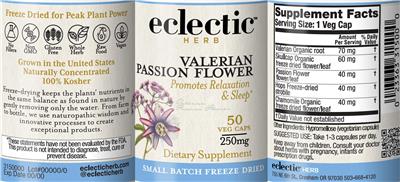
Supplement Facts
The label details for Valerian Passion Flower 250 mg by Eclectic Herb, sourced from the NIH Dietary Supplement Label Database.
Supplement Facts
| Ingredient | Amount | % DV |
|---|---|---|
| Valerian | 70 mg | -- |
| Passionflower | 40 mg | -- |
| Skullcap, Freeze-Dried | 60 mg | -- |
| Hops, Freeze-Dried | 40 mg | -- |
| Chamomile, Freeze-Dried | 40 mg | -- |
Other ingredients: Hypromellose
Tap any ingredient to jump to its full detail below.
These statements are the manufacturer’s wording, reproduced from the product label — the label is saying it, not HelloPharmacist. We don’t verify or endorse them.
Formulation
Freeze dried fresh for peak plant power Raw food Grown in the United States Naturally concentrated Freeze-drying keeps the plants' nutrients in the same balance as found in nature by gently removing only the water. From farm to bottle, we use naturopathic wisdom and innovative processes to create exceptional products.
No fillers Non GMO Gluten free
Vegan
Promotes relaxation & sleep Small batch freeze dried
Formula
100% Kosher
FDA Disclaimer Statement
These statements have not been evaluated by the FDA. This product is not intended to diagnose, treat, cure or prevent disease.
FDA Statement of Identity
Dietary Supplement
Suggested/Recommended/Usage/Directions
Suggested use: Take 1-3 capsules per day.
Precautions
Keep away from children. Consult your doctor about herbs with pregnancy, infants or prescription drugs.
Consult your doctor about herbs with pregnancy, infants or prescription drugs.
General Statements
@eclecticherb
Is this label outdated? Report a formula or label change and our pharmacy team will review it.
Valerian Passion Flower 250 mg by Eclectic Herb label
The label scan from the NIH Dietary Supplement Label Database. Tap to enlarge.
Label images are published by the NIH Dietary Supplement Label Database for the version of this product on file. Always read your actual product label.
View the full label (PDF)The Ingredients in Valerian Passion Flower 250 mg by Eclectic Herb
These are the 5 active ingredients this product is made of. Select any to open its full monograph.
Serving size1 Veg Cap(s) Dosage formCapsule Servings per container50 Amounts shown are per serving.
Most supplement products combine several ingredients, and a medication can interact with the product through any one of them. Each ingredient below shows whether it has known drug interactions.
Valerian
Interacts with902 drugs
Valerian is an herb whose root is widely used as a natural sleep aid and for calming nerves. The evidence is mixed and often weak, so it may help some...
Valerian monograph & interactionsPassionflower
Interacts with836 drugs
Passion flower is a traditional calming herb that many people use for anxiety and sleep. Early studies hint it may help with mild anxiety and restless...
Passionflower monograph & interactionsSkullcap, Freeze-Dried
Interacts with248 drugs
American skullcap is an herb traditionally used to calm anxiety and promote relaxation, but solid human evidence is very limited. It is generally cons...
Skullcap, Freeze-Dried monograph & interactionsHops, Freeze-Dried
Interacts with863 drugs
Hops are most often used for sleep and mild anxiety, frequently combined with valerian, but the human evidence is limited and not very strong. They ar...
Hops, Freeze-Dried monograph & interactionsChamomile, Freeze-Dried
Other (inactive) ingredients: Hypromellose. These complete the product’s ingredient list but are not active constituents.
Valerian Passion Flower 250 mg by Eclectic Herb Drug Interactions
HelloPharmacist Interaction Report
Valerian Passion Flower 250 mg by Eclectic Herb contains five active ingredients, four of which have documented interactions with medications.
The most serious concern is with CNS depressants (sedative drugs, sleep aids, anxiety medications) — all four checked ingredients can add to their sedative effects. This is a Moderate severity interaction: valerian, passionflower, skullcap, and hops can each boost drowsiness and mental slowness when combined with these drugs.
Read the full breakdown — every affected drug type, severity by severity
Valerian also interacts with glucuronidated drugs (Moderate), which include certain pain relievers and other medications metabolized by your liver's UGT enzymes. Valerian may weakly slow their clearance and raise their levels.
Alprazolam (Xanax) and alcohol also carry Moderate-severity interactions with valerian — both add to sedation risk. On a smaller scale, valerian, passionflower, and hops all have Minor interactions with drugs metabolized by the CYP3A4 enzyme, a major liver pathway that handles many common medications.
Passionflower carries a Minor interaction with OATP transporters, which move certain drugs into and out of cells. Chamomile could not be checked — we hold no interaction data for it.
Altogether, these interactions span 947 individual medications. Before you start this product, check your exact medications with the search tool below.
Check your own medications below · Editorial policy · How we use AI
Want to check YOUR meds against Valerian Passion Flower 250 mg?
Ask about interactions with your drugs in plain English — “Can I take it with lisinopril?” — and we find you the answer in seconds, ingredient by ingredient.
Go to the checkerIngredients driving the most interactions
Individual Drug Interactions
The ingredients in Valerian Passion Flower 250 mg interact with 958 drugs. Click any drug to see the details.
4 of the 5 ingredients in Valerian Passion Flower 250 mg interact with drugs. Each result below shows which ingredient is responsible. Valerian Hops, Freeze-Dried Passionflower Skullcap, Freeze-Dried
AcepromazineAtravet
How Acepromazine interacts with Valerian Passion Flower 250 mg — through 4 ingredients. Tap an ingredient for the detail:
Skullcap, Freeze-driedCns Depressants Moderate
Interaction Summary
Theoretically, skullcap can have additive effects when used with other CNS depressants.
Read the full Skullcap, Freeze-dried + Acepromazine interactionPassionflowerCns Depressants Moderate
Interaction Summary
Concomitant use of passion flower with sedative drugs might cause additive effects and side effects.
Read the full Passionflower + Acepromazine interactionHops, Freeze-driedCns Depressants Moderate
Interaction Summary
Theoretically, concomitant use of hops with sedative drugs might cause additive sedation.
Read the full Hops, Freeze-dried + Acepromazine interactionValerianCns Depressants Moderate
Interaction Summary
Valerian can have additive sedative effects when used concomitantly with CNS depressant drugs.
Read the full Valerian + Acepromazine interactionAcetaminophenChildren's Tylenol, Children's Tylenol Meltaways, Tylenol, Tylenol Ex Strength
How Acetaminophen interacts with Valerian Passion Flower 250 mg — through 2 ingredients. Tap an ingredient for the detail:
ValerianGlucuronidated Drugs Moderate
Interaction Summary
Valerian might weakly inhibit glucuronidation and increase concentrations of drugs metabolized by UGT1A1 and UGT2B7.
Read the full Valerian + Acetaminophen interactionHops, Freeze-driedCytochrome P450 1a2 (cyp1a2) Substrates Minor
Interaction Summary
Hops extract does not seem to affect the metabolism of CYP1A2 substrates.
Read the full Hops, Freeze-dried + Acetaminophen interactionAcetaminophen, AspirinGemnisyn
How Acetaminophen, Aspirin interacts with Valerian Passion Flower 250 mg — through 2 ingredients. Tap an ingredient for the detail:
ValerianGlucuronidated Drugs Moderate
Interaction Summary
Valerian might weakly inhibit glucuronidation and increase concentrations of drugs metabolized by UGT1A1 and UGT2B7.
Read the full Valerian + Acetaminophen, Aspirin interactionHops, Freeze-driedCytochrome P450 1a2 (cyp1a2) Substrates Minor
Interaction Summary
Hops extract does not seem to affect the metabolism of CYP1A2 substrates.
Read the full Hops, Freeze-dried + Acetaminophen, Aspirin interactionAcetaminophen, Aspirin, CaffeineExcedrin, Excedrin Extra Strength, Excedrin Migraine
How Acetaminophen, Aspirin, Caffeine interacts with Valerian Passion Flower 250 mg — through 3 ingredients. Tap an ingredient for the detail:
ValerianGlucuronidated Drugs, Cytochrome P450 3a4 (cyp3a4) Substrates Moderate
Interaction Summary
Valerian might weakly inhibit glucuronidation and increase concentrations of drugs metabolized by UGT1A1 and UGT2B7.
Read the full Valerian + Acetaminophen, Aspirin, Caffeine interactionHops, Freeze-driedCytochrome P450 1a2 (cyp1a2) Substrates, Cytochrome P450 3a4 (cyp3a4) Substrates Minor
Interaction Summary
Hops extract does not seem to affect the metabolism of CYP1A2 substrates.
Read the full Hops, Freeze-dried + Acetaminophen, Aspirin, Caffeine interactionPassionflowerCytochrome P450 3a4 (cyp3a4) Substrates Minor
Interaction Summary
Theoretically, passion flower might decrease the effects of CYP3A4 substrates.
Read the full Passionflower + Acetaminophen, Aspirin, Caffeine interactionAcetaminophen, Brompheniramine, PhenylpropanolamineDimetapp Cold and Flu
How Acetaminophen, Brompheniramine, Phenylpropanolamine interacts with Valerian Passion Flower 250 mg — through 2 ingredients. Tap an ingredient for the detail:
ValerianGlucuronidated Drugs Moderate
Interaction Summary
Valerian might weakly inhibit glucuronidation and increase concentrations of drugs metabolized by UGT1A1 and UGT2B7.
Read the full Valerian + Acetaminophen, Brompheniramine, Phenylpropanolamine interactionHops, Freeze-driedCytochrome P450 1a2 (cyp1a2) Substrates Minor
Interaction Summary
Hops extract does not seem to affect the metabolism of CYP1A2 substrates.
Read the full Hops, Freeze-dried + Acetaminophen, Brompheniramine, Phenylpropanolamine interactionAcetaminophen, ButalbitalAxocet, Bancap, Bucet, Butex Forte, Esgic CF, Orbivan CF +5 more
How Acetaminophen, Butalbital interacts with Valerian Passion Flower 250 mg — through 2 ingredients. Tap an ingredient for the detail:
ValerianGlucuronidated Drugs Moderate
Interaction Summary
Valerian might weakly inhibit glucuronidation and increase concentrations of drugs metabolized by UGT1A1 and UGT2B7.
Read the full Valerian + Acetaminophen, Butalbital interactionHops, Freeze-driedCytochrome P450 1a2 (cyp1a2) Substrates Minor
Interaction Summary
Hops extract does not seem to affect the metabolism of CYP1A2 substrates.
Read the full Hops, Freeze-dried + Acetaminophen, Butalbital interactionAcetaminophen, Butalbital, CaffeineEsgic, Esgic Plus, Fiogesic, Fioricet, Repan, Tecnal +1 more
How Acetaminophen, Butalbital, Caffeine interacts with Valerian Passion Flower 250 mg — through 3 ingredients. Tap an ingredient for the detail:
ValerianGlucuronidated Drugs, Cytochrome P450 3a4 (cyp3a4) Substrates Moderate
Interaction Summary
Valerian might weakly inhibit glucuronidation and increase concentrations of drugs metabolized by UGT1A1 and UGT2B7.
Read the full Valerian + Acetaminophen, Butalbital, Caffeine interactionPassionflowerCytochrome P450 3a4 (cyp3a4) Substrates Minor
Interaction Summary
Theoretically, passion flower might decrease the effects of CYP3A4 substrates.
Read the full Passionflower + Acetaminophen, Butalbital, Caffeine interactionHops, Freeze-driedCytochrome P450 1a2 (cyp1a2) Substrates, Cytochrome P450 3a4 (cyp3a4) Substrates Minor
Interaction Summary
Hops extract does not seem to affect the metabolism of CYP1A2 substrates.
Read the full Hops, Freeze-dried + Acetaminophen, Butalbital, Caffeine interactionAcetaminophen, Butalbital, Caffeine, CodeineEsgic with Codeine, Fioricet w/ Codeine
How Acetaminophen, Butalbital, Caffeine, Codeine interacts with Valerian Passion Flower 250 mg — through 4 ingredients. Tap an ingredient for the detail:
Hops, Freeze-driedCytochrome P450 3a4 (cyp3a4) Substrates, Cytochrome P450 1a2 (cyp1a2) Substrates +1 Moderate
Interaction Summary
Theoretically, hops extract might alter metabolism of CYP3A4 substrates; however, this effect may not be clinically significant.
Read the full Hops, Freeze-dried + Acetaminophen, Butalbital, Caffeine, Codeine interactionValerianCns Depressants, Cytochrome P450 2d6 (cyp2d6) Substrates +2 Moderate
Interaction Summary
Valerian can have additive sedative effects when used concomitantly with CNS depressant drugs.
Read the full Valerian + Acetaminophen, Butalbital, Caffeine, Codeine interactionSkullcap, Freeze-driedCns Depressants Moderate
Interaction Summary
Theoretically, skullcap can have additive effects when used with other CNS depressants.
Read the full Skullcap, Freeze-dried + Acetaminophen, Butalbital, Caffeine, Codeine interactionPassionflowerCns Depressants, Cytochrome P450 3a4 (cyp3a4) Substrates Moderate
Interaction Summary
Concomitant use of passion flower with sedative drugs might cause additive effects and side effects.
Read the full Passionflower + Acetaminophen, Butalbital, Caffeine, Codeine interactionAcetaminophen, Butalbital, CodeineBancap w/ Codeine
How Acetaminophen, Butalbital, Codeine interacts with Valerian Passion Flower 250 mg — through 4 ingredients. Tap an ingredient for the detail:
Skullcap, Freeze-driedCns Depressants Moderate
Interaction Summary
Theoretically, skullcap can have additive effects when used with other CNS depressants.
Read the full Skullcap, Freeze-dried + Acetaminophen, Butalbital, Codeine interactionValerianGlucuronidated Drugs, Cytochrome P450 2d6 (cyp2d6) Substrates +1 Moderate
Interaction Summary
Valerian might weakly inhibit glucuronidation and increase concentrations of drugs metabolized by UGT1A1 and UGT2B7.
Read the full Valerian + Acetaminophen, Butalbital, Codeine interactionPassionflowerCns Depressants Moderate
Interaction Summary
Concomitant use of passion flower with sedative drugs might cause additive effects and side effects.
Read the full Passionflower + Acetaminophen, Butalbital, Codeine interactionHops, Freeze-driedCns Depressants, Cytochrome P450 1a2 (cyp1a2) Substrates Moderate
Interaction Summary
Theoretically, concomitant use of hops with sedative drugs might cause additive sedation.
Read the full Hops, Freeze-dried + Acetaminophen, Butalbital, Codeine interactionAcetaminophen, Butalbital, Codeine PhosphatePhrenilin #3
How Acetaminophen, Butalbital, Codeine Phosphate interacts with Valerian Passion Flower 250 mg — through 4 ingredients. Tap an ingredient for the detail:
Hops, Freeze-driedCytochrome P450 1a2 (cyp1a2) Substrates, Cns Depressants Moderate
Interaction Summary
Hops extract does not seem to affect the metabolism of CYP1A2 substrates.
Read the full Hops, Freeze-dried + Acetaminophen, Butalbital, Codeine Phosphate interactionValerianCns Depressants, Cytochrome P450 2d6 (cyp2d6) Substrates +1 Moderate
Interaction Summary
Valerian can have additive sedative effects when used concomitantly with CNS depressant drugs.
Read the full Valerian + Acetaminophen, Butalbital, Codeine Phosphate interactionPassionflowerCns Depressants Moderate
Interaction Summary
Concomitant use of passion flower with sedative drugs might cause additive effects and side effects.
Read the full Passionflower + Acetaminophen, Butalbital, Codeine Phosphate interactionSkullcap, Freeze-driedCns Depressants Moderate
Interaction Summary
Theoretically, skullcap can have additive effects when used with other CNS depressants.
Read the full Skullcap, Freeze-dried + Acetaminophen, Butalbital, Codeine Phosphate interactionAcetaminophen, Caffeine, Chlorpheniramine, Hydrocodone, PhenylephrineHycomine Compound
How Acetaminophen, Caffeine, Chlorpheniramine, Hydrocodone, Phenylephrine interacts with Valerian Passion Flower 250 mg — through 4 ingredients. Tap an ingredient for the detail:
Skullcap, Freeze-driedCns Depressants Moderate
Interaction Summary
Theoretically, skullcap can have additive effects when used with other CNS depressants.
Read the full Skullcap, Freeze-dried + Acetaminophen, Caffeine, Chlorpheniramine, Hydrocodone, Phenylephrine interactionPassionflowerCns Depressants, Cytochrome P450 3a4 (cyp3a4) Substrates Moderate
Interaction Summary
Concomitant use of passion flower with sedative drugs might cause additive effects and side effects.
Read the full Passionflower + Acetaminophen, Caffeine, Chlorpheniramine, Hydrocodone, Phenylephrine interactionValerianGlucuronidated Drugs, Cytochrome P450 3a4 (cyp3a4) Substrates +2 Moderate
Interaction Summary
Valerian might weakly inhibit glucuronidation and increase concentrations of drugs metabolized by UGT1A1 and UGT2B7.
Read the full Valerian + Acetaminophen, Caffeine, Chlorpheniramine, Hydrocodone, Phenylephrine interactionHops, Freeze-driedCns Depressants, Cytochrome P450 3a4 (cyp3a4) Substrates +1 Moderate
Interaction Summary
Theoretically, concomitant use of hops with sedative drugs might cause additive sedation.
Read the full Hops, Freeze-dried + Acetaminophen, Caffeine, Chlorpheniramine, Hydrocodone, Phenylephrine interactionAcetaminophen, Caffeine, CodeineGesic C15, Gesic C30, Gesic C8, Lenoltec 1, Lenoltec 2, Lenoltec 3 +1 more
How Acetaminophen, Caffeine, Codeine interacts with Valerian Passion Flower 250 mg — through 4 ingredients. Tap an ingredient for the detail:
ValerianCns Depressants, Cytochrome P450 2d6 (cyp2d6) Substrates +2 Moderate
Interaction Summary
Valerian can have additive sedative effects when used concomitantly with CNS depressant drugs.
Read the full Valerian + Acetaminophen, Caffeine, Codeine interactionHops, Freeze-driedCns Depressants, Cytochrome P450 1a2 (cyp1a2) Substrates +1 Moderate
Interaction Summary
Theoretically, concomitant use of hops with sedative drugs might cause additive sedation.
Read the full Hops, Freeze-dried + Acetaminophen, Caffeine, Codeine interactionPassionflowerCns Depressants, Cytochrome P450 3a4 (cyp3a4) Substrates Moderate
Interaction Summary
Concomitant use of passion flower with sedative drugs might cause additive effects and side effects.
Read the full Passionflower + Acetaminophen, Caffeine, Codeine interactionSkullcap, Freeze-driedCns Depressants Moderate
Interaction Summary
Theoretically, skullcap can have additive effects when used with other CNS depressants.
Read the full Skullcap, Freeze-dried + Acetaminophen, Caffeine, Codeine interactionAcetaminophen, Caffeine, Codeine, SalicylamideCodalan No.1, Codalan No.2, Codalan No.3
How Acetaminophen, Caffeine, Codeine, Salicylamide interacts with Valerian Passion Flower 250 mg — through 4 ingredients. Tap an ingredient for the detail:
ValerianGlucuronidated Drugs, Cytochrome P450 3a4 (cyp3a4) Substrates +2 Moderate
Interaction Summary
Valerian might weakly inhibit glucuronidation and increase concentrations of drugs metabolized by UGT1A1 and UGT2B7.
Read the full Valerian + Acetaminophen, Caffeine, Codeine, Salicylamide interactionPassionflowerCns Depressants, Cytochrome P450 3a4 (cyp3a4) Substrates Moderate
Interaction Summary
Concomitant use of passion flower with sedative drugs might cause additive effects and side effects.
Read the full Passionflower + Acetaminophen, Caffeine, Codeine, Salicylamide interactionSkullcap, Freeze-driedCns Depressants Moderate
Interaction Summary
Theoretically, skullcap can have additive effects when used with other CNS depressants.
Read the full Skullcap, Freeze-dried + Acetaminophen, Caffeine, Codeine, Salicylamide interactionHops, Freeze-driedCytochrome P450 3a4 (cyp3a4) Substrates, Cns Depressants +1 Moderate
Interaction Summary
Theoretically, hops extract might alter metabolism of CYP3A4 substrates; however, this effect may not be clinically significant.
Read the full Hops, Freeze-dried + Acetaminophen, Caffeine, Codeine, Salicylamide interactionAcetaminophen, Caffeine, DihydrocodeineDHC Plus, Panlor DC, Panlor SS
How Acetaminophen, Caffeine, Dihydrocodeine interacts with Valerian Passion Flower 250 mg — through 4 ingredients. Tap an ingredient for the detail:
Hops, Freeze-driedCytochrome P450 1a2 (cyp1a2) Substrates, Cns Depressants +1 Moderate
Interaction Summary
Hops extract does not seem to affect the metabolism of CYP1A2 substrates.
Read the full Hops, Freeze-dried + Acetaminophen, Caffeine, Dihydrocodeine interactionValerianCytochrome P450 2d6 (cyp2d6) Substrates, Cns Depressants +2 Moderate
Interaction Summary
Valerian does not seem to have a clinically relevant effect on levels of drugs metabolized by CYP2D6.
Read the full Valerian + Acetaminophen, Caffeine, Dihydrocodeine interactionSkullcap, Freeze-driedCns Depressants Moderate
Interaction Summary
Theoretically, skullcap can have additive effects when used with other CNS depressants.
Read the full Skullcap, Freeze-dried + Acetaminophen, Caffeine, Dihydrocodeine interactionPassionflowerCytochrome P450 3a4 (cyp3a4) Substrates, Cns Depressants Moderate
Interaction Summary
Theoretically, passion flower might decrease the effects of CYP3A4 substrates.
Read the full Passionflower + Acetaminophen, Caffeine, Dihydrocodeine interactionAcetaminophen, Caffeine, IsomethepteneMigralam
How Acetaminophen, Caffeine, Isometheptene interacts with Valerian Passion Flower 250 mg — through 3 ingredients. Tap an ingredient for the detail:
ValerianGlucuronidated Drugs, Cytochrome P450 3a4 (cyp3a4) Substrates Moderate
Interaction Summary
Valerian might weakly inhibit glucuronidation and increase concentrations of drugs metabolized by UGT1A1 and UGT2B7.
Read the full Valerian + Acetaminophen, Caffeine, Isometheptene interactionPassionflowerCytochrome P450 3a4 (cyp3a4) Substrates Minor
Interaction Summary
Theoretically, passion flower might decrease the effects of CYP3A4 substrates.
Read the full Passionflower + Acetaminophen, Caffeine, Isometheptene interactionHops, Freeze-driedCytochrome P450 3a4 (cyp3a4) Substrates, Cytochrome P450 1a2 (cyp1a2) Substrates Minor
Interaction Summary
Theoretically, hops extract might alter metabolism of CYP3A4 substrates; however, this effect may not be clinically significant.
Read the full Hops, Freeze-dried + Acetaminophen, Caffeine, Isometheptene interactionAcetaminophen, Caffeine, PyrilamineMidol Max Strength Menstrual
How Acetaminophen, Caffeine, Pyrilamine interacts with Valerian Passion Flower 250 mg — through 3 ingredients. Tap an ingredient for the detail:
ValerianCytochrome P450 3a4 (cyp3a4) Substrates, Glucuronidated Drugs Moderate
Interaction Summary
Valerian does not seem to have a clinically relevant effect on levels of drugs metabolized by CYP3A4.
Read the full Valerian + Acetaminophen, Caffeine, Pyrilamine interactionHops, Freeze-driedCytochrome P450 1a2 (cyp1a2) Substrates, Cytochrome P450 3a4 (cyp3a4) Substrates Minor
Interaction Summary
Hops extract does not seem to affect the metabolism of CYP1A2 substrates.
Read the full Hops, Freeze-dried + Acetaminophen, Caffeine, Pyrilamine interactionPassionflowerCytochrome P450 3a4 (cyp3a4) Substrates Minor
Interaction Summary
Theoretically, passion flower might decrease the effects of CYP3A4 substrates.
Read the full Passionflower + Acetaminophen, Caffeine, Pyrilamine interactionAcetaminophen, Chlorpheniramine Maleate, Dextromethorphan HbrVicks Formula 44M Cough, Cold & Flu Relief
How Acetaminophen, Chlorpheniramine Maleate, Dextromethorphan Hbr interacts with Valerian Passion Flower 250 mg — through 3 ingredients. Tap an ingredient for the detail:
ValerianCytochrome P450 3a4 (cyp3a4) Substrates, Glucuronidated Drugs +1 Moderate
Interaction Summary
Valerian does not seem to have a clinically relevant effect on levels of drugs metabolized by CYP3A4.
Read the full Valerian + Acetaminophen, Chlorpheniramine Maleate, Dextromethorphan Hbr interactionPassionflowerCytochrome P450 3a4 (cyp3a4) Substrates Minor
Interaction Summary
Theoretically, passion flower might decrease the effects of CYP3A4 substrates.
Read the full Passionflower + Acetaminophen, Chlorpheniramine Maleate, Dextromethorphan Hbr interactionHops, Freeze-driedCytochrome P450 1a2 (cyp1a2) Substrates, Cytochrome P450 3a4 (cyp3a4) Substrates Minor
Interaction Summary
Hops extract does not seem to affect the metabolism of CYP1A2 substrates.
Read the full Hops, Freeze-dried + Acetaminophen, Chlorpheniramine Maleate, Dextromethorphan Hbr interactionAcetaminophen, Chlorpheniramine, Codeine, PhenylephrineColrex
How Acetaminophen, Chlorpheniramine, Codeine, Phenylephrine interacts with Valerian Passion Flower 250 mg — through 4 ingredients. Tap an ingredient for the detail:
ValerianCytochrome P450 2d6 (cyp2d6) Substrates, Cns Depressants +2 Moderate
Interaction Summary
Valerian does not seem to have a clinically relevant effect on levels of drugs metabolized by CYP2D6.
Read the full Valerian + Acetaminophen, Chlorpheniramine, Codeine, Phenylephrine interactionHops, Freeze-driedCytochrome P450 1a2 (cyp1a2) Substrates, Cytochrome P450 3a4 (cyp3a4) Substrates +1 Moderate
Interaction Summary
Hops extract does not seem to affect the metabolism of CYP1A2 substrates.
Read the full Hops, Freeze-dried + Acetaminophen, Chlorpheniramine, Codeine, Phenylephrine interactionPassionflowerCytochrome P450 3a4 (cyp3a4) Substrates, Cns Depressants Moderate
Interaction Summary
Theoretically, passion flower might decrease the effects of CYP3A4 substrates.
Read the full Passionflower + Acetaminophen, Chlorpheniramine, Codeine, Phenylephrine interactionSkullcap, Freeze-driedCns Depressants Moderate
Interaction Summary
Theoretically, skullcap can have additive effects when used with other CNS depressants.
Read the full Skullcap, Freeze-dried + Acetaminophen, Chlorpheniramine, Codeine, Phenylephrine interactionAcetaminophen, Chlorpheniramine, DextromethorphanCoricidin II Extra Strength Cold and Flu
How Acetaminophen, Chlorpheniramine, Dextromethorphan interacts with Valerian Passion Flower 250 mg — through 3 ingredients. Tap an ingredient for the detail:
ValerianGlucuronidated Drugs, Cytochrome P450 3a4 (cyp3a4) Substrates +1 Moderate
Interaction Summary
Valerian might weakly inhibit glucuronidation and increase concentrations of drugs metabolized by UGT1A1 and UGT2B7.
Read the full Valerian + Acetaminophen, Chlorpheniramine, Dextromethorphan interactionPassionflowerCytochrome P450 3a4 (cyp3a4) Substrates Minor
Interaction Summary
Theoretically, passion flower might decrease the effects of CYP3A4 substrates.
Read the full Passionflower + Acetaminophen, Chlorpheniramine, Dextromethorphan interactionHops, Freeze-driedCytochrome P450 1a2 (cyp1a2) Substrates, Cytochrome P450 3a4 (cyp3a4) Substrates Minor
Interaction Summary
Hops extract does not seem to affect the metabolism of CYP1A2 substrates.
Read the full Hops, Freeze-dried + Acetaminophen, Chlorpheniramine, Dextromethorphan interactionAcetaminophen, Chlorpheniramine, Dextromethorphan HydrobromideCoricidin HBP Maximum Strength Flu
How Acetaminophen, Chlorpheniramine, Dextromethorphan Hydrobromide interacts with Valerian Passion Flower 250 mg — through 3 ingredients. Tap an ingredient for the detail:
ValerianCytochrome P450 2d6 (cyp2d6) Substrates, Cytochrome P450 3a4 (cyp3a4) Substrates +1 Moderate
Interaction Summary
Valerian does not seem to have a clinically relevant effect on levels of drugs metabolized by CYP2D6.
Read the full Valerian + Acetaminophen, Chlorpheniramine, Dextromethorphan Hydrobromide interactionHops, Freeze-driedCytochrome P450 3a4 (cyp3a4) Substrates, Cytochrome P450 1a2 (cyp1a2) Substrates Minor
Interaction Summary
Theoretically, hops extract might alter metabolism of CYP3A4 substrates; however, this effect may not be clinically significant.
Read the full Hops, Freeze-dried + Acetaminophen, Chlorpheniramine, Dextromethorphan Hydrobromide interactionPassionflowerCytochrome P450 3a4 (cyp3a4) Substrates Minor
Interaction Summary
Theoretically, passion flower might decrease the effects of CYP3A4 substrates.
Read the full Passionflower + Acetaminophen, Chlorpheniramine, Dextromethorphan Hydrobromide interactionAcetaminophen, Chlorpheniramine, Dextromethorphan, PhenylpropanolamineMulti Symptom Cold Relief
How Acetaminophen, Chlorpheniramine, Dextromethorphan, Phenylpropanolamine interacts with Valerian Passion Flower 250 mg — through 3 ingredients. Tap an ingredient for the detail:
ValerianGlucuronidated Drugs, Cytochrome P450 3a4 (cyp3a4) Substrates +1 Moderate
Interaction Summary
Valerian might weakly inhibit glucuronidation and increase concentrations of drugs metabolized by UGT1A1 and UGT2B7.
Read the full Valerian + Acetaminophen, Chlorpheniramine, Dextromethorphan, Phenylpropanolamine interactionPassionflowerCytochrome P450 3a4 (cyp3a4) Substrates Minor
Interaction Summary
Theoretically, passion flower might decrease the effects of CYP3A4 substrates.
Read the full Passionflower + Acetaminophen, Chlorpheniramine, Dextromethorphan, Phenylpropanolamine interactionHops, Freeze-driedCytochrome P450 1a2 (cyp1a2) Substrates, Cytochrome P450 3a4 (cyp3a4) Substrates Minor
Interaction Summary
Hops extract does not seem to affect the metabolism of CYP1A2 substrates.
Read the full Hops, Freeze-dried + Acetaminophen, Chlorpheniramine, Dextromethorphan, Phenylpropanolamine interactionAcetaminophen, Chlorpheniramine, Dextromethorphan, PseudoephedrineChildren's Tylenol Cold Plus Cough, Tylenol Cold Ex Strength
How Acetaminophen, Chlorpheniramine, Dextromethorphan, Pseudoephedrine interacts with Valerian Passion Flower 250 mg — through 3 ingredients. Tap an ingredient for the detail:
ValerianCytochrome P450 2d6 (cyp2d6) Substrates, Cytochrome P450 3a4 (cyp3a4) Substrates +1 Moderate
Interaction Summary
Valerian does not seem to have a clinically relevant effect on levels of drugs metabolized by CYP2D6.
Read the full Valerian + Acetaminophen, Chlorpheniramine, Dextromethorphan, Pseudoephedrine interactionHops, Freeze-driedCytochrome P450 3a4 (cyp3a4) Substrates, Cytochrome P450 1a2 (cyp1a2) Substrates Minor
Interaction Summary
Theoretically, hops extract might alter metabolism of CYP3A4 substrates; however, this effect may not be clinically significant.
Read the full Hops, Freeze-dried + Acetaminophen, Chlorpheniramine, Dextromethorphan, Pseudoephedrine interactionPassionflowerCytochrome P450 3a4 (cyp3a4) Substrates Minor
Interaction Summary
Theoretically, passion flower might decrease the effects of CYP3A4 substrates.
Read the full Passionflower + Acetaminophen, Chlorpheniramine, Dextromethorphan, Pseudoephedrine interactionAcetaminophen, Chlorpheniramine, Guaifenesin, Phenylephrine, SalicylamideRhinogesic GG
How Acetaminophen, Chlorpheniramine, Guaifenesin, Phenylephrine, Salicylamide interacts with Valerian Passion Flower 250 mg — through 3 ingredients. Tap an ingredient for the detail:
ValerianCytochrome P450 3a4 (cyp3a4) Substrates, Glucuronidated Drugs Moderate
Interaction Summary
Valerian does not seem to have a clinically relevant effect on levels of drugs metabolized by CYP3A4.
Read the full Valerian + Acetaminophen, Chlorpheniramine, Guaifenesin, Phenylephrine, Salicylamide interactionPassionflowerCytochrome P450 3a4 (cyp3a4) Substrates Minor
Interaction Summary
Theoretically, passion flower might decrease the effects of CYP3A4 substrates.
Read the full Passionflower + Acetaminophen, Chlorpheniramine, Guaifenesin, Phenylephrine, Salicylamide interactionHops, Freeze-driedCytochrome P450 1a2 (cyp1a2) Substrates, Cytochrome P450 3a4 (cyp3a4) Substrates Minor
Interaction Summary
Hops extract does not seem to affect the metabolism of CYP1A2 substrates.
Read the full Hops, Freeze-dried + Acetaminophen, Chlorpheniramine, Guaifenesin, Phenylephrine, Salicylamide interactionAcetaminophen, Chlorpheniramine, PhenylephrineAlka-Seltzer PLUS, Histex SR, Protid
How Acetaminophen, Chlorpheniramine, Phenylephrine interacts with Valerian Passion Flower 250 mg — through 3 ingredients. Tap an ingredient for the detail:
ValerianCytochrome P450 3a4 (cyp3a4) Substrates, Glucuronidated Drugs Moderate
Interaction Summary
Valerian does not seem to have a clinically relevant effect on levels of drugs metabolized by CYP3A4.
Read the full Valerian + Acetaminophen, Chlorpheniramine, Phenylephrine interactionHops, Freeze-driedCytochrome P450 3a4 (cyp3a4) Substrates, Cytochrome P450 1a2 (cyp1a2) Substrates Minor
Interaction Summary
Theoretically, hops extract might alter metabolism of CYP3A4 substrates; however, this effect may not be clinically significant.
Read the full Hops, Freeze-dried + Acetaminophen, Chlorpheniramine, Phenylephrine interactionPassionflowerCytochrome P450 3a4 (cyp3a4) Substrates Minor
Interaction Summary
Theoretically, passion flower might decrease the effects of CYP3A4 substrates.
Read the full Passionflower + Acetaminophen, Chlorpheniramine, Phenylephrine interactionAcetaminophen, Chlorpheniramine, Phenylephrine, SalicylamideRhinogesic, Rhinogesic JR
How Acetaminophen, Chlorpheniramine, Phenylephrine, Salicylamide interacts with Valerian Passion Flower 250 mg — through 3 ingredients. Tap an ingredient for the detail:
ValerianGlucuronidated Drugs, Cytochrome P450 3a4 (cyp3a4) Substrates Moderate
Interaction Summary
Valerian might weakly inhibit glucuronidation and increase concentrations of drugs metabolized by UGT1A1 and UGT2B7.
Read the full Valerian + Acetaminophen, Chlorpheniramine, Phenylephrine, Salicylamide interactionPassionflowerCytochrome P450 3a4 (cyp3a4) Substrates Minor
Interaction Summary
Theoretically, passion flower might decrease the effects of CYP3A4 substrates.
Read the full Passionflower + Acetaminophen, Chlorpheniramine, Phenylephrine, Salicylamide interactionHops, Freeze-driedCytochrome P450 1a2 (cyp1a2) Substrates, Cytochrome P450 3a4 (cyp3a4) Substrates Minor
Interaction Summary
Hops extract does not seem to affect the metabolism of CYP1A2 substrates.
Read the full Hops, Freeze-dried + Acetaminophen, Chlorpheniramine, Phenylephrine, Salicylamide interactionAcetaminophen, Chlorpheniramine, PhenylpropanolamineAlumadrine, Conex, Sinadrin Max Strength, Sinulin
How Acetaminophen, Chlorpheniramine, Phenylpropanolamine interacts with Valerian Passion Flower 250 mg — through 3 ingredients. Tap an ingredient for the detail:
ValerianGlucuronidated Drugs, Cytochrome P450 3a4 (cyp3a4) Substrates Moderate
Interaction Summary
Valerian might weakly inhibit glucuronidation and increase concentrations of drugs metabolized by UGT1A1 and UGT2B7.
Read the full Valerian + Acetaminophen, Chlorpheniramine, Phenylpropanolamine interactionHops, Freeze-driedCytochrome P450 1a2 (cyp1a2) Substrates, Cytochrome P450 3a4 (cyp3a4) Substrates Minor
Interaction Summary
Hops extract does not seem to affect the metabolism of CYP1A2 substrates.
Read the full Hops, Freeze-dried + Acetaminophen, Chlorpheniramine, Phenylpropanolamine interactionPassionflowerCytochrome P450 3a4 (cyp3a4) Substrates Minor
Interaction Summary
Theoretically, passion flower might decrease the effects of CYP3A4 substrates.
Read the full Passionflower + Acetaminophen, Chlorpheniramine, Phenylpropanolamine interactionAcetaminophen, Chlorpheniramine, Phenylpropanolamine, OpiumHista-Derfule
How Acetaminophen, Chlorpheniramine, Phenylpropanolamine, Opium interacts with Valerian Passion Flower 250 mg — through 4 ingredients. Tap an ingredient for the detail:
ValerianCytochrome P450 3a4 (cyp3a4) Substrates, Glucuronidated Drugs +1 Moderate
Interaction Summary
Valerian does not seem to have a clinically relevant effect on levels of drugs metabolized by CYP3A4.
Read the full Valerian + Acetaminophen, Chlorpheniramine, Phenylpropanolamine, Opium interactionPassionflowerCns Depressants, Cytochrome P450 3a4 (cyp3a4) Substrates Moderate
Interaction Summary
Concomitant use of passion flower with sedative drugs might cause additive effects and side effects.
Read the full Passionflower + Acetaminophen, Chlorpheniramine, Phenylpropanolamine, Opium interactionSkullcap, Freeze-driedCns Depressants Moderate
Interaction Summary
Theoretically, skullcap can have additive effects when used with other CNS depressants.
Read the full Skullcap, Freeze-dried + Acetaminophen, Chlorpheniramine, Phenylpropanolamine, Opium interactionHops, Freeze-driedCytochrome P450 3a4 (cyp3a4) Substrates, Cns Depressants +1 Moderate
Interaction Summary
Theoretically, hops extract might alter metabolism of CYP3A4 substrates; however, this effect may not be clinically significant.
Read the full Hops, Freeze-dried + Acetaminophen, Chlorpheniramine, Phenylpropanolamine, Opium interactionAcetaminophen, Chlorpheniramine, Phenylpropanolamine, PhenyltoloxamineNorel Plus
How Acetaminophen, Chlorpheniramine, Phenylpropanolamine, Phenyltoloxamine interacts with Valerian Passion Flower 250 mg — through 3 ingredients. Tap an ingredient for the detail:
ValerianGlucuronidated Drugs, Cytochrome P450 3a4 (cyp3a4) Substrates Moderate
Interaction Summary
Valerian might weakly inhibit glucuronidation and increase concentrations of drugs metabolized by UGT1A1 and UGT2B7.
Read the full Valerian + Acetaminophen, Chlorpheniramine, Phenylpropanolamine, Phenyltoloxamine interactionHops, Freeze-driedCytochrome P450 3a4 (cyp3a4) Substrates, Cytochrome P450 1a2 (cyp1a2) Substrates Minor
Interaction Summary
Theoretically, hops extract might alter metabolism of CYP3A4 substrates; however, this effect may not be clinically significant.
Read the full Hops, Freeze-dried + Acetaminophen, Chlorpheniramine, Phenylpropanolamine, Phenyltoloxamine interactionPassionflowerCytochrome P450 3a4 (cyp3a4) Substrates Minor
Interaction Summary
Theoretically, passion flower might decrease the effects of CYP3A4 substrates.
Read the full Passionflower + Acetaminophen, Chlorpheniramine, Phenylpropanolamine, Phenyltoloxamine interactionAcetaminophen, Chlorpheniramine, PseudoephedrineAlka-Seltzer PLUS Liquid Gels, Children's Tylenol Cold, Codimal, Comtrex, Extra Strength Tylenol Allergy Sinus, Lorsin +3 more
How Acetaminophen, Chlorpheniramine, Pseudoephedrine interacts with Valerian Passion Flower 250 mg — through 3 ingredients. Tap an ingredient for the detail:
ValerianGlucuronidated Drugs, Cytochrome P450 3a4 (cyp3a4) Substrates Moderate
Interaction Summary
Valerian might weakly inhibit glucuronidation and increase concentrations of drugs metabolized by UGT1A1 and UGT2B7.
Read the full Valerian + Acetaminophen, Chlorpheniramine, Pseudoephedrine interactionPassionflowerCytochrome P450 3a4 (cyp3a4) Substrates Minor
Interaction Summary
Theoretically, passion flower might decrease the effects of CYP3A4 substrates.
Read the full Passionflower + Acetaminophen, Chlorpheniramine, Pseudoephedrine interactionHops, Freeze-driedCytochrome P450 1a2 (cyp1a2) Substrates, Cytochrome P450 3a4 (cyp3a4) Substrates Minor
Interaction Summary
Hops extract does not seem to affect the metabolism of CYP1A2 substrates.
Read the full Hops, Freeze-dried + Acetaminophen, Chlorpheniramine, Pseudoephedrine interactionAcetaminophen, ChlorzoxazoneAcetazone Forte, Extra Strength Tylenol Aches & Strains, Parafon Forte
How Acetaminophen, Chlorzoxazone interacts with Valerian Passion Flower 250 mg — through 2 ingredients. Tap an ingredient for the detail:
ValerianGlucuronidated Drugs Moderate
Interaction Summary
Valerian might weakly inhibit glucuronidation and increase concentrations of drugs metabolized by UGT1A1 and UGT2B7.
Read the full Valerian + Acetaminophen, Chlorzoxazone interactionHops, Freeze-driedCytochrome P450 1a2 (cyp1a2) Substrates Minor
Interaction Summary
Hops extract does not seem to affect the metabolism of CYP1A2 substrates.
Read the full Hops, Freeze-dried + Acetaminophen, Chlorzoxazone interactionEach ingredient & the kinds of drugs it affects
For each ingredient in Valerian Passion Flower 250 mg with known interactions, here are the types of medications they can affect. Open any type for the detail — or search your exact drug in the checker above.
Valerian
Alcohol (Ethanol)
Valerian can have additive sedative effects when used concomitantly with alcohol.
Valerian has sedative effects. Theoretically, valerian might have an additive sedative effect when combined with alcohol. Excessive sedation has been reported in an alcohol-abusing individual who took valerian and Gingko biloba. However, the potential interaction between valerian and alcohol has been disputed in other research. Limited evidence suggests that a combination of valerian 160 mg and lemon balm 80 mg (Euvegal) does not cause further deterioration in reaction ability and reaction rate when taken with alcohol as compared to the effects of alcohol alone.
Alprazolam (Xanax)
Valerian can have additive sedative effects when used with alprazolam. Also, valerian in high doses might modestly increase alprazolam levels, though this is not likely to be clinically significant.
Valerian has sedative effects. Theoretically, valerian might cause additive sedation when combined with alprazolam. Also, a small pharmacokinetic study shows that taking valerian extract 1000 mg daily (providing 11 mg valerenic acid) might increase alprazolam levels by about 19%. This might be due to valerian's mild inhibition of cytochrome P450 3A4 (CYP3A4). Despite being statistically significant, this increase is not likely to be clinically significant.
Cns Depressants
Valerian can have additive sedative effects when used concomitantly with CNS depressant drugs.
Theoretically, concomitant use of valerian and drugs with sedative and anesthetic properties may cause additive therapeutic and adverse effects.
Glucuronidated Drugs
Valerian might weakly inhibit glucuronidation and increase concentrations of drugs metabolized by UGT1A1 and UGT2B7.
In vitro research shows that methanolic valerian extract and valerenic acid might competitively inhibit UDP-glucuronosyltransferase (UGT) 1A1 (UGT1A1) and UGT2B7.
Cytochrome P450 2D6 (Cyp2D6) Substrates
Valerian does not seem to have a clinically relevant effect on levels of drugs metabolized by CYP2D6.
Although some in vitro evidence suggests that valerian affects CYP2D6, clinical pharmacokinetic (PK) studies show that valerian is unlikely to affect the CYP2D6 enzyme. In one PK study, taking valerian 1000 mg (providing about 11 mg valerenic acid) nightly for 14 days did not affect the metabolism of dextromethorphan, a CYP2D6 substrate. In another PK study, taking valerian 125 mg three times daily for 28 days did not affect metabolism of debrisoquine, an accepted CYP2D6 probe-substrate.
Cytochrome P450 3A4 (Cyp3A4) Substrates
Valerian does not seem to have a clinically relevant effect on levels of drugs metabolized by CYP3A4.
Although some in vitro evidence suggests that valerian extract might inhibit or induce CYP3A4, clinical pharmacokinetic (PK) studies show that valerian does not have a clinically significant effect on the CYP3A4 enzyme. In one PK study, taking valerian 125 mg three times daily for 28 days did not affect metabolism of midazolam, an accepted CYP3A4 probe-substrate. In another PK study, taking valerian 1000 mg (providing about 11 mg valerenic acid) nightly for 14 days modestly increases levels of alprazolam, a CYP3A4 substrate, suggesting mild inhibition of CYP3A4. However, this mild inhibition is unlikely to be clinically relevant.
Hops, Freeze-Dried
Cns Depressants
Theoretically, concomitant use of hops with sedative drugs might cause additive sedation.
Some animal research shows that hops has sedative effects.
Estrogens
Theoretically, concomitant use of large amounts of hops might interfere with hormone replacement therapy due to competition for estrogen receptors.
In vitro research suggests that certain hops constituents can competitively bind to estrogen receptors. However, most hops extracts contain very small amounts of these constituents.
Cytochrome P450 1A2 (Cyp1A2) Substrates
Hops extract does not seem to affect the metabolism of CYP1A2 substrates.
In vitro research suggests that flavonoid constituents of hops inhibit CYP1A2 enzyme activity. However, a pharmacokinetic study in healthy postmenopausal patients shows that taking a standardized extract of spent hops containing prenylated phenols, as 59.5 mg twice daily for 2 weeks, does not affect levels of caffeine, a CYP1A2 probe substrate.
Cytochrome P450 3A4 (Cyp3A4) Substrates
Theoretically, hops extract might alter metabolism of CYP3A4 substrates; however, this effect may not be clinically significant.
Animal research suggests that specific constituents of hops, called lupulones, can induce hepatic CYP3A4 enzyme activity. However, a pharmacokinetic study in healthy postmenopausal patients with normal metabolism shows that taking a standardized extract of spent hops containing prenylated phenols, as 59.5 mg twice daily for 2 weeks, decreases the concentration of alprazolam, a CYP3A4 probe substrate, by 7.6%. This reduction is unlikely to be clinically relevant.
Passionflower
Cns Depressants
Concomitant use of passion flower with sedative drugs might cause additive effects and side effects.
Research in animals and humans shows that passion flower has sedative effects which can be additive when used with sedative medications like lorazepam.
Cytochrome P450 3A4 (Cyp3A4) Substrates
Theoretically, passion flower might decrease the effects of CYP3A4 substrates.
In vitro research suggests that passion flower can induce CYP3A4 enzymes, albeit to a much lower degree than rifampin, a known CYP3A4 inducer.
Organic Anion-Transporting Polypeptide Substrates (Oatp)
Theoretically, passion flower might reduce the bioavailability of OATP2B1 and OATP1A2 substrates.
In vitro research shows that the passion flower constituents apigenin and vitexin inhibit OATP2B1 and OATP1A2. This inhibition may be dose-dependent. One specific high-flavonoid passion flower extract (Valverde) seems to inhibit OATP2B1 and OATP1A2, while another extract with a lower flavonoid concentration (Arkocaps) shows less potent inhibition. OATPs are responsible for the uptake of drugs and other compounds into the body; however, the specific activities of OATP2B1 and OATP1A2 are not well characterized.
Skullcap, Freeze-Dried
Cns Depressants
Theoretically, skullcap can have additive effects when used with other CNS depressants.
Animal and clinical research suggests that skullcap can cause sedation and cognitive impairment.
Brand information
Manufacturer and brand details for Valerian Passion Flower 250 mg, from the product label.
Eclectic Herb
See all Eclectic Herb products- Name
- Eclectic Herb
- Street Address
- 755 NE 6th St.
- City
- Gresham
- State
- Oregon
- ZipCode
- 97030
- Phone Number
- 503.668.4120
- Web Address
- www.eclecticherb.com
Valerian Passion Flower 250 mg by Eclectic Herb: Common Questions
Does Valerian Passion Flower 250 mg by Eclectic Herb interact with any medications?
How can one product interact with so many drugs?
Where does this information come from?
Can I take this while pregnant?
Is it safe to breastfeed while taking this?
Will this make me drowsy?
What happens if I stop taking it suddenly after a few weeks?
Does this product work for anxiety before a medical procedure?
Can I use this long-term?
Written and reviewed by the HelloPharmacist editorial staff. Our editorial policy
Not sure if Valerian Passion Flower 250 mg is safe with your meds?
Our pharmacists answer your medication & supplement questions — free.
Label information is sourced from the NIH Dietary Supplement Label Database and reflects the product version on file; always read your actual product label. This page is for education only and is not a substitute for professional medical advice. Confirm with your pharmacist or doctor before combining supplements and medications.
The Full Monographs Behind Valerian Passion Flower 250 mg’s Ingredients
Every ingredient we hold a full HelloPharmacist monograph for — uses, evidence, safety, and the complete interaction list.
Valerian
Interacts with 902 drugsValerian is an herb whose root is widely used as a natural sleep aid and for calming nerves. The evidence is mixed and often weak, so it may help some people sleep but does not work reliably...
Read the full Valerian monograph → Herb & supplement monographPassion Flower
Interacts with 836 drugsPassion flower is a traditional calming herb that many people use for anxiety and sleep. Early studies hint it may help with mild anxiety and restlessness, but the evidence is limited and mo...
Read the full Passion Flower monograph → Herb & supplement monographSkullcap
Interacts with 248 drugsAmerican skullcap is an herb traditionally used to calm anxiety and promote relaxation, but solid human evidence is very limited. It is generally considered relatively safe for short-term us...
Read the full Skullcap monograph → Herb & supplement monographHops
Interacts with 863 drugsHops are most often used for sleep and mild anxiety, frequently combined with valerian, but the human evidence is limited and not very strong. They are generally well tolerated when used sho...
Read the full Hops monograph →Sources & How We Checked
Valerian Passion Flower 250 mg's label data comes from the NIH Dietary Supplement Label Database; the ingredient interaction data is from the Natural Medicines database, reviewed by our pharmacists.
- NIH Dietary Supplement Label Database (DSLD) — The official product label on file for this supplement.
- Natural Medicines (Therapeutic Research Center) — Evidence-graded clinical reference behind the ingredient interaction data.
Content is written and reviewed by licensed HelloPharmacist pharmacists. See our data sources and editorial standards for how this information is built and checked.
The 74 references behind this product’s interaction data
Every citation that drives the interaction findings for this product’s ingredients, from the evidence-graded Natural Medicines (TRC Healthcare) database. Open an ingredient to browse its citations — links open the study on PubMed or the publisher’s site.
Valerian 37 references
- Willey LB, Mady SP, Cobaugh DJ, Wax PM. Valerian overdose: a case report. Vet Hum Toxicol 1995;37:364-5.
- Kuhlmann J, Berger W, Podzuweit H, Schmidt U. The influence of valerian treatment on "reaction time, alertness and concentration" in volunteers. Pharmacopsychiatry 1999;32:235-41. PubMed
- Klepser TB, Klepser ME. Unsafe and potentially safe herbal therapies. Am J Health Syst Pharm 1999;56:125-38. PubMed
- Houghton PJ. The scientific basis for the reputed activity of Valerian. J Pharm Pharmacol 1999;51:505-12. PubMed
- Garges HP, Varia I, Doraiswamy PM. Cardiac complications and delirium associated with Valerian root withdrawal. [Letter to the Editor]. JAMA 1998;280:1566-7. PubMed
- Budzinski JW, Foster BC, Vandenhoek S, Arnason JT. An in vitro evaluation of human cytochrome P450 3A4 inhibition by selected commercial herbal extracts and tinctures. Phytomedicine 2000;7:273-82. PubMed
- MacGregor FB, Abernethy VE, Dahabra S, et al. Hepatotoxicity of herbal remedies. BMJ 1989;299:1156-7. PubMed
- Leathwood PD, Chauffard F. Aqueous extract of valerian reduces latency to fall asleep in man. Planta Med 1985;2:144-8. PubMed
- Hadley S, Petry JJ. Valerian. Am Fam Physician 2003;67:1755-8..
- Glass JR, Sproule BA, Herrmann N, et al. Acute pharmacological effects of temazepam, diphenhydramine, and valerian in healthy elderly subjects. J Clin Psychopharmacol 2003;23:260-8. PubMed
- Lefebvre T, Foster BC, Drouin CE, et al. In vitro activity of commercial valerian root extracts against human cytochrome P450 3A4. J Pharm Pharmaceut Sci 2004;7:265-73.
- Yuan CS, Mehendale S, Xiao Y, et al. The gamma-aminobutyric acidergic effects of valerian and valerenic acid on rat brainstem neuronal activity. Anesth Analg 2004;98:353-8. PubMed
- Donovan JL, DeVane CL, Chavin KD, et al. Multiple night-time doses of valerian (Valeriana officinalis) had minimal effects on CYP3A4 activity and no effect on CYP2D6 activity in healthy volunteers. Drug Metab Dispos 2004;32:1333-6. PubMed
- Gurley BJ, Gardner SF, Hubbard MA, et al. In vivo effects of goldenseal, kava kava, black cohosh, and valerian on human cytochrome P450 1A2, 2D6, 2E1, and 3A4/5 phenotypes. Clin Pharmacol Ther 2005;77:415-26. PubMed
- Gutierrez S, Ang-Lee MK, Walker DJ, Zacny JP. Assessing subjective and psychomotor effects of the herbal medication valerian in healthy volunteers. Pharmacol Biochem Behav 2004;78:57-64. PubMed
- Jacobs BP, Bent S, Tice JA, et al. An internet-based randomized, placebo-controlled trial of kava and valerian for anxiety and insomnia. Medicine (Baltimore) 2005;84:197-207. PubMed
- National Toxicology Program, US Department of Health and Human Services. Chemical Information Review Document for Valerian (Valeriana officinalis L.) [CAS No. 8057-49-6] and Oils [CAS No. 8008-88-6]. Supporting Nomination for Toxicological Evaluation by t
- Fernández-San-Martín MI, Masa-Font R, Palacios-Soler L, et al. Effectiveness of Valerian on insomnia: a meta-analysis of randomized placebo-controlled trials. Sleep Med. 2010 Jun;11:505-11. PubMed
- Coxeter PD, Schluter PJ, Eastwood HL, et al. Valerian does not appear to reduce symptoms for patients with chronic insomnia in general practice using a series of randomised n-of-1 trials. Complement Ther Med. 2003 Dec;11:215-22. PubMed
- Diaper A, Hindmarch I. A double-blind, placebo-controlled investigation of the effects of two doses of a valerian preparation on the sleep, cognitive and psychomotor function of sleep-disturbed older adults. Phytother Res. 2004 Oct;18:831-6. PubMed
- Cuellar NG, Ratcliffe SJ. Does valerian improve sleepiness and symptom severity in people with restless legs syndrome? Altern Ther Health Med 2009;15:22-8.
- Chen D, Klesmer J, Giovanniello A, et al. Mental status changes in an alcohol abuser taking valerian and gingko biloba. Am J Addict. 2002 Winter;11:75-7. PubMed
- Albrecht M, Berger W, Laux P, Schmidt U, et al. Psychopharmaka und Verkehrssicherheit. Der Einfluß von Euvegal® - Dragees forte auf die Fahrtüchtigkeit und Kombinationswirkungen mit Alkohol Z Allg Med 1995;71:1215-25.
- Carrasco MC, Vallejo JR, Pardo-de-Santayana M, et al. Interactions of Valeriana officinalis L. and Passiflora incarnata L. in a patient treated with lorazepam. Phytother Res. 2009 Dec;23:1795-6.
- Hellum BH, Nilsen OG. The in vitro inhibitory potential of trade herbal products on human CYP2D6-mediated metabolism and the influence of ethanol. Basic Clin Pharmacol Toxicol. 2007 Nov;101:350-8.
- Hellum BH, Hu Z, Nilsen OG. The induction of CYP1A2, CYP2D6 and CYP3A4 by six trade herbal products in cultured primary human hepatocytes. Basic Clin Pharmacol Toxicol. 2007 Jan;100:23-30. PubMed
- Alkharfy, K. M. and Frye, R. F. Effect of valerian, valerian/hops extracts, and valerenic acid on glucuronidation in vitro. Xenobiotica 2007;37(2):113-123.
- Vassiliadis, T., Anagnostis, P., Patsiaoura, K., Giouleme, O., Katsinelos, P., Mpoumponaris, A., and Eugenidis, N. Valeriana hepatotoxicity. Sleep Med 2009;10(8):935. PubMed
- Muller, Z., Sarkany, A., Altorjay, A., Szilagyi, A., Tura, T., and Ozsvar, Z. [Liver failure a la Eastern Europe]. Orv.Hetil. 3-22-2009;150(12):555-557. PubMed
- National Toxicology Program, US Department of Health and Human Services. Chemical Information Review Document for Valerian (Valeriana officinalis L.) [CAS No. 8057-49-6] and Oils [CAS No. 8008-88-6]. 2009;
- Wells SR. International intravenous administration of a crude valerian root extract. NACCT 1995;33:542.
- Aydinoglu U, Özcan H, Yücel A, Yücel N, Mutlu M. Valerian induced hypomania: a case report. Bull Clin Psychopharma 2012;22(Suppl. 1):S63.
- Mirabi P, Mojab F. The effects of valerian root on hot flashes in menopausal women. Iran J Pharm Res 2013;12(1):217-22.
- Thomas K, Canedo J, Perry PJ, et al. Effects of valerian on subjective sedation, field sobriety testing and driving simulator performance. Accid Anal Prev. 2016 Jul;92:240-4. PubMed
- Kia YH, Alexander S, Dowling D, Standish R. A case of steroid-responsive valerian-associated hepatitis. Intern Med J. 2016 Jan;46(1):118-9. PubMed
- Burke H, Jiang S, Chatham P, Stern TA. Delirium After Withdrawal From Valerian Root: A Case Report. Psychosomatics. 2020;61(6):787-790. PubMed
- Hajizadeh I, Jamshidi M, Kazemi M, Kargar H, Sadeghi T. Comparison the effect of valerian and gabapentin on RLS and sleep quality in hemodialysis patients: A randomized clinical trial. Ther Apher Dial 2023.
Passion Flower 19 references
- Newall CA, Anderson LA, Philpson JD. Herbal Medicine: A Guide for Healthcare Professionals. London, UK: The Pharmaceutical Press, 1996.
- The Review of Natural Products by Facts and Comparisons. St. Louis, MO: Wolters Kluwer Co., 1999.
- Fisher AA, Purcell P, Le Couteur DG. Toxicity of Passiflora incarnata L. J Toxicol Clin Toxicol 2000;38:63-6.
- Akhondzadeh S, Naghavi HR, Shayeganpour A, et al. Passionflower in the treatment of generalized anxiety: a pilot double-blind randomized controlled trial with oxazepam. J Clin Pharm Ther 2001;26:363-7. PubMed
- Farnsworth N, Bingel A, Cordell G, et al. Potential value of plants as sources of new antifertility agents I. J Pharm Sci 1975;64:535-98. DOI
- Mori A, Hasegawa K, Murasaki M, et al. Clinical evaluation of Passiflamin (passiflora extract) on neurosis - multicenter double blind study in comparison with mexazolam. Rinsho Hyoka (Clinical Evaluation) 1993;21:383-440.
- Miyasaka LS, Atallah AN, Soares BG. Passiflora for anxiety disorder. Cochrane Database Syst Rev 2007;(1):CD004518. DOI
- Speroni E., Minghetti A. Neuropharmacological activity of extracts from Passiflora incarnata. Planta Med. 1988;54:488-91.
- Capasso A., Sorrentino L. Pharmacological studies on the sedative and hypnotic effect of Kava kava and Passiflora extracts combination. Phytomedicine. 2005;12:39-45. PubMed
- Carrasco MC, Vallejo JR, Pardo-de-Santayana M, et al. Interactions of Valeriana officinalis L. and Passiflora incarnata L. in a patient treated with lorazepam. Phytother Res. 2009 Dec;23:1795-6.
- Smith, G. W., Chalmers, T. M., and Nuki, G. Vasculitis associated with herbal preparation containing Passiflora extract. Br J Rheumatol. 1993;32(1):87-88.
- Soulimani, R., Younos, C., Jarmouni, S., Bousta, D., Misslin, R., and Mortier, F. Behavioural effects of Passiflora incarnata L. and its indole alkaloid and flavonoid derivatives and maltol in the mouse. J Ethnopharmacol. 1997;57(1):11-20. PubMed
- Nojoumi M, Ghaeli P, Salimi S, Sharifi A, Raisi F. Effects of Passion Flower Extract, as an Add-On Treatment to Sertraline, on Reaction Time in Patients ?with Generalized Anxiety Disorder: A Double-Blind Placebo-Controlled Study. Iran J Psychiatry. 2016;1
- Rokhtabnak F, Ghodraty MR, Kholdebarin A, et al. Comparing the Effect of Preoperative Administration of Melatonin and Passiflora incarnata on Postoperative Cognitive Disorders in Adult Patients Undergoing Elective Surgery. Anesth Pain Med. 2016;7(1):e4123 PubMed
- Dantas LP, de Oliveira-Ribeiro A, de Almeida-Souza LM, Groppo FC. Effects of passiflora incarnata and midazolam for control of anxiety in patients undergoing dental extraction. Med Oral Patol Oral Cir Bucal. 2017;22(1):e95-e101. PubMed
- Ozturk Z, Kalayci CC. Pregnancy outcomes in psychiatric patients treated with passiflora incarnata. Complement Ther Med. 2018 Feb;36:30-32. PubMed
- da Cunha RS, Amorim KS, Gercina AC, et al. Herbal medicines as anxiolytics prior to third molar surgical extraction. A randomized controlled clinical trial. Clin Oral Investig. 2020. PubMed
- Schäfer AM, Gilgen PM, Spirgi C, et al. Constituents of Passiflora incarnata, but Not of Valeriana officinalis, Interact with the Organic Anion Transporting Polypeptides (OATP)2B1 and OATP1A2. Planta Med. 2021. PubMed
- Mazzari ALDA, Lacerda MG, Milton FA, et al. In vitro effects of European and Latin-American medicinal plants in CYP3A4 gene expression, glutathione levels, and P-glycoprotein activity. Front Pharmacol 2022;13:826395. PubMed
Skullcap 3 references
- Wolfson P, Hoffmann DL. An investigation into the efficacy of Scutellaria lateriflora in healthy volunteers. Altern Ther Health Med 2003;9:74-8.
- Awad, R., Arnason, J. T., Trudeau, V., Bergeron, C., Budzinski, J. W., Foster, B. C., and Merali, Z. Phytochemical and biological analysis of skullcap (Scutellaria lateriflora L.): a medicinal plant with anxiolytic properties. Phytomedicine. 2003;10(8):6 PubMed
- Brock C, Whitehouse J, Tewfik I, Towell T. American skullcap (Scutellaria lateriflora): a randomised, double-blind placebo-controlled crossover study of its effects on mood in healthy volunteers. Phytother Res 2014;28(5):692-8.
Hops 15 references
- Newall CA, Anderson LA, Philpson JD. Herbal Medicine: A Guide for Healthcare Professionals. London, UK: The Pharmaceutical Press, 1996.
- McGuffin M, Hobbs C, Upton R, Goldberg A, eds. American Herbal Products Association's Botanical Safety Handbook. Boca Raton, FL: CRC Press, LLC 1997.
- Zava DT, Dollbaum CM, Blen M. Estrogen and progestin bioactivity of foods, herbs, and spices. Proc Soc Exp Biol Med 1998;217:369-78. PubMed
- Milligan SR, Kalita JC, Heyerick A, et al. Identification of a potent phytoestrogen in hops (Humulus lupulus L.) and beer. J Clin Endocrinol Metab 1999;84:2249-52.. PubMed
- Milligan SR, Kalita JC, Pocock V, et al. The endocrine activities of 8-prenylnaringenin and related hop (Humulus lupulus L.) flavonoids. J Clin Endocrinol Metab 2000;85:4912-5.. DOI
- Henderson MC, Miranda CL, Stevens JF, et al. In vitro inhibition of human P450 enzymes by prenylated flavonoids from hops, Humulus lupulus. Xenobiotica 2000;30:235-51.. PubMed
- Mannering, G. J., Shoeman, J. A., and Deloria, L. B. Identification of the antibiotic hops component, colupulone, as an inducer of hepatic cytochrome P-4503A in the mouse. Drug Metab Dispos 1992;20(2):142-147. DOI
- Skorska, C., Mackiewicz, B., Gora, A., Golec, M., and Dutkiewicz, J. Health effects of inhalation exposure to organic dust in hops farmers. Ann.Univ Mariae.Curie Sklodowska [Med] 2003;58(1):459-465.
- Schiller, H., Forster, A., Vonhoff, C., Hegger, M., Biller, A., and Winterhoff, H. Sedating effects of Humulus lupulus L. extracts. Phytomedicine. 2006;13(8):535-541. PubMed
- van Hunsel, F. P. and Kampschoer, P. [Postmenopausal bleeding and dietary supplements: a possible causal relationship with hop- and soy-containing preparations]. Ned.Tijdschr.Geneeskd. 2012;156(41):A5095.
- Fenselau, C. and Talalay, P. Is oestrogenic activity present in hops? Food Cosmet.Toxicol. 1973;11(4):597-602. PubMed
- Godnic-Cvar, J., Zuskin, E., Mustajbegovic, J., Schachter, E. N., Kanceljak, B., Macan, J., Ilic, Z., and Ebling, Z. Respiratory and immunological findings in brewery workers. Am J Ind Med 1999;35(1):68-75. DOI
- Lee KM, Jung JS, Song DK, and et al. Effects of Humulus lupulus extract on the central nervous system in mice. Planta Med 1993;59(Suppl):A691.
- Assessment report on Humulus lupulus L., flos. European Medicines Agency, 2014. Available at: https://www.ema.europa.eu/en/documents/herbal-report/final-assessment-report-humulus-lupulus-l-flos_en.pdf. Accessed September 29, 2021.
- van Breemen RB, Chen L, Tonsing-Carter A, et al. Pharmacokinetic Interactions of a Hop Dietary Supplement with Drug Metabolism in Perimenopausal and Postmenopausal Women. J Agric Food Chem. 2020;68(18):5212-5220. PubMed
Parts of this content are provided by the Therapeutic Research Center, LLC.
DISCLAIMER: Currently this does not check for drug-drug interactions. This is not an all-inclusive comprehensive list of potential interactions and is for informational purposes only. Not all interactions are known or well-reported in the scientific literature, and new interactions are continually being reported. Input is needed from a qualified healthcare provider including a pharmacist before starting any therapy. Application of clinical judgment is necessary.
© 2021 Therapeutic Research Center, LLC