
Xanth Myst Ingredients & Drug Interactions
by Twist & Myst
What is this page for?
First and foremost: checking Xanth Myst against your medications. The heart of this page is the interaction checker and the full interaction report — how this product’s ingredients may interact with prescription and over-the-counter medicines you may be taking.
Around that, we add a pharmacist’s high-level view of the product as a whole — what’s inside, the evidence for its stated use, how transparent the label is, and what safety data exists — so you can see the full picture in one place. It’s educational information from our licensed clinical databases and the clinical staff at HelloPharmacist — not medical advice — and we don’t sell or endorse products. Our editorial policy
Xanth Myst is a dietary supplement by Twist & Myst with 3 active ingredients. Its ingredients are commonly taken for high cholesterol, liver health, brain and memory support.Based on those ingredients, 211 medications have a known interaction with it, the most serious rated moderate. The ingredients most likely to interact are Mangosteen Peel Extract, Coconut. Use the checker below to test your specific medication, or read the full HelloPharmacist Interaction Report.
Check Your Meds Against Xanth Myst by Twist & Myst
Ask about any prescription or over-the-counter medication and we check it for interactions with Xanth Myst by Twist & Myst — and tell you which ingredient is responsible.
AI summaries are generated from our interaction database for education only — always confirm with your pharmacist. How we use AI
Ask the Pharmacist
A licensed pharmacist will answer your question by email — free, usually within 24 hours.
Got it — thank you!
A licensed pharmacist will answer within 24 hours. Keep an eye on your email (worth checking spam, just in case).
HelloPharmacist Scorecard of Xanth Myst by Twist & Myst
Our pharmacy team’s full take, with four database checks built into the cards below — a summary of what is known, not a grade of the product itself.
What’s inside
Low disclosure
Xanth Myst is a liquid supplement with three active ingredients. Sunflower lecithin is a phospholipid extracted from sunflower seeds, traditionally used as an emulsifier and in some health applications.
Coconut — the whole fruit — appears in concentrated supplement form here. The third ingredient is a proprietary xanthone-rich nutrient blend that includes mangosteen peel extract, which supplies compounds called xanthones believed to be the active part of mangosteen.
The product also contains several inactive ingredients: distilled water, natural flavors, stevia leaf extract (a sweetener), potassium sorbate, and sodium benzoate (preservatives).
Does it work?
Not established
The evidence for what this product actually does is quite limited in our data. Sunflower lecithin is rated likely ineffective for Alzheimer disease, and we don't have reliable evidence yet for its use in age-related cognitive decline or anxiety.
Coconut carries insufficient evidence to rate for diabetes, cholesterol, obesity, or other conditions in our monograph. Mangosteen peel extract is possibly effective for periodontitis (gum inflammation), but we have insufficient evidence for androgenic alopecia (hair loss), Alzheimer disease, and atopic dermatitis (eczema).
If you're considering this product for a specific health goal, the evidence backing it is either absent or not yet established in the data we hold.
How safe is it?
Well-documented data
Sunflower lecithin and coconut are generally well tolerated in food and supplement amounts, though lecithin can occasionally cause stomach upset — abdominal pain, diarrhea, fullness, or nausea — and both can trigger allergic reactions in people with egg, soy, or coconut allergies. Coconut allergies are taken seriously: they can range from hives to anaphylaxis, and roughly half of reported cases involved severe reactions.
Mangosteen peel extract is less well studied at high doses; reported side effects in trials included tiredness, headache, dizziness, constipation, nausea, vomiting, diarrhea, dry throat, and flu-like symptoms, though it's unclear whether these were caused by the extract itself. During pregnancy, sunflower lecithin and coconut are likely safe, but mangosteen supplement amounts lack enough safety data — the facts advise against them in pregnancy and breastfeeding.
Meds to double-check
Moderate interaction found
Before taking Xanth Myst, double-check it with your pharmacist if you take blood thinners or antiplatelet drugs (moderate interaction risk with mangosteen), antidiabetes medications (minor risk from coconut), or donepezil for Alzheimer disease (minor interaction with mangosteen). No interactions are documented for sunflower lecithin among the ingredients we could check.
The bottom line
Scorecard at a glanceFormula with limited ingredient disclosure with no established evidence rating for its marketed use. Moderate medication interactions have been identified, and safety information is well characterized.
This product may appeal to someone looking for xanthone-rich plant compounds, particularly if interested in potential gum health support. If you take blood thinners, antidiabetes medications, or donepezil, check with your pharmacist first — those are the main medication interactions on file.
Pregnant or breastfeeding people should avoid the mangosteen ingredient specifically. Talk to your pharmacist before starting, especially if you have a coconut or tree nut allergy.
Educational only — not medical advice; always confirm with your pharmacist. Our editorial policy · How we use AI
Assessment coverage: 3 of 3 active ingredients matched to our full ingredient reviews (monographs). Based on the product label dated Mar 25, 2025.
This Scorecard evaluates available label information, ingredient evidence, and known medication-safety considerations. It does not independently verify product identity, purity, potency, contamination, or manufacturing quality. How these ratings are computed
General information
Key facts about Xanth Myst, straight from the product label.
| Brand | Twist & Myst |
|---|---|
| Net contents | 0.6 Fluid Ounce(s); 18 mL |
| Market status | On market |
| Date entered into DSLD | Mar 25, 2025 |
| DSLD ID | 320785 |
| Product type | Botanical With Nutrients |
| Supplement form | Liquid |
| Dietary claims / uses | All Other |
| Intended target group(s) | Adult (18 - 50 Years) |
Everything in this section is reproduced from the manufacturer’s own product label — it’s the label speaking, not HelloPharmacist. We show it so you can see exactly what the maker states; we don’t verify or endorse those statements.
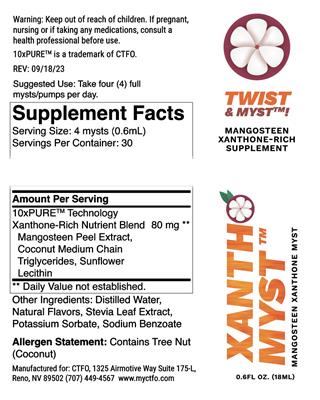
Supplement Facts
The label details for Xanth Myst by Twist & Myst, sourced from the NIH Dietary Supplement Label Database.
Supplement Facts
| Ingredient | Amount | % DV |
|---|---|---|
| Sunflower Lecithin | 0 NP | -- |
| Coconut | 0 NP | -- |
| Xanthone-Rich Nutrient Blend | 80 mg | -- |
| Mangosteen Peel Extract | 0 NP | -- |
Other ingredients: Water, Distilled, Natural Flavors, Stevia Leaf Extract, Potassium Sorbate, Sodium Benzoate
Tap any ingredient to jump to its full detail below.
These statements are the manufacturer’s wording, reproduced from the product label — the label is saying it, not HelloPharmacist. We don’t verify or endorse them.
Precautions
Warning: Keep out of reach of children.
If pregnant, nursing or if taking any medications, consult a health professional before use.
Allergen statement: Contains tree nut (coconut)
Brand IP Statement(s)
10xPure is a trademark of CTFO.
Suggested/Recommended/Usage/Directions
Suggested use: Take four (4) full mysts/pumps per day.
FDA Statement of Identity
Mangosteen Xanthone-Rich Supplement
Formula
Mangosteen xanthone myst
Is this label outdated? Report a formula or label change and our pharmacy team will review it.
Xanth Myst by Twist & Myst label
The label scan from the NIH Dietary Supplement Label Database. Tap to enlarge.
Label images are published by the NIH Dietary Supplement Label Database for the version of this product on file. Always read your actual product label.
View the full label (PDF)The Ingredients in Xanth Myst by Twist & Myst
These are the 3 active ingredients this product is made of. Select any to open its full monograph.
Serving size0.6 mL Dosage formLiquid Servings per container30 Amounts shown are per serving.
Most supplement products combine several ingredients, and a medication can interact with the product through any one of them. Each ingredient below shows whether it has known drug interactions.
Xanthone-Rich Nutrient Blend
Other (inactive) ingredients: Water, Distilled, Natural Flavors, Stevia Leaf Extract, Potassium Sorbate, Sodium Benzoate. These complete the product’s ingredient list but are not active constituents.
Xanth Myst by Twist & Myst Drug Interactions
HelloPharmacist Interaction Report
Xanth Myst by Twist & Myst contains three active ingredients, and we've found documented interactions for two of them.
The most serious concern is with mangosteen peel extract and blood thinners (anticoagulants) or antiplatelet drugs — there's a moderate-level risk that mangosteen might increase bleeding when combined with these medications. This is based on lab and animal research showing that one of mangosteen's compounds can reduce how platelets clump together.
Read the full breakdown — every affected drug type, severity by severity
Coconut carries a minor interaction with antidiabetes drugs (medications for blood sugar control). Animal research suggests coconut might lower blood sugar levels further, raising the theoretical risk of low blood sugar (hypoglycemia).
Mangosteen also has a minor interaction with donepezil (Aricept), a medication for Alzheimer disease — animal studies show mangosteen extract may increase how much donepezil reaches the brain.
Sunflower lecithin has no interactions documented in our data, though that isn't a guarantee none exist. Altogether, these interactions span 210 individual medications.
Please use the medication checker on this page to look up any prescriptions or over-the-counter drugs you're taking.
Check your own medications below · Editorial policy · How we use AI
Want to check YOUR meds against Xanth Myst?
Ask about interactions with your drugs in plain English — “Can I take it with lisinopril?” — and we find you the answer in seconds, ingredient by ingredient.
Go to the checkerIngredients driving the most interactions
Individual Drug Interactions
The ingredients in Xanth Myst interact with 211 drugs. Click any drug to see the details.
2 of the 3 ingredients in Xanth Myst interact with drugs. Each result below shows which ingredient is responsible. Mangosteen Peel Extract Coconut
Aspirin, Calcium Carbonate, Magnesium Carbonate, Magnesium OxideBufferin
How Aspirin, Calcium Carbonate, Magnesium Carbonate, Magnesium Oxide interacts with Xanth Myst — through 1 ingredient. Tap an ingredient for the detail:
Mangosteen Peel ExtractAnticoagulant/antiplatelet Drugs Moderate
Interaction Summary
Theoretically, concomitant use of mangosteen with anticoagulant or antiplatelet drugs may increase the risk of bleeding.
Read the full Mangosteen Peel Extract + Aspirin, Calcium Carbonate, Magnesium Carbonate, Magnesium Oxide interactionAspirin, CarisoprodolSoma Compound
How Aspirin, Carisoprodol interacts with Xanth Myst — through 1 ingredient. Tap an ingredient for the detail:
Mangosteen Peel ExtractAnticoagulant/antiplatelet Drugs Moderate
Interaction Summary
Theoretically, concomitant use of mangosteen with anticoagulant or antiplatelet drugs may increase the risk of bleeding.
Read the full Mangosteen Peel Extract + Aspirin, Carisoprodol interactionAspirin, Carisoprodol, Codeine PhosphateSoma Compound w/ Codeine
How Aspirin, Carisoprodol, Codeine Phosphate interacts with Xanth Myst — through 1 ingredient. Tap an ingredient for the detail:
Mangosteen Peel ExtractAnticoagulant/antiplatelet Drugs Moderate
Interaction Summary
Theoretically, concomitant use of mangosteen with anticoagulant or antiplatelet drugs may increase the risk of bleeding.
Read the full Mangosteen Peel Extract + Aspirin, Carisoprodol, Codeine Phosphate interactionAspirin, Chlorpheniramine, PhenylpropanolamineAlka-Seltzer Plus Cold
How Aspirin, Chlorpheniramine, Phenylpropanolamine interacts with Xanth Myst — through 1 ingredient. Tap an ingredient for the detail:
Mangosteen Peel ExtractAnticoagulant/antiplatelet Drugs Moderate
Interaction Summary
Theoretically, concomitant use of mangosteen with anticoagulant or antiplatelet drugs may increase the risk of bleeding.
Read the full Mangosteen Peel Extract + Aspirin, Chlorpheniramine, Phenylpropanolamine interactionAspirin, Citric Acid, Sodium BicarbonateAlka-Seltzer Pain Reliever and Antacid
How Aspirin, Citric Acid, Sodium Bicarbonate interacts with Xanth Myst — through 1 ingredient. Tap an ingredient for the detail:
Mangosteen Peel ExtractAnticoagulant/antiplatelet Drugs Moderate
Interaction Summary
Theoretically, concomitant use of mangosteen with anticoagulant or antiplatelet drugs may increase the risk of bleeding.
Read the full Mangosteen Peel Extract + Aspirin, Citric Acid, Sodium Bicarbonate interactionAspirin, Codeine PhosphateAspirin w/ Codeine
How Aspirin, Codeine Phosphate interacts with Xanth Myst — through 1 ingredient. Tap an ingredient for the detail:
Mangosteen Peel ExtractAnticoagulant/antiplatelet Drugs Moderate
Interaction Summary
Theoretically, concomitant use of mangosteen with anticoagulant or antiplatelet drugs may increase the risk of bleeding.
Read the full Mangosteen Peel Extract + Aspirin, Codeine Phosphate interactionAspirin, Codeine Phosphate, MethocarbamolRobaxisal C
How Aspirin, Codeine Phosphate, Methocarbamol interacts with Xanth Myst — through 1 ingredient. Tap an ingredient for the detail:
Mangosteen Peel ExtractAnticoagulant/antiplatelet Drugs Moderate
Interaction Summary
Theoretically, concomitant use of mangosteen with anticoagulant or antiplatelet drugs may increase the risk of bleeding.
Read the full Mangosteen Peel Extract + Aspirin, Codeine Phosphate, Methocarbamol interactionAspirin, Codeine Phosphate, PhenobarbitalPhenaphen
How Aspirin, Codeine Phosphate, Phenobarbital interacts with Xanth Myst — through 1 ingredient. Tap an ingredient for the detail:
Mangosteen Peel ExtractAnticoagulant/antiplatelet Drugs Moderate
Interaction Summary
Theoretically, concomitant use of mangosteen with anticoagulant or antiplatelet drugs may increase the risk of bleeding.
Read the full Mangosteen Peel Extract + Aspirin, Codeine Phosphate, Phenobarbital interactionAspirin, Diphenhydramine, PhenylpropanolamineAlka Seltzer Plus Night Time Effervescent
How Aspirin, Diphenhydramine, Phenylpropanolamine interacts with Xanth Myst — through 1 ingredient. Tap an ingredient for the detail:
Mangosteen Peel ExtractAnticoagulant/antiplatelet Drugs Moderate
Interaction Summary
Theoretically, concomitant use of mangosteen with anticoagulant or antiplatelet drugs may increase the risk of bleeding.
Read the full Mangosteen Peel Extract + Aspirin, Diphenhydramine, Phenylpropanolamine interactionAspirin, DipyridamoleAggrenox, Asasantin Retard
How Aspirin, Dipyridamole interacts with Xanth Myst — through 1 ingredient. Tap an ingredient for the detail:
Mangosteen Peel ExtractAnticoagulant/antiplatelet Drugs Moderate
Interaction Summary
Theoretically, concomitant use of mangosteen with anticoagulant or antiplatelet drugs may increase the risk of bleeding.
Read the full Mangosteen Peel Extract + Aspirin, Dipyridamole interactionAspirin, Ethoheptazine, MeprobamateEquagesic
How Aspirin, Ethoheptazine, Meprobamate interacts with Xanth Myst — through 1 ingredient. Tap an ingredient for the detail:
Mangosteen Peel ExtractAnticoagulant/antiplatelet Drugs Moderate
Interaction Summary
Theoretically, concomitant use of mangosteen with anticoagulant or antiplatelet drugs may increase the risk of bleeding.
Read the full Mangosteen Peel Extract + Aspirin, Ethoheptazine, Meprobamate interactionAspirin, HydrocodoneAlor 5 500, Lortab ASA
How Aspirin, Hydrocodone interacts with Xanth Myst — through 1 ingredient. Tap an ingredient for the detail:
Mangosteen Peel ExtractAnticoagulant/antiplatelet Drugs Moderate
Interaction Summary
Theoretically, concomitant use of mangosteen with anticoagulant or antiplatelet drugs may increase the risk of bleeding.
Read the full Mangosteen Peel Extract + Aspirin, Hydrocodone interactionAspirin, MeprobamateMicrainin
How Aspirin, Meprobamate interacts with Xanth Myst — through 1 ingredient. Tap an ingredient for the detail:
Mangosteen Peel ExtractAnticoagulant/antiplatelet Drugs Moderate
Interaction Summary
Theoretically, concomitant use of mangosteen with anticoagulant or antiplatelet drugs may increase the risk of bleeding.
Read the full Mangosteen Peel Extract + Aspirin, Meprobamate interactionAspirin, MethocarbamolRobaxisal
How Aspirin, Methocarbamol interacts with Xanth Myst — through 1 ingredient. Tap an ingredient for the detail:
Mangosteen Peel ExtractAnticoagulant/antiplatelet Drugs Moderate
Interaction Summary
Theoretically, concomitant use of mangosteen with anticoagulant or antiplatelet drugs may increase the risk of bleeding.
Read the full Mangosteen Peel Extract + Aspirin, Methocarbamol interactionAspirin, OmeprazoleYosprala
How Aspirin, Omeprazole interacts with Xanth Myst — through 1 ingredient. Tap an ingredient for the detail:
Mangosteen Peel ExtractAnticoagulant/antiplatelet Drugs Moderate
Interaction Summary
Theoretically, concomitant use of mangosteen with anticoagulant or antiplatelet drugs may increase the risk of bleeding.
Read the full Mangosteen Peel Extract + Aspirin, Omeprazole interactionAspirin, OxycodonePercodan
How Aspirin, Oxycodone interacts with Xanth Myst — through 1 ingredient. Tap an ingredient for the detail:
Mangosteen Peel ExtractAnticoagulant/antiplatelet Drugs Moderate
Interaction Summary
Theoretically, concomitant use of mangosteen with anticoagulant or antiplatelet drugs may increase the risk of bleeding.
Read the full Mangosteen Peel Extract + Aspirin, Oxycodone interactionAspirin, PentazocineTalwin Compound
How Aspirin, Pentazocine interacts with Xanth Myst — through 1 ingredient. Tap an ingredient for the detail:
Mangosteen Peel ExtractAnticoagulant/antiplatelet Drugs Moderate
Interaction Summary
Theoretically, concomitant use of mangosteen with anticoagulant or antiplatelet drugs may increase the risk of bleeding.
Read the full Mangosteen Peel Extract + Aspirin, Pentazocine interactionBetrixabanBevyxxa
How Betrixaban interacts with Xanth Myst — through 1 ingredient. Tap an ingredient for the detail:
Mangosteen Peel ExtractAnticoagulant/antiplatelet Drugs Moderate
Interaction Summary
Theoretically, concomitant use of mangosteen with anticoagulant or antiplatelet drugs may increase the risk of bleeding.
Read the full Mangosteen Peel Extract + Betrixaban interactionBivalirudinAngiomax, Angiomax Rtu, Angiox
How Bivalirudin interacts with Xanth Myst — through 1 ingredient. Tap an ingredient for the detail:
Mangosteen Peel ExtractAnticoagulant/antiplatelet Drugs Moderate
Interaction Summary
Theoretically, concomitant use of mangosteen with anticoagulant or antiplatelet drugs may increase the risk of bleeding.
Read the full Mangosteen Peel Extract + Bivalirudin interactionBromfenac SodiumBromsite, Prolensa
How Bromfenac Sodium interacts with Xanth Myst — through 1 ingredient. Tap an ingredient for the detail:
Mangosteen Peel ExtractAnticoagulant/antiplatelet Drugs Moderate
Interaction Summary
Theoretically, concomitant use of mangosteen with anticoagulant or antiplatelet drugs may increase the risk of bleeding.
Read the full Mangosteen Peel Extract + Bromfenac Sodium interactionCabliviCablivi
How Cablivi interacts with Xanth Myst — through 1 ingredient. Tap an ingredient for the detail:
Mangosteen Peel ExtractAnticoagulant/antiplatelet Drugs Moderate
Interaction Summary
Theoretically, concomitant use of mangosteen with anticoagulant or antiplatelet drugs may increase the risk of bleeding.
Read the full Mangosteen Peel Extract + Cablivi interactionCangrelorKengreal
How Cangrelor interacts with Xanth Myst — through 1 ingredient. Tap an ingredient for the detail:
Mangosteen Peel ExtractAnticoagulant/antiplatelet Drugs Moderate
Interaction Summary
Theoretically, concomitant use of mangosteen with anticoagulant or antiplatelet drugs may increase the risk of bleeding.
Read the full Mangosteen Peel Extract + Cangrelor interactionCilostazolPletal
How Cilostazol interacts with Xanth Myst — through 1 ingredient. Tap an ingredient for the detail:
Mangosteen Peel ExtractAnticoagulant/antiplatelet Drugs Moderate
Interaction Summary
Theoretically, concomitant use of mangosteen with anticoagulant or antiplatelet drugs may increase the risk of bleeding.
Read the full Mangosteen Peel Extract + Cilostazol interactionClopidogrelPlavix
How Clopidogrel interacts with Xanth Myst — through 1 ingredient. Tap an ingredient for the detail:
Mangosteen Peel ExtractAnticoagulant/antiplatelet Drugs Moderate
Interaction Summary
Theoretically, concomitant use of mangosteen with anticoagulant or antiplatelet drugs may increase the risk of bleeding.
Read the full Mangosteen Peel Extract + Clopidogrel interactionDalteparinFragmin
How Dalteparin interacts with Xanth Myst — through 1 ingredient. Tap an ingredient for the detail:
Mangosteen Peel ExtractAnticoagulant/antiplatelet Drugs Moderate
Interaction Summary
Theoretically, concomitant use of mangosteen with anticoagulant or antiplatelet drugs may increase the risk of bleeding.
Read the full Mangosteen Peel Extract + Dalteparin interactionDanaparoidOrgaran
How Danaparoid interacts with Xanth Myst — through 1 ingredient. Tap an ingredient for the detail:
Mangosteen Peel ExtractAnticoagulant/antiplatelet Drugs Moderate
Interaction Summary
Theoretically, concomitant use of mangosteen with anticoagulant or antiplatelet drugs may increase the risk of bleeding.
Read the full Mangosteen Peel Extract + Danaparoid interactionDefibrotide SodiumDefitelio
How Defibrotide Sodium interacts with Xanth Myst — through 1 ingredient. Tap an ingredient for the detail:
Mangosteen Peel ExtractAnticoagulant/antiplatelet Drugs Moderate
Interaction Summary
Theoretically, concomitant use of mangosteen with anticoagulant or antiplatelet drugs may increase the risk of bleeding.
Read the full Mangosteen Peel Extract + Defibrotide Sodium interactionDiclofenacZorvolex
How Diclofenac interacts with Xanth Myst — through 1 ingredient. Tap an ingredient for the detail:
Mangosteen Peel ExtractAnticoagulant/antiplatelet Drugs Moderate
Interaction Summary
Theoretically, concomitant use of mangosteen with anticoagulant or antiplatelet drugs may increase the risk of bleeding.
Read the full Mangosteen Peel Extract + Diclofenac interactionDiclofenac PotassiumCambia, Cataflam, Cataflam IR, Voltaren Rapide, Voltarol Rapid
How Diclofenac Potassium interacts with Xanth Myst — through 1 ingredient. Tap an ingredient for the detail:
Mangosteen Peel ExtractAnticoagulant/antiplatelet Drugs Moderate
Interaction Summary
Theoretically, concomitant use of mangosteen with anticoagulant or antiplatelet drugs may increase the risk of bleeding.
Read the full Mangosteen Peel Extract + Diclofenac Potassium interactionDiclofenac SodiumAcoflam, Acoflam 75 SR, Acoflam Retard, Defenac, Defenac Retard, Defenac SR +40 more
How Diclofenac Sodium interacts with Xanth Myst — through 1 ingredient. Tap an ingredient for the detail:
Mangosteen Peel ExtractAnticoagulant/antiplatelet Drugs Moderate
Interaction Summary
Theoretically, concomitant use of mangosteen with anticoagulant or antiplatelet drugs may increase the risk of bleeding.
Read the full Mangosteen Peel Extract + Diclofenac Sodium interactionEach ingredient & the kinds of drugs it affects
For each ingredient in Xanth Myst with known interactions, here are the types of medications they can affect. Open any type for the detail — or search your exact drug in the checker above.
Mangosteen Peel Extract
Anticoagulant/Antiplatelet Drugs
Theoretically, concomitant use of mangosteen with anticoagulant or antiplatelet drugs may increase the risk of bleeding.
In vitro and animal research shows that gamma-mangostin, a constituent of mangosteen, is a potent and competitive antagonist of the serotonin 2A (5-HT2A) receptor. Antagonism of the 5-HT2A receptor is believed to reduce platelet aggregation.
Donepezil (Aricept)
Theoretically, concomitant use of mangosteen with donepezil might increase the effects of donepezil.
Animal research shows that concomitant use of an aqueous extract of mangosteen pericarp with donepezil increases brain concentrations of donepezil at 4 hours by 64% without associated effects on systemic exposure.
Coconut
Antidiabetes Drugs
Theoretically, taking coconut with antidiabetes drugs might increase the risk of hypoglycemia.
Animal research suggests that coconut milk might increase insulin levels and/or decrease blood glucose levels.
Brand information
Manufacturer and brand details for Xanth Myst, from the product label.
Twist & Myst
See all Twist & Myst products- Name
- CTFO, Inc.
- Street Address
- 1325 Airmotive Way, Suite 175-L
- City
- Reno
- State
- NV
- ZipCode
- 89502
- Phone Number
- (707) 449-4567
- Web Address
- www.myctfo.com
Xanth Myst by Twist & Myst: Common Questions
Does Xanth Myst by Twist & Myst interact with any medications?
How can one product interact with so many drugs?
Where does this information come from?
Is this safe if I have a tree nut allergy?
Can I take this while pregnant or breastfeeding?
What does mangosteen peel extract actually do?
Does this help with memory or Alzheimer disease?
What side effects might I experience?
Does this product have fillers?
Written and reviewed by the HelloPharmacist editorial staff. Our editorial policy
Not sure if Xanth Myst is safe with your meds?
Our pharmacists answer your medication & supplement questions — free.
Label information is sourced from the NIH Dietary Supplement Label Database and reflects the product version on file; always read your actual product label. This page is for education only and is not a substitute for professional medical advice. Confirm with your pharmacist or doctor before combining supplements and medications.
The Full Monographs Behind Xanth Myst’s Ingredients
Every ingredient we hold a full HelloPharmacist monograph for — uses, evidence, safety, and the complete interaction list.
Lecithin
Lecithin is a natural fatty substance found in foods and made by the body that is widely used as a supplement and food emulsifier. Evidence supporting most of its health claims is limited, t...
Read the full Lecithin monograph → Herb & supplement monographCoconut
Interacts with 86 drugsCoconut is a nutritious tropical food enjoyed as oil, water, milk, and flesh, and it is generally safe to eat in normal food amounts. While some uses (like skin moisturizing and hydration) h...
Read the full Coconut monograph → Herb & supplement monographMangosteen
Interacts with 125 drugsMangosteen is a tropical fruit whose rind is rich in plant compounds called xanthones that act as antioxidants. While it is popular in juices and supplements for inflammation, immune support...
Read the full Mangosteen monograph →Sources & How We Checked
Xanth Myst's label data comes from the NIH Dietary Supplement Label Database; the ingredient interaction data is from the Natural Medicines database, reviewed by our pharmacists.
- NIH Dietary Supplement Label Database (DSLD) — The official product label on file for this supplement.
- Natural Medicines (Therapeutic Research Center) — Evidence-graded clinical reference behind the ingredient interaction data.
Content is written and reviewed by licensed HelloPharmacist pharmacists. See our data sources and editorial standards for how this information is built and checked.
The 25 references behind this product’s interaction data
Every citation that drives the interaction findings for this product’s ingredients, from the evidence-graded Natural Medicines (TRC Healthcare) database. Open an ingredient to browse its citations — links open the study on PubMed or the publisher’s site.
Lecithin 9 references
- Buchman AL, Dubin M, Jenden D, et al. Lecithin increases plasma free choline and decreases hepatic steatosis in long-term total parenteral nutrition patients. Gastroenterology 1992;102:1363-70.
- Food and Nutrition Board, Institute of Medicine. Dietary Reference Intakes for Thiamin, Riboflavin, Niacin, Vitamin B6, Folate, Vitamin B12, Pantothenic Acid, Biotin, and Choline (2000). Washington, DC: National Academy Press, 2000. Available at: http://b
- Chatellier G, Lacomblez L. Tacrine (tetrahydroaminoacridine; THA) and lecithin in senile dementia of the Alzheimer type: a multicentre trial. Groupe Francais d'Etude de la Tetrahydroaminoacridine. BMJ 1990;300:495-9.
- Gelenberg AJ, Dorer DJ, Wojcik JD, et al. A crossover study of lecithin treatment of tardive dyskinesia. J Clin Psychiatry 1990;51:149-53.
- Little A, Levy R, Chuaqui-Kidd P, Hand D. A double-blind, placebo controlled trial of high-dose lecithin in Alzheimer's disease. J Neurol Neurosurg Psychiatry 1985;48:736-42. PubMed
- Palm M, Moneret-Vautrin DA, Kanny G, et al. Food allergy to egg and soy lecithins. Allergy 1999;54:1116-7. PubMed
- Drachman DA, Glosser G, Fleming P, et al. Memory decline in the aged: treatment with lecithin and physostigmine. Neurology 1982;32:944-50. PubMed
- Gelenberg, A. J., Doller-Wojcik, J. C., and Growdon, J. H. Choline and lecithin in the treatment of tardive dyskinesia: preliminary results from a pilot study. Am J Psychiatry 1979;136(6):772-776. PubMed
- Electronic Code of Federal Regulations. Title 21, Chapter 1, Subchapter B, Part 184: Direct food substances affirmed as Generally Recognized as Safe. Subpart B - listing of specific substances affirmed as GRAS. Sec. 184.1400 Lecithin. Available at: https:
Coconut 10 references
- Teuber SS, Peterson WR. Systemic allergic reaction to coconut (Cocos nucifera) in 2 subjects with hypersensitivity to tree nut and demonstration of cross-reactivity to legumin-like seed storage proteins: new coconut and walnut food allergens. J Allergy Cl PubMed
- Rosado A, Fernandez-Rivas M, Gonzalez-Mancebo E, et al. Anaphylaxis to coconut. Allergy 2002;57(2):182-3. PubMed
- Karmakar PR, Das A, Chatterjee BP. Placebo-controlled immunotherapy with Cocos nucifera pollen extract. Int Arch Allergy Immunol 1994;103(2):194-201. PubMed
- Anagnostou K. Coconut Allergy Revisited. Children (Basel). 2017;4(10). pii: E85. PubMed
- Cifuentes L, Mistrello G, Amato S, et al. Identification of cross-reactivity between buckwheat and coconut. Ann Allergy Asthma Immunol. 2015;115(6):530-2. PubMed
- Michavila Gomez A, Amat Bou M, Gonzalez Cortés MV, Segura Navas L, Moreno Palanques MA, Bartolomé B. Coconut anaphylaxis: Case report and review. Allergol Immunopathol (Madr). 2015;43(2):219-20. PubMed
- 21CFR170.3. U.S. Food and Drug Administration Department of Health and Human Services. Updated April 1, 2017. https://www.accessdata.fda.gov/scripts/cdrh/cfdocs/cfcfr/CFRSearch.cfm?fr=170.3
- Alatawi KA, Alshubaily FA. Coconut products alleviate hyperglycaemic, hyperlipidimic and nephropathy indices in streptozotocin-induced diabetic wistar rats. Saudi J Biol Sci. 2021;28(8):4224-4231. PubMed
- Kruse L, Lor J, Yousif R, Pongracic JA, Fishbein AB. Coconut allergy: Characteristics of reactions and diagnostic predictors in a pediatric tertiary care center. Ann Allergy Asthma Immunol 2021;126(5):562-568.
- Pathmanandavel K, Kaur N, Joshi P, Ford LS. Anaphylaxis and allergy to coconut: An Australian pediatric case series. J Allergy Clin Immunol Pract 2020;8(10):3657-3659. PubMed
Mangosteen 6 references
- Chairungsrilerd N, Furukawa K, Ohta T, et al. Histaminergic and serotonergic receptor blocking substances from the medicinal plant Garcinia mangostana. Planta Med 1996;62:471-2.
- Wong LP, Klemmer PJ. Severe lactic acidosis associated with juice of the mangosteen fruit Garcinia mangostana. Am J Kidney Dis 2008;51:829-33. PubMed
- Furukawa, K., Chairungsrilerd, N., Ohta, T., Nozoe, S., and Ohizumi, Y. [Novel types of receptor antagonists from the medicinal plant Garcinia mangostana]. Nippon Yakurigaku Zasshi 1997;110 Suppl 1:153P-158P. PubMed
- Chairungsrilerd, N., Furukawa, K., Tadano, T., Kisara, K., and Ohizumi, Y. Effect of gamma-mangostin through the inhibition of 5-hydroxy-tryptamine2A receptors in 5-fluoro-alpha-methyltryptamine-induced head-twitch responses of mice. Br J Pharmacol. 1998
- Suthammarak W, Numpraphrut P, Charoensakdi R, et al. Antioxidant-enhancing property of the polar fraction of mangosteen pericarp extract and evaluation of its safety in humans. Oxid Med Cell Longev 2016;2016:1293036. PubMed
- Bae M, Han SY, Kim ES, et al. Effect of Water Extract of Mangosteen Pericarp on Donepezil Pharmacokinetics in Mice. Molecules 2021;26(17):5246. PubMed
Parts of this content are provided by the Therapeutic Research Center, LLC.
DISCLAIMER: Currently this does not check for drug-drug interactions. This is not an all-inclusive comprehensive list of potential interactions and is for informational purposes only. Not all interactions are known or well-reported in the scientific literature, and new interactions are continually being reported. Input is needed from a qualified healthcare provider including a pharmacist before starting any therapy. Application of clinical judgment is necessary.
© 2021 Therapeutic Research Center, LLC