
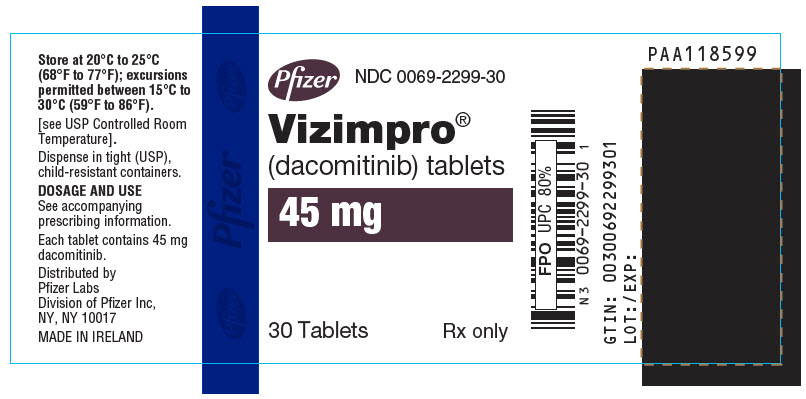
Vizimpro dacomitinib 45 mg Tablet, Film Coated, 30-count — NDC 0069-2299-30 (Billing 00069-2299-30)
This is a package of 30 tablets of Vizimpro dacomitinib 45 mg Tablet, Film Coated from Pfizer Laboratories Div Pfizer Inc, marketed since Oct 2018 and currently FDA-listed, this package's marketing is listed to end Oct 2028. It is this product's only package size.
NDC database record
One package, one record: these facts belong to NDC 0069-2299-30 alone.
- Record
- FDA NDC Directory package listing · Human prescription drug
- Code segments
- 0069 labeler · 2299 product · 30 package
- Package marketed since
- Oct 4, 2018
- Package marketing ended
- Oct 31, 2028
- Sample package
- No — commercial package
- Billing quantity
- 30 EA per package
- Barcode (UPC)
- 0300691198308, 0300692299301, 0300690197302
- FDA record last changed
- Jul 24, 2026
Identity & classification
Regulatory identifiers FDA, NLM and CMS codes for this package
Drug-database identifiers Medi-Span GPI and First Databank GCN / HICL / AHFS classification
- GSN (GCN sequence number): 079000
- GCN: 40423
- GPI-14 (Medi-Span): 21360019000340
- HICL (First Databank): 045283
- AHFS class code: 10:00.00.00
- RxCUI (RxNorm): 2058915
Where does this data come from?
- FDA openFDA NDC Directory · synced Oct 8, 2026
- FDA label on DailyMed · label index refreshed Oct 6, 2026
- RxNorm (NLM RxNav) · catalog refreshed Oct 1, 2026
- Medi-Span GPI (licensed)
- First Databank (licensed) · refreshed Oct 8, 2026
RxNorm drug class
This medicine belongs to the Epidermal growth factor receptor (EGFR) tyrosine kinase inhibitors class.
Where does this data come from?
- RxClass (NLM) · catalog refreshed Oct 1, 2026
Clinical
- It treats metastatic non-small cell lung cancer in people whose tumors have a specific EGFR mutation (exon 19 deletion or exon 21 L858R). It is used as the first treatment. A test...
- Take one tablet by mouth once a day, at the same time each day. Food doesn't matter. If you vomit or miss a dose, don't double up. Just take your next dose at the regular time.
- Diarrhea, rash, nail-fold problems, mouth sores, dry skin, lower appetite and weight loss are common. Start moisturizing and limit sun exposure early, and tell your care team about...
- Call promptly if you have new or worsening shortness of breath, cough or fever, since these can signal a serious lung problem. Also call for severe or lasting diarrhea, or a severe...
Patient education
Supplement & herbal interactions
Some supplements/herbs that may interact with Dacomitinib — tap one for details:
Where does this data come from?
- MedlinePlus (NLM) · refreshed Oct 1, 2026
- FDA label on DailyMed · label index refreshed Oct 6, 2026
Ask a licensed pharmacist directly — free, answered by our team.
Pricing
A drug doesn't have one price. Each row is a different public payment system, and none is what you'd pay at the counter — that depends on your insurance. The ⓘ on each row explains what it measures.
| Price system | Per each | Per package |
|---|---|---|
| Retail pharmacies payNADAC · weekly | Not in the retail survey — common for institutional, discontinued, or low-volume packs. | |
| Medicaid paysCMS SDUD · 12 mo | No recent Medicaid claims on file for this NDC — rare and low-volume NDCs are suppressed in the public data. | |
| Medicare drug plans payPart D · Q2 2026 | $579.88 | $17,396.54 / 30 tablets |
Where does this data come from?
- CMS NADAC weekly file
- CMS ASP pricing files · refreshed Sep 20, 2026
- CMS Medicaid State Drug Utilization Data · refreshed Oct 8, 2026
- CMS Part D plan pricing files · refreshed Sep 24, 2026
- VA National Acquisition Center price file
Packaging — all sizes for this product
| Package NDC | Description | Marketing start | Marketing end | Status |
|---|---|---|---|---|
| 00069-2299-30 You're viewing this Main listing | 30 TABLET, FILM COATED in 1 BOTTLE, PLASTIC | 2018-10-04 | Oct 31, 2028 | Active |
Therapeutic equivalents
| Product | Labeler | Pack | NADAC/unit | TE | Status | Price vs. this |
|---|---|---|---|---|---|---|
| Vizimpro 45 mgthis 00069-2299-30 | Pfizer | 30 tablets | — | — | FDA listed | — |
Where does this data come from?
- FDA openFDA NDC Directory · synced Oct 8, 2026
- FDA Orange Book · refreshed Oct 3, 2026
- CMS NADAC weekly file
Availability & generic status
We did not find an FDA-approved generic match for this exact strength, form and route. Patent/protection dates below may affect future generic timing.
Why the date isn’t exact: Generic timing can change because patents may be challenged, settled, licensed, added, removed, or worked around with a narrower label — and FDA approval does not always mean a pharmacy can get the generic today.
🛈 What do these terms mean?
- Patent
- Legal protection listed in the Orange Book that may delay generic approval or launch. Issued by the U.S. Patent & Trademark Office.
- Substance patent
- Covers the active drug molecule itself — the hardest to design around. A generic generally can’t launch until it expires.
- Formulation (product) patent
- Covers a specific formulation or dosage form. A generic can sometimes work around it with a different formulation.
- Method-of-use patent
- A patent covering one specific approved use of the drug — not necessarily the whole molecule. A generic can sometimes launch with a “skinny label” that carves out the protected use and keeps the others.
- Skinny label
- A generic label that omits a still-patented use when the FDA allows it — letting a generic reach the market for the unprotected uses.
- Exclusivity
- FDA-granted marketing protection, separate from patents — e.g. 5-yr new chemical entity, 7-yr orphan drug, or a +6-month pediatric extension.
- Paragraph IV
- A generic applicant’s formal challenge to a listed patent. It can potentially lead to earlier generic entry, but often involves litigation or a settlement.
- RLD / RS
- Reference Listed Drug — the brand product the FDA uses as the reference for generic applications. Reference Standard — the product the FDA expects generics to compare against in bioequivalence testing.
- TE / AB rating
- FDA therapeutic-equivalence rating. An AB rating generally means the FDA considers a generic therapeutically equivalent to — and substitutable for — the brand.
- LOE (loss of exclusivity)
- The latest patent or exclusivity currently listed — the loss-of-exclusivity / latest-listed-protection date shown on this page. Paragraph-IV challenges and settlements can move the real date earlier; FDA approval and a manufacturer’s decision to market can move it later.
Built from the FDA Orange Book. The bars above are scaled to each protection’s expiry; the red LOE marker is the last one to lapse.
| Patent | Type | Use code | Expires |
|---|---|---|---|
| US 10603314 ↗ | Method of use | U-3337 | Feb 2, 2026 |
| US 10603314 ↗ | Method of use | U-3337 | Feb 2, 2026 |
| US 10603314 ↗ | Method of use | U-3337 | Feb 2, 2026 |
| US 10596162 ↗ | Method of use | U-3338 | Feb 2, 2026 |
| US 10596162 ↗ | Method of use | U-3338 | Feb 2, 2026 |
| US 10596162 ↗ | Method of use | U-3338 | Feb 2, 2026 |
| US 7772243 ↗ | Drug substance | — | Sep 27, 2032 |
| US 7772243 ↗ | Drug substance | — | Sep 27, 2032 |
| US 7772243 ↗ | Drug substance | — | Sep 27, 2032 |
Is there a generic version of VIZIMPRO 45 MG TABLET?
The FDA approved a generic — why can’t I get it at my pharmacy yet?
Why do different websites show different generic release dates?
What does “FDA listed” mean?
What does a patent or protection date mean here?
What does “current Orange Book estimate” mean?
Can a generic come out before the last patent expires?
Can a generic come out after the listed dates?
What is the difference between patents and exclusivity?
Why are there multiple patent dates?
Where does this data come from?
- FDA Orange Book · refreshed Oct 3, 2026
What it looks like
Where does this data come from?
- FDA label on DailyMed · label index refreshed Oct 6, 2026
Inactive Ingredients / Excipients
Inactive ingredients, also called excipients, are components of the drug product other than the active ingredient. They may include fillers, dyes, coatings, preservatives, flavors, or other formulation ingredients.
🧪 Avoiding an ingredient? See Dacomitinib inactive ingredients by manufacturer: every current product's list side by side, so you can ask your pharmacy for the version that does not list it.
💡 Tap an ingredient (hover on desktop) to see what it is and why it’s used.
-
UNII L06K8R7DQK
A synthetic blue dye approved by the FDA for use in medications and foods. It serves as a colorant to make pills and liquids visually distinct and easier to identify.
-
UNII EWQ57Q8I5X
Lactose monohydrate is a natural sugar derived from milk. It serves as a filler and binder in tablets and capsules, helping create the proper size, texture, and consistency of the medicine.
-
UNII 70097M6I30
Magnesium stearate is a salt made from magnesium and stearic acid, a fatty substance. It's used in tablets and capsules as a lubricant and glidant to help ingredients flow smoothly during manufacturing and prevent sticking.
-
UNII OP1R32D61U
Microcrystalline cellulose is a purified form of cellulose, a natural fiber from plant sources. It acts as a binder and filler in tablets and capsules, helping hold ingredients together and give the medicine its shape and size.
-
UNII G2M7P15E5P
Polyethylene glycol 3350 is a synthetic polymer used as a solvent, humectant, and thickening agent in medicines. It helps dissolve other ingredients, retain moisture in the product, and achieve the desired consistency.
-
UNII 532B59J990
Polyvinyl alcohol is a synthetic polymer made from plant-derived materials. It's used as a binder to hold ingredients together, a film-former in coatings, and a thickener in liquid formulations.
-
UNII 5856J3G2A2
A starch-based powder made from potatoes and processed with sodium. It acts as a disintegrant, helping the tablet or capsule break apart quickly in the stomach so the medicine can be absorbed.
-
UNII 7SEV7J4R1U
A powder made from a naturally occurring mineral. In medicines, talc works as a glidant and anti-caking agent, helping tablets and capsules flow smoothly during manufacturing and preventing clumping.
-
UNII 15FIX9V2JP
Titanium dioxide is a bright white mineral powder commonly used as a colorant and opacifying agent. It makes pills and tablets white or lighter in color and helps make coatings non-transparent.
9 inactive ingredients listed in the exact product block matched to this NDC.
Where does this data come from?
ingredient classCode="IACT" elements from the exact product block matched by this NDC. Label-section narrative from DailyMed / the openFDA label index is shown separately when available.- FDA label on DailyMed · label index refreshed Oct 6, 2026
- FDA openFDA NDC Directory · synced Oct 8, 2026
Inactive ingredient FAQ
Are inactive ingredients the same for every manufacturer?
Why might an inactive ingredient be missing?
Can inactive ingredients matter?
Manufacturer & labeler
More NDCs from Pfizer Laboratories Div Pfizer Inc labeler code 00069
- Cutaquig immunoglobulin G 165 mg/mL Solution NDC 0069-1802-02
- Cutaquig immunoglobulin G 165 mg/mL Solution NDC 0069-1960-02
- Cutaquig immunoglobulin G 165 mg/mL Solution NDC 0069-1965-02
- Vyndaqel tafamidis meglumine 20 mg Capsule, Liquid Filled NDC 0069-1975-40
- HYMPAVZI marstacimab-hncq 150 mg/mL Injection, Solution NDC 0069-2151-01
- Caduet amlodipine besylate and atorvastatin calcium 5 mg; 80 mg Tablet, Film Coated NDC 0069-2260-30
- Abrysvo Respiratory Syncytial Virus Vaccine .06 mg/.5mL; .06 mg/.5mL Injection, Powder, Lyophilized, For Solution NDC 0069-2465-01
- Comirnaty COVID-19 Vaccine, mRNA .0158 mg/.48mL Injection, Suspension NDC 0069-2501-10
- Elrexfio elranatamab-bcmm 44 mg/1.1mL Injection, Solution NDC 0069-2522-02
- Comirnaty COVID-19 Vaccine, mRNA .042 mg/.418mL Injection, Suspension NDC 0069-2528-10
- Comirnaty COVID-19 Vaccine, mRNA .0158 mg/.48mL Injection, Suspension NDC 0069-2609-10
- Comirnaty COVID-19 Vaccine, mRNA .042 mg/.418mL Injection, Suspension NDC 0069-2631-10
Where does this data come from?
- FDA openFDA NDC Directory · synced Oct 8, 2026
- Drugs@FDA
Full prescribing information FDA SPL
🎯 Indications and Usage ▾
1 INDICATIONS AND USAGE VIZIMPRO is indicated for the first-line treatment of patients with metastatic non-small cell lung cancer (NSCLC) with epidermal growth factor receptor (EGFR) exon 19 deletion or exon 21 L858R substitution mutations as detected by an FDA-approved test [see Dosage and Administration (2.1) ] . VIZIMPRO is a kinase inhibitor indicated for the first-line treatment of patients with metastatic non-small cell lung cancer (NSCLC) with epidermal growth factor receptor (EGFR) exon 19 deletion or exon 21 L858R substitution mutations as detected by an FDA-approved test.
( 1 )
⏱️ Dosage and Administration ▾
2 DOSAGE AND ADMINISTRATION Recommended Dosage: 45 mg orally once daily with or without food. ( 2.2 )
2.1Patient Selection Select patients for the first-line treatment of metastatic NSCLC with VIZIMPRO based on the presence of an EGFR exon 19 deletion or exon 21 L858R substitution mutation in tumor specimens. Information on FDA-approved tests for the detection of EGFR mutations in NSCLC is available at: http://www.fda.gov/CompanionDiagnostics.
2.2Recommended Dosage The recommended dosage of VIZIMPRO is 45 mg taken orally once daily, until disease progression or unacceptable toxicity occurs. VIZIMPRO can be taken with or without food [see Dosage and Administration (2.4) and Clinical Pharmacology (12.3) ] . Take VIZIMPRO the same time each day. If the patient vomits or misses a dose, do not take an additional dose or make up a missed dose but continue with the next scheduled dose.
2.3Dosage Modifications for Adverse Reactions Reduce the dose of VIZIMPRO for adverse reactions as described in Table 1. Dosage modifications for specific adverse reactions are provided in Table 2. Table 1.
VIZIMPRO Recommended Dose Reductions for Adverse Reactions Dose Level Dose (Once Daily) First dose reduction 30 mg Second dose reduction 15 mg Table 2. VIZIMPRO Dosage Modifications for Adverse Reactions Adverse Reaction Severity National Cancer Institute Common Terminology Criteria for Adverse Events Version 4.03. Dosage Modification Interstitial lung disease (ILD) [see Warnings and Precautions (5.1) ] Any Grade • Permanently discontinue VIZIMPRO.
Diarrhea [see Warnings and Precautions (5.2) ] Grade 2 • Withhold VIZIMPRO until recovery to less than or equal to Grade 1; then resume VIZIMPRO at the same dose level. • For recurrent Grade 2 diarrhea, withhold until recovery to less than or equal to Grade 1; then resume VIZIMPRO at a reduced dose. Grade 3 or 4 • Withhold VIZIMPRO until recovery to less than or equal to Grade 1; then resume VIZIMPRO at a reduced dose. Dermatologic Adverse Reactions [see Warnings and Precautions (5.3) ] Grade 2 • Withhold VIZIMPRO for persistent dermatologic adverse reactions; upon recovery to less than or equal to Grade 1, resume VIZIMPRO at the same dose level. • For recurrent persistent Grade 2 dermatologic adverse reactions, withhold until recovery to less than or equal to Grade 1; then resume VIZIMPRO at a reduced dose.
Grade 3 or 4 • Withhold VIZIMPRO until recovery to less than or equal to Grade 1; then resume VIZIMPRO at a reduced dose. Other Grade 3 or 4 • Withhold VIZIMPRO until recovery to less than or equal to Grade 2; then resume VIZIMPRO at a reduced dose.
2.4Dosage Modifications for Acid-Reducing Agents Avoid the concomitant use of proton pump inhibitors (PPIs) while taking VIZIMPRO. As an alternative to PPIs, use locally-acting antacids or if using an histamine 2 (H2)-receptor antagonist, administer VIZIMPRO at least 6 hours before or 10 hours after taking an H2-receptor antagonist [see Drug Interactions (7.1) and Clinical Pharmacology (12.3) ] .
💊 Dosage Forms and Strengths ▾
3 DOSAGE FORMS AND STRENGTHS Tablets: • 45 mg: blue film-coated, immediate release, round biconvex tablet, debossed with "Pfizer" on one side and "DCB45" on the other side. • 30 mg: blue film-coated, immediate release, round biconvex tablet, debossed with "Pfizer" on one side and "DCB30" on the other side. • 15 mg: blue film-coated, immediate release, round biconvex tablet, debossed with "Pfizer" on one side and "DCB15" on the other side. Tablets: 15 mg, 30 mg, and 45 mg. ( 3 )
⛔ Contraindications ▾
4 CONTRAINDICATIONS None. None. ( 4 )
⚠️ Warnings and Cautions ▾
5 WARNINGS AND PRECAUTIONS • Interstitial Lung Disease (ILD): Permanently discontinue VIZIMPRO if ILD is confirmed. ( 5.1 ) • Diarrhea: Withhold and reduce the dose of VIZIMPRO based on the severity. ( 2.3 , 5.2 ) • Dermatologic Adverse Reactions: Withhold and reduce the dose of VIZIMPRO based on the severity.
( 2.3 , 5.3 ) • Embryo-Fetal Toxicity: VIZIMPRO can cause fetal harm. Advise females of reproductive potential to use effective contraception. ( 5.4 , 8.1 , 8.3 )
5.1Interstitial Lung Disease (ILD) Severe and fatal ILD/pneumonitis occurred in patients treated with VIZIMPRO and occurred in 0.5% of the 394 VIZIMPRO-treated patients; 0.3% of cases were fatal. Monitor patients for pulmonary symptoms indicative of ILD/pneumonitis. Withhold VIZIMPRO and promptly investigate for ILD in patients who present with worsening of respiratory symptoms which may be indicative of ILD (e.g., dyspnea, cough, and fever).
Permanently discontinue VIZIMPRO if ILD is confirmed [see Adverse Reactions (6.1) ] .
5.2Diarrhea Severe and fatal diarrhea occurred in patients treated with VIZIMPRO. Diarrhea occurred in 86% of the 394 VIZIMPRO-treated patients; Grade 3 or 4 diarrhea was reported in 11% of patients and 0.3% of cases were fatal. Withhold VIZIMPRO for Grade 2 or greater diarrhea until recovery to less than or equal to Grade 1 severity, then resume VIZIMPRO at the same or a reduced dose depending on the severity of diarrhea [see Dosage and Administration (2.3) and Adverse Reactions (6.1) ].
Promptly initiate anti-diarrheal treatment (loperamide or diphenoxylate hydrochloride with atropine sulfate) for diarrhea.
5.3Dermatologic Adverse Reactions Rash and exfoliative skin reactions occurred in patients treated with VIZIMPRO. Rash occurred in 78% of the 394 VIZIMPRO-treated patients; Grade 3 or 4 rash was reported in 21% of patients. Exfoliative skin reactions of any severity were reported in 7% of patients.
Grade 3 or 4 exfoliative skin reactions were reported in 1.8% of patients. Withhold VIZIMPRO for persistent Grade 2 or any Grade 3 or 4 dermatologic adverse reaction until recovery to less than or equal to Grade 1 severity, then resume VIZIMPRO at the same or a reduced dose depending on the severity of the dermatologic adverse reaction [see Dosage and Administration (2.3) and Adverse Reactions (6.1) ]. The incidence and severity of rash and exfoliative skin reactions may increase with sun exposure.
At the time of initiation of VIZIMPRO, initiate use of moisturizers and appropriate measures to limit sun exposure. Upon development of Grade 1 rash, initiate treatment with topical antibiotics and topical steroids. Initiate oral antibiotics for Grade 2 or more severe dermatologic adverse reactions.
5.4Embryo-Fetal Toxicity Based on findings from animal studies and its mechanism of action, VIZIMPRO can cause fetal harm when administered to a pregnant woman. In animal reproduction studies, oral administration of dacomitinib to pregnant rats during the period of organogenesis resulted in an increased incidence of post-implantation loss and reduced fetal body weight at doses resulting in exposures near the exposure at the 45 mg human dose. The absence of EGFR signaling has been shown to result in embryolethality as well as post-natal death in animals.
Advise pregnant women of the potential risk to the fetus. Advise females of reproductive potential to use effective contraception during treatment with VIZIMPRO and for at least 17 days after the final dose [see Use in Specific Populations (8.1 and 8.3) ] .
🤒 Adverse Reactions ▾
6 ADVERSE REACTIONS The following adverse drug reactions are described elsewhere in the labeling: • Interstitial Lung Disease [see Warnings and Precautions (5.1) ] • Diarrhea [see Warnings and Precautions (5.2) ] • Dermatologic Adverse Reactions [see Warnings and Precautions (5.3) ] Most common adverse reactions (incidence >20%) are diarrhea, rash, paronychia, stomatitis, decreased appetite, dry skin, decreased weight, alopecia, cough, and pruritus. ( 6.1 ) To report SUSPECTED ADVERSE REACTIONS, contact Pfizer Inc. at 1-800-438-1985 or FDA at 1-800-FDA-1088 or www.fda.gov/medwatch.
6.1Clinical Trials Experience Because clinical trials are conducted under widely varying conditions, adverse reaction rates observed in the clinical trials of a drug cannot be directly compared to rates in the clinical trials of another drug and may not reflect the rates observed in practice. The data in the Warnings and Precautions section reflect exposure to VIZIMPRO in 394 patients with first-line or previously treated NSCLC with EGFR exon 19 deletion or exon 21 L858R substitution mutations who received VIZIMPRO at the recommended dose of 45 mg once daily in 4 randomized, active-controlled trials [ARCHER 1050 (N=227), Study A7471009 (N=38), Study A7471011 (N=83), and Study A7471028 (N=16)] and one single-arm trial [Study A7471017 (N=30)].
The median duration of exposure to VIZIMPRO was 10.8 months (range 0.07–68) [see Warnings and Precautions (5) ]. The data described below reflect exposure to VIZIMPRO in 227 patients with EGFR mutation-positive, metastatic NSCLC enrolled in a randomized, active-controlled trial (ARCHER 1050 ) ; 224 patients received gefitinib 250 mg orally once daily in the active control arm [see Clinical Studies (14) ] . Patients were excluded if they had a history of ILD, interstitial pneumonitis, or brain metastases.
The median duration of exposure to VIZIMPRO was 15 months (range 0.07–37). The most common (>20%) adverse reactions in patients treated with VIZIMPRO were diarrhea (87%), rash (69%), paronychia (64%), stomatitis (45%), decreased appetite (31%), dry skin (30%), decreased weight (26%), alopecia (23%), cough (21%), and pruritus (21%). Serious adverse reactions occurred in 27% of patients treated with VIZIMPRO.
The most common (≥1%) serious adverse reactions were diarrhea (2.2%) and interstitial lung disease (1.3%). Dose interruptions occurred in 57% of patients treated with VIZIMPRO. The most frequent (>5%) adverse reactions leading to dose interruptions were rash (23%), paronychia (13%), and diarrhea (10%).
Dose reductions occurred in 66% of patients treated with VIZIMPRO. The most frequent (>5%) adverse reactions leading to dose reductions were rash (29%), paronychia (17%), and diarrhea (8%). Adverse reactions leading to permanent discontinuation of VIZIMPRO occurred in 18% of patients.
The most common (>0.5%) adverse reactions leading to permanent discontinuation of VIZIMPRO were: rash (2.6%), interstitial lung disease (1.8%), stomatitis (0.9%), and diarrhea (0.9%). Tables 3 and 4 summarize the most common adverse reactions and laboratory abnormalities, respectively, in ARCHER 1050. ARCHER 1050 was not designed to demonstrate a statistically significant difference in adverse reaction rates for VIZIMPRO or for gefitinib for any adverse reaction or laboratory value listed in Table 3 or 4.
Table 3. Adverse Reactions Occurring in ≥10% of Patients Receiving VIZIMPRO in ARCHER 1050 National Cancer Institute Common Terminology Criteria for Adverse Events (NCI CTCAE) v4.03. Adverse Reaction VIZIMPRO (N=227) Gefitinib (N=224) All Grades Grades 1 through 5 are included in All Grades. % Grades 3 and 4 % All Grades % Grades 3 and 4 % Gastrointestinal Diarrhea One Grade 5 (fatal) event in the VIZIMPRO arm.
87 8 56
0.9Stomatitis Stomatitis includes mucosal inflammation and stomatitis. 45 4.4 19
0.4Nausea 19 1.3 22
0.4Constipation 13 0 14 0 Mouth ulceration 12 0 6 0 Skin and Subcutaneous Tissue Rash Rash includes dermatiti… [Excerpted — this section continues on DailyMed.]
🔄 Drug Interactions ▾
7 DRUG INTERACTIONS • Proton Pump Inhibitors (PPIs): Avoid use with VIZIMPRO; use locally-acting antacids or H2-receptor antagonist; administer VIZIMPRO at least 6 hours before or 10 hours after H2-receptor antagonist. ( 2.4 , 7.1 ) • CYP2D6 Substrates: Avoid concomitant use with VIZIMPRO where minimal increases in concentration of the CYP2D6 substrate may lead to serious or life-threatening toxicities. ( 7.2 )
7.1Effect of Other Drugs on VIZIMPRO Concomitant use with a PPI decreases dacomitinib concentrations, which may reduce VIZIMPRO efficacy. Avoid the concomitant use of PPIs with VIZIMPRO. As an alternative to PPIs, use locally-acting antacids or an H2-receptor antagonist. Administer VIZIMPRO at least 6 hours before or 10 hours after taking an H2-receptor antagonist [see Dosage and Administration (2.4) and Clinical Pharmacology (12.3) ] .
7.2Effect of VIZIMPRO on CYP2D6 Substrates Concomitant use of VIZIMPRO increases the concentration of drugs that are CYP2D6 substrates [see Clinical Pharmacology (12.3) ] which may increase the risk of toxicities of these drugs. Avoid concomitant use of VIZIMPRO with CYP2D6 substrates where minimal increases in concentration of the CYP2D6 substrate may lead to serious or life-threatening toxicities.
👥 Use in Specific Populations ▾
8 USE IN SPECIFIC POPULATIONS • Lactation: Advise not to breastfeed. ( 8.2 )
8.1Pregnancy Risk Summary Based on findings from animal studies and its mechanism of action, VIZIMPRO can cause fetal harm when administered to a pregnant woman [see Clinical Pharmacology (12.1) ] . There are no available data on VIZIMPRO use in pregnant women. In animal reproduction studies, oral administration of dacomitinib to pregnant rats during the period of organogenesis resulted in an increased incidence of post-implantation loss and reduced fetal body weight at doses resulting in exposures near the exposure at the 45 mg human dose (see Data) .
The absence of EGFR signaling has been shown to result in embryolethality as well as post-natal death in animals (see Data) . Advise pregnant women of the potential risk to a fetus [see Use in Special Populations (8.3) ] . In the U.S. general population, the estimated background risk of major birth defects and miscarriage in clinically recognized pregnancies is 2% to 4% and 15% to 20%, respectively.
Data Animal Data Daily oral administration of dacomitinib to pregnant rats during the period of organogenesis resulted in an increased incidence of post-implantation loss, maternal toxicity, and reduced fetal body weight at 5 mg/kg/day (approximately 1.2 times the exposure based on area under the curve [AUC] at the 45 mg human dose). Disruption or depletion of EGFR in mouse models has shown EGFR is critically important in reproductive and developmental processes including blastocyst implantation, placental development, and embryo-fetal/post-natal survival and development.
Reduction or elimination of embryo-fetal or maternal EGFR signaling in mice can prevent implantation, and can cause embryo-fetal loss during various stages of gestation (through effects on placental development), developmental anomalies, early death in surviving fetuses, and adverse developmental outcomes in multiple organs in embryos/neonates.
8.2Lactation Risk Summary There is no information regarding the presence of dacomitinib or its metabolites in human milk or their effects on the breastfed infant or on milk production. Because of the potential for serious adverse reactions in breastfed infants from VIZIMPRO, advise women not to breastfeed during treatment with VIZIMPRO and for at least 17 days after the last dose.
8.3Females and Males of Reproductive Potential Pregnancy Testing Verify the pregnancy status of females of reproductive potential prior to initiating VIZIMPRO [ see Use in Specific Populations (8.1) ]. Contraception VIZIMPRO can cause fetal harm when administered to a pregnant woman [see Use in Specific Populations (8.1) ]. Females Advise females of reproductive potential to use effective contraception during treatment with VIZIMPRO and for at least 17 days after the final dose.
8.4Pediatric Use The safety and effectiveness of VIZIMPRO in pediatrics have not been established.
8.5Geriatric Use Of the total number of patients (N=394) in five clinical studies with EGFR mutation-positive NSCLC who received VIZIMPRO at a dose of 45 mg orally once daily [ARCHER 1050 (N=227), Study A7471009 (N=38), Study A7471011 (N=83), Study A7471028 (N=16), and Study A7471017 (N=30)] 40% were 65 years of age and older. Exploratory analyses across this population suggest a higher incidence of Grade 3 and 4 adverse reactions (67% versus 56%, respectively), more frequent dose interruptions (53% versus 45%, respectively), and more frequent discontinuations (24% versus 10%, respectively) for adverse reactions in patients 65 years or older as compared to those younger than 65 years.
8.6Renal Impairment No dosage modification is recommended for patients with mild or moderate renal impairment (creatinine clearance [CLcr] 30 to 89 mL/min estimated by Cockcroft-Gault). The recommended dose of VIZIMPRO has not been established for patients with severe renal impairment (CLcr <30 mL/min) [see Clinical Pharmacology (12.3) ] .
8.7Hepatic Impairment No… [Excerpted — this section continues on DailyMed.]
🤰 Pregnancy ▾
8.1Pregnancy Risk Summary Based on findings from animal studies and its mechanism of action, VIZIMPRO can cause fetal harm when administered to a pregnant woman [see Clinical Pharmacology (12.1) ] . There are no available data on VIZIMPRO use in pregnant women. In animal reproduction studies, oral administration of dacomitinib to pregnant rats during the period of organogenesis resulted in an increased incidence of post-implantation loss and reduced fetal body weight at doses resulting in exposures near the exposure at the 45 mg human dose (see Data) .
The absence of EGFR signaling has been shown to result in embryolethality as well as post-natal death in animals (see Data) . Advise pregnant women of the potential risk to a fetus [see Use in Special Populations (8.3) ] . In the U.S. general population, the estimated background risk of major birth defects and miscarriage in clinically recognized pregnancies is 2% to 4% and 15% to 20%, respectively.
Data Animal Data Daily oral administration of dacomitinib to pregnant rats during the period of organogenesis resulted in an increased incidence of post-implantation loss, maternal toxicity, and reduced fetal body weight at 5 mg/kg/day (approximately 1.2 times the exposure based on area under the curve [AUC] at the 45 mg human dose). Disruption or depletion of EGFR in mouse models has shown EGFR is critically important in reproductive and developmental processes including blastocyst implantation, placental development, and embryo-fetal/post-natal survival and development.
Reduction or elimination of embryo-fetal or maternal EGFR signaling in mice can prevent implantation, and can cause embryo-fetal loss during various stages of gestation (through effects on placental development), developmental anomalies, early death in surviving fetuses, and adverse developmental outcomes in multiple organs in embryos/neonates.
🧒 Pediatric Use ▾
8.4Pediatric Use The safety and effectiveness of VIZIMPRO in pediatrics have not been established.
🧓 Geriatric Use ▾
8.5Geriatric Use Of the total number of patients (N=394) in five clinical studies with EGFR mutation-positive NSCLC who received VIZIMPRO at a dose of 45 mg orally once daily [ARCHER 1050 (N=227), Study A7471009 (N=38), Study A7471011 (N=83), Study A7471028 (N=16), and Study A7471017 (N=30)] 40% were 65 years of age and older. Exploratory analyses across this population suggest a higher incidence of Grade 3 and 4 adverse reactions (67% versus 56%, respectively), more frequent dose interruptions (53% versus 45%, respectively), and more frequent discontinuations (24% versus 10%, respectively) for adverse reactions in patients 65 years or older as compared to those younger than 65 years.
🧬 Clinical Pharmacology ▾
12 CLINICAL PHARMACOLOGY
12.1Mechanism of Action Dacomitinib is an irreversible inhibitor of the kinase activity of the human EGFR family (EGFR/HER1, HER2, and HER4) and certain EGFR activating mutations (exon 19 deletion or the exon 21 L858R substitution mutation). In vitro dacomitinib also inhibited the activity of DDR1, EPHA6, LCK, DDR2, and MNK1 at clinically relevant concentrations. Dacomitinib demonstrated dose-dependent inhibition of EGFR and HER2 autophosphorylation and tumor growth in mice bearing subcutaneously implanted human tumor xenografts driven by HER family targets including mutated EGFR.
Dacomitinib also exhibited antitumor activity in orally-dosed mice bearing intracranial human tumor xenografts driven by EGFR amplifications.
12.2Pharmacodynamics Cardiac Electrophysiology The effect of dacomitinib on the QT interval corrected for heart rate (QTc) was evaluated using time-matched electrocardiograms (ECGs) evaluating the change from baseline and corresponding pharmacokinetic data in 32 patients with advanced NSCLC. Dacomitinib had no large effect on QTc (i.e., >20 ms) at maximum dacomitinib concentrations achieved with VIZIMPRO 45 mg orally once daily. Exposure-Response Relationships Higher exposures, across the range of exposures with the recommended dose of 45 mg daily, correlated with an increased probability of Grade ≥3 adverse events, specifically dermatologic toxicities and diarrhea.
12.3Pharmacokinetics The maximum dacomitinib plasma concentration (C max ) and AUC at steady state increased proportionally over the dose range of VIZIMPRO 2 mg to 60 mg orally once daily (0.04 to 1.3 times the recommended dose) across dacomitinib studies in patients with cancer. At a dose of 45 mg orally once daily, the geometric mean [coefficient of variation (CV%)] C max was 108 ng/mL (35%) and the AUC 0–24h was 2213 ng∙h/mL (35%) at steady state in a dose-finding clinical study conducted in patients with solid tumors.
Steady state was achieved within 14 days following repeated dosing and the estimated geometric mean (CV%) accumulation ratio was 5.7 (28%) based on AUC. Absorption The mean absolute bioavailability of dacomitinib is 80% after oral administration. The median dacomitinib time to reach maximum concentration (T max ) occurred at approximately 6.0 hours (range 2.0 to 24 hours) after a single oral dose of VIZIMPRO 45 mg in patients with cancer.
Effect of Food Administration of VIZIMPRO with a high-fat, high-calorie meal (approximately 800 to 1000 calories with 150, 250, and 500 to 600 calories from protein, carbohydrate and fat, respectively) had no clinically meaningful effect on dacomitinib pharmacokinetics. Distribution The geometric mean (CV%) volume of distribution of dacomitinib (V ss ) was 1889 L (18%). In vitro binding of dacomitinib to human plasma proteins is approximately 98% and is independent of drug concentrations from 250 ng/mL to 1000 ng/mL.
Elimination Following a single 45 mg oral dose of VIZIMPRO in patients with cancer, the mean (CV%) plasma half-life of dacomitinib was 70 hours (21%), and the geometric mean (CV%) apparent plasma clearance of dacomitinib was
24.9L/h (36%). Metabolism Hepatic metabolism is the main route of clearance of dacomitinib, with oxidation and glutathione conjugation as the major pathways. Following oral administration of a single 45 mg dose of [ 14 C] dacomitinib, the most abundant circulating metabolite was O-desmethyl dacomitinib, which had similar in vitro pharmacologic activity as dacomitinib.
The steady-state plasma trough concentration of O-desmethyl dacomitinib ranges from 7.4% to 19% of the parent. In vitro studies indicated that cytochrome P450 (CYP) 2D6 was the major isozyme involved in the formation of O-desmethyl dacomitinib, while CYP3A4 contributed to the formation of other minor oxidative metabolites. Excretion Following a single oral 45 mg dose of [ 14 C] radiolabeled dacomitinib, 79% of the radioactivity was recovered in feces (20% as dacomitinib)… [Excerpted — this section continues on DailyMed.]
🧬 Mechanism of Action ▾
12.1Mechanism of Action Dacomitinib is an irreversible inhibitor of the kinase activity of the human EGFR family (EGFR/HER1, HER2, and HER4) and certain EGFR activating mutations (exon 19 deletion or the exon 21 L858R substitution mutation). In vitro dacomitinib also inhibited the activity of DDR1, EPHA6, LCK, DDR2, and MNK1 at clinically relevant concentrations. Dacomitinib demonstrated dose-dependent inhibition of EGFR and HER2 autophosphorylation and tumor growth in mice bearing subcutaneously implanted human tumor xenografts driven by HER family targets including mutated EGFR.
Dacomitinib also exhibited antitumor activity in orally-dosed mice bearing intracranial human tumor xenografts driven by EGFR amplifications.
📦 How Supplied / Storage and Handling ▾
16 HOW SUPPLIED/STORAGE AND HANDLING VIZIMPRO is supplied in strengths and package configurations as described in Table 6 below: Table 6. VIZIMPRO Strengths and Package Configurations VIZIMPRO Tablets Package Configuration Tablet Strength (mg) NDC Tablet Description 30-Count Bottle with a child-resistant closure 15 0069-0197-30 Blue film-coated, immediate release, round biconvex tablet, debossed with "Pfizer" on one side and "DCB15" on the other side. 30-Count Bottle with a child-resistant closure 30 0069-1198-30 Blue film-coated immediate release, round biconvex tablet, debossed with "Pfizer" on one side and "DCB30" on the other side.
30-Count Bottle with a child-resistant closure 45 0069-2299-30 Blue film-coated immediate release, round biconvex tablet, debossed with "Pfizer" on one side and "DCB45" on the other side. Store at 20 °C to 25 °C (68 °F to 77 °F); excursions permitted between 15 °C to 30 °C (59 °F to 86 °F). [see USP Controlled Room Temperature].
📦 Storage and Handling ▾
Store at 20 °C to 25 °C (68 °F to 77 °F); excursions permitted between 15 °C to 30 °C (59 °F to 86 °F). [see USP Controlled Room Temperature].
📋 Description ▾
11 DESCRIPTION Dacomitinib is an oral kinase inhibitor with a molecular formula of C 24 H 25 ClFN 5 O 2 ∙ H 2 O and a molecular weight of 487.95 Daltons. The chemical name is: (2 E )- N -{4-[(3-Chloro-4-fluorophenyl)amino]-7-methoxyquinazolin-6-yl}-4-(piperidin-1-yl)but-2-enamide monohydrate and its structural formula is: Dacomitinib is a white to pale yellow powder. VIZIMPRO tablets contain 45, 30, or 15 mg of dacomitinib with the following inactive ingredients in the tablet core; lactose monohydrate, microcrystalline cellulose, sodium starch glycolate, and magnesium stearate.
The film coating consists of Opadry II ® Blue 85F30716 containing: Polyvinyl alcohol – partially hydrolyzed, Talc, Titanium dioxide, Macrogol/PEG 3350, and FD&C Blue #2/Indigo Carmine Aluminum Lake. Chemical Structure
💬 Information for Patients ▾
17 PATIENT COUNSELING INFORMATION Advise the patient to read the FDA-approved patient labeling (Patient Information). Interstitial Lung Disease (ILD) • Advise patients of the risks of severe or fatal ILD, including pneumonitis. Advise patients to contact their healthcare provider immediately to report new or worsening respiratory symptoms [see Warnings and Precautions (5.1) ] .
Diarrhea • Advise patients to contact their healthcare provider at the first signs of diarrhea. Advise patients that intravenous hydration and/or anti-diarrheal medication (e.g., loperamide) may be required to manage diarrhea [see Warnings and Precautions (5.2) ] . Dermatologic Adverse Reactions • Advise patients to initiate use of moisturizers and to minimize sun exposure with protective clothing and use of sunscreen at the time of initiation of VIZIMPRO.
Advise patients to contact their healthcare provider immediately to report new or worsening rash, erythematous and exfoliative reactions [see Warning and Precautions (5.3) ]. Drug Interactions • Advise patients to avoid use of PPIs while taking VIZIMPRO. Short-acting antacids or H2 receptor antagonists may be used if needed.
Advise patients to take VIZIMPRO at least 6 hours before or 10 hours after taking an H2-receptor antagonist [see Drug Interactions (7.1) ]. Embryo-Fetal Toxicity • Advise females of reproductive potential that VIZIMPRO can result in fetal harm and to use effective contraception during treatment with VIZIMPRO and for 17 days after the last dose of VIZIMPRO. Advise females of reproductive potential to contact their healthcare provider with a known or suspected pregnancy [see Use in Specific Populations (8.1 and 8.3) ].
Lactation • Advise women not to breastfeed during treatment with VIZIMPRO and for 17 days after the last dose of VIZIMPRO [see Use in Specific Populations (8.2) ] .
🧬 Pharmacokinetics ▾
12.3Pharmacokinetics The maximum dacomitinib plasma concentration (C max ) and AUC at steady state increased proportionally over the dose range of VIZIMPRO 2 mg to 60 mg orally once daily (0.04 to 1.3 times the recommended dose) across dacomitinib studies in patients with cancer. At a dose of 45 mg orally once daily, the geometric mean [coefficient of variation (CV%)] C max was 108 ng/mL (35%) and the AUC 0–24h was 2213 ng∙h/mL (35%) at steady state in a dose-finding clinical study conducted in patients with solid tumors.
Steady state was achieved within 14 days following repeated dosing and the estimated geometric mean (CV%) accumulation ratio was 5.7 (28%) based on AUC. Absorption The mean absolute bioavailability of dacomitinib is 80% after oral administration. The median dacomitinib time to reach maximum concentration (T max ) occurred at approximately 6.0 hours (range 2.0 to 24 hours) after a single oral dose of VIZIMPRO 45 mg in patients with cancer.
Effect of Food Administration of VIZIMPRO with a high-fat, high-calorie meal (approximately 800 to 1000 calories with 150, 250, and 500 to 600 calories from protein, carbohydrate and fat, respectively) had no clinically meaningful effect on dacomitinib pharmacokinetics. Distribution The geometric mean (CV%) volume of distribution of dacomitinib (V ss ) was 1889 L (18%). In vitro binding of dacomitinib to human plasma proteins is approximately 98% and is independent of drug concentrations from 250 ng/mL to 1000 ng/mL.
Elimination Following a single 45 mg oral dose of VIZIMPRO in patients with cancer, the mean (CV%) plasma half-life of dacomitinib was 70 hours (21%), and the geometric mean (CV%) apparent plasma clearance of dacomitinib was
24.9L/h (36%). Metabolism Hepatic metabolism is the main route of clearance of dacomitinib, with oxidation and glutathione conjugation as the major pathways. Following oral administration of a single 45 mg dose of [ 14 C] dacomitinib, the most abundant circulating metabolite was O-desmethyl dacomitinib, which had similar in vitro pharmacologic activity as dacomitinib.
The steady-state plasma trough concentration of O-desmethyl dacomitinib ranges from 7.4% to 19% of the parent. In vitro studies indicated that cytochrome P450 (CYP) 2D6 was the major isozyme involved in the formation of O-desmethyl dacomitinib, while CYP3A4 contributed to the formation of other minor oxidative metabolites. Excretion Following a single oral 45 mg dose of [ 14 C] radiolabeled dacomitinib, 79% of the radioactivity was recovered in feces (20% as dacomitinib) and 3% in urine (<1% as dacomitinib).
Specific Populations Patients with Renal Impairment Based on population pharmacokinetic analyses, mild (60 mL/min ≤CLcr <90 mL/min; N=590) and moderate (30 mL/min ≤CLcr <60 mL/min; N=218) renal impairment did not alter dacomitinib pharmacokinetics, relative to the pharmacokinetics in patients with normal renal function (CLcr ≥90 mL/min; N=567). The pharmacokinetics of dacomitinib has not been adequately characterized in patients with severe renal impairment (CLcr <30 mL/min) (N=4) or studied in patients requiring hemodialysis.
Patients with Hepatic Impairment No clinically significant differences in the pharmacokinetics of dacomitinib were observed in subjects with mild, moderate or severe hepatic impairment (Child-Pugh A, B or C) [see Use in Specific Populations (8.7) ]. Drug Interaction Studies Clinical Studies Effect of Acid-Reducing Agents on Dacomitinib Coadministration of a single 45 mg dose of VIZIMPRO with multiple doses of rabeprazole (a proton pump inhibitor) decreased dacomitinib C max by 51% and AUC 0–96h by 39% [see Dosage and Administration (2.4) and Drug Interactions (7.1) ].
Coadministration of VIZIMPRO with a local antacid (Maalox ® Maximum Strength, 400 mg/5 mL) did not cause clinically relevant changes dacomitinib concentrations [see Dosage and Administration (2.4) and Drug Interactions (7.1) ] . The effect of H2 receptor antagonists on dacomitinib phar… [Excerpted — this section continues on DailyMed.]
🧬 Pharmacodynamics ▾
12.2Pharmacodynamics Cardiac Electrophysiology The effect of dacomitinib on the QT interval corrected for heart rate (QTc) was evaluated using time-matched electrocardiograms (ECGs) evaluating the change from baseline and corresponding pharmacokinetic data in 32 patients with advanced NSCLC. Dacomitinib had no large effect on QTc (i.e., >20 ms) at maximum dacomitinib concentrations achieved with VIZIMPRO 45 mg orally once daily. Exposure-Response Relationships Higher exposures, across the range of exposures with the recommended dose of 45 mg daily, correlated with an increased probability of Grade ≥3 adverse events, specifically dermatologic toxicities and diarrhea.
🔬 Clinical Studies ▾
14 CLINICAL STUDIES The efficacy of VIZIMPRO was demonstrated in a randomized, multicenter, multinational, open-label study (ARCHER 1050; [NCT01774721]). Patients were required to have unresectable, metastatic NSCLC with no prior therapy for metastatic disease or recurrent disease with a minimum of 12 months disease-free after completion of systemic therapy; an Eastern Cooperative Oncology Group (ECOG) performance status of 0 or 1; EGFR exon 19 deletion or exon 21 L858R substitution mutations. EGFR mutation status was prospectively determined by local laboratory or commercially available tests (e.g., therascreen ® EGFR RGQ PCR and cobas ® EGFR Mutation Test).
Patients were randomized (1:1) to receive VIZIMPRO 45 mg orally once daily or gefitinib 250 mg orally once daily until disease progression or unacceptable toxicity. Randomization was stratified by region (Japanese versus mainland Chinese versus other East Asian versus non-East Asian), and EGFR mutation status (exon 19 deletions versus exon 21 L858R substitution mutation). The major efficacy outcome measure was progression-free survival (PFS) as determined by blinded Independent Radiologic Central (IRC) review per RECIST v1.1.
Additional efficacy outcome measures were overall response rate (ORR), duration of response (DoR), and overall survival (OS). A total of 452 patients were randomized to receive VIZIMPRO (N=227) or gefitinib (N=225). The demographic characteristics were 60% female; median age 62 years (range: 28 to 87), with 40% aged 65 years and older; and 23% White, 77% Asian, and less than 1% Black.
Prognostic and tumor characteristics were ECOG performance status 0 (30%) or 1 (70%); 59% with exon 19 deletion and 41% with exon 21 L858R substitution; Stage IIIB (8%) and Stage IV (92%); 64% were never smokers; and 1% received prior adjuvant or neoadjuvant therapy. ARCHER 1050 demonstrated a statistically significant improvement in PFS as determined by the IRC. Results are summarized in Table 5 and Figures 1 and 2.
The hierarchical statistical testing order was PFS followed by ORR and then OS. No formal testing of OS was conducted since the formal comparison of ORR was not statistically significant. Table 5.
Efficacy Results in ARCHER 1050 VIZIMPRO N=227 Gefitinib N=225 CI=confidence interval; DoR=duration of response; HR=hazard ratio; IRC=Independent Radiologic Central; N/n=total number; PFS=progression-free survival. Progression-Free Survival (per IRC) Number of patients with event, n (%) 136 (59.9%) 179 (79.6%) Median PFS in months (95% CI) 14.7 (11.1, 16.6) 9.2 (9.1, 11.0) HR (95% CI) From stratified Cox Regression. 0.59 (0.47, 0.74) p-value Based on the stratified log-rank test. <0.0001 Overall Response Rate (per IRC) Overall Response Rate % (95% CI) 75% (69, 80) 72% (65, 77) p-value Based on the stratified Cochran-Mantel-Haenszel test.
0.39Duration of Response in Responders (per IRC) Median DoR in months (95% CI) 14.8 (12.0, 17.4) 8.3 (7.4, 9.2) Figure 1. Kaplan-Meier Curve for PFS per IRC Review in ARCHER 1050 Figure 2. Kaplan-Meier Curve for OS in ARCHER 1050 Figure 1 Figure 2
🧪 Nonclinical Toxicology ▾
13 NONCLINICAL TOXICOLOGY
13.1Carcinogenesis, Mutagenesis, Impairment of Fertility Carcinogenicity studies have not been performed with VIZIMPRO. Dacomitinib was not mutagenic in a bacterial reverse mutation (Ames) assay or clastogenic in an in vitro human lymphocyte chromosome aberration assay or clastogenic or aneugenic in an in vivo rat bone marrow micronucleus assay. Daily oral administration of dacomitinib at doses ≥0.5 mg/kg/day to female rats (approximately 0.14 times the exposure based on AUC at the 45 mg human dose) resulted in reversible epithelial atrophy in the cervix and vagina.
Oral administration of dacomitinib at 2 mg/kg/day to male rats (approximately 0.6 times the human exposure based on AUC at the 45 mg clinical dose) resulted in reversible decreased secretion in the prostate gland.
📄 Carcinogenesis, Mutagenesis, Impairment of Fertility ▾
13.1Carcinogenesis, Mutagenesis, Impairment of Fertility Carcinogenicity studies have not been performed with VIZIMPRO. Dacomitinib was not mutagenic in a bacterial reverse mutation (Ames) assay or clastogenic in an in vitro human lymphocyte chromosome aberration assay or clastogenic or aneugenic in an in vivo rat bone marrow micronucleus assay. Daily oral administration of dacomitinib at doses ≥0.5 mg/kg/day to female rats (approximately 0.14 times the exposure based on AUC at the 45 mg human dose) resulted in reversible epithelial atrophy in the cervix and vagina.
Oral administration of dacomitinib at 2 mg/kg/day to male rats (approximately 0.6 times the human exposure based on AUC at the 45 mg clinical dose) resulted in reversible decreased secretion in the prostate gland.
📄 Patient Package Insert ▾
PATIENT INFORMATION VIZIMPRO ® ( vih-ZIM-pro ) (dacomitinib) tablets What is VIZIMPRO? VIZIMPRO is a prescription medicine used to treat non-small cell lung cancer (NSCLC) that has spread to other parts of the body (metastatic): • As your first treatment if your tumor has certain types of abnormal epidermal growth factor receptor (EGFR) gene(s). Your healthcare provider will perform a test to make sure that VIZIMPRO is right for you.
It is not known if VIZIMPRO is safe and effective in children. Before taking VIZIMPRO, tell your healthcare provider about all your medical conditions, including if you: • have frequent diarrhea. • have a history of lung or breathing problems other than lung cancer. • are pregnant, or plan to become pregnant. VIZIMPRO can harm your unborn baby.
Females who are able to become pregnant: o Your healthcare provider should do a pregnancy test before you start treatment with VIZIMPRO. o You should use effective birth control (contraception) during treatment and for at least 17 days after your last dose of VIZIMPRO. Talk to your healthcare provider about birth control methods that may be right for you during this time. o Tell your healthcare provider right away if you become pregnant during your treatment with VIZIMPRO. • are breastfeeding or plan to breastfeed. It is not known if VIZIMPRO passes into your breast milk.
Do not breastfeed during treatment and for at least 17 days after your last dose of VIZIMPRO. Talk to your healthcare provider about the best way to feed your baby during this time. Tell your healthcare provider about all of the medicines you take, including prescription and over-the-counter medicines, vitamins, and herbal supplements.
VIZIMPRO and other medicines or supplements may affect each other causing side effects. How should I take VIZIMPRO? • Take VIZIMPRO exactly as your healthcare provider tells you. • Take your dose at approximately the same time each day. • Your healthcare provider may change your dose, temporarily stop, or permanently stop treatment with VIZIMPRO if you have side effects. • Take VIZIMPRO 1 time each day with or without food. • If you take an antacid or H2 blocker medicine during treatment with VIZIMPRO, take your dose of VIZIMPRO at least 6 hours before or 10 hours after taking the antacid or H2 blocker medicine.
Do not change your dose or stop taking VIZIMPRO unless your healthcare provider tells you. • If you vomit or miss a dose of VIZIMPRO, do not take another dose or make up for the missed dose. Take your next dose at your regular time. What should I avoid during treatment with VIZIMPRO? • Minimize exposure to sunlight.
VIZIMPRO can cause skin reactions. See “What are the possible side effects of VIZIMPRO?” What are the possible side effects of VIZIMPRO? VIZIMPRO may cause serious side effects, including: • Lung or breathing problems .
VIZIMPRO may cause severe inflammation of the lung that may lead to death. Symptoms may be similar to those symptoms from lung cancer. Tell your healthcare provider right away if you have any new or worsening lung symptoms, including trouble breathing or shortness of breath, cough, or fever. • Diarrhea .
Diarrhea is common during treatment with VIZIMPRO, and can be severe and lead to death. Diarrhea can cause you to lose too much body fluid (dehydration). Your healthcare provider may tell you to start drinking more fluids or start taking your anti-diarrheal medicines.
Tell your healthcare provider right away, if you have any loose stools or have stools more often than is normal for you. • Skin reactions . Skin reactions are common with VIZIMPRO and can be severe. These skin reactions may include: dry skin, redness, rash, acne, itching, and peeling or blistering of your skin.
Use moisturizers every day when taking VIZIMPRO. Use sunscreen and wear protective clothing that covers your skin, while exposed to sunlight, while you are taking VIZIMPRO. Your healthcare provider may prescribe other medicines to help skin reactions.… [Excerpted — this section continues on DailyMed.]
📄 Package Label / Principal Display Panel ▾
PRINCIPAL DISPLAY PANEL - 15 mg Tablet Bottle Label Pfizer NDC 0069-0197-30 Vizimpro ® (dacomitinib) tablets 15 mg 30 Tablets Rx only PRINCIPAL DISPLAY PANEL - 15 mg Tablet Bottle Label
PRINCIPAL DISPLAY PANEL - 30 mg Tablet Bottle Label Pfizer NDC 0069-1198-30 Vizimpro ® (dacomitinib) tablets 30 mg 30 Tablets Rx only PRINCIPAL DISPLAY PANEL - 30 mg Tablet Bottle Label
PRINCIPAL DISPLAY PANEL - 45 mg Tablet Bottle Label Pfizer NDC 0069-2299-30 Vizimpro ® (dacomitinib) tablets 45 mg 30 Tablets Rx only PRINCIPAL DISPLAY PANEL - 45 mg Tablet Bottle Label
Medicare Part D spend CMS · PART D · 2026 (Q1)
About this NDC listing & data coverage
What data is (and isn’t) available for this NDC — tap to expand
| NDC identity (package / product / labeler codes) | ✓ Available |
| Labeler | ✓ Available |
| Product & package description | ✓ Available |
| Marketing category & status | ✓ Available |
| Active ingredient / dosage form / route | ✓ Available |
| FDA label (SPL via DailyMed) | ✓ Available |
| Package photos | ✓ Available |
| Inactive ingredients (structured) | ✓ Available |
| NADAC pharmacy acquisition price (CMS) | — Not published for this NDC CMS publishes NADAC only for NDCs reported in its retail-pharmacy survey. |
| Orange Book / therapeutic-equivalence data | ✓ Available |
| HCPCS J-code billing crosswalk | — Not published for this NDC Most self-administered / retail products have no J-code — that is normal. |
| Medicaid utilization (CMS SDUD) | — Not published for this NDC CMS reports utilization only for NDCs with Medicaid claims above its privacy threshold. |