
Ultramicrosize Griseofulvin 250 mg Tablet, Coated, 100-count — NDC 0115-1725-01 (Billing 00115-1725-01)
This is a package of 100 tablets of Ultramicrosize Griseofulvin 250 mg Tablet, Coated from Amneal Pharmaceuticals of New York LLC, marketed since Sep 2014 and currently FDA-listed; retail pharmacies pay about $3.74 per tablet (NADAC). It is the main listing for this product, which comes in 2 package sizes.
NDC database record
One package, one record: these facts belong to NDC 0115-1725-01 alone.
- Record
- FDA NDC Directory package listing · Human prescription drug
- Code segments
- 0115 labeler · 1725 product · 01 package
- Package marketed since
- Sep 29, 2014
- Sample package
- No — commercial package
- Listing certified through
- Dec 31, 2027
- Billing quantity
- 100 EA per package
- Barcode (UPC-A, from the NDC)
- 3 0115172501 0
- Medicaid fills, this package
- 1,372 prescriptions in the last four reported quarters
- FDA record last changed
- Oct 8, 2026
Identity & classification
Regulatory identifiers FDA, NLM and CMS codes for this package
Drug-database identifiers Medi-Span GPI and First Databank GCN / HICL / AHFS classification
- GSN (GCN sequence number): 009522
- GCN: 42412
- HICL (First Databank): 004127
- AHFS class code: 08:14.92.00
Where does this data come from?
- FDA openFDA NDC Directory · synced Oct 8, 2026
- FDA label on DailyMed · label index refreshed Oct 6, 2026
- RxNorm (NLM RxNav) · catalog refreshed Oct 1, 2026
- Medi-Span GPI (licensed)
- First Databank (licensed) · refreshed Oct 8, 2026
Clinical
Griseofulvin is used to treat skin infections such as jock itch, athlete's foot, and ringworm; and fungal infections of the scalp, fingernails, and toenails. This medication is sometimes prescribed for other uses; ask your doctor or pharmacist for more information.
Read the full MedlinePlus article ↗- It treats fungal infections of the skin, hair and nails, such as ringworm, athlete’s foot, scalp ringworm and nail fungus. It is used when creams alone are not enough. It will not...
- Take it by mouth exactly as your prescriber directs. A meal with some fat can help your body absorb it. If you take Ultramicrosize Griseofulvin tablets, they can be crushed into ap...
- It depends on the infection. Skin infections may take a few weeks, while fingernails take at least 4 months and toenails at least 6. Keep going until the fungus is gone, or the inf...
- Headache, nausea, upset stomach, diarrhea, rash and tiredness are among the more common ones. Call your doctor for a severe rash or blistering, yellow skin or eyes, or numbness and...
Patient education
Supplement & herbal interactions
Where does this data come from?
- MedlinePlus (NLM) · refreshed Oct 1, 2026
- FDA label on DailyMed · label index refreshed Oct 6, 2026
Ask a licensed pharmacist directly — free, answered by our team.
Pricing
A drug doesn't have one price. Each row is a different public payment system, and none is what you'd pay at the counter — that depends on your insurance. The ⓘ on each row explains what it measures.
| Price system | Per ea | Per package |
|---|---|---|
| Retail pharmacies payNADAC · weekly | $3.741 | $374.14 / 100 tablets |
| Medicaid paysCMS SDUD · 12 mo | $3.71 | $371.08 / 100 tablets |
| Medicare drug plans payPart D · Q2 2026 | $4.11 | $410.67 / 100 tablets |
Where does this data come from?
- CMS NADAC weekly file · file of Oct 7, 2026
- CMS ASP pricing files · refreshed Sep 20, 2026
- CMS Medicaid State Drug Utilization Data · through Q1 2026
- CMS Part D plan pricing files · refreshed Sep 24, 2026
- VA National Acquisition Center price file
Packaging — all sizes for this product
| Package NDC | Description | Per unit | Per pack | Marketing start | Marketing end | Status |
|---|---|---|---|---|---|---|
| 00115-1725-01 You're viewing this Main listing | 100 TABLET, COATED in 1 BOTTLE, PLASTIC | $3.74 / ea | $374.14 | 2014-09-29 | — | Active |
| 00115-1725-03 0115-1725-03 | 1000 TABLET, COATED in 1 BOTTLE, PLASTIC | — | — | 2014-09-29 | — | Active |
You're viewing the smallest of 2 pack sizes for this product.
In Medicaid, this is the most-dispensed pack of this product — about 100% of fills over the last four reported quarters. See all packs ↓
Pack size FAQ
What quantity is in this package?
How does this package differ from NDC 00115-1725-03?
What NDC number is used to bill for this package of Ultramicrosize Griseofulvin 250 mg Tablet, Coated?
Prices are the latest CMS NADAC pharmacy acquisition cost per NDC; per-pack figures are per-unit × pack quantity, shown only when the pack is denominated in the same measure NADAC prices.
Therapeutic equivalents
| Product | Labeler | Pack | NADAC/unit | TE | Status | Price vs. this |
|---|---|---|---|---|---|---|
| Ultramicrosize Griseofulvin 250 mgthis 00115-1725-01 | Amneal | 100 tablets | $3.741 | AB | Availability likely | — |
| Ultramicrosize Griseofulvin 250 mg 00781-5828-01 | Sandoz | 100 tablets | $3.741 | AB | Availability likely | — |
| Ultramicrosize Griseofulvin 250 mg 23155-0864-01 | Heritage | 100 tablets | $3.741 | AB | Availability likely | — |
| Ultramicrosize Griseofulvin 250 mg 42794-0014-08 | Sigmapharm | 30 tablets | $3.741 | AB | Availability likely | — |
| Ultramicrosize Griseofulvin 250 mg 62135-0495-01 | Chartwell | 100 tablets | $3.741 | AB | Availability likely | — |
| Griseofulvin 250 mg 00781-5514-01 | Sandoz | 100 tablets | — | AB | FDA listed | — |
Where does this data come from?
- FDA openFDA NDC Directory · synced Oct 8, 2026
- FDA Orange Book · refreshed Oct 3, 2026
- CMS NADAC weekly file · file of Oct 7, 2026
Availability & generic status
This product is an FDA-approved generic. Other versions of the same drug are listed under Therapeutic equivalents, least expensive first.
Where does this data come from?
- FDA Orange Book · refreshed Oct 3, 2026
What it looks like
Where does this data come from?
- FDA label on DailyMed · label index refreshed Oct 6, 2026
Inactive Ingredients / Excipients
Inactive ingredients, also called excipients, are components of the drug product other than the active ingredient. They may include fillers, dyes, coatings, preservatives, flavors, or other formulation ingredients.
🧪 Avoiding an ingredient? See Griseofulvin inactive ingredients by manufacturer: every current product's list side by side, so you can ask your pharmacy for the version that does not list it.
💡 Tap an ingredient (hover on desktop) to see what it is and why it’s used.
-
UNII 70097M6I30
Magnesium stearate is a salt made from magnesium and stearic acid, a fatty substance. It's used in tablets and capsules as a lubricant and glidant to help ingredients flow smoothly during manufacturing and prevent sticking.
-
UNII G2M7P15E5P
Polyethylene glycol 3350 is a synthetic polymer used as a solvent, humectant, and thickening agent in medicines. It helps dissolve other ingredients, retain moisture in the product, and achieve the desired consistency.
-
UNII 30IQX730WE
Polyethylene glycol 6000 is a synthetic polymer made from ethylene glycol units. It acts as a binder, filler, and solubilizer in medicines to help hold ingredients together, add bulk, and improve how well active drugs dissolve and absorb.
-
UNII Q662QK8M3B
Polyethylene glycol 8000 is a synthetic polymer made from ethylene oxide. It acts as a binder and filler in tablets and capsules, helping hold ingredients together and add bulk to the medicine.
-
UNII 532B59J990
Polyvinyl alcohol is a synthetic polymer made from plant-derived materials. It's used as a binder to hold ingredients together, a film-former in coatings, and a thickener in liquid formulations.
-
UNII ETJ7Z6XBU4
Silicon dioxide is a naturally occurring mineral used as a glidant and anti-caking agent. It helps powder ingredients flow smoothly and prevents clumping during manufacturing and storage.
-
UNII 368GB5141J
A detergent and foaming agent derived from coconut or palm oil. In medications, it helps break down and mix oil and water-based ingredients, aids in tablet disintegration, and improves how the drug dissolves and spreads in the mouth or digestive system.
-
UNII 7SEV7J4R1U
A powder made from a naturally occurring mineral. In medicines, talc works as a glidant and anti-caking agent, helping tablets and capsules flow smoothly during manufacturing and preventing clumping.
-
UNII 15FIX9V2JP
Titanium dioxide is a bright white mineral powder commonly used as a colorant and opacifying agent. It makes pills and tablets white or lighter in color and helps make coatings non-transparent.
9 inactive ingredients listed in the exact product block matched to this NDC.
Where does this data come from?
ingredient classCode="IACT" elements from the exact product block matched by this NDC. Label-section narrative from DailyMed / the openFDA label index is shown separately when available.- FDA label on DailyMed · label index refreshed Oct 6, 2026
- FDA openFDA NDC Directory · synced Oct 8, 2026
Inactive ingredient FAQ
Are inactive ingredients the same for every manufacturer?
Why might an inactive ingredient be missing?
Can inactive ingredients matter?
Manufacturer & labeler
More NDCs from Amneal Pharmaceuticals of New York LLC labeler code 00115
- Albendazole 200 mg Tablet, Film Coated NDC 0115-1701-49
- Dexmethylphenidate hydrochloride 25 mg Capsule, Extended Release NDC 0115-1709-01
- Dexmethylphenidate hydrochloride 35 mg Capsule, Extended Release NDC 0115-1710-01
- Apixaban 2.5 mg Tablet, Film Coated NDC 0115-1721-01
- Apixaban 5 mg Tablet, Film Coated NDC 0115-1722-01
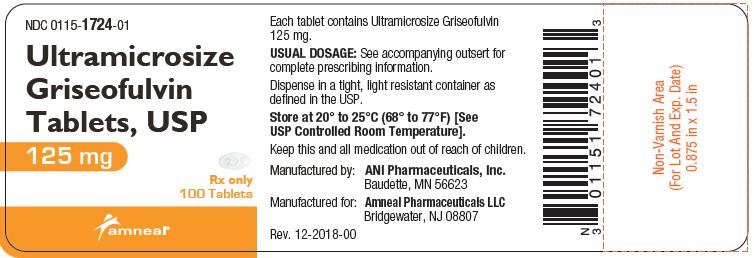
- Ultramicrosize Griseofulvin 125 mg Tablet, Coated NDC 0115-1724-01
- Methylphenidate Hydrochloride 10 mg Capsule, Extended Release NDC 0115-1736-01
- Methylphenidate Hydrochloride 20 mg Capsule, Extended Release NDC 0115-1737-01
- Methylphenidate Hydrochloride 30 mg Capsule, Extended Release NDC 0115-1738-01
- Methylphenidate Hydrochloride 40 mg Capsule, Extended Release NDC 0115-1739-01
- Methylphenidate Hydrochloride 50 mg Capsule, Extended Release NDC 0115-1740-01
- Methylphenidate Hydrochloride 60 mg Capsule, Extended Release NDC 0115-1741-01
Where does this data come from?
- FDA openFDA NDC Directory · synced Oct 8, 2026
- Drugs@FDA
Full prescribing information FDA SPL
🎯 Indications and Usage ▾
INDICATIONS AND USAGE Ultramicrosize griseofulvin tablets are indicated for the treatment of the following ringworm infections; tinea corporis (ringworm of the body), tinea pedis (athlete's foot), tinea cruris (ringworm of the groin and thigh), tinea barbae (barber's itch), tinea capitis (ringworm of the scalp), and tinea unguium (onychomycosis, ringworm of the nails), when caused by one or more of the following genera of fungi: Trichophyton rubrum, Trichophyton tonsurans, Trichophyton mentagrophytes, Trichophyton interdigitalis, Trichophyton verrucosum, Trichophyton megnini, Trichophyton gallinae, Trichophyton crateriform, Trichophyton sulphureum, Trichophyton schoenleini, Microsporum audouini, Microsporum canis, Microsporum gypseum and Epidermophyton floccosum.
NOTE: Prior to therapy, the type of fungi responsible for the infection should be identified. The use of the drug is not justified in minor or trivial infections which will respond to topical agents alone. Griseofulvin is not effective in the following: bacterial infections, candidiasis (moniliasis), histoplasmosis, actinomycosis, sporotrichosis, chromoblastomycosis, coccidioidomycosis, North American blastomycosis, cryptococcosis (torulosis), tinea versicolor and nocardiosis.
⏱️ Dosage and Administration ▾
DOSAGE AND ADMINISTRATION Accurate diagnosis of infecting organism is essential. Identification should be made either by direct microscopic examination of a mounting of infected tissue in a solution of potassium hydroxide or by culture on an appropriate medium. Medication must be continued until the infecting organism is completely eradicated as indicated by appropriate clinical or laboratory examination.
Representative treatment periods are tinea capitis, 4 to 6 weeks; tinea corporis, 2 to 4 weeks; tinea pedis, 4 to 8 weeks; tinea unguium-depending on rate of growth-fingernails, at least 4 months; toenails, at least 6 months. General measures in regard to hygiene should be observed to control sources of infection or reinfection. Concomitant use of appropriate topical agents is usually required, particularly in treatment of tinea pedis.
In some forms of athlete's foot, yeasts and bacteria may be involved as well as fungi. Griseofulvin will not eradicate the bacterial or monilial infection. Ultramicrosize griseofulvin tablets may be swallowed whole or crushed and sprinkled onto 1 tablespoonful of applesauce and swallowed immediately without chewing.
Adults: Daily administration of 375 mg (as a single-dose or in divided doses) will give a satisfactory response in most patients with tinea corporis, tinea cruris, and tinea capitis. For those fungal infections more difficult to eradicate, such as tinea pedis and tinea unguium, a divided dose of 750 mg is recommended. Pediatric Use: Approximately 7.3 mg per kg of body weight per day of ultramicrosize griseofulvin is an effective dose for most pediatric patients.
On this basis, the following dosage schedule is suggested: 16 kg to 27 kg: 125 mg to 187.5 mg daily over 27 kg: 187.5 mg to 375 mg daily Children and infants 2 years of age and younger - dosage has not been established. Clinical experience with griseofulvin in children with tinea capitis indicates that a single daily dose is effective. Clinical relapse will occur if the medication is not continued until the infecting organism is eradicated.
⛔ Contraindications ▾
CONTRAINDICATIONS Two cases of conjoined twins have been reported since 1977 in patients taking griseofulvin during the first trimester of pregnancy. Griseofulvin should not be prescribed to pregnant patients. If the patient becomes pregnant while taking this drug, the patient should be apprised of the potential hazard to the fetus.
This drug is contraindicated in patients with porphyria or hepatocellular failure and in individuals with a history of hypersensitivity to griseofulvin.
⚠️ Warnings ▾
WARNINGS Prophylactic Usage Safety and efficacy of griseofulvin for prophylaxis of fungal infections have not been established. Serious Skin Reactions Severe skin reactions (e.g., Stevens-Johnson syndrome, toxic epidermal necrolysis) and erythema multiforme have been reported with griseofulvin use. These reactions may be serious and may result in hospitalization or death.
If severe skin reactions occur, griseofulvin should be discontinued (see ADVERSE REACTIONS section). Hepatotoxicity Elevations in AST, ALT, bilirubin, and jaundice have been reported with griseofulvin use. These reactions may be serious and may result in hospitalization or death.
Patients should be monitored for hepatic adverse events and discontinuation of griseofulvin considered if warranted (see ADVERSE REACTIONS section). Animal Toxicology Chronic feeding of griseofulvin, at levels ranging from 0.5% to 2.5% of the diet resulted in the development of liver tumors in several strains of mice, particularly in males. Smaller particle sizes result in an enhanced effect.
Lower oral dosage levels have not been tested. Subcutaneous administration of relatively small doses of griseofulvin once a week during the first three weeks of life has also been reported to induce hepatomata in mice. Thyroid tumors, mostly adenomas but some carcinomas, have been reported in male rats receiving griseofulvin at levels of 2.0%, 1.0% and 0.2% of the diet, and in female rats receiving the two higher dose levels.
Although studies in other animal species have not yielded evidence of tumorigenicity, these studies were not of adequate design to form a basis for conclusion in this regard. In subacute toxicity studies, orally administered griseofulvin produced hepatocellular necrosis in mice, but this has not been seen in other species. Disturbances in porphyrin metabolism have been reported in griseofulvin-treated laboratory animals.
Griseofulvin has been reported to have a colchicine-like effect on mitosis and cocarcinogenicity with methylcholanthrene in cutaneous tumor induction in laboratory animals. Usage in Pregnancy see CONTRAINDICATIONS section. Animal Reproduction Studies It has been reported in the literature that griseofulvin was found to be embryotoxic and teratogenic on oral administration to pregnant rats.
Pups with abnormalities have been reported in the litters of a few bitches treated with griseofulvin. Suppression of spermatogenesis has been reported to occur in rats, but investigation in man failed to confirm this.
🤒 Adverse Reactions ▾
ADVERSE REACTIONS There have been post-marketing reports of severe skin and hepatic adverse events associated with griseofulvin use (see WARNINGS section). When adverse reactions occur, they are most commonly of the hypersensitivity type such as skin rashes, urticaria, erythema multiforme-like drug reactions, and rarely, angioneurotic edema, and may necessitate withdrawal of therapy and appropriate countermeasures. Paresthesia of the hands and feet have been reported after extended therapy.
Other side effects reported occasionally are oral thrush, nausea, vomiting, epigastric distress, diarrhea, headache, fatigue, dizziness, insomnia, mental confusion, and impairment of performance of routine activities. Proteinuria and leukopenia have been reported rarely. Administration of the drug should be discontinued if granulocytopenia occurs.
When rare, serious reactions occur with griseofulvin, they are usually associated with high dosages, long periods of therapy, or both. To report SUSPECTED ADVERSE REACTIONS, contact Amneal Pharmaceuticals at 1-877-835-5472 or FDA at 1-800-FDA-1088 or www.fda.gov/medwatch.
🧬 Clinical Pharmacology ▾
CLINICAL PHARMACOLOGY Microbiology Griseofulvin is fungistatic with in vitro activity against various species of Microsporum, Epidermophyton and Trichophyton . It has no effect on bacteria or other genera of fungi. Pharmacokinetics Following oral administration, griseofulvin is deposited in the keratin precursor cells and has a greater affinity for diseased tissue.
The drug is tightly bound to the new keratin which becomes highly resistant to fungal invasions. The efficiency of gastrointestinal absorption of ultramicrocrystalline griseofulvin is approximately one and one-half times that of the conventional microsize griseofulvin. This factor permits the oral intake of two-thirds as much ultramicrocrystalline griseofulvin as the microsize form.
However, there is currently no evidence that this lower dose confers any significant clinical differences with regard to safety and/or efficacy. In a bioequivalence study conducted in healthy volunteers (N=24) in the fasted state, 250 mg ultramicrocrystalline griseofulvin tablets were compared with 250 mg ultramicrocrystalline griseofulvin tablets that were physically altered (crushed) and administered with applesauce. The 250 mg ultramicrocrystalline griseofulvin tablets were found to be bioequivalent to the physically altered (crushed) 250 mg ultramicrocrystalline griseofulvin tablets (see Table 1).
Table 1: Mean (± SD) of the Pharmacokinetic Parameters for Griseofulvin administered in applesauce as a Single-Dose of Ultramicrosize Griseofulvin Tablets, 250 mg Uncrushed and Crushed to fasted Healthy Volunteers (N=24) 250 mg Ultramicrocrystalline Griseofulvin Tablets-Unaltered 250 mg Ultramicrocrystalline Griseofulvin Tablets-Physically Altered (Crushed and in Applesauce) C max (ng/mL) 600.61 (± 167.6) 672.61 (± 146.2) T max (hr) 4.04 (± 2.2) 3.08 (± 1.02) AUC (ng∙hr/mL) 8,618.89 (± 1,907.2) 9,023.71 (± 1,911.5)
📦 How Supplied / Storage and Handling ▾
HOW SUPPLIED Ultramicrosize Griseofulvin Tablets USP, 125 mg , are supplied as white to off-white oval coated tablets, debossed “C” on the left side of the score line and “P” on the right side of the score line on one side, and “295”on the other side. The 125 mg strength is film-coated, functionally scored. They are available as follows: Bottles of 100: NDC 0115-1724-01 Ultramicrosize Griseofulvin Tablets USP, 250 mg , are supplied as white to off-white oval coated tablets, debossed “C” on the left side of the score line and “P” on the right side of the score line on one side, and “296”on the other side.
The 250 mg strength is film-coated, functionally scored. They are available as follows: Bottles of 100: NDC 0115-1725-01
📦 Storage and Handling ▾
STORAGE Store at 20° to 25°C (68° to 77°F) [see USP Controlled Room Temperature]. Dispense in a tight, light-resistant container as defined in the USP. Manufactured by: Amneal Pharmaceuticals Pvt. Ltd. Ahmedabad 382220, INDIA Distributed by: Amneal Pharmaceuticals LLC Bridgewater, NJ 08807 Rev. 06-2024-00
📋 Description ▾
DESCRIPTION Ultramicrosize griseofulvin tablets, USP contain ultramicrosize crystals of griseofulvin, an antibiotic derived from a species of Penicillium . The chemical name of griseofulvin, USP is 7-Chloro- 2’,4,6-trimethoxy-6’β-methylspiro[benzofuran-2(3H),1’-[2]cyclohexene]-3,4’-dione. Its structural formula is: Griseofulvin, USP occurs as a white or yellowish-white, odorless powder which is practically insoluble in water, freely soluble in dimethylformamide,slightly soluble in anhydrous ethanol and in methanol.
Each ultramicrosize griseofulvin tablet, USP contains: Active Ingredient: Ultramicrosize Griseofulvin..........................125 mg Inactive Ingredients: Colloidal silicon dioxide, magnesium stearate, polyethylene glycol 3350, polyethylene glycol 6000, polyethylene glycol 8000, polyvinyl alcohol, sodium lauryl sulfate, talc and titanium dioxide. OR Active Ingredient: Ultramicrosize Griseofulvin..........................250 mg Inactive Ingredients: Colloidal silicon dioxide, magnesium stearate, polyethylene glycol 3350, polyethylene glycol 6000, polyethylene glycol 8000, polyvinyl alcohol, sodium lauryl sulfate, talc and titanium dioxide.
Chemical Structure
⚠️ Precautions ▾
PRECAUTIONS Patients on prolonged therapy with any potent medication should be under close observation. Periodic monitoring of organ system function, including renal, hepatic and hematopoietic, should be done. Since griseofulvin is derived from species of Penicillium , the possibility of cross-sensitivity with penicillin exists; however, known penicillin-sensitive patients have been treated without difficulty.
Since a photosensitivity reaction is occasionally associated with griseofulvin therapy, patients should be warned to avoid exposure to intense natural or artificial sunlight. Lupus erythematosus or lupus-like syndromes have been reported in patients receiving griseofulvin. Griseofulvin decreases the activity of warfarin-type anticoagulants so that patients receiving these drugs concomitantly may require dosage adjustment of the anticoagulant during and after griseofulvin therapy.
Barbiturates usually depress griseofulvin activity and concomitant administration may require a dosage adjustment of the antifungal agent. There have been reports in the literature of possible interactions between griseofulvin and oral contraceptives. The effect of alcohol may be potentiated by griseofulvin, producing such effects as tachycardia and flush.
📄 Package Label / Principal Display Panel ▾
Prinicipal Display Panel - 125 mg, 100 Tablets 125 mg 100 c
Prinicipal Display Panel - 250 mg, 100 Tablets 250 mg 100 c