
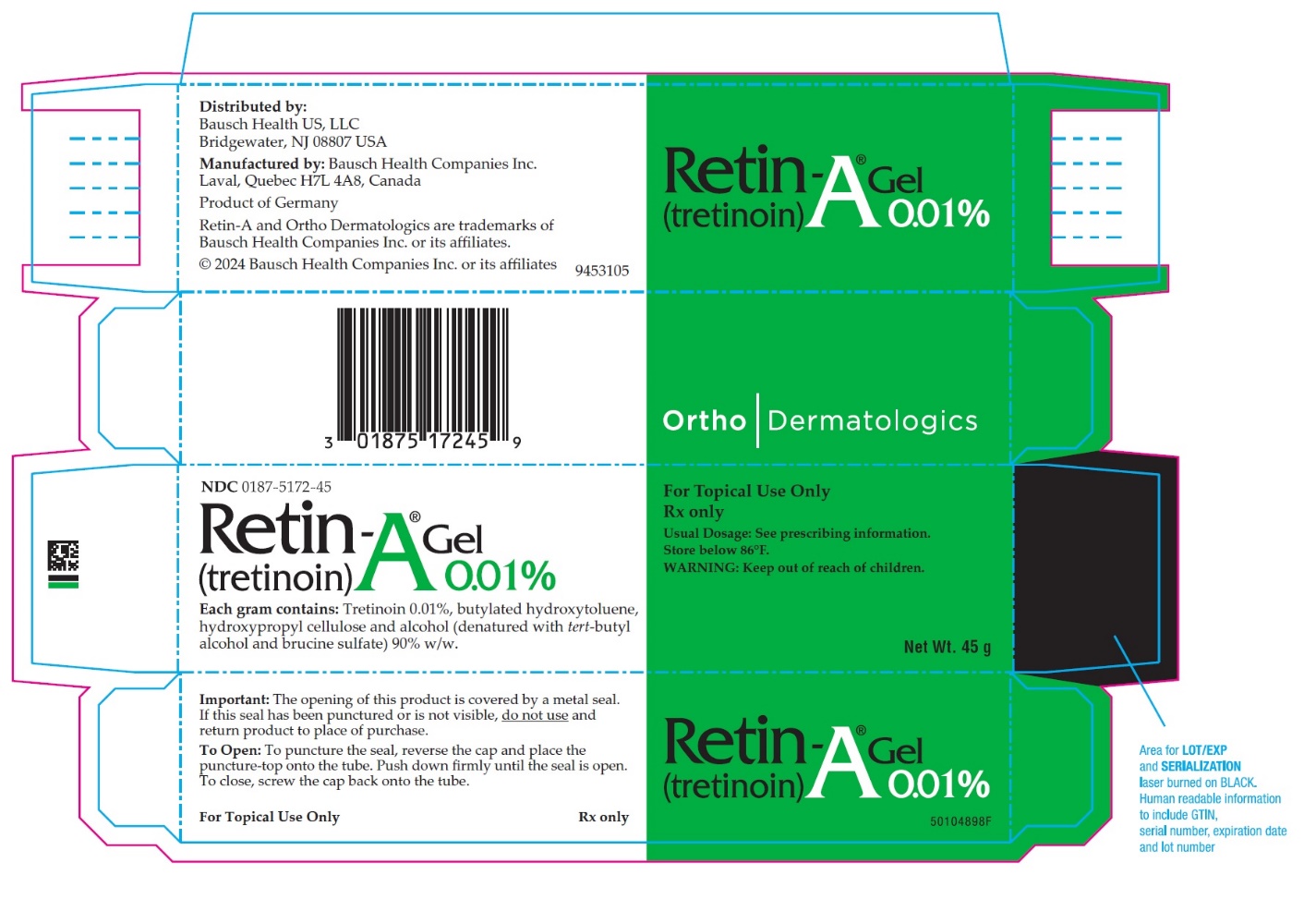
Retin-A Tretinoin .1 mg/g Gel
🆔 Identity & classification
Where does this data come from?
🏷️ RxNorm drug class
This medicine belongs to the Retinoid class.
Where does this data come from?
🏭 Manufacturer & labeler
Where does this data come from?
🩺 Clinical
- Honestly, it won't erase wrinkles — and the label is pretty direct about that. What it's approved to do is help reduce the appearance of fine wrinkles as part of a full routine tha...
- Will tretinoin actually get rid of my wrinkles?
- Redness, peeling, and irritation in the first couple of weeks are very common and usually mean your skin is adjusting — not that something is wrong. If it's tolerable, try hanging...
- My skin is really red and peeling after the first week — should I stop?
Patient education
Supplement & herbal interactions
Some supplements/herbs that may interact with Tretinoin — tap one for details:
Tretinoin may be associated with lower levels of 1 nutrient — worth a chat with your pharmacist, not a cause for alarm.
Where does this data come from?
Ask a licensed pharmacist directly — free, answered by our team.
🧪 Inactive Ingredients / Excipients
Inactive ingredients, also called excipients, are components of the drug product other than the active ingredient. They may include fillers, dyes, coatings, preservatives, flavors, or other formulation ingredients.
Where does this data come from?
IACT rows and label-wide narrative are kept separate; availability and product-level specificity depend on the submitted label.Inactive ingredient FAQ
Are inactive ingredients the same for every manufacturer?
Why might an inactive ingredient be missing?
Can inactive ingredients matter?
💲 Pricing
A drug doesn't have one price. Each row is a different public payment system, and none is what you'd pay at the counter — that depends on your insurance. The ⓘ on each row explains what it measures.
| Price system | Per g | Per package |
|---|---|---|
| Retail pharmacies payNADAC · weekly | $0.955 | $42.97 / 45 g |
| Medicaid paysCMS SDUD · 12 mo | $1.08 | $48.64 / 45 g |
| Medicare drug plans payPart D · Q2 2026 | $0.4978 | $22.40 / 45 g |
Where does this data come from?
🔁 Therapeutic equivalents
| Product | Labeler | Pack | NADAC/unit | TE | Status | Price vs. this |
|---|---|---|---|---|---|---|
| Retin-A .1 mg/gthis 00187-5172-45 | Bausch | 1 tube | $0.955 | AB | FDA listed | — |
| Tretinoin .1 mg/g 00378-8085-15 | Mylan | 1 tube | $2.740 | AB | Availability likely | +187% |
| Tretinoin .1 mg/g 00574-2301-15 | Padagis | 1 tube | $2.740 | AB | Availability likely | +187% |
| Tretinoin .1 mg/g 21922-0056-04 | Encube | 1 tube | $2.740 | AB | Availability likely | +187% |
| Tretinoin .1 mg/g 59651-0712-14 | Aurobindo | 1 tube | $2.740 | AB | Availability likely | +187% |
| Tretinoin .1 mg/g 71335-2952-01 | Bryant | 1 tube | — | AB | FDA listed | — |
Where does this data come from?
⏳ Availability & generic status
FDA-approved generic versions are listed, and recent pricing/market data suggests they may be available — see Therapeutic equivalents.
Where does this data come from?
🗺️ Medicaid utilization & spend
💊 Medicaid utilization by pack size
📊 Medicare Part D spend CMS · PART D · 2026 (Q1)
📦 Packaging — all sizes for this product
| Package NDC | Description | Per unit | Per pack | Marketing start | Status |
|---|---|---|---|---|---|
| 00187-5172-15 | 1 TUBE in 1 CARTON (0187-5172-15) / 15 g in 1 TUBE | — | — | 1979-07-30 | Active |
| 00187-5172-45 You're viewing this | 1 TUBE in 1 CARTON (0187-5172-45) / 45 g in 1 TUBE | $0.9549 / g | $42.97 | 1979-07-30 | Active |
In Medicaid, this is the most-dispensed pack of this product — about 63% of fills over the last four reported quarters. See all packs ↓
Pack size FAQ
What quantity is in NDC 00187-5172-45?
What NDC number is used to bill for this package of Retin-A Tretinoin .1 mg/g Gel?
Prices are the latest CMS NADAC pharmacy acquisition cost per NDC; per-pack figures are per-unit × pack quantity, shown only when the pack is denominated in the same measure NADAC prices.
📄 Full prescribing information FDA SPL
🎯 Indications and Usage ▾
INDICATIONS AND USAGE RETIN-A is indicated for topical application in the treatment of acne vulgaris. The safety and efficacy of the long-term use of this product in the treatment of other disorders have not been established.
⏱️ Dosage and Administration ▾
DOSAGE AND ADMINISTRATION RETIN-A Gel or Cream should be applied once a day, before retiring, to the skin where acne lesions appear, using enough to cover the entire affected area lightly. Gel: Excessive application results in “pilling” of the gel, which minimizes the likelihood of overapplication by the patient. Application may cause a transitory feeling of warmth or slight stinging.
In cases where it has been necessary to temporarily discontinue therapy or to reduce the frequency of application, therapy may be resumed or frequency of application increased when the patients become able to tolerate the treatment. Alterations of vehicle, drug concentration, or dose frequency should be closely monitored by careful observation of the clinical therapeutic response and skin tolerance. During the early weeks of therapy, an apparent exacerbation of inflammatory lesions may occur.
This is due to the action of the medication on deep, previously unseen lesions and should not be considered a reason to discontinue therapy. Therapeutic results should be noticed after 2 to 3 weeks but more than 6 weeks of therapy may be required before definite beneficial effects are seen. Once the acne lesions have responded satisfactorily, it may be possible to maintain the improvement with less frequent applications, or other dosage forms.
Patients treated with RETIN-A (tretinoin) acne treatment may use cosmetics, but the area to be treated should be cleansed thoroughly before the medication is applied (see PRECAUTIONS ).
⛔ Contraindications ▾
CONTRAINDICATIONS Use of the product should be discontinued if hypersensitivity to any of the ingredients is noted.
🤒 Adverse Reactions ▾
ADVERSE REACTIONS The skin of certain sensitive individuals may become excessively red, edematous, blistered, or crusted. If these effects occur, the medication should either be discontinued until the integrity of the skin is restored, or the medication should be adjusted to a level the patient can tolerate. True contact allergy to topical tretinoin is rarely encountered.
Temporary hyper- or hypopigmentation has been reported with repeated application of RETIN-A. Some individuals have been reported to have heightened susceptibility to sunlight while under treatment with RETIN-A. To date, all adverse effects of RETIN-A have been reversible upon discontinuance of therapy (see DOSAGE AND ADMINISTRATION ).
To report SUSPECTED ADVERSE REACTIONS, contact Bausch Health US, LLC at 1-800-321-4576 or FDA at 1-800-FDA-1088 or www.fda.gov/medwatch.
🔄 Drug Interactions ▾
Drug Interactions Concomitant topical medication, medicated or abrasive soaps and cleansers, soaps and cosmetics that have a strong drying effect, and products with high concentrations of alcohol, astringents, spices or lime should be used with caution because of possible interaction with tretinoin. Particular caution should be exercised in using preparations containing sulfur, resorcinol, or salicylic acid with RETIN-A. It also is advisable to “rest” a patient’s skin until the effects of such preparations subside before use of RETIN-A is begun.
🤰 Pregnancy ▾
Pregnancy Teratogenic Effects Oral tretinoin has been shown to be teratogenic in rats, mice, hamsters, and subhuman primates. It was teratogenic and fetotoxic in Wistar rats when given orally or topically in doses greater than 1 mg/kg/day (8 times the maximum human systemic dose adjusted for total body surface area). However, variations in teratogenic doses among various strains of rats have been reported.
In the cynomolgus monkey, which metabolically is closer to humans for tretinoin than the other species examined, fetal malformations were reported at doses of 10 mg/kg/day or greater, but none were observed at 5 mg/kg/day (83 times the maximum human systemic dose adjusted for total body surface area), although increased skeletal variations were observed at all doses. A dose-related increase in embryolethality and abortion was reported. Similar results have also been reported in pigtail macaques.
Topical tretinoin in animal teratogenicity tests has generated equivocal results. There is evidence for teratogenicity (shortened or kinked tail) of topical tretinoin in Wistar rats at doses greater than 1 mg/kg/day (8 times the maximum human systemic dose adjusted for total body surface area). Anomalies (humerus: short 13%, bent 6%, os parietale incompletely ossified 14%) have also been reported when 10 mg/kg/day was topically applied.
There are other reports in New Zealand White rabbits administered doses of greater than 0.2 mg/kg/day (3.3 times the maximum human systemic dose adjusted for total body surface area) of an increased incidence of domed head and hydrocephaly, typical of retinoid-induced fetal malformations in this species. In contrast, several well-controlled animals studies have shown that dermally applied tretinoin may be fetotoxic, but not overly teratogenic in rats and rabbits at doses of 1.0 and 0.5 mg/kg/day, respectively (8 times the maximum human systemic dose adjusted for total body surface area in both species).
With widespread use of any drug, a small number of birth defect reports associated temporally with the administration of the drug would be expected by chance alone. Thirty human cases of temporally associated congenital malformations have been reported during two decades of clinical use of RETIN-A. Although no definite pattern of teratogenicity and no causal association have been established from these cases, five of the reports describe the rare birth defect category holoprosencephaly (defects associated with incomplete midline development of the forebrain).
The significance of these spontaneous reports in terms of risk to the fetus is not known. Nonteratogenic Effects Topical tretinoin has been shown to be fetotoxic in rabbits when administered 0.5 mg/kg/day (8 times the maximum human systemic dose adjusted for total body surface area). Oral tretinoin has been shown to be fetotoxic, resulting in skeletal variations and increased intrauterine death in rats when administered 2.5 mg/kg/day (20 times the maximum human systemic dose adjusted for total body surface area).
There are, however, no adequate and well-controlled studies in pregnant women. Tretinoin should be used during pregnancy only if the potential benefit justifies the potential risk to the fetus.
🧒 Pediatric Use ▾
Pediatric Use Safety and effectiveness in pediatric patients below the age of 12 have not been established.
🧓 Geriatric Use ▾
Geriatric Use Safety and effectiveness in a geriatric population have not been established. Clinical studies of RETIN-A did not include sufficient numbers of subjects aged 65 and over to determine whether they respond differently from younger patients. GELS ARE FLAMMABLE. Note: Keep away from heat and flame. Keep tube tightly closed.
🆘 Overdosage ▾
OVERDOSAGE If medication is applied excessively, no more rapid or better results will be obtained and marked redness, peeling, or discomfort may occur. Oral ingestion of the drug may lead to the same side effects as those associated with excessive oral intake of Vitamin A.
🧬 Clinical Pharmacology ▾
CLINICAL PHARMACOLOGY Although the exact mode of action of tretinoin is unknown, current evidence suggests that topical tretinoin decreases cohesiveness of follicular epithelial cells with decreased microcomedo formation. Additionally, tretinoin stimulates mitotic activity and increased turnover of follicular epithelial cells causing extrusion of the comedones.
📦 How Supplied / Storage and Handling ▾
HOW SUPPLIED RETIN-A (tretinoin) is supplied as: RETIN-A Cream RETIN-A Gel NDC Code RETIN-A Strength/ Form RETIN-A Qty. NDC Code RETIN-A Strength/ Form RETIN-A Qty. 0187-5160-20 0.025% Cream 20 g 0187-5172-15 0.01% Gel 15 g 0187-5160-45 0.025% Cream 45 g 0187-5172-45 0.01% Gel 45 g 0187-5162-20 0.05% Cream 20 g 0187-5170-15 0.025% Gel 15 g 0187-5162-45 0.05% Cream 45 g 0187-5170-45 0.025% Gel 45 g 0187-5164-20 0.1% Cream 20 g 0187-5164-45 0.1% Cream 45 g Storage Conditions: RETIN-A Gel, 0.025% and 0.01%: store below 86°F.
RETIN-A Cream, 0.1%, 0.05%, and 0.025%: store below 80°F.
📦 Storage and Handling ▾
Storage Conditions: RETIN-A Gel, 0.025% and 0.01%: store below 86°F. RETIN-A Cream, 0.1%, 0.05%, and 0.025%: store below 80°F.
📋 Description ▾
DESCRIPTION RETIN-A Gel and Cream, containing tretinoin, are used for the topical treatment of acne vulgaris. RETIN-A Gel contains tretinoin (retinoic acid, vitamin A acid) in either of two strengths, 0.025% or 0.01% by weight, in a gel vehicle of butylated hydroxytoluene, hydroxypropyl cellulose and alcohol (denatured with tert -butyl alcohol and brucine sulfate) 90% w/w. RETIN-A (tretinoin) Cream contains tretinoin in one of three strengths, 0.1%, 0.05%, or 0.025% by weight, in a hydrophilic cream vehicle of stearic acid, isopropyl myristate, polyoxyl 40 stearate, stearyl alcohol, xanthan gum, sorbic acid, butylated hydroxytoluene, and purified water.
Chemically, tretinoin is all - trans -retinoic acid and has the following structure: Chemical Structure