
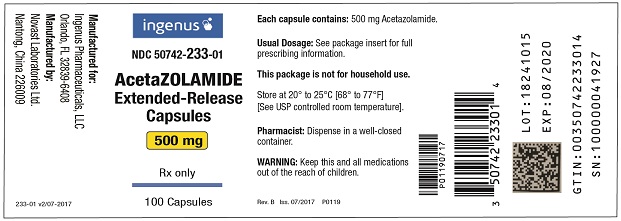
Acetazolamide 500 mg Capsule, Extended Release, 100-count — NDC 50742-233-01 (Billing 50742-0233-01)
This is a package of 100 capsules of Acetazolamide 500 mg Capsule, Extended Release from Ingenus Pharmaceuticals, LLC, marketed since Jul 2017 and currently FDA-listed; retail pharmacies pay about $0.3491 per capsule (NADAC). It is this product's only package size.
NDC database record
One package, one record: these facts belong to NDC 50742-233-01 alone.
- Record
- FDA NDC Directory package listing · Human prescription drug
- Code segments
- 50742 labeler · 233 product · 01 package
- Package marketed since
- Jul 31, 2017
- Sample package
- No — commercial package
- Listing certified through
- Dec 31, 2026
- Billing quantity
- 100 EA per package
- Barcode (UPC-A, from the NDC)
- 3 5074223301 4
- Medicaid fills, this package
- 125 prescriptions in the last four reported quarters
- FDA record last changed
- Jul 24, 2026
Other active recalls for Acetazolamide (different manufacturers) — 1 · tap to view
Identity & classification
Regulatory identifiers FDA, NLM and CMS codes for this package
Drug-database identifiers Medi-Span GPI and First Databank GCN / HICL / AHFS classification
- GSN (GCN sequence number): 008164
- GCN: 34700
- GPI-14 (Medi-Span): 37100010006920
- HICL (First Databank): 003641
- AHFS class code: 24:36.04.00
- RxCUI (RxNorm): 562524
Where does this data come from?
- FDA openFDA NDC Directory · synced Oct 1, 2026
- FDA label on DailyMed · label index refreshed Oct 5, 2026
- RxNorm (NLM RxNav) · catalog refreshed Oct 1, 2026
- Medi-Span GPI (licensed)
- First Databank (licensed) · refreshed Oct 1, 2026
RxNorm drug class
This medicine belongs to the Carbonic Anhydrase Inhibitor class.
Where does this data come from?
- RxClass (NLM) · catalog refreshed Oct 1, 2026
Clinical
Acetazolamide is used to treat glaucoma, a condition in which increased pressure in the eye can lead to gradual loss of vision. Acetazolamide decreases the pressure in the eye. Acetazolamide is also used to reduce the severity and duration of symptoms (upset stomach, headache, shortness of breath, dizziness, drowsiness, and fatigue) of altitude (mountain) sickness. Acetazolamide is used with other medicines to reduce edema (excess fluid retention) and to help control seizures in certain types of epilepsy. This medication is sometimes prescribed for other uses; ask your doctor or pharmacist for...
Read the full MedlinePlus article ↗- It is used as an add-on treatment, most commonly for glaucoma. Depending on the product, it is also used for swelling from heart failure, certain seizure disorders, and preventing...
- Tablets and capsules are taken by mouth, and the injection is given in a vein by a professional. Extended-release capsules for glaucoma are usually taken morning and evening. For m...
- Tingling in fingers or face, more urination, tiredness, nausea, appetite or taste changes, and drowsiness are among the reported effects. Mention them if they bother you.
- Call right away if you get a rash, blisters, fever, sore throat, unusual bruising, yellow skin or eyes, confusion, or swelling of the face. Acetazolamide is a sulfa-type drug, and...
Patient education
Supplement & herbal interactions
Some supplements/herbs that may interact with Acetazolamide — tap one for details:
Acetazolamide may be associated with lower levels of 8 nutrients — worth a chat with your pharmacist, not a cause for alarm.
Where does this data come from?
- MedlinePlus (NLM) · refreshed Oct 1, 2026
- FDA label on DailyMed · label index refreshed Oct 5, 2026
Ask a licensed pharmacist directly — free, answered by our team.
Pricing
A drug doesn't have one price. Each row is a different public payment system, and none is what you'd pay at the counter — that depends on your insurance. The ⓘ on each row explains what it measures.
| Price system | Per ea | Per package |
|---|---|---|
| Retail pharmacies payNADAC · weekly | $0.349 | $34.91 / 100 capsules |
| Medicaid paysCMS SDUD · 12 mo | $0.4142 | $41.42 / 100 capsules |
| Medicare drug plans payPart D · Q2 2026 | $0.4628 | $46.28 / 100 capsules |
Where does this data come from?
- CMS NADAC weekly file · file of Nov 23, 2022
- CMS ASP pricing files · refreshed Sep 20, 2026
- CMS Medicaid State Drug Utilization Data · through Q1 2026
- CMS Part D plan pricing files · refreshed Sep 24, 2026
- VA National Acquisition Center price file
Packaging — all sizes for this product
| Package NDC | Description | Marketing start | Marketing end | Status |
|---|---|---|---|---|
| 50742-0233-01 You're viewing this Main listing | 100 CAPSULE, EXTENDED RELEASE in 1 BOTTLE | 2017-07-31 | — | Active |
Therapeutic equivalents
| Product | Labeler | Pack | NADAC/unit | TE | Status | Price vs. this |
|---|---|---|---|---|---|---|
| acetazolamide 500 mg 16729-0331-01 | Accord | 100 capsules | $0.288 | AB | Availability likely | save 17% |
| Acetazolamide 500 mg 23155-0787-01 | Heritage | 100 capsules | $0.288 | AB | Availability likely | save 17% |
| Acetazolamide Extended-Release 500 mg 42571-0243-01 | Micro | 100 capsules | $0.288 | AB | Availability likely | save 17% |
| Acetazolamide Extended-Release 500 mg 50268-0042-12 | AvPAK | 20 capsules | $0.288 | AB | Availability likely | save 17% |
| acetazolamide 500 mg 60687-0578-21 | American | 30 capsules | $0.288 | AB | Availability likely | save 17% |
| Acetazolamide 500 mg 62135-0612-60 | Chartwell | 60 capsules | $0.288 | AB | Availability likely | save 17% |
| Acetazolamide 500 mg 69367-0209-01 | Westminster | 100 capsules | $0.288 | AB | Availability likely | save 17% |
| Acetazolamide 500 mgthis 50742-0233-01 | Ingenus | 100 capsules | $0.349 | AB | FDA listed | — |
| Acetazolamide 500 mg 62332-0349-31 | Alembic | 100 capsules | $0.368 | AB | FDA listed | +5% |
| Acetazolamide 500 mg 46708-0349-31 | Alembic | 100 capsules | — | AB | FDA listed | — |
| Acetazolamide 500 mg 50090-5945-00 | A-S | 30 capsules | — | AB | FDA listed | — |
| acetazolamide 500 mg 65841-0762-01 | Zydus | 100 capsules | — | AB | FDA listed | — |
| Acetazolamide 500 mg 70518-4646-00 | REMEDYREPACK | 1 capsule | — | AB | FDA listed | — |
| acetazolamide 500 mg 70710-1591-00 | Zydus | 1000 capsules | — | AB | FDA listed | — |
| acetazolamide 500 mg 71335-9729-01 | Bryant | 180 capsules | — | AB | FDA listed | — |
Where does this data come from?
- FDA openFDA NDC Directory · synced Oct 1, 2026
- FDA Orange Book · refreshed Oct 3, 2026
- CMS NADAC weekly file · file of Nov 23, 2022
Availability & generic status
This product is an FDA-approved generic. Other versions of the same drug are listed under Therapeutic equivalents, least expensive first.
Where does this data come from?
- FDA Orange Book · refreshed Oct 3, 2026
What it looks like
Where does this data come from?
- FDA label on DailyMed · label index refreshed Oct 5, 2026
Inactive Ingredients / Excipients
Inactive ingredients, also called excipients, are components of the drug product other than the active ingredient. They may include fillers, dyes, coatings, preservatives, flavors, or other formulation ingredients.
🧪 Avoiding an ingredient? See Acetazolamide inactive ingredients by manufacturer: every current product's list side by side, so you can ask your pharmacy for the version that does not list it.
💡 Tap an ingredient (hover on desktop) to see what it is and why it’s used.
-
UNII OP1R32D61U
Microcrystalline cellulose is a purified form of cellulose, a natural fiber from plant sources. It acts as a binder and filler in tablets and capsules, helping hold ingredients together and give the medicine its shape and size.
-
UNII XM0M87F357
A dark iron oxide compound that gives medicines their black or dark color. It's used as a colorant in tablets and capsules to help identify the product and make it visually distinctive.
-
UNII 2G86QN327L
Gelatin is a protein derived from animal collagen, commonly used in medicines as a gelling agent and capsule material. It helps create soft or hard capsule shells that hold and release medication, and can also thicken liquid formulations.
-
UNII RFW2ET671P
Hydroxypropyl cellulose is a plant-derived thickening agent made from cellulose. It acts as a binder to hold tablet ingredients together and as a film-former to coat tablets or control how fast the medicine releases.
-
UNII WZH3C48M4T
Potassium hydroxide is a strong alkaline chemical used in medicines to adjust and maintain the pH level of liquid formulations, helping keep the product stable and the active ingredients effective.
-
UNII 46N107B71O
Shellac is a natural resin secreted by the lac beetle. It's used as a coating on tablets and capsules to control how quickly the medicine dissolves and to improve appearance and stability.
-
UNII 368GB5141J
A detergent and foaming agent derived from coconut or palm oil. In medications, it helps break down and mix oil and water-based ingredients, aids in tablet disintegration, and improves how the drug dissolves and spreads in the mouth or digestive system.
-
UNII O8232NY3SJ
A plant-based carbohydrate derived from corn kernels. It acts as a filler to add bulk, a binder to hold ingredients together, and a disintegrant to help the tablet break apart in your stomach for absorption.
-
UNII 7SEV7J4R1U
A powder made from a naturally occurring mineral. In medicines, talc works as a glidant and anti-caking agent, helping tablets and capsules flow smoothly during manufacturing and preventing clumping.
-
UNII 15FIX9V2JP
Titanium dioxide is a bright white mineral powder commonly used as a colorant and opacifying agent. It makes pills and tablets white or lighter in color and helps make coatings non-transparent.
10 inactive ingredients listed in the exact product block matched to this NDC.
Where does this data come from?
ingredient classCode="IACT" elements from the exact product block matched by this NDC. Label-section narrative from DailyMed / the openFDA label index is shown separately when available.- FDA label on DailyMed · label index refreshed Oct 5, 2026
- FDA openFDA NDC Directory · synced Oct 1, 2026
Inactive ingredient FAQ
Are inactive ingredients the same for every manufacturer?
Why might an inactive ingredient be missing?
Can inactive ingredients matter?
Manufacturer & labeler
More NDCs from Ingenus Pharmaceuticals, LLC labeler code 50742
- Cyproheptadine Hydrochloride 4 mg Tablet NDC 50742-190-01
- Primaquine Phosphate 15 mg Tablet, Film Coated NDC 50742-191-01
- Tolcapone 100 mg Tablet NDC 50742-193-90
- Tizanidine Hydrochloride 2 mg Capsule NDC 50742-224-15
- Tizanidine Hydrochloride 4 mg Capsule NDC 50742-225-15
- Tizanidine Hydrochloride 6 mg Capsule NDC 50742-226-15
- Quinine Sulfate 324 mg Capsule NDC 50742-238-30
- Mexiletine Hydrochloride 150 mg Capsule NDC 50742-239-01
- Mexiletine Hydrochloride 200 mg Capsule NDC 50742-240-01
- Mexiletine Hydrochloride 250 mg Capsule NDC 50742-241-01
- Isosorbide dinitrate and hydralazine hydrochloride 37.5 mg; 20 mg Tablet NDC 50742-246-18
- Clonidine .1 mg Tablet, Extended Release NDC 50742-247-05
Where does this data come from?
- FDA openFDA NDC Directory · synced Oct 1, 2026
- Drugs@FDA
Full prescribing information FDA SPL
🎯 Indications and Usage ▾
INDICATIONS AND USAGE For adjunctive treatment of: chronic simple (open-angle) glaucoma, secondary glaucoma, and preoperatively in acute angle-closure glaucoma where delay of surgery is desired in order to lower intraocular pressure. Acetazolamide is also indicated for the prevention or amelioration of symptoms associated with acute mountain sickness despite gradual ascent.
⏱️ Dosage and Administration ▾
DOSAGE AND ADMINISTRATION Glaucoma: The recommended dosage is 1 capsule (500 mg) two times a day. Usually 1 capsule is administered in the morning and 1 capsule in the evening. It may be necessary to adjust the dose, but it has usually been found that dosage in excess of 2 capsules (1 g) does not produce an increased effect.
The dosage should be adjusted with careful individual attention both to symptomatology and intraocular tension. In all cases, continuous supervision by a physician is advisable. In those unusual instances where adequate control is not obtained by the twice-a-day administration of acetazolamide extended-release capsule, the desired control may be established by means of acetazolamide (tablets or parenteral).
Use tablets or parenteral in accordance with the more frequent dosage schedules recommended for these dosage forms, such as 250 mg every four hours, or an initial dose of 500 mg followed by 250 mg or 125 mg every four hours, depending on the case in question. Acute Mountain Sickness: Dosage is 500 mg to 1000 mg daily, in divided doses using tablets or extended-release capsules as appropriate. In circumstances of rapid ascent, such as in rescue or military operations, the higher dose level of 1000 mg is recommended.
It is preferable to initiate dosing 24 to 48 hours before ascent and to continue for 48 hours while at high altitude, or longer as necessary to control symptoms.
⛔ Contraindications ▾
CONTRAINDICATIONS Hypersensitivity to acetazolamide or any excipients in the formulation. Since acetazolamide is a sulfonamide derivative, cross sensitivity between acetazolamide, sulfonamides and other sulfonamide derivatives is possible. Acetazolamide therapy is contraindicated in situations in which sodium and/or potassium blood serum levels are depressed, in cases of marked kidney and liver disease or dysfunction, in suprarenal gland failure, and in hyperchloremic acidosis.
It is contraindicated in patients with cirrhosis because of the risk of development of hepatic encephalopathy. Long-term administration of acetazolamide is contraindicated in patients with chronic non-congestive angle-closure glaucoma since it may permit organic closure of the angle to occur while the worsening glaucoma is masked by lowered intraocular pressure.
⚠️ Warnings ▾
WARNINGS Fatalities have occurred, although rarely, due to severe reactions to sulfonamides including Stevens- Johnson syndrome, toxic epidermal necrolysis, fulminant hepatic necrosis, anaphylaxis, agranulocytosis, aplastic anemia, and other blood dyscrasias. Sensitizations may recur when a sulfonamide is readministered irrespective of the route of administration. If signs of hypersensitivity or other serious reactions occur, discontinue use of this drug.
Caution is advised for patients receiving concomitant high-dose aspirin and acetazolamide, as anorexia, tachypnea, lethargy, metabolic acidosis, coma, and death have been reported.
🤒 Adverse Reactions ▾
ADVERSE REACTIONS Body as a whole: Headache, malaise, fatigue, fever, pain at injection site, flushing, growth retardation in children, flaccid paralysis, anaphylaxis. Digestive: Gastrointestinal disturbances such as nausea, vomiting, diarrhea. Hematological/Lymphatic: Blood dyscrasias such as aplastic anemia, agranulocytosis, leukopenia, thrombocytopenic purpura, melena.
Hepato-biliary disorders: Abnormal liver function, cholestatic jaundice, hepatic insufficiency, fulminant hepatic necrosis. Metabolic/Nutritional: Metabolic acidosis, electrolyte imbalance, including hypokalemia, hyponatremia, osteomalacia with long-term phenytoin therapy, loss of appetite, taste alteration, hyper/hypoglycemia. Nervous: Drowsiness, paresthesia (including numbness and tingling of extremities and face), depression, excitement, ataxia, confusion, convulsions dizziness Skin: Allergic skin reactions including urticaria, photosensitivity, Stevens-Johnson syndrome, toxic epidermal necrolysis Special senses: Hearing disturbances, tinnitus, transient myopia Urogenital: Crystalluria, increased risk of nephrolithiasis with long-term therapy, hematuria, glycosuria, renal failure polyuria
🔄 Drug Interactions ▾
Drug Interactions Aspirin- See WARNINGS Acetazolamide modifies phenytoin metabolism with increased serum levels of phenytoin. This may increase or enhance the occurrence of osteomalacia in some patients receiving chronic phenytoin therapy. Caution is advised in patients receiving chronic concomitant therapy.
By decreasing the gastrointestinal absorption of primidone, acetazolamide may decrease serum concentrations of primidone and its metabolites, with a consequent possible decrease in anticonvulsant effect. Caution is advised when beginning, discontinuing, or changing the dose of acetazolamide in patients receiving primidone. Because of possible additive effects with other carbonic anhydrase inhibitors, concomitant use is not advisable.
Acetazolamide may increase the effects of other folic acid antagonists. Acetazolamide decreases urinary excretion of amphetamine and may enhance the magnitude and duration of their effect. Acetazolamide reduces urinary excretion of quinidine and may enhance its effect.
Acetazolamide may prevent the urinary antiseptic effect of methenamine. Acetazolamide increases lithium excretion and the lithium may be decreased. Acetazolamide and sodium bicarbonate used concurrently increases the risk of renal calculus formation.
Acetazolamide may elevate cyclosporine levels.
🧒 Pediatric Use ▾
Pediatric Use The safety and effectiveness of acetazolamide extended-release capsule in pediatric patients below the age of 12 years have not been established. Growth retardation has been reported in children receiving long-term therapy, believed secondary to chronic acidosis.
🧓 Geriatric Use ▾
Geriatric Use Metabolic acidosis, which can be severe, may occur in the elderly with reduced renal function. In general, dose selection for an elderly patient should be cautious, usually starting at the low end of the dosing range, reflecting the greater frequency of decreased hepatic, renal, or cardiac function, and concomitant disease or other drug therapy.
🆘 Overdosage ▾
OVERDOSAGE No specific antidote is known. Treatment should be symptomatic and supportive. Electrolyte imbalance, development of an acidotic state, and central nervous system effects might be expected to occur.
Serum electrolyte levels (particularly potassium) and blood pH levels should be monitored. Supportive measures are required to restore electrolyte and pH balance. The acidotic state can usually be corrected by the administration of bicarbonate.
Despite its high intraerythrocytic distribution and plasma protein binding properties, acetazolamide may be dialyzable. This may be particularly important in the management of acetazolamide overdosage when complicated by the presence of renal failure.
🧬 Clinical Pharmacology ▾
CLINICAL PHARMACOLOGY Acetazolamide is a potent carbonic anhydrase inhibitor, effective in the control of fluid secretion (e.g., some types of glaucoma), in the treatment of certain convulsive disorders (e.g., epilepsy) and in the promotion of diuresis in instances of abnormal fluid retention (e.g., cardiac edema). Acetazolamide is not a mercurial diuretic. Rather, it is a non-bacteriostatic sulfonamide possessing a chemical structure and pharmacological activity distinctly different from the bacteriostatic sulfonamides.
Acetazolamide is an enzyme inhibitor that acts specifically on carbonic anhydrase, the enzyme that catalyzes the reversible reaction involving the hydration of carbon dioxide and the dehydration of carbonic acid. In the eye, this inhibitory action of acetazolamide decreases the secretion of aqueous humor and results in a drop in intraocular pressure, a reaction considered desirable in cases of glaucoma and even in certain non-glaucomatous conditions. Evidence seems to indicate that acetazolamide has utility as an adjuvant in treatment of certain dysfunctions of the central nervous system (e.g., epilepsy).
Inhibition of carbonic anhydrase in this area appears to retard abnormal, paroxysmal, excessive discharge from central nervous system neurons. The diuretic effect of Acetazolamide is due to its action in the kidney on the reversible reaction involving hydration of carbon dioxide and dehydration of carbonic acid. The result is renal loss of HCO 3 ion, which carries out sodium, water, and potassium.
Alkalinization of the urine and promotion of diuresis are thus affected. Alteration in ammonia metabolism occurs due to increased reabsorption of ammonia by the renal tubules as a result of urinary alkalinization. Acetazolamide extended-release capsules provide prolonged action to inhibit aqueous humor secretion for 18 to 24 hours after each dose, whereas tablets act for only 8 to 12 hours.
The prolonged continuous effect of acetazolamide extended-release capsule permits a reduction in dosage frequency. Plasma concentrations of acetazolamide peak from three to six hours after administration of acetazolamide extended-release capsule, compared to one to four hours with tablets. Food does not affect bioavailability of acetazolamide extended-release capsules.
Placebo-controlled clinical trials have shown that prophylactic administration of acetazolamide at a dose of 250 mg every eight to 12 hours (or a 500 mg controlled-release capsule once daily) before and during rapid ascent to altitude results in fewer and/or less severe symptoms of acute mountain sickness (AMS) such as headache, nausea, shortness of breath, dizziness, drowsiness, and fatigue. Pulmonary function (e.g., minute ventilation, expired vital capacity, and peak flow) is greater in the acetazolamide treated group, both in subjects with AMS and asymptomatic subjects.
The acetazolamide treated climbers also had less difficulty in sleeping.
📦 How Supplied / Storage and Handling ▾
HOW SUPPLIED Acetazolamide Extended-Release Capsules are available as 500 mg: White capsules containing white to off-white pellets, imprinted in black ink (Body:N16; Cap: 548) Available in bottles of 100 Capsules. NDC 50742-233-01. Store at 20° to 25°C [68° to 77°F][See USP controlled room temperature].
To report SUSPECTED ADVERSE REACTIONS, contact Ingenus Pharmaceuticals LLC, toll-free at 1-877-748-1970 or FDA at 1-800-FDA-1088 or www.fda.gov/medwatch . Ingenus Logo
📋 Description ▾
DESCRIPTION Acetazolamide Extended-Release Capsules are an inhibitor of the enzyme carbonic anhydrase. Acetazolamide is a white to faintly yellowish white crystalline, odorless powder, weakly acidic, very slightly soluble in water and slightly soluble in alcohol. The chemical name for Acetazolamide is N-(5-Sulfamoyl-1,3,4-thiadiazol-2-yl) acetamide and has the following chemical structure: Each acetazolamide extended-release capsule, for oral administration, contains 500 mg of acetazolamide and the following inactive ingredients: Microcrystalline cellulose, hydroxypropyl cellulose, pregelatinized starch, talc.
The capsule shell contains gelatin, sodium lauryl sulphate and titanium dioxide. The imprinting ink contains shellac, potassium hydroxide and black iron oxide. structure
💬 Information for Patients ▾
Information for Patients Adverse reactions common to all sulfonamide derivatives may occur: anaphylaxis, fever, rash (including erythema multiforme, Steven-Johnson syndrome, toxic epidermal necrolysis), crystalluria, renal calculus, bone marrow depression, thrombocytopenic purpura, hemolytic anemia, leukopenia, pancytopenia, and agranulocytosis. Caution is advised for early detection of such reactions and the drug should be discontinued and appropriate therapy instituted. In patients with pulmonary obstruction or emphysema where alveolar ventilation may be impaired, acetazolamide which may precipitate or aggravate acidosis should be used with caution.
Gradual ascent is desirable to try to avoid acute mountain sickness. If rapid ascent is undertaken and acetazolamide is used, it should be noted that such use does not obviate the need for prompt descent if severe forms of high altitude sickness occur, i.e., high altitude pulmonary edema (HAPE) or high altitude cerebral edema. Caution is advised for patients receiving concomitant high-dose aspirin and acetazolamide, as anorexia, tachypnea, lethargy, metabolic acidosis, coma, and death have been reported (see WARNINGS ).
Both increases and decreases in blood glucose have been described in patients treated with acetazolamide. This should be taken into consideration in patients with impaired glucose tolerance or diabetes mellitus. Acetazolamide treatment may cause electrolyte imbalances, including hyponatremia and hypokalemia, as well as metabolic acidosis.
Therefore, periodic monitoring of serum electrolytes is recommended. Particular caution is recommended in patients with conditions that are associated with, or predispose a patient to, electrolyte and acid/base imbalances, such as patients with impaired renal function (including elderly patients; see PRECAUTIONS , Geriatric Use ), patients with diabetes mellitus, and patients with impaired alveolar ventilation. Some adverse reactions to acetazolamide, such as drowsiness, fatigue, and myopia, may impair the ability to drive and operate machinery.
⚠️ Precautions ▾
PRECAUTIONS General Increasing the dose does not increase the diuresis and may increase the incidence of drowsiness and/or paresthesia. Increasing the dose often results in a decrease in diuresis. Under certain circumstances, however, very large doses have been given in conjunction with other diuretics in order to secure diuresis in complete refractory failure.
Information for Patients Adverse reactions common to all sulfonamide derivatives may occur: anaphylaxis, fever, rash (including erythema multiforme, Steven-Johnson syndrome, toxic epidermal necrolysis), crystalluria, renal calculus, bone marrow depression, thrombocytopenic purpura, hemolytic anemia, leukopenia, pancytopenia, and agranulocytosis. Caution is advised for early detection of such reactions and the drug should be discontinued and appropriate therapy instituted. In patients with pulmonary obstruction or emphysema where alveolar ventilation may be impaired, acetazolamide which may precipitate or aggravate acidosis should be used with caution.
Gradual ascent is desirable to try to avoid acute mountain sickness. If rapid ascent is undertaken and acetazolamide is used, it should be noted that such use does not obviate the need for prompt descent if severe forms of high altitude sickness occur, i.e., high altitude pulmonary edema (HAPE) or high altitude cerebral edema. Caution is advised for patients receiving concomitant high-dose aspirin and acetazolamide, as anorexia, tachypnea, lethargy, metabolic acidosis, coma, and death have been reported (see WARNINGS ).
Both increases and decreases in blood glucose have been described in patients treated with acetazolamide. This should be taken into consideration in patients with impaired glucose tolerance or diabetes mellitus. Acetazolamide treatment may cause electrolyte imbalances, including hyponatremia and hypokalemia, as well as metabolic acidosis.
Therefore, periodic monitoring of serum electrolytes is recommended. Particular caution is recommended in patients with conditions that are associated with, or predispose a patient to, electrolyte and acid/base imbalances, such as patients with impaired renal function (including elderly patients; see PRECAUTIONS , Geriatric Use ), patients with diabetes mellitus, and patients with impaired alveolar ventilation. Some adverse reactions to acetazolamide, such as drowsiness, fatigue, and myopia, may impair the ability to drive and operate machinery.
Laboratory Tests To monitor for hematologic reactions common to all sulfonamides, it is recommended that a baseline CBC and platelet count be obtained on patients prior to initiating acetazolamide therapy and at regular intervals during therapy. If significant changes occur, early discontinuance and institution of appropriate therapy are important. Periodic monitoring of serum electrolytes is recommended.
Drug Interactions Aspirin- See WARNINGS Acetazolamide modifies phenytoin metabolism with increased serum levels of phenytoin. This may increase or enhance the occurrence of osteomalacia in some patients receiving chronic phenytoin therapy. Caution is advised in patients receiving chronic concomitant therapy.
By decreasing the gastrointestinal absorption of primidone, acetazolamide may decrease serum concentrations of primidone and its metabolites, with a consequent possible decrease in anticonvulsant effect. Caution is advised when beginning, discontinuing, or changing the dose of acetazolamide in patients receiving primidone. Because of possible additive effects with other carbonic anhydrase inhibitors, concomitant use is not advisable.
Acetazolamide may increase the effects of other folic acid antagonists. Acetazolamide decreases urinary excretion of amphetamine and may enhance the magnitude and duration of their effect. Acetazolamide reduces urinary excretion of quinidine and may enhance its effect.
Acetazolamide may prevent the urinary antiseptic effect of methenamine. Acetazolamide increases lithium excretion and the lithium… [Excerpted — this section continues on DailyMed.]
🍼 Nursing Mothers ▾
Nursing Mothers Because of the potential for serious adverse reactions in nursing infants from acetazolamide, a decision should be made whether to discontinue nursing or to discontinue the drug taking into account the importance of the drug to the mother. Acetazolamide should only be used by nursing women if the potential benefit justifies the potential risk to the child.
📄 Package Label / Principal Display Panel ▾
PACKAGE LABEL.PRINCIPAL DISPLAY PANEL Acetazolamide extended-release capsules, 500 mg, 100ct Bottle Label NDC 50742-233-01 Acetazolamide Extended-Release Capsules, 500 mg 100 Capsules Ingenus Rx only Acetazolamide ER Caps 500mg bottle label- 100ct (250 mL)