
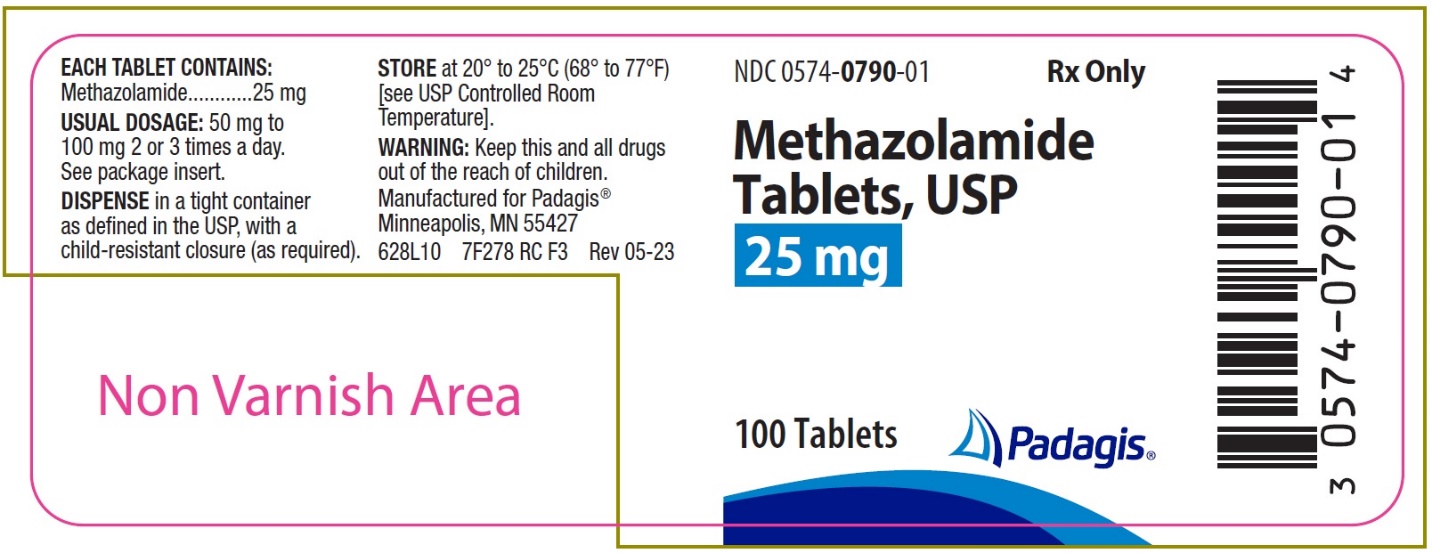
methazolamide 25 mg Tablet, 100-count — NDC 0574-0790-01 (Billing 00574-0790-01)
This is a package of 100 tablets of methazolamide 25 mg Tablet from Padagis US LLC, marketed since Sep 2014 and currently FDA-listed, this package's marketing is listed to end Sep 2027; retail pharmacies pay about $0.6275 per tablet (NADAC). It is this product's only package size.
NDC database record
One package, one record: these facts belong to NDC 0574-0790-01 alone.
- Record
- FDA NDC Directory package listing · Human prescription drug
- Code segments
- 0574 labeler · 0790 product · 01 package
- Package marketed since
- Sep 30, 2014
- Package marketing ended
- Sep 30, 2027
- Sample package
- No — commercial package
- Billing quantity
- 100 EA per package
- Barcode (UPC)
- 0305740790014, 0305740791011
- Medicaid fills, this package
- 38 prescriptions in the last four reported quarters
- FDA record last changed
- Jul 24, 2026
Identity & classification
Regulatory identifiers FDA, NLM and CMS codes for this package
Drug-database identifiers Medi-Span GPI and First Databank GCN / HICL / AHFS classification
- GSN (GCN sequence number): 008168
- GCN: 34741
- GPI-14 (Medi-Span): 37100030000303
- HICL (First Databank): 003643
- AHFS class code: 52:40.12.00
- RxCUI (RxNorm): 197939
Where does this data come from?
- FDA openFDA NDC Directory · synced Oct 1, 2026
- FDA label on DailyMed · label index refreshed Oct 5, 2026
- RxNorm (NLM RxNav) · catalog refreshed Oct 1, 2026
- Medi-Span GPI (licensed)
- First Databank (licensed) · refreshed Oct 1, 2026
RxNorm drug class
This medicine belongs to the Carbonic anhydrase inhibitors class.
Where does this data come from?
- RxClass (NLM) · catalog refreshed Oct 1, 2026
Clinical
Methazolamide is used to treat glaucoma (a condition in which increased pressure in the eye can lead to gradual loss of vision). Methazolamide is in a class of medications called carbonic anhydrase inhibitors. It works by decreasing the pressure in the eye.
Read the full MedlinePlus article ↗- It's reducing the pressure inside your eye. Your eye constantly makes a fluid called aqueous humor, and methazolamide slows down how much of that fluid is produced. Less fluid mean...
- What is methazolamide actually doing for my eyes?
- The most common one people notice is a tingling or 'pins and needles' feeling in their hands and feet — it can be a little odd but it's well known with this type of drug. You might...
- What side effects should I actually expect when I start taking it?
Patient education
Supplement & herbal interactions
Some supplements/herbs that may interact with Methazolamide — tap one for details:
Methazolamide may be associated with lower levels of 7 nutrients — worth a chat with your pharmacist, not a cause for alarm.
Where does this data come from?
- MedlinePlus (NLM) · refreshed Oct 1, 2026
- FDA label on DailyMed · label index refreshed Oct 5, 2026
Ask a licensed pharmacist directly — free, answered by our team.
Pricing
A drug doesn't have one price. Each row is a different public payment system, and none is what you'd pay at the counter — that depends on your insurance. The ⓘ on each row explains what it measures.
| Price system | Per ea | Per package |
|---|---|---|
| Retail pharmacies payNADAC · weekly | $0.628 | $62.75 / 100 tablets |
| Medicaid paysCMS SDUD · 12 mo | $0.9884 | $98.84 / 100 tablets |
| Medicare drug plans payPart D · Q2 2026 | $1.59 | $159.26 / 100 tablets |
Where does this data come from?
- CMS NADAC weekly file · file of Sep 30, 2026
- CMS ASP pricing files · refreshed Sep 20, 2026
- CMS Medicaid State Drug Utilization Data · through Q1 2026
- CMS Part D plan pricing files · refreshed Sep 24, 2026
- VA National Acquisition Center price file
Packaging — all sizes for this product
| Package NDC | Description | Marketing start | Marketing end | Status |
|---|---|---|---|---|
| 00574-0790-01 You're viewing this Main listing | 100 TABLET in 1 BOTTLE, PLASTIC | 2014-09-30 | Sep 30, 2027 | Active |
Therapeutic equivalents
| Product | Labeler | Pack | NADAC/unit | TE | Status | Price vs. this |
|---|---|---|---|---|---|---|
| methazolamide 25 mgthis 00574-0790-01 | Padagis | 100 tablets | $0.627 | AB | Availability likely | — |
| Methazolamide 25 mg 62559-0240-01 | ANI | 100 tablets | $0.627 | AB | Availability likely | — |
| Methazolamide 25 mg 68094-0908-50 | Precision | 100 tablets | $0.627 | AB | Availability likely | — |
| Methazolamide 25 mg 72603-0166-01 | NorthStar | 100 tablets | $0.627 | AB | Availability likely | — |
| Methazolamide 25 mg 24208-0022-01 | Bausch | 1000 tablets | — | AB | FDA listed | — |
| Methazolamide 25 mg 27241-0246-01 | Ajanta | 100 tablets | — | AB | FDA listed | — |
| Methazolamide 25 mg 42571-0239-05 | Micro | 500 tablets | — | AB | FDA listed | — |
| Methazolamide 25 mg 51407-0026-01 | Golden | 100 tablets | — | AB | FDA listed | — |
| Methazolamide 25 mg 63629-1986-01 | Bryant | 100 tablets | — | AB | FDA listed | — |
| Methazolamide 25 mg 72162-1754-01 | Bryant | 100 tablets | — | AB | FDA listed | — |
Where does this data come from?
- FDA openFDA NDC Directory · synced Oct 1, 2026
- FDA Orange Book · refreshed Oct 3, 2026
- CMS NADAC weekly file · file of Sep 30, 2026
Availability & generic status
This product is an FDA-approved generic. Other versions of the same drug are listed under Therapeutic equivalents, least expensive first.
Where does this data come from?
- FDA Orange Book · refreshed Oct 3, 2026
What it looks like
Where does this data come from?
- FDA label on DailyMed · label index refreshed Oct 5, 2026
Inactive Ingredients / Excipients
Inactive ingredients, also called excipients, are components of the drug product other than the active ingredient. They may include fillers, dyes, coatings, preservatives, flavors, or other formulation ingredients.
🧪 Avoiding an ingredient? See Methazolamide inactive ingredients by manufacturer: every current product's list side by side, so you can ask your pharmacy for the version that does not list it.
💡 Tap an ingredient (hover on desktop) to see what it is and why it’s used.
-
UNII M28OL1HH48
Croscarmellose sodium is a plant-based substance derived from cellulose. It acts as a disintegrant, helping tablets and capsules break down quickly in the digestive system so the medicine can be absorbed.
-
UNII O7TSZ97GEP
A mineral compound that serves as a filler and binding agent in tablets and capsules. It adds bulk to the medicine and helps hold ingredients together during manufacturing.
-
UNII 70097M6I30
Magnesium stearate is a salt made from magnesium and stearic acid, a fatty substance. It's used in tablets and capsules as a lubricant and glidant to help ingredients flow smoothly during manufacturing and prevent sticking.
-
UNII OP1R32D61U
Microcrystalline cellulose is a purified form of cellulose, a natural fiber from plant sources. It acts as a binder and filler in tablets and capsules, helping hold ingredients together and give the medicine its shape and size.
-
UNII ETJ7Z6XBU4
Silicon dioxide is a naturally occurring mineral used as a glidant and anti-caking agent. It helps powder ingredients flow smoothly and prevents clumping during manufacturing and storage.
5 inactive ingredients listed in the exact product block matched to this NDC.
Where does this data come from?
ingredient classCode="IACT" elements from the exact product block matched by this NDC. Label-section narrative from DailyMed / the openFDA label index is shown separately when available.- FDA label on DailyMed · label index refreshed Oct 5, 2026
- FDA openFDA NDC Directory · synced Oct 1, 2026
Inactive ingredient FAQ
Are inactive ingredients the same for every manufacturer?
Why might an inactive ingredient be missing?
Can inactive ingredients matter?
Manufacturer & labeler
More NDCs from Padagis US LLC labeler code 00574
- hydromorphone hydrochloride 32 mg Tablet, Extended Release NDC 0574-0297-01
- ACTIDOSE activated charcoal 208 mg/mL Suspension NDC 0574-0520-04
- ACTIDOSE AQUA activated charcoal 208 mg/mL Suspension NDC 0574-0521-04
- Podocon 25 Podophyllum resin 1 mg/4mL Tincture NDC 0574-0601-15
- PODOFILOX 5 mg/mL Solution NDC 0574-0611-05
- Podofilox 5 mg/g Gel NDC 0574-0621-05
- methazolamide 50 mg Tablet NDC 0574-0791-01
- acetylcysteine 200 mg/mL Injection NDC 0574-0805-30
- Testosterone Cypionate 200 mg/mL Injection, Solution NDC 0574-0820-01
- Testosterone Cypionate 200 mg/mL Injection, Solution NDC 0574-0827-01
- Brompheniramine Maleate, Pseudoephedrine Hydrochloride and Dextromethorphan Hydrobromide 2 mg/5mL; 10 mg/5mL; 30 mg/5mL Syrup NDC 0574-1104-04
- SPIRONOLACTONE 25 mg/5mL Suspension NDC 0574-1133-04
Where does this data come from?
- FDA openFDA NDC Directory · synced Oct 1, 2026
- Drugs@FDA
Full prescribing information FDA SPL
🎯 Indications and Usage ▾
INDICATIONS AND USAGE: Methazolamide Tablets USP is indicated in the treatment of ocular conditions where lowering intraocular pressure is likely to be of therapeutic benefit, such as chronic open-angle glaucoma, secondary glaucoma, and preoperatively in acute angle-closure glaucoma where lowering the intraocular pressure is desired before surgery.
⏱️ Dosage and Administration ▾
DOSAGE AND ADMINISTRATION: The effective therapeutic dose administered varies from 50 mg to 100 mg two or three times daily. The drug may be used concomitantly with miotic and osmotic agents.
⛔ Contraindications ▾
CONTRAINDICATIONS: Methazolamide therapy is contraindicated in situations in which sodium and/or potassium serum levels are depressed, in cases of marked kidney or liver disease or dysfunction, in adrenal gland failure, and in hyperchloremic acidosis. In patients with cirrhosis, use may precipitate the development of hepatic encephalopathy. Long-term administration of methazolamide is contraindicated in patients with angle-closure glaucoma, since organic closure of the angle may occur in spite of lowered intraocular pressure.
⚠️ Warnings ▾
WARNINGS: Fatalities have occurred, although rarely, due to severe reactions to sulfonamides including Stevens-Johnson syndrome, toxic epidermal necrolysis, fulminant hepatic necrosis, agranulocytosis, aplastic anemia, and other blood dyscrasias. Hypersensitivity reactions may recur when a sulfonamide is readministered, irrespective of the route of administration. If hypersensitivity or other serious reactions occur, the use of this drug should be discontinued.
Caution is advised for patients receiving high-dose aspirin and methazolamide concomitantly, as anorexia, tachypnea, lethargy, coma, and death have been reported with concomitant use of high-dose aspirin and carbonic anhydrase inhibitors.
🤒 Adverse Reactions ▾
ADVERSE REACTIONS: Adverse reactions, occurring most often early in therapy, include paresthesias, particularly a “tingling” feeling in the extremities; hearing dysfunction or tinnitus; fatigue; malaise; loss of appetite; taste alteration; gastrointestinal disturbances such as nausea, vomiting, and diarrhea; polyuria; and occasional instances of drowsiness and confusion. Metabolic acidosis and electrolyte imbalance may occur. Transient myopia has been reported.
This condition invariably subsides upon diminution or discontinuance of the medication. Other occasional adverse reactions include urticaria, melena, hematuria, glycosuria, hepatic insufficiency, flaccid paralysis, photosensitivity, convulsions, and, rarely, crystalluria and renal calculi. Also see PRECAUTIONS: Information for Patients for possible reactions common to sulfonamide derivatives.
Fatalities have occurred, although rarely, due to severe reactions to sulfonamides including Stevens-Johnson syndrome, toxic epidermal necrolysis, fulminant hepatic necrosis, agranulocytosis, aplastic anemia, and other blood dyscrasias (see WARNINGS ).
🔄 Drug Interactions ▾
Drug Interactions: Methazolamide should be used with caution in patients on steroid therapy because of the potential for developing hypokalemia. Caution is advised for patients receiving high-dose aspirin and methazolamide concomitantly, as anorexia, tachypnea, lethargy, coma and death have been reported with concomitant use of high-dose aspirin and carbonic anhydrase inhibitors (see WARNINGS ).
🤰 Pregnancy ▾
Pregnancy: Teratogenic effects. Pregnancy Category C. Methazolamide has been shown to be teratogenic (skeletal anomalies) in rats when given in doses approximately 40 times the human dose. There are no adequate and well controlled studies in pregnant women. Methazolamide should be used during pregnancy only if the potential benefit justifies the potential risk to the fetus.
🧒 Pediatric Use ▾
Pediatric Use: The safety and effectiveness of methazolamide in pediatric patients have not been established.
🆘 Overdosage ▾
OVERDOSAGE: No data are available regarding methazolamide overdosage in humans as no cases of acute poisoning with this drug have been reported. Animal data suggest that even a high dose of methazolamide is nontoxic. No specific antidote is known.
Treatment should be symptomatic and supportive. Electrolyte imbalance, development of an acidotic state, and central nervous system effects might be expected to occur. Serum electrolyte levels (particularly potassium) and blood pH levels should be monitored.
Supportive measures may be required to restore electrolyte and pH balance.
🧬 Clinical Pharmacology ▾
CLINICAL PHARMACOLOGY: Methazolamide is a potent inhibitor of carbonic anhydrase. Methazolamide is well absorbed from the gastrointestinal tract. Peak plasma concentrations are observed 1 to 2 hours after dosing.
In a multiple-dose, pharmacokinetic study, administration of methazolamide 25 mg bid, 50 mg bid, and 100 mg bid demonstrated a linear relationship between plasma methazolamide levels and methazolamide dose. Peak plasma concentrations (C max ) for the 25 mg, 50 mg and 100 mg bid regimens were 2.5 mcg/mL, 5.1 mcg/mL, and 10.7 mcg/mL, respectively. The area under the plasma concentration-time curves (AUC) was 1130 mcg.min/mL, 2571 mcg.min/mL, and 5418 mcg.min/mL for the 25 mg, 50 mg, and 100 mg dosage regimens, respectively.
Methazolamide is distributed throughout the body including the plasma, cerebrospinal fluid, aqueous humor of the eye, red blood cells, bile and extracellular fluid. The mean apparent volume of distribution (V area /F) ranges from 17 L to 23 L. Approximately 55% is bound to plasma proteins.
The steady-state methazolamide red blood cell:plasma ratio varies with dose and was found to be 27:1, 16:1, and 10:1 following the administration of methazolamide 25 mg bid, 50 mg bid, and 100 mg bid, respectively. The mean steady-state plasma elimination half-life for methazolamide is approximately 14 hours. At steady-state, approximately 25% of the dose is recovered unchanged in the urine over the dosing interval.
Renal clearance accounts for 20% to 25% of the total clearance of drug. After repeated bid-tid dosing, methazolamide accumulates to steady-state concentrations in 7 days. Methazolamide’s inhibitory action on carbonic anhydrase decreases the secretion of aqueous humor and results in a decrease in intraocular pressure.
The onset of the decrease in intraocular pressure generally occurs within 2 to 4 hours, has a peak effect in 6 to 8 hours and a total duration of 10 to 18 hours. Methazolamide is a sulfonamide derivative; however, it does not have any clinically significant antimicrobial properties. Although methazolamide achieves a high concentration in the cerebrospinal fluid, it is not considered an effective anticonvulsant.
Methazolamide has a weak and transient diuretic effect; therefore, use results in an increase in urinary volume, with excretion of sodium, potassium, and chloride. The drug should not be used as a diuretic. Inhibition of renal bicarbonate reabsorption produces an alkaline urine.
Plasma bicarbonate decreases, and a relative, transient metabolic acidosis may occur due to a disequilibrium in carbon dioxide transport in the red blood cell. Urinary citrate excretion is decreased by approximately 40% after doses of 100 mg every 8 hours. Uric acid output has been shown to decrease 36% in the first 24 hour period.
📦 How Supplied / Storage and Handling ▾
HOW SUPPLIED: Methazolamide Tablets USP, 25 mg are round, white tablets, debossed “EFF” on one side and “21” on the other side and are supplied in bottles of 100, NDC 0574- 0790 -01. Methazolamide Tablets USP, 50 mg are round, white, scored tablets debossed “EFF” on one side and “20” on the other side and are supplied in bottles of 100, NDC 0574- 0791 -01. Store at 20° to 25°C (68° to 77°F) [see USP Controlled Room Temperature].
Dispense in a tight container as defined in the USP, with a child-resistant closure (as required). Rx only Manufactured for Padagis ® Minneapolis, MN 55427 www.padagis.com Rev 05-23 5P800 RC PH3 Code 617M00
📋 Description ▾
DESCRIPTION: Methazolamide, a sulfonamide derivative, is a white crystalline powder, weakly acidic, slightly soluble in water, alcohol and acetone. The chemical name for methazolamide is: N-[5-(aminosulfonyl)-3-methyl-1,3,4-thiadiazol-2(3H)-ylidene]-acetamide and it has the following structural formula: Each tablet, for oral administration, contains 25 mg or 50 mg methazolamide. In addition, each tablet contains the following inactive ingredients: colloidal silicon dioxide, croscarmellose sodium, dibasic calcium phosphate dihydrate, magnesium stearate (powder), and microcrystalline cellulose.
Chemical Structure
💬 Information for Patients ▾
Information for Patients: Adverse reactions common to all sulfonamide derivatives may occur: anaphylaxis, fever, rash (including erythema multiforme, Stevens-Johnson syndrome, toxic epidermal necrolysis), crystalluria, renal calculus, bone marrow depression, thrombocytopenic purpura, hemolytic anemia, leukopenia, pancytopenia, and agranulocytosis. Precaution is advised for early detection of such reactions, and the drug should be discontinued and appropriate therapy instituted. Caution is advised for patients receiving high-dose aspirin and methazolamide concomitantly.
⚠️ Precautions ▾
PRECAUTIONS: General: Potassium excretion is increased initially upon administration of methazolamide and in patients with cirrhosis or hepatic insufficiency could precipitate a hepatic coma. In patients with pulmonary obstruction or emphysema, where alveolar ventilation may be impaired, methazolamide should be used with caution because it may precipitate or aggravate acidosis. Information for Patients: Adverse reactions common to all sulfonamide derivatives may occur: anaphylaxis, fever, rash (including erythema multiforme, Stevens-Johnson syndrome, toxic epidermal necrolysis), crystalluria, renal calculus, bone marrow depression, thrombocytopenic purpura, hemolytic anemia, leukopenia, pancytopenia, and agranulocytosis.
Precaution is advised for early detection of such reactions, and the drug should be discontinued and appropriate therapy instituted. Caution is advised for patients receiving high-dose aspirin and methazolamide concomitantly. Laboratory Tests: To monitor for hematologic reactions common to all sulfonamides, it is recommended that a baseline CBC and platelet count be obtained on patients prior to initiating methazolamide therapy and at regular intervals during therapy.
If significant changes occur, early discontinuance and institution of appropriate therapy are important. Periodic monitoring of serum electrolytes is also recommended. Drug Interactions: Methazolamide should be used with caution in patients on steroid therapy because of the potential for developing hypokalemia.
Caution is advised for patients receiving high-dose aspirin and methazolamide concomitantly, as anorexia, tachypnea, lethargy, coma and death have been reported with concomitant use of high-dose aspirin and carbonic anhydrase inhibitors (see WARNINGS ). Carcinogenesis, Mutagenesis, Impairment of Fertility: Long-term studies in animals to evaluate the carcinogenic potential of methazolamide and its effect on fertility have not been conducted. Methazolamide was not mutagenic in the Ames bacterial test.
Pregnancy: Teratogenic effects. Pregnancy Category C. Methazolamide has been shown to be teratogenic (skeletal anomalies) in rats when given in doses approximately 40 times the human dose.
There are no adequate and well controlled studies in pregnant women. Methazolamide should be used during pregnancy only if the potential benefit justifies the potential risk to the fetus. Nursing Mothers: It is not known whether this drug is excreted in human milk.
Because many drugs are excreted in human milk and because of the potential for serious adverse reactions in nursing infants from methazolamide, a decision should be made whether to discontinue nursing or to discontinue the drug, taking into account the importance of the drug to the mother. Pediatric Use: The safety and effectiveness of methazolamide in pediatric patients have not been established.
🍼 Nursing Mothers ▾
Nursing Mothers: It is not known whether this drug is excreted in human milk. Because many drugs are excreted in human milk and because of the potential for serious adverse reactions in nursing infants from methazolamide, a decision should be made whether to discontinue nursing or to discontinue the drug, taking into account the importance of the drug to the mother.
📄 Carcinogenesis, Mutagenesis, Impairment of Fertility ▾
Carcinogenesis, Mutagenesis, Impairment of Fertility: Long-term studies in animals to evaluate the carcinogenic potential of methazolamide and its effect on fertility have not been conducted. Methazolamide was not mutagenic in the Ames bacterial test.
📄 Package Label / Principal Display Panel ▾
PACKAGE/LABEL PRINCIPAL DISPLAY PANEL – 25 mg Label NDC 0574-0790-01 Rx Only Methazolamide Tablets, USP 25 mg 100 Tablets The following image is a placeholder representing the product identifier that is either affixed or imprinted on the drug package label during the packaging operation. 25mg label serialization-template.jpg
PACKAGE/LABEL PRINCIPAL DISPLAY PANEL – 50 mg Label NDC 0574-0791-01 Rx Only Methazolamide Tablets, USP 50 mg 100 Tablets The following image is a placeholder representing the product identifier that is either affixed or imprinted on the drug package label during the packaging operation. 50mg label serialization-template.jpg