
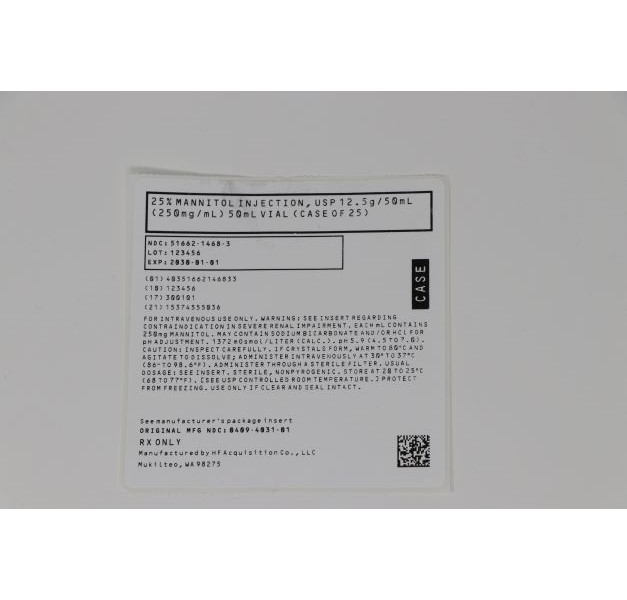
MANNITOL 12.5 g/50mL Injection, Solution — NDC 51662-1468-3 (Billing 51662-1468-03)
This is a package of MANNITOL 12.5 g/50mL Injection, Solution from HF Acquisition Co LLC, DBA HealthFirst, marketed since Dec 2019 and currently FDA-listed.
NDC database record
One package, one record: these facts belong to NDC 51662-1468-3 alone.
- Record
- FDA NDC Directory package listing · Human prescription drug
- Code segments
- 51662 labeler · 1468 product · 3 package
- Package marketed since
- Dec 11, 2022
- Sample package
- No — commercial package
- Listing certified through
- Dec 31, 2026
- Barcode (UPC-A, from the NDC)
- 3 5166214683 5
- FDA record last changed
- Jul 24, 2026
Identity & classification
Regulatory identifiers FDA, NLM and CMS codes for this package
- RxCUI (RxNorm): 311450
Where does this data come from?
- FDA openFDA NDC Directory · synced Oct 8, 2026
- FDA label on DailyMed · label index refreshed Oct 6, 2026
- RxNorm (NLM RxNav) · catalog refreshed Oct 1, 2026
- Medi-Span GPI (licensed)
- First Databank (licensed) · refreshed Oct 8, 2026
RxNorm drug class
This medicine belongs to the Osmotic Diuretic class.
Where does this data come from?
- RxClass (NLM) · catalog refreshed Oct 1, 2026
Clinical
Patient education
Supplement & herbal interactions
Some supplements/herbs that may interact with Mannitol — tap one for details:
Mannitol may be associated with lower levels of 7 nutrients — worth a chat with your pharmacist, not a cause for alarm.
Where does this data come from?
- MedlinePlus (NLM) · refreshed Oct 1, 2026
- FDA label on DailyMed · label index refreshed Oct 6, 2026
Ask a licensed pharmacist directly — free, answered by our team.
Pricing
A drug doesn't have one price. Each row is a different public payment system, and none is what you'd pay at the counter — that depends on your insurance. The ⓘ on each row explains what it measures.
| Price system | Per mL | Per package |
|---|---|---|
| Retail pharmacies payNADAC · weekly | Not in the retail survey — common for institutional, discontinued, or low-volume packs. | |
| Medicaid paysCMS SDUD · 12 mo | No recent Medicaid claims on file for this NDC — rare and low-volume NDCs are suppressed in the public data. | |
| Medicare drug plans payPart D · quarterly | No Part D plan price is available for this NDC in our data. | |
| Medicare Part B allowsASP · J2151 | $0.071 / J2151 unit | — |
Where does this data come from?
- CMS NADAC weekly file
- CMS ASP pricing files · refreshed Sep 20, 2026
- CMS Medicaid State Drug Utilization Data · refreshed Oct 8, 2026
- CMS Part D plan pricing files · refreshed Sep 24, 2026
- VA National Acquisition Center price file
Billing & reimbursement
Where does this data come from?
- CMS ASP NDC-HCPCS crosswalk · refreshed Sep 22, 2026
- DMEPDAC NDC-HCPCS crosswalk
- openFDA NSDE billing units · refreshed Oct 7, 2026
Packaging — all sizes for this product
| Package NDC | Description | Marketing start | Marketing end | Status |
|---|---|---|---|---|
| 51662-1468-01 51662-1468-1 Main listing | 50 mL in 1 VIAL, SINGLE-DOSE | 2019-12-13 | — | Active |
| 51662-1468-03 You're viewing this | 25 POUCH in 1 CASE / 1 VIAL, SINGLE-DOSE in 1 POUCH / 50 mL in 1 VIAL, SINGLE-DOSE | 2022-12-11 | — | Active |
Pack size FAQ
What quantity is in this package?
What NDC number is used to bill for this package of MANNITOL 12.5 g/50mL Injection, Solution?
Therapeutic equivalents
| Product | Labeler | Pack | NADAC/unit | TE | Status | Price vs. this |
|---|---|---|---|---|---|---|
| Mannitol 12.5 g/50mL 00404-9905-50 | Henry | 1 vial | — | — | FDA listed | — |
| Mannitol 12.5 g/50mL 00409-4031-01 | Hospira, | 25 vials | — | — | FDA listed | — |
| Mannitol 12.5 g/50mLthis 51662-1468-03 | HF | 25 pouches | — | — | FDA listed | — |
| Mannitol 250 mg/mL 63323-0024-25 | Fresenius | 25 vials | — | AP | FDA listed | — |
| Mannitol 250 mg/mL 84549-0024-25 | ProPharma | 50 ml | — | AP | FDA listed | — |
Where does this data come from?
- FDA openFDA NDC Directory · synced Oct 8, 2026
- FDA Orange Book · refreshed Oct 3, 2026
- CMS NADAC weekly file
Availability & generic status
The FDA lists approved generic versions of this medicine, but that does not always mean a pharmacy can get one today. Patent rules, launch agreements, supply and pricing can affect when generics actually arrive.
Where does this data come from?
- FDA Orange Book · refreshed Oct 3, 2026
Inactive Ingredients / Excipients
Inactive ingredients, also called excipients, are components of the drug product other than the active ingredient. They may include fillers, dyes, coatings, preservatives, flavors, or other formulation ingredients.
💡 Tap an ingredient (hover on desktop) to see what it is and why it’s used.
-
UNII QTT17582CB
A strong acid used to adjust and maintain the proper pH level in liquid medicines, ensuring stability and preventing breakdown of active ingredients.
-
UNII 8MDF5V39QO
A white powder form of baking soda that acts as a buffer and pH regulator in medicines. It helps maintain the right acid-base balance and may aid tablet disintegration.
-
UNII 059QF0KO0R
Water is a liquid solvent that dissolves and mixes ingredients together in liquid medicines, syrups, and injections. It helps distribute the active drug evenly throughout the product.
3 inactive ingredients listed in the exact product block matched to this NDC.
Where does this data come from?
ingredient classCode="IACT" elements from the exact product block matched by this NDC. Label-section narrative from DailyMed / the openFDA label index is shown separately when available.- FDA label on DailyMed · label index refreshed Oct 6, 2026
- FDA openFDA NDC Directory · synced Oct 8, 2026
Inactive ingredient FAQ
Are inactive ingredients the same for every manufacturer?
Why might an inactive ingredient be missing?
Can inactive ingredients matter?
Manufacturer & labeler
More NDCs from HF Acquisition Co LLC, DBA HealthFirst labeler code 51662
- LIDOCAINE HCI 10 mg/mL Injection, Solution NDC 51662-1461-1
- 7.5% SODIUM BICARBONATE 75 mg/mL Injection, Solution NDC 51662-1463-1
- SODIUM CHLORIDE 9 mg/mL Injection, Solution NDC 51662-1464-1
- 1% LIDOCAINE HCI 10 mg/mL Injection, Solution NDC 51662-1465-1
- 1% LIDOCAINE HCI 10 mg/mL Injection, Solution NDC 51662-1466-1
- 2% LIDOCAINE HCI 20 mg/mL Injection, Solution NDC 51662-1467-1
- ONDANSETRON 2 mg/mL Injection, Solution NDC 51662-1469-1
- PROPOFOL 10 mg/mL Injection, Emulsion NDC 51662-1470-1
- PROPOFOL 10 mg/mL Injection, Emulsion NDC 51662-1471-1
- PEDIATRIC 8.4% SODIUM BICARBONATE 84 mg/mL Injection, Solution NDC 51662-1472-1
- BACTERIOSTATIC WATER 1 mL/mL Injection, Solution NDC 51662-1473-1
- STERILE WATER 1 mL/mL Injection NDC 51662-1474-1
Where does this data come from?
- FDA openFDA NDC Directory · synced Oct 8, 2026
- Drugs@FDA
Full prescribing information FDA SPL
🎯 Indications and Usage ▾
1 INDICATIONS & USAGE Mannitol Injection is indicated for the following purposes in adults and pediatric patients. Therapeutic Use Reduction of intracranial pressure and brain mass. Reduction of high intraocular pressure. Diagnostic Use Measurement of glomerular filtration rate.
⏱️ Dosage and Administration ▾
2 DOSAGE & ADMINISTRATION
2.1Important Preparation and Administration Instructions For intravenous use only. Do not administer intramuscularly or subcutaneously. Never add mannitol in whole blood for transfusion.
Do not administer unless solution is clear and container is undamaged. Discard unused portion. Do not administer 25% mannitol if the fliptop vial seal is not intact.
Additives may be incompatible. Consult with pharmacist, if available. Do not place 25% Mannitol Injection in polyvinylchloride (PVC) bags; a white flocculent precipitate may form from contact with PVC surfaces.
Parenteral drug products should be inspected visually for particulate matter and discoloration whenever container and solution permit.
2.2Recommended Dosage Reduction of Intracranial Pressure and Brain Mass In adults a dose of 0.25 to 2 g/kg body weight as a 15% to 25% solution administered over a period of 30 to 60 minutes; pediatric patients 1 to 2 g/kg body weight or 30 to 60 g/m2 body surface area over a period of 30 to 60 minutes. In small or debilitated patients, a dose of 500 mg/kg may be sufficient. Careful evaluation must be made of the circulatory and renal reserve prior to and during administration of mannitol at the higher doses and rapid infusion rates.
Careful attention must be paid to fluid and electrolyte balance, body weight, and total input and output before and after infusion of mannitol. Evidence of reduced cerebral spinal fluid pressure must be observed within 15 minutes after starting infusion. Reduction of Intraocular Pressure In adults a dose of 0.25 to 2 g/kg body weight as a 15% to 25% solution administered over a period of 30 to 60 minutes; pediatric patients 1 to 2 g/kg body weight or 30 to 60 g/m2 body surface area over a period of 30 to 60 minutes.
In small or debilitated patients, a dose of 500 mg/kg may be sufficient. When used preoperatively, the dose should be given one to one and one-half hours before surgery to achieve maximal reduction of intraocular pressure before operation. Measurement of Glomerular Filtration Rate (GFR) 100 mL of a 20% solution (20 g) should be diluted with 180 mL of sodium chloride injection (normal saline) or 200 mL of a 10% solution (20 g) should be diluted with 80 mL of sodium chloride injection (normal saline).
The resulting 280 mL of 7.2% solution is infused at a rate of 20 mL per minute. The urine is collected by catheter for a specific period of time and analyzed for mannitol excreted in mg per minute. A blood sample is drawn at the start and at the end of the time period and the concentration of mannitol determined in mg/mL of plasma.
GFR is the number of mL of plasma that must have been filtered to account for the amount excreted per minute in the urine. Normal clearance rates are approximately 125 mL/minute for men; 116 mL/minute for women.
💊 Dosage Forms and Strengths ▾
3 DOSAGE FORMS AND STRENGTHS Mannitol Injection, USP: 25% (250 mg/mL): 25 grams of mannitol, USP per 100 mL in a single-dose 50 mL fliptop vial
⛔ Contraindications ▾
4 CONTRAINDICATIONS Mannitol Injection is contraindicated in patients with: Well established anuria due to severe renal disease. Severe pulmonary congestion or frank pulmonary edema. Active intracranial bleeding except during craniotomy. Severe dehydration. Progressive heart failure or pulmonary congestion after institution of mannitol therapy. Do not administer to patients with a known hypersensitivity to mannitol.
⚠️ Warnings and Cautions ▾
5 WARNINGS AND PRECAUTIONS
5.1Renal Complications Including Renal Failure Renal complications, including irreversible renal failure have been reported in patients receiving mannitol. Reversible, oliguric acute kidney injury (AKI) has occurred in patients with normal pretreatment renal function who received mannitol. Osmotic nephrosis, a reversible vacuolization of the tubules of no known clinical significance, may proceed to severe irreversible nephrosis, so that the renal function must be closely monitored during mannitol infusion.
Patients with pre-existing renal disease, patients with conditions that put them at risk for renal failure, or those receiving potentially nephrotoxic drugs or other diuretics, are at increased risk for renal failure. Avoid concomitant administration of nephrotoxic drugs (e.g., aminoglycosides) or other diuretics with mannitol [see Drug Interactions (7) ]. If urine output declines during mannitol infusion, the patient's clinical status should be closely reviewed and mannitol infusion suspended if necessary.
5.2Fluid and Electrolyte Imbalances The obligatory diuretic response following rapid infusion of 25% mannitol may further aggravate pre-existing hemoconcentration. Excessive loss of water and electrolytes may lead to serious imbalances. With continued administration of mannitol, loss of water in excess of electrolytes can cause hypernatremia.
Electrolyte measurements, including sodium and potassium are therefore of vital importance in monitoring the infusion of mannitol. The shift of sodium-free intracellular fluid into the extracellular compartment following mannitol infusion may lower serum sodium concentration and aggravate pre-existing hyponatremia. By sustaining diuresis, mannitol administration may obscure and intensify inadequate hydration or hypovolemia.
Accumulation of mannitol may result in overexpansion of the extracellular fluid which may intensify existing or latent congestive heart failure. The cardiovascular status of the patient should be carefully evaluated before rapidly administering mannitol since sudden expansion of the extracellular fluid may lead to fulminating congestive heart failure.
5.3Central Nervous System (CNS) Toxicity Mannitol injection may increase cerebral blood flow and the risk of postoperative bleeding in neurosurgical patients. Mannitol may increase cerebral blood flow and worsen intracranial hypertension in children who develop generalized cerebral hyperemia during the first 24 to 48 hours post injury.
5.4Monitoring Serum sodium and potassium should be carefully monitored during mannitol administration. If an adverse reaction does occur, discontinue the infusion, evaluate the patient, institute appropriate therapeutic counter measures and save the remainder of the fluid for examination if deemed necessary. Electrolyte-free mannitol solutions should not be given conjointly with blood.
If it is essential that blood be given simultaneously, at least 20 mEq of sodium chloride should be added to each liter of mannitol solution to avoid pseudoagglutination. When exposed to low temperatures, solutions of mannitol may crystallize. If crystals are observed, the container should be warmed to redissolve, then cooled to body temperature before administering [see How Supplied/Storage and Handling (16) ].
When infusing 25% mannitol, the administration set should include a filter. Do not infuse mannitol solution if crystals are present.
🤒 Adverse Reactions ▾
6 ADVERSE REACTIONS The following adverse reactions associated with the use mannitol were identified in clinical studies or postmarketing reports. Because some of these reactions were reported voluntarily from a population of uncertain size, it is not always possible to reliably estimate their frequency or establish a causal relationship to drug exposure. ADVERSE REACTIONS
🔄 Drug Interactions ▾
7 DRUG INTERACTIONS
7.1Nephrotoxic Drugs Patients receiving potentially nephrotoxic drugs are at increased risk for renal failure. Avoid concomitant administration of nephrotoxic drugs (e.g., aminoglycosides) with mannitol [see Warnings and Precautions (5) ].
7.2Diuretics Pateints receiving other diuretics are at increased risk for renal failure. Avoid concomitant administration of other diuretics with mannitol [see Warnings and Precautions (5) ].
👥 Use in Specific Populations ▾
8 USE IN SPECIFIC POPULATIONS
8.1Pregnancy Risk Summary There are no well-controlled studies in pregnant women that establish developmental toxicity related to the use of mannitol injection. Mannitol crosses the placenta and may cause fluid shifts that could potentially result in adverse effects in the fetus (see Data). The available data do not establish the presence or absence of developmental toxicity related to the use of mannitol.
There are limited animal data in the published literature. The effects of mannitol on embryo-fetal development have not been evaluated; however, fluid shifts occurred in animal studies in response to maternal infusion of mannitol. Mannitol injection should be given to a pregnant woman only if clearly needed.
The estimated background risk of major birth defects and miscarriage for the indicated population is unknown. All pregnancies have a background risk of birth defect, loss, or other adverse outcomes. In the U.S. general population, the estimated background risk of major birth defects and miscarriage in clinically recognized pregnancies is 2–4% and 15–20%, respectively.
Data Human Data Published literature reports the presence of mannitol in amniotic fluid when mannitol is administered to pregnant women during the third trimester of pregnancy.
8.2Lactation Risk Summary Lactation studies have not been conducted with mannitol. It is not known whether this drug is excreted in human milk. Mannitol injection should be administered to lactating women only if clearly indicated.
Studies assessing the effects of mannitol injection in breastfed children have not been performed. Studies to assess the effect of mannitol on milk production or excretion have not been performed. The developmental and health benefits of breastfeeding should be considered along with the mother's clinical need for mannitol and any potential adverse effects on the breastfed child from mannitol or from the underlying maternal condition.
8.5Geriatric Use Mannitol is known to be substantially excreted by the kidney, and the risk of adverse reactions to this drug may be greater in elderly patients with impaired renal function. Evaluate the renal, cardiac and pulmonary status of the patient and correct fluid and electrolyte imbalances prior to administration of mannitol [see Warnings and Precautions (5) ].
8.6Renal Impairment Patients with pre-existing renal disease, patients with conditions that put them at high risk for renal failure, or those receiving potentially nephrotoxic drugs or other diuretics, are at increased risk of renal failure with administration of mannitol. Evaluate the renal, cardiac and pulmonary status of the patient and correct fluid and electrolyte imbalances prior to administration of mannitol [see Warnings and Precautions (5)] .
🆘 Overdosage ▾
10 OVERDOSAGE Too rapid infusion of large amounts of mannitol will cause a shift of intracellular water into the extracellular compartment resulting in cellular dehydration and overexpansion of the intravascular space with hyponatremia, congestive heart failure and pulmonary edema. Repeated doses should not be given to patients with persistent oliguria as this can produce a hyperosmolar state and precipitate congestive heart failure and pulmonary edema due to volume overload. Dosage must be carefully monitored and adjusted in accordance with the clinical situation to avoid the consequences of overdosage [see Contraindications (4) , Warnings and Precautions (5) , Dosage and Administration (2) ].
🧬 Clinical Pharmacology ▾
12 CLINICAL PHARMACOLOGY
12.1Mechanism of Action Mannitol, when administered intravenously, exerts its osmotic diuretic effect as a solute of relatively small molecular size largely confined to the extracellular space. Mannitol hinders tubular reabsorption of water and enhances excretion of sodium and chloride by elevating the osmolarity of the glomerular filtrate. By increasing the osmotic pressure of plasma and the extracellular space, intravenously administered mannitol will induce the movement of intracellular water to the extracellular and vascular spaces.
This action underlies the role of mannitol in reducing intracranial pressure, intracranial edema, and intraocular pressure.
12.3Pharmacokinetics Distribution Mannitol distributes largely to the extracellular space within 20 to 40 minutes after intravenous administration. The plasma half-life for this distribution phase is 0.16 hour. The volume of distribution of mannitol is approximately 17 L in adults.
Elimination In subjects with normal renal function, the total clearance is 87 to 109 mL/minute. The elimination half-life of mannitol is 0.5 to 2.5 hours Metabolism Only a relatively small amount of the mannitol dose is metabolized after intravenous administration to healthy subjects. Excretion Approximately 80% of a 100 g dose appears in the urine in 3 hours.
The drug is freely filtered by the glomeruli, with less than 10% tubular reabsorption; it is not secreted by tubular cells. Specific Populations Patients with Renal Impairment In patients with renal impairment, the elimination half-life of mannitol is prolonged. In a published study, in patients with renal impairment including acute renal failure and end stage renal failure, the elimination half-life of mannitol was estimated at about 36 hours, based on serum osmolarity.
In patients with renal impairment on dialysis, the elimination half-life of mannitol was reduced to 6 and 21 hours during hemodialysis and peritoneal dialysis, respectively.
📦 How Supplied / Storage and Handling ▾
16 HOW SUPPLIED/STORAGE AND HANDLING Mannitol Injection, USP is supplied in single-dose containers as follows: 25% MANNITOL INJECTION, USP is supplied in the following dosage forms. NDC 51662-1468-1 25% MANNITOL INJECTION, USP 12.5g/50mL (250mg/mL) 50mL VIAL NDC 51662-1468-2 25% MANNITOL INJECTION, USP 12.5g/50mL (250mg/mL) 50mL VIAL, 1 VIAL PER POUCH NDC 51662-1468-3 25% MANNITOL INJECTION, USP 12.5g/50mL (250mg/mL) 50mL VIAL, 1 VIAL PER POUCH, 25 POUCHES PER CASE HF Acquisition Co LLC, DBA HealthFirst Mukilteo, WA 98275 NOTE: Crystals may form in mannitol solutions especially if the solutions are chilled.
To dissolve the crystals, warm the bottle in hot water at 80°C and periodically shake vigorously. 25% Mannitol Injection, USP may be autoclaved at 121°C for 20 minutes at 15 psi. Remove cover from fliptop vial and cleanse stopper with antiseptic before use.
Cool to body temperature or less before administering. When infusing 25% mannitol concentrations, the administration set should include a filter. Protect from freezing.
Store at 20 to 25°C (68 to 77°F). [See USP Controlled Room Temperature.] INSTRUCTlONS FOR USE Remove cover and cleanse stopper with antiseptic before use.
📋 Description ▾
11 DESCRIPTION Mannitol Injection, USP is a sterile, nonpyrogenic solution of mannitol in water for injection available in a concentration of 25% in a fliptop vial for administration by intravenous infusion only. The content and characteristics are as follows: The solution contains no bacteriostat, antimicrobial agent or added buffer (except for pH adjustment) and is intended only as a single-dose injection. When smaller doses are required, the unused portion should be discarded.
Mannitol Injection, USP is a parenteral obligatory osmotic diuretic. Mannitol, USP is chemically designated D-mannitol (C6H14O6), a white crystalline powder or free-flowing granules freely soluble in water. It has the following structural formula: * May contain sodium bicarbonate and/or hydrochloric acid for pH adjustment.
25 25 1372 5.9 (4.5 to 7.0) Water for Injection, USP is chemically designated H2O. DESCRIPTION STRUCTURE
🧪 Nonclinical Toxicology ▾
13 NONCLINICAL TOXICOLOGY
13.1Carcinogenesis, Mutagenesis, Impairment of Fertility Studies with Mannitol Injection have not been performed to evaluate carcinogenic potential, mutagenic potential or effects on fertility.
📄 Package Label / Principal Display Panel ▾
PRINCIPAL DISPLAY PANEL - VIAL LABEL OPT. 1 PRINCIPAL DISPLAY PANEL - VIAL LABEL OPT. 1 PRINCIPAL DISPLAY PANEL - VIAL LABEL OPT. 1
PRINCIPAL DISPLAY PANEL - VIAL LABEL OPT. 2 PRINCIPAL DISPLAY PANEL - VIAL LABEL OPT. 2 PRINCIPAL DISPLAY PANEL - VIAL LABEL OPT. 2
PRINCIPAL DISPLAY PANEL - VIAL LABEL OPT. 3 PRINCIPAL DISPLAY PANEL - VIAL LABEL OPT. 3 PRINCIPAL DISPLAY PANEL - VIAL LABEL OPT. 3
PRINCIPAL DISPLAY PANEL - VIAL LABEL OPT. 4 PRINCIPAL DISPLAY PANEL - VIAL LABEL OPT. 4 PRINCIPAL DISPLAY PANEL - VIAL LABEL OPT. 4
PRINCIPAL DISPLAY PANEL - SERIALIZED VIAL LABELING PRINCIPAL DISPLAY PANEL - SERIALIZED VIAL LABELING PRINCIPAL DISPLAY PANEL - SERIALIZED VIAL LABELING
PRINCIPAL DISPLAY PANEL - NDC 51662-1468-2 POUCH LABELING NDC 51662-1468-2 POUCH LABELING VIAL LABEL POUCH LABELING VIAL LABEL
PRINCIPAL DISPLAY PANEL - NDC 51662-1468-3 CASE LABELING CASE LABELING NDC 51662-1468-3 51662-1468-3 SERIALIZED RFID LABELING Case Labeling RFID Label
Medicare Part D spend CMS · PART D · 2025 (Q1-Q4)
About this NDC listing & data coverage
What data is (and isn’t) available for this NDC — tap to expand
| NDC identity (package / product / labeler codes) | ✓ Available |
| Labeler | ✓ Available |
| Product & package description | ✓ Available |
| Marketing category & status | ✓ Available |
| Active ingredient / dosage form / route | ✓ Available |
| FDA label (SPL via DailyMed) | ✓ Available |
| Package photos | ✓ Available |
| Inactive ingredients (structured) | ✓ Available |
| NADAC pharmacy acquisition price (CMS) | — Not published for this NDC CMS publishes NADAC only for NDCs reported in its retail-pharmacy survey. |
| Orange Book / therapeutic-equivalence data | — Not published for this NDC Applies only to products approved under an NDA/ANDA; many listings are out of scope. |
| HCPCS J-code billing crosswalk | ✓ Available |
| Medicaid utilization (CMS SDUD) | — Not published for this NDC CMS reports utilization only for NDCs with Medicaid claims above its privacy threshold. |