
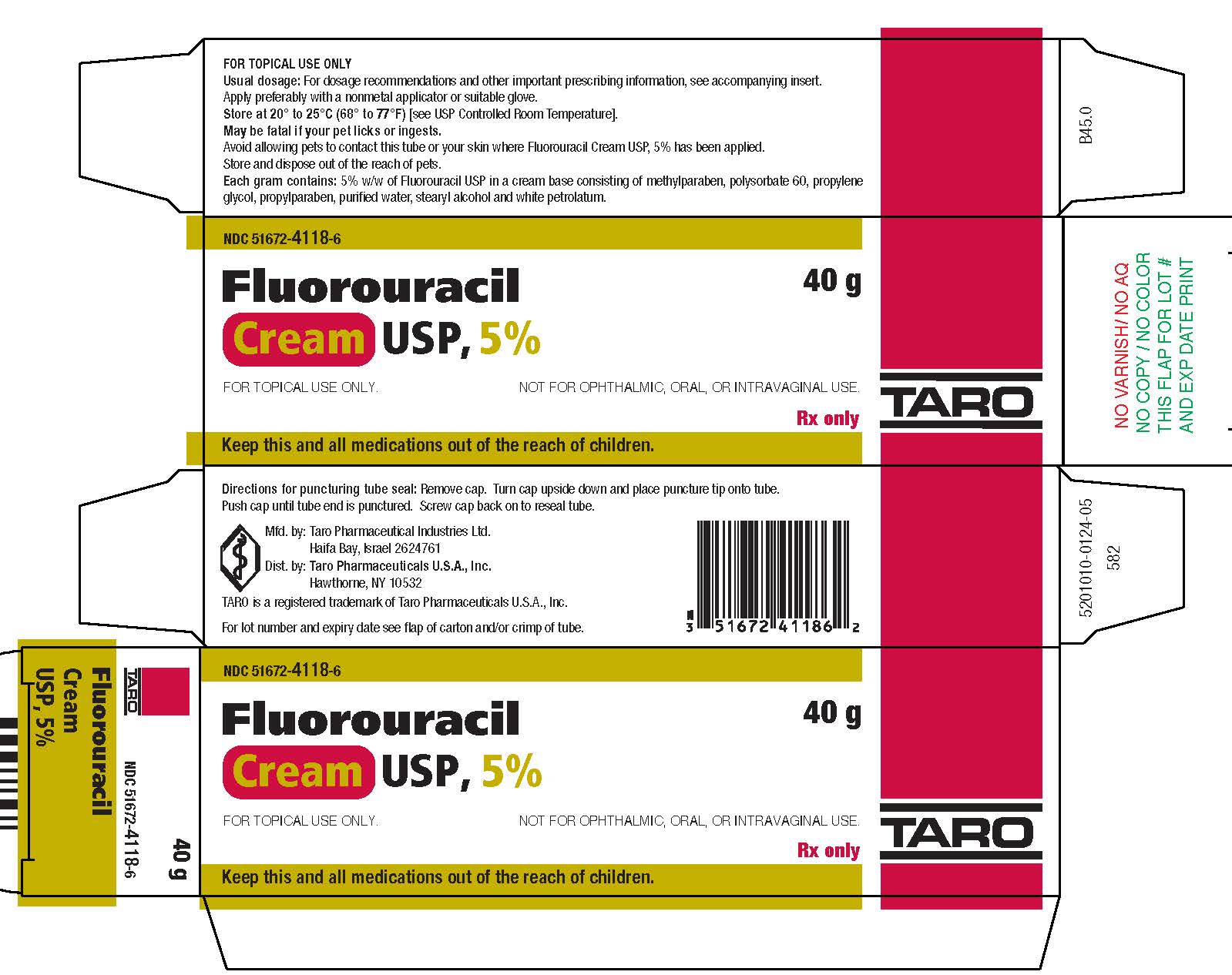
Fluorouracil 50 mg/g Cream — NDC 51672-4118-6 (Billing 51672-4118-06)
This is a package of Fluorouracil 50 mg/g Cream from Sun Pharmaceutical Industries, Inc., marketed since Mar 2010 and currently FDA-listed; retail pharmacies pay about $0.6156 per g (NADAC). It is the main listing for this product, which comes in 3 package sizes.
NDC database record
One package, one record: these facts belong to NDC 51672-4118-6 alone.
- Record
- FDA NDC Directory package listing · Human prescription drug
- Code segments
- 51672 labeler · 4118 product · 6 package
- Package marketed since
- Mar 17, 2017
- Sample package
- No — commercial package
- Listing certified through
- Dec 31, 2027
- Barcode (UPC-A, from the NDC)
- 3 5167241186 2
- Medicaid fills, this package
- 18,628 prescriptions in the last four reported quarters
- FDA record last changed
- Jul 24, 2026
Identity & classification
Regulatory identifiers FDA, NLM and CMS codes for this package
Drug-database identifiers Medi-Span GPI and First Databank GCN / HICL / AHFS classification
- GSN (GCN sequence number): 007502
- GCN: 30781
- HICL (First Databank): 003907
- AHFS class code: 10:00.00.00
- RxCUI (RxNorm): 105583
Where does this data come from?
- FDA openFDA NDC Directory · synced Oct 1, 2026
- FDA label on DailyMed · label index refreshed Oct 5, 2026
- RxNorm (NLM RxNav) · catalog refreshed Oct 1, 2026
- Medi-Span GPI (licensed)
- First Databank (licensed) · refreshed Oct 1, 2026
RxNorm drug class
This medicine belongs to the Nucleoside Metabolic Inhibitor class.
Where does this data come from?
- RxClass (NLM) · catalog refreshed Oct 1, 2026
Clinical
Fluorouracil cream and topical solution are used to treat actinic or solar keratoses (scaly or crusted lesions [skin areas] caused by years of too much exposure to sunlight). Fluorouracil cream and topical solution are also used to treat a type of skin cancer called superficial basal cell carcinoma if usual types of treatment cannot be used. Fluorouracil is in a class of medications called antimetabolites. It works by killing fast-growing cells such as the abnormal cells in actinic keratoses and basal cell carcinoma.
Read the full MedlinePlus article ↗- It depends on the form. By IV, it treats colon, rectal, breast, stomach and pancreatic cancers. As a skin cream or solution, it treats actinic keratosis (sun-damaged patches) and,...
- Follow your label and prescriber. Tolak is applied once daily after washing and drying the area. The 5% cream and solution are applied twice daily. Use a nonmetal applicator or glo...
- How do I use the skin cream or solution?
- Redness, dryness, scaling, crusting, itching, stinging or burning, swelling and raw spots are very common. They usually peak at the end of treatment and fade within about 4 weeks a...
Patient education
Supplement & herbal interactions
Some supplements/herbs that may interact with Fluorouracil — tap one for details:
Fluorouracil may be associated with lower levels of 2 nutrients — worth a chat with your pharmacist, not a cause for alarm.
Where does this data come from?
- MedlinePlus (NLM) · refreshed Oct 1, 2026
- FDA label on DailyMed · label index refreshed Oct 5, 2026
Ask a licensed pharmacist directly — free, answered by our team.
Pricing
A drug doesn't have one price. Each row is a different public payment system, and none is what you'd pay at the counter — that depends on your insurance. The ⓘ on each row explains what it measures.
| Price system | Per g | Per package |
|---|---|---|
| Retail pharmacies payNADAC · weekly | $0.616 | $24.62 / 40 g |
| Medicaid paysCMS SDUD · 12 mo | $1.32 | $52.82 / 40 g |
| Medicare drug plans payPart D · Q2 2026 | $1.45 | $58.09 / 40 g |
Where does this data come from?
- CMS NADAC weekly file · file of Sep 30, 2026
- CMS ASP pricing files · refreshed Sep 20, 2026
- CMS Medicaid State Drug Utilization Data · through Q1 2026
- CMS Part D plan pricing files · refreshed Sep 24, 2026
- VA National Acquisition Center price file
Packaging — all sizes for this product
| Package NDC | Description | Per unit | Per pack | Marketing start | Marketing end | Status |
|---|---|---|---|---|---|---|
| 51672-4118-02 51672-4118-2 | 1 TUBE in 1 CARTON / 25 g in 1 TUBE | — | — | 2017-03-17 | — | Active |
| 51672-4118-05 51672-4118-5 | 5 g in 1 TUBE | — | — | 2017-03-17 | — | Active |
| 51672-4118-06 You're viewing this Main listing | 1 TUBE in 1 CARTON / 40 g in 1 TUBE | $0.6156 / g | $24.63 | 2017-03-17 | — | Active |
In Medicaid, this is the most-dispensed pack of this product — about 100% of fills over the last four reported quarters. See all packs ↓
Pack size FAQ
What quantity is in this package?
What NDC number is used to bill for this package of Fluorouracil 50 mg/g Cream?
Prices are the latest CMS NADAC pharmacy acquisition cost per NDC; per-pack figures are per-unit × pack quantity, shown only when the pack is denominated in the same measure NADAC prices.
Therapeutic equivalents
| Product | Labeler | Pack | NADAC/unit | TE | Status | Price vs. this |
|---|---|---|---|---|---|---|
| Fluorouracil 50 mg/g 16729-0542-35 | Accord | 1 tube | $0.592 | AB | Availability likely | save 4% |
| Fluorouracil 5 mg/g 00378-4791-06 | Mylan | 1 tube | $0.616 | AB | Availability likely | — |
| Fluorouracil 50 mg/g 16714-0178-01 | NORTHSTAR | 1 tube | $0.616 | AB | Availability likely | — |
| Fluorouracil 2 g/40g 21922-0049-17 | Encube | 1 tube | $0.616 | AB | Availability likely | — |
| Fluorouracil 50 mg/gthis 51672-4118-06 | Sun | 1 tube | $0.616 | AB | Availability likely | — |
| Fluorouracil 50 mg/g 51862-0362-40 | Mayne | 1 tube | $0.616 | AB | Availability likely | — |
| Fluorouracil 50 mg/g 75907-0095-40 | Dr. | 1 tube | $0.616 | AB | Availability likely | — |
| Efudex 2 g/40g 00187-3204-47 | Bausch | 1 tube | $1.438 | AB | Discontinued | +134% |
Where does this data come from?
- FDA openFDA NDC Directory · synced Oct 1, 2026
- FDA Orange Book · refreshed Oct 3, 2026
- CMS NADAC weekly file · file of Sep 30, 2026
Availability & generic status
This product is an FDA-approved generic. Other versions of the same drug are listed under Therapeutic equivalents, least expensive first.
Where does this data come from?
- FDA Orange Book · refreshed Oct 3, 2026
What it looks like
Where does this data come from?
- FDA label on DailyMed · label index refreshed Oct 5, 2026
Inactive Ingredients / Excipients
Inactive ingredients, also called excipients, are components of the drug product other than the active ingredient. They may include fillers, dyes, coatings, preservatives, flavors, or other formulation ingredients.
🧪 Avoiding an ingredient? See Fluorouracil inactive ingredients by manufacturer: every current product's list side by side, so you can ask your pharmacy for the version that does not list it.
💡 Tap an ingredient (hover on desktop) to see what it is and why it’s used.
-
UNII A2I8C7HI9T
Methylparaben is a preservative derived from benzoic acid that prevents growth of bacteria, fungi, and mold in medicines. It extends the product's shelf life and maintains safety during storage.
-
UNII CAL22UVI4M
A synthetic emulsifier derived from sorbitol and fatty acids. It helps mix oil and water-based ingredients together and improves the texture and stability of the medicine.
-
UNII 6DC9Q167V3
Propylene glycol is a clear liquid derived from petroleum or vegetable sources. It acts as a solvent, humectant, and preservative in medicines, helping dissolve active ingredients and maintain product stability.
-
UNII Z8IX2SC1OH
Propylparaben is a chemical preservative used to prevent bacterial and fungal growth in medicines and personal care products. It helps extend shelf life and maintain product safety during storage.
-
UNII 2KR89I4H1Y
Stearyl alcohol is a waxy, fatty substance derived from natural oils or made synthetically. It acts as an emulsifier and thickener in medicines, helping mix ingredients together and give the product the right texture.
-
UNII 059QF0KO0R
Water is a liquid solvent that dissolves and mixes ingredients together in liquid medicines, syrups, and injections. It helps distribute the active drug evenly throughout the product.
-
UNII B6E5W8RQJ4
White petrolatum is a purified mineral oil product used as a lubricant and skin protectant in medications. It helps pills slide through manufacturing equipment and can soften or protect the skin when applied topically.
7 inactive ingredients listed in the exact product block matched to this NDC.
Where does this data come from?
ingredient classCode="IACT" elements from the exact product block matched by this NDC. Label-section narrative from DailyMed / the openFDA label index is shown separately when available.- FDA label on DailyMed · label index refreshed Oct 5, 2026
- FDA openFDA NDC Directory · synced Oct 1, 2026
Inactive ingredient FAQ
Are inactive ingredients the same for every manufacturer?
Why might an inactive ingredient be missing?
Can inactive ingredients matter?
Manufacturer & labeler
More NDCs from Sun Pharmaceutical Industries, Inc. labeler code 51672
- Clindamycin Phosphate 10 mg/mL Solution NDC 51672-4081-3
- Hydrocortisone Butyrate 1 mg/g Ointment NDC 51672-4083-1
- Ondansetron 4 mg/5mL Solution NDC 51672-4091-3
- Phenytoin Sodium 100 mg Capsule, Extended Release NDC 51672-4111-0
- Metronidazole 7.5 mg/g Gel NDC 51672-4116-2
- Nystatin 100000 [USP'U]/mL Suspension NDC 51672-4117-0
- Carbamazepine 100 mg Tablet, Extended Release NDC 51672-4123-1
- Carbamazepine 200 mg Tablet, Extended Release NDC 51672-4124-1
- Carbamazepine 400 mg Tablet, Extended Release NDC 51672-4125-1
- Lamotrigine 25 mg Tablet NDC 51672-4130-0
- Lamotrigine 100 mg Tablet NDC 51672-4131-0
- Lamotrigine 150 mg Tablet NDC 51672-4132-0
Where does this data come from?
- FDA openFDA NDC Directory · synced Oct 1, 2026
- Drugs@FDA
Full prescribing information FDA SPL
🎯 Indications and Usage ▾
INDICATIONS AND USAGE Fluorouracil is recommended for the topical treatment of multiple actinic or solar keratoses. In the 5% strength, it is also useful in the treatment of superficial basal cell carcinomas when conventional methods are impractical, such as with multiple lesions or difficult treatment sites. Safety and efficacy in other indications have not been established.
The diagnosis should be established prior to treatment, since this method has not been proven effective in other types of basal cell carcinomas. With isolated, easily accessible basal cell carcinomas, surgery is preferred since success with such lesions is almost 100%. The success rate with fluorouracil cream and solution is approximately 93%, based on 113 lesions in 54 patients.
Twenty-five lesions treated with the solution produced 1 failure and 88 lesions treated with the cream produced 7 failures.
⏱️ Dosage and Administration ▾
DOSAGE AND ADMINISTRATION When fluorouracil is applied to a lesion, a response occurs with the following sequence: erythema, usually followed by vesiculation, desquamation, erosion and re-epithelialization. Fluorouracil should be applied preferably with a nonmetal applicator or suitable glove. If fluorouracil is applied with the fingers, the hands should be washed immediately afterward.
Actinic or Solar Keratosis Apply cream twice daily in an amount sufficient to cover the lesions. Medication should be continued until the inflammatory response reaches the erosion stage, at which time use of the drug should be terminated. The usual duration of therapy is from 2 to 4 weeks.
Complete healing of the lesions may not be evident for 1 to 2 months following cessation of fluorouracil therapy. Superficial Basal Cell Carcinomas Only the 5% strength is recommended. Apply cream twice daily in an amount sufficient to cover the lesions.
Treatment should be continued for at least 3 to 6 weeks. Therapy may be required for as long as 10 to 12 weeks before the lesions are obliterated. As in any neoplastic condition, the patient should be followed for a reasonable period of time to determine if a cure has been obtained.
⛔ Contraindications ▾
CONTRAINDICATIONS Fluorouracil may cause fetal harm when administered to a pregnant woman. There are no adequate and well-controlled studies in pregnant women with either the topical or the parenteral forms of fluorouracil. One birth defect (cleft lip and palate) has been reported in the newborn of a patient using fluorouracil as recommended.
One birth defect (ventricular septal defect) and cases of miscarriage have been reported when fluorouracil was applied to mucous membrane areas. Multiple birth defects have been reported in a fetus of a patient treated with intravenous fluorouracil. Animal reproduction studies have not been conducted with fluorouracil.
Fluorouracil administered parenterally has been shown to be teratogenic in mice, rats, and hamsters when given at doses equivalent to the usual human intravenous dose; however, the amount of fluorouracil absorbed systemically after topical administration to actinic keratoses is minimal (see CLINICAL PHARMACOLOGY ). Fluorouracil exhibited maximum teratogenicity when given to mice as single intraperitoneal injections of 10 to 40 mg/kg on Day 10 or 12 of gestation. Similarly, intraperitoneal doses of 12 to 37 mg/kg given to rats between Days 9 and 12 of gestation and intramuscular doses of 3 to 9 mg/kg given to hamsters between Days 8 and 11 of gestation were teratogenic and/or embryotoxic (i.e., resulted in increased resorptions or embryolethality).
In monkeys, divided doses of 40 mg/kg given between Days 20 and 24 of gestation were not teratogenic. Doses higher than 40 mg/kg resulted in abortion. Fluorouracil should not be used in patients with dihydropyrimidine dehydrogenase (DPD) enzyme deficiency.
A large percentage of fluorouracil is catabolized by the DPD enzyme. DPD enzyme deficiency can result in shunting of fluorouracil to the anabolic pathway, leading to cytotoxic activity and potential toxicities. Fluorouracil is contraindicated in women who are or may become pregnant during therapy.
If this drug is used during pregnancy, or if the patient becomes pregnant while using this drug, the patient should be apprised of the potential hazard to the fetus. Fluorouracil is also contraindicated in patients with known hypersensitivity to any of its components.
⚠️ Warnings ▾
WARNINGS Application to mucous membranes should be avoided due to the possibility of local inflammation and ulceration. Additionally, cases of miscarriage and a birth defect (ventricular septal defect) have been reported when fluorouracil was applied to mucous membrane areas during pregnancy. Occlusion of the skin with resultant hydration has been shown to increase percutaneous penetration of several topical preparations.
If any occlusive dressing is used in treatment of basal cell carcinoma, there may be an increase in the severity of inflammatory reactions in the adjacent normal skin. A porous gauze dressing may be applied for cosmetic reasons without increase in reaction. Exposure to ultraviolet rays should be minimized during and immediately following treatment with fluorouracil because the intensity of the reaction may be increased.
Patients should discontinue therapy with fluorouracil if symptoms of DPD enzyme deficiency develop (see CONTRAINDICATIONS section). Rarely, life-threatening toxicities such as stomatitis, diarrhea, neutropenia, and neurotoxicity have been reported with intravenous administration of fluorouracil in patients with DPD enzyme deficiency. One case of life-threatening systemic toxicity has been reported with the topical use of fluorouracil in a patient with DPD enzyme deficiency.
Symptoms included severe abdominal pain, bloody diarrhea, vomiting, fever, and chills. Physical examination revealed stomatitis, erythematous skin rash, neutropenia, thrombocytopenia, inflammation of the esophagus, stomach, and small bowel. Although this case was observed with 5% fluorouracil cream, it is unknown whether patients with profound DPD enzyme deficiency would develop systemic toxicity with lower concentrations of topically applied fluorouracil.
🤒 Adverse Reactions ▾
ADVERSE REACTIONS The most frequent adverse reactions to fluorouracil occur locally and are often related to an extension of the pharmacological activity of the drug. These include burning, crusting, allergic contact dermatitis, pruritus, scarring, rash, soreness and ulceration. Ulcerations, other local reactions, cases of miscarriage and a birth defect (ventricular septal defect) have been reported when fluorouracil was applied to mucous membrane areas.
Leukocytosis is the most frequent hematological side effect. Although a causal relationship is remote, other adverse reactions which have been reported infrequently are: Central Nervous System: Emotional upset, insomnia, irritability. Gastrointestinal: Medicinal taste, stomatitis.
Hematological: Eosinophilia, thrombocytopenia, toxic granulation. Integumentary: Alopecia, blistering, bullous pemphigoid, discomfort, ichthyosis, scaling, suppuration, swelling, telangiectasia, tenderness, urticaria, skin rash. Special Senses: Conjunctival reaction, corneal reaction, lacrimation, nasal irritation.
Miscellaneous: Herpes simplex. To report SUSPECTED ADVERSE REACTIONS, contact Taro Pharmaceuticals U.S.A., Inc., at 1-866-923-4914 and/or FDA at 1-800-FDA-1088 or www.fda.gov/medwatch.
🤰 Pregnancy ▾
Pregnancy See CONTRAINDICATIONS .
🧒 Pediatric Use ▾
Pediatric Use Safety and effectiveness in children have not been established.
🆘 Overdosage ▾
OVERDOSAGE There have been no reports of overdosage with fluorouracil. The oral LD 50 for the 5% cream was 234 mg/kg in rats and 39 mg/kg in dogs. These doses represented 11.7 and 1.95 mg/kg of fluorouracil, respectively.
Studies with a 5% topical solution yielded an oral LD 50 of 214 mg/kg in rats and 28.5 mg/kg in dogs, corresponding to 10.7 and 1.43 mg/kg of fluorouracil, respectively. The topical application of the 5% cream to rats yielded an LD 50 of greater than 500 mg/kg.
🧬 Clinical Pharmacology ▾
CLINICAL PHARMACOLOGY There is evidence that the metabolism of fluorouracil in the anabolic pathway blocks the methylation reaction of deoxyuridylic acid to thymidylic acid. In this manner fluorouracil interferes with the synthesis of deoxyribonucleic acid (DNA) and to a lesser extent inhibits the formation of ribonucleic acid (RNA). Since DNA and RNA are essential for cell division and growth, the effect of fluorouracil may be to create a thymine deficiency which provokes unbalanced growth and death of the cell.
The effects of DNA and RNA deprivation are most marked on those cells which grow more rapidly and take up fluorouracil at a more rapid rate. The catabolic metabolism of fluorouracil results in degradation products (e.g., CO 2 , urea, α-fluoro-β-alanine) which are inactive. Systemic absorption studies of topically applied fluorouracil have been performed on patients with actinic keratoses using tracer amounts of 14 C-labeled fluorouracil added to a 5% preparation.
All patients had been receiving nonlabeled fluorouracil until the peak of the inflammatory reaction occurred (2 to 3 weeks), ensuring that the time of maximum absorption was used for measurement. One gram of labeled preparation was applied to the entire face and neck and left in place for 12 hours. Urine samples were collected.
At the end of 3 days, the total recovery ranged between 0.48% and 0.94% with an average of 0.76%, indicating that approximately 5.98% of the topical dose was absorbed systemically. If applied twice daily, this would indicate systemic absorption of topical fluorouracil to be in the range of 5 to 6 mg per daily dose of 100 mg. In an additional study, negligible amounts of labeled material were found in plasma, urine and expired CO 2 after 3 days of treatment with topically applied 14 C-labeled fluorouracil.
📦 How Supplied / Storage and Handling ▾
HOW SUPPLIED Fluorouracil Cream USP, 5% is supplied in a 25 g tube (NDC 51672-4118-2) and 40 g tube (NDC 51672-4118-6). Store at 20° to 25°C (68° to 77°F) [see USP Controlled Room Temperature].
📦 Storage and Handling ▾
Store at 20° to 25°C (68° to 77°F) [see USP Controlled Room Temperature].
📋 Description ▾
DESCRIPTION Fluorouracil Cream is a topical preparation containing the fluorinated pyrimidine 5-fluorouracil, an antineoplastic antimetabolite. Fluorouracil Cream contains 5% w/w of fluorouracil USP in a cream base consisting of methylparaben, polysorbate 60, propylene glycol, propylparaben, purified water, stearyl alcohol and white petrolatum. Chemically, fluorouracil is 5-fluoro-2,4(1 H ,3 H )-pyrimidinedione.
It is a white to practically white crystalline powder which is sparingly soluble in water and slightly soluble in alcohol. One gram of fluorouracil is soluble in 100 mL of propylene glycol. The molecular weight of 5-fluorouracil is 130.08 and the structural formula is: Chemical Structure
💬 Information for Patients ▾
Information for Patients Patients should be forewarned that the reaction in the treated areas may be unsightly during therapy and, usually, for several weeks following cessation of therapy. Patients should be instructed to avoid exposure to ultraviolet rays during and immediately following treatment with fluorouracil because the intensity of the reaction may be increased. If fluorouracil is applied with the fingers, the hands should be washed immediately afterward.
Fluorouracil should not be applied on the eyelids or directly into the eyes, nose or mouth because irritation may occur. Fluorouracil, including fluorouracil cream, may be fatal if ingested by pets. Avoid allowing pets to contact the fluorouracil cream container or the skin where fluorouracil cream has been applied.
Store fluorouracil cream out of reach of pets. Safely discard or clean any cloth or applicator that may retain fluorouracil cream and avoid leaving any residues of fluorouracil cream on your hands, clothing, carpeting or furniture.
⚠️ Precautions ▾
PRECAUTIONS General There is a possibility of increased absorption through ulcerated or inflamed skin. Information for Patients Patients should be forewarned that the reaction in the treated areas may be unsightly during therapy and, usually, for several weeks following cessation of therapy. Patients should be instructed to avoid exposure to ultraviolet rays during and immediately following treatment with fluorouracil because the intensity of the reaction may be increased.
If fluorouracil is applied with the fingers, the hands should be washed immediately afterward. Fluorouracil should not be applied on the eyelids or directly into the eyes, nose or mouth because irritation may occur. Fluorouracil, including fluorouracil cream, may be fatal if ingested by pets.
Avoid allowing pets to contact the fluorouracil cream container or the skin where fluorouracil cream has been applied. Store fluorouracil cream out of reach of pets. Safely discard or clean any cloth or applicator that may retain fluorouracil cream and avoid leaving any residues of fluorouracil cream on your hands, clothing, carpeting or furniture.
Laboratory Tests Solar keratoses which do not respond should be biopsied to confirm the diagnosis. Follow-up biopsies should be performed as indicated in the management of superficial basal cell carcinoma. Carcinogenesis, Mutagenesis, Impairment of Fertility Adequate long-term studies in animals to evaluate carcinogenic potential have not been conducted with fluorouracil.
Studies with the active ingredient of fluorouracil, 5-fluorouracil, have shown positive effects in in vitro tests for mutagenicity and on impairment of fertility. 5-Fluorouracil was positive in three in vitro cell neoplastic transformation assays. In the C3H/10T½ clone 8 mouse embryo cell system, the resulting morphologically transformed cells formed tumors when inoculated into immunosuppressed syngeneic mice.
While no evidence for mutagenic activity was observed in the Ames test (three studies), fluorouracil has been shown to be mutagenic in the survival count rec-assay with Bacillus subtilis and in the Drosophila winghair spot test. Fluorouracil produced petite mutations in Saccharomyces cerevisiae and was positive in the micronucleus test (bone marrow cells of male mice). Fluorouracil was clastogenic in vitro (i.e., chromatid gaps, breaks and exchanges) in Chinese hamster fibroblasts at concentrations of 1.0 and 2.0 mcg/mL and has been shown to increase sister chromatid exchange in vitro in human lymphocytes.
In addition, 5-fluorouracil has been reported to produce an increase in numerical and structural chromosome aberrations in peripheral lymphocytes of patients treated with this product. Doses of 125 to 250 mg/kg, administered intraperitoneally, have been shown to induce chromosomal aberrations and changes in chromosome organization of spermatogonia in rats. Spermatogonial differentiation was also inhibited by fluorouracil, resulting in transient infertility.
However, in studies with a strain of mouse which is sensitive to the induction of sperm head abnormalities after exposure to a range of chemical mutagens and carcinogens, fluorouracil was inactive at oral doses of 5 to 80 mg/kg/day. In female rats, fluorouracil administered intraperitoneally at doses of 25 and 50 mg/kg during the preovulatory phase of oogenesis significantly reduced the incidence of fertile matings, delayed the development of preimplantation and postimplantation embryos, increased the incidence of preimplantation lethality and induced chromosomal anomalies in these embryos.
Single-dose intravenous and intraperitoneal injections of 5-fluorouracil have been reported to kill differentiated spermatogonia and spermatocytes (at 500 mg/kg) and to produce abnormalities in spermatids (at 50 mg/kg) in mice. Pregnancy See CONTRAINDICATIONS . Nursing Mothers It is not known whether fluorouracil is excreted in human milk.
Because there is some systemic absorption of fluorouracil after topical… [Excerpted — this section continues on DailyMed.]
🍼 Nursing Mothers ▾
Nursing Mothers It is not known whether fluorouracil is excreted in human milk. Because there is some systemic absorption of fluorouracil after topical administration (see CLINICAL PHARMACOLOGY ), because many drugs are excreted in human milk, and because of the potential for serious adverse reactions in nursing infants, a decision should be made whether to discontinue nursing or to discontinue use of the drug, taking into account the importance of the drug to the mother.
📄 Carcinogenesis, Mutagenesis, Impairment of Fertility ▾
Carcinogenesis, Mutagenesis, Impairment of Fertility Adequate long-term studies in animals to evaluate carcinogenic potential have not been conducted with fluorouracil. Studies with the active ingredient of fluorouracil, 5-fluorouracil, have shown positive effects in in vitro tests for mutagenicity and on impairment of fertility. 5-Fluorouracil was positive in three in vitro cell neoplastic transformation assays.
In the C3H/10T½ clone 8 mouse embryo cell system, the resulting morphologically transformed cells formed tumors when inoculated into immunosuppressed syngeneic mice. While no evidence for mutagenic activity was observed in the Ames test (three studies), fluorouracil has been shown to be mutagenic in the survival count rec-assay with Bacillus subtilis and in the Drosophila winghair spot test. Fluorouracil produced petite mutations in Saccharomyces cerevisiae and was positive in the micronucleus test (bone marrow cells of male mice).
Fluorouracil was clastogenic in vitro (i.e., chromatid gaps, breaks and exchanges) in Chinese hamster fibroblasts at concentrations of 1.0 and 2.0 mcg/mL and has been shown to increase sister chromatid exchange in vitro in human lymphocytes. In addition, 5-fluorouracil has been reported to produce an increase in numerical and structural chromosome aberrations in peripheral lymphocytes of patients treated with this product. Doses of 125 to 250 mg/kg, administered intraperitoneally, have been shown to induce chromosomal aberrations and changes in chromosome organization of spermatogonia in rats.
Spermatogonial differentiation was also inhibited by fluorouracil, resulting in transient infertility. However, in studies with a strain of mouse which is sensitive to the induction of sperm head abnormalities after exposure to a range of chemical mutagens and carcinogens, fluorouracil was inactive at oral doses of 5 to 80 mg/kg/day. In female rats, fluorouracil administered intraperitoneally at doses of 25 and 50 mg/kg during the preovulatory phase of oogenesis significantly reduced the incidence of fertile matings, delayed the development of preimplantation and postimplantation embryos, increased the incidence of preimplantation lethality and induced chromosomal anomalies in these embryos.
Single-dose intravenous and intraperitoneal injections of 5-fluorouracil have been reported to kill differentiated spermatogonia and spermatocytes (at 500 mg/kg) and to produce abnormalities in spermatids (at 50 mg/kg) in mice.
📄 Package Label / Principal Display Panel ▾
PRINCIPAL DISPLAY PANEL - 40 g Tube Carton NDC 51672-4118-6 40 g Fluorouracil Cream USP, 5% fluorouracil-01