
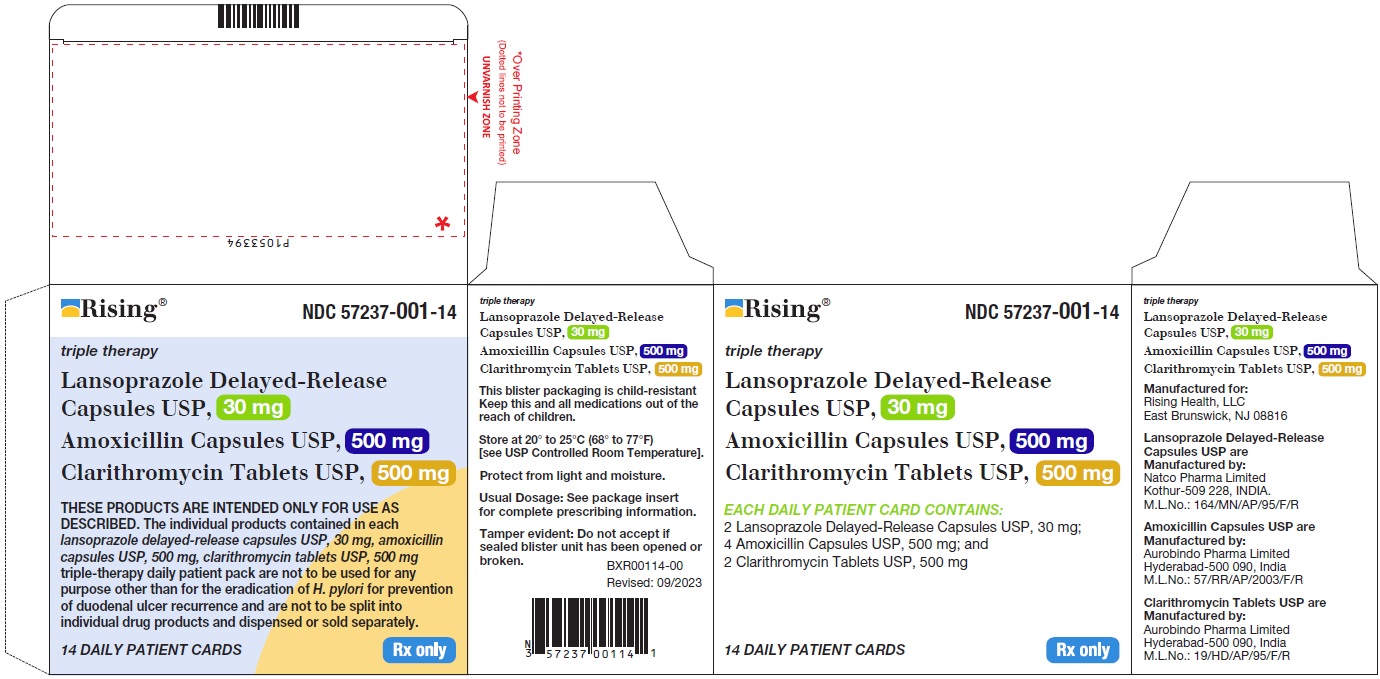
Lansoprazole, Amoxicillin, Clarithromycin Kit — NDC 57237-001-14 (Billing 57237-0001-14)
This is a package of Lansoprazole, Amoxicillin, Clarithromycin Kit from Rising Pharma Holdings, Inc., marketed since Oct 2016 and currently FDA-listed; retail pharmacies pay about $6.04 per unit (NADAC). It is this product's only package size.
NDC database record
One package, one record: these facts belong to NDC 57237-001-14 alone.
- Record
- FDA NDC Directory package listing · Human prescription drug
- Code segments
- 57237 labeler · 001 product · 14 package
- Package marketed since
- Oct 14, 2016
- Sample package
- No — commercial package
- Listing certified through
- Dec 31, 2026
- Barcode (UPC-A, from the NDC)
- 3 5723700114 1
- Medicaid fills, this package
- 29 prescriptions in the last four reported quarters
- FDA record last changed
- Jul 24, 2026
Identity & classification
Regulatory identifiers FDA, NLM and CMS codes for this package
Drug-database identifiers Medi-Span GPI and First Databank GCN / HICL / AHFS classification
- GSN (GCN sequence number): 037219
- GCN: 64269
- GPI-14 (Medi-Span): 4999300320B120
- HICL (First Databank): 017026
- AHFS class code: 08:12.12.08
- RxCUI (RxNorm): 197517
Where does this data come from?
- FDA openFDA NDC Directory · synced Oct 8, 2026
- FDA label on DailyMed · label index refreshed Oct 8, 2026
- RxNorm (NLM RxNav) · catalog refreshed Oct 8, 2026
- Medi-Span GPI (licensed)
- First Databank (licensed) · refreshed Oct 8, 2026
RxNorm drug class
This medicine belongs to the Macrolide Antimicrobial class.
Where does this data come from?
- RxClass (NLM) · catalog refreshed Oct 8, 2026
Clinical
Amoxicillin is used to treat certain infections caused by bacteria, such as pneumonia, skin, and urinary tract infections eliminate H. pylori, a bacteria that causes ulcers in combination with other medications Amoxicillin is in a class of medications called penicillin-like antibiotics. It works by stopping the growth of bacteria. Antibiotics such as amoxicillin will not work for colds, flu, and other viral infections. Taking antibiotics when they are not needed increases your risk of getting an infection later that resists antibiotic treatment.
Read the full MedlinePlus article ↗- It treats H. pylori, a stomach bacteria, in people with a duodenal ulcer. Clearing the infection lowers the chance the ulcer comes back. It combines an acid reducer (lansoprazole)...
- You take all three together by mouth, morning and evening, for 10 or 14 days. Lansoprazole works best before meals, while the two antibiotics can go with or without food. Finish th...
- The most common ones are diarrhea, headache and a changed taste in your mouth. Some people have nausea, stomach pain or dizziness. These are usually manageable, but let me know if...
- Get help right away for swelling, trouble breathing, a blistering rash, yellow skin or eyes, a racing or irregular heartbeat, or fainting. Also call for severe or bloody diarrhea,...
Patient education
Supplement & herbal interactions
Some supplements/herbs that may interact with Lansoprazole, Amoxicillin, Clarithromycin — tap one for details:
Lansoprazole, Amoxicillin, Clarithromycin may be associated with lower levels of 14 nutrients — worth a chat with your pharmacist, not a cause for alarm.
Where does this data come from?
- MedlinePlus (NLM) · refreshed Oct 8, 2026
- FDA label on DailyMed · label index refreshed Oct 8, 2026
Ask a licensed pharmacist directly — free, answered by our team.
Pricing
A drug doesn't have one price. Each row is a different public payment system, and none is what you'd pay at the counter — that depends on your insurance. The ⓘ on each row explains what it measures.
| Price system | Per ea | Per package |
|---|---|---|
| Retail pharmacies payNADAC · weekly | $6.042 | $84.59 / 14 kit |
| Medicaid paysCMS SDUD · 12 mo | $4.54 | $63.53 / 14 kit |
| Medicare drug plans payPart D · Q2 2026 | $6.05 | $84.67 / 14 kit |
Where does this data come from?
- CMS NADAC weekly file · file of Oct 7, 2026
- CMS ASP pricing files · refreshed Sep 20, 2026
- CMS Medicaid State Drug Utilization Data · through Q1 2026
- CMS Part D plan pricing files · refreshed Sep 24, 2026
- VA National Acquisition Center price file
Packaging — all sizes for this product
| Package NDC | Description | Marketing start | Marketing end | Status |
|---|---|---|---|---|
| 57237-0001-14 You're viewing this Main listing | 14 BLISTER PACK in 1 CARTON / 1 KIT in 1 BLISTER PACK | 2016-10-14 | — | Active |
Therapeutic equivalents
| Product | Labeler | Pack | NADAC/unit | TE | Status | Price vs. this |
|---|---|---|---|---|---|---|
| Lansoprazole, Amoxicillin, Clarithromycinthis 57237-0001-14 | Rising | 1 kit | $6.042 | AB | Availability likely | — |
Where does this data come from?
- FDA openFDA NDC Directory · synced Oct 8, 2026
- FDA Orange Book · refreshed Oct 3, 2026
- CMS NADAC weekly file · file of Oct 7, 2026
Availability & generic status
This product is an FDA-approved generic. Other versions of the same drug are listed under Therapeutic equivalents, least expensive first.
Where does this data come from?
- FDA Orange Book · refreshed Oct 3, 2026
What it looks like
Where does this data come from?
- FDA label on DailyMed · label index refreshed Oct 8, 2026
Inactive Ingredients / Excipients
Inactive ingredients, also called excipients, are components of the drug product other than the active ingredient. They may include fillers, dyes, coatings, preservatives, flavors, or other formulation ingredients.
🧪 Avoiding an ingredient? See Lansoprazole, Clarithromycin, and Amoxicillin inactive ingredients by manufacturer: every current product's list side by side, so you can ask your pharmacy for the version that does not list it.
Where does this data come from?
IACT rows and label-wide narrative are kept separate; availability and product-level specificity depend on the submitted label.- FDA label on DailyMed · label index refreshed Oct 8, 2026
- FDA openFDA NDC Directory · synced Oct 8, 2026
Inactive ingredient FAQ
Are inactive ingredients the same for every manufacturer?
Why might an inactive ingredient be missing?
Can inactive ingredients matter?
Manufacturer & labeler
More NDCs from Rising Pharma Holdings, Inc. labeler code 57237
Where does this data come from?
- FDA openFDA NDC Directory · synced Oct 8, 2026
- Drugs@FDA
Full prescribing information FDA SPL
🎯 Indications and Usage ▾
INDICATIONS AND USAGE H. pylori Eradication to Reduce the Risk of Duodenal Ulcer Recurrence The components in lansoprazole delayed-release capsules, amoxicillin capsules, and clarithromycin tablets are indicated for the treatment of patients with H. pylori infection and duodenal ulcer disease (active or one-year history of a duodenal ulcer) to eradicate H. pylori . Eradication of H. pylori has been shown to reduce the risk of duodenal ulcer recurrence (see CLINICAL STUDIES and DOSAGE AND ADMINISTRATION ). To reduce the development of drug-resistant bacteria and maintain the effectiveness of lansoprazole delayed-release capsules, amoxicillin capsules, and clarithromycin tablets and other antibacterial drugs, lansoprazole delayed-release capsules, amoxicillin capsules, and clarithromycin tablets should be used only to treat or prevent infections that are proven or strongly suspected to be caused by susceptible bacteria.
When culture and susceptibility information are available, they should be considered in selecting or modifying antibacterial therapy. In the absence of such data, local epidemiology and susceptibility patterns may contribute to the empiric selection of therapy.
⏱️ Dosage and Administration ▾
DOSAGE AND ADMINISTRATION H. pylori Eradication to Reduce the Risk of Duodenal Ulcer Recurrence The recommended adult oral dose is 30 mg lansoprazole delayed-release capsules, 1 g amoxicillin, and 500 mg clarithromycin administered together twice daily (morning and evening) for 10 or 14 days (see INDICATIONS AND USAGE ). Lansoprazole delayed-release capsules, 30 mg, amoxicillin capsules, 500 mg, and clarithromycin tablets, 500 mg are not recommended in patients with creatinine clearance less than 30 mL/min.
⛔ Contraindications ▾
CONTRAINDICATIONS Lansoprazole delayed-release capsules, amoxicillin capsules, and clarithromycin tablets are contraindicated in patients with known severe hypersensitivity to any component of the formulation of lansoprazole delayed-release capsules. Hypersensitivity reactions may include anaphylaxis, anaphylactic shock, angioedema, bronchospasm, acute interstitial nephritis, and urticaria (see ADVERSE REACTIONS ). Proton Pump Inhibitors (PPIs), including lansoprazole delayed-release capsules, are contraindicated with rilpivirine-containing products (see CLINICAL PHARMACOLOGY , Drug Interaction Studies ).
A history of severe hypersensitivity reactions (e.g., anaphylaxis or Stevens-Johnson syndrome) to amoxicillin or other beta-lactam antibiotics (e.g., penicillins and cephalosporins) is a contraindication. Clarithromycin is contraindicated in patients with a known hypersensitivity to clarithromycin, erythromycin, or any of the macrolide antibiotics. Clarithromycin is contraindicated in patients with a history of cholestatic jaundice/hepatic dysfunction associated with prior use of clarithromycin.
Clarithromycin is contraindicated with concomitant use of lurasidone due to the risk of an increase in lurasidone exposure and the potential for serious adverse reactions [(see PRECAUTIONS , Drug Interactions ) (7)]. Clarithromycin should not be given to patients with history of QT prolongation or ventricular cardiac arrhythmia, including torsades de pointes. Concomitant administration of clarithromycin, a component of lansoprazole delayed-release capsules, amoxicillin capsules, and clarithromycin tablets, and any of the following drugs is contraindicated: cisapride, pimozide, astemizole, terfenadine, ergotamine or dihydroergotamine (see PRECAUTIONS, Drug Interactions ).
There have been post-marketing reports of drug interactions when clarithromycin and/or erythromycin are coadministered with cisapride, pimozide, astemizole, or terfenadine resulting in cardiac arrhythmias (QT prolongation, ventricular tachycardia, ventricular fibrillation, and torsades de pointes ) most likely due to inhibition of metabolism of these drugs by erythromycin and clarithromycin. Fatalities have been reported. Concomitant administration of clarithromycin and colchicine is contraindicated in patients with renal or hepatic impairment.
Clarithromycin should not be used concomitantly with HMG-CoA reductase inhibitors (statins) that are extensively metabolized by CYP3A4 (lovastatin or simvastatin), due to the increase risk of myopathy, including rhabdomyolysis (see WARNINGS ).
⚠️ Warnings ▾
WARNINGS Acute Hypersensitivity Reactions Serious and occasionally fatal hypersensitivity (anaphylactic) reactions have been reported in patients on penicillin therapy, including amoxicillin. Although anaphylaxis is more frequent following parenteral therapy, it has occurred in patients on oral penicillins. These reactions are more likely to occur in individuals with a history of penicillin hypersensitivity and/or a history of sensitivity to multiple allergens.
There have been reports of individuals with a history of penicillin hypersensitivity who have experienced severe reactions when treated with cephalosporins. Before initiating therapy with lansoprazole delayed-release capsules, amoxicillin capsules, and clarithromycin tablets careful inquiry should be made regarding previous hypersensitivity reactions to penicillins, cephalosporins, or other allergens. In the event of severe acute hypersensitivity reactions, such as anaphylaxis, and Henoch-Schonlein purpura lansoprazole delayed-release capsules, amoxicillin capsules, and clarithromycin tablets should be discontinued immediately and appropriate treatment should be urgently initiated.
Severe Cutaneous Adverse Reactions Severe cutaneous adverse reactions (SCAR), including Stevens-Johnson syndrome (SJS), toxic epidermal necrolysis (TEN), drug reaction with eosinophilia and systemic symptoms (DRESS), and acute generalized exanthematous pustulosis (AGEP) have been reported with the components of lansoprazole delayed-release capsules, amoxicillin capsules, and clarithromycin tablets: lansoprazole, clarithromycin, and amoxicillin (see ADVERSE REACTIONS ). Monitor closely and discontinue lansoprazole delayed-release capsules, amoxicillin capsules, and clarithromycin tablets at the first signs of SCAR.
Drug-induced enterocolitis syndrome (DIES) Drug-induced enterocolitis syndrome (DIES) has been reported with amoxicillin use (see ADVERSE REACTIONS ), with most cases occurring in pediatric patients ≤18 years of age. DIES is a non-IgE mediated hypersensitivity reaction characterized by protracted vomiting occurring 1 to 4 hours after drug ingestion in the absence of skin or respiratory symptoms. DIES may be associated with pallor, lethargy, hypotension, shock, diarrhea within 24 hours after ingesting amoxicillin, and leukocytosis with neutrophilia.
If DIES occurs, discontinue lansoprazole delayed-release capsules, amoxicillin capsules, and clarithromycin tablets and institute appropriate therapy. Use in Pregnancy CLARITHROMYCIN SHOULD NOT BE USED IN PREGNANT WOMEN EXCEPT IN CLINICAL CIRCUMSTANCES WHERE NO ALTERNATIVE THERAPY IS APPROPRIATE. IF PREGNANCY OCCURS WHILE TAKING CLARITHROMYCIN, THE PATIENT SHOULD BE INFORMED OF THE POTENTIAL HAZARD TO THE FETUS.
CLARITHROMYCIN HAS DEMONSTRATED ADVERSE EFFECTS OF PREGNANCY OUTCOME AND/OR EMBRYO-FETAL DEVELOPMENT IN MONKEYS, RATS, MICE, AND RABBITS AT DOSES THAT PRODUCED PLASMA LEVELS TWO TO 17 TIMES THE SERUM LEVELS ACHIEVED IN HUMANS TREATED AT THE MAXIMUM RECOMMENDED HUMAN DOSES (see PRECAUTIONS , Pregnancy ). Hepatotoxicity Hepatic dysfunction, including increased liver enzymes, and hepatocellular and/or cholestatic hepatitis, with or without jaundice, has been reported with clarithromycin. This hepatic dysfunction may be severe and is usually reversible.
In some instances, hepatic failure with fatal outcome has been reported and generally has been associated with serious underlying diseases and/or concomitant medications. Symptoms of hepatitis can include anorexia, jaundice, dark urine, pruritus, or tender abdomen. Discontinue clarithromycin immediately if signs and symptoms of hepatitis occur.
QT Prolongation Clarithromycin has been associated with prolongation of the QT interval and infrequent cases of arrhythmia. Cases of torsades de pointes have been spontaneously reported during postmarketing surveillance in patients receiving clarithromycin. Fatalities have been reported.
Clarithromycin should be avoided in patients with ongoing… [Excerpted — this section continues on DailyMed.]
🤒 Adverse Reactions ▾
ADVERSE REACTIONS LANSOPRAZOLE DELAYED-RELEASE CAPSULES, AMOXICILLIN CAPSULES, AND CLARITHROMYCIN TABLETS Because clinical trials are conducted under widely varying conditions, adverse reaction rates observed in the clinical trials of a drug cannot be directly compared to rates in the clinical trials of another drug and may not reflect the rates observed in clinical practice. The most common adverse reactions (≥3%) reported in clinical trials when all three components of this therapy were given concomitantly for 14 days are listed in Table 8.
Table 8: Adverse Reactions Most Frequently Reported in Clinical Trials (≥3%) Adverse Reaction Triple Therapy n = 138 (%) Diarrhea
7.0 Headache
6.0 Taste Perversion
5.0The additional adverse reactions which were reported as possibly or probably related to treatment (less than 3%) in clinical trials when all three components of this therapy were given concomitantly are listed below and divided by body system: Body as a Whole - abdominal pain Digestive System - dark stools, dry mouth/thirst, glossitis, rectal itching, nausea, oral moniliasis, stomatitis, tongue discoloration, tongue disorder, vomiting Musculoskeletal System - myalgia Nervous System - confusion, dizziness Respiratory System - respiratory disorders Skin and Appendages - skin reactions Urogenital System - vaginitis, vaginal moniliasis There were no statistically significant differences in the frequency of reported adverse events between the 10 and 14 day triple therapy regimens.
Lansoprazole Delayed-Release Capsules The following adverse reactions from the labeling for lansoprazole delayed-release capsules are provided for information: Worldwide, over 10,000 patients have been treated with lansoprazole delayed-release capsules in Phase 2 or Phase 3 clinical trials involving various dosages and durations of treatment. In general, lansoprazole delayed-release capsules treatment has been well-tolerated in both short-term and long-term trials. Incidence in Clinical Trials The following adverse events were reported by the treating physician to have a possible or probable relationship to drug in 1% or more of lansoprazole delayed-release capsules-treated patients and occurred at a greater rate in lansoprazole delayed-release capsules-treated patients than placebo-treated patients: Table 9: Incidence of Possibly or Probably Treatment-Related Adverse Reactions in Short-Term, Placebo-Controlled Lansoprazole Delayed-Release Capsules Studies Body System/Adverse Event Lansoprazole Delayed-Release Capsules (N=2768) % Placebo (N=1023) % Body as a Whole Abdominal Pain 2.1
1.2Digestive System Constipation 1.0
0.4Diarrhea 3.8
2.3Nausea 1.3
1.2Headache was also seen at greater than 1% incidence but was more common on placebo. The incidence of diarrhea was similar between patients who received placebo and patients who received 30 mg of lansoprazole delayed-release capsules, but higher in the patients who received 60 mg of lansoprazole delayed-release capsules (2.9%, 4.2%, and 7.4%, respectively). The most commonly reported possibly or probably treatment-related adverse event during maintenance therapy was diarrhea.
Additional adverse experiences occurring in less than 1% of patients or subjects who received lansoprazole delayed-release capsules in domestic trials are shown below: Body as a Whole – abdomen enlarged, allergic reaction, asthenia, back pain, candidiasis, carcinoma, chest pain (not otherwise specified), chills, edema, fever, flu syndrome, halitosis, infection (not otherwise specified), malaise, neck pain, neck rigidity, pain, pelvic pain Cardiovascular System – angina, arrhythmia, bradycardia, cerebrovascular accident/cerebral infarction, hypertension/hypotension, migraine, myocardial infarction, palpitations, shock (circulatory failure), syncope, tachycardia, vasodilation Digestive System – abnormal stools, anorexia, bezoar, cardiospasm, cholelithiasis, colitis, dry mouth, dyspepsia, dysphagia, enteritis, eructation, esophageal… [Excerpted — this section continues on DailyMed.]
🔄 Drug Interactions ▾
Drug Interactions No drug interaction studies have been conducted specifically with lansoprazole delayed-release capsules, amoxicillin capsules, and clarithromycin tablets. The following drug interactions are for the individual drug components: lansoprazole, amoxicillin, and clarithromycin. Therefore, the decision to adjust dosage should depend on the clinician’s assessment of among other things, the cumulative or net effect of the drug components of lansoprazole delayed-release capsules, amoxicillin capsules, and clarithromycin tablets.
Lansoprazole Delayed-Release Capsules Tables 5 and 6 include drugs with clinically important drug interactions and interaction with diagnostics when administered concomitantly with lansoprazole delayed-release capsules and instructions for preventing or managing them. Consult the labeling of concomitantly used drugs to obtain further information about interactions with PPIs. Table 5.
Clinically Relevant Interactions Affecting Drugs Coadministered with Lansoprazole Delayed-release Capsules and Interactions with Diagnostics Antiretrovirals Clinical Impact: The effect of PPIs on antiretroviral drugs is variable. The clinical importance and the mechanisms behind these interactions are not always known. Decreased exposure of some antiretroviral drugs (e.g., rilpivirine, atazanavir, and nelfinavir) when used concomitantly with lansoprazole may reduce antiviral effect and promote the development of drug resistance.
Increased exposure of other antiretroviral drugs (e.g., saquinavir) when used concomitantly with lansoprazole may increase toxicity of the antiretroviral drugs. There are other antiretroviral drugs which do not result in clinically relevant interactions with lansoprazole. Intervention: Rilpivirine-containing products: Concomitant use with lansoprazole is contraindicated (see CONTRAINDICATIONS ).
See prescribing information. Atazanavir : See prescribing information for atazanavir for dosing information. Nelfinavir : Avoid concomitant use with lansoprazole.
See prescribing information for nelfinavir. Saquinavir : See the prescribing information for saquinavir and monitor for potential saquinavir toxicities. Other antiretrovirals : See prescribing information.
Warfarin Clinical Impact: Increased INR and prothrombin time in patients receiving PPIs and warfarin concomitantly. Increases in INR and prothrombin time may lead to abnormal bleeding and even death. Intervention: Monitor INR and prothrombin time.
Dose adjustment of warfarin may be needed to maintain target INR range. See prescribing information for warfarin. Methotrexate Clinical Impact: Concomitant use of PPIs with methotrexate (primarily at high dose) may elevate and prolong serum concentrations of methotrexate and/or its metabolite hydroxymethotrexate, possibly leading to methotrexate toxicities.
No formal drug interaction studies of high-dose methotrexate with PPIs have been conducted (see WARNINGS ). Intervention: A temporary withdrawal of lansoprazole may be considered in some patients receiving high-dose methotrexate. Digoxin Clinical Impact: Potential for increased exposure of digoxin.
Intervention: Monitor digoxin concentrations. Dose adjustment of digoxin may be needed to maintain therapeutic drug concentrations. See prescribing information for digoxin.
Theophylline Clinical Impact: Increased clearance of theophylline (see CLINICAL PHARMACOLOGY ). Intervention: Individual patients may require additional titration of their theophylline dosage when lansoprazole is started or stopped to ensure clinically effective blood concentrations. Drugs Dependent on Gastric pH for Absorption (e.g., iron salts, erlotinib, dasatinib, nilotinib, mycophenolate mofetil, ketoconazole/itraconazole) Clinical Impact: Lansoprazole can reduce the absorption of other drugs due to its effect on reducing intragastric acidity.
Intervention: Mycophenolate mofetil (MMF): Coadministration of PPIs in healthy subjects and in transplant patients receiving MMF h… [Excerpted — this section continues on DailyMed.]
🔄 Drug / Laboratory Test Interactions ▾
Drug/Laboratory Test Interactions High urine concentrations of ampicillin may result in false-positive reactions when testing for the presence of glucose in urine using CLINITEST, Benedict's Solution or Fehling's Solution. Since this effect may also occur with amoxicillin, it is recommended that glucose tests based on enzymatic glucose oxidase reactions (such as CLINISTIX) be used. Following administration of ampicillin to pregnant women, a transient decrease in plasma concentration of total conjugated estriol, estriol-glucuronide, conjugated estrone, and estradiol has been noted.
This effect may also occur with amoxicillin.
🤰 Pregnancy ▾
Pregnancy Teratogenic Effects Pregnancy Category C Category C is based on the pregnancy category for clarithromycin. There are no adequate and well-controlled studies of lansoprazole, clarithromycin or amoxicillin (used separately or together) in pregnant women. Lansoprazole delayed-release capsules, amoxicillin capsules, and clarithromycin tablets should be used during pregnancy only if the potential benefit justifies the potential risk to the fetus and there is no appropriate alternative therapy (see WARNINGS ).
Lansoprazole No adverse effects on embryo-fetal development occurred in studies performed in pregnant rats at oral lansoprazole doses up to 150 mg/kg/day (40 times the recommended human dose [30 mg/day] based on body surface area) administered during organogenesis and pregnant rabbits at oral lansoprazole doses up to 30 mg/kg/day (16 times the recommended human dose based on body surface area) administered during organogenesis. A pre- and postnatal developmental toxicity study in rats with additional endpoints to evaluate bone development was performed with lansoprazole at oral doses of 10 to 100 mg/kg/day (0.7 to 6.4 times the maximum recommended human lansoprazole dose of 30 mg based on AUC [area under the plasma concentration-time curve]) administered during organogenesis through lactation.
Maternal effects observed at 100 mg/kg/day (6.4 times the maximum recommended human lansoprazole dose of 30 mg based on AUC) included increased gestation period, decreased body weight gain during gestation, and decreased food consumption. The number of stillbirths was increased at this dose, which may have been secondary to maternal toxicity. Body weight of pups was reduced at 100 mg/kg/day starting on postnatal Day 11.
Femur weight, femur length, and crown-rump length were reduced at 100 mg/kg/day on postnatal Day 21. Femur weight was still decreased in the 100 mg/kg/day group at age 17 to 18 weeks. Growth plate thickness was decreased in the 100 mg/kg/day males on postnatal Day 21, and was increased in the 30 and 100 mg/kg/day males at age 17 to 18 weeks.
The effects on bone parameters were associated with reduction in body weight gain. Amoxicillin Reproduction studies with amoxicillin have been performed in mice and rats at doses up to ten times the human dose and revealed no evidence of impaired fertility or harm to the fetus. Clarithromycin Four teratogenicity studies in rats with clarithromycin (three with oral doses and one with intravenous doses up to 160 mg/kg/day administered during the period of major organogenesis) and two in rabbits at oral doses up to 125 mg/kg/day (approximately two times the recommended maximum human dose based on mg/m 2 ) or intravenous doses of 30 mg/kg/day administered during gestation days six to 18 failed to demonstrate any teratogenicity from clarithromycin.
Two additional oral studies in a different rat strain at similar doses and similar conditions demonstrated a low incidence of cardiovascular anomalies at doses of 150 mg/kg/day administered during gestation days six to 15. Plasma levels after 150 mg/kg/day were two times the human serum levels. Four studies in mice revealed a variable incidence of cleft palate following oral doses of 1000 mg/kg/day (two and four times the recommended maximum human dose based on mg/m 2 , respectively) during gestation days six to 15.
Cleft palate was also seen at 500 mg/kg/day. The 1000 mg/kg/day exposure resulted in plasma levels 17 times the human serum levels. In monkeys, an oral dose of 70 mg/kg/day (an approximate equidose of the recommended maximum human dose based on mg/m 2 ) produced fetal growth retardation at plasma levels that were two times the human serum levels.
🧒 Pediatric Use ▾
Pediatric Use The safety and effectiveness of lansoprazole delayed-release capsules, amoxicillin capsules, and clarithromycin tablets in pediatric patients infected with H. pylori have not been established. Juvenile Animal Toxicity Data In a juvenile rat study, adverse effects on bone growth and development and heart valves were observed at lansoprazole doses higher than the maximum recommended equivalent human dose. An eight-week oral toxicity study with a four-week recovery phase was conducted in juvenile rats, with lansoprazole administered from postnatal Day 7 (age equivalent to neonatal humans) through 62 (age equivalent to approximately 14 years in humans) at doses of 40 to 500 mg/kg/day (about 1.2 to 12 times the daily pediatric dose of 15 mg in children age one to 11 years weighing 30 kg or less, based on AUC).
Heart valve thickening occurred at a dose of 500 mg/kg/day (approximately 12 times the daily dose of 15 mg in pediatric patients age one to 11 years weighing 30 kg or less, based on AUC). Heart valve thickening was not observed at the next lower dose (250 mg/kg/day) and below. The findings trended towards reversibility after a four-week drug-free recovery period.
The relevance of heart valve thickening in this study to pediatric patients less than approximately 12 years of age is unknown. These findings are not relevant for patients 12 years of age and older. No effects on heart valves were observed in a 13-week intravenous toxicity study of lansoprazole in adolescent rats (approximately 12 years human age equivalence) at systemic exposures similar to those achieved in the eight-week oral toxicity study in juvenile (neonatal) rats.
In the eight-week oral toxicity study, doses equal to or greater than 100 mg/kg/day (about 2.5 times the daily pediatric dose of 15 mg in children age one to 11 years weighing 30 kg or less, based on AUC) produced delayed growth, with impairment of weight gain observed as early as postnatal Day 10 (age equivalent to neonatal humans). At the end of treatment, the signs of impaired growth at 100 mg/kg/day and higher included reductions in body weight (14% to 44% compared to controls), absolute weight of multiple organs, femur weight, femur length, and crown-rump length.
Femoral growth plate thickness was reduced only in males and only at the 500 mg/kg/day dose. The effects related to delayed growth persisted through the end of the 4- week recovery period. Longer term data were not collected.
🧓 Geriatric Use ▾
Geriatric Use Elderly patients may suffer from asymptomatic renal and hepatic dysfunction. Care should be taken when administering lansoprazole delayed-release capsules, amoxicillin capsules, and clarithromycin tablets to this patient population. An analysis of clinical studies of amoxicillin was conducted to determine whether subjects aged 65 and over respond differently from younger subjects.
These analyses have not identified differences in responses between the elderly and younger patients, but a greater sensitivity of some older individuals cannot be ruled out. Amoxicillin is known to be substantially excreted by the kidney, and the risk of toxic reactions to this drug may be greater in patients with impaired renal function. Because elderly patients are more likely to have decreased renal function, care should be taken in dose selection, and it may be useful to monitor renal function.
In a steady-state study in which healthy elderly subjects (age 65 to 81 years old) were given 500 mg of clarithromycin every 12 hours, the maximum serum concentrations and area under the curves of clarithromycin and 14-OH clarithromycin were increased compared to those achieved in healthy young adults. These changes in pharmacokinetics parallel known age-related decreases in renal function. In clinical trials of clarithromycin, elderly patients did not have an increased incidence of adverse events when compared to younger patients.
Dosage adjustment should be considered in elderly patients with severe renal impairment. Elderly patients may be more susceptible to development of torsades de pointes arrhythmias than younger patients (see WARNINGS and PRECAUTIONS ). Most reports of acute kidney injury with calcium channel blockers metabolized by CYP3A4 (e.g., verapamil, amlodipine, diltiazem, nifedipine) involved elderly patients 65 years of age or older (see WARNINGS ).
🆘 Overdosage ▾
OVERDOSAGE In case of an overdose, patients should contact a physician, poison control center, or emergency room. There is neither a pharmacologic basis nor data suggesting an increased toxicity of the combination compared to individual components. In the event of over-exposure, treatment should be symptomatic and supportive.
If over-exposure occurs, call your poison control center at 1-800-222-1222 for current information on the management of poisoning or over-exposure. Amoxicillin In case of amoxicillin overdosage, discontinue medication, treat symptomatically and institute supportive measures as needed. If the overdosage is very recent and there is no contraindication, an attempt at emesis or other means of removal of drug from the stomach may be performed.
A prospective study of 51 pediatric patients at a poison-control center suggested that overdosages of less than 250 mg/kg of amoxicillin are not associated with significant clinical symptoms and do not require gastric emptying. 2 Interstitial nephritis resulting in oliguric renal failure has been reported in a small number of patients after overdosage with amoxicillin. Crystalluria, in some cases leading to renal failure, has also been reported after amoxicillin overdosage in adult and pediatric patients.
In case of overdosage, adequate fluid intake and diuresis should be maintained to reduce the risk of amoxicillin crystalluria. Renal impairment appears to be reversible with cessation of drug administration. High blood levels may occur more readily in patients with impaired renal function because of decreased renal clearance of amoxicillin.
Amoxicillin can be removed from circulation by hemodialysis. Clarithromycin Overdosage of clarithromycin can cause gastrointestinal symptoms such as abdominal pain, vomiting, nausea, and diarrhea. Adverse reactions accompanying overdosage should be treated by the prompt elimination of unabsorbed drug and supportive measures.
As with other macrolides, clarithromycin serum concentrations are not expected to be appreciably affected by hemodialysis or peritoneal dialysis. Lansoprazole Delayed-Release Capsules Lansoprazole is not removed from the circulation by hemodialysis. In one reported overdose, a patient consumed 600 mg of lansoprazole delayed-release capsules with no adverse reaction.
Oral lansoprazole delayed-release capsules doses up to 5000 mg/kg in rats (approximately 650 times the recommended human dose of 60 mg/day based on BSA) and in mice (about 338 times the recommended human dose of 60 mg/day based on BSA) did not produce deaths or any clinical signs.
🧬 Clinical Pharmacology ▾
CLINICAL PHARMACOLOGY Pharmacokinetics Pharmacokinetics when all three components of the lansoprazole delayed-release capsules, amoxicillin capsules, and clarithromycin tablets were coadministered has not been studied. Studies have shown no clinically significant interactions of lansoprazole delayed-release capsules and amoxicillin or lansoprazole delayed-release capsules and clarithromycin when administered together. There is no information about the gastric mucosal concentrations of lansoprazole delayed-release capsules, amoxicillin and clarithromycin after administration of these agents concomitantly.
The systemic pharmacokinetic information presented below is based on studies in which each product was administered alone. Lansoprazole Delayed-Release Capsules Absorption Lansoprazole delayed-release capsules contain an enteric-coated granule formulation of lansoprazole (because lansoprazole is acid-labile), so that absorption of lansoprazole begins only after the granules leave the stomach. The mean peak plasma levels of lansoprazole occur at approximately 1.7 hours.
After a single-dose administration of 15 to 60 mg of oral lansoprazole, the peak plasma concentrations (C max ) of lansoprazole and the area under the plasma concentration curves (AUCs) of lansoprazole were approximately proportional to the administered dose. Lansoprazole does not accumulate and its pharmacokinetics are unaltered by multiple dosing. The absolute bioavailability is over 80%.
In healthy subjects, the mean (±SD) plasma half-life was 1.5 (±1.0) hours. Both the C max and AUC are diminished by about 50 to 70% if lansoprazole is given 30 minutes after food, compared to the fasting condition. There is no significant food effect if lansoprazole is given before meals.
Distribution Lansoprazole is 97% bound to plasma proteins. Plasma protein binding is constant over the concentration range of 0.05 to 5 mcg/mL. Elimination Metabolism Lansoprazole is extensively metabolized in the liver.
Two metabolites have been identified in measurable quantities in plasma (the hydroxylated sulfinyl and sulfone derivatives of lansoprazole). These metabolites have very little or no antisecretory activity. Lansoprazole is thought to be transformed into two active species which inhibit acid secretion by blocking the proton pump [(H + ,K + )-ATPase enzyme system] at the secretory surface of the gastric parietal cell.
The two active species are not present in the systemic circulation. The plasma elimination half-life of lansoprazole is less than two hours while the acid inhibitory effect lasts more than 24 hours. Therefore, the plasma elimination half-life of lansoprazole does not reflect its duration of suppression of gastric acid secretion.
Excretion Following single-dose oral administration of lansoprazole delayed-release capsules, virtually no unchanged lansoprazole was excreted in the urine. In one study, after a single oral dose of 14 C-lansoprazole, approximately one-third of the administered radiation was excreted in the urine and two-thirds was recovered in the feces. This implies a significant biliary excretion of the lansoprazole metabolites.
Amoxicillin Absorption Amoxicillin is stable in the presence of gastric acid and may be given without regard to meals. It is rapidly absorbed after oral administration. Orally administered doses of 500 mg amoxicillin capsules result in average peak blood levels one to two hours after administration in the range of 5.5 mcg/mL to 7.5 mcg/mL.
Distribution Amoxicillin diffuses readily into most body tissues and fluids, with the exception of brain and spinal fluid, except when meninges are inflamed. In blood serum, amoxicillin is approximately 20% protein-bound. Metabolism/Elimination The elimination half-life of amoxicillin is 61.3 minutes.
Detectable serum levels are observed up to eight hours after an orally administered dose of amoxicillin. Approximately 60% of the orally administered dose of amoxicillin is excreted unchanged in… [Excerpted — this section continues on DailyMed.]
📦 How Supplied / Storage and Handling ▾
HOW SUPPLIED Lansoprazole delayed-release capsules USP, 30 mg, amoxicillin capsules USP, 500 mg, and clarithromycin tablets USP, 500 mg are supplied in boxes of 14 daily administration cards, each card containing: Lansoprazole Delayed-Release Capsules USP Two size '1' capsules with dark blue color body and pink color cap, printed NATCO on cap and 30 on body with white ink are filled with white to off white colored spherical shaped pellets. Amoxicillin Capsules USP Four blue/pink size "0EL" hard gelatin capsules filled with white to off white granular powder and imprinted with "A45" on pink body with black ink.
Clarithromycin Tablets USP Two light yellow colored, oval shaped, biconvex film-coated tablets, with 'D' debossed on one side and '63' on the other side. NDC 57237-001-14 Carton containing 14 daily administration cards NDC 57237-001-01 Daily administration card Store between 20ºC to 25ºC (68ºF to 77ºF) [see USP Controlled Room Temperature]. Protect from light and moisture.
📋 Description ▾
DESCRIPTION Lansoprazole delayed-release capsules USP, amoxicillin capsules USP, and clarithromycin tablets USP consist of a daily administration card containing two lansoprazole 30 mg delayed-release capsules USP, four amoxicillin 500 mg capsules USP, and two clarithromycin 500 mg tablets USP, for oral administration. Lansoprazole Delayed-Release Capsules, USP The active ingredient in lansoprazole delayed-release capsules USP is lansoprazole, a proton pump inhibitor. Its empirical formula is C 16 H 14 F 3 N 3 O 2 S with a molecular weight of 369.37.
Lansoprazole has the following structure: Lansoprazole USP is a white to brownish-white odorless crystalline powder which melts with decomposition at approximately 166°C. Lansoprazole is freely soluble in dimethylformamide; soluble in methanol; sparingly soluble in ethanol; slightly soluble in ethyl acetate, dichloromethane and acetonitrile; very slightly soluble in ether; and practically insoluble in hexane and water. Each delayed-release capsule contains enteric-coated pellets consisting of 30 mg of lansoprazole USP (active ingredient) and the following inactive ingredients: acetone, hypromellose, isopropyl alcohol, light magnesium carbonate, methacrylic acid copolymer, polyethylene glycol, polysorbate 80, sugar spheres (which contain sucrose and corn starch), talc, and titanium dioxide.
Components of the gelatin capsule include D&C Red No. 28, FD&C Blue No. 1, FD&C Red No.
40, gelatin, sodium lauryl sulfate, and titanium dioxide. Amoxicillin Capsules, USP Amoxicillin, is a penicillin class antibacterial, with a broad spectrum of bactericidal activity against many gram-positive and gram-negative microorganisms. Chemically it is (2 S , 5 R , 6 R )-6-[( R )-(-)-2-amino-2-( p -hydroxyphenyl)acetamido]-3,3-dimethyl-7-oxo-4-thia-1-azabicyclo[3.2.0] heptane-2-carboxylic acid trihydrate.
The molecular formula is C 16 H 19 N 3 O 5 S•3H 2 O and the molecular weight of 419.45. Amoxicillin has the following structure: Amoxicillin capsules USP are intended for oral administration. The pink body with blue cap capsules contain amoxicillin trihydrate equivalent to 500 mg of amoxicillin USP.
Inactive ingredients: Capsule shells - D&C Red No. 28, FD&C Blue No. 1, FD&C Red No.
40, gelatin, sodium lauryl sulfate and titanium dioxide; Capsule contents – magnesium stearate, microcrystalline cellulose. Meets USP Dissolution Test 2. Clarithromycin Tablets, USP Clarithromycin is a macrolide antimicrobial.
Chemically, it is 6- O -methylerythromycin. The molecular formula is C 38 H 69 NO 13 , and the molecular weight is 747.96. Clarithromycin has the following structure: Clarithromycin USP is a white or almost white, crystalline powder.
It is soluble in acetone, slightly soluble in methanol, ethanol, and acetonitrile, and practically insoluble in water. Each light yellow colored, oval shaped, biconvex film-coated immediate-release tablet contains 500 mg of clarithromycin USP and the following inactive ingredients: colloidal silicon dioxide, croscarmellose sodium, hydroxypropyl cellulose, hypromellose, iron oxide yellow, magnesium stearate, microcrystalline cellulose, povidone, propylene glycol, sorbic acid, titanium dioxide, and vanillin. lansoprazole-amoxicillin-clarithromycin-structure-1.jpg lansoprazole-amoxicillin-clarithromycin-structure-2.jpg lansoprazole-amoxicillin-clarithromycin-structure-3.jpg
💬 Information for Patients ▾
Information for Patients Each dose of lansoprazole delayed-release capsules, amoxicillin capsules, and clarithromycin tablets contain four pills: one dark blue and pink capsule (lansoprazole delayed-release capsules), two blue/pink hard gelatin capsules (amoxicillin) and one light yellow tablet (clarithromycin). Each dose should be taken twice per day before eating. Patients should be instructed to swallow each pill whole.
Lansoprazole delayed-release capsules, amoxicillin capsules, and clarithromycin tablets may interact with some drugs; therefore patients should be advised to report to their doctor the use of any other medications. Patients should be counseled that antibacterial drugs including lansoprazole delayed-release capsules, amoxicillin capsules, and clarithromycin tablets should only be used to treat bacterial infections. They do not treat viral infections (e.g., the common cold).
When lansoprazole delayed-release capsules, amoxicillin capsules, and clarithromycin tablets are prescribed to treat a bacterial infection, patients should be told that although it is common to feel better early in the course of therapy, the medication should be taken exactly as directed. Skipping doses or not completing the full course of therapy may (1) decrease the effectiveness of the immediate treatment and (2) increase the likelihood that bacteria will develop resistance and will not be treatable by lansoprazole delayed-release capsules, amoxicillin capsules, and clarithromycin tablets or other antibacterial drugs in the future.
Diarrhea is a common problem caused by antibiotics which usually ends when the antibiotic is discontinued. Sometimes after starting treatment with antibiotics, patients can develop watery and bloody stools (with or without stomach cramps and fever) even as late as two or more months after having taken the last dose of the antibiotic. If this occurs, patients should contact their physician as soon as possible.
Patients should be advised to immediately report and seek care for diarrhea that does not improve. This may be a sign of Clostridium difficile associated diarrhea (see WARNINGS ). Patients should be advised to immediately report and seek care for any cardiovascular or neurological symptoms including palpitations, dizziness, seizures, and tetany as these may be signs of hypomagnesemia (see WARNINGS ).
Advise patients to report any symptoms associated with cutaneous or systemic lupus erythematosus (see WARNINGS ). Advise patients to report to their healthcare provider if they are taking rilpivirine-containing products or high-dose methotrexate (see WARNINGS ). Advise patients about the signs and symptoms of serious skin manifestations.
Instruct patients to stop taking lansoprazole delayed-release capsules, amoxicillin capsules, and clarithromycin tablets immediately and promptly report the first signs or symptoms of skin rash, mucosal lesions, or any other sign of hypersensitivity.
⚠️ Precautions ▾
PRECAUTIONS General The possibility of superinfections with fungal or bacterial pathogens should be considered during therapy. If superinfections occur, lansoprazole delayed-release capsules, amoxicillin capsules, and clarithromycin tablets should be discontinued and appropriate therapy instituted. Prescribing lansoprazole delayed-release capsules, amoxicillin capsules, and clarithromycin tablets either in the absence of a proven or strongly suspected bacterial infection is unlikely to provide benefit to the patient and increases the risk of the development of drug-resistant bacteria.
Clarithromycin is principally excreted via the liver and kidney. Clarithromycin may be administered without dosage adjustment to patients with hepatic impairment and normal renal function. However, in the presence of severe renal impairment with or without coexisting hepatic impairment, decreased dosage or prolonged dosing intervals may be appropriate.
Exacerbation of symptoms of myasthenia gravis and new onset of symptoms of myasthenic syndrome has been reported in patients receiving clarithromycin therapy. Information for Patients Each dose of lansoprazole delayed-release capsules, amoxicillin capsules, and clarithromycin tablets contain four pills: one dark blue and pink capsule (lansoprazole delayed-release capsules), two blue/pink hard gelatin capsules (amoxicillin) and one light yellow tablet (clarithromycin). Each dose should be taken twice per day before eating.
Patients should be instructed to swallow each pill whole. Lansoprazole delayed-release capsules, amoxicillin capsules, and clarithromycin tablets may interact with some drugs; therefore patients should be advised to report to their doctor the use of any other medications. Patients should be counseled that antibacterial drugs including lansoprazole delayed-release capsules, amoxicillin capsules, and clarithromycin tablets should only be used to treat bacterial infections.
They do not treat viral infections (e.g., the common cold). When lansoprazole delayed-release capsules, amoxicillin capsules, and clarithromycin tablets are prescribed to treat a bacterial infection, patients should be told that although it is common to feel better early in the course of therapy, the medication should be taken exactly as directed. Skipping doses or not completing the full course of therapy may (1) decrease the effectiveness of the immediate treatment and (2) increase the likelihood that bacteria will develop resistance and will not be treatable by lansoprazole delayed-release capsules, amoxicillin capsules, and clarithromycin tablets or other antibacterial drugs in the future.
Diarrhea is a common problem caused by antibiotics which usually ends when the antibiotic is discontinued. Sometimes after starting treatment with antibiotics, patients can develop watery and bloody stools (with or without stomach cramps and fever) even as late as two or more months after having taken the last dose of the antibiotic. If this occurs, patients should contact their physician as soon as possible.
Patients should be advised to immediately report and seek care for diarrhea that does not improve. This may be a sign of Clostridium difficile associated diarrhea (see WARNINGS ). Patients should be advised to immediately report and seek care for any cardiovascular or neurological symptoms including palpitations, dizziness, seizures, and tetany as these may be signs of hypomagnesemia (see WARNINGS ).
Advise patients to report any symptoms associated with cutaneous or systemic lupus erythematosus (see WARNINGS ). Advise patients to report to their healthcare provider if they are taking rilpivirine-containing products or high-dose methotrexate (see WARNINGS ). Advise patients about the signs and symptoms of serious skin manifestations.
Instruct patients to stop taking lansoprazole delayed-release capsules, amoxicillin capsules, and clarithromycin tablets immediately and promptly report the first signs or symptoms of skin… [Excerpted — this section continues on DailyMed.]
🍼 Nursing Mothers ▾
Nursing Mothers Lansoprazole and its metabolites are excreted in the milk of rats. It is not known whether lansoprazole is excreted in human milk. Because of the potential for serious adverse reactions in nursing infants from lansoprazole delayed-release capsules, amoxicillin capsules, and clarithromycin tablets, and the potential for tumorigenicity shown for lansoprazole in rat carcinogenicity studies, a decision should be made whether to discontinue nursing or to discontinue lansoprazole delayed-release capsules, amoxicillin capsules, and clarithromycin tablets, taking into account the importance of the therapy to the mother.
Penicillins have been shown to be excreted in human milk. Amoxicillin use by nursing mothers may lead to sensitization of infants. Caution should be exercised when amoxicillin is administered to a nursing woman.
Clarithromycin and its active metabolite 14-hydroxy clarithromycin are excreted in human milk. Serum and milk samples were obtained after three days of treatment, at steady state, from one published study of 12 lactating women who were taking clarithromycin 250 mg orally twice daily. Based on the limited data from this study, and assuming milk consumption of 150 mL/kg/day, an exclusively human milk-fed infant would receive an estimated average of 136 mcg/kg/day of clarithromycin and its active metabolite, with this maternal dosage regimen.
This is less than 2% of the maternal weight-adjusted dose (7.8 mg/kg/day, based on the average maternal weight of 64 kg), and less than 1% of the pediatric dose (15 mg/kg/day) for children greater than six months of age. A prospective observational study of 55 breastfed infants of mothers taking a macrolide antibiotic (six were exposed to clarithromycin) were compared to 36 breastfed infants of mothers taking amoxicillin. Adverse reactions were comparable in both groups.
Adverse reactions occurred in 12.7% of infants exposed to macrolides and included rash, diarrhea, loss of appetite, and somnolence. Caution should be exercised when clarithromycin is administered to nursing women. The development and health benefits of human milk feeding should be considered along with the mother's clinical need for clarithromycin and any potential adverse effects on the human milk-fed child from the drug or from the underlying maternal condition.
🔬 Clinical Studies ▾
CLINICAL STUDIES H. pylori Eradication to Reduce the Risk of Duodenal Ulcer Recurrence Randomized, double-blind clinical studies performed in the U.S. in patients with H. pylori and duodenal ulcer disease (defined as an active ulcer or history of an ulcer within one year) evaluated the efficacy of lansoprazole delayed-release capsules, amoxicillin capsules, and clarithromycin tablets as triple 14-day therapy for the eradication of H. pylori . The triple therapy regimen (lansoprazole delayed-release capsules 30 mg twice daily/amoxicillin 1 g twice daily/clarithromycin 500 mg twice daily) produced statistically significantly higher eradication rates than lansoprazole delayed-release capsules plus amoxicillin, lansoprazole delayed-release capsules plus clarithromycin, and amoxicillin plus clarithromycin dual therapies.
H. pylori eradication was defined as two negative tests (culture and histology) at four to six weeks following the end of treatment. Triple therapy was shown to be more effective than all possible dual therapy combinations. The combination of lansoprazole delayed-release capsules plus amoxicillin and clarithromycin as triple therapy was effective in eradicating H. pylori .
Eradication of H. pylori has been shown to reduce the risk of duodenal ulcer recurrence. A randomized, double-blind clinical study performed in the U.S. in patients with H. pylori and duodenal ulcer disease (defined as an active ulcer or history of an ulcer within one year) compared the efficacy of lansoprazole delayed-release capsules triple therapy for ten and 14 days. This study established that the 10-day triple therapy was equivalent to the 14-day triple therapy in eradicating H. pylori .
Table 4 H. pylori Eradication Rates – Triple Therapy (Lansoprazole Delayed-Release Capsules/Amoxicillin/Clarithromycin) Percent of Patients Cured [95% Confidence Interval] (Number of patients) Study Duration Triple Therapy Evaluable Analysis * Triple Therapy Intent-to-Treat Analysis † M93-131 14 days 92 ‡ [80 to 97.7] (N=48) 86 ‡ [73.3 to 93.5] (N=55) M95-392 14 days 86 § [75.7 to 93.6] (N=66) 83 § [72 to 90.8] (N=70) M95-399 ¶ 14 days 85 [77 to 91] (N=113) 82 [73.9 to 88.1] (N=126) 10 days 84 [76 to 89.8] (N=123) 81 [73.9 to 87.6] (N=135) * Based on evaluable patients with confirmed duodenal ulcer (active or within one year) and H. pylori infection at baseline defined as at least two of three positive endoscopic tests from CLOtest, histology and/or culture.
Patients were included in the analysis if they completed the study. Additionally, if patients dropped out of the study due to an adverse event related to the study drug, they were included in the evaluable analysis as failures of therapy. † Patients were included in the analysis if they had documented H. pylori infection at baseline as defined above and had a confirmed duodenal ulcer (active or within one year). All dropouts were included as failures of therapy. ‡ (p<0.05) versus lansoprazole delayed-release capsules/amoxicillin and lansoprazole delayed-release capsules/clarithromycin dual therapy § (p<0.05) versus clarithromycin/amoxicillin dual therapy ¶ The 95% confidence interval for the difference in eradication rates, 10-day minus 14-day is (-10.5, 8.1) in the evaluable analysis and (-9.7, 9.1) in the intent-to-treat analysis.
📄 Carcinogenesis, Mutagenesis, Impairment of Fertility ▾
Carcinogenesis, Mutagenesis, Impairment of Fertility Lansoprazole Delayed-Release Capsules In two 24-month carcinogenicity studies, Sprague-Dawley rats were treated with oral lansoprazole at doses of 5 to 150 mg/kg/day, about 0.5 to 20 times the recommended human dose of 60 mg/day, based on body surface area (BSA). Lansoprazole produced dose-related gastric enterochromaffin-like (ECL) cell hyperplasia and ECL cell carcinoids in both male and female rats. The incidences of intestinal metaplasia of the gastric epithelium were also increased in both sexes.
In male rats, lansoprazole produced a dose-related increase in the incidence of testicular interstitial cell adenomas at doses two to 20 times the recommended human dose of 60 mg/day based on BSA. In a 24-month carcinogenicity study, CD-1 mice were treated with oral lansoprazole at doses of 15 to 600 mg/kg/day (one to 40 times the recommended human dose of 60 mg/day based on BSA comparisons). Lansoprazole produced a dose-related increased incidence of gastric ECL cell hyperplasia.
The incidence of liver tumors (hepatocellular adenoma plus carcinoma) was increased in male mice (at doses 20 to 40 times the recommended human dose of 60 mg/day based on BSA) and in female mice (treated at doses ten to 40 times the recommended human dose based on BSA). Lansoprazole treatment produced adenoma of rete testis in male mice receiving doses five to 40 times the recommended human dose of 60 mg/day based on BSA. A 26 week p53 (+/-) transgenic mouse carcinogenicity study was not positive.
Lansoprazole was positive in the Ames test and the in vitro human lymphocyte chromosomal aberration assay. Lansoprazole was not genotoxic in the ex vivo rat hepatocyte unscheduled DNA synthesis (UDS) test, the in vivo mouse micronucleus test, or the rat bone marrow cell chromosomal aberration test. Lansoprazole at oral doses up to 150 mg/kg/day (20 times the recommended human dose of 60 mg/day based on BSA) was found to have no effect on fertility and reproductive performance of male and female rats.
Amoxicillin Long-term studies in animals have not been performed to evaluate the mutagenic or carcinogenic potential of amoxicillin alone. A 4:1 mixture of amoxicillin and potassium clavulanate was non-mutagenic in the Ames bacterial mutation assay, and the yeast gene conversion assay. The amoxicillin/potassium clavulanate mixture was also negative in the mouse micronucleus test, and in the dominant lethal assay in mice, but was weakly positive in the mouse lymphoma assay.
In a multi-generation reproduction study in rats, no impairment of fertility or other adverse reproductive effects were seen at doses up to 500 mg/kg, approximately three times the human dose based on BSA comparisons. Clarithromycin The following in vitro mutagenicity tests have been conducted with clarithromycin: Salmonella /Mammalian Microsomes Test Bacterial Induced Mutation Frequency Test In Vitro Chromosome Aberration Test Rat Hepatocyte DNA Synthesis Assay Mouse Lymphoma Assay Mouse Dominant Lethal Study Mouse Micronucleus Test All tests had negative results except the In Vitro Chromosome Aberration Test which was weakly positive in one test and negative in another.
In addition, a Bacterial Reverse-Mutation Test (Ames Test) has been performed on clarithromycin metabolites with negative results. Fertility and reproduction studies have shown that daily doses of up to 160 mg/kg/day (1.3 times the recommended maximum human dose based on mg/m 2 ) to male and female rats caused no adverse effects on the estrous cycle, fertility, parturition, or number and viability of offspring. Plasma levels in rats after 150 mg/kg/day were two times the human serum levels.
In the 150 mg/kg/day monkey studies, plasma levels were three times the human serum levels. When given orally at 150 mg/kg/day (2.4 times the recommended maximum human dose based on mg/m 2 ), clarithromycin was shown to produce embryonic loss in monkeys. This effect has been attributed to… [Excerpted — this section continues on DailyMed.]
📚 References ▾
REFERENCES CLSI. Methods for Antimicrobial Dilution and Disk Diffusion Susceptibility Testing of Infrequently Isolated or Fastidious Bacteria – 2 nd edition. CLSI document M45-A2, 2010.
Swanson Biearman B, Dean BS, Lopez G, Krenzelok EP. The effects of penicillin and cephalosporin ingestions in children less than six years of age. Vet Hum Toxicol .
1988; 30:66-67. Manufactured for: Rising Pharma Holdings, Inc. East Brunswick, NJ 08816 Lansoprazole Delayed-Release Capsules USP are Manufactured by: Natco Pharma Limited Kothur-509 228, INDIA.
Amoxicillin Capsules USP are Manufactured by: Aurobindo Pharma Limited Hyderabad-500 090, India Clarithromycin Tablets USP are Manufactured by: Aurobindo Pharma Limited Hyderabad-500 090, India The brands listed are trademarks of their respective owners and are not trademarks of Aurobindo Pharma Limited. Revised: 02/2025 PIR00114-06
📄 Package Label / Principal Display Panel ▾
PACKAGE LABEL-PRINCIPAL DISPLAY PANEL - 30 mg/500 mg/500 mg Carton Label Rising NDC 57237-001-14 triple therapy Lansoprazole Delayed-Release Capsules USP, 30 mg Amoxicillin Capsules USP, 500 mg Clarithromycin Tablets USP, 500 mg EACH DAILY PATIENT CARD CONTAINS: 2 Lansoprazole Delayed-Release Capsules USP, 30 mg; 4 Amoxicillin Capsules USP, 500 mg; and 2 Clarithromycin Tablets USP, 500 mg 14 DAILY PATIENT CARDS Rx only lansoprazole-amoxicillin-clarithromycin-carton.jpg
Medicaid utilization & spend
About this NDC listing & data coverage
Kit / multi-component package
This NDC identifies a kit — a package containing more than one component. Structured data (pricing, ingredients, equivalents) is often reported per component rather than for the kit NDC itself, which can make this page look thinner than the components' own pages.
What data is (and isn’t) available for this NDC — tap to expand
| NDC identity (package / product / labeler codes) | ✓ Available |
| Labeler | ✓ Available |
| Product & package description | ✓ Available |
| Marketing category & status | ✓ Available |
| Active ingredient / dosage form / route | ✓ Available |
| FDA label (SPL via DailyMed) | ✓ Available |
| Package photos | ✓ Available |
| Inactive ingredients (structured) | — Not published for this NDC The labeler did not submit a structured excipient list, or no SPL is available. |
| NADAC pharmacy acquisition price (CMS) | ✓ Available |
| Orange Book / therapeutic-equivalence data | ✓ Available |
| HCPCS J-code billing crosswalk | — Not published for this NDC Most self-administered / retail products have no J-code — that is normal. |
| Medicaid utilization (CMS SDUD) | ✓ Available |