
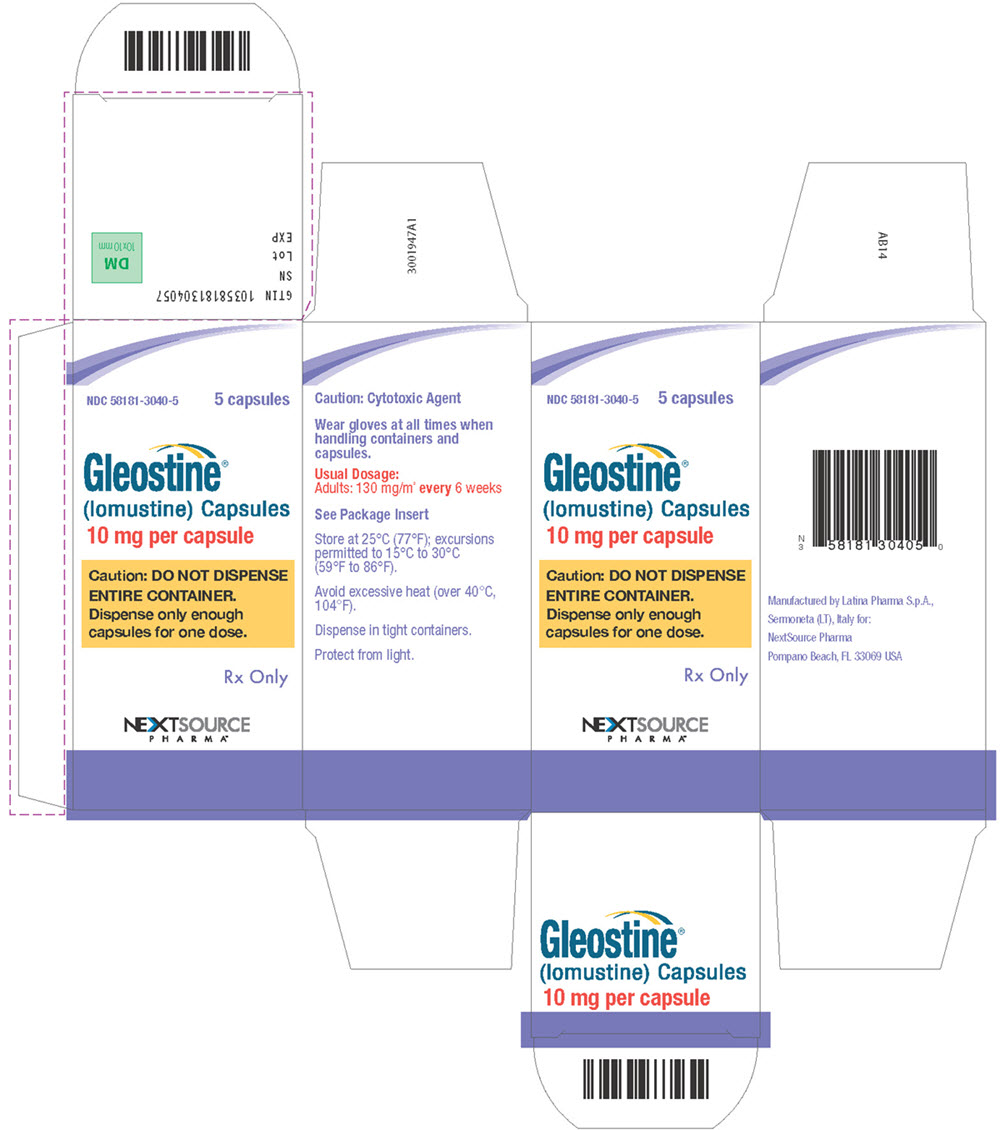
Gleostine lomustine 10 mg Capsule, Gelatin Coated, 5-count — NDC 58181-3040-5 (Billing 58181-3040-05)
This is a package of 5 capsules of Gleostine lomustine 10 mg Capsule, Gelatin Coated from NextSource Biotechnology, LLC, marketed since Aug 2014 and currently FDA-listed. It is this product's only package size.
Identity & classification
Regulatory identifiers FDA, NLM and CMS codes for this package
Drug-database identifiers Medi-Span GPI and First Databank GCN / HICL / AHFS classification
- GSN (GCN sequence number): 008779
- GCN: 38431
- GPI-14 (Medi-Span): 21102020000110
- HICL (First Databank): 003900
- AHFS class code: 10:00.00.00
- RxCUI (RxNorm): 197894
Where does this data come from?
- FDA openFDA NDC Directory · synced Oct 1, 2026
- FDA label on DailyMed · label index refreshed Oct 1, 2026
- RxNorm (NLM RxNav) · catalog refreshed Oct 1, 2026
- Medi-Span GPI (licensed)
- First Databank (licensed) · refreshed Oct 1, 2026
RxNorm drug class
This medicine belongs to the Alkylating Drug class.
Where does this data come from?
- RxClass (NLM) · catalog refreshed Oct 1, 2026
Clinical
Lomustine is used to treat certain types of brain tumors. Lomustine is also used with other medications to treat Hodgkin's lymphoma (Hodgkin's disease) that has not improved or that has worsened after treatment with other medications. Lomustine is in a class of medications called alkylating agents. It works by slowing or stopping the growth of cancer cells in your body.
Read the full MedlinePlus article ↗- It's a chemotherapy capsule used for brain tumors, both ones that start in the brain and ones that spread there, usually after surgery or radiation. It's also used with other chemo...
- You take one single dose by mouth, and then you do not repeat it for at least 6 weeks. Your dose may be several capsules of different colors. Never take extra, since too much can b...
- Nausea, vomiting, mouth sores, and hair loss are common. The most important effect is a drop in blood counts that shows up about 4 to 6 weeks after a dose, so you'll have regular b...
- Call right away for fever or signs of infection, unusual bleeding or bruising, new cough or shortness of breath, vision changes, or confusion. These can be signs of serious effects...
Patient education
Supplement & herbal interactions
Some supplements/herbs that may interact with Lomustine — tap one for details:
Lomustine may be associated with lower levels of 1 nutrient — worth a chat with your pharmacist, not a cause for alarm.
Where does this data come from?
- MedlinePlus (NLM) · refreshed Oct 1, 2026
- FDA label on DailyMed · label index refreshed Oct 1, 2026
Ask a licensed pharmacist directly — free, answered by our team.
Pricing
A drug doesn't have one price. Each row is a different public payment system, and none is what you'd pay at the counter — that depends on your insurance. The ⓘ on each row explains what it measures.
| Price system | Per each | Per package |
|---|---|---|
| Retail pharmacies payNADAC · weekly | Not in the retail survey — common for institutional, discontinued, or low-volume packs. | |
| Medicaid paysCMS SDUD · 12 mo | No recent Medicaid claims on file for this NDC — rare and low-volume NDCs are suppressed in the public data. | |
| Medicare drug plans payPart D · Q2 2026 | $121.73 | $608.67 / 5 capsules |
Where does this data come from?
- CMS NADAC weekly file
- CMS ASP pricing files · refreshed Sep 20, 2026
- CMS Medicaid State Drug Utilization Data · refreshed Oct 3, 2026
- CMS Part D plan pricing files · refreshed Sep 24, 2026
- VA National Acquisition Center price file
Packaging — all sizes for this product
| Package NDC | Description | Marketing start | Marketing end | Status |
|---|---|---|---|---|
| 58181-3040-05 You're viewing this Main listing | 1 BOTTLE in 1 CARTON / 5 CAPSULE, GELATIN COATED in 1 BOTTLE | 2014-08-18 | — | Active |
Therapeutic equivalents
| Product | Labeler | Pack | NADAC/unit | TE | Status | Price vs. this |
|---|---|---|---|---|---|---|
| Gleostine 10 mg 24338-0340-05 | Azurity | 5 capsules | — | AB | FDA listed | — |
| Lomustine 10 mg 52536-0340-05 | Wilshire | 5 capsules | — | AB | FDA listed | — |
| Gleostine 10 mgthis 58181-3040-05 | NextSource | 5 capsules | — | AB | FDA listed | — |
| Lomustine 10 mg 80005-0114-02 | Carnegie | 5 capsules | — | AB | FDA listed | — |
Where does this data come from?
- FDA openFDA NDC Directory · synced Oct 1, 2026
- FDA Orange Book · refreshed Sep 3, 2026
- CMS NADAC weekly file
Availability & generic status
The FDA lists approved generic versions of this medicine, but that does not always mean a pharmacy can get one today. Patent rules, launch agreements, supply and pricing can affect when generics actually arrive.
Where does this data come from?
- FDA Orange Book · refreshed Sep 3, 2026
What it looks like
Where does this data come from?
- FDA label on DailyMed · label index refreshed Oct 1, 2026
Inactive Ingredients / Excipients
Inactive ingredients, also called excipients, are components of the drug product other than the active ingredient. They may include fillers, dyes, coatings, preservatives, flavors, or other formulation ingredients.
💡 Tap an ingredient (hover on desktop) to see what it is and why it’s used.
-
UNII 70097M6I30
Magnesium stearate is a salt made from magnesium and stearic acid, a fatty substance. It's used in tablets and capsules as a lubricant and glidant to help ingredients flow smoothly during manufacturing and prevent sticking.
-
UNII 3OWL53L36A
A natural sugar alcohol derived from seaweed or synthesized in the lab. It's used as a filler to add bulk, a sweetener in sugar-free formulas, and a disintegrant to help tablets break apart in the stomach.
2 inactive ingredients listed in the exact product block matched to this NDC.
Where does this data come from?
ingredient classCode="IACT" elements from the exact product block matched by this NDC. Label-section narrative from DailyMed / the openFDA label index is shown separately when available.- FDA label on DailyMed · label index refreshed Oct 1, 2026
- FDA openFDA NDC Directory · synced Oct 1, 2026
Inactive ingredient FAQ
Are inactive ingredients the same for every manufacturer?
Why might an inactive ingredient be missing?
Can inactive ingredients matter?
Manufacturer & labeler
Where does this data come from?
- FDA openFDA NDC Directory · synced Oct 1, 2026
- Drugs@FDA
Full prescribing information FDA SPL
🚨 Boxed Warning ▾
WARNING: DELAYED MYELOSUPPRESSION and RISK OF OVERDOSAGE DELAYED MYELOSUPPRESSION Gleostine causes myelosuppression including fatal myelosuppression. Myelosuppression is delayed, dose-related, and cumulative; occurring 4 to 6 weeks after drug administration and persisting for 1 to 2 weeks. Thrombocytopenia is generally more severe than leukopenia.
Cumulative myelosuppression from Gleostine is manifested by greater severity and longer duration of cytopenias. Monitor blood counts for at least 6 weeks after each dose. Do not give Gleostine more frequently than every 6 weeks [see Warnings and Precautions ( 5.1 ), Dosage and Administration ( 2.2 , 2.3 )] .
RISK OF OVERDOSAGE PRESCRIBE, DISPENSE, AND ADMINISTER ONLY ENOUGH CAPSULES FOR ONE DOSE. Fatal toxicity occurs with overdosage of Gleostine. Both physician and pharmacist should emphasize to the patient that only one dose of Gleostine is taken every 6 weeks [see Dosage and Administration ( 2.1 ), Warnings and Precautions ( 5.2 ), Overdosage ( 10 )] .
WARNING: DELAYED MYELOSUPPRESSION and RISK OF OVERDOSAGE See full prescribing information for complete boxed warning. Delayed Myelosuppression Gleostine causes myelosuppression including fatal myelosuppression. Myelosuppression is delayed, dose-related, and cumulative.
Thrombocytopenia is generally more severe than leukopenia. Monitor blood counts and do not give Gleostine more frequently than every 6 weeks. ( 2.2 , 2.3 , 5.1 ) Risk of Overdosage PRESCRIBE, DISPENSE, AND ADMINISTER ONLY ENOUGH CAPSULES FOR ONE DOSE.
Fatal toxicity occurs with overdosage of Gleostine. Both physician and pharmacist should emphasize to patient that only one dose of Gleostine is taken every 6 weeks. ( 2.1 , 5.2 , 10 )
🎯 Indications and Usage ▾
1 INDICATIONS AND USAGE Gleostine is an alkylating drug indicated for the treatment of patients with: Brain tumors, primary and metastatic, following appropriate surgical and/or radiotherapeutic procedures. ( 1 ) Hodgkin's lymphoma in combination with other chemotherapies, following disease progression with initial chemotherapy. ( 1 )
1.1Brain Tumors Gleostine is indicated for the treatment of patients with primary and metastatic brain tumors following appropriate surgical and/or radiotherapeutic procedures.
1.2Hodgkin's Lymphoma Gleostine is indicated as a component of combination chemotherapy for the treatment of patients with Hodgkin's lymphoma whose disease has progressed following initial chemotherapy.
⏱️ Dosage and Administration ▾
2 DOSAGE AND ADMINISTRATION Recommended dose in adult and pediatric patients is 130 mg/m 2 orally every 6 weeks. ( 2.1 ) Round dose to nearest 10 mg. Give as a single oral dose and do not repeat for at least 6 weeks.
2.1Important Prescribing and Dispensing Information PRESCRIBE ONLY ONE DOSE FOR EACH TREATMENT CYCLE. DO NOT DISPENSE ENTIRE CONTAINER. Dispense only a sufficient number of capsules for one dose.
Confirm the total dose prescribed by the physician and the appropriate combination of capsule strengths. Dispense only the appropriate number of Gleostine capsules required for the administration of a single dose. The prescribed dose may consist of two or more different strengths and colors of capsules.
Instruct patients that Gleostine is taken as a single oral dose and will not be repeated for at least 6 weeks. Taking more than the recommended dose causes toxicities, including fatal outcomes [see Warnings and Precautions ( 5.2 ) and Overdosage ( 10 )] . Gleostine is a cytotoxic drug.
Follow applicable special handling and disposal procedures. 1 To minimize the risk of dermal exposure, always wear impervious gloves when handling bottles containing Gleostine capsules. Do not break Gleostine capsules; avoid exposure to broken capsules.
If dermal contact occurs, wash areas of skin contact immediately and thoroughly.
2.2Recommended Dose The recommended dose of Gleostine in adult and pediatric patients is 130 mg/m 2 taken as a single oral dose every 6 weeks. Round doses to the nearest 10 mg. Give as a single oral dose and do not repeat for at least 6 weeks. Reduce dose to 100 mg/m 2 every 6 weeks in patients with compromised bone marrow function. Also reduce dose accordingly when using with other myelosuppressive drugs.
2.3Dose Modifications Perform weekly complete blood counts and withhold each subsequent dose for more than 6 weeks if needed until platelet counts recover to 100,000/mm 3 or greater and leukocytes recover to 4000/mm 3 or greater [see Warnings and Precautions ( 5.1 )] . Modify each dose of Gleostine according to the hematologic response of the preceding dose as described in Table 1 : Table 1. Dose Modifications for Gleostine Nadir After Prior Dose Dose Adjustment Leukocytes (/mm 3 ) Platelets (/mm 3 ) ≥ 4000 ≥ 100,000 None 3000 – 3999 75,000 – 99,999 None 2000 – 2999 25,000 – 74,999 Reduce dose by 30% < 2000 < 25,000 Reduce dose by 50%
💊 Dosage Forms and Strengths ▾
3 DOSAGE FORMS AND STRENGTHS Gleostine capsules are available in three strengths, distinguishable by the color of the capsules: 100 mg capsules (green/green) 40 mg capsules (white/green) 10 mg capsules (white/white) Capsules: 10 mg, 40 mg, and 100 mg ( 3 )
⛔ Contraindications ▾
4 CONTRAINDICATIONS None.
⚠️ Warnings and Cautions ▾
5 WARNINGS AND PRECAUTIONS Pulmonary toxicity : Pulmonary infiltrates and/or fibrosis occurs with Gleostine. Perform pulmonary function tests prior to treatment and repeat frequently. Permanently discontinue Gleostine in patients diagnosed with pulmonary fibrosis.
( 5.3 ) Secondary malignancies : Acute leukemia and myelodysplasia can occur with long-term use. ( 5.4 ) Hepatotoxicity : Increased levels of transaminases, alkaline phosphatase and bilirubin can occur with Gleostine. Monitor liver function.
( 5.5 ) Nephrotoxicity : Can cause renal failure. Monitor renal function. ( 5.6 ) Embryo-fetal toxicity : Can cause fetal harm.
Advise males and females of reproductive potential of the potential risk to a fetus and to use effective contraception. ( 5.7 , 8.1 , 8.3 )
5.1Delayed Myelosuppression Gleostine causes myelosuppression that can result in fatal infections and bleeding. Myelosuppression from Gleostine is delayed, dose-related, and cumulative. It usually occurs 4 to 6 weeks after drug administration and persists for 1 to 2 weeks.
Thrombocytopenia is generally more severe than leukopenia. Cumulative myelosuppression from Gleostine is manifested by greater severity and longer duration of cytopenias. Monitor blood counts for at least 6 weeks after each dose.
Do not give Gleostine more frequently than every 6 weeks. Adjust dose based on nadir blood counts from prior dose [see Dosage and Administration ( 2.3 )].
5.2Risk of Overdosage Fatal toxicity occurs with overdosage of Gleostine. Dispensing or administering more than one dose can lead to fatal toxicity. Prescribe only one dose at a time. Dispense only enough capsules for one dose. Both physician and pharmacist should emphasize to the patient that only one dose of Gleostine is taken every 6 weeks [see Dosage and Administration ( 2.1 ) and Overdosage ( 10 )].
5.3Pulmonary Toxicity Pulmonary toxicity characterized by pulmonary infiltrates and/or fibrosis occurs with Gleostine. Patients with a baseline below 70% of the predicted Forced Vital Capacity (FVC) or Carbon Monoxide Diffusing Capacity (DL CO ) are at increased risk. The onset of pulmonary toxicity occurs after an interval of 6 months or longer from the start of therapy, with cumulative doses of Gleostine usually greater than 1100 mg/m 2 .
Obtain baseline pulmonary function tests prior to initiating treatment and repeat frequently during treatment. Permanently discontinue Gleostine in patients diagnosed with pulmonary fibrosis.
5.4Secondary Malignancies Secondary malignancies, including acute leukemia and myelodysplasia, occur with long term use.
5.5Hepatotoxicity Hepatic toxicity, manifested by increased levels of transaminases, alkaline phosphatase, and bilirubin occurs with Gleostine. Monitor liver function.
5.6Nephrotoxicity Progressive renal failure with a decrease in kidney size occurs with Gleostine. Monitor renal function.
5.7Embryo-Fetal Toxicity Based on animal data and its mechanism of action, Gleostine can cause fetal harm when administered to a pregnant woman. Embryo-fetal toxicity and teratogenicity occurred in rats and rabbits receiving lomustine daily during organogenesis at doses approximately two to four times the total human dose of 130 mg/m 2 over 6 weeks (0.18 to 0.27 times the single human dose of 130 mg/m 2 ) based on body surface area (BSA). Advise pregnant women of the potential risk to a fetus.
Advise females of reproductive potential to use effective contraception during treatment with Gleostine and for 2 weeks after the final dose. Advise males with female partners of reproductive potential to use effective contraception during treatment with Gleostine and for 3.5 months after the final dose [see Use in Specific Populations ( 8.1 , 8.3 )] .
🤒 Adverse Reactions ▾
6 ADVERSE REACTIONS The following serious adverse reactions are discussed in greater detail in other sections of the labeling: Delayed myelosuppression [see Warnings and Precautions ( 5.1 )] Risks of overdosage [see Warnings and Precautions ( 5.2 )] Pulmonary toxicity [see Warnings and Precautions ( 5.3 )] Secondary malignancies [see Warnings and Precautions ( 5.4 )] Hepatotoxicity [see Warnings and Precautions ( 5.5 )] Nephrotoxicity [see Warnings and Precautions ( 5.6 )] The following adverse reactions associated with the use of Gleostine were identified in clinical trials or postmarketing reports.
Because these reactions were reported from a population of uncertain size, it is not possible to estimate their frequency, reliability, or establish a causal relationship to drug exposure. Gastrointestinal disorders: nausea, vomiting, and stomatitis Ocular disorders: optic atrophy, visual disturbances, and blindness Neurologic disorders: disorientation, lethargy, ataxia, and dysarthria Other: alopecia Common adverse reactions include delayed myelosupression, nausea, vomiting, stomatitis, and alopecia. ( 6 ) To report SUSPECTED ADVERSE REACTIONS, contact NextSource Biotechnology at 855- 672-2468 or FDA at 1-800-FDA-1088 or www.fda.gov/medwatch.
👥 Use in Specific Populations ▾
8 USE IN SPECIFIC POPULATIONS Lactation: Do not breastfeed. ( 8.2 )
8.1Pregnancy Risk Summary Based on animal data and its mechanism of action, Gleostine can cause fetal harm when administered to a pregnant woman [see Clinical Pharmacology ( 12.1 )] . There are no available data on Gleostine exposure in pregnant women. Lomustine was teratogenic in rats and embryotoxic in rabbits at total dose levels approximately two to four times the total human dose of 130 mg/m 2 over 6 weeks (0.18 to 0.27 times the single human dose of 130 mg/m 2 ) based on BSA [see Data] .
Advise pregnant women of the potential risk to a fetus. In the U.S. general population, the estimated background risk of major birth defects and miscarriage in clinically recognized pregnancies is 2-4% and 15-20%, respectively. Data Animal Data Lomustine was administered by intraperitoneal injection daily to pregnant rats during the period of organogenesis at dose levels of 0, 2, 4, 6, and 8 mg/kg.
Resorption rates and post-implantation loss occurred at doses greater than or equal to 4 mg/kg (approximately 0.18 times the clinical dose of 130 mg/m 2 based on BSA or approximately twice the total clinical dose of lomustine over 6 weeks). Malformations (omphalocele, ectopia cordis, scoliosis, syndactyly, hydrocephalus, microphthalmia, anophthalmia, anomalies of aortic arch, dextrocardia, malpositioning of the ovaries and testes, sternoschisis, and shortened/misshapen bone of the fore or hind limbs) and decreased fetal body weight occurred at all dose levels.
In pregnant rabbits treated with lomustine at 3 mg/kg (approximately 0.27 times the 130 mg/m 2 clinical dose based on BSA or approximately four times the total clinical dose of lomustine over 6 weeks) during organogenesis, there were increases in abortions and decreases in surviving pup weight that persisted postnatally.
8.2Lactation Risk Summary There is no information on the presence of lomustine or its metabolites in human milk, its effects on the breastfed infant, or its effects on milk production. Because of the potential for serious adverse reactions in breastfed infants from Gleostine, advise women not to breastfeed during treatment with Gleostine and for 2 weeks after the final dose.
8.3Females and Males of Reproductive Potential Contraception Females Based on animal data and its mechanism of action, Gleostine can cause fetal harm [see Use in Specific Populations ( 8.1 )] . Advise females of reproductive potential to use effective contraception during treatment and for 2 weeks after the final dose. Males Based on Gleostine's mechanism of action, advise males with female partners of reproductive potential to use effective contraception during treatment with Gleostine and for 3.5 months after the final dose [see Clinical Pharmacology ( 12.1 )] .
Infertility Based on animal findings and its mechanism of action, Gleostine may result in reduced fertility in males and females of reproductive potential [see Nonclinical Toxicology ( 13.1 )] .
8.4Pediatric Use Pediatric use, including dose, is not based on adequate and well-controlled clinical studies.
8.5Geriatric Use No data in the clinical studies of Gleostine are available for patients 65 years of age and over to determine whether they respond differently than younger patients. Other reported clinical experience has not identified differences in responses between elderly and younger patients. In general, dose selection for an elderly patient should be cautious, reflecting the greater frequency of decreased hepatic, renal, or cardiac function and of concomitant disease or other drug therapy.
Lomustine and its metabolites are known to be substantially excreted by the kidney, and the risk of toxic reactions to this drug may be greater in patients with impaired renal function. Because elderly patients are more likely to have decreased renal function, care should be taken in dose selection, and renal function should be monitored.
🤰 Pregnancy ▾
8.1Pregnancy Risk Summary Based on animal data and its mechanism of action, Gleostine can cause fetal harm when administered to a pregnant woman [see Clinical Pharmacology ( 12.1 )] . There are no available data on Gleostine exposure in pregnant women. Lomustine was teratogenic in rats and embryotoxic in rabbits at total dose levels approximately two to four times the total human dose of 130 mg/m 2 over 6 weeks (0.18 to 0.27 times the single human dose of 130 mg/m 2 ) based on BSA [see Data] .
Advise pregnant women of the potential risk to a fetus. In the U.S. general population, the estimated background risk of major birth defects and miscarriage in clinically recognized pregnancies is 2-4% and 15-20%, respectively. Data Animal Data Lomustine was administered by intraperitoneal injection daily to pregnant rats during the period of organogenesis at dose levels of 0, 2, 4, 6, and 8 mg/kg.
Resorption rates and post-implantation loss occurred at doses greater than or equal to 4 mg/kg (approximately 0.18 times the clinical dose of 130 mg/m 2 based on BSA or approximately twice the total clinical dose of lomustine over 6 weeks). Malformations (omphalocele, ectopia cordis, scoliosis, syndactyly, hydrocephalus, microphthalmia, anophthalmia, anomalies of aortic arch, dextrocardia, malpositioning of the ovaries and testes, sternoschisis, and shortened/misshapen bone of the fore or hind limbs) and decreased fetal body weight occurred at all dose levels.
In pregnant rabbits treated with lomustine at 3 mg/kg (approximately 0.27 times the 130 mg/m 2 clinical dose based on BSA or approximately four times the total clinical dose of lomustine over 6 weeks) during organogenesis, there were increases in abortions and decreases in surviving pup weight that persisted postnatally.
🧒 Pediatric Use ▾
8.4Pediatric Use Pediatric use, including dose, is not based on adequate and well-controlled clinical studies.
🧓 Geriatric Use ▾
8.5Geriatric Use No data in the clinical studies of Gleostine are available for patients 65 years of age and over to determine whether they respond differently than younger patients. Other reported clinical experience has not identified differences in responses between elderly and younger patients. In general, dose selection for an elderly patient should be cautious, reflecting the greater frequency of decreased hepatic, renal, or cardiac function and of concomitant disease or other drug therapy.
Lomustine and its metabolites are known to be substantially excreted by the kidney, and the risk of toxic reactions to this drug may be greater in patients with impaired renal function. Because elderly patients are more likely to have decreased renal function, care should be taken in dose selection, and renal function should be monitored.
🆘 Overdosage ▾
10 OVERDOSAGE Overdosage with Gleostine has occurred, including fatal cases [see Dosage and Administration ( 2.1 ), Warnings and Precautions ( 5.2 )]. Overdosage causes severe myelosuppression, as well as abdominal pain, diarrhea, vomiting, anorexia, lethargy, dizziness, abnormal hepatic function, cough, and shortness of breath. No antidotes exist for Gleostine overdosage.
🧬 Clinical Pharmacology ▾
12 CLINICAL PHARMACOLOGY
12.1Mechanism of Action Lomustine alkylates DNA and RNA. As with other nitrosoureas, it may also inhibit several key enzymatic processes by carbamoylation of amino acids in proteins.
12.2Pharmacodynamics The pharmacodynamics of lomustine are unknown.
12.3Pharmacokinetics Distribution Lomustine crosses the blood-brain barrier. Elimination The serum half-life of lomustine metabolites ranges from 16 hours to 48 hours. Metabolism Metabolic pathways involved in the elimination of lomustine have not been characterized.
Excretion Following oral administration of radioactive lomustine at doses ranging from 30 mg/m 2 to 100 mg/m 2 , approximately half of the radioactivity administered was excreted in the urine in the form of degradation products within 24 hours. Specific Populations The impact of patient specific (e.g., age, sex, and race) or disease (e.g., renal or hepatic impairment) characteristics on the pharmacokinetics of lomustine is unknown.
🧬 Mechanism of Action ▾
12.1Mechanism of Action Lomustine alkylates DNA and RNA. As with other nitrosoureas, it may also inhibit several key enzymatic processes by carbamoylation of amino acids in proteins.
📦 How Supplied / Storage and Handling ▾
16 HOW SUPPLIED/STORAGE AND HANDLING
16.1How Supplied Gleostine is available in three strengths, distinguishable by the color of the capsules, in individual bottles of 5 capsules each: Strength Capsule Description NDC Code 100 mg Moss green cap and body, imprinted in black ink, with "CPL" over "3032" on the cap and "100 mg" on the body of the capsule. 58181-3042-5 40 mg White cap and a moss green body, imprinted in black ink, with "CPL" over "3031" on the cap and "40 mg" on the body of the capsule. 58181-3041-5 10 mg White cap and body, imprinted in black ink, with "CPL" over "3030" on the cap and "10 mg" on the body of the capsule 58181-3040-5
16.2Storage and Handling Store at 25°C (77°F); excursions permitted to 15°C to 30°C (59°F to 86°F) [see USP Controlled Room Temperature]. Avoid temperatures over 40°C (104°F). Gleostine is a cytotoxic drug.
Follow applicable special handling and disposal procedures. 1 To minimize the risk of dermal exposure, always wear impervious gloves when handling bottles containing Gleostine capsules. Do not break Gleostine capsules; avoid exposure to broken capsules.
If dermal contact occurs, wash areas of skin contact immediately and thoroughly.
📦 Storage and Handling ▾
16.2Storage and Handling Store at 25°C (77°F); excursions permitted to 15°C to 30°C (59°F to 86°F) [see USP Controlled Room Temperature]. Avoid temperatures over 40°C (104°F). Gleostine is a cytotoxic drug.
Follow applicable special handling and disposal procedures. 1 To minimize the risk of dermal exposure, always wear impervious gloves when handling bottles containing Gleostine capsules. Do not break Gleostine capsules; avoid exposure to broken capsules.
If dermal contact occurs, wash areas of skin contact immediately and thoroughly.
📋 Description ▾
11 DESCRIPTION Gleostine (lomustine) is an alkylating drug for oral administration. The chemical name for lomustine is 1-(2-chloro-ethyl)-3-cyclohexyl-1-nitrosourea and the molecular formula is C 9 H 16 ClN 3 O 2 . The molecular weight is 233.71.
Lomustine is a yellow powder, which is soluble in 10% ethanol (0.05 mg per mL) and in absolute alcohol (70 mg per mL). Lomustine is insoluble in water (<0.05 mg per mL). The chemical structure is: Gleostine is supplied as 10 mg, 40 mg, and 100 mg capsules and contains the following inactive ingredients: magnesium stearate NF and mannitol USP.
The capsule shells are composed of gelatin and coloring pigments, depending on the strength: titanium dioxide, and/or yellow iron oxide, and/or Indigotine – FD&C Blue2. Chemical Structure
💬 Information for Patients ▾
17 PATIENT COUNSELING INFORMATION Myelosuppression Advise patients that periodic assessment of their blood counts are required. Advise patients to contact their healthcare provider for new onset of bleeding or fever or symptoms of infection [see Warnings and Precautions ( 5.1 )]. Overdosage Advise patients that toxicity including fatal toxicity occurs with Gleostine overdosage [see Warnings and Precautions ( 5.2 ), Overdosage ( 10 ), Dosage and Administration ( 2.1 )].
Advise patients to take Gleostine as directed: Gleostine is taken as a single oral dose that will not be repeated for at least 6 weeks. Use of the recommended dose at less than 6 week intervals leads to toxicities including fatal toxicities. Each dose may consist of 2 or more different strengths and colors of capsules.
Pulmonary Fibrosis Advise patients to contact their healthcare provider for new or worsening cough, chest pain, or shortness of breath [see Warnings and Precautions ( 5.3 )] . Hepatotoxicity Inform patients that Gleostine can cause hepatotoxicity and that liver function monitoring during treatment is necessary [see Warnings and Precautions ( 5.5 )]. Nephrotoxicity Inform patients that Gleostine can cause nephrotoxicity and that renal function and electrolyte monitoring during treatment is necessary [see Warnings and Precautions ( 5.6 )].
Embryo-Fetal Toxicity Advise females of reproductive potential of the potential risk to a fetus and to inform their healthcare provider of a known or suspected pregnancy [see Warnings and Precautions ( 5.7 ), Use in Specific Populations ( 8.1 )] . Advise females of reproductive potential to use effective contraception during treatment with Gleostine and for at least 2 weeks after the final dose [see Use in Specific Populations ( 8.3 )]. Advise male patients with female partners of reproductive potential to use condoms during treatment with Gleostine and for 3.5 months after the final dose [see Use in Specific Populations ( 8.3 )] .
Lactation Advise women not to breastfeed during treatment with Gleostine and for 2 weeks after the final dose [see Use in Specific Populations ( 8.2 )]. Infertility Advise females and males of reproductive potential of the potential for reduced fertility from Gleostine [see Use in Specific Populations ( 8.3 ) and Nonclinical Toxicology ( 13.1 )]. Manufactured by Latina Pharma S.p.A., Sermoneta (LT), Italy for: NextSource Pharma Pompano Beach, FL 33069 USA Logo
🧬 Pharmacokinetics ▾
12.3Pharmacokinetics Distribution Lomustine crosses the blood-brain barrier. Elimination The serum half-life of lomustine metabolites ranges from 16 hours to 48 hours. Metabolism Metabolic pathways involved in the elimination of lomustine have not been characterized.
Excretion Following oral administration of radioactive lomustine at doses ranging from 30 mg/m 2 to 100 mg/m 2 , approximately half of the radioactivity administered was excreted in the urine in the form of degradation products within 24 hours. Specific Populations The impact of patient specific (e.g., age, sex, and race) or disease (e.g., renal or hepatic impairment) characteristics on the pharmacokinetics of lomustine is unknown.
🧪 Nonclinical Toxicology ▾
13 NONCLINICAL TOXICOLOGY
13.1Carcinogenesis, Mutagenesis, Impairment of Fertility Lomustine is carcinogenic in rats and mice, producing a marked increase in tumor incidence in doses lower than those employed clinically. In female rats, daily intraperitoneal treatment with lomustine for 2 weeks prior to mating with untreated males resulted in dose dependent decreases in number of corpora lutea and resorption rates with no live births at a dose of 3 mg/kg (approximately 0.14 times the recommended clinical dose of 130 mg/m 2 based on body surface area (BSA), or approximately twice the total clinical dose of lomustine over 6 weeks) and decreased pup survival during the first 4 postnatal days at doses greater than or equal to 1.5 mg/kg (a daily dose of approximately 0.06 times the recommended clinical dose of 130 mg/m 2 based on BSA or approximately equal to the total clinical dose of lomustine over 6 weeks).
Gleostine may also result in decreased male fertility. Intraperitoneal injection of lomustine resulted in decreased fertility in male rats mated to untreated females based on decreased implantations and decreased fetal body weight at weekly doses greater than or equal to 5 mg/kg (approximately 0.23 times the single clinical dose of 130 mg/m 2 based on BSA, or approximately equal to the total clinical dose of lomustine over 6 weeks), and increased resorptions at doses greater than or equal to 2.5 mg/kg/week.
📄 Carcinogenesis, Mutagenesis, Impairment of Fertility ▾
13.1Carcinogenesis, Mutagenesis, Impairment of Fertility Lomustine is carcinogenic in rats and mice, producing a marked increase in tumor incidence in doses lower than those employed clinically. In female rats, daily intraperitoneal treatment with lomustine for 2 weeks prior to mating with untreated males resulted in dose dependent decreases in number of corpora lutea and resorption rates with no live births at a dose of 3 mg/kg (approximately 0.14 times the recommended clinical dose of 130 mg/m 2 based on body surface area (BSA), or approximately twice the total clinical dose of lomustine over 6 weeks) and decreased pup survival during the first 4 postnatal days at doses greater than or equal to 1.5 mg/kg (a daily dose of approximately 0.06 times the recommended clinical dose of 130 mg/m 2 based on BSA or approximately equal to the total clinical dose of lomustine over 6 weeks).
Gleostine may also result in decreased male fertility. Intraperitoneal injection of lomustine resulted in decreased fertility in male rats mated to untreated females based on decreased implantations and decreased fetal body weight at weekly doses greater than or equal to 5 mg/kg (approximately 0.23 times the single clinical dose of 130 mg/m 2 based on BSA, or approximately equal to the total clinical dose of lomustine over 6 weeks), and increased resorptions at doses greater than or equal to 2.5 mg/kg/week.
📚 References ▾
15 REFERENCES OSHA. http://www.osha.gov/SLTC/hazardousdrugs/index.html.
📄 Package Label / Principal Display Panel ▾
Principal Display Panel - Carton Label NDC 58181-3040-5 5 capsules Gleostine ® (lomustine) Capsules 10 mg per capsule Caution: DO NOT DISPENSE ENTIRE CONTAINER. Dispense only enough capsules for one dose. Rx Only NEXTSOURCE PHARMA 10 mg Carton
Principal Display Panel - Carton Label NDC 58181-3041-5 5 capsules Gleostine ® (lomustine) Capsules 40 mg per capsule Caution: DO NOT DISPENSE ENTIRE CONTAINER. Dispense only enough capsules for one dose. Rx Only NEXTSOURCE PHARMA 40 mg Carton
Principal Display Panel - Carton Label NDC 58181-3042-5 5 capsules Gleostine ® (lomustine) Capsules 100 mg per capsule Caution: DO NOT DISPENSE ENTIRE CONTAINER. Dispense only enough capsules for one dose. Rx Only NEXTSOURCE PHARMA 100 mg Carton
Medicare Part D spend CMS · PART D · 2026 (Q1)
About this NDC listing & data coverage
What data is (and isn’t) available for this NDC — tap to expand
| NDC identity (package / product / labeler codes) | ✓ Available |
| Labeler | ✓ Available |
| Product & package description | ✓ Available |
| Marketing category & status | ✓ Available |
| Active ingredient / dosage form / route | ✓ Available |
| FDA label (SPL via DailyMed) | ✓ Available |
| Package photos | ✓ Available |
| Inactive ingredients (structured) | ✓ Available |
| NADAC pharmacy acquisition price (CMS) | — Not published for this NDC CMS publishes NADAC only for NDCs reported in its retail-pharmacy survey. |
| Orange Book / therapeutic-equivalence data | ✓ Available |
| HCPCS J-code billing crosswalk | — Not published for this NDC Most self-administered / retail products have no J-code — that is normal. |
| Medicaid utilization (CMS SDUD) | — Not published for this NDC CMS reports utilization only for NDCs with Medicaid claims above its privacy threshold. |