
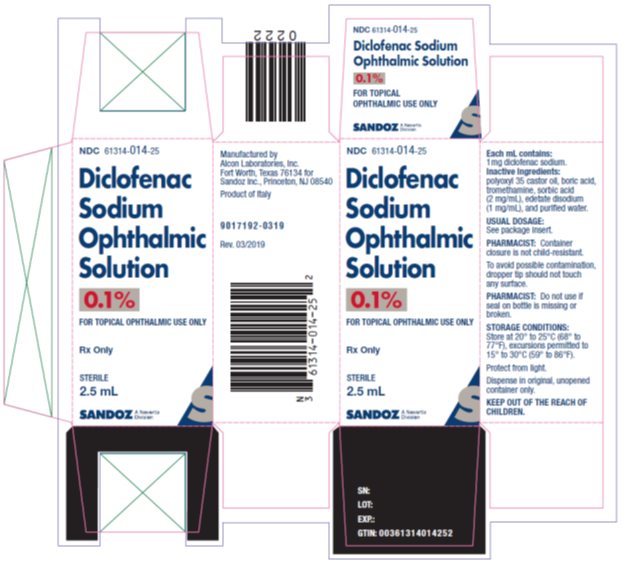
Diclofenac Sodium 1 mg/mL Solution, 2.5 mL — NDC 61314-014-25 (Billing 61314-0014-25)
This is a package of 2.5 mL of Diclofenac Sodium 1 mg/mL Solution from Sandoz Inc, marketed since Feb 2008 and currently FDA-listed; retail pharmacies pay about $1.75 per mL (NADAC).
Other active recalls for Diclofenac Sodium (different manufacturers) — 3 · tap to view
Identity & classification
Regulatory identifiers FDA, NLM and CMS codes for this package
Drug-database identifiers Medi-Span GPI and First Databank GCN / HICL / AHFS classification
- GSN (GCN sequence number): 016008
- GCN: 33831
- GPI-14 (Medi-Span): 86805010102010
- HICL (First Databank): 003733
- AHFS class code: 52:08.20.00
- RxCUI (RxNorm): 854801
Where does this data come from?
- FDA openFDA NDC Directory · synced Oct 1, 2026
- FDA label on DailyMed · label index refreshed Oct 1, 2026
- RxNorm (NLM RxNav) · catalog refreshed Oct 1, 2026
- Medi-Span GPI (licensed)
- First Databank (licensed) · refreshed Oct 1, 2026
RxNorm drug class
This medicine belongs to the Nonsteroidal Anti-inflammatory Drug class.
Where does this data come from?
- RxClass (NLM) · catalog refreshed Oct 1, 2026
Clinical
Diclofenac ophthalmic solution is used to treat eye pain, redness, and swelling in patients who are recovering from cataract surgery (procedure to treat clouding of the lens in the eye). Diclofenac ophthalmic solution is also used to temporarily relieve eye pain and sensitivity to light in patients who are recovering from corneal refractive surgery (surgery to improve vision). Diclofenac is in a class of medications called nonsteroidal anti-inflammatory drugs. It works by stopping the production of certain natural substances that cause pain and swelling.
Read the full MedlinePlus article ↗- It's an NSAID used for pain and inflammation. Depending on the form, that may be arthritis, period pain, acute pain, strains and sprains, or migraine attacks. Check that your produ...
- Take oral forms by mouth and apply gels, solutions and patches to the skin as directed. Use the lowest dose for the shortest time that works. Food won't change how much you absorb,...
- Stomach upset, nausea, gas, diarrhea or constipation, headache and dizziness are common. Skin products can cause dryness, redness or irritation where applied. Call me or your docto...
- Get emergency help for chest pain, trouble breathing, weakness on one side, black or bloody stools, vomiting blood, or swelling of the face or tongue. Stop it and call for a new ra...
Patient education
Supplement & herbal interactions
Some supplements/herbs that may interact with Diclofenac Sodium — tap one for details:
Diclofenac Sodium may be associated with lower levels of 1 nutrient — worth a chat with your pharmacist, not a cause for alarm.
Where does this data come from?
- MedlinePlus (NLM) · refreshed Oct 1, 2026
- FDA label on DailyMed · label index refreshed Oct 1, 2026
Ask a licensed pharmacist directly — free, answered by our team.
Pricing
A drug doesn't have one price. Each row is a different public payment system, and none is what you'd pay at the counter — that depends on your insurance. The ⓘ on each row explains what it measures.
| Price system | Per mL | Per package |
|---|---|---|
| Retail pharmacies payNADAC · weekly | $1.750 | $4.37 / 2.5 ml |
| Medicaid paysCMS SDUD · 12 mo | $4.18 | $10.45 / 2.5 ml |
| Medicare drug plans payPart D · Q2 2026 | $2.49 | $6.23 / 2.5 ml |
Where does this data come from?
- CMS NADAC weekly file · file of Sep 30, 2026
- CMS ASP pricing files · refreshed Sep 20, 2026
- CMS Medicaid State Drug Utilization Data · through Q1 2026
- CMS Part D plan pricing files · refreshed Sep 24, 2026
- VA National Acquisition Center price file
Packaging — all sizes for this product
| Package NDC | Description | Per unit | Per pack | Marketing start | Marketing end | Status |
|---|---|---|---|---|---|---|
| 61314-0014-05 61314-014-05 Main listing | 5 mL in 1 BOTTLE | $1.70 / mL | $8.48 | 2008-02-14 | — | Active |
| 61314-0014-25 You're viewing this | 2.5 mL in 1 BOTTLE | $1.75 / mL | $4.37 | 2008-02-14 | — | Active |
Per mL, this pack runs about 3% above the cheapest pack (5 mL, $1.70 vs $1.75 NADAC).
This pack accounts for about 23% of this product's recent Medicaid fills; most go to the 5 ml pack. See all packs ↓
Pack size FAQ
What quantity is in this package?
How does this package differ from NDC 61314-0014-05?
What NDC number is used to bill for this package of Diclofenac Sodium 1 mg/mL Solution?
Prices are the latest CMS NADAC pharmacy acquisition cost per NDC; per-pack figures are per-unit × pack quantity, shown only when the pack is denominated in the same measure NADAC prices.
Therapeutic equivalents
| Product | Labeler | Pack | NADAC/unit | TE | Status | Price vs. this |
|---|---|---|---|---|---|---|
| Diclofenac Sodium 1 mg/mL 24208-0457-05 | Bausch | 1 bottle | $1.695 | AT | Availability likely | save 3% |
| Diclofenac Sodium 1 mg/mLthis 61314-0014-25 | Sandoz | 2.5 ml | $1.750 | AT | Availability likely | — |
| Diclofenac Sodium 1 mg/mL 72888-0150-21 | Advagen | 1 bottle | $1.750 | AT | Availability likely | — |
| Diclofenac Sodium 1 mg/mL 50090-2454-00 | A-S | 1 bottle | — | AT | FDA listed | — |
| Diclofenac Sodium 1 mg/mL 50090-3568-00 | A-S | 5 ml | — | AT | FDA listed | — |
| Diclofenac 1 mg/mL 59390-0149-02 | Altaire | 1 bottle | — | AT | FDA listed | — |
Where does this data come from?
- FDA openFDA NDC Directory · synced Oct 1, 2026
- FDA Orange Book · refreshed Sep 3, 2026
- CMS NADAC weekly file · file of Sep 30, 2026
Availability & generic status
This product is an FDA-approved generic. Other versions of the same drug are listed under Therapeutic equivalents, least expensive first.
Where does this data come from?
- FDA Orange Book · refreshed Sep 3, 2026
Inactive Ingredients / Excipients
Inactive ingredients, also called excipients, are components of the drug product other than the active ingredient. They may include fillers, dyes, coatings, preservatives, flavors, or other formulation ingredients.
💡 Tap an ingredient (hover on desktop) to see what it is and why it’s used.
-
UNII R57ZHV85D4
Boric acid is a weak acid derived from boron. In medicines, it typically serves as a buffer to help maintain the product's pH level and may act as a preservative in certain formulations.
-
UNII 7FLD91C86K
Edetate disodium is a chemical compound that binds and removes certain metal ions. In medicines, it acts as a preservative and stabilizer by preventing metals like calcium from interfering with the product's shelf life and consistency.
-
UNII 6D4M1DAL6O
Polyoxyl 35 castor oil is a synthetic compound made by chemically treating castor oil. It works as a solubilizer and emulsifier to help dissolve and evenly mix oily and water-based ingredients in medicines.
-
UNII X045WJ989B
Sorbic acid is a preservative derived from berries that prevents mold, yeast, and bacterial growth in medicines. It keeps the product stable and safe during storage.
-
UNII 023C2WHX2V
Tromethamine is a chemical buffer that helps maintain the proper acidity level in liquid medicines. It neutralizes acids and stabilizes the solution so the medication remains effective and safe throughout its shelf life.
-
UNII 059QF0KO0R
Water is a liquid solvent that dissolves and mixes ingredients together in liquid medicines, syrups, and injections. It helps distribute the active drug evenly throughout the product.
6 inactive ingredients listed in the exact product block matched to this NDC.
Where does this data come from?
ingredient classCode="IACT" elements from the exact product block matched by this NDC. Label-section narrative from DailyMed / the openFDA label index is shown separately when available.- FDA label on DailyMed · label index refreshed Oct 1, 2026
- FDA openFDA NDC Directory · synced Oct 1, 2026
Inactive ingredient FAQ
Are inactive ingredients the same for every manufacturer?
Why might an inactive ingredient be missing?
Can inactive ingredients matter?
Manufacturer & labeler
Where does this data come from?
- FDA openFDA NDC Directory · synced Oct 1, 2026
- Drugs@FDA
Full prescribing information FDA SPL
🎯 Indications and Usage ▾
INDICATIONS AND USAGE Diclofenac sodium ophthalmic solution is indicated for the treatment of postoperative inflammation in patients who have undergone cataract extraction and for the temporary relief of pain and photophobia in patients undergoing corneal refractive surgery.
⏱️ Dosage and Administration ▾
DOSAGE AND ADMINISTRATION Cataract Surgery One drop of diclofenac sodium ophthalmic solution should be applied to the affected eye, 4 times daily beginning 24 hours after cataract surgery and continuing throughout the first 2 weeks of the postoperative period. Corneal Refractive Surgery One or two drops of diclofenac sodium ophthalmic solution should be applied to the operative eye within the hour prior to corneal refractive surgery. Within 15 minutes after surgery, one or two drops should be applied to the operative eye and continued 4 times daily for up to 3 days.
⛔ Contraindications ▾
CONTRAINDICATIONS Diclofenac sodium ophthalmic solution is contraindicated in patients who are hypersensitive to any component of the medication.
⚠️ Warnings ▾
WARNINGS The refractive stability of patients undergoing corneal refractive procedures and treated with diclofenac sodium ophthalmic solution has not been established. Patients should be monitored for a year following use in this setting. With some nonsteroidal anti-inflammatory drugs, there exists the potential for increased bleeding time due to interference with thrombocyte aggregation.
There have been reports that ocularly applied non-steroidal anti-inflammatory drugs may cause increased bleeding of ocular tissues (including hyphemas) in conjunction with ocular surgery. There is the potential for cross-sensitivity to acetylsalicylic acid, phenylacetic acid derivatives, and other nonsteroidal anti-inflammatory agents. Therefore, caution should be used when treating individuals who have previously exhibited sensitivities to these drugs.
🤒 Adverse Reactions ▾
ADVERSE REACTIONS Ocular Transient burning and stinging were reported in approximately 15% of patients across studies with the use of diclofenac sodium ophthalmic solution. In cataract surgery studies, keratitis was reported in up to 28% of patients receiving diclofenac sodium ophthalmic solution, although in many of these cases keratitis was initially noted prior to the initiation of treatment. Elevated intraocular pressure following cataract surgery was reported in approximately 15% of patients undergoing cataract surgery.
Lacrimation complaints were reported in approximately 30% of case studies undergoing incisional refractive surgery. The following adverse reactions were reported in approximately 10% or less of patients: abnormal vision, acute elevated IOP, blurred vision, conjunctivitis, corneal deposits, corneal edema, corneal opacity, corneal lesions, discharge, eyelid swelling, eye pain, injection (redness), iritis, irritation, itching, lacrimation disorder, and ocular allergy. Systemic The following adverse reactions were reported in 3% or less of patients: abdominal pain, asthenia, chills, dizziness, facial edema, fever, headache, insomnia, nausea, pain, rhinitis, viral infection, and vomiting.
Clinical Practice The following reactions have been identified during postmarketing use of topical diclofenac sodium ophthalmic solution, 0.1% in clinical practice. Because they are reported voluntarily from a population of unknown size, estimates of frequency cannot be made. The reactions, which have been chosen for inclusion due to either their seriousness, frequency of reporting, possible causal connection to topical diclofenac sodium ophthalmic solution, 0.1%, or a combination of these factors, include corneal erosion, corneal infiltrates, corneal perforation, corneal thinning, corneal ulceration, and epithelial breakdown [see PRECAUTIONS, General ].
To report SUSPECTED ADVERSE REACTIONS, contact Sandoz Inc., at 1-800-525-8747 or FDA at 1-800-FDA-1088 or www.fda.gov/medwatch
🤰 Pregnancy ▾
PREGNANCY
🧒 Pediatric Use ▾
Pediatric Use Safety and effectiveness in pediatric patients have not been established.
🧓 Geriatric Use ▾
Geriatric Use No overall differences in safety or effectiveness have been observed between elderly and younger adult patients.
🆘 Overdosage ▾
OVERDOSAGE Overdosage will not ordinarily cause acute problems. If diclofenac sodium ophthalmic solution is accidentally ingested, fluids should be taken to dilute the medication.
🧬 Clinical Pharmacology ▾
CLINICAL PHARMACOLOGY Pharmacodynamics Diclofenac sodium is one of a series of phenylacetic acids that has demonstrated anti-inflammatory and analgesic properties in pharmacological studies. It is thought to inhibit the enzyme cyclooxygenase, which is essential in the biosynthesis of prostaglandins. Animal Studies Prostaglandins have been shown in many animal models to be mediators of certain kinds of intraocular inflammation.
In studies performed in animal eyes, prostaglandins have been shown to produce disruption of the blood-aqueous humor barrier, vasodilation, increased vascular permeability, leukocytosis, and increased intraocular pressure. Pharmacokinetics Results from a bioavailability study established that plasma levels of diclofenac following ocular instillation of two drops of diclofenac sodium ophthalmic solution, 0.1% to each eye were below the limit of quantification (10 ng/mL) over a 4-hour period. This study suggests that limited, if any, systemic absorption occurs with diclofenac sodium ophthalmic solution, 0.1%.
Clinical Trials Postoperative Anti-Inflammatory Effects In two double-masked, controlled, efficacy studies of postoperative inflammation, a total of 206 cataract patients were treated with diclofenac sodium ophthalmic solution, 0.1% and 103 patients were treated with vehicle placebo. Diclofenac sodium ophthalmic solution, 0.1% was favored over vehicle placebo over a 2-week period for the clinical assessments of inflammation as measured by anterior chamber cells and flare. In double-masked, controlled studies of corneal refractive surgery (radial keratotomy (RK) and laser photorefractive keratectomy (PRK)) patients were treated with diclofenac sodium ophthalmic solution, 0.1% and/or vehicle placebo.
The efficacy of diclofenac sodium ophthalmic solution given before and shortly after surgery was favored over vehicle placebo during the 6-hour period following surgery for the clinical assessments of pain and photophobia. Patients were permitted to use a hydrogel soft contact lens with diclofenac sodium ophthalmic solution for up to three days after PRK.
📦 How Supplied / Storage and Handling ▾
HOW SUPPLIED Diclofenac sodium ophthalmic solution, 0.1% (1 mg/mL) Sterile Solution is supplied in a low density polyethylene (LDPE) white bottle with a natural LDPE dropper tip and a gray polypropylene closure in the following sizes: 2.5 mL fill in 4 mL container NDC 61314-014-25 5 mL fill in 8 mL container NDC 61314-014-05 STORAGE CONDITIONS Store at 20° to 25°C (68° to 77°F), excursions permitted to 15° to 30°C (59° to 86°F). Protect from light. Dispense in original, unopened container only.
📋 Description ▾
DESCRIPTION Diclofenac sodium ophthalmic solution, 0.1% is a sterile, topical, nonsteroidal, anti-inflammatory product for ophthalmic use. Diclofenac sodium is designated chemically as 2-[(2,6-dichlorophenyl)amino] benzeneacetic acid, monosodium salt, with an empirical formula of C 14 H 10 Cl 2 NO 2 Na. The structural formula of diclofenac sodium is: Diclofenac sodium ophthalmic solution, 0.1% is available as a sterile solution which contains diclofenac sodium 0.1% (1 mg/mL).
Inactive Ingredients: polyoxyl 35 castor oil, boric acid, tromethamine, sorbic acid (2 mg/mL), edetate disodium (1 mg/mL), and purified water. Diclofenac sodium is a faintly yellow-white to light-beige, slightly hygroscopic crystalline powder. It is freely soluble in methanol, sparingly soluble in water, very slightly soluble in acetonitrile, and insoluble in chloroform and in 0.1N hydrochloric acid.
Its molecular weight is 318.14. Diclofenac sodium ophthalmic solution, 0.1% is an iso-osmotic solution with an osmolality of about 300 mOsmol/1000 g, buffered at approximately pH 7.2. Diclofenac sodium ophthalmic solution, 0.1% has a faint characteristic odor of castor oil. chemical
💬 Information for Patients ▾
Information for Patients Except for the use of a bandage hydrogel soft contact lens during the first 3 days following refractive surgery, diclofenac sodium ophthalmic solution should not be used by patients currently wearing soft contact lenses due to adverse events that have occurred in other circumstances.
⚠️ Precautions ▾
PRECAUTIONS General Precautions All topical nonsteroidal anti-inflammatory drugs (NSAIDs) may slow or delay healing. Topical corticosteroids are also known to slow or delay healing. Concomitant use of topical NSAIDs and topical steroids may increase the potential for healing problems.
Use of topical NSAIDs may result in keratitis. In some susceptible patients continued use of topical NSAIDs may result in epithelial breakdown, corneal thinning, corneal infiltrates, corneal erosion, corneal ulceration, and corneal perforation. These events may be sight-threatening.
Patients with evidence of corneal epithelial breakdown should immediately discontinue use of topical NSAIDs and should be closely monitored for corneal health. Postmarketing experience with topical NSAIDs suggests that patients experiencing complicated ocular surgeries, corneal denervation, corneal epithelial defects, diabetes mellitus, ocular surface disease (e.g., dry eye syndrome), rheumatoid arthritis, or repeat ocular surgeries within a short period of time may be at increased risk for corneal adverse events, which may become sight-threatening.
Topical NSAIDs should be used with caution in these patients. Postmarketing experience with topical NSAIDs also suggests that use more than 24 hours prior to surgery or use beyond 14 days post-surgery may increase patient risk for occurrence and severity of corneal adverse events. It is recommended that diclofenac sodium ophthalmic solution, like other NSAIDs, be used with caution in patients with known bleeding tendencies or who are receiving other medications which may prolong bleeding time.
Use of the same bottle for both eyes is not recommended with topical eye drops that are used in association with surgery. Results from clinical studies indicate that diclofenac sodium ophthalmic solution has no significant effect upon ocular pressure. However, elevations in intraocular pressure may occur following cataract surgery.
Information for Patients Except for the use of a bandage hydrogel soft contact lens during the first 3 days following refractive surgery, diclofenac sodium ophthalmic solution should not be used by patients currently wearing soft contact lenses due to adverse events that have occurred in other circumstances. Carcinogenesis, Mutagenesis, Impairment of Fertility Long-term carcinogenicity studies in rats given diclofenac sodium ophthalmic solution in oral doses up to 2 mg/kg/day (approximately 500 times the human topical ophthalmic dose) revealed no significant increases in tumor incidence.
A 2-year carcinogenicity study conducted in mice employing oral diclofenac sodium ophthalmic solution up to 2 mg/kg/day did not reveal any oncogenic potential. Diclofenac sodium ophthalmic solution did not show mutagenic potential in various mutagenicity studies including the Ames test. Diclofenac sodium ophthalmic solution administered to male and female rats at 4 mg/kg/day (approximately 1000 times the human topical ophthalmic dose) did not affect fertility.
Geriatric Use No overall differences in safety or effectiveness have been observed between elderly and younger adult patients. PREGNANCY Teratogenic Effects Pregnancy Category C. Reproduction studies performed in mice at oral doses up to 5,000 times (20 mg/kg/day) and in rats and rabbits at oral doses up to 2,500 times (10 mg/kg/day) the human topical dose have revealed no evidence of teratogenicity due to diclofenac sodium ophthalmic solution despite the induction of maternal toxicity and fetal toxicity.
In rats, maternally toxic doses were associated with dystocia, prolonged gestation, reduced fetal weights and growth, and reduced fetal survival. Diclofenac sodium ophthalmic solution has been shown to cross the placental barrier in mice and rats. There are, however, no adequate and well-controlled studies in pregnant women.
Because animal reproduction studies are not always predictive of human response, this drug should be used during pregnancy only if clearly need… [Excerpted — this section continues on DailyMed.]
📄 Carcinogenesis, Mutagenesis, Impairment of Fertility ▾
Carcinogenesis, Mutagenesis, Impairment of Fertility Long-term carcinogenicity studies in rats given diclofenac sodium ophthalmic solution in oral doses up to 2 mg/kg/day (approximately 500 times the human topical ophthalmic dose) revealed no significant increases in tumor incidence. A 2-year carcinogenicity study conducted in mice employing oral diclofenac sodium ophthalmic solution up to 2 mg/kg/day did not reveal any oncogenic potential. Diclofenac sodium ophthalmic solution did not show mutagenic potential in various mutagenicity studies including the Ames test.
Diclofenac sodium ophthalmic solution administered to male and female rats at 4 mg/kg/day (approximately 1000 times the human topical ophthalmic dose) did not affect fertility.
📄 Package Label / Principal Display Panel ▾
PRINCIPAL DISPLAY PANEL NDC 61314-014-25 Diclofenac Sodium Ophthalmic Solution 0.1% FOR TOPICAL OPHTHALMIC USE ONLY Rx Only STERILE 2.5 mL SANDOZ carton