
Leucovorin Calcium 5 mg Tablet, 100-count — NDC 69315-184-01 (Billing 69315-0184-01)
This is a package of 100 tablets of Leucovorin Calcium 5 mg Tablet from Leading Pharma, LLC, marketed since Nov 2020 and currently FDA-listed; retail pharmacies pay about $0.3300 per tablet (NADAC).
Identity & classification
Regulatory identifiers FDA, NLM and CMS codes for this package
Drug-database identifiers Medi-Span GPI and First Databank GCN / HICL / AHFS classification
- GSN (GCN sequence number): 044539
- GCN: 87558
- HICL (First Databank): 001063
- AHFS class code: 91:04.12.00
- RxCUI (RxNorm): 197860
Where does this data come from?
- FDA openFDA NDC Directory · synced Oct 1, 2026
- FDA label on DailyMed · label index refreshed Oct 1, 2026
- RxNorm (NLM RxNav) · catalog refreshed Oct 1, 2026
- Medi-Span GPI (licensed)
- First Databank (licensed) · refreshed Oct 1, 2026
RxNorm drug class
This medicine belongs to the Folate Analog class.
Where does this data come from?
- RxClass (NLM) · catalog refreshed Oct 1, 2026
Clinical
- It depends on which chemotherapy you're getting. If you're on methotrexate, leucovorin acts like a protective antidote — it steps in to restore the folate your cells need, shieldin...
- Why am I being given leucovorin alongside my chemotherapy?
- Yes — you can take Leucovorin Calcium tablets with or without food. Food isn't expected to meaningfully affect how your body absorbs it. If you have trouble swallowing the tablet,...
- Can I take the leucovorin tablet with food?
Patient education
Supplement & herbal interactions
Some supplements/herbs that may interact with Leucovorin Calcium — tap one for details:
Where does this data come from?
- MedlinePlus (NLM) · refreshed Oct 1, 2026
- FDA label on DailyMed · label index refreshed Oct 1, 2026
Ask a licensed pharmacist directly — free, answered by our team.
Pricing
A drug doesn't have one price. Each row is a different public payment system, and none is what you'd pay at the counter — that depends on your insurance. The ⓘ on each row explains what it measures.
| Price system | Per ea | Per package |
|---|---|---|
| Retail pharmacies payNADAC · weekly | $0.330 | $33.00 / 100 tablets |
| Medicaid paysCMS SDUD · 12 mo | $0.5546 | $55.46 / 100 tablets |
| Medicare drug plans payPart D · Q2 2026 | $0.7402 | $74.02 / 100 tablets |
Where does this data come from?
- CMS NADAC weekly file · file of Sep 30, 2026
- CMS ASP pricing files · refreshed Sep 20, 2026
- CMS Medicaid State Drug Utilization Data · through Q1 2026
- CMS Part D plan pricing files · refreshed Sep 24, 2026
- VA National Acquisition Center price file
Packaging — all sizes for this product
| Package NDC | Description | Per unit | Per pack | Marketing start | Marketing end | Status |
|---|---|---|---|---|---|---|
| 69315-0184-01 You're viewing this | 100 TABLET in 1 BOTTLE | $0.3300 / ea | $33.00 | 2020-11-16 | — | Active |
| 69315-0184-03 69315-184-03 Main listing | 30 TABLET in 1 BOTTLE | $0.3300 / ea | $9.90 | 2020-11-16 | — | Active |
You're viewing the largest of 2 pack sizes for this product.
This pack has the lowest per-ea cost of the 2 priced pack sizes ($0.3300 NADAC).
This pack accounts for about 7.0% of this product's recent Medicaid fills; most go to the 30 tablets pack. See all packs ↓
Pack size FAQ
What quantity is in this package?
How does this package differ from NDC 69315-0184-03?
What NDC number is used to bill for this package of Leucovorin Calcium 5 mg Tablet?
Prices are the latest CMS NADAC pharmacy acquisition cost per NDC; per-pack figures are per-unit × pack quantity, shown only when the pack is denominated in the same measure NADAC prices.
Therapeutic equivalents
| Product | Labeler | Pack | NADAC/unit | TE | Status | Price vs. this |
|---|---|---|---|---|---|---|
| Leucovorin Calcium 5 mg 00054-4496-13 | Hikma | 30 tablets | $0.330 | AB | Availability likely | — |
| Leucovorin Calcium 5 mg 00054-8496-19 | Hikma | 50 tablets | $0.330 | AB | Availability likely | — |
| Leucovorin Calcium 5 mg 00555-0484-01 | Teva | 30 tablets | $0.330 | AB | Availability likely | — |
| Leucovorin Calcium 5 mg 42806-0358-01 | Epic | 100 tablets | $0.330 | AB | Availability likely | — |
| Leucovorin Calcium 5 mg 50742-0181-01 | Ingenus | 100 tablets | $0.330 | AB | Availability likely | — |
| Leucovorin Calcium 5 mgthis 69315-0184-01 | Leading | 100 tablets | $0.330 | AB | Availability likely | — |
| Lederle Leucovorin 5 mg 00069-5886-24 | Pfizer | 24 tablets | — | — | FDA listed | — |
| Leucovorin Calcium 5 mg 71205-0908-00 | Proficient | 100 tablets | — | AB | FDA listed | — |
| Lederle Leucovorin 5 mg 73591-5886-01 | FARMASIERRA | 100 tablets | — | — | FDA listed | — |
Where does this data come from?
- FDA openFDA NDC Directory · synced Oct 1, 2026
- FDA Orange Book · refreshed Sep 3, 2026
- CMS NADAC weekly file · file of Sep 30, 2026
Availability & generic status
This product is an FDA-approved generic. Other versions of the same drug are listed under Therapeutic equivalents, least expensive first.
Where does this data come from?
- FDA Orange Book · refreshed Sep 3, 2026
What it looks like
Where does this data come from?
- FDA label on DailyMed · label index refreshed Oct 1, 2026
Inactive Ingredients / Excipients
Inactive ingredients, also called excipients, are components of the drug product other than the active ingredient. They may include fillers, dyes, coatings, preservatives, flavors, or other formulation ingredients.
Where does this data come from?
IACT rows and label-wide narrative are kept separate; availability and product-level specificity depend on the submitted label.- FDA label on DailyMed · label index refreshed Oct 1, 2026
- FDA openFDA NDC Directory · synced Oct 1, 2026
Inactive ingredient FAQ
Are inactive ingredients the same for every manufacturer?
Why might an inactive ingredient be missing?
Can inactive ingredients matter?
Manufacturer & labeler
Where does this data come from?
- FDA openFDA NDC Directory · synced Oct 1, 2026
- Drugs@FDA
Full prescribing information FDA SPL
🎯 Indications and Usage ▾
1 INDICATIONS AND USAGE Leucovorin is a folate analog indicated: To reduce the toxicity of: Methotrexate in adult patients with impaired methotrexate elimination, and Folic acid antagonists or dihydrofolate reductase (DHFR) inhibitors following an overdose in adult patients. (1.1) For the treatment of cerebral folate transport deficiency in adult and pediatric patients who have a confirmed variant in the folate receptor 1 gene (FOLR1-CFTD). (1.2) Limitations of Use Leucovorin is not recommended for use in patients with a deficiency of methenyltetrahydrofolate synthetase (MTHFS) because MTHFS is a primary enzyme in the metabolism of leucovorin to 5-methenyltetrahydrofolate.
(1.2) Limitations of Use Leucovorin is not indicated for the treatment of pernicious anemia or other megaloblastic anemias, due to the lack of vitamin B12, because of the risk of progression of neurologic manifestations despite hematologic remission. (1.3)
1.1Reduction of Toxicity of Folic Acid Antagonists or Dihydrofolate Reductase Inhibitors Leucovorin is indicated to reduce the toxicity of: Methotrexate in adult patients with impaired methotrexate elimination, and Folic acid antagonists or dihydrofolate reductase (DHFR) inhibitors following an overdose in adult patients.
1.2Cerebral Folate Transport Deficiency with Folate Receptor 1 Genetic Variant Leucovorin is indicated for the treatment of cerebral folate transport deficiency in adult and pediatric patients who have a confirmed variant in the folate receptor 1 gene (FOLR1-CFTD). Limitations of Use Leucovorin is not recommended for use in patients with a deficiency of methenyltetrahydrofolate synthetase (MTHFS) because MTHFS is a primary enzyme in the metabolism of leucovorin to 5-methenyltetrahydrofolate (5-MTHF) [see Clinical Pharmacology (12.3) ].
1.3Limitations of Use Leucovorin is not indicated for the treatment of pernicious anemia or other megaloblastic anemias, due to the lack of vitamin B12, because of the risk of progression of neurologic manifestations despite hematologic remission.
1.1Reduction of Toxicity of Folic Acid Antagonists or Dihydrofolate Reductase Inhibitors Leucovorin is indicated to reduce the toxicity of: Methotrexate in adult patients with impaired methotrexate elimination, and Folic acid antagonists or dihydrofolate reductase (DHFR) inhibitors following an overdose in adult patients.
1.2Cerebral Folate Transport Deficiency with Folate Receptor 1 Genetic Variant Leucovorin is indicated for the treatment of cerebral folate transport deficiency in adult and pediatric patients who have a confirmed variant in the folate receptor 1 gene (FOLR1-CFTD). Limitations of Use Leucovorin is not recommended for use in patients with a deficiency of methenyltetrahydrofolate synthetase (MTHFS) because MTHFS is a primary enzyme in the metabolism of leucovorin to 5-methenyltetrahydrofolate (5-MTHF) [see Clinical Pharmacology (12.3) ].
1.3Limitations of Use Leucovorin is not indicated for the treatment of pernicious anemia or other megaloblastic anemias, due to the lack of vitamin B12, because of the risk of progression of neurologic manifestations despite hematologic remission.
⏱️ Dosage and Administration ▾
2 DOSAGE AND ADMINISTRATION Leucovorin calcium tablets are for oral administration only and can be taken with or without food. Crushing of leucovorin tablets and mixing with food or liquid has been reported in literature. (2.1) Administer Leucovorin calcium tablets as soon as possible after a folic acid antagonist or dihydrofolate reductase (DHFR) inhibitor overdose and within 24 hours of methotrexate use when there is impaired methotrexate elimination.
(2.2) Recommended Dosage to Reduce Methotrexate Toxicity in Patients with Impaired Methotrexate Elimination 10 mg/m 2 (up to 25 mg) orally every 6 hours until the serum methotrexate levels are less than 10 -8 M (0.01 micromolar). If a dosage greater than 25 mg every 6 hours is needed, an injectable formulation of leucovorin should be administered parenterally. (2.2) Recommended Dosage to Reduce the Toxicity of Folic Acid Antagonists or DHFR Inhibitors in Patients Following an Overdosage 5 mg to 15 mg per day.
(2.2) For patients with impaired methotrexate elimination and following a methotrexate overdose, administer intravenous fluids (3 L/day) and alkalinize the urine to maintain the urine pH at 7.0 or greater. (2.2) Recommended Dosage to Treat FOLR1-CFTD Initiate oral leucovorin calcium tablets as follows based on body weight: Less than 40 kg: 1 to 2 mg/kg/day and adjust to the maximum recommended dosage of 8.5 mg/kg/day. (2.3) 40 kg or more: 1 to 2 mg/kg/day and adjust to the maximum recommended dosage of 330 mg/day.
(2.3) Administer the total daily dosage once daily or in divided doses up to 6 times per day. (2.3) Single doses of 25 mg or less are preferred; do not administer more than 75 mg as a single dose. (2.3)
2.1Important Administration Instructions Each indication has a different method for calculating the dosage (i.e., fixed dosage, body surface area-based dosage, or body weight-based dosage). Ensure that the correct method for calculating the dosage is used [see Dosage and Administration (2.2, 2.3) ]. Leucovorin is for oral administration only and can be taken with or without food [see Clinical Pharmacology (12.3) ].
Crushing of leucovorin tablets and mixing with food or liquid (e.g., water, breastmilk, infant formula) has been reported in literature. If administering via this method, administer immediately after mixing.
2.2Recommended Dosage to Reduce the Toxicity of Methotrexate in Patients with Impaired Methotrexate Elimination or to Reduce the Toxicity of Folic Acid Antagonists or Dihydrofolate Reductase Inhibitors Following Overdose Administer leucovorin as soon as possible after a folic acid antagonist or DHFR inhibitor overdose and within 24 hours of methotrexate administration when there is impaired methotrexate elimination. The effectiveness of leucovorin decreases as the time interval between leucovorin administration and the folic acid antagonist or DHFR inhibitor increases.
For patients with impaired methotrexate elimination, monitor serum methotrexate concentrations and serum creatinine to determine the recommended dosage and duration of leucovorin. For patients with impaired methotrexate elimination and in patients following a methotrexate overdose, administer intravenous fluids (3 Liters per day) and alkalinize the urine to maintain a urine pH of 7.0 or greater. The recommended leucovorin dosage to reduce methotrexate toxicity in patients with impaired methotrexate elimination: 10 mg/m 2 (up to 25 mg) orally every 6 hours until the serum methotrexate levels are less than 10 -8 M (0.01 micromolar).
When a dosage greater than 25 mg every 6 hours is needed for this use, leucovorin is not recommended because this dosage and the formulation may be inadequate to treat significant methotrexate toxicity, resulting in possible methotrexate toxicity fatalities. Refer to the prescribing information for leucovorin injection for dosage recommendations. If the 24-hour serum creatinine has increased 50% over baseline or if the 24-hour methotrexate level is greater… [Excerpted — this section continues on DailyMed.]
💊 Dosage Forms and Strengths ▾
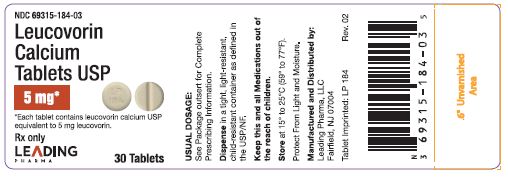
3 DOSAGE FORMS AND STRENGTHS Leucovorin calcium tablets: 5 mg tablets are supplied as a white to off-white to pale yellow, round tablet; scored on one side and "LP" over "184" debossed on the other side; bottles of 30 (NDC 69315-184-03) and 100 (NDC 69315-184-01). 10 mg tablets are supplied as a white to off-white to pale yellow, round tablet; scored on one side and "LP" over "185" debossed on the other side; bottles of 12 (NDC 69315-185-12) and 24 (NDC 69315-185-24). 15 mg tablets are supplied as a white to off-white to pale yellow, round tablet; scored on one side and "LP" over "186" debossed on the other side; bottles of 24 (NDC 69315-186-24).
25 mg tablets are supplied as a white to off-white to pale yellow, round tablet; scored on one side and "LP" over "187" debossed on the other side; bottles of 25 (NDC 69315-187-25). Tablets: 5 mg, 10 mg, 15 mg, 25 mg of leucovorin (3)
⛔ Contraindications ▾
4 CONTRAINDICATIONS Leucovorin is contraindicated in patients with a history of hypersensitivity reaction depending on indication as described below, to leucovorin (folinic acid), levoleucovorin, folic acid, or any component of leucovorin [see Description (11) ]: Folic acid antagonist or DHFR inhibitor toxicity: history of severe hypersensitivity reaction FOLR1-CFTD: history of any hypersensitivity reaction Reactions have included anaphylactic reactions [see Warnings and Precautions (5.1) ] . History of hypersensitivity reaction, depending on indication, to leucovorin (folinic acid), levoleucovorin, folic acid, or any component of leucovorin calcium tablets: folic acid antagonist or DHFR inhibitor toxicity: history of a severe hypersensitivity reaction FOLR1-CFTD: history of any hypersensitivity reaction.
(4, 5.1)
⚠️ Warnings and Cautions ▾
5 WARNINGS AND PRECAUTIONS Hypersensitivity Reactions : Withhold or permanently discontinue leucovorin based on severity and indication. (4, 5.1)
5.1Hypersensitivity Reactions Hypersensitivity reactions, including anaphylactic reactions and urticaria, have been reported following the administration of leucovorin. Leucovorin is contraindicated for the treatment of folic acid antagonist or DHFR inhibitor toxicity in patients with a history of a severe hypersensitivity reaction and for the treatment of FOLR1-CFTD in patients with a history of any hypersensitivity reaction to leucovorin, levoleucovorin, folic acid, or any component of leucovorin [see Contraindications (4) ] .
Withhold or permanently discontinue leucovorin based on the severity of hypersensitivity.
5.1Hypersensitivity Reactions Hypersensitivity reactions, including anaphylactic reactions and urticaria, have been reported following the administration of leucovorin. Leucovorin is contraindicated for the treatment of folic acid antagonist or DHFR inhibitor toxicity in patients with a history of a severe hypersensitivity reaction and for the treatment of FOLR1-CFTD in patients with a history of any hypersensitivity reaction to leucovorin, levoleucovorin, folic acid, or any component of leucovorin [see Contraindications (4) ] .
Withhold or permanently discontinue leucovorin based on the severity of hypersensitivity.
🤒 Adverse Reactions ▾
6 ADVERSE REACTIONS The following clinically significant adverse reactions are described elsewhere in the labeling: Hypersensitivity Reactions [see Warnings and Precautions (5.1) ]. The following adverse reactions have been identified during postapproval use of leucovorin (d,l-leucovorin) or levoleucovorin (l-leucovorin). Because these reactions are reported voluntarily from a population of uncertain size, it is not always possible to reliably estimate their frequency or establish a causal relationship to drug exposure.
Dermatologic: Pruritus, rash. Respiratory: Dyspnea. Other Clinical Events: Rigors, temperature change.
Safety information for the treatment of FOLR1-CFTD with oral leucovorin is limited. The available evidence is based on published case reports [see Clinical Studies (14.1) ] . Adverse reactions included pruritus, rash, urticaria, dyspnea, hypersensitivity reactions, rigors, and temperature change.
(6) To report SUSPECTED ADVERSE REACTIONS, contact Leading Pharma LLC at 1-844-740-7500 or FDA at 1-800-FDA-1088 or www.fda.gov/medwatch.
🔄 Drug Interactions ▾
7 DRUG INTERACTIONS Certain Antiepileptic Drugs : Increase monitoring for seizure activity in leucovorin-treated patients taking certain concomitant antiepileptic drugs. Certain antiepileptic drugs may reduce the effectiveness of leucovorin. (7.1, 7.2) Trimethoprim-Sulfamethoxazole : Avoid concomitant use of leucovorin with trimethoprim-sulfamethoxazole.
(7.1) Fluorouracil : Leucovorin may enhance the toxicity of fluorouracil. Deaths from severe enterocolitis, diarrhea, and dehydration have been reported in elderly patients. (7.1)
7.1Effects of Leucovorin on Other Drugs Certain Antiepileptic Drugs Increase monitoring for seizure activity in leucovorin-treated patients taking certain concomitant antiepileptic drugs. Folic acid in high doses may reduce the effectiveness of certain antiepileptic drugs (e.g., phenobarbital, phenytoin, and primidone) and thereby increase the frequency of seizures in susceptible patients, including pediatric patients. It is not known whether folinic acid, including leucovorin, has the same effects; however, both folic and folinic acids, including leucovorin, share some common metabolic pathways.
Trimethoprim-Sulfamethoxazole Avoid concomitant use of leucovorin with trimethoprim-sulfamethoxazole. The effectiveness of trimethoprim-sulfamethoxazole can be decreased if used concomitantly with leucovorin, which was associated with increased rates of treatment failure and mortality in patients with HIV infection who receive trimethoprim-sulfamethoxazole for the acute treatment of Pneumocystis jirovecii pneumonia. Fluorouracil Leucovorin may enhance the toxicity of fluorouracil.
Deaths from severe enterocolitis, diarrhea, and dehydration have been reported in elderly patients receiving weekly leucovorin and fluorouracil. Concomitant granulocytopenia and fever were present in some but not all of the patients.
7.2Effect of Other Drugs on Leucovorin Certain antiepileptic drugs may reduce folate absorption and metabolism leading to folate deficiency. As folic acid and folinic acid share common metabolic pathways, certain antiepileptic drugs may reduce the effectiveness of leucovorin.
7.1Effects of Leucovorin on Other Drugs Certain Antiepileptic Drugs Increase monitoring for seizure activity in leucovorin-treated patients taking certain concomitant antiepileptic drugs. Folic acid in high doses may reduce the effectiveness of certain antiepileptic drugs (e.g., phenobarbital, phenytoin, and primidone) and thereby increase the frequency of seizures in susceptible patients, including pediatric patients. It is not known whether folinic acid, including leucovorin, has the same effects; however, both folic and folinic acids, including leucovorin, share some common metabolic pathways.
Trimethoprim-Sulfamethoxazole Avoid concomitant use of leucovorin with trimethoprim-sulfamethoxazole. The effectiveness of trimethoprim-sulfamethoxazole can be decreased if used concomitantly with leucovorin, which was associated with increased rates of treatment failure and mortality in patients with HIV infection who receive trimethoprim-sulfamethoxazole for the acute treatment of Pneumocystis jirovecii pneumonia. Fluorouracil Leucovorin may enhance the toxicity of fluorouracil.
Deaths from severe enterocolitis, diarrhea, and dehydration have been reported in elderly patients receiving weekly leucovorin and fluorouracil. Concomitant granulocytopenia and fever were present in some but not all of the patients.
7.2Effect of Other Drugs on Leucovorin Certain antiepileptic drugs may reduce folate absorption and metabolism leading to folate deficiency. As folic acid and folinic acid share common metabolic pathways, certain antiepileptic drugs may reduce the effectiveness of leucovorin.
👥 Use in Specific Populations ▾
8 USE IN SPECIFIC POPULATIONS
8.1Pregnancy Risk Summary Available data on the intermittent use of leucovorin for the treatment of folic acid antagonist or DHFR inhibitor toxicity during pregnancy have not identified a drug-associated risk of major birth defects, miscarriage, or adverse maternal or fetal outcomes. There are no adequate data on the use of leucovorin for the treatment of FOLR1-CFTD in pregnant women. Adequate animal reproductive and developmental studies have not been conducted with leucovorin.
In the U.S. general population, the estimated background risk of major birth defects and miscarriage in clinically recognized pregnancies is 2% to 4% and 15% to 20%, respectively. Risks with Concomitant Use of leucovorin and Chemotherapy Drugs administered in combination with leucovorin may cause fetal harm. Refer to the Prescribing Information for the chemotherapy administered in combination with leucovorin for additional information, as appropriate.
8.2Lactation Risk Summary There are no data on the presence of leucovorin in human milk, the effects on the breastfed infant, or the effects on milk production. The developmental and health benefits of breastfeeding should be considered along with the mother’s clinical need for leucovorin and any potential adverse effects on the breastfed infant from leucovorin or from the underlying maternal condition. Refer to the Prescribing Information for chemotherapy administered in combination with leucovorin for breastfeeding recommendations, as appropriate.
8.4Pediatric Use Leucovorin is indicated for the treatment of cerebral folate transport deficiency in pediatric patients who have a confirmed variant in the folate receptor 1 gene (FOLR1-CFTD) [see Clinical Studies (14.1) ] . The safety and effectiveness of leucovorin have not been established to reduce the toxicity of methotrexate in pediatric patients with impaired methotrexate elimination or in pediatric patients to reduce the toxicity of folic acid antagonists or dihydrofolate reductase (DHFR) inhibitors following an overdose.
Folic acid in large amounts may counteract the antiepileptic effect of phenobarbital, phenytoin, and primidone, and increase the frequency of seizures in susceptible pediatric patients [see Drug Interactions (7.1) ] .
8.5Geriatric Use There is insufficient information in patients 65 years of age and older on the use of leucovorin to reduce the toxicity of methotrexate, other folic acid antagonists, or DHFR inhibitors, and there is no information on the use of leucovorin to treat FOLR1-CFTD in patients 65 years of age and older to determine whether they respond differently from younger patients [see Clinical Studies (14.1) ] .
🤰 Pregnancy ▾
8.1Pregnancy Risk Summary Available data on the intermittent use of leucovorin for the treatment of folic acid antagonist or DHFR inhibitor toxicity during pregnancy have not identified a drug-associated risk of major birth defects, miscarriage, or adverse maternal or fetal outcomes. There are no adequate data on the use of leucovorin for the treatment of FOLR1-CFTD in pregnant women. Adequate animal reproductive and developmental studies have not been conducted with leucovorin.
In the U.S. general population, the estimated background risk of major birth defects and miscarriage in clinically recognized pregnancies is 2% to 4% and 15% to 20%, respectively. Risks with Concomitant Use of leucovorin and Chemotherapy Drugs administered in combination with leucovorin may cause fetal harm. Refer to the Prescribing Information for the chemotherapy administered in combination with leucovorin for additional information, as appropriate.
🧒 Pediatric Use ▾
8.4Pediatric Use Leucovorin is indicated for the treatment of cerebral folate transport deficiency in pediatric patients who have a confirmed variant in the folate receptor 1 gene (FOLR1-CFTD) [see Clinical Studies (14.1) ] . The safety and effectiveness of leucovorin have not been established to reduce the toxicity of methotrexate in pediatric patients with impaired methotrexate elimination or in pediatric patients to reduce the toxicity of folic acid antagonists or dihydrofolate reductase (DHFR) inhibitors following an overdose.
Folic acid in large amounts may counteract the antiepileptic effect of phenobarbital, phenytoin, and primidone, and increase the frequency of seizures in susceptible pediatric patients [see Drug Interactions (7.1) ] .
🧓 Geriatric Use ▾
8.5Geriatric Use There is insufficient information in patients 65 years of age and older on the use of leucovorin to reduce the toxicity of methotrexate, other folic acid antagonists, or DHFR inhibitors, and there is no information on the use of leucovorin to treat FOLR1-CFTD in patients 65 years of age and older to determine whether they respond differently from younger patients [see Clinical Studies (14.1) ] .
🆘 Overdosage ▾
10 OVERDOSAGE Consider contacting the Poison Help line (1-800-222-1222) or a medical toxicologist for overdose management recommendations.
🧬 Clinical Pharmacology ▾
12 CLINICAL PHARMACOLOGY
12.1Mechanism of Action Levoleucovorin, a reduced folate and the pharmacologically active isomer of leucovorin (5-formyl-tetrahydrofolic acid), can mitigate the toxic effects of folate antagonists, including methotrexate and other agents that inhibit dihydrofolate reductase (DHFR). Inhibition of DHFR blocks the formation of tetrahydrofolate, an essential cofactor for DNA synthesis and repair. Levoleucovorin has been observed to increase levels of 5-MTHF, an active metabolite of folate, in case studies of FOLR1-CFTD [see Clinical Studies (14.1) ] .
12.2Pharmacodynamics Levoleucovorin and its metabolites (5,10-methenyltetrahydrofolate, 5,10-methylenetetrahydrofolate, and 5-MTHF) serve as cofactors in “one carbon” metabolism. These reactions are involved in the generation of nucleic acids and the regulation of gene expression.
12.3Pharmacokinetics Leucovorin is a racemic mixture of (l)- or levoleucovorin and (d)- or dextroleucovorin. Following oral administration of leucovorin to healthy adults, dextroleucovorin, levoleucovorin, and 5-MTHF exposures increased in a dose proportional manner with doses up to 25 mg, but in a less than dose proportional manner with doses greater than 25 mg. Absorption Following oral administration of leucovorin in adults, the apparent bioavailability of levoleucovorin is 97% for 25 mg, 75% for 50 mg, and 37% for 100 mg, and dextroleucovorin is approximately 19% for 25 mg, 20% for 50 mg, and 7% for 100 mg.
After a single oral 15 mg (7.5 mg/m 2 ) dose of leucovorin, time to peak serum folate concentration is 1.7 hours. Effect of Food: The effect of food on the pharmacokinetics of leucovorin has not been evaluated. As leucovorin is a highly soluble and well absorbed drug, and different immediate-release oral formulations of leucovorin (oral tablet and oral solution) showed relatively higher bioavailability of total folates (>95%), food is not expected to have a clinically significant effect on the pharmacokinetics of leucovorin or 5-MTHF.
Crushing of leucovorin tablets and mixing with food or liquid has been reported in literature. Distribution Levoleucovorin is minimally bound to human serum albumin. The reported human serum albumin binding of 5-MTHF ranges from 42-49%.
Leucovorin is not observed in cerebrospinal fluid (CSF) and 5-MTHF is reported to accumulate in CSF in children with leukemia. Elimination After intravenous administration of leucovorin in adults, the reported mean plasma elimination half-life in the literature was 0.5-1.3 hours for levoleucovorin and 3-7 hours for 5-MTHF. Metabolism: Following administration of oral leucovorin, levoleucovorin undergoes metabolism in intestinal cells via methenyltetrahydrofolate synthetase (MTHFS) and methylenetetrahydrofolate reductase (MTHFR) to its active metabolite, 5-MTHF.
5-MTHF is the main active metabolite in plasma after oral administration of leucovorin. Excretion: Leucovorin is mainly excreted by the kidney as unchanged dextroleucovorin, levoleucovorin, or as 5-MTHF, the metabolic product of levoleucovorin. Specific Populations Patients with Renal Impairment: The kidney is reported to contribute to the elimination of dextroleucovorin, levoleucovorin and its active metabolite, and plasma concentrations of dextroleucovorin, levoleucovorin, and 5-MTHF may be increased in patients with renal impairment.
However, clinical studies on the impact of renal impairment have not been conducted. Patients with Hepatic Impairment: The liver is reported to contribute to the metabolism of levoleucovorin, and plasma concentrations of levoleucovorin and 5-MTHF may be increased in patients with hepatic impairment. However, clinical studies on the impact of hepatic impairment have not been conducted.
🧬 Mechanism of Action ▾
12.1Mechanism of Action Levoleucovorin, a reduced folate and the pharmacologically active isomer of leucovorin (5-formyl-tetrahydrofolic acid), can mitigate the toxic effects of folate antagonists, including methotrexate and other agents that inhibit dihydrofolate reductase (DHFR). Inhibition of DHFR blocks the formation of tetrahydrofolate, an essential cofactor for DNA synthesis and repair. Levoleucovorin has been observed to increase levels of 5-MTHF, an active metabolite of folate, in case studies of FOLR1-CFTD [see Clinical Studies (14.1) ] .
📦 How Supplied / Storage and Handling ▾
16 HOW SUPPLIED/STORAGE AND HANDLING
16.1How Supplied Leucovorin Calcium Tablets, USP: 5 mg tablets are supplied as a white to off-white to pale yellow, round tablet; scored on one side and "LP" over "184" debossed on the other side; bottles of 30 (NDC 69315-184-03) and 100 (NDC 69315-184-01). 10 mg tablets are supplied as a white to off-white to pale yellow, round tablet; scored on one side and "LP" over "185" debossed on the other side; bottles of 12 (NDC 69315-185-12) and 24 (NDC 69315-185-24). 15 mg tablets are supplied as a white to off-white to pale yellow, round tablet; scored on one side and "LP" over " 186" debossed on the other side; bottles of 24 (NDC 69315-186-24).
25 mg tablets are supplied as a white to off-white to pale yellow, round tablet; scored on one side and "LP" over " 187" debossed on the other side; bottles of 25 (NDC 69315-187-25). Storage and Handling Store at 15°C to 25°C (59°F to 77°F). Protect from light and moisture.
16.1How Supplied Leucovorin Calcium Tablets, USP: 5 mg tablets are supplied as a white to off-white to pale yellow, round tablet; scored on one side and "LP" over "184" debossed on the other side; bottles of 30 (NDC 69315-184-03) and 100 (NDC 69315-184-01). 10 mg tablets are supplied as a white to off-white to pale yellow, round tablet; scored on one side and "LP" over "185" debossed on the other side; bottles of 12 (NDC 69315-185-12) and 24 (NDC 69315-185-24). 15 mg tablets are supplied as a white to off-white to pale yellow, round tablet; scored on one side and "LP" over " 186" debossed on the other side; bottles of 24 (NDC 69315-186-24).
25 mg tablets are supplied as a white to off-white to pale yellow, round tablet; scored on one side and "LP" over " 187" debossed on the other side; bottles of 25 (NDC 69315-187-25). Storage and Handling Store at 15°C to 25°C (59°F to 77°F). Protect from light and moisture.
📋 Description ▾
11 DESCRIPTION Leucovorin Calcium Tablets contain either 5 mg, 10 mg, 15 mg or 25 mg leucovorin as the calcium salt of N -[4-[[(2-amino-5-formyl-1,4,5,6,7,8-hexahydro-4-oxo-6-pteridinyl)methyl]amino]benzoyl]- L - glutamic acid and the inactive ingredients Colloidal Silicon Dioxide, Croscarmellose Sodium, Magnesium Stearate, Microcrystalline Cellulose and Pregelatinized Starch. This is equivalent to 5.4 mg, 10.8 mg, 16.21 mg or 27.01 mg of anhydrous leucovorin calcium. Leucovorin is a water soluble form of reduced folate in the folate group; it is useful as an antidote to drugs which act as folic acid antagonists.
These tablets are intended for oral administration only. The structural formula of leucovorin calcium is: Chemical structure
🧬 Pharmacokinetics ▾
12.3Pharmacokinetics Leucovorin is a racemic mixture of (l)- or levoleucovorin and (d)- or dextroleucovorin. Following oral administration of leucovorin to healthy adults, dextroleucovorin, levoleucovorin, and 5-MTHF exposures increased in a dose proportional manner with doses up to 25 mg, but in a less than dose proportional manner with doses greater than 25 mg. Absorption Following oral administration of leucovorin in adults, the apparent bioavailability of levoleucovorin is 97% for 25 mg, 75% for 50 mg, and 37% for 100 mg, and dextroleucovorin is approximately 19% for 25 mg, 20% for 50 mg, and 7% for 100 mg.
After a single oral 15 mg (7.5 mg/m 2 ) dose of leucovorin, time to peak serum folate concentration is 1.7 hours. Effect of Food: The effect of food on the pharmacokinetics of leucovorin has not been evaluated. As leucovorin is a highly soluble and well absorbed drug, and different immediate-release oral formulations of leucovorin (oral tablet and oral solution) showed relatively higher bioavailability of total folates (>95%), food is not expected to have a clinically significant effect on the pharmacokinetics of leucovorin or 5-MTHF.
Crushing of leucovorin tablets and mixing with food or liquid has been reported in literature. Distribution Levoleucovorin is minimally bound to human serum albumin. The reported human serum albumin binding of 5-MTHF ranges from 42-49%.
Leucovorin is not observed in cerebrospinal fluid (CSF) and 5-MTHF is reported to accumulate in CSF in children with leukemia. Elimination After intravenous administration of leucovorin in adults, the reported mean plasma elimination half-life in the literature was 0.5-1.3 hours for levoleucovorin and 3-7 hours for 5-MTHF. Metabolism: Following administration of oral leucovorin, levoleucovorin undergoes metabolism in intestinal cells via methenyltetrahydrofolate synthetase (MTHFS) and methylenetetrahydrofolate reductase (MTHFR) to its active metabolite, 5-MTHF.
5-MTHF is the main active metabolite in plasma after oral administration of leucovorin. Excretion: Leucovorin is mainly excreted by the kidney as unchanged dextroleucovorin, levoleucovorin, or as 5-MTHF, the metabolic product of levoleucovorin. Specific Populations Patients with Renal Impairment: The kidney is reported to contribute to the elimination of dextroleucovorin, levoleucovorin and its active metabolite, and plasma concentrations of dextroleucovorin, levoleucovorin, and 5-MTHF may be increased in patients with renal impairment.
However, clinical studies on the impact of renal impairment have not been conducted. Patients with Hepatic Impairment: The liver is reported to contribute to the metabolism of levoleucovorin, and plasma concentrations of levoleucovorin and 5-MTHF may be increased in patients with hepatic impairment. However, clinical studies on the impact of hepatic impairment have not been conducted.
🧬 Pharmacodynamics ▾
12.2Pharmacodynamics Levoleucovorin and its metabolites (5,10-methenyltetrahydrofolate, 5,10-methylenetetrahydrofolate, and 5-MTHF) serve as cofactors in “one carbon” metabolism. These reactions are involved in the generation of nucleic acids and the regulation of gene expression.
🔬 Clinical Studies ▾
14 CLINICAL STUDIES
14.1Cerebral Folate Transport Deficiency with Folate Receptor 1 Genetic Variant (FOLR1-CFTD) FOLR1-CFTD is a very rare neurological syndrome. No clinical trials have been conducted to examine the efficacy and safety of leucovorin in patients with FOLR1 variants. Evidence for the efficacy and safety of leucovorin in patients with FOLR1-CFTD was derived from the published literature.
Forty-six patients with FOLR1-CFTD who received leucovorin treatment via various administration routes were identified in 26 published case reports and case reviews through 2024. Thirty cases were described in more than one publication. Of the 46 patients, a total of 27 (59%) were reported as having received leucovorin only via the oral administration route.
These 27 patients ranged from approximately 2 months of age to 33 years of age at treatment initiation, and 25 of the patients had dosing information. The starting oral dose ranged from 0.5 to 3 mg/kg/day, and was 2 mg/kg/day in 14 of the 25 patients. Of the 20 patients with dose escalation reported, 17 had a maximum dose ≤6 mg/kg/day (reported range: 1.7 to 8.5 mg/kg/day).
Information related to duration of use of leucovorin was limited, and there was no obvious relationship between the starting or maximum oral dose with patient demographics or disease severity. In some cases, it was reported that dose increase was based on clinical review of patient response. A range of clinical improvements in various neurological symptoms following treatment with oral leucovorin was reported for 24 of the 27 patients (e.g., reduction in severity or number of seizures; improvements in motor function, communication, and/or behavior).
The remaining 3 patients showed either no change or no progression of symptoms; both the observed clinical improvements and the lack of disease progression are unexpected when compared to the progressive natural history of these patients with FOLR1-CFTD. CSF 5-MTHF measurements were collected at varying, unspecified time points across patients, with timing broadly categorized as before or after treatment initiation in most cases. In the subset of 27 FOLR1-CFTD patients who received oral leucovorin only, pre-treatment 5-MTHF levels were very low (<10 nmol/L in 17 of 21 patients with observed levels) compared to reported reference ranges from 40 up to 240 nmol/L.
A subset of 7 patients had CSF 5-MTHF levels measured both before and after leucovorin initiation. All 7 patients experienced an increase in CSF 5-MTHF levels following treatment initiation, with 5 achieving normalization above 40 nmol/L.
14.1Cerebral Folate Transport Deficiency with Folate Receptor 1 Genetic Variant (FOLR1-CFTD) FOLR1-CFTD is a very rare neurological syndrome. No clinical trials have been conducted to examine the efficacy and safety of leucovorin in patients with FOLR1 variants. Evidence for the efficacy and safety of leucovorin in patients with FOLR1-CFTD was derived from the published literature.
Forty-six patients with FOLR1-CFTD who received leucovorin treatment via various administration routes were identified in 26 published case reports and case reviews through 2024. Thirty cases were described in more than one publication. Of the 46 patients, a total of 27 (59%) were reported as having received leucovorin only via the oral administration route.
These 27 patients ranged from approximately 2 months of age to 33 years of age at treatment initiation, and 25 of the patients had dosing information. The starting oral dose ranged from 0.5 to 3 mg/kg/day, and was 2 mg/kg/day in 14 of the 25 patients. Of the 20 patients with dose escalation reported, 17 had a maximum dose ≤6 mg/kg/day (reported range: 1.7 to 8.5 mg/kg/day).
Information related to duration of use of leucovorin was limited, and there was no obvious relationship between the starting or maximum oral dose with patient demographics or disease severity. In some cases, it was reported that dose increase was based on clinical r… [Excerpted — this section continues on DailyMed.]
🧪 Nonclinical Toxicology ▾
13 NONCLINICAL TOXICOLOGY
13.1Carcinogenesis, Mutagenesis, Impairment of Fertility Adequate studies to assess the potential for carcinogenicity or genotoxicity, or for adverse effects on fertility have not been conducted for leucovorin.
📄 Carcinogenesis, Mutagenesis, Impairment of Fertility ▾
13.1Carcinogenesis, Mutagenesis, Impairment of Fertility Adequate studies to assess the potential for carcinogenicity or genotoxicity, or for adverse effects on fertility have not been conducted for leucovorin.
📄 Recent Major Changes ▾
Indications and Usage (1.2) 3/2026 Dosage and Administration (2.1, 2.3) 3/2026 Contraindications (4) 3/2026 Warnings and Precautions (5.1) 3/2026
📄 Package Label / Principal Display Panel ▾
PACKAGE LABEL.PRINCIPAL DISPLAY PANEL container5mg30cc container5mg100cc container10mg12cc container10mg24cc container15mg24cc container25mg25cc