
Aloe 10,000 & Probiotics Ingredients & Drug Interactions
by NOW
What is this page for?
First and foremost: checking Aloe 10,000 & Probiotics against your medications. The heart of this page is the interaction checker and the full interaction report — how this product’s ingredients may interact with prescription and over-the-counter medicines you may be taking.
Around that, we add a pharmacist’s high-level view of the product as a whole — what’s inside, the evidence for its stated use, how transparent the label is, and what safety data exists — so you can see the full picture in one place. It’s educational information from our licensed clinical databases and the clinical staff at HelloPharmacist — not medical advice — and we don’t sell or endorse products. Our editorial policy
Aloe 10,000 & Probiotics is a dietary supplement by NOW with 11 active ingredients. Its ingredients are commonly taken for minor burns and skin irritation, wound healing, constipation.Based on those ingredients, 641 medications have a known interaction with it, the most serious rated major. The ingredients most likely to interact are organic Aloe Vera, Bifidobacterium longum BI-05, Bifidobacterium breve (Bb-03). Use the checker below to test your specific medication, or read the full HelloPharmacist Interaction Report.
Check Your Meds Against Aloe 10,000 & Probiotics by NOW
Ask about any prescription or over-the-counter medication and we check it for interactions with Aloe 10,000 & Probiotics by NOW — and tell you which ingredient is responsible.
AI summaries are generated from our interaction database for education only — always confirm with your pharmacist. How we use AI
Ask the Pharmacist
A licensed pharmacist will answer your question by email — free, usually within 24 hours.
Got it — thank you!
A licensed pharmacist will answer within 24 hours. Keep an eye on your email (worth checking spam, just in case).
HelloPharmacist Scorecard of Aloe 10,000 & Probiotics by NOW
Our pharmacy team’s full take, with four database checks built into the cards below — a summary of what is known, not a grade of the product itself.
What’s inside
Low disclosure
This product combines 11 ingredients: a probiotic blend of 10 bacterial strains (Streptococcus thermophilus, Bifidobacterium longum, Bifidobacterium breve, Lactobacillus paracasei, Lactobacillus plantarum, Lactobacillus acidophilus, Lactobacillus rhamnosus, Lactobacillus casei, Bifidobacterium animalis lactis, and Lactobacillus salivarius) plus organic aloe vera. The probiotics are live microorganisms intended to support digestive and immune function, while the aloe vera serves as a soothing botanical.
The remaining contents are inactive ingredients — microcrystalline cellulose, hypromellose, fructooligosaccharides, stearic acid, and silicon dioxide — which are fillers and binders that form the capsule.
Does it work?
Moderate evidence
Evidence for the probiotics in this product varies. Lactobacillus acidophilus has possibly effective data for irritable bowel syndrome, Helicobacter pylori infection, antibiotic-associated diarrhea, and bacterial vaginosis, though it appears possibly ineffective for atopic disease.
The other probiotic strains — Streptococcus thermophilus, Bifidobacterium longum, Bifidobacterium breve, and the strains we could not check — have insufficient evidence to rate for the conditions studied. Aloe vera shows possibly effective evidence for acne, obesity, diabetes, psoriasis, burns, and constipation.
Because this product contains both aloe and multiple probiotics with limited evidence, the overall effectiveness depends on which of these conditions you're targeting — and that's a conversation worth having with your doctor or pharmacist.
How safe is it?
Well-documented data
The probiotics in this product are generally well tolerated in healthy people but require caution in those with weakened immune systems, serious illness, or indwelling catheters; rare cases of bloodstream infection (bacteremia) and sepsis have occurred in critically ill and immunocompromised patients. Oral aloe latex carries greater risks than the gel — it commonly causes abdominal pain, cramps, and diarrhea, and long-term overuse can lead to serious potassium depletion, muscle weakness, and heart rhythm problems.
For pregnancy: aloe is rated possibly unsafe because the latex may stimulate the uterus and act as a strong laxative; the probiotics Lactobacillus acidophilus and Bifidobacterium longum are possibly safe, but data are limited, so discuss with your doctor first. For breastfeeding: aloe is possibly unsafe due to laxative effects and limited data; most probiotic data on breastfeeding is insufficient, so check with your healthcare provider before use.
Meds to double-check
Major interaction found
Check before taking if you use digoxin (Lanoxin) or other heart medications — aloe can raise toxicity risk. Also double-check antibiotic drugs, blood thinners (warfarin, antiplatelet drugs like aspirin), diabetes medications, water pills (diuretics), strong laxatives, or medications processed through the liver's CYP1A2 system.
Separating antibiotic doses from the probiotics by a few hours may help preserve the supplement's live organisms.
The bottom line
Scorecard at a glanceFormula with limited ingredient disclosure with some supporting evidence behind its ingredients' uses. Major medication interactions have been identified, and safety information is well characterized.
This product may help with certain digestive conditions and skin concerns if you're in good health and not taking antibiotics or heart, blood-thinning, diabetes, or diuretic medications. If you take any of those drugs — especially digoxin — or have a weakened immune system, talk with your doctor or pharmacist before starting.
Anyone pregnant or breastfeeding should discuss it with their provider first, since aloe poses risks and probiotic safety data are limited.
Educational only — not medical advice; always confirm with your pharmacist. Our editorial policy · How we use AI
Assessment coverage: 5 of 11 active ingredients matched to our full ingredient reviews (monographs). Based on the product label dated May 23, 2024.
This Scorecard evaluates available label information, ingredient evidence, and known medication-safety considerations. It does not independently verify product identity, purity, potency, contamination, or manufacturing quality. How these ratings are computed
General information
Key facts about Aloe 10,000 & Probiotics, straight from the product label.
| Brand | NOW |
|---|---|
| Barcode (UPC) | 733739030290 |
| Net contents | 60 Veg Capsule(s) |
| Market status | On market |
| Date entered into DSLD | May 23, 2024 |
| DSLD ID | 313559 |
| Product type | Other Combinations |
| Supplement form | Capsule |
| Dietary claims / uses | All Other, Structure/Function |
| Intended target group(s) | Vegan, Vegetarian, Adult (18 - 50 Years), Kosher, Gluten Free, Dairy Free |
Everything in this section is reproduced from the manufacturer’s own product label — it’s the label speaking, not HelloPharmacist. We show it so you can see exactly what the maker states; we don’t verify or endorse those statements.
Supplement Facts
The label details for Aloe 10,000 & Probiotics by NOW, sourced from the NIH Dietary Supplement Label Database.
Supplement Facts
| Ingredient | Amount | % DV |
|---|---|---|
| Streptococcus thermophilus (St-21) | 0 NP | -- |
| Bifidobacterium longum BI-05 | 0 NP | -- |
| Bifidobacterium breve (Bb-03) | 0 NP | -- |
| Lactobacillus paracasei Lpc-37 | 0 NP | -- |
| Lactobacillus plantarum (Lp-115) | 0 NP | -- |
| organic Aloe Vera | 50 mg | -- |
| Blend of 10 Strains of Probiotic Bacteria | 40 mg | -- |
| Lactobacillus acidophilus La-14 | 0 NP | -- |
| Lactobacillus rhamnosus (Lr-32) | 0 NP | -- |
| Lactobacillus casei (Lc-11) | 0 NP | -- |
| Bifidobacterium animalis lactis Bl-04 | 0 NP | -- |
| Lactobacillus salivarius (Ls-33) | 0 NP | -- |
Other ingredients: Microcrystalline Cellulose, Hypromellose, Fructooligosaccharides, Stearic Acid, Silicon Dioxide
Tap any ingredient to jump to its full detail below.
These statements are the manufacturer’s wording, reproduced from the product label — the label is saying it, not HelloPharmacist. We don’t verify or endorse them.
Suggested/Recommended/Usage/Directions
Suggested Usage: Take 1 capsule twice daily.
Storage
Keep refrigerated to maintain potency.
Formula
Aloe Vera offers a variety of nutrients, including vitamins, minerals, enzymes and amino acids. Aloe Vera’s constituent mucopolysaccharides, also known as glycosaminoglycans (GAGs), are thought to be its active component. Scientific studies have indicated that Aloe can help to support the body’s own healing processes. A 10-Strain Probiotic Blend has been included to complement Aloe’s role in the support of a healthy digestive system.
10,000 mg Aloe vera equivalency 10-strain (5 billion) Probiotic blend
Triangle K (Kosher)
FDA Disclaimer Statement
These statements have not been evaluated by the Food and Drug Administration. This product is not intended to diagnose, treat, cure or prevent any disease.
Precautions
Caution: For adults only.
Consult physician if pregnant/nursing, taking medication (especially immune-suppressing and anti-diabetes drugs), or have a medical condition (especially if immune system is compromised or if diabetic or hypoglycemic).
Keep out of reach of children.
Not manufactured with wheat, gluten, soy, milk, egg, fish, shellfish, tree nut or sesame ingredients. Produced in a GMP facility that processes other ingredients containing these allergens.
General Statements
This bottle is made from 100% PCR (post-consumer recycled) resin.
Digestive Family owned since 1968.
Formulation
Supports digestive health
Non-GMO
Vegetarian/Vegan
Made and quality tested in the USA with globally sourced ingredients.
Not manufactured with wheat, gluten, soy, milk, egg, fish, shellfish, tree nut or sesame ingredients.
Natural color variation may occur in this product.
The probiotic strains in this product have been identity-verified using DNA-fingerprinting technology.
Seals/Symbols
Triangle K (Kosher)
Strain Verified
GMP Quality Assured
FDA Statement of Identity
A Dietary Supplement
Is this label outdated? Report a formula or label change and our pharmacy team will review it.
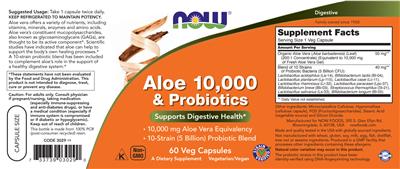
Aloe 10,000 & Probiotics by NOW label
The label scan from the NIH Dietary Supplement Label Database. Tap to enlarge.
Label images are published by the NIH Dietary Supplement Label Database for the version of this product on file. Always read your actual product label.
View the full label (PDF)The Ingredients in Aloe 10,000 & Probiotics by NOW
These are the 11 active ingredients this product is made of. Select any to open its full monograph.
Serving size1 Veg Capsule(s) Dosage formCapsule Servings per container60 Amounts shown are per serving.
Most supplement products combine several ingredients, and a medication can interact with the product through any one of them. Each ingredient below shows whether it has known drug interactions.
Organic Aloe Vera
Interacts with461 drugs
Aloe vera gel is widely used on the skin for minor burns and irritation, and some research suggests it may help. Aloe latex (the yellow part) is a str...
Organic Aloe Vera monograph & interactionsBlend of 10 Strains of Probiotic Bacteria
- › Streptococcus thermophilus (St-21)
- › Bifidobacterium longum BI-05
- › Bifidobacterium breve (Bb-03)
- › Lactobacillus paracasei Lpc-37
- › Lactobacillus plantarum (Lp-115)
- › Lactobacillus acidophilus La-14
- › Lactobacillus rhamnosus (Lr-32)
- › Lactobacillus casei (Lc-11)
- › Bifidobacterium animalis lactis Bl-04
- › Lactobacillus salivarius (Ls-33)
Other (inactive) ingredients: Microcrystalline Cellulose, Hypromellose, Fructooligosaccharides, Stearic Acid, Silicon Dioxide. These complete the product’s ingredient list but are not active constituents.
Aloe 10,000 & Probiotics by NOW Drug Interactions
HelloPharmacist Interaction Report
NOW's Aloe 10,000 & Probiotics contains several ingredients with documented interactions — through its aloe vera, Bifidobacterium longum, Bifidobacterium breve, and Lactobacillus acidophilus content.
The most serious is aloe's interaction with digoxin (Lanoxin), a heart medication: overuse of aloe latex can deplete potassium, which raises the risk of toxicity when combined with digoxin.
Read the full breakdown — every affected drug type, severity by severity
Aloe also interacts with blood thinners and antiplatelet drugs (warfarin, aspirin, and others), raising bleeding risk; diabetes medications, potentially causing low blood sugar (hypoglycemia); water pills (diuretics), increasing potassium loss; and strong laxatives, compounding fluid and electrolyte loss. Additionally, aloe may lower the effectiveness of certain medications processed through the liver's CYP1A2 enzyme system.
All four probiotic strains we could check — Bifidobacterium longum, Bifidobacterium breve, and Lactobacillus acidophilus — interact with antibiotic drugs (severity: Moderate). Since these probiotics contain live organisms, taking antibiotics at the same time may kill them and reduce the product's effectiveness; separating doses by a few hours helps.
We could not check Lactobacillus paracasei, Lactobacillus plantarum, Lactobacillus rhamnosus, Lactobacillus casei, or Bifidobacterium animalis lactis for interactions — we hold no data for these strains. Altogether, these interactions span 641 individual medications.
Use the search tool on this page to check your exact medications before starting.
Check your own medications below · Editorial policy · How we use AI
Want to check YOUR meds against Aloe 10,000 & Probiotics?
Ask about interactions with your drugs in plain English — “Can I take it with lisinopril?” — and we find you the answer in seconds, ingredient by ingredient.
Go to the checkerIngredients driving the most interactions
Individual Drug Interactions
The ingredients in Aloe 10,000 & Probiotics interact with 641 drugs. Click any drug to see the details.
4 of the 11 ingredients in Aloe 10,000 & Probiotics interact with drugs. Each result below shows which ingredient is responsible. organic Aloe Vera Bifidobacterium longum BI-05 Bifidobacterium breve (Bb-03) Lactobacillus acidophilus La-14
DicumarolDicumarol
How Dicumarol interacts with Aloe 10,000 & Probiotics — through 1 ingredient. Tap an ingredient for the detail:
Organic Aloe VeraAnticoagulant/antiplatelet Drugs Moderate
Interaction Summary
Theoretically, aloe gel might increase the risk of bleeding when taken with anticoagulant or antiplatelet drugs.
Read the full Organic Aloe Vera + Dicumarol interactionDiphenhydramine Hydrochloride, Naproxen SodiumAleve PM
How Diphenhydramine Hydrochloride, Naproxen Sodium interacts with Aloe 10,000 & Probiotics — through 1 ingredient. Tap an ingredient for the detail:
Organic Aloe VeraAnticoagulant/antiplatelet Drugs, Cytochrome P450 1a2 (cyp1a2) Substrates Moderate
Interaction Summary
Theoretically, aloe gel might increase the risk of bleeding when taken with anticoagulant or antiplatelet drugs.
Read the full Organic Aloe Vera + Diphenhydramine Hydrochloride, Naproxen Sodium interactionDipyridamoleDipyridamole, Persantin, Persantin Injection, Persantin Retard, Persantine
How Dipyridamole interacts with Aloe 10,000 & Probiotics — through 1 ingredient. Tap an ingredient for the detail:
Organic Aloe VeraAnticoagulant/antiplatelet Drugs Moderate
Interaction Summary
Theoretically, aloe gel might increase the risk of bleeding when taken with anticoagulant or antiplatelet drugs.
Read the full Organic Aloe Vera + Dipyridamole interactionDirithromycinDynabac
How Dirithromycin interacts with Aloe 10,000 & Probiotics — through 3 ingredients. Tap an ingredient for the detail:
Bifidobacterium Breve (bb-03)Antibiotic Drugs Moderate
Interaction Summary
Theoretically, taking Bifidobacterium breve with antibiotic drugs might decrease the effectiveness of B.
Read the full Bifidobacterium Breve (bb-03) + Dirithromycin interactionBifidobacterium Longum Bi-05Antibiotic Drugs Moderate
Interaction Summary
Theoretically, taking Bifidobacterium longum with antibiotic drugs might decrease the effectiveness of B.
Read the full Bifidobacterium Longum Bi-05 + Dirithromycin interactionLactobacillus Acidophilus La-14Antibiotic Drugs Moderate
Interaction Summary
Theoretically, taking Lactobacillus acidophilus with antibiotic drugs might decrease the effectiveness of L.
Read the full Lactobacillus Acidophilus La-14 + Dirithromycin interactionDocusate Calcium, PhenolphthaleinDoxidan (Canadian)
How Docusate Calcium, Phenolphthalein interacts with Aloe 10,000 & Probiotics — through 1 ingredient. Tap an ingredient for the detail:
Organic Aloe VeraStimulant Laxatives Moderate
Interaction Summary
Theoretically, aloe latex might increase the risk for fluid and electrolyte loss when taken with stimulant laxatives.
Read the full Organic Aloe Vera + Docusate Calcium, Phenolphthalein interactionDocusate Sodium, PhenolphthaleinCorrectol, Modane Plus
How Docusate Sodium, Phenolphthalein interacts with Aloe 10,000 & Probiotics — through 1 ingredient. Tap an ingredient for the detail:
Organic Aloe VeraStimulant Laxatives Moderate
Interaction Summary
Theoretically, aloe latex might increase the risk for fluid and electrolyte loss when taken with stimulant laxatives.
Read the full Organic Aloe Vera + Docusate Sodium, Phenolphthalein interactionDocusate Sodium, Sennosides (otc Drug)Senokot-S
How Docusate Sodium, Sennosides (otc Drug) interacts with Aloe 10,000 & Probiotics — through 1 ingredient. Tap an ingredient for the detail:
Organic Aloe VeraStimulant Laxatives Moderate
Interaction Summary
Theoretically, aloe latex might increase the risk for fluid and electrolyte loss when taken with stimulant laxatives.
Read the full Organic Aloe Vera + Docusate Sodium, Sennosides (otc Drug) interactionDoripenemDoribax
How Doripenem interacts with Aloe 10,000 & Probiotics — through 3 ingredients. Tap an ingredient for the detail:
Lactobacillus Acidophilus La-14Antibiotic Drugs Moderate
Interaction Summary
Theoretically, taking Lactobacillus acidophilus with antibiotic drugs might decrease the effectiveness of L.
Read the full Lactobacillus Acidophilus La-14 + Doripenem interactionBifidobacterium Longum Bi-05Antibiotic Drugs Moderate
Interaction Summary
Theoretically, taking Bifidobacterium longum with antibiotic drugs might decrease the effectiveness of B.
Read the full Bifidobacterium Longum Bi-05 + Doripenem interactionBifidobacterium Breve (bb-03)Antibiotic Drugs Moderate
Interaction Summary
Theoretically, taking Bifidobacterium breve with antibiotic drugs might decrease the effectiveness of B.
Read the full Bifidobacterium Breve (bb-03) + Doripenem interactionDoxycyclineDoryx, Doxy, Doxy-D, Doxycin, Doxycycline Injection, Doxylin +6 more
How Doxycycline interacts with Aloe 10,000 & Probiotics — through 3 ingredients. Tap an ingredient for the detail:
Bifidobacterium Breve (bb-03)Antibiotic Drugs Moderate
Interaction Summary
Theoretically, taking Bifidobacterium breve with antibiotic drugs might decrease the effectiveness of B.
Read the full Bifidobacterium Breve (bb-03) + Doxycycline interactionBifidobacterium Longum Bi-05Antibiotic Drugs Moderate
Interaction Summary
Theoretically, taking Bifidobacterium longum with antibiotic drugs might decrease the effectiveness of B.
Read the full Bifidobacterium Longum Bi-05 + Doxycycline interactionLactobacillus Acidophilus La-14Antibiotic Drugs Moderate
Interaction Summary
Theoretically, taking Lactobacillus acidophilus with antibiotic drugs might decrease the effectiveness of L.
Read the full Lactobacillus Acidophilus La-14 + Doxycycline interactionDoxycycline HyclateActiclate, Acticlate Cap, Lymepak
How Doxycycline Hyclate interacts with Aloe 10,000 & Probiotics — through 3 ingredients. Tap an ingredient for the detail:
Lactobacillus Acidophilus La-14Antibiotic Drugs Moderate
Interaction Summary
Theoretically, taking Lactobacillus acidophilus with antibiotic drugs might decrease the effectiveness of L.
Read the full Lactobacillus Acidophilus La-14 + Doxycycline Hyclate interactionBifidobacterium Breve (bb-03)Antibiotic Drugs Moderate
Interaction Summary
Theoretically, taking Bifidobacterium breve with antibiotic drugs might decrease the effectiveness of B.
Read the full Bifidobacterium Breve (bb-03) + Doxycycline Hyclate interactionBifidobacterium Longum Bi-05Antibiotic Drugs Moderate
Interaction Summary
Theoretically, taking Bifidobacterium longum with antibiotic drugs might decrease the effectiveness of B.
Read the full Bifidobacterium Longum Bi-05 + Doxycycline Hyclate interactionDoxycycline MonohydrateErfacea
How Doxycycline Monohydrate interacts with Aloe 10,000 & Probiotics — through 3 ingredients. Tap an ingredient for the detail:
Bifidobacterium Longum Bi-05Antibiotic Drugs Moderate
Interaction Summary
Theoretically, taking Bifidobacterium longum with antibiotic drugs might decrease the effectiveness of B.
Read the full Bifidobacterium Longum Bi-05 + Doxycycline Monohydrate interactionLactobacillus Acidophilus La-14Antibiotic Drugs Moderate
Interaction Summary
Theoretically, taking Lactobacillus acidophilus with antibiotic drugs might decrease the effectiveness of L.
Read the full Lactobacillus Acidophilus La-14 + Doxycycline Monohydrate interactionBifidobacterium Breve (bb-03)Antibiotic Drugs Moderate
Interaction Summary
Theoretically, taking Bifidobacterium breve with antibiotic drugs might decrease the effectiveness of B.
Read the full Bifidobacterium Breve (bb-03) + Doxycycline Monohydrate interactionDoxycylineDoxychel
How Doxycyline interacts with Aloe 10,000 & Probiotics — through 3 ingredients. Tap an ingredient for the detail:
Bifidobacterium Breve (bb-03)Antibiotic Drugs Moderate
Interaction Summary
Theoretically, taking Bifidobacterium breve with antibiotic drugs might decrease the effectiveness of B.
Read the full Bifidobacterium Breve (bb-03) + Doxycyline interactionBifidobacterium Longum Bi-05Antibiotic Drugs Moderate
Interaction Summary
Theoretically, taking Bifidobacterium longum with antibiotic drugs might decrease the effectiveness of B.
Read the full Bifidobacterium Longum Bi-05 + Doxycyline interactionLactobacillus Acidophilus La-14Antibiotic Drugs Moderate
Interaction Summary
Theoretically, taking Lactobacillus acidophilus with antibiotic drugs might decrease the effectiveness of L.
Read the full Lactobacillus Acidophilus La-14 + Doxycyline interactionDulaglutideTrulicity
How Dulaglutide interacts with Aloe 10,000 & Probiotics — through 1 ingredient. Tap an ingredient for the detail:
Organic Aloe VeraAntidiabetes Drugs Moderate
Interaction Summary
Aloe might increase the risk of hypoglycemia when taken with antidiabetes drugs.
Read the full Organic Aloe Vera + Dulaglutide interactionEdoxabanSavaysa
How Edoxaban interacts with Aloe 10,000 & Probiotics — through 1 ingredient. Tap an ingredient for the detail:
Organic Aloe VeraAnticoagulant/antiplatelet Drugs Moderate
Interaction Summary
Theoretically, aloe gel might increase the risk of bleeding when taken with anticoagulant or antiplatelet drugs.
Read the full Organic Aloe Vera + Edoxaban interactionEffientPrasugrel
How Effient interacts with Aloe 10,000 & Probiotics — through 1 ingredient. Tap an ingredient for the detail:
Organic Aloe VeraAnticoagulant/antiplatelet Drugs Moderate
Interaction Summary
Theoretically, aloe gel might increase the risk of bleeding when taken with anticoagulant or antiplatelet drugs.
Read the full Organic Aloe Vera + Effient interactionEmpagliflozinJardiance
How Empagliflozin interacts with Aloe 10,000 & Probiotics — through 1 ingredient. Tap an ingredient for the detail:
Organic Aloe VeraAntidiabetes Drugs Moderate
Interaction Summary
Aloe might increase the risk of hypoglycemia when taken with antidiabetes drugs.
Read the full Organic Aloe Vera + Empagliflozin interactionEmpagliflozin, Linagliptin, Metformin HydrochlorideTrijardy XR
How Empagliflozin, Linagliptin, Metformin Hydrochloride interacts with Aloe 10,000 & Probiotics — through 1 ingredient. Tap an ingredient for the detail:
Organic Aloe VeraAntidiabetes Drugs Moderate
Interaction Summary
Aloe might increase the risk of hypoglycemia when taken with antidiabetes drugs.
Read the full Organic Aloe Vera + Empagliflozin, Linagliptin, Metformin Hydrochloride interactionEmpagliflozin, MetforminSynjardy
How Empagliflozin, Metformin interacts with Aloe 10,000 & Probiotics — through 1 ingredient. Tap an ingredient for the detail:
Organic Aloe VeraAntidiabetes Drugs Moderate
Interaction Summary
Aloe might increase the risk of hypoglycemia when taken with antidiabetes drugs.
Read the full Organic Aloe Vera + Empagliflozin, Metformin interactionEmpagliflozin, Metformin HydrochlorideSynjardy XR
How Empagliflozin, Metformin Hydrochloride interacts with Aloe 10,000 & Probiotics — through 1 ingredient. Tap an ingredient for the detail:
Organic Aloe VeraAntidiabetes Drugs Moderate
Interaction Summary
Aloe might increase the risk of hypoglycemia when taken with antidiabetes drugs.
Read the full Organic Aloe Vera + Empagliflozin, Metformin Hydrochloride interactionEnalapril Maleate, HydrochlorothiazideVaseretic
How Enalapril Maleate, Hydrochlorothiazide interacts with Aloe 10,000 & Probiotics — through 1 ingredient. Tap an ingredient for the detail:
Organic Aloe VeraDiuretic Drugs Moderate
Interaction Summary
Theoretically, aloe latex might increase the risk of hypokalemia when taken with diuretic drugs.
Read the full Organic Aloe Vera + Enalapril Maleate, Hydrochlorothiazide interactionEnoxacinPenetrex
How Enoxacin interacts with Aloe 10,000 & Probiotics — through 3 ingredients. Tap an ingredient for the detail:
Lactobacillus Acidophilus La-14Antibiotic Drugs Moderate
Interaction Summary
Theoretically, taking Lactobacillus acidophilus with antibiotic drugs might decrease the effectiveness of L.
Read the full Lactobacillus Acidophilus La-14 + Enoxacin interactionBifidobacterium Breve (bb-03)Antibiotic Drugs Moderate
Interaction Summary
Theoretically, taking Bifidobacterium breve with antibiotic drugs might decrease the effectiveness of B.
Read the full Bifidobacterium Breve (bb-03) + Enoxacin interactionBifidobacterium Longum Bi-05Antibiotic Drugs Moderate
Interaction Summary
Theoretically, taking Bifidobacterium longum with antibiotic drugs might decrease the effectiveness of B.
Read the full Bifidobacterium Longum Bi-05 + Enoxacin interactionEnoxaparinLovenox
How Enoxaparin interacts with Aloe 10,000 & Probiotics — through 1 ingredient. Tap an ingredient for the detail:
Organic Aloe VeraAnticoagulant/antiplatelet Drugs Moderate
Interaction Summary
Theoretically, aloe gel might increase the risk of bleeding when taken with anticoagulant or antiplatelet drugs.
Read the full Organic Aloe Vera + Enoxaparin interactionEptifibatideIntegrilin
How Eptifibatide interacts with Aloe 10,000 & Probiotics — through 1 ingredient. Tap an ingredient for the detail:
Organic Aloe VeraAnticoagulant/antiplatelet Drugs Moderate
Interaction Summary
Theoretically, aloe gel might increase the risk of bleeding when taken with anticoagulant or antiplatelet drugs.
Read the full Organic Aloe Vera + Eptifibatide interactionErtapenemInvanz
How Ertapenem interacts with Aloe 10,000 & Probiotics — through 3 ingredients. Tap an ingredient for the detail:
Lactobacillus Acidophilus La-14Antibiotic Drugs Moderate
Interaction Summary
Theoretically, taking Lactobacillus acidophilus with antibiotic drugs might decrease the effectiveness of L.
Read the full Lactobacillus Acidophilus La-14 + Ertapenem interactionBifidobacterium Breve (bb-03)Antibiotic Drugs Moderate
Interaction Summary
Theoretically, taking Bifidobacterium breve with antibiotic drugs might decrease the effectiveness of B.
Read the full Bifidobacterium Breve (bb-03) + Ertapenem interactionBifidobacterium Longum Bi-05Antibiotic Drugs Moderate
Interaction Summary
Theoretically, taking Bifidobacterium longum with antibiotic drugs might decrease the effectiveness of B.
Read the full Bifidobacterium Longum Bi-05 + Ertapenem interactionErtugliflozinSteglatro
How Ertugliflozin interacts with Aloe 10,000 & Probiotics — through 1 ingredient. Tap an ingredient for the detail:
Organic Aloe VeraAntidiabetes Drugs Moderate
Interaction Summary
Aloe might increase the risk of hypoglycemia when taken with antidiabetes drugs.
Read the full Organic Aloe Vera + Ertugliflozin interactionErtugliflozin, Metformin HydrochlorideSegluromet
How Ertugliflozin, Metformin Hydrochloride interacts with Aloe 10,000 & Probiotics — through 1 ingredient. Tap an ingredient for the detail:
Organic Aloe VeraAntidiabetes Drugs Moderate
Interaction Summary
Aloe might increase the risk of hypoglycemia when taken with antidiabetes drugs.
Read the full Organic Aloe Vera + Ertugliflozin, Metformin Hydrochloride interactionErythromycinE-Mycin, Ery-Tab, Eryc, EryPed Chewable, Erythro Base, Erythro E-C +6 more
How Erythromycin interacts with Aloe 10,000 & Probiotics — through 3 ingredients. Tap an ingredient for the detail:
Lactobacillus Acidophilus La-14Antibiotic Drugs Moderate
Interaction Summary
Theoretically, taking Lactobacillus acidophilus with antibiotic drugs might decrease the effectiveness of L.
Read the full Lactobacillus Acidophilus La-14 + Erythromycin interactionBifidobacterium Breve (bb-03)Antibiotic Drugs Moderate
Interaction Summary
Theoretically, taking Bifidobacterium breve with antibiotic drugs might decrease the effectiveness of B.
Read the full Bifidobacterium Breve (bb-03) + Erythromycin interactionBifidobacterium Longum Bi-05Antibiotic Drugs Moderate
Interaction Summary
Theoretically, taking Bifidobacterium longum with antibiotic drugs might decrease the effectiveness of B.
Read the full Bifidobacterium Longum Bi-05 + Erythromycin interactionErythromycin EthylsuccinateE.E.S. 400, E.E.S. Chewable, Wyamycin S
How Erythromycin Ethylsuccinate interacts with Aloe 10,000 & Probiotics — through 3 ingredients. Tap an ingredient for the detail:
Bifidobacterium Breve (bb-03)Antibiotic Drugs Moderate
Interaction Summary
Theoretically, taking Bifidobacterium breve with antibiotic drugs might decrease the effectiveness of B.
Read the full Bifidobacterium Breve (bb-03) + Erythromycin Ethylsuccinate interactionBifidobacterium Longum Bi-05Antibiotic Drugs Moderate
Interaction Summary
Theoretically, taking Bifidobacterium longum with antibiotic drugs might decrease the effectiveness of B.
Read the full Bifidobacterium Longum Bi-05 + Erythromycin Ethylsuccinate interactionLactobacillus Acidophilus La-14Antibiotic Drugs Moderate
Interaction Summary
Theoretically, taking Lactobacillus acidophilus with antibiotic drugs might decrease the effectiveness of L.
Read the full Lactobacillus Acidophilus La-14 + Erythromycin Ethylsuccinate interactionErythromycin Ethylsuccinate, SulfisoxazolePediazole
How Erythromycin Ethylsuccinate, Sulfisoxazole interacts with Aloe 10,000 & Probiotics — through 3 ingredients. Tap an ingredient for the detail:
Lactobacillus Acidophilus La-14Antibiotic Drugs Moderate
Interaction Summary
Theoretically, taking Lactobacillus acidophilus with antibiotic drugs might decrease the effectiveness of L.
Read the full Lactobacillus Acidophilus La-14 + Erythromycin Ethylsuccinate, Sulfisoxazole interactionBifidobacterium Longum Bi-05Antibiotic Drugs Moderate
Interaction Summary
Theoretically, taking Bifidobacterium longum with antibiotic drugs might decrease the effectiveness of B.
Read the full Bifidobacterium Longum Bi-05 + Erythromycin Ethylsuccinate, Sulfisoxazole interactionBifidobacterium Breve (bb-03)Antibiotic Drugs Moderate
Interaction Summary
Theoretically, taking Bifidobacterium breve with antibiotic drugs might decrease the effectiveness of B.
Read the full Bifidobacterium Breve (bb-03) + Erythromycin Ethylsuccinate, Sulfisoxazole interactionErythromycin GluceptateErythromycin Gluceptate
How Erythromycin Gluceptate interacts with Aloe 10,000 & Probiotics — through 3 ingredients. Tap an ingredient for the detail:
Bifidobacterium Breve (bb-03)Antibiotic Drugs Moderate
Interaction Summary
Theoretically, taking Bifidobacterium breve with antibiotic drugs might decrease the effectiveness of B.
Read the full Bifidobacterium Breve (bb-03) + Erythromycin Gluceptate interactionLactobacillus Acidophilus La-14Antibiotic Drugs Moderate
Interaction Summary
Theoretically, taking Lactobacillus acidophilus with antibiotic drugs might decrease the effectiveness of L.
Read the full Lactobacillus Acidophilus La-14 + Erythromycin Gluceptate interactionBifidobacterium Longum Bi-05Antibiotic Drugs Moderate
Interaction Summary
Theoretically, taking Bifidobacterium longum with antibiotic drugs might decrease the effectiveness of B.
Read the full Bifidobacterium Longum Bi-05 + Erythromycin Gluceptate interactionEach ingredient & the kinds of drugs it affects
For each ingredient in Aloe 10,000 & Probiotics with known interactions, here are the types of medications they can affect. Open any type for the detail — or search your exact drug in the checker above.
organic Aloe Vera
Digoxin (Lanoxin)
Theoretically, aloe latex might increase the risk of adverse effects when taken with cardiac glycosides.
Overuse of aloe latex can increase the risk of adverse effects from cardiac glycoside drugs, such as digoxin, due to potassium depletion. Overuse of aloe, along with cardiac glycoside drugs, can increase the risk of toxicity.
Anticoagulant/Antiplatelet Drugs
Theoretically, aloe gel might increase the risk of bleeding when taken with anticoagulant or antiplatelet drugs.
In vitro research shows that aloe gel can inhibit platelet aggregation. This inhibition was greater than that seen with celecoxib, but less than that seen with aspirin.
Antidiabetes Drugs
Aloe might increase the risk of hypoglycemia when taken with antidiabetes drugs.
Preliminary clinical research suggests aloe gel might lower blood glucose levels and have additive effects when used with antidiabetes drugs. Monitor blood glucose levels closely.
Diuretic Drugs
Theoretically, aloe latex might increase the risk of hypokalemia when taken with diuretic drugs.
Overuse of aloe latex might compound diuretic-induced potassium loss, increasing the risk of hypokalemia.
Stimulant Laxatives
Theoretically, aloe latex might increase the risk for fluid and electrolyte loss when taken with stimulant laxatives.
Due to cathartic laxative effects of aloe latex, concomitant use with other stimulant laxatives might compound fluid and electrolyte loss.
Warfarin (Coumadin)
Theoretically, aloe latex might increase the risk of bleeding when taken with warfarin.
Aloe latex has stimulant laxative effects. In some people aloe latex can cause diarrhea. Diarrhea can increase the effects of warfarin, increase international normalized ratio (INR), and increase the risk of bleeding. Advise patients who take warfarin not to take excessive amounts of aloe vera.
Cytochrome P450 1A2 (Cyp1A2) Substrates
Theoretically, aloe might decrease the levels and clinical effects of CYP1A2 substrates.
In vitro research shows that aloe extract induces CYP1A2 enzymes.
Bifidobacterium longum BI-05
Antibiotic Drugs
Theoretically, taking Bifidobacterium longum with antibiotic drugs might decrease the effectiveness of B. longum.
Since B. longum preparations usually contain live and active organisms, simultaneously taking antibiotics might kill a significant number of the organisms. Tell patients to separate administration of antibiotics and B. longum preparations by at least 2 hours.
Bifidobacterium breve (Bb-03)
Antibiotic Drugs
Theoretically, taking Bifidobacterium breve with antibiotic drugs might decrease the effectiveness of B. breve.
Since B. breve preparations usually contain live and active organisms, simultaneously taking antibiotics might kill a significant number of the organisms. Tell patients to separate administration of antibiotics and B. breve preparations by at least 2 hours.
Lactobacillus acidophilus La-14
Antibiotic Drugs
Theoretically, taking Lactobacillus acidophilus with antibiotic drugs might decrease the effectiveness of L. acidophilus.
L. acidophilus preparations usually contain live and active organisms. Therefore, simultaneously taking antibiotics might kill a significant number of the organisms. Tell patients to separate administration of antibiotics and L. acidophilus preparations by at least two hours.
Brand information
Manufacturer and brand details for Aloe 10,000 & Probiotics, from the product label.
NOW
See all NOW products- Name
- NOW FOODS
- Street Address
- 395 S. Glen Ellyn Rd.
- City
- Bloomingdale
- State
- IL
- ZipCode
- 60108
- Web Address
- nowfoods.com
Aloe 10,000 & Probiotics by NOW: Common Questions
Does Aloe 10,000 & Probiotics by NOW interact with any medications?
How can one product interact with so many drugs?
Where does this information come from?
Will this work if I'm taking antibiotics?
What are the probiotics actually supposed to do?
Is the aloe in here the same as aloe gel you put on a sunburn?
Can I take this while pregnant?
What side effects might I notice?
How many probiotic strains are actually in here?
Written and reviewed by the HelloPharmacist editorial staff. Our editorial policy
Not sure if Aloe 10,000 & Probiotics is safe with your meds?
Our pharmacists answer your medication & supplement questions — free.
Label information is sourced from the NIH Dietary Supplement Label Database and reflects the product version on file; always read your actual product label. This page is for education only and is not a substitute for professional medical advice. Confirm with your pharmacist or doctor before combining supplements and medications.
The Full Monographs Behind Aloe 10,000 & Probiotics’s Ingredients
Every ingredient we hold a full HelloPharmacist monograph for — uses, evidence, safety, and the complete interaction list.
Aloe
Interacts with 461 drugsAloe vera gel is widely used on the skin for minor burns and irritation, and some research suggests it may help. Aloe latex (the yellow part) is a strong laxative that can cause cramping and...
Read the full Aloe monograph → Herb & supplement monographStreptococcus Thermophilus
Streptococcus thermophilus is a friendly bacterium used as a probiotic, often combined with other strains in yogurt and supplements. It is generally well tolerated in healthy people and may...
Read the full Streptococcus Thermophilus monograph → Herb & supplement monographBifidobacterium Longum
Interacts with 182 drugsBifidobacterium longum is a 'friendly' bacterium found naturally in the human gut and used as a probiotic. It is generally well tolerated and is most studied for digestive issues, though evi...
Read the full Bifidobacterium Longum monograph → Herb & supplement monographBifidobacterium Breve
Interacts with 182 drugsBifidobacterium breve is a 'friendly' gut bacterium taken as a probiotic, most often to support digestion and balance the gut microbiome. Some studies suggest possible benefits for certain d...
Read the full Bifidobacterium Breve monograph → Herb & supplement monographLactobacillus Acidophilus
Interacts with 182 drugsLactobacillus acidophilus is a 'friendly' bacterium used as a probiotic to support gut and vaginal health. It is generally well tolerated in healthy people, and there is reasonable evidence...
Read the full Lactobacillus Acidophilus monograph →Sources & How We Checked
Aloe 10,000 & Probiotics's label data comes from the NIH Dietary Supplement Label Database; the ingredient interaction data is from the Natural Medicines database, reviewed by our pharmacists.
- NIH Dietary Supplement Label Database (DSLD) — The official product label on file for this supplement.
- Natural Medicines (Therapeutic Research Center) — Evidence-graded clinical reference behind the ingredient interaction data.
Content is written and reviewed by licensed HelloPharmacist pharmacists. See our data sources and editorial standards for how this information is built and checked.
The 107 references behind this product’s interaction data
Every citation that drives the interaction findings for this product’s ingredients, from the evidence-graded Natural Medicines (TRC Healthcare) database. Open an ingredient to browse its citations — links open the study on PubMed or the publisher’s site.
Streptococcus Thermophilus 21 references
- Saxelin M, Chuang NH, Chassy B, et al. Lactobacilli and bacteremia in southern Finland 1989-1992. Clin Infect Dis 1996;22:564-6. PubMed
- Tynkkynen S, Singh KV, Varmanen P. Vancomycin resistance factor of Lactobacillus rhamnosus GG in relation to enterococcal vancomycin resistance (van) genes. Int J Food Microbiol 1998;41:195-204. PubMed
- Klein G, Zill E, Schindler R, et al. Peritonitis associated with vancomycin-resistant Lactobacillus rhamnosus in a continuous ambulatory peritoneal dialysis patient; organism identification, antibiotic therapy, and case report. J Clin Microbiol 1998;36:
- Kalima P, Masterton RG, Roddie PH, et al. Lactobacillus rhamnosus infection in a child following bone marrow transplant. J Infect 1996;32:165-7. PubMed
- Goldin BR. Health Benefits of probiotics. Br J Nutr 1998;80:S203-7. DOI
- Rautio M, Jousimies-Somer H, Kauma H, et al. Liver abscess due to Lactobacillus rhamnosus strain indistinguishable from L. rhamnosus strain GG. Clin Infect Dis 1999;28:1159-60.
- MacGregor G, Smith AJ, Thakker B, Kinsella J. Yoghurt biotherapy: contraindicated in immunosuppressed patients? Postgrad Med J 2002;78:366-7. PubMed
- Land MH, Rouster-Stevens K, Woods CR, et al. Lactobacillus sepsis associated with probiotic therapy. Pediatrics 2005;115:178-81.
- De Groote MA, Frank DN, Dowell E, et al. Lactobacillus rhamnosus GG bacteremia associated with probiotic use in a child with short gut syndrome. Pediatr Infect Dis J 2005;24:278-80. PubMed
- Vahabnezhad E, Mochon AB, Wozniak LJ, Ziring DA. Lactobacillus bacteremia associated with probiotic use in a pediatric patient with ulcerative colitis. J Clin Gastroenterol. 2013;47(5):437-9. PubMed
- Dolatkhah N, Hajifaraji M, Abbasalizadeh F, Aghamohammadzadeh N, Mehrabi Y, Abbasi MM. Is there a value for probiotic supplements in gestational diabetes mellitus? A randomized clinical trial. J Health Popul Nutr. 2015;33:25. PubMed
- Pruccoli G, Silvestro E, Pace Napoleone C, Aidala E, Garazzino S, Scolfaro C. Are probiotics safe? Bifidobacterium bacteremia in a child with severe heart failure. Infez Med. 2019;27(2):175-178.
- Sendil S, Shrimanker I, Mansoora Q, Goldman J, Nookala VK. Lactobacillus rhamnosus bacteremia in an immunocompromised renal transplant patient. Cureus. 2020;12(2):e6887. PubMed
- Albarillo FS, Shah U, Joyce C, Slade D. Lactobacillus rhamnosus Infection: A single-center 4-year descriptive analysis. J Glob Infect Dis. 2020;12(3):119-123. PubMed
- Pasala S, Singer L, Arshad T, Roach K. Lactobacillus endocarditis in a healthy patient with probiotic use. IDCases. 2020;22:e00915. PubMed
- Agrawal S, Tuchman ES, Bruce MJ, Theodorou ME. Fatal Lactobacillus endocarditis in a patient with transcatheter aortic valve replacement. BMJ Case Rep. 2020;13(11):e236835.
- Antoun M, Hattab Y, Akhrass FA, Hamilton LD. Uncommon pathogen, Lactobacillus, causing infective endocarditis: Case report and review. Case Rep Infect Dis. 2020;2020:8833948. PubMed
- Rossi F, Amadoro C, Gasperi M, Colavita G. Lactobacilli infection case reports in the last three years and safety implications. Nutrients. 2022;14(6):1178. PubMed
- Franko B, Vaillant M, Recule C, Vautrin E, et al. Lactobacillus paracasei endocarditis in a consumer of probiotics. Med Mal Infect. 2013;43(4):171-3. PubMed
- Campbell RE, Miller A, Afroze A. Native valve endocarditis secondary to Lactobacillus paracasei bacteremia. Consultant. 2020;60(9):27-8. DOI
- Kato K, Funabashi N, Takaoka H, et al. Lactobacillus paracasei endocarditis in a consumer of probiotics with advanced and severe bicuspid aortic valve stenosis complicated with diffuse left ventricular mid-layer fibrosis. Int J Cardiol. 2016;224:157-161. PubMed
See these in context on the Streptococcus Thermophilus monograph →
Bifidobacterium Longum 21 references
- Ha GY, Yang CH, Kim H, Chong Y. Case of sepsis caused by Bifidobacterium longum. J Clin Microbiol 1999;37:1227-8.
- Pierce A. The American Pharmaceutical Association Practical Guide to Natural Medicines. New York: The Stonesong Press, 1999:19.
- Xiao JZ, Takahashi S, Odamaki T, et al. Antibiotic susceptibility of bifidobacterial strains distributed in the Japanese market. Biosci Biotechnol Biochem. 2010;74(2):336-42. PubMed
- Rautava S, Kainonen E, Salminen S, Isolauri E. Maternal probiotic supplementation during pregnancy and breast-feeding reduces the risk of eczema in the infant. J Allergy Clin Immunol. 2012;130(6):1355-60. PubMed
- Pruccoli G, Silvestro E, Pace Napoleone C, Aidala E, Garazzino S, Scolfaro C. Are probiotics safe? Bifidobacterium bacteremia in a child with severe heart failure. Infez Med. 2019;27(2):175-178.
- Pellonperä O, Vahlberg T, Mokkala K, et al. Weight gain and body composition during pregnancy: a randomised pilot trial with probiotics and/or fish oil. Br J Nutr. 2020 Nov 4:1-11. PubMed
- Pellonperä O, Mokkala K, Houttu N, et al. Efficacy of fish oil and/or probiotic intervention on the incidence of gestational diabetes mellitus in an at-risk group of overweight and obese women: A randomized, placebo-controlled, double-blind clinical trial PubMed
- Shahriari A, Karimi E, Shahriari M, Aslani N, Khooshideh M, Arab A. The effect of probiotic supplementation on the risk of gestational diabetes mellitus among high-risk pregnant women: A parallel double-blind, randomized, placebo-controlled clinical trial PubMed
- Esaiassen E, Hjerde E, Cavanagh JP, Simonsen GS, Klingenberg C; Norwegian Study Group on Invasive Bifidobacterial Infections. Bifidobacterium bacteremia: Clinical characteristics and a genomic approach to assess pathogenicity. J Clin Microbiol. 2017;55(7) PubMed
- Enomoto T, Sowa M, Nishimori K, et al. Effects of bifidobacterial supplementation to pregnant women and infants in the prevention of allergy development in infants and on fecal microbiota. Allergol Int 2014;63(4):575-85. PubMed
- US Food and Drug Administration (FDA). Dear Healthcare Provider Letter: Warning Regarding Use of Probiotics in Preterm Infants. September 2023. Available at: https://www.fda.gov/media/172606/download?attachment. Accessed November 1, 2023.
- Pillai A, Tan J, Paquette V, Panczuk J. Does probiotic bacteremia in premature infants impact clinically relevant outcomes? A case report and updated review of literature. Clin Nutr ESPEN. 2020;39:255-259. PubMed
- Sabaté JM, Iglicki F. Effect of Bifidobacterium longum 35624 on disease severity and quality of life in patients with irritable bowel syndrome. World J Gastroenterol 2022;28(7):732-744.
- Malaguarnera M, Greco F, Barone G, Gargante MP, Malaguarnera M, Toscano MA. Bifidobacterium longum with fructo-oligosaccharide (FOS) treatment in minimal hepatic encephalopathy: a randomized, double-blind, placebo-controlled study. Dig Dis Sci 2007;52(11) PubMed
- Zbinden A, Zbinden R, Berger C, Arlettaz R. Case series of Bifidobacterium longum bacteremia in three preterm infants on probiotic therapy. Neonatology 2015;107(1):56-9.
- Tamaki H, Nakase H, Inoue S, et al. Efficacy of probiotic treatment with Bifidobacterium longum 536 for induction of remission in active ulcerative colitis: A randomized, double-blinded, placebo-controlled multicenter trial. Dig Endosc 2016;28(1):67-74.
- Bertelli C, Pillonel T, Torregrossa A, et al. Bifidobacterium longum bacteremia in preterm infants receiving probiotics. Clin Infect Dis 2015;60(6):924-7. PubMed
- Esaiassen E, Cavanagh P, Hjerde E, Simonsen GS, Støen R, Klingenberg C. Bifidobacterium longum subspecies infantis bacteremia in 3 extremely preterm infants receiving probiotics. Emerg Infect Dis 2016;22(9):1664-6.
- Tena D, Losa C, Medina MJ, Sáez-Nieto JA. Peritonitis caused by Bifidobacterium longum: case report and literature review. Anaerobe 2014;27:27-30. PubMed
- Sangkanjanavanich S, Pradubpongsa P, Mitthamsiri W, Sangasapaviliya A, Boonpiyathad T. Bifidobacterium infantis 35624 efficacy in patients with uncontrolled asthma: A randomized placebo-controlled trial. Ann Allergy Asthma Immunol 2022;129(6):790-792. PubMed
- Wilson HL, Ong CW. Bifidobacterium longum vertebrodiscitis in a patient with cirrhosis and prostate cancer. Anaerobe 2017;47:47-50. PubMed
See these in context on the Bifidobacterium Longum monograph →
Bifidobacterium Breve 9 references
- Pierce A. The American Pharmaceutical Association Practical Guide to Natural Medicines. New York: The Stonesong Press, 1999:19.
- Xiao JZ, Takahashi S, Odamaki T, et al. Antibiotic susceptibility of bifidobacterial strains distributed in the Japanese market. Biosci Biotechnol Biochem. 2010;74(2):336-42. PubMed
- Pruccoli G, Silvestro E, Pace Napoleone C, Aidala E, Garazzino S, Scolfaro C. Are probiotics safe? Bifidobacterium bacteremia in a child with severe heart failure. Infez Med. 2019;27(2):175-178.
- Ohishi A, Takahashi S, Ito Y, et al. Bifidobacterium septicemia associated with postoperative probiotic therapy in a neonate with omphalocele. J Pediatr. 2010;156(4):679-81. PubMed
- Sakurai Y, Watanabe T, Miura Y, et al. Clinical and bacteriologic characteristics of six cases of Bifidobacterium breve bacteremia due to probiotic administration in the neonatal intensive care unit. Pediatr Infect Dis J 2022;41(1):62-65. PubMed
- Esaiassen E, Hjerde E, Cavanagh JP, Simonsen GS, Klingenberg C; Norwegian Study Group on Invasive Bifidobacterial Infections. Bifidobacterium bacteremia: Clinical characteristics and a genomic approach to assess pathogenicity. J Clin Microbiol. 2017;55(7) PubMed
- Wakabayashi Y, Nakayama S, Yamamoto A, et al. First case of necrotizing fasciitis and bacteremia caused by Bifidobacteriumbreve. Anaerobe 2022;76:102613.
- Takeda Y, Ota K, Kondo A, et al. A case of necrotizing fasciitis caused by Bifidobacterium breve. IDCases 2022;31:e01667. PubMed
- Suwantarat N, Romagnoli M, Wakefield T, Carroll KC. Ventriculoperitoneal shunt infection caused by Bifidobacterium breve. Anaerobe 2014;28:1-3. PubMed
See these in context on the Bifidobacterium Breve monograph →
Aloe 41 references
- Newall CA, Anderson LA, Philpson JD. Herbal Medicine: A Guide for Healthcare Professionals. London, UK: The Pharmaceutical Press, 1996.
- Wichtl MW. Herbal Drugs and Phytopharmaceuticals. Ed. N.M. Bisset. Stuttgart: Medpharm GmbH Scientific Publishers, 1994.
- Brinker F. Herb Contraindications and Drug Interactions. 2nd ed. Sandy, OR: Eclectic Medical Publications, 1998.
- Nusko G, Schneider B, Schneider I, et al. Anthranoid laxative use is not a risk factor for colorectal neoplasia: results of a prospective case control study. Gut 2000;46:651-5. PubMed
- Luyckx VA, Ballantine R, Claeys M, et al. Herbal remedy-associated acute renal failure secondary to Cape aloes. Am J Kidney Dis 2002;39:E13. PubMed
- Rajasekaran S, Sivagnanam K, Ravi K, Subramanian S. Hypoglycemic effect of Aloe vera gel on streptozotocin-induced diabetes in experimental rats. J Med Food 2004;7:61-6.
- Williams MS, Burk M, Loprinzi CL, et al. Phase III double-blind evaluation of an aloe vera gel as a prophylactic agent for radiation-induced skin toxicity. Int J Radiat Oncol Biol Phys 1996;36:345-9. PubMed
- Vogler BK, Ernst E. Aloe vera: a systematic review of its clinical effectiveness. Br J Gen Pract 1999;49:823-8.
- Bottenberg MM, Wall GC, Harvey RL, Habib S. Oral aloe vera-induced hepatitis. Ann Pharmacother 2007;41:1740-3. PubMed
- Rabe C, Musch A, Schirmacher P, et al. Acute hepatitis induced by an Aloe vera preparation: a case report. World J Gastroenterol 2005;11:303-4. PubMed
- Kanat O, Ozet A, Ataergin S. Aloe vera-induced acute toxic hepatitis in a healthy young man. Eur J Int Med 2006;17:589. PubMed
- Mueller SO, Stopper H. Characterization of the genotoxicity of anthraquinones in mammalian cells. Biochim Biophys Acta 1999;1428:406-14. PubMed
- Schorkhuber M, Richter M, Dutter A, et al. Effect of anthraquinone laxatives on the proliferation and urokinase secretion of normal, premalignant and malignant colonic epithelial cells. Eur J Cancer 1998;34:1091-8. PubMed
- Yang HN, Kim DJ, Kim YM, et al. Aloe-induced toxic hepatitis. J Korean Med Sci 2010;25:492-5. PubMed
- Choonhakarn C, Busaracome P, Sripanidkulchai B, et al. A prospective, randomized clinical trial comparing topical aloe vera with 0.1% triamcinolone acetonide in mild to moderate plaque psoriasis. J.Eur.Acad.Dermatol.Venereol. 2010;24:168-72. PubMed
- Ishii Y, Tanizawa H, Takino Y. Studies of aloe. IV. Mechanism of cathartic effect. (3). Biol Pharm Bull. 1994;17:495-7. PubMed
- Ishii Y, Tanizawa H, Takino Y. Studies of aloe. V. Mechanism of cathartic effect. (4). Biol Pharm Bull. 1994;17:651-3. PubMed
- Nelemans FA. Clinical and toxicological aspects of anthraquinone laxatives. Pharmacology. 1976;14 Suppl 1:73-7. PubMed
- Paulsen E, Korsholm L, Brandrup F. A double-blind, placebo-controlled study of a commercial Aloe vera gel in the treatment of slight to moderate psoriasis vulgaris. J Eur Acad Dermatol Venereol. 2005;19:326-31.
- Huseini HF, Kianbakht S, Hajiaghaee R, et al. Anti-hyperglycemic and anti-hypercholesterolemic effects of Aloe vera leaf gel in hyperlipidemic type 2 diabetic patients: a randomized double-blind placebo-controlled clinical trial. Planta Med. 2012;78:311-6
- Ferreira, M., Teixeira, M., Silva, E., and Selores, M. Allergic contact dermatitis to Aloe vera. Contact Dermatitis 2007;57(4):278-279.
- Choonhakarn, C., Busaracome, P., Sripanidkulchai, B., and Sarakarn, P. The efficacy of aloe vera gel in the treatment of oral lichen planus: a randomized controlled trial. Br J Dermatol 2008;158(3):573-577. PubMed
- Baretta, Z., Ghiotto, C., Marino, D., and Jirillo, A. Aloe-induced hypokalemia in a patient with breast cancer during chemotherapy. Ann.Oncol. 2009;20(8):1445-1446. PubMed
- Hunter, D. and Frumkin, A. Adverse reactions to vitamin E and aloe vera preparations after dermabrasion and chemical peel. Cutis 1991;47(3):193-196.
- Alvarez-Perea, A., Garcia, A. P., Hernandez, A. L., de, Barrio M., and Baeza, M. L. Urticaria due to aloe vera: a new sensitizer? Ann.Allergy Asthma Immunol. 2010;105(5):404-405. PubMed
- Hogan, D. J. Widespread dermatitis after topical treatment of chronic leg ulcers and stasis dermatitis. CMAJ. 2-15-1988;138(4):336-338.
- Savchak VI. Acute bullous allergic dermatitis due to local application of aloe leaves. Vestnik Dermatologii i Venerologii 1977;12:44-45.
- Nakamura, T. and Kotajima, S. Contact dermatitis from aloe arborescens. Contact Dermatitis 1984;11(1):51. PubMed
- Shoji, A. Contact dermatitis to Aloe arborescens. Contact Dermatitis 1982;8(3):164-167. PubMed
- Morrow, D. M., Rapaport, M. J., and Strick, R. A. Hypersensitivity to aloe. Arch Dermatol. 1980;116(9):1064-1065. DOI
- Cosmetic Ingredient Review Expert Panel. Final report on the safety assessment of AloeAndongensis Extract, Aloe Andongensis Leaf Juice,aloe Arborescens Leaf Extract, Aloe Arborescens Leaf Juice, Aloe Arborescens Leaf Protoplasts, Aloe Barbadensis Flower E
- Bhalang K, Thunyakitpisal P, Rungsirisatean N. Acemannan, a polysaccharide extracted from Aloe vera, is effective in the treatment of oral aphthous ulceration. J Altern Complement Med 2013;19(5):429-34.
- Hajheydari Z, Saeedi M, Morteza-Semnani K, Soltani A. Effect of Aloe vera topical gel combined with tretinoin in treatment of mild and moderate acne vulgaris: a randomized, double-blind, prospective trial. J Dermatolog Treat 2014;25(2):123-9.
- Jiménez-Encarnación E, Ríos G, Muñoz-Mirabal A, Vilá LM. Euforia-induced acute hepatitis in a patient with scleroderma. BMJ Case Rep 2012;2012. PubMed
- Lee J, Lee MS, Nam KW. Acute toxic hepatitis caused by an aloe vera preparation in a young patient: a case report with a literature review. Korean J Gastroenterol 2014;64(1):54-8. PubMed
- Guo X, Mei N. Aloe Vera - A Review of Toxicity and Adverse Clinical Effects. J Environ Sci Health C Environ Carcinog Ecotoxicol Rev 2016;34(2):77-96.
- Hoogenboom TCH, Patel N, Cook NA, Williams R, Taylor-Robinson SD, Lim AKP. The effect of Aloe vera juice on liver enzymes and hepatic structure in a healthy population. Integr Med (Encinitas) 2020;19(3):30-4.
- Mushtaq S, Mushtaq Z, Sarfraz J, et al. Comparison of effect of aloe vera gel with aspirin and celecoxib on platelet aggregation. Professional Med J. 2020; 27(5):973-978. DOI
- Haron MH, Dale O, Martin K, et al. Evaluation of the Herb-Drug Interaction Potential of Commonly Used Botanicals on the US Market with Regard to PXR- and AhR-Mediated Influences on CYP3A4 and CYP1A2. J Diet Suppl 2022. PubMed
- Sabbaghzadegan S, Soltani MH, Kamalinejad M, Bahrami M, Kabir A, Dadmehr M. The effect of a standardized capsule of Aloe vera gel on the quality of life in patients with systolic heart failure: A randomized double-blind placebo-controlled clinical trial.
- Lewis ED, Crowley DC, Guthrie N, Evans M. Healthy adults supplemented with a nutraceutical formulation containing Aloe vera gel, rosemary and Poria cocos enhances the effect of influenza vaccination in a randomized, triple-blind, placebo-controlled trial. PubMed
Lactobacillus Acidophilus 15 references
- Pierce A. The American Pharmaceutical Association Practical Guide to Natural Medicines. New York: The Stonesong Press, 1999:19.
- Begtrup LM, de Muckadell OB, Kjeldsen J, Christensen RD, Jarbøl DE. Long-term treatment with probiotics in primary care patients with irritable bowel syndrome--a randomised, double-blind, placebo controlled trial. Scand J Gastroenterol 2013;48(10):1127-35 PubMed
- Chatterjee S, Kar P, Das T, Ray S, Gangulyt S, Rajendiran C, Mitra M. Randomised placebo-controlled double blind multicentric trial on efficacy and safety of Lactobacillus acidophilus LA-5 and Bifidobacterium BB-12 for prevention of antibiotic-associated
- Shavakhi A, Tabesh E, Yaghoutkar A, Hashemi H, Tabesh F, Khodadoostan M,Minakari M, Shavakhi S, Gholamrezaei A. The effects of multistrain probiotic compound on bismuth-containing quadruple therapy for Helicobacter pylori infection: a randomized placebo-c
- Karamali M, Dadkhah F, Sadrkhanlou M, et al. Effects of probiotic supplementation on glycaemic control and lipid profiles in gestational diabetes: a randomized, double-blind, placebo-controlled trial. Diabetes Metab 2016;42(4):234-41. PubMed
- Badehnoosh B, Karamali M, Zarrati M, et al. The effects of probiotic supplementation on biomarkers of inflammation, oxidative stress and pregnancy outcomes in gestational diabetes. J Matern Fetal Neonatal Med. 2018 May;31(9):1128-1136.
- Kumar S, Kumar R, Rohilla L, Jacob N, Yadav J, Sachdeva N. A high potency multi-strain probiotic improves glycemic control in children with new-onset type 1 diabetes mellitus: A randomized, double-blind, and placebo-controlled pilot study. Pediatr Diabete
- Shahriari A, Karimi E, Shahriari M, Aslani N, Khooshideh M, Arab A. The effect of probiotic supplementation on the risk of gestational diabetes mellitus among high-risk pregnant women: A parallel double-blind, randomized, placebo-controlled clinical trial PubMed
- Xiao SD, Zhang DZ, Lu H, et al. Multicenter, randomized, controlled trial of heat-killed Lactobacillus acidophilus LB in patients with chronic diarrhea. Adv Ther. 2003;20(5):253-60.
- Rossi F, Amadoro C, Gasperi M, Colavita G. Lactobacilli infection case reports in the last three years and safety implications. Nutrients. 2022;14(6):1178. PubMed
- Ozer M, Goksu SY, Shahverdiani A, Mustafa M. Lactobacillus acidophilus-induced endocarditis and associated splenic abscess. Case Rep Infect Dis 2020;2020:1382709.
- Sadrin S, Sennoune S, Gout B, et al. A 2-strain mixture of Lactobacillus acidophilus in the treatment of irritable bowel syndrome: A placebo-controlled randomized clinical trial. Dig Liver Dis 2020;52(5):534-540. PubMed
- Stoffer JN, Slingsby TJ, Giuliari GP. Lactobacillus acidophilus endophthalmitis after intravitreal bevacizumab injection requiring intraocular lens explantation. Can J Ophthalmol 2022;57(1):e21-e22. PubMed
- Cukovic-Cavka S, Likic R, Francetic I, Rustemovic N, Opacic M, Vucelic B. Lactobacillus acidophilus as a cause of liver abscess in a NOD2/CARD15-positive patient with Crohn's disease. Digestion 2006;73(2-3):107-10.
- Hui J, Ren Y, Wang Y, Han Q. Lactobacillus acidophilus endophthalmitis postcataract operation: A case report with a literature review. Ocul Immunol Inflamm 2023.
See these in context on the Lactobacillus Acidophilus monograph →
Parts of this content are provided by the Therapeutic Research Center, LLC.
DISCLAIMER: Currently this does not check for drug-drug interactions. This is not an all-inclusive comprehensive list of potential interactions and is for informational purposes only. Not all interactions are known or well-reported in the scientific literature, and new interactions are continually being reported. Input is needed from a qualified healthcare provider including a pharmacist before starting any therapy. Application of clinical judgment is necessary.
© 2021 Therapeutic Research Center, LLC