
Apple Cider Vinegar Ingredients & Drug Interactions
by Bluebonnet
What is this page for?
First and foremost: checking Apple Cider Vinegar against your medications. The heart of this page is the interaction checker and the full interaction report — how this product’s ingredients may interact with prescription and over-the-counter medicines you may be taking.
Around that, we add a pharmacist’s high-level view of the product as a whole — what’s inside, the evidence for its stated use, how transparent the label is, and what safety data exists — so you can see the full picture in one place. It’s educational information from our licensed clinical databases and the clinical staff at HelloPharmacist — not medical advice — and we don’t sell or endorse products. Our editorial policy
Apple Cider Vinegar is a dietary supplement by Bluebonnet with 1 active ingredient. Its ingredients are commonly taken for blood sugar support, weight management, digestive upset.Based on those ingredients, 162 medications have a known interaction with it, the most serious rated moderate. The ingredients most likely to interact are Apple Cider Vinegar, Powder. Use the checker below to test your specific medication, or read the full HelloPharmacist Interaction Report.
Check Your Meds Against Apple Cider Vinegar by Bluebonnet
Ask about any prescription or over-the-counter medication and we check it for interactions with Apple Cider Vinegar by Bluebonnet — and tell you which ingredient is responsible.
AI summaries are generated from our interaction database for education only — always confirm with your pharmacist. How we use AI
Ask the Pharmacist
A licensed pharmacist will answer your question by email — free, usually within 24 hours.
Got it — thank you!
A licensed pharmacist will answer within 24 hours. Keep an eye on your email (worth checking spam, just in case).
HelloPharmacist Scorecard of Apple Cider Vinegar by Bluebonnet
Four independent checks of what is known — a summary of the available information, not a grade of the product itself.
By FDA rules, dietary supplements can’t claim to treat, cure, or prevent disease — so labels speak in careful marketing language. We discern each product’s intended use from its name, label claims, and label statements, then grade the clinical evidence for that use. How these ratings are computed
None of the active ingredients could be matched to our evidence database, so intended use can't be graded.
Why this rating?
- None of the active ingredients could be matched to a HelloPharmacist monograph, so intended use can't be graded against our evidence data.
Every active ingredient lists its own amount on the label.
Why this rating?
- The label discloses an exact amount for 1 of its 1 active ingredient.
- “Apple Cider Vinegar, Powder” is listed as a grouped ingredient — the label gives one combined amount (1,000 mg) without saying how much of each component you get.
None of the active ingredients could be matched to our interaction database.
Why this rating?
- We couldn't match any ingredient to a HelloPharmacist monograph, so there was nothing to check interactions against.
None of the active ingredients could be matched to our safety data.
Why this rating?
- We couldn't match any ingredient to a HelloPharmacist monograph, so there was no safety data to measure.
HelloPharmacist summaryFully disclosed formula with no assessable stated purpose. Medication interactions could not be assessed, and safety information could not be assessed.
Assessment coverage: 0 of 1 active ingredient matched to our full ingredient reviews (monographs). Based on the product label dated Jun 20, 2024.
This Scorecard evaluates available label information, ingredient evidence, and known medication-safety considerations. It does not independently verify product identity, purity, potency, contamination, or manufacturing quality. How these ratings are computed
General information
Key facts about Apple Cider Vinegar, straight from the product label.
| Brand | Bluebonnet |
|---|---|
| Barcode (UPC) | 743715009820 |
| Net contents | 60 Vegetable Capsule(s) |
| Market status | On market |
| Date entered into DSLD | Jun 20, 2024 |
| DSLD ID | 314777 |
| Product type | Botanical |
| Supplement form | Capsule |
| Dietary claims / uses | All Other, Structure/Function |
| Intended target group(s) | Vegan, Vegetarian, Adult (18 - 50 Years), Kosher, Women (not pregnant or lactating), No Allergies |
Everything in this section is reproduced from the manufacturer’s own product label — it’s the label speaking, not HelloPharmacist. We show it so you can see exactly what the maker states; we don’t verify or endorse those statements.
Supplement Facts
The label details for Apple Cider Vinegar by Bluebonnet, sourced from the NIH Dietary Supplement Label Database.
Supplement Facts
| Ingredient | Amount | % DV |
|---|---|---|
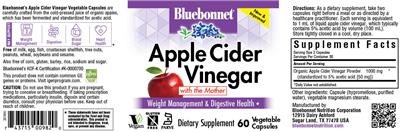
| Apple Cider Vinegar, Powder | 1000 mg | -- |
| Acetic Acid | 50 mg | -- |
Other ingredients: Hypromellose, Water, Purified, Magnesium Stearate
Tap any ingredient to jump to its full detail below.
These statements are the manufacturer’s wording, reproduced from the product label — the label is saying it, not HelloPharmacist. We don’t verify or endorse them.
Formula
Bluebonnet's Apple Cider Vinegar vegetable capsules are carefully crafted from the cold-pressed juice of organic apples, which has been fermented and standardized for acetic acid.
Bluebonnet's KOF-K Certification #K-0000700
Apple Cider Vinegar with the Mother
K Parve (Kosher)
Formulation
May support Weight management Digestion Blood sugar Heart health
Free of milk, egg, fish, crustacean shellfish, tree nuts, peanuts, wheat, soybeans and sesame. Also free of corn, gluten, barley, rice, sodium and sugar.
This product does not contain common GE genes or proteins. Visit igenprogram.com IGEN Non-GMO Tested
Weight management & digestive health
Vegan
Gluten free
Seals/Symbols
IGEN Non-GMO Tested
K Parve (Kosher)
Precautions
Caution: Do not use this product if you are pregnant, trying to conceive or breastfeeding. If taking prescription medications, particularly insulin, digoxin and certain diuretics, consult your physician before use.
Keep out of reach of children.
FDA Disclaimer Statement
These statements have not been evaluated by the Food and Drug Administration. This product is not intended to diagnose, treat, cure, or prevent any disease.
General Statements
New & improved
FDA Statement of Identity
Dietary Supplement
Suggested/Recommended/Usage/Directions
Directions: As a dietary supplement, take two capsules right before a meal or as directed by a healthcare practitioner. Each serving is equivalent to 1 mL of liquid apple cider vinegar, which typically contains 5% acetic acid by volume (100 mL).
Storage
Store tightly closed in a cool, dry place.
Is this label outdated? Report a formula or label change and our pharmacy team will review it.
Apple Cider Vinegar by Bluebonnet label
The label scan from the NIH Dietary Supplement Label Database. Tap to enlarge.
Label images are published by the NIH Dietary Supplement Label Database for the version of this product on file. Always read your actual product label.
View the full label (PDF)The Ingredients in Apple Cider Vinegar by Bluebonnet
This is the 1 active ingredient this product is made of. Select it to open its full monograph.
Serving size2 Vegetable Capsule(s) Dosage formCapsule Servings per container30 Amounts shown are per serving.
Apple Cider Vinegar, Powder
Interacts with162 drugs
Apple cider vinegar is a fermented apple product that many people use hoping to help with blood sugar, weight, or digestion. The evidence for most of...
Apple Cider Vinegar, Powder monograph & interactions- › Acetic Acid
Other (inactive) ingredients: Hypromellose, Water, Purified, Magnesium Stearate. These complete the product’s ingredient list but are not active constituents.
Apple Cider Vinegar by Bluebonnet Drug Interactions
Apple Cider Vinegar contains a single active ingredient, and it has known interactions with 162 medications. Here’s the picture, then you can look up your own drug.
Want to check YOUR meds against Apple Cider Vinegar?
Ask about interactions with your drugs in plain English — “Can I take it with lisinopril?” — and we find you the answer in seconds, ingredient by ingredient.
Go to the checkerIngredients driving the most interactions
Individual Drug Interactions
The ingredients in Apple Cider Vinegar interact with 162 drugs. Click any drug to see the details.
1 of the 1 ingredient in Apple Cider Vinegar interact with drugs. Each result below shows which ingredient is responsible. Apple Cider Vinegar, Powder
Acetaminophen, Caffeine, PyrilamineMidol Max Strength Menstrual
How Acetaminophen, Caffeine, Pyrilamine interacts with Apple Cider Vinegar — through 1 ingredient. Tap an ingredient for the detail:
Apple Cider Vinegar, PowderDiuretic Drugs Moderate
Interaction Summary
Theoretically, concomitant use of apple cider vinegar with diuretic drugs might increase the risk of hypokalemia.
Read the full Apple Cider Vinegar, Powder + Acetaminophen, Caffeine, Pyrilamine interactionAcetaminophen, Pamabrom, PyrilamineMidol Max Strength PMS, Pamprin, Pamprin ES
How Acetaminophen, Pamabrom, Pyrilamine interacts with Apple Cider Vinegar — through 1 ingredient. Tap an ingredient for the detail:
Apple Cider Vinegar, PowderDiuretic Drugs Moderate
Interaction Summary
Theoretically, concomitant use of apple cider vinegar with diuretic drugs might increase the risk of hypokalemia.
Read the full Apple Cider Vinegar, Powder + Acetaminophen, Pamabrom, Pyrilamine interactionAcetazolamideAk-Zol, Diamox
How Acetazolamide interacts with Apple Cider Vinegar — through 1 ingredient. Tap an ingredient for the detail:
Apple Cider Vinegar, PowderDiuretic Drugs Moderate
Interaction Summary
Theoretically, concomitant use of apple cider vinegar with diuretic drugs might increase the risk of hypokalemia.
Read the full Apple Cider Vinegar, Powder + Acetazolamide interactionAmiloride, HydrochlorothiazideAmil-Co, Amilzide, Moduret 25, Moduretic
How Amiloride, Hydrochlorothiazide interacts with Apple Cider Vinegar — through 1 ingredient. Tap an ingredient for the detail:
Apple Cider Vinegar, PowderDiuretic Drugs Moderate
Interaction Summary
Theoretically, concomitant use of apple cider vinegar with diuretic drugs might increase the risk of hypokalemia.
Read the full Apple Cider Vinegar, Powder + Amiloride, Hydrochlorothiazide interactionAmmonium ChlorideAmmonium Chloride
How Ammonium Chloride interacts with Apple Cider Vinegar — through 1 ingredient. Tap an ingredient for the detail:
Apple Cider Vinegar, PowderDiuretic Drugs Moderate
Interaction Summary
Theoretically, concomitant use of apple cider vinegar with diuretic drugs might increase the risk of hypokalemia.
Read the full Apple Cider Vinegar, Powder + Ammonium Chloride interactionAtenolol, ChlortalidoneAtenixCo, Tenoret 50, Totaretic
How Atenolol, Chlortalidone interacts with Apple Cider Vinegar — through 1 ingredient. Tap an ingredient for the detail:
Apple Cider Vinegar, PowderDiuretic Drugs Moderate
Interaction Summary
Theoretically, concomitant use of apple cider vinegar with diuretic drugs might increase the risk of hypokalemia.
Read the full Apple Cider Vinegar, Powder + Atenolol, Chlortalidone interactionAtenolol, ChlorthalidoneTenoretic
How Atenolol, Chlorthalidone interacts with Apple Cider Vinegar — through 1 ingredient. Tap an ingredient for the detail:
Apple Cider Vinegar, PowderDiuretic Drugs Moderate
Interaction Summary
Theoretically, concomitant use of apple cider vinegar with diuretic drugs might increase the risk of hypokalemia.
Read the full Apple Cider Vinegar, Powder + Atenolol, Chlorthalidone interactionAzilsartan, ChlorthalidoneEdarbyclor
How Azilsartan, Chlorthalidone interacts with Apple Cider Vinegar — through 1 ingredient. Tap an ingredient for the detail:
Apple Cider Vinegar, PowderDiuretic Drugs Moderate
Interaction Summary
Theoretically, concomitant use of apple cider vinegar with diuretic drugs might increase the risk of hypokalemia.
Read the full Apple Cider Vinegar, Powder + Azilsartan, Chlorthalidone interactionBenazepril, HydrochlorothiazideLotensin HCT
How Benazepril, Hydrochlorothiazide interacts with Apple Cider Vinegar — through 1 ingredient. Tap an ingredient for the detail:
Apple Cider Vinegar, PowderDiuretic Drugs Moderate
Interaction Summary
Theoretically, concomitant use of apple cider vinegar with diuretic drugs might increase the risk of hypokalemia.
Read the full Apple Cider Vinegar, Powder + Benazepril, Hydrochlorothiazide interactionBendroflumethiazideAprinox, Naturetin, Neo-NaClex
How Bendroflumethiazide interacts with Apple Cider Vinegar — through 1 ingredient. Tap an ingredient for the detail:
Apple Cider Vinegar, PowderDiuretic Drugs Moderate
Interaction Summary
Theoretically, concomitant use of apple cider vinegar with diuretic drugs might increase the risk of hypokalemia.
Read the full Apple Cider Vinegar, Powder + Bendroflumethiazide interactionBendroflumethiazide, NadololCorzide
How Bendroflumethiazide, Nadolol interacts with Apple Cider Vinegar — through 1 ingredient. Tap an ingredient for the detail:
Apple Cider Vinegar, PowderDiuretic Drugs Moderate
Interaction Summary
Theoretically, concomitant use of apple cider vinegar with diuretic drugs might increase the risk of hypokalemia.
Read the full Apple Cider Vinegar, Powder + Bendroflumethiazide, Nadolol interactionBendroflumethiazide, PotassiumCentyl K, Neo-NaClex-K
How Bendroflumethiazide, Potassium interacts with Apple Cider Vinegar — through 1 ingredient. Tap an ingredient for the detail:
Apple Cider Vinegar, PowderDiuretic Drugs Moderate
Interaction Summary
Theoretically, concomitant use of apple cider vinegar with diuretic drugs might increase the risk of hypokalemia.
Read the full Apple Cider Vinegar, Powder + Bendroflumethiazide, Potassium interactionBendroflumethiazide, Rauwolfia SerpentinaRauzide
How Bendroflumethiazide, Rauwolfia Serpentina interacts with Apple Cider Vinegar — through 1 ingredient. Tap an ingredient for the detail:
Apple Cider Vinegar, PowderDiuretic Drugs Moderate
Interaction Summary
Theoretically, concomitant use of apple cider vinegar with diuretic drugs might increase the risk of hypokalemia.
Read the full Apple Cider Vinegar, Powder + Bendroflumethiazide, Rauwolfia Serpentina interactionBenzthiazideExna
How Benzthiazide interacts with Apple Cider Vinegar — through 1 ingredient. Tap an ingredient for the detail:
Apple Cider Vinegar, PowderDiuretic Drugs Moderate
Interaction Summary
Theoretically, concomitant use of apple cider vinegar with diuretic drugs might increase the risk of hypokalemia.
Read the full Apple Cider Vinegar, Powder + Benzthiazide interactionBisoprolol, HydrochlorothiazideZiac
How Bisoprolol, Hydrochlorothiazide interacts with Apple Cider Vinegar — through 1 ingredient. Tap an ingredient for the detail:
Apple Cider Vinegar, PowderDiuretic Drugs Moderate
Interaction Summary
Theoretically, concomitant use of apple cider vinegar with diuretic drugs might increase the risk of hypokalemia.
Read the full Apple Cider Vinegar, Powder + Bisoprolol, Hydrochlorothiazide interactionBumetanideBurinex
How Bumetanide interacts with Apple Cider Vinegar — through 1 ingredient. Tap an ingredient for the detail:
Apple Cider Vinegar, PowderDiuretic Drugs Moderate
Interaction Summary
Theoretically, concomitant use of apple cider vinegar with diuretic drugs might increase the risk of hypokalemia.
Read the full Apple Cider Vinegar, Powder + Bumetanide interactionBumetanide, PotassiumBurinex K
How Bumetanide, Potassium interacts with Apple Cider Vinegar — through 1 ingredient. Tap an ingredient for the detail:
Apple Cider Vinegar, PowderDiuretic Drugs Moderate
Interaction Summary
Theoretically, concomitant use of apple cider vinegar with diuretic drugs might increase the risk of hypokalemia.
Read the full Apple Cider Vinegar, Powder + Bumetanide, Potassium interactionCaffeine, Potassium Salicylate, SalicylamideTrim-Elim
How Caffeine, Potassium Salicylate, Salicylamide interacts with Apple Cider Vinegar — through 1 ingredient. Tap an ingredient for the detail:
Apple Cider Vinegar, PowderDiuretic Drugs Moderate
Interaction Summary
Theoretically, concomitant use of apple cider vinegar with diuretic drugs might increase the risk of hypokalemia.
Read the full Apple Cider Vinegar, Powder + Caffeine, Potassium Salicylate, Salicylamide interactionCandesartan Cilexetil, HydrochlorothiazideAtacand HCT
How Candesartan Cilexetil, Hydrochlorothiazide interacts with Apple Cider Vinegar — through 1 ingredient. Tap an ingredient for the detail:
Apple Cider Vinegar, PowderDiuretic Drugs Moderate
Interaction Summary
Theoretically, concomitant use of apple cider vinegar with diuretic drugs might increase the risk of hypokalemia.
Read the full Apple Cider Vinegar, Powder + Candesartan Cilexetil, Hydrochlorothiazide interactionCaptopril, HydrochlorothiazideAcezide, Capozide
How Captopril, Hydrochlorothiazide interacts with Apple Cider Vinegar — through 1 ingredient. Tap an ingredient for the detail:
Apple Cider Vinegar, PowderDiuretic Drugs Moderate
Interaction Summary
Theoretically, concomitant use of apple cider vinegar with diuretic drugs might increase the risk of hypokalemia.
Read the full Apple Cider Vinegar, Powder + Captopril, Hydrochlorothiazide interactionChlorothiazideDiuril
How Chlorothiazide interacts with Apple Cider Vinegar — through 1 ingredient. Tap an ingredient for the detail:
Apple Cider Vinegar, PowderDiuretic Drugs Moderate
Interaction Summary
Theoretically, concomitant use of apple cider vinegar with diuretic drugs might increase the risk of hypokalemia.
Read the full Apple Cider Vinegar, Powder + Chlorothiazide interactionChlorothiazide, MethyldopaAldochlor, Aldoclor 150, Aldoclor 250
How Chlorothiazide, Methyldopa interacts with Apple Cider Vinegar — through 1 ingredient. Tap an ingredient for the detail:
Apple Cider Vinegar, PowderDiuretic Drugs Moderate
Interaction Summary
Theoretically, concomitant use of apple cider vinegar with diuretic drugs might increase the risk of hypokalemia.
Read the full Apple Cider Vinegar, Powder + Chlorothiazide, Methyldopa interactionChlorothiazide, ReserpineDiupres
How Chlorothiazide, Reserpine interacts with Apple Cider Vinegar — through 1 ingredient. Tap an ingredient for the detail:
Apple Cider Vinegar, PowderDiuretic Drugs Moderate
Interaction Summary
Theoretically, concomitant use of apple cider vinegar with diuretic drugs might increase the risk of hypokalemia.
Read the full Apple Cider Vinegar, Powder + Chlorothiazide, Reserpine interactionChlorthalidoneHygroton, Thalitone
How Chlorthalidone interacts with Apple Cider Vinegar — through 1 ingredient. Tap an ingredient for the detail:
Apple Cider Vinegar, PowderDiuretic Drugs Moderate
Interaction Summary
Theoretically, concomitant use of apple cider vinegar with diuretic drugs might increase the risk of hypokalemia.
Read the full Apple Cider Vinegar, Powder + Chlorthalidone interactionChlorthalidone, ClonidineClorpres, Combipres
How Chlorthalidone, Clonidine interacts with Apple Cider Vinegar — through 1 ingredient. Tap an ingredient for the detail:
Apple Cider Vinegar, PowderDiuretic Drugs Moderate
Interaction Summary
Theoretically, concomitant use of apple cider vinegar with diuretic drugs might increase the risk of hypokalemia.
Read the full Apple Cider Vinegar, Powder + Chlorthalidone, Clonidine interactionCryptenamine, MethyclothiazideDiutensen
How Cryptenamine, Methyclothiazide interacts with Apple Cider Vinegar — through 1 ingredient. Tap an ingredient for the detail:
Apple Cider Vinegar, PowderDiuretic Drugs Moderate
Interaction Summary
Theoretically, concomitant use of apple cider vinegar with diuretic drugs might increase the risk of hypokalemia.
Read the full Apple Cider Vinegar, Powder + Cryptenamine, Methyclothiazide interactionCyclothiazideAnhydron, Fluidil
How Cyclothiazide interacts with Apple Cider Vinegar — through 1 ingredient. Tap an ingredient for the detail:
Apple Cider Vinegar, PowderDiuretic Drugs Moderate
Interaction Summary
Theoretically, concomitant use of apple cider vinegar with diuretic drugs might increase the risk of hypokalemia.
Read the full Apple Cider Vinegar, Powder + Cyclothiazide interactionDeserpidine, HydrochlorothiazideOreticyl, Oreticyl Forte
How Deserpidine, Hydrochlorothiazide interacts with Apple Cider Vinegar — through 1 ingredient. Tap an ingredient for the detail:
Apple Cider Vinegar, PowderDiuretic Drugs Moderate
Interaction Summary
Theoretically, concomitant use of apple cider vinegar with diuretic drugs might increase the risk of hypokalemia.
Read the full Apple Cider Vinegar, Powder + Deserpidine, Hydrochlorothiazide interactionDeserpidine, MethyclothiazideEnduronyl, Enduronyl Forte
How Deserpidine, Methyclothiazide interacts with Apple Cider Vinegar — through 1 ingredient. Tap an ingredient for the detail:
Apple Cider Vinegar, PowderDiuretic Drugs Moderate
Interaction Summary
Theoretically, concomitant use of apple cider vinegar with diuretic drugs might increase the risk of hypokalemia.
Read the full Apple Cider Vinegar, Powder + Deserpidine, Methyclothiazide interactionDigoxinDigitek, Lanoxicaps, Lanoxin
How Digoxin interacts with Apple Cider Vinegar — through 1 ingredient. Tap an ingredient for the detail:
Apple Cider Vinegar, PowderDigoxin (lanoxin) Moderate
Interaction Summary
Theoretically, concomitant use of apple cider vinegar with digoxin might increase the risk of cardiac toxicity.
Read the full Apple Cider Vinegar, Powder + Digoxin interactionEach ingredient & the kinds of drugs it affects
For each ingredient in Apple Cider Vinegar with known interactions, here are the types of medications it can affect. Open any type for the detail — or search your exact drug in the checker above.
Apple Cider Vinegar, Powder
Digoxin (Lanoxin)
Theoretically, concomitant use of apple cider vinegar with digoxin might increase the risk of cardiac toxicity.
A case of hypokalemia related to chronic use of apple cider vinegar has been reported. Theoretically, overuse of apple cider vinegar could decrease potassium levels, increasing the risk of toxicity with digoxin.
Diuretic Drugs
Theoretically, concomitant use of apple cider vinegar with diuretic drugs might increase the risk of hypokalemia.
A case of hypokalemia related to chronic use of apple cider vinegar has been reported. There is some concern that people taking apple cider vinegar along with potassium depleting diuretics might have an increased risk for hypokalemia.
Insulin
Theoretically, concomitant use of apple cider vinegar with insulin might increase the risk of hypokalemia.
A case of hypokalemia related to chronic use of apple cider vinegar has been reported. Theoretically, overuse of apple cider vinegar concomitantly with insulin might increase the risk of hypokalemia.
Antidiabetes Drugs
Theoretically, taking apple cider vinegar with antidiabetes drugs might increase the risk of hypoglycemia.
Apple cider vinegar might reduce fasting and postprandial blood glucose levels and decrease gastric emptying in people with diabetes. However, not all research agrees. Theoretically, it might have additive effects on glucose levels when used with antidiabetes drugs.
Brand information
Manufacturer and brand details for Apple Cider Vinegar, from the product label.
Bluebonnet
- Name
- Bluebonnet Nutrition Corporation
- Street Address
- 12915 Dairy Ashford
- City
- Sugar Land
- State
- TX
- ZipCode
- 77478
- Web Address
- www.bluebonnetnutrition.com
Apple Cider Vinegar by Bluebonnet: Common Questions
Does Apple Cider Vinegar by Bluebonnet interact with any medications?
How can one product interact with so many drugs?
Where does this information come from?
Written and reviewed by the HelloPharmacist editorial staff. Our editorial policy
Not sure if Apple Cider Vinegar is safe with your meds?
Our pharmacists answer your medication & supplement questions — free.
Label information is sourced from the NIH Dietary Supplement Label Database and reflects the product version on file; always read your actual product label. This page is for education only and is not a substitute for professional medical advice. Confirm with your pharmacist or doctor before combining supplements and medications.
The Full Monographs Behind Apple Cider Vinegar’s Ingredients
Every ingredient we hold a full HelloPharmacist monograph for — uses, evidence, safety, and the complete interaction list.
Sources & How We Checked
Apple Cider Vinegar's label data comes from the NIH Dietary Supplement Label Database; the ingredient interaction data is from the Natural Medicines database, reviewed by our pharmacists.
- NIH Dietary Supplement Label Database (DSLD) — The official product label on file for this supplement.
- Natural Medicines (Therapeutic Research Center) — Evidence-graded clinical reference behind the ingredient interaction data.
Content is written and reviewed by licensed HelloPharmacist pharmacists. See our data sources and editorial standards for how this information is built and checked.
The 11 references behind this product’s interaction data
Every citation that drives the interaction findings for this product’s ingredients, from the evidence-graded Natural Medicines (TRC Healthcare) database. Open an ingredient to browse its citations — links open the study on PubMed or the publisher’s site.
Apple Cider Vinegar 11 references
- Lhotta K, Hofle G, Gasser R, Finkenstedt G. Hypokalemia, hyperreninemia, and osteoporosis in a patient ingesting large amounts of cider vinegar. Nephron 1998;80:242-3. PubMed
- Hill LL, Woodruff LH, Foote JC, Barreto-Alcoba M. Esophageal injury by apple cider vinegar tablets and subsequent evaluation of products. J Am Diet Assoc 2005;105:1141-4. PubMed
- Hlebowicz J, Darwiche G, Björgell O, Almér LO. Effect of apple cider vinegar on delayed gastric emptying in patients with type 1 diabetes mellitus: a pilot study. BMC Gastroenterol 2007;7:46. PubMed
- Johnston CS, Kim CM, Buller AJ. Vinegar improves insulin sensitivity to a high-carbohydrate meal in subjects with insulin resistance or type 2 diabetes. Diabetes Care 2004;27:281-2. PubMed
- Lhotta, K., Hofle, G., Gasser, R., and Finkenstedt, G. Hypokalemia, hyperreninemia and osteoporosis in a patient ingesting large amounts of cider vinegar. Nephron 1998;80(2):242-243. PubMed
- Bunick CG, Lott JP, Warren CB, et al. Chemical burn from topical apple cider vinegar. J Am Acad Dermatol 2012;67(4):e143-4. PubMed
- Feldstein S, Afshar M, Krakowski AC. Chemical Burn from Vinegar Following an Internet-based Protocol for Self-removal of Nevi. J Clin Aesthet Dermatol. 2015 Jun;8(6):50.
- Luu LA, Flowers RH, Kellams AL, et al. Apple cider vinegar soaks [0.5%] as a treatment for atopic dermatitis do not improve skin barrier integrity. Pediatr Dermatol. 2019;36(5):634-639. PubMed
- Hadi A, Pourmasoumi M, Najafgholizadeh A, Clark CCT, Esmaillzadeh A. The effect of apple cider vinegar on lipid profiles and glycemic parameters: a systematic review and meta-analysis of randomized clinical trials. BMC Complement Med Ther 2021;21(1):179. PubMed
- Feise NK, Johnston CS. Commercial vinegar tablets do not display the same physiological benefits for managing postprandial glucose concentrations as liquid vinegar. J Nutr Metab 2020;2020:9098739. PubMed
- Gheflati A, Bashiri R, Ghadiri-Anari A, Reza JZ, Kord MT, Nadjarzadeh A. The effect of apple vinegar consumption on glycemic indices, blood pressure, oxidative stress, and homocysteine in patients with type 2 diabetes and dyslipidemia: A randomized contro
Parts of this content are provided by the Therapeutic Research Center, LLC.
DISCLAIMER: Currently this does not check for drug-drug interactions. This is not an all-inclusive comprehensive list of potential interactions and is for informational purposes only. Not all interactions are known or well-reported in the scientific literature, and new interactions are continually being reported. Input is needed from a qualified healthcare provider including a pharmacist before starting any therapy. Application of clinical judgment is necessary.
© 2021 Therapeutic Research Center, LLC