
Balance Boss + Ingredients & Drug Interactions
What is this page for?
First and foremost: checking Balance Boss + against your medications. The heart of this page is the interaction checker and the full interaction report — how this product’s ingredients may interact with prescription and over-the-counter medicines you may be taking.
Around that, we add a pharmacist’s high-level view of the product as a whole — what’s inside, the evidence for its stated use, how transparent the label is, and what safety data exists — so you can see the full picture in one place. It’s educational information from our licensed clinical databases and the clinical staff at HelloPharmacist — not medical advice — and we don’t sell or endorse products. Our editorial policy
Balance Boss + is a dietary supplement by Herbal Goodness with 6 active ingredients. Its ingredients are commonly taken for fatigue and low energy, stress and coping (adaptogen), mental performance and focus.Based on those ingredients, 1,284 medications have a known interaction with it, the most serious rated moderate. The ingredients most likely to interact are Rhodiola rosea Extract, Lemon Balm extract, Marigold Extract. Use the checker below to test your specific medication, or read the full HelloPharmacist Interaction Report.
Check Your Meds Against Balance Boss + by Herbal Goodness
Ask about any prescription or over-the-counter medication and we check it for interactions with Balance Boss + by Herbal Goodness — and tell you which ingredient is responsible.
AI summaries are generated from our interaction database for education only — always confirm with your pharmacist. How we use AI
Ask the Pharmacist
A licensed pharmacist will answer your question by email — free, usually within 24 hours.
Got it — thank you!
A licensed pharmacist will answer within 24 hours. Keep an eye on your email (worth checking spam, just in case).
HelloPharmacist Scorecard of Balance Boss + by Herbal Goodness
Our pharmacy team’s full take, with four database checks built into the cards below — a summary of what is known, not a grade of the product itself.
What’s inside
Low disclosure
Balance Boss + contains 6 ingredients total. The active ingredients are rhodiola rosea extract, lemon balm extract, guava leaf extract, and graviola leaf extract.
The product also includes marigold extract and an extract blend (whose individual components are listed separately). There are no inactive other ingredients listed.
Does it work?
Moderate evidence
The evidence for rhodiola in this product isn't firmly established — we hold ratings of insufficient evidence for altitude sickness, anxiety, heart rhythm problems, athletic performance, and bladder cancer. Lemon balm fares somewhat better: it's possibly effective for cold sores and stress, and possibly effective for depression.
For guava leaf and graviola leaf, the evidence we hold is insufficient to rate — it covers diarrhea, gum disease, high blood pressure, knee pain, headache, HPV, and other uses, but none reach a confidence level we can endorse.
How safe is it?
Well-documented data
Rhodiola and lemon balm are generally well tolerated for short-term use, though their long-term safety isn't well studied. Both can cause dizziness; rhodiola may increase or decrease saliva production, and lemon balm may cause sedation (though this wasn't more common than placebo in trials).
Guava leaf extract may cause temporary stomach pain or nausea when taken by mouth, or contact dermatitis when applied to skin. Graviola leaf extract is a bigger concern — it's generally well tolerated, but regular use raises rare but serious risks: movement disorders and nerve damage (myeloneuropathy) with symptoms similar to Parkinson's disease, plus stomach pain and nausea.
Lab studies also raise questions about long-term nerve toxicity. Rhodiola and guava leaf extract are not well studied in pregnancy or while breastfeeding.
Graviola is possibly unsafe in pregnancy and should be avoided, and there's no reliable safety data for it while breastfeeding. Lemon balm has insufficient data for pregnancy, so it's best avoided unless your doctor advises otherwise; breastfeeding caution applies.
Meds to double-check
Moderate interaction found
Before you take Balance Boss +, double-check these medication types: blood pressure medications, diabetes drugs, heart rhythm medications that rely on liver metabolism (CYP2C9, CYP3A4, CYP1A2 substrates), thyroid hormone replacement, sedatives and other central nervous system depressants, carbamazepine (Tegretol), and losartan (Cozaar). The product may lower blood pressure further, raise low-blood-sugar risk, slow drug clearance, or reduce seizure medication effectiveness.
The bottom line
Scorecard at a glanceFormula with limited ingredient disclosure with some supporting evidence for its stated purpose. Moderate medication interactions have been identified, and safety information is well characterized.
This product brings together herbs with modest evidence and real interaction risks. If you take blood pressure medications, diabetes drugs, thyroid replacement, seizure medication, sedatives, or any heart rhythm drugs, you'll want to check your exact medications with us before starting.
Talk to your pharmacist about whether Balance Boss + fits your health picture — especially if you're pregnant, breastfeeding, or planning long-term use.
Educational only — not medical advice; always confirm with your pharmacist. Our editorial policy · How we use AI
Assessment coverage: 5 of 6 active ingredients matched to our full ingredient reviews (monographs). Based on the product label dated Nov 22, 2024.
This Scorecard evaluates available label information, ingredient evidence, and known medication-safety considerations. It does not independently verify product identity, purity, potency, contamination, or manufacturing quality. How these ratings are computed
General information
Key facts about Balance Boss +, straight from the product label.
| Brand | Herbal Goodness |
|---|---|
| Barcode (UPC) | 810128950220 |
| Net contents | 12 Ounce(s); 354 Milliliter(s) |
| Market status | On market |
| Date entered into DSLD | Nov 22, 2024 |
| DSLD ID | 303496 |
| Product type | Botanical |
| Supplement form | Liquid |
| Dietary claims / uses | Nutrient, All Other, Structure/Function |
| Intended target group(s) | Adult (18 - 50 Years) |
Everything in this section is reproduced from the manufacturer’s own product label — it’s the label speaking, not HelloPharmacist. We show it so you can see exactly what the maker states; we don’t verify or endorse those statements.
Supplement Facts
The label details for Balance Boss + by Herbal Goodness, sourced from the NIH Dietary Supplement Label Database.
Supplement Facts
| Ingredient | Amount | % DV |
|---|---|---|
| Rhodiola rosea Extract | 0 NP | -- |
| Marigold Extract | 0 NP | -- |
| Extract Blend | 0 NP | -- |
| Lemon Balm extract | 0 NP | -- |
| Guava Leaf Extract | 0 NP | -- |
| Graviola Leaf Extract | 0 NP | -- |
| St. John's Extract | 0 NP | -- |
Tap any ingredient to jump to its full detail below.
These statements are the manufacturer’s wording, reproduced from the product label — the label is saying it, not HelloPharmacist. We don’t verify or endorse them.
Formula
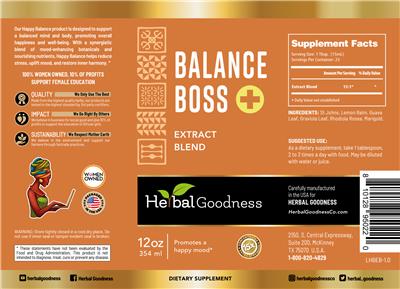
Our Happy Balance product is designed to support a balance mind and body, promoting overall happiness and well-being. With a synergistic blend of mood-enhancing botanicals and nourishing nutrients, Happy Balance helps reduce stress, uplift mood, and restore inner harmony.
Extract Blend
General Statements
100% Women Owned, 10% of Profits Support Female Education Quality We Only Use The best Made from the highest quality herbs, our products are tested to the highest standard by 3rd party certifiers. Impact We Do Right By Others We believe in business for social good and give 10% of profits to support the education of African girls. Sustainability We Respect Mother Earth We believe in the environment and support our farmers through fairtrade practices Women Owned
YouTube herbalgoodness Facebook herbalgoodness Instagram herbalgoodnessco Twitter herbal_goodness
Seals/Symbols
Packaged in the USA
Storage
Warning: Store tightly closed in a cool dry place.
Precautions
Do not use if inner seal or tamper evident seal is broken.
FDA Disclaimer Statement
These statements have not been evaluated by the Food and Drug Administration. This product is not intended to diagnose, treat, cure or prevent any disease.
Formulation
Promotes a happy mood 15x Concentrated Extra Strength
FDA Statement of Identity
Dietary Supplement
Suggested/Recommended/Usage/Directions
Suggested use: As a dietary supplement, take 1 tablespoon, 2 to 3 times a day with food. May be diluted with water or juice.
Is this label outdated? Report a formula or label change and our pharmacy team will review it.
Balance Boss + by Herbal Goodness label
The label scan from the NIH Dietary Supplement Label Database. Tap to enlarge.
Label images are published by the NIH Dietary Supplement Label Database for the version of this product on file. Always read your actual product label.
View the full label (PDF)The Ingredients in Balance Boss + by Herbal Goodness
These are the 6 active ingredients this product is made of. Select any to open its full monograph.
Serving size15 mL Dosage formLiquid Servings per container23 Amounts shown are per serving.
Most supplement products combine several ingredients, and a medication can interact with the product through any one of them. Each ingredient below shows whether it has known drug interactions.
Extract Blend
- › Rhodiola rosea Extract
- › Marigold Extract
- › Lemon Balm extract
- › Guava Leaf Extract
- › Graviola Leaf Extract
- › St. John's Extract
Balance Boss + by Herbal Goodness Drug Interactions
HelloPharmacist Interaction Report
Balance Boss + by Herbal Goodness contains several ingredients with documented interactions.
Rhodiola rosea extract carries the most serious concerns — it may increase the risk of low blood pressure (hypotension) when combined with blood pressure medications (antihypertensive drugs), and it can raise blood sugar medication effects, risking dangerously low blood sugar (hypoglycemia). Rhodiola may also slow how your body clears certain heart rhythm drugs and other medications metabolized by liver enzymes (CYP2C9, CYP3A4, and CYP1A2 substrates).
A clinical study found it reduced losartan (Cozaar) clearance by 21%.
Read the full breakdown — every affected drug type, severity by severity
Lemon balm extract may add to the drowsiness of sedatives and other central nervous system depressants (CNS depressants), and it theoretically could interfere with thyroid hormone replacement therapy. Guava leaf extract may increase the blood-sugar-lowering effect of diabetes medications, raising hypoglycemia risk.
Graviola leaf extract may reduce carbamazepine (Tegretol) levels, potentially making the drug less effective.
We could not check the interaction data for marigold extract or St. John's extract — no monograph is on file for either.
Altogether, these interactions span 1,266 individual medications.
Use the medication checker on this page to search your exact prescriptions before you start.
Check your own medications below · Editorial policy · How we use AI
Want to check YOUR meds against Balance Boss +?
Ask about interactions with your drugs in plain English — “Can I take it with lisinopril?” — and we find you the answer in seconds, ingredient by ingredient.
Go to the checkerIngredients driving the most interactions
Individual Drug Interactions
The ingredients in Balance Boss + interact with 1,284 drugs. Click any drug to see the details.
5 of the 6 ingredients in Balance Boss + interact with drugs. Each result below shows which ingredient is responsible. Rhodiola rosea Extract Lemon Balm extract Marigold Extract Guava Leaf Extract Graviola Leaf Extract
6-mercaptopurinePurinethol
How 6-mercaptopurine interacts with Balance Boss + — through 1 ingredient. Tap an ingredient for the detail:
Rhodiola Rosea ExtractImmunosuppressants Moderate
Interaction Summary
Theoretically, rhodiola use might interfere with immunosuppressive therapy.
Read the full Rhodiola Rosea Extract + 6-mercaptopurine interactionAbrocitinibCibinqo
How Abrocitinib interacts with Balance Boss + — through 1 ingredient. Tap an ingredient for the detail:
Rhodiola Rosea ExtractImmunosuppressants, Cytochrome P450 2c9 (cyp2c9) Substrates Moderate
Interaction Summary
Theoretically, rhodiola use might interfere with immunosuppressive therapy.
Read the full Rhodiola Rosea Extract + Abrocitinib interactionAcalabrutinibCalquence
How Acalabrutinib interacts with Balance Boss + — through 1 ingredient. Tap an ingredient for the detail:
Rhodiola Rosea ExtractCytochrome P450 3a4 (cyp3a4) Substrates, P-glycoprotein Substrates Moderate
Interaction Summary
Theoretically, rhodiola might increase levels of drugs metabolized by CYP3A4.
Read the full Rhodiola Rosea Extract + Acalabrutinib interactionAcarboseGlucobay, Prandase, Precose
How Acarbose interacts with Balance Boss + — through 2 ingredients. Tap an ingredient for the detail:
Rhodiola Rosea ExtractAntidiabetes Drugs Moderate
Interaction Summary
Theoretically, taking rhodiola with antidiabetes drugs might increase the risk of hypoglycemia.
Read the full Rhodiola Rosea Extract + Acarbose interactionGuava Leaf ExtractAntidiabetes Drugs Moderate
Interaction Summary
Theoretically, concomitant use with antidiabetes drugs might have additive effects and increase the risk of hypoglycemia.
Read the full Guava Leaf Extract + Acarbose interactionAcebutololRhotral, Sectral
How Acebutolol interacts with Balance Boss + — through 1 ingredient. Tap an ingredient for the detail:
Rhodiola Rosea ExtractAntihypertensive Drugs Moderate
Interaction Summary
Theoretically, taking rhodiola with antihypertensive drugs might increase the risk of hypotension.
Read the full Rhodiola Rosea Extract + Acebutolol interactionAcepromazineAtravet
How Acepromazine interacts with Balance Boss + — through 3 ingredients. Tap an ingredient for the detail:
Lemon Balm ExtractCns Depressants Moderate
Interaction Summary
Theoretically, concomitant use of lemon balm might have additive effects with CNS depressant drugs.
Read the full Lemon Balm Extract + Acepromazine interactionMarigold ExtractCns Depressants Minor
Interaction Summary
Theoretically, calendula might have additive effects when used with CNS depressants, although this appears to be unlikely.
Read the full Marigold Extract + Acepromazine interactionRhodiola Rosea ExtractCns Depressants Minor
Interaction Summary
Theoretically, rhodiola might increase the risk of adverse effects when taken with CNS depressants.
Read the full Rhodiola Rosea Extract + Acepromazine interactionAcetaminophen, Butalbital, Caffeine, CodeineEsgic with Codeine, Fioricet w/ Codeine
How Acetaminophen, Butalbital, Caffeine, Codeine interacts with Balance Boss + — through 3 ingredients. Tap an ingredient for the detail:
Lemon Balm ExtractCns Depressants Moderate
Interaction Summary
Theoretically, concomitant use of lemon balm might have additive effects with CNS depressant drugs.
Read the full Lemon Balm Extract + Acetaminophen, Butalbital, Caffeine, Codeine interactionRhodiola Rosea ExtractCytochrome P450 3a4 (cyp3a4) Substrates, Cytochrome P450 1a2 (cyp1a2) Substrates +1 Minor
Interaction Summary
Theoretically, rhodiola might increase levels of drugs metabolized by CYP3A4.
Read the full Rhodiola Rosea Extract + Acetaminophen, Butalbital, Caffeine, Codeine interactionMarigold ExtractCns Depressants Minor
Interaction Summary
Theoretically, calendula might have additive effects when used with CNS depressants, although this appears to be unlikely.
Read the full Marigold Extract + Acetaminophen, Butalbital, Caffeine, Codeine interactionAcetaminophen, Butalbital, CodeineBancap w/ Codeine
How Acetaminophen, Butalbital, Codeine interacts with Balance Boss + — through 3 ingredients. Tap an ingredient for the detail:
Lemon Balm ExtractCns Depressants Moderate
Interaction Summary
Theoretically, concomitant use of lemon balm might have additive effects with CNS depressant drugs.
Read the full Lemon Balm Extract + Acetaminophen, Butalbital, Codeine interactionRhodiola Rosea ExtractCns Depressants, Cytochrome P450 1a2 (cyp1a2) Substrates Minor
Interaction Summary
Theoretically, rhodiola might increase the risk of adverse effects when taken with CNS depressants.
Read the full Rhodiola Rosea Extract + Acetaminophen, Butalbital, Codeine interactionMarigold ExtractCns Depressants Minor
Interaction Summary
Theoretically, calendula might have additive effects when used with CNS depressants, although this appears to be unlikely.
Read the full Marigold Extract + Acetaminophen, Butalbital, Codeine interactionAcetaminophen, Butalbital, Codeine PhosphatePhrenilin #3
How Acetaminophen, Butalbital, Codeine Phosphate interacts with Balance Boss + — through 3 ingredients. Tap an ingredient for the detail:
Lemon Balm ExtractCns Depressants Moderate
Interaction Summary
Theoretically, concomitant use of lemon balm might have additive effects with CNS depressant drugs.
Read the full Lemon Balm Extract + Acetaminophen, Butalbital, Codeine Phosphate interactionMarigold ExtractCns Depressants Minor
Interaction Summary
Theoretically, calendula might have additive effects when used with CNS depressants, although this appears to be unlikely.
Read the full Marigold Extract + Acetaminophen, Butalbital, Codeine Phosphate interactionRhodiola Rosea ExtractCns Depressants, Cytochrome P450 1a2 (cyp1a2) Substrates Minor
Interaction Summary
Theoretically, rhodiola might increase the risk of adverse effects when taken with CNS depressants.
Read the full Rhodiola Rosea Extract + Acetaminophen, Butalbital, Codeine Phosphate interactionAcetaminophen, Caffeine, Chlorpheniramine, Hydrocodone, PhenylephrineHycomine Compound
How Acetaminophen, Caffeine, Chlorpheniramine, Hydrocodone, Phenylephrine interacts with Balance Boss + — through 3 ingredients. Tap an ingredient for the detail:
Lemon Balm ExtractCns Depressants Moderate
Interaction Summary
Theoretically, concomitant use of lemon balm might have additive effects with CNS depressant drugs.
Read the full Lemon Balm Extract + Acetaminophen, Caffeine, Chlorpheniramine, Hydrocodone, Phenylephrine interactionRhodiola Rosea ExtractCytochrome P450 1a2 (cyp1a2) Substrates, Cytochrome P450 3a4 (cyp3a4) Substrates +1 Minor
Interaction Summary
Theoretically, rhodiola might increase levels of drugs metabolized by CYP1A2.
Read the full Rhodiola Rosea Extract + Acetaminophen, Caffeine, Chlorpheniramine, Hydrocodone, Phenylephrine interactionMarigold ExtractCns Depressants Minor
Interaction Summary
Theoretically, calendula might have additive effects when used with CNS depressants, although this appears to be unlikely.
Read the full Marigold Extract + Acetaminophen, Caffeine, Chlorpheniramine, Hydrocodone, Phenylephrine interactionAcetaminophen, Caffeine, CodeineGesic C15, Gesic C30, Gesic C8, Lenoltec 1, Lenoltec 2, Lenoltec 3 +1 more
How Acetaminophen, Caffeine, Codeine interacts with Balance Boss + — through 3 ingredients. Tap an ingredient for the detail:
Lemon Balm ExtractCns Depressants Moderate
Interaction Summary
Theoretically, concomitant use of lemon balm might have additive effects with CNS depressant drugs.
Read the full Lemon Balm Extract + Acetaminophen, Caffeine, Codeine interactionRhodiola Rosea ExtractCns Depressants, Cytochrome P450 3a4 (cyp3a4) Substrates +1 Minor
Interaction Summary
Theoretically, rhodiola might increase the risk of adverse effects when taken with CNS depressants.
Read the full Rhodiola Rosea Extract + Acetaminophen, Caffeine, Codeine interactionMarigold ExtractCns Depressants Minor
Interaction Summary
Theoretically, calendula might have additive effects when used with CNS depressants, although this appears to be unlikely.
Read the full Marigold Extract + Acetaminophen, Caffeine, Codeine interactionAcetaminophen, Caffeine, Codeine, SalicylamideCodalan No.1, Codalan No.2, Codalan No.3
How Acetaminophen, Caffeine, Codeine, Salicylamide interacts with Balance Boss + — through 3 ingredients. Tap an ingredient for the detail:
Lemon Balm ExtractCns Depressants Moderate
Interaction Summary
Theoretically, concomitant use of lemon balm might have additive effects with CNS depressant drugs.
Read the full Lemon Balm Extract + Acetaminophen, Caffeine, Codeine, Salicylamide interactionRhodiola Rosea ExtractCytochrome P450 1a2 (cyp1a2) Substrates, Cns Depressants +1 Minor
Interaction Summary
Theoretically, rhodiola might increase levels of drugs metabolized by CYP1A2.
Read the full Rhodiola Rosea Extract + Acetaminophen, Caffeine, Codeine, Salicylamide interactionMarigold ExtractCns Depressants Minor
Interaction Summary
Theoretically, calendula might have additive effects when used with CNS depressants, although this appears to be unlikely.
Read the full Marigold Extract + Acetaminophen, Caffeine, Codeine, Salicylamide interactionAcetaminophen, Caffeine, DihydrocodeineDHC Plus, Panlor DC, Panlor SS
How Acetaminophen, Caffeine, Dihydrocodeine interacts with Balance Boss + — through 3 ingredients. Tap an ingredient for the detail:
Lemon Balm ExtractCns Depressants Moderate
Interaction Summary
Theoretically, concomitant use of lemon balm might have additive effects with CNS depressant drugs.
Read the full Lemon Balm Extract + Acetaminophen, Caffeine, Dihydrocodeine interactionMarigold ExtractCns Depressants Minor
Interaction Summary
Theoretically, calendula might have additive effects when used with CNS depressants, although this appears to be unlikely.
Read the full Marigold Extract + Acetaminophen, Caffeine, Dihydrocodeine interactionRhodiola Rosea ExtractCns Depressants, Cytochrome P450 1a2 (cyp1a2) Substrates +1 Minor
Interaction Summary
Theoretically, rhodiola might increase the risk of adverse effects when taken with CNS depressants.
Read the full Rhodiola Rosea Extract + Acetaminophen, Caffeine, Dihydrocodeine interactionAcetaminophen, Chlorpheniramine, Codeine, PhenylephrineColrex
How Acetaminophen, Chlorpheniramine, Codeine, Phenylephrine interacts with Balance Boss + — through 3 ingredients. Tap an ingredient for the detail:
Lemon Balm ExtractCns Depressants Moderate
Interaction Summary
Theoretically, concomitant use of lemon balm might have additive effects with CNS depressant drugs.
Read the full Lemon Balm Extract + Acetaminophen, Chlorpheniramine, Codeine, Phenylephrine interactionMarigold ExtractCns Depressants Minor
Interaction Summary
Theoretically, calendula might have additive effects when used with CNS depressants, although this appears to be unlikely.
Read the full Marigold Extract + Acetaminophen, Chlorpheniramine, Codeine, Phenylephrine interactionRhodiola Rosea ExtractCns Depressants, Cytochrome P450 1a2 (cyp1a2) Substrates +1 Minor
Interaction Summary
Theoretically, rhodiola might increase the risk of adverse effects when taken with CNS depressants.
Read the full Rhodiola Rosea Extract + Acetaminophen, Chlorpheniramine, Codeine, Phenylephrine interactionAcetaminophen, Chlorpheniramine, Phenylpropanolamine, OpiumHista-Derfule
How Acetaminophen, Chlorpheniramine, Phenylpropanolamine, Opium interacts with Balance Boss + — through 3 ingredients. Tap an ingredient for the detail:
Lemon Balm ExtractCns Depressants Moderate
Interaction Summary
Theoretically, concomitant use of lemon balm might have additive effects with CNS depressant drugs.
Read the full Lemon Balm Extract + Acetaminophen, Chlorpheniramine, Phenylpropanolamine, Opium interactionRhodiola Rosea ExtractCytochrome P450 1a2 (cyp1a2) Substrates, Cytochrome P450 3a4 (cyp3a4) Substrates +1 Minor
Interaction Summary
Theoretically, rhodiola might increase levels of drugs metabolized by CYP1A2.
Read the full Rhodiola Rosea Extract + Acetaminophen, Chlorpheniramine, Phenylpropanolamine, Opium interactionMarigold ExtractCns Depressants Minor
Interaction Summary
Theoretically, calendula might have additive effects when used with CNS depressants, although this appears to be unlikely.
Read the full Marigold Extract + Acetaminophen, Chlorpheniramine, Phenylpropanolamine, Opium interactionAcetaminophen, Chlorzoxazone, CodeineAcetazone Forte C8, Parafon Forte C8
How Acetaminophen, Chlorzoxazone, Codeine interacts with Balance Boss + — through 3 ingredients. Tap an ingredient for the detail:
Lemon Balm ExtractCns Depressants Moderate
Interaction Summary
Theoretically, concomitant use of lemon balm might have additive effects with CNS depressant drugs.
Read the full Lemon Balm Extract + Acetaminophen, Chlorzoxazone, Codeine interactionRhodiola Rosea ExtractCytochrome P450 1a2 (cyp1a2) Substrates, Cns Depressants Minor
Interaction Summary
Theoretically, rhodiola might increase levels of drugs metabolized by CYP1A2.
Read the full Rhodiola Rosea Extract + Acetaminophen, Chlorzoxazone, Codeine interactionMarigold ExtractCns Depressants Minor
Interaction Summary
Theoretically, calendula might have additive effects when used with CNS depressants, although this appears to be unlikely.
Read the full Marigold Extract + Acetaminophen, Chlorzoxazone, Codeine interactionAcetaminophen, CodeineTylenol No.3, Tylenol w/ Codeine
How Acetaminophen, Codeine interacts with Balance Boss + — through 3 ingredients. Tap an ingredient for the detail:
Lemon Balm ExtractCns Depressants Moderate
Interaction Summary
Theoretically, concomitant use of lemon balm might have additive effects with CNS depressant drugs.
Read the full Lemon Balm Extract + Acetaminophen, Codeine interactionRhodiola Rosea ExtractCns Depressants, Cytochrome P450 1a2 (cyp1a2) Substrates Minor
Interaction Summary
Theoretically, rhodiola might increase the risk of adverse effects when taken with CNS depressants.
Read the full Rhodiola Rosea Extract + Acetaminophen, Codeine interactionMarigold ExtractCns Depressants Minor
Interaction Summary
Theoretically, calendula might have additive effects when used with CNS depressants, although this appears to be unlikely.
Read the full Marigold Extract + Acetaminophen, Codeine interactionAcetaminophen, Codeine, DoxylamineMersyndol
How Acetaminophen, Codeine, Doxylamine interacts with Balance Boss + — through 3 ingredients. Tap an ingredient for the detail:
Lemon Balm ExtractCns Depressants Moderate
Interaction Summary
Theoretically, concomitant use of lemon balm might have additive effects with CNS depressant drugs.
Read the full Lemon Balm Extract + Acetaminophen, Codeine, Doxylamine interactionMarigold ExtractCns Depressants Minor
Interaction Summary
Theoretically, calendula might have additive effects when used with CNS depressants, although this appears to be unlikely.
Read the full Marigold Extract + Acetaminophen, Codeine, Doxylamine interactionRhodiola Rosea ExtractCns Depressants, Cytochrome P450 1a2 (cyp1a2) Substrates Minor
Interaction Summary
Theoretically, rhodiola might increase the risk of adverse effects when taken with CNS depressants.
Read the full Rhodiola Rosea Extract + Acetaminophen, Codeine, Doxylamine interactionAcetaminophen, Codeine, MethocarbamolAcetaminophen, Codeine, Methocarbamol, Robaxacet 8
How Acetaminophen, Codeine, Methocarbamol interacts with Balance Boss + — through 3 ingredients. Tap an ingredient for the detail:
Lemon Balm ExtractCns Depressants Moderate
Interaction Summary
Theoretically, concomitant use of lemon balm might have additive effects with CNS depressant drugs.
Read the full Lemon Balm Extract + Acetaminophen, Codeine, Methocarbamol interactionRhodiola Rosea ExtractCytochrome P450 1a2 (cyp1a2) Substrates, Cns Depressants Minor
Interaction Summary
Theoretically, rhodiola might increase levels of drugs metabolized by CYP1A2.
Read the full Rhodiola Rosea Extract + Acetaminophen, Codeine, Methocarbamol interactionMarigold ExtractCns Depressants Minor
Interaction Summary
Theoretically, calendula might have additive effects when used with CNS depressants, although this appears to be unlikely.
Read the full Marigold Extract + Acetaminophen, Codeine, Methocarbamol interactionAcetaminophen, Dichloralantipyrine, IsomethepteneAmidrine, Midchlor, Migquin, Migratine
How Acetaminophen, Dichloralantipyrine, Isometheptene interacts with Balance Boss + — through 3 ingredients. Tap an ingredient for the detail:
Lemon Balm ExtractCns Depressants Moderate
Interaction Summary
Theoretically, concomitant use of lemon balm might have additive effects with CNS depressant drugs.
Read the full Lemon Balm Extract + Acetaminophen, Dichloralantipyrine, Isometheptene interactionRhodiola Rosea ExtractCns Depressants, Cytochrome P450 1a2 (cyp1a2) Substrates Minor
Interaction Summary
Theoretically, rhodiola might increase the risk of adverse effects when taken with CNS depressants.
Read the full Rhodiola Rosea Extract + Acetaminophen, Dichloralantipyrine, Isometheptene interactionMarigold ExtractCns Depressants Minor
Interaction Summary
Theoretically, calendula might have additive effects when used with CNS depressants, although this appears to be unlikely.
Read the full Marigold Extract + Acetaminophen, Dichloralantipyrine, Isometheptene interactionAcetaminophen, Dichloralphenazone, IsomethepteneMidrin
How Acetaminophen, Dichloralphenazone, Isometheptene interacts with Balance Boss + — through 3 ingredients. Tap an ingredient for the detail:
Lemon Balm ExtractCns Depressants Moderate
Interaction Summary
Theoretically, concomitant use of lemon balm might have additive effects with CNS depressant drugs.
Read the full Lemon Balm Extract + Acetaminophen, Dichloralphenazone, Isometheptene interactionMarigold ExtractCns Depressants Minor
Interaction Summary
Theoretically, calendula might have additive effects when used with CNS depressants, although this appears to be unlikely.
Read the full Marigold Extract + Acetaminophen, Dichloralphenazone, Isometheptene interactionRhodiola Rosea ExtractCns Depressants, Cytochrome P450 1a2 (cyp1a2) Substrates Minor
Interaction Summary
Theoretically, rhodiola might increase the risk of adverse effects when taken with CNS depressants.
Read the full Rhodiola Rosea Extract + Acetaminophen, Dichloralphenazone, Isometheptene interactionAcetaminophen, Dichlorophenazone, IsometheptaneIsocom
How Acetaminophen, Dichlorophenazone, Isometheptane interacts with Balance Boss + — through 3 ingredients. Tap an ingredient for the detail:
Lemon Balm ExtractCns Depressants Moderate
Interaction Summary
Theoretically, concomitant use of lemon balm might have additive effects with CNS depressant drugs.
Read the full Lemon Balm Extract + Acetaminophen, Dichlorophenazone, Isometheptane interactionMarigold ExtractCns Depressants Minor
Interaction Summary
Theoretically, calendula might have additive effects when used with CNS depressants, although this appears to be unlikely.
Read the full Marigold Extract + Acetaminophen, Dichlorophenazone, Isometheptane interactionRhodiola Rosea ExtractCytochrome P450 1a2 (cyp1a2) Substrates, Cns Depressants Minor
Interaction Summary
Theoretically, rhodiola might increase levels of drugs metabolized by CYP1A2.
Read the full Rhodiola Rosea Extract + Acetaminophen, Dichlorophenazone, Isometheptane interactionAcetaminophen, DiphenhydramineTylenol PM, Tylenol PM Ex Strength
How Acetaminophen, Diphenhydramine interacts with Balance Boss + — through 3 ingredients. Tap an ingredient for the detail:
Lemon Balm ExtractCns Depressants Moderate
Interaction Summary
Theoretically, concomitant use of lemon balm might have additive effects with CNS depressant drugs.
Read the full Lemon Balm Extract + Acetaminophen, Diphenhydramine interactionRhodiola Rosea ExtractCns Depressants, Cytochrome P450 1a2 (cyp1a2) Substrates Minor
Interaction Summary
Theoretically, rhodiola might increase the risk of adverse effects when taken with CNS depressants.
Read the full Rhodiola Rosea Extract + Acetaminophen, Diphenhydramine interactionMarigold ExtractCns Depressants Minor
Interaction Summary
Theoretically, calendula might have additive effects when used with CNS depressants, although this appears to be unlikely.
Read the full Marigold Extract + Acetaminophen, Diphenhydramine interactionAcetaminophen, Diphenhydramine, PseudoephedrineChildren's Tylenol Allergy, Cold Control, Contac Night Allergy Relief
How Acetaminophen, Diphenhydramine, Pseudoephedrine interacts with Balance Boss + — through 3 ingredients. Tap an ingredient for the detail:
Lemon Balm ExtractCns Depressants Moderate
Interaction Summary
Theoretically, concomitant use of lemon balm might have additive effects with CNS depressant drugs.
Read the full Lemon Balm Extract + Acetaminophen, Diphenhydramine, Pseudoephedrine interactionMarigold ExtractCns Depressants Minor
Interaction Summary
Theoretically, calendula might have additive effects when used with CNS depressants, although this appears to be unlikely.
Read the full Marigold Extract + Acetaminophen, Diphenhydramine, Pseudoephedrine interactionRhodiola Rosea ExtractCns Depressants, Cytochrome P450 1a2 (cyp1a2) Substrates Minor
Interaction Summary
Theoretically, rhodiola might increase the risk of adverse effects when taken with CNS depressants.
Read the full Rhodiola Rosea Extract + Acetaminophen, Diphenhydramine, Pseudoephedrine interactionAcetaminophen, HydrocodoneAnexsia, Anodynos DHC, Azdone, Co-Gesic, Doucet, Lorcet +9 more
How Acetaminophen, Hydrocodone interacts with Balance Boss + — through 3 ingredients. Tap an ingredient for the detail:
Lemon Balm ExtractCns Depressants Moderate
Interaction Summary
Theoretically, concomitant use of lemon balm might have additive effects with CNS depressant drugs.
Read the full Lemon Balm Extract + Acetaminophen, Hydrocodone interactionRhodiola Rosea ExtractCytochrome P450 1a2 (cyp1a2) Substrates, Cytochrome P450 3a4 (cyp3a4) Substrates +1 Minor
Interaction Summary
Theoretically, rhodiola might increase levels of drugs metabolized by CYP1A2.
Read the full Rhodiola Rosea Extract + Acetaminophen, Hydrocodone interactionMarigold ExtractCns Depressants Minor
Interaction Summary
Theoretically, calendula might have additive effects when used with CNS depressants, although this appears to be unlikely.
Read the full Marigold Extract + Acetaminophen, Hydrocodone interactionAcetaminophen, IbuprofenCombogesic
How Acetaminophen, Ibuprofen interacts with Balance Boss + — through 1 ingredient. Tap an ingredient for the detail:
Rhodiola Rosea ExtractCytochrome P450 2c9 (cyp2c9) Substrates, Cytochrome P450 1a2 (cyp1a2) Substrates Moderate
Interaction Summary
Theoretically, rhodiola might increase levels of drugs metabolized by CYP2C9.
Read the full Rhodiola Rosea Extract + Acetaminophen, Ibuprofen interactionAcetaminophen, MeperidineDemerol APAP
How Acetaminophen, Meperidine interacts with Balance Boss + — through 3 ingredients. Tap an ingredient for the detail:
Lemon Balm ExtractCns Depressants Moderate
Interaction Summary
Theoretically, concomitant use of lemon balm might have additive effects with CNS depressant drugs.
Read the full Lemon Balm Extract + Acetaminophen, Meperidine interactionRhodiola Rosea ExtractCytochrome P450 1a2 (cyp1a2) Substrates, Cns Depressants Minor
Interaction Summary
Theoretically, rhodiola might increase levels of drugs metabolized by CYP1A2.
Read the full Rhodiola Rosea Extract + Acetaminophen, Meperidine interactionMarigold ExtractCns Depressants Minor
Interaction Summary
Theoretically, calendula might have additive effects when used with CNS depressants, although this appears to be unlikely.
Read the full Marigold Extract + Acetaminophen, Meperidine interactionAcetaminophen, OxycodonePercocet, Roxicet, Tylox, Xartemis XR
How Acetaminophen, Oxycodone interacts with Balance Boss + — through 3 ingredients. Tap an ingredient for the detail:
Lemon Balm ExtractCns Depressants Moderate
Interaction Summary
Theoretically, concomitant use of lemon balm might have additive effects with CNS depressant drugs.
Read the full Lemon Balm Extract + Acetaminophen, Oxycodone interactionRhodiola Rosea ExtractCytochrome P450 1a2 (cyp1a2) Substrates, Cns Depressants Minor
Interaction Summary
Theoretically, rhodiola might increase levels of drugs metabolized by CYP1A2.
Read the full Rhodiola Rosea Extract + Acetaminophen, Oxycodone interactionMarigold ExtractCns Depressants Minor
Interaction Summary
Theoretically, calendula might have additive effects when used with CNS depressants, although this appears to be unlikely.
Read the full Marigold Extract + Acetaminophen, Oxycodone interactionAcetaminophen, PentazocineTalacen
How Acetaminophen, Pentazocine interacts with Balance Boss + — through 3 ingredients. Tap an ingredient for the detail:
Lemon Balm ExtractCns Depressants Moderate
Interaction Summary
Theoretically, concomitant use of lemon balm might have additive effects with CNS depressant drugs.
Read the full Lemon Balm Extract + Acetaminophen, Pentazocine interactionRhodiola Rosea ExtractCytochrome P450 1a2 (cyp1a2) Substrates, Cns Depressants Minor
Interaction Summary
Theoretically, rhodiola might increase levels of drugs metabolized by CYP1A2.
Read the full Rhodiola Rosea Extract + Acetaminophen, Pentazocine interactionMarigold ExtractCns Depressants Minor
Interaction Summary
Theoretically, calendula might have additive effects when used with CNS depressants, although this appears to be unlikely.
Read the full Marigold Extract + Acetaminophen, Pentazocine interactionAcetaminophen, PropoxypheneDarvocet-N 100, Darvocet-N 50, E-Lor, Wygesic
How Acetaminophen, Propoxyphene interacts with Balance Boss + — through 3 ingredients. Tap an ingredient for the detail:
Lemon Balm ExtractCns Depressants Moderate
Interaction Summary
Theoretically, concomitant use of lemon balm might have additive effects with CNS depressant drugs.
Read the full Lemon Balm Extract + Acetaminophen, Propoxyphene interactionRhodiola Rosea ExtractCytochrome P450 1a2 (cyp1a2) Substrates, Cns Depressants Minor
Interaction Summary
Theoretically, rhodiola might increase levels of drugs metabolized by CYP1A2.
Read the full Rhodiola Rosea Extract + Acetaminophen, Propoxyphene interactionMarigold ExtractCns Depressants Minor
Interaction Summary
Theoretically, calendula might have additive effects when used with CNS depressants, although this appears to be unlikely.
Read the full Marigold Extract + Acetaminophen, Propoxyphene interactionEach ingredient & the kinds of drugs it affects
For each ingredient in Balance Boss + with known interactions, here are the types of medications they can affect. Open any type for the detail — or search your exact drug in the checker above.
Rhodiola rosea Extract
Antidiabetes Drugs
Theoretically, taking rhodiola with antidiabetes drugs might increase the risk of hypoglycemia.
In vitro and animal research shows that rhodiola extract can decrease blood glucose due to alpha-glucosidase activity.
Antihypertensive Drugs
Theoretically, taking rhodiola with antihypertensive drugs might increase the risk of hypotension.
In vitro and animal research shows that rhodiola extract inhibits angiotensin-converting enzyme (ACE) and might lower blood pressure.
Cytochrome P450 2C9 (Cyp2C9) Substrates
Theoretically, rhodiola might increase levels of drugs metabolized by CYP2C9.
In vitro research shows that rhodiola inhibits CYP2C9. This effect is highly variable and appears to be dependent on the rhodiola product studied. Also, a clinical study in healthy young males found that taking rhodiola extract 290 mg daily for 14 days reduces the metabolism of losartan, a CYP2C9 substrate, by 21% after 4 hours.
Immunosuppressants
Theoretically, rhodiola use might interfere with immunosuppressive therapy.
In vitro and animal research show that rhodiola has immunostimulatory effects.
Losartan (Cozaar)
Rhodiola might increase the levels and adverse effects of losartan.
A clinical study in healthy young males found that taking rhodiola extract 290 mg daily for 14 days reduces the metabolism of losartan, a CYP2C9 substrate, by 21% after 4 hours.
P-Glycoprotein Substrates
Theoretically, rhodiola might increase levels of P-glycoprotein substrates.
In vitro research shows that rhodiola inhibits P-glycoprotein. Theoretically, using rhodiola with P-glycoprotein substrates might increase drug levels and potentially increase the risk of adverse effects.
Antidepressant Drugs
Theoretically, rhodiola might increase the risk of adverse effects when taken with antidepressants.
A review of adverse event reports in Poland identified cases of tachyarrhythmias, myalgia, arthralgia, gum pain, restless leg syndrome, swallowing disorders, and changes in consciousness when rhodiola was taken in combination with paroxetine, escitalopram, fluoxetine, sertraline, trazodone, and/or duloxetine.
Cns Depressants
Theoretically, rhodiola might increase the risk of adverse effects when taken with CNS depressants.
A review of adverse event reports in Poland identified cases of excessive sedation, myoclonus, hypotension, and hallucinations when rhodiola was taken with haloperidol, diazepam, or alprazolam.
Cytochrome P450 1A2 (Cyp1A2) Substrates
Theoretically, rhodiola might increase levels of drugs metabolized by CYP1A2.
In vitro research shows that rhodiola inhibits CYP1A2. This effect is highly variable and appears to be dependent on the rhodiola product studied. However, a clinical study in healthy young males found that taking rhodiola extract 290 mg daily for 14 days does not inhibit the metabolism of caffeine, a CYP1A2 substrate.
Cytochrome P450 3A4 (Cyp3A4) Substrates
Theoretically, rhodiola might increase levels of drugs metabolized by CYP3A4.
In vitro research shows that rhodiola inhibits CYP3A4. This effect is highly variable and appears to be dependent on the rhodiola product studied. However, a clinical study in healthy young males found that taking rhodiola extract 290 mg daily for 14 days does not inhibit the metabolism of midazolam, a CYP3A4 substrate.
Lemon Balm extract
Cns Depressants
Theoretically, concomitant use of lemon balm might have additive effects with CNS depressant drugs.
Lemon balm seems to have CNS depressant activity in animals and in humans.
Thyroid Hormone
Theoretically, lemon balm might interfere with thyroid hormone replacement therapy.
In vitro, constituents of lemon balm extract bind to thyroid stimulating hormone (TSH), preventing TSH receptor-binding and leading to the inhibition of TSH-stimulated adenylate cyclase activity. In animals, lemon balm extract has been shown to decrease levels of circulating TSH and inhibit thyroid secretion.
Marigold Extract
Cns Depressants
Theoretically, calendula might have additive effects when used with CNS depressants, although this appears to be unlikely.
Although some animal research has suggested that a saponoside constituent in calendula may have sedative effects, calendula has been used for over 30 years without reports of sedation in humans.
Guava Leaf Extract
Antidiabetes Drugs
Theoretically, concomitant use with antidiabetes drugs might have additive effects and increase the risk of hypoglycemia. Animal research shows that guava leaf extract or guava fruit can have hypoglycemic effects. Monitor blood glucose levels closely. Medication dose adjustments may be necessary. Some antidiabetes drugs include glimepiride (Amaryl), glyburide (Diabeta, Glynase PresTab, Micronase), insulin, metformin, pioglitazone (Actos), rosiglitazone (Avandia), and others.
Graviola Leaf Extract
Carbamazepine (Tegretol)
Theoretically, graviola might decrease concentrations of carbamazepine when used concomitantly.
A study in rats shows that graviola extract reduces the area under the curve of carbamazepine by 46% and maximum concentration by 35% when compared with carbamazepine alone.
Brand information
Manufacturer and brand details for Balance Boss +, from the product label.
Herbal Goodness
See all Herbal Goodness products- Name
- Herbal Goodness
- Street Address
- 2150 S. Central Expressway, Suite 200
- City
- McKinney
- State
- TX
- ZipCode
- 75070
- Phone Number
- 800-820-4829
- Web Address
- herbalgoodnessco.com
Balance Boss + by Herbal Goodness: Common Questions
Does Balance Boss + by Herbal Goodness interact with any medications?
How can one product interact with so many drugs?
Where does this information come from?
Can I take Balance Boss + if I'm pregnant?
Is it safe while breastfeeding?
What side effects might I notice?
Does lemon balm in this product actually help with stress or depression?
How long is it safe to use Balance Boss +?
Can I use this if I take losartan (Cozaar) for blood pressure?
Written and reviewed by the HelloPharmacist editorial staff. Our editorial policy
Not sure if Balance Boss + is safe with your meds?
Our pharmacists answer your medication & supplement questions — free.
Label information is sourced from the NIH Dietary Supplement Label Database and reflects the product version on file; always read your actual product label. This page is for education only and is not a substitute for professional medical advice. Confirm with your pharmacist or doctor before combining supplements and medications.
The Full Monographs Behind Balance Boss +’s Ingredients
Every ingredient we hold a full HelloPharmacist monograph for — uses, evidence, safety, and the complete interaction list.
Rhodiola
Interacts with 1,271 drugsRhodiola is an herb traditionally used to fight fatigue and help the body cope with stress. Some small studies suggest it may modestly reduce fatigue and improve mood, but the evidence is li...
Read the full Rhodiola monograph → Herb & supplement monographCalendula
Interacts with 248 drugsCalendula is a flowering plant whose petals are used mainly in skin creams, oils, and ointments to soothe minor irritation and support wound healing. Some early research is promising for ski...
Read the full Calendula monograph → Herb & supplement monographLemon Balm
Interacts with 264 drugsLemon balm is a gentle, lemon-scented mint-family herb traditionally used to ease stress, support sleep, and calm digestion, and topically for cold sores. Early studies are promising but gen...
Read the full Lemon Balm monograph → Herb & supplement monographGuava
Interacts with 86 drugsGuava is a tropical fruit tree whose leaves and fruit have a long history of folk use for diarrhea, blood sugar, and general wellness. The fruit is a nutritious food rich in vitamin C, but e...
Read the full Guava monograph → Herb & supplement monographGraviola
Interacts with 1 drugGraviola (soursop) is a tropical fruit tree whose leaves, fruit, and bark are used in traditional medicine, especially in parts of South America, Africa, and Asia. Despite popular online cla...
Read the full Graviola monograph →Sources & How We Checked
Balance Boss +'s label data comes from the NIH Dietary Supplement Label Database; the ingredient interaction data is from the Natural Medicines database, reviewed by our pharmacists.
- NIH Dietary Supplement Label Database (DSLD) — The official product label on file for this supplement.
- Natural Medicines (Therapeutic Research Center) — Evidence-graded clinical reference behind the ingredient interaction data.
Content is written and reviewed by licensed HelloPharmacist pharmacists. See our data sources and editorial standards for how this information is built and checked.
The 45 references behind this product’s interaction data
Every citation that drives the interaction findings for this product’s ingredients, from the evidence-graded Natural Medicines (TRC Healthcare) database. Open an ingredient to browse its citations — links open the study on PubMed or the publisher’s site.
Rhodiola 13 references
- Kim SH, Hyun SH, Choung SY. Antioxidative effects of Cinnamomi cassiae and Rhodiola rosea extracts in liver of diabetic mice. Biofactors 2006;26:209-19.
- Kwon YI, Jang HD, Shetty K. Evaluation of Rhodiola crenulata and Rhodiola rosea for management of type II diabetes and hypertension. Asia Pac J Clin Nutr 2006;15:425-32.
- Bystritsky A, Kerwin L, Feusner JD. A pilot study of Rhodiola rosea (Rhodax) for generalized anxiety disorder (GAD). J Altern Complement Med 2008;14:175-80.
- Shevtsov VA, Zholus BI, Shervarly VI, et al. A randomized trial of two different doses of a SHR-5 Rhodiola rosea extract versus placebo and control of capacity for mental work. Phytomedicine 2003;10:95-105. PubMed
- Apostolidis E, Kwon YI, Shetty K. Potential of cranberry-based herbal synergies for diabetes and hypertension management. Asia Pac J Clin Nutr 2006;15:433-41.
- Hellum BH, Tosse A, Hoybakk K, et al. Potent in vitro inhibition of CYP3A4 and P-glycoprotein by Rhodiola rosea. Planta Med 2010;76:331-8.
- Skopriska-Rozewska E, Wojcik R, Siwicki AK, et al. The effect of Rhodiola quadrifida extracts on cellular immunity in mice and rats. Pol J Vet Sci 2008;11:105-11.
- Mishra KP, Chanda S, Shukla K, Ganju L. Adjuvant effect of aqueous extract of Rhodiola imbricate rhizome on the immune responses to tetanus toxoid and ovalbumin in rats. Immunopharmacol Immunotoxicol 2010;32:141-6.
- Li HX, Sze SC, Tong Y, Ng TB. Production of Th1- and Th2-dependent cytokines induced by the Chinese medicine herb, Rhodiola algida, on human peripheral blood monocytes. J Ethnopharmacol 2009;123:257-66. PubMed
- Mishra KP, Ganju L, Chanda S, et al. Aqueous extract of Rhodiola imbricate rhizome stimulates Toll-like receptor 4, granzyme-B and Th1 cytokines in vitro. Immunobiology 2009;214:27-31.
- Thu OK, Nilsen OG, Hellum B. In vitro inhibition of cytochrome P-450 activities and quantification of constituents in a selection of commercial Rhodiola rosea products. Pharm Bio. 2016 Dec;54(12):3249-3256.
- Thu OK, Spigset O, Nilsen OG, Hellum B. Effect of commercial Rhodiola rosea on CYP enzyme activity in humans. Eur J Clin Pharmacol. 2016 Mar;72(3):295-300. PubMed
- Woron J, Siwek M. Unwanted effects of psychotropic drug interactions with medicinal products and diet supplements containing plant extracts. Psychiatr Pol 2018;52(6):983-96. PubMed
Calendula 9 references
- Newall CA, Anderson LA, Philpson JD. Herbal Medicine: A Guide for Healthcare Professionals. London, UK: The Pharmaceutical Press, 1996.
- Reider N, Komericki P, Hausen BM, et al. The seamy side of natural medicines: contact sensitization to arnica (Arnica montana L.) and marigold (Calendula officinalis L.). Contact Dermatitis 2001;45:269-72..
- Gol'dman II. [Anaphylactic shock after gargling with an infusion of Calendula]. Klin Med (Mosk) 1974;52:142-3.
- Paulsen E. Contact sensitization from Compositae-containing herbal remedies and cosmetics. Contact Dermatitis 2002;47:189-98. PubMed
- Bojadjiev C. On the sedative and hypotensive effect of preparations from the plant Calendula officinalis. Nauch Trud Visshi Med Inst Sof 1964;43:15-20.
- Samochowiec L. Pharmacological study of saponosides from Aralia mandshurica Rupr. et Maxim and Calendula officinalis L. Herba Pol. 1983;29:151-155.
- Madisetti M, Kelechi TJ, Mueller M, Amella EJ, Prentice MA. Feasibility, acceptability, and tolerability of RGN107 in the palliative wound care management of chronic wound symptoms. J Wound Care. 2017;26(Sup1):S25-S34. PubMed
- Final Assessment report on Calendula officinalis L., flos. European Medicines Agency: Committee on Herbal Medicinal Products (HMPC). 2018. EMA/HMPC/603409/2017. Available at: https://www.ema.europa.eu/en/documents/herbal-report/final-assessment-report-cal
- Puaratanaarunkon T, Washrawirul C, Chuenboonngarm N, Noppakun N, Asawanonda P, Kumtornrut C. Efficacy and safety of a facial serum containing snail secretion filtrate, Calendula officinalis, and Glycyrrhiza glaba root extract in the treatment of maskne: A
Lemon Balm 12 references
- Wolbling RH, Leonhardt K. Local therapy of herpes simplex with dried extract from Melissa officinalis. Phytomedicine 1994;1:25-31.
- Akhondzadeh S, Noroozian M, Mohammadi M, et al. Melissa officinalis extract in the treatment of patients with mild to moderate Alzheimer's disease: a double blind, randomised, placebo controlled trial. J Neurol Neurosurg Psychiatry 2003;74:863-6. PubMed
- Kennedy DO, Scholey AB, Tildesley NT, et al. Modulation of mood and cognitive performance following acute administration of Melissa officinalis (lemon balm). Pharmacol Biochem Behav 2002;72:953-64. PubMed
- Albrecht M, Berger W, Laux P, Schmidt U, et al. Psychopharmaka und Verkehrssicherheit. Der Einfluß von Euvegal® - Dragees forte auf die Fahrtüchtigkeit und Kombinationswirkungen mit Alkohol Z Allg Med 1995;71:1215-25.
- Herberg, KW. Nebenwirkungen pflanzlicher Beruhigungsmittel/ Leistung und Befinden nach Einnahme einer Baldrian-Hopfen-Kombination. Z.Allg Med 1996;72:234-240.
- Soulimani R, Fleurentin J, Mortier F, et al. Neurotropic action of the hydroalcoholic extract of Melissa officinalis in the mouse. Planta Med. 1991 Apr;57:105-9.
- Sourgens H, Winterhoff H, Gumbinger HG, et al. Antihormonal effects of plant extracts. TSH- and prolactin-suppressing properties of Lithospermum officinale and other plants. Planta Med. 1982 Jun;45:78-86. DOI
- Auf'mkolk M, Ingbar JC, Amir SM, et al. Inhibition by certain plant extracts of the binding and adenylate cyclase stimulatory effect of bovine thyrotropin in human thyroid membranes. Endocrinology. 1984 Aug;115:527-34. PubMed
- Santini F, Vitti P, Ceccarini G, et al. In vitro assay of thyroid disruptors affecting TSH-stimulated adenylate cyclase activity. J Endocrinol Invest. 2003 Oct;26:950-5. PubMed
- Alijaniha F, et al. Heart palpitation relief with Melissa officinalis leaf extract: double blind, randomized, placebo controlled trial of efficacy and safety. J Ethnopharmacol. 2015;164:378-384. doi: 10.1016/j.jep.2015.02.007. Epub 2015 Feb 11. PubMed
- Araj-Khodaei M, Noorbala AA, Yarani R, et al. A double-blind, randomized pilot study for comparison of Melissa officinalis L. and Lavandula angustifolia Mill. with Fluoxetine for the treatment of depression. BMC Complement Med Ther. 2020;20(1):207. PubMed
- Kucuk U, Pham M, Raza Raja MH, Saad Shaukat MH, Clark R. Transient complete atrioventricular block associated with herbal supplement use. S D Med 2023;76(7):311-313.
Guava 7 references
- Lozoya, X., Reyes-Morales, H., Chavez-Soto, M. A., Martinez-Garcia, Mdel C., Soto-Gonzalez, Y., and Doubova, S. V. Intestinal anti-spasmodic effect of a phytodrug of Psidium guajava folia in the treatment of acute diarrheic disease. J Ethnopharmacol 2002 PubMed
- Obi M, Miyazaki Y, Yokozeki H, Nishioka K. Allergic contact dermatitis due to guava tea. Contact Dermatitis. 2001;44(2):116-7. PubMed
- Singh RB, Rastogi SS, Singh R, Ghosh S, Niaz MA. Effects of guava intake on serum total and high-density lipoprotein cholesterol levels and on systemic blood pressure. Am J Cardiol. 1992;70(15):1287-91. PubMed
- Nayak N, Varghese J, Shetty S, et al. Evaluation of a mouthrinse containing guava leaf extract as part of comprehensive oral care regimen- a randomized placebo-controlled clinical trial. BMC Complement Altern Med. 2019;19(1):327. PubMed
- Kakuo S, Fushimi T, Kawasaki K, Nakamura J, Ota N. Effects of Psidium guajava Linn. Leaf extract in Japanese subjects with knee pain: a randomized, double-blind, placebo-controlled, parallel pilot study. Aging Clin Exp Res. 2018;30(11):1391-1398. PubMed
- Gutiérrez RM, Mitchell S, Solis RV. Psidium guajava: a review of its traditional uses, phytochemistry and pharmacology. J Ethnopharmacol. 2008;117(1):1-27. PubMed
- Doubova SV, Morales HR, Hernández SF, et al. Effect of a Psidii guajavae folium extract in the treatment of primary dysmenorrhea: a randomized clinical trial. J Ethnopharmacol. 2007;110(2):305-10. PubMed
Graviola 4 references
- Caparros-Lefebvre D, Elbaz A. Possible relation of atypical parkinsonism in the French West Indies with consumption of tropical plants: a case-control study. Caribbean Parkinsonism Study Group. Lancet 1999;354:281-6. PubMed
- Gavamukulya Y, Wamunyokoli F, El-Shemy HA. Annona muricata: Is the natural therapy to most disease conditions including cancer growing in our backyard? A systematic review of its research history and future prospects. Asian Pac J Trop Med. 2017;10(9):835- PubMed
- Abu Soukhon AA, Abu-Qatouseh L, Mansoor K, et al. Cytotoxicity Activity of Graviola Fruit Extract with Carbamazepine and Valproic Acid Show Antagonistic and Indifferent Effects. Asian Pac J Cancer Prev 2023;24(6):1869-1875. PubMed
- Cleret de Langavant L, Roze E, Petit A, et al. Annonaceae Consumption Worsens Disease Severity and Cognitive Deficits in Degenerative Parkinsonism. Mov Disord 2022;37(12):2355-2366. PubMed
Parts of this content are provided by the Therapeutic Research Center, LLC.
DISCLAIMER: Currently this does not check for drug-drug interactions. This is not an all-inclusive comprehensive list of potential interactions and is for informational purposes only. Not all interactions are known or well-reported in the scientific literature, and new interactions are continually being reported. Input is needed from a qualified healthcare provider including a pharmacist before starting any therapy. Application of clinical judgment is necessary.
© 2021 Therapeutic Research Center, LLC