
Biofilm Defense Ingredients & Drug Interactions
by Kirkman
What is this page for?
First and foremost: checking Biofilm Defense against your medications. The heart of this page is the interaction checker and the full interaction report — how this product’s ingredients may interact with prescription and over-the-counter medicines you may be taking.
Around that, we add a pharmacist’s high-level view of the product as a whole — what’s inside, the evidence for its stated use, how transparent the label is, and what safety data exists — so you can see the full picture in one place. It’s educational information from our licensed clinical databases and the clinical staff at HelloPharmacist — not medical advice — and we don’t sell or endorse products. Our editorial policy
Biofilm Defense is a dietary supplement by Kirkman with 3 active ingredients.Based on those ingredients, 289 medications have a known interaction with it, the most serious rated moderate. Use the checker below to test your specific medication, or read the full HelloPharmacist Interaction Report.
Check Your Meds Against Biofilm Defense by Kirkman
Ask about any prescription or over-the-counter medication and we check it for interactions with Biofilm Defense by Kirkman — and tell you which ingredient is responsible.
AI summaries are generated from our interaction database for education only — always confirm with your pharmacist. How we use AI
Ask the Pharmacist
A licensed pharmacist will answer your question by email — free, usually within 24 hours.
Got it — thank you!
A licensed pharmacist will answer within 24 hours. Keep an eye on your email (worth checking spam, just in case).
HelloPharmacist Scorecard of Biofilm Defense by Kirkman
Our pharmacy team’s full take, with four database checks built into the cards below — a summary of what is known, not a grade of the product itself.
What’s inside
Low disclosure
Biofilm Defense contains 15 active ingredients, most of them digestive enzymes designed to break down different components of food and biofilm structures. The main players are proteases (including protease and protease AM) that digest proteins, lipase for fat digestion, and carbohydrate-digesting enzymes like amylase, cellulase, and glucoamylase.
You'll also find nattokinase and serrapeptase, which are specialized enzymes with effects beyond digestion — nattokinase is a fibrin-dissolving enzyme, and serrapeptase is known for its anti-inflammatory properties. The product is rounded out with inactive ingredients like hypromellose (a capsule component), rice extract, gum arabic, and maltodextrose.
Does it work?
Couldn't assess
The evidence for how well these ingredients work isn't established in the data we hold. Nattokinase, lipase, and serrapeptase all show insufficient reliable evidence for the conditions they're commonly taken for — whether that's cardiovascular health, digestive support, or inflammation.
Most of the other enzymes in this blend also lack clear effectiveness ratings. If you're considering this product for a specific health concern, it's worth talking with your pharmacist or doctor about what the research actually shows.
How safe is it?
Well-documented data
The digestive enzymes in this product — protease and protease AM — are generally well tolerated but may occasionally cause digestive upset or allergic reactions. Nattokinase and serrapeptase are generally tolerated short-term, though long-term safety data for serrapeptase is limited.
Because nattokinase has blood-thinning effects, it does carry a caution for people with bleeding risk. Protease enzymes have been known to trigger allergic reactions in some people, especially with airborne exposure.
For pregnancy and breastfeeding, the safety data is thin across the board. Protease is best avoided during pregnancy unless prescribed.
Nattokinase and serrapeptase should be avoided in pregnancy — there isn't enough data to know if they're safe. While breastfeeding, there's little safety information for protease, lipase, nattokinase, and serrapeptase; your doctor should weigh in before you use this product.
Meds to double-check
Moderate interaction found
If you take blood thinners (anticoagulants) or antiplatelet drugs like warfarin, aspirin, apixaban, or clopidogrel, check with your pharmacist before using this product. Nattokinase and serrapeptase both carry a Moderate interaction risk for increased bleeding.
Also double-check if you're on blood pressure medications — nattokinase may lower your pressure further.
The bottom line
Scorecard at a glanceFormula with limited ingredient disclosure with no assessable stated purpose. Moderate medication interactions have been identified, and safety information is well characterized.
This is an enzyme-based supplement aimed at digestion and biofilm support, but the evidence for its effectiveness isn't well established. If you take blood thinners or blood pressure medications, you need to check with your pharmacist first — nattokinase and serrapeptase could increase bleeding risk or lower your pressure further.
Pregnant or breastfeeding? Talk to your doctor before starting, since safety data is limited for most ingredients.
Educational only — not medical advice; always confirm with your pharmacist. Our editorial policy · How we use AI
Assessment coverage: 5 of 15 active ingredients matched to our full ingredient reviews (monographs). Based on the product label dated May 21, 2025.
This Scorecard evaluates available label information, ingredient evidence, and known medication-safety considerations. It does not independently verify product identity, purity, potency, contamination, or manufacturing quality. How these ratings are computed
General information
Key facts about Biofilm Defense, straight from the product label.
| Brand | Kirkman |
|---|---|
| Barcode (UPC) | 812325024957 |
| Net contents | 60 Capsule(s) |
| Market status | On market |
| Date entered into DSLD | May 21, 2025 |
| DSLD ID | 333034 |
| Product type | Non-nutrient/non-botanical |
| Supplement form | Capsule |
| Dietary claims / uses | All Other, Structure/Function |
| Intended target group(s) | Adult (18 - 50 Years), Dairy Free |
Everything in this section is reproduced from the manufacturer’s own product label — it’s the label speaking, not HelloPharmacist. We show it so you can see exactly what the maker states; we don’t verify or endorse those statements.
Supplement Facts
The label details for Biofilm Defense by Kirkman, sourced from the NIH Dietary Supplement Label Database.
Supplement Facts
| Ingredient | Amount | % DV |
|---|---|---|
| Amylase | 0 NP | -- |
| Protease | 0 NP | -- |
| Lipase | 0 NP | -- |
| Cellulase | 0 NP | -- |
| Peptidase | 0 NP | -- |
| Pectinase | 0 NP | -- |
| Invertase | 0 NP | -- |
| Glucoamylase | 0 NP | -- |
| Xylanase | 0 NP | -- |
| Beta-Glucanase | 0 NP | -- |
| Hemicellulase | 0 NP | -- |
| Nattokinase | 0 NP | -- |
| Alpha-Galactosidase | 0 NP | -- |
| Biofilm Enzyme Proprietary Blend | 432.5 mg | -- |
| Protein Digestion | 0 NP | -- |
| Serrapeptase | 0 NP | -- |
| Protease AM | 0 NP | -- |
| Fat Digestion | 0 NP | -- |
| Carbohydrate Digestion | 0 NP | -- |
Other ingredients: Hypromellose, Water, Rice extract, Rice Husk, Gum Arabic, Sunflower Oil, Maltodextrin, Dextrose
Tap any ingredient to jump to its full detail below.
These statements are the manufacturer’s wording, reproduced from the product label — the label is saying it, not HelloPharmacist. We don’t verify or endorse them.
Storage
Important: Store in a cool dry place and tightly capped.
Precautions
Keep out of the reach of children.
Caution: Consult your physician if using in the presence of peptic ulcer. If stomach or abdominal pain occurs, discontinue use.
If you are taking blood thinning drugs or supplements, consult your doctor before use.
Allergen warning: Contains sulphites. Enzymes grown on fermentation media containing wheat and soy (may contain undetectable trace amounts).
Formulation
Free of: Milk, eggs, fish, shellfish, tree nuts, peanuts, wheat or
Gluten-free
Supports digestion of intestinal biofilm
FDA Disclaimer Statement
These statements have not been evaluated by the Food and Drug Administration. This product is not intended to diagnose, treat, cure or prevent any disease.
Brand IP Statement(s)
Registered Trademark is Reg. US. Pat. & Tm. off.
Seals/Symbols
Ultra Tested cGMP Good Manufacturing Products Consistent Quality
FDA Statement of Identity
Dietary Supplement
Suggested/Recommended/Usage/Directions
Suggested use: One capsule daily or as directed by your physician.
General Statements
503.694.1600
Is this label outdated? Report a formula or label change and our pharmacy team will review it.
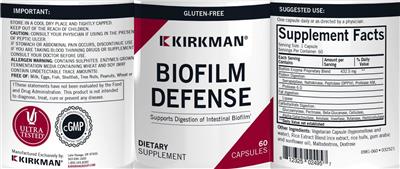
Biofilm Defense by Kirkman label
The label scan from the NIH Dietary Supplement Label Database. Tap to enlarge.
Label images are published by the NIH Dietary Supplement Label Database for the version of this product on file. Always read your actual product label.
View the full label (PDF)The Ingredients in Biofilm Defense by Kirkman
These are the 3 active ingredients this product is made of. Select any to open its full monograph.
Serving size1 Capsule(s) Dosage formCapsule Servings per container60 Amounts shown are per serving.
Most supplement products combine several ingredients, and a medication can interact with the product through any one of them. Each ingredient below shows whether it has known drug interactions.
Biofilm Enzyme Proprietary Blend
- › Protein Digestion
- › Fat Digestion
- › Carbohydrate Digestion
Other (inactive) ingredients: Hypromellose, Water, Rice extract, Rice Husk, Gum Arabic, Sunflower Oil, Maltodextrin, Dextrose. These complete the product’s ingredient list but are not active constituents.
Biofilm Defense by Kirkman Drug Interactions
HelloPharmacist Interaction Report
Biofilm Defense by Kirkman contains two ingredients with documented medication interactions: nattokinase and serrapeptase.
The most serious concern is nattokinase's interaction with blood thinners (anticoagulant/antiplatelet drugs). Nattokinase has blood-thinning effects of its own, and combining it with medications like warfarin, apixaban, or aspirin may increase bleeding risk — there's even a case report of brain bleeding in someone taking nattokinase with low-dose aspirin.
Read the full breakdown — every affected drug type, severity by severity
Nattokinase may also lower blood pressure, so if you take medications to manage high blood pressure (antihypertensive drugs), it could increase the effect and cause your pressure to drop too far. Both interactions are rated Moderate severity.
Serrapeptase, another enzyme in this product, carries a Moderate-severity interaction with blood thinners and antiplatelet drugs for similar reasons — in lab studies it shows blood-thinning activity, which could compound the effect of your medications.
Several other ingredients — amylase, cellulase, peptidase, pectinase, invertase, glucoamylase, xylanase, beta-glucanase, hemicellulase, and alpha-galactosidase — we could not check for interactions. Altogether, these interactions span 287 individual medications.
Use the medication checker on this page to look up your exact drugs before you start.
Check your own medications below · Editorial policy · How we use AI
Want to check YOUR meds against Biofilm Defense?
Ask about interactions with your drugs in plain English — “Can I take it with lisinopril?” — and we find you the answer in seconds, ingredient by ingredient.
Go to the checkerIngredients driving the most interactions
Individual Drug Interactions
The ingredients in Biofilm Defense interact with 289 drugs. Click any drug to see the details.
0 of the 3 ingredients in Biofilm Defense interact with drugs. Each result below shows which ingredient is responsible.
AbciximabReoPro
How Abciximab interacts with Biofilm Defense — through 2 ingredients. Tap an ingredient for the detail:
NattokinaseAnticoagulant/antiplatelet Drugs Moderate
Interaction Summary
Nattokinase might increase the risk of bleeding when used with anticoagulant/antiplatelet drugs.
Read the full Nattokinase + Abciximab interactionSerrapeptaseAnticoagulant/antiplatelet Drugs Moderate
Interaction Summary
Theoretically, taking serrapeptase with drugs that have antiplatelet or anticoagulant effects might increase the risk of bruising and bleeding.
Read the full Serrapeptase + Abciximab interactionAbrocitinibCibinqo
How Abrocitinib interacts with Biofilm Defense — through 2 ingredients. Tap an ingredient for the detail:
NattokinaseAnticoagulant/antiplatelet Drugs Moderate
Interaction Summary
Nattokinase might increase the risk of bleeding when used with anticoagulant/antiplatelet drugs.
Read the full Nattokinase + Abrocitinib interactionSerrapeptaseAnticoagulant/antiplatelet Drugs Moderate
Interaction Summary
Theoretically, taking serrapeptase with drugs that have antiplatelet or anticoagulant effects might increase the risk of bruising and bleeding.
Read the full Serrapeptase + Abrocitinib interactionAcebutololRhotral, Sectral
How Acebutolol interacts with Biofilm Defense — through 1 ingredient. Tap an ingredient for the detail:
NattokinaseAntihypertensive Drugs Moderate
Interaction Summary
Theoretically, nattokinase might increase the risk of hypotension when used with antihypertensive drugs.
Read the full Nattokinase + Acebutolol interactionAcenocoumarolSintrom
How Acenocoumarol interacts with Biofilm Defense — through 2 ingredients. Tap an ingredient for the detail:
NattokinaseAnticoagulant/antiplatelet Drugs Moderate
Interaction Summary
Nattokinase might increase the risk of bleeding when used with anticoagulant/antiplatelet drugs.
Read the full Nattokinase + Acenocoumarol interactionSerrapeptaseAnticoagulant/antiplatelet Drugs Moderate
Interaction Summary
Theoretically, taking serrapeptase with drugs that have antiplatelet or anticoagulant effects might increase the risk of bruising and bleeding.
Read the full Serrapeptase + Acenocoumarol interactionAcetaminophen, AspirinGemnisyn
How Acetaminophen, Aspirin interacts with Biofilm Defense — through 2 ingredients. Tap an ingredient for the detail:
SerrapeptaseAnticoagulant/antiplatelet Drugs Moderate
Interaction Summary
Theoretically, taking serrapeptase with drugs that have antiplatelet or anticoagulant effects might increase the risk of bruising and bleeding.
Read the full Serrapeptase + Acetaminophen, Aspirin interactionNattokinaseAnticoagulant/antiplatelet Drugs Moderate
Interaction Summary
Nattokinase might increase the risk of bleeding when used with anticoagulant/antiplatelet drugs.
Read the full Nattokinase + Acetaminophen, Aspirin interactionAcetaminophen, Aspirin, CaffeineExcedrin, Excedrin Extra Strength, Excedrin Migraine
How Acetaminophen, Aspirin, Caffeine interacts with Biofilm Defense — through 2 ingredients. Tap an ingredient for the detail:
NattokinaseAnticoagulant/antiplatelet Drugs Moderate
Interaction Summary
Nattokinase might increase the risk of bleeding when used with anticoagulant/antiplatelet drugs.
Read the full Nattokinase + Acetaminophen, Aspirin, Caffeine interactionSerrapeptaseAnticoagulant/antiplatelet Drugs Moderate
Interaction Summary
Theoretically, taking serrapeptase with drugs that have antiplatelet or anticoagulant effects might increase the risk of bruising and bleeding.
Read the full Serrapeptase + Acetaminophen, Aspirin, Caffeine interactionAcetaminophen, IbuprofenCombogesic
How Acetaminophen, Ibuprofen interacts with Biofilm Defense — through 2 ingredients. Tap an ingredient for the detail:
NattokinaseAnticoagulant/antiplatelet Drugs Moderate
Interaction Summary
Nattokinase might increase the risk of bleeding when used with anticoagulant/antiplatelet drugs.
Read the full Nattokinase + Acetaminophen, Ibuprofen interactionSerrapeptaseAnticoagulant/antiplatelet Drugs Moderate
Interaction Summary
Theoretically, taking serrapeptase with drugs that have antiplatelet or anticoagulant effects might increase the risk of bruising and bleeding.
Read the full Serrapeptase + Acetaminophen, Ibuprofen interactionAcetazolamideAk-Zol, Diamox
How Acetazolamide interacts with Biofilm Defense — through 1 ingredient. Tap an ingredient for the detail:
NattokinaseAntihypertensive Drugs Moderate
Interaction Summary
Theoretically, nattokinase might increase the risk of hypotension when used with antihypertensive drugs.
Read the full Nattokinase + Acetazolamide interactionAcetylsalicylic AcidEntrophen
How Acetylsalicylic Acid interacts with Biofilm Defense — through 2 ingredients. Tap an ingredient for the detail:
NattokinaseAnticoagulant/antiplatelet Drugs Moderate
Interaction Summary
Nattokinase might increase the risk of bleeding when used with anticoagulant/antiplatelet drugs.
Read the full Nattokinase + Acetylsalicylic Acid interactionSerrapeptaseAnticoagulant/antiplatelet Drugs Moderate
Interaction Summary
Theoretically, taking serrapeptase with drugs that have antiplatelet or anticoagulant effects might increase the risk of bruising and bleeding.
Read the full Serrapeptase + Acetylsalicylic Acid interactionAliskirenTekturna
How Aliskiren interacts with Biofilm Defense — through 1 ingredient. Tap an ingredient for the detail:
NattokinaseAntihypertensive Drugs Moderate
Interaction Summary
Theoretically, nattokinase might increase the risk of hypotension when used with antihypertensive drugs.
Read the full Nattokinase + Aliskiren interactionAlteplase, TpaActilyse, Activase
How Alteplase, Tpa interacts with Biofilm Defense — through 2 ingredients. Tap an ingredient for the detail:
NattokinaseAnticoagulant/antiplatelet Drugs Moderate
Interaction Summary
Nattokinase might increase the risk of bleeding when used with anticoagulant/antiplatelet drugs.
Read the full Nattokinase + Alteplase, Tpa interactionSerrapeptaseAnticoagulant/antiplatelet Drugs Moderate
Interaction Summary
Theoretically, taking serrapeptase with drugs that have antiplatelet or anticoagulant effects might increase the risk of bruising and bleeding.
Read the full Serrapeptase + Alteplase, Tpa interactionAluminum Hydroxide, Aspirin, Codeine Phosphate, Magnesium HydroxideAscriptin Codeine #2
How Aluminum Hydroxide, Aspirin, Codeine Phosphate, Magnesium Hydroxide interacts with Biofilm Defense — through 2 ingredients. Tap an ingredient for the detail:
SerrapeptaseAnticoagulant/antiplatelet Drugs Moderate
Interaction Summary
Theoretically, taking serrapeptase with drugs that have antiplatelet or anticoagulant effects might increase the risk of bruising and bleeding.
Read the full Serrapeptase + Aluminum Hydroxide, Aspirin, Codeine Phosphate, Magnesium Hydroxide interactionNattokinaseAnticoagulant/antiplatelet Drugs Moderate
Interaction Summary
Nattokinase might increase the risk of bleeding when used with anticoagulant/antiplatelet drugs.
Read the full Nattokinase + Aluminum Hydroxide, Aspirin, Codeine Phosphate, Magnesium Hydroxide interactionAluminum Hydroxide, Aspirin, Magnesium HydroxideAscriptin
How Aluminum Hydroxide, Aspirin, Magnesium Hydroxide interacts with Biofilm Defense — through 2 ingredients. Tap an ingredient for the detail:
NattokinaseAnticoagulant/antiplatelet Drugs Moderate
Interaction Summary
Nattokinase might increase the risk of bleeding when used with anticoagulant/antiplatelet drugs.
Read the full Nattokinase + Aluminum Hydroxide, Aspirin, Magnesium Hydroxide interactionSerrapeptaseAnticoagulant/antiplatelet Drugs Moderate
Interaction Summary
Theoretically, taking serrapeptase with drugs that have antiplatelet or anticoagulant effects might increase the risk of bruising and bleeding.
Read the full Serrapeptase + Aluminum Hydroxide, Aspirin, Magnesium Hydroxide interactionAmbrisentanLetairis, Volibris
How Ambrisentan interacts with Biofilm Defense — through 1 ingredient. Tap an ingredient for the detail:
NattokinaseAntihypertensive Drugs Moderate
Interaction Summary
Theoretically, nattokinase might increase the risk of hypotension when used with antihypertensive drugs.
Read the full Nattokinase + Ambrisentan interactionAmilorideAmilamont, Midamor
How Amiloride interacts with Biofilm Defense — through 1 ingredient. Tap an ingredient for the detail:
NattokinaseAntihypertensive Drugs Moderate
Interaction Summary
Theoretically, nattokinase might increase the risk of hypotension when used with antihypertensive drugs.
Read the full Nattokinase + Amiloride interactionAmiloride, HydrochlorothiazideAmil-Co, Amilzide, Moduret 25, Moduretic
How Amiloride, Hydrochlorothiazide interacts with Biofilm Defense — through 1 ingredient. Tap an ingredient for the detail:
NattokinaseAntihypertensive Drugs Moderate
Interaction Summary
Theoretically, nattokinase might increase the risk of hypotension when used with antihypertensive drugs.
Read the full Nattokinase + Amiloride, Hydrochlorothiazide interactionAmlodipineNorliqva
How Amlodipine interacts with Biofilm Defense — through 1 ingredient. Tap an ingredient for the detail:
NattokinaseAntihypertensive Drugs Moderate
Interaction Summary
Theoretically, nattokinase might increase the risk of hypotension when used with antihypertensive drugs.
Read the full Nattokinase + Amlodipine interactionAmlodipine BenzoateKaterzia
How Amlodipine Benzoate interacts with Biofilm Defense — through 1 ingredient. Tap an ingredient for the detail:
NattokinaseAntihypertensive Drugs Moderate
Interaction Summary
Theoretically, nattokinase might increase the risk of hypotension when used with antihypertensive drugs.
Read the full Nattokinase + Amlodipine Benzoate interactionAmlodipine BesilateIstin
How Amlodipine Besilate interacts with Biofilm Defense — through 1 ingredient. Tap an ingredient for the detail:
NattokinaseAntihypertensive Drugs Moderate
Interaction Summary
Theoretically, nattokinase might increase the risk of hypotension when used with antihypertensive drugs.
Read the full Nattokinase + Amlodipine Besilate interactionAmlodipine BesylateNorvasc
How Amlodipine Besylate interacts with Biofilm Defense — through 1 ingredient. Tap an ingredient for the detail:
NattokinaseAntihypertensive Drugs Moderate
Interaction Summary
Theoretically, nattokinase might increase the risk of hypotension when used with antihypertensive drugs.
Read the full Nattokinase + Amlodipine Besylate interactionAmlodipine Besylate, BenazeprilLotrel
How Amlodipine Besylate, Benazepril interacts with Biofilm Defense — through 1 ingredient. Tap an ingredient for the detail:
NattokinaseAntihypertensive Drugs Moderate
Interaction Summary
Theoretically, nattokinase might increase the risk of hypotension when used with antihypertensive drugs.
Read the full Nattokinase + Amlodipine Besylate, Benazepril interactionAmlodipine, CelecoxibConsensi
How Amlodipine, Celecoxib interacts with Biofilm Defense — through 1 ingredient. Tap an ingredient for the detail:
NattokinaseAntihypertensive Drugs Moderate
Interaction Summary
Theoretically, nattokinase might increase the risk of hypotension when used with antihypertensive drugs.
Read the full Nattokinase + Amlodipine, Celecoxib interactionAmmonium ChlorideAmmonium Chloride
How Ammonium Chloride interacts with Biofilm Defense — through 1 ingredient. Tap an ingredient for the detail:
NattokinaseAntihypertensive Drugs Moderate
Interaction Summary
Theoretically, nattokinase might increase the risk of hypotension when used with antihypertensive drugs.
Read the full Nattokinase + Ammonium Chloride interactionAnacaulase-bcdbNexoBrid
How Anacaulase-bcdb interacts with Biofilm Defense — through 2 ingredients. Tap an ingredient for the detail:
NattokinaseAnticoagulant/antiplatelet Drugs Moderate
Interaction Summary
Nattokinase might increase the risk of bleeding when used with anticoagulant/antiplatelet drugs.
Read the full Nattokinase + Anacaulase-bcdb interactionSerrapeptaseAnticoagulant/antiplatelet Drugs Moderate
Interaction Summary
Theoretically, taking serrapeptase with drugs that have antiplatelet or anticoagulant effects might increase the risk of bruising and bleeding.
Read the full Serrapeptase + Anacaulase-bcdb interactionAnagrelideAgrylin
How Anagrelide interacts with Biofilm Defense — through 2 ingredients. Tap an ingredient for the detail:
SerrapeptaseAnticoagulant/antiplatelet Drugs Moderate
Interaction Summary
Theoretically, taking serrapeptase with drugs that have antiplatelet or anticoagulant effects might increase the risk of bruising and bleeding.
Read the full Serrapeptase + Anagrelide interactionNattokinaseAnticoagulant/antiplatelet Drugs Moderate
Interaction Summary
Nattokinase might increase the risk of bleeding when used with anticoagulant/antiplatelet drugs.
Read the full Nattokinase + Anagrelide interactionAnisindioneMiradon
How Anisindione interacts with Biofilm Defense — through 2 ingredients. Tap an ingredient for the detail:
NattokinaseAnticoagulant/antiplatelet Drugs Moderate
Interaction Summary
Nattokinase might increase the risk of bleeding when used with anticoagulant/antiplatelet drugs.
Read the full Nattokinase + Anisindione interactionSerrapeptaseAnticoagulant/antiplatelet Drugs Moderate
Interaction Summary
Theoretically, taking serrapeptase with drugs that have antiplatelet or anticoagulant effects might increase the risk of bruising and bleeding.
Read the full Serrapeptase + Anisindione interactionAntithrombin IiiThrombate III
How Antithrombin Iii interacts with Biofilm Defense — through 2 ingredients. Tap an ingredient for the detail:
NattokinaseAnticoagulant/antiplatelet Drugs Moderate
Interaction Summary
Nattokinase might increase the risk of bleeding when used with anticoagulant/antiplatelet drugs.
Read the full Nattokinase + Antithrombin Iii interactionSerrapeptaseAnticoagulant/antiplatelet Drugs Moderate
Interaction Summary
Theoretically, taking serrapeptase with drugs that have antiplatelet or anticoagulant effects might increase the risk of bruising and bleeding.
Read the full Serrapeptase + Antithrombin Iii interactionApixabanEliquis
How Apixaban interacts with Biofilm Defense — through 2 ingredients. Tap an ingredient for the detail:
NattokinaseAnticoagulant/antiplatelet Drugs Moderate
Interaction Summary
Nattokinase might increase the risk of bleeding when used with anticoagulant/antiplatelet drugs.
Read the full Nattokinase + Apixaban interactionSerrapeptaseAnticoagulant/antiplatelet Drugs Moderate
Interaction Summary
Theoretically, taking serrapeptase with drugs that have antiplatelet or anticoagulant effects might increase the risk of bruising and bleeding.
Read the full Serrapeptase + Apixaban interactionAprocitentanTryvio
How Aprocitentan interacts with Biofilm Defense — through 1 ingredient. Tap an ingredient for the detail:
NattokinaseAntihypertensive Drugs Moderate
Interaction Summary
Theoretically, nattokinase might increase the risk of hypotension when used with antihypertensive drugs.
Read the full Nattokinase + Aprocitentan interactionArgatrobanArgatroban
How Argatroban interacts with Biofilm Defense — through 2 ingredients. Tap an ingredient for the detail:
NattokinaseAnticoagulant/antiplatelet Drugs Moderate
Interaction Summary
Nattokinase might increase the risk of bleeding when used with anticoagulant/antiplatelet drugs.
Read the full Nattokinase + Argatroban interactionSerrapeptaseAnticoagulant/antiplatelet Drugs Moderate
Interaction Summary
Theoretically, taking serrapeptase with drugs that have antiplatelet or anticoagulant effects might increase the risk of bruising and bleeding.
Read the full Serrapeptase + Argatroban interactionEach ingredient & the kinds of drugs it affects
For each ingredient in Biofilm Defense with known interactions, here are the types of medications it can affect. Open any type for the detail — or search your exact drug in the checker above.
Brand information
Manufacturer and brand details for Biofilm Defense, from the product label.
Kirkman
See all Kirkman products- Name
- Kirkman
- City
- Lake Oswego
- State
- OR
- ZipCode
- 97035
- Phone Number
- 1-800-245-8282
- Web Address
- KirkmanGroup.com
Biofilm Defense by Kirkman: Common Questions
Does Biofilm Defense by Kirkman interact with any medications?
How can one product interact with so many drugs?
Where does this information come from?
Can I take this if I'm on aspirin or warfarin?
Is this safe during pregnancy?
Will this cause digestive upset?
What's nattokinase and why is it in here?
Can I take this while breastfeeding?
What does serrapeptase do?
Written and reviewed by the HelloPharmacist editorial staff. Our editorial policy
Not sure if Biofilm Defense is safe with your meds?
Our pharmacists answer your medication & supplement questions — free.
Label information is sourced from the NIH Dietary Supplement Label Database and reflects the product version on file; always read your actual product label. This page is for education only and is not a substitute for professional medical advice. Confirm with your pharmacist or doctor before combining supplements and medications.
Sources & How We Checked
Biofilm Defense's label data comes from the NIH Dietary Supplement Label Database; the ingredient interaction data is from the Natural Medicines database, reviewed by our pharmacists.
- NIH Dietary Supplement Label Database (DSLD) — The official product label on file for this supplement.
- Natural Medicines (Therapeutic Research Center) — Evidence-graded clinical reference behind the ingredient interaction data.
Content is written and reviewed by licensed HelloPharmacist pharmacists. See our data sources and editorial standards for how this information is built and checked.
The 15 references behind this product’s interaction data
Every citation that drives the interaction findings for this product’s ingredients, from the evidence-graded Natural Medicines (TRC Healthcare) database. Open an ingredient to browse its citations — links open the study on PubMed or the publisher’s site.
Proteolytic Enzymes (proteases) 3 references
- Weeks JA, Harper RA, Simon RA, Burdick JD. Assessment of sensitization risk of a laundry pre-spotter containing protease. Cutan Ocul Toxicol. 2011;30(4):272-9. PubMed
- Marquès LI, Lara S, Abós T, Bartolomé B. Occupational rhinitis due to pepsin. J Investig Allergol Clin Immunol. 2006;16(2):136-7. DOI
- Cartier A, Malo JL, Pineau L, Dolovich J. Occupational asthma due to pepsin. J Allergy Clin Immunol. 1984;73(5 Pt 1):574-7. PubMed
See these in context on the Proteolytic Enzymes (proteases) monograph →
Lipase 1 reference
- Casper C, Hascoet JM, Ertl T, et al. Recombinant bile salt-stimulated lipase in preterm infant feeding: A randomized phase 3 study. PLoS One. 2016;11(5):e0156071. PubMed
Nattokinase 9 references
- Suzuki Y, Kondo K, Matsumoto Y, et al. Dietary supplementation of fermented soybean, natto, suppresses intimal thickening and modulates the lysis of mural thrombi after endothelial injury in rat femoral artery. Life Sci 2003;73:1289-98.. PubMed
- Sumi H, Hamada H, Nakanishi K, Hiratani H. Enchancement of fibrinolytic activity in plasma by oral administration of nattokinase. Acta Haematol 1990;84:139-43.
- Chang, Y. Y., Liu, J. S., Lai, S. L., Wu, H. S., and Lan, M. Y. Cerebellar hemorrhage provoked by combined use of nattokinase and aspirin in a patient with cerebral microbleeds. Intern Med 2008;47(5):467-469. PubMed
- Kim, J. Y., Gum, S. N., Paik, J. K., Lim, H. H., Kim, K. C., Ogasawara, K., Inoue, K., Park, S., Jang, Y., and Lee, J. H. Effects of nattokinase on blood pressure: a randomized, controlled trial. Hypertens.Res 2008;31(8):1583-1588. PubMed
- <p>Maruyama M, Sumi H (eds): Effect of natto diet on blood pressure, in Basic and Clinical Aspects of Japanese Traditional Food Natto II. Japan Technology Transfer Association (JTTAS), 1998, pp 1–3.</p>
- Kurosawa Y, Nirengi S, Homma T, et al. A single-dose of oral nattokinase potentiates thrombolysis and anti-coagulation profiles. Sci Rep 2015;5:11601. PubMed
- Ramachandran L, Aqeel A, Jafri A, Sidhu Y, Mohamed Djirdeh T. Nattokinase-associated hemoperitoneum in an elderly woman. Cureus 2021;13(12):e20074. PubMed
- Awatani-Yoshidome K, Hashimoto T, Satoh T. Anaphylaxis from nattokinase in a patient with fermented soybean (natto) allergy. Allergol Int 2022;71(1):153-4. PubMed
- Suzuki K, Nakamura M, Sato N, Futamura K, Matsunaga K, Yagami A. Nattokinase, a subtilisin family serine protease, is a novel allergen contained in the traditional Japanese fermented food natto. Allergol Int 2022.
Serrapeptase 2 references
- Tachibana M, Mizukoshi O, Harada Y, et al. A multi-centre, double-blind study of serrapeptase versus placebo in post-antrotomy buccal swelling. Pharmatherapeutica 1984;3:526-30..
- Mazzone A, Catalani M, Costanzo M, et al. Evaluation of Serratia peptidase in acute or chronic inflammation of otorhinolaryngology pathology: a multicentre, double-blind, randomized trial versus placebo. J Int Med Res 1990;18:379-88.. PubMed
Parts of this content are provided by the Therapeutic Research Center, LLC.
DISCLAIMER: Currently this does not check for drug-drug interactions. This is not an all-inclusive comprehensive list of potential interactions and is for informational purposes only. Not all interactions are known or well-reported in the scientific literature, and new interactions are continually being reported. Input is needed from a qualified healthcare provider including a pharmacist before starting any therapy. Application of clinical judgment is necessary.
© 2021 Therapeutic Research Center, LLC