
Black Elderberry NightTime Syrup Ingredients & Drug Interactions
by Gaia Herbs
What is this page for?
First and foremost: checking Black Elderberry NightTime Syrup against your medications. The heart of this page is the interaction checker and the full interaction report — how this product’s ingredients may interact with prescription and over-the-counter medicines you may be taking.
Around that, we add a pharmacist’s high-level view of the product as a whole — what’s inside, the evidence for its stated use, how transparent the label is, and what safety data exists — so you can see the full picture in one place. It’s educational information from our licensed clinical databases and the clinical staff at HelloPharmacist — not medical advice — and we don’t sell or endorse products. Our editorial policy
Black Elderberry NightTime Syrup is a dietary supplement by Gaia Herbs with 5 active ingredients. Its ingredients are commonly taken for anxiety and stress, sleep problems, digestive upset.Based on those ingredients, 492 medications have a known interaction with it, the most serious rated moderate. The ingredients most likely to interact are Lemon Balm Leaf Extract, California Poppy Leaf Extract, Acerola Fruit Extract. Use the checker below to test your specific medication, or read the full HelloPharmacist Interaction Report.
Check Your Meds Against Black Elderberry NightTime Syrup by Gaia Herbs
Ask about any prescription or over-the-counter medication and we check it for interactions with Black Elderberry NightTime Syrup by Gaia Herbs — and tell you which ingredient is responsible.
AI summaries are generated from our interaction database for education only — always confirm with your pharmacist. How we use AI
Ask the Pharmacist
A licensed pharmacist will answer your question by email — free, usually within 24 hours.
Got it — thank you!
A licensed pharmacist will answer within 24 hours. Keep an eye on your email (worth checking spam, just in case).
HelloPharmacist Scorecard of Black Elderberry NightTime Syrup by Gaia Herbs
Our pharmacy team’s full take, with four database checks built into the cards below — a summary of what is known, not a grade of the product itself.
What’s inside
Low disclosure
This syrup contains five active ingredients. Acerola fruit extract supplies vitamin C and antioxidants.
Lemon balm leaf extract is a traditional herb used to support relaxation and calm. Black elderberry fruit juice concentrate provides antioxidants and immune-supporting compounds.
Grindelia flowering tops extract is traditionally used for respiratory comfort. California poppy leaf extract is included for its mild sedative properties to support sleep.
The product also contains inactive ingredients—cane sugar, water, lemon fruit juice, and xanthan gum (a thickener)—that make up the syrup base.
Does it work?
Moderate evidence
The evidence for this product's ingredients is mixed. Acerola is possibly effective for vitamin C deficiency, but evidence for its use with colds and diarrhea is insufficient.
Lemon balm is possibly effective for stress and depression, and also possibly effective for cold sores. For the other active ingredients—black elderberry, grindelia, and California poppy—the evidence we hold does not establish effectiveness for their intended uses in this product.
How safe is it?
Well-documented data
Acerola from properly prepared supplements is generally well tolerated, though concentrated forms warrant a conversation with your doctor beforehand. Large doses of vitamin C (above 2,000 mg daily) can cause stomach upset and diarrhea.
Lemon balm is generally well tolerated short-term but may cause dizziness or sedation in some people; it's best avoided in pregnancy unless your doctor advises otherwise, and caution is warranted while breastfeeding. Black elderberry made from ripe, cooked fruit is generally well tolerated, but raw or unripe berries, seeds, leaves, and bark contain toxins and should be avoided; avoid elderberry supplements entirely during pregnancy and breastfeeding due to insufficient safety data.
Grindelia is traditionally used in small amounts; it can cause stomach irritation, diarrhea, and kidney irritation in some people, and should be avoided in pregnancy and while breastfeeding. California poppy is considered mild for short-term use but has limited human safety data and should be avoided in pregnancy and while breastfeeding.
Meds to double-check
Moderate interaction found
Before taking this product, double-check with your doctor or pharmacist if you take any CNS depressants (Moderate severity)—this includes sleep aids, anti-anxiety medications, opioid pain relievers, and sedating antihistamines—as lemon balm and California poppy may increase drowsiness. Check as well if you take alkylating agent or antitumor antibiotic chemotherapy drugs (Moderate), immunosuppressants (Moderate), pazopanib (Moderate), estrogen-based birth control or hormone replacement (Minor), aspirin (Minor), aluminum-containing antacids (Minor), or warfarin or other blood thinners (Minor).
No interactions are documented for grindelia flowering tops extract, as we could not check that ingredient.
The bottom line
Scorecard at a glanceFormula with limited ingredient disclosure with some supporting evidence for its stated purpose. Moderate medication interactions have been identified, and safety information is well characterized.
This is a nighttime syrup built around lemon balm and California poppy for relaxation and sleep support, plus antioxidant herbs. If you take medications—especially sleep aids, anxiety drugs, blood thinners, birth control, chemotherapy, or immunosuppressants—check your exact medications with the tool on this page before starting.
Pregnant and breastfeeding people should talk with their doctor or pharmacist first, as several ingredients lack sufficient safety data in those situations. A conversation with your own healthcare provider is the best way to decide if this product is right for you.
Educational only — not medical advice; always confirm with your pharmacist. Our editorial policy · How we use AI
Assessment coverage: 5 of 5 active ingredients matched to our full ingredient reviews (monographs). Based on the product label dated May 23, 2024.
This Scorecard evaluates available label information, ingredient evidence, and known medication-safety considerations. It does not independently verify product identity, purity, potency, contamination, or manufacturing quality. How these ratings are computed
General information
Key facts about Black Elderberry NightTime Syrup, straight from the product label.
| Brand | Gaia Herbs |
|---|---|
| Net contents | 3 Fluid Ounce(s); 89 Milliliter(s) |
| Market status | On market |
| Date entered into DSLD | May 23, 2024 |
| DSLD ID | 309553 |
| Product type | Botanical |
| Supplement form | Liquid |
| Dietary claims / uses | All Other, Structure/Function |
| Intended target group(s) | Vegan, Vegetarian, Adult (18 - 50 Years), Women (not pregnant or lactating), Organic, Gluten Free |
Everything in this section is reproduced from the manufacturer’s own product label — it’s the label speaking, not HelloPharmacist. We show it so you can see exactly what the maker states; we don’t verify or endorse those statements.
Supplement Facts
The label details for Black Elderberry NightTime Syrup by Gaia Herbs, sourced from the NIH Dietary Supplement Label Database.
Supplement Facts
| Ingredient | Amount | % DV |
|---|---|---|
| Calories | 20 Calorie(s) | -- |
| Total Carbohydrates | 5 Gram(s) | 2% |
| Proprietary Blend | 104 mg | -- |
| Added Sugars | 4 Gram(s) | 8% |
| Total Sugars | 4 Gram(s) | -- |
| Acerola Fruit Extract | 147 mg | -- |
| Lemon Balm Leaf Extract | 0 NP | -- |
| Black Elderberry Fruit Juice Concentrate | 1903 mg | -- |
| Grindelia Flowering Tops Extract | 0 NP | -- |
| California Poppy Leaf Extract | 0 NP | -- |
Other ingredients: Cane Sugar, Water, Lemon fruit juice, Xanthan Gum
Tap any ingredient to jump to its full detail below.
These statements are the manufacturer’s wording, reproduced from the product label — the label is saying it, not HelloPharmacist. We don’t verify or endorse them.
Brand IP Statement(s)
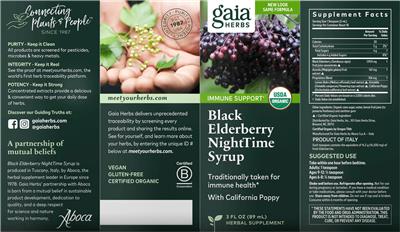
Gaia Herbs Connecting Plants & People Since 1987
Formulation
Purity - Keep it clean All products are screened for pesticides, microbes & heavy metals. Integrity - Keep it real See the proof at meetyourherbs.com, the world's first traceability platform. Potency - Keep it strong Concentrated extracts provide a delicious & convenient way to get your daily dose of herbs.
Vegan
Gluten-free
Certified Organic USDA Organic Certified Organic by Oregon Tilth
Immune support Traditionally taken for immune health Product of Italy
General Statements
Discover our guiding truths at: Facebook Instagram gaiaherbs.com @gaiaherbs
A partnership of mutual beliefs Black Elderberry NightTime Syrup is produced in Tuscany, Italy, by Aboca, the herbal supplement leader in Europe since 1978. Gaia Herbs' partnership with Aboca is born from a mutual belief in sustainable product development, dedication to quality, and a deep respect for science and nature working in harmony. Aboca Gaia Herbs delivers unprecedented traceability by screening every product and sharing the results online. See for yourself, and learn more about your herbs, by entering the unique ID # below at meetyourherbs.com.
New look Same formula
Seals/Symbols
EST 1987 USA Integrity Purity Potency Certified B Corporation
USDA Organic
Formula
Black Elderberry NightTime Syrup with California Poppy Each teaspoon contains the equivalent of 14.5 g (14,500mg) of fresh elderberries.
FDA Statement of Identity
Herbal Supplement
Suggested/Recommended/Usage/Directions
Suggested use Take within one hour before bedtime. Adults: 1 teaspoon Ages 9-12: 1/2 teaspoon Ages 6-8: 1/4 teaspoon Shake well before use.
Precautions
Not for use during pregnancy or lactation. If you have a medical condition or take medications, please consult with your doctor before use.
Store away from children.
Do not use if cap seal is broken.
Storage
Consume within 6 months of opening.
FDA Disclaimer Statement
These statements have not been evaluated by the Food and Drug Administration. This product is not intended to diagnose, treat, cure, or prevent any disease.
Is this label outdated? Report a formula or label change and our pharmacy team will review it.
Black Elderberry NightTime Syrup by Gaia Herbs label
The label scan from the NIH Dietary Supplement Label Database. Tap to enlarge.
Label images are published by the NIH Dietary Supplement Label Database for the version of this product on file. Always read your actual product label.
View the full label (PDF)The Ingredients in Black Elderberry NightTime Syrup by Gaia Herbs
These are the 5 active ingredients this product is made of. Select any to open its full monograph.
Serving size0.25 Teaspoon(s) Dosage formLiquid Servings per container18 Amounts shown are per serving.
Most supplement products combine several ingredients, and a medication can interact with the product through any one of them. Each ingredient below shows whether it has known drug interactions.
Proprietary Blend
Acerola Fruit Extract
Interacts with128 drugs
Acerola is a small tropical fruit prized for its very high natural vitamin C content, and it is mostly used as a food-based source of vitamin C and an...
Acerola Fruit Extract monograph & interactionsBlack Elderberry Fruit Juice Concentrate
Interacts with121 drugs
Elderberry is a popular herbal supplement, mainly taken to help with colds and flu. Some small studies suggest it may modestly shorten cold or flu sym...
Black Elderberry Fruit Juice Concentrate monograph & interactionsOther (inactive) ingredients: Cane Sugar, Water, Lemon fruit juice, Xanthan Gum. These complete the product’s ingredient list but are not active constituents.
Black Elderberry NightTime Syrup by Gaia Herbs Drug Interactions
HelloPharmacist Interaction Report
Gaia Herbs Black Elderberry NightTime Syrup interacts with medications through its acerola fruit extract, lemon balm leaf extract, black elderberry fruit juice concentrate, and California poppy leaf extract.
The most serious interaction is a Moderate-severity effect: lemon balm and California poppy may add to the sedative effects of CNS depressants (sleep aids, anxiety medications, opioids, and similar drugs), potentially increasing drowsiness and impaired coordination.
Read the full breakdown — every affected drug type, severity by severity
Acerola's vitamin C content poses Moderate-severity concerns with chemotherapy drugs—specifically alkylating agents and antitumor antibiotics—where antioxidants might theoretically reduce drug effectiveness. Black elderberry carries a Moderate-severity interaction with immunosuppressants (used after transplant or for autoimmune conditions), as its immune-stimulating activity could interfere with these medications' intended effects.
Elderberry also interacts with pazopanib, a cancer medication.
Acerola has several Minor-severity interactions: it may increase estrogenic effects with birth control pills or hormone replacement therapy, theoretically reduce aspirin clearance, increase aluminum absorption from antacids, and potentially lower warfarin (a blood thinner) effectiveness—though acerola's vitamin C level is likely too low for clinically significant effects. We were unable to check grindelia flowering tops extract for interactions.
Altogether, these interactions span 492 individual medications.
Use the medication checker on this page to look up your exact prescriptions before you start.
Check your own medications below · Editorial policy · How we use AI
Want to check YOUR meds against Black Elderberry NightTime Syrup?
Ask about interactions with your drugs in plain English — “Can I take it with lisinopril?” — and we find you the answer in seconds, ingredient by ingredient.
Go to the checkerIngredients driving the most interactions
Individual Drug Interactions
The ingredients in Black Elderberry NightTime Syrup interact with 492 drugs. Click any drug to see the details.
4 of the 5 ingredients in Black Elderberry NightTime Syrup interact with drugs. Each result below shows which ingredient is responsible. Lemon Balm Leaf Extract California Poppy Leaf Extract Acerola Fruit Extract Black Elderberry Fruit Juice Concentrate
DaclizumabZenapax, Zinbryta
How Daclizumab interacts with Black Elderberry NightTime Syrup — through 1 ingredient. Tap an ingredient for the detail:
Black Elderberry Fruit Juice ConcentrateImmunosuppressants Moderate
Interaction Summary
Theoretically, elderberry might interfere with immunosuppressant therapy due to its immunostimulant activity.
Read the full Black Elderberry Fruit Juice Concentrate + Daclizumab interactionDactinomycinCosmegan, Cosmegen
How Dactinomycin interacts with Black Elderberry NightTime Syrup — through 1 ingredient. Tap an ingredient for the detail:
Acerola Fruit ExtractAntitumor Antibiotics Moderate
Interaction Summary
Theoretically, the antioxidant effects of acerola might reduce the effectiveness of antitumor antibiotics.
Read the full Acerola Fruit Extract + Dactinomycin interactionDaridorexantQuviviq
How Daridorexant interacts with Black Elderberry NightTime Syrup — through 2 ingredients. Tap an ingredient for the detail:
Lemon Balm Leaf ExtractCns Depressants Moderate
Interaction Summary
Theoretically, concomitant use of lemon balm might have additive effects with CNS depressant drugs.
Read the full Lemon Balm Leaf Extract + Daridorexant interactionCalifornia Poppy Leaf ExtractCns Depressants Moderate
Interaction Summary
Theoretically, taking California poppy with drugs with sedative effects may increase the risk of sedative effects.
Read the full California Poppy Leaf Extract + Daridorexant interactionDaunorubicin CitrateDaunoXome
How Daunorubicin Citrate interacts with Black Elderberry NightTime Syrup — through 1 ingredient. Tap an ingredient for the detail:
Acerola Fruit ExtractAntitumor Antibiotics Moderate
Interaction Summary
Theoretically, the antioxidant effects of acerola might reduce the effectiveness of antitumor antibiotics.
Read the full Acerola Fruit Extract + Daunorubicin Citrate interactionDaunorubicin HydrochlorideCerubidine
How Daunorubicin Hydrochloride interacts with Black Elderberry NightTime Syrup — through 1 ingredient. Tap an ingredient for the detail:
Acerola Fruit ExtractAntitumor Antibiotics Moderate
Interaction Summary
Theoretically, the antioxidant effects of acerola might reduce the effectiveness of antitumor antibiotics.
Read the full Acerola Fruit Extract + Daunorubicin Hydrochloride interactionDaunorubicin, CytarabineVyxeos
How Daunorubicin, Cytarabine interacts with Black Elderberry NightTime Syrup — through 1 ingredient. Tap an ingredient for the detail:
Acerola Fruit ExtractAntitumor Antibiotics Moderate
Interaction Summary
Theoretically, the antioxidant effects of acerola might reduce the effectiveness of antitumor antibiotics.
Read the full Acerola Fruit Extract + Daunorubicin, Cytarabine interactionDeflazacortEmflaza
How Deflazacort interacts with Black Elderberry NightTime Syrup — through 1 ingredient. Tap an ingredient for the detail:
Black Elderberry Fruit Juice ConcentrateImmunosuppressants Moderate
Interaction Summary
Theoretically, elderberry might interfere with immunosuppressant therapy due to its immunostimulant activity.
Read the full Black Elderberry Fruit Juice Concentrate + Deflazacort interactionDehydrocholic Acid, Homatropine Methylbromide, PhenobarbitalG.B.S.
How Dehydrocholic Acid, Homatropine Methylbromide, Phenobarbital interacts with Black Elderberry NightTime Syrup — through 2 ingredients. Tap an ingredient for the detail:
Lemon Balm Leaf ExtractCns Depressants Moderate
Interaction Summary
Theoretically, concomitant use of lemon balm might have additive effects with CNS depressant drugs.
Read the full Lemon Balm Leaf Extract + Dehydrocholic Acid, Homatropine Methylbromide, Phenobarbital interactionCalifornia Poppy Leaf ExtractCns Depressants Moderate
Interaction Summary
Theoretically, taking California poppy with drugs with sedative effects may increase the risk of sedative effects.
Read the full California Poppy Leaf Extract + Dehydrocholic Acid, Homatropine Methylbromide, Phenobarbital interactionDenosumabProlia, XGEVA
How Denosumab interacts with Black Elderberry NightTime Syrup — through 1 ingredient. Tap an ingredient for the detail:
Black Elderberry Fruit Juice ConcentrateImmunosuppressants Moderate
Interaction Summary
Theoretically, elderberry might interfere with immunosuppressant therapy due to its immunostimulant activity.
Read the full Black Elderberry Fruit Juice Concentrate + Denosumab interactionDesiccated Thyroid ExtractWesthroid, WP Thyroid
How Desiccated Thyroid Extract interacts with Black Elderberry NightTime Syrup — through 1 ingredient. Tap an ingredient for the detail:
Lemon Balm Leaf ExtractThyroid Hormone Moderate
Interaction Summary
Theoretically, lemon balm might interfere with thyroid hormone replacement therapy.
Read the full Lemon Balm Leaf Extract + Desiccated Thyroid Extract interactionDesiccated Thyroid Extract (prescription Drug)Nature-Throid, Thyrar
How Desiccated Thyroid Extract (prescription Drug) interacts with Black Elderberry NightTime Syrup — through 1 ingredient. Tap an ingredient for the detail:
Lemon Balm Leaf ExtractThyroid Hormone Moderate
Interaction Summary
Theoretically, lemon balm might interfere with thyroid hormone replacement therapy.
Read the full Lemon Balm Leaf Extract + Desiccated Thyroid Extract (prescription Drug) interactionDesipramineDesipramine, Norpramin, Pertofrane
How Desipramine interacts with Black Elderberry NightTime Syrup — through 2 ingredients. Tap an ingredient for the detail:
California Poppy Leaf ExtractCns Depressants Moderate
Interaction Summary
Theoretically, taking California poppy with drugs with sedative effects may increase the risk of sedative effects.
Read the full California Poppy Leaf Extract + Desipramine interactionLemon Balm Leaf ExtractCns Depressants Moderate
Interaction Summary
Theoretically, concomitant use of lemon balm might have additive effects with CNS depressant drugs.
Read the full Lemon Balm Leaf Extract + Desipramine interactionDeucravacitinibSotyktu
How Deucravacitinib interacts with Black Elderberry NightTime Syrup — through 1 ingredient. Tap an ingredient for the detail:
Black Elderberry Fruit Juice ConcentrateImmunosuppressants Moderate
Interaction Summary
Theoretically, elderberry might interfere with immunosuppressant therapy due to its immunostimulant activity.
Read the full Black Elderberry Fruit Juice Concentrate + Deucravacitinib interactionDeutetrabenazineAustedo
How Deutetrabenazine interacts with Black Elderberry NightTime Syrup — through 2 ingredients. Tap an ingredient for the detail:
Lemon Balm Leaf ExtractCns Depressants Moderate
Interaction Summary
Theoretically, concomitant use of lemon balm might have additive effects with CNS depressant drugs.
Read the full Lemon Balm Leaf Extract + Deutetrabenazine interactionCalifornia Poppy Leaf ExtractCns Depressants Moderate
Interaction Summary
Theoretically, taking California poppy with drugs with sedative effects may increase the risk of sedative effects.
Read the full California Poppy Leaf Extract + Deutetrabenazine interactionDexamethasoneDecadron, Dexone, Dextenza, Dexycu, Hemady, Hexadrol +1 more
How Dexamethasone interacts with Black Elderberry NightTime Syrup — through 1 ingredient. Tap an ingredient for the detail:
Black Elderberry Fruit Juice ConcentrateImmunosuppressants Moderate
Interaction Summary
Theoretically, elderberry might interfere with immunosuppressant therapy due to its immunostimulant activity.
Read the full Black Elderberry Fruit Juice Concentrate + Dexamethasone interactionDexmedetomidineIgalmi, Precedex
How Dexmedetomidine interacts with Black Elderberry NightTime Syrup — through 2 ingredients. Tap an ingredient for the detail:
California Poppy Leaf ExtractCns Depressants Moderate
Interaction Summary
Theoretically, taking California poppy with drugs with sedative effects may increase the risk of sedative effects.
Read the full California Poppy Leaf Extract + Dexmedetomidine interactionLemon Balm Leaf ExtractCns Depressants Moderate
Interaction Summary
Theoretically, concomitant use of lemon balm might have additive effects with CNS depressant drugs.
Read the full Lemon Balm Leaf Extract + Dexmedetomidine interactionDextrothyroxineCholoxin
How Dextrothyroxine interacts with Black Elderberry NightTime Syrup — through 1 ingredient. Tap an ingredient for the detail:
Lemon Balm Leaf ExtractThyroid Hormone Moderate
Interaction Summary
Theoretically, lemon balm might interfere with thyroid hormone replacement therapy.
Read the full Lemon Balm Leaf Extract + Dextrothyroxine interactionDiazepamDiastat AcuDial, Valium, Valium injection, Valtoco
How Diazepam interacts with Black Elderberry NightTime Syrup — through 2 ingredients. Tap an ingredient for the detail:
Lemon Balm Leaf ExtractCns Depressants Moderate
Interaction Summary
Theoretically, concomitant use of lemon balm might have additive effects with CNS depressant drugs.
Read the full Lemon Balm Leaf Extract + Diazepam interactionCalifornia Poppy Leaf ExtractCns Depressants Moderate
Interaction Summary
Theoretically, taking California poppy with drugs with sedative effects may increase the risk of sedative effects.
Read the full California Poppy Leaf Extract + Diazepam interactionDicyclomine, PhenobarbitalBentyl w/ Pb
How Dicyclomine, Phenobarbital interacts with Black Elderberry NightTime Syrup — through 2 ingredients. Tap an ingredient for the detail:
California Poppy Leaf ExtractCns Depressants Moderate
Interaction Summary
Theoretically, taking California poppy with drugs with sedative effects may increase the risk of sedative effects.
Read the full California Poppy Leaf Extract + Dicyclomine, Phenobarbital interactionLemon Balm Leaf ExtractCns Depressants Moderate
Interaction Summary
Theoretically, concomitant use of lemon balm might have additive effects with CNS depressant drugs.
Read the full Lemon Balm Leaf Extract + Dicyclomine, Phenobarbital interactionDiphenhydramineAllerdryl, Benadryl, Benadryl cream, Benadryl spray, Compoz, Dermamycin cream +9 more
How Diphenhydramine interacts with Black Elderberry NightTime Syrup — through 2 ingredients. Tap an ingredient for the detail:
Lemon Balm Leaf ExtractCns Depressants Moderate
Interaction Summary
Theoretically, concomitant use of lemon balm might have additive effects with CNS depressant drugs.
Read the full Lemon Balm Leaf Extract + Diphenhydramine interactionCalifornia Poppy Leaf ExtractCns Depressants Moderate
Interaction Summary
Theoretically, taking California poppy with drugs with sedative effects may increase the risk of sedative effects.
Read the full California Poppy Leaf Extract + Diphenhydramine interactionDiphenhydramine Hydrochloride, Naproxen SodiumAleve PM
How Diphenhydramine Hydrochloride, Naproxen Sodium interacts with Black Elderberry NightTime Syrup — through 2 ingredients. Tap an ingredient for the detail:
California Poppy Leaf ExtractCns Depressants Moderate
Interaction Summary
Theoretically, taking California poppy with drugs with sedative effects may increase the risk of sedative effects.
Read the full California Poppy Leaf Extract + Diphenhydramine Hydrochloride, Naproxen Sodium interactionLemon Balm Leaf ExtractCns Depressants Moderate
Interaction Summary
Theoretically, concomitant use of lemon balm might have additive effects with CNS depressant drugs.
Read the full Lemon Balm Leaf Extract + Diphenhydramine Hydrochloride, Naproxen Sodium interactionDiphenhydramine, PseudoephedrineActifed Allergy
How Diphenhydramine, Pseudoephedrine interacts with Black Elderberry NightTime Syrup — through 2 ingredients. Tap an ingredient for the detail:
Lemon Balm Leaf ExtractCns Depressants Moderate
Interaction Summary
Theoretically, concomitant use of lemon balm might have additive effects with CNS depressant drugs.
Read the full Lemon Balm Leaf Extract + Diphenhydramine, Pseudoephedrine interactionCalifornia Poppy Leaf ExtractCns Depressants Moderate
Interaction Summary
Theoretically, taking California poppy with drugs with sedative effects may increase the risk of sedative effects.
Read the full California Poppy Leaf Extract + Diphenhydramine, Pseudoephedrine interactionDiroximel FumarateVumerity
How Diroximel Fumarate interacts with Black Elderberry NightTime Syrup — through 1 ingredient. Tap an ingredient for the detail:
Black Elderberry Fruit Juice ConcentrateImmunosuppressants Moderate
Interaction Summary
Theoretically, elderberry might interfere with immunosuppressant therapy due to its immunostimulant activity.
Read the full Black Elderberry Fruit Juice Concentrate + Diroximel Fumarate interactionDivalproex SodiumDepakote
How Divalproex Sodium interacts with Black Elderberry NightTime Syrup — through 2 ingredients. Tap an ingredient for the detail:
Lemon Balm Leaf ExtractCns Depressants Moderate
Interaction Summary
Theoretically, concomitant use of lemon balm might have additive effects with CNS depressant drugs.
Read the full Lemon Balm Leaf Extract + Divalproex Sodium interactionCalifornia Poppy Leaf ExtractCns Depressants Moderate
Interaction Summary
Theoretically, taking California poppy with drugs with sedative effects may increase the risk of sedative effects.
Read the full California Poppy Leaf Extract + Divalproex Sodium interactionDoripenemDoribax
How Doripenem interacts with Black Elderberry NightTime Syrup — through 1 ingredient. Tap an ingredient for the detail:
Acerola Fruit ExtractAntitumor Antibiotics Moderate
Interaction Summary
Theoretically, the antioxidant effects of acerola might reduce the effectiveness of antitumor antibiotics.
Read the full Acerola Fruit Extract + Doripenem interactionDoxepinDoxepin, Sinequan, Zonalon
How Doxepin interacts with Black Elderberry NightTime Syrup — through 2 ingredients. Tap an ingredient for the detail:
California Poppy Leaf ExtractCns Depressants Moderate
Interaction Summary
Theoretically, taking California poppy with drugs with sedative effects may increase the risk of sedative effects.
Read the full California Poppy Leaf Extract + Doxepin interactionLemon Balm Leaf ExtractCns Depressants Moderate
Interaction Summary
Theoretically, concomitant use of lemon balm might have additive effects with CNS depressant drugs.
Read the full Lemon Balm Leaf Extract + Doxepin interactionDoxorubicinAdriamycin, Caelyx, Doxil, Myocet, Rubex
How Doxorubicin interacts with Black Elderberry NightTime Syrup — through 1 ingredient. Tap an ingredient for the detail:
Acerola Fruit ExtractAntitumor Antibiotics Moderate
Interaction Summary
Theoretically, the antioxidant effects of acerola might reduce the effectiveness of antitumor antibiotics.
Read the full Acerola Fruit Extract + Doxorubicin interactionDurvalumabImfinzi
How Durvalumab interacts with Black Elderberry NightTime Syrup — through 1 ingredient. Tap an ingredient for the detail:
Black Elderberry Fruit Juice ConcentrateImmunosuppressants Moderate
Interaction Summary
Theoretically, elderberry might interfere with immunosuppressant therapy due to its immunostimulant activity.
Read the full Black Elderberry Fruit Juice Concentrate + Durvalumab interactionDyphylline, Ephedrine, Guaifenesin, PhenobarbitalLufyllin-EPG
How Dyphylline, Ephedrine, Guaifenesin, Phenobarbital interacts with Black Elderberry NightTime Syrup — through 2 ingredients. Tap an ingredient for the detail:
Lemon Balm Leaf ExtractCns Depressants Moderate
Interaction Summary
Theoretically, concomitant use of lemon balm might have additive effects with CNS depressant drugs.
Read the full Lemon Balm Leaf Extract + Dyphylline, Ephedrine, Guaifenesin, Phenobarbital interactionCalifornia Poppy Leaf ExtractCns Depressants Moderate
Interaction Summary
Theoretically, taking California poppy with drugs with sedative effects may increase the risk of sedative effects.
Read the full California Poppy Leaf Extract + Dyphylline, Ephedrine, Guaifenesin, Phenobarbital interactionEculizumabSoliris
How Eculizumab interacts with Black Elderberry NightTime Syrup — through 1 ingredient. Tap an ingredient for the detail:
Black Elderberry Fruit Juice ConcentrateImmunosuppressants Moderate
Interaction Summary
Theoretically, elderberry might interfere with immunosuppressant therapy due to its immunostimulant activity.
Read the full Black Elderberry Fruit Juice Concentrate + Eculizumab interactionEach ingredient & the kinds of drugs it affects
For each ingredient in Black Elderberry NightTime Syrup with known interactions, here are the types of medications they can affect. Open any type for the detail — or search your exact drug in the checker above.
Lemon Balm Leaf Extract
Cns Depressants
Theoretically, concomitant use of lemon balm might have additive effects with CNS depressant drugs.
Lemon balm seems to have CNS depressant activity in animals and in humans.
Thyroid Hormone
Theoretically, lemon balm might interfere with thyroid hormone replacement therapy.
In vitro, constituents of lemon balm extract bind to thyroid stimulating hormone (TSH), preventing TSH receptor-binding and leading to the inhibition of TSH-stimulated adenylate cyclase activity. In animals, lemon balm extract has been shown to decrease levels of circulating TSH and inhibit thyroid secretion.
California Poppy Leaf Extract
Cns Depressants
Theoretically, taking California poppy with drugs with sedative effects may increase the risk of sedative effects.
Laboratory research shows that California poppy has sedative effects.
Acerola Fruit Extract
Alkylating Agents
Theoretically, the antioxidant effects of acerola might reduce the effectiveness of alkylating agents.
Acerola contains vitamin C, an antioxidant. There is concern that antioxidants might reduce the activity of chemotherapy drugs that generate free radicals, such as alkylating agents. In contrast, other researchers theorize that antioxidants might make alkylating chemotherapy more effective by reducing oxidative stress that could interfere with apoptosis (cell death) of cancer cells. More evidence is needed to determine what effect, if any, antioxidants such as vitamin C have on chemotherapy.
Antitumor Antibiotics
Theoretically, the antioxidant effects of acerola might reduce the effectiveness of antitumor antibiotics.
Acerola contains vitamin C, an antioxidant. There is concern that antioxidants might reduce the activity of chemotherapy drugs that generate free radicals, such as antitumor antibiotics. In contrast, other researchers theorize that antioxidants might make antitumor antibiotic chemotherapy more effective by reducing oxidative stress that could interfere with apoptosis (cell death) of cancer cells. More evidence is needed to determine what effects, if any, antioxidants such as vitamin C have on antitumor antibiotic chemotherapy.
Aluminum
Theoretically, concomitant use of acerola with aluminum salts might increase the amount of aluminum absorbed.
Acerola contains vitamin C. It is thought that vitamin C chelates aluminum, keeping it in solution and available for absorption. In people with normal renal function, urinary excretion of aluminum likely increases, making aluminum retention and toxicity unlikely. However, patients with renal failure who take aluminum-containing compounds, such as phosphate binders, should avoid acerola in doses that provide more vitamin C than the recommended dietary allowances.
Aspirin
Theoretically, acerola might reduce the clearance of aspirin; however, its vitamin C content is likely too low to produce clinically significant effects.
Acerola contains vitamin C. It has been suggested that acidification of the urine by vitamin C can decrease the urinary excretion of salicylates, increasing plasma salicylate levels. However, short-term use of up to 6 grams daily of vitamin C does not seem to affect urinary pH or salicylate excretion. The vitamin C content of acerola is typically about 2000 mg per 100 grams. Thus, a clinically significant interaction between acerola and aspirin is unlikely.
Estrogens
Theoretically, concomitant use of acerola with estrogens might increase estrogenic effects.
Acerola contains vitamin C. Increases in plasma estrogen levels of up to 55% have occurred under some circumstances when vitamin C is taken concurrently with oral contraceptives or hormone replacement therapy, including topical products. It is suggested that vitamin C prevents oxidation of estrogen in the tissues, regenerates oxidized estrogen, and reduces sulfate conjugation of estrogen in the gut wall. When tissue levels of vitamin C are high, these processes are already maximized and supplemental vitamin C does not have any effect on estrogen levels. However, increases in plasma estrogen levels may occur when women who are deficient in vitamin C take supplements.
Warfarin (Coumadin)
Theoretically, acerola might reduce the effectiveness of warfarin; however, its vitamin C content is likely too low to produce clinically significant effects.
Acerola contains vitamin C. High doses of vitamin C may reduce the response to warfarin, possibly by causing diarrhea and reducing warfarin absorption. This occurred in two people who took up to 16 grams daily of vitamin C, and resulted in decreased prothrombin time. Lower doses of 5-10 grams daily of vitamin C can also reduce warfarin absorption, but this does not seem to be clinically significant. The vitamin C content of acerola is typically about 2000 mg per 100 grams. Thus, a clinically significant interaction between acerola and warfarin is unlikely.
Black Elderberry Fruit Juice Concentrate
Immunosuppressants
Theoretically, elderberry might interfere with immunosuppressant therapy due to its immunostimulant activity.
Elderberry has immunostimulant activity, increasing the production of cytokines, including interleukin and tumor necrosis factor.
Pazopanib (Votrient)
Theoretically, elderberry might interact with pazopanib, potentially increasing the risk of adverse effects.
Brand information
Manufacturer and brand details for Black Elderberry NightTime Syrup, from the product label.
Gaia Herbs
See all Gaia Herbs products- Name
- Gaia Herbs Inc.
- Street Address
- 101 Gaia Herbs Dr.
- City
- Brevard
- State
- NC
- ZipCode
- 28712
Black Elderberry NightTime Syrup by Gaia Herbs: Common Questions
Does Black Elderberry NightTime Syrup by Gaia Herbs interact with any medications?
How can one product interact with so many drugs?
Where does this information come from?
Will this make me drowsy the next morning?
Can I take this if I'm pregnant or breastfeeding?
Does elderberry in this product actually prevent colds?
Is this safe if I have raw or unripe berries in it?
What is grindelia in this product used for?
Can I take this with my sleep medication?
Written and reviewed by the HelloPharmacist editorial staff. Our editorial policy
Not sure if Black Elderberry NightTime Syrup is safe with your meds?
Our pharmacists answer your medication & supplement questions — free.
Label information is sourced from the NIH Dietary Supplement Label Database and reflects the product version on file; always read your actual product label. This page is for education only and is not a substitute for professional medical advice. Confirm with your pharmacist or doctor before combining supplements and medications.
The Full Monographs Behind Black Elderberry NightTime Syrup’s Ingredients
Every ingredient we hold a full HelloPharmacist monograph for — uses, evidence, safety, and the complete interaction list.
Lemon Balm
Interacts with 264 drugsLemon balm is a gentle, lemon-scented mint-family herb traditionally used to ease stress, support sleep, and calm digestion, and topically for cold sores. Early studies are promising but gen...
Read the full Lemon Balm monograph → Herb & supplement monographGumweed
Gumweed is a traditional North American plant used mostly for coughs, chest congestion, and skin irritation such as poison ivy rashes. Good-quality human studies are lacking, so its benefits...
Read the full Gumweed monograph → Herb & supplement monographCalifornia Poppy
Interacts with 248 drugsCalifornia poppy is a traditional herbal remedy used mainly for anxiety and sleep problems, often combined with other calming herbs. Human research is very limited, so its true benefits are...
Read the full California Poppy monograph → Herb & supplement monographAcerola
Interacts with 128 drugsAcerola is a small tropical fruit prized for its very high natural vitamin C content, and it is mostly used as a food-based source of vitamin C and antioxidants. While vitamin C itself has w...
Read the full Acerola monograph → Herb & supplement monographElderberry
Interacts with 121 drugsElderberry is a popular herbal supplement, mainly taken to help with colds and flu. Some small studies suggest it may modestly shorten cold or flu symptoms, but the evidence is limited and n...
Read the full Elderberry monograph →Sources & How We Checked
Black Elderberry NightTime Syrup's label data comes from the NIH Dietary Supplement Label Database; the ingredient interaction data is from the Natural Medicines database, reviewed by our pharmacists.
- NIH Dietary Supplement Label Database (DSLD) — The official product label on file for this supplement.
- Natural Medicines (Therapeutic Research Center) — Evidence-graded clinical reference behind the ingredient interaction data.
Content is written and reviewed by licensed HelloPharmacist pharmacists. See our data sources and editorial standards for how this information is built and checked.
The 44 references behind this product’s interaction data
Every citation that drives the interaction findings for this product’s ingredients, from the evidence-graded Natural Medicines (TRC Healthcare) database. Open an ingredient to browse its citations — links open the study on PubMed or the publisher’s site.
Acerola 20 references
- Back DJ, Breckenridge AM, MacIver M, et al. Interaction of ethinyloestradiol with ascorbic acid in man. Br Med J (Clin Res Ed) 1981;282:1516.
- Morris JC, Beeley L, Ballantine N. Interaction of ethinyloestradiol with ascorbic acid in man [letter]. Br Med J (Clin Res Ed) 1981;283:503.
- Labriola D, Livingston R. Possible interactions between dietary antioxidants and chemotherapy. Oncology 1999;13:1003-8.
- Hansten PD, Horn JR. Drug Interactions Analysis and Management. Vancouver, WA: Applied Therapeutics Inc., 1997 and updates.
- Food and Nutrition Board, Institute of Medicine. Dietary Reference Intakes for Vitamin C, Vitamin E, Selenium, and Carotenoids. Washington, DC: National Academy Press, 2000. Available at: http://www.nap.edu/books/0309069351/html/.
- Rosenthal G. Interaction of ascorbic acid and warfarin. JAMA 1971;215:1671. DOI
- Hume R, Johnstone JM, Weyers E. Interaction of ascorbic acid and warfarin. JAMA 1972;219:1479. DOI
- Smith EC, Skalski RJ, Johnson GC, Rossi GV. Interaction of ascorbic acid and warfarin. JAMA 1972;221:1166. DOI
- Domingo JL, Gomez M, Llobet JM, Richart C. Effect of ascorbic acid on gastrointestinal aluminum absorption (letter). Lancet 1991;338:1467.
- Domingo JL, Gomez M, Llobet JM, Corbella J. Influence of some dietary constituents on aluminum absorption and retention in rats. Kidney Int 1991;39:598-601. PubMed
- Partridge NA, Regnier FE, White JL, Hem SL. Influence of dietary constituents on intestinal absorption of aluminum. Kidney Int 1989;35:1413-7. PubMed
- Mc Leod DC, Nahata MC. Inefficacy of ascorbic acid as a urinary acidifier (letter). N Engl J Med 1977;296:1413. DOI
- Hansten PD, Hayton WL. Effect of antacid and ascorbic acid on serum salicylate concentration. J Clin Pharmacol 1980;20:326-31. PubMed
- Vihtamaki T, Parantainen J, Koivisto AM, et al. Oral ascorbic acid increases plasma oestradiol during postmenopausal hormone replacement therapy. Maturitas 2002;42:129-35. PubMed
- Feetam CL, Leach RH, Meynell MJ. Lack of a clinically important interaction between warfarin and ascorbic acid. Toxicol Appl Pharmacol 1975;31:544-7. PubMed
- Weintraub M, Griner PF. Warfarin and ascorbic acid: lack of evidence for a drug interaction. Toxicol Appl Pharmacol 1974;28:53-6. PubMed
- Prasad KN. Rationale for using high-dose multiple dietary antioxidants as an adjunct to radiation therapy and chemotherapy. J Nutr 2004;134:3182S-3S. PubMed
- Conklin KA. Cancer chemotherapy and antioxidants. J Nutr 2004;134:3201S-3204S. PubMed
- Denadai R, Souza FM, Valle MR. Fecal impaction by rectal acerola bezoar. Indian J Pediatr 2013;80(5):432-3. PubMed
- Raulf-Heimsoth M, Stark R, Sander I, et al. Anaphylactic reaction to apple juice containing acerola: cross-reactivity to latex due to prohevein. J Allergy Clin Immunol 2002;109(4):715-6. PubMed
Lemon Balm 12 references
- Wolbling RH, Leonhardt K. Local therapy of herpes simplex with dried extract from Melissa officinalis. Phytomedicine 1994;1:25-31.
- Akhondzadeh S, Noroozian M, Mohammadi M, et al. Melissa officinalis extract in the treatment of patients with mild to moderate Alzheimer's disease: a double blind, randomised, placebo controlled trial. J Neurol Neurosurg Psychiatry 2003;74:863-6. PubMed
- Kennedy DO, Scholey AB, Tildesley NT, et al. Modulation of mood and cognitive performance following acute administration of Melissa officinalis (lemon balm). Pharmacol Biochem Behav 2002;72:953-64. PubMed
- Albrecht M, Berger W, Laux P, Schmidt U, et al. Psychopharmaka und Verkehrssicherheit. Der Einfluß von Euvegal® - Dragees forte auf die Fahrtüchtigkeit und Kombinationswirkungen mit Alkohol Z Allg Med 1995;71:1215-25.
- Herberg, KW. Nebenwirkungen pflanzlicher Beruhigungsmittel/ Leistung und Befinden nach Einnahme einer Baldrian-Hopfen-Kombination. Z.Allg Med 1996;72:234-240.
- Soulimani R, Fleurentin J, Mortier F, et al. Neurotropic action of the hydroalcoholic extract of Melissa officinalis in the mouse. Planta Med. 1991 Apr;57:105-9.
- Sourgens H, Winterhoff H, Gumbinger HG, et al. Antihormonal effects of plant extracts. TSH- and prolactin-suppressing properties of Lithospermum officinale and other plants. Planta Med. 1982 Jun;45:78-86. DOI
- Auf'mkolk M, Ingbar JC, Amir SM, et al. Inhibition by certain plant extracts of the binding and adenylate cyclase stimulatory effect of bovine thyrotropin in human thyroid membranes. Endocrinology. 1984 Aug;115:527-34. PubMed
- Santini F, Vitti P, Ceccarini G, et al. In vitro assay of thyroid disruptors affecting TSH-stimulated adenylate cyclase activity. J Endocrinol Invest. 2003 Oct;26:950-5. PubMed
- Alijaniha F, et al. Heart palpitation relief with Melissa officinalis leaf extract: double blind, randomized, placebo controlled trial of efficacy and safety. J Ethnopharmacol. 2015;164:378-384. doi: 10.1016/j.jep.2015.02.007. Epub 2015 Feb 11. PubMed
- Araj-Khodaei M, Noorbala AA, Yarani R, et al. A double-blind, randomized pilot study for comparison of Melissa officinalis L. and Lavandula angustifolia Mill. with Fluoxetine for the treatment of depression. BMC Complement Med Ther. 2020;20(1):207. PubMed
- Kucuk U, Pham M, Raza Raja MH, Saad Shaukat MH, Clark R. Transient complete atrioventricular block associated with herbal supplement use. S D Med 2023;76(7):311-313.
Elderberry 6 references
- Barak V, Halperin T, Kalickman I. The effect of Sambucol, a black elderberry-based, natural product, on the production of human cytokines: I. Inflammatory cytokines. Eur Cytokine Netw 2001;12:290-6..
- Elderberry (Sambucus species). The Poison Plant Patch, Novia Scotia Museum, 2007. Available at: http://museum.gov.ns.ca/poison/?section=species&id=117 (Accessed 16 October 2009).
- European elder. Canadian Poisonous Plants Information System. Available at: http://www.cbif.gc.ca/pls/pp/ppack.jump?p_null=all&p_psn=121&p_type=all&p_sci=comm&p_x=px (Accessed 16 October 2009).
- Raus K, Pleschka S, Klein P, Schoop R, Fisher P. Effect of an echinacea-based hot drink versus oseltamivir in Influenza treatment: a randomized, double-blind, double-dummy, multicenter, noninferiority clinical trial. . Curr Ther Res Clin Exp. 2015;20;77:6 PubMed
- Ramachandran A, Antala D, Pudasainee P, Panginikkod S, Gupta H. A Plausible Association Between the Use of Elderberry and Autoimmune Hepatitis. Cureus 2022;14(4):e24250. PubMed
- Agarwal N, Mangla A. Elderberry interaction with pazopanib in a patient with soft-tissue sarcoma: A case report and literature review. Mol Clin Oncol 2024;20(5):36. PubMed
Gumweed 3 references
- Blumenthal M, ed. The Complete German Commission E Monographs: Therapeutic Guide to Herbal Medicines. Trans. S. Klein. Boston, MA: American Botanical Council, 1998.
- McGuffin M, Hobbs C, Upton R, Goldberg A, eds. American Herbal Products Association's Botanical Safety Handbook. Boca Raton, FL: CRC Press, LLC 1997.
- Gruenwald J, Brendler T, Jaenicke C. PDR for Herbal Medicines. 1st ed. Montvale, NJ: Medical Economics Company, Inc., 1998.
California Poppy 3 references
- Hanus M, Lafon J, Mathieu M. Double-blind, randomised, placebo-controlled study to evaluate the efficacy and safety of a fixed combination containing two plant extracts (Crataegus oxyacantha and Eschscholtzia californica) and magnesium in mild-to-moderate
- Paul LD, Springer D, Staack RF, et al. Cytochrome P450 isoenzymes involved in rat liver microsomal metabolism of californine and protopine. Eur J Pharmacol 2004;485:69-79. PubMed
- Paul LD, Maurer HH. Studies on the metabolism and toxicological detection of the Eschscholtzia californica alkaloids californine and protopine in urine using gas chromatography-mass spectrometry. J Chromatogr B Analyt Technol Biomed Life Sci 2003;789:43-5
Parts of this content are provided by the Therapeutic Research Center, LLC.
DISCLAIMER: Currently this does not check for drug-drug interactions. This is not an all-inclusive comprehensive list of potential interactions and is for informational purposes only. Not all interactions are known or well-reported in the scientific literature, and new interactions are continually being reported. Input is needed from a qualified healthcare provider including a pharmacist before starting any therapy. Application of clinical judgment is necessary.
© 2021 Therapeutic Research Center, LLC