
Borage Oil 1,000 mg Ingredients & Drug Interactions
What is this page for?
First and foremost: checking Borage Oil 1,000 mg against your medications. The heart of this page is the interaction checker and the full interaction report — how this product’s ingredients may interact with prescription and over-the-counter medicines you may be taking.
Around that, we add a pharmacist’s high-level view of the product as a whole — what’s inside, the evidence for its stated use, how transparent the label is, and what safety data exists — so you can see the full picture in one place. It’s educational information from our licensed clinical databases and the clinical staff at HelloPharmacist — not medical advice — and we don’t sell or endorse products. Our editorial policy
Borage Oil 1,000 mg is a dietary supplement by Woodstock Vitamins with 5 active ingredients. Its ingredients are commonly taken for heart health, healthy cooking fat, skin moisturizing.Based on those ingredients, 312 medications have a known interaction with it, the most serious rated moderate. The ingredients most likely to interact are Borage Oil, Oleic Acid. Use the checker below to test your specific medication, or read the full HelloPharmacist Interaction Report.
Check Your Meds Against Borage Oil 1,000 mg by Woodstock Vitamins
Ask about any prescription or over-the-counter medication and we check it for interactions with Borage Oil 1,000 mg by Woodstock Vitamins — and tell you which ingredient is responsible.
AI summaries are generated from our interaction database for education only — always confirm with your pharmacist. How we use AI
Ask the Pharmacist
A licensed pharmacist will answer your question by email — free, usually within 24 hours.
Got it — thank you!
A licensed pharmacist will answer within 24 hours. Keep an eye on your email (worth checking spam, just in case).
HelloPharmacist Scorecard of Borage Oil 1,000 mg by Woodstock Vitamins
Our pharmacy team’s full take, with four database checks built into the cards below — a summary of what is known, not a grade of the product itself.
What’s inside
Full disclosure
Borage Oil 1,000 mg contains 5 active ingredients that come from borage seed oil itself. The main components are gamma-linolenic acid, oleic acid, palmitic acid, and linoleic acid — all fatty acids that naturally occur in the seed.
The softgel capsule also holds gelatin, glycerin, and purified water as inactive ingredients to hold everything together.
Does it work?
Moderate evidence
The evidence for borage oil's benefits is mixed. For eczema (atopic dermatitis), the data suggests it's possibly ineffective.
The evidence isn't established in our data for ADHD, acute respiratory distress syndrome, or alcoholism. Oleic acid — one of the fatty acids in borage oil — shows possibly effective evidence for high cholesterol and coronary heart disease, though that benefit comes from dietary sources like olive oil rather than from borage specifically.
How safe is it?
Well-documented data
Borage seed oil is generally well tolerated when taken by mouth. The most common side effects are mild digestive ones: belching, bloating, diarrhea, and soft stools.
The safety data advises against this product during pregnancy because of concern about liver-toxic alkaloids and a theoretical risk to the uterus. For breastfeeding, there isn't enough safety data, and contamination with these alkaloids is a concern, so it's best avoided then too.
This product is certified free of pyrrolizidine alkaloids (the liver-harming compounds), which is reassuring, but other borage plant parts can contain them.
Meds to double-check
Moderate interaction found
Before you start, check with your doctor or pharmacist if you take blood thinners or antiplatelet drugs (warfarin, aspirin, clopidogrel), phenothiazine antipsychotics, drugs that induce CYP3A4 liver metabolism, or oral diabetes medications. Moderate interactions are documented for all of these drug types.
The bottom line
Scorecard at a glanceFully disclosed formula with some supporting evidence for its stated purpose. Moderate medication interactions have been identified, and safety information is well characterized.
Borage oil might be worth considering if you're exploring options for high cholesterol or heart health, though the evidence is modest and comes mainly from dietary oleic acid rather than borage itself. You should be cautious if you're on blood thinners, antiplatelets, seizure medications, or diabetes drugs — talk with your doctor or pharmacist before adding this to make sure it's safe with your specific medications.
The pregnancy and breastfeeding safety data advises against it during those times.
Educational only — not medical advice; always confirm with your pharmacist. Our editorial policy · How we use AI
Assessment coverage: 2 of 5 active ingredients matched to our full ingredient reviews (monographs). Based on the product label dated May 23, 2024.
This Scorecard evaluates available label information, ingredient evidence, and known medication-safety considerations. It does not independently verify product identity, purity, potency, contamination, or manufacturing quality. How these ratings are computed
General information
Key facts about Borage Oil 1,000 mg, straight from the product label.
| Brand | Woodstock Vitamins |
|---|---|
| Barcode (UPC) | 719985133251 |
| Net contents | 90 Softgel(s) |
| Market status | On market |
| Date entered into DSLD | May 23, 2024 |
| DSLD ID | 310179 |
| Product type | Fat/fatty Acid |
| Supplement form | Softgel Capsule |
| Dietary claims / uses | Nutrient, All Other, Structure/Function |
| Intended target group(s) | Adult (18 - 50 Years), Gluten Free, Dairy Free |
Everything in this section is reproduced from the manufacturer’s own product label — it’s the label speaking, not HelloPharmacist. We show it so you can see exactly what the maker states; we don’t verify or endorse those statements.
Supplement Facts
The label details for Borage Oil 1,000 mg by Woodstock Vitamins, sourced from the NIH Dietary Supplement Label Database.
Supplement Facts
| Ingredient | Amount | % DV |
|---|---|---|
| Total Fat | 1 Gram(s) | 1% |
| Gamma-Linolenic Acid | 200 mg | -- |
| Calories | 10 Calorie(s) | -- |
| Oleic Acid | 150 mg | -- |
| Palmitic Acid | 90 mg | -- |
| Linoleic Acid | 370 mg | -- |
| Borage Oil | 1000 mg | -- |
Other ingredients: Gelatin, Glycerin, purified Water
Tap any ingredient to jump to its full detail below.
These statements are the manufacturer’s wording, reproduced from the product label — the label is saying it, not HelloPharmacist. We don’t verify or endorse them.
Formulation
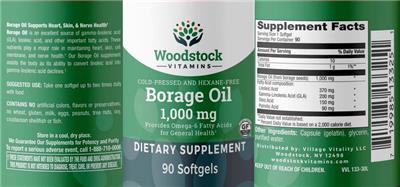
Borage Oil supports heart, skin, & nerve health
Contains no artificial colors, flavors or preservatives; no wheat, gluten, milk, eggs, peanuts, tree nuts, soy, crustacean shellfish or fish.
We guarantee our supplements for potency and purity
Cold-pressed and hexane-free
Cold-pressed and hexane-free
Double Verified GF Gluten free
Formula
Borage Oil is an excellent source of gamma-linolenic acid (GLA), linoleic acid, and other important fatty acids. These nutrients play a major role in maintaining heart, skin, cell membrane and nerve health. Our Borage Oil supplement assists the body as its ability to convert linoleic acid into gamma-linolenic acid declines.
Provides Omega-6 Fatty Acids for general health
Suggested/Recommended/Usage/Directions
Suggested Use: Take one softgel up to two times daily with food.
Storage
Store in a cool, dry place.
Precautions
To report a serious adverse event, call 1-888-710-0006
Keep out of reach of children.
FDA Disclaimer Statement
These statements have not been evaluated by the Food and Drug Administration. This product is not intended to diagnose, treat, cure, or prevent any disease.
Seals/Symbols
Double Verified GF Gluten free
FDA Statement of Identity
Dietary Supplement
Is this label outdated? Report a formula or label change and our pharmacy team will review it.
Borage Oil 1,000 mg by Woodstock Vitamins label
The label scan from the NIH Dietary Supplement Label Database. Tap to enlarge.
Label images are published by the NIH Dietary Supplement Label Database for the version of this product on file. Always read your actual product label.
View the full label (PDF)The Ingredients in Borage Oil 1,000 mg by Woodstock Vitamins
These are the 5 active ingredients this product is made of. Select any to open its full monograph.
Serving size1 Softgel(s) Dosage formSoftgel Capsule Servings per container90 Amounts shown are per serving.
Most supplement products combine several ingredients, and a medication can interact with the product through any one of them. Each ingredient below shows whether it has known drug interactions.
Gamma-Linolenic Acid
Oleic Acid
Interacts with86 drugs
Oleic acid is a heart-healthy monounsaturated fat found mainly in olive oil, canola oil, avocados, and nuts. As part of a Mediterranean-style diet, it...
Oleic Acid monograph & interactionsPalmitic Acid
Linoleic Acid
Borage Oil
Interacts with226 drugs
Borage is a Mediterranean herb whose seed oil is rich in gamma-linolenic acid (GLA), an omega-6 fatty acid studied mostly for skin conditions and arth...
Borage Oil monograph & interactionsOther (inactive) ingredients: Gelatin, Glycerin, Purified Water. These complete the product’s ingredient list but are not active constituents.
Borage Oil 1,000 mg by Woodstock Vitamins Drug Interactions
HelloPharmacist Interaction Report
Borage Oil 1,000 mg by Woodstock Vitamins interacts with medications through its borage oil and oleic acid content.
The most serious interactions are Moderate in severity. Borage oil may increase bleeding risk if you're on blood thinners or antiplatelet drugs (like warfarin or aspirin), and there's a theoretical concern it could lower your seizure threshold if combined with phenothiazine antipsychotics.
Additionally, if you take drugs that speed up CYP3A4 liver metabolism, borage oil could theoretically raise levels of certain toxic compounds.
Read the full breakdown — every affected drug type, severity by severity
Oleic acid in this product may increase the effects of diabetes medications — preliminary research suggests that diets rich in oleic acid lower fasting blood glucose compared to other oil types, so you'll want to monitor your blood sugar closely if you're on oral diabetes drugs. Altogether, these interactions span 313 individual medications.
We couldn't check three other ingredients in this product — Gamma-Linolenic Acid, Palmitic Acid, and Linoleic Acid — because we hold no interaction data for them. Use the medication search tool on this page to look up your exact prescriptions before you start, and talk with your doctor or pharmacist about whether this product is right for you.
Check your own medications below · Editorial policy · How we use AI
Want to check YOUR meds against Borage Oil 1,000 mg?
Ask about interactions with your drugs in plain English — “Can I take it with lisinopril?” — and we find you the answer in seconds, ingredient by ingredient.
Go to the checkerIngredients driving the most interactions
Individual Drug Interactions
The ingredients in Borage Oil 1,000 mg interact with 312 drugs. Click any drug to see the details.
2 of the 5 ingredients in Borage Oil 1,000 mg interact with drugs. Each result below shows which ingredient is responsible. Borage Oil Oleic Acid
AbciximabReoPro
How Abciximab interacts with Borage Oil 1,000 mg — through 1 ingredient. Tap an ingredient for the detail:
Borage OilAnticoagulant/antiplatelet Drugs Moderate
Interaction Summary
Theoretically, borage seed oil may increase the risk of bleeding if used with anticoagulant or antiplatelet drugs.
Read the full Borage Oil + Abciximab interactionAbrocitinibCibinqo
How Abrocitinib interacts with Borage Oil 1,000 mg — through 1 ingredient. Tap an ingredient for the detail:
Borage OilAnticoagulant/antiplatelet Drugs Moderate
Interaction Summary
Theoretically, borage seed oil may increase the risk of bleeding if used with anticoagulant or antiplatelet drugs.
Read the full Borage Oil + Abrocitinib interactionAcarboseGlucobay, Prandase, Precose
How Acarbose interacts with Borage Oil 1,000 mg — through 1 ingredient. Tap an ingredient for the detail:
Oleic AcidAntidiabetes Drugs Moderate
Interaction Summary
Theoretically, oleic acid might increase the effects of antidiabetes drugs.
Read the full Oleic Acid + Acarbose interactionAcenocoumarolSintrom
How Acenocoumarol interacts with Borage Oil 1,000 mg — through 1 ingredient. Tap an ingredient for the detail:
Borage OilAnticoagulant/antiplatelet Drugs Moderate
Interaction Summary
Theoretically, borage seed oil may increase the risk of bleeding if used with anticoagulant or antiplatelet drugs.
Read the full Borage Oil + Acenocoumarol interactionAcepromazineAtravet
How Acepromazine interacts with Borage Oil 1,000 mg — through 1 ingredient. Tap an ingredient for the detail:
Borage OilPhenothiazines Moderate
Interaction Summary
Theoretically, taking borage sed oil with phenothiazines might increase the risk of seizures.
Read the full Borage Oil + Acepromazine interactionAcetaminophen, AspirinGemnisyn
How Acetaminophen, Aspirin interacts with Borage Oil 1,000 mg — through 1 ingredient. Tap an ingredient for the detail:
Borage OilAnticoagulant/antiplatelet Drugs Moderate
Interaction Summary
Theoretically, borage seed oil may increase the risk of bleeding if used with anticoagulant or antiplatelet drugs.
Read the full Borage Oil + Acetaminophen, Aspirin interactionAcetaminophen, Aspirin, CaffeineExcedrin, Excedrin Extra Strength, Excedrin Migraine
How Acetaminophen, Aspirin, Caffeine interacts with Borage Oil 1,000 mg — through 1 ingredient. Tap an ingredient for the detail:
Borage OilAnticoagulant/antiplatelet Drugs Moderate
Interaction Summary
Theoretically, borage seed oil may increase the risk of bleeding if used with anticoagulant or antiplatelet drugs.
Read the full Borage Oil + Acetaminophen, Aspirin, Caffeine interactionAcetaminophen, IbuprofenCombogesic
How Acetaminophen, Ibuprofen interacts with Borage Oil 1,000 mg — through 1 ingredient. Tap an ingredient for the detail:
Borage OilAnticoagulant/antiplatelet Drugs Moderate
Interaction Summary
Theoretically, borage seed oil may increase the risk of bleeding if used with anticoagulant or antiplatelet drugs.
Read the full Borage Oil + Acetaminophen, Ibuprofen interactionAcetohexamideDymelor
How Acetohexamide interacts with Borage Oil 1,000 mg — through 1 ingredient. Tap an ingredient for the detail:
Oleic AcidAntidiabetes Drugs Moderate
Interaction Summary
Theoretically, oleic acid might increase the effects of antidiabetes drugs.
Read the full Oleic Acid + Acetohexamide interactionAcetylsalicylic AcidEntrophen
How Acetylsalicylic Acid interacts with Borage Oil 1,000 mg — through 1 ingredient. Tap an ingredient for the detail:
Borage OilAnticoagulant/antiplatelet Drugs Moderate
Interaction Summary
Theoretically, borage seed oil may increase the risk of bleeding if used with anticoagulant or antiplatelet drugs.
Read the full Borage Oil + Acetylsalicylic Acid interactionAlbiglutideTanzeum
How Albiglutide interacts with Borage Oil 1,000 mg — through 1 ingredient. Tap an ingredient for the detail:
Oleic AcidAntidiabetes Drugs Moderate
Interaction Summary
Theoretically, oleic acid might increase the effects of antidiabetes drugs.
Read the full Oleic Acid + Albiglutide interactionAlogliptinNesina
How Alogliptin interacts with Borage Oil 1,000 mg — through 1 ingredient. Tap an ingredient for the detail:
Oleic AcidAntidiabetes Drugs Moderate
Interaction Summary
Theoretically, oleic acid might increase the effects of antidiabetes drugs.
Read the full Oleic Acid + Alogliptin interactionAlogliptin, MetforminKazano
How Alogliptin, Metformin interacts with Borage Oil 1,000 mg — through 1 ingredient. Tap an ingredient for the detail:
Oleic AcidAntidiabetes Drugs Moderate
Interaction Summary
Theoretically, oleic acid might increase the effects of antidiabetes drugs.
Read the full Oleic Acid + Alogliptin, Metformin interactionAlogliptin, PioglitazoneOseni
How Alogliptin, Pioglitazone interacts with Borage Oil 1,000 mg — through 1 ingredient. Tap an ingredient for the detail:
Oleic AcidAntidiabetes Drugs Moderate
Interaction Summary
Theoretically, oleic acid might increase the effects of antidiabetes drugs.
Read the full Oleic Acid + Alogliptin, Pioglitazone interactionAlteplase, TpaActilyse, Activase
How Alteplase, Tpa interacts with Borage Oil 1,000 mg — through 1 ingredient. Tap an ingredient for the detail:
Borage OilAnticoagulant/antiplatelet Drugs Moderate
Interaction Summary
Theoretically, borage seed oil may increase the risk of bleeding if used with anticoagulant or antiplatelet drugs.
Read the full Borage Oil + Alteplase, Tpa interactionAluminum Hydroxide, Aspirin, Codeine Phosphate, Magnesium HydroxideAscriptin Codeine #2
How Aluminum Hydroxide, Aspirin, Codeine Phosphate, Magnesium Hydroxide interacts with Borage Oil 1,000 mg — through 1 ingredient. Tap an ingredient for the detail:
Borage OilAnticoagulant/antiplatelet Drugs Moderate
Interaction Summary
Theoretically, borage seed oil may increase the risk of bleeding if used with anticoagulant or antiplatelet drugs.
Read the full Borage Oil + Aluminum Hydroxide, Aspirin, Codeine Phosphate, Magnesium Hydroxide interactionAluminum Hydroxide, Aspirin, Magnesium HydroxideAscriptin
How Aluminum Hydroxide, Aspirin, Magnesium Hydroxide interacts with Borage Oil 1,000 mg — through 1 ingredient. Tap an ingredient for the detail:
Borage OilAnticoagulant/antiplatelet Drugs Moderate
Interaction Summary
Theoretically, borage seed oil may increase the risk of bleeding if used with anticoagulant or antiplatelet drugs.
Read the full Borage Oil + Aluminum Hydroxide, Aspirin, Magnesium Hydroxide interactionAminoglutethimideCytadren
How Aminoglutethimide interacts with Borage Oil 1,000 mg — through 1 ingredient. Tap an ingredient for the detail:
Borage OilCytochrome P450 3a4 (cyp3a4) Inducers Moderate
Interaction Summary
Theoretically, taking borage with drugs that induce CYP3A4 might increase levels of pyrrolizidine alkaloid (PA) toxic metabolites.
Read the full Borage Oil + Aminoglutethimide interactionAmitriptyline, PerphenazineEtrafon, Etrafon-A, Etrafon-Forte, Triavil
How Amitriptyline, Perphenazine interacts with Borage Oil 1,000 mg — through 1 ingredient. Tap an ingredient for the detail:
Borage OilPhenothiazines Moderate
Interaction Summary
Theoretically, taking borage sed oil with phenothiazines might increase the risk of seizures.
Read the full Borage Oil + Amitriptyline, Perphenazine interactionAmoxicillin, Omeprazole Magnesium, RifabutinTalicia
How Amoxicillin, Omeprazole Magnesium, Rifabutin interacts with Borage Oil 1,000 mg — through 1 ingredient. Tap an ingredient for the detail:
Borage OilCytochrome P450 3a4 (cyp3a4) Inducers Moderate
Interaction Summary
Theoretically, taking borage with drugs that induce CYP3A4 might increase levels of pyrrolizidine alkaloid (PA) toxic metabolites.
Read the full Borage Oil + Amoxicillin, Omeprazole Magnesium, Rifabutin interactionAnacaulase-bcdbNexoBrid
How Anacaulase-bcdb interacts with Borage Oil 1,000 mg — through 1 ingredient. Tap an ingredient for the detail:
Borage OilAnticoagulant/antiplatelet Drugs Moderate
Interaction Summary
Theoretically, borage seed oil may increase the risk of bleeding if used with anticoagulant or antiplatelet drugs.
Read the full Borage Oil + Anacaulase-bcdb interactionAnagrelideAgrylin
How Anagrelide interacts with Borage Oil 1,000 mg — through 1 ingredient. Tap an ingredient for the detail:
Borage OilAnticoagulant/antiplatelet Drugs Moderate
Interaction Summary
Theoretically, borage seed oil may increase the risk of bleeding if used with anticoagulant or antiplatelet drugs.
Read the full Borage Oil + Anagrelide interactionAnisindioneMiradon
How Anisindione interacts with Borage Oil 1,000 mg — through 1 ingredient. Tap an ingredient for the detail:
Borage OilAnticoagulant/antiplatelet Drugs Moderate
Interaction Summary
Theoretically, borage seed oil may increase the risk of bleeding if used with anticoagulant or antiplatelet drugs.
Read the full Borage Oil + Anisindione interactionAntidiabetes, Dipeptidyl Peptidase-4 (dpp-iv) InhibitorGlyxambi
How Antidiabetes, Dipeptidyl Peptidase-4 (dpp-iv) Inhibitor interacts with Borage Oil 1,000 mg — through 1 ingredient. Tap an ingredient for the detail:
Oleic AcidAntidiabetes Drugs Moderate
Interaction Summary
Theoretically, oleic acid might increase the effects of antidiabetes drugs.
Read the full Oleic Acid + Antidiabetes, Dipeptidyl Peptidase-4 (dpp-iv) Inhibitor interactionAntithrombin IiiThrombate III
How Antithrombin Iii interacts with Borage Oil 1,000 mg — through 1 ingredient. Tap an ingredient for the detail:
Borage OilAnticoagulant/antiplatelet Drugs Moderate
Interaction Summary
Theoretically, borage seed oil may increase the risk of bleeding if used with anticoagulant or antiplatelet drugs.
Read the full Borage Oil + Antithrombin Iii interactionApalutamideErleada
How Apalutamide interacts with Borage Oil 1,000 mg — through 1 ingredient. Tap an ingredient for the detail:
Borage OilCytochrome P450 3a4 (cyp3a4) Inducers Moderate
Interaction Summary
Theoretically, taking borage with drugs that induce CYP3A4 might increase levels of pyrrolizidine alkaloid (PA) toxic metabolites.
Read the full Borage Oil + Apalutamide interactionApixabanEliquis
How Apixaban interacts with Borage Oil 1,000 mg — through 1 ingredient. Tap an ingredient for the detail:
Borage OilAnticoagulant/antiplatelet Drugs Moderate
Interaction Summary
Theoretically, borage seed oil may increase the risk of bleeding if used with anticoagulant or antiplatelet drugs.
Read the full Borage Oil + Apixaban interactionAprepitantCinvanti, Emend
How Aprepitant interacts with Borage Oil 1,000 mg — through 1 ingredient. Tap an ingredient for the detail:
Borage OilCytochrome P450 3a4 (cyp3a4) Inducers Moderate
Interaction Summary
Theoretically, taking borage with drugs that induce CYP3A4 might increase levels of pyrrolizidine alkaloid (PA) toxic metabolites.
Read the full Borage Oil + Aprepitant interactionAprobarbital, Butabarbital, PhenobarbitalTriple Barbital
How Aprobarbital, Butabarbital, Phenobarbital interacts with Borage Oil 1,000 mg — through 1 ingredient. Tap an ingredient for the detail:
Borage OilCytochrome P450 3a4 (cyp3a4) Inducers Moderate
Interaction Summary
Theoretically, taking borage with drugs that induce CYP3A4 might increase levels of pyrrolizidine alkaloid (PA) toxic metabolites.
Read the full Borage Oil + Aprobarbital, Butabarbital, Phenobarbital interactionAprocitentanTryvio
How Aprocitentan interacts with Borage Oil 1,000 mg — through 1 ingredient. Tap an ingredient for the detail:
Borage OilCytochrome P450 3a4 (cyp3a4) Inducers Moderate
Interaction Summary
Theoretically, taking borage with drugs that induce CYP3A4 might increase levels of pyrrolizidine alkaloid (PA) toxic metabolites.
Read the full Borage Oil + Aprocitentan interactionEach ingredient & the kinds of drugs it affects
For each ingredient in Borage Oil 1,000 mg with known interactions, here are the types of medications they can affect. Open any type for the detail — or search your exact drug in the checker above.
Borage Oil
Anticoagulant/Antiplatelet Drugs
Theoretically, borage seed oil may increase the risk of bleeding if used with anticoagulant or antiplatelet drugs.
In healthy individuals, borage seed oil supplementation does not seem to affect platelet aggregation. However, gamma-linolenic acid, a constituent of borage seed oil, seems to decrease platelet aggregation by 45% and increase the risk of bleeding by 40% in animal and clinical research.
Cytochrome P450 3A4 (Cyp3A4) Inducers
Theoretically, taking borage with drugs that induce CYP3A4 might increase levels of pyrrolizidine alkaloid (PA) toxic metabolites.
Although borage seed oil contains little to no PAs, some borage plant parts, such as the leaf, flower, and seed, can contain hepatotoxic PAs. Hepatotoxic PAs are substrates of CYP3A4, which converts these chemicals into toxic metabolites. Tell patients to avoid borage preparations that are not certified and labeled as hepatotoxic PA-free.
Phenothiazines
Theoretically, taking borage sed oil with phenothiazines might increase the risk of seizures.
Borage seed oil contains gamma-linolenic acid (GLA). There is concern that taking supplements containing GLA might cause seizures, or lower the seizure threshold, when taken with phenothiazines. This is based on limited data from two reports published in the 1980s. In one report, three patients with schizophrenia who had received phenothiazines developed EEG changes suggestive of temporal lobe epilepsy after starting treatment with evening primrose, another source of GLA. However, none experienced an actual seizure. In the other report, two patients with schizophrenia who were stabilized on phenothiazines developed seizures when evening primrose 4 grams daily was added. One of these patients had a prior history of seizures. It is unclear whether evening primrose had any additive epileptogenic effects with the phenothiazines, but there is no evidence that taking GLA-containing supplements alone can cause seizures.
Oleic Acid
Antidiabetes Drugs
Theoretically, oleic acid might increase the effects of antidiabetes drugs. Preliminary clinical research in patients with type 2 diabetes taking oral hypoglycemic drugs shows that eating a diet rich in oleic acid from olive oil decreases fasting blood glucose levels when compared to eating a diet rich in linoleic acid from sunflower oil. It is unknown if taking oleic acid supplements would have this effect or if this change is clinically significant. Until more is known, use caution. Dose adjustment may be necessary. Some antidiabetes drugs include glimepiride (Amaryl), glyburide (DiaBeta, Glynase PresTab, Micronase), insulin, metformin (Glucophage), pioglitazone (Actos), rosiglitazone (Avandia), and others.
Brand information
Manufacturer and brand details for Borage Oil 1,000 mg, from the product label.
Woodstock Vitamins
See all Woodstock Vitamins products- Name
- Village Vitality LLC
- City
- Woodstock
- State
- NY
- ZipCode
- 12498
- Phone Number
- 1-888-710-0006
- Web Address
- www.WoodstockVitamins.com
Borage Oil 1,000 mg by Woodstock Vitamins: Common Questions
Does Borage Oil 1,000 mg by Woodstock Vitamins interact with any medications?
How can one product interact with so many drugs?
Where does this information come from?
Will borage oil thin my blood?
Can I take this if I'm pregnant?
What are the common side effects?
Does borage oil actually help with eczema?
Is this product safe from liver-harming alkaloids?
Written and reviewed by the HelloPharmacist editorial staff. Our editorial policy
Not sure if Borage Oil 1,000 mg is safe with your meds?
Our pharmacists answer your medication & supplement questions — free.
Label information is sourced from the NIH Dietary Supplement Label Database and reflects the product version on file; always read your actual product label. This page is for education only and is not a substitute for professional medical advice. Confirm with your pharmacist or doctor before combining supplements and medications.
The Full Monographs Behind Borage Oil 1,000 mg’s Ingredients
Every ingredient we hold a full HelloPharmacist monograph for — uses, evidence, safety, and the complete interaction list.
Oleic Acid
Interacts with 86 drugsOleic acid is a heart-healthy monounsaturated fat found mainly in olive oil, canola oil, avocados, and nuts. As part of a Mediterranean-style diet, it is widely viewed as a healthier replace...
Read the full Oleic Acid monograph → Herb & supplement monographBorage
Interacts with 226 drugsBorage is a Mediterranean herb whose seed oil is rich in gamma-linolenic acid (GLA), an omega-6 fatty acid studied mostly for skin conditions and arthritis with mixed results. The plant's le...
Read the full Borage monograph →Sources & How We Checked
Borage Oil 1,000 mg's label data comes from the NIH Dietary Supplement Label Database; the ingredient interaction data is from the Natural Medicines database, reviewed by our pharmacists.
- NIH Dietary Supplement Label Database (DSLD) — The official product label on file for this supplement.
- Natural Medicines (Therapeutic Research Center) — Evidence-graded clinical reference behind the ingredient interaction data.
Content is written and reviewed by licensed HelloPharmacist pharmacists. See our data sources and editorial standards for how this information is built and checked.
The 30 references behind this product’s interaction data
Every citation that drives the interaction findings for this product’s ingredients, from the evidence-graded Natural Medicines (TRC Healthcare) database. Open an ingredient to browse its citations — links open the study on PubMed or the publisher’s site.
Oleic Acid 19 references
- Madigan C, Ryan M, Owens D, et al. Dietary unsaturated fatty acids in type 2 diabetes: higher levels of postprandial lipoprotein on a linoleic acid-rich sunflower oil diet compared with an oleic acid-rich olive oil diet. Diabetes Care 2000;23:1472-7. PubMed
- Gillingham, L. G., Gustafson, J. A., Han, S. Y., Jassal, D. S., and Jones, P. J. High-oleic rapeseed (canola) and flaxseed oils modulate serum lipids and inflammatory biomarkers in hypercholesterolaemic subjects. Br J Nutr 2011;105(3):417-427. PubMed
- Jones PJ, Senanayake VK, Pu S, Jenkins DJ, Connelly PW, Lamarche B, Couture P, Charest A, Baril-Gravel L, West SG, Liu X, Fleming JA, McCrea CE, Kris-Etherton PM. DHA-enriched high-oleic acid canola oil improves lipid profile and lowers predicted cardiova
- Cater, N. B., Heller, H. J., and Denke, M. A. Comparison of the effects of medium-chain triacylglycerols, palm oil, and high oleic acid sunflower oil on plasma triacylglycerol fatty acids and lipid and lipoprotein concentrations in humans. Am.J Clin.Nutr PubMed
- Mozaffarian D, Clarke R. Quantitative effects on cardiovascular risk factors and coronary heart disease risk of replacing partially hydrogenated vegetable oils with other fats and oils. Eur J Clin Nutr. 2009;63(Suppl 2):S22-33. PubMed
- Cao Y, Hou L, Wang W. Dietary total fat and fatty acids intake, serum fatty acids and risk of breast cancer: A meta-analysis of prospective cohort studies. Int J Cancer. 2016;138(8):1894-904. doi: 10.1002/ijc.29938. PubMed
- FDA completes review of qualified health claim petition for oleic acid and the risk of coronary heart disease. November 2018. Available at: www.fda.gov/Food/NewsEvents/ConstituentUpdates/ucm624758.htm. Accessed January 25, 2019.
- Liu X, Kris-Etherton PM, West SG, et al. Effects of canola and high-oleic-acid canola oils on abdominal fat mass in individuals with central obesity. Obesity. 2016;24(11):2261-2268. PubMed
- Bowen KJ, Kris-Etherton PM, West SG, et al. Diets enriched with conventional or high-oleic acid canola oils lower atherogenic lipids and lipoproteins compared to a diet with a western fatty acid profile in adults with central adiposity. J Nutr. 2019;149(3 PubMed
- Steffen BT, Duprez D, Szklo M, Guan W, Tsai MY. Circulating oleic acid levels are related to greater risks of cardiovascular events and all-cause mortality: The Multi-Ethnic Study of Atherosclerosis. J Clin Lipidol. 2018;12(6):1404-1412. PubMed
- Banim PJ, Luben R, Khaw KT, Hart AR. Dietary oleic acid is inversely associated with pancreatic cancer - Data from food diaries in a cohort study. Pancreatology. 2018;18(6):655-660. PubMed
- Morin SJ, Gaziano JM, Djoussé L. Relation between plasma phospholipid oleic acid and risk of heart failure. Eur J Nutr. 2018;57(8):2937-2942. PubMed
- Samieri C, Féart C, Proust-Lima C, et al. Olive oil consumption, plasma oleic acid, and stroke incidence: the Three-City Study. Neurology. 2011;77(5):418-25. PubMed
- Compher CW, Kinosian BP, Rubesin SE, Ratcliffe SJ, Metz DC. Energy absorption is reduced with oleic acid supplements in human short bowel syndrome. JPEN J Parenter Enteral Nutr. 2009;33(1):102-8. PubMed
- Ben Fradj MK, Ouanes Y, Hadj-Taieb S, et al. Decreased oleic acid and marine n?-?3 polyunsaturated fatty acids in Tunisian patients with urothelial bladder cancer. Nutr Cancer. 2018;70(7):1043-1050.
- de Silva PS, Luben R, Shrestha SS, Khaw KT, Hart AR. Dietary arachidonic and oleic acid intake in ulcerative colitis etiology: a prospective cohort study using 7-day food diaries. Eur J Gastroenterol Hepatol. 2014;26(1):11-8. PubMed
- Higashi K, Shige H, Ito T, et al. Effect of a low-fat diet enriched with oleic acid on postprandial lipemia in patients with type 2 diabetes mellitus. Lipids. 2001;36(1):1-6. PubMed
- Lin HC, van Citters GW, Heimer F, Bonorris G. Slowing of gastrointestinal transit by oleic acid: a preliminary report of a novel, nutrient-based treatment in humans. Dig Dis Sci. 2001;46(2):223-9. PubMed
- Li D, Tong Y, Li Y. Associations between dietary oleic acid and linoleic acid and depressive symptoms in perimenopausal women: The Study of Women's Health Across the Nation. Nutrition. 2020 Mar;71:110602. PubMed
Borage 11 references
- Guivernau M, Meza N, Barja P, Roman O. Clinical and experimental study on the long-term effect of dietary gamma-linolenic acid on plasma lipids, platelet aggregation, thromboxane formation, and prostacyclin production. Prostaglandins Leukot Essent Fatty A PubMed
- WHO working group. Pyrrolizidine alkaloids. Environmental Health Criteria, 80. WHO: Geneva, 1988.
- Fan YY, Chapkin RS. Importance of dietary gamma-linolenic acid in human health and nutrition. J Nutr 1998;128:1411-4.
- Takwale A, Tan E, Agarwal S, et al. Efficacy and tolerability of borage oil in adults and children with atopic eczema: randomised, double blind, placebo controlled, parallel group trial. BMJ 2003;327:1385. PubMed
- Chojkier M. Hepatic sinusoidal-obstruction syndrome: toxicity of pyrrolizidine alkaloids. J Hepatol 2003;39:437-46. PubMed
- Roeder E. Medicinal plants in Europe containing pyrrolizidine alkaloids. Pharmazie 1995;50:83-98.
- Wang YP, Yan J, Fu PP, Chou MW. Human liver microsomal reduction of pyrrolizidine alkaloid N-oxides to form the corresponding carcinogenic parent alkaloid. Toxicol Lett 2005;155:411-20. PubMed
- Holman CP and Bell AF. A trial of evening primrose oil in the treatment of chronic schizophrenia. J Orhtomolecular Psych 1983;12:302-304.
- Vaddadi KS. The use of gamma-linolenic acid and linoleic acid to differentiate between temporal lobe epilepsy and schizophrenia. Prostaglandins Med 1981;6(4):375-379. PubMed
- Bard, J. M., Luc, G., Jude, B., Bordet, J. C., Lacroix, B., Bonte, J. P., Parra, H. J., and Duriez, P. A therapeutic dosage (3 g/day) of borage oil supplementation has no effect on platelet aggregation in healthy volunteers. Fundam.Clin.Pharmacol. 1997;1
- Puri BK. The safety of evening primrose oil in epilepsy. Prostaglandins Leukotrienes Essential Fatty Acids 2007;77:101-3. PubMed
Parts of this content are provided by the Therapeutic Research Center, LLC.
DISCLAIMER: Currently this does not check for drug-drug interactions. This is not an all-inclusive comprehensive list of potential interactions and is for informational purposes only. Not all interactions are known or well-reported in the scientific literature, and new interactions are continually being reported. Input is needed from a qualified healthcare provider including a pharmacist before starting any therapy. Application of clinical judgment is necessary.
© 2021 Therapeutic Research Center, LLC