
Cranberry 300 mg Ingredients & Drug Interactions
What is this page for?
First and foremost: checking Cranberry 300 mg against your medications. The heart of this page is the interaction checker and the full interaction report — how this product’s ingredients may interact with prescription and over-the-counter medicines you may be taking.
Around that, we add a pharmacist’s high-level view of the product as a whole — what’s inside, the evidence for its stated use, how transparent the label is, and what safety data exists — so you can see the full picture in one place. It’s educational information from our licensed clinical databases and the clinical staff at HelloPharmacist — not medical advice — and we don’t sell or endorse products. Our editorial policy
Cranberry 300 mg is a dietary supplement by Eclectic Herb with 1 active ingredient. Its ingredients are commonly taken for urinary tract infection prevention, bladder health, antioxidant support.Based on those ingredients, 712 medications have a known interaction with it, the most serious rated moderate. The ingredients most likely to interact are Cranberry, Freeze-Dried. Use the checker below to test your specific medication, or read the full HelloPharmacist Interaction Report.
Check Your Meds Against Cranberry 300 mg by Eclectic Herb
Ask about any prescription or over-the-counter medication and we check it for interactions with Cranberry 300 mg by Eclectic Herb — and tell you which ingredient is responsible.
AI summaries are generated from our interaction database for education only — always confirm with your pharmacist. How we use AI
Ask the Pharmacist
A licensed pharmacist will answer your question by email — free, usually within 24 hours.
Got it — thank you!
A licensed pharmacist will answer within 24 hours. Keep an eye on your email (worth checking spam, just in case).
HelloPharmacist Scorecard of Cranberry 300 mg by Eclectic Herb
Our pharmacy team’s full take, with four database checks built into the cards below — a summary of what is known, not a grade of the product itself.
What’s inside
Full disclosure
This supplement contains one active ingredient: cranberry, freeze-dried and concentrated into a 300 mg capsule. Freeze-drying removes water while keeping the fruit's active compounds intact.
The only inactive ingredient is hypromellose, which is a capsule material.
Does it work?
Moderate evidence
Cranberry has possibly effective evidence for urinary tract infections (UTIs) — meaning there is some research support for its use here. For age-related cognitive decline, benign prostatic hyperplasia (enlarged prostate), cancer prevention, nonalcoholic fatty liver disease, and chronic fatigue syndrome, the evidence is too limited or unreliable for us to rate how well it works.
If you're considering cranberry for a specific condition, talk with your pharmacist about whether the research matches your situation.
How safe is it?
Well-documented data
Cranberry is generally well tolerated as a food or supplement. The most common side effects are diarrhea and gastrointestinal discomfort — a small number of trial participants reported these.
In very large doses (several liters of juice per day), stomach upset and diarrhea can be more pronounced, especially in young children. One case of skin redness and itching was reported.
Pregnancy and lactation data rate cranberry as likely safe, though the safety notes remind us that concentrated supplement doses haven't been studied as thoroughly as food amounts — check with your provider before using the supplement if you're pregnant or breastfeeding.
Meds to double-check
Moderate interaction found
Check this product first if you take blood thinners like warfarin, cholesterol drugs like atorvastatin, or blood pressure medications like nifedipine — all have moderate interactions with cranberry. Also check if you're on CYP3A4-metabolized drugs (a wide class your pharmacist can identify) or nonsteroidal anti-inflammatory drugs like diclofenac, which have minor interactions documented.
The bottom line
Scorecard at a glanceFully disclosed formula with some supporting evidence for its stated purpose. Moderate medication interactions have been identified, and safety information is well characterized.
Cranberry is worth considering if you're dealing with recurrent UTIs and want an option backed by some research. If you take blood thinners, cholesterol drugs, or blood pressure medications, you'll need to check this with your pharmacist first — the interactions are real and can be serious.
Talk to us before starting.
Educational only — not medical advice; always confirm with your pharmacist. Our editorial policy · How we use AI
Assessment coverage: 1 of 1 active ingredient matched to our full ingredient reviews (monographs). Based on the product label dated Aug 22, 2024.
This Scorecard evaluates available label information, ingredient evidence, and known medication-safety considerations. It does not independently verify product identity, purity, potency, contamination, or manufacturing quality. How these ratings are computed
General information
Key facts about Cranberry 300 mg, straight from the product label.
| Brand | Eclectic Herb |
|---|---|
| Barcode (UPC) | 023363301386 |
| Net contents | 120 Veg Cap(s) |
| Market status | On market |
| Date entered into DSLD | Aug 22, 2024 |
| DSLD ID | 316762 |
| Product type | Botanical |
| Supplement form | Capsule |
| Dietary claims / uses | All Other, Structure/Function |
| Intended target group(s) | Vegan, Vegetarian, Adult (18 - 50 Years), Kosher, Gluten Free, Dairy Free |
Everything in this section is reproduced from the manufacturer’s own product label — it’s the label speaking, not HelloPharmacist. We show it so you can see exactly what the maker states; we don’t verify or endorse those statements.
Supplement Facts
The label details for Cranberry 300 mg by Eclectic Herb, sourced from the NIH Dietary Supplement Label Database.
Supplement Facts
| Ingredient | Amount | % DV |
|---|---|---|
| Cranberry, Freeze-Dried | 600 mg | -- |
Other ingredients: Hypromellose
Tap any ingredient to jump to its full detail below.
These statements are the manufacturer’s wording, reproduced from the product label — the label is saying it, not HelloPharmacist. We don’t verify or endorse them.
Formulation
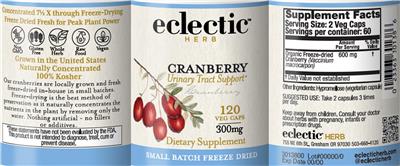
Concentrated 7 1/2 X through freeze-drying Freeze dried fresh for peak plant power Raw food Grown in the United States Naturally concentrated Freeze-drying is the best method of preservation as it naturally concentrates the nutrients in the plant by removing only the water.
Non GMO Gluten free
Vegan
Nothing artificial - no fillers or additives.
Urinary tract support Small batch freeze dried
Formula
100% Kosher
Our cranberries are locally grown and fresh freeze-dried in-house in small batches.
FDA Disclaimer Statement
These statements have not been evaluated by the FDA. This product is not intended to diagnose, treat, cure or prevent disease.
FDA Statement of Identity
Dietary Supplement
Suggested/Recommended/Usage/Directions
Suggested use: Take 2 capsules 3 times per day.
Precautions
Keep away from children. Consult your doctor about herbs with pregnancy, infants or prescription drugs.
Consult your doctor about herbs with pregnancy, infants or prescription drugs.
General Statements
@eclecticherb
Is this label outdated? Report a formula or label change and our pharmacy team will review it.
Cranberry 300 mg by Eclectic Herb label
The label scan from the NIH Dietary Supplement Label Database. Tap to enlarge.
Label images are published by the NIH Dietary Supplement Label Database for the version of this product on file. Always read your actual product label.
View the full label (PDF)The Ingredients in Cranberry 300 mg by Eclectic Herb
This is the 1 active ingredient this product is made of. Select it to open its full monograph.
Serving size2 Veg Cap(s) Dosage formCapsule Servings per container60 Amounts shown are per serving.
Cranberry, Freeze-Dried
Interacts with712 drugs
Cranberry is best known for helping to prevent repeated urinary tract infections (UTIs) in some people, and the evidence here is moderate but mixed. I...
Cranberry, Freeze-Dried monograph & interactionsOther (inactive) ingredients: Hypromellose. These complete the product’s ingredient list but are not active constituents.
Cranberry 300 mg by Eclectic Herb Drug Interactions
HelloPharmacist Interaction Report
Eclectic Herb's Cranberry 300 mg is a single-ingredient supplement that does interact with several medications.
The most serious concern is with blood thinners (anticoagulants) like warfarin — cranberry may increase how much warfarin stays in your body, raising your bleeding risk. Though research is mixed on this one, case reports link cranberry juice to higher INR levels (a measure of blood thickness) in patients on warfarin.
Read the full breakdown — every affected drug type, severity by severity
Cranberry also has moderate interactions with cholesterol drugs like atorvastatin and with certain blood pressure medications like nifedipine. In one case, a patient on atorvastatin developed muscle pain, a serious muscle condition (rhabdomyolysis), and liver problems after drinking large amounts of cranberry juice daily for two weeks — though this is rare.
The active compounds in cranberry may slow how your liver breaks down these drugs, letting them build up to higher levels.
Minor interactions are documented with nonsteroidal anti-inflammatory drugs (NSAIDs) like diclofenac and with a broader class of liver-metabolized medications (CYP2C9 substrates), though the clinical significance of these is less clear. Altogether, these interactions span 702 individual medications.
If you take any prescription medication — especially blood thinners, cholesterol drugs, or blood pressure medications — use the medication checker below before starting this product.
Check your own medications below · Editorial policy · How we use AI
Want to check YOUR meds against Cranberry 300 mg?
Ask about interactions with your drugs in plain English — “Can I take it with lisinopril?” — and we find you the answer in seconds, ingredient by ingredient.
Go to the checkerIngredients driving the most interactions
Individual Drug Interactions
The ingredients in Cranberry 300 mg interact with 712 drugs. Click any drug to see the details.
1 of the 1 ingredient in Cranberry 300 mg interact with drugs. Each result below shows which ingredient is responsible. Cranberry, Freeze-Dried
Acetaminophen, Dextromethorphan, Guaifenesin, PhenylpropanolamineAnatuss
How Acetaminophen, Dextromethorphan, Guaifenesin, Phenylpropanolamine interacts with Cranberry 300 mg — through 1 ingredient. Tap an ingredient for the detail:
Cranberry, Freeze-driedCytochrome P450 3a4 (cyp3a4) Substrates Moderate
Interaction Summary
Theoretically, cranberry might increase the levels and adverse effects of CYP3A4 substrates.
Read the full Cranberry, Freeze-dried + Acetaminophen, Dextromethorphan, Guaifenesin, Phenylpropanolamine interactionAcetaminophen, Dextromethorphan, Guaifenesin, PseudoephedrineRobitussin Cold, Severe Cold, Suphedrine Cold/Cough
How Acetaminophen, Dextromethorphan, Guaifenesin, Pseudoephedrine interacts with Cranberry 300 mg — through 1 ingredient. Tap an ingredient for the detail:
Cranberry, Freeze-driedCytochrome P450 3a4 (cyp3a4) Substrates Moderate
Interaction Summary
Theoretically, cranberry might increase the levels and adverse effects of CYP3A4 substrates.
Read the full Cranberry, Freeze-dried + Acetaminophen, Dextromethorphan, Guaifenesin, Pseudoephedrine interactionAcetaminophen, Dextromethorphan, Phenylpropanolamine, PyrilamineTheracaps
How Acetaminophen, Dextromethorphan, Phenylpropanolamine, Pyrilamine interacts with Cranberry 300 mg — through 1 ingredient. Tap an ingredient for the detail:
Cranberry, Freeze-driedCytochrome P450 3a4 (cyp3a4) Substrates Moderate
Interaction Summary
Theoretically, cranberry might increase the levels and adverse effects of CYP3A4 substrates.
Read the full Cranberry, Freeze-dried + Acetaminophen, Dextromethorphan, Phenylpropanolamine, Pyrilamine interactionAcetaminophen, Dextromethorphan, PseudoephedrineAlka-Seltzer PLUS Flu Liquid Gels, Non Aspirin Cold Caps, Tylenol Cold, Tylenol Flu Daytime Ex Strength, Tylenol Flu Ex Strength
How Acetaminophen, Dextromethorphan, Pseudoephedrine interacts with Cranberry 300 mg — through 1 ingredient. Tap an ingredient for the detail:
Cranberry, Freeze-driedCytochrome P450 3a4 (cyp3a4) Substrates Moderate
Interaction Summary
Theoretically, cranberry might increase the levels and adverse effects of CYP3A4 substrates.
Read the full Cranberry, Freeze-dried + Acetaminophen, Dextromethorphan, Pseudoephedrine interactionAcetaminophen, HydrocodoneAnexsia, Anodynos DHC, Azdone, Co-Gesic, Doucet, Lorcet +9 more
How Acetaminophen, Hydrocodone interacts with Cranberry 300 mg — through 1 ingredient. Tap an ingredient for the detail:
Cranberry, Freeze-driedCytochrome P450 3a4 (cyp3a4) Substrates Moderate
Interaction Summary
Theoretically, cranberry might increase the levels and adverse effects of CYP3A4 substrates.
Read the full Cranberry, Freeze-dried + Acetaminophen, Hydrocodone interactionAcetaminophen, Phenylephrine, ChlorpheniramineSuper Cold Tabs
How Acetaminophen, Phenylephrine, Chlorpheniramine interacts with Cranberry 300 mg — through 1 ingredient. Tap an ingredient for the detail:
Cranberry, Freeze-driedCytochrome P450 3a4 (cyp3a4) Substrates Moderate
Interaction Summary
Theoretically, cranberry might increase the levels and adverse effects of CYP3A4 substrates.
Read the full Cranberry, Freeze-dried + Acetaminophen, Phenylephrine, Chlorpheniramine interactionAdagrasibKrazati
How Adagrasib interacts with Cranberry 300 mg — through 1 ingredient. Tap an ingredient for the detail:
Cranberry, Freeze-driedCytochrome P450 3a4 (cyp3a4) Substrates Moderate
Interaction Summary
Theoretically, cranberry might increase the levels and adverse effects of CYP3A4 substrates.
Read the full Cranberry, Freeze-dried + Adagrasib interactionAlfentanilAlfenta
How Alfentanil interacts with Cranberry 300 mg — through 1 ingredient. Tap an ingredient for the detail:
Cranberry, Freeze-driedCytochrome P450 3a4 (cyp3a4) Substrates Moderate
Interaction Summary
Theoretically, cranberry might increase the levels and adverse effects of CYP3A4 substrates.
Read the full Cranberry, Freeze-dried + Alfentanil interactionAlfuzosinUroxatral
How Alfuzosin interacts with Cranberry 300 mg — through 1 ingredient. Tap an ingredient for the detail:
Cranberry, Freeze-driedCytochrome P450 3a4 (cyp3a4) Substrates Moderate
Interaction Summary
Theoretically, cranberry might increase the levels and adverse effects of CYP3A4 substrates.
Read the full Cranberry, Freeze-dried + Alfuzosin interactionAliskirenTekturna
How Aliskiren interacts with Cranberry 300 mg — through 1 ingredient. Tap an ingredient for the detail:
Cranberry, Freeze-driedCytochrome P450 3a4 (cyp3a4) Substrates Moderate
Interaction Summary
Theoretically, cranberry might increase the levels and adverse effects of CYP3A4 substrates.
Read the full Cranberry, Freeze-dried + Aliskiren interactionAlmotriptanAlmogran, Axert
How Almotriptan interacts with Cranberry 300 mg — through 1 ingredient. Tap an ingredient for the detail:
Cranberry, Freeze-driedCytochrome P450 3a4 (cyp3a4) Substrates Moderate
Interaction Summary
Theoretically, cranberry might increase the levels and adverse effects of CYP3A4 substrates.
Read the full Cranberry, Freeze-dried + Almotriptan interactionAlogliptinNesina
How Alogliptin interacts with Cranberry 300 mg — through 1 ingredient. Tap an ingredient for the detail:
Cranberry, Freeze-driedCytochrome P450 3a4 (cyp3a4) Substrates Moderate
Interaction Summary
Theoretically, cranberry might increase the levels and adverse effects of CYP3A4 substrates.
Read the full Cranberry, Freeze-dried + Alogliptin interactionAlogliptin, PioglitazoneOseni
How Alogliptin, Pioglitazone interacts with Cranberry 300 mg — through 1 ingredient. Tap an ingredient for the detail:
Cranberry, Freeze-driedCytochrome P450 3a4 (cyp3a4) Substrates Moderate
Interaction Summary
Theoretically, cranberry might increase the levels and adverse effects of CYP3A4 substrates.
Read the full Cranberry, Freeze-dried + Alogliptin, Pioglitazone interactionAlpelisibPiqray
How Alpelisib interacts with Cranberry 300 mg — through 1 ingredient. Tap an ingredient for the detail:
Cranberry, Freeze-driedCytochrome P450 3a4 (cyp3a4) Substrates Moderate
Interaction Summary
Theoretically, cranberry might increase the levels and adverse effects of CYP3A4 substrates.
Read the full Cranberry, Freeze-dried + Alpelisib interactionAlprazolamNiravam, Xanax
How Alprazolam interacts with Cranberry 300 mg — through 1 ingredient. Tap an ingredient for the detail:
Cranberry, Freeze-driedCytochrome P450 3a4 (cyp3a4) Substrates Moderate
Interaction Summary
Theoretically, cranberry might increase the levels and adverse effects of CYP3A4 substrates.
Read the full Cranberry, Freeze-dried + Alprazolam interactionAmbrisentanLetairis, Volibris
How Ambrisentan interacts with Cranberry 300 mg — through 1 ingredient. Tap an ingredient for the detail:
Cranberry, Freeze-driedCytochrome P450 3a4 (cyp3a4) Substrates Moderate
Interaction Summary
Theoretically, cranberry might increase the levels and adverse effects of CYP3A4 substrates.
Read the full Cranberry, Freeze-dried + Ambrisentan interactionAmiodaroneCordarone, Pacerone
How Amiodarone interacts with Cranberry 300 mg — through 1 ingredient. Tap an ingredient for the detail:
Cranberry, Freeze-driedCytochrome P450 3a4 (cyp3a4) Substrates Moderate
Interaction Summary
Theoretically, cranberry might increase the levels and adverse effects of CYP3A4 substrates.
Read the full Cranberry, Freeze-dried + Amiodarone interactionAmitriptylineElavil
How Amitriptyline interacts with Cranberry 300 mg — through 1 ingredient. Tap an ingredient for the detail:
Cranberry, Freeze-driedCytochrome P450 2c9 (cyp2c9) Substrates, Cytochrome P450 3a4 (cyp3a4) Substrates Moderate
Interaction Summary
Theoretically, cranberry might increase the levels and adverse effects of CYP2C9 substrates.
Read the full Cranberry, Freeze-dried + Amitriptyline interactionAmitriptyline, ChlordiazepoxideLimbitrol DS
How Amitriptyline, Chlordiazepoxide interacts with Cranberry 300 mg — through 1 ingredient. Tap an ingredient for the detail:
Cranberry, Freeze-driedCytochrome P450 2c9 (cyp2c9) Substrates, Cytochrome P450 3a4 (cyp3a4) Substrates Moderate
Interaction Summary
Theoretically, cranberry might increase the levels and adverse effects of CYP2C9 substrates.
Read the full Cranberry, Freeze-dried + Amitriptyline, Chlordiazepoxide interactionAmitriptyline, PerphenazineEtrafon, Etrafon-A, Etrafon-Forte, Triavil
How Amitriptyline, Perphenazine interacts with Cranberry 300 mg — through 1 ingredient. Tap an ingredient for the detail:
Cranberry, Freeze-driedCytochrome P450 2c9 (cyp2c9) Substrates, Cytochrome P450 3a4 (cyp3a4) Substrates Moderate
Interaction Summary
Theoretically, cranberry might increase the levels and adverse effects of CYP2C9 substrates.
Read the full Cranberry, Freeze-dried + Amitriptyline, Perphenazine interactionAmlodipineNorliqva
How Amlodipine interacts with Cranberry 300 mg — through 1 ingredient. Tap an ingredient for the detail:
Cranberry, Freeze-driedCytochrome P450 3a4 (cyp3a4) Substrates Moderate
Interaction Summary
Theoretically, cranberry might increase the levels and adverse effects of CYP3A4 substrates.
Read the full Cranberry, Freeze-dried + Amlodipine interactionAmlodipine BenzoateKaterzia
How Amlodipine Benzoate interacts with Cranberry 300 mg — through 1 ingredient. Tap an ingredient for the detail:
Cranberry, Freeze-driedCytochrome P450 3a4 (cyp3a4) Substrates Moderate
Interaction Summary
Theoretically, cranberry might increase the levels and adverse effects of CYP3A4 substrates.
Read the full Cranberry, Freeze-dried + Amlodipine Benzoate interactionAmlodipine BesilateIstin
How Amlodipine Besilate interacts with Cranberry 300 mg — through 1 ingredient. Tap an ingredient for the detail:
Cranberry, Freeze-driedCytochrome P450 3a4 (cyp3a4) Substrates Moderate
Interaction Summary
Theoretically, cranberry might increase the levels and adverse effects of CYP3A4 substrates.
Read the full Cranberry, Freeze-dried + Amlodipine Besilate interactionAmlodipine BesylateNorvasc
How Amlodipine Besylate interacts with Cranberry 300 mg — through 1 ingredient. Tap an ingredient for the detail:
Cranberry, Freeze-driedCytochrome P450 3a4 (cyp3a4) Substrates Moderate
Interaction Summary
Theoretically, cranberry might increase the levels and adverse effects of CYP3A4 substrates.
Read the full Cranberry, Freeze-dried + Amlodipine Besylate interactionAmlodipine Besylate, BenazeprilLotrel
How Amlodipine Besylate, Benazepril interacts with Cranberry 300 mg — through 1 ingredient. Tap an ingredient for the detail:
Cranberry, Freeze-driedCytochrome P450 3a4 (cyp3a4) Substrates Moderate
Interaction Summary
Theoretically, cranberry might increase the levels and adverse effects of CYP3A4 substrates.
Read the full Cranberry, Freeze-dried + Amlodipine Besylate, Benazepril interactionAmlodipine, CelecoxibConsensi
How Amlodipine, Celecoxib interacts with Cranberry 300 mg — through 1 ingredient. Tap an ingredient for the detail:
Cranberry, Freeze-driedCytochrome P450 2c9 (cyp2c9) Substrates, Cytochrome P450 3a4 (cyp3a4) Substrates Moderate
Interaction Summary
Theoretically, cranberry might increase the levels and adverse effects of CYP2C9 substrates.
Read the full Cranberry, Freeze-dried + Amlodipine, Celecoxib interactionAmoxicillin, Omeprazole Magnesium, RifabutinTalicia
How Amoxicillin, Omeprazole Magnesium, Rifabutin interacts with Cranberry 300 mg — through 1 ingredient. Tap an ingredient for the detail:
Cranberry, Freeze-driedCytochrome P450 3a4 (cyp3a4) Substrates, Cytochrome P450 2c9 (cyp2c9) Substrates Moderate
Interaction Summary
Theoretically, cranberry might increase the levels and adverse effects of CYP3A4 substrates.
Read the full Cranberry, Freeze-dried + Amoxicillin, Omeprazole Magnesium, Rifabutin interactionAmprenavirAgenerase
How Amprenavir interacts with Cranberry 300 mg — through 1 ingredient. Tap an ingredient for the detail:
Cranberry, Freeze-driedCytochrome P450 3a4 (cyp3a4) Substrates Moderate
Interaction Summary
Theoretically, cranberry might increase the levels and adverse effects of CYP3A4 substrates.
Read the full Cranberry, Freeze-dried + Amprenavir interactionApalutamideErleada
How Apalutamide interacts with Cranberry 300 mg — through 1 ingredient. Tap an ingredient for the detail:
Cranberry, Freeze-driedCytochrome P450 3a4 (cyp3a4) Substrates Moderate
Interaction Summary
Theoretically, cranberry might increase the levels and adverse effects of CYP3A4 substrates.
Read the full Cranberry, Freeze-dried + Apalutamide interactionApixabanEliquis
How Apixaban interacts with Cranberry 300 mg — through 1 ingredient. Tap an ingredient for the detail:
Cranberry, Freeze-driedCytochrome P450 3a4 (cyp3a4) Substrates Moderate
Interaction Summary
Theoretically, cranberry might increase the levels and adverse effects of CYP3A4 substrates.
Read the full Cranberry, Freeze-dried + Apixaban interactionEach ingredient & the kinds of drugs it affects
For each ingredient in Cranberry 300 mg with known interactions, here are the types of medications it can affect. Open any type for the detail — or search your exact drug in the checker above.
Cranberry, Freeze-Dried
Atorvastatin (Lipitor)
Theoretically, cranberry might increase levels and adverse effects of atorvastatin.
In one case report, a patient taking atorvastatin experienced upper back pain, rhabdomyolysis, and abnormal liver function after drinking cranberry juice 16 ounces daily for 2 weeks. Theoretically, this may have been caused by inhibition of cytochrome P450 3A4 (CYP3A4) enzymes by cranberry juice, as atorvastatin is a CYP3A4 substrate. Creatinine kinase and liver enzymes normalized within 2 weeks of stopping cranberry juice. Patients taking atorvastatin should avoid large quantities of cranberry juice.
Cytochrome P450 3A4 (Cyp3A4) Substrates
Theoretically, cranberry might increase the levels and adverse effects of CYP3A4 substrates.
A case of upper back pain, rhabdomyolysis, and abnormal liver function has been reported for a patient taking atorvastatin, a CYP3A4 substrate, in combination with cranberry juice 16 ounces daily for 2 weeks. Creatinine kinase and liver enzymes normalized within 2 weeks of stopping cranberry juice. Also, animal research suggests that cranberry juice, administered intraduodenally 30 minutes prior to nifedipine, a CYP3A4 substrate, inhibits nifedipine metabolism and increases the area under the concentration-time curve by 1.6-fold compared to control.
Nifedipine (Procardia)
Theoretically, cranberry might increase the levels and adverse effects of nifedipine.
Animal research suggests that cranberry juice, administered intraduodenally 30 minutes prior to nifedipine treatment, inhibits nifedipine metabolism and increases the area under the concentration-time curve by 1.6-fold compared to control. This interaction has not been reported in humans.
Warfarin (Coumadin)
Theoretically, cranberry might increase the levels and adverse effects of warfarin. However, research is conflicting.
There is contradictory evidence about the effect of cranberry juice on warfarin. Case reports have linked cranberry juice consumption to increases in the international normalized ratio (INR) in patients taking warfarin, resulting in severe spontaneous bleeding and excessive postoperative bleeding. Daily consumption of cranberry sauce for one week has also been linked to an increase in INR in one case report. In a small study in healthy young males, taking a high dose of 3 grams of cranberry juice concentrate capsules, equivalent to 57 grams of fruit daily, for 2 weeks produced a 30% increase in the area under the INR-time curve after a single 25-mg dose of warfarin. However, 3 very small clinical studies in patients stabilized on warfarin reported that cranberry juice 250 mL once or twice daily for 7 days (27% cranberry juice or pure cranberry juice) or 240 mL once daily for 14 days does not significantly increase INR or affect plasma warfarin levels. The reasons for these discrepant findings are unclear. It is possible that the form and dose of cranberry may play a role, as cranberry extracts and juices contain different constituents. Additionally, an in vitro study evaluating 5 different cranberry juices found varying effects, with only a cranberry concentrate, and not diluted cranberry juices, inhibiting CYP2C9. However, this concentrate did not inhibit CYP2C9 activity in humans.
Cytochrome P450 2C9 (Cyp2C9) Substrates
Theoretically, cranberry might increase the levels and adverse effects of CYP2C9 substrates. However, research is conflicting.
There is contradictory evidence about the effect of cranberry on CYP2C9 enzymes. In vitro evidence suggests that flavonoids in cranberry inhibit CYP2C9 enzymes. However, clinical research shows that cranberry juice does not significantly affect the levels, metabolism, or elimination of the CYP2C9 substrates flurbiprofen or diclofenac. Also, in patients stabilized on warfarin, drinking cranberry juice 250 mL daily for 7 days does not significantly increase the anticoagulant activity of warfarin, a CYP2C9 substrate. Additional pharmacokinetic research shows that cranberry juice does not increase peak plasma concentrations or area under the concentration-time curve of warfarin.
Diclofenac (Voltaren, Others)
Theoretically, cranberry might modestly increase the levels and adverse effects of diclofenac.
In vitro evidence suggests that cranberry juice inhibits diclofenac metabolism by human liver microsomes. However, drinking cranberry juice does not seem to affect diclofenac metabolism in humans.
Brand information
Manufacturer and brand details for Cranberry 300 mg, from the product label.
Eclectic Herb
See all Eclectic Herb products- Name
- Eclectic Herb
- Street Address
- 755 NE 6th St.
- City
- Gresham
- State
- Oregon
- ZipCode
- 97030
- Phone Number
- 503.668.4120
- Web Address
- www.eclecticherb.com
Cranberry 300 mg by Eclectic Herb: Common Questions
Does Cranberry 300 mg by Eclectic Herb interact with any medications?
How can one product interact with so many drugs?
Where does this information come from?
Will cranberry actually help prevent UTIs?
What are the side effects I might notice?
Is this safe to take if I'm pregnant or breastfeeding?
Can I take this with my blood thinner?
Why does cranberry interact with so many drugs?
Is it cranberry juice or the supplement that causes the interactions?
Written and reviewed by the HelloPharmacist editorial staff. Our editorial policy
Not sure if Cranberry 300 mg is safe with your meds?
Our pharmacists answer your medication & supplement questions — free.
Label information is sourced from the NIH Dietary Supplement Label Database and reflects the product version on file; always read your actual product label. This page is for education only and is not a substitute for professional medical advice. Confirm with your pharmacist or doctor before combining supplements and medications.
The Full Monographs Behind Cranberry 300 mg’s Ingredients
Every ingredient we hold a full HelloPharmacist monograph for — uses, evidence, safety, and the complete interaction list.
Sources & How We Checked
Cranberry 300 mg's label data comes from the NIH Dietary Supplement Label Database; the ingredient interaction data is from the Natural Medicines database, reviewed by our pharmacists.
- NIH Dietary Supplement Label Database (DSLD) — The official product label on file for this supplement.
- Natural Medicines (Therapeutic Research Center) — Evidence-graded clinical reference behind the ingredient interaction data.
Content is written and reviewed by licensed HelloPharmacist pharmacists. See our data sources and editorial standards for how this information is built and checked.
The 33 references behind this product’s interaction data
Every citation that drives the interaction findings for this product’s ingredients, from the evidence-graded Natural Medicines (TRC Healthcare) database. Open an ingredient to browse its citations — links open the study on PubMed or the publisher’s site.
Cranberry 33 references
- Anon. Possible interaction between warfarin and cranberry juice. Current Problems in Pharmacovigilance 2003;29:8. PubMed
- Greenblatt DJ, von Moltke LL, Perloff ES, et al. Interaction of flurbiprofen with cranberry juice, grape juice, tea, and fluconazole: in vitro and clinical studies. Clin Pharmacol Ther 2006;79:125-33. PubMed
- Hodek P, Trefil P, Stiborova M. Flavonoids-potent and versatile biologically active compounds interacting with cytochromes P450. Chem Biol Interact 2002;139:1-21.. PubMed
- Grant P. Warfarin and cranberry juice: An interaction? J Heart Valve Dis 2004;13:25-6.
- Suvarna R, Pirmohamed M, Henderson L. Possible interaction between warfarin and cranberry juice. BMJ 2003;327:1454. PubMed
- Li Z, Seeram NP, Carpenter CL, et al. Cranberry does not affect prothrombin time in male subjects on warfarin. J Am Diet Assoc 2006;106:2057-61. PubMed
- Lilja JJ, Backman JT, Neuvonen PJ. Effects of daily ingestion of cranberry juice on the pharmacokinetics of warfarin, tizanidine, and midazolam - probes of CYP2C9, CYP1A2 and CYP3A4. Clin Pharmacol The 2007:81:833-9. PubMed
- Wing DA, Rumney PJ, Preslicka CW, Chung JH. Daily cranberry juice for the prevention of asymptomatic bacteriuria in pregnancy: a randomized, controlled pilot study. J Urol 2008;180:1367-72. PubMed
- Mohammed Abdul MI, Jiang X, Williams KM, et al. Pharmacodynamic interaction of warfarin with cranberry but not with garlic in healthy subjects. Br J Pharmacol 2008;154:1691-700. PubMed
- McMurdo MET, Argo I, Phillips G, et al. Cranberry or trimethoprim for the prevention of recurrently urinary tract infections? A randomized controlled trial in older women. J Antimicrob Chemother 2009;63:389-95.
- Mergenhagen KA, Sherman O. Elevated International Normalized Ratio after concurrent ingestion of cranberry sauce and warfarin. Am J Health-Syst Pharm 2008;65:2113-6. PubMed
- Ansell J, McDonough M, Zhao Y, et al. The absence of an interaction between warfarin and cranberry juice: a randomized, double-blind trial. J Clin Pharmacol 2009;49:824-30. PubMed
- Haber SL, Cauthon KA, Raney EC. Cranberry and warfarin interaction: a case report and review of the literature. Consult Pharm 2012;27:58-65. PubMed
- Hamann GL, Campbell JD, George CM. Warfarin-cranberry juice interaction. Ann Pharmacother 2011;45:e17. PubMed
- Roberts D, Flanagan P. Case report: Cranberry juice and warfarin. Home Healthc Nurse 2011;29:92-7.
- Garcia-Calatayud, S., Larreina Cordoba, J. J., and Lozano De La Torre MJ. [Severe cranberry juice poisoning]. An.Esp.Pediatr. 2002;56(1):72-73.
- Patel, D. A., Gillespie, B., Sobel, J. D., Leaman, D., Nyirjesy, P., Weitz, M. V., and Foxman, B. Risk factors for recurrent vulvovaginal candidiasis in women receiving maintenance antifungal therapy: results of a prospective cohort study. Am J Obstet.Gy PubMed
- Isele, H. [Fatal bleeding under warfarin plus cranberry juice. Is it due to salicylic acid?]. MMW.Fortschr.Med 3-11-2004;146(11):13.
- Linsenmeyer, T. A., Harrison, B., Oakley, A., Kirshblum, S., Stock, J. A., and Millis, S. R. Evaluation of cranberry supplement for reduction of urinary tract infections in individuals with neurogenic bladders secondary to spinal cord injury. A prospecti
- McMurdo, M. E., Bissett, L. Y., Price, R. J., Phillips, G., and Crombie, I. K. Does ingestion of cranberry juice reduce symptomatic urinary tract infections in older people in hospital? A double-blind, placebo-controlled trial. Age Ageing 2005;34(3):256- PubMed
- Sylvan, L. and Justice, N. P. Possible interaction between warfarin and cranberry juice. Am Fam.Physician 9-15-2005;72(6):1000.
- Niklasson, A. and Andren, L. [Interaction between Waran and cranberry juice]. Lakartidningen 3-15-2006;103(11):853-854.
- Rindone, J. P. and Murphy, T. W. Warfarin-cranberry juice interaction resulting in profound hypoprothrombinemia and bleeding. Am J Ther 2006;13(3):283-284. PubMed
- Uesawa, Y. and Mohri, K. Effects of cranberry juice on nifedipine pharmacokinetics in rats. J Pharm Pharmacol 2006;58(8):1067-1072. PubMed
- Valentova, K., Stejskal, D., Bednar, P., Vostalova, J., Cihalik, C., Vecerova, R., Koukalova, D., Kolar, M., Reichenbach, R., Sknouril, L., Ulrichova, J., and Simanek, V. Biosafety, antioxidant status, and metabolites in urine after consumption of dried
- Royer, D. J., George, J. N., and Terrell, D. R. Thrombocytopenia as an adverse effect of complementary and alternative medicines, herbal remedies, nutritional supplements, foods, and beverages. Eur J Haematol 2010;84(5):421-429. PubMed
- Stapleton, A. E., Dziura, J., Hooton, T. M., Cox, M. E., Yarova-Yarovaya, Y., Chen, S., and Gupta, K. Recurrent urinary tract infection and urinary Escherichia coli in women ingesting cranberry juice daily: a randomized controlled trial. Mayo.Clin.Proc. PubMed
- Doad GJ, Kabange W. Cranberry juice, atorvastatin and back pain. J Med Assoc Ga 2014;103(1):14.
- Griffiths AP, Beddall A, Pegler S. Fatal haemopericardium and gastrointestinal haemorrhage due to possible interaction of cranberry juice with warfarin. J R Soc Promot Health 2008;128(6):324-6. PubMed
- Mellen CK, Ford M, Rindone JP. Effect of high-dose cranberry juice on the pharmacodynamics of warfarin in patients. Br J Clin Pharmacol 2010;70(1):139-42. PubMed
- Ushijima K, Tsuruoka S, Tsuda H, Hasegawa G, Obi Y, Kaneda T, Takahashi M, Maekawa T, Sasaki T, Koshimizu TA, Fujimura A. Cranberry juice suppressed the diclofenac metabolism by human liver microsomes, but not in healthy human subjects. Br J Clin Pharmaco PubMed
- Ngo N, Brantley SJ, Carrizosa DR, et al. The warfarin-cranberry juice interaction revisited: A systematic in vitro-in vivo evaluation. J Exp Pharmacol. 2010;2010(2):83-91.
- Williams G, Stothart CI, Hahn D, Stephens JH, Craig JC, Hodson EM. Cranberries for preventing urinary tract infections. Cochrane Database Syst Rev 2023;11(11):CD001321. PubMed
Parts of this content are provided by the Therapeutic Research Center, LLC.
DISCLAIMER: Currently this does not check for drug-drug interactions. This is not an all-inclusive comprehensive list of potential interactions and is for informational purposes only. Not all interactions are known or well-reported in the scientific literature, and new interactions are continually being reported. Input is needed from a qualified healthcare provider including a pharmacist before starting any therapy. Application of clinical judgment is necessary.
© 2021 Therapeutic Research Center, LLC