
Ionic Sulfur Ingredients & Drug Interactions
What is this page for?
First and foremost: checking Ionic Sulfur against your medications. The heart of this page is the interaction checker and the full interaction report — how this product’s ingredients may interact with prescription and over-the-counter medicines you may be taking.
Around that, we add a pharmacist’s high-level view of the product as a whole — what’s inside, the evidence for its stated use, how transparent the label is, and what safety data exists — so you can see the full picture in one place. It’s educational information from our licensed clinical databases and the clinical staff at HelloPharmacist — not medical advice — and we don’t sell or endorse products. Our editorial policy
Ionic Sulfur is a dietary supplement by AM Angstrom Minerals with 3 active ingredients. Its ingredients are commonly taken for replacing fluids and electrolytes, preventing dehydration during exercise or illness, treating low blood sodium (under medical care).Based on those ingredients, 205 medications have a known interaction with it, the most serious rated moderate. The ingredients most likely to interact are Sodium. Use the checker below to test your specific medication, or read the full HelloPharmacist Interaction Report.
Check Your Meds Against Ionic Sulfur by AM Angstrom Minerals
Ask about any prescription or over-the-counter medication and we check it for interactions with Ionic Sulfur by AM Angstrom Minerals — and tell you which ingredient is responsible.
AI summaries are generated from our interaction database for education only — always confirm with your pharmacist. How we use AI
Ask the Pharmacist
A licensed pharmacist will answer your question by email — free, usually within 24 hours.
Got it — thank you!
A licensed pharmacist will answer within 24 hours. Keep an eye on your email (worth checking spam, just in case).
HelloPharmacist Scorecard of Ionic Sulfur by AM Angstrom Minerals
Our pharmacy team’s full take, with four database checks built into the cards below — a summary of what is known, not a grade of the product itself.
What’s inside
Partial disclosure
Ionic Sulfur contains 2 active ingredients: sodium and sulfur, in a liquid form with purified water. Sodium is an essential mineral your body needs for nerve and muscle function, but this product is a supplement source rather than dietary sodium.
Sulfur is a mineral used topically and orally in various traditional and clinical applications.
Does it work?
Moderate evidence
For sodium, the evidence supports it as likely effective for cystic fibrosis and possibly effective for reducing kidney damage from the antibiotic amphotericin B. Evidence isn't established for bipolar disorder or heart failure.
For sulfur, the evidence shows it's possibly effective for scabies and dandruff. Evidence isn't established for acne, hay fever, COPD, or common cold in our data.
How safe is it?
Well-documented data
Sodium is well tolerated in normal dietary amounts, but the safety data advises caution with supplements — too much is linked to high blood pressure, heart strain, and kidney disease. Serious adverse effects from excess sodium are rare but can include worsened heart and kidney problems.
Interestingly, very low sodium is also a concern and may increase osteoporosis risk. High sodium intake is also associated with increased gastric cancer risk in population studies.
Sulfur is generally well tolerated topically at concentrations up to 10%, though it can cause skin dryness, irritation, and itching. Taken by mouth, it has caused diarrhea and in one case metabolic acidosis (a dangerous blood pH imbalance), particularly in someone with underlying kidney and blood sugar problems.
Safety data for oral sulfur is limited.
Meds to double-check
Moderate interaction found
Check with your pharmacist before taking this product if you're on blood pressure medication, lithium (Lithobid), corticosteroids like prednisone, didanosine (Videx), sodium phosphate laxatives, tolvaptan (Samsca), or any other sodium-containing medications. All of these have Moderate-severity interactions with the sodium in this supplement.
The bottom line
Scorecard at a glancePartially disclosed formula with some supporting evidence for its stated purpose. Moderate medication interactions have been identified, and safety information is well characterized.
If you take blood pressure medication, lithium, corticosteroids, or any HIV or sodium-regulating drugs, talk to your pharmacist before starting this product — sodium can significantly alter how these medications work. If you're considering this for a specific health condition, check what the evidence actually supports: sodium for cystic fibrosis, sulfur for scabies or dandruff.
For other uses, the evidence isn't there yet.
Educational only — not medical advice; always confirm with your pharmacist. Our editorial policy · How we use AI
Assessment coverage: 2 of 2 active ingredients matched to our full ingredient reviews (monographs). Based on the product label dated Aug 22, 2025.
This Scorecard evaluates available label information, ingredient evidence, and known medication-safety considerations. It does not independently verify product identity, purity, potency, contamination, or manufacturing quality. How these ratings are computed
General information
Key facts about Ionic Sulfur, straight from the product label.
| Brand | AM Angstrom Minerals |
|---|---|
| Barcode (UPC) | 759675387366 |
| Net contents | 16 Fluid Ounce(s) |
| Market status | On market |
| Date entered into DSLD | Aug 22, 2025 |
| DSLD ID | 337046 |
| Product type | Mineral |
| Supplement form | Liquid |
| Dietary claims / uses | Nutrient, All Other, Structure/Function |
| Intended target group(s) | Children 4 or More Years of Age, Adult (18 - 50 Years) |
Everything in this section is reproduced from the manufacturer’s own product label — it’s the label speaking, not HelloPharmacist. We show it so you can see exactly what the maker states; we don’t verify or endorse those statements.
Supplement Facts
The label details for Ionic Sulfur by AM Angstrom Minerals, sourced from the NIH Dietary Supplement Label Database.
Supplement Facts
| Ingredient | Amount | % DV |
|---|---|---|
| Calories | 0 Gram(s), 0 Gram(s) | -- |
| Total Carbohydrates | 0 Gram(s), 0 Gram(s) | -- |
| Sodium | 0 Gram(s), 0 Gram(s) | -- |
| Total Fat | 0 Gram(s), 0 Gram(s) | -- |
| Protein | 0 Gram(s), 0 Gram(s) | -- |
| Sulfur | 30 mg, 60 mg | -- |
Other ingredients: Water, Purified
Tap any ingredient to jump to its full detail below.
These statements are the manufacturer’s wording, reproduced from the product label — the label is saying it, not HelloPharmacist. We don’t verify or endorse them.
Formula
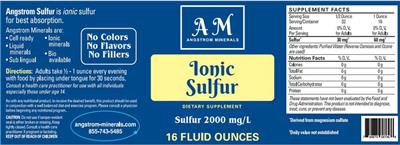
Angstrom Sulfur is ionic sulfur for best absorption. Angstrom Minerals are: Liquid minerals Ionic minerals
Sulfur 2000 mg/L
Derived from magnesium sulfate
Formulation
Cell ready Sub lingual Bio available
No colors No flavors No fillers
Suggested/Recommended/Usage/Directions
Directions: Adults take 1/2 -1 ounce every morning with food by placing under tongue for 30 seconds.
Precautions
Consult health care practitioner for use with all individuals especially those under age 14.
As with any nutritional product, to receive the desired benefit, this product should be used in conjunction with a well balanced diet and exercise program. Please consult a physician before beginning any nutritional program. Caution: Do not use if tamper-evident seal is either broken or missing.
Consult a health care practitioner if pregnant or lactating.
Keep out of reach of children
Storage
Keep tightly closed.
FDA Statement of Identity
Dietary Supplement
FDA Disclaimer Statement
These statements have not been evaluated by the Food and Drug Administration. This product is not intended to diagnose, treat, cure, or prevent any disease.
General Statements
Serving/container 32 16
Is this label outdated? Report a formula or label change and our pharmacy team will review it.
Ionic Sulfur by AM Angstrom Minerals label
The label scan from the NIH Dietary Supplement Label Database. Tap to enlarge.
Label images are published by the NIH Dietary Supplement Label Database for the version of this product on file. Always read your actual product label.
View the full label (PDF)The Ingredients in Ionic Sulfur by AM Angstrom Minerals
These are the 3 active ingredients this product is made of. Select any to open its full monograph.
Serving size0.5 Ounce(s) Dosage formLiquid Servings per container16 Amounts shown are per serving.
Most supplement products combine several ingredients, and a medication can interact with the product through any one of them. Each ingredient below shows whether it has known drug interactions.
Sodium
Interacts with205 drugs
Sodium is an essential mineral and electrolyte your body needs to balance fluids, support nerves, and help muscles work. Most people in modern diets g...
Sodium monograph & interactionsProtein
Sulfur
No knowninteractions
Sulfur is a mineral used mainly in topical skin products for acne, rosacea, dandruff, and certain skin infections, and has a long history in dermatolo...
Sulfur monograph & interactionsOther (inactive) ingredients: Water, Purified. These complete the product’s ingredient list but are not active constituents.
Ionic Sulfur by AM Angstrom Minerals Drug Interactions
HelloPharmacist Interaction Report
Ionic Sulfur by AM Angstrom Minerals contains sodium, which has documented interactions with a number of medications.
The most serious concern is with blood pressure drugs (antihypertensives) — sodium can reduce how well they work, because high sodium intake raises blood pressure and may require doctors to increase your medication dose to keep your pressure controlled.
Read the full breakdown — every affected drug type, severity by severity
Sodium also interacts with corticosteroids (steroids used for inflammation), lithium (a mood stabilizer), didanosine (an HIV medication), sodium phosphate laxatives, tolvaptan (used for low blood sodium), and other sodium-containing drugs — all at Moderate severity. With corticosteroids, there's a risk of high sodium levels (hypernatremia).
With lithium, the interaction goes both ways: high sodium can lower lithium levels and make it less effective, while low sodium can raise lithium levels dangerously high. Didanosine already contains significant sodium, so adding more increases hypernatremia risk.
Tolvaptan is actually used to raise sodium levels, so taking it with a sodium supplement could be counterproductive.
Sulfur, the other active ingredient, has no documented interactions with medications in our data.
Altogether, these interactions span 203 individual medications. Before you start this product, run your exact prescriptions through the interaction checker below — especially if you take blood pressure medication, mood stabilizers, corticosteroids, or any HIV or sodium-regulating drugs.
Check your own medications below · Editorial policy · How we use AI
Want to check YOUR meds against Ionic Sulfur?
Ask about interactions with your drugs in plain English — “Can I take it with lisinopril?” — and we find you the answer in seconds, ingredient by ingredient.
Go to the checkerIngredients driving the most interactions
Individual Drug Interactions
The ingredients in Ionic Sulfur interact with 205 drugs. Click any drug to see the details.
1 of the 3 ingredients in Ionic Sulfur interact with drugs. Each result below shows which ingredient is responsible. Sodium
LabetalolNormodyne, Trandate
How Labetalol interacts with Ionic Sulfur — through 1 ingredient. Tap an ingredient for the detail:
SodiumAntihypertensive Drugs Moderate
Interaction Summary
Theoretically, a high intake of dietary sodium might reduce the effectiveness of antihypertensive drugs.
Read the full Sodium + Labetalol interactionLercanidipine HydrochlorideZanidip
How Lercanidipine Hydrochloride interacts with Ionic Sulfur — through 1 ingredient. Tap an ingredient for the detail:
SodiumAntihypertensive Drugs Moderate
Interaction Summary
Theoretically, a high intake of dietary sodium might reduce the effectiveness of antihypertensive drugs.
Read the full Sodium + Lercanidipine Hydrochloride interactionLevamlodipineConjupri
How Levamlodipine interacts with Ionic Sulfur — through 1 ingredient. Tap an ingredient for the detail:
SodiumAntihypertensive Drugs Moderate
Interaction Summary
Theoretically, a high intake of dietary sodium might reduce the effectiveness of antihypertensive drugs.
Read the full Sodium + Levamlodipine interactionLisinoprilPrinivil, Qbrelis, Zestril
How Lisinopril interacts with Ionic Sulfur — through 1 ingredient. Tap an ingredient for the detail:
SodiumAntihypertensive Drugs Moderate
Interaction Summary
Theoretically, a high intake of dietary sodium might reduce the effectiveness of antihypertensive drugs.
Read the full Sodium + Lisinopril interactionLithium Carbonate (prescription Drug)Eskalith, Lithium Carbonate
How Lithium Carbonate (prescription Drug) interacts with Ionic Sulfur — through 1 ingredient. Tap an ingredient for the detail:
SodiumLithium Moderate
Interaction Summary
Altering dietary intake of sodium might alter the levels and clinical effects of lithium.
Read the full Sodium + Lithium Carbonate (prescription Drug) interactionLosartan PotassiumCozaar
How Losartan Potassium interacts with Ionic Sulfur — through 1 ingredient. Tap an ingredient for the detail:
SodiumAntihypertensive Drugs Moderate
Interaction Summary
Theoretically, a high intake of dietary sodium might reduce the effectiveness of antihypertensive drugs.
Read the full Sodium + Losartan Potassium interactionMacitentanOpsumit
How Macitentan interacts with Ionic Sulfur — through 1 ingredient. Tap an ingredient for the detail:
SodiumAntihypertensive Drugs Moderate
Interaction Summary
Theoretically, a high intake of dietary sodium might reduce the effectiveness of antihypertensive drugs.
Read the full Sodium + Macitentan interactionMacitentan, TadalafilOpsynvi
How Macitentan, Tadalafil interacts with Ionic Sulfur — through 1 ingredient. Tap an ingredient for the detail:
SodiumAntihypertensive Drugs Moderate
Interaction Summary
Theoretically, a high intake of dietary sodium might reduce the effectiveness of antihypertensive drugs.
Read the full Sodium + Macitentan, Tadalafil interactionMannitolBronchitol, Osmitrol
How Mannitol interacts with Ionic Sulfur — through 1 ingredient. Tap an ingredient for the detail:
SodiumAntihypertensive Drugs Moderate
Interaction Summary
Theoretically, a high intake of dietary sodium might reduce the effectiveness of antihypertensive drugs.
Read the full Sodium + Mannitol interactionMecamylamineInversine
How Mecamylamine interacts with Ionic Sulfur — through 1 ingredient. Tap an ingredient for the detail:
SodiumAntihypertensive Drugs Moderate
Interaction Summary
Theoretically, a high intake of dietary sodium might reduce the effectiveness of antihypertensive drugs.
Read the full Sodium + Mecamylamine interactionMethazolamideNeptazane
How Methazolamide interacts with Ionic Sulfur — through 1 ingredient. Tap an ingredient for the detail:
SodiumAntihypertensive Drugs Moderate
Interaction Summary
Theoretically, a high intake of dietary sodium might reduce the effectiveness of antihypertensive drugs.
Read the full Sodium + Methazolamide interactionMethyclothiazideAquatensen, Enduron
How Methyclothiazide interacts with Ionic Sulfur — through 1 ingredient. Tap an ingredient for the detail:
SodiumAntihypertensive Drugs Moderate
Interaction Summary
Theoretically, a high intake of dietary sodium might reduce the effectiveness of antihypertensive drugs.
Read the full Sodium + Methyclothiazide interactionMethyclothiazide, PargylineEutron
How Methyclothiazide, Pargyline interacts with Ionic Sulfur — through 1 ingredient. Tap an ingredient for the detail:
SodiumAntihypertensive Drugs Moderate
Interaction Summary
Theoretically, a high intake of dietary sodium might reduce the effectiveness of antihypertensive drugs.
Read the full Sodium + Methyclothiazide, Pargyline interactionMethyclothiazide, ReserpineDiutensen-R
How Methyclothiazide, Reserpine interacts with Ionic Sulfur — through 1 ingredient. Tap an ingredient for the detail:
SodiumAntihypertensive Drugs Moderate
Interaction Summary
Theoretically, a high intake of dietary sodium might reduce the effectiveness of antihypertensive drugs.
Read the full Sodium + Methyclothiazide, Reserpine interactionMethyldopaAldomet, Methyldopa
How Methyldopa interacts with Ionic Sulfur — through 1 ingredient. Tap an ingredient for the detail:
SodiumAntihypertensive Drugs Moderate
Interaction Summary
Theoretically, a high intake of dietary sodium might reduce the effectiveness of antihypertensive drugs.
Read the full Sodium + Methyldopa interactionMethylprednisoloneMedrol, Medrol Dosepak
How Methylprednisolone interacts with Ionic Sulfur — through 1 ingredient. Tap an ingredient for the detail:
SodiumCorticosteroids Moderate
Interaction Summary
Concomitant use of mineralocorticoids and some glucocorticoids with sodium supplements might increase the risk of hypernatremia.
Read the full Sodium + Methylprednisolone interactionMetolazoneDiulo, Mykrox, Zaroxolyn
How Metolazone interacts with Ionic Sulfur — through 1 ingredient. Tap an ingredient for the detail:
SodiumAntihypertensive Drugs Moderate
Interaction Summary
Theoretically, a high intake of dietary sodium might reduce the effectiveness of antihypertensive drugs.
Read the full Sodium + Metolazone interactionMetoprololLopressor, Toprol XL
How Metoprolol interacts with Ionic Sulfur — through 1 ingredient. Tap an ingredient for the detail:
SodiumAntihypertensive Drugs Moderate
Interaction Summary
Theoretically, a high intake of dietary sodium might reduce the effectiveness of antihypertensive drugs.
Read the full Sodium + Metoprolol interactionMinoxidilLoniten, Minoxidil, Rogaine
How Minoxidil interacts with Ionic Sulfur — through 1 ingredient. Tap an ingredient for the detail:
SodiumAntihypertensive Drugs Moderate
Interaction Summary
Theoretically, a high intake of dietary sodium might reduce the effectiveness of antihypertensive drugs.
Read the full Sodium + Minoxidil interactionMoexiprilUnivasc
How Moexipril interacts with Ionic Sulfur — through 1 ingredient. Tap an ingredient for the detail:
SodiumAntihypertensive Drugs Moderate
Interaction Summary
Theoretically, a high intake of dietary sodium might reduce the effectiveness of antihypertensive drugs.
Read the full Sodium + Moexipril interactionMoxonidinePhysiotens
How Moxonidine interacts with Ionic Sulfur — through 1 ingredient. Tap an ingredient for the detail:
SodiumAntihypertensive Drugs Moderate
Interaction Summary
Theoretically, a high intake of dietary sodium might reduce the effectiveness of antihypertensive drugs.
Read the full Sodium + Moxonidine interactionNadololCorgard, Nadolol
How Nadolol interacts with Ionic Sulfur — through 1 ingredient. Tap an ingredient for the detail:
SodiumAntihypertensive Drugs Moderate
Interaction Summary
Theoretically, a high intake of dietary sodium might reduce the effectiveness of antihypertensive drugs.
Read the full Sodium + Nadolol interactionNebivololBystolic, Nebilet
How Nebivolol interacts with Ionic Sulfur — through 1 ingredient. Tap an ingredient for the detail:
SodiumAntihypertensive Drugs Moderate
Interaction Summary
Theoretically, a high intake of dietary sodium might reduce the effectiveness of antihypertensive drugs.
Read the full Sodium + Nebivolol interactionNebivolol Hydrochloride, ValsartanByvalson
How Nebivolol Hydrochloride, Valsartan interacts with Ionic Sulfur — through 1 ingredient. Tap an ingredient for the detail:
SodiumAntihypertensive Drugs Moderate
Interaction Summary
Theoretically, a high intake of dietary sodium might reduce the effectiveness of antihypertensive drugs.
Read the full Sodium + Nebivolol Hydrochloride, Valsartan interactionNicardipineCardene, Cardene IV, Cardene SR
How Nicardipine interacts with Ionic Sulfur — through 1 ingredient. Tap an ingredient for the detail:
SodiumAntihypertensive Drugs Moderate
Interaction Summary
Theoretically, a high intake of dietary sodium might reduce the effectiveness of antihypertensive drugs.
Read the full Sodium + Nicardipine interactionNifedipineAdalat, Adalat CC, Adalat LA, Adalat PA, Adalat Retard, Adalat XL +15 more
How Nifedipine interacts with Ionic Sulfur — through 1 ingredient. Tap an ingredient for the detail:
SodiumAntihypertensive Drugs Moderate
Interaction Summary
Theoretically, a high intake of dietary sodium might reduce the effectiveness of antihypertensive drugs.
Read the full Sodium + Nifedipine interactionNimodipineNimotop, Nymalize
How Nimodipine interacts with Ionic Sulfur — through 1 ingredient. Tap an ingredient for the detail:
SodiumAntihypertensive Drugs Moderate
Interaction Summary
Theoretically, a high intake of dietary sodium might reduce the effectiveness of antihypertensive drugs.
Read the full Sodium + Nimodipine interactionNisoldipineSular
How Nisoldipine interacts with Ionic Sulfur — through 1 ingredient. Tap an ingredient for the detail:
SodiumAntihypertensive Drugs Moderate
Interaction Summary
Theoretically, a high intake of dietary sodium might reduce the effectiveness of antihypertensive drugs.
Read the full Sodium + Nisoldipine interactionNitroprussideNitropress
How Nitroprusside interacts with Ionic Sulfur — through 1 ingredient. Tap an ingredient for the detail:
SodiumAntihypertensive Drugs Moderate
Interaction Summary
Theoretically, a high intake of dietary sodium might reduce the effectiveness of antihypertensive drugs.
Read the full Sodium + Nitroprusside interactionOlmesartan MedoxomilBenicar, Olmesartan Medoxomil
How Olmesartan Medoxomil interacts with Ionic Sulfur — through 1 ingredient. Tap an ingredient for the detail:
SodiumAntihypertensive Drugs Moderate
Interaction Summary
Theoretically, a high intake of dietary sodium might reduce the effectiveness of antihypertensive drugs.
Read the full Sodium + Olmesartan Medoxomil interactionEach ingredient & the kinds of drugs it affects
For each ingredient in Ionic Sulfur with known interactions, here are the types of medications it can affect. Open any type for the detail — or search your exact drug in the checker above.
Sodium
Antihypertensive Drugs
Theoretically, a high intake of dietary sodium might reduce the effectiveness of antihypertensive drugs.
High intake of dietary sodium can increase systolic and diastolic blood pressure. Also, high intake of sodium may necessitate increased use of antihypertensive medications to achieve blood pressure control in some patients, such as those with chronic kidney disease.
Corticosteroids
Concomitant use of mineralocorticoids and some glucocorticoids with sodium supplements might increase the risk of hypernatremia.
Mineralocorticoids and some glucocorticoids (corticosteroids) cause sodium retention. This effect is dose-related and depends on mineralocorticoid potency. It is most common with hydrocortisone, cortisone, and fludrocortisone, followed by prednisone and prednisolone.
Didanosine (Videx)
Concomitant use of didanosine with additional sodium from dietary or supplemental sources may increase the risk of hypernatremia.
Didanosine formulations contain a significant amount of sodium.
Lithium
Altering dietary intake of sodium might alter the levels and clinical effects of lithium.
High sodium intake can reduce plasma concentrations of lithium by increasing lithium excretion. Reducing sodium intake can significantly increase plasma concentrations of lithium and cause lithium toxicity in patients being treated with lithium carbonate. Stabilizing sodium intake is shown to reduce the percentage of patients with lithium level fluctuations above 0.8 mEq/L. Patients taking lithium should avoid significant alterations in their dietary intake of sodium.
Sodium Phosphates
Theoretically, concomitant use of sodium phosphate with sodium supplements might increase the risk of hypernatremia.
Use of high doses (> 45 mL in 24 hours) of sodium phosphate, such as those used for bowel cleansing before surgery, can lead to serious electrolyte disturbances, including hypernatremia. The risk of hypernatremia is highest in the elderly and people with other risk factors for electrolyte disturbances.
Sodium-Containing Drugs
Concomitant use of sodium-containing drugs with additional sodium from dietary or supplemental sources may increase the risk of hypernatremia and long-term sodium-related complications.
The Chronic Disease Risk Reduction (CDRR) intake level of 2.3 grams of sodium daily indicates the intake at which it is believed that chronic disease risk increases for the apparently healthy population. Some medications contain high quantities of sodium. When used in conjunction with sodium supplements or high-sodium diets, the CDRR may be exceeded. Additionally, concomitant use may increase the risk for hypernatremia; this risk is highest in the elderly and people with other risk factors for electrolyte disturbances.
Tolvaptan (Samsca)
Theoretically, concomitant use of tolvaptan with sodium might increase the risk of hypernatremia.
Tolvaptan is a vasopressin receptor 2 antagonist that is used to increase sodium levels in patients with hyponatremia. Patients taking tolvaptan should use caution with the use of sodium salts such as sodium chloride.
Brand information
Manufacturer and brand details for Ionic Sulfur, from the product label.
AM Angstrom Minerals
See all AM Angstrom Minerals products- Name
- AM Angstrom Minerals
- Phone Number
- 855-743-5485
- Web Address
- angstrom-minerals.com
Ionic Sulfur by AM Angstrom Minerals: Common Questions
Does Ionic Sulfur by AM Angstrom Minerals interact with any medications?
How can one product interact with so many drugs?
Where does this information come from?
Is this safe to take during pregnancy or while breastfeeding?
What does the sodium in this product do?
What's the sulfur for?
Can I use this if I have high blood pressure?
Are there any side effects from taking this product?
Does this product have any fillers or inactive ingredients?
Written and reviewed by the HelloPharmacist editorial staff. Our editorial policy
Not sure if Ionic Sulfur is safe with your meds?
Our pharmacists answer your medication & supplement questions — free.
Label information is sourced from the NIH Dietary Supplement Label Database and reflects the product version on file; always read your actual product label. This page is for education only and is not a substitute for professional medical advice. Confirm with your pharmacist or doctor before combining supplements and medications.
The Full Monographs Behind Ionic Sulfur’s Ingredients
Every ingredient we hold a full HelloPharmacist monograph for — uses, evidence, safety, and the complete interaction list.
Sodium
Interacts with 205 drugsSodium is an essential mineral and electrolyte your body needs to balance fluids, support nerves, and help muscles work. Most people in modern diets get more than enough—often too much—from...
Read the full Sodium monograph → Herb & supplement monographSulfur
Sulfur is a mineral used mainly in topical skin products for acne, rosacea, dandruff, and certain skin infections, and has a long history in dermatology. Topical sulfur is generally well tol...
Read the full Sulfur monograph →Sources & How We Checked
Ionic Sulfur's label data comes from the NIH Dietary Supplement Label Database; the ingredient interaction data is from the Natural Medicines database, reviewed by our pharmacists.
- NIH Dietary Supplement Label Database (DSLD) — The official product label on file for this supplement.
- Natural Medicines (Therapeutic Research Center) — Evidence-graded clinical reference behind the ingredient interaction data.
Content is written and reviewed by licensed HelloPharmacist pharmacists. See our data sources and editorial standards for how this information is built and checked.
The 55 references behind this product’s interaction data
Every citation that drives the interaction findings for this product’s ingredients, from the evidence-graded Natural Medicines (TRC Healthcare) database. Open an ingredient to browse its citations — links open the study on PubMed or the publisher’s site.
Sodium 38 references
- Garabedian-Ruffalo SM, Ruffalo RL. Drug and nutrient interactions. Am Fam Physician 1986;33:165-74.
- Food and Drug Administration Science Background: Safety of Sodium Phosphates Oral Solution. September 17, 2001. Available at: http://www.fda.gov/cder/drug/safety/sodiumphospate.htm
- Coton T, Mallaret C, Coilliot C, Carre D, Guisset M. Severe acute ulcerated gastritis induced by salt. Presse Med 2009;38(3):499-500. PubMed
- Frings-Meuthen P, Buehlmeier J, Baecker N, et al. High sodium chloride intake exacerbates immobilization-induced bone resorption and protein losses. J Appl Physiol 2011;111(2):537-542. PubMed
- Frings-Meuthen P, Baecker N, Heer M. Low-grade metabolic acidosis may be the cause of sodium chloride-induced exaggerated bone resorption. J Bone Miner Res 2008;23(4):517-524. PubMed
- Alam S, Johnson AG. A meta-analysis of randomised controlled trials (RCT) among healthy normotensive and essential hypertensive elderly patients to determine the effect of high salt (NaCl) diet of blood pressure. J Hum Hypertens 1999;13(6):367-74.
- Boudville N, Ward S, Benaroia M, House AA. Increased sodium intake correlates with greater use of antihypertensive agents by subjects with chronic kidney disease. Am J Hypertens 2005;18(10):1300-5. PubMed
- Bennett WM. Drug interactions and consequences of sodium restriction. Am J Clin Nutr 1997;65(2 Suppl):678S-681S. PubMed
- Okusa MD, Crystal LJ. Clinical manifestations and management of acute lithium intoxication. Am J Med 1994;97(4):383-9. PubMed
- Food and Nutrition Board, Institute of Medicine. Dietary reference intakes for water, potassium, sodium, chloride, and sulfate. Washington, DC: National Academy Press, 2005. Available at: http://www.nap.edu/openbook.php?record_id=10925. DOI
- D'Elia L, Rossi G, Ippolito R, Cappuccio FP, Strazzullo P. Habitual salt intake and risk of gastric cancer: a meta-analysis of prospective studies. Clin Nutr 2012;31(4):489-98. PubMed
- Goldsmith SR. Hyponatremia in heart failure: time for a trial. J Card Fail 2013;19(6):398-400. PubMed
- Willocks L, Brettle R, Keen J, Valentine C, Pinching AJ. Formulations of didanosine (ddI) and salt overload. Lancet 1992;339(8786):190.
- Chen L, Zhang Z, Chen W, Whelton PK, Appel LJ. Lower Sodium Intake and Risk of Headaches: Results From the Trial of Nonpharmacologic Interventions in the Elderly. Am J Public Health. 2016;106(7):1270-5. PubMed
- Cook NR, Appel LJ, Whelton PK. Lower levels of sodium intake and reduced cardiovascular risk. Circulation. 2014;129(9):981-9. PubMed
- Cook NR, Appel LJ, Whelton PK. Sodium Intake and All-Cause Mortality Over 20 Years in the Trials of Hypertension Prevention. J Am Coll Cardiol. 2016;68(15):1609-1617. PubMed
- Mente A, O'Donnell M, Rangarajan S, et al. Associations of urinary sodium excretion with cardiovascular events in individuals with and without hypertension: a pooled analysis of data from four studies. Lancet. 2016;388(10043):465-75. PubMed
- Moosavian SP, Haghighatdoost F, Surkan PJ, Azadbakht L. Salt and obesity: a systematic review and meta-analysis of observational studies. Int J Food Sci Nutr. 2017;68(3):265-277. PubMed
- O'Donnell M, Mente A, Rangarajan S, et al. Urinary sodium and potassium excretion, mortality, and cardiovascular events. N Engl J Med. 2014;371(7):612-23. DOI
- Poggio R, Gutierrez L, Matta MG, Elorriaga N, Irazola V, Rubinstein A. Daily sodium consumption and CVD mortality in the general population: systematic review and meta-analysis of prospective studies. Public Health Nutr. 2015;18(4):695-704. PubMed
- Stallings VA, Harrison M, Oria M; Committee to Review the Dietary Reference Intakes for Sodium and Potassium, Food and Nutrition Board, Health and Medicine Division, National Academies of Sciences, Engineering, and Medicine. Washington (DC): National Acad
- Mahtani KR, Heneghan C, Onakpoya I, et al. Reduced Salt Intake for Heart Failure: A Systematic Review. JAMA Intern Med. 2018 Dec 1;178(12):1693-1700. PubMed
- Yancy CW. Sodium Restriction in Heart Failure: Too Much Uncertainty-Do the Trials. JAMA Intern Med. 2018 Dec 1;178(12):1700-1701. PubMed
- He FJ, Campbell NRC, Ma Y, MacGregor GA, Cogswell ME, Cook NR. Errors in estimating usual sodium intake by the Kawasaki formula alter its relationship with mortality: implications for public health. Int J Epidemiol. 2018;47(6):1784-1795. PubMed
- Murthy K, Ondrey GJ, Malkani N, et al. THE EFFECTS OF HYPONATREMIA ON BONE DENSITY AND FRACTURES: A SYSTEMATIC REVIEW AND META-ANALYSIS. Endocr Pract. 2019;25(4):366-378. PubMed
- Messerli FH, Hofstetter L, Syrogiannouli L, et al. Sodium intake, life expectancy, and all-cause mortality. Eur Heart J 2021;42(21):2103-2112. PubMed
- Graudal NA, Hubeck-Graudal T, Jurgens G. Effects of low sodium diet versus high sodium diet on blood pressure, renin, aldosterone, catecholamines, cholesterol, and triglyceride. Cochrane Database Syst Rev 2020;12(12):CD004022. PubMed
- Giatti S, Santos RB, Aielo AN, et al. Association of sodium with obstructive sleep apnea. The ELSA-Brasil study. Ann Am Thorac Soc 2021;18(3):502-510. PubMed
- Nan X, Lu H, Wu J, et al. The interactive association between sodium intake, alcohol consumption and hypertension among elderly in northern China: a cross-sectional study. BMC Geriatr 2021;21(1):135. PubMed
- Kyozuka H, Fukusda T, Murata T, et al. Impact of preconception sodium intake on hypertensive disorders of pregnancy: The Japan Environment and Children's study. Pregnancy Hypertens 2021;23:66-72. PubMed
- Zhao L, Ogden CL, Yang Q, et al. Association of usual sodium intake with obesity among US children and adolescents, NHANES 2009-2016. Obesity (Silver Spring) 2021;29(3):587-594. PubMed
- Ma Y, He FJ, Sun Q, et al. 24-Hour urinary sodium and potassium excretion and cardiovascular risk. N Engl J Med 2022;386(3):252-263. PubMed
- Liu J, Yang X, Zhang P, et al. Association of urinary sodium excretion and left ventricular hypertrophy in people with type 2 diabetes mellitus: A cross-sectional study. Front Endocrinol (Lausanne) 2021;12:728493. PubMed
- Filippini T, Malavolti M, Whelton PK, Vinceti M. Sodium intake and risk of hypertension: A systematic review and dose-response meta-analysis of observational cohort studies. Curr Hypertens Rep 2022;24(5):133-144. PubMed
- Wang DD, Li Y, Nguyen XT, et al. Dietary sodium and potassium intake and risk of non-fatal cardiovascular diseases: The million veteran program. Nutrients 2022;14(5):1121. PubMed
- Kwak JH, Park CH, Eun CS, et al. The associations of dietary intake of high sodium and low zinc with gastric cancer mortality: A prospective cohort study in Korea. Nutr Cancer 2022;74(10):3501-3508. PubMed
- George S, Maiti R, Mishra BR, Jena M, Mohapatra D. Effect of regulated add-on sodium chloride intake on stabilization of serum lithium concentration in bipolar disorder: A randomized controlled trial. Bipolar Disord 2023;25(1):66-75. PubMed
- Zhou TL, Schütten MTJ, Kroon AA, et al. Urinary Sodium Excretion and Salt Intake Are Not Associated With Blood Pressure Variability in a White General Population. J Am Heart Assoc 2023;12(1):e026578. PubMed
Sulfur 17 references
- Blum, J. E. and Coe, F. L. Metabolic acidosis after sulfur ingestion. N Engl J Med 1977;297(16):869-70. PubMed
- Roos, T. C., Alam, M., Roos, S., Merk, H. F., and Bickers, D. R. Pharmacotherapy of ectoparasitic infections. Drugs 2001;61(8):1067-88. PubMed
- Diaz, M., Cazorla, D., and Acosta, M. [Efficacy, safety and acceptability of precipitated sulphur petrolatum for topical treatment of scabies at the city of Coro, Falcon State, Venezuela]. Rev Invest Clin 2004;56(5):615-22.
- Schmiedel, V. and Klein, P. A complex homeopathic preparation for the symptomatic treatment of upper respiratory infections associated with the common cold: An observational study. Explore (NY) 2006;2(2):109-14. PubMed
- Weiser, M., Gegenheimer, L. H., and Klein, P. A randomized equivalence trial comparing the efficacy and safety of Luffa comp.-Heel nasal spray with cromolyn sodium spray in the treatment of seasonal allergic rhinitis. Forsch Komplementarmed 1999;6(3):142- PubMed
- FDA OTC ingredients list, April 2010. Available at: www.fda.gov/downloads/AboutFDA/CentersOffices/CDER/UCM135691.pdf (accessed 2/7/15).
- Leyden, J. J., McGinley, K. J., Mills, O. H., Kyriakopoulos, A. A., and Kligman, A. M. Effects of sulfur and salicylic acid in a shampoo base in the treatment of dandruff: a double-blind study using corneocyte counts and clinical grading. Cutis 1987;39(6)
- Trumbore, M. W., Goldstein, J. A., and Gurge, R. M. Treatment of papulopustular rosacea with sodium sulfacetamide 10%/sulfur 5% emollient foam. J Drugs Dermatol 2009;8(3):299-304.
- Pelle, M. T., Crawford, G. H., and James, W. D. Rosacea: II. Therapy. J Am Acad Dermatol 2004;51:499-512.
- Blom I, Hornmark AM. Topical treatment with sulfur 10 per cent for rosacea. Acta Derm Venereol 1984;64:358-9. DOI
- Gupta, A. K. and Nicol, K. The use of sulfur in dermatology. J Drugs Dermatol 2004;3(4):427-31.
- Akhavan, A. and Bershad, S. Topical acne drugs: review of clinical properties, systemic exposure, and safety. Am J Clin Dermatol 2003;4(7):473-92.
- Wilkinson RD, Adam JE, Murray JJ, Craig GE. Benzoyl peroxide and sulfur: foundation for acne management. Can Med Assoc J 1966;95(1):28-9.
- Food and Drug Administration. Classification of benzoyl peroxide as safe and effective and revision of labeling to drug facts format; topical acne drug products for over-the-counter human use; final rule. Federal Register 2010;75(42):9767-77.
- Lin, A. N., Reimer, R. J., and Carter, D. M. Sulfur revisited. J Am Acad Dermatol 1988;18(3):553-8.
- Goszcz, A., Kostka-Trabka, E., Grodzinska, L., et al. [The effect of treatment with sulphur water from the spring in Wieslaw in Busko-Solec on levels of lipids, the fibrinolytic system and thrombogenic platelet function in patients with arteriosclerosis].
- Contoli M, Gnesini G, Forini G, et al. Reducing agents decrease the oxidative burst and improve clinical outcomes in COPD patients: a randomised controlled trial on the effects of sulphurous thermal water inhalation. ScientificWorldJournal. 2013 Dec 23;20 PubMed
Parts of this content are provided by the Therapeutic Research Center, LLC.
DISCLAIMER: Currently this does not check for drug-drug interactions. This is not an all-inclusive comprehensive list of potential interactions and is for informational purposes only. Not all interactions are known or well-reported in the scientific literature, and new interactions are continually being reported. Input is needed from a qualified healthcare provider including a pharmacist before starting any therapy. Application of clinical judgment is necessary.
© 2021 Therapeutic Research Center, LLC