
Lily of the Valley & Blessed Thistle Ingredients & Drug Interactions
by Pure Herbs
What is this page for?
First and foremost: checking Lily of the Valley & Blessed Thistle against your medications. The heart of this page is the interaction checker and the full interaction report — how this product’s ingredients may interact with prescription and over-the-counter medicines you may be taking.
Around that, we add a pharmacist’s high-level view of the product as a whole — what’s inside, the evidence for its stated use, how transparent the label is, and what safety data exists — so you can see the full picture in one place. It’s educational information from our licensed clinical databases and the clinical staff at HelloPharmacist — not medical advice — and we don’t sell or endorse products. Our editorial policy
Lily of the Valley & Blessed Thistle is a dietary supplement by Pure Herbs with 2 active ingredients. Its ingredients are commonly taken for digestive upset and poor appetite, boosting bile flow, general bitter tonic.Based on those ingredients, 192 medications have a known interaction with it, the most serious rated major. The ingredients most likely to interact are Lily of the Valley Root Extract, Blessed Thistle Aerial Parts Extract. Use the checker below to test your specific medication, or read the full HelloPharmacist Interaction Report.
Check Your Meds Against Lily of the Valley & Blessed Thistle by Pure Herbs
Ask about any prescription or over-the-counter medication and we check it for interactions with Lily of the Valley & Blessed Thistle by Pure Herbs — and tell you which ingredient is responsible.
AI summaries are generated from our interaction database for education only — always confirm with your pharmacist. How we use AI
Ask the Pharmacist
A licensed pharmacist will answer your question by email — free, usually within 24 hours.
Got it — thank you!
A licensed pharmacist will answer within 24 hours. Keep an eye on your email (worth checking spam, just in case).
HelloPharmacist Scorecard of Lily of the Valley & Blessed Thistle by Pure Herbs
Our pharmacy team’s full take, with four database checks built into the cards below — a summary of what is known, not a grade of the product itself.
What’s inside
Low disclosure
This liquid contains two active ingredients: Blessed Thistle Aerial Parts Extract and Lily of the Valley Root Extract, blended together. Blessed thistle is traditionally used for digestive support, while lily-of-the-valley has been used historically for heart and circulatory concerns.
There are no inactive ingredients listed.
Does it work?
Not established
The evidence supporting either ingredient is not well established. Blessed thistle for indigestion (dyspepsia) is rated insufficient reliable evidence to rate.
Lily-of-the-valley for heart arrhythmias and heart failure is also rated insufficient reliable evidence to rate. Neither ingredient has solid clinical evidence behind the claims.
How safe is it?
Well-documented data
Blessed thistle is often well tolerated in small amounts, but human safety data are limited. Doses higher than 5 grams per cup of tea can cause stomach irritation and vomiting.
Some people sensitive to the ragweed and daisy family (Asteraceae) can develop an allergic skin reaction. Lily-of-the-valley, however, is unsafe for oral use without professional medical supervision.
All its parts are poisonous and can cause life-threatening heart problems, including abnormal heart rhythms, headache, visual disturbances, and confusion. Even small amounts—like a few sprigs—have sent people to the hospital.
Blessed thistle is traditionally thought to affect the uterus and lacks safety data, so it's best avoided during pregnancy. It's been used to support milk supply but safety hasn't been well studied—talk with your doctor first if you're breastfeeding.
Lily-of-the-valley is rated likely unsafe during both pregnancy and breastfeeding.
Meds to double-check
Major interaction found
Before taking this product, check with your doctor or pharmacist if you take digoxin (Lanoxin), corticosteroids, quinine, diuretics, lithium, stimulant laxatives, or macrolide or tetracycline antibiotics. You should also confirm it won't reduce the effectiveness of your acid-reducing medications (H2-blockers, antacids, or proton pump inhibitors).
The bottom line
Scorecard at a glanceFormula with limited ingredient disclosure with no established evidence rating for its marketed use. Major medication interactions have been identified, and safety information is well characterized.
This product carries serious risks because of lily-of-the-valley's cardiac toxicity, especially if you take heart medications, corticosteroids, or certain antibiotics. Even the blessed thistle can interfere with acid-reducing drugs.
The evidence for either ingredient's effectiveness is not solid. If you're considering it, talk with your doctor or pharmacist about whether it's right for you and your medications—this is not a product to start on your own.
Educational only — not medical advice; always confirm with your pharmacist. Our editorial policy · How we use AI
Assessment coverage: 2 of 2 active ingredients matched to our full ingredient reviews (monographs). Based on the product label dated Nov 22, 2022.
This Scorecard evaluates available label information, ingredient evidence, and known medication-safety considerations. It does not independently verify product identity, purity, potency, contamination, or manufacturing quality. How these ratings are computed
General information
Key facts about Lily of the Valley & Blessed Thistle, straight from the product label.
| Brand | Pure Herbs |
|---|---|
| Net contents | 1 Fluid Ounce(s); 30 mL |
| Market status | On market |
| Date entered into DSLD | Nov 22, 2022 |
| DSLD ID | 279991 |
| Product type | Botanical |
| Supplement form | Liquid |
| Dietary claims / uses | All Other, Structure/Function |
| Intended target group(s) | Adult (18 - 50 Years), Women (not pregnant or lactating) |
Everything in this section is reproduced from the manufacturer’s own product label — it’s the label speaking, not HelloPharmacist. We show it so you can see exactly what the maker states; we don’t verify or endorse those statements.
Supplement Facts
The label details for Lily of the Valley & Blessed Thistle by Pure Herbs, sourced from the NIH Dietary Supplement Label Database.
Supplement Facts
| Ingredient | Amount | % DV |
|---|---|---|
| Proprietary Blend | 1876 mg | -- |
| Blessed Thistle Aerial Parts Extract | 0 NP | -- |
| Lily of the Valley Root Extract | 0 NP | -- |
Other ingredients: None
Tap any ingredient to jump to its full detail below.
These statements are the manufacturer’s wording, reproduced from the product label — the label is saying it, not HelloPharmacist. We don’t verify or endorse them.
Suggested/Recommended/Usage/Directions
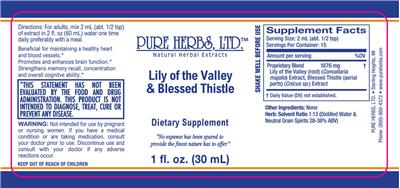
Directions: For adults, mix 2 mL (abt. 1/2 tsp) of extract in 2 fl. oz (60 mL) water one time daily preferably with a meal.
Shake well before use
Formulation
Beneficial for maintaining a healthy heart and blood vessels. Promotes and enhances brain function. Strengthens memory recall, concentration and overall cognitive ability.
FDA Disclaimer Statement
This statement has not been evaluated by the Food and Drug Administration. This product is not intended to diagnose, treat, cure or prevent any disease.
Precautions
Warning: Not intended for use by pregnant or nursing women. If you have a medical condition or are taking medication, consult your doctor prior to use.
Discontinue use and consult with your doctor if any adverse reactions occur.
Keep out of reach of children
Brand IP Statement(s)
Pure Herbs, Ltd. Natural Herbal Extracts
FDA Statement of Identity
Dietary Supplement
General Statements
"No expense has been spared to provide the finest nature has to offer."
Is this label outdated? Report a formula or label change and our pharmacy team will review it.
Lily of the Valley & Blessed Thistle by Pure Herbs label
The label scan from the NIH Dietary Supplement Label Database. Tap to enlarge.
Label images are published by the NIH Dietary Supplement Label Database for the version of this product on file. Always read your actual product label.
View the full label (PDF)The Ingredients in Lily of the Valley & Blessed Thistle by Pure Herbs
These are the 2 active ingredients this product is made of. Select any to open its full monograph.
Serving size2 mL Dosage formLiquid Servings per container15 Amounts shown are per serving.
Most supplement products combine several ingredients, and a medication can interact with the product through any one of them. Each ingredient below shows whether it has known drug interactions.
Proprietary Blend
Other (inactive) ingredients: None. These complete the product’s ingredient list but are not active constituents.
Lily of the Valley & Blessed Thistle by Pure Herbs Drug Interactions
HelloPharmacist Interaction Report
Pure Herbs' Lily of the Valley & Blessed Thistle has serious documented interactions with medications.
The biggest concern is lily-of-the-valley, which contains cardiac glycosides—compounds that affect your heart rhythm. If you take digoxin (a heart medication), corticosteroids long-term, or quinine, this product poses a Major risk of heart toxicity and shouldn't be combined without close medical supervision.
Read the full breakdown — every affected drug type, severity by severity
Lily-of-the-valley also interacts at a Moderate level with diuretics (water pills), lithium, stimulant laxatives, and certain antibiotics (macrolides and tetracyclines). Each of these can increase the chance that the cardiac glycosides build up to dangerous levels in your body.
Blessed thistle, the other ingredient, carries Minor interactions with acid-reducing drugs—H2-blockers, antacids, and proton pump inhibitors—because it may raise stomach acid and theoretically make those medications less effective.
Altogether, these interactions span 192 individual medications. Before you start this product, run your exact medications through the interaction checker on this page, and talk it over with your doctor or pharmacist—especially if you take anything for your heart, blood pressure, or digestion.
Check your own medications below · Editorial policy · How we use AI
Want to check YOUR meds against Lily of the Valley & Blessed Thistle?
Ask about interactions with your drugs in plain English — “Can I take it with lisinopril?” — and we find you the answer in seconds, ingredient by ingredient.
Go to the checkerIngredients driving the most interactions
Individual Drug Interactions
The ingredients in Lily of the Valley & Blessed Thistle interact with 192 drugs. Click any drug to see the details.
2 of the 2 ingredients in Lily of the Valley & Blessed Thistle interact with drugs. Each result below shows which ingredient is responsible. Lily of the Valley Root Extract Blessed Thistle Aerial Parts Extract
Azelastine Hydrochloride, Fluticasone PropionateDymista
How Azelastine Hydrochloride, Fluticasone Propionate interacts with Lily of the Valley & Blessed Thistle — through 1 ingredient. Tap an ingredient for the detail:
Lily Of The Valley Root ExtractCorticosteroids Major
Interaction Summary
Theoretically, using lily-of-the-valley with prolonged corticosteroid therapy can cause cardiac glycoside toxicity.
Read the full Lily Of The Valley Root Extract + Azelastine Hydrochloride, Fluticasone Propionate interactionBeclometasone DipropionateBecotide
How Beclometasone Dipropionate interacts with Lily of the Valley & Blessed Thistle — through 1 ingredient. Tap an ingredient for the detail:
Lily Of The Valley Root ExtractCorticosteroids Major
Interaction Summary
Theoretically, using lily-of-the-valley with prolonged corticosteroid therapy can cause cardiac glycoside toxicity.
Read the full Lily Of The Valley Root Extract + Beclometasone Dipropionate interactionBeclomethasoneBeclovent, Vanceril
How Beclomethasone interacts with Lily of the Valley & Blessed Thistle — through 1 ingredient. Tap an ingredient for the detail:
Lily Of The Valley Root ExtractCorticosteroids Major
Interaction Summary
Theoretically, using lily-of-the-valley with prolonged corticosteroid therapy can cause cardiac glycoside toxicity.
Read the full Lily Of The Valley Root Extract + Beclomethasone interactionBeclomethasone DipropionateQNASL, Qvar
How Beclomethasone Dipropionate interacts with Lily of the Valley & Blessed Thistle — through 1 ingredient. Tap an ingredient for the detail:
Lily Of The Valley Root ExtractCorticosteroids Major
Interaction Summary
Theoretically, using lily-of-the-valley with prolonged corticosteroid therapy can cause cardiac glycoside toxicity.
Read the full Lily Of The Valley Root Extract + Beclomethasone Dipropionate interactionBetamethasoneCelestone, Diprolene AF, Diprosone
How Betamethasone interacts with Lily of the Valley & Blessed Thistle — through 1 ingredient. Tap an ingredient for the detail:
Lily Of The Valley Root ExtractCorticosteroids Major
Interaction Summary
Theoretically, using lily-of-the-valley with prolonged corticosteroid therapy can cause cardiac glycoside toxicity.
Read the full Lily Of The Valley Root Extract + Betamethasone interactionBetamethasone DipropionateSernivo
How Betamethasone Dipropionate interacts with Lily of the Valley & Blessed Thistle — through 1 ingredient. Tap an ingredient for the detail:
Lily Of The Valley Root ExtractCorticosteroids Major
Interaction Summary
Theoretically, using lily-of-the-valley with prolonged corticosteroid therapy can cause cardiac glycoside toxicity.
Read the full Lily Of The Valley Root Extract + Betamethasone Dipropionate interactionBetamethasone Dipropionate, CalcipotrieneEnstilar, Wynzora
How Betamethasone Dipropionate, Calcipotriene interacts with Lily of the Valley & Blessed Thistle — through 1 ingredient. Tap an ingredient for the detail:
Lily Of The Valley Root ExtractCorticosteroids Major
Interaction Summary
Theoretically, using lily-of-the-valley with prolonged corticosteroid therapy can cause cardiac glycoside toxicity.
Read the full Lily Of The Valley Root Extract + Betamethasone Dipropionate, Calcipotriene interactionBetamethasone ValerateLuxiq
How Betamethasone Valerate interacts with Lily of the Valley & Blessed Thistle — through 1 ingredient. Tap an ingredient for the detail:
Lily Of The Valley Root ExtractCorticosteroids Major
Interaction Summary
Theoretically, using lily-of-the-valley with prolonged corticosteroid therapy can cause cardiac glycoside toxicity.
Read the full Lily Of The Valley Root Extract + Betamethasone Valerate interactionBudesonideEntocort EC, Eohilia, Pulmicort, Tarpeyo, Uceris
How Budesonide interacts with Lily of the Valley & Blessed Thistle — through 1 ingredient. Tap an ingredient for the detail:
Lily Of The Valley Root ExtractCorticosteroids Major
Interaction Summary
Theoretically, using lily-of-the-valley with prolonged corticosteroid therapy can cause cardiac glycoside toxicity.
Read the full Lily Of The Valley Root Extract + Budesonide interactionClobetasolClobex, Temovate
How Clobetasol interacts with Lily of the Valley & Blessed Thistle — through 1 ingredient. Tap an ingredient for the detail:
Lily Of The Valley Root ExtractCorticosteroids Major
Interaction Summary
Theoretically, using lily-of-the-valley with prolonged corticosteroid therapy can cause cardiac glycoside toxicity.
Read the full Lily Of The Valley Root Extract + Clobetasol interactionCortisone AcetateCortisone Tablets, Cortone
How Cortisone Acetate interacts with Lily of the Valley & Blessed Thistle — through 1 ingredient. Tap an ingredient for the detail:
Lily Of The Valley Root ExtractCorticosteroids Major
Interaction Summary
Theoretically, using lily-of-the-valley with prolonged corticosteroid therapy can cause cardiac glycoside toxicity.
Read the full Lily Of The Valley Root Extract + Cortisone Acetate interactionDexamethasoneDecadron, Dexone, Dextenza, Dexycu, Hemady, Hexadrol +1 more
How Dexamethasone interacts with Lily of the Valley & Blessed Thistle — through 1 ingredient. Tap an ingredient for the detail:
Lily Of The Valley Root ExtractCorticosteroids Major
Interaction Summary
Theoretically, using lily-of-the-valley with prolonged corticosteroid therapy can cause cardiac glycoside toxicity.
Read the full Lily Of The Valley Root Extract + Dexamethasone interactionDigoxinDigitek, Lanoxicaps, Lanoxin
How Digoxin interacts with Lily of the Valley & Blessed Thistle — through 1 ingredient. Tap an ingredient for the detail:
Lily Of The Valley Root ExtractDigoxin (lanoxin) Major
Interaction Summary
Using lily-of-the-valley with digoxin can cause cardiac glycoside toxicity.
Read the full Lily Of The Valley Root Extract + Digoxin interactionFludrocortisoneFlorinef Acetate
How Fludrocortisone interacts with Lily of the Valley & Blessed Thistle — through 1 ingredient. Tap an ingredient for the detail:
Lily Of The Valley Root ExtractCorticosteroids Major
Interaction Summary
Theoretically, using lily-of-the-valley with prolonged corticosteroid therapy can cause cardiac glycoside toxicity.
Read the full Lily Of The Valley Root Extract + Fludrocortisone interactionFluticasoneFlixotide, Flonase, Flovent, Seretide, Veramyst
How Fluticasone interacts with Lily of the Valley & Blessed Thistle — through 1 ingredient. Tap an ingredient for the detail:
Lily Of The Valley Root ExtractCorticosteroids Major
Interaction Summary
Theoretically, using lily-of-the-valley with prolonged corticosteroid therapy can cause cardiac glycoside toxicity.
Read the full Lily Of The Valley Root Extract + Fluticasone interactionFluticasone Furoate, Umeclidinium, VilanterolTrelegy Ellipta
How Fluticasone Furoate, Umeclidinium, Vilanterol interacts with Lily of the Valley & Blessed Thistle — through 1 ingredient. Tap an ingredient for the detail:
Lily Of The Valley Root ExtractCorticosteroids Major
Interaction Summary
Theoretically, using lily-of-the-valley with prolonged corticosteroid therapy can cause cardiac glycoside toxicity.
Read the full Lily Of The Valley Root Extract + Fluticasone Furoate, Umeclidinium, Vilanterol interactionFluticasone Furoate, Vilanterol TrifenatateBreo Ellipta
How Fluticasone Furoate, Vilanterol Trifenatate interacts with Lily of the Valley & Blessed Thistle — through 1 ingredient. Tap an ingredient for the detail:
Lily Of The Valley Root ExtractCorticosteroids Major
Interaction Summary
Theoretically, using lily-of-the-valley with prolonged corticosteroid therapy can cause cardiac glycoside toxicity.
Read the full Lily Of The Valley Root Extract + Fluticasone Furoate, Vilanterol Trifenatate interactionHydrocortisoneAlkindi Sprinkle, Alphaderm, Calmurid HC, Carmol HC cream, Cortef, Dioderm +8 more
How Hydrocortisone interacts with Lily of the Valley & Blessed Thistle — through 1 ingredient. Tap an ingredient for the detail:
Lily Of The Valley Root ExtractCorticosteroids Major
Interaction Summary
Theoretically, using lily-of-the-valley with prolonged corticosteroid therapy can cause cardiac glycoside toxicity.
Read the full Lily Of The Valley Root Extract + Hydrocortisone interactionMethylprednisoloneMedrol, Medrol Dosepak
How Methylprednisolone interacts with Lily of the Valley & Blessed Thistle — through 1 ingredient. Tap an ingredient for the detail:
Lily Of The Valley Root ExtractCorticosteroids Major
Interaction Summary
Theoretically, using lily-of-the-valley with prolonged corticosteroid therapy can cause cardiac glycoside toxicity.
Read the full Lily Of The Valley Root Extract + Methylprednisolone interactionOlopatadine Hydrochloride, Mometasone FuroateRyaltris
How Olopatadine Hydrochloride, Mometasone Furoate interacts with Lily of the Valley & Blessed Thistle — through 1 ingredient. Tap an ingredient for the detail:
Lily Of The Valley Root ExtractCorticosteroids Major
Interaction Summary
Theoretically, using lily-of-the-valley with prolonged corticosteroid therapy can cause cardiac glycoside toxicity.
Read the full Lily Of The Valley Root Extract + Olopatadine Hydrochloride, Mometasone Furoate interactionPrednisoloneCortalone, Delta Cortef, Pred Forte, Prednisolone, Solupred, Sterane
How Prednisolone interacts with Lily of the Valley & Blessed Thistle — through 1 ingredient. Tap an ingredient for the detail:
Lily Of The Valley Root ExtractCorticosteroids Major
Interaction Summary
Theoretically, using lily-of-the-valley with prolonged corticosteroid therapy can cause cardiac glycoside toxicity.
Read the full Lily Of The Valley Root Extract + Prednisolone interactionPrednisoneCortan, Deltasone, Meticorten, Orasone, Prednicen-M, Prednisone +2 more
How Prednisone interacts with Lily of the Valley & Blessed Thistle — through 1 ingredient. Tap an ingredient for the detail:
Lily Of The Valley Root ExtractCorticosteroids Major
Interaction Summary
Theoretically, using lily-of-the-valley with prolonged corticosteroid therapy can cause cardiac glycoside toxicity.
Read the full Lily Of The Valley Root Extract + Prednisone interactionQuinineQualaquin
How Quinine interacts with Lily of the Valley & Blessed Thistle — through 1 ingredient. Tap an ingredient for the detail:
Lily Of The Valley Root ExtractQuinine Major
Interaction Summary
Theoretically, using lily-of-the-valley with quinine can increase the risk of cardiac glycoside toxicity.
Read the full Lily Of The Valley Root Extract + Quinine interactionQuinine SulfateQuinamm, Quinine Sulfate
How Quinine Sulfate interacts with Lily of the Valley & Blessed Thistle — through 1 ingredient. Tap an ingredient for the detail:
Lily Of The Valley Root ExtractQuinine Major
Interaction Summary
Theoretically, using lily-of-the-valley with quinine can increase the risk of cardiac glycoside toxicity.
Read the full Lily Of The Valley Root Extract + Quinine Sulfate interactionTriamcinoloneAdcortyl in Orabase, Adcortyl Intra-articular / Intradermal, Aristocort, Kenacort, Kenalog Intra-articular / Intramuscular, Triesence
How Triamcinolone interacts with Lily of the Valley & Blessed Thistle — through 1 ingredient. Tap an ingredient for the detail:
Lily Of The Valley Root ExtractCorticosteroids Major
Interaction Summary
Theoretically, using lily-of-the-valley with prolonged corticosteroid therapy can cause cardiac glycoside toxicity.
Read the full Lily Of The Valley Root Extract + Triamcinolone interactionTriamcinolone AcetonideXipere, Zilretta
How Triamcinolone Acetonide interacts with Lily of the Valley & Blessed Thistle — through 1 ingredient. Tap an ingredient for the detail:
Lily Of The Valley Root ExtractCorticosteroids Major
Interaction Summary
Theoretically, using lily-of-the-valley with prolonged corticosteroid therapy can cause cardiac glycoside toxicity.
Read the full Lily Of The Valley Root Extract + Triamcinolone Acetonide interactionAcetaminophen, Caffeine, PyrilamineMidol Max Strength Menstrual
How Acetaminophen, Caffeine, Pyrilamine interacts with Lily of the Valley & Blessed Thistle — through 1 ingredient. Tap an ingredient for the detail:
Lily Of The Valley Root ExtractDiuretic Drugs Moderate
Interaction Summary
Theoretically, using lily-of-the-valley with diuretics can increase the risk of cardiac glycoside toxicity.
Read the full Lily Of The Valley Root Extract + Acetaminophen, Caffeine, Pyrilamine interactionAcetaminophen, Pamabrom, PyrilamineMidol Max Strength PMS, Pamprin, Pamprin ES
How Acetaminophen, Pamabrom, Pyrilamine interacts with Lily of the Valley & Blessed Thistle — through 1 ingredient. Tap an ingredient for the detail:
Lily Of The Valley Root ExtractDiuretic Drugs Moderate
Interaction Summary
Theoretically, using lily-of-the-valley with diuretics can increase the risk of cardiac glycoside toxicity.
Read the full Lily Of The Valley Root Extract + Acetaminophen, Pamabrom, Pyrilamine interactionAcetazolamideAk-Zol, Diamox
How Acetazolamide interacts with Lily of the Valley & Blessed Thistle — through 1 ingredient. Tap an ingredient for the detail:
Lily Of The Valley Root ExtractDiuretic Drugs Moderate
Interaction Summary
Theoretically, using lily-of-the-valley with diuretics can increase the risk of cardiac glycoside toxicity.
Read the full Lily Of The Valley Root Extract + Acetazolamide interactionAmiloride, HydrochlorothiazideAmil-Co, Amilzide, Moduret 25, Moduretic
How Amiloride, Hydrochlorothiazide interacts with Lily of the Valley & Blessed Thistle — through 1 ingredient. Tap an ingredient for the detail:
Lily Of The Valley Root ExtractDiuretic Drugs Moderate
Interaction Summary
Theoretically, using lily-of-the-valley with diuretics can increase the risk of cardiac glycoside toxicity.
Read the full Lily Of The Valley Root Extract + Amiloride, Hydrochlorothiazide interactionEach ingredient & the kinds of drugs it affects
For each ingredient in Lily of the Valley & Blessed Thistle with known interactions, here are the types of medications they can affect. Open any type for the detail — or search your exact drug in the checker above.
Lily of the Valley Root Extract
Corticosteroids
Theoretically, using lily-of-the-valley with prolonged corticosteroid therapy can cause cardiac glycoside toxicity.
Lily-of-the-valley contains cardiac glycosides. Concomitant, long-term corticosteroid use can increase the risk of cardiac glycoside toxicity due to potassium depletion and electrolyte imbalance.
Digoxin (Lanoxin)
Using lily-of-the-valley with digoxin can cause cardiac glycoside toxicity.
Lily-of-the-valley contains cardiac glycosides. Use of the cardiac glycoside digoxin and lily-of-the-valley concomitantly increases the risk of cardiac glycoside toxicity.
Quinine
Theoretically, using lily-of-the-valley with quinine can increase the risk of cardiac glycoside toxicity.
Quinine may reduce the clearance of oral digoxin. Theoretically, concomitant use of quinine with lily-of-the-valley might reduce the clearance of cardiac glycosides found in lily-of-the-valley and increase the risk of toxicity.
Diuretic Drugs
Theoretically, using lily-of-the-valley with diuretics can increase the risk of cardiac glycoside toxicity.
Lily-of-the-valley contains cardiac glycosides. Concomitant use of potassium depleting diuretics and lily-of-the-valley can increase the risk of cardiac glycoside toxicity due to potassium depletion and electrolyte imbalance.
Lithium
Theoretically, lily-of-the-valley can increase levels of lithium and increase toxicity.
Lily-of-the-valley is thought to have diuretic properties. Theoretically, due to these potential diuretic effects, lily-of-the-valley might reduce excretion and increase levels of lithium. The dose of lithium might need to be decreased.
Macrolide Antibiotics
Theoretically, using lily-of-the-valley with macrolide antibiotics can increase the risk of cardiac glycoside toxicity.
Macrolide antibiotics appear to increase the gastrointestinal absorption of oral digoxin. Theoretically, concomitant use of macrolide antibiotics might increase the absorption of the cardiac glycosides found in lily-of-the-valley.
Stimulant Laxatives
Theoretically, using lily-of-the-valley with stimulant laxatives can increase the risk of cardiac glycoside toxicity.
Lily-of-the-valley contains cardiac glycosides. The overuse of stimulant laxatives can increase the risk of cardiac glycoside toxicity with lily-of-the-valley due to potassium depletion.
Tetracycline Antibiotics
Theoretically, using lily-of-the-valley with tetracycline antibiotics might increase the risk of cardiac glycoside toxicity.
Tetracycline antibiotics appear to increase the gastrointestinal absorption of oral digoxin, a cardiac glycoside. Theoretically, concomitant use of tetracycline antibiotics might increase the absorption of the cardiac glycosides found in lily-of-the-valley.
Blessed Thistle Aerial Parts Extract
Antacids
Theoretically, blessed thistle might decrease the effectiveness of antacids.
There are reports that blessed thistle increases stomach acid.
H2-Blockers
Theoretically, blessed thistle might decrease the effectiveness of H2-blockers.
There are reports that blessed thistle increases stomach acid.
Proton Pump Inhibitors (Ppis)
Theoretically, blessed thistle might decrease the effectiveness of PPIs.
There are reports that blessed thistle increases stomach acid.
Brand information
Manufacturer and brand details for Lily of the Valley & Blessed Thistle, from the product label.
Pure Herbs
See all Pure Herbs products- Name
- Pure Herbs, Ltd.
- City
- Sterling Heights
- State
- MI
- Phone Number
- (800) 860-4372
- Web Address
- www.pureherbs.com
Lily of the Valley & Blessed Thistle by Pure Herbs: Common Questions
Does Lily of the Valley & Blessed Thistle by Pure Herbs interact with any medications?
How can one product interact with so many drugs?
Where does this information come from?
What does blessed thistle do?
What does lily-of-the-valley do?
Can I take this product while pregnant?
Can I take this product while breastfeeding?
What are the side effects?
Is this product safe?
Written and reviewed by the HelloPharmacist editorial staff. Our editorial policy
Not sure if Lily of the Valley & Blessed Thistle is safe with your meds?
Our pharmacists answer your medication & supplement questions — free.
Label information is sourced from the NIH Dietary Supplement Label Database and reflects the product version on file; always read your actual product label. This page is for education only and is not a substitute for professional medical advice. Confirm with your pharmacist or doctor before combining supplements and medications.
The Full Monographs Behind Lily of the Valley & Blessed Thistle’s Ingredients
Every ingredient we hold a full HelloPharmacist monograph for — uses, evidence, safety, and the complete interaction list.
Blessed Thistle
Interacts with 36 drugsBlessed thistle is a bitter herb traditionally used to stimulate appetite and ease mild digestive complaints. High-quality human studies are lacking, so its benefits are not well proven. It...
Read the full Blessed Thistle monograph → Herb & supplement monographLily-of-the-valley
Interacts with 157 drugsLily-of-the-valley is a poisonous plant that contains powerful heart-affecting compounds called cardiac glycosides, similar to the drug digoxin. While it was used historically for heart cond...
Read the full Lily-of-the-valley monograph →Sources & How We Checked
Lily of the Valley & Blessed Thistle's label data comes from the NIH Dietary Supplement Label Database; the ingredient interaction data is from the Natural Medicines database, reviewed by our pharmacists.
- NIH Dietary Supplement Label Database (DSLD) — The official product label on file for this supplement.
- Natural Medicines (Therapeutic Research Center) — Evidence-graded clinical reference behind the ingredient interaction data.
Content is written and reviewed by licensed HelloPharmacist pharmacists. See our data sources and editorial standards for how this information is built and checked.
The 9 references behind this product’s interaction data
Every citation that drives the interaction findings for this product’s ingredients, from the evidence-graded Natural Medicines (TRC Healthcare) database. Open an ingredient to browse its citations — links open the study on PubMed or the publisher’s site.
Blessed Thistle 2 references
- McGuffin M, Hobbs C, Upton R, Goldberg A, eds. American Herbal Products Association's Botanical Safety Handbook. Boca Raton, FL: CRC Press, LLC 1997.
- Brinker F. Herb Contraindications and Drug Interactions. 2nd ed. Sandy, OR: Eclectic Medical Publications, 1998.
Lily-of-the-valley 7 references
- Blumenthal M, ed. The Complete German Commission E Monographs: Therapeutic Guide to Herbal Medicines. Trans. S. Klein. Boston, MA: American Botanical Council, 1998.
- McGuffin M, Hobbs C, Upton R, Goldberg A, eds. American Herbal Products Association's Botanical Safety Handbook. Boca Raton, FL: CRC Press, LLC 1997.
- Ellenhorn MJ, et al. Ellenhorn's Medical Toxicology: Diagnoses and Treatment of Human Poisoning. 2nd ed. Baltimore, MD: Williams & Wilkins, 1997.
- Gruenwald J, Brendler T, Jaenicke C. PDR for Herbal Medicines. 1st ed. Montvale, NJ: Medical Economics Company, Inc., 1998.
- Brinker F. Herb Contraindications and Drug Interactions. 2nd ed. Sandy, OR: Eclectic Medical Publications, 1998.
- Burnham TH, ed. Drug Facts and Comparisons, Updated Monthly. Facts and Comparisons, St. Louis, MO.
- Alexandre J, Foucault A, Coutance G, et al. Digitalis intoxication induced by an acute accidental poisoning by lily of the valley. Circulation 2012 Feb 28;125(8):1053-5. PubMed
Parts of this content are provided by the Therapeutic Research Center, LLC.
DISCLAIMER: Currently this does not check for drug-drug interactions. This is not an all-inclusive comprehensive list of potential interactions and is for informational purposes only. Not all interactions are known or well-reported in the scientific literature, and new interactions are continually being reported. Input is needed from a qualified healthcare provider including a pharmacist before starting any therapy. Application of clinical judgment is necessary.
© 2021 Therapeutic Research Center, LLC