
Metabolic Pre & Postbiotic Ingredients & Drug Interactions
by Nutrilite
What is this page for?
First and foremost: checking Metabolic Pre & Postbiotic against your medications. The heart of this page is the interaction checker and the full interaction report — how this product’s ingredients may interact with prescription and over-the-counter medicines you may be taking.
Around that, we add a pharmacist’s high-level view of the product as a whole — what’s inside, the evidence for its stated use, how transparent the label is, and what safety data exists — so you can see the full picture in one place. It’s educational information from our licensed clinical databases and the clinical staff at HelloPharmacist — not medical advice — and we don’t sell or endorse products. Our editorial policy
Metabolic Pre & Postbiotic is a dietary supplement by Nutrilite with 5 active ingredients. Its ingredients are commonly taken for riboflavin deficiency, migraine prevention, general energy and metabolism support.Based on those ingredients, 308 medications have a known interaction with it, the most serious rated moderate. The ingredients most likely to interact are Livaux, Riboflavin. Use the checker below to test your specific medication, or read the full HelloPharmacist Interaction Report.
Check Your Meds Against Metabolic Pre & Postbiotic by Nutrilite
Ask about any prescription or over-the-counter medication and we check it for interactions with Metabolic Pre & Postbiotic by Nutrilite — and tell you which ingredient is responsible.
AI summaries are generated from our interaction database for education only — always confirm with your pharmacist. How we use AI
Ask the Pharmacist
A licensed pharmacist will answer your question by email — free, usually within 24 hours.
Got it — thank you!
A licensed pharmacist will answer within 24 hours. Keep an eye on your email (worth checking spam, just in case).
HelloPharmacist Scorecard of Metabolic Pre & Postbiotic by Nutrilite
Our pharmacy team’s full take, with four database checks built into the cards below — a summary of what is known, not a grade of the product itself.
What’s inside
Full disclosure
This formula has 5 active ingredients: riboflavin (a B vitamin), pantothenic acid (another B vitamin), purple carrot concentrate, Livaux (a kiwi extract), and Bifidobacterium animalis lactis CECT8145 (a probiotic). The capsules also contain several inactive ingredients — microcrystalline cellulose, hydroxypropyl methylcellulose, tapioca maltodextrin, silicon dioxide, and stearic acid — which are fillers and binders.
Does it work?
Not established
The evidence is limited for most uses. Riboflavin and pantothenic acid are both B vitamins; pantothenic acid is effective for vitamin A deficiency, but we don't have effectiveness ratings for riboflavin in this data.
For purple carrot concentrate, there's some evidence it may help with vitamin A deficiency, though most other uses (cancer prevention, fibromyalgia) lack reliable proof. Livaux (kiwi) is rated as insufficient evidence for asthma, constipation, high blood pressure, and IBS.
We hold no effectiveness data for the probiotic strain in this product.
How safe is it?
Well-documented data
Riboflavin is very well tolerated; any excess leaves your body in urine. The main side effects are dose-related nausea and bright yellow urine at higher doses.
Pantothenic acid is generally well tolerated orally, though it can cause diarrhea. Purple carrot concentrate as a food is safe, but some people are allergic to carrot — allergic reactions can range from hives and swelling to breathing trouble or anaphylaxis.
Kiwi (Livaux) is safe when eaten as regular food, but can trigger allergies affecting the lips, mouth, and throat; rarely, severe reactions like anaphylaxis have been reported. For pregnancy and breastfeeding, riboflavin and kiwi are likely safe, and carrot as food is fine — but talk to your doctor before using high-dose supplements, especially of carrot or kiwi products.
Meds to double-check
Moderate interaction found
Before taking this product, check your medications against it if you take blood pressure drugs (Moderate risk of extra lowering) or blood thinners and antiplatelet medications like warfarin or aspirin (Moderate risk of increased bleeding). Tetracycline antibiotics (like doxycycline) also interact at Moderate severity — riboflavin may reduce their potency.
Use the interaction checker on this page with your exact medications.
The bottom line
Scorecard at a glanceFully disclosed formula with no established evidence rating for its marketed use. Moderate medication interactions have been identified, and safety information is well characterized.
This product may work for you if you're interested in probiotics and plant-based nutrients, but it's not established as effective for any specific condition in our data. If you take blood pressure medications, blood thinners, or tetracycline antibiotics, check with your pharmacist before starting.
Allergies to kiwi or carrot are a reason to skip it.
Educational only — not medical advice; always confirm with your pharmacist. Our editorial policy · How we use AI
Assessment coverage: 4 of 5 active ingredients matched to our full ingredient reviews (monographs). Based on the product label dated Mar 25, 2025.
This Scorecard evaluates available label information, ingredient evidence, and known medication-safety considerations. It does not independently verify product identity, purity, potency, contamination, or manufacturing quality. How these ratings are computed
General information
Key facts about Metabolic Pre & Postbiotic, straight from the product label.
| Brand | Nutrilite |
|---|---|
| Barcode (UPC) | 127620 |
| Net contents | 60 Capsule(s) |
| Market status | On market |
| Date entered into DSLD | Mar 25, 2025 |
| DSLD ID | 328257 |
| Product type | Other Combinations |
| Supplement form | Capsule |
| Dietary claims / uses | Nutrient, All Other, Structure/Function |
| Intended target group(s) | Adult (18 - 50 Years), Kosher, Halal |
Everything in this section is reproduced from the manufacturer’s own product label — it’s the label speaking, not HelloPharmacist. We show it so you can see exactly what the maker states; we don’t verify or endorse those statements.
Supplement Facts
The label details for Metabolic Pre & Postbiotic by Nutrilite, sourced from the NIH Dietary Supplement Label Database.
Supplement Facts
| Ingredient | Amount | % DV |
|---|---|---|
| Riboflavin | 0.6 mg | 46% |
| Pantothenic Acid | 2.5 mg | 50% |
| Purple Carrot Concentrate | 49 mg | -- |
| Livaux | 93 mg | -- |
| Bifidobacterium animalis lactis CECT8145 | 10 mg | -- |
Other ingredients: Microcrystalline Cellulose, Hydroxypropyl Methylcellulose, Tapioca Maltodextrin, Silicon Dioxide, Stearic Acid
Tap any ingredient to jump to its full detail below.
These statements are the manufacturer’s wording, reproduced from the product label — the label is saying it, not HelloPharmacist. We don’t verify or endorse them.
Formula
Provides an award-winning heat-treated postbiotic B. lactis CECT 8145. Includes Gold Kiwi fruit powder from Nutrilite partner farm in New Zealand and purple carrot powder from partner farm in New Zealand and purple carrot powder from Nutrilite farms Vitamins B2 and B5 are included to help Nutrilite farms. Vitamins B2 and B5 are included to help support energy metabolism.
Star-K (Kosher)
Crescent M (Halal)
Precautions
Contains Kiwi.
For adult use only. Keep out of reach of children.
If you are pregnant, nursing or have a medical condition, please consult your physician before use.
Storage
Keep bottle tightly closed. Store in a cool, dry place.
FDA Disclaimer Statement
This statement has not been evaluated by the Food and Drug Administration. This product is not intended to diagnose, treat, cure, or prevent any disease.
Formulation
Helps support healthy weight
FDA Statement of Identity
Dietary Supplement
General Statements
Quality You Can Trust Since 1934
For Questions: 1-800-253-6500
Exclusively from Amway
Suggested/Recommended/Usage/Directions
2 capsules, 1x per day Suggested use: Take 2 capsules per day, preferably in the morning.
Brand IP Statement(s)
LIVAUX is a registered trademark of Anagenix Ltd. Copyright Alticor Inc.
Seals/Symbols
Star-K (Kosher) Crescent M (Halal) NSF Contents Verified
Is this label outdated? Report a formula or label change and our pharmacy team will review it.
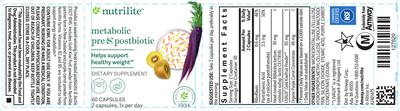
Metabolic Pre & Postbiotic by Nutrilite label
The label scan from the NIH Dietary Supplement Label Database. Tap to enlarge.
Label images are published by the NIH Dietary Supplement Label Database for the version of this product on file. Always read your actual product label.
View the full label (PDF)The Ingredients in Metabolic Pre & Postbiotic by Nutrilite
These are the 5 active ingredients this product is made of. Select any to open its full monograph.
Serving size2 Capsule(s) Dosage formCapsule Servings per container30 Amounts shown are per serving.
Most supplement products combine several ingredients, and a medication can interact with the product through any one of them. Each ingredient below shows whether it has known drug interactions.
Riboflavin
Interacts with20 drugs
Riboflavin (vitamin B2) is an essential nutrient your body needs to turn food into energy and to keep skin, eyes, and nerves healthy. It is generally...
Riboflavin monograph & interactionsPantothenic Acid
No knowninteractions
Pantothenic acid is vitamin B5, an essential nutrient your body uses to turn food into energy. True deficiency is very rare because it is found in nea...
Pantothenic Acid monograph & interactionsPurple Carrot Concentrate
No knowninteractions
Carrot is a common food vegetable that is a rich source of beta-carotene (which the body turns into vitamin A) and other nutrients. Eating carrots is...
Purple Carrot Concentrate monograph & interactionsLivaux
Interacts with289 drugs
Kiwi is a nutritious fruit that is rich in vitamin C, fiber, and antioxidants, and it is generally safe to eat as a food. The strongest evidence is fo...
Livaux monograph & interactionsBifidobacterium animalis lactis CECT8145
Other (inactive) ingredients: Microcrystalline Cellulose, Hydroxypropyl Methylcellulose, Tapioca Maltodextrin, Silicon Dioxide, Stearic Acid. These complete the product’s ingredient list but are not active constituents.
Metabolic Pre & Postbiotic by Nutrilite Drug Interactions
HelloPharmacist Interaction Report
Nutrilite's Metabolic Pre & Postbiotic contains two ingredients with documented interactions with medications.
Livaux (kiwi) is the more significant concern — it can lower blood pressure and thin the blood, which means it may amplify the effects of blood pressure medications (like captopril or enalapril) and blood thinners or antiplatelet drugs (like warfarin, aspirin, or clopidogrel). The risk is Moderate for both.
Riboflavin, the B vitamin in the formula, has a Moderate interaction with tetracycline antibiotics — in theory, it may reduce how well these antibiotics work, though this hasn't been reported in actual patients.
Read the full breakdown — every affected drug type, severity by severity
We couldn't check Bifidobacterium animalis lactis CECT8145 (a probiotic strain) — we hold no data for it. Altogether, these interactions span 306 individual medications.
If you take any blood pressure medication, blood thinner, or tetracycline antibiotic, run this product through the checker below before starting it.
Check your own medications below · Editorial policy · How we use AI
Want to check YOUR meds against Metabolic Pre & Postbiotic?
Ask about interactions with your drugs in plain English — “Can I take it with lisinopril?” — and we find you the answer in seconds, ingredient by ingredient.
Go to the checkerIngredients driving the most interactions
Individual Drug Interactions
The ingredients in Metabolic Pre & Postbiotic interact with 308 drugs. Click any drug to see the details.
2 of the 5 ingredients in Metabolic Pre & Postbiotic interact with drugs. Each result below shows which ingredient is responsible. Livaux Riboflavin
AbciximabReoPro
How Abciximab interacts with Metabolic Pre & Postbiotic — through 1 ingredient. Tap an ingredient for the detail:
LivauxAnticoagulant/antiplatelet Drugs Moderate
Interaction Summary
Clinical research suggests that kiwi inhibits platelet aggregation.
Read the full Livaux + Abciximab interactionAbrocitinibCibinqo
How Abrocitinib interacts with Metabolic Pre & Postbiotic — through 1 ingredient. Tap an ingredient for the detail:
LivauxAnticoagulant/antiplatelet Drugs Moderate
Interaction Summary
Clinical research suggests that kiwi inhibits platelet aggregation.
Read the full Livaux + Abrocitinib interactionAcebutololRhotral, Sectral
How Acebutolol interacts with Metabolic Pre & Postbiotic — through 1 ingredient. Tap an ingredient for the detail:
LivauxAntihypertensive Drugs Moderate
Interaction Summary
Clinical research suggests that consuming kiwi reduces systolic and diastolic blood pressure in hypertensive individuals.
Read the full Livaux + Acebutolol interactionAcenocoumarolSintrom
How Acenocoumarol interacts with Metabolic Pre & Postbiotic — through 1 ingredient. Tap an ingredient for the detail:
LivauxAnticoagulant/antiplatelet Drugs Moderate
Interaction Summary
Clinical research suggests that kiwi inhibits platelet aggregation.
Read the full Livaux + Acenocoumarol interactionAcetaminophen, AspirinGemnisyn
How Acetaminophen, Aspirin interacts with Metabolic Pre & Postbiotic — through 1 ingredient. Tap an ingredient for the detail:
LivauxAnticoagulant/antiplatelet Drugs Moderate
Interaction Summary
Clinical research suggests that kiwi inhibits platelet aggregation.
Read the full Livaux + Acetaminophen, Aspirin interactionAcetaminophen, Aspirin, CaffeineExcedrin, Excedrin Extra Strength, Excedrin Migraine
How Acetaminophen, Aspirin, Caffeine interacts with Metabolic Pre & Postbiotic — through 1 ingredient. Tap an ingredient for the detail:
LivauxAnticoagulant/antiplatelet Drugs Moderate
Interaction Summary
Clinical research suggests that kiwi inhibits platelet aggregation.
Read the full Livaux + Acetaminophen, Aspirin, Caffeine interactionAcetaminophen, IbuprofenCombogesic
How Acetaminophen, Ibuprofen interacts with Metabolic Pre & Postbiotic — through 1 ingredient. Tap an ingredient for the detail:
LivauxAnticoagulant/antiplatelet Drugs Moderate
Interaction Summary
Clinical research suggests that kiwi inhibits platelet aggregation.
Read the full Livaux + Acetaminophen, Ibuprofen interactionAcetazolamideAk-Zol, Diamox
How Acetazolamide interacts with Metabolic Pre & Postbiotic — through 1 ingredient. Tap an ingredient for the detail:
LivauxAntihypertensive Drugs Moderate
Interaction Summary
Clinical research suggests that consuming kiwi reduces systolic and diastolic blood pressure in hypertensive individuals.
Read the full Livaux + Acetazolamide interactionAcetylsalicylic AcidEntrophen
How Acetylsalicylic Acid interacts with Metabolic Pre & Postbiotic — through 1 ingredient. Tap an ingredient for the detail:
LivauxAnticoagulant/antiplatelet Drugs Moderate
Interaction Summary
Clinical research suggests that kiwi inhibits platelet aggregation.
Read the full Livaux + Acetylsalicylic Acid interactionAliskirenTekturna
How Aliskiren interacts with Metabolic Pre & Postbiotic — through 1 ingredient. Tap an ingredient for the detail:
LivauxAntihypertensive Drugs Moderate
Interaction Summary
Clinical research suggests that consuming kiwi reduces systolic and diastolic blood pressure in hypertensive individuals.
Read the full Livaux + Aliskiren interactionAlteplase, TpaActilyse, Activase
How Alteplase, Tpa interacts with Metabolic Pre & Postbiotic — through 1 ingredient. Tap an ingredient for the detail:
LivauxAnticoagulant/antiplatelet Drugs Moderate
Interaction Summary
Clinical research suggests that kiwi inhibits platelet aggregation.
Read the full Livaux + Alteplase, Tpa interactionAluminum Hydroxide, Aspirin, Codeine Phosphate, Magnesium HydroxideAscriptin Codeine #2
How Aluminum Hydroxide, Aspirin, Codeine Phosphate, Magnesium Hydroxide interacts with Metabolic Pre & Postbiotic — through 1 ingredient. Tap an ingredient for the detail:
LivauxAnticoagulant/antiplatelet Drugs Moderate
Interaction Summary
Clinical research suggests that kiwi inhibits platelet aggregation.
Read the full Livaux + Aluminum Hydroxide, Aspirin, Codeine Phosphate, Magnesium Hydroxide interactionAluminum Hydroxide, Aspirin, Magnesium HydroxideAscriptin
How Aluminum Hydroxide, Aspirin, Magnesium Hydroxide interacts with Metabolic Pre & Postbiotic — through 1 ingredient. Tap an ingredient for the detail:
LivauxAnticoagulant/antiplatelet Drugs Moderate
Interaction Summary
Clinical research suggests that kiwi inhibits platelet aggregation.
Read the full Livaux + Aluminum Hydroxide, Aspirin, Magnesium Hydroxide interactionAmbrisentanLetairis, Volibris
How Ambrisentan interacts with Metabolic Pre & Postbiotic — through 1 ingredient. Tap an ingredient for the detail:
LivauxAntihypertensive Drugs Moderate
Interaction Summary
Clinical research suggests that consuming kiwi reduces systolic and diastolic blood pressure in hypertensive individuals.
Read the full Livaux + Ambrisentan interactionAmilorideAmilamont, Midamor
How Amiloride interacts with Metabolic Pre & Postbiotic — through 1 ingredient. Tap an ingredient for the detail:
LivauxAntihypertensive Drugs Moderate
Interaction Summary
Clinical research suggests that consuming kiwi reduces systolic and diastolic blood pressure in hypertensive individuals.
Read the full Livaux + Amiloride interactionAmiloride, HydrochlorothiazideAmil-Co, Amilzide, Moduret 25, Moduretic
How Amiloride, Hydrochlorothiazide interacts with Metabolic Pre & Postbiotic — through 1 ingredient. Tap an ingredient for the detail:
LivauxAntihypertensive Drugs Moderate
Interaction Summary
Clinical research suggests that consuming kiwi reduces systolic and diastolic blood pressure in hypertensive individuals.
Read the full Livaux + Amiloride, Hydrochlorothiazide interactionAmlodipineNorliqva
How Amlodipine interacts with Metabolic Pre & Postbiotic — through 1 ingredient. Tap an ingredient for the detail:
LivauxAntihypertensive Drugs Moderate
Interaction Summary
Clinical research suggests that consuming kiwi reduces systolic and diastolic blood pressure in hypertensive individuals.
Read the full Livaux + Amlodipine interactionAmlodipine BenzoateKaterzia
How Amlodipine Benzoate interacts with Metabolic Pre & Postbiotic — through 1 ingredient. Tap an ingredient for the detail:
LivauxAntihypertensive Drugs Moderate
Interaction Summary
Clinical research suggests that consuming kiwi reduces systolic and diastolic blood pressure in hypertensive individuals.
Read the full Livaux + Amlodipine Benzoate interactionAmlodipine BesilateIstin
How Amlodipine Besilate interacts with Metabolic Pre & Postbiotic — through 1 ingredient. Tap an ingredient for the detail:
LivauxAntihypertensive Drugs Moderate
Interaction Summary
Clinical research suggests that consuming kiwi reduces systolic and diastolic blood pressure in hypertensive individuals.
Read the full Livaux + Amlodipine Besilate interactionAmlodipine BesylateNorvasc
How Amlodipine Besylate interacts with Metabolic Pre & Postbiotic — through 1 ingredient. Tap an ingredient for the detail:
LivauxAntihypertensive Drugs Moderate
Interaction Summary
Clinical research suggests that consuming kiwi reduces systolic and diastolic blood pressure in hypertensive individuals.
Read the full Livaux + Amlodipine Besylate interactionAmlodipine Besylate, BenazeprilLotrel
How Amlodipine Besylate, Benazepril interacts with Metabolic Pre & Postbiotic — through 1 ingredient. Tap an ingredient for the detail:
LivauxAntihypertensive Drugs Moderate
Interaction Summary
Clinical research suggests that consuming kiwi reduces systolic and diastolic blood pressure in hypertensive individuals.
Read the full Livaux + Amlodipine Besylate, Benazepril interactionAmlodipine, CelecoxibConsensi
How Amlodipine, Celecoxib interacts with Metabolic Pre & Postbiotic — through 1 ingredient. Tap an ingredient for the detail:
LivauxAntihypertensive Drugs Moderate
Interaction Summary
Clinical research suggests that consuming kiwi reduces systolic and diastolic blood pressure in hypertensive individuals.
Read the full Livaux + Amlodipine, Celecoxib interactionAmmonium ChlorideAmmonium Chloride
How Ammonium Chloride interacts with Metabolic Pre & Postbiotic — through 1 ingredient. Tap an ingredient for the detail:
LivauxAntihypertensive Drugs Moderate
Interaction Summary
Clinical research suggests that consuming kiwi reduces systolic and diastolic blood pressure in hypertensive individuals.
Read the full Livaux + Ammonium Chloride interactionAmphotericin, TetracyclineMysteclin-F
How Amphotericin, Tetracycline interacts with Metabolic Pre & Postbiotic — through 1 ingredient. Tap an ingredient for the detail:
RiboflavinTetracycline Antibiotics Moderate
Interaction Summary
Theoretically, taking riboflavin with tetracycline antibiotics may decrease the potency of these antibiotics.
Read the full Riboflavin + Amphotericin, Tetracycline interactionAnacaulase-bcdbNexoBrid
How Anacaulase-bcdb interacts with Metabolic Pre & Postbiotic — through 1 ingredient. Tap an ingredient for the detail:
LivauxAnticoagulant/antiplatelet Drugs Moderate
Interaction Summary
Clinical research suggests that kiwi inhibits platelet aggregation.
Read the full Livaux + Anacaulase-bcdb interactionAnagrelideAgrylin
How Anagrelide interacts with Metabolic Pre & Postbiotic — through 1 ingredient. Tap an ingredient for the detail:
LivauxAnticoagulant/antiplatelet Drugs Moderate
Interaction Summary
Clinical research suggests that kiwi inhibits platelet aggregation.
Read the full Livaux + Anagrelide interactionAnisindioneMiradon
How Anisindione interacts with Metabolic Pre & Postbiotic — through 1 ingredient. Tap an ingredient for the detail:
LivauxAnticoagulant/antiplatelet Drugs Moderate
Interaction Summary
Clinical research suggests that kiwi inhibits platelet aggregation.
Read the full Livaux + Anisindione interactionAntithrombin IiiThrombate III
How Antithrombin Iii interacts with Metabolic Pre & Postbiotic — through 1 ingredient. Tap an ingredient for the detail:
LivauxAnticoagulant/antiplatelet Drugs Moderate
Interaction Summary
Clinical research suggests that kiwi inhibits platelet aggregation.
Read the full Livaux + Antithrombin Iii interactionApixabanEliquis
How Apixaban interacts with Metabolic Pre & Postbiotic — through 1 ingredient. Tap an ingredient for the detail:
LivauxAnticoagulant/antiplatelet Drugs Moderate
Interaction Summary
Clinical research suggests that kiwi inhibits platelet aggregation.
Read the full Livaux + Apixaban interactionAprocitentanTryvio
How Aprocitentan interacts with Metabolic Pre & Postbiotic — through 1 ingredient. Tap an ingredient for the detail:
LivauxAntihypertensive Drugs Moderate
Interaction Summary
Clinical research suggests that consuming kiwi reduces systolic and diastolic blood pressure in hypertensive individuals.
Read the full Livaux + Aprocitentan interactionEach ingredient & the kinds of drugs it affects
For each ingredient in Metabolic Pre & Postbiotic with known interactions, here are the types of medications they can affect. Open any type for the detail — or search your exact drug in the checker above.
Livaux
Anticoagulant/Antiplatelet Drugs
Clinical research suggests that kiwi inhibits platelet aggregation. Theoretically, kiwi might increase the risk of bleeding when used with antiplatelet or anticoagulant drugs. Some anticoagulant or antiplatelet drugs include aspirin, clopidogrel (Plavix), dalteparin (Fragmin), enoxaparin (Lovenox), heparin, ticlopidine (Ticlid), warfarin (Coumadin), and others.
Antihypertensive Drugs
Clinical research suggests that consuming kiwi reduces systolic and diastolic blood pressure in hypertensive individuals. Theoretically, concomitant use of kiwi and antihypertensive drugs may increase the risk of hypotension when used in combination with drugs that lower blood pressure. These include captopril (Capoten), enalapril (Vasotec), losartan (Cozaar), valsartan (Diovan), diltiazem (Cardizem), amlodipine (Norvasc), hydrochlorothiazide (HydroDiuril), furosemide (Lasix), and many others.
Riboflavin
Tetracycline Antibiotics
Theoretically, taking riboflavin with tetracycline antibiotics may decrease the potency of these antibiotics.
In vitro research suggests that riboflavin may inhibit the potency of tetracycline antibiotics. It is not clear if this effect is clinically significant, as this interaction has not been reported in humans.
Brand information
Manufacturer and brand details for Metabolic Pre & Postbiotic, from the product label.
Nutrilite
See all Nutrilite products- Name
- Amway Corp.
- City
- Ada
- State
- MI
- ZipCode
- 49355
- Phone Number
- 1-800-253-6500
- Web Address
- Amway.com/Nutrilite
Metabolic Pre & Postbiotic by Nutrilite: Common Questions
Does Metabolic Pre & Postbiotic by Nutrilite interact with any medications?
How can one product interact with so many drugs?
Where does this information come from?
Does this product actually lower blood pressure?
Is this safe during pregnancy?
What does the probiotic in here do?
Can I take this if I'm allergic to kiwi?
Will this cause side effects?
Is there any ingredient here that actually works?
Written and reviewed by the HelloPharmacist editorial staff. Our editorial policy
Not sure if Metabolic Pre & Postbiotic is safe with your meds?
Our pharmacists answer your medication & supplement questions — free.
Label information is sourced from the NIH Dietary Supplement Label Database and reflects the product version on file; always read your actual product label. This page is for education only and is not a substitute for professional medical advice. Confirm with your pharmacist or doctor before combining supplements and medications.
The Full Monographs Behind Metabolic Pre & Postbiotic’s Ingredients
Every ingredient we hold a full HelloPharmacist monograph for — uses, evidence, safety, and the complete interaction list.
Riboflavin
Interacts with 20 drugsRiboflavin (vitamin B2) is an essential nutrient your body needs to turn food into energy and to keep skin, eyes, and nerves healthy. It is generally very safe at typical doses, and the stro...
Read the full Riboflavin monograph → Herb & supplement monographPantothenic Acid
Pantothenic acid is vitamin B5, an essential nutrient your body uses to turn food into energy. True deficiency is very rare because it is found in nearly all foods, and most people meet thei...
Read the full Pantothenic Acid monograph → Herb & supplement monographCarrot
Carrot is a common food vegetable that is a rich source of beta-carotene (which the body turns into vitamin A) and other nutrients. Eating carrots is safe and nutritious for most people, but...
Read the full Carrot monograph → Herb & supplement monographKiwi
Interacts with 289 drugsKiwi is a nutritious fruit that is rich in vitamin C, fiber, and antioxidants, and it is generally safe to eat as a food. The strongest evidence is for helping with constipation and overall...
Read the full Kiwi monograph →Sources & How We Checked
Metabolic Pre & Postbiotic's label data comes from the NIH Dietary Supplement Label Database; the ingredient interaction data is from the Natural Medicines database, reviewed by our pharmacists.
- NIH Dietary Supplement Label Database (DSLD) — The official product label on file for this supplement.
- Natural Medicines (Therapeutic Research Center) — Evidence-graded clinical reference behind the ingredient interaction data.
Content is written and reviewed by licensed HelloPharmacist pharmacists. See our data sources and editorial standards for how this information is built and checked.
The 62 references behind this product’s interaction data
Every citation that drives the interaction findings for this product’s ingredients, from the evidence-graded Natural Medicines (TRC Healthcare) database. Open an ingredient to browse its citations — links open the study on PubMed or the publisher’s site.
Riboflavin 5 references
- Schoenen J, Jacquy J, Lenaerts M. Effectiveness of high-dose riboflavin in migraine prophylaxis. A randomized controlled trial. Neurology 1998;50:466-70. PubMed
- Yates AA, Schlicker SA, Suitor CW. Dietary reference intakes: The new basis for recommendations for calcium and related nutrients, B vitamins, and choline. J Am Diet Assoc 1998;98:699-706. PubMed
- Leeson LJ, Weidenheimer JF. Stability of tetracycline and riboflavin. J Pharm Sci. 1969;58(3):355-7. PubMed
- MacLennan, S. C., Wade, F. M., Forrest, K. M., Ratanayake, P. D., Fagan, E., and Antony, J. High-dose riboflavin for migraine prophylaxis in children: a double-blind, randomized, placebo-controlled trial. J Child Neurol. 2008;23(11):1300-1304.
- Dietary reference intakes (DRIs): estimated average requirements. Food and Nutrition Board, Institute of Medicine, National Academics. https://www.nal.usda.gov/sites/default/files/fnic_uploads//recommended_intakes_individuals.pdf Accessed July 24, 2017.
Pantothenic Acid 11 references
- McEvoy GK, ed. AHFS Drug Information. Bethesda, MD: American Society of Health-System Pharmacists, 1998.
- Yates AA, Schlicker SA, Suitor CW. Dietary reference intakes: The new basis for recommendations for calcium and related nutrients, B vitamins, and choline. J Am Diet Assoc 1998;98:699-706. PubMed
- Debourdeau PM, Djezzar S, Estival JL, et al. Life-threatening eosinophilic pleuropericardial effusion related to vitamins B5 and H. Ann Pharmacother 2001;35:424-6. DOI
- Schmuth, M., Wimmer, M. A., Hofer, S., Sztankay, A., Weinlich, G., Linder, D. M., Elias, P. M., Fritsch, P. O., and Fritsch, E. Topical corticosteroid therapy for acute radiation dermatitis: a prospective, randomized, double-blind study. Br.J.Dermatol. 2 PubMed
- Schreck, U., Paulsen, F., Bamberg, M., and Budach, W. Intraindividual comparison of two different skin care conceptions in patients undergoing radiotherapy of the head-and-neck region. Creme or powder? Strahlenther.Onkol. 2002;178(6):321-329. PubMed
- Herbst, R. A., Uter, W., Pirker, C., Geier, J., and Frosch, P. J. Allergic and non-allergic periorbital dermatitis: patch test results of the Information Network of the Departments of Dermatology during a 5-year period. Contact Dermatitis 2004;51(1):13-1 PubMed
- Champault, G. and Patel, J. C. [Treatment of constipation with Bepanthene]. Med.Chir Dig. 1977;6(1):57-59.
- Scott LN, Fiume M, Bergfeld WF, et al. Safety Assessment of Panthenol, Pantothenic Acid, and Derivatives as Used in Cosmetics. Int J Toxicol 2022;41(3_suppl):77-128. PubMed
- Han J, Warshaw EM. Allergic Contact Dermatitis to Panthenol in "Hypoallergenic" Products. Dermatitis 2023;34(1):62-63. PubMed
- Blanchard G, Kerre S, Walker A, et al. Allergic contact dermatitis from pantolactone and dexpanthenol in wound healing creams. Contact Dermatitis 2022;87(5):468-471. PubMed
- Peltier E, Trapp S, de Salvo R, et al. A new dexpanthenol-containing liquid cleanser for atopic-prone skin: Results from two prospective clinical studies evaluating cutaneous tolerability, moisturization potential, and effects on barrier function. J Cosme PubMed
Carrot 14 references
- Electronic Code of Federal Regulations. Title 21. Part 182 -- Substances Generally Recognized As Safe. Available at: https://www.accessdata.fda.gov/scripts/cdrh/cfdocs/cfcfr/CFRSearch.cfm?CFRPart=182
- Wetzel WE, Lehn W, Grieb A. [Carotene jaundice in infants with "sugar nursing bottle syndrome"]. Monatsschr Kinderheilkd 1989;137(10):659-61.
- el-Arab AE, Khalil F, Hussein L. Vitamin A deficiency among preschool children in a rural area of Egypt: the results of dietary assessment and biochemical assay. Int J Food Sci Nutr 2002;53(6):465-74. PubMed
- Helbling A. [Food allergy]. Ther Umsch 1994;51(1):31-7.
- Kaplan R. Carrot addiction. Aust N Z J Psychiatry 1996;30(5):698-700.
- Ncube, T. N., Greiner, T., Malaba, L. C., and Gebre-Medhin, M. Supplementing lactating women with puréed papaya and grated carrots improved vitamin A status in a placebo-controlled trial. J Nutr 2001;131(5):1497-1502. PubMed
- Mullins M, Froelke BR, Rivera MR. Effect of delayed activated charcoal on acetaminophen concentration after simulated overdose of oxycodone and acetaminophen. Clin Toxicol (Phila) 2009;47(2):112-5. PubMed
- Kawai M, Tamagawa-Mineoka R, Hagura A, Masuda K, Katoh N. Allergic contact dermatitis due to carrots. J Dermatol 2014;41(8):753-4. PubMed
- Xu X, Cheng Y, Li S, et al. Dietary carrot consumption and the risk of prostate cancer. Eur J Nutr 2014;53(8):1615-23. PubMed
- Donaldson MS, Speight N, Loomis S. Fibromyalgia syndrome improved using a mostly raw vegetarian diet: an observational study. BMC Complement Altern Med. 2001;1:7. PubMed
- Chen H, Shao F, Zhang F, Miao Q. Association between dietary carrot intake and breast cancer: A meta-analysis. Medicine (Baltimore). 2018;97(37):e12164. PubMed
- Bosanac SS, Clark AK, Sivamani RK. Phytophotodermatitis related to carrot extract-containing sunscreen. Dermatol Online J. 2018;24(1). pii: 13030/qt2nv2d1n0. DOI
- Deding U, Baatrup G, Christensen LP, Kobaek-Larsen M. Carrot Intake and Risk of Colorectal Cancer: A Prospective Cohort Study of 57,053 Danes. Nutrients 2020;12(2):332. PubMed
- Sánchez-Guerrero IM, Nieto A, Meseguer J, et al. Occupational Rhinoconjunctivitis Induced by Unusual Allergens of Carrot. J Investig Allergol Clin Immunol 2020;30(3):204-206. PubMed
Kiwi 32 references
- The Review of Natural Products by Facts and Comparisons. St. Louis, MO: Wolters Kluwer Co., 1999.
- Diez-Gomez ML, Quirce S, Aragoneses E, Cuevas M. Asthma caused by Ficus benjamina latex: evidence of cross-reactivity with fig fruit and papain. Ann Allergy Asthma Immunol 1998;80:24-30.
- Forastiere F, Pistelli R, Sestini P, et al. Consumption of fresh fruit rich in vitamin C and wheezing symptoms in children. Thorax 2000;55:283-8. DOI
- Carey IM, Strachan DP, Cook DG. Effects of changes in fresh fruit consumption on ventilatory function in healthy British adults. Am J Respir Crit Care Med 1998;158:728-33. PubMed
- Schwartz J, Weiss ST. Relationship between dietary vitamin C intake and pulmonary function in the First National Health and Nutrition Examination Survey (NHANES I). Am J Clin Nutr 1994;59:110-4. PubMed
- Butland BK, Fehily AM, Elwood PC. Diet, lung function, and lung function decline in a cohort of 2512 middle aged men. Thorax 2000;55:102-8. PubMed
- Troisi RJ, Willett WC, Weiss ST, et al. A prospective study of diet and adult-onset asthma. Am J Respir Crit Care Med 1995;151:1401-8. PubMed
- Blanco C, Diaz-Perales A, Collada C, et al. Class I chitinases as potential panallergens involved in the latex-fruit syndrome. J Allergy Clin Immunol 1999;103(3 Pt 1):507-13. PubMed
- Diaz-Perales A, Collada C, Blanco C, et al. Cross-reactions in the latex-fruit syndrome: A relevant role of chitinases but not of complex asparagine-linked glycans. J Allergy Clin Immunol 1999;104:681-7. PubMed
- Rance, F. and Dutau, G. Labial food challenge in children with food allergy. Pediatr Allergy Immunol. 1997;8(1):41-44. PubMed
- Kim, K. T. and Hussain, H. Prevalence of food allergy in 137 latex-allergic patients. Allergy Asthma Proc 1999;20(2):95-97. PubMed
- Ishida, T., Murai, K., Yasuda, T., Satou, T., Sejima, T., and Kitamura, K. [Oral allergy syndrome in patients with Japanese cedar pollinosis]. Nippon Jibiinkoka Gakkai Kaiho 2000;103(3):199-205. PubMed
- Lucas, J. S., Lewis, S. A., and Hourihane, J. O. Kiwi fruit allergy: a review. Pediatr.Allergy Immunol. 2003;14(6):420-428. PubMed
- Eriksson, N. E., Moller, C., Werner, S., Magnusson, J., Bengtsson, U., and Zolubas, M. Self-reported food hypersensitivity in Sweden, Denmark, Estonia, Lithuania, and Russia. J Investig.Allergol.Clin Immunol. 2004;14(1):70-79.
- Lucas, J. S., Grimshaw, K. E., Collins, K., Warner, J. O., and Hourihane, J. O. Kiwi fruit is a significant allergen and is associated with differing patterns of reactivity in children and adults. Clin.Exp.Allergy 2004;34(7):1115-1121. PubMed
- Hemmer, W., Focke, M., Gotz, M., and Jarisch, R. Sensitization to Ficus benjamina: relationship to natural rubber latex allergy and identification of foods implicated in the Ficus-fruit syndrome. Clin.Exp.Allergy 2004;34(8):1251-1258.
- Duttaroy, A. K. and Jorgensen, A. Effects of kiwi fruit consumption on platelet aggregation and plasma lipids in healthy human volunteers. Platelets. 2004;15(5):287-292. PubMed
- Chan, A. O., Leung, G., Tong, T., and Wong, N. Y. Increasing dietary fiber intake in terms of kiwifruit improves constipation in Chinese patients. World J Gastroenterol. 9-21-2007;13(35):4771-4775. PubMed
- Chang, C. C., Lin, Y. T., Lu, Y. T., Liu, Y. S., and Liu, J. F. Kiwifruit improves bowel function in patients with irritable bowel syndrome with constipation. Asia Pac.J Clin.Nutr. 2010;19(4):451-457.
- Brevik, A., Gaivao, I., Medin, T., Jorgenesen, A., Piasek, A., Elilasson, J., Karlsen, A., Blomhoff, R., Veggan, T., Duttaroy, A. K., and Collins, A. R. Supplementation of a western diet with golden kiwifruits (Actinidia chinensis var.'Hort 16A':) effect
- Veraldi, S. and Schianchi-Veraldi, R. Contact urticaria from kiwi fruit. Contact Dermatitis 1990;22(4):244. PubMed
- Garcia, B. E., de la Cuesta, C. G., Santos, F., Feliu, X., and Cordoba, H. A rare case of food allergy: monosensitivity to kiwi (Actinidia chinensis). Allergol.Immunopathol.(Madr.) 1989;17(4):217-218.
- Falliers, C. J. Anaphylaxis to Kiwi fruit and related "exoti"" items. J.Asthma 1983;20(3):193-196.
- Shimizu, T. and Morikawa, A. Anaphylaxis to kiwi fruit in a 12-year-old boy. J.Asthma 1995;32(2):159-160. PubMed
- Novembre, E., Bernardini, R., Bertini, G., Massai, G., and Vierucci, A. Skin-prick-test-induced anaphylaxis. Allergy 1995;50(6):511-513. PubMed
- Castillo, R., Delgado, J., Quiralte, J., Blanco, C., and Carrillo, T. Food hypersensitivity among adult patients: epidemiological and clinical aspects. Allergol.Immunopathol.(Madr.) 1996;24(3):93-97.
- Rademaker, M. Allergic contact dermatitis from kiwi fruit vine (actinidia chinensis). Contact Dermatitis 1996;34(3):221-222. PubMed
- Gastaminza, G., Bernaola, G., and Camino, M. E. Acute pancreatitis caused by allergy to kiwi fruit. Allergy 1998;53(11):1104-1105. PubMed
- Svendsen, M., Klemsdal, T. O., Heggen, E., Holme, I., Pedersen, T. R., Seljeflot, I., Blomhoff, R., and Tonstad, S. Effect of Dietary Intake of Kiwi Fruit on 24-Hour Ambulatory Blood Pressure (Abstract 16175). Circulation 2011;
- Eady SL, Wallace AJ, Hedderley DI, Bentley-Hewitt KL, Butts CA. The effects on immune function and digestive health of consuming the skin and flesh of Zespri SunGold Kiwifruit (Actinidia Chinensis var. Chinensis 'Zesy002') in healthy and IBS-constipated i
- Gabrielli S, Clarke AE, Morris J, et al. Fruit-induced anaphylaxis: clinical presentation and management. J Allergy Clin Immunol Pract 2021;9(7):2825-30. PubMed
- Ukleja-Sokolowska N, Zacniewski R, Lis K, Zbikowska-Gotz M, Kuzminski A, Bartuzi Z. Exercise induced anaphylaxis in kiwi allergic patient: case report. Allergy Asthma Clin Immunol 2021;17(1):91. PubMed
Parts of this content are provided by the Therapeutic Research Center, LLC.
DISCLAIMER: Currently this does not check for drug-drug interactions. This is not an all-inclusive comprehensive list of potential interactions and is for informational purposes only. Not all interactions are known or well-reported in the scientific literature, and new interactions are continually being reported. Input is needed from a qualified healthcare provider including a pharmacist before starting any therapy. Application of clinical judgment is necessary.
© 2021 Therapeutic Research Center, LLC