
Organic Dashamula Cut Ingredients & Drug Interactions
What is this page for?
First and foremost: checking Organic Dashamula Cut against your medications. The heart of this page is the interaction checker and the full interaction report — how this product’s ingredients may interact with prescription and over-the-counter medicines you may be taking.
Around that, we add a pharmacist’s high-level view of the product as a whole — what’s inside, the evidence for its stated use, how transparent the label is, and what safety data exists — so you can see the full picture in one place. It’s educational information from our licensed clinical databases and the clinical staff at HelloPharmacist — not medical advice — and we don’t sell or endorse products. Our editorial policy
Organic Dashamula Cut is a dietary supplement by Banyan Botanicals with 10 active ingredients. Its ingredients are commonly taken for diarrhea and dysentery, indigestion and other digestive complaints, constipation.Based on those ingredients, 962 medications have a known interaction with it, the most serious rated moderate. The ingredients most likely to interact are Bilva, Gokshura. Use the checker below to test your specific medication, or read the full HelloPharmacist Interaction Report.
Check Your Meds Against Organic Dashamula Cut by Banyan Botanicals
Ask about any prescription or over-the-counter medication and we check it for interactions with Organic Dashamula Cut by Banyan Botanicals — and tell you which ingredient is responsible.
AI summaries are generated from our interaction database for education only — always confirm with your pharmacist. How we use AI
Ask the Pharmacist
A licensed pharmacist will answer your question by email — free, usually within 24 hours.
Got it — thank you!
A licensed pharmacist will answer within 24 hours. Keep an eye on your email (worth checking spam, just in case).
HelloPharmacist Scorecard of Organic Dashamula Cut by Banyan Botanicals
Our pharmacy team’s full take, with four database checks built into the cards below — a summary of what is known, not a grade of the product itself.
What’s inside
Low disclosure
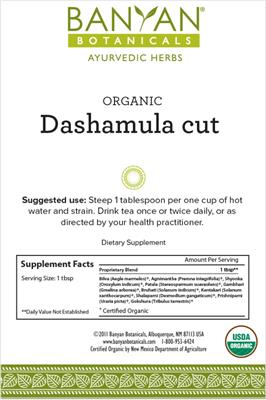
Organic Dashamula Cut is a 10-ingredient blend rooted in Ayurvedic tradition. The product contains a proprietary combination of bilva, agnimantha, shyonka, patala, gambhari, bruhati, kantakari, shalaparni, prishniparni, and gokshura in a cut form meant for brewing as a tea.
There are no inactive or filler ingredients listed.
Does it work?
Couldn't assess
Evidence for this blend's effectiveness is limited. For bilva, the data available shows insufficient reliable evidence to rate its use for asthma or shigellosis (a bacterial infection).
For gokshura, research suggests it may be possibly effective for sexual dysfunction, though it appears possibly ineffective for athletic performance, and there isn't enough evidence to rate it for benign prostatic hyperplasia (enlarged prostate). The effectiveness data we hold does not cover most of the other ingredients in this formula.
How safe is it?
Well-documented data
Bilva's ripe fruit is commonly eaten as food, but concentrated medicinal supplements lack strong safety data. The main concern is gastrointestinal upset and constipation with larger amounts.
Safety data advises against medicinal use during pregnancy and while breastfeeding. Gokshura is often well tolerated short-term in healthy adults, but long-term safety and quality data are limited.
It should be avoided during pregnancy because it may affect hormones, and avoid it while breastfeeding due to lack of reliable safety information. Rare serious effects including liver and kidney injury, seizures, and painful erection have been reported with tribulus products.
Meds to double-check
Moderate interaction found
Before taking this product, check with your own doctor or pharmacist if you take antidiabetes medications (risk of low blood sugar), antihypertensive drugs for blood pressure, or lithium for mood. Also check if you take cholinergic drugs (for memory, urination, or nerve function) or medications metabolized by your liver's CYP1A2 or CYP3A4 enzymes, including amitriptyline, haloperidol, ondansetron, lovastatin, ketoconazole, or itraconazole.
The bottom line
Scorecard at a glanceFormula with limited ingredient disclosure with no assessable stated purpose. Moderate medication interactions have been identified, and safety information is well characterized.
This traditional Ayurvedic blend may appeal to you if you're exploring herbal approaches, but significant caution is needed if you take blood sugar medications, blood pressure drugs, lithium, or nerve-function medications — talk with your own doctor or pharmacist before starting it. Pregnant or breastfeeding individuals should avoid medicinal use of this product.
Because we lack safety data for most of its ingredients, discussing it with your healthcare provider first is important.
Educational only — not medical advice; always confirm with your pharmacist. Our editorial policy · How we use AI
Assessment coverage: 2 of 10 active ingredients matched to our full ingredient reviews (monographs). Based on the product label dated Apr 25, 2019.
This Scorecard evaluates available label information, ingredient evidence, and known medication-safety considerations. It does not independently verify product identity, purity, potency, contamination, or manufacturing quality. How these ratings are computed
General information
Key facts about Organic Dashamula Cut, straight from the product label.
| Brand | Banyan Botanicals |
|---|---|
| Net contents | 0 Not Present |
| Market status | On market |
| Date entered into DSLD | Apr 25, 2019 |
| DSLD ID | 199526 |
| Product type | Botanical |
| Supplement form | Other (e.g. Tea Bag) |
| Dietary claims / uses | No Claim |
| Intended target group(s) | Adult (18 - 50 Years), Organic |
Everything in this section is reproduced from the manufacturer’s own product label — it’s the label speaking, not HelloPharmacist. We show it so you can see exactly what the maker states; we don’t verify or endorse those statements.
Supplement Facts
The label details for Organic Dashamula Cut by Banyan Botanicals, sourced from the NIH Dietary Supplement Label Database.
Supplement Facts
| Ingredient | Amount | % DV |
|---|---|---|
| Proprietary Blend | 1 Tablespoon(s) | -- |
| Bilva | 0 NP | -- |
| Agnimantha | 0 NP | -- |
| Shyonka | 0 NP | -- |
| Patala | 0 NP | -- |
| Gambhari | 0 NP | -- |
| Bruhati | 0 NP | -- |
| Kantakari | 0 NP | -- |
| Shalaparni | 0 NP | -- |
| Prishniparni | 0 NP | -- |
| Gokshura | 0 NP | -- |
Tap any ingredient to jump to its full detail below.
These statements are the manufacturer’s wording, reproduced from the product label — the label is saying it, not HelloPharmacist. We don’t verify or endorse them.
General Statements
Ayurvedic herbs
Suggested/Recommended/Usage/Directions
Suggested use: Steep 1 tablespoon per one cup of hot water and strain. Drink tea once or twice daily, or as directed by your health practitioner.
FDA Statement of Identity
Dietary Supplement
Brand IP Statement(s)
2011 Banyan Botanicals
Formulation
Certified Organic by New Mexico Department of Agriculture
Seals/Symbols
USDA Organic
Is this label outdated? Report a formula or label change and our pharmacy team will review it.
Organic Dashamula Cut by Banyan Botanicals label
The label scan from the NIH Dietary Supplement Label Database. Tap to enlarge.
Label images are published by the NIH Dietary Supplement Label Database for the version of this product on file. Always read your actual product label.
View the full label (PDF)The Ingredients in Organic Dashamula Cut by Banyan Botanicals
These are the 10 active ingredients this product is made of. Select any to open its full monograph.
Serving size1 Tablespoon(s) Dosage formOther (e.g. Tea Bag) Amounts shown are per serving.
Most supplement products combine several ingredients, and a medication can interact with the product through any one of them. Each ingredient below shows whether it has known drug interactions.
Organic Dashamula Cut by Banyan Botanicals Drug Interactions
HelloPharmacist Interaction Report
Banyan Botanicals' Organic Dashamula Cut contains two ingredients with documented interactions: bilva (bael) and gokshura (tribulus).
The most serious concern is a moderate risk of low blood sugar (hypoglycemia) with diabetes medications — both ingredients may lower blood glucose on their own, and combining them with antidiabetes drugs could push levels too low.
Read the full breakdown — every affected drug type, severity by severity
Bilva also has moderate interactions with cholinergic drugs (medications that affect nerve and muscle function, like donepezil for memory or bethanechol for urination), where it might increase side effects. Additionally, bilva may slow how your liver processes certain medications via two different enzyme pathways — the CYP1A2 and CYP3A4 systems — potentially raising levels of drugs like amitriptyline, haloperidol, ondansetron, lovastatin, ketoconazole, and itraconazole, though this hasn't yet been reported in humans.
Gokshura carries moderate interactions with blood pressure medications (antihypertensive drugs), where it might lower blood pressure further, and with lithium (a mood stabilizer), where it could raise lithium levels and increase side effects. We could not check seven other ingredients — agnimantha, shyonka, patala, gambhari, bruhati, kantakari, shalaparni, and prishniparni — because no safety data is on file for them.
Altogether, these interactions span 961 individual medications. Before you start this product, run your exact medications through the search tool on this page.
Check your own medications below · Editorial policy · How we use AI
Want to check YOUR meds against Organic Dashamula Cut?
Ask about interactions with your drugs in plain English — “Can I take it with lisinopril?” — and we find you the answer in seconds, ingredient by ingredient.
Go to the checkerIngredients driving the most interactions
Individual Drug Interactions
The ingredients in Organic Dashamula Cut interact with 962 drugs. Click any drug to see the details.
2 of the 10 ingredients in Organic Dashamula Cut interact with drugs. Each result below shows which ingredient is responsible. Bilva Gokshura
AcarboseGlucobay, Prandase, Precose
How Acarbose interacts with Organic Dashamula Cut — through 2 ingredients. Tap an ingredient for the detail:
BilvaAntidiabetes Drugs Moderate
Interaction Summary
Evidence from animal research suggests that extracts of bael seed and leaf can reduce blood glucose levels.
Read the full Bilva + Acarbose interactionGokshuraAntidiabetes Drugs Moderate
Interaction Summary
Taking tribulus with antidiabetes drugs might increase the risk of hypoglycemia.
Read the full Gokshura + Acarbose interactionAcebutololRhotral, Sectral
How Acebutolol interacts with Organic Dashamula Cut — through 1 ingredient. Tap an ingredient for the detail:
GokshuraAntihypertensive Drugs Moderate
Interaction Summary
Theoretically, taking tribulus with antihypertensive drugs might increase the risk of hypotension.
Read the full Gokshura + Acebutolol interactionAcetazolamideAk-Zol, Diamox
How Acetazolamide interacts with Organic Dashamula Cut — through 1 ingredient. Tap an ingredient for the detail:
GokshuraAntihypertensive Drugs Moderate
Interaction Summary
Theoretically, taking tribulus with antihypertensive drugs might increase the risk of hypotension.
Read the full Gokshura + Acetazolamide interactionAcetohexamideDymelor
How Acetohexamide interacts with Organic Dashamula Cut — through 2 ingredients. Tap an ingredient for the detail:
GokshuraAntidiabetes Drugs Moderate
Interaction Summary
Taking tribulus with antidiabetes drugs might increase the risk of hypoglycemia.
Read the full Gokshura + Acetohexamide interactionBilvaAntidiabetes Drugs Moderate
Interaction Summary
Evidence from animal research suggests that extracts of bael seed and leaf can reduce blood glucose levels.
Read the full Bilva + Acetohexamide interactionAcetylcholineMiochol-E
How Acetylcholine interacts with Organic Dashamula Cut — through 1 ingredient. Tap an ingredient for the detail:
BilvaCholinergic Drugs Moderate
Interaction Summary
Bael leaf extract shows acetylcholinesterase (AChE) inhibitory activity in vitro.
Read the full Bilva + Acetylcholine interactionAlbiglutideTanzeum
How Albiglutide interacts with Organic Dashamula Cut — through 2 ingredients. Tap an ingredient for the detail:
GokshuraAntidiabetes Drugs Moderate
Interaction Summary
Taking tribulus with antidiabetes drugs might increase the risk of hypoglycemia.
Read the full Gokshura + Albiglutide interactionBilvaAntidiabetes Drugs Moderate
Interaction Summary
Evidence from animal research suggests that extracts of bael seed and leaf can reduce blood glucose levels.
Read the full Bilva + Albiglutide interactionAliskirenTekturna
How Aliskiren interacts with Organic Dashamula Cut — through 2 ingredients. Tap an ingredient for the detail:
GokshuraAntihypertensive Drugs Moderate
Interaction Summary
Theoretically, taking tribulus with antihypertensive drugs might increase the risk of hypotension.
Read the full Gokshura + Aliskiren interactionBilvaCytochrome P450 3a4 (cyp3a4) Substrates Minor
Interaction Summary
Bael and its constituents marmelosin and marmesinin inhibited cytochrome P450 3A4 (CYP3A4) activity in vitro.
Read the full Bilva + Aliskiren interactionAlogliptinNesina
How Alogliptin interacts with Organic Dashamula Cut — through 2 ingredients. Tap an ingredient for the detail:
BilvaAntidiabetes Drugs, Cytochrome P450 3a4 (cyp3a4) Substrates Moderate
Interaction Summary
Evidence from animal research suggests that extracts of bael seed and leaf can reduce blood glucose levels.
Read the full Bilva + Alogliptin interactionGokshuraAntidiabetes Drugs Moderate
Interaction Summary
Taking tribulus with antidiabetes drugs might increase the risk of hypoglycemia.
Read the full Gokshura + Alogliptin interactionAlogliptin, MetforminKazano
How Alogliptin, Metformin interacts with Organic Dashamula Cut — through 2 ingredients. Tap an ingredient for the detail:
GokshuraAntidiabetes Drugs Moderate
Interaction Summary
Taking tribulus with antidiabetes drugs might increase the risk of hypoglycemia.
Read the full Gokshura + Alogliptin, Metformin interactionBilvaAntidiabetes Drugs Moderate
Interaction Summary
Evidence from animal research suggests that extracts of bael seed and leaf can reduce blood glucose levels.
Read the full Bilva + Alogliptin, Metformin interactionAlogliptin, PioglitazoneOseni
How Alogliptin, Pioglitazone interacts with Organic Dashamula Cut — through 2 ingredients. Tap an ingredient for the detail:
BilvaAntidiabetes Drugs, Cytochrome P450 3a4 (cyp3a4) Substrates Moderate
Interaction Summary
Evidence from animal research suggests that extracts of bael seed and leaf can reduce blood glucose levels.
Read the full Bilva + Alogliptin, Pioglitazone interactionGokshuraAntidiabetes Drugs Moderate
Interaction Summary
Taking tribulus with antidiabetes drugs might increase the risk of hypoglycemia.
Read the full Gokshura + Alogliptin, Pioglitazone interactionAmbenonium ChlorideMytelase
How Ambenonium Chloride interacts with Organic Dashamula Cut — through 1 ingredient. Tap an ingredient for the detail:
BilvaCholinergic Drugs Moderate
Interaction Summary
Bael leaf extract shows acetylcholinesterase (AChE) inhibitory activity in vitro.
Read the full Bilva + Ambenonium Chloride interactionAmbrisentanLetairis, Volibris
How Ambrisentan interacts with Organic Dashamula Cut — through 2 ingredients. Tap an ingredient for the detail:
GokshuraAntihypertensive Drugs Moderate
Interaction Summary
Theoretically, taking tribulus with antihypertensive drugs might increase the risk of hypotension.
Read the full Gokshura + Ambrisentan interactionBilvaCytochrome P450 3a4 (cyp3a4) Substrates Minor
Interaction Summary
Bael and its constituents marmelosin and marmesinin inhibited cytochrome P450 3A4 (CYP3A4) activity in vitro.
Read the full Bilva + Ambrisentan interactionAmifampridineRuzurgi
How Amifampridine interacts with Organic Dashamula Cut — through 1 ingredient. Tap an ingredient for the detail:
BilvaCholinergic Drugs Moderate
Interaction Summary
Bael leaf extract shows acetylcholinesterase (AChE) inhibitory activity in vitro.
Read the full Bilva + Amifampridine interactionAmifampridine PhosphateFirdapse
How Amifampridine Phosphate interacts with Organic Dashamula Cut — through 1 ingredient. Tap an ingredient for the detail:
BilvaCholinergic Drugs Moderate
Interaction Summary
Bael leaf extract shows acetylcholinesterase (AChE) inhibitory activity in vitro.
Read the full Bilva + Amifampridine Phosphate interactionAmilorideAmilamont, Midamor
How Amiloride interacts with Organic Dashamula Cut — through 1 ingredient. Tap an ingredient for the detail:
GokshuraAntihypertensive Drugs Moderate
Interaction Summary
Theoretically, taking tribulus with antihypertensive drugs might increase the risk of hypotension.
Read the full Gokshura + Amiloride interactionAmiloride, HydrochlorothiazideAmil-Co, Amilzide, Moduret 25, Moduretic
How Amiloride, Hydrochlorothiazide interacts with Organic Dashamula Cut — through 1 ingredient. Tap an ingredient for the detail:
GokshuraAntihypertensive Drugs Moderate
Interaction Summary
Theoretically, taking tribulus with antihypertensive drugs might increase the risk of hypotension.
Read the full Gokshura + Amiloride, Hydrochlorothiazide interactionAmlodipineNorliqva
How Amlodipine interacts with Organic Dashamula Cut — through 2 ingredients. Tap an ingredient for the detail:
GokshuraAntihypertensive Drugs Moderate
Interaction Summary
Theoretically, taking tribulus with antihypertensive drugs might increase the risk of hypotension.
Read the full Gokshura + Amlodipine interactionBilvaCytochrome P450 3a4 (cyp3a4) Substrates Minor
Interaction Summary
Bael and its constituents marmelosin and marmesinin inhibited cytochrome P450 3A4 (CYP3A4) activity in vitro.
Read the full Bilva + Amlodipine interactionAmlodipine BenzoateKaterzia
How Amlodipine Benzoate interacts with Organic Dashamula Cut — through 2 ingredients. Tap an ingredient for the detail:
GokshuraAntihypertensive Drugs Moderate
Interaction Summary
Theoretically, taking tribulus with antihypertensive drugs might increase the risk of hypotension.
Read the full Gokshura + Amlodipine Benzoate interactionBilvaCytochrome P450 3a4 (cyp3a4) Substrates Minor
Interaction Summary
Bael and its constituents marmelosin and marmesinin inhibited cytochrome P450 3A4 (CYP3A4) activity in vitro.
Read the full Bilva + Amlodipine Benzoate interactionAmlodipine BesilateIstin
How Amlodipine Besilate interacts with Organic Dashamula Cut — through 2 ingredients. Tap an ingredient for the detail:
GokshuraAntihypertensive Drugs Moderate
Interaction Summary
Theoretically, taking tribulus with antihypertensive drugs might increase the risk of hypotension.
Read the full Gokshura + Amlodipine Besilate interactionBilvaCytochrome P450 3a4 (cyp3a4) Substrates Minor
Interaction Summary
Bael and its constituents marmelosin and marmesinin inhibited cytochrome P450 3A4 (CYP3A4) activity in vitro.
Read the full Bilva + Amlodipine Besilate interactionAmlodipine BesylateNorvasc
How Amlodipine Besylate interacts with Organic Dashamula Cut — through 2 ingredients. Tap an ingredient for the detail:
GokshuraAntihypertensive Drugs Moderate
Interaction Summary
Theoretically, taking tribulus with antihypertensive drugs might increase the risk of hypotension.
Read the full Gokshura + Amlodipine Besylate interactionBilvaCytochrome P450 3a4 (cyp3a4) Substrates Minor
Interaction Summary
Bael and its constituents marmelosin and marmesinin inhibited cytochrome P450 3A4 (CYP3A4) activity in vitro.
Read the full Bilva + Amlodipine Besylate interactionAmlodipine Besylate, BenazeprilLotrel
How Amlodipine Besylate, Benazepril interacts with Organic Dashamula Cut — through 2 ingredients. Tap an ingredient for the detail:
GokshuraAntihypertensive Drugs Moderate
Interaction Summary
Theoretically, taking tribulus with antihypertensive drugs might increase the risk of hypotension.
Read the full Gokshura + Amlodipine Besylate, Benazepril interactionBilvaCytochrome P450 3a4 (cyp3a4) Substrates Minor
Interaction Summary
Bael and its constituents marmelosin and marmesinin inhibited cytochrome P450 3A4 (CYP3A4) activity in vitro.
Read the full Bilva + Amlodipine Besylate, Benazepril interactionAmlodipine, CelecoxibConsensi
How Amlodipine, Celecoxib interacts with Organic Dashamula Cut — through 2 ingredients. Tap an ingredient for the detail:
GokshuraAntihypertensive Drugs Moderate
Interaction Summary
Theoretically, taking tribulus with antihypertensive drugs might increase the risk of hypotension.
Read the full Gokshura + Amlodipine, Celecoxib interactionBilvaCytochrome P450 3a4 (cyp3a4) Substrates Minor
Interaction Summary
Bael and its constituents marmelosin and marmesinin inhibited cytochrome P450 3A4 (CYP3A4) activity in vitro.
Read the full Bilva + Amlodipine, Celecoxib interactionAmmonium ChlorideAmmonium Chloride
How Ammonium Chloride interacts with Organic Dashamula Cut — through 1 ingredient. Tap an ingredient for the detail:
GokshuraAntihypertensive Drugs Moderate
Interaction Summary
Theoretically, taking tribulus with antihypertensive drugs might increase the risk of hypotension.
Read the full Gokshura + Ammonium Chloride interactionAntidiabetes, Dipeptidyl Peptidase-4 (dpp-iv) InhibitorGlyxambi
How Antidiabetes, Dipeptidyl Peptidase-4 (dpp-iv) Inhibitor interacts with Organic Dashamula Cut — through 2 ingredients. Tap an ingredient for the detail:
BilvaAntidiabetes Drugs Moderate
Interaction Summary
Evidence from animal research suggests that extracts of bael seed and leaf can reduce blood glucose levels.
Read the full Bilva + Antidiabetes, Dipeptidyl Peptidase-4 (dpp-iv) Inhibitor interactionGokshuraAntidiabetes Drugs Moderate
Interaction Summary
Taking tribulus with antidiabetes drugs might increase the risk of hypoglycemia.
Read the full Gokshura + Antidiabetes, Dipeptidyl Peptidase-4 (dpp-iv) Inhibitor interactionAprocitentanTryvio
How Aprocitentan interacts with Organic Dashamula Cut — through 1 ingredient. Tap an ingredient for the detail:
GokshuraAntihypertensive Drugs Moderate
Interaction Summary
Theoretically, taking tribulus with antihypertensive drugs might increase the risk of hypotension.
Read the full Gokshura + Aprocitentan interactionAtenololAtenix, Tenormin
How Atenolol interacts with Organic Dashamula Cut — through 1 ingredient. Tap an ingredient for the detail:
GokshuraAntihypertensive Drugs Moderate
Interaction Summary
Theoretically, taking tribulus with antihypertensive drugs might increase the risk of hypotension.
Read the full Gokshura + Atenolol interactionAtenolol, ChlortalidoneAtenixCo, Tenoret 50, Totaretic
How Atenolol, Chlortalidone interacts with Organic Dashamula Cut — through 1 ingredient. Tap an ingredient for the detail:
GokshuraAntihypertensive Drugs Moderate
Interaction Summary
Theoretically, taking tribulus with antihypertensive drugs might increase the risk of hypotension.
Read the full Gokshura + Atenolol, Chlortalidone interactionAtenolol, ChlorthalidoneTenoretic
How Atenolol, Chlorthalidone interacts with Organic Dashamula Cut — through 1 ingredient. Tap an ingredient for the detail:
GokshuraAntihypertensive Drugs Moderate
Interaction Summary
Theoretically, taking tribulus with antihypertensive drugs might increase the risk of hypotension.
Read the full Gokshura + Atenolol, Chlorthalidone interactionAzilsartanEdarbi
How Azilsartan interacts with Organic Dashamula Cut — through 1 ingredient. Tap an ingredient for the detail:
GokshuraAntihypertensive Drugs Moderate
Interaction Summary
Theoretically, taking tribulus with antihypertensive drugs might increase the risk of hypotension.
Read the full Gokshura + Azilsartan interactionAzilsartan, ChlorthalidoneEdarbyclor
How Azilsartan, Chlorthalidone interacts with Organic Dashamula Cut — through 1 ingredient. Tap an ingredient for the detail:
GokshuraAntihypertensive Drugs Moderate
Interaction Summary
Theoretically, taking tribulus with antihypertensive drugs might increase the risk of hypotension.
Read the full Gokshura + Azilsartan, Chlorthalidone interactionEach ingredient & the kinds of drugs it affects
For each ingredient in Organic Dashamula Cut with known interactions, here are the types of medications they can affect. Open any type for the detail — or search your exact drug in the checker above.
Bilva
Antidiabetes Drugs
Evidence from animal research suggests that extracts of bael seed and leaf can reduce blood glucose levels. Theoretically, bael might have additive effects with antidiabetes drugs and increase the risk of hypoglycemia. Monitor blood glucose levels closely. Dose adjustments might be necessary.
Some antidiabetes drugs include glimepiride (Amaryl), glyburide (DiaBeta, Glynase PresTab, Micronase), insulin, pioglitazone (Actos), rosiglitazone (Avandia), and others.
Cholinergic Drugs
Bael leaf extract shows acetylcholinesterase (AChE) inhibitory activity in vitro. Theoretically, bael might have additive effects with cholinergic drugs and increase the risk of cholinergic side effects.
Cholinergic drugs include bethanechol (Urecholine), donepezil (Aricept), echothiophate (Phospholine Iodide), edrophonium (Enlon, Reversol, Tensilon), neostigmine (Prostigmin), physostigmine (Antilirium), pyridostigmine (Mestinon, Regonol), succinylcholine (Anectine, Quelicin), and tacrine (Cognex).
Cytochrome P450 1A2 (Cyp1A2) Substrates
Bael extract and its constituent marmesinin inhibited cytochrome P450 1A2 (CYP1A2) activity in vitro. So far, this interaction has not been reported in humans. Theoretically, bael might increase levels of drugs metabolized by CYP1A2.
Some drugs metabolized by CYP1A2 include amitriptyline (Elavil), haloperidol (Haldol), ondansetron (Zofran), propranolol (Inderal), theophylline (Theo-Dur, others), verapamil (Calan, Isoptin, others), and others. Use bael cautiously or avoid in patients taking these drugs.
Cytochrome P450 3A4 (Cyp3A4) Substrates
Bael and its constituents marmelosin and marmesinin inhibited cytochrome P450 3A4 (CYP3A4) activity in vitro. So far, this interaction has not been reported in humans. Theoretically, bael might increase levels of drugs metabolized by CYP3A4.
Some drugs metabolized by CYP3A4 include lovastatin (Mevacor), ketoconazole (Nizoral), itraconazole (Sporanox), fexofenadine (Allegra), triazolam (Halcion), and numerous others. Use bael cautiously or avoid in patients taking these drugs.
Gokshura
Antidiabetes Drugs
Taking tribulus with antidiabetes drugs might increase the risk of hypoglycemia.
Clinical research shows that Tribulus can lower blood glucose levels in adults with type 2 diabetes who are taking antidiabetes medications.
Antihypertensive Drugs
Theoretically, taking tribulus with antihypertensive drugs might increase the risk of hypotension.
Animal research shows that tribulus can lower blood pressure by inhibiting angiotensin-converting enzyme (ACE). Tribulus has also demonstrated hypotensive effects in pre-hypertensive adults.
Lithium
Theoretically, tribulus might increase the levels and clinical effects of lithium.
Tribulus is thought to have diuretic properties. Due to these potential diuretic effects, tribulus might reduce excretion and increase levels of lithium. The dose of lithium might need to be decreased.
Brand information
Manufacturer and brand details for Organic Dashamula Cut, from the product label.
Banyan Botanicals
See all Banyan Botanicals products- Name
- Banyan Botanicals
- City
- Albuquerque
- State
- NM
- ZipCode
- 87113
- Phone Number
- 1-800-953-6424
- Web Address
- www.banyanbotanicals.com
Organic Dashamula Cut by Banyan Botanicals: Common Questions
Does Organic Dashamula Cut by Banyan Botanicals interact with any medications?
How can one product interact with so many drugs?
Where does this information come from?
Is this safe to take if I'm pregnant or breastfeeding?
What's in Dashamula Cut, and what's it supposed to do?
Can it cause side effects?
Does gokshura really work for sexual function?
I take diabetes medication — can I take this?
What are these 'cut' ingredients? Do I brew them as tea?
Written and reviewed by the HelloPharmacist editorial staff. Our editorial policy
Not sure if Organic Dashamula Cut is safe with your meds?
Our pharmacists answer your medication & supplement questions — free.
Label information is sourced from the NIH Dietary Supplement Label Database and reflects the product version on file; always read your actual product label. This page is for education only and is not a substitute for professional medical advice. Confirm with your pharmacist or doctor before combining supplements and medications.
The Full Monographs Behind Organic Dashamula Cut’s Ingredients
Every ingredient we hold a full HelloPharmacist monograph for — uses, evidence, safety, and the complete interaction list.
Bael
Interacts with 821 drugsBael is a fruit-bearing tree long used in traditional Indian (Ayurvedic) medicine, mostly for digestive problems like diarrhea and indigestion. Modern human evidence for its medicinal benefi...
Read the full Bael monograph → Herb & supplement monographTribulus
Interacts with 259 drugsTribulus is a plant supplement most often marketed to boost libido, testosterone, and athletic performance, but the human evidence behind these claims is weak and inconsistent. It is general...
Read the full Tribulus monograph →Sources & How We Checked
Organic Dashamula Cut's label data comes from the NIH Dietary Supplement Label Database; the ingredient interaction data is from the Natural Medicines database, reviewed by our pharmacists.
- NIH Dietary Supplement Label Database (DSLD) — The official product label on file for this supplement.
- Natural Medicines (Therapeutic Research Center) — Evidence-graded clinical reference behind the ingredient interaction data.
Content is written and reviewed by licensed HelloPharmacist pharmacists. See our data sources and editorial standards for how this information is built and checked.
The 17 references behind this product’s interaction data
Every citation that drives the interaction findings for this product’s ingredients, from the evidence-graded Natural Medicines (TRC Healthcare) database. Open an ingredient to browse its citations — links open the study on PubMed or the publisher’s site.
Bael 7 references
- Gruenwald J, Brendler T, Jaenicke C. PDR for Herbal Medicines. 1st ed. Montvale, NJ: Medical Economics Company, Inc., 1998.
- Sabu, M. C. and Kuttan, R. Antidiabetic activity of Aegle marmelos and its relationship with its antioxidant properties. Indian J Physiol Pharmacol 2004;48(1):81-88.
- Kesari, A. N., Gupta, R. K., Singh, S. K., Diwakar, S., and Watal, G. Hypoglycemic and antihyperglycemic activity of Aegle marmelos seed extract in normal and diabetic rats. J Ethnopharmacol 10-11-2006;107(3):374-379. PubMed
- Haider, R., Khan, A. K., Aziz, K. M., Chowdhury, A., and Kabir, I. Evaluation of indigenous plants in the treatment of acute shigellosis. Trop.Geogr.Med 1991;43(3):266-270.
- Asaduzzaman M, Uddin MJ, Kader MA, et al. In vitro acetylcholinesterase inhibitory activity and the antioxidant properties of Aegle marmelos leaf extract: implications for the treatment of Alzheimer's disease. Psychogeriatrics. 2014;14(1):1-10.
- Yugandhar P, Rao KM, Sengupta K. A novel herbal composition containing extracts of Boswellia serrata gum resin and Aegle marmelos fruit alleviates symptoms of asthma in a placebo controlled double-blind clinical study. Phytother Res. 2018;32(1):140-150.
- Manda VK, Avula B, Chittiboyina AG, Khan IA, Walker LA, Khan SI. Inhibition of CYP3A4 and CYP1A2 by Aegle marmelos and its constituents. Xenobiotica. 2016;46(2):117-25.
Tribulus 10 references
- Sharifi AM, Darabi R, Akbarloo N. Study of antihypertensive mechanism of Tribulus terrestris in 2K1C hypertensive rats: role of tissue ACE activity. Life Sci 2003;73:2963-71. PubMed
- Walker D, Bird A, Flora T, O'Sullivan B. Some effects of feeding Tribulus terrestris, Ipomoea lonchophylla and the seed of Abelmoschus ficulneus on fetal development and the outcome of pregnancy in sheep. Reprod Fertil Dev 1992;4:135-44. PubMed
- Al-Ali M, Wahbi S, Twaij H, Al-Badr A. Tribulus terrestris: preliminary study of its diuretic and contractile effects and comparison with Zea mays. J Ethnopharmacol 2003;85:257-60. PubMed
- Tabakova, P., Dimitrov, M., Ognyanov, K., and et al. Clinical study of Tribestan in females with endocrine sterility. Documentation for Registration (unpublished) 1999.
- Akhtari E, Raisi F, Keshavarz M, et al. Tribulus terrestris for treatment of sexual dysfunction in women: randomized double-blind placebo-controlled study. Daru 2014;22:40. PubMed
- Ryan M, Lazar I, Nadasdy GM, et al. Acute kidney injury and hyperbilirubinemia in a young male after ingestion of Tribulus terrestris. Clin Nephrol 2015;83(3):177-83. PubMed
- Postigo S, Lima SM, Yamada SS, et al. Assessment of the effects of Tribulus terrestris on sexual function of menopausal women. Rev Bras Ginecol Obstet 2016;38(3):140-6. PubMed
- Talasaz AH, Abbasi MR, Abkhiz S, Dashti-Khavidaki S. Tribulus terrestris-induced severe nephrotoxicity in a young healthy male. Nephrol Dial Tranplant 2010;25(11):3792-3. PubMed
- Samani NB, Jokar A, Soveid M, Heydari M, Mosavat SH. Efficacy of the hydroalcoholic extract of Tribulus terrestris on the serum glucose and lipid profile of women with diabetes mellitus: a double-blind randomized placebo-controlled clinical trial. J Evid
- Siddiqui MA, Itrat M, Mobeen A, Khan MI. Efficacy of khar-i-khasak (Tribulus terrestris Linn.) in prehypertension: a randomized, double-blind, placebo-controlled trial. J Complement Integr Med. 2021.
Parts of this content are provided by the Therapeutic Research Center, LLC.
DISCLAIMER: Currently this does not check for drug-drug interactions. This is not an all-inclusive comprehensive list of potential interactions and is for informational purposes only. Not all interactions are known or well-reported in the scientific literature, and new interactions are continually being reported. Input is needed from a qualified healthcare provider including a pharmacist before starting any therapy. Application of clinical judgment is necessary.
© 2021 Therapeutic Research Center, LLC