
Parasite-Ease Vermifuge Ingredients & Drug Interactions
What is this page for?
First and foremost: checking Parasite-Ease Vermifuge against your medications. The heart of this page is the interaction checker and the full interaction report — how this product’s ingredients may interact with prescription and over-the-counter medicines you may be taking.
Around that, we add a pharmacist’s high-level view of the product as a whole — what’s inside, the evidence for its stated use, how transparent the label is, and what safety data exists — so you can see the full picture in one place. It’s educational information from our licensed clinical databases and the clinical staff at HelloPharmacist — not medical advice — and we don’t sell or endorse products. Our editorial policy
Parasite-Ease Vermifuge is a dietary supplement by Earth Friend Herb Co. with 13 active ingredients. Its ingredients are commonly taken for cough and respiratory congestion, sore throat, digestive upset.Based on those ingredients, 1,527 medications have a known interaction with it, the most serious rated moderate. The ingredients most likely to interact are Sage, Cloves, Wormwood. Use the checker below to test your specific medication, or read the full HelloPharmacist Interaction Report.
Check Your Meds Against Parasite-Ease Vermifuge by Earth Friend Herb Co.
Ask about any prescription or over-the-counter medication and we check it for interactions with Parasite-Ease Vermifuge by Earth Friend Herb Co. — and tell you which ingredient is responsible.
AI summaries are generated from our interaction database for education only — always confirm with your pharmacist. How we use AI
Ask the Pharmacist
A licensed pharmacist will answer your question by email — free, usually within 24 hours.
Got it — thank you!
A licensed pharmacist will answer within 24 hours. Keep an eye on your email (worth checking spam, just in case).
HelloPharmacist Scorecard of Parasite-Ease Vermifuge by Earth Friend Herb Co.
Our pharmacy team’s full take, with four database checks built into the cards below — a summary of what is known, not a grade of the product itself.
What’s inside
Low disclosure
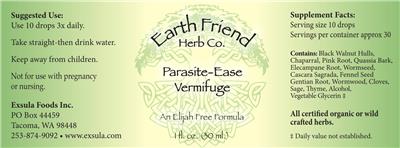
Parasite-Ease Vermifuge contains 13 active herbal ingredients: Thyme, Fennel, Wormwood, Wormseed, Cloves, Gentian, Black Walnut, Quassia, Cascara sagrada, Sage, Elecampane, Chaparral, and Pink Root. The product is formulated as a liquid with alcohol and glycerin as inactive ingredients.
These herbs have been traditionally used for digestive and parasitic concerns, though the evidence supporting them varies. Most have not been rigorously tested in humans for the conditions this product may be marketed for.
Does it work?
Not established
The evidence supporting the individual ingredients in this product is limited. Fennel shows possibly effective evidence for dysmenorrhea (painful periods), and Sage shows possibly effective evidence for menopausal symptoms, high cholesterol, and cognitive function.
Cloves are possibly effective for ventilator-associated pneumonia, and Wormwood is possibly effective for hay fever. The remaining ingredients — Thyme, Wormseed, Gentian, Black Walnut, Quassia, Cascara sagrada, Elecampane, Chaparral, and Pink Root — lack established evidence for their effectiveness, or the data we hold is insufficient to rate them.
None of these ingredients have documented effectiveness against parasitic infections in the data we have.
How safe is it?
Well-documented data
Several ingredients carry significant safety concerns. Chaparral is regarded as unsafe and has been linked to serious liver and kidney damage; Wormseed is unsafe and can cause severe toxicity symptoms including seizures, muscle twitching, and even death in medicinal amounts; and Cascara sagrada, while possibly tolerable short-term, carries risks with long-term use including mineral loss and rare liver damage.
Most other ingredients are generally well tolerated when used as food or in small amounts, but concentrated doses and essential oils present risks. Common side effects reported across ingredients include nausea, vomiting, diarrhea, headache, and allergic reactions.
Thyme, Fennel, Cloves, and Sage may cause contact dermatitis or skin irritation when applied topically.
Meds to double-check
Moderate interaction found
Before taking this product, check with your pharmacist if you take blood thinners (anticoagulants like warfarin), heart medications (including digoxin), blood-pressure drugs, blood-sugar medications, sedatives or CNS depressants, or any drug metabolized by the liver (a large category that includes many common prescriptions). Also double-check if you take estrogen or birth control, diuretics, corticosteroids, or acid-reflux medications.
No interactions are documented for Wormseed in our data, but that does not mean none exist.
The bottom line
Scorecard at a glanceFormula with limited ingredient disclosure with no established evidence rating for its marketed use. Moderate medication interactions have been identified, and safety information is well characterized.
This product combines multiple herbs with limited human evidence and several serious safety flags — most notably Chaparral (linked to liver failure) and Wormseed (unsafe, potentially toxic). If you're considering it, you must check your medications first using the tool on this page, because the ingredients interact with well over a thousand individual drugs.
Talk to your pharmacist or doctor before starting, especially if you take any prescription medications, have liver or kidney disease, or are pregnant or nursing.
Educational only — not medical advice; always confirm with your pharmacist. Our editorial policy · How we use AI
Assessment coverage: 13 of 13 active ingredients matched to our full ingredient reviews (monographs). Based on the product label dated Dec 21, 2024.
This Scorecard evaluates available label information, ingredient evidence, and known medication-safety considerations. It does not independently verify product identity, purity, potency, contamination, or manufacturing quality. How these ratings are computed
General information
Key facts about Parasite-Ease Vermifuge, straight from the product label.
| Brand | Earth Friend Herb Co. |
|---|---|
| Net contents | 1 Fluid Ounce; 30 mL |
| Market status | On market |
| Date entered into DSLD | Dec 21, 2024 |
| DSLD ID | 323613 |
| Product type | Botanical |
| Supplement form | Liquid |
| Dietary claims / uses | All Other |
| Intended target group(s) | Adult (18 - 50 Years), Women (not pregnant or lactating) |
Everything in this section is reproduced from the manufacturer’s own product label — it’s the label speaking, not HelloPharmacist. We show it so you can see exactly what the maker states; we don’t verify or endorse those statements.
Supplement Facts
The label details for Parasite-Ease Vermifuge by Earth Friend Herb Co., sourced from the NIH Dietary Supplement Label Database.
Supplement Facts
| Ingredient | Amount | % DV |
|---|---|---|
| Thyme | 0 NP | -- |
| Fennel | 0 NP | -- |
| Wormwood | 0 NP | -- |
| Wormseed | 0 NP | -- |
| Cloves | 0 NP | -- |
| Gentian | 0 NP | -- |
| Black Walnut | 0 NP | -- |
| Quassia | 0 NP | -- |
| Cascara sagrada | 0 NP | -- |
| Sage | 0 NP | -- |
| Elecampane | 0 NP | -- |
| Chaparral | 0 NP | -- |
| Pink Root | 0 NP | -- |
Other ingredients: Alcohol, Glycerin
Tap any ingredient to jump to its full detail below.
These statements are the manufacturer’s wording, reproduced from the product label — the label is saying it, not HelloPharmacist. We don’t verify or endorse them.
Suggested/Recommended/Usage/Directions
Suggested Use: Use 10 drops 3x daily. Take straight-then drink water.
Precautions
Keep away from children.
Not for use with pregnancy or nursing.
General Statements
An Elijah Free formula
Formulation
All certified organic or wild crafted herbs.
Is this label outdated? Report a formula or label change and our pharmacy team will review it.
Parasite-Ease Vermifuge by Earth Friend Herb Co. label
The label scan from the NIH Dietary Supplement Label Database. Tap to enlarge.
Label images are published by the NIH Dietary Supplement Label Database for the version of this product on file. Always read your actual product label.
View the full label (PDF)The Ingredients in Parasite-Ease Vermifuge by Earth Friend Herb Co.
These are the 13 active ingredients this product is made of. Select any to open its full monograph.
Serving size10 Drop(s) Dosage formLiquid Servings per container30 Amounts shown are per serving.
Most supplement products combine several ingredients, and a medication can interact with the product through any one of them. Each ingredient below shows whether it has known drug interactions.
Thyme
Interacts with379 drugs
Thyme is a common kitchen herb that has long been used for coughs, sore throats, and digestive complaints. It is generally safe in the amounts found i...
Thyme monograph & interactionsFennel
Interacts with740 drugs
Fennel is a Mediterranean herb widely used as a food and spice, and traditionally taken for digestive complaints, colic, and menstrual cramps. Some sm...
Fennel monograph & interactionsWormwood
Interacts with889 drugs
Sweet Annie (Artemisia annua) is the source of artemisinin, a compound used in prescription antimalarial drugs. While the purified drug is well studie...
Wormwood monograph & interactionsWormseed
No knowninteractions
Wormseed (also called epazote) is a strong-smelling herb traditionally used to expel intestinal worms and to flavor food. Its essential oil is potenti...
Wormseed monograph & interactionsCloves
Interacts with977 drugs
Clove is a common cooking spice that is also used in traditional medicine, especially as a topical numbing agent for tooth pain thanks to its main com...
Cloves monograph & interactionsGentian
Interacts with172 drugs
Gentian is a very bitter root traditionally used to stimulate appetite and ease mild digestive complaints, often as part of "bitters" before meals. Th...
Gentian monograph & interactionsBlack Walnut
No knowninteractions
Black walnut is a tree whose green hulls are traditionally used as a natural antiparasitic and digestive remedy, but solid human evidence for these us...
Black Walnut monograph & interactionsQuassia
Interacts with198 drugs
Quassia is a tropical wood known for its very bitter taste, traditionally used as a digestive bitter and as a folk remedy for parasites and head lice....
Quassia monograph & interactionsCascara sagrada
Interacts with745 drugs
Cascara sagrada is a stimulant laxative made from the aged bark of a Pacific Northwest tree, used mainly for short-term relief of constipation. Becaus...
Cascara sagrada monograph & interactionsSage
Interacts with1,296 drugs
Sage is a common kitchen herb that is generally safe in food amounts and is traditionally used for sore throats, digestion, sweating, and memory. Some...
Sage monograph & interactionsElecampane
Interacts with248 drugs
Elecampane is a traditional herb used mainly for coughs and other respiratory complaints, and as a bitter for digestion. Modern human evidence is very...
Elecampane monograph & interactionsChaparral
Interacts with370 drugs
Chaparral is a desert shrub long used in traditional medicine, but there is no reliable proof it treats any condition. It has been linked to serious a...
Chaparral monograph & interactionsPink Root
No knowninteractions
Pink Root (Spigelia marilandica) is a North American plant that was historically used to expel intestinal worms. It contains potentially toxic compoun...
Pink Root monograph & interactionsOther (inactive) ingredients: Alcohol, Glycerin. These complete the product’s ingredient list but are not active constituents.
Parasite-Ease Vermifuge by Earth Friend Herb Co. Drug Interactions
HelloPharmacist Interaction Report
Parasite-Ease Vermifuge by Earth Friend Herb Co. has documented interactions with a substantial number of medications across its 13 ingredients.
The most serious interaction is with Chaparral, which carries a Moderate severity risk with hepatotoxic drugs (medications that can harm the liver) — concomitant use might have additive liver-damaging effects, and chaparral itself has been linked to serious hepatotoxicity requiring transplant in some cases.
Read the full breakdown — every affected drug type, severity by severity
Several other ingredients present Moderate interactions: Thyme with estrogens, blood thinners (anticoagulants), and certain nervous-system medications; Fennel with birth control pills, estrogens, blood thinners, the antibiotic ciprofloxacin, and tamoxifen (a breast-cancer drug); Wormwood with liver-toxic drugs and certain drug-metabolizing enzymes; Cloves with blood-sugar drugs, blood thinners, and multiple liver enzymes that process many common medications; Gentian with blood-pressure drugs; Quassia with blood-sugar drugs, diuretics, digoxin (a heart medication), and acid-reflux drugs; Cascara sagrada with blood thinners, diuretics, heart medications, and steroid drugs; Sage with sedatives, blood-pressure drugs, and multiple liver enzymes; and Elecampane with sedatives.
Cloves and Sage together affect the most drug-metabolizing enzymes (CYP450 pathways), potentially raising levels of dozens of medications processed by those pathways. Wormseed could not be checked — we hold no interaction data for it.
Altogether, these interactions span 1,505 individual medications.
Before you start this product, use the medication checker on this page to search your exact prescriptions and over-the-counter drugs.
Check your own medications below · Editorial policy · How we use AI
Want to check YOUR meds against Parasite-Ease Vermifuge?
Ask about interactions with your drugs in plain English — “Can I take it with lisinopril?” — and we find you the answer in seconds, ingredient by ingredient.
Go to the checkerIngredients driving the most interactions
Individual Drug Interactions
The ingredients in Parasite-Ease Vermifuge interact with 1,527 drugs. Click any drug to see the details.
10 of the 13 ingredients in Parasite-Ease Vermifuge interact with drugs. Each result below shows which ingredient is responsible. Sage Cloves Wormwood Cascara sagrada Fennel Thyme Chaparral Elecampane Quassia Gentian
6-mercaptopurinePurinethol
How 6-mercaptopurine interacts with Parasite-Ease Vermifuge — through 2 ingredients. Tap an ingredient for the detail:
ChaparralHepatotoxic Drugs Moderate
Interaction Summary
Theoretically, chaparral might have additive adverse effects on the liver when used with hepatotoxic drugs.
Read the full Chaparral + 6-mercaptopurine interactionWormwoodHepatotoxic Drugs Moderate
Interaction Summary
Theoretically, concomitant use might have additive adverse hepatotoxic effects.
Read the full Wormwood + 6-mercaptopurine interactionAdo-trastuzumab EmtansineKadcyla
How Ado-trastuzumab Emtansine interacts with Parasite-Ease Vermifuge — through 5 ingredients. Tap an ingredient for the detail:
ClovesCytochrome P450 3a4 (cyp3a4) Substrates Moderate
Interaction Summary
Theoretically, concomitant use of clove may increase levels of drugs metabolized by CYP3A4.
Read the full Cloves + Ado-trastuzumab Emtansine interactionFennelCytochrome P450 3a4 (cyp3a4) Substrates Moderate
Interaction Summary
Theoretically, fennel might increase levels of drugs metabolized by CYP3A4.
Read the full Fennel + Ado-trastuzumab Emtansine interactionSageCytochrome P450 3a4 (cyp3a4) Substrates Moderate
Interaction Summary
Theoretically, sage might increase the levels and clinical effects of drugs metabolized by CYP3A4.
Read the full Sage + Ado-trastuzumab Emtansine interactionWormwoodCytochrome P450 3a4 (cyp3a4) Substrates Moderate
Interaction Summary
Sweet Annie may alter plasma levels and clinical effects of drugs metabolized by CYP3A4.
Read the full Wormwood + Ado-trastuzumab Emtansine interactionCascara SagradaCytochrome P450 3a4 (cyp3a4) Substrates Minor
Interaction Summary
Theoretically, cascara sagrada might decrease the effects of CYP3A4 substrates.
Read the full Cascara Sagrada + Ado-trastuzumab Emtansine interactionAbacavir Sulfate, Dolutegravir, LamivudineTriumeq
How Abacavir Sulfate, Dolutegravir, Lamivudine interacts with Parasite-Ease Vermifuge — through 2 ingredients. Tap an ingredient for the detail:
WormwoodHepatotoxic Drugs Moderate
Interaction Summary
Theoretically, concomitant use might have additive adverse hepatotoxic effects.
Read the full Wormwood + Abacavir Sulfate, Dolutegravir, Lamivudine interactionChaparralHepatotoxic Drugs Moderate
Interaction Summary
Theoretically, chaparral might have additive adverse effects on the liver when used with hepatotoxic drugs.
Read the full Chaparral + Abacavir Sulfate, Dolutegravir, Lamivudine interactionAbacavir, LamivudineEpzicom
How Abacavir, Lamivudine interacts with Parasite-Ease Vermifuge — through 2 ingredients. Tap an ingredient for the detail:
ChaparralHepatotoxic Drugs Moderate
Interaction Summary
Theoretically, chaparral might have additive adverse effects on the liver when used with hepatotoxic drugs.
Read the full Chaparral + Abacavir, Lamivudine interactionWormwoodHepatotoxic Drugs Moderate
Interaction Summary
Theoretically, concomitant use might have additive adverse hepatotoxic effects.
Read the full Wormwood + Abacavir, Lamivudine interactionAbciximabReoPro
How Abciximab interacts with Parasite-Ease Vermifuge — through 3 ingredients. Tap an ingredient for the detail:
ThymeAnticoagulant/antiplatelet Drugs Moderate
Interaction Summary
Theoretically, thyme leaf extract might have additive effects with anticoagulant or antiplatelet drugs.
Read the full Thyme + Abciximab interactionFennelAnticoagulant/antiplatelet Drugs Moderate
Interaction Summary
Theoretically, fennel might increase the risk of bleeding when used with antiplatelet or anticoagulant drugs.
Read the full Fennel + Abciximab interactionClovesAnticoagulant/antiplatelet Drugs Minor
Interaction Summary
Theoretically, clove oil may increase the risk of bleeding if used with anticoagulant or antiplatelet drugs.
Read the full Cloves + Abciximab interactionAbemaciclibVerzenio
How Abemaciclib interacts with Parasite-Ease Vermifuge — through 5 ingredients. Tap an ingredient for the detail:
FennelCytochrome P450 3a4 (cyp3a4) Substrates Moderate
Interaction Summary
Theoretically, fennel might increase levels of drugs metabolized by CYP3A4.
Read the full Fennel + Abemaciclib interactionClovesCytochrome P450 3a4 (cyp3a4) Substrates Moderate
Interaction Summary
Theoretically, concomitant use of clove may increase levels of drugs metabolized by CYP3A4.
Read the full Cloves + Abemaciclib interactionWormwoodCytochrome P450 3a4 (cyp3a4) Substrates Moderate
Interaction Summary
Sweet Annie may alter plasma levels and clinical effects of drugs metabolized by CYP3A4.
Read the full Wormwood + Abemaciclib interactionSageCytochrome P450 3a4 (cyp3a4) Substrates Moderate
Interaction Summary
Theoretically, sage might increase the levels and clinical effects of drugs metabolized by CYP3A4.
Read the full Sage + Abemaciclib interactionCascara SagradaCytochrome P450 3a4 (cyp3a4) Substrates Minor
Interaction Summary
Theoretically, cascara sagrada might decrease the effects of CYP3A4 substrates.
Read the full Cascara Sagrada + Abemaciclib interactionAbiraterone
How Abiraterone interacts with Parasite-Ease Vermifuge — through 6 ingredients. Tap an ingredient for the detail:
SageCytochrome P450 3a4 (cyp3a4) Substrates Moderate
Interaction Summary
Theoretically, sage might increase the levels and clinical effects of drugs metabolized by CYP3A4.
Read the full Sage + Abiraterone interactionWormwoodCytochrome P450 3a4 (cyp3a4) Substrates, Hepatotoxic Drugs Moderate
Interaction Summary
Sweet Annie may alter plasma levels and clinical effects of drugs metabolized by CYP3A4.
Read the full Wormwood + Abiraterone interactionFennelCytochrome P450 3a4 (cyp3a4) Substrates Moderate
Interaction Summary
Theoretically, fennel might increase levels of drugs metabolized by CYP3A4.
Read the full Fennel + Abiraterone interactionClovesCytochrome P450 3a4 (cyp3a4) Substrates Moderate
Interaction Summary
Theoretically, concomitant use of clove may increase levels of drugs metabolized by CYP3A4.
Read the full Cloves + Abiraterone interactionChaparralHepatotoxic Drugs Moderate
Interaction Summary
Theoretically, chaparral might have additive adverse effects on the liver when used with hepatotoxic drugs.
Read the full Chaparral + Abiraterone interactionCascara SagradaCytochrome P450 3a4 (cyp3a4) Substrates Minor
Interaction Summary
Theoretically, cascara sagrada might decrease the effects of CYP3A4 substrates.
Read the full Cascara Sagrada + Abiraterone interactionAbiraterone AcetateYonsa, Zytiga
How Abiraterone Acetate interacts with Parasite-Ease Vermifuge — through 6 ingredients. Tap an ingredient for the detail:
ChaparralHepatotoxic Drugs Moderate
Interaction Summary
Theoretically, chaparral might have additive adverse effects on the liver when used with hepatotoxic drugs.
Read the full Chaparral + Abiraterone Acetate interactionFennelCytochrome P450 3a4 (cyp3a4) Substrates Moderate
Interaction Summary
Theoretically, fennel might increase levels of drugs metabolized by CYP3A4.
Read the full Fennel + Abiraterone Acetate interactionSageCytochrome P450 3a4 (cyp3a4) Substrates Moderate
Interaction Summary
Theoretically, sage might increase the levels and clinical effects of drugs metabolized by CYP3A4.
Read the full Sage + Abiraterone Acetate interactionWormwoodHepatotoxic Drugs, Cytochrome P450 3a4 (cyp3a4) Substrates Moderate
Interaction Summary
Theoretically, concomitant use might have additive adverse hepatotoxic effects.
Read the full Wormwood + Abiraterone Acetate interactionClovesCytochrome P450 3a4 (cyp3a4) Substrates Moderate
Interaction Summary
Theoretically, concomitant use of clove may increase levels of drugs metabolized by CYP3A4.
Read the full Cloves + Abiraterone Acetate interactionCascara SagradaCytochrome P450 3a4 (cyp3a4) Substrates Minor
Interaction Summary
Theoretically, cascara sagrada might decrease the effects of CYP3A4 substrates.
Read the full Cascara Sagrada + Abiraterone Acetate interactionAbrocitinibCibinqo
How Abrocitinib interacts with Parasite-Ease Vermifuge — through 4 ingredients. Tap an ingredient for the detail:
ClovesAnticoagulant/antiplatelet Drugs, Cytochrome P450 2c9 (cyp2c9) Substrates Moderate
Interaction Summary
Theoretically, clove oil may increase the risk of bleeding if used with anticoagulant or antiplatelet drugs.
Read the full Cloves + Abrocitinib interactionSageCytochrome P450 2c9 (cyp2c9) Substrates, Cytochrome P450 2c19 (cyp2c19) Substrates Moderate
Interaction Summary
Theoretically, sage might increase the levels and clinical effects of drugs metabolized by CYP2C9.
Read the full Sage + Abrocitinib interactionThymeAnticoagulant/antiplatelet Drugs Moderate
Interaction Summary
Theoretically, thyme leaf extract might have additive effects with anticoagulant or antiplatelet drugs.
Read the full Thyme + Abrocitinib interactionFennelAnticoagulant/antiplatelet Drugs Moderate
Interaction Summary
Theoretically, fennel might increase the risk of bleeding when used with antiplatelet or anticoagulant drugs.
Read the full Fennel + Abrocitinib interactionAcalabrutinibCalquence
How Acalabrutinib interacts with Parasite-Ease Vermifuge — through 5 ingredients. Tap an ingredient for the detail:
FennelCytochrome P450 3a4 (cyp3a4) Substrates Moderate
Interaction Summary
Theoretically, fennel might increase levels of drugs metabolized by CYP3A4.
Read the full Fennel + Acalabrutinib interactionClovesCytochrome P450 3a4 (cyp3a4) Substrates Moderate
Interaction Summary
Theoretically, concomitant use of clove may increase levels of drugs metabolized by CYP3A4.
Read the full Cloves + Acalabrutinib interactionSageP-glycoprotein Substrates, Cytochrome P450 3a4 (cyp3a4) Substrates Moderate
Interaction Summary
Theoretically, sage might increase levels of drugs transported by P-glycoprotein.
Read the full Sage + Acalabrutinib interactionWormwoodCytochrome P450 3a4 (cyp3a4) Substrates Moderate
Interaction Summary
Sweet Annie may alter plasma levels and clinical effects of drugs metabolized by CYP3A4.
Read the full Wormwood + Acalabrutinib interactionCascara SagradaCytochrome P450 3a4 (cyp3a4) Substrates Minor
Interaction Summary
Theoretically, cascara sagrada might decrease the effects of CYP3A4 substrates.
Read the full Cascara Sagrada + Acalabrutinib interactionAcarboseGlucobay, Prandase, Precose
How Acarbose interacts with Parasite-Ease Vermifuge — through 5 ingredients. Tap an ingredient for the detail:
WormwoodHepatotoxic Drugs Moderate
Interaction Summary
Theoretically, concomitant use might have additive adverse hepatotoxic effects.
Read the full Wormwood + Acarbose interactionClovesAntidiabetes Drugs Moderate
Interaction Summary
Theoretically, concomitant use of clove extracts with antidiabetes drugs might increase the risk of hypoglycemia.
Read the full Cloves + Acarbose interactionQuassiaAntidiabetes Drugs Moderate
Interaction Summary
In animals, quassia extract reduced levels of fasting glucose.
Read the full Quassia + Acarbose interactionChaparralHepatotoxic Drugs Moderate
Interaction Summary
Theoretically, chaparral might have additive adverse effects on the liver when used with hepatotoxic drugs.
Read the full Chaparral + Acarbose interactionSageAntidiabetes Drugs Moderate
Interaction Summary
Theoretically, taking sage with antidiabetes drugs might increase the risk of hypoglycemia.
Read the full Sage + Acarbose interactionAcebutololRhotral, Sectral
How Acebutolol interacts with Parasite-Ease Vermifuge — through 4 ingredients. Tap an ingredient for the detail:
SageAntihypertensive Drugs Moderate
Interaction Summary
Theoretically, sage might increase or decrease the effects of antihypertensive drugs.
Read the full Sage + Acebutolol interactionGentianAntihypertensive Drugs Moderate
Interaction Summary
Theoretically, taking gentian with antihypertensive drugs might increase the risk of hypotension.
Read the full Gentian + Acebutolol interactionWormwoodHepatotoxic Drugs Moderate
Interaction Summary
Theoretically, concomitant use might have additive adverse hepatotoxic effects.
Read the full Wormwood + Acebutolol interactionChaparralHepatotoxic Drugs Moderate
Interaction Summary
Theoretically, chaparral might have additive adverse effects on the liver when used with hepatotoxic drugs.
Read the full Chaparral + Acebutolol interactionAcenocoumarolSintrom
How Acenocoumarol interacts with Parasite-Ease Vermifuge — through 3 ingredients. Tap an ingredient for the detail:
ThymeAnticoagulant/antiplatelet Drugs Moderate
Interaction Summary
Theoretically, thyme leaf extract might have additive effects with anticoagulant or antiplatelet drugs.
Read the full Thyme + Acenocoumarol interactionFennelAnticoagulant/antiplatelet Drugs Moderate
Interaction Summary
Theoretically, fennel might increase the risk of bleeding when used with antiplatelet or anticoagulant drugs.
Read the full Fennel + Acenocoumarol interactionClovesAnticoagulant/antiplatelet Drugs Minor
Interaction Summary
Theoretically, clove oil may increase the risk of bleeding if used with anticoagulant or antiplatelet drugs.
Read the full Cloves + Acenocoumarol interactionAcepromazineAtravet
How Acepromazine interacts with Parasite-Ease Vermifuge — through 3 ingredients. Tap an ingredient for the detail:
ElecampaneCns Depressants Moderate
Interaction Summary
Theoretically, elecampane may cause additive sedative effects when taken with CNS depressants.
Read the full Elecampane + Acepromazine interactionSageCns Depressants, Anticholinergic Drugs Moderate
Interaction Summary
Theoretically, taking sage might increase the sedative and adverse effects of CNS depressants.
Read the full Sage + Acepromazine interactionThymeAnticholinergic Drugs Moderate
Interaction Summary
Theoretically, concurrent use of anticholinergic drugs and thyme essential oil might reduce the effects of anticholinergic drugs.
Read the full Thyme + Acepromazine interactionAcetaminophenChildren's Tylenol, Children's Tylenol Meltaways, Tylenol, Tylenol Ex Strength
How Acetaminophen interacts with Parasite-Ease Vermifuge — through 4 ingredients. Tap an ingredient for the detail:
ChaparralHepatotoxic Drugs Moderate
Interaction Summary
Theoretically, chaparral might have additive adverse effects on the liver when used with hepatotoxic drugs.
Read the full Chaparral + Acetaminophen interactionSageCytochrome P450 2e1 (cyp2e1) Substrates Moderate
Interaction Summary
Theoretically, sage might decrease the levels and clinical effects of drugs metabolized by CYP2E1.
Read the full Sage + Acetaminophen interactionClovesCytochrome P450 1a2 (cyp1a2) Substrates Moderate
Interaction Summary
Theoretically, concomitant use of clove may increase levels of drugs metabolized by CYP1A2.
Read the full Cloves + Acetaminophen interactionWormwoodHepatotoxic Drugs Moderate
Interaction Summary
Theoretically, concomitant use might have additive adverse hepatotoxic effects.
Read the full Wormwood + Acetaminophen interactionAcetaminophen, AspirinGemnisyn
How Acetaminophen, Aspirin interacts with Parasite-Ease Vermifuge — through 6 ingredients. Tap an ingredient for the detail:
WormwoodHepatotoxic Drugs Moderate
Interaction Summary
Theoretically, concomitant use might have additive adverse hepatotoxic effects.
Read the full Wormwood + Acetaminophen, Aspirin interactionSageCytochrome P450 2e1 (cyp2e1) Substrates Moderate
Interaction Summary
Theoretically, sage might decrease the levels and clinical effects of drugs metabolized by CYP2E1.
Read the full Sage + Acetaminophen, Aspirin interactionChaparralHepatotoxic Drugs Moderate
Interaction Summary
Theoretically, chaparral might have additive adverse effects on the liver when used with hepatotoxic drugs.
Read the full Chaparral + Acetaminophen, Aspirin interactionThymeAnticoagulant/antiplatelet Drugs Moderate
Interaction Summary
Theoretically, thyme leaf extract might have additive effects with anticoagulant or antiplatelet drugs.
Read the full Thyme + Acetaminophen, Aspirin interactionFennelAnticoagulant/antiplatelet Drugs Moderate
Interaction Summary
Theoretically, fennel might increase the risk of bleeding when used with antiplatelet or anticoagulant drugs.
Read the full Fennel + Acetaminophen, Aspirin interactionClovesCytochrome P450 1a2 (cyp1a2) Substrates, Anticoagulant/antiplatelet Drugs Moderate
Interaction Summary
Theoretically, concomitant use of clove may increase levels of drugs metabolized by CYP1A2.
Read the full Cloves + Acetaminophen, Aspirin interactionAcetaminophen, Aspirin, CaffeineExcedrin, Excedrin Extra Strength, Excedrin Migraine
How Acetaminophen, Aspirin, Caffeine interacts with Parasite-Ease Vermifuge — through 7 ingredients. Tap an ingredient for the detail:
ClovesAnticoagulant/antiplatelet Drugs, Cytochrome P450 1a2 (cyp1a2) Substrates +1 Moderate
Interaction Summary
Theoretically, clove oil may increase the risk of bleeding if used with anticoagulant or antiplatelet drugs.
Read the full Cloves + Acetaminophen, Aspirin, Caffeine interactionThymeAnticoagulant/antiplatelet Drugs Moderate
Interaction Summary
Theoretically, thyme leaf extract might have additive effects with anticoagulant or antiplatelet drugs.
Read the full Thyme + Acetaminophen, Aspirin, Caffeine interactionChaparralHepatotoxic Drugs Moderate
Interaction Summary
Theoretically, chaparral might have additive adverse effects on the liver when used with hepatotoxic drugs.
Read the full Chaparral + Acetaminophen, Aspirin, Caffeine interactionWormwoodHepatotoxic Drugs, Cytochrome P450 3a4 (cyp3a4) Substrates Moderate
Interaction Summary
Theoretically, concomitant use might have additive adverse hepatotoxic effects.
Read the full Wormwood + Acetaminophen, Aspirin, Caffeine interactionSageCytochrome P450 2e1 (cyp2e1) Substrates, Cytochrome P450 3a4 (cyp3a4) Substrates Moderate
Interaction Summary
Theoretically, sage might decrease the levels and clinical effects of drugs metabolized by CYP2E1.
Read the full Sage + Acetaminophen, Aspirin, Caffeine interactionFennelAnticoagulant/antiplatelet Drugs, Cytochrome P450 3a4 (cyp3a4) Substrates Moderate
Interaction Summary
Theoretically, fennel might increase the risk of bleeding when used with antiplatelet or anticoagulant drugs.
Read the full Fennel + Acetaminophen, Aspirin, Caffeine interactionCascara SagradaCytochrome P450 3a4 (cyp3a4) Substrates Minor
Interaction Summary
Theoretically, cascara sagrada might decrease the effects of CYP3A4 substrates.
Read the full Cascara Sagrada + Acetaminophen, Aspirin, Caffeine interactionAcetaminophen, Brompheniramine, PhenylpropanolamineDimetapp Cold and Flu
How Acetaminophen, Brompheniramine, Phenylpropanolamine interacts with Parasite-Ease Vermifuge — through 4 ingredients. Tap an ingredient for the detail:
WormwoodHepatotoxic Drugs Moderate
Interaction Summary
Theoretically, concomitant use might have additive adverse hepatotoxic effects.
Read the full Wormwood + Acetaminophen, Brompheniramine, Phenylpropanolamine interactionClovesCytochrome P450 1a2 (cyp1a2) Substrates Moderate
Interaction Summary
Theoretically, concomitant use of clove may increase levels of drugs metabolized by CYP1A2.
Read the full Cloves + Acetaminophen, Brompheniramine, Phenylpropanolamine interactionChaparralHepatotoxic Drugs Moderate
Interaction Summary
Theoretically, chaparral might have additive adverse effects on the liver when used with hepatotoxic drugs.
Read the full Chaparral + Acetaminophen, Brompheniramine, Phenylpropanolamine interactionSageCytochrome P450 2e1 (cyp2e1) Substrates Moderate
Interaction Summary
Theoretically, sage might decrease the levels and clinical effects of drugs metabolized by CYP2E1.
Read the full Sage + Acetaminophen, Brompheniramine, Phenylpropanolamine interactionAcetaminophen, ButalbitalAxocet, Bancap, Bucet, Butex Forte, Esgic CF, Orbivan CF +5 more
How Acetaminophen, Butalbital interacts with Parasite-Ease Vermifuge — through 4 ingredients. Tap an ingredient for the detail:
SageCytochrome P450 2e1 (cyp2e1) Substrates Moderate
Interaction Summary
Theoretically, sage might decrease the levels and clinical effects of drugs metabolized by CYP2E1.
Read the full Sage + Acetaminophen, Butalbital interactionClovesCytochrome P450 1a2 (cyp1a2) Substrates Moderate
Interaction Summary
Theoretically, concomitant use of clove may increase levels of drugs metabolized by CYP1A2.
Read the full Cloves + Acetaminophen, Butalbital interactionWormwoodHepatotoxic Drugs Moderate
Interaction Summary
Theoretically, concomitant use might have additive adverse hepatotoxic effects.
Read the full Wormwood + Acetaminophen, Butalbital interactionChaparralHepatotoxic Drugs Moderate
Interaction Summary
Theoretically, chaparral might have additive adverse effects on the liver when used with hepatotoxic drugs.
Read the full Chaparral + Acetaminophen, Butalbital interactionAcetaminophen, Butalbital, CaffeineEsgic, Esgic Plus, Fiogesic, Fioricet, Repan, Tecnal +1 more
How Acetaminophen, Butalbital, Caffeine interacts with Parasite-Ease Vermifuge — through 6 ingredients. Tap an ingredient for the detail:
ChaparralHepatotoxic Drugs Moderate
Interaction Summary
Theoretically, chaparral might have additive adverse effects on the liver when used with hepatotoxic drugs.
Read the full Chaparral + Acetaminophen, Butalbital, Caffeine interactionClovesCytochrome P450 3a4 (cyp3a4) Substrates, Cytochrome P450 1a2 (cyp1a2) Substrates Moderate
Interaction Summary
Theoretically, concomitant use of clove may increase levels of drugs metabolized by CYP3A4.
Read the full Cloves + Acetaminophen, Butalbital, Caffeine interactionFennelCytochrome P450 3a4 (cyp3a4) Substrates Moderate
Interaction Summary
Theoretically, fennel might increase levels of drugs metabolized by CYP3A4.
Read the full Fennel + Acetaminophen, Butalbital, Caffeine interactionSageCytochrome P450 2e1 (cyp2e1) Substrates, Cytochrome P450 3a4 (cyp3a4) Substrates Moderate
Interaction Summary
Theoretically, sage might decrease the levels and clinical effects of drugs metabolized by CYP2E1.
Read the full Sage + Acetaminophen, Butalbital, Caffeine interactionWormwoodHepatotoxic Drugs, Cytochrome P450 3a4 (cyp3a4) Substrates Moderate
Interaction Summary
Theoretically, concomitant use might have additive adverse hepatotoxic effects.
Read the full Wormwood + Acetaminophen, Butalbital, Caffeine interactionCascara SagradaCytochrome P450 3a4 (cyp3a4) Substrates Minor
Interaction Summary
Theoretically, cascara sagrada might decrease the effects of CYP3A4 substrates.
Read the full Cascara Sagrada + Acetaminophen, Butalbital, Caffeine interactionAcetaminophen, Butalbital, Caffeine, CodeineEsgic with Codeine, Fioricet w/ Codeine
How Acetaminophen, Butalbital, Caffeine, Codeine interacts with Parasite-Ease Vermifuge — through 7 ingredients. Tap an ingredient for the detail:
WormwoodCytochrome P450 3a4 (cyp3a4) Substrates, Hepatotoxic Drugs Moderate
Interaction Summary
Sweet Annie may alter plasma levels and clinical effects of drugs metabolized by CYP3A4.
Read the full Wormwood + Acetaminophen, Butalbital, Caffeine, Codeine interactionFennelCytochrome P450 3a4 (cyp3a4) Substrates Moderate
Interaction Summary
Theoretically, fennel might increase levels of drugs metabolized by CYP3A4.
Read the full Fennel + Acetaminophen, Butalbital, Caffeine, Codeine interactionSageCns Depressants, Cytochrome P450 2d6 (cyp2d6) Substrates +2 Moderate
Interaction Summary
Theoretically, taking sage might increase the sedative and adverse effects of CNS depressants.
Read the full Sage + Acetaminophen, Butalbital, Caffeine, Codeine interactionChaparralHepatotoxic Drugs Moderate
Interaction Summary
Theoretically, chaparral might have additive adverse effects on the liver when used with hepatotoxic drugs.
Read the full Chaparral + Acetaminophen, Butalbital, Caffeine, Codeine interactionClovesCytochrome P450 2d6 (cyp2d6) Substrates, Cytochrome P450 3a4 (cyp3a4) Substrates +1 Moderate
Interaction Summary
Theoretically, concomitant use of clove may increase levels of drugs metabolized by CYP2D6.
Read the full Cloves + Acetaminophen, Butalbital, Caffeine, Codeine interactionElecampaneCns Depressants Moderate
Interaction Summary
Theoretically, elecampane may cause additive sedative effects when taken with CNS depressants.
Read the full Elecampane + Acetaminophen, Butalbital, Caffeine, Codeine interactionCascara SagradaCytochrome P450 3a4 (cyp3a4) Substrates Minor
Interaction Summary
Theoretically, cascara sagrada might decrease the effects of CYP3A4 substrates.
Read the full Cascara Sagrada + Acetaminophen, Butalbital, Caffeine, Codeine interactionAcetaminophen, Butalbital, CodeineBancap w/ Codeine
How Acetaminophen, Butalbital, Codeine interacts with Parasite-Ease Vermifuge — through 5 ingredients. Tap an ingredient for the detail:
SageCytochrome P450 2e1 (cyp2e1) Substrates, Cytochrome P450 2d6 (cyp2d6) Substrates +1 Moderate
Interaction Summary
Theoretically, sage might decrease the levels and clinical effects of drugs metabolized by CYP2E1.
Read the full Sage + Acetaminophen, Butalbital, Codeine interactionChaparralHepatotoxic Drugs Moderate
Interaction Summary
Theoretically, chaparral might have additive adverse effects on the liver when used with hepatotoxic drugs.
Read the full Chaparral + Acetaminophen, Butalbital, Codeine interactionWormwoodHepatotoxic Drugs Moderate
Interaction Summary
Theoretically, concomitant use might have additive adverse hepatotoxic effects.
Read the full Wormwood + Acetaminophen, Butalbital, Codeine interactionClovesCytochrome P450 1a2 (cyp1a2) Substrates, Cytochrome P450 2d6 (cyp2d6) Substrates Moderate
Interaction Summary
Theoretically, concomitant use of clove may increase levels of drugs metabolized by CYP1A2.
Read the full Cloves + Acetaminophen, Butalbital, Codeine interactionElecampaneCns Depressants Moderate
Interaction Summary
Theoretically, elecampane may cause additive sedative effects when taken with CNS depressants.
Read the full Elecampane + Acetaminophen, Butalbital, Codeine interactionAcetaminophen, Butalbital, Codeine PhosphatePhrenilin #3
How Acetaminophen, Butalbital, Codeine Phosphate interacts with Parasite-Ease Vermifuge — through 5 ingredients. Tap an ingredient for the detail:
ClovesCytochrome P450 2d6 (cyp2d6) Substrates, Cytochrome P450 1a2 (cyp1a2) Substrates Moderate
Interaction Summary
Theoretically, concomitant use of clove may increase levels of drugs metabolized by CYP2D6.
Read the full Cloves + Acetaminophen, Butalbital, Codeine Phosphate interactionElecampaneCns Depressants Moderate
Interaction Summary
Theoretically, elecampane may cause additive sedative effects when taken with CNS depressants.
Read the full Elecampane + Acetaminophen, Butalbital, Codeine Phosphate interactionWormwoodHepatotoxic Drugs Moderate
Interaction Summary
Theoretically, concomitant use might have additive adverse hepatotoxic effects.
Read the full Wormwood + Acetaminophen, Butalbital, Codeine Phosphate interactionSageCytochrome P450 2e1 (cyp2e1) Substrates, Cns Depressants +1 Moderate
Interaction Summary
Theoretically, sage might decrease the levels and clinical effects of drugs metabolized by CYP2E1.
Read the full Sage + Acetaminophen, Butalbital, Codeine Phosphate interactionChaparralHepatotoxic Drugs Moderate
Interaction Summary
Theoretically, chaparral might have additive adverse effects on the liver when used with hepatotoxic drugs.
Read the full Chaparral + Acetaminophen, Butalbital, Codeine Phosphate interactionAcetaminophen, Caffeine, Chlorpheniramine, Hydrocodone, PhenylephrineHycomine Compound
How Acetaminophen, Caffeine, Chlorpheniramine, Hydrocodone, Phenylephrine interacts with Parasite-Ease Vermifuge — through 8 ingredients. Tap an ingredient for the detail:
SageCytochrome P450 2d6 (cyp2d6) Substrates, Cns Depressants +3 Moderate
Interaction Summary
Theoretically, sage might increase the levels and clinical effects of drugs metabolized by CYP2D6.
Read the full Sage + Acetaminophen, Caffeine, Chlorpheniramine, Hydrocodone, Phenylephrine interactionFennelCytochrome P450 3a4 (cyp3a4) Substrates Moderate
Interaction Summary
Theoretically, fennel might increase levels of drugs metabolized by CYP3A4.
Read the full Fennel + Acetaminophen, Caffeine, Chlorpheniramine, Hydrocodone, Phenylephrine interactionClovesCytochrome P450 1a2 (cyp1a2) Substrates, Cytochrome P450 3a4 (cyp3a4) Substrates +1 Moderate
Interaction Summary
Theoretically, concomitant use of clove may increase levels of drugs metabolized by CYP1A2.
Read the full Cloves + Acetaminophen, Caffeine, Chlorpheniramine, Hydrocodone, Phenylephrine interactionElecampaneCns Depressants Moderate
Interaction Summary
Theoretically, elecampane may cause additive sedative effects when taken with CNS depressants.
Read the full Elecampane + Acetaminophen, Caffeine, Chlorpheniramine, Hydrocodone, Phenylephrine interactionWormwoodHepatotoxic Drugs, Cytochrome P450 3a4 (cyp3a4) Substrates Moderate
Interaction Summary
Theoretically, concomitant use might have additive adverse hepatotoxic effects.
Read the full Wormwood + Acetaminophen, Caffeine, Chlorpheniramine, Hydrocodone, Phenylephrine interactionChaparralHepatotoxic Drugs Moderate
Interaction Summary
Theoretically, chaparral might have additive adverse effects on the liver when used with hepatotoxic drugs.
Read the full Chaparral + Acetaminophen, Caffeine, Chlorpheniramine, Hydrocodone, Phenylephrine interactionThymeAnticholinergic Drugs Moderate
Interaction Summary
Theoretically, concurrent use of anticholinergic drugs and thyme essential oil might reduce the effects of anticholinergic drugs.
Read the full Thyme + Acetaminophen, Caffeine, Chlorpheniramine, Hydrocodone, Phenylephrine interactionCascara SagradaCytochrome P450 3a4 (cyp3a4) Substrates Minor
Interaction Summary
Theoretically, cascara sagrada might decrease the effects of CYP3A4 substrates.
Read the full Cascara Sagrada + Acetaminophen, Caffeine, Chlorpheniramine, Hydrocodone, Phenylephrine interactionAcetaminophen, Caffeine, CodeineGesic C15, Gesic C30, Gesic C8, Lenoltec 1, Lenoltec 2, Lenoltec 3 +1 more
How Acetaminophen, Caffeine, Codeine interacts with Parasite-Ease Vermifuge — through 7 ingredients. Tap an ingredient for the detail:
ChaparralHepatotoxic Drugs Moderate
Interaction Summary
Theoretically, chaparral might have additive adverse effects on the liver when used with hepatotoxic drugs.
Read the full Chaparral + Acetaminophen, Caffeine, Codeine interactionClovesCytochrome P450 2d6 (cyp2d6) Substrates, Cytochrome P450 1a2 (cyp1a2) Substrates +1 Moderate
Interaction Summary
Theoretically, concomitant use of clove may increase levels of drugs metabolized by CYP2D6.
Read the full Cloves + Acetaminophen, Caffeine, Codeine interactionElecampaneCns Depressants Moderate
Interaction Summary
Theoretically, elecampane may cause additive sedative effects when taken with CNS depressants.
Read the full Elecampane + Acetaminophen, Caffeine, Codeine interactionSageCns Depressants, Cytochrome P450 2d6 (cyp2d6) Substrates +2 Moderate
Interaction Summary
Theoretically, taking sage might increase the sedative and adverse effects of CNS depressants.
Read the full Sage + Acetaminophen, Caffeine, Codeine interactionFennelCytochrome P450 3a4 (cyp3a4) Substrates Moderate
Interaction Summary
Theoretically, fennel might increase levels of drugs metabolized by CYP3A4.
Read the full Fennel + Acetaminophen, Caffeine, Codeine interactionWormwoodCytochrome P450 3a4 (cyp3a4) Substrates, Hepatotoxic Drugs Moderate
Interaction Summary
Sweet Annie may alter plasma levels and clinical effects of drugs metabolized by CYP3A4.
Read the full Wormwood + Acetaminophen, Caffeine, Codeine interactionCascara SagradaCytochrome P450 3a4 (cyp3a4) Substrates Minor
Interaction Summary
Theoretically, cascara sagrada might decrease the effects of CYP3A4 substrates.
Read the full Cascara Sagrada + Acetaminophen, Caffeine, Codeine interactionAcetaminophen, Caffeine, Codeine, SalicylamideCodalan No.1, Codalan No.2, Codalan No.3
How Acetaminophen, Caffeine, Codeine, Salicylamide interacts with Parasite-Ease Vermifuge — through 7 ingredients. Tap an ingredient for the detail:
WormwoodHepatotoxic Drugs, Cytochrome P450 3a4 (cyp3a4) Substrates Moderate
Interaction Summary
Theoretically, concomitant use might have additive adverse hepatotoxic effects.
Read the full Wormwood + Acetaminophen, Caffeine, Codeine, Salicylamide interactionFennelCytochrome P450 3a4 (cyp3a4) Substrates Moderate
Interaction Summary
Theoretically, fennel might increase levels of drugs metabolized by CYP3A4.
Read the full Fennel + Acetaminophen, Caffeine, Codeine, Salicylamide interactionSageCns Depressants, Cytochrome P450 2d6 (cyp2d6) Substrates +2 Moderate
Interaction Summary
Theoretically, taking sage might increase the sedative and adverse effects of CNS depressants.
Read the full Sage + Acetaminophen, Caffeine, Codeine, Salicylamide interactionChaparralHepatotoxic Drugs Moderate
Interaction Summary
Theoretically, chaparral might have additive adverse effects on the liver when used with hepatotoxic drugs.
Read the full Chaparral + Acetaminophen, Caffeine, Codeine, Salicylamide interactionClovesCytochrome P450 1a2 (cyp1a2) Substrates, Cytochrome P450 2d6 (cyp2d6) Substrates +1 Moderate
Interaction Summary
Theoretically, concomitant use of clove may increase levels of drugs metabolized by CYP1A2.
Read the full Cloves + Acetaminophen, Caffeine, Codeine, Salicylamide interactionElecampaneCns Depressants Moderate
Interaction Summary
Theoretically, elecampane may cause additive sedative effects when taken with CNS depressants.
Read the full Elecampane + Acetaminophen, Caffeine, Codeine, Salicylamide interactionCascara SagradaCytochrome P450 3a4 (cyp3a4) Substrates Minor
Interaction Summary
Theoretically, cascara sagrada might decrease the effects of CYP3A4 substrates.
Read the full Cascara Sagrada + Acetaminophen, Caffeine, Codeine, Salicylamide interactionAcetaminophen, Caffeine, DihydrocodeineDHC Plus, Panlor DC, Panlor SS
How Acetaminophen, Caffeine, Dihydrocodeine interacts with Parasite-Ease Vermifuge — through 7 ingredients. Tap an ingredient for the detail:
SageCytochrome P450 3a4 (cyp3a4) Substrates, Cytochrome P450 2e1 (cyp2e1) Substrates +2 Moderate
Interaction Summary
Theoretically, sage might increase the levels and clinical effects of drugs metabolized by CYP3A4.
Read the full Sage + Acetaminophen, Caffeine, Dihydrocodeine interactionChaparralHepatotoxic Drugs Moderate
Interaction Summary
Theoretically, chaparral might have additive adverse effects on the liver when used with hepatotoxic drugs.
Read the full Chaparral + Acetaminophen, Caffeine, Dihydrocodeine interactionWormwoodCytochrome P450 3a4 (cyp3a4) Substrates, Hepatotoxic Drugs Moderate
Interaction Summary
Sweet Annie may alter plasma levels and clinical effects of drugs metabolized by CYP3A4.
Read the full Wormwood + Acetaminophen, Caffeine, Dihydrocodeine interactionFennelCytochrome P450 3a4 (cyp3a4) Substrates Moderate
Interaction Summary
Theoretically, fennel might increase levels of drugs metabolized by CYP3A4.
Read the full Fennel + Acetaminophen, Caffeine, Dihydrocodeine interactionElecampaneCns Depressants Moderate
Interaction Summary
Theoretically, elecampane may cause additive sedative effects when taken with CNS depressants.
Read the full Elecampane + Acetaminophen, Caffeine, Dihydrocodeine interactionClovesCytochrome P450 3a4 (cyp3a4) Substrates, Cytochrome P450 2d6 (cyp2d6) Substrates +1 Moderate
Interaction Summary
Theoretically, concomitant use of clove may increase levels of drugs metabolized by CYP3A4.
Read the full Cloves + Acetaminophen, Caffeine, Dihydrocodeine interactionCascara SagradaCytochrome P450 3a4 (cyp3a4) Substrates Minor
Interaction Summary
Theoretically, cascara sagrada might decrease the effects of CYP3A4 substrates.
Read the full Cascara Sagrada + Acetaminophen, Caffeine, Dihydrocodeine interactionAcetaminophen, Caffeine, IsomethepteneMigralam
How Acetaminophen, Caffeine, Isometheptene interacts with Parasite-Ease Vermifuge — through 6 ingredients. Tap an ingredient for the detail:
ClovesCytochrome P450 1a2 (cyp1a2) Substrates, Cytochrome P450 3a4 (cyp3a4) Substrates Moderate
Interaction Summary
Theoretically, concomitant use of clove may increase levels of drugs metabolized by CYP1A2.
Read the full Cloves + Acetaminophen, Caffeine, Isometheptene interactionWormwoodCytochrome P450 3a4 (cyp3a4) Substrates, Hepatotoxic Drugs Moderate
Interaction Summary
Sweet Annie may alter plasma levels and clinical effects of drugs metabolized by CYP3A4.
Read the full Wormwood + Acetaminophen, Caffeine, Isometheptene interactionSageCytochrome P450 2e1 (cyp2e1) Substrates, Cytochrome P450 3a4 (cyp3a4) Substrates Moderate
Interaction Summary
Theoretically, sage might decrease the levels and clinical effects of drugs metabolized by CYP2E1.
Read the full Sage + Acetaminophen, Caffeine, Isometheptene interactionChaparralHepatotoxic Drugs Moderate
Interaction Summary
Theoretically, chaparral might have additive adverse effects on the liver when used with hepatotoxic drugs.
Read the full Chaparral + Acetaminophen, Caffeine, Isometheptene interactionFennelCytochrome P450 3a4 (cyp3a4) Substrates Moderate
Interaction Summary
Theoretically, fennel might increase levels of drugs metabolized by CYP3A4.
Read the full Fennel + Acetaminophen, Caffeine, Isometheptene interactionCascara SagradaCytochrome P450 3a4 (cyp3a4) Substrates Minor
Interaction Summary
Theoretically, cascara sagrada might decrease the effects of CYP3A4 substrates.
Read the full Cascara Sagrada + Acetaminophen, Caffeine, Isometheptene interactionAcetaminophen, Caffeine, PyrilamineMidol Max Strength Menstrual
How Acetaminophen, Caffeine, Pyrilamine interacts with Parasite-Ease Vermifuge — through 8 ingredients. Tap an ingredient for the detail:
FennelCytochrome P450 3a4 (cyp3a4) Substrates Moderate
Interaction Summary
Theoretically, fennel might increase levels of drugs metabolized by CYP3A4.
Read the full Fennel + Acetaminophen, Caffeine, Pyrilamine interactionQuassiaDiuretic Drugs Moderate
Interaction Summary
Overuse of quassia might compound diuretic-induced potassium loss.
Read the full Quassia + Acetaminophen, Caffeine, Pyrilamine interactionSageCytochrome P450 3a4 (cyp3a4) Substrates, Cytochrome P450 2e1 (cyp2e1) Substrates +1 Moderate
Interaction Summary
Theoretically, sage might increase the levels and clinical effects of drugs metabolized by CYP3A4.
Read the full Sage + Acetaminophen, Caffeine, Pyrilamine interactionClovesCytochrome P450 3a4 (cyp3a4) Substrates, Cytochrome P450 1a2 (cyp1a2) Substrates Moderate
Interaction Summary
Theoretically, concomitant use of clove may increase levels of drugs metabolized by CYP3A4.
Read the full Cloves + Acetaminophen, Caffeine, Pyrilamine interactionWormwoodHepatotoxic Drugs, Cytochrome P450 3a4 (cyp3a4) Substrates Moderate
Interaction Summary
Theoretically, concomitant use might have additive adverse hepatotoxic effects.
Read the full Wormwood + Acetaminophen, Caffeine, Pyrilamine interactionCascara SagradaCytochrome P450 3a4 (cyp3a4) Substrates, Diuretic Drugs Moderate
Interaction Summary
Theoretically, cascara sagrada might decrease the effects of CYP3A4 substrates.
Read the full Cascara Sagrada + Acetaminophen, Caffeine, Pyrilamine interactionChaparralHepatotoxic Drugs Moderate
Interaction Summary
Theoretically, chaparral might have additive adverse effects on the liver when used with hepatotoxic drugs.
Read the full Chaparral + Acetaminophen, Caffeine, Pyrilamine interactionThymeAnticholinergic Drugs Moderate
Interaction Summary
Theoretically, concurrent use of anticholinergic drugs and thyme essential oil might reduce the effects of anticholinergic drugs.
Read the full Thyme + Acetaminophen, Caffeine, Pyrilamine interactionAcetaminophen, Chlorpheniramine Maleate, Dextromethorphan HbrVicks Formula 44M Cough, Cold & Flu Relief
How Acetaminophen, Chlorpheniramine Maleate, Dextromethorphan Hbr interacts with Parasite-Ease Vermifuge — through 7 ingredients. Tap an ingredient for the detail:
ChaparralHepatotoxic Drugs Moderate
Interaction Summary
Theoretically, chaparral might have additive adverse effects on the liver when used with hepatotoxic drugs.
Read the full Chaparral + Acetaminophen, Chlorpheniramine Maleate, Dextromethorphan Hbr interactionThymeAnticholinergic Drugs Moderate
Interaction Summary
Theoretically, concurrent use of anticholinergic drugs and thyme essential oil might reduce the effects of anticholinergic drugs.
Read the full Thyme + Acetaminophen, Chlorpheniramine Maleate, Dextromethorphan Hbr interactionClovesCytochrome P450 2d6 (cyp2d6) Substrates, Cytochrome P450 1a2 (cyp1a2) Substrates +1 Moderate
Interaction Summary
Theoretically, concomitant use of clove may increase levels of drugs metabolized by CYP2D6.
Read the full Cloves + Acetaminophen, Chlorpheniramine Maleate, Dextromethorphan Hbr interactionFennelCytochrome P450 3a4 (cyp3a4) Substrates Moderate
Interaction Summary
Theoretically, fennel might increase levels of drugs metabolized by CYP3A4.
Read the full Fennel + Acetaminophen, Chlorpheniramine Maleate, Dextromethorphan Hbr interactionSageCytochrome P450 3a4 (cyp3a4) Substrates, Cytochrome P450 2d6 (cyp2d6) Substrates +2 Moderate
Interaction Summary
Theoretically, sage might increase the levels and clinical effects of drugs metabolized by CYP3A4.
Read the full Sage + Acetaminophen, Chlorpheniramine Maleate, Dextromethorphan Hbr interactionWormwoodCytochrome P450 3a4 (cyp3a4) Substrates, Hepatotoxic Drugs Moderate
Interaction Summary
Sweet Annie may alter plasma levels and clinical effects of drugs metabolized by CYP3A4.
Read the full Wormwood + Acetaminophen, Chlorpheniramine Maleate, Dextromethorphan Hbr interactionCascara SagradaCytochrome P450 3a4 (cyp3a4) Substrates Minor
Interaction Summary
Theoretically, cascara sagrada might decrease the effects of CYP3A4 substrates.
Read the full Cascara Sagrada + Acetaminophen, Chlorpheniramine Maleate, Dextromethorphan Hbr interactionEach ingredient & the kinds of drugs it affects
For each ingredient in Parasite-Ease Vermifuge with known interactions, here are the types of medications they can affect. Open any type for the detail — or search your exact drug in the checker above.
Sage
Anticholinergic Drugs
Theoretically, sage might decrease the clinical effects of anticholinergic drugs.
In vitro evidence suggests that common sage (Salvia officinalis) and Spanish sage (Salvia lavandulaefolia) can inhibit acetylcholinesterase and might increase acetylcholine levels.
Anticonvulsants
Theoretically, sage might interfere with the clinical effects of anticonvulsant drugs.
Some species of sage can cause convulsions when consumed in large quantities.
Antidiabetes Drugs
Theoretically, taking sage with antidiabetes drugs might increase the risk of hypoglycemia.
In patients with polycystic ovary syndrome (PCOS) or inadequately controlled type 2 diabetes, common sage (Salvia officinalis) has demonstrated hypoglycemic activity. However, other clinical research in patients with inadequately controlled type 2 diabetes shows that common sage extract does not lower fasting blood glucose levels.
Antihypertensive Drugs
Theoretically, sage might increase or decrease the effects of antihypertensive drugs.
Animal research suggests that common sage (Salvia officinalis) can cause prolonged blood pressure reduction. However, clinical research suggests that Spanish sage (Salvia lavandulaefolia) can increase blood pressure in some people with hypertension. Until more is known, use with caution.
Benzodiazepines
Theoretically, taking sage might increase the sedative and adverse effects of benzodiazepines.
In vitro evidence suggests that certain components of common sage (Salvia officinalis) can bind to benzodiazepine receptors. This effect has not been reported in humans.
Cholinergic Drugs
Theoretically, sage might have additive effects when used with cholinergic drugs.
In vitro evidence suggests that common sage (Salvia officinalis) and Spanish sage (Salvia lavandulaefolia) can inhibit acetylcholinesterase and might increase acetylcholine levels.
Cns Depressants
Theoretically, taking sage might increase the sedative and adverse effects of CNS depressants.
Some constituents of sage have CNS depressant activity.
Cytochrome P450 2C19 (Cyp2C19) Substrates
Theoretically, sage might increase the levels and clinical effects of drugs metabolized by CYP2C19.
In vitro evidence suggests that aqueous extracts of sage can inhibit CYP2C19. So far, this interaction has not been reported in humans.
Cytochrome P450 2C9 (Cyp2C9) Substrates
Theoretically, sage might increase the levels and clinical effects of drugs metabolized by CYP2C9.
In vitro evidence suggests that aqueous extracts of sage can inhibit CYP2C9. So far, this interaction has not been reported in humans.
Cytochrome P450 2D6 (Cyp2D6) Substrates
Theoretically, sage might increase the levels and clinical effects of drugs metabolized by CYP2D6.
In vitro evidence suggests that aqueous extracts of sage can inhibit CYP2D6. So far, this interaction has not been reported in humans.
Cytochrome P450 2E1 (Cyp2E1) Substrates
Theoretically, sage might decrease the levels and clinical effects of drugs metabolized by CYP2E1.
Animal research suggests that drinking common sage (Salvia officinalis) tea increases the expression of CYP2E1. So far, this interaction has not been reported in humans.
Cytochrome P450 3A4 (Cyp3A4) Substrates
Theoretically, sage might increase the levels and clinical effects of drugs metabolized by CYP3A4.
In vitro evidence suggests that aqueous extracts of sage can inhibit CYP3A4. So far, this interaction has not been reported in humans.
Estrogens
Theoretically, sage might interfere with hormone therapy.
In vitro evidence suggests that geraniol, a constituent of Spanish sage (Salvia lavandulaefolia), exerts estrogenic activity. The clinical significance of this effect is unclear.
P-Glycoprotein Substrates
Theoretically, sage might increase levels of drugs transported by P-glycoprotein.
In vitro research suggests that common sage (Salvia officinalis) can inhibit the multi-drug transporter protein, P-glycoprotein. This effect has not been reported in humans.
Cloves
Antidiabetes Drugs
Theoretically, concomitant use of clove extracts with antidiabetes drugs might increase the risk of hypoglycemia.
Clinical and laboratory research suggest that polyphenol extracts from clove flower buds might lower blood glucose levels. Dosing adjustments for insulin or oral hypoglycemic agents may be necessary when taken with clove. Monitor blood glucose levels closely.
Cytochrome P450 1A2 (Cyp1A2) Substrates
Theoretically, concomitant use of clove may increase levels of drugs metabolized by CYP1A2.
In vitro research shows that eugenol, the principal constituent of clove, can inhibit CYP1A2 in a dose-dependent manner,. This effect has not been reported in humans.
Cytochrome P450 2C9 (Cyp2C9) Substrates
Theoretically, concomitant use of clove may increase levels of drugs metabolized by CYP2C9.
In vitro research shows that eugenol, the principal constituent of clove, inhibits CYP2C9 in a dose-dependent manner. This effect has not been reported in humans.
Cytochrome P450 2D6 (Cyp2D6) Substrates
Theoretically, concomitant use of clove may increase levels of drugs metabolized by CYP2D6.
In vitro research shows that eugenol, the principal constituent of clove, can inhibit CYP2D6 in a dose-dependent manner. This effect has not been reported in humans.
Cytochrome P450 3A4 (Cyp3A4) Substrates
Theoretically, concomitant use of clove may increase levels of drugs metabolized by CYP3A4.
In vitro research shows that eugenol, the principal constituent of clove, can inhibit CYP3A4 in a dose-dependent manner. This effect has not been reported in humans.
Anticoagulant/Antiplatelet Drugs
Theoretically, clove oil may increase the risk of bleeding if used with anticoagulant or antiplatelet drugs.
Laboratory research suggests that eugenol, a constituent of clove, has antiplatelet activity. This interaction has not been reported in humans.
Ibuprofen (Advil, Others)
Theoretically, topical application of clove oil with ibuprofen might increase the absorption and side effects of topical ibuprofen.
Laboratory research shows that topical application of clove oil increases the absorption of topical ibuprofen. This interaction has not been reported in humans.
Wormwood
Cytochrome P450 2B6 (Cyp2B6) Substrates
Sweet Annie may alter plasma levels and clinical effects of drugs metabolized by CYP2B6.
In vitro research shows that the Sweet Annie constituent artemisinin induces CYP2B6, possibly increasing CYP2B6 activity by 1.6-fold. However, Sweet Annie extract seems to inhibit the activity of CYP2B6 in vitro, suggesting that other constituents of Sweet Annie play a role in its effects on the overall activity of this enzyme. More information is needed to determine whether taking Sweet Annie extract affects the metabolism of CYP2B6 substrates.
Cytochrome P450 3A4 (Cyp3A4) Substrates
Sweet Annie may alter plasma levels and clinical effects of drugs metabolized by CYP3A4.
In vitro research shows that the Sweet Annie constituent artemisinin induces CYP3A4, possibly increasing CYP3A4 activity by 1.9-fold. However, Sweet Annie extract seems to inhibit the activity of CYP3A4 in vitro, suggesting that other constituents of Sweet Annie play a role in its effects on the overall activity of this enzyme. More information is needed to determine whether taking Sweet Annie extract affects the metabolism of CYP3A4 substrates.
Hepatotoxic Drugs
Theoretically, concomitant use might have additive adverse hepatotoxic effects.
There is some concern that Sweet Annie can adversely affect the liver.
Cascara sagrada
Corticosteroids
Theoretically, cascara sagrada might increase the risk of hypokalemia when taken with corticosteroids.
Cascara sagrada has stimulant laxative effects, and long-term use has been associated with hypokalemia.
Digoxin (Lanoxin)
Theoretically, cascara sagrada might cause hypokalemia, potentially increasing the risk of digoxin toxicity.
Cascara sagrada has stimulant laxative effects, and long-term use has been associated with hypokalemia.
Diuretic Drugs
Theoretically, cascara sagrada might increase the risk of hypokalemia when taken with diuretic drugs.
Cascara sagrada has stimulant laxative effects, and long-term use has been associated with hypokalemia.
Stimulant Laxatives
Theoretically, cascara sagrada might have additive adverse effects when taken with stimulant laxatives.
Cascara sagrada has stimulant laxative effects and might compound fluid and electrolyte losses when taken with stimulant laxatives.
Warfarin (Coumadin)
Theoretically, cascara sagrada might increase the risk of bleeding when taken with warfarin.
Cascara sagrada has stimulant laxative effects. In some people, cascara sagrada can cause diarrhea. Diarrhea can increase the effects of warfarin, increase international normalized ratio (INR), and increase the risk of bleeding.
Cytochrome P450 3A4 (Cyp3A4) Substrates
Theoretically, cascara sagrada might decrease the effects of CYP3A4 substrates.
In vitro research suggests that cascara sagrada can induce CYP3A4 enzymes, albeit to a much lower degree than rifampin, a known CYP3A4 inducer.
Fennel
Anticoagulant/Antiplatelet Drugs
Theoretically, fennel might increase the risk of bleeding when used with antiplatelet or anticoagulant drugs.
Animal research suggests that fennel oil has antithrombotic and antiplatelet effects.
Ciprofloxacin (Cipro)
Theoretically, fennel might decrease the levels and clinical effects of ciprofloxacin.
Animal research shows that fennel reduces ciprofloxacin bioavailability by nearly 50%, possibly due to the metal cations such as calcium, iron, and magnesium contained in fennel. This study also found that fennel increased tissue distribution and slowed elimination of ciprofloxacin.
Contraceptive Drugs
Theoretically, taking large amounts of fennel might decrease the effects of contraceptive drugs due to competition for estrogen receptors.
Some constituents of fennel have estrogenic activity.
Cytochrome P450 3A4 (Cyp3A4) Substrates
Theoretically, fennel might increase levels of drugs metabolized by CYP3A4.
In vitro research suggests that fennel inhibits CYP3A4 enzyme activity. This effect has not been reported in humans.
Estrogens
Theoretically, taking large amounts of fennel might interfere with hormone replacement therapy due to competition for estrogen receptors.
Some constituents of fennel have estrogenic activity.
Tamoxifen (Nolvadex)
Theoretically, taking large amounts of fennel might decrease the antiestrogenic effect of tamoxifen.
Some constituents of fennel have estrogenic activity, which may interfere with the antiestrogenic activity of tamoxifen.
Thyme
Anticholinergic Drugs
Theoretically, concurrent use of anticholinergic drugs and thyme essential oil might reduce the effects of anticholinergic drugs.
In vitro evidence suggests that thyme essential oil and specific essential oil constituents like thymohydroquinone and carvacrol can inhibit acetylcholinesterase (AChE). However, this effect has not been observed in humans.
Anticoagulant/Antiplatelet Drugs
Theoretically, thyme leaf extract might have additive effects with anticoagulant or antiplatelet drugs.
In vitro and animal research suggests that thyme leaf extract has antiplatelet effects. However, this effect has not been observed in humans.
Cholinergic Drugs
Theoretically, concurrent use of cholinergic drugs and thyme essential oil might cause additive cholinergic effects.
In vitro evidence suggests that thyme essential oil and specific essential oil constituents like thymohydroquinone and carvacrol can inhibit acetylcholinesterase (AChE). However, this effect has not been observed in humans.
Estrogens
Theoretically, thyme might competitively inhibit the effects of estrogen replacement therapy.
In vitro research shows that thyme has estrogen receptor-binding activity and phytoestrogen content. However, this effect has not been observed in humans.
Chaparral
Hepatotoxic Drugs
Theoretically, chaparral might have additive adverse effects on the liver when used with hepatotoxic drugs.
Elecampane
Cns Depressants
Theoretically, elecampane may cause additive sedative effects when taken with CNS depressants.
Elecampane might have sedative effects.
Quassia
Antidiabetes Drugs
In animals, quassia extract reduced levels of fasting glucose. Theoretically, quassia might have additive effects when used with antidiabetes drugs. This might increase the risk of hypoglycemia in some patients. Monitor blood glucose levels closely.
Some antidiabetes drugs include glimepiride (Amaryl), glyburide (DiaBeta, Glynase PresTab, Micronase), insulin, metformin (Glucophage), pioglitazone (Actos), rosiglitazone (Avandia), and others.
Digoxin (Lanoxin)
Theoretically, concomitant use with cardiac medications might increase the risk of therapeutic and adverse effects.
Diuretic Drugs
Overuse of quassia might compound diuretic-induced potassium loss. There is some concern that people taking quassia along with potassium depleting diuretics might have an increased risk for hypokalemia. Initiation of potassium supplementation or an increase in potassium supplement dose may be necessary for some patients.
Some diuretics that can deplete potassium include chlorothiazide (Diuril), chlorthalidone (Thalitone), furosemide (Lasix), and hydrochlorothiazide (HCTZ, Hydrodiuril, Microzide), and others.
Antacids
Theoretically, due to reports that quassia increases stomach acid, quassia might decrease the effectiveness of antacids.
H2-Blockers
Theoretically, due to reports that quassia increases stomach acid, quassia might decrease the effectiveness of H2-blockers. The H2 blockers include cimetidine (Tagamet), ranitidine (Zantac), nizatidine (Axid), and famotidine (Pepcid).
Proton Pump Inhibitors (Ppis)
Theoretically, due to reports that quassia increases stomach acid, quassia might decrease the effectiveness of PPIs. PPIs include omeprazole (Prilosec), lansoprazole (Prevacid), rabeprazole (Aciphex), pantoprazole (Protonix), and esomeprazole (Nexium).
Gentian
Antihypertensive Drugs
Theoretically, taking gentian with antihypertensive drugs might increase the risk of hypotension.
In vitro research shows that gentian can cause vasodilation and lower blood pressure.
Brand information
Manufacturer and brand details for Parasite-Ease Vermifuge, from the product label.
Earth Friend Herb Co.
See all Earth Friend Herb Co. products- Name
- Exsula Foods Inc.
- Street Address
- PO Box 44459
- City
- Tacoma
- State
- WA
- ZipCode
- 98448
- Phone Number
- 253-874-9092
- Web Address
- www.exsula.com
Parasite-Ease Vermifuge by Earth Friend Herb Co.: Common Questions
Does Parasite-Ease Vermifuge by Earth Friend Herb Co. interact with any medications?
How can one product interact with so many drugs?
Where does this information come from?
Is this safe to take while pregnant or breastfeeding?
Can this product actually treat parasite infections?
What are the most common side effects?
Why does this product interact with so many medications?
Is Cascara sagrada safe in this product?
What is Chaparral, and should I be concerned?
Written and reviewed by the HelloPharmacist editorial staff. Our editorial policy
Not sure if Parasite-Ease Vermifuge is safe with your meds?
Our pharmacists answer your medication & supplement questions — free.
Label information is sourced from the NIH Dietary Supplement Label Database and reflects the product version on file; always read your actual product label. This page is for education only and is not a substitute for professional medical advice. Confirm with your pharmacist or doctor before combining supplements and medications.
The Full Monographs Behind Parasite-Ease Vermifuge’s Ingredients
Every ingredient we hold a full HelloPharmacist monograph for — uses, evidence, safety, and the complete interaction list.
Thyme
Interacts with 379 drugsThyme is a common kitchen herb that has long been used for coughs, sore throats, and digestive complaints. It is generally safe in the amounts found in food, and some cough products that com...
Read the full Thyme monograph → Herb & supplement monographFennel
Interacts with 740 drugsFennel is a Mediterranean herb widely used as a food and spice, and traditionally taken for digestive complaints, colic, and menstrual cramps. Some small studies suggest possible benefit for...
Read the full Fennel monograph → Herb & supplement monographSweet Annie
Interacts with 889 drugsSweet Annie (Artemisia annua) is the source of artemisinin, a compound used in prescription antimalarial drugs. While the purified drug is well studied for malaria, the herb itself as a supp...
Read the full Sweet Annie monograph → Herb & supplement monographWormseed
Wormseed (also called epazote) is a strong-smelling herb traditionally used to expel intestinal worms and to flavor food. Its essential oil is potentially toxic and has caused serious poison...
Read the full Wormseed monograph → Herb & supplement monographClove
Interacts with 977 drugsClove is a common cooking spice that is also used in traditional medicine, especially as a topical numbing agent for tooth pain thanks to its main compound, eugenol. Food amounts are general...
Read the full Clove monograph → Herb & supplement monographGentian
Interacts with 172 drugsGentian is a very bitter root traditionally used to stimulate appetite and ease mild digestive complaints, often as part of "bitters" before meals. The evidence is mostly traditional and pre...
Read the full Gentian monograph → Herb & supplement monographBlack Walnut
Black walnut is a tree whose green hulls are traditionally used as a natural antiparasitic and digestive remedy, but solid human evidence for these uses is lacking. It contains a compound ca...
Read the full Black Walnut monograph → Herb & supplement monographQuassia
Interacts with 198 drugsQuassia is a tropical wood known for its very bitter taste, traditionally used as a digestive bitter and as a folk remedy for parasites and head lice. Human evidence for these uses is limite...
Read the full Quassia monograph → Herb & supplement monographCascara Sagrada
Interacts with 745 drugsCascara sagrada is a stimulant laxative made from the aged bark of a Pacific Northwest tree, used mainly for short-term relief of constipation. Because it can cause cramping, dehydration, an...
Read the full Cascara Sagrada monograph → Herb & supplement monographSage
Interacts with 1,296 drugsSage is a common kitchen herb that is generally safe in food amounts and is traditionally used for sore throats, digestion, sweating, and memory. Some early research is encouraging for sore...
Read the full Sage monograph → Herb & supplement monographElecampane
Interacts with 248 drugsElecampane is a traditional herb used mainly for coughs and other respiratory complaints, and as a bitter for digestion. Modern human evidence is very limited, so it should be seen as a folk...
Read the full Elecampane monograph → Herb & supplement monographChaparral
Interacts with 370 drugsChaparral is a desert shrub long used in traditional medicine, but there is no reliable proof it treats any condition. It has been linked to serious and sometimes irreversible liver and kidn...
Read the full Chaparral monograph → Herb & supplement monographPink Root
Pink Root (Spigelia marilandica) is a North American plant that was historically used to expel intestinal worms. It contains potentially toxic compounds, has little modern safety or effectiv...
Read the full Pink Root monograph →Sources & How We Checked
Parasite-Ease Vermifuge's label data comes from the NIH Dietary Supplement Label Database; the ingredient interaction data is from the Natural Medicines database, reviewed by our pharmacists.
- NIH Dietary Supplement Label Database (DSLD) — The official product label on file for this supplement.
- Natural Medicines (Therapeutic Research Center) — Evidence-graded clinical reference behind the ingredient interaction data.
Content is written and reviewed by licensed HelloPharmacist pharmacists. See our data sources and editorial standards for how this information is built and checked.
The 147 references behind this product’s interaction data
Every citation that drives the interaction findings for this product’s ingredients, from the evidence-graded Natural Medicines (TRC Healthcare) database. Open an ingredient to browse its citations — links open the study on PubMed or the publisher’s site.
Thyme 18 references
- Zava DT, Dollbaum CM, Blen M. Estrogen and progestin bioactivity of foods, herbs, and spices. Proc Soc Exp Biol Med 1998;217:369-78. PubMed
- Electronic Code of Federal Regulations. Title 21. Part 182 -- Substances Generally Recognized As Safe. Available at: https://www.accessdata.fda.gov/scripts/cdrh/cfdocs/cfcfr/CFRSearch.cfm?CFRPart=182
- Okazaki K, Kawazoe K, Takaishi Y. Human platelet aggregation inhibitors from thyme (Thymus vulgaris L.). Phytother Res 2002;16:398-9. .
- Spiewak R, Skorska C, Dutkiewicz J. Occupational airborne contact dermatitis caused by thyme dust. Contact Dermatitis 2001;44:235-9. . PubMed
- Ernst E, Marz R, Sieder C. A controlled multi-centre study of herbal versus synthetic secretolytic drugs for acute bronchitis. Phytomedicine 1997;4:287-93. PubMed
- Yamamoto J, Yamada K, Naemura A, et al. Testing various herbs for antithrombotic effect. Nutrition 2005;21(5):580-7. PubMed
- Tognolini, M., Barocelli, E., Ballabeni, V., Bruni, R., Bianchi, A., Chiavarini, M., and Impicciatore, M. Comparative screening of plant essential oils: phenylpropanoid moiety as basic core for antiplatelet activity. Life Sci. 2-23-2006;78(13):1419-1432. PubMed
- Mackiewicz, B., Skorska, C., Dutkiewicz, J., Michnar, M., Milanowski, J., Prazmo, Z., Krysinska-Traczyk, E., and Cisak, E. Allergic alveolitis due to herb dust exposure. Ann Agric Environ Med 1999;6(2):167-170.
- Martinez-Gonzalez, M. C., Goday Bujan, J. J., Martinez, Gomez W., and Fonseca, Capdevila E. Concomitant allergic contact dermatitis due to Rosmarinus officinalis (rosemary) and Thymus vulgaris (thyme). Contact Dermatitis 2007;56(1):49-50.
- Jukic, M., Politeo, O., Maksimovic, M., Milos, M., and Milos, M. In vitro acetylcholinesterase inhibitory properties of thymol, carvacrol and their derivatives thymoquinone and thymohydroquinone. Phytother.Res 2007;21(3):259-261.
- Marzian, O. [Treatment of acute bronchitis in children and adolescents. Non-interventional postmarketing surveillance study confirms the benefit and safety of a syrup made of extracts from thyme and ivy leaves]. MMW.Fortschr.Med 6-28-2007;149(27-28 Suppl
- Cuzzolin, L. and Benoni, G. Attitudes and knowledge toward natural products safety in the pharmacy setting: an Italian study. Phytother.Res 2009;23(7):1018-1023. PubMed
- Berova, N., Stransky, L., and Krasteva, M. Studies on contact dermatitis in stomatological staff. Dermatol.Monatsschr. 1990;176(1):15-18.
- Smeenk, G., Kerckhoffs, H. P., and Schreurs, P. H. Contact allergy to a reaction product in Hirudoid cream: an example of compound allergy. Br.J Dermatol. 1987;116(2):223-231.
- Le Roy, R., Grosshans, E., and Foussereau, J. [Investigation of contact allergies in 100 cases of ulcus cruris (author's transl)]. Derm.Beruf.Umwelt. 1981;29(6):168-170.
- Lorenzi, S., Placucci, F., Vincenzi, C., Bardazzi, F., and Tosti, A. Allergic contact dermatitis due to thymol. Contact Dermatitis 1995;33(6):439-440. PubMed
- Bahadoran P, Rokni FK, Fahami F. Investigating the therapeutic effect of vaginal cream containing garlic and thyme compared to clotrimazole cream for the treatment of mycotic vaginitis. Iran J Nurs Midwifery Res 2010;15(Suppl 1):343-9.
- Erol S, Aydin B, Dilli D, Okumus N, Zenciroglu A, Gündüz M. An interesting newborn case of fructose 1-6 diphosphatase deficiency triggered after thyme juice ingestion. Clin Lab. 2014;60(1):151-3. PubMed
Fennel 17 references
- Leung AY, Foster S. Encyclopedia of Common Natural Ingredients Used in Food, Drugs and Cosmetics. 2nd ed. New York, NY: John Wiley & Sons, 1996.
- Brinker F. Herb Contraindications and Drug Interactions. 2nd ed. Sandy, OR: Eclectic Medical Publications, 1998.
- Zhu M, Wong PY, Li RC. Effect of oral administration of fennel (Foeniculum vulgare) on ciprofloxacin absorption and disposition in the rat. J Pharm Pharmacol 1999;51:1391-6.
- Gral N, Beani JC, Bonnot D, et al. [Plasma levels of psoralens after celery ingestion]. Ann Dermatol Venereol 1993;120:599-603.
- Burkhard PR, Burkhardt K, Haenggeli CA, Landis T. Plant-induced seizures: reappearance of an old problem. J Neurol 1999;246:667-70. PubMed
- Rosti L, Nardini A, Bettinelli ME, Rosti D. Toxic effects of a herbal tea mixture in two newborns. Acta Paediatrica 1994;83:683. PubMed
- Cuzzolin L, Zaffani S, and Benoni G. Safety implications regarding use of phytomedicines. Eur.J Clin Pharmacol. 2006;62:37-42. PubMed
- Tognolini, M., Ballabeni, V., Bertoni, S., Bruni, R., Impicciatore, M., and Barocelli, E. Protective effect of Foeniculum vulgare essential oil and anethole in an experimental model of thrombosis. Pharmacol.Res 2007;56(3):254-260. PubMed
- Subehan, Usia, T., Iwata, H., Kadota, S., and Tezuka, Y. Mechanism-based inhibition of CYP3A4 and CYP2D6 by Indonesian medicinal plants. J Ethnopharmacol. 5-24-2006;105(3):449-455. PubMed
- Tognolini, M., Barocelli, E., Ballabeni, V., Bruni, R., Bianchi, A., Chiavarini, M., and Impicciatore, M. Comparative screening of plant essential oils: phenylpropanoid moiety as basic core for antiplatelet activity. Life Sci. 2-23-2006;78(13):1419-1432. PubMed
- Subehan, Zaidi, S. F., Kadota, S., and Tezuka, Y. Inhibition on human liver cytochrome P450 3A4 by constituents of fennel (Foeniculum vulgare): identification and characterization of a mechanism-based inactivator. J Agric.Food Chem. 12-12-2007;55(25):101 PubMed
- LEVY, S. B. Bronchial asthma due to ingestion of fennel and fennel seed. Ann.Allergy 1948;6(4):415.
- Ottolenghi, A., De Chiara, A., Arrigoni, S., Terracciano, L., and De Amici, M. [Diagnosis of food allergy caused by fruit and vegetables in children with atopic dermatitis]. Pediatr Med Chir 1995;17(6):525-530.
- Trabace L, Tucci P, Ciuffreda L, et al. "Natural" relief of pregnancy-related symptoms and neonatal outcomes: above all do no harm. J Ethnopharmacol. 2015;174:396-402. PubMed
- Denaxa D, Arkwright PD. Fennel as a cause of immediate hypersensitivity to toothpaste. Ann Allergy Asthma Immunol. 2020;125(1):99-100. PubMed
- Lee HW, Ang L, Lee MS, Alimoradi Z, Kim E. Fennel for reducing pain in primary dysmenorrhea: a systematic review and meta-analysis of randomized controlled trials. Nutrients 2020;12(11):3438. PubMed
- Mathew T, John SK, Javali M, Vasireddy M, Nadig R, Sarma GRK. Substance use related cluster headache: A case series. Headache 2022;62(7):908-910. PubMed
Sweet Annie 11 references
- Mueller MS, Karhagomba IB, Hirt HM, Wemakor E. The potential of Artemisia annua L. as a locally produced remedy for malaria in the tropics: agricultural, chemical and clinical aspects. J Ethnopharmacol 2000;73:487-93. PubMed
- Rath K, Taxis K, Walz G, et al. Pharmacokinetic study of artemisinin after oral intake of a traditional preparation of Artemisia annua L. (annual wormwood). Am J Trop Med Hyg 2004;70:128-32. DOI
- Centers for Disease Control and Prevention (CDC). Hepatitis temporally associated with an herbal supplement containing artemisinin-Washington, 2008. MMWR Morb Mortal Wkly Rep 2009;58:854-8.
- Xing J, Kirby BJ, Whittington D, et al. Evaluation of P450 inhibition and induction by artemisinin antimalarials in human liver microsomes and primary human hepatocytes. Drug Metabl Dispos 2012;40(9):1757-64. PubMed
- Savage RL, Hill GR, Barnes J, Kenyon SH, Tatley MV. Suspected hepatotoxicity with a supercritical carbon dioxide extract of Artemisia annua in grapeseed oil used in New Zealand. Front Pharmacol. 2019;10:1448. PubMed
- Ruperti-Repilado FJ, Haefliger S, Rehm S, et al. Danger of herbal tea: a case of acute cholestatic hepatitis due to Artemisia annua tea. Front Med (Lausanne). 2019;6:221. PubMed
- Yang J, Shen Z, Liu L, et al. Clinical efficacy and safety of Artesimia annua-Sublingual immunotherapy in seasonal allergic rhinitis patients based on different intervention time. Int Arch Allergy Immunol 2022;183(8):852-859.
- Kane NF, Kiani BH, Desrosiers MR, Towler MJ, Weathers PJ. Artemisia extracts differ from artemisinin effects on human hepatic CYP450s 2B6 and 3A4 in vitro. J Ethnopharmacol 2022. DOI
- Feng Y, Cao Y, Liu Y, et al. Clinical efficacy and safety of coseasonal initiation of Artemisia annua sublingual immunotherapy on patients with Artemisia-induced rhinoconjunctivitis. Am J Otolaryngol 2023;44(5):103942. PubMed
- Yang J, Wang W, Shen Z, et al. Efficacy and safety of Artemisia annua sublingual immunotherapy in patients with seasonal allergic rhinoconjunctivitis over two pollen seasons. Eur Arch Otorhinolaryngol. 2023;280(11):4939-4947. PubMed
- Shen Z, Zhang P, Kang W, et al. Clinical efficacy in one-year treatment with Artemisia annua-SLIT drops in monosensitized and polysensitized individuals. Am J Otolaryngol 2023;44(6):104002. PubMed
Wormseed 1 reference
- Gruenwald J, Brendler T, Jaenicke C. PDR for Herbal Medicines. 1st ed. Montvale, NJ: Medical Economics Company, Inc., 1998.
Clove 26 references
- The Review of Natural Products by Facts and Comparisons. St. Louis, MO: Wolters Kluwer Co., 1999.
- Electronic Code of Federal Regulations. Title 21. Part 182 -- Substances Generally Recognized As Safe. Available at: https://www.accessdata.fda.gov/scripts/cdrh/cfdocs/cfcfr/CFRSearch.cfm?CFRPart=182
- Kanerva L, Estlander T, Jolanki R. Occupational allergic contact dermatitis from spices. Contact Dermatitis 1996;35:157-62. PubMed
- Chen SJ, Wang MH, Chen IJ. Antiplatelet and calcium inhibitory properties of eugenol and sodium eugenol acetate. Gen Pharmacol 1996;27:629-33. PubMed
- Malson JL, Lee EM, Murty R, et al. Clove cigarette smoking: biochemical, physiological, and subjective effects. Pharmacol Biochem Behav 2003;74:739-45. PubMed
- Kirsch CM, Yenokida GG, Jensen WA, et al. Non-cardiogenic pulmonary oedema due to the intravenous administration of clove oil. Thorax 1990;45:235-6. PubMed
- Pallares, D. E. Link between clove cigarettes and urticaria? Postgrad.Med 10-1-1999;106(4):153. PubMed
- Barnard, D. R. Repellency of essential oils to mosquitoes (Diptera: Culicidae). J Med Entomol. 1999;36(5):625-629. PubMed
- Sanchez-Perez, J. and Garcia-Diez, A. Occupational allergic contact dermatitis from eugenol, oil of cinnamon and oil of cloves in a physiotherapist. Contact Dermatitis 1999;41(6):346-347. PubMed
- Andersen, K. E., Johansen, J. D., Bruze, M., Frosch, P. J., Goossens, A., Lepoittevin, J. P., Rastogi, S., White, I., and Menne, T. The time-dose-response relationship for elicitation of contact dermatitis in isoeugenol allergic individuals. Toxicol.Appl PubMed
- Alqareer, A., Alyahya, A., and Andersson, L. The effect of clove and benzocaine versus placebo as topical anesthetics. J Dent 2006;34(10):747-750. PubMed
- Lane, B. W., Ellenhorn, M. J., Hulbert, T. V., and McCarron, M. Clove oil ingestion in an infant. Hum.Exp Toxicol. 1991;10(4):291-294. PubMed
- Quirce, S., Fernandez-Nieto, M., del, Pozo, V, Sastre, B., and Sastre, J. Occupational asthma and rhinitis caused by eugenol in a hairdresser. Allergy 2008;63(1):137-138. PubMed
- Srivastava, K. C. and Malhotra, N. Acetyl eugenol, a component of oil of cloves (Syzygium aromaticum L.) inhibits aggregation and alters arachidonic acid metabolism in human blood platelets. Prostaglandins Leukot.Essent.Fatty Acids 1991;42(1):73-81. PubMed
- Dyrbye, B. A., Dubois, L., Vink, R., and Horn, J. A patient with clove oil intoxication. Anaesth.Intensive Care 2012;40(2):365-366.
- Guidotti, T. L., Laing, L., and Prakash, U. B. Clove cigarettes. The basis for concern regarding health effects. West J Med 1989;151(2):220-228.
- Anonymous. Evaluation of the health hazard of clove cigarettes. Council on Scientific Affairs. JAMA 12-23-1988;260(24):3641-3644. DOI
- Romaguera, C., Alomar, A., Camarasa, J. M., Garcia, Bravo B., Garcia, Perez A., Grimalt, F., Guerra, P., Lopez, Gorretcher B., Pascual, A. M., Miranda, A., and . Contact dermatitis in children. Contact Dermatitis 1985;12(5):283-284. PubMed
- Hackett, P. H., Rodriguez, G., and Roach, R. C. Clove cigarettes and high-altitude pulmonary edema. JAMA 6-28-1985;253(24):3551-3552. DOI
- Isaacs, G. Permanent local anaesthesia and anhidrosis after clove oil spillage. Lancet 4-16-1983;1(8329):882. PubMed
- Saeed, S. A. and Gilani, A. H. Antithrombotic activity of clove oil. J Pak Med Assoc 1994;44(5):112-115.
- Hartnoll, G., Moore, D., and Douek, D. Near fatal ingestion of oil of cloves. Arch.Dis Child 1993;69(3):392-393. PubMed
- Srivastava, K. C. Antiplatelet principles from a food spice clove (Syzygium aromaticum L) [corrected]. Prostaglandins Leukot.Essent.Fatty Acids 1993;48(5):363-372.
- Jiang Q, Wu Y, Zhang H, et al. Development of essential oils as skin permeation enhancers: penetration enhancement effect and mechanism of action. Pharmaceutical Biol. 2017;55(1):1592-1600. PubMed
- Mohan R, Jose S, Mulakkal J, Karpinsky-Semper D, Swick AG, Krishnakumar IM. Water-soluble polyphenol-rich clove extract lowers pre- and post-prandial blood glucose levels in healthy and prediabetic volunteers: an open label pilot study. BMC Complement Alt PubMed
- Alharbi NFM, Ahad A, Bin Jardan YA, Al-Jenoobi FI. Effect of eugenol on cytochrome P450 1A2, 2C9, 2D6, and 3A4 activity in human liver microsomes. Saudi Pharm J 2024;32(7):102118. PubMed
Gentian 5 references
- Neubauer N, Marz RW. Placebo-controlled, randomized, double-blind, clincal trial with Sinupret sugar coated tablets on the basis of a therapy with antibiotics and decongestant nasal drops in acute sinusitis. Phytomedicine 1994;1:177-81.
- Marz RW, Ismail C, Popp MA. Action profile and efficacy of a herbal combination preparation for the treatment of sinusitis. Wien Med Wochenschr 1999;149:202-8.
- Uncini Manganelli RE, Chericoni S, Baragatti B. Ethnopharmacobotany in Tuscany: plants used as antihypertensives. Fitoterapia 2000;71:S95-100. PubMed
- Baragatti B, Calderone V, Testai L, et al. Vasodilator activity of crude methanolic extract of Gentiana kokiana Perr. et Song. (Gentianaceae). J Ethnopharmacol 2002;79:369-72. PubMed
- Sanatani M, Younus J, Stitt L, et al. Tolerability of the combination of ginger (Zingiber officinalis), gentian (Gentiana lutea) and turmeric (Curcuma longa) in patients with cancer-associated anorexia. J Complement Integr Med. 2015;12(1):57-60.
Black Walnut 3 references
- Blumenthal M, ed. The Complete German Commission E Monographs: Therapeutic Guide to Herbal Medicines. Trans. S. Klein. Boston, MA: American Botanical Council, 1998.
- McGuffin M, Hobbs C, Upton R, Goldberg A, eds. American Herbal Products Association's Botanical Safety Handbook. Boca Raton, FL: CRC Press, LLC 1997.
- Food and Drug Administration. Food Allergen Labeling and Consumer Protection Act of 2004 (FALCPA); Public Law 108-282, Title II. Accessed on May 19, 2021. Available at: https://www.fda.gov/food/food-allergensgluten-free-guidance-documents-regulatory-infor
Quassia 8 references
- Newall CA, Anderson LA, Philpson JD. Herbal Medicine: A Guide for Healthcare Professionals. London, UK: The Pharmaceutical Press, 1996.
- Robbers JE, Speedie MK, Tyler VE. Pharmacognosy and Pharmacobiotechnology. Baltimore, MD: Williams & Wilkins, 1996.
- Gruenwald J, Brendler T, Jaenicke C. PDR for Herbal Medicines. 1st ed. Montvale, NJ: Medical Economics Company, Inc., 1998.
- Brinker F. Herb Contraindications and Drug Interactions. 2nd ed. Sandy, OR: Eclectic Medical Publications, 1998.
- Jensen O, Nielsen AO, Bjerregaard P. Pediculosis capitis treated with quassia tincture. Acta Derm Venereol 1978;58:557-9. DOI
- Diehl C, Ferrari A. Efficacy of topical 4% Quassia amara gel in facial seborrheic dermatitis:a randomized, double-blind, comparative study. J Drugs Dermatol. 2013;12(3):312-5.
- Ferrari A, Diehl C. Evaluation of the efficacy and tolerance of a topical gel with 4% quassia extract in the treatment of rosacea. J Clin Pharmacol. 2012;52(1):84-8. PubMed
- Husain GM, Singh PN, Singh RK, Kumar V. Antidiabetic activity of standardized extract of Quassia amara in nicotinamide-streptozotocin-induced diabetic rats. Phytother Res. 2011;25(12):1806-12.
Cascara Sagrada 9 references
- Blumenthal M, ed. The Complete German Commission E Monographs: Therapeutic Guide to Herbal Medicines. Trans. S. Klein. Boston, MA: American Botanical Council, 1998.
- Newall CA, Anderson LA, Philpson JD. Herbal Medicine: A Guide for Healthcare Professionals. London, UK: The Pharmaceutical Press, 1996.
- Brinker F. Herb Contraindications and Drug Interactions. 2nd ed. Sandy, OR: Eclectic Medical Publications, 1998.
- Covington TR, et al. Handbook of Nonprescription Drugs. 11th ed. Washington, DC: American Pharmaceutical Association, 1996.
- Nusko G, Schneider B, Schneider I, et al. Anthranoid laxative use is not a risk factor for colorectal neoplasia: results of a prospective case control study. Gut 2000;46:651-5. PubMed
- Nadir A, Reddy D, Van Thiel DH. Cascara-sagrada induced intrahepatic cholestasis causing portal hypertension: case report and review of herbal hepatotoxicity. Am J Gastroenterol 2000;95:3634-7. PubMed
- Nakasone ES, Tokeshi J. A serendipitous find: a case of cholangiocarcinoma identified incidentally after acute liver injury due to cascara sagrada ingestion. Hawaii J Med Public Health 2015;74(6):200-2.
- Cirillo C, Capasso R. Constipation and botanical medicines: an overview. Phytother Res 2015;29(10):1488-93. PubMed
- Mazzari ALDA, Lacerda MG, Milton FA, et al. In vitro effects of European and Latin-American medicinal plants in CYP3A4 gene expression, glutathione levels, and P-glycoprotein activity. Front Pharmacol 2022;13:826395. PubMed
Sage 27 references
- Brinker F. Herb Contraindications and Drug Interactions. 2nd ed. Sandy, OR: Eclectic Medical Publications, 1998.
- Todorov S, Philianos S, Petkov V, et al. Experimental pharmacological study of three species from genus Salvia. Acta Physiol Pharmacol (Bulg) 1984;10:13-20.
- Perry NS, Bollen C, Perry EK, Ballard C. Salvia for dementia therapy: review of pharmacological activity and pilot tolerability clinical trial. Pharmacol Biochem Behav 2003;75:651-9.. PubMed
- Saller R, Buechi S, Meyrat R, Schmidhauser C. Combined herbal preparation for topical treatment of Herpes labialis. Forsch Komplementarmed Klass Naturheilkd 2001;8:373-82. PubMed
- Akhondzadeh S, Noroozian M, Mohammadi M, et al. Salvia officinalis extract in the treatment of patients with mild to moderate Alzheimer's disease: a double blind, randomized and placebo-controlled trial. J Clin Pharm Ther 2003;28:53-9.
- Perry NB, Anderson RE, Brennan NJ, et al. Essential oils from dalmatian sage (Salvia officinalis l.): variations among individuals, plant parts, seasons, and sites. J Agric Food Chem 1999;47:2048-54..
- Foster BC, Vandenhoek S, Hana J, et al. In vitro inhibition of human cytochrome P450-mediated metabolism of marker substrates by natural products. Phytomedicine 2003;10:334-42.. PubMed
- Burkhard PR, Burkhardt K, Haenggeli CA, Landis T. Plant-induced seizures: reappearance of an old problem. J Neurol 1999;246:667-70. PubMed
- Bommer S, Klein P, Suter A. First time proof of sage's tolerability and efficacy in menopausal women with hot flushes. Adv Ther 2011;28:490-500. PubMed
- Hellum BH, Nilsen OG. The in vitro inhibitory potential of trade herbal products on human CYP2D6-mediated metabolism and the influence of ethanol. Basic Clin Pharmacol Toxicol. 2007 Nov;101:350-8.
- Orhan, I., Kartal, M., Kan, Y., and Sener, B. Activity of essential oils and individual components against acetyl- and butyrylcholinesterase. Z.Naturforsch.C. 2008;63(7-8):547-553.
- Perry, N. S., Houghton, P. J., Theobald, A., Jenner, P., and Perry, E. K. In-vitro inhibition of human erythrocyte acetylcholinesterase by salvia lavandulaefolia essential oil and constituent terpenes. J Pharm Pharmacol 2000;52(7):895-902.
- Perry, N. S., Houghton, P. J., Sampson, J., Theobald, A. E., Hart, S., Lis-Balchin, M., Hoult, J. R., Evans, P., Jenner, P., Milligan, S., and Perry, E. K. In-vitro activity of S. lavandulaefolia (Spanish sage) relevant to treatment of Alzheimer's diseas
- Futrell, J. M. and Rietschel, R. L. Spice allergy evaluated by results of patch tests. Cutis 1993;52(5):288-290.
- Kavvadias, D., Monschein, V., Sand, P., Riederer, P., and Schreier, P. Constituents of sage (Salvia officinalis) with in vitro affinity to human brain benzodiazepine receptor. Planta Med. 2003;69(2):113-117.
- Savelev, S. U., Okello, E. J., and Perry, E. K. Butyryl- and acetyl-cholinesterase inhibitory activities in essential oils of Salvia species and their constituents. Phytother Res 2004;18(4):315-324.
- Kennedy, D. O., Pace, S., Haskell, C., Okello, E. J., Milne, A., and Scholey, A. B. Effects of cholinesterase inhibiting sage (Salvia officinalis) on mood, anxiety and performance on a psychological stressor battery. Neuropsychopharmacology 2006;31(4):84 PubMed
- Hubbert, M., Sievers, H., Lehnfeld, R., and Kehrl, W. Efficacy and tolerability of a spray with Salvia officinalis in the treatment of acute pharyngitis - a randomised, double-blind, placebo-controlled study with adaptive design and interim analysis. Eur
- Lima, C. F., Fernandes-Ferreira, M., and Pereira-Wilson, C. Drinking of Salvia officinalis tea increases CCl(4)-induced hepatotoxicity in mice. Food Chem.Toxicol. 2007;45(3):456-464.
- Hellum, B. H. and Nilsen, O. G. In vitro inhibition of CYP3A4 metabolism and P-glycoprotein-mediated transport by trade herbal products. Basic Clin Pharmacol Toxicol. 2008;102(5):466-475.
- Mayer, E., Gescheidt-Shoshany, H., and Weltfriend, S. Allergic contact dermatitis caused by Salvia officinalis extract. Contact Dermatitis 2011;64(4):237-238. PubMed
- Halicioglu, O., Astarcioglu, G., Yaprak, I., and Aydinlioglu, H. Toxicity of Salvia officinalis in a newborn and a child: an alarming report. Pediatr.Neurol. 2011;45(4):259-260. PubMed
- Sertoli, A., Fabbri, P., Campolmi, P., and Panconesi, E. Allergic contact dermatitis to Salvia Officinalis, Inula Viscosa and Conyza Bonariensis. Contact Dermatitis 1978;4(5):314-315.
- Vandecasteele K, Ost P, Oosterlinck W, et al. Evaluation of the efficacy and safety of Salvia officinalis in controlling hot flashes in prostate cancer patients treated with androgen deprivation. Phytother Res. 2012;26(2):208-13.
- Kianbakht S, Dabaghian FH. Improved glycemic control and lipid profile in hyperlipidemic type 2 diabetic patients consuming Salvia officinalis L. leaf extract: a randomized placebo. Controlled clinical trial. Complement Ther Med. 2013;21(5):441-6. PubMed
- Amini L, Mojab F, Jahanfar S, Sepidarkish M, Raoofi Z, Maleki-Hajiagha A. Efficacy of Salvia officinalis extract on the prevention of insulin resistance in euglycemic patients with polycystic ovary syndrome: A double-blinded placebo-controlled clinical tr
- Behradmanesh S, Derees F, Rafieian-Kopaei M. Effect of Salvia officinalis on diabetic patients. J Renal Inj Prev. 2013;2(2):51-4.
Elecampane 5 references
- Newall CA, Anderson LA, Philpson JD. Herbal Medicine: A Guide for Healthcare Professionals. London, UK: The Pharmaceutical Press, 1996.
- McGuffin M, Hobbs C, Upton R, Goldberg A, eds. American Herbal Products Association's Botanical Safety Handbook. Boca Raton, FL: CRC Press, LLC 1997.
- Lamminpaa A, Estlander T, Jolanki R, Kanerva L. Occupational allergic contact dermatitis caused by decorative plants. Contact Dermatitis 1996;34:330-5. PubMed
- Pazzaglia, M., Venturo, N., Borda, G., and Tosti, A. Contact dermatitis due to a massage liniment containing Inula helenium extract. Contact Dermatitis 1995;33(4):267.
- Aalto-Korte, K., Alanko, K., Kuuliala, O., and Jolanki, R. Late reactions in patch tests: a 4-year review from a clinic of occupational dermatology. Contact Dermatitis 2007;56(2):81-86. PubMed
Chaparral 16 references
- Smith BC, Desmond PV. Acute hepatitis induced by ingestion of the herbal medication chaparral. Aust N Z J Med 1993;23:526.. PubMed
- Gordon DW, Rosenthal G, Hart J, et al. Chaparral ingestion: the broadening spectrum of liver injury caused by herbal medications. JAMA 1995;273:489-90.
- Batchelor WB, Heathcote J, Wanless IR. Chaparral-induced hepatic injury. Am J Gastroenterol 1995;90:831-3.
- Katz M, Saibil F. Herbal hepatitis: subacute hepatic necrosis secondary to chaparral leaf. J Clin Gastroenterol 1990;12:203-6.
- Klepser TB, Klepser ME. Unsafe and potentially safe herbal therapies. Am J Health Syst Pharm 1999;56:125-38. PubMed
- Sheikh NM, Philen RM, Love LA. Chaparral-associated hepatotoxicity. Arch Intern Med 1997;157:913-9. DOI
- Heron S, Yarnell E. The safety of low-dose Larrea tridentata (DC) Coville (creosote bush or chaparral): a retrospective clinical study. J Altern Complement Med 2001;7:175-85..
- Chaparral-induced toxic hepatitis-California and Texas, 1992. MMWR Morb Mortal Wkly Rep 1992;41:812-4.. DOI
- Estes JD, Stolpman D, Olyaei A, et al. High prevalence of potentially hepatotoxic herbal supplement use in patients with fulminant hepatic failure. Arch Surg 2003;138:852-8.. PubMed
- Lambert JD, Zhao D, Meyers RO, et al. Nordihydroguaiaretic acid: hepatotoxicity and detoxification in the mouse. Toxicon 2002;40:1701-8.. PubMed
- Shasky DR. Contact dermatitis from Larrea tridentata (creosote bush). J Am Acad Dermatol 1986;15:302.. PubMed
- Smith AY, Feddersen RM, Gardner KD Jr, Davis CJ Jr. Cystic renal cell carcinoma and acquired renal cystic disease associated with consumption of chaparral tea: a case report. J Urol 1994;152:2089-91.. PubMed
- Kauma, H., Koskela, R., Makisalo, H., Autio-Harmainen, H., Lehtola, J., and Hockerstedt, K. Toxic acute hepatitis and hepatic fibrosis after consumption of chaparral tablets. Scand.J Gastroenterol. 2004;39(11):1168-1171. PubMed
- Leonforte, J. F. Contact dermatitis from Larrea (creosote bush). J Am Acad.Dermatol. 1986;14(2 Pt 1):202-207. PubMed
- Alderman, S., Kailas, S., Goldfarb, S., Singaram, C., and Malone, D. G. Cholestatic hepatitis after ingestion of chaparral leaf: confirmation by endoscopic retrograde cholangiopancreatography and liver biopsy. J Clin.Gastroenterol. 1994;19(3):242-247.
- Clark, F. Chaparral-induced toxic hepatitis: California and Texas, 1992. MMWR Morb Mortal Wkly Rep. 1992;41:812-814. DOI
Pink Root 1 reference
- Covington TR, et al. Handbook of Nonprescription Drugs. 11th ed. Washington, DC: American Pharmaceutical Association, 1996.
Parts of this content are provided by the Therapeutic Research Center, LLC.
DISCLAIMER: Currently this does not check for drug-drug interactions. This is not an all-inclusive comprehensive list of potential interactions and is for informational purposes only. Not all interactions are known or well-reported in the scientific literature, and new interactions are continually being reported. Input is needed from a qualified healthcare provider including a pharmacist before starting any therapy. Application of clinical judgment is necessary.
© 2021 Therapeutic Research Center, LLC