
Phospholipid Complex 7,800 mg Ingredients & Drug Interactions
by NuMedica
What is this page for?
First and foremost: checking Phospholipid Complex 7,800 mg against your medications. The heart of this page is the interaction checker and the full interaction report — how this product’s ingredients may interact with prescription and over-the-counter medicines you may be taking.
Around that, we add a pharmacist’s high-level view of the product as a whole — what’s inside, the evidence for its stated use, how transparent the label is, and what safety data exists — so you can see the full picture in one place. It’s educational information from our licensed clinical databases and the clinical staff at HelloPharmacist — not medical advice — and we don’t sell or endorse products. Our editorial policy
Phospholipid Complex 7,800 mg is a dietary supplement by NuMedica with 5 active ingredients. Its ingredients are commonly taken for cooking and frying, skin moisturizing, hair and scalp care.Based on those ingredients, 86 medications have a known interaction with it, the most serious rated moderate. The ingredients most likely to interact are Sunflower Oil. Use the checker below to test your specific medication, or read the full HelloPharmacist Interaction Report.
Check Your Meds Against Phospholipid Complex 7,800 mg by NuMedica
Ask about any prescription or over-the-counter medication and we check it for interactions with Phospholipid Complex 7,800 mg by NuMedica — and tell you which ingredient is responsible.
AI summaries are generated from our interaction database for education only — always confirm with your pharmacist. How we use AI
Ask the Pharmacist
A licensed pharmacist will answer your question by email — free, usually within 24 hours.
Got it — thank you!
A licensed pharmacist will answer within 24 hours. Keep an eye on your email (worth checking spam, just in case).
HelloPharmacist Scorecard of Phospholipid Complex 7,800 mg by NuMedica
Our pharmacy team’s full take, with four database checks built into the cards below — a summary of what is known, not a grade of the product itself.
What’s inside
Low disclosure
This liquid formula contains five active ingredients in a phospholipid blend. Sunflower oil makes up a portion of the mix and is a common dietary fat.
Phosphatidylcholine is a type of fat molecule (phospholipid) that your body uses to build and maintain cell membranes. The product also contains phosphatidylinositol, phosphatidylethanolamine, and glycolipids — all phospholipids with structural roles in your cells.
There are no inactive fillers listed.
Does it work?
Moderate evidence
Sunflower oil has possibly effective evidence for helping lower cholesterol and supporting heart health. Phosphatidylcholine is possibly effective for ulcerative colitis, but evidence is insufficient to rate it for nonalcoholic fatty liver disease, alcohol-related liver disease, Alzheimer disease, or anxiety.
The other phospholipids in this formula haven't been rated for any condition in our data.
How safe is it?
Well-documented data
Sunflower oil is generally well tolerated in normal dietary amounts, though concentrated supplements should be discussed with your doctor first. People allergic to plants in the ragweed family (like chrysanthemums and daisies) should be aware of a potential cross-reaction, though severe allergy is rare.
Phosphatidylcholine is generally well tolerated, but higher doses can cause digestive upset — bloating, diarrhea, altered taste, nausea, or vomiting may occur. Choline is needed in pregnancy, but we don't have enough data on supplement safety beyond food sources during pregnancy or breastfeeding — talk with your doctor or pharmacist for personalized advice.
Meds to double-check
Moderate interaction found
If you take any diabetes or blood sugar medication, check with your pharmacist first — sunflower oil in this product may affect how well those drugs work and could require a dose adjustment.
The bottom line
Scorecard at a glanceFormula with limited ingredient disclosure with some supporting evidence for its stated purpose. Moderate medication interactions have been identified, and safety information is well characterized.
This product may help support cholesterol and heart health, but it's not right for you if you take diabetes medication without checking first. If you're pregnant or breastfeeding, or if you have a ragweed allergy, discuss it with your pharmacist.
Run your medications through our checker before you start.
Educational only — not medical advice; always confirm with your pharmacist. Our editorial policy · How we use AI
Assessment coverage: 2 of 5 active ingredients matched to our full ingredient reviews (monographs). Based on the product label dated Jan 23, 2025.
This Scorecard evaluates available label information, ingredient evidence, and known medication-safety considerations. It does not independently verify product identity, purity, potency, contamination, or manufacturing quality. How these ratings are computed
General information
Key facts about Phospholipid Complex 7,800 mg, straight from the product label.
| Brand | NuMedica |
|---|---|
| Barcode (UPC) | 812527014213 |
| Net contents | 12 Fluid Ounce(s); 360 mL |
| Market status | On market |
| Date entered into DSLD | Jan 23, 2025 |
| DSLD ID | 323673 |
| Product type | Other Combinations |
| Supplement form | Liquid |
| Dietary claims / uses | Nutrient, All Other, Structure/Function |
| Intended target group(s) | Vegan, Vegetarian, Adult (18 - 50 Years), Gluten Free, Dairy Free |
Everything in this section is reproduced from the manufacturer’s own product label — it’s the label speaking, not HelloPharmacist. We show it so you can see exactly what the maker states; we don’t verify or endorse those statements.
Supplement Facts
The label details for Phospholipid Complex 7,800 mg by NuMedica, sourced from the NIH Dietary Supplement Label Database.
Supplement Facts
| Ingredient | Amount | % DV |
|---|---|---|
| Sunflower Oil | 0 NP | -- |
| Phospholipid Complex | 7800 mg | -- |
| Phosphatidylcholine | 0 NP | -- |
| Phosphatidylinositol | 0 NP | -- |
| Phosphatidylethanolamine | 0 NP | -- |
| Glycolipids | 0 NP | -- |
Tap any ingredient to jump to its full detail below.
These statements are the manufacturer’s wording, reproduced from the product label — the label is saying it, not HelloPharmacist. We don’t verify or endorse them.
Brand IP Statement(s)
NuMedica Advancing Nutrition
Formula
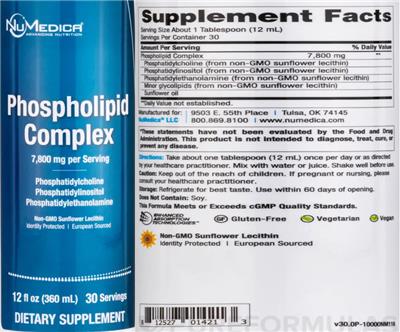
Phospholipid Complex 7,800 mg per serving Phosphatidylcholine Phosphatidylinositol Phosphatidylethanolamine Non-GMO sunflower lecithin
Formulation
Non-GMO sunflower lecithin
Identity protected | European sourced
Does not contain: Soy.
This formula meets or exceeds cGMP quality standards. Enhanced absorption technologies
GF Gluten-free
Vegetarian Vegan
Identity protected | European sourced
FDA Statement of Identity
Dietary Supplement
FDA Disclaimer Statement
These statements have not been evaluated by the Food and Drug Administration. This product is not intended to diagnose, treat, cure, or prevent any disease.
Suggested/Recommended/Usage/Directions
Directions: Take about one tablespoon (12 mL) once per day or as directed by your healthcare practitioner. Mix with water or juice. Shake well before use.
Precautions
Caution: Keep out of the reach of children.
If pregnant or nursing, please consult your healthcare practitioner.
Storage
Storage: Refrigerate for best taste. Use within 60 days of opening.
Is this label outdated? Report a formula or label change and our pharmacy team will review it.
Phospholipid Complex 7,800 mg by NuMedica label
The label scan from the NIH Dietary Supplement Label Database. Tap to enlarge.
Label images are published by the NIH Dietary Supplement Label Database for the version of this product on file. Always read your actual product label.
View the full label (PDF)The Ingredients in Phospholipid Complex 7,800 mg by NuMedica
These are the 5 active ingredients this product is made of. Select any to open its full monograph.
Serving size12 mL Dosage formLiquid Servings per container30 Amounts shown are per serving.
Most supplement products combine several ingredients, and a medication can interact with the product through any one of them. Each ingredient below shows whether it has known drug interactions.
Phospholipid Complex
- › Sunflower Oil
- › Phosphatidylcholine
- › Phosphatidylinositol
- › Phosphatidylethanolamine
- › Glycolipids
Phospholipid Complex 7,800 mg by NuMedica Drug Interactions
HelloPharmacist Interaction Report
NuMedica's Phospholipid Complex 7,800 mg contains sunflower oil, which has a documented interaction with diabetes medications.
If you take drugs to lower blood sugar, sunflower oil may reduce how well they work — your fasting glucose levels could rise, and you might need a dose adjustment. Talk to your doctor or pharmacist before starting this product if you're on any diabetes medication.
Read the full breakdown — every affected drug type, severity by severity
Phosphatidylcholine, another active ingredient here, has no documented interactions in our data. We were unable to check three other ingredients in this formula — phosphatidylinositol, phosphatidylethanolamine, and glycolipids — because we don't hold interaction data for them.
Altogether, these interactions span 85 individual medications.
Use the medication checker on this page to search your exact drugs. If you take blood sugar medication or anything else you're unsure about, run it through before you buy.
Check your own medications below · Editorial policy · How we use AI
Want to check YOUR meds against Phospholipid Complex 7,800 mg?
Ask about interactions with your drugs in plain English — “Can I take it with lisinopril?” — and we find you the answer in seconds, ingredient by ingredient.
Go to the checkerIngredients driving the most interactions
Individual Drug Interactions
The ingredients in Phospholipid Complex 7,800 mg interact with 86 drugs. Click any drug to see the details.
1 of the 5 ingredients in Phospholipid Complex 7,800 mg interact with drugs. Each result below shows which ingredient is responsible. Sunflower Oil
GlucoseIV Glucose
How Glucose interacts with Phospholipid Complex 7,800 mg — through 1 ingredient. Tap an ingredient for the detail:
Sunflower OilAntidiabetes Drugs Moderate
Interaction Summary
Theoretically, sunflower oil might decrease the effectiveness of antidiabetes medications.
Read the full Sunflower Oil + Glucose interactionGlyburideAlbert Glyburide, Diabeta, Glycron, Glynase, Glynase PresTab, Micronase +1 more
How Glyburide interacts with Phospholipid Complex 7,800 mg — through 1 ingredient. Tap an ingredient for the detail:
Sunflower OilAntidiabetes Drugs Moderate
Interaction Summary
Theoretically, sunflower oil might decrease the effectiveness of antidiabetes medications.
Read the full Sunflower Oil + Glyburide interactionGlyburide, MetforminGlucovance
How Glyburide, Metformin interacts with Phospholipid Complex 7,800 mg — through 1 ingredient. Tap an ingredient for the detail:
Sunflower OilAntidiabetes Drugs Moderate
Interaction Summary
Theoretically, sunflower oil might decrease the effectiveness of antidiabetes medications.
Read the full Sunflower Oil + Glyburide, Metformin interactionInhaled InsulinExubera
How Inhaled Insulin interacts with Phospholipid Complex 7,800 mg — through 1 ingredient. Tap an ingredient for the detail:
Sunflower OilAntidiabetes Drugs Moderate
Interaction Summary
Theoretically, sunflower oil might decrease the effectiveness of antidiabetes medications.
Read the full Sunflower Oil + Inhaled Insulin interactionInsulinNovoRapid Insulin
How Insulin interacts with Phospholipid Complex 7,800 mg — through 1 ingredient. Tap an ingredient for the detail:
Sunflower OilAntidiabetes Drugs Moderate
Interaction Summary
Theoretically, sunflower oil might decrease the effectiveness of antidiabetes medications.
Read the full Sunflower Oil + Insulin interactionInsulin (bovine)Hypurin Bovine Neutral
How Insulin (bovine) interacts with Phospholipid Complex 7,800 mg — through 1 ingredient. Tap an ingredient for the detail:
Sunflower OilAntidiabetes Drugs Moderate
Interaction Summary
Theoretically, sunflower oil might decrease the effectiveness of antidiabetes medications.
Read the full Sunflower Oil + Insulin (bovine) interactionInsulin (human)Afrezza, Novolin 70/30, Novolin L, Novolin N, Novolin R
How Insulin (human) interacts with Phospholipid Complex 7,800 mg — through 1 ingredient. Tap an ingredient for the detail:
Sunflower OilAntidiabetes Drugs Moderate
Interaction Summary
Theoretically, sunflower oil might decrease the effectiveness of antidiabetes medications.
Read the full Sunflower Oil + Insulin (human) interactionInsulin (pork)Hypurin Porcine Neutral, Lente Iletin II, NPH Iletin, NPH Iletin II, Pork Actrapid, Regular Iletin +1 more
How Insulin (pork) interacts with Phospholipid Complex 7,800 mg — through 1 ingredient. Tap an ingredient for the detail:
Sunflower OilAntidiabetes Drugs Moderate
Interaction Summary
Theoretically, sunflower oil might decrease the effectiveness of antidiabetes medications.
Read the full Sunflower Oil + Insulin (pork) interactionInsulin (rdna)Actrapid, Humalog, Humalog Mix 75/25, Humulin 50/50, Humulin 70/30, Humulin L +8 more
How Insulin (rdna) interacts with Phospholipid Complex 7,800 mg — through 1 ingredient. Tap an ingredient for the detail:
Sunflower OilAntidiabetes Drugs Moderate
Interaction Summary
Theoretically, sunflower oil might decrease the effectiveness of antidiabetes medications.
Read the full Sunflower Oil + Insulin (rdna) interactionInsulin AspartFiasp
How Insulin Aspart interacts with Phospholipid Complex 7,800 mg — through 1 ingredient. Tap an ingredient for the detail:
Sunflower OilAntidiabetes Drugs Moderate
Interaction Summary
Theoretically, sunflower oil might decrease the effectiveness of antidiabetes medications.
Read the full Sunflower Oil + Insulin Aspart interactionInsulin Aspart, Insulin DegludecRyzodeg 70/30
How Insulin Aspart, Insulin Degludec interacts with Phospholipid Complex 7,800 mg — through 1 ingredient. Tap an ingredient for the detail:
Sunflower OilAntidiabetes Drugs Moderate
Interaction Summary
Theoretically, sunflower oil might decrease the effectiveness of antidiabetes medications.
Read the full Sunflower Oil + Insulin Aspart, Insulin Degludec interactionInsulin DegludecTresiba
How Insulin Degludec interacts with Phospholipid Complex 7,800 mg — through 1 ingredient. Tap an ingredient for the detail:
Sunflower OilAntidiabetes Drugs Moderate
Interaction Summary
Theoretically, sunflower oil might decrease the effectiveness of antidiabetes medications.
Read the full Sunflower Oil + Insulin Degludec interactionInsulin Degludec, LiraglutideXultophy 100/3.6
How Insulin Degludec, Liraglutide interacts with Phospholipid Complex 7,800 mg — through 1 ingredient. Tap an ingredient for the detail:
Sunflower OilAntidiabetes Drugs Moderate
Interaction Summary
Theoretically, sunflower oil might decrease the effectiveness of antidiabetes medications.
Read the full Sunflower Oil + Insulin Degludec, Liraglutide interactionInsulin GlargineBasaglar, Lusduna, Semglee
How Insulin Glargine interacts with Phospholipid Complex 7,800 mg — through 1 ingredient. Tap an ingredient for the detail:
Sunflower OilAntidiabetes Drugs Moderate
Interaction Summary
Theoretically, sunflower oil might decrease the effectiveness of antidiabetes medications.
Read the full Sunflower Oil + Insulin Glargine interactionInsulin Glargine (rdna)Lantus
How Insulin Glargine (rdna) interacts with Phospholipid Complex 7,800 mg — through 1 ingredient. Tap an ingredient for the detail:
Sunflower OilAntidiabetes Drugs Moderate
Interaction Summary
Theoretically, sunflower oil might decrease the effectiveness of antidiabetes medications.
Read the full Sunflower Oil + Insulin Glargine (rdna) interactionInsulin Glargine RecombinantToujeo Solostar
How Insulin Glargine Recombinant interacts with Phospholipid Complex 7,800 mg — through 1 ingredient. Tap an ingredient for the detail:
Sunflower OilAntidiabetes Drugs Moderate
Interaction Summary
Theoretically, sunflower oil might decrease the effectiveness of antidiabetes medications.
Read the full Sunflower Oil + Insulin Glargine Recombinant interactionInsulin Glargine, LixisenatideSoliqua 100/33
How Insulin Glargine, Lixisenatide interacts with Phospholipid Complex 7,800 mg — through 1 ingredient. Tap an ingredient for the detail:
Sunflower OilAntidiabetes Drugs Moderate
Interaction Summary
Theoretically, sunflower oil might decrease the effectiveness of antidiabetes medications.
Read the full Sunflower Oil + Insulin Glargine, Lixisenatide interactionInsulin Glulisine (rdna)Apidra
How Insulin Glulisine (rdna) interacts with Phospholipid Complex 7,800 mg — through 1 ingredient. Tap an ingredient for the detail:
Sunflower OilAntidiabetes Drugs Moderate
Interaction Summary
Theoretically, sunflower oil might decrease the effectiveness of antidiabetes medications.
Read the full Sunflower Oil + Insulin Glulisine (rdna) interactionInsulin Human, Sodium ChlorideMyxredlin
How Insulin Human, Sodium Chloride interacts with Phospholipid Complex 7,800 mg — through 1 ingredient. Tap an ingredient for the detail:
Sunflower OilAntidiabetes Drugs Moderate
Interaction Summary
Theoretically, sunflower oil might decrease the effectiveness of antidiabetes medications.
Read the full Sunflower Oil + Insulin Human, Sodium Chloride interactionInsulin LisproAdmelog, Admelog Solostar
How Insulin Lispro interacts with Phospholipid Complex 7,800 mg — through 1 ingredient. Tap an ingredient for the detail:
Sunflower OilAntidiabetes Drugs Moderate
Interaction Summary
Theoretically, sunflower oil might decrease the effectiveness of antidiabetes medications.
Read the full Sunflower Oil + Insulin Lispro interactionInsulin Lispro RecombinantHumalog Kwikpen
How Insulin Lispro Recombinant interacts with Phospholipid Complex 7,800 mg — through 1 ingredient. Tap an ingredient for the detail:
Sunflower OilAntidiabetes Drugs Moderate
Interaction Summary
Theoretically, sunflower oil might decrease the effectiveness of antidiabetes medications.
Read the full Sunflower Oil + Insulin Lispro Recombinant interactionInsulin Lispro-aabcLyumjev
How Insulin Lispro-aabc interacts with Phospholipid Complex 7,800 mg — through 1 ingredient. Tap an ingredient for the detail:
Sunflower OilAntidiabetes Drugs Moderate
Interaction Summary
Theoretically, sunflower oil might decrease the effectiveness of antidiabetes medications.
Read the full Sunflower Oil + Insulin Lispro-aabc interactionInsulin DetermirLevemir
How Insulin Determir interacts with Phospholipid Complex 7,800 mg — through 1 ingredient. Tap an ingredient for the detail:
Sunflower OilAntidiabetes Drugs Moderate
Interaction Summary
Theoretically, sunflower oil might decrease the effectiveness of antidiabetes medications.
Read the full Sunflower Oil + Insulin Determir interactionLinagliptinTradjenta
How Linagliptin interacts with Phospholipid Complex 7,800 mg — through 1 ingredient. Tap an ingredient for the detail:
Sunflower OilAntidiabetes Drugs Moderate
Interaction Summary
Theoretically, sunflower oil might decrease the effectiveness of antidiabetes medications.
Read the full Sunflower Oil + Linagliptin interactionLinagliptin, Metformin HydrochlorideJentadueto XR
How Linagliptin, Metformin Hydrochloride interacts with Phospholipid Complex 7,800 mg — through 1 ingredient. Tap an ingredient for the detail:
Sunflower OilAntidiabetes Drugs Moderate
Interaction Summary
Theoretically, sunflower oil might decrease the effectiveness of antidiabetes medications.
Read the full Sunflower Oil + Linagliptin, Metformin Hydrochloride interactionLiraglutideVictoza
How Liraglutide interacts with Phospholipid Complex 7,800 mg — through 1 ingredient. Tap an ingredient for the detail:
Sunflower OilAntidiabetes Drugs Moderate
Interaction Summary
Theoretically, sunflower oil might decrease the effectiveness of antidiabetes medications.
Read the full Sunflower Oil + Liraglutide interactionLiraglutide RecombinantSaxenda
How Liraglutide Recombinant interacts with Phospholipid Complex 7,800 mg — through 1 ingredient. Tap an ingredient for the detail:
Sunflower OilAntidiabetes Drugs Moderate
Interaction Summary
Theoretically, sunflower oil might decrease the effectiveness of antidiabetes medications.
Read the full Sunflower Oil + Liraglutide Recombinant interactionLixisenatideAdlyxin
How Lixisenatide interacts with Phospholipid Complex 7,800 mg — through 1 ingredient. Tap an ingredient for the detail:
Sunflower OilAntidiabetes Drugs Moderate
Interaction Summary
Theoretically, sunflower oil might decrease the effectiveness of antidiabetes medications.
Read the full Sunflower Oil + Lixisenatide interactionMetforminGlucophage, Metformin
How Metformin interacts with Phospholipid Complex 7,800 mg — through 1 ingredient. Tap an ingredient for the detail:
Sunflower OilAntidiabetes Drugs Moderate
Interaction Summary
Theoretically, sunflower oil might decrease the effectiveness of antidiabetes medications.
Read the full Sunflower Oil + Metformin interactionMetformin HydrochlorideRiomet ER
How Metformin Hydrochloride interacts with Phospholipid Complex 7,800 mg — through 1 ingredient. Tap an ingredient for the detail:
Sunflower OilAntidiabetes Drugs Moderate
Interaction Summary
Theoretically, sunflower oil might decrease the effectiveness of antidiabetes medications.
Read the full Sunflower Oil + Metformin Hydrochloride interactionEach ingredient & the kinds of drugs it affects
For each ingredient in Phospholipid Complex 7,800 mg with known interactions, here are the types of medications it can affect. Open any type for the detail — or search your exact drug in the checker above.
Sunflower Oil
Antidiabetes Drugs
Theoretically, sunflower oil might decrease the effectiveness of antidiabetes medications.
A diet using sunflower oil as a fat source can cause increased fasting blood glucose levels in patients with type 2 diabetes. Dose adjustments to diabetes medications might be necessary.
Brand information
Manufacturer and brand details for Phospholipid Complex 7,800 mg, from the product label.
NuMedica
See all NuMedica products- Name
- NuMedica LLC
- Street Address
- 9503 E. 55th Place
- City
- Tulsa
- State
- OK
- ZipCode
- 74145
- Phone Number
- 800.869.8100
- Web Address
- www.numedica.com
Phospholipid Complex 7,800 mg by NuMedica: Common Questions
Does Phospholipid Complex 7,800 mg by NuMedica interact with any medications?
How can one product interact with so many drugs?
Where does this information come from?
Can I take this if I'm pregnant?
Can I take this while breastfeeding?
What are the most common side effects?
Does this product have fillers?
Will this help my cholesterol?
Is this safe if I'm allergic to ragweed?
Written and reviewed by the HelloPharmacist editorial staff. Our editorial policy
Not sure if Phospholipid Complex 7,800 mg is safe with your meds?
Our pharmacists answer your medication & supplement questions — free.
Label information is sourced from the NIH Dietary Supplement Label Database and reflects the product version on file; always read your actual product label. This page is for education only and is not a substitute for professional medical advice. Confirm with your pharmacist or doctor before combining supplements and medications.
The Full Monographs Behind Phospholipid Complex 7,800 mg’s Ingredients
Every ingredient we hold a full HelloPharmacist monograph for — uses, evidence, safety, and the complete interaction list.
Sunflower Oil
Interacts with 86 drugsSunflower oil is a common edible vegetable oil rich in unsaturated fats and vitamin E that most people can use safely as part of a normal diet. As a food it is generally regarded as safe, an...
Read the full Sunflower Oil monograph → Herb & supplement monographPhosphatidylcholine
Phosphatidylcholine is a phospholipid that is part of every cell membrane and a source of choline. People take it for liver, brain, and gut health, but solid human evidence is limited for mo...
Read the full Phosphatidylcholine monograph →Sources & How We Checked
Phospholipid Complex 7,800 mg's label data comes from the NIH Dietary Supplement Label Database; the ingredient interaction data is from the Natural Medicines database, reviewed by our pharmacists.
- NIH Dietary Supplement Label Database (DSLD) — The official product label on file for this supplement.
- Natural Medicines (Therapeutic Research Center) — Evidence-graded clinical reference behind the ingredient interaction data.
Content is written and reviewed by licensed HelloPharmacist pharmacists. See our data sources and editorial standards for how this information is built and checked.
The 17 references behind this product’s interaction data
Every citation that drives the interaction findings for this product’s ingredients, from the evidence-graded Natural Medicines (TRC Healthcare) database. Open an ingredient to browse its citations — links open the study on PubMed or the publisher’s site.
Sunflower Oil 2 references
- Madigan C, Ryan M, Owens D, et al. Dietary unsaturated fatty acids in type 2 diabetes: higher levels of postprandial lipoprotein on a linoleic acid-rich sunflower oil diet compared with an oleic acid-rich olive oil diet. Diabetes Care 2000;23:1472-7. PubMed
- An J. Anaphylaxis to sunflower seed with tolerance to sunflower oil: A case report. Medicina (Kaunas) 2021;57(7):661. PubMed
Phosphatidylcholine 15 references
- Domino EF, May WW, Demetriou S, et al. Lack of clinically significant improvement of patients with tardive dyskinesia following phosphatidylcholine therapy. Biol Psychiatry 1985;20:1189-96. PubMed
- Aronson PJ, Lorincz AL. Promotion of palmar sweating with oral phosphatidylcholine. Acta Derm Venereol 1985;65:19-24. DOI
- Hexsel DM, Serra M, de Oliveira Dal'Forno T, et al. Cosmetic uses of injectable phosphatidylcholine on the face. Otolaryngol Clin North Am 2005;38:1119-29. PubMed
- Kopera D, Binder B, Toplak H, et al. Histopathologic changes after intralesional application of phosphatidylcholine for lipoma reduction: report of a case. Am J Dermatopathol 2006;28:331-3. PubMed
- Rittes PG. The use of phosphatidylcholine for correction of lower lid bulging due to prominent fat pads. Dermatol Surg 2001;27:391-2. PubMed
- Rotunda AM, Kolodney MS. Mesotherapy and phosphatidylcholine injections: historical clarification and review. Dermatol Surg 2006;32:465-80. PubMed
- Hexsel D, Serra M, Mazzuco R, et al. Phosphatidylcholine in the treatment of localized fat. J Drugs Dermatol 2003;2:511-8.
- Hasengschwandtner F. Phosphatidylcholine treatment to induce lipolysis. Cosmet Dermatol 2005;4:308-13. PubMed
- Rittes PG. The use of phosphatidylcholine for correction of localized fat deposits. Aesthetic Plast Surg 2003;27:315-8. PubMed
- Ablon G, Rotunda AM. Treatment of lower eyelid fat pads using phosphatidylcholine: clinical trial and review. Dermatol Surg 2004;30:422-7. PubMed
- Loguercio C, Andreone P, Brisc C, et al. Silybin combined with phosphatidylcholine and vitamin E in patients with nonalcoholic fatty liver disease: a randomized controlled trial. Free Radic Biol Med 2012;52(9):1658-65. PubMed
- Panos, J. M., Palson, R., Johnson, R., Portmann, B., and Williams, R. Polyunsaturated phosphatidylcholine for acute alcoholic hepatitis: a double blind randomized placebo controlled trial. Eur.J.Gastroenterol 1990;2:351-355.
- Stremmel W, Braun A, Hanemann A, Ehehalt R, Autschbach F, Karner M. Delayed release phosphatidylcholine in chronic-active ulcerative colitis: a randomized, double-blinded, dose finding study. J Clin Gastroenterol 2010;44(5):e101-7. PubMed
- Stremmel W, Ehehalt R, Autschbach F, Karner M. Phosphatidylcholine for steroid-refractory chronic ulcerative colitis: a randomized trial. Ann Intern Med. 2007;147(9):603-10. PubMed
- Stremmel W, Vural H, Evliyaoglu O, Weiskirchen R. Delayed Release Phosphatidylcholine is Effective for Treatment of Ulcerative Colitis: A Meta-Analysis. Dig Dis 2021;39(5):508-515. PubMed
Parts of this content are provided by the Therapeutic Research Center, LLC.
DISCLAIMER: Currently this does not check for drug-drug interactions. This is not an all-inclusive comprehensive list of potential interactions and is for informational purposes only. Not all interactions are known or well-reported in the scientific literature, and new interactions are continually being reported. Input is needed from a qualified healthcare provider including a pharmacist before starting any therapy. Application of clinical judgment is necessary.
© 2021 Therapeutic Research Center, LLC