
Pyloricom Ingredients & Drug Interactions
by Energique
What is this page for?
First and foremost: checking Pyloricom against your medications. The heart of this page is the interaction checker and the full interaction report — how this product’s ingredients may interact with prescription and over-the-counter medicines you may be taking.
Around that, we add a pharmacist’s high-level view of the product as a whole — what’s inside, the evidence for its stated use, how transparent the label is, and what safety data exists — so you can see the full picture in one place. It’s educational information from our licensed clinical databases and the clinical staff at HelloPharmacist — not medical advice — and we don’t sell or endorse products. Our editorial policy
Pyloricom is a dietary supplement by Energique with 6 active ingredients. Its ingredients are commonly taken for cough and respiratory congestion, sore throat, digestive upset.Based on those ingredients, 1,328 medications have a known interaction with it, the most serious rated moderate. The ingredients most likely to interact are Clove, Sweet Wormwood, Uva-ursi. Use the checker below to test your specific medication, or read the full HelloPharmacist Interaction Report.
Check Your Meds Against Pyloricom by Energique
Ask about any prescription or over-the-counter medication and we check it for interactions with Pyloricom by Energique — and tell you which ingredient is responsible.
AI summaries are generated from our interaction database for education only — always confirm with your pharmacist. How we use AI
Ask the Pharmacist
A licensed pharmacist will answer your question by email — free, usually within 24 hours.
Got it — thank you!
A licensed pharmacist will answer within 24 hours. Keep an eye on your email (worth checking spam, just in case).
HelloPharmacist Scorecard of Pyloricom by Energique
Our pharmacy team’s full take, with four database checks built into the cards below — a summary of what is known, not a grade of the product itself.
What’s inside
Low disclosure
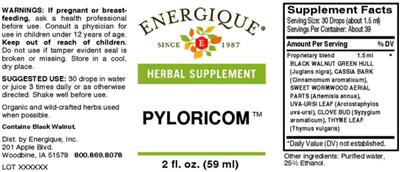
Pyloricom contains six active ingredients delivered in a liquid form. The blend includes thyme, sweet wormwood (also called sweet annie), uva-ursi, black walnut, cassia (cinnamon), and clove.
The product is suspended in water and ethanol as inactive ingredients.
Does it work?
Moderate evidence
The evidence for most uses in this product is incomplete or insufficient. Thyme has insufficient reliable evidence for bronchitis, aging skin, and alopecia areata.
Sweet wormwood is possibly effective for hay fever (allergic rhinitis) but has insufficient evidence for nonalcoholic fatty liver disease, malaria, and osteoarthritis. Uva-ursi is possibly ineffective for urinary tract infections and has insufficient evidence for bronchitis, benign prostate enlargement, and other conditions.
Black walnut has insufficient evidence for heart disease and wound healing. Cassia has insufficient evidence for amenorrhea, angina, cold, diabetes, diarrhea, and cholesterol.
Clove is possibly effective for ventilator-associated pneumonia in hospitalized patients but has insufficient evidence for cough, acute pain, and indigestion. If you're considering this product for a specific health goal, talk with your doctor or pharmacist about whether the evidence supports it for your situation.
How safe is it?
Well-documented data
Most of the individual ingredients are generally well tolerated at typical food amounts. However, medicinal doses of several carry cautions.
Thyme as food or tea is safe for most adults; the concentrated essential oil can be toxic if swallowed. Sweet wormwood is typically used short-term and should not replace proven treatments, and it must be avoided during pregnancy and breastfeeding.
Uva-ursi is well tolerated in low doses short-term but can be toxic at high doses (20 grams or more has caused serious effects including convulsions and delirium, and doses of 30 grams or more may be fatal); it should be avoided during pregnancy and breastfeeding. Black walnut fruit (nut) is well tolerated, but the leaf, bark, and hull contain high tannins that may cause stomach upset; safety during breastfeeding is unclear.
Cassia cinnamon is safe in food amounts, but large supplement doses over time may harm the liver due to coumarin content, and medicinal doses should be avoided in pregnancy. Clove is safe as a spice but concentrated oil (even 5–10 mL) can be toxic to children; clove oil can cause serious liver damage, and inhaled clove (cigarettes) carries risks including pulmonary damage.
Meds to double-check
Moderate interaction found
Before taking Pyloricom, double-check with your doctor or pharmacist if you take any of these: drugs metabolized by CYP3A4, CYP2C19, CYP2D6, CYP1A2, CYP2C9, or glucuronidation (covers a very large number of medications); estrogens or hormone replacement therapy; blood thinners or antiplatelet drugs; diabetes medications; lithium; anticholinergic drugs; cholinergic drugs; or drugs for liver disease or those that may harm the liver. These represent the Moderate-severity interactions in the product.
Additionally, there are Minor-severity interactions with ibuprofen and blood thinners from clove.
The bottom line
Scorecard at a glanceFormula with limited ingredient disclosure with some supporting evidence behind its ingredients' uses. Moderate medication interactions have been identified, and safety information is well characterized.
Pyloricom is a multibotanical product with modest or unproven effectiveness for most of its listed uses and significant documented interactions with many medications. If you take any prescription medication—especially blood thinners, diabetes drugs, lithium, heart medications, or drugs metabolized by liver enzymes—you need to check with your own doctor or pharmacist before starting it.
The individual ingredients, especially uva-ursi and sweet wormwood, require careful dosing and short-term use only.
Educational only — not medical advice; always confirm with your pharmacist. Our editorial policy · How we use AI
Assessment coverage: 6 of 6 active ingredients matched to our full ingredient reviews (monographs). Based on the product label dated Aug 22, 2024.
This Scorecard evaluates available label information, ingredient evidence, and known medication-safety considerations. It does not independently verify product identity, purity, potency, contamination, or manufacturing quality. How these ratings are computed
General information
Key facts about Pyloricom, straight from the product label.
Everything in this section is reproduced from the manufacturer’s own product label — it’s the label speaking, not HelloPharmacist. We show it so you can see exactly what the maker states; we don’t verify or endorse those statements.
Supplement Facts
The label details for Pyloricom by Energique, sourced from the NIH Dietary Supplement Label Database.
Supplement Facts
| Ingredient | Amount | % DV |
|---|---|---|
| Proprietary Blend | 1.5 mL | -- |
| Thyme | 0 NP | -- |
| Sweet Wormwood | 0 NP | -- |
| Uva-ursi | 0 NP | -- |
| Black Walnut | 0 NP | -- |
| Cassia | 0 NP | -- |
| Clove | 0 NP | -- |
Other ingredients: Water, Purified, Ethanol
Tap any ingredient to jump to its full detail below.
These statements are the manufacturer’s wording, reproduced from the product label — the label is saying it, not HelloPharmacist. We don’t verify or endorse them.
Precautions
Warnings: If pregnant or breast-feeding, ask a health professional before use.
Consult a physician for use in children under 12 years of age. Keep out of reach of children.
Do not use if tamper evident seal is broken or missing.
Contains Black Walnut.
Storage
Store in a cool, dry place.
Suggested/Recommended/Usage/Directions
Suggested Use: 30 drops in water or juice 3 times daily or as otherwise directed. Shake well before use.
Formulation
Organic and wild-crafted herbs used when possible.
Brand IP Statement(s)
Energique Since 1987
FDA Statement of Identity
Herbal Supplement
Is this label outdated? Report a formula or label change and our pharmacy team will review it.
Pyloricom by Energique label
The label scan from the NIH Dietary Supplement Label Database. Tap to enlarge.
Label images are published by the NIH Dietary Supplement Label Database for the version of this product on file. Always read your actual product label.
View the full label (PDF)The Ingredients in Pyloricom by Energique
These are the 6 active ingredients this product is made of. Select any to open its full monograph.
Serving size1.5 Milliliter(s) Dosage formLiquid Servings per container39 Amounts shown are per serving.
Most supplement products combine several ingredients, and a medication can interact with the product through any one of them. Each ingredient below shows whether it has known drug interactions.
Proprietary Blend
- › Thyme
- › Sweet Wormwood
- › Uva-ursi
- › Black Walnut
- › Cassia
- › Clove
Other (inactive) ingredients: Water, Purified, Ethanol. These complete the product’s ingredient list but are not active constituents.
Pyloricom by Energique Drug Interactions
HelloPharmacist Interaction Report
Pyloricom by Energique contains six ingredients, and through its thyme, sweet wormwood, uva-ursi, cassia, and clove content, it interacts with a significant number of medications.
The most serious interaction documented is a Moderate-severity effect: sweet wormwood and uva-ursi may each alter how your body metabolizes drugs processed through CYP3A4 (a major liver enzyme), potentially changing their strength or side effects. This matters for many common medications, including certain statins, blood pressure drugs, and immunosuppressants.
Read the full breakdown — every affected drug type, severity by severity
Thyme may theoretically reduce the effects of estrogens (including hormone replacement therapy) and have additive effects with blood thinners, though these effects haven't been confirmed in humans. It may also theoretically interfere with anticholinergic drugs (used for Parkinson's disease, overactive bladder, and other conditions) or add to the effects of cholinergic drugs (used for Alzheimer's disease and myasthenia gravis).
Uva-ursi may theoretically slow the metabolism of CYP2C19 substrates and increase levels of drugs processed through glucuronidation, and it may raise lithium levels if you take lithium for bipolar disorder. Cassia may have additive effects with diabetes medications and theoretically cause liver harm if combined with other liver-toxic drugs.
Clove may theoretically increase levels of several drug types metabolized by CYP2D6, CYP1A2, CYP2C9, and CYP3A4, and may theoretically increase bleeding risk with blood thinners.
Black walnut has no interactions documented in our data. Because many of these effects are theoretical and not yet confirmed in humans, checking your exact medications with the search tool on this page before starting Pyloricom is essential.
Altogether, these interactions span 1,328 individual medications.
Check your own medications below · Editorial policy · How we use AI
Want to check YOUR meds against Pyloricom?
Ask about interactions with your drugs in plain English — “Can I take it with lisinopril?” — and we find you the answer in seconds, ingredient by ingredient.
Go to the checkerIngredients driving the most interactions
Individual Drug Interactions
The ingredients in Pyloricom interact with 1,328 drugs. Click any drug to see the details.
5 of the 6 ingredients in Pyloricom interact with drugs. Each result below shows which ingredient is responsible. Clove Sweet Wormwood Uva-ursi Cassia Thyme
6-mercaptopurinePurinethol
How 6-mercaptopurine interacts with Pyloricom — through 2 ingredients. Tap an ingredient for the detail:
CassiaHepatotoxic Drugs Moderate
Interaction Summary
Theoretically, large doses of cassia cinnamon might cause additive effects when used with hepatotoxic drugs.
Read the full Cassia + 6-mercaptopurine interactionSweet WormwoodHepatotoxic Drugs Moderate
Interaction Summary
Theoretically, concomitant use might have additive adverse hepatotoxic effects.
Read the full Sweet Wormwood + 6-mercaptopurine interactionAdo-trastuzumab EmtansineKadcyla
How Ado-trastuzumab Emtansine interacts with Pyloricom — through 3 ingredients. Tap an ingredient for the detail:
Uva-ursiCytochrome P450 3a4 (cyp3a4) Substrates Moderate
Interaction Summary
Theoretically, uva ursi may decrease the metabolism of CYP3A4 substrates.
Read the full Uva-ursi + Ado-trastuzumab Emtansine interactionSweet WormwoodCytochrome P450 3a4 (cyp3a4) Substrates Moderate
Interaction Summary
Sweet Annie may alter plasma levels and clinical effects of drugs metabolized by CYP3A4.
Read the full Sweet Wormwood + Ado-trastuzumab Emtansine interactionCloveCytochrome P450 3a4 (cyp3a4) Substrates Moderate
Interaction Summary
Theoretically, concomitant use of clove may increase levels of drugs metabolized by CYP3A4.
Read the full Clove + Ado-trastuzumab Emtansine interactionAbacavir Sulfate, Dolutegravir, LamivudineTriumeq
How Abacavir Sulfate, Dolutegravir, Lamivudine interacts with Pyloricom — through 2 ingredients. Tap an ingredient for the detail:
Sweet WormwoodHepatotoxic Drugs Moderate
Interaction Summary
Theoretically, concomitant use might have additive adverse hepatotoxic effects.
Read the full Sweet Wormwood + Abacavir Sulfate, Dolutegravir, Lamivudine interactionCassiaHepatotoxic Drugs Moderate
Interaction Summary
Theoretically, large doses of cassia cinnamon might cause additive effects when used with hepatotoxic drugs.
Read the full Cassia + Abacavir Sulfate, Dolutegravir, Lamivudine interactionAbacavir, LamivudineEpzicom
How Abacavir, Lamivudine interacts with Pyloricom — through 2 ingredients. Tap an ingredient for the detail:
CassiaHepatotoxic Drugs Moderate
Interaction Summary
Theoretically, large doses of cassia cinnamon might cause additive effects when used with hepatotoxic drugs.
Read the full Cassia + Abacavir, Lamivudine interactionSweet WormwoodHepatotoxic Drugs Moderate
Interaction Summary
Theoretically, concomitant use might have additive adverse hepatotoxic effects.
Read the full Sweet Wormwood + Abacavir, Lamivudine interactionAbciximabReoPro
How Abciximab interacts with Pyloricom — through 2 ingredients. Tap an ingredient for the detail:
ThymeAnticoagulant/antiplatelet Drugs Moderate
Interaction Summary
Theoretically, thyme leaf extract might have additive effects with anticoagulant or antiplatelet drugs.
Read the full Thyme + Abciximab interactionCloveAnticoagulant/antiplatelet Drugs Minor
Interaction Summary
Theoretically, clove oil may increase the risk of bleeding if used with anticoagulant or antiplatelet drugs.
Read the full Clove + Abciximab interactionAbemaciclibVerzenio
How Abemaciclib interacts with Pyloricom — through 3 ingredients. Tap an ingredient for the detail:
Sweet WormwoodCytochrome P450 3a4 (cyp3a4) Substrates Moderate
Interaction Summary
Sweet Annie may alter plasma levels and clinical effects of drugs metabolized by CYP3A4.
Read the full Sweet Wormwood + Abemaciclib interactionUva-ursiCytochrome P450 3a4 (cyp3a4) Substrates Moderate
Interaction Summary
Theoretically, uva ursi may decrease the metabolism of CYP3A4 substrates.
Read the full Uva-ursi + Abemaciclib interactionCloveCytochrome P450 3a4 (cyp3a4) Substrates Moderate
Interaction Summary
Theoretically, concomitant use of clove may increase levels of drugs metabolized by CYP3A4.
Read the full Clove + Abemaciclib interactionAbiraterone
How Abiraterone interacts with Pyloricom — through 4 ingredients. Tap an ingredient for the detail:
CloveCytochrome P450 3a4 (cyp3a4) Substrates Moderate
Interaction Summary
Theoretically, concomitant use of clove may increase levels of drugs metabolized by CYP3A4.
Read the full Clove + Abiraterone interactionSweet WormwoodCytochrome P450 3a4 (cyp3a4) Substrates, Hepatotoxic Drugs Moderate
Interaction Summary
Sweet Annie may alter plasma levels and clinical effects of drugs metabolized by CYP3A4.
Read the full Sweet Wormwood + Abiraterone interactionCassiaHepatotoxic Drugs Moderate
Interaction Summary
Theoretically, large doses of cassia cinnamon might cause additive effects when used with hepatotoxic drugs.
Read the full Cassia + Abiraterone interactionUva-ursiCytochrome P450 3a4 (cyp3a4) Substrates Moderate
Interaction Summary
Theoretically, uva ursi may decrease the metabolism of CYP3A4 substrates.
Read the full Uva-ursi + Abiraterone interactionAbiraterone AcetateYonsa, Zytiga
How Abiraterone Acetate interacts with Pyloricom — through 4 ingredients. Tap an ingredient for the detail:
Sweet WormwoodHepatotoxic Drugs, Cytochrome P450 3a4 (cyp3a4) Substrates Moderate
Interaction Summary
Theoretically, concomitant use might have additive adverse hepatotoxic effects.
Read the full Sweet Wormwood + Abiraterone Acetate interactionUva-ursiCytochrome P450 3a4 (cyp3a4) Substrates Moderate
Interaction Summary
Theoretically, uva ursi may decrease the metabolism of CYP3A4 substrates.
Read the full Uva-ursi + Abiraterone Acetate interactionCloveCytochrome P450 3a4 (cyp3a4) Substrates Moderate
Interaction Summary
Theoretically, concomitant use of clove may increase levels of drugs metabolized by CYP3A4.
Read the full Clove + Abiraterone Acetate interactionCassiaHepatotoxic Drugs Moderate
Interaction Summary
Theoretically, large doses of cassia cinnamon might cause additive effects when used with hepatotoxic drugs.
Read the full Cassia + Abiraterone Acetate interactionAbrocitinibCibinqo
How Abrocitinib interacts with Pyloricom — through 3 ingredients. Tap an ingredient for the detail:
ThymeAnticoagulant/antiplatelet Drugs Moderate
Interaction Summary
Theoretically, thyme leaf extract might have additive effects with anticoagulant or antiplatelet drugs.
Read the full Thyme + Abrocitinib interactionCloveAnticoagulant/antiplatelet Drugs, Cytochrome P450 2c9 (cyp2c9) Substrates Moderate
Interaction Summary
Theoretically, clove oil may increase the risk of bleeding if used with anticoagulant or antiplatelet drugs.
Read the full Clove + Abrocitinib interactionUva-ursiCytochrome P450 2c19 (cyp2c19) Substrates Moderate
Interaction Summary
Theoretically, uva ursi may decrease the metabolism of CYP2C19 substrates.
Read the full Uva-ursi + Abrocitinib interactionAcalabrutinibCalquence
How Acalabrutinib interacts with Pyloricom — through 3 ingredients. Tap an ingredient for the detail:
CloveCytochrome P450 3a4 (cyp3a4) Substrates Moderate
Interaction Summary
Theoretically, concomitant use of clove may increase levels of drugs metabolized by CYP3A4.
Read the full Clove + Acalabrutinib interactionUva-ursiCytochrome P450 3a4 (cyp3a4) Substrates, P-glycoprotein Substrates Moderate
Interaction Summary
Theoretically, uva ursi may decrease the metabolism of CYP3A4 substrates.
Read the full Uva-ursi + Acalabrutinib interactionSweet WormwoodCytochrome P450 3a4 (cyp3a4) Substrates Moderate
Interaction Summary
Sweet Annie may alter plasma levels and clinical effects of drugs metabolized by CYP3A4.
Read the full Sweet Wormwood + Acalabrutinib interactionAcarboseGlucobay, Prandase, Precose
How Acarbose interacts with Pyloricom — through 3 ingredients. Tap an ingredient for the detail:
CassiaAntidiabetes Drugs, Hepatotoxic Drugs Moderate
Interaction Summary
Theoretically, cassia cinnamon may have additive effects with antidiabetes drugs.
Read the full Cassia + Acarbose interactionCloveAntidiabetes Drugs Moderate
Interaction Summary
Theoretically, concomitant use of clove extracts with antidiabetes drugs might increase the risk of hypoglycemia.
Read the full Clove + Acarbose interactionSweet WormwoodHepatotoxic Drugs Moderate
Interaction Summary
Theoretically, concomitant use might have additive adverse hepatotoxic effects.
Read the full Sweet Wormwood + Acarbose interactionAcebutololRhotral, Sectral
How Acebutolol interacts with Pyloricom — through 2 ingredients. Tap an ingredient for the detail:
Sweet WormwoodHepatotoxic Drugs Moderate
Interaction Summary
Theoretically, concomitant use might have additive adverse hepatotoxic effects.
Read the full Sweet Wormwood + Acebutolol interactionCassiaHepatotoxic Drugs Moderate
Interaction Summary
Theoretically, large doses of cassia cinnamon might cause additive effects when used with hepatotoxic drugs.
Read the full Cassia + Acebutolol interactionAcenocoumarolSintrom
How Acenocoumarol interacts with Pyloricom — through 2 ingredients. Tap an ingredient for the detail:
ThymeAnticoagulant/antiplatelet Drugs Moderate
Interaction Summary
Theoretically, thyme leaf extract might have additive effects with anticoagulant or antiplatelet drugs.
Read the full Thyme + Acenocoumarol interactionCloveAnticoagulant/antiplatelet Drugs Minor
Interaction Summary
Theoretically, clove oil may increase the risk of bleeding if used with anticoagulant or antiplatelet drugs.
Read the full Clove + Acenocoumarol interactionAcepromazineAtravet
How Acepromazine interacts with Pyloricom — through 1 ingredient. Tap an ingredient for the detail:
ThymeAnticholinergic Drugs Moderate
Interaction Summary
Theoretically, concurrent use of anticholinergic drugs and thyme essential oil might reduce the effects of anticholinergic drugs.
Read the full Thyme + Acepromazine interactionAcetaminophenChildren's Tylenol, Children's Tylenol Meltaways, Tylenol, Tylenol Ex Strength
How Acetaminophen interacts with Pyloricom — through 4 ingredients. Tap an ingredient for the detail:
CassiaHepatotoxic Drugs Moderate
Interaction Summary
Theoretically, large doses of cassia cinnamon might cause additive effects when used with hepatotoxic drugs.
Read the full Cassia + Acetaminophen interactionUva-ursiGlucuronidated Drugs Moderate
Interaction Summary
Theoretically, uva ursi may increase levels of drugs metabolized by glucuronidation.
Read the full Uva-ursi + Acetaminophen interactionSweet WormwoodHepatotoxic Drugs Moderate
Interaction Summary
Theoretically, concomitant use might have additive adverse hepatotoxic effects.
Read the full Sweet Wormwood + Acetaminophen interactionCloveCytochrome P450 1a2 (cyp1a2) Substrates Moderate
Interaction Summary
Theoretically, concomitant use of clove may increase levels of drugs metabolized by CYP1A2.
Read the full Clove + Acetaminophen interactionAcetaminophen, AspirinGemnisyn
How Acetaminophen, Aspirin interacts with Pyloricom — through 5 ingredients. Tap an ingredient for the detail:
CloveCytochrome P450 1a2 (cyp1a2) Substrates, Anticoagulant/antiplatelet Drugs Moderate
Interaction Summary
Theoretically, concomitant use of clove may increase levels of drugs metabolized by CYP1A2.
Read the full Clove + Acetaminophen, Aspirin interactionCassiaHepatotoxic Drugs Moderate
Interaction Summary
Theoretically, large doses of cassia cinnamon might cause additive effects when used with hepatotoxic drugs.
Read the full Cassia + Acetaminophen, Aspirin interactionThymeAnticoagulant/antiplatelet Drugs Moderate
Interaction Summary
Theoretically, thyme leaf extract might have additive effects with anticoagulant or antiplatelet drugs.
Read the full Thyme + Acetaminophen, Aspirin interactionUva-ursiGlucuronidated Drugs Moderate
Interaction Summary
Theoretically, uva ursi may increase levels of drugs metabolized by glucuronidation.
Read the full Uva-ursi + Acetaminophen, Aspirin interactionSweet WormwoodHepatotoxic Drugs Moderate
Interaction Summary
Theoretically, concomitant use might have additive adverse hepatotoxic effects.
Read the full Sweet Wormwood + Acetaminophen, Aspirin interactionAcetaminophen, Aspirin, CaffeineExcedrin, Excedrin Extra Strength, Excedrin Migraine
How Acetaminophen, Aspirin, Caffeine interacts with Pyloricom — through 5 ingredients. Tap an ingredient for the detail:
Uva-ursiGlucuronidated Drugs, Cytochrome P450 3a4 (cyp3a4) Substrates Moderate
Interaction Summary
Theoretically, uva ursi may increase levels of drugs metabolized by glucuronidation.
Read the full Uva-ursi + Acetaminophen, Aspirin, Caffeine interactionSweet WormwoodHepatotoxic Drugs, Cytochrome P450 3a4 (cyp3a4) Substrates Moderate
Interaction Summary
Theoretically, concomitant use might have additive adverse hepatotoxic effects.
Read the full Sweet Wormwood + Acetaminophen, Aspirin, Caffeine interactionCloveAnticoagulant/antiplatelet Drugs, Cytochrome P450 1a2 (cyp1a2) Substrates +1 Moderate
Interaction Summary
Theoretically, clove oil may increase the risk of bleeding if used with anticoagulant or antiplatelet drugs.
Read the full Clove + Acetaminophen, Aspirin, Caffeine interactionThymeAnticoagulant/antiplatelet Drugs Moderate
Interaction Summary
Theoretically, thyme leaf extract might have additive effects with anticoagulant or antiplatelet drugs.
Read the full Thyme + Acetaminophen, Aspirin, Caffeine interactionCassiaHepatotoxic Drugs Moderate
Interaction Summary
Theoretically, large doses of cassia cinnamon might cause additive effects when used with hepatotoxic drugs.
Read the full Cassia + Acetaminophen, Aspirin, Caffeine interactionAcetaminophen, Brompheniramine, PhenylpropanolamineDimetapp Cold and Flu
How Acetaminophen, Brompheniramine, Phenylpropanolamine interacts with Pyloricom — through 4 ingredients. Tap an ingredient for the detail:
CassiaHepatotoxic Drugs Moderate
Interaction Summary
Theoretically, large doses of cassia cinnamon might cause additive effects when used with hepatotoxic drugs.
Read the full Cassia + Acetaminophen, Brompheniramine, Phenylpropanolamine interactionUva-ursiGlucuronidated Drugs Moderate
Interaction Summary
Theoretically, uva ursi may increase levels of drugs metabolized by glucuronidation.
Read the full Uva-ursi + Acetaminophen, Brompheniramine, Phenylpropanolamine interactionSweet WormwoodHepatotoxic Drugs Moderate
Interaction Summary
Theoretically, concomitant use might have additive adverse hepatotoxic effects.
Read the full Sweet Wormwood + Acetaminophen, Brompheniramine, Phenylpropanolamine interactionCloveCytochrome P450 1a2 (cyp1a2) Substrates Moderate
Interaction Summary
Theoretically, concomitant use of clove may increase levels of drugs metabolized by CYP1A2.
Read the full Clove + Acetaminophen, Brompheniramine, Phenylpropanolamine interactionAcetaminophen, ButalbitalAxocet, Bancap, Bucet, Butex Forte, Esgic CF, Orbivan CF +5 more
How Acetaminophen, Butalbital interacts with Pyloricom — through 4 ingredients. Tap an ingredient for the detail:
CloveCytochrome P450 1a2 (cyp1a2) Substrates Moderate
Interaction Summary
Theoretically, concomitant use of clove may increase levels of drugs metabolized by CYP1A2.
Read the full Clove + Acetaminophen, Butalbital interactionCassiaHepatotoxic Drugs Moderate
Interaction Summary
Theoretically, large doses of cassia cinnamon might cause additive effects when used with hepatotoxic drugs.
Read the full Cassia + Acetaminophen, Butalbital interactionUva-ursiGlucuronidated Drugs Moderate
Interaction Summary
Theoretically, uva ursi may increase levels of drugs metabolized by glucuronidation.
Read the full Uva-ursi + Acetaminophen, Butalbital interactionSweet WormwoodHepatotoxic Drugs Moderate
Interaction Summary
Theoretically, concomitant use might have additive adverse hepatotoxic effects.
Read the full Sweet Wormwood + Acetaminophen, Butalbital interactionAcetaminophen, Butalbital, CaffeineEsgic, Esgic Plus, Fiogesic, Fioricet, Repan, Tecnal +1 more
How Acetaminophen, Butalbital, Caffeine interacts with Pyloricom — through 4 ingredients. Tap an ingredient for the detail:
Uva-ursiGlucuronidated Drugs, Cytochrome P450 3a4 (cyp3a4) Substrates Moderate
Interaction Summary
Theoretically, uva ursi may increase levels of drugs metabolized by glucuronidation.
Read the full Uva-ursi + Acetaminophen, Butalbital, Caffeine interactionSweet WormwoodHepatotoxic Drugs, Cytochrome P450 3a4 (cyp3a4) Substrates Moderate
Interaction Summary
Theoretically, concomitant use might have additive adverse hepatotoxic effects.
Read the full Sweet Wormwood + Acetaminophen, Butalbital, Caffeine interactionCloveCytochrome P450 1a2 (cyp1a2) Substrates, Cytochrome P450 3a4 (cyp3a4) Substrates Moderate
Interaction Summary
Theoretically, concomitant use of clove may increase levels of drugs metabolized by CYP1A2.
Read the full Clove + Acetaminophen, Butalbital, Caffeine interactionCassiaHepatotoxic Drugs Moderate
Interaction Summary
Theoretically, large doses of cassia cinnamon might cause additive effects when used with hepatotoxic drugs.
Read the full Cassia + Acetaminophen, Butalbital, Caffeine interactionAcetaminophen, Butalbital, Caffeine, CodeineEsgic with Codeine, Fioricet w/ Codeine
How Acetaminophen, Butalbital, Caffeine, Codeine interacts with Pyloricom — through 4 ingredients. Tap an ingredient for the detail:
CassiaHepatotoxic Drugs Moderate
Interaction Summary
Theoretically, large doses of cassia cinnamon might cause additive effects when used with hepatotoxic drugs.
Read the full Cassia + Acetaminophen, Butalbital, Caffeine, Codeine interactionSweet WormwoodCytochrome P450 3a4 (cyp3a4) Substrates, Hepatotoxic Drugs Moderate
Interaction Summary
Sweet Annie may alter plasma levels and clinical effects of drugs metabolized by CYP3A4.
Read the full Sweet Wormwood + Acetaminophen, Butalbital, Caffeine, Codeine interactionUva-ursiGlucuronidated Drugs, Cytochrome P450 3a4 (cyp3a4) Substrates Moderate
Interaction Summary
Theoretically, uva ursi may increase levels of drugs metabolized by glucuronidation.
Read the full Uva-ursi + Acetaminophen, Butalbital, Caffeine, Codeine interactionCloveCytochrome P450 2d6 (cyp2d6) Substrates, Cytochrome P450 3a4 (cyp3a4) Substrates +1 Moderate
Interaction Summary
Theoretically, concomitant use of clove may increase levels of drugs metabolized by CYP2D6.
Read the full Clove + Acetaminophen, Butalbital, Caffeine, Codeine interactionAcetaminophen, Butalbital, CodeineBancap w/ Codeine
How Acetaminophen, Butalbital, Codeine interacts with Pyloricom — through 4 ingredients. Tap an ingredient for the detail:
CloveCytochrome P450 1a2 (cyp1a2) Substrates, Cytochrome P450 2d6 (cyp2d6) Substrates Moderate
Interaction Summary
Theoretically, concomitant use of clove may increase levels of drugs metabolized by CYP1A2.
Read the full Clove + Acetaminophen, Butalbital, Codeine interactionCassiaHepatotoxic Drugs Moderate
Interaction Summary
Theoretically, large doses of cassia cinnamon might cause additive effects when used with hepatotoxic drugs.
Read the full Cassia + Acetaminophen, Butalbital, Codeine interactionUva-ursiGlucuronidated Drugs Moderate
Interaction Summary
Theoretically, uva ursi may increase levels of drugs metabolized by glucuronidation.
Read the full Uva-ursi + Acetaminophen, Butalbital, Codeine interactionSweet WormwoodHepatotoxic Drugs Moderate
Interaction Summary
Theoretically, concomitant use might have additive adverse hepatotoxic effects.
Read the full Sweet Wormwood + Acetaminophen, Butalbital, Codeine interactionAcetaminophen, Butalbital, Codeine PhosphatePhrenilin #3
How Acetaminophen, Butalbital, Codeine Phosphate interacts with Pyloricom — through 4 ingredients. Tap an ingredient for the detail:
Uva-ursiGlucuronidated Drugs Moderate
Interaction Summary
Theoretically, uva ursi may increase levels of drugs metabolized by glucuronidation.
Read the full Uva-ursi + Acetaminophen, Butalbital, Codeine Phosphate interactionSweet WormwoodHepatotoxic Drugs Moderate
Interaction Summary
Theoretically, concomitant use might have additive adverse hepatotoxic effects.
Read the full Sweet Wormwood + Acetaminophen, Butalbital, Codeine Phosphate interactionCloveCytochrome P450 2d6 (cyp2d6) Substrates, Cytochrome P450 1a2 (cyp1a2) Substrates Moderate
Interaction Summary
Theoretically, concomitant use of clove may increase levels of drugs metabolized by CYP2D6.
Read the full Clove + Acetaminophen, Butalbital, Codeine Phosphate interactionCassiaHepatotoxic Drugs Moderate
Interaction Summary
Theoretically, large doses of cassia cinnamon might cause additive effects when used with hepatotoxic drugs.
Read the full Cassia + Acetaminophen, Butalbital, Codeine Phosphate interactionAcetaminophen, Caffeine, Chlorpheniramine, Hydrocodone, PhenylephrineHycomine Compound
How Acetaminophen, Caffeine, Chlorpheniramine, Hydrocodone, Phenylephrine interacts with Pyloricom — through 5 ingredients. Tap an ingredient for the detail:
CassiaHepatotoxic Drugs Moderate
Interaction Summary
Theoretically, large doses of cassia cinnamon might cause additive effects when used with hepatotoxic drugs.
Read the full Cassia + Acetaminophen, Caffeine, Chlorpheniramine, Hydrocodone, Phenylephrine interactionThymeAnticholinergic Drugs Moderate
Interaction Summary
Theoretically, concurrent use of anticholinergic drugs and thyme essential oil might reduce the effects of anticholinergic drugs.
Read the full Thyme + Acetaminophen, Caffeine, Chlorpheniramine, Hydrocodone, Phenylephrine interactionSweet WormwoodCytochrome P450 3a4 (cyp3a4) Substrates, Hepatotoxic Drugs Moderate
Interaction Summary
Sweet Annie may alter plasma levels and clinical effects of drugs metabolized by CYP3A4.
Read the full Sweet Wormwood + Acetaminophen, Caffeine, Chlorpheniramine, Hydrocodone, Phenylephrine interactionUva-ursiGlucuronidated Drugs, Cytochrome P450 3a4 (cyp3a4) Substrates Moderate
Interaction Summary
Theoretically, uva ursi may increase levels of drugs metabolized by glucuronidation.
Read the full Uva-ursi + Acetaminophen, Caffeine, Chlorpheniramine, Hydrocodone, Phenylephrine interactionCloveCytochrome P450 1a2 (cyp1a2) Substrates, Cytochrome P450 3a4 (cyp3a4) Substrates +1 Moderate
Interaction Summary
Theoretically, concomitant use of clove may increase levels of drugs metabolized by CYP1A2.
Read the full Clove + Acetaminophen, Caffeine, Chlorpheniramine, Hydrocodone, Phenylephrine interactionAcetaminophen, Caffeine, CodeineGesic C15, Gesic C30, Gesic C8, Lenoltec 1, Lenoltec 2, Lenoltec 3 +1 more
How Acetaminophen, Caffeine, Codeine interacts with Pyloricom — through 4 ingredients. Tap an ingredient for the detail:
Uva-ursiCytochrome P450 3a4 (cyp3a4) Substrates, Glucuronidated Drugs Moderate
Interaction Summary
Theoretically, uva ursi may decrease the metabolism of CYP3A4 substrates.
Read the full Uva-ursi + Acetaminophen, Caffeine, Codeine interactionCloveCytochrome P450 2d6 (cyp2d6) Substrates, Cytochrome P450 1a2 (cyp1a2) Substrates +1 Moderate
Interaction Summary
Theoretically, concomitant use of clove may increase levels of drugs metabolized by CYP2D6.
Read the full Clove + Acetaminophen, Caffeine, Codeine interactionCassiaHepatotoxic Drugs Moderate
Interaction Summary
Theoretically, large doses of cassia cinnamon might cause additive effects when used with hepatotoxic drugs.
Read the full Cassia + Acetaminophen, Caffeine, Codeine interactionSweet WormwoodHepatotoxic Drugs, Cytochrome P450 3a4 (cyp3a4) Substrates Moderate
Interaction Summary
Theoretically, concomitant use might have additive adverse hepatotoxic effects.
Read the full Sweet Wormwood + Acetaminophen, Caffeine, Codeine interactionAcetaminophen, Caffeine, Codeine, SalicylamideCodalan No.1, Codalan No.2, Codalan No.3
How Acetaminophen, Caffeine, Codeine, Salicylamide interacts with Pyloricom — through 4 ingredients. Tap an ingredient for the detail:
Sweet WormwoodCytochrome P450 3a4 (cyp3a4) Substrates, Hepatotoxic Drugs Moderate
Interaction Summary
Sweet Annie may alter plasma levels and clinical effects of drugs metabolized by CYP3A4.
Read the full Sweet Wormwood + Acetaminophen, Caffeine, Codeine, Salicylamide interactionUva-ursiGlucuronidated Drugs, Cytochrome P450 3a4 (cyp3a4) Substrates Moderate
Interaction Summary
Theoretically, uva ursi may increase levels of drugs metabolized by glucuronidation.
Read the full Uva-ursi + Acetaminophen, Caffeine, Codeine, Salicylamide interactionCloveCytochrome P450 1a2 (cyp1a2) Substrates, Cytochrome P450 2d6 (cyp2d6) Substrates +1 Moderate
Interaction Summary
Theoretically, concomitant use of clove may increase levels of drugs metabolized by CYP1A2.
Read the full Clove + Acetaminophen, Caffeine, Codeine, Salicylamide interactionCassiaHepatotoxic Drugs Moderate
Interaction Summary
Theoretically, large doses of cassia cinnamon might cause additive effects when used with hepatotoxic drugs.
Read the full Cassia + Acetaminophen, Caffeine, Codeine, Salicylamide interactionAcetaminophen, Caffeine, DihydrocodeineDHC Plus, Panlor DC, Panlor SS
How Acetaminophen, Caffeine, Dihydrocodeine interacts with Pyloricom — through 4 ingredients. Tap an ingredient for the detail:
CassiaHepatotoxic Drugs Moderate
Interaction Summary
Theoretically, large doses of cassia cinnamon might cause additive effects when used with hepatotoxic drugs.
Read the full Cassia + Acetaminophen, Caffeine, Dihydrocodeine interactionUva-ursiGlucuronidated Drugs, Cytochrome P450 3a4 (cyp3a4) Substrates Moderate
Interaction Summary
Theoretically, uva ursi may increase levels of drugs metabolized by glucuronidation.
Read the full Uva-ursi + Acetaminophen, Caffeine, Dihydrocodeine interactionSweet WormwoodHepatotoxic Drugs, Cytochrome P450 3a4 (cyp3a4) Substrates Moderate
Interaction Summary
Theoretically, concomitant use might have additive adverse hepatotoxic effects.
Read the full Sweet Wormwood + Acetaminophen, Caffeine, Dihydrocodeine interactionCloveCytochrome P450 2d6 (cyp2d6) Substrates, Cytochrome P450 1a2 (cyp1a2) Substrates +1 Moderate
Interaction Summary
Theoretically, concomitant use of clove may increase levels of drugs metabolized by CYP2D6.
Read the full Clove + Acetaminophen, Caffeine, Dihydrocodeine interactionAcetaminophen, Caffeine, IsomethepteneMigralam
How Acetaminophen, Caffeine, Isometheptene interacts with Pyloricom — through 4 ingredients. Tap an ingredient for the detail:
Uva-ursiCytochrome P450 3a4 (cyp3a4) Substrates, Glucuronidated Drugs Moderate
Interaction Summary
Theoretically, uva ursi may decrease the metabolism of CYP3A4 substrates.
Read the full Uva-ursi + Acetaminophen, Caffeine, Isometheptene interactionCloveCytochrome P450 1a2 (cyp1a2) Substrates, Cytochrome P450 3a4 (cyp3a4) Substrates Moderate
Interaction Summary
Theoretically, concomitant use of clove may increase levels of drugs metabolized by CYP1A2.
Read the full Clove + Acetaminophen, Caffeine, Isometheptene interactionCassiaHepatotoxic Drugs Moderate
Interaction Summary
Theoretically, large doses of cassia cinnamon might cause additive effects when used with hepatotoxic drugs.
Read the full Cassia + Acetaminophen, Caffeine, Isometheptene interactionSweet WormwoodCytochrome P450 3a4 (cyp3a4) Substrates, Hepatotoxic Drugs Moderate
Interaction Summary
Sweet Annie may alter plasma levels and clinical effects of drugs metabolized by CYP3A4.
Read the full Sweet Wormwood + Acetaminophen, Caffeine, Isometheptene interactionAcetaminophen, Caffeine, PyrilamineMidol Max Strength Menstrual
How Acetaminophen, Caffeine, Pyrilamine interacts with Pyloricom — through 5 ingredients. Tap an ingredient for the detail:
Uva-ursiGlucuronidated Drugs, Cytochrome P450 3a4 (cyp3a4) Substrates Moderate
Interaction Summary
Theoretically, uva ursi may increase levels of drugs metabolized by glucuronidation.
Read the full Uva-ursi + Acetaminophen, Caffeine, Pyrilamine interactionSweet WormwoodHepatotoxic Drugs, Cytochrome P450 3a4 (cyp3a4) Substrates Moderate
Interaction Summary
Theoretically, concomitant use might have additive adverse hepatotoxic effects.
Read the full Sweet Wormwood + Acetaminophen, Caffeine, Pyrilamine interactionCloveCytochrome P450 3a4 (cyp3a4) Substrates, Cytochrome P450 1a2 (cyp1a2) Substrates Moderate
Interaction Summary
Theoretically, concomitant use of clove may increase levels of drugs metabolized by CYP3A4.
Read the full Clove + Acetaminophen, Caffeine, Pyrilamine interactionCassiaHepatotoxic Drugs Moderate
Interaction Summary
Theoretically, large doses of cassia cinnamon might cause additive effects when used with hepatotoxic drugs.
Read the full Cassia + Acetaminophen, Caffeine, Pyrilamine interactionThymeAnticholinergic Drugs Moderate
Interaction Summary
Theoretically, concurrent use of anticholinergic drugs and thyme essential oil might reduce the effects of anticholinergic drugs.
Read the full Thyme + Acetaminophen, Caffeine, Pyrilamine interactionAcetaminophen, Chlorpheniramine Maleate, Dextromethorphan HbrVicks Formula 44M Cough, Cold & Flu Relief
How Acetaminophen, Chlorpheniramine Maleate, Dextromethorphan Hbr interacts with Pyloricom — through 5 ingredients. Tap an ingredient for the detail:
ThymeAnticholinergic Drugs Moderate
Interaction Summary
Theoretically, concurrent use of anticholinergic drugs and thyme essential oil might reduce the effects of anticholinergic drugs.
Read the full Thyme + Acetaminophen, Chlorpheniramine Maleate, Dextromethorphan Hbr interactionCassiaHepatotoxic Drugs Moderate
Interaction Summary
Theoretically, large doses of cassia cinnamon might cause additive effects when used with hepatotoxic drugs.
Read the full Cassia + Acetaminophen, Chlorpheniramine Maleate, Dextromethorphan Hbr interactionUva-ursiGlucuronidated Drugs, Cytochrome P450 3a4 (cyp3a4) Substrates Moderate
Interaction Summary
Theoretically, uva ursi may increase levels of drugs metabolized by glucuronidation.
Read the full Uva-ursi + Acetaminophen, Chlorpheniramine Maleate, Dextromethorphan Hbr interactionSweet WormwoodHepatotoxic Drugs, Cytochrome P450 3a4 (cyp3a4) Substrates Moderate
Interaction Summary
Theoretically, concomitant use might have additive adverse hepatotoxic effects.
Read the full Sweet Wormwood + Acetaminophen, Chlorpheniramine Maleate, Dextromethorphan Hbr interactionCloveCytochrome P450 1a2 (cyp1a2) Substrates, Cytochrome P450 2d6 (cyp2d6) Substrates +1 Moderate
Interaction Summary
Theoretically, concomitant use of clove may increase levels of drugs metabolized by CYP1A2.
Read the full Clove + Acetaminophen, Chlorpheniramine Maleate, Dextromethorphan Hbr interactionEach ingredient & the kinds of drugs it affects
For each ingredient in Pyloricom with known interactions, here are the types of medications they can affect. Open any type for the detail — or search your exact drug in the checker above.
Clove
Antidiabetes Drugs
Theoretically, concomitant use of clove extracts with antidiabetes drugs might increase the risk of hypoglycemia.
Clinical and laboratory research suggest that polyphenol extracts from clove flower buds might lower blood glucose levels. Dosing adjustments for insulin or oral hypoglycemic agents may be necessary when taken with clove. Monitor blood glucose levels closely.
Cytochrome P450 1A2 (Cyp1A2) Substrates
Theoretically, concomitant use of clove may increase levels of drugs metabolized by CYP1A2.
In vitro research shows that eugenol, the principal constituent of clove, can inhibit CYP1A2 in a dose-dependent manner,. This effect has not been reported in humans.
Cytochrome P450 2C9 (Cyp2C9) Substrates
Theoretically, concomitant use of clove may increase levels of drugs metabolized by CYP2C9.
In vitro research shows that eugenol, the principal constituent of clove, inhibits CYP2C9 in a dose-dependent manner. This effect has not been reported in humans.
Cytochrome P450 2D6 (Cyp2D6) Substrates
Theoretically, concomitant use of clove may increase levels of drugs metabolized by CYP2D6.
In vitro research shows that eugenol, the principal constituent of clove, can inhibit CYP2D6 in a dose-dependent manner. This effect has not been reported in humans.
Cytochrome P450 3A4 (Cyp3A4) Substrates
Theoretically, concomitant use of clove may increase levels of drugs metabolized by CYP3A4.
In vitro research shows that eugenol, the principal constituent of clove, can inhibit CYP3A4 in a dose-dependent manner. This effect has not been reported in humans.
Anticoagulant/Antiplatelet Drugs
Theoretically, clove oil may increase the risk of bleeding if used with anticoagulant or antiplatelet drugs.
Laboratory research suggests that eugenol, a constituent of clove, has antiplatelet activity. This interaction has not been reported in humans.
Ibuprofen (Advil, Others)
Theoretically, topical application of clove oil with ibuprofen might increase the absorption and side effects of topical ibuprofen.
Laboratory research shows that topical application of clove oil increases the absorption of topical ibuprofen. This interaction has not been reported in humans.
Sweet Wormwood
Cytochrome P450 2B6 (Cyp2B6) Substrates
Sweet Annie may alter plasma levels and clinical effects of drugs metabolized by CYP2B6.
In vitro research shows that the Sweet Annie constituent artemisinin induces CYP2B6, possibly increasing CYP2B6 activity by 1.6-fold. However, Sweet Annie extract seems to inhibit the activity of CYP2B6 in vitro, suggesting that other constituents of Sweet Annie play a role in its effects on the overall activity of this enzyme. More information is needed to determine whether taking Sweet Annie extract affects the metabolism of CYP2B6 substrates.
Cytochrome P450 3A4 (Cyp3A4) Substrates
Sweet Annie may alter plasma levels and clinical effects of drugs metabolized by CYP3A4.
In vitro research shows that the Sweet Annie constituent artemisinin induces CYP3A4, possibly increasing CYP3A4 activity by 1.9-fold. However, Sweet Annie extract seems to inhibit the activity of CYP3A4 in vitro, suggesting that other constituents of Sweet Annie play a role in its effects on the overall activity of this enzyme. More information is needed to determine whether taking Sweet Annie extract affects the metabolism of CYP3A4 substrates.
Hepatotoxic Drugs
Theoretically, concomitant use might have additive adverse hepatotoxic effects.
There is some concern that Sweet Annie can adversely affect the liver.
Uva-ursi
Cytochrome P450 2C19 (Cyp2C19) Substrates
Theoretically, uva ursi may decrease the metabolism of CYP2C19 substrates.
In vitro, uva ursi appears to inhibit cytochrome CYP2C19. This effect has not been reported in humans.
Cytochrome P450 3A4 (Cyp3A4) Substrates
Theoretically, uva ursi may decrease the metabolism of CYP3A4 substrates.
In vitro, uva ursi appears to inhibit CYP3A4. This effect has not been reported in humans.
Glucuronidated Drugs
Theoretically, uva ursi may increase levels of drugs metabolized by glucuronidation.
In vitro, uva ursi extract appears to strongly inhibit UDP-glucuronosyltransferase (UGT) 1A1 (UGT1A1). However, uva ursi extract does not appear to inhibit UGT1A1 in animal models. This effect has not been reported in humans.
Lithium
Theoretically, uva ursi may increase lithium levels, necessitating a decrease in dose.
Uva ursi may have diuretic properties. Diuretics may increase lithium reabsorption with sodium in the proximal tubule of the kidney. Theoretically, uva ursi might reduce excretion and increase levels of lithium.
Urinary Acidifying Agents
Effects of uva ursi in the urinary tract may be reduced by urinary acidifying agents.
Uva ursi seems to work best in alkaline urine. Theoretically, taking uva ursi with medications known to acidify the urine may decrease any effects of uva ursi on the urinary tract.
P-Glycoprotein Substrates
Theoretically, uva ursi may alter the levels of drugs transported by P-glycoprotein.
In vitro, uva ursi appears to inhibit the multi-drug transporter protein, P-glycoprotein. This effect has not been reported in humans.
Cassia
Antidiabetes Drugs
Theoretically, cassia cinnamon may have additive effects with antidiabetes drugs.
Cassia cinnamon may lower blood glucose levels, and have additive effects in patients treated with antidiabetic agents. Dose adjustments to diabetes medications might be necessary.
Hepatotoxic Drugs
Theoretically, large doses of cassia cinnamon might cause additive effects when used with hepatotoxic drugs.
There is some concern that ingesting large amounts of cassia cinnamon for an extended duration might cause hepatotoxicity in some people. Cassia cinnamon contains coumarin, which can cause hepatotoxicity in animal models. In humans, very high doses of coumarin from 50-7000 mg/day can result in hepatotoxicity that resolves when coumarin use is discontinued. Lower amounts might also cause liver problems in sensitive people, such as those with liver disease or those taking potentially hepatotoxic agents.
Thyme
Anticholinergic Drugs
Theoretically, concurrent use of anticholinergic drugs and thyme essential oil might reduce the effects of anticholinergic drugs.
In vitro evidence suggests that thyme essential oil and specific essential oil constituents like thymohydroquinone and carvacrol can inhibit acetylcholinesterase (AChE). However, this effect has not been observed in humans.
Anticoagulant/Antiplatelet Drugs
Theoretically, thyme leaf extract might have additive effects with anticoagulant or antiplatelet drugs.
In vitro and animal research suggests that thyme leaf extract has antiplatelet effects. However, this effect has not been observed in humans.
Cholinergic Drugs
Theoretically, concurrent use of cholinergic drugs and thyme essential oil might cause additive cholinergic effects.
In vitro evidence suggests that thyme essential oil and specific essential oil constituents like thymohydroquinone and carvacrol can inhibit acetylcholinesterase (AChE). However, this effect has not been observed in humans.
Estrogens
Theoretically, thyme might competitively inhibit the effects of estrogen replacement therapy.
In vitro research shows that thyme has estrogen receptor-binding activity and phytoestrogen content. However, this effect has not been observed in humans.
Brand information
Manufacturer and brand details for Pyloricom, from the product label.
Energique
See all Energique products- Name
- Energique, Inc.
- Street Address
- 201 Apple Blvd.
- City
- Woodbine
- State
- IA
- ZipCode
- 51579
- Phone Number
- 800.869.8078
Pyloricom by Energique: Common Questions
Does Pyloricom by Energique interact with any medications?
How can one product interact with so many drugs?
Where does this information come from?
Can I take Pyloricom if I'm pregnant?
Can I take Pyloricom while breastfeeding?
Does Pyloricom work for urinary tract infections?
What are the most common side effects?
Is clove oil in this product safe?
What does each ingredient in Pyloricom do?
Written and reviewed by the HelloPharmacist editorial staff. Our editorial policy
Not sure if Pyloricom is safe with your meds?
Our pharmacists answer your medication & supplement questions — free.
Label information is sourced from the NIH Dietary Supplement Label Database and reflects the product version on file; always read your actual product label. This page is for education only and is not a substitute for professional medical advice. Confirm with your pharmacist or doctor before combining supplements and medications.
The Full Monographs Behind Pyloricom’s Ingredients
Every ingredient we hold a full HelloPharmacist monograph for — uses, evidence, safety, and the complete interaction list.
Thyme
Interacts with 379 drugsThyme is a common kitchen herb that has long been used for coughs, sore throats, and digestive complaints. It is generally safe in the amounts found in food, and some cough products that com...
Read the full Thyme monograph → Herb & supplement monographSweet Annie
Interacts with 892 drugsSweet Annie (Artemisia annua) is the source of artemisinin, a compound used in prescription antimalarial drugs. While the purified drug is well studied for malaria, the herb itself as a supp...
Read the full Sweet Annie monograph → Herb & supplement monographUva Ursi
Interacts with 804 drugsUva ursi is a traditional herb used mainly for urinary tract infections, and its leaves contain a compound called arbutin that may have antimicrobial effects in the urine. Evidence in people...
Read the full Uva Ursi monograph → Herb & supplement monographBlack Walnut
Black walnut is a tree whose green hulls are traditionally used as a natural antiparasitic and digestive remedy, but solid human evidence for these uses is lacking. It contains a compound ca...
Read the full Black Walnut monograph → Herb & supplement monographCassia Cinnamon
Interacts with 444 drugsCassia cinnamon is the common, inexpensive cinnamon used in cooking, and it is also taken as a supplement, most often for blood sugar support. The evidence for its health benefits is mixed a...
Read the full Cassia Cinnamon monograph → Herb & supplement monographClove
Interacts with 979 drugsClove is a common cooking spice that is also used in traditional medicine, especially as a topical numbing agent for tooth pain thanks to its main compound, eugenol. Food amounts are general...
Read the full Clove monograph →Sources & How We Checked
Pyloricom's label data comes from the NIH Dietary Supplement Label Database; the ingredient interaction data is from the Natural Medicines database, reviewed by our pharmacists.
- NIH Dietary Supplement Label Database (DSLD) — The official product label on file for this supplement.
- Natural Medicines (Therapeutic Research Center) — Evidence-graded clinical reference behind the ingredient interaction data.
Content is written and reviewed by licensed HelloPharmacist pharmacists. See our data sources and editorial standards for how this information is built and checked.
The 86 references behind this product’s interaction data
Every citation that drives the interaction findings for this product’s ingredients, from the evidence-graded Natural Medicines (TRC Healthcare) database. Open an ingredient to browse its citations — links open the study on PubMed or the publisher’s site.
Thyme 18 references
- Zava DT, Dollbaum CM, Blen M. Estrogen and progestin bioactivity of foods, herbs, and spices. Proc Soc Exp Biol Med 1998;217:369-78. PubMed
- Electronic Code of Federal Regulations. Title 21. Part 182 -- Substances Generally Recognized As Safe. Available at: https://www.accessdata.fda.gov/scripts/cdrh/cfdocs/cfcfr/CFRSearch.cfm?CFRPart=182
- Okazaki K, Kawazoe K, Takaishi Y. Human platelet aggregation inhibitors from thyme (Thymus vulgaris L.). Phytother Res 2002;16:398-9. .
- Spiewak R, Skorska C, Dutkiewicz J. Occupational airborne contact dermatitis caused by thyme dust. Contact Dermatitis 2001;44:235-9. . PubMed
- Ernst E, Marz R, Sieder C. A controlled multi-centre study of herbal versus synthetic secretolytic drugs for acute bronchitis. Phytomedicine 1997;4:287-93. PubMed
- Yamamoto J, Yamada K, Naemura A, et al. Testing various herbs for antithrombotic effect. Nutrition 2005;21(5):580-7. PubMed
- Tognolini, M., Barocelli, E., Ballabeni, V., Bruni, R., Bianchi, A., Chiavarini, M., and Impicciatore, M. Comparative screening of plant essential oils: phenylpropanoid moiety as basic core for antiplatelet activity. Life Sci. 2-23-2006;78(13):1419-1432. PubMed
- Mackiewicz, B., Skorska, C., Dutkiewicz, J., Michnar, M., Milanowski, J., Prazmo, Z., Krysinska-Traczyk, E., and Cisak, E. Allergic alveolitis due to herb dust exposure. Ann Agric Environ Med 1999;6(2):167-170.
- Martinez-Gonzalez, M. C., Goday Bujan, J. J., Martinez, Gomez W., and Fonseca, Capdevila E. Concomitant allergic contact dermatitis due to Rosmarinus officinalis (rosemary) and Thymus vulgaris (thyme). Contact Dermatitis 2007;56(1):49-50.
- Jukic, M., Politeo, O., Maksimovic, M., Milos, M., and Milos, M. In vitro acetylcholinesterase inhibitory properties of thymol, carvacrol and their derivatives thymoquinone and thymohydroquinone. Phytother.Res 2007;21(3):259-261.
- Marzian, O. [Treatment of acute bronchitis in children and adolescents. Non-interventional postmarketing surveillance study confirms the benefit and safety of a syrup made of extracts from thyme and ivy leaves]. MMW.Fortschr.Med 6-28-2007;149(27-28 Suppl
- Cuzzolin, L. and Benoni, G. Attitudes and knowledge toward natural products safety in the pharmacy setting: an Italian study. Phytother.Res 2009;23(7):1018-1023. PubMed
- Berova, N., Stransky, L., and Krasteva, M. Studies on contact dermatitis in stomatological staff. Dermatol.Monatsschr. 1990;176(1):15-18.
- Smeenk, G., Kerckhoffs, H. P., and Schreurs, P. H. Contact allergy to a reaction product in Hirudoid cream: an example of compound allergy. Br.J Dermatol. 1987;116(2):223-231.
- Le Roy, R., Grosshans, E., and Foussereau, J. [Investigation of contact allergies in 100 cases of ulcus cruris (author's transl)]. Derm.Beruf.Umwelt. 1981;29(6):168-170.
- Lorenzi, S., Placucci, F., Vincenzi, C., Bardazzi, F., and Tosti, A. Allergic contact dermatitis due to thymol. Contact Dermatitis 1995;33(6):439-440. PubMed
- Bahadoran P, Rokni FK, Fahami F. Investigating the therapeutic effect of vaginal cream containing garlic and thyme compared to clotrimazole cream for the treatment of mycotic vaginitis. Iran J Nurs Midwifery Res 2010;15(Suppl 1):343-9.
- Erol S, Aydin B, Dilli D, Okumus N, Zenciroglu A, Gündüz M. An interesting newborn case of fructose 1-6 diphosphatase deficiency triggered after thyme juice ingestion. Clin Lab. 2014;60(1):151-3. PubMed
Sweet Annie 11 references
- Mueller MS, Karhagomba IB, Hirt HM, Wemakor E. The potential of Artemisia annua L. as a locally produced remedy for malaria in the tropics: agricultural, chemical and clinical aspects. J Ethnopharmacol 2000;73:487-93. PubMed
- Rath K, Taxis K, Walz G, et al. Pharmacokinetic study of artemisinin after oral intake of a traditional preparation of Artemisia annua L. (annual wormwood). Am J Trop Med Hyg 2004;70:128-32. DOI
- Centers for Disease Control and Prevention (CDC). Hepatitis temporally associated with an herbal supplement containing artemisinin-Washington, 2008. MMWR Morb Mortal Wkly Rep 2009;58:854-8.
- Xing J, Kirby BJ, Whittington D, et al. Evaluation of P450 inhibition and induction by artemisinin antimalarials in human liver microsomes and primary human hepatocytes. Drug Metabl Dispos 2012;40(9):1757-64. PubMed
- Savage RL, Hill GR, Barnes J, Kenyon SH, Tatley MV. Suspected hepatotoxicity with a supercritical carbon dioxide extract of Artemisia annua in grapeseed oil used in New Zealand. Front Pharmacol. 2019;10:1448. PubMed
- Ruperti-Repilado FJ, Haefliger S, Rehm S, et al. Danger of herbal tea: a case of acute cholestatic hepatitis due to Artemisia annua tea. Front Med (Lausanne). 2019;6:221. PubMed
- Yang J, Shen Z, Liu L, et al. Clinical efficacy and safety of Artesimia annua-Sublingual immunotherapy in seasonal allergic rhinitis patients based on different intervention time. Int Arch Allergy Immunol 2022;183(8):852-859.
- Kane NF, Kiani BH, Desrosiers MR, Towler MJ, Weathers PJ. Artemisia extracts differ from artemisinin effects on human hepatic CYP450s 2B6 and 3A4 in vitro. J Ethnopharmacol 2022. DOI
- Feng Y, Cao Y, Liu Y, et al. Clinical efficacy and safety of coseasonal initiation of Artemisia annua sublingual immunotherapy on patients with Artemisia-induced rhinoconjunctivitis. Am J Otolaryngol 2023;44(5):103942. PubMed
- Yang J, Wang W, Shen Z, et al. Efficacy and safety of Artemisia annua sublingual immunotherapy in patients with seasonal allergic rhinoconjunctivitis over two pollen seasons. Eur Arch Otorhinolaryngol. 2023;280(11):4939-4947. PubMed
- Shen Z, Zhang P, Kang W, et al. Clinical efficacy in one-year treatment with Artemisia annua-SLIT drops in monosensitized and polysensitized individuals. Am J Otolaryngol 2023;44(6):104002. PubMed
Uva Ursi 8 references
- Newall CA, Anderson LA, Philpson JD. Herbal Medicine: A Guide for Healthcare Professionals. London, UK: The Pharmaceutical Press, 1996.
- Schulz V, Hansel R, Tyler VE. Rational Phytotherapy: A Physician's Guide to Herbal Medicine. Terry C. Telger, transl. 3rd ed. Berlin, GER: Springer, 1998.
- Brinker F. Herb Contraindications and Drug Interactions. 2nd ed. Sandy, OR: Eclectic Medical Publications, 1998.
- Wang L, Del Priore LV. Bull's-eye maculopathy secondary to herbal toxicity from uva ursi. Am J Ophthalmol 2004;137:1135-7. PubMed
- Beaux, D., Fleurentin, J., and Mortier, F. Effect of extracts of Orthosiphon stamineus Benth, Hieracium pilosella L., Sambucus nigra L. and Arctostaphylos uva-ursi (L.) Spreng. in rats. Phytother.Res 1999;13(3):222-225.
- de Arriba SG, Naser B, Nolte KU. Risk assessment of free hydroquinone derived from Arctostaphylos Uva-ursi folium herbal preparations. Int J Toxicol. 2013;32(6):442-453.
- Park JB, Kim D, Min JS, et al. Identification and characterization of in vitro inhibitors against UDP-glucuronosyltransferase 1A1 in uva-ursi extracts and evaluation of in vivo uva-ursi-drug interactions. Food Chem Toxicol. 2018;120:651-661. PubMed
- Chauhan B, Yu C, Krantis A, et al. In vitro activity of uva-ursi against cytochrome P450 isoenzymes and P-glycoprotein. Can J Physiol Pharmacol. 2007;85(11):1099-107.
Black Walnut 3 references
- Blumenthal M, ed. The Complete German Commission E Monographs: Therapeutic Guide to Herbal Medicines. Trans. S. Klein. Boston, MA: American Botanical Council, 1998.
- McGuffin M, Hobbs C, Upton R, Goldberg A, eds. American Herbal Products Association's Botanical Safety Handbook. Boca Raton, FL: CRC Press, LLC 1997.
- Food and Drug Administration. Food Allergen Labeling and Consumer Protection Act of 2004 (FALCPA); Public Law 108-282, Title II. Accessed on May 19, 2021. Available at: https://www.fda.gov/food/food-allergensgluten-free-guidance-documents-regulatory-infor
Cassia Cinnamon 20 references
- Electronic Code of Federal Regulations. Title 21. Part 182 -- Substances Generally Recognized As Safe. Available at: https://www.accessdata.fda.gov/scripts/cdrh/cfdocs/cfcfr/CFRSearch.cfm?CFRPart=182
- Khan A, Safdar M, Ali Khan M, et al. Cinnamon improves glucose and lipids of people with type 2 diabetes. Diabetes Care 2003;26:3215-8. PubMed
- De Benito V, Alzaga R. Occupational allergic contact dermatitis from cassia (Chinese cinnamon) as a flavouring agent in coffee. Contact Dermatitis 1999;40:165. PubMed
- Drake TE, Maibach HI. Allergic contact dermatitis and stomatitis caused by a cinnamic aldehyde-flavored toothpaste. Arch Dermatol 1976;112:202-3.
- Press release. Cinnamon capsules to reduce blood sugar are medicinal products! Efficacy has not been scientifically proven - some products contain high levels of coumarin. Federal Institute of Risk Assessment (BfM), Germany, November 11, 2006. Available a
- Felter SP, Vassallo JD, Carlton BD, Daston GP. A safety assessment of coumarin taking into account species-specificity of toxicokinetics. Food Chem Toxicol 2006;44:462-75. PubMed
- Crawford P. Effectiveness of cinnamon for lowering hemoglobin A1C in patients with type 2 diabetes: a randomized, controlled trial. J Am Board Fam Med 2009;22:507-12. PubMed
- Akilen, R., Tsiami, A., Devendra, D., and Robinson, N. Glycated haemoglobin and blood pressure-lowering effect of cinnamon in multi-ethnic Type 2 diabetic patients in the UK: a randomized, placebo-controlled, double-blind clinical trial. Diabet.Med. 2010; PubMed
- Lu T, Sheng H Wu J Cheng Y Zhu J Chen Y. Cinnamon extract improves fasting blood glucose and glycosylated hemoglobin level in Chinese patients with type 2 diabetes. Nutr Res. 2012;32(6):408-412. PubMed
- Choi, J., Lee, K. T., Ka, H., Jung, W. T., Jung, H. J., and Park, H. J. Constituents of the essential oil of the Cinnamomum cassia stem bark and the biological properties. Arch Pharm Res 2001;24(5):418-423.
- Altschuler JA, Casella SJ, MacKenzie TA, Curtis KM. The effect of cinnamon on A1C among adolescents with type 1 diabetes. Diabetes Care 2007;30(4):813-6. PubMed
- Stoecker BR, Zhan Z, Luo R, et al. Cinnamon extract lowers blood glucose in hyperglycemic subjects. FASEB J. 2010;22:722.1 (Abstract only). DOI
- Admani S, Hill H, Jacob SE. Cinnamon Sugar Scrub Dermatitis: "Natural" Is Not Always Best. Pediatr Dermatol. 2017;34(1):e42-e43. PubMed
- Isaac-Renton M, Li MK, Parsons LM. Cinnamon spice and everything not nice: many features of intraoral allergy to cinnamic aldehyde. Dermatitis. 2015;26(3):116-21. PubMed
- Vandersall A, Katta R. Eyelid dermatitis as a manifestation of systemic contact dermatitis to cinnamon. Dermatitis. 2015 Jul-Aug;26(4):189. PubMed
- Wickenberg J, Lindstedt S, Nilsson J, Hlebowicz J. Cassia cinnamon does not change the insulin sensitivity or the liver enzymes in subjects with impaired glucose tolerance. Nutr J 2014 Sep 24;13:96. PubMed
- Brancheau D, Patel B, Zughaib M. Do cinnamon supplements cause acute hepatitis? Am J Case Rep 2015;16:250-4. PubMed
- Shekarchizadeh-Esfahani P, Heydarpour F, Izadi F, Jalili C. The effect of cinnamon supplementation on liver enzymes in adults: A systematic review and meta-analysis of randomized controlled trials. Complement Ther Med 2021;58:102699. PubMed
- Bernaola J, Valverde-Monge M, Otal-Buesa M, Cullen D, Heras-Mendaza F. Cinnamon allergic contact cheilitis. Contact Dermatitis 2023;88(5):418-419. PubMed
- Patel K, Howard M, Tate B. Cheilitis caused by allergic contact dermatitis to cinnamon in chai tea: A case report. Contact Dermatitis 2023;88(3):239-240. PubMed
Clove 26 references
- The Review of Natural Products by Facts and Comparisons. St. Louis, MO: Wolters Kluwer Co., 1999.
- Electronic Code of Federal Regulations. Title 21. Part 182 -- Substances Generally Recognized As Safe. Available at: https://www.accessdata.fda.gov/scripts/cdrh/cfdocs/cfcfr/CFRSearch.cfm?CFRPart=182
- Kanerva L, Estlander T, Jolanki R. Occupational allergic contact dermatitis from spices. Contact Dermatitis 1996;35:157-62. PubMed
- Chen SJ, Wang MH, Chen IJ. Antiplatelet and calcium inhibitory properties of eugenol and sodium eugenol acetate. Gen Pharmacol 1996;27:629-33. PubMed
- Malson JL, Lee EM, Murty R, et al. Clove cigarette smoking: biochemical, physiological, and subjective effects. Pharmacol Biochem Behav 2003;74:739-45. PubMed
- Kirsch CM, Yenokida GG, Jensen WA, et al. Non-cardiogenic pulmonary oedema due to the intravenous administration of clove oil. Thorax 1990;45:235-6. PubMed
- Pallares, D. E. Link between clove cigarettes and urticaria? Postgrad.Med 10-1-1999;106(4):153. PubMed
- Barnard, D. R. Repellency of essential oils to mosquitoes (Diptera: Culicidae). J Med Entomol. 1999;36(5):625-629. PubMed
- Sanchez-Perez, J. and Garcia-Diez, A. Occupational allergic contact dermatitis from eugenol, oil of cinnamon and oil of cloves in a physiotherapist. Contact Dermatitis 1999;41(6):346-347. PubMed
- Andersen, K. E., Johansen, J. D., Bruze, M., Frosch, P. J., Goossens, A., Lepoittevin, J. P., Rastogi, S., White, I., and Menne, T. The time-dose-response relationship for elicitation of contact dermatitis in isoeugenol allergic individuals. Toxicol.Appl PubMed
- Alqareer, A., Alyahya, A., and Andersson, L. The effect of clove and benzocaine versus placebo as topical anesthetics. J Dent 2006;34(10):747-750. PubMed
- Lane, B. W., Ellenhorn, M. J., Hulbert, T. V., and McCarron, M. Clove oil ingestion in an infant. Hum.Exp Toxicol. 1991;10(4):291-294. PubMed
- Quirce, S., Fernandez-Nieto, M., del, Pozo, V, Sastre, B., and Sastre, J. Occupational asthma and rhinitis caused by eugenol in a hairdresser. Allergy 2008;63(1):137-138. PubMed
- Srivastava, K. C. and Malhotra, N. Acetyl eugenol, a component of oil of cloves (Syzygium aromaticum L.) inhibits aggregation and alters arachidonic acid metabolism in human blood platelets. Prostaglandins Leukot.Essent.Fatty Acids 1991;42(1):73-81. PubMed
- Dyrbye, B. A., Dubois, L., Vink, R., and Horn, J. A patient with clove oil intoxication. Anaesth.Intensive Care 2012;40(2):365-366.
- Guidotti, T. L., Laing, L., and Prakash, U. B. Clove cigarettes. The basis for concern regarding health effects. West J Med 1989;151(2):220-228.
- Anonymous. Evaluation of the health hazard of clove cigarettes. Council on Scientific Affairs. JAMA 12-23-1988;260(24):3641-3644. DOI
- Romaguera, C., Alomar, A., Camarasa, J. M., Garcia, Bravo B., Garcia, Perez A., Grimalt, F., Guerra, P., Lopez, Gorretcher B., Pascual, A. M., Miranda, A., and . Contact dermatitis in children. Contact Dermatitis 1985;12(5):283-284. PubMed
- Hackett, P. H., Rodriguez, G., and Roach, R. C. Clove cigarettes and high-altitude pulmonary edema. JAMA 6-28-1985;253(24):3551-3552. DOI
- Isaacs, G. Permanent local anaesthesia and anhidrosis after clove oil spillage. Lancet 4-16-1983;1(8329):882. PubMed
- Saeed, S. A. and Gilani, A. H. Antithrombotic activity of clove oil. J Pak Med Assoc 1994;44(5):112-115.
- Hartnoll, G., Moore, D., and Douek, D. Near fatal ingestion of oil of cloves. Arch.Dis Child 1993;69(3):392-393. PubMed
- Srivastava, K. C. Antiplatelet principles from a food spice clove (Syzygium aromaticum L) [corrected]. Prostaglandins Leukot.Essent.Fatty Acids 1993;48(5):363-372.
- Jiang Q, Wu Y, Zhang H, et al. Development of essential oils as skin permeation enhancers: penetration enhancement effect and mechanism of action. Pharmaceutical Biol. 2017;55(1):1592-1600. PubMed
- Mohan R, Jose S, Mulakkal J, Karpinsky-Semper D, Swick AG, Krishnakumar IM. Water-soluble polyphenol-rich clove extract lowers pre- and post-prandial blood glucose levels in healthy and prediabetic volunteers: an open label pilot study. BMC Complement Alt PubMed
- Alharbi NFM, Ahad A, Bin Jardan YA, Al-Jenoobi FI. Effect of eugenol on cytochrome P450 1A2, 2C9, 2D6, and 3A4 activity in human liver microsomes. Saudi Pharm J 2024;32(7):102118. PubMed
Parts of this content are provided by the Therapeutic Research Center, LLC.
DISCLAIMER: Currently this does not check for drug-drug interactions. This is not an all-inclusive comprehensive list of potential interactions and is for informational purposes only. Not all interactions are known or well-reported in the scientific literature, and new interactions are continually being reported. Input is needed from a qualified healthcare provider including a pharmacist before starting any therapy. Application of clinical judgment is necessary.
© 2021 Therapeutic Research Center, LLC