
Recovery Tonic Ingredients & Drug Interactions
What is this page for?
First and foremost: checking Recovery Tonic against your medications. The heart of this page is the interaction checker and the full interaction report — how this product’s ingredients may interact with prescription and over-the-counter medicines you may be taking.
Around that, we add a pharmacist’s high-level view of the product as a whole — what’s inside, the evidence for its stated use, how transparent the label is, and what safety data exists — so you can see the full picture in one place. It’s educational information from our licensed clinical databases and the clinical staff at HelloPharmacist — not medical advice — and we don’t sell or endorse products. Our editorial policy
Recovery Tonic is a dietary supplement by True Botanica with 1 active ingredient. Its ingredients are commonly taken for stress and anxiety, sleep problems, fatigue and low energy.Based on those ingredients, 1,372 medications have a known interaction with it, the most serious rated moderate. The ingredients most likely to interact are Sensoril. Use the checker below to test your specific medication, or read the full HelloPharmacist Interaction Report.
Check Your Meds Against Recovery Tonic by True Botanica
Ask about any prescription or over-the-counter medication and we check it for interactions with Recovery Tonic by True Botanica — and tell you which ingredient is responsible.
AI summaries are generated from our interaction database for education only — always confirm with your pharmacist. How we use AI
Ask the Pharmacist
A licensed pharmacist will answer your question by email — free, usually within 24 hours.
Got it — thank you!
A licensed pharmacist will answer within 24 hours. Keep an eye on your email (worth checking spam, just in case).
HelloPharmacist Scorecard of Recovery Tonic by True Botanica
Four independent checks of what is known — a summary of the available information, not a grade of the product itself.
By FDA rules, dietary supplements can’t claim to treat, cure, or prevent disease — so labels speak in careful marketing language. We discern each product’s intended use from its name, label claims, and label statements, then grade the clinical evidence for that use. How these ratings are computed
None of the active ingredients could be matched to our evidence database, so intended use can't be graded.
Why this rating?
- None of the active ingredients could be matched to a HelloPharmacist monograph, so intended use can't be graded against our evidence data.
Every active ingredient lists its own amount on the label.
Why this rating?
- The label discloses an exact amount for 1 of its 1 active ingredient.
- “Sensoril” is listed as a grouped ingredient — the label gives one combined amount (125 mg) without saying how much of each component you get.
None of the active ingredients could be matched to our interaction database.
Why this rating?
- We couldn't match any ingredient to a HelloPharmacist monograph, so there was nothing to check interactions against.
None of the active ingredients could be matched to our safety data.
Why this rating?
- We couldn't match any ingredient to a HelloPharmacist monograph, so there was no safety data to measure.
HelloPharmacist summaryFully disclosed formula with no assessable stated purpose. Medication interactions could not be assessed, and safety information could not be assessed.
Assessment coverage: 0 of 1 active ingredient matched to our full ingredient reviews (monographs). Based on the product label dated Aug 22, 2025.
This Scorecard evaluates available label information, ingredient evidence, and known medication-safety considerations. It does not independently verify product identity, purity, potency, contamination, or manufacturing quality. How these ratings are computed
General information
Key facts about Recovery Tonic, straight from the product label.
| Brand | True Botanica |
|---|---|
| Net contents | 60 Capsule(s) |
| Market status | On market |
| Date entered into DSLD | Aug 22, 2025 |
| DSLD ID | 336240 |
| Product type | Botanical |
| Supplement form | Capsule |
| Dietary claims / uses | All Other, Structure/Function |
| Intended target group(s) | Adult (18 - 50 Years), No Allergies, Gluten Free, Dairy Free |
Everything in this section is reproduced from the manufacturer’s own product label — it’s the label speaking, not HelloPharmacist. We show it so you can see exactly what the maker states; we don’t verify or endorse those statements.
Supplement Facts
The label details for Recovery Tonic by True Botanica, sourced from the NIH Dietary Supplement Label Database.
Supplement Facts
| Ingredient | Amount | % DV |
|---|---|---|
| Withanolides | 12.5 mg | -- |
| Sensoril | 125 mg | -- |
Other ingredients: Frutafit, Cellulose, Ashwagandha
Tap any ingredient to jump to its full detail below.
These statements are the manufacturer’s wording, reproduced from the product label — the label is saying it, not HelloPharmacist. We don’t verify or endorse them.
Formula
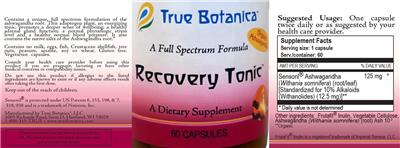
Contains a unique, full spectrum formulation of the ashwagandha root. This adaptogen plant, an energizing tonic, promotes a deeper sense of wellbeing; a healthy adrenal gland function; a normal physiologic stress level and a healthy normal blood pressure. It also contains the native salts of the ashwagandha root.
Organic ashwagandha
Formulation
Contains no milk, eggs, fish, crustacean shellfish, tree nuts, peanuts, sesame, soy or wheat. Gluten free.
Vegetarian capsules.
A full spectrum formula
Organic ashwagandha
Precautions
Consult your health care provider before using this product if you are pregnant, lactating or have other medical concerns or compatibility issues.
Do not use this product if allergies to the listed ingredients are known to exist or if any adverse effects result after taking the first dose.
Keep out of the reach of children.
Brand IP Statement(s)
Sensoril is protected under US Patents 6,153,198, & 7,318,938 and is a trademark of Natreon, Inc.
FrutaFit-Inulin is a registered trademark of Imperial-Sensus, LLC
FDA Disclaimer Statement
These statements have not been evaluated by the FDA. This product is not intended to diagnose, treat, cure or prevent any disease.
FDA Statement of Identity
A Dietary Supplement
Suggested/Recommended/Usage/Directions
Suggested usage: One capsule twice daily or as suggested by your health care provider.
Is this label outdated? Report a formula or label change and our pharmacy team will review it.
Recovery Tonic by True Botanica label
The label scan from the NIH Dietary Supplement Label Database. Tap to enlarge.
Label images are published by the NIH Dietary Supplement Label Database for the version of this product on file. Always read your actual product label.
View the full label (PDF)The Ingredients in Recovery Tonic by True Botanica
This is the 1 active ingredient this product is made of. Select it to open its full monograph.
Serving size1 Capsule(s) Dosage formCapsule Servings per container60 Amounts shown are per serving.
Sensoril
Interacts with1,372 drugs
Ashwagandha is an Ayurvedic herb most often taken to help with stress, anxiety, and sleep, and some small studies suggest it may help, though the evid...
Sensoril monograph & interactions- › Withanolides
Other (inactive) ingredients: Frutafit, Cellulose, Ashwagandha. These complete the product’s ingredient list but are not active constituents.
Recovery Tonic by True Botanica Drug Interactions
Recovery Tonic contains a single active ingredient, and it has known interactions with 1,372 medications. Here’s the picture, then you can look up your own drug.
Want to check YOUR meds against Recovery Tonic?
Ask about interactions with your drugs in plain English — “Can I take it with lisinopril?” — and we find you the answer in seconds, ingredient by ingredient.
Go to the checkerIngredients driving the most interactions
Individual Drug Interactions
The ingredients in Recovery Tonic interact with 1,372 drugs. Click any drug to see the details.
1 of the 1 ingredient in Recovery Tonic interact with drugs. Each result below shows which ingredient is responsible. Sensoril
AlogliptinNesina
How Alogliptin interacts with Recovery Tonic — through 1 ingredient. Tap an ingredient for the detail:
SensorilHepatotoxic Drugs, Cytochrome P450 3a4 (cyp3a4) Substrates +1 Moderate
Interaction Summary
Theoretically, taking ashwagandha with hepatotoxic drugs might increase the risk of liver damage.
Read the full Sensoril + Alogliptin interactionAlogliptin, MetforminKazano
How Alogliptin, Metformin interacts with Recovery Tonic — through 1 ingredient. Tap an ingredient for the detail:
SensorilAntidiabetes Drugs Moderate
Interaction Summary
Theoretically, taking ashwagandha with antidiabetes drugs might increase the risk of hypoglycemia.
Read the full Sensoril + Alogliptin, Metformin interactionAlogliptin, PioglitazoneOseni
How Alogliptin, Pioglitazone interacts with Recovery Tonic — through 1 ingredient. Tap an ingredient for the detail:
SensorilAntidiabetes Drugs, Hepatotoxic Drugs +1 Moderate
Interaction Summary
Theoretically, taking ashwagandha with antidiabetes drugs might increase the risk of hypoglycemia.
Read the full Sensoril + Alogliptin, Pioglitazone interactionAlprazolamNiravam, Xanax
How Alprazolam interacts with Recovery Tonic — through 1 ingredient. Tap an ingredient for the detail:
SensorilBenzodiazepines, Cytochrome P450 3a4 (cyp3a4) Substrates +1 Moderate
Interaction Summary
Theoretically, taking ashwagandha might increase the sedative effects of benzodiazepines.
Read the full Sensoril + Alprazolam interactionAluminum Hydroxide, Aspirin, Codeine Phosphate, Magnesium HydroxideAscriptin Codeine #2
How Aluminum Hydroxide, Aspirin, Codeine Phosphate, Magnesium Hydroxide interacts with Recovery Tonic — through 1 ingredient. Tap an ingredient for the detail:
SensorilCns Depressants Moderate
Interaction Summary
Theoretically, taking ashwagandha might increase the sedative effects of CNS depressants.
Read the full Sensoril + Aluminum Hydroxide, Aspirin, Codeine Phosphate, Magnesium Hydroxide interactionAmbrisentanLetairis, Volibris
How Ambrisentan interacts with Recovery Tonic — through 1 ingredient. Tap an ingredient for the detail:
SensorilCytochrome P450 3a4 (cyp3a4) Substrates, Antihypertensive Drugs +1 Moderate
Interaction Summary
Theoretically, ashwagandha might decrease the levels and clinical effects of CYP3A4 substrates.
Read the full Sensoril + Ambrisentan interactionAmilorideAmilamont, Midamor
How Amiloride interacts with Recovery Tonic — through 1 ingredient. Tap an ingredient for the detail:
SensorilAntihypertensive Drugs Moderate
Interaction Summary
Theoretically, taking ashwagandha with antihypertensive drugs might increase the risk of hypotension.
Read the full Sensoril + Amiloride interactionAmiloride, HydrochlorothiazideAmil-Co, Amilzide, Moduret 25, Moduretic
How Amiloride, Hydrochlorothiazide interacts with Recovery Tonic — through 1 ingredient. Tap an ingredient for the detail:
SensorilAntihypertensive Drugs Moderate
Interaction Summary
Theoretically, taking ashwagandha with antihypertensive drugs might increase the risk of hypotension.
Read the full Sensoril + Amiloride, Hydrochlorothiazide interactionAminoglutethimideCytadren
How Aminoglutethimide interacts with Recovery Tonic — through 1 ingredient. Tap an ingredient for the detail:
SensorilCns Depressants Moderate
Interaction Summary
Theoretically, taking ashwagandha might increase the sedative effects of CNS depressants.
Read the full Sensoril + Aminoglutethimide interactionAminophylline, Amobarbital, EphedrineAmesec
How Aminophylline, Amobarbital, Ephedrine interacts with Recovery Tonic — through 1 ingredient. Tap an ingredient for the detail:
SensorilCns Depressants Moderate
Interaction Summary
Theoretically, taking ashwagandha might increase the sedative effects of CNS depressants.
Read the full Sensoril + Aminophylline, Amobarbital, Ephedrine interactionAminosalicylic AcidPaser
How Aminosalicylic Acid interacts with Recovery Tonic — through 1 ingredient. Tap an ingredient for the detail:
SensorilHepatotoxic Drugs Moderate
Interaction Summary
Theoretically, taking ashwagandha with hepatotoxic drugs might increase the risk of liver damage.
Read the full Sensoril + Aminosalicylic Acid interactionAmiodaroneCordarone, Pacerone
How Amiodarone interacts with Recovery Tonic — through 1 ingredient. Tap an ingredient for the detail:
SensorilHepatotoxic Drugs, Cytochrome P450 3a4 (cyp3a4) Substrates Moderate
Interaction Summary
Theoretically, taking ashwagandha with hepatotoxic drugs might increase the risk of liver damage.
Read the full Sensoril + Amiodarone interactionAmitriptylineElavil
How Amitriptyline interacts with Recovery Tonic — through 1 ingredient. Tap an ingredient for the detail:
SensorilCytochrome P450 3a4 (cyp3a4) Substrates, Cytochrome P450 1a2 (cyp1a2) Substrates +2 Moderate
Interaction Summary
Theoretically, ashwagandha might decrease the levels and clinical effects of CYP3A4 substrates.
Read the full Sensoril + Amitriptyline interactionAmitriptyline, ChlordiazepoxideLimbitrol DS
How Amitriptyline, Chlordiazepoxide interacts with Recovery Tonic — through 1 ingredient. Tap an ingredient for the detail:
SensorilSerotonergic Drugs, Cytochrome P450 1a2 (cyp1a2) Substrates +3 Moderate
Interaction Summary
Some animal studies have reported that ashwagandha can enhance serotonergic transmission by altering certain serotonin (5-HT) receptors.
Read the full Sensoril + Amitriptyline, Chlordiazepoxide interactionAmitriptyline, PerphenazineEtrafon, Etrafon-A, Etrafon-Forte, Triavil
How Amitriptyline, Perphenazine interacts with Recovery Tonic — through 1 ingredient. Tap an ingredient for the detail:
SensorilCns Depressants, Serotonergic Drugs +2 Moderate
Interaction Summary
Theoretically, taking ashwagandha might increase the sedative effects of CNS depressants.
Read the full Sensoril + Amitriptyline, Perphenazine interactionAmlodipineNorliqva
How Amlodipine interacts with Recovery Tonic — through 1 ingredient. Tap an ingredient for the detail:
SensorilAntihypertensive Drugs, Cytochrome P450 3a4 (cyp3a4) Substrates Moderate
Interaction Summary
Theoretically, taking ashwagandha with antihypertensive drugs might increase the risk of hypotension.
Read the full Sensoril + Amlodipine interactionAmlodipine BenzoateKaterzia
How Amlodipine Benzoate interacts with Recovery Tonic — through 1 ingredient. Tap an ingredient for the detail:
SensorilCytochrome P450 3a4 (cyp3a4) Substrates, Antihypertensive Drugs Moderate
Interaction Summary
Theoretically, ashwagandha might decrease the levels and clinical effects of CYP3A4 substrates.
Read the full Sensoril + Amlodipine Benzoate interactionAmlodipine BesilateIstin
How Amlodipine Besilate interacts with Recovery Tonic — through 1 ingredient. Tap an ingredient for the detail:
SensorilAntihypertensive Drugs, Cytochrome P450 3a4 (cyp3a4) Substrates Moderate
Interaction Summary
Theoretically, taking ashwagandha with antihypertensive drugs might increase the risk of hypotension.
Read the full Sensoril + Amlodipine Besilate interactionAmlodipine BesylateNorvasc
How Amlodipine Besylate interacts with Recovery Tonic — through 1 ingredient. Tap an ingredient for the detail:
SensorilAntihypertensive Drugs, Cytochrome P450 3a4 (cyp3a4) Substrates Moderate
Interaction Summary
Theoretically, taking ashwagandha with antihypertensive drugs might increase the risk of hypotension.
Read the full Sensoril + Amlodipine Besylate interactionAmlodipine Besylate, BenazeprilLotrel
How Amlodipine Besylate, Benazepril interacts with Recovery Tonic — through 1 ingredient. Tap an ingredient for the detail:
SensorilCytochrome P450 3a4 (cyp3a4) Substrates, Antihypertensive Drugs Moderate
Interaction Summary
Theoretically, ashwagandha might decrease the levels and clinical effects of CYP3A4 substrates.
Read the full Sensoril + Amlodipine Besylate, Benazepril interactionAmlodipine, CelecoxibConsensi
How Amlodipine, Celecoxib interacts with Recovery Tonic — through 1 ingredient. Tap an ingredient for the detail:
SensorilAntihypertensive Drugs, Cytochrome P450 3a4 (cyp3a4) Substrates Moderate
Interaction Summary
Theoretically, taking ashwagandha with antihypertensive drugs might increase the risk of hypotension.
Read the full Sensoril + Amlodipine, Celecoxib interactionAmmonium ChlorideAmmonium Chloride
How Ammonium Chloride interacts with Recovery Tonic — through 1 ingredient. Tap an ingredient for the detail:
SensorilAntihypertensive Drugs Moderate
Interaction Summary
Theoretically, taking ashwagandha with antihypertensive drugs might increase the risk of hypotension.
Read the full Sensoril + Ammonium Chloride interactionAmobarbitalAmytal
How Amobarbital interacts with Recovery Tonic — through 1 ingredient. Tap an ingredient for the detail:
SensorilCns Depressants Moderate
Interaction Summary
Theoretically, taking ashwagandha might increase the sedative effects of CNS depressants.
Read the full Sensoril + Amobarbital interactionAmobarbital, Ephedrine SulfateEphedrine & Amytal
How Amobarbital, Ephedrine Sulfate interacts with Recovery Tonic — through 1 ingredient. Tap an ingredient for the detail:
SensorilCns Depressants Moderate
Interaction Summary
Theoretically, taking ashwagandha might increase the sedative effects of CNS depressants.
Read the full Sensoril + Amobarbital, Ephedrine Sulfate interactionAmobarbital, SecobarbitalTuinal
How Amobarbital, Secobarbital interacts with Recovery Tonic — through 1 ingredient. Tap an ingredient for the detail:
SensorilCns Depressants Moderate
Interaction Summary
Theoretically, taking ashwagandha might increase the sedative effects of CNS depressants.
Read the full Sensoril + Amobarbital, Secobarbital interactionAmoxicillinAmix, Amoram, Amoxident, Amoxil Capsules, Amoxil Injection, Galenamox +3 more
How Amoxicillin interacts with Recovery Tonic — through 1 ingredient. Tap an ingredient for the detail:
SensorilHepatotoxic Drugs Moderate
Interaction Summary
Theoretically, taking ashwagandha with hepatotoxic drugs might increase the risk of liver damage.
Read the full Sensoril + Amoxicillin interactionAmoxicillin VeterinaryBiomox
How Amoxicillin Veterinary interacts with Recovery Tonic — through 1 ingredient. Tap an ingredient for the detail:
SensorilHepatotoxic Drugs Moderate
Interaction Summary
Theoretically, taking ashwagandha with hepatotoxic drugs might increase the risk of liver damage.
Read the full Sensoril + Amoxicillin Veterinary interactionAmoxicillin, Clavulanate PotassiumAugmentin, Augmentin '125/31 SF', Augmentin '250/62 SF', Augmentin XR, Augmentin-Duo 400/57, Clavulin
How Amoxicillin, Clavulanate Potassium interacts with Recovery Tonic — through 1 ingredient. Tap an ingredient for the detail:
SensorilHepatotoxic Drugs Moderate
Interaction Summary
Theoretically, taking ashwagandha with hepatotoxic drugs might increase the risk of liver damage.
Read the full Sensoril + Amoxicillin, Clavulanate Potassium interactionAmoxicillin, Omeprazole Magnesium, RifabutinTalicia
How Amoxicillin, Omeprazole Magnesium, Rifabutin interacts with Recovery Tonic — through 1 ingredient. Tap an ingredient for the detail:
SensorilCytochrome P450 3a4 (cyp3a4) Substrates, Hepatotoxic Drugs Moderate
Interaction Summary
Theoretically, ashwagandha might decrease the levels and clinical effects of CYP3A4 substrates.
Read the full Sensoril + Amoxicillin, Omeprazole Magnesium, Rifabutin interactionAmphotericin, TetracyclineMysteclin-F
How Amphotericin, Tetracycline interacts with Recovery Tonic — through 1 ingredient. Tap an ingredient for the detail:
SensorilHepatotoxic Drugs Moderate
Interaction Summary
Theoretically, taking ashwagandha with hepatotoxic drugs might increase the risk of liver damage.
Read the full Sensoril + Amphotericin, Tetracycline interactionEach ingredient & the kinds of drugs it affects
For each ingredient in Recovery Tonic with known interactions, here are the types of medications it can affect. Open any type for the detail — or search your exact drug in the checker above.
Sensoril
Antidiabetes Drugs
Theoretically, taking ashwagandha with antidiabetes drugs might increase the risk of hypoglycemia.
There is preliminary clinical evidence suggesting that ashwagandha might lower blood glucose levels. Theoretically, ashwagandha might have additive effects when used with antidiabetes drugs and increase the risk of hypoglycemia.
Antihypertensive Drugs
Theoretically, taking ashwagandha with antihypertensive drugs might increase the risk of hypotension.
Animal research suggests that ashwagandha might lower systolic and diastolic blood pressure. Theoretically, ashwagandha might have additive effects when used with antihypertensive drugs and increase the risk of hypotension.
Benzodiazepines
Theoretically, taking ashwagandha might increase the sedative effects of benzodiazepines.
There is preliminary evidence that ashwagandha might have an additive effect with diazepam (Valium) and clonazepam (Klonopin). This may also occur with other benzodiazepines.
Cns Depressants
Theoretically, taking ashwagandha might increase the sedative effects of CNS depressants.
Ashwagandha seems to have sedative effects. Theoretically, this may potentiate the effects of barbiturates, other sedatives, and anxiolytics.
Hepatotoxic Drugs
Theoretically, taking ashwagandha with hepatotoxic drugs might increase the risk of liver damage.
Ashwagandha has been linked to cases of acute hepatitis, liver failure, hepatic encephalopathy, autoimmune hepatitis, the need for liver transplantation, and death due to liver failure.
Immunosuppressants
Theoretically, taking ashwagandha might decrease the effects of immunosuppressants.
Ashwagandha has demonstrated immunostimulant effects in humans. Animal research has shown that ashwagandha can attenuate the immunosuppression caused by cyclophosphamide.
Thyroid Hormone
Ashwagandha might increase the effects and adverse effects of thyroid hormone.
Concomitant use of ashwagandha with thyroid hormones may cause additive therapeutic and adverse effects. Preliminary clinical research and animal studies suggest that ashwagandha boosts thyroid hormone synthesis and secretion. In one clinical study, ashwagandha increased triiodothyronine (T3) and thyroxine (T4) levels by 41.5% and 19.6%, respectively, and reduced serum TSH levels by 17.4% from baseline in adults with subclinical hypothyroidism.
Cytochrome P450 1A2 (Cyp1A2) Substrates
Theoretically, ashwagandha might decrease the levels and clinical effects of CYP1A2 substrates.
In vitro research shows that ashwagandha extract induces CYP1A2 enzymes.
Cytochrome P450 3A4 (Cyp3A4) Substrates
Theoretically, ashwagandha might decrease the levels and clinical effects of CYP3A4 substrates.
In vitro research shows that ashwagandha extract induces CYP3A4 enzymes.
Serotonergic Drugs
Some animal studies have reported that ashwagandha can enhance serotonergic transmission by altering certain serotonin (5-HT) receptors. However, there is no evidence to suggest that ashwagandha increases the risk of serotonin-related effects, and there have been no published case reports of serotonin syndrome when combined with other serotonergic drugs. Nevertheless, due to the lack of extensive studies on the matter and the fact that ashwagandha appears to affect serotonergic pathways, it would be prudent to exercise caution when combining it with drugs that affect serotonin. [References: - Effects of Withania somnifera (Ashwaga ndha) on Stress and the Stress-Related Neuropsychiatric Disorders Anxiety, Depression, and Insomnia. Curr Neuropharmacol. 2021 Sep 14; 19: 1468–1495. - A Prospective, Randomized Double-Blind, Placebo-Controlled Study of Safety and Efficacy of a High-Concentration Full-Spectrum Extract of Ashwagandha Root in Reducing Stress and Anxiety in Adults. https://www.ncbi.nlm.nih.gov/pmc/articles/PMC3573577/]
Brand information
Manufacturer and brand details for Recovery Tonic, from the product label.
True Botanica
See all True Botanica products- Name
- True Botanica, LLC
- Street Address
- 1005 Richards Road, Suite D
- City
- Hartland
- State
- WI
- ZipCode
- 53029
- Phone Number
- 1-800-315-8783
- Web Address
- www.truebotanica.com
Recovery Tonic by True Botanica: Common Questions
Does Recovery Tonic by True Botanica interact with any medications?
How can one product interact with so many drugs?
Where does this information come from?
Written and reviewed by the HelloPharmacist editorial staff. Our editorial policy
Not sure if Recovery Tonic is safe with your meds?
Our pharmacists answer your medication & supplement questions — free.
Label information is sourced from the NIH Dietary Supplement Label Database and reflects the product version on file; always read your actual product label. This page is for education only and is not a substitute for professional medical advice. Confirm with your pharmacist or doctor before combining supplements and medications.
The Full Monographs Behind Recovery Tonic’s Ingredients
Every ingredient we hold a full HelloPharmacist monograph for — uses, evidence, safety, and the complete interaction list.
Sources & How We Checked
Recovery Tonic's label data comes from the NIH Dietary Supplement Label Database; the ingredient interaction data is from the Natural Medicines database, reviewed by our pharmacists.
- NIH Dietary Supplement Label Database (DSLD) — The official product label on file for this supplement.
- Natural Medicines (Therapeutic Research Center) — Evidence-graded clinical reference behind the ingredient interaction data.
Content is written and reviewed by licensed HelloPharmacist pharmacists. See our data sources and editorial standards for how this information is built and checked.
The 32 references behind this product’s interaction data
Every citation that drives the interaction findings for this product’s ingredients, from the evidence-graded Natural Medicines (TRC Healthcare) database. Open an ingredient to browse its citations — links open the study on PubMed or the publisher’s site.
Ashwagandha 32 references
- McGuffin M, Hobbs C, Upton R, Goldberg A, eds. American Herbal Products Association's Botanical Safety Handbook. Boca Raton, FL: CRC Press, LLC 1997.
- Upton R, ed. Ashwagandha Root (Withania somnifera): Analytical, quality control, and therapuetic monograph. Santa Cruz, CA: American Herbal Pharmacopoeia 2000:1-25.
- Davis L, Kuttan G. Effect of Withania somnifera on cyclophosphamide-induced urotoxicity. Cancer Lett 2000;148:9-17. PubMed
- Davis L, Kuttan G. Suppressive effect of cyclophosphamide-induced toxicity by Withania somnifera extract in mice. J Ethnopharmacol 1998;62:209-14. PubMed
- Mishra LC, Singh BB, Dagenais S. Scientific basis for the therapeutic use of Withania somnifera (ashwagandha): a review. Altern Med Rev 2000;5:334-46. DOI
- Andallu B, Radhika B. Hypoglycemic, diuretic and hypocholesterolemic effect of winter cherry (Withania somnifera, Dunal) root. Indian J Exp Biol 2000;38:607-9.
- Kulkarni RR, Patki PS, Jog VP, et al. Treatment of osteoarthritis with a herbomineral formulation: a double-blind, placebo-controlled, cross-over study. J Ethnopharmacol 1991;33:91-5. PubMed
- Ahumada F, Aspee F, Wikman G, Hancke J. Withania somnifera exract. Its effects on arterial blood pressure in anaesthetized dogs. Phytother Res 1991;5:111-14.
- Panda S, Kar A. Withania somnifera and Bauhinia purpurea in the regulation of circulating thyroid hormone concentrations in female mice. J Ethnopharmacol 1999;67:233-39. PubMed
- Panda S, Kar A. Changes in thyroid hormone concentrations after administration of ashwagandha root extract to adult male mice. J Pharm Pharmacol 1998;50:1065-68. PubMed
- Sehgal, V. N., Verma, P., and Bhattacharya, S. N. Fixed-drug eruption caused by ashwagandha (Withania somnifera): a widely used Ayurvedic drug. Skinmed. 2012;10(1):48-49.
- Agnihotri AP, Sontakke SD, Thawani VR, Saoji A, Goswami VS. Effects of Withania somnifera in patients of schizophrenia: a randomized, double blind, placebo controlled pilot trial study. Indian J Pharmacol. 2013;45(4):417-8. PubMed
- Biswal BM, Sulaiman SA, Ismail HC, Zakaria H, Musa KI. Effect of Withania somnifera (Ashwagandha) on the development of chemotherapy-induced fatigue and quality of life in breast cancer patients. Integr Cancer Ther. 2013;12(4):312-22.
- Sharma AK, Basu I, Singh S. Efficacy and safety of Ashwagandha root extract in subclinical hypothyroid patients: a double-blind, randomized placebo-controlled trial. J Altern Complement Med. 2018 Mar;24(3):243-248. PubMed
- Durg S, Bavage S, Shivaram SB. Withania somnifera (Indian ginseng) in diabetes mellitus: A systematic review and meta-analysis of scientific evidence from experimental research to clinical application. Phytother Res. 2020;34(5):1041-1059.
- Björnsson HK, Björnsson ES, Avula B, et al. Ashwagandha-induced liver injury: A case series from Iceland and the US Drug-Induced Liver Injury Network. Liver Int. 2020;40(4):825-829. PubMed
- Tharakan A, Shukla H, Benny IR, Tharakan M, George L, Koshy S. Immunomodulatory Effect of Withania somnifera (Ashwagandha) Extract-A Randomized, Double-Blind, Placebo Controlled Trial with an Open Label Extension on Healthy Participants. J Clin Med 2021;1 PubMed
- Ireland PJ, Hardy T, Burt AD, Donnelly MC. Drug-induced hepatocellular injury due to herbal supplement ashwagandha. J R Coll Physicians Edinb. 2021;51(4):363-365. PubMed
- Kamal HI, Patel K, Brdak A, Heffernan J, Ahmad N. Ashwagandha as a unique cause of thyrotoxicosis presenting with supraventricular tachycardia. Cureus. 2022 Mar 25;14(3):e23494. PubMed
- Suryawanshi G, Abdallah M, Thomson M, Desai N, Chauhan A, Lim N. Ashwagandha-Associated Acute Liver Failure Requiring Liver Transplantation. Am J Ther 2023;30(1):e80-e83. PubMed
- Pusec CM, Wolsky R, Llerena C, Sura P. A Case of Supplement-Induced Hepatitis. Cureus 2022;14(10):e30433. PubMed
- Ajgaonkar A, Jain M, Debnath K. Efficacy and Safety of Ashwagandha (Withania somnifera) Root Extract for Improvement of Sexual Health in Healthy Women: A Prospective, Randomized, Placebo-Controlled Study. Cureus 2022;14(10):e30787. PubMed
- Haron MH, Dale O, Martin K, et al. Evaluation of the Herb-Drug Interaction Potential of Commonly Used Botanicals on the US Market with Regard to PXR- and AhR-Mediated Influences on CYP3A4 and CYP1A2. J Diet Suppl 2022. PubMed
- Lubarska M, Halasinski P, Hryhorowicz S, et al. Liver Dangers of Herbal Products: A Case Report of Ashwagandha-Induced Liver Injury. Int J Environ Res Public Health 2023;20(5):3921. PubMed
- Tóth M, Benedek AE, Longerich T, Seitz HK. Ashwagandha-induced acute liver injury: A case report. Clin Case Rep 2023;11(3):e7078.
- Bokan G, Glamocanin T, Mavija Z, et al. Herb-Induced Liver Injury by Ayurvedic Ashwagandha as Assessed for Causality by the Updated RUCAM: An Emerging Cause. Pharmaceuticals (Basel) 2023;16(8):1129. PubMed
- Patel PA, Sanborn E, Then R, Williams DM. Recurrent Reversible Cerebral Vasoconstriction Syndrome: A Report of Two Cases. Cureus 2023;15(8):e42992. PubMed
- Majeed M, Nagabhushanam K, Murali A, Vishwanathan DT, Mamidala RV, Mundkur L. A Standardized Withania somniferra (Linn.) Root Extract with Piperine Alleviates the Symptoms of Anxiety and Depression by Increasing Serotonin Levels: A Double-Blind, Randomize
- Philips CA, Valsan A, Theruvath AH, et al. Ashwagandha-induced liver injury-A case series from India and literature review. Hepatol Commun 2023;7(10):e0270. PubMed
- Hayashi M, Hamada H, Azuma SI, Hayashi K. Painless Thyroiditis by Withania somnifera (Ashwagandha). Cureus 2024;16(3):e55352. PubMed
- Vazirani S, Kothari A, Fujimoto J, Gomez M. Supplements Are Not a Synonym for Safe: Suspected Liver Injury From Ashwagandha. Fed Pract 2023;40(9):315-319. PubMed
- Patel M, Newell R, Hillier M, Ramalingam R. Herbal remedies as a potential cause of hypoadrenalism. Br J Hosp Med (Lond) 2024;85(6):1-4. PubMed
Parts of this content are provided by the Therapeutic Research Center, LLC.
DISCLAIMER: Currently this does not check for drug-drug interactions. This is not an all-inclusive comprehensive list of potential interactions and is for informational purposes only. Not all interactions are known or well-reported in the scientific literature, and new interactions are continually being reported. Input is needed from a qualified healthcare provider including a pharmacist before starting any therapy. Application of clinical judgment is necessary.
© 2021 Therapeutic Research Center, LLC