
Sesame Seed Oil Ingredients & Drug Interactions
What is this page for?
First and foremost: checking Sesame Seed Oil against your medications. The heart of this page is the interaction checker and the full interaction report — how this product’s ingredients may interact with prescription and over-the-counter medicines you may be taking.
Around that, we add a pharmacist’s high-level view of the product as a whole — what’s inside, the evidence for its stated use, how transparent the label is, and what safety data exists — so you can see the full picture in one place. It’s educational information from our licensed clinical databases and the clinical staff at HelloPharmacist — not medical advice — and we don’t sell or endorse products. Our editorial policy
Sesame Seed Oil is a dietary supplement by SP Standard Process with 1 active ingredient. Its ingredients are commonly taken for heart and cholesterol health, blood pressure support, source of healthy fats and minerals.Based on those ingredients, 528 medications have a known interaction with it, the most serious rated moderate. The ingredients most likely to interact are Sesame Seed Oil. Use the checker below to test your specific medication, or read the full HelloPharmacist Interaction Report.
Check Your Meds Against Sesame Seed Oil by SP Standard Process
Ask about any prescription or over-the-counter medication and we check it for interactions with Sesame Seed Oil by SP Standard Process — and tell you which ingredient is responsible.
AI summaries are generated from our interaction database for education only — always confirm with your pharmacist. How we use AI
Ask the Pharmacist
A licensed pharmacist will answer your question by email — free, usually within 24 hours.
Got it — thank you!
A licensed pharmacist will answer within 24 hours. Keep an eye on your email (worth checking spam, just in case).
HelloPharmacist Scorecard of Sesame Seed Oil by SP Standard Process
Four independent checks of what is known — a summary of the available information, not a grade of the product itself.
By FDA rules, dietary supplements can’t claim to treat, cure, or prevent disease — so labels speak in careful marketing language. We discern each product’s intended use from its name, label claims, and label statements, then grade the clinical evidence for that use. How these ratings are computed
The stated purpose hasn't been mapped to our evidence data yet.
Why this rating?
- We haven't mapped this product's purpose to our evidence data yet — it'll be graded on the next content refresh.
Every active ingredient lists its own amount on the label.
Why this rating?
- The label discloses an exact amount for 1 of its 1 active ingredient.
- No proprietary blends here — you can verify the dose of every single component.
The most serious documented interaction for these ingredients is Moderate. Check your medications for a personalized result.
Why this rating?
- 1 of the 1 matched ingredient can interact with medications — Sesame.
- The most serious interaction on file is rated Moderate.
- Some involve high-stakes drug classes: diabetes medications.
- For scale: 528 individual medications appear in the full list. A big number alone doesn't make a product dangerous — what matters is whether YOUR medication is on it, so run yours through the interaction checker on this page.
Adverse-effect, pregnancy, and general safety data are on file for most of these ingredients.
Why this rating?
- We hold adverse-effect (side-effect) data for 1 of the 1 matched ingredient.
- Pregnancy & breastfeeding safety ratings cover 1 of 1.
- General safety write-ups exist for 1 of 1.
- Remember: this measures how much safety information exists. Thin data is not the same as being safe.
HelloPharmacist summaryFully disclosed formula with no assessable stated purpose. Moderate medication interactions have been identified, and safety information is well characterized.
Assessment coverage: 1 of 1 active ingredient matched to our full ingredient reviews (monographs). Based on the product label dated Sep 25, 2025.
This Scorecard evaluates available label information, ingredient evidence, and known medication-safety considerations. It does not independently verify product identity, purity, potency, contamination, or manufacturing quality. How these ratings are computed
General information
Key facts about Sesame Seed Oil, straight from the product label.
| Brand | SP Standard Process |
|---|---|
| Barcode (UPC) | 812122011693 |
| Net contents | 60 Softgel(s) |
| Market status | On market |
| Date entered into DSLD | Sep 25, 2025 |
| DSLD ID | 340278 |
| Product type | Fat/fatty Acid |
| Supplement form | Softgel Capsule |
| Dietary claims / uses | All Other, Structure/Function |
| Intended target group(s) | Adult (18 - 50 Years), Gluten Free |
Everything in this section is reproduced from the manufacturer’s own product label — it’s the label speaking, not HelloPharmacist. We show it so you can see exactly what the maker states; we don’t verify or endorse those statements.
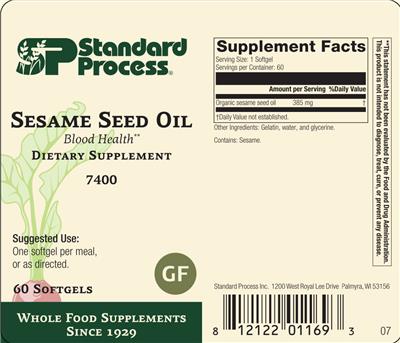
Supplement Facts
The label details for Sesame Seed Oil by SP Standard Process, sourced from the NIH Dietary Supplement Label Database.
Supplement Facts
| Ingredient | Amount | % DV |
|---|---|---|
| Sesame Seed Oil | 385 mg | -- |
Other ingredients: Gelatin, Water, Glycerin
Tap any ingredient to jump to its full detail below.
These statements are the manufacturer’s wording, reproduced from the product label — the label is saying it, not HelloPharmacist. We don’t verify or endorse them.
Formulation
Blood health
GF (gluten free)
FDA Statement of Identity
Dietary Supplement
Suggested/Recommended/Usage/Directions
Suggested use: One softgel per meal, or as directed.
General Statements
Whole food supplements since 1929
Precautions
Contains: Sesame.
FDA Disclaimer Statement
This statement has not been evaluated by the Food and Drug Administration. This product is not intended to diagnose, treat, cure, or prevent any disease.
Is this label outdated? Report a formula or label change and our pharmacy team will review it.
Sesame Seed Oil by SP Standard Process label
The label scan from the NIH Dietary Supplement Label Database. Tap to enlarge.
Label images are published by the NIH Dietary Supplement Label Database for the version of this product on file. Always read your actual product label.
View the full label (PDF)The Ingredients in Sesame Seed Oil by SP Standard Process
This is the 1 active ingredient this product is made of. Select it to open its full monograph.
Serving size1 Softgel(s) Dosage formSoftgel Capsule Servings per container60 Amounts shown are per serving.
Sesame Seed Oil
Interacts with528 drugs
Sesame is a nutritious seed and oil widely used in cooking and traditional medicine, and it provides healthy fats, fiber, and antioxidant compounds ca...
Sesame Seed Oil monograph & interactionsOther (inactive) ingredients: Gelatin, Water, Glycerin. These complete the product’s ingredient list but are not active constituents.
Sesame Seed Oil by SP Standard Process Drug Interactions
Sesame Seed Oil contains a single active ingredient, and it has known interactions with 528 medications. Here’s the picture, then you can look up your own drug.
Want to check YOUR meds against Sesame Seed Oil?
Ask about interactions with your drugs in plain English — “Can I take it with lisinopril?” — and we find you the answer in seconds, ingredient by ingredient.
Go to the checkerIngredients driving the most interactions
Individual Drug Interactions
The ingredients in Sesame Seed Oil interact with 528 drugs. Click any drug to see the details.
1 of the 1 ingredient in Sesame Seed Oil interact with drugs. Each result below shows which ingredient is responsible. Sesame Seed Oil
AbrocitinibCibinqo
How Abrocitinib interacts with Sesame Seed Oil — through 1 ingredient. Tap an ingredient for the detail:
Sesame Seed OilCytochrome P450 2c9 (cyp2c9) Substrates Moderate
Interaction Summary
Theoretically, sesame might increase the levels and clinical effects of CYP2C9 substrates.
Read the full Sesame Seed Oil + Abrocitinib interactionAcarboseGlucobay, Prandase, Precose
How Acarbose interacts with Sesame Seed Oil — through 1 ingredient. Tap an ingredient for the detail:
Sesame Seed OilAntidiabetes Drugs Moderate
Interaction Summary
Taking sesame oil with antidiabetes drugs might increase the risk of hypoglycemia.
Read the full Sesame Seed Oil + Acarbose interactionAcebutololRhotral, Sectral
How Acebutolol interacts with Sesame Seed Oil — through 1 ingredient. Tap an ingredient for the detail:
Sesame Seed OilAntihypertensive Drugs Moderate
Interaction Summary
Taking sesame oil with antihypertensive drugs might increase the risk of hypotension.
Read the full Sesame Seed Oil + Acebutolol interactionAcetaminophen, IbuprofenCombogesic
How Acetaminophen, Ibuprofen interacts with Sesame Seed Oil — through 1 ingredient. Tap an ingredient for the detail:
Sesame Seed OilCytochrome P450 2c9 (cyp2c9) Substrates Moderate
Interaction Summary
Theoretically, sesame might increase the levels and clinical effects of CYP2C9 substrates.
Read the full Sesame Seed Oil + Acetaminophen, Ibuprofen interactionAcetazolamideAk-Zol, Diamox
How Acetazolamide interacts with Sesame Seed Oil — through 1 ingredient. Tap an ingredient for the detail:
Sesame Seed OilAntihypertensive Drugs Moderate
Interaction Summary
Taking sesame oil with antihypertensive drugs might increase the risk of hypotension.
Read the full Sesame Seed Oil + Acetazolamide interactionAcetohexamideDymelor
How Acetohexamide interacts with Sesame Seed Oil — through 1 ingredient. Tap an ingredient for the detail:
Sesame Seed OilAntidiabetes Drugs Moderate
Interaction Summary
Taking sesame oil with antidiabetes drugs might increase the risk of hypoglycemia.
Read the full Sesame Seed Oil + Acetohexamide interactionAerosphere Budesonide, Formoterol Fumarate, GlycopyrrolateBreztri
How Aerosphere Budesonide, Formoterol Fumarate, Glycopyrrolate interacts with Sesame Seed Oil — through 1 ingredient. Tap an ingredient for the detail:
Sesame Seed OilCytochrome P450 2c9 (cyp2c9) Substrates Moderate
Interaction Summary
Theoretically, sesame might increase the levels and clinical effects of CYP2C9 substrates.
Read the full Sesame Seed Oil + Aerosphere Budesonide, Formoterol Fumarate, Glycopyrrolate interactionAgomelatineValdoxan
How Agomelatine interacts with Sesame Seed Oil — through 1 ingredient. Tap an ingredient for the detail:
Sesame Seed OilCytochrome P450 2c9 (cyp2c9) Substrates Moderate
Interaction Summary
Theoretically, sesame might increase the levels and clinical effects of CYP2C9 substrates.
Read the full Sesame Seed Oil + Agomelatine interactionAlbiglutideTanzeum
How Albiglutide interacts with Sesame Seed Oil — through 1 ingredient. Tap an ingredient for the detail:
Sesame Seed OilAntidiabetes Drugs Moderate
Interaction Summary
Taking sesame oil with antidiabetes drugs might increase the risk of hypoglycemia.
Read the full Sesame Seed Oil + Albiglutide interactionAliskirenTekturna
How Aliskiren interacts with Sesame Seed Oil — through 1 ingredient. Tap an ingredient for the detail:
Sesame Seed OilAntihypertensive Drugs Moderate
Interaction Summary
Taking sesame oil with antihypertensive drugs might increase the risk of hypotension.
Read the full Sesame Seed Oil + Aliskiren interactionAlogliptinNesina
How Alogliptin interacts with Sesame Seed Oil — through 1 ingredient. Tap an ingredient for the detail:
Sesame Seed OilAntidiabetes Drugs Moderate
Interaction Summary
Taking sesame oil with antidiabetes drugs might increase the risk of hypoglycemia.
Read the full Sesame Seed Oil + Alogliptin interactionAlogliptin, MetforminKazano
How Alogliptin, Metformin interacts with Sesame Seed Oil — through 1 ingredient. Tap an ingredient for the detail:
Sesame Seed OilAntidiabetes Drugs Moderate
Interaction Summary
Taking sesame oil with antidiabetes drugs might increase the risk of hypoglycemia.
Read the full Sesame Seed Oil + Alogliptin, Metformin interactionAlogliptin, PioglitazoneOseni
How Alogliptin, Pioglitazone interacts with Sesame Seed Oil — through 1 ingredient. Tap an ingredient for the detail:
Sesame Seed OilAntidiabetes Drugs Moderate
Interaction Summary
Taking sesame oil with antidiabetes drugs might increase the risk of hypoglycemia.
Read the full Sesame Seed Oil + Alogliptin, Pioglitazone interactionAmbrisentanLetairis, Volibris
How Ambrisentan interacts with Sesame Seed Oil — through 1 ingredient. Tap an ingredient for the detail:
Sesame Seed OilP-glycoprotein Substrates, Antihypertensive Drugs Moderate
Interaction Summary
Theoretically, sesame might alter the transport of P-glycoprotein substrates.
Read the full Sesame Seed Oil + Ambrisentan interactionAmilorideAmilamont, Midamor
How Amiloride interacts with Sesame Seed Oil — through 1 ingredient. Tap an ingredient for the detail:
Sesame Seed OilAntihypertensive Drugs Moderate
Interaction Summary
Taking sesame oil with antihypertensive drugs might increase the risk of hypotension.
Read the full Sesame Seed Oil + Amiloride interactionAmiloride, HydrochlorothiazideAmil-Co, Amilzide, Moduret 25, Moduretic
How Amiloride, Hydrochlorothiazide interacts with Sesame Seed Oil — through 1 ingredient. Tap an ingredient for the detail:
Sesame Seed OilAntihypertensive Drugs Moderate
Interaction Summary
Taking sesame oil with antihypertensive drugs might increase the risk of hypotension.
Read the full Sesame Seed Oil + Amiloride, Hydrochlorothiazide interactionAmitriptylineElavil
How Amitriptyline interacts with Sesame Seed Oil — through 1 ingredient. Tap an ingredient for the detail:
Sesame Seed OilCytochrome P450 2c9 (cyp2c9) Substrates Moderate
Interaction Summary
Theoretically, sesame might increase the levels and clinical effects of CYP2C9 substrates.
Read the full Sesame Seed Oil + Amitriptyline interactionAmitriptyline, ChlordiazepoxideLimbitrol DS
How Amitriptyline, Chlordiazepoxide interacts with Sesame Seed Oil — through 1 ingredient. Tap an ingredient for the detail:
Sesame Seed OilCytochrome P450 2c9 (cyp2c9) Substrates Moderate
Interaction Summary
Theoretically, sesame might increase the levels and clinical effects of CYP2C9 substrates.
Read the full Sesame Seed Oil + Amitriptyline, Chlordiazepoxide interactionAmitriptyline, PerphenazineEtrafon, Etrafon-A, Etrafon-Forte, Triavil
How Amitriptyline, Perphenazine interacts with Sesame Seed Oil — through 1 ingredient. Tap an ingredient for the detail:
Sesame Seed OilCytochrome P450 2c9 (cyp2c9) Substrates Moderate
Interaction Summary
Theoretically, sesame might increase the levels and clinical effects of CYP2C9 substrates.
Read the full Sesame Seed Oil + Amitriptyline, Perphenazine interactionAmlodipineNorliqva
How Amlodipine interacts with Sesame Seed Oil — through 1 ingredient. Tap an ingredient for the detail:
Sesame Seed OilAntihypertensive Drugs Moderate
Interaction Summary
Taking sesame oil with antihypertensive drugs might increase the risk of hypotension.
Read the full Sesame Seed Oil + Amlodipine interactionAmlodipine BenzoateKaterzia
How Amlodipine Benzoate interacts with Sesame Seed Oil — through 1 ingredient. Tap an ingredient for the detail:
Sesame Seed OilAntihypertensive Drugs Moderate
Interaction Summary
Taking sesame oil with antihypertensive drugs might increase the risk of hypotension.
Read the full Sesame Seed Oil + Amlodipine Benzoate interactionAmlodipine BesilateIstin
How Amlodipine Besilate interacts with Sesame Seed Oil — through 1 ingredient. Tap an ingredient for the detail:
Sesame Seed OilAntihypertensive Drugs Moderate
Interaction Summary
Taking sesame oil with antihypertensive drugs might increase the risk of hypotension.
Read the full Sesame Seed Oil + Amlodipine Besilate interactionAmlodipine BesylateNorvasc
How Amlodipine Besylate interacts with Sesame Seed Oil — through 1 ingredient. Tap an ingredient for the detail:
Sesame Seed OilAntihypertensive Drugs Moderate
Interaction Summary
Taking sesame oil with antihypertensive drugs might increase the risk of hypotension.
Read the full Sesame Seed Oil + Amlodipine Besylate interactionAmlodipine Besylate, BenazeprilLotrel
How Amlodipine Besylate, Benazepril interacts with Sesame Seed Oil — through 1 ingredient. Tap an ingredient for the detail:
Sesame Seed OilAntihypertensive Drugs Moderate
Interaction Summary
Taking sesame oil with antihypertensive drugs might increase the risk of hypotension.
Read the full Sesame Seed Oil + Amlodipine Besylate, Benazepril interactionAmlodipine, CelecoxibConsensi
How Amlodipine, Celecoxib interacts with Sesame Seed Oil — through 1 ingredient. Tap an ingredient for the detail:
Sesame Seed OilAntihypertensive Drugs, Cytochrome P450 2c9 (cyp2c9) Substrates Moderate
Interaction Summary
Taking sesame oil with antihypertensive drugs might increase the risk of hypotension.
Read the full Sesame Seed Oil + Amlodipine, Celecoxib interactionAmmonium ChlorideAmmonium Chloride
How Ammonium Chloride interacts with Sesame Seed Oil — through 1 ingredient. Tap an ingredient for the detail:
Sesame Seed OilAntihypertensive Drugs Moderate
Interaction Summary
Taking sesame oil with antihypertensive drugs might increase the risk of hypotension.
Read the full Sesame Seed Oil + Ammonium Chloride interactionAmoxicillin, Omeprazole Magnesium, RifabutinTalicia
How Amoxicillin, Omeprazole Magnesium, Rifabutin interacts with Sesame Seed Oil — through 1 ingredient. Tap an ingredient for the detail:
Sesame Seed OilCytochrome P450 2c9 (cyp2c9) Substrates Moderate
Interaction Summary
Theoretically, sesame might increase the levels and clinical effects of CYP2C9 substrates.
Read the full Sesame Seed Oil + Amoxicillin, Omeprazole Magnesium, Rifabutin interactionAntidiabetes, Dipeptidyl Peptidase-4 (dpp-iv) InhibitorGlyxambi
How Antidiabetes, Dipeptidyl Peptidase-4 (dpp-iv) Inhibitor interacts with Sesame Seed Oil — through 1 ingredient. Tap an ingredient for the detail:
Sesame Seed OilP-glycoprotein Substrates, Antidiabetes Drugs Moderate
Interaction Summary
Theoretically, sesame might alter the transport of P-glycoprotein substrates.
Read the full Sesame Seed Oil + Antidiabetes, Dipeptidyl Peptidase-4 (dpp-iv) Inhibitor interactionAprocitentanTryvio
How Aprocitentan interacts with Sesame Seed Oil — through 1 ingredient. Tap an ingredient for the detail:
Sesame Seed OilAntihypertensive Drugs Moderate
Interaction Summary
Taking sesame oil with antihypertensive drugs might increase the risk of hypotension.
Read the full Sesame Seed Oil + Aprocitentan interactionAspirin, OmeprazoleYosprala
How Aspirin, Omeprazole interacts with Sesame Seed Oil — through 1 ingredient. Tap an ingredient for the detail:
Sesame Seed OilCytochrome P450 2c9 (cyp2c9) Substrates Moderate
Interaction Summary
Theoretically, sesame might increase the levels and clinical effects of CYP2C9 substrates.
Read the full Sesame Seed Oil + Aspirin, Omeprazole interactionEach ingredient & the kinds of drugs it affects
For each ingredient in Sesame Seed Oil with known interactions, here are the types of medications it can affect. Open any type for the detail — or search your exact drug in the checker above.
Sesame Seed Oil
Antidiabetes Drugs
Taking sesame oil with antidiabetes drugs might increase the risk of hypoglycemia.
Clinical studies show that sesame oil can decrease plasma glucose and glycated hemoglobin (HbA1c) levels. Some clinical research in patients taking glibenclamide shows that using sesame oil or a blend of sesame oil and rice bran oil in place of other oil for cooking reduces plasma glucose more than glibenclamide alone. Monitor blood glucose levels closely. Dose adjustments might be necessary.
Antihypertensive Drugs
Taking sesame oil with antihypertensive drugs might increase the risk of hypotension.
Clinical research shows that replacing other cooking oil with sesame oil can lower systolic blood pressure (SBP) and diastolic blood pressure (DBP) in patients with or without hypertension. There is also some evidence that sesame oil has additive effects in patients also taking atenolol, nifedipine, and/or hydrochlorothiazide. In patients using nifedipine, using a blend of sesame oil and rice bran oil for cooking reduces both SBP and DBP more than nifedipine alone.
Cytochrome P450 2C9 (Cyp2C9) Substrates
Theoretically, sesame might increase the levels and clinical effects of CYP2C9 substrates.
In vitro, sesame inhibits CYP2C9. However, this interaction has not been reported in humans.
Tamoxifen (Nolvadex)
Theoretically, sesame might interfere with tamoxifen.
In animal research, sesame seed reduces the tumor-inhibitory effect of tamoxifen by reducing apoptosis and increasing proliferation. This interaction has not been reported in humans.
P-Glycoprotein Substrates
Theoretically, sesame might alter the transport of P-glycoprotein substrates.
In vitro research suggests that sesamin, a constituent of sesame, can inhibit the multi-drug transporter protein, P-glycoprotein. However, this interaction has not been reported in humans.
Brand information
Manufacturer and brand details for Sesame Seed Oil, from the product label.
SP Standard Process
See all SP Standard Process products- Name
- Standard Process Inc.
- Street Address
- 1200 West Royal Lee Drive
- City
- Palmyra
- State
- WI
- ZipCode
- 53156
Sesame Seed Oil by SP Standard Process: Common Questions
Does Sesame Seed Oil by SP Standard Process interact with any medications?
How can one product interact with so many drugs?
Where does this information come from?
Written and reviewed by the HelloPharmacist editorial staff. Our editorial policy
Not sure if Sesame Seed Oil is safe with your meds?
Our pharmacists answer your medication & supplement questions — free.
Label information is sourced from the NIH Dietary Supplement Label Database and reflects the product version on file; always read your actual product label. This page is for education only and is not a substitute for professional medical advice. Confirm with your pharmacist or doctor before combining supplements and medications.
The Full Monographs Behind Sesame Seed Oil’s Ingredients
Every ingredient we hold a full HelloPharmacist monograph for — uses, evidence, safety, and the complete interaction list.
Sources & How We Checked
Sesame Seed Oil's label data comes from the NIH Dietary Supplement Label Database; the ingredient interaction data is from the Natural Medicines database, reviewed by our pharmacists.
- NIH Dietary Supplement Label Database (DSLD) — The official product label on file for this supplement.
- Natural Medicines (Therapeutic Research Center) — Evidence-graded clinical reference behind the ingredient interaction data.
Content is written and reviewed by licensed HelloPharmacist pharmacists. See our data sources and editorial standards for how this information is built and checked.
The 53 references behind this product’s interaction data
Every citation that drives the interaction findings for this product’s ingredients, from the evidence-graded Natural Medicines (TRC Healthcare) database. Open an ingredient to browse its citations — links open the study on PubMed or the publisher’s site.
Sesame 53 references
- von Moltke LL, Weemhoff JL, Bedir E, et al. Inhibition of human cytochromes P450 by components of Ginkgo biloba. J Pharm Pharmacol 2004;56:1039-44.
- Sankar, D., Sambandam, G., Ramakrishna, Rao M., and Pugalendi, K. V. Modulation of blood pressure, lipid profiles and redox status in hypertensive patients taking different edible oils. Clin Chim Acta 2005;355(1-2):97-104. PubMed
- Sankar, D., Rao, M. R., Sambandam, G., and Pugalendi, K. V. A pilot study of open label sesame oil in hypertensive diabetics. J Med Food 2006;9(3):408-412. PubMed
- Sankar, D., Rao, M. R., Sambandam, G., and Pugalendi, K. V. Effect of sesame oil on diuretics or Beta-blockers in the modulation of blood pressure, anthropometry, lipid profile, and redox status. Yale J Biol.Med. 2006;79(1):19-26.
- Sacco, S. M., Chen, J., Power, K. A., Ward, W. E., and Thompson, L. U. Lignan-rich sesame seed negates the tumor-inhibitory effect of tamoxifen but maintains bone health in a postmenopausal athymic mouse model with estrogen-responsive breast tumors. Menop PubMed
- Sacco, S. M., Power, K. A., Chen, J., Ward, W. E., and Thompson, L. U. Interaction of sesame seed and tamoxifen on tumor growth and bone health in athymic mice. Exp Biol Med (Maywood) 2007;232(6):754-761.
- Hsiao, E. S., Lin, L. J., Li, F. Y., Wang, M. M., Liao, M. Y., and Tzen, J. T. Gene families encoding isoforms of two major sesame seed storage proteins, 11S globulin and 2S albumin. J Agric Food Chem 2006;54(25):9544-9550. PubMed
- Ramesh, B., Saravanan, R., and Pugalendi, K. V. Influence of sesame oil on blood glucose, lipid peroxidation, and antioxidant status in streptozotocin diabetic rats. J Med Food 2005;8(3):377-381. PubMed
- Panizzolo, C., Tura, M., and Barbato, A. Anaphylaxis to sesame paste. Eur Ann Allergy Clin Immunol 2005;37(1):34-35.
- Leduc, V., Moneret-Vautrin, D. A., Tzen, J. T., Morisset, M., Guerin, L., and Kanny, G. Identification of oleosins as major allergens in sesame seed allergic patients. Allergy 2006;61(3):349-356. PubMed
- Agne, P. S., Bidat, E., Agne, P. S., Rance, F., and Paty, E. Sesame seed allergy in children. Eur Ann Allergy Clin Immunol 2004;36(8):300-305.
- Dalal, I., Binson, I., Levine, A., Somekh, E., Ballin, A., and Reifen, R. The pattern of sesame sensitivity among infants and children. Pediatr Allergy Immunol 2003;14(4):312-316. PubMed
- Moneret-Vautrin, D. A., Kanny, G., and Lagrange, A. [Occupational asthma caused by organic substances]. Rev Med Interne 1994;15 Suppl 2:216s-225s.
- Keskinen, H., Ostman, P., Vaheri, E., Tarvainen, K., Grenquist-Norden, B., Karppinen, O., and Nordman, H. A case of occupational asthma, rhinitis and urticaria due to sesame seed. Clin Exp Allergy 1991;21(5):623-624. PubMed
- Alday, E., Curiel, G., Lopez-Gil, M. J., Carreno, D., and Moneo, I. Occupational hypersensitivity to sesame seeds. Allergy 1996;51(1):69-70. DOI
- Kubo, Y., Nonaka, S., and Yoshida, H. Contact sensitivity to unsaponifiable substances in sesame oil. Contact Dermatitis 1986;15(4):215-217. PubMed
- Steurich, F. [Allergy to sesame seeds]. Pneumologie 1989;43(12):710-714.
- Morisset, M., Moneret-Vautrin, D. A., Kanny, G., Guenard, L., Beaudouin, E., Flabbee, J., and Hatahet, R. Thresholds of clinical reactivity to milk, egg, peanut and sesame in immunoglobulin E-dependent allergies: evaluation by double-blind or single-blind
- Tsai, H. J., Kumar, R., Pongracic, J., Liu, X., Story, R., Yu, Y., Caruso, D., Costello, J., Schroeder, A., Fang, Y., Demirtas, H., Meyer, K. E., O'Gorman, M. R., and Wang, X. Familial aggregation of food allergy and sensitization to food allergens: a fam
- James, C., Williams-Akita, A., Rao, Y. A., Chiarmonte, L. T., and Scheider, A. T. Sesame seed anaphylaxis. N Y State J Med 1991;91(10):457-458.
- Chiu, J. T. and Haydik, I. B. Sesame seed oil anaphylaxis. J Allergy Clin Immunol 1991;88(3 Pt 1):414-415. PubMed
- Asero, R., Mistrello, G., Roncarolo, D., Antoniotti, P. L., and Falagiani, P. A case of sesame seed-induced anaphylaxis. Allergy 1999;54(5):526-527.
- Pajno, G. B., Passalacqua, G., Magazzu, G., Barberio, G., Vita, D., and Canonica, G. W. Anaphylaxis to sesame. Allergy 2000;55(2):199-201. PubMed
- Neering, H., Vitanyi, B. E., Malten, K. E., van Ketel, W. G., and van Dijk, E. Allergens in sesame oil contact dermatitis. Acta Derm Venereol 1975;55(1):31-34. DOI
- Caminiti, L., Vita, D., Passalacqua, G., Arrigo, T., Barberi, S., Lombardo, F., and Pajno, G. B. Tahini, a little known sesame-containing food, as an unexpected cause of severe allergic reaction. J Investig Allergol Clin Immunol 2006;16(5):308-310.
- Phan, T. G., Strasser, S. I., Koorey, D., McCaughan, G. W., Rimmer, J., Dunckley, H., Goddard, L., and Adelstein, S. Passive transfer of nut allergy after liver transplantation. Arch Intern Med 2003;163(2):237-239. PubMed
- Oiso, N., Yamadori, Y., Higashimori, N., Kawara, S., and Kawada, A. Allergic contact dermatitis caused by sesame oil in a topical Chinese medicine, shi-un-ko. Contact Dermatitis 2008;58(2):109.
- VAN Dijk, E., Dijk, E., Neering, H., and Vitanyi, B. E. Contact hypersensitivity to sesame oil in patients with leg ulcers and eczema. Acta Derm Venereol 1973;53(2):133-135. DOI
- Beyer, K., Bardina, L., Grishina, G., and Sampson, H. A. Identification of sesame seed allergens by 2-dimensional proteomics and Edman sequencing: seed storage proteins as common food allergens. J Allergy Clin Immunol 2002;110(1):154-159. PubMed
- Koopman, M., Richter, C., Parren, R. J., and Janssen, M. Bodybuilding, sesame oil and vasculitis. Rheumatology (Oxford) 2005;44(9):1135. PubMed
- Kagi, M. K. and Wuthrich, B. Falafel burger anaphylaxis due to sesame seed allergy. Ann Allergy 1993;71(2):127-129.
- Hayakawa, R., Matsunaga, K., Suzuki, M., Hosokawa, K., Arima, Y., Shin, C. S., and Yoshida, M. Is sesamol present in sesame oil? Contact Dermatitis 1987;17(3):133-135.
- Malish, D., Glovsky, M. M., Hoffman, D. R., Ghekiere, L., and Hawkins, J. M. Anaphylaxis after sesame seed ingestion. J Allergy Clin Immunol 1981;67(1):35-38. PubMed
- Fremont, S., Zitouni, N., Kanny, G., Veneri, V., Metche, M., Moneret-Vautrin, D. A., and Nicolas, J. P. Allergenicity of some isoforms of white sesame proteins. Clin Exp Allergy 2002;32(8):1211-1215. PubMed
- Pastorello, E. A., Varin, E., Farioli, L., Pravettoni, V., Ortolani, C., Trambaioli, C., Fortunato, D., Giuffrida, M. G., Rivolta, F., Robino, A., Calamari, A. M., Lacava, L., and Conti, A. The major allergen of sesame seeds (Sesamum indicum) is a 2S albu
- Wolff, N., Cogan, U., Admon, A., Dalal, I., Katz, Y., Hodos, N., Karin, N., and Yannai, S. Allergy to sesame in humans is associated primarily with IgE antibody to a 14 kDa 2S albumin precursor. Food Chem Toxicol 2003;41(8):1165-1174. PubMed
- Wolff, N., Yannai, S., Karin, N., Levy, Y., Reifen, R., Dalal, I., and Cogan, U. Identification and characterization of linear B-cell epitopes of beta-globulin, a major allergen of sesame seeds. J Allergy Clin Immunol 2004;114(5):1151-1158.
- Navuluri, L., Parvataneni, S., Hassan, H., Birmingham, N. P., Kelly, C., and Gangur, V. Allergic and anaphylactic response to sesame seeds in mice: identification of Ses i 3 and basic subunit of 11s globulins as allergens. Int Arch Allergy Immunol 2006;14 PubMed
- Beyer, K., Grishina, G., Bardina, L., and Sampson, H. A. Identification of 2 new sesame seed allergens: Ses i 6 and Ses i 7. J Allergy Clin Immunol 2007;119(6):1554-1556. PubMed
- Moreno, F. J., Rubio, L. A., Olano, A., and Clemente, A. Uptake of 2S albumin allergens, Ber e 1 and Ses i 1, across human intestinal epithelial Caco-2 cell monolayers. J Agric Food Chem 2006;54(22):8631-8639. PubMed
- Moreno, F. J., Maldonado, B. M., Wellner, N., and Mills, E. N. Thermostability and in vitro digestibility of a purified major allergen 2S albumin (Ses i 1) from white sesame seeds (Sesamum indicum L.). Biochim Biophys Acta 2005;1752(2):142-153. PubMed
- Okura, T., Ibe, M., Umegaki, K., Shinozuka, K., and Yamada, S. Effects of dietary ingredients on function and expression of P-glycoprotein in human intestinal epithelial cells. Biol Pharm Bull 2010;33(2):255-259. PubMed
- Nabekura, T., Yamaki, T., Ueno, K., and Kitagawa, S. Inhibition of P-glycoprotein and multidrug resistance protein 1 by dietary phytochemicals. Cancer Chemother Pharmacol 2008;62(5):867-873. PubMed
- Devarajan S, Chatterjee B, Urata H, et al. A blend of sesame and rice bran oils lowers hyperglycemia and improves the lipids. Am J Med. 2016;129(7):731-9. PubMed
- Khosravi-Boroujeni H, Nikbakht E, Natanelov E, Khalesi S. Can sesame consumption improve blood pressure? A systematic review and meta-analysis of controlled trials. J Sci Food Agric. 2017;97(10):3087-3094. PubMed
- Devarajan S, Singh R, Chatterjee B, Zhang B, Ali A. A blend of sesame oil and rice bran oil lowers blood pressure and improves the lipid profile in mild-to-moderate hypertensive patients. J Clin Lipidol. 2016;10(2):339-49. PubMed
- Warren CM, Chadha AS, Sicherer SH. Prevalence and severity of sesame allergy in the United States. JAMA Netw Open. 2019;2(8):e199144. PubMed
- Sillcox C, Gabrielli S, Clarke AE, et al. Sesame-induced anaphylaxis in pediatric patients from the cross-Canada anaphylaxis registry. Ann Allergy Asthma Immunol 2022;129(3):342-346. PubMed
- Yargholi A, Najafi MH, Zareian MA, Hawkins J, Shirbeigi L, Ayati MH. The effects of sesame consumption on glycemic control in adults: A systematic review and meta-analysis of randomized clinical trial. Evid Based Complement Alternat Med 2021;2021:2873534. PubMed
- Sohouli MH, Haghshenas N, Hernández-Ruiz Á, Shidfar F. Consumption of sesame seeds and sesame products has favorable effects on blood glucose levels but not on insulin resistance: A systematic review and meta-analysis of controlled clinical trials. Phytot PubMed
- Atefi M, Entezari MH, Vahedi H, Hassanzadeh A. The effects of sesame oil on metabolic biomarkers: a systematic review and meta-analysis of clinical trials. J Diabetes Metab Disord 2022;21(1):1065-1080. PubMed
- Khani B, Bidgoli SR, Moattar F, Hassani H. Effect of sesame on sperm quality of infertile men. J Res Med Sci. 2013;18(3):184-7.
- Huang H, Zhou G, Pu R, Cui Y, Liao D. Clinical evidence of dietary supplementation with sesame on cardiovascular risk factors: An updated meta-analysis of randomized controlled trials. Crit Rev Food Sci Nutr. 2022;62(20):5592-5602. PubMed
Parts of this content are provided by the Therapeutic Research Center, LLC.
DISCLAIMER: Currently this does not check for drug-drug interactions. This is not an all-inclusive comprehensive list of potential interactions and is for informational purposes only. Not all interactions are known or well-reported in the scientific literature, and new interactions are continually being reported. Input is needed from a qualified healthcare provider including a pharmacist before starting any therapy. Application of clinical judgment is necessary.
© 2021 Therapeutic Research Center, LLC