
T-W Ingredients & Drug Interactions
by Pure Herbs
What is this page for?
First and foremost: checking T-W against your medications. The heart of this page is the interaction checker and the full interaction report — how this product’s ingredients may interact with prescription and over-the-counter medicines you may be taking.
Around that, we add a pharmacist’s high-level view of the product as a whole — what’s inside, the evidence for its stated use, how transparent the label is, and what safety data exists — so you can see the full picture in one place. It’s educational information from our licensed clinical databases and the clinical staff at HelloPharmacist — not medical advice — and we don’t sell or endorse products. Our editorial policy
T-W is a dietary supplement by Pure Herbs with 4 active ingredients. Its ingredients are commonly taken for source of iodine and minerals, thyroid support, respiratory issues and cough.Based on those ingredients, 1,128 medications have a known interaction with it, the most serious rated moderate. The ingredients most likely to interact are Bladderwrack, Wild Lettuce, Dulse. Use the checker below to test your specific medication, or read the full HelloPharmacist Interaction Report.
Check Your Meds Against T-W by Pure Herbs
Ask about any prescription or over-the-counter medication and we check it for interactions with T-W by Pure Herbs — and tell you which ingredient is responsible.
AI summaries are generated from our interaction database for education only — always confirm with your pharmacist. How we use AI
Ask the Pharmacist
A licensed pharmacist will answer your question by email — free, usually within 24 hours.
Got it — thank you!
A licensed pharmacist will answer within 24 hours. Keep an eye on your email (worth checking spam, just in case).
HelloPharmacist Scorecard of T-W by Pure Herbs
Our pharmacy team’s full take, with four database checks built into the cards below — a summary of what is known, not a grade of the product itself.
What’s inside
Low disclosure
Pure Herbs T-W is a 4-ingredient capsule. The active ingredients are Irish Moss (a type of seaweed also called sea moss), Wild Lettuce, Bladderwrack (another seaweed), and Dulse (a third seaweed).
The product also contains gelatin as an inactive ingredient. The three seaweeds — Irish Moss, Bladderwrack, and Dulse — are all iodine-rich and potassium-rich foods.
Wild Lettuce is a plant traditionally used for its calming properties, though we hold no reliable effectiveness data for any of these ingredients in supplement form.
Does it work?
Couldn't assess
We don't hold established evidence that any of the active ingredients in this product work for any specific condition. Irish Moss, Bladderwrack, and Dulse have been rated with insufficient reliable evidence for fatigue, muscle strength, chronic pain, quality of life, and iodine deficiency.
Bladderwrack also lacks evidence for aging skin, cardiovascular disease, constipation, diarrhea, and indigestion. Dulse is rated insufficient for high cholesterol and iodine deficiency.
Wild Lettuce has no effectiveness ratings in our data.
How safe is it?
Well-documented data
Irish Moss is generally seen as a food, but its iodine content and possible heavy-metal contamination warrant caution. Safety data advises against it during pregnancy and breastfeeding because unpredictable iodine levels and contaminants can affect the baby's development and thyroid.
Wild Lettuce has limited human safety data. At high doses, it has caused sweating, fast heart rate, dizziness, ringing in the ears, vision problems, and drowsiness — and rarely, respiratory depression, coma, or death.
It's best avoided during pregnancy and breastfeeding. Bladderwrack is possibly unsafe in pregnancy and lactation because its high, variable iodine content can disrupt thyroid function and passes into breast milk, potentially affecting the baby's thyroid.
Dulse is generally safe as food but concentrated supplements carry unpredictable iodine and potassium; avoid supplement doses during pregnancy, and check with your doctor if breastfeeding. Orally, mature, properly harvested wild lettuce seems generally well tolerated, but Irish Moss has been reported to cause constipation and diarrhea.
Meds to double-check
Moderate interaction found
Before taking this product, double-check with your doctor or pharmacist if you take thyroid hormone, antithyroid drugs, amiodarone (a heart rhythm medication), lithium, digoxin (a heart medication), potassium-sparing diuretics, ACE inhibitors, ARBs, blood thinners, sedating medications, or drugs metabolized by your liver. The iodine and potassium in the seaweeds and the potential sedative effects of wild lettuce may alter how these medications work.
The bottom line
Scorecard at a glanceFormula with limited ingredient disclosure with no assessable stated purpose. Moderate medication interactions have been identified, and safety information is well characterized.
This product is aimed at people seeking a natural supplement from seaweed and herbal sources, but the evidence for effectiveness is not established. The bigger concern is if you take thyroid medication, heart medication, lithium, or blood pressure drugs — this product's iodine and potassium content could interfere.
If you're pregnant, breastfeeding, or take any prescription medication, talk with your doctor or pharmacist before starting it.
Educational only — not medical advice; always confirm with your pharmacist. Our editorial policy · How we use AI
Assessment coverage: 4 of 4 active ingredients matched to our full ingredient reviews (monographs). Based on the product label dated Feb 23, 2025.
This Scorecard evaluates available label information, ingredient evidence, and known medication-safety considerations. It does not independently verify product identity, purity, potency, contamination, or manufacturing quality. How these ratings are computed
General information
Key facts about T-W, straight from the product label.
| Brand | Pure Herbs |
|---|---|
| Net contents | 100 Capsule(s) |
| Market status | On market |
| Date entered into DSLD | Feb 23, 2025 |
| DSLD ID | 327253 |
| Product type | Botanical |
| Supplement form | Capsule |
| Dietary claims / uses | All Other |
| Intended target group(s) | Adult (18 - 50 Years), Women (not pregnant or lactating) |
Everything in this section is reproduced from the manufacturer’s own product label — it’s the label speaking, not HelloPharmacist. We show it so you can see exactly what the maker states; we don’t verify or endorse those statements.
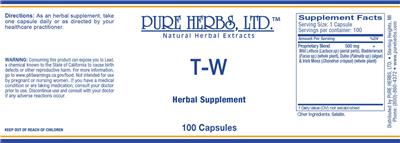
Supplement Facts
The label details for T-W by Pure Herbs, sourced from the NIH Dietary Supplement Label Database.
Supplement Facts
| Ingredient | Amount | % DV |
|---|---|---|
| Proprietary Blend | 500 mg | -- |
| Irish Moss | 0 NP | -- |
| Wild Lettuce | 0 NP | -- |
| Bladderwrack | 0 NP | -- |
| Dulse | 0 NP | -- |
Other ingredients: Gelatin
Tap any ingredient to jump to its full detail below.
These statements are the manufacturer’s wording, reproduced from the product label — the label is saying it, not HelloPharmacist. We don’t verify or endorse them.
Suggested/Recommended/Usage/Directions
Directions: As an herbal supplement, take one capsule daily or as directed by your healthcare practitioner.
Precautions
Warning: Consuming this product can expose you to lead, a chemical known to the State of California to cause birth defects or other reproductive harm. For more information, go to www.P65warnings.ca.gov/food.
Not intended for use by pregnant or nursing women. If you have a medical condition or are taking medication, consult your doctor prior to use.
Discontinue use and consult with your doctor if any adverse reactions occur.
Keep out of reach of children
Brand IP Statement(s)
Pure Herbs, Ltd. Natural Herbal Extracts
FDA Statement of Identity
Herbal Supplement
Is this label outdated? Report a formula or label change and our pharmacy team will review it.
T-W by Pure Herbs label
The label scan from the NIH Dietary Supplement Label Database. Tap to enlarge.
Label images are published by the NIH Dietary Supplement Label Database for the version of this product on file. Always read your actual product label.
View the full label (PDF)The Ingredients in T-W by Pure Herbs
These are the 4 active ingredients this product is made of. Select any to open its full monograph.
Serving size1 Capsule(s) Dosage formCapsule Servings per container100 Amounts shown are per serving.
Most supplement products combine several ingredients, and a medication can interact with the product through any one of them. Each ingredient below shows whether it has known drug interactions.
Proprietary Blend
- › Irish Moss
- › Wild Lettuce
- › Bladderwrack
- › Dulse
Other (inactive) ingredients: Gelatin. These complete the product’s ingredient list but are not active constituents.
T-W by Pure Herbs Drug Interactions
HelloPharmacist Interaction Report
Pure Herbs T-W contains Irish Moss, Wild Lettuce, Bladderwrack, and Dulse — through their iodine and potassium content and potential CNS effects, these ingredients interact with several medication types.
The most serious documented interaction is between Bladderwrack and lithium, which has caused hyperthyroidism in at least one patient.
Read the full breakdown — every affected drug type, severity by severity
Irish Moss, Bladderwrack, and Dulse all contain iodine and may alter how your body responds to thyroid hormone (like levothyroxine), antithyroid drugs, or amiodarone — a heart rhythm medication that's already high in iodine. Wild Lettuce may add to the effects of sedating medications (CNS depressants) and theoretically contains an anticholinergic compound that could cause constipation, dry mouth, or dizziness at high doses.
Bladderwrack also has minor theoretical interactions with blood thinners (anticoagulants and antiplatelet drugs) and with drugs metabolized by your liver's CYP2D6, CYP2C9, and CYP3A4 pathways — though these have not been reported in humans. Dulse is rich in potassium and may increase blood potassium levels if you take digoxin (a heart medication), potassium-sparing water pills, ACE inhibitors, or ARBs — especially at supplement doses.
Altogether, these interactions span 1,129 individual medications. Before you start this product, use the medication checker below to confirm your exact drugs, and talk with your doctor or pharmacist about whether it's right for you — particularly if you take any thyroid, heart, blood pressure, or psychiatric medication.
Check your own medications below · Editorial policy · How we use AI
Want to check YOUR meds against T-W?
Ask about interactions with your drugs in plain English — “Can I take it with lisinopril?” — and we find you the answer in seconds, ingredient by ingredient.
Go to the checkerIngredients driving the most interactions
Individual Drug Interactions
The ingredients in T-W interact with 1,128 drugs. Click any drug to see the details.
4 of the 4 ingredients in T-W interact with drugs. Each result below shows which ingredient is responsible. Bladderwrack Wild Lettuce Dulse Irish Moss
Oxycodone HydrochlorideRoxybond, Xtampza ER
How Oxycodone Hydrochloride interacts with T-W — through 2 ingredients. Tap an ingredient for the detail:
Wild LettuceCns Depressants Moderate
Interaction Summary
Theoretically, concomitant use with drugs with sedative effects might cause additive therapeutic effects and adverse effects.
Read the full Wild Lettuce + Oxycodone Hydrochloride interactionBladderwrackCytochrome P450 2d6 (cyp2d6) Substrates Minor
Interaction Summary
Theoretically, concomitant use of Fucus vesiculosus with CYP2D6 substrates might alter the effects of these substrates.
Read the full Bladderwrack + Oxycodone Hydrochloride interactionOxycodone, NaloxoneTarginiq ER
How Oxycodone, Naloxone interacts with T-W — through 2 ingredients. Tap an ingredient for the detail:
Wild LettuceCns Depressants Moderate
Interaction Summary
Theoretically, concomitant use with drugs with sedative effects might cause additive therapeutic effects and adverse effects.
Read the full Wild Lettuce + Oxycodone, Naloxone interactionBladderwrackCytochrome P450 2d6 (cyp2d6) Substrates Minor
Interaction Summary
Theoretically, concomitant use of Fucus vesiculosus with CYP2D6 substrates might alter the effects of these substrates.
Read the full Bladderwrack + Oxycodone, Naloxone interactionOxymorphoneNumorphan, Opana, Opana ER, Opana Injection
How Oxymorphone interacts with T-W — through 1 ingredient. Tap an ingredient for the detail:
Wild LettuceCns Depressants Moderate
Interaction Summary
Theoretically, concomitant use with drugs with sedative effects might cause additive therapeutic effects and adverse effects.
Read the full Wild Lettuce + Oxymorphone interactionPentazocineTalwin
How Pentazocine interacts with T-W — through 1 ingredient. Tap an ingredient for the detail:
Wild LettuceCns Depressants Moderate
Interaction Summary
Theoretically, concomitant use with drugs with sedative effects might cause additive therapeutic effects and adverse effects.
Read the full Wild Lettuce + Pentazocine interactionPentobarbitalNembutal
How Pentobarbital interacts with T-W — through 1 ingredient. Tap an ingredient for the detail:
Wild LettuceCns Depressants Moderate
Interaction Summary
Theoretically, concomitant use with drugs with sedative effects might cause additive therapeutic effects and adverse effects.
Read the full Wild Lettuce + Pentobarbital interactionPentobarbitonePentobarbitone
How Pentobarbitone interacts with T-W — through 1 ingredient. Tap an ingredient for the detail:
Wild LettuceCns Depressants Moderate
Interaction Summary
Theoretically, concomitant use with drugs with sedative effects might cause additive therapeutic effects and adverse effects.
Read the full Wild Lettuce + Pentobarbitone interactionPerampanelFycompa
How Perampanel interacts with T-W — through 2 ingredients. Tap an ingredient for the detail:
Wild LettuceCns Depressants Moderate
Interaction Summary
Theoretically, concomitant use with drugs with sedative effects might cause additive therapeutic effects and adverse effects.
Read the full Wild Lettuce + Perampanel interactionBladderwrackCytochrome P450 3a4 (cyp3a4) Substrates, Cytochrome P450 2c9 (cyp2c9) Substrates Minor
Interaction Summary
Theoretically, concomitant use of Fucus vesiculosus with CYP3A4 substrates might increase the risk for adverse effects.
Read the full Bladderwrack + Perampanel interactionPerphenazineTrilafon
How Perphenazine interacts with T-W — through 2 ingredients. Tap an ingredient for the detail:
Wild LettuceAnticholinergic Drugs Moderate
Interaction Summary
Studies report varying evidence on whether or not wild lettuce contains hyoscyamine, an anticholinergic drug.
Read the full Wild Lettuce + Perphenazine interactionBladderwrackCytochrome P450 2d6 (cyp2d6) Substrates Minor
Interaction Summary
Theoretically, concomitant use of Fucus vesiculosus with CYP2D6 substrates might alter the effects of these substrates.
Read the full Bladderwrack + Perphenazine interactionPhenacemidePhenurone
How Phenacemide interacts with T-W — through 1 ingredient. Tap an ingredient for the detail:
Wild LettuceCns Depressants Moderate
Interaction Summary
Theoretically, concomitant use with drugs with sedative effects might cause additive therapeutic effects and adverse effects.
Read the full Wild Lettuce + Phenacemide interactionPhenelzine SulfateNardil
How Phenelzine Sulfate interacts with T-W — through 1 ingredient. Tap an ingredient for the detail:
Wild LettuceCns Depressants Moderate
Interaction Summary
Theoretically, concomitant use with drugs with sedative effects might cause additive therapeutic effects and adverse effects.
Read the full Wild Lettuce + Phenelzine Sulfate interactionPheniramine, Phenylephrine, Phenylpropan, Pyrilamine,Allerstat
How Pheniramine, Phenylephrine, Phenylpropan, Pyrilamine, interacts with T-W — through 1 ingredient. Tap an ingredient for the detail:
Wild LettuceAnticholinergic Drugs Moderate
Interaction Summary
Studies report varying evidence on whether or not wild lettuce contains hyoscyamine, an anticholinergic drug.
Read the full Wild Lettuce + Pheniramine, Phenylephrine, Phenylpropan, Pyrilamine, interactionPheniramine, Phenylpropanolamine, Phenyltoloxamine, PyrilamineHighland Histine D, Highland Histine D PED, Multihist D, Multihist D Ped, Multihistamine D, Multihistamine D Ped +7 more
How Pheniramine, Phenylpropanolamine, Phenyltoloxamine, Pyrilamine interacts with T-W — through 1 ingredient. Tap an ingredient for the detail:
Wild LettuceAnticholinergic Drugs Moderate
Interaction Summary
Studies report varying evidence on whether or not wild lettuce contains hyoscyamine, an anticholinergic drug.
Read the full Wild Lettuce + Pheniramine, Phenylpropanolamine, Phenyltoloxamine, Pyrilamine interactionPhenobarbitalLuminal, Phenobarbital, Solfoton
How Phenobarbital interacts with T-W — through 1 ingredient. Tap an ingredient for the detail:
Wild LettuceAnticholinergic Drugs, Cns Depressants Moderate
Interaction Summary
Studies report varying evidence on whether or not wild lettuce contains hyoscyamine, an anticholinergic drug.
Read the full Wild Lettuce + Phenobarbital interactionPhenobarbital, PhenytoinDilantin with PB
How Phenobarbital, Phenytoin interacts with T-W — through 2 ingredients. Tap an ingredient for the detail:
Wild LettuceCns Depressants Moderate
Interaction Summary
Theoretically, concomitant use with drugs with sedative effects might cause additive therapeutic effects and adverse effects.
Read the full Wild Lettuce + Phenobarbital, Phenytoin interactionBladderwrackCytochrome P450 2c8 (cyp2c8) Substrates, Cytochrome P450 2c9 (cyp2c9) Substrates Minor
Interaction Summary
Theoretically, concomitant use of Fucus vesiculosus with CYP2C8 substrates might increase the risk for adverse effects.
Read the full Bladderwrack + Phenobarbital, Phenytoin interactionPhenobarbital, Sodium NitrateSoniphen
How Phenobarbital, Sodium Nitrate interacts with T-W — through 1 ingredient. Tap an ingredient for the detail:
Wild LettuceCns Depressants Moderate
Interaction Summary
Theoretically, concomitant use with drugs with sedative effects might cause additive therapeutic effects and adverse effects.
Read the full Wild Lettuce + Phenobarbital, Sodium Nitrate interactionPhensuximideMilontin
How Phensuximide interacts with T-W — through 1 ingredient. Tap an ingredient for the detail:
Wild LettuceCns Depressants Moderate
Interaction Summary
Theoretically, concomitant use with drugs with sedative effects might cause additive therapeutic effects and adverse effects.
Read the full Wild Lettuce + Phensuximide interactionPhentermine, TopiramateQsymia
How Phentermine, Topiramate interacts with T-W — through 1 ingredient. Tap an ingredient for the detail:
Wild LettuceCns Depressants Moderate
Interaction Summary
Theoretically, concomitant use with drugs with sedative effects might cause additive therapeutic effects and adverse effects.
Read the full Wild Lettuce + Phentermine, Topiramate interactionPhenylephrine, TropicamideMydcombi
How Phenylephrine, Tropicamide interacts with T-W — through 1 ingredient. Tap an ingredient for the detail:
Wild LettuceAnticholinergic Drugs Moderate
Interaction Summary
Studies report varying evidence on whether or not wild lettuce contains hyoscyamine, an anticholinergic drug.
Read the full Wild Lettuce + Phenylephrine, Tropicamide interactionPhenytoinDi-Phen, Dilantin, Dilantin Infatabs, Dilantin injection, Dilantin Kapseals, Phenytek
How Phenytoin interacts with T-W — through 2 ingredients. Tap an ingredient for the detail:
Wild LettuceCns Depressants Moderate
Interaction Summary
Theoretically, concomitant use with drugs with sedative effects might cause additive therapeutic effects and adverse effects.
Read the full Wild Lettuce + Phenytoin interactionBladderwrackCytochrome P450 2c9 (cyp2c9) Substrates, Cytochrome P450 2c8 (cyp2c8) Substrates Minor
Interaction Summary
Theoretically, concomitant use of Fucus vesiculosus with CYP2C9 substrates might increase the risk for adverse effects.
Read the full Bladderwrack + Phenytoin interactionPimozideOrap
How Pimozide interacts with T-W — through 2 ingredients. Tap an ingredient for the detail:
Wild LettuceAnticholinergic Drugs Moderate
Interaction Summary
Studies report varying evidence on whether or not wild lettuce contains hyoscyamine, an anticholinergic drug.
Read the full Wild Lettuce + Pimozide interactionBladderwrackCytochrome P450 3a4 (cyp3a4) Substrates Minor
Interaction Summary
Theoretically, concomitant use of Fucus vesiculosus with CYP3A4 substrates might increase the risk for adverse effects.
Read the full Bladderwrack + Pimozide interactionPotassium Iodide (prescription Drug)Thyro-Block
How Potassium Iodide (prescription Drug) interacts with T-W — through 3 ingredients. Tap an ingredient for the detail:
BladderwrackAntithyroid Drugs Moderate
Interaction Summary
Due to its iodine content, Fucus vesiculosus might alter the effects of antithyroid drugs.
Read the full Bladderwrack + Potassium Iodide (prescription Drug) interactionDulseAntithyroid Drugs Moderate
Interaction Summary
Theoretically, due to its iodine content, dulse might alter the effects of antithyroid drugs.
Read the full Dulse + Potassium Iodide (prescription Drug) interactionIrish MossAntithyroid Drugs Moderate
Interaction Summary
Due to its iodine content, sea moss might alter the effects of antithyroid drugs.
Read the full Irish Moss + Potassium Iodide (prescription Drug) interactionPrabotulinumtoxina-xvfsJeuveau
How Prabotulinumtoxina-xvfs interacts with T-W — through 1 ingredient. Tap an ingredient for the detail:
Wild LettuceAnticholinergic Drugs Moderate
Interaction Summary
Studies report varying evidence on whether or not wild lettuce contains hyoscyamine, an anticholinergic drug.
Read the full Wild Lettuce + Prabotulinumtoxina-xvfs interactionPrazepamCentrax
How Prazepam interacts with T-W — through 1 ingredient. Tap an ingredient for the detail:
Wild LettuceCns Depressants Moderate
Interaction Summary
Theoretically, concomitant use with drugs with sedative effects might cause additive therapeutic effects and adverse effects.
Read the full Wild Lettuce + Prazepam interactionPregabalinLyrica, Lyrica CR
How Pregabalin interacts with T-W — through 1 ingredient. Tap an ingredient for the detail:
Wild LettuceCns Depressants Moderate
Interaction Summary
Theoretically, concomitant use with drugs with sedative effects might cause additive therapeutic effects and adverse effects.
Read the full Wild Lettuce + Pregabalin interactionPrimidoneMysoline
How Primidone interacts with T-W — through 1 ingredient. Tap an ingredient for the detail:
Wild LettuceCns Depressants Moderate
Interaction Summary
Theoretically, concomitant use with drugs with sedative effects might cause additive therapeutic effects and adverse effects.
Read the full Wild Lettuce + Primidone interactionProcainamideProcan, Procan SR, Procanbid, Pronestyl, Pronestyl-SR
How Procainamide interacts with T-W — through 1 ingredient. Tap an ingredient for the detail:
Wild LettuceAnticholinergic Drugs Moderate
Interaction Summary
Studies report varying evidence on whether or not wild lettuce contains hyoscyamine, an anticholinergic drug.
Read the full Wild Lettuce + Procainamide interactionProchlorperazineCompazine, Prochlor
How Prochlorperazine interacts with T-W — through 1 ingredient. Tap an ingredient for the detail:
Wild LettuceAnticholinergic Drugs Moderate
Interaction Summary
Studies report varying evidence on whether or not wild lettuce contains hyoscyamine, an anticholinergic drug.
Read the full Wild Lettuce + Prochlorperazine interactionProcyclidineArpicolin, Kemadrin, Kemadrin Injection, Procyclid
How Procyclidine interacts with T-W — through 1 ingredient. Tap an ingredient for the detail:
Wild LettuceAnticholinergic Drugs Moderate
Interaction Summary
Studies report varying evidence on whether or not wild lettuce contains hyoscyamine, an anticholinergic drug.
Read the full Wild Lettuce + Procyclidine interactionPromazineSparine
How Promazine interacts with T-W — through 1 ingredient. Tap an ingredient for the detail:
Wild LettuceAnticholinergic Drugs Moderate
Interaction Summary
Studies report varying evidence on whether or not wild lettuce contains hyoscyamine, an anticholinergic drug.
Read the full Wild Lettuce + Promazine interactionPromethazinePhenergan
How Promethazine interacts with T-W — through 1 ingredient. Tap an ingredient for the detail:
Wild LettuceAnticholinergic Drugs Moderate
Interaction Summary
Studies report varying evidence on whether or not wild lettuce contains hyoscyamine, an anticholinergic drug.
Read the full Wild Lettuce + Promethazine interactionEach ingredient & the kinds of drugs it affects
For each ingredient in T-W with known interactions, here are the types of medications they can affect. Open any type for the detail — or search your exact drug in the checker above.
Bladderwrack
Amiodarone (Cordarone)
Theoretically, combining Fucus vesiculosus with amiodarone might cause excessively high iodine levels.
Fucus vesiculosus contains high concentrations of iodine. Amiodarone contains 37.3% iodine and can increase iodine levels. Concomitant use might increase the risk of having excessive iodine levels and adversely affecting thyroid function. Monitor thyroid function.
Antithyroid Drugs
Due to its iodine content, Fucus vesiculosus might alter the effects of antithyroid drugs.
Fucus vesiculosus contains high concentrations of iodine. Iodine in high doses has been reported to cause both hyperthyroidism and hypothyroidism, depending on the individual's past medical history. Taking Fucus vesiculosus while using antithyroid drugs could alter the effects of the antithyroid drugs.
Lithium
Concomitant use of Fucus vesiculosus and lithium has resulted in hyperthyroidism.
There is a case of hyperthyroidism occurring in a patient taking Fucus vesiculosus and lithium. Monitor thyroid hormones closely in patients taking lithium and Fucus vesiculosus concomitantly.
Thyroid Hormone
Due to its iodine content, Fucus vesiculosus might alter the effects of thyroid hormone.
Fucus vesiculosus contains high concentrations of iodine. Iodine in high doses has been reported to cause both hyperthyroidism and hypothyroidism, depending on the individual's past medical history. Taking Fucus vesiculosus while using thyroid hormone could alter the effects of thyroid hormone.
Anticoagulant/Antiplatelet Drugs
Theoretically, taking Fucus vesiculosus with antiplatelet or anticoagulant drugs might increase the risk of bruising and bleeding.
In vitro evidence suggests that a constituent of Fucus vesiculosus, known as fucoidan, has anticoagulant effects. However, in clinical research, fucoidan does not seem to have significant anticoagulant activity when taken orally, possibly due to poor absorption.
Cytochrome P450 2C8 (Cyp2C8) Substrates
Theoretically, concomitant use of Fucus vesiculosus with CYP2C8 substrates might increase the risk for adverse effects.
In vitro research shows that fucoidan, a constituent of Fucus vesiculosus, inhibits CYP2C8. This interaction has not been reported in humans.
Cytochrome P450 2C9 (Cyp2C9) Substrates
Theoretically, concomitant use of Fucus vesiculosus with CYP2C9 substrates might increase the risk for adverse effects.
In vitro research shows that fucoidan, a constituent of Fucus vesiculosus, inhibits CYP2C9. This interaction has not been reported in humans.
Cytochrome P450 2D6 (Cyp2D6) Substrates
Theoretically, concomitant use of Fucus vesiculosus with CYP2D6 substrates might alter the effects of these substrates.
In vitro research shows that fucoidan, a constituent of Fucus vesiculosus, both inhibits and induces CYP2D6. This interaction has not been reported in humans.
Cytochrome P450 3A4 (Cyp3A4) Substrates
Theoretically, concomitant use of Fucus vesiculosus with CYP3A4 substrates might increase the risk for adverse effects.
In vitro research shows that fucoidan, a constituent of Fucus vesiculosus, inhibits CYP3A4. This interaction has not been reported in humans.
Wild Lettuce
Anticholinergic Drugs
Studies report varying evidence on whether or not wild lettuce contains hyoscyamine, an anticholinergic drug. If it does, it appears to be in very low amounts. Nevertheless, there have been case reports of individuals consuming large amounts of wild lettuce experiencing anticholinergic-related side effects, such as constipation, dry mouth, dizziness, and sweating. Therefore, if you are already taking a drug with anticholinergic effects, you should be cautious about combining it with wild lettuce as the risk of side effects may be increased.
Cns Depressants
Theoretically, concomitant use with drugs with sedative effects might cause additive therapeutic effects and adverse effects.
Dulse
Amiodarine (Cordarone)
Theoretically, combining dulse with amiodarone might cause excessively high iodine levels.
Dulse is rich in iodine, and amiodarone contains 37.3% iodine and can increase iodine levels.
Antithyroid Drugs
Theoretically, due to its iodine content, dulse might alter the effects of antithyroid drugs.
Dulse is rich in iodine. Iodine in high doses has been reported to cause both hyperthyroidism and hypothyroidism, depending on the individual's past medical history.
Digoxin (Lanoxin)
Theoretically, dulse might increase the risk of hyperkalemia when taken with digoxin.
Dulse is rich in potassium, and digoxin can increase potassium levels in the blood. This interaction has not been demonstrated in humans.
Thyroid Hormone
Theoretically, due to its iodine content, dulse might alter the effects of thyroid hormone.
Dulse is rich in iodine. Iodine in high doses has been reported to cause both hyperthyroidism and hypothyroidism, depending on the individual's past medical history. Although dulse has been associated with a statistically significant increase in thyroid stimulating hormone (TSH) levels in clinical research, clinically significant increases have not been documented.
Ace Inhibitors (Aceis)
Theoretically, dulse might increase the risk of hyperkalemia when taken with ACEIs.
Dulse is rich in potassium. ACEIs block the actions of the renin-angiotensin-aldosterone system and reduce potassium excretion. Concomitant use of these drugs with moderate dietary potassium intake (about 3775-5200 mg daily) does not increase serum potassium levels. However, using these drugs while consuming dulse in quantities that provide larger amounts of potassium daily might increase the risk of hyperkalemia. Additionally, in vitro research suggests that dulse protein hydrolysates inhibit the activity of ACE. However, these effects have not been demonstrated in humans.
Angiotensin Receptor Blockers (Arbs)
Theoretically, dulse might increase the risk of hyperkalemia when taken with ARBs.
Dulse is rich in potassium. ARBs block the actions of the renin-angiotensin-aldosterone system and reduce potassium excretion. Concomitant use of these drugs with moderate dietary potassium intake (about 3775-5200 mg daily) does not increase serum potassium levels. However, using these drugs while consuming dulse in quantities that provide higher amounts of potassium daily might increase the risk of hyperkalemia. Additionally, in vitro research suggests that dulse protein hydrolysates inhibit the activity of angiotensin converting enzyme (ACE). However, these effects have not been demonstrated in humans.
Potassium-Sparing Diuretics
Theoretically, dulse might increase the risk of hyperkalemia when taken with potassium-sparing diuretics.
Dulse is rich in potassium, and potassium-sparing diuretics can increase potassium levels in the blood. This interaction has not been shown in humans.
Irish Moss
Amiodarone (Cordarone)
Theoretically, combining sea moss with amiodarone might cause excessively high iodine levels.
Amiodarone contains 37.3% iodine and can increase iodine levels. Concomitant use with sea moss, which contains approximately 4-7 mcg of iodine per gram, might increase the risk of adverse effects from iodine, including altered thyroid function.
Antithyroid Drugs
Due to its iodine content, sea moss might alter the effects of antithyroid drugs.
Sea moss contains approximately 4-7 mcg of iodine per gram. Iodine in high doses has been reported to cause both hyperthyroidism and hypothyroidism, depending on the individual's past medical history. Taking sea moss could theoretically alter the effects of antithyroid drugs.
Thyroid Hormone
Due to its iodine content, sea moss might alter the effects of thyroid hormone.
Sea moss contains approximately 4-7 mcg of iodine per gram. Iodine in high doses has been reported to cause both hyperthyroidism and hypothyroidism, depending on the individual's past medical history. Taking sea moss could theoretically alter the effects of thyroid hormone.
Brand information
Manufacturer and brand details for T-W, from the product label.
Pure Herbs
See all Pure Herbs products- Name
- Pure Herbs, Ltd.
- City
- Sterling Heights
- State
- MI
- Phone Number
- (800) 860-4372
- Web Address
- www.pureherbs.com
T-W by Pure Herbs: Common Questions
Does T-W by Pure Herbs interact with any medications?
How can one product interact with so many drugs?
Where does this information come from?
Is this safe during pregnancy?
Is this safe while breastfeeding?
Does wild lettuce actually help with anything?
Can this cause side effects?
Why do the seaweeds matter if I take thyroid medication?
Written and reviewed by the HelloPharmacist editorial staff. Our editorial policy
Not sure if T-W is safe with your meds?
Our pharmacists answer your medication & supplement questions — free.
Label information is sourced from the NIH Dietary Supplement Label Database and reflects the product version on file; always read your actual product label. This page is for education only and is not a substitute for professional medical advice. Confirm with your pharmacist or doctor before combining supplements and medications.
The Full Monographs Behind T-W’s Ingredients
Every ingredient we hold a full HelloPharmacist monograph for — uses, evidence, safety, and the complete interaction list.
Sea Moss
Interacts with 22 drugsSea moss is a type of red seaweed that is naturally rich in iodine and several minerals, and it is popular as a 'whole-food' supplement. Strong human evidence for most of its health claims i...
Read the full Sea Moss monograph → Herb & supplement monographWild Lettuce
Interacts with 393 drugsWild lettuce is a traditional herb used mainly for sleep, anxiety, and pain, but solid human research supporting these uses is very limited. Because its safety is not well studied, it should...
Read the full Wild Lettuce monograph → Herb & supplement monographFucus Vesiculosus
Interacts with 893 drugsFucus vesiculosus (bladderwrack) is a brown seaweed rich in iodine that has been used traditionally for thyroid concerns, weight, and skin. There is little solid human evidence to support mo...
Read the full Fucus Vesiculosus monograph → Herb & supplement monographDulse
Interacts with 85 drugsDulse is a red seaweed eaten as a food in many coastal cultures and is a natural source of iodine, potassium, protein, and antioxidant compounds. As a food it is generally considered safe fo...
Read the full Dulse monograph →Sources & How We Checked
T-W's label data comes from the NIH Dietary Supplement Label Database; the ingredient interaction data is from the Natural Medicines database, reviewed by our pharmacists.
- NIH Dietary Supplement Label Database (DSLD) — The official product label on file for this supplement.
- Natural Medicines (Therapeutic Research Center) — Evidence-graded clinical reference behind the ingredient interaction data.
Content is written and reviewed by licensed HelloPharmacist pharmacists. See our data sources and editorial standards for how this information is built and checked.
The 28 references behind this product’s interaction data
Every citation that drives the interaction findings for this product’s ingredients, from the evidence-graded Natural Medicines (TRC Healthcare) database. Open an ingredient to browse its citations — links open the study on PubMed or the publisher’s site.
Sea Moss 3 references
- Darias-Rosales J, Rubio C, Gutiérrez ÁJ, Paz S, Hardisson A. Risk assessment of iodine intake from the consumption of red seaweeds (Palmaria palmata and Chondrus crispus). Environ Sci Pollut Res Int 2020;27(36):45737-45741. PubMed
- U.S. Department of Agriculture (USDA). Agricultural Research Service. FoodData Central. Seaweed, irishmoss, raw. April 2019. Available at: https://fdc.nal.usda.gov/fdc-app.html#/food-details/168456/nutrients. Accessed Aug. 30, 2022.
- Palmieri B, Vadalà M, Laurino C. Clinical effects of overwintered-stressed Chondrus Crispus and non-overwintered-stressed Chondrus crispus dietary supplementations. Asian J Med Sci. 2018; 9(6): 7-13. DOI
Wild Lettuce 5 references
- Newall CA, Anderson LA, Philpson JD. Herbal Medicine: A Guide for Healthcare Professionals. London, UK: The Pharmaceutical Press, 1996.
- Gruenwald J, Brendler T, Jaenicke C. PDR for Herbal Medicines. 1st ed. Montvale, NJ: Medical Economics Company, Inc., 1998.
- Brinker F. Herb Contraindications and Drug Interactions. 2nd ed. Sandy, OR: Eclectic Medical Publications, 1998.
- Besharat S, Besharat M, Jabbari A. Wild lettuce (Lactuca virosa) toxicity. BMJ Case Rep. 2009;2009. pii: bcr06.2008.0134.
- Mullins ME, Horowitz BZ. The case of the salad shooters: intravenous injection of wild lettuce extract. Vet Hum Toxicol. 1998;40(5):290-1.
Fucus Vesiculosus 15 references
- Goodman GA, Rall TW, Nies AS, Taylor P. The Pharmacological Basis of Therapeutics, 9th ed.
- Food and Nutrition Board, Institute of Medicine. Dietary Reference Intakes for Vitamin A, Vitamin K, Arsenic, Boron, Chromium, Copper, Iodine, Iron, Manganese, Molybdenum, Nickel, Silicon, Vanadium, and Zinc. Washington, DC: National Academy Press, 2002.
- Phaneuf D, Cote I, Dumas P, et al. Evaluation of the contamination of marine algae (Seaweed) from the St. Lawrence River and likely to be consumed by humans. Environ Res 1999;80:S175-S182. PubMed
- Durig J, Bruhn T, Zurborn KH, et al. Anticoagulant fucoidan fractions from Fucus vesiculosus induce platelet activation in vitro. Thromb Res 1997;85:479-91. PubMed
- Conz PA, La Greca G, Benedetti P, et al. Fucus vesiculosus: a nephrotoxic alga? Nephrol Dial Transplant 1998;13:526-7.
- Ohye H, Fukata S, Kanoh M, et al. Thyrotoxicosis caused by weight-reducing herbal medicines. Arch Intern Med 2005;165:831-4. PubMed
- Okamura K, Inoue K, Omae T. A case of Hashimoto's thyroiditis with thyroid immunological abnormality manifested after habitual ingestion of seaweed. Acta Endocrinol (Copenh) 1978;88:703-12. PubMed
- Agarwal SC, Crook JR, Pepper CB. Herbal remedies -- how safe are they? A case report of polymorphic ventricular tachycardia/ventricular fibrillation induced by herbal medication used for obesity. Int J Cardiol 2006;106:260-1. PubMed
- Sterling JB, Heymann WR. Potassium iodide in dermatology: a 19th century drug for the 21st century-uses, pharmacology, adverse effects, and contraindications. J Am Acad Dermatol 2000;43:691-7. PubMed
- Catania, M. A., Oteri, A., Caiello, P., Russo, A., Salvo, F., Giustini, E. S., Caputi, A. P., and Polimeni, G. Hemorrhagic cystitis induced by an herbal mixture. South.Med.J. 2010;103(1):90-92. PubMed
- Cumashi, A., Ushakova, N. A., Preobrazhenskaya, M. E., D'Incecco, A., Piccoli, A., Totani, L., Tinari, N., Morozevich, G. E., Berman, A. E., Bilan, M. I., Usov, A. I., Ustyuzhanina, N. E., Grachev, A. A., Sanderson, C. J., Kelly, M., Rabinovich, G. A., I
- Irhimeh, M. R., Fitton, J. H., and Lowenthal, R. M. Pilot clinical study to evaluate the anticoagulant activity of fucoidan. Blood Coagul.Fibrinolysis 2009;20(7):607-610. PubMed
- Arbaizar, B. and Llorca, J. [Fucus vesiculosus induced hyperthyroidism in a patient undergoing concomitant treatment with lithium]. Actas Esp.Psiquiatr. 2011;39(6):401-403.
- Church FC, Meade JB, Treanor RE, and et al. Antithrombin activity of fucoidan. The interaction of fucoidan with heparin cofactor II, antithrombin III, and thrombin. J Biol Chem 2-25-1989;264(6):3618-3623. DOI
- Mathew L, Burney M, Gaikwad A, et al. Preclinical evaluation of safety of fucoidan extracts from Undaria pinnatifida and Fucus vesiculosus for use in cancer treatment. Integr Cancer Ther 2017;16(4):572-84.
Dulse 5 references
- Malta D, Arcand J, Ravindran A, Floras V, Allard JP, Newton GE. Adequate intake of potassium does not cause hyperkalemia in hypertensive individuals taking medications that antagonize the renin angiotensin aldosterone system. Am J Clin Nutr 2016 Oct;104(4 PubMed
- Allsopp P, Crowe W, Bahar B, et al. The effect of consuming Palmaria palmata-enriched bread on inflammatory markers, antioxidant status, lipid profile and thyroid function in a randomised placebo-controlled intervention trial in healthy adults. Eur J Nutr PubMed
- McGrath BM, Harmon JP, Bishop G. Palmaria palmata (Dulse) as an unusual maritime aetiology of hyperkalemia in a patient with chronic renal failure: a case report. J Med Case Rep. 2010;4:301. PubMed
- Furuta T, Miyabe Y, Yasui H, Kinoshita Y, Kishimura H. Angiotensin I converting enzyme inhibitory peptides derived from phycobiliproteins of dulse Palmaria palmata. Mar Drugs. 2016;14(2):32. PubMed
- Takase T, Nakamura A, Miyoshi H, et al. Effects of Palmaria palmata on lipid metabolism and glycemic control in participants with hypercholesterolemia in a randomized double-blind placebo-controlled trial. Phytother Res. 2020.
Parts of this content are provided by the Therapeutic Research Center, LLC.
DISCLAIMER: Currently this does not check for drug-drug interactions. This is not an all-inclusive comprehensive list of potential interactions and is for informational purposes only. Not all interactions are known or well-reported in the scientific literature, and new interactions are continually being reported. Input is needed from a qualified healthcare provider including a pharmacist before starting any therapy. Application of clinical judgment is necessary.
© 2021 Therapeutic Research Center, LLC