
Tangerine Ingredients & Drug Interactions
by doTERRA
What is this page for?
First and foremost: checking Tangerine against your medications. The heart of this page is the interaction checker and the full interaction report — how this product’s ingredients may interact with prescription and over-the-counter medicines you may be taking.
Around that, we add a pharmacist’s high-level view of the product as a whole — what’s inside, the evidence for its stated use, how transparent the label is, and what safety data exists — so you can see the full picture in one place. It’s educational information from our licensed clinical databases and the clinical staff at HelloPharmacist — not medical advice — and we don’t sell or endorse products. Our editorial policy
Tangerine is a dietary supplement by doTERRA with 1 active ingredient. Its ingredients are commonly taken for source of vitamin c, digestive support, aromatherapy and relaxation.Based on those ingredients, 643 medications have a known interaction with it, the most serious rated minor. The ingredients most likely to interact are Tangerine. Use the checker below to test your specific medication, or read the full HelloPharmacist Interaction Report.
Check Your Meds Against Tangerine by doTERRA
Ask about any prescription or over-the-counter medication and we check it for interactions with Tangerine by doTERRA — and tell you which ingredient is responsible.
AI summaries are generated from our interaction database for education only — always confirm with your pharmacist. How we use AI
Ask the Pharmacist
A licensed pharmacist will answer your question by email — free, usually within 24 hours.
Got it — thank you!
A licensed pharmacist will answer within 24 hours. Keep an eye on your email (worth checking spam, just in case).
HelloPharmacist Scorecard of Tangerine by doTERRA
Our pharmacy team’s full take, with four database checks built into the cards below — a summary of what is known, not a grade of the product itself.
What’s inside
Full disclosure
This product contains one active ingredient: tangerine liquid. The fruit itself is a well-known food source, and this liquid form is derived from it.
There are no other inactive ingredients listed.
Does it work?
Couldn't assess
The evidence we hold rates tangerine for cancer prevention as having insufficient reliable evidence to rate. That means we don't have enough robust data to say whether it works for that purpose.
How safe is it?
Well-documented data
Tangerine fruit is generally well tolerated when eaten as food. However, the safety facts we hold note that concentrated extracts and essential oils should be used with caution and under medical advice, because their safety isn't as well studied as the whole fruit.
Adverse effects are rare with medicinal use of tangerine, though a thorough safety review hasn't been done. Topically, contact dermatitis (a skin rash from direct contact) has been reported with tangerine essential oil in one case report.
Pregnancy and lactation safety data aren't on file for this ingredient.
Meds to double-check
Minor interactions only
If you take any medication that your liver processes through the CYP3A4 enzyme, check it here before you start — that includes sedatives like midazolam (Versed) and a large number of other common drugs. The minor interactions documented don't mean you can't take them together, but your pharmacist should see the combination.
The bottom line
Scorecard at a glanceFully disclosed formula with no assessable stated purpose. Only minor medication interactions are documented, and safety information is well characterized.
If you eat tangerine as food, no concern — it's a common fruit. But this is a concentrated liquid supplement, so the caution about extracts applies.
If you take medications metabolized by your liver, check them with our tool first. Talk to your pharmacist if you're pregnant, breastfeeding, or have questions about how this fits into your health routine.
Educational only — not medical advice; always confirm with your pharmacist. Our editorial policy · How we use AI
Assessment coverage: 1 of 1 active ingredient matched to our full ingredient reviews (monographs). Based on the product label dated May 28, 2019.
This Scorecard evaluates available label information, ingredient evidence, and known medication-safety considerations. It does not independently verify product identity, purity, potency, contamination, or manufacturing quality. How these ratings are computed
General information
Key facts about Tangerine, straight from the product label.
Everything in this section is reproduced from the manufacturer’s own product label — it’s the label speaking, not HelloPharmacist. We show it so you can see exactly what the maker states; we don’t verify or endorse those statements.
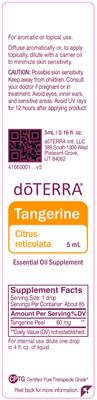
Supplement Facts
The label details for Tangerine by doTERRA, sourced from the NIH Dietary Supplement Label Database.
Supplement Facts
| Ingredient | Amount | % DV |
|---|---|---|
| Tangerine | 60 mg | -- |
Tap any ingredient to jump to its full detail below.
These statements are the manufacturer’s wording, reproduced from the product label — the label is saying it, not HelloPharmacist. We don’t verify or endorse them.
Suggested/Recommended/Usage/Directions
For aromatic or topical use. Diffuse aromatically or, to apply topically, dilute with a carrier oil to minimize skin sensitivity.
For internal use dilute one drop in 4 fl. oz. of liquid.
Precautions
Caution: Possible skin sensitivity.
Keep away from children.
Consult your doctor if pregnant or in treatment.
Avoid eyes, inner ears, and sensitive areas. Avoid UV rays for 12 hours after applying product.
General
v5 41660001
Formula
Citrus reticulata
FDA Statement of Identity
Essential Oil Supplement
Brand IP Statement(s)
CPTG Certified Pure Therapeutic Grade
General Statements
Peel back for more information.
Is this label outdated? Report a formula or label change and our pharmacy team will review it.
Tangerine by doTERRA label
The label scan from the NIH Dietary Supplement Label Database. Tap to enlarge.
Label images are published by the NIH Dietary Supplement Label Database for the version of this product on file. Always read your actual product label.
View the full label (PDF)The Ingredients in Tangerine by doTERRA
This is the 1 active ingredient this product is made of. Select it to open its full monograph.
Serving size1 Drop(s) Dosage formLiquid Servings per container85 Amounts shown are per serving.
Tangerine
Interacts with643 drugs
Tangerine is a sweet citrus fruit that is a good source of vitamin C and other nutrients, and is widely enjoyed as food. While the peel and essential...
Tangerine monograph & interactionsTangerine by doTERRA Drug Interactions
HelloPharmacist Interaction Report
Tangerine by doTERRA is a single-ingredient liquid product.
In test-tube studies, tangeretin (a compound in tangerine) appeared to speed up how your liver breaks down midazolam (Versed), a sedative medication — suggesting it might reduce midazolam's effect. However, when people actually drank 200 mL of tangerine juice, absorption of midazolam was only slightly delayed and the drug was metabolized normally.
This means the test-tube finding didn't translate to a clinically meaningful interaction in humans.
Read the full breakdown — every affected drug type, severity by severity
Tangerine interacts with a broad group of medications that your liver processes through an enzyme called CYP3A4 (cytochrome P450 3A4). Altogether, these interactions span 633 individual medications.
Because the human data is reassuring for midazolam specifically — the best-studied case — the interactions are rated Minor. Even so, if you take any medication that your liver metabolizes, run it through the checker below before starting this product.
Check your own medications below · Editorial policy · How we use AI
Want to check YOUR meds against Tangerine?
Ask about interactions with your drugs in plain English — “Can I take it with lisinopril?” — and we find you the answer in seconds, ingredient by ingredient.
Go to the checkerIngredients driving the most interactions
Individual Drug Interactions
The ingredients in Tangerine interact with 643 drugs. Click any drug to see the details.
1 of the 1 ingredient in Tangerine interact with drugs. Each result below shows which ingredient is responsible. Tangerine
Acetaminophen, Dextromethorphan, Guaifenesin, PhenylpropanolamineAnatuss
How Acetaminophen, Dextromethorphan, Guaifenesin, Phenylpropanolamine interacts with Tangerine — through 1 ingredient. Tap an ingredient for the detail:
TangerineCytochrome P450 3a4 (cyp3a4) Substrates Minor
Interaction Summary
In vitro, tangeretin, a constituent of tangerine, induces a 52% increase in the metabolism of midazolam by cytochrome P450 3A4 (CYP3A4).
Read the full Tangerine + Acetaminophen, Dextromethorphan, Guaifenesin, Phenylpropanolamine interactionAcetaminophen, Dextromethorphan, Guaifenesin, PseudoephedrineRobitussin Cold, Severe Cold, Suphedrine Cold/Cough
How Acetaminophen, Dextromethorphan, Guaifenesin, Pseudoephedrine interacts with Tangerine — through 1 ingredient. Tap an ingredient for the detail:
TangerineCytochrome P450 3a4 (cyp3a4) Substrates Minor
Interaction Summary
In vitro, tangeretin, a constituent of tangerine, induces a 52% increase in the metabolism of midazolam by cytochrome P450 3A4 (CYP3A4).
Read the full Tangerine + Acetaminophen, Dextromethorphan, Guaifenesin, Pseudoephedrine interactionAcetaminophen, Dextromethorphan, Phenylpropanolamine, PyrilamineTheracaps
How Acetaminophen, Dextromethorphan, Phenylpropanolamine, Pyrilamine interacts with Tangerine — through 1 ingredient. Tap an ingredient for the detail:
TangerineCytochrome P450 3a4 (cyp3a4) Substrates Minor
Interaction Summary
In vitro, tangeretin, a constituent of tangerine, induces a 52% increase in the metabolism of midazolam by cytochrome P450 3A4 (CYP3A4).
Read the full Tangerine + Acetaminophen, Dextromethorphan, Phenylpropanolamine, Pyrilamine interactionAcetaminophen, Dextromethorphan, PseudoephedrineAlka-Seltzer PLUS Flu Liquid Gels, Non Aspirin Cold Caps, Tylenol Cold, Tylenol Flu Daytime Ex Strength, Tylenol Flu Ex Strength
How Acetaminophen, Dextromethorphan, Pseudoephedrine interacts with Tangerine — through 1 ingredient. Tap an ingredient for the detail:
TangerineCytochrome P450 3a4 (cyp3a4) Substrates Minor
Interaction Summary
In vitro, tangeretin, a constituent of tangerine, induces a 52% increase in the metabolism of midazolam by cytochrome P450 3A4 (CYP3A4).
Read the full Tangerine + Acetaminophen, Dextromethorphan, Pseudoephedrine interactionAcetaminophen, HydrocodoneAnexsia, Anodynos DHC, Azdone, Co-Gesic, Doucet, Lorcet +9 more
How Acetaminophen, Hydrocodone interacts with Tangerine — through 1 ingredient. Tap an ingredient for the detail:
TangerineCytochrome P450 3a4 (cyp3a4) Substrates Minor
Interaction Summary
In vitro, tangeretin, a constituent of tangerine, induces a 52% increase in the metabolism of midazolam by cytochrome P450 3A4 (CYP3A4).
Read the full Tangerine + Acetaminophen, Hydrocodone interactionAcetaminophen, Phenylephrine, ChlorpheniramineSuper Cold Tabs
How Acetaminophen, Phenylephrine, Chlorpheniramine interacts with Tangerine — through 1 ingredient. Tap an ingredient for the detail:
TangerineCytochrome P450 3a4 (cyp3a4) Substrates Minor
Interaction Summary
In vitro, tangeretin, a constituent of tangerine, induces a 52% increase in the metabolism of midazolam by cytochrome P450 3A4 (CYP3A4).
Read the full Tangerine + Acetaminophen, Phenylephrine, Chlorpheniramine interactionAdagrasibKrazati
How Adagrasib interacts with Tangerine — through 1 ingredient. Tap an ingredient for the detail:
TangerineCytochrome P450 3a4 (cyp3a4) Substrates Minor
Interaction Summary
In vitro, tangeretin, a constituent of tangerine, induces a 52% increase in the metabolism of midazolam by cytochrome P450 3A4 (CYP3A4).
Read the full Tangerine + Adagrasib interactionAlfentanilAlfenta
How Alfentanil interacts with Tangerine — through 1 ingredient. Tap an ingredient for the detail:
TangerineCytochrome P450 3a4 (cyp3a4) Substrates Minor
Interaction Summary
In vitro, tangeretin, a constituent of tangerine, induces a 52% increase in the metabolism of midazolam by cytochrome P450 3A4 (CYP3A4).
Read the full Tangerine + Alfentanil interactionAlfuzosinUroxatral
How Alfuzosin interacts with Tangerine — through 1 ingredient. Tap an ingredient for the detail:
TangerineCytochrome P450 3a4 (cyp3a4) Substrates Minor
Interaction Summary
In vitro, tangeretin, a constituent of tangerine, induces a 52% increase in the metabolism of midazolam by cytochrome P450 3A4 (CYP3A4).
Read the full Tangerine + Alfuzosin interactionAliskirenTekturna
How Aliskiren interacts with Tangerine — through 1 ingredient. Tap an ingredient for the detail:
TangerineCytochrome P450 3a4 (cyp3a4) Substrates Minor
Interaction Summary
In vitro, tangeretin, a constituent of tangerine, induces a 52% increase in the metabolism of midazolam by cytochrome P450 3A4 (CYP3A4).
Read the full Tangerine + Aliskiren interactionAlmotriptanAlmogran, Axert
How Almotriptan interacts with Tangerine — through 1 ingredient. Tap an ingredient for the detail:
TangerineCytochrome P450 3a4 (cyp3a4) Substrates Minor
Interaction Summary
In vitro, tangeretin, a constituent of tangerine, induces a 52% increase in the metabolism of midazolam by cytochrome P450 3A4 (CYP3A4).
Read the full Tangerine + Almotriptan interactionAlogliptinNesina
How Alogliptin interacts with Tangerine — through 1 ingredient. Tap an ingredient for the detail:
TangerineCytochrome P450 3a4 (cyp3a4) Substrates Minor
Interaction Summary
In vitro, tangeretin, a constituent of tangerine, induces a 52% increase in the metabolism of midazolam by cytochrome P450 3A4 (CYP3A4).
Read the full Tangerine + Alogliptin interactionAlogliptin, PioglitazoneOseni
How Alogliptin, Pioglitazone interacts with Tangerine — through 1 ingredient. Tap an ingredient for the detail:
TangerineCytochrome P450 3a4 (cyp3a4) Substrates Minor
Interaction Summary
In vitro, tangeretin, a constituent of tangerine, induces a 52% increase in the metabolism of midazolam by cytochrome P450 3A4 (CYP3A4).
Read the full Tangerine + Alogliptin, Pioglitazone interactionAlpelisibPiqray
How Alpelisib interacts with Tangerine — through 1 ingredient. Tap an ingredient for the detail:
TangerineCytochrome P450 3a4 (cyp3a4) Substrates Minor
Interaction Summary
In vitro, tangeretin, a constituent of tangerine, induces a 52% increase in the metabolism of midazolam by cytochrome P450 3A4 (CYP3A4).
Read the full Tangerine + Alpelisib interactionAlprazolamNiravam, Xanax
How Alprazolam interacts with Tangerine — through 1 ingredient. Tap an ingredient for the detail:
TangerineCytochrome P450 3a4 (cyp3a4) Substrates Minor
Interaction Summary
In vitro, tangeretin, a constituent of tangerine, induces a 52% increase in the metabolism of midazolam by cytochrome P450 3A4 (CYP3A4).
Read the full Tangerine + Alprazolam interactionAmbrisentanLetairis, Volibris
How Ambrisentan interacts with Tangerine — through 1 ingredient. Tap an ingredient for the detail:
TangerineCytochrome P450 3a4 (cyp3a4) Substrates Minor
Interaction Summary
In vitro, tangeretin, a constituent of tangerine, induces a 52% increase in the metabolism of midazolam by cytochrome P450 3A4 (CYP3A4).
Read the full Tangerine + Ambrisentan interactionAmiodaroneCordarone, Pacerone
How Amiodarone interacts with Tangerine — through 1 ingredient. Tap an ingredient for the detail:
TangerineCytochrome P450 3a4 (cyp3a4) Substrates Minor
Interaction Summary
In vitro, tangeretin, a constituent of tangerine, induces a 52% increase in the metabolism of midazolam by cytochrome P450 3A4 (CYP3A4).
Read the full Tangerine + Amiodarone interactionAmitriptylineElavil
How Amitriptyline interacts with Tangerine — through 1 ingredient. Tap an ingredient for the detail:
TangerineCytochrome P450 3a4 (cyp3a4) Substrates Minor
Interaction Summary
In vitro, tangeretin, a constituent of tangerine, induces a 52% increase in the metabolism of midazolam by cytochrome P450 3A4 (CYP3A4).
Read the full Tangerine + Amitriptyline interactionAmitriptyline, ChlordiazepoxideLimbitrol DS
How Amitriptyline, Chlordiazepoxide interacts with Tangerine — through 1 ingredient. Tap an ingredient for the detail:
TangerineCytochrome P450 3a4 (cyp3a4) Substrates Minor
Interaction Summary
In vitro, tangeretin, a constituent of tangerine, induces a 52% increase in the metabolism of midazolam by cytochrome P450 3A4 (CYP3A4).
Read the full Tangerine + Amitriptyline, Chlordiazepoxide interactionAmitriptyline, PerphenazineEtrafon, Etrafon-A, Etrafon-Forte, Triavil
How Amitriptyline, Perphenazine interacts with Tangerine — through 1 ingredient. Tap an ingredient for the detail:
TangerineCytochrome P450 3a4 (cyp3a4) Substrates Minor
Interaction Summary
In vitro, tangeretin, a constituent of tangerine, induces a 52% increase in the metabolism of midazolam by cytochrome P450 3A4 (CYP3A4).
Read the full Tangerine + Amitriptyline, Perphenazine interactionAmlodipineNorliqva
How Amlodipine interacts with Tangerine — through 1 ingredient. Tap an ingredient for the detail:
TangerineCytochrome P450 3a4 (cyp3a4) Substrates Minor
Interaction Summary
In vitro, tangeretin, a constituent of tangerine, induces a 52% increase in the metabolism of midazolam by cytochrome P450 3A4 (CYP3A4).
Read the full Tangerine + Amlodipine interactionAmlodipine BenzoateKaterzia
How Amlodipine Benzoate interacts with Tangerine — through 1 ingredient. Tap an ingredient for the detail:
TangerineCytochrome P450 3a4 (cyp3a4) Substrates Minor
Interaction Summary
In vitro, tangeretin, a constituent of tangerine, induces a 52% increase in the metabolism of midazolam by cytochrome P450 3A4 (CYP3A4).
Read the full Tangerine + Amlodipine Benzoate interactionAmlodipine BesilateIstin
How Amlodipine Besilate interacts with Tangerine — through 1 ingredient. Tap an ingredient for the detail:
TangerineCytochrome P450 3a4 (cyp3a4) Substrates Minor
Interaction Summary
In vitro, tangeretin, a constituent of tangerine, induces a 52% increase in the metabolism of midazolam by cytochrome P450 3A4 (CYP3A4).
Read the full Tangerine + Amlodipine Besilate interactionAmlodipine BesylateNorvasc
How Amlodipine Besylate interacts with Tangerine — through 1 ingredient. Tap an ingredient for the detail:
TangerineCytochrome P450 3a4 (cyp3a4) Substrates Minor
Interaction Summary
In vitro, tangeretin, a constituent of tangerine, induces a 52% increase in the metabolism of midazolam by cytochrome P450 3A4 (CYP3A4).
Read the full Tangerine + Amlodipine Besylate interactionAmlodipine Besylate, BenazeprilLotrel
How Amlodipine Besylate, Benazepril interacts with Tangerine — through 1 ingredient. Tap an ingredient for the detail:
TangerineCytochrome P450 3a4 (cyp3a4) Substrates Minor
Interaction Summary
In vitro, tangeretin, a constituent of tangerine, induces a 52% increase in the metabolism of midazolam by cytochrome P450 3A4 (CYP3A4).
Read the full Tangerine + Amlodipine Besylate, Benazepril interactionAmlodipine, CelecoxibConsensi
How Amlodipine, Celecoxib interacts with Tangerine — through 1 ingredient. Tap an ingredient for the detail:
TangerineCytochrome P450 3a4 (cyp3a4) Substrates Minor
Interaction Summary
In vitro, tangeretin, a constituent of tangerine, induces a 52% increase in the metabolism of midazolam by cytochrome P450 3A4 (CYP3A4).
Read the full Tangerine + Amlodipine, Celecoxib interactionAmoxicillin, Omeprazole Magnesium, RifabutinTalicia
How Amoxicillin, Omeprazole Magnesium, Rifabutin interacts with Tangerine — through 1 ingredient. Tap an ingredient for the detail:
TangerineCytochrome P450 3a4 (cyp3a4) Substrates Minor
Interaction Summary
In vitro, tangeretin, a constituent of tangerine, induces a 52% increase in the metabolism of midazolam by cytochrome P450 3A4 (CYP3A4).
Read the full Tangerine + Amoxicillin, Omeprazole Magnesium, Rifabutin interactionAmprenavirAgenerase
How Amprenavir interacts with Tangerine — through 1 ingredient. Tap an ingredient for the detail:
TangerineCytochrome P450 3a4 (cyp3a4) Substrates Minor
Interaction Summary
In vitro, tangeretin, a constituent of tangerine, induces a 52% increase in the metabolism of midazolam by cytochrome P450 3A4 (CYP3A4).
Read the full Tangerine + Amprenavir interactionApalutamideErleada
How Apalutamide interacts with Tangerine — through 1 ingredient. Tap an ingredient for the detail:
TangerineCytochrome P450 3a4 (cyp3a4) Substrates Minor
Interaction Summary
In vitro, tangeretin, a constituent of tangerine, induces a 52% increase in the metabolism of midazolam by cytochrome P450 3A4 (CYP3A4).
Read the full Tangerine + Apalutamide interactionApixabanEliquis
How Apixaban interacts with Tangerine — through 1 ingredient. Tap an ingredient for the detail:
TangerineCytochrome P450 3a4 (cyp3a4) Substrates Minor
Interaction Summary
In vitro, tangeretin, a constituent of tangerine, induces a 52% increase in the metabolism of midazolam by cytochrome P450 3A4 (CYP3A4).
Read the full Tangerine + Apixaban interactionEach ingredient & the kinds of drugs it affects
For each ingredient in Tangerine with known interactions, here are the types of medications it can affect. Open any type for the detail — or search your exact drug in the checker above.
Tangerine
Cytochrome P450 3A4 (Cyp3A4) Substrates
In vitro, tangeretin, a constituent of tangerine, induces a 52% increase in the metabolism of midazolam by cytochrome P450 3A4 (CYP3A4). This suggests that tangeretin may stimulate CYP3A4 activity. However, in humans, drinking tangerine juice 200 mL slightly delayed the absorption, but did not affect the metabolism, of midazolam, a CYP3A4 substrate. Theoretically, tangerine juice might increase CYP3A4 activity and decrease levels of drugs metabolized by this enzyme. However, this effect is unlikely.
Some drugs metabolized by CYP3A4 include amitriptyline (Elavil), amiodarone (Cordarone), citalopram (Celexa), felodipine (Plendil), lansoprazole (Prevacid), ondansetron (Zofran), prednisone (Deltasone, Orasone), sertraline (Zoloft), sibutramine (Meridia), and many others.
Midazolam (Versed)
In vitro, tangeretin, a constituent of tangerine, appears to increase the metabolism of midazolam in human liver microsomes by up to 52%. However, in humans, drinking tangerine juice 200 mL slightly delayed the absorption, but did not affect the metabolism, of midazolam. Theoretically, tangerine juice might increase the metabolism and reduce the effects of midazolam. However, this effect is unlikely.
Brand information
Manufacturer and brand details for Tangerine, from the product label.
doTERRA
See all doTERRA products- Name
- doTERRA Intl, LLC
- Street Address
- 389 South 1300 West
- City
- Pleasant Grove
- State
- UT
- ZipCode
- 84062
Tangerine by doTERRA: Common Questions
Does Tangerine by doTERRA interact with any medications?
How can one product interact with so many drugs?
Where does this information come from?
Is tangerine essential oil safe to use on skin?
Can I use this if I'm pregnant or breastfeeding?
Does tangerine really help prevent cancer?
Why does the product facts mention 633 medications?
Is eating a tangerine fruit the same as taking this liquid supplement?
Written and reviewed by the HelloPharmacist editorial staff. Our editorial policy
Not sure if Tangerine is safe with your meds?
Our pharmacists answer your medication & supplement questions — free.
Label information is sourced from the NIH Dietary Supplement Label Database and reflects the product version on file; always read your actual product label. This page is for education only and is not a substitute for professional medical advice. Confirm with your pharmacist or doctor before combining supplements and medications.
The Full Monographs Behind Tangerine’s Ingredients
Every ingredient we hold a full HelloPharmacist monograph for — uses, evidence, safety, and the complete interaction list.
Sources & How We Checked
Tangerine's label data comes from the NIH Dietary Supplement Label Database; the ingredient interaction data is from the Natural Medicines database, reviewed by our pharmacists.
- NIH Dietary Supplement Label Database (DSLD) — The official product label on file for this supplement.
- Natural Medicines (Therapeutic Research Center) — Evidence-graded clinical reference behind the ingredient interaction data.
Content is written and reviewed by licensed HelloPharmacist pharmacists. See our data sources and editorial standards for how this information is built and checked.
The 3 references behind this product’s interaction data
Every citation that drives the interaction findings for this product’s ingredients, from the evidence-graded Natural Medicines (TRC Healthcare) database. Open an ingredient to browse its citations — links open the study on PubMed or the publisher’s site.
Tangerine 3 references
- Yuan, J. M., Wang, X. L., Xiang, Y. B., Gao, Y. T., Ross, R. K., and Yu, M. C. Preserved foods in relation to risk of nasopharyngeal carcinoma in Shanghai, China. Int J Cancer 2000;85(3):358-363. DOI
- Backman, J. T., Maenpaa, J., Belle, D. J., Wrighton, S. A., Kivisto, K. T., and Neuvonen, P. J. Lack of correlation between in vitro and in vivo studies on the effects of tangeretin and tangerine juice on midazolam hydroxylation. Clin Pharmacol Ther 2000; PubMed
- Vilaplana, J. and Romaguera, C. Contact dermatitis from the essential oil of tangerine in fragrance. Contact Dermatitis 2002;46(2):108. PubMed
Parts of this content are provided by the Therapeutic Research Center, LLC.
DISCLAIMER: Currently this does not check for drug-drug interactions. This is not an all-inclusive comprehensive list of potential interactions and is for informational purposes only. Not all interactions are known or well-reported in the scientific literature, and new interactions are continually being reported. Input is needed from a qualified healthcare provider including a pharmacist before starting any therapy. Application of clinical judgment is necessary.
© 2021 Therapeutic Research Center, LLC