
Total Eye Health + Ingredients & Drug Interactions
by Lightbody
What is this page for?
First and foremost: checking Total Eye Health + against your medications. The heart of this page is the interaction checker and the full interaction report — how this product’s ingredients may interact with prescription and over-the-counter medicines you may be taking.
Around that, we add a pharmacist’s high-level view of the product as a whole — what’s inside, the evidence for its stated use, how transparent the label is, and what safety data exists — so you can see the full picture in one place. It’s educational information from our licensed clinical databases and the clinical staff at HelloPharmacist — not medical advice — and we don’t sell or endorse products. Our editorial policy
Total Eye Health + is a dietary supplement by Lightbody with 4 active ingredients. Its ingredients are commonly taken for antioxidant support, blood sugar support, eye health and dry eye.Based on those ingredients, 372 medications have a known interaction with it, the most serious rated moderate. The ingredients most likely to interact are Rosemary Extract, MaquiBright. Use the checker below to test your specific medication, or read the full HelloPharmacist Interaction Report.
Check Your Meds Against Total Eye Health + by Lightbody
Ask about any prescription or over-the-counter medication and we check it for interactions with Total Eye Health + by Lightbody — and tell you which ingredient is responsible.
AI summaries are generated from our interaction database for education only — always confirm with your pharmacist. How we use AI
Ask the Pharmacist
A licensed pharmacist will answer your question by email — free, usually within 24 hours.
Got it — thank you!
A licensed pharmacist will answer within 24 hours. Keep an eye on your email (worth checking spam, just in case).
HelloPharmacist Scorecard of Total Eye Health + by Lightbody
Our pharmacy team’s full take, with four database checks built into the cards below — a summary of what is known, not a grade of the product itself.
What’s inside
Low disclosure
Total Eye Health + contains four active ingredients. MaquiBright is maqui fruit extract, added for eye health.
FloraGLO is lutein, a plant pigment concentrated in the retina. Tomato extract provides lycopene, another plant compound.
Rosemary extract rounds out the blend. The formula also contains inactive ingredients — safflower oil, tocopherols, medium chain triglyceride oil, beeswax, lecithin, gelatin, glycerin, sorbitol, and purified water — which serve as the capsule and carrier.
Does it work?
Moderate evidence
The evidence for what this product actually does is limited. Lutein is possibly effective for age-related macular degeneration and cataracts.
For maqui fruit extract, dry eye, prediabetes, and mood, the evidence is insufficient to rate. Tomato extract shows insufficient evidence for most conditions tested.
Rosemary extract is possibly effective for memory, but evidence for other uses in this formula is insufficient. In short, we have solid support only for lutein's role in two eye conditions; the other ingredients lack established proof in humans.
How safe is it?
Well-documented data
Lutein is generally well tolerated at supplement doses up to 20 mg daily and is likely safe in pregnancy and breastfeeding. Tomato extract and tomato fruit are well tolerated in normal amounts, though high-dose lycopene supplements are less studied; tomato is likely safe in pregnancy and breastfeeding.
Rosemary is safe in food amounts, but medicinal doses during pregnancy or breastfeeding lack enough safety data, so they're best avoided then. MaquiBright (maqui fruit extract) has not been well studied as a supplement — it's likely safe in food amounts, but supplement safety is unclear and high-dose use is not recommended without medical guidance.
Meds to double-check
Moderate interaction found
Before taking this product, check with your pharmacist if you take blood thinners (anticoagulants) or antiplatelet drugs — rosemary may increase bleeding risk (Moderate). Also double-check if you take diabetes medications, aspirin, or salicylate-containing pain relievers; rosemary interacts with all three (Moderate severity for the first two, Moderate for salicylate drugs).
If you take medications broken down by your liver's CYP1A2 pathway, mention this product to your pharmacist as well (Minor).
The bottom line
Scorecard at a glanceFormula with limited ingredient disclosure with some supporting evidence for its stated purpose. Moderate medication interactions have been identified, and safety information is well characterized.
Total Eye Health + combines lutein (backed by evidence for eye health) with three other ingredients that lack strong human proof. If you take blood thinners, aspirin, or diabetes medications, talk to your pharmacist before starting — rosemary and maqui may interact with these.
During pregnancy or breastfeeding, discuss with your doctor or pharmacist first, especially regarding the rosemary and maqui components.
Educational only — not medical advice; always confirm with your pharmacist. Our editorial policy · How we use AI
Assessment coverage: 4 of 4 active ingredients matched to our full ingredient reviews (monographs). Based on the product label dated Jul 25, 2024.
This Scorecard evaluates available label information, ingredient evidence, and known medication-safety considerations. It does not independently verify product identity, purity, potency, contamination, or manufacturing quality. How these ratings are computed
General information
Key facts about Total Eye Health +, straight from the product label.
| Brand | Lightbody |
|---|---|
| Barcode (UPC) | 758890489930 |
| Net contents | 30 Softgel(s) |
| Market status | On market |
| Date entered into DSLD | Jul 25, 2024 |
| DSLD ID | 314194 |
| Product type | Other Combinations |
| Supplement form | Softgel Capsule |
| Dietary claims / uses | All Other, Structure/Function |
| Intended target group(s) | Adult (18 - 50 Years), Gluten Free, Dairy Free |
Everything in this section is reproduced from the manufacturer’s own product label — it’s the label speaking, not HelloPharmacist. We show it so you can see exactly what the maker states; we don’t verify or endorse those statements.
Supplement Facts
The label details for Total Eye Health + by Lightbody, sourced from the NIH Dietary Supplement Label Database.
Supplement Facts
| Ingredient | Amount | % DV |
|---|---|---|
| Ocular Botanical Blend | 184 mg | -- |
| MaquiBright | 0 NP | -- |
| FloraGLO | 0 NP | -- |
| Tomato Extract | 0 NP | -- |
| Rosemary Extract | 0 NP | -- |
Other ingredients: Safflower Oil, Tocopherols, Medium Chain Triglyceride Oil, Beeswax, Lecithin, Gelatin, Glycerin, Sorbitol, Water, Purified
Tap any ingredient to jump to its full detail below.
These statements are the manufacturer’s wording, reproduced from the product label — the label is saying it, not HelloPharmacist. We don’t verify or endorse them.
Formulation
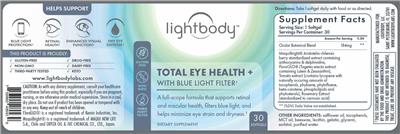
Helps Support Blue light protection Retinal health Enhanced visual function Dry eye defense
This product is proudly: Gluten-free Non-GMO Drug-free Dairy-free
Third-party tested
Total Eye Health + with blue light filter A full-scope formula that supports retinal and macular health, filters blue light, and helps minimize eye strain and dryness.
Formula
Keto
Precautions
Caution: As with any dietary supplement, consult your healthcare practitioner before using this product, especially if you are pregnant, nursing, or are otherwise under medical supervision.
Do not use if product has been opened or tampered with in any way.
Keep out of reach of children.
Storage
Store in a cool, dry place.
Brand IP Statement(s)
FloraGLO is a registered trademark of Kemin Industries, Inc. MaquiBright is a registered trademark of Maqui New Life S.A., Chile and Oryza Oil & Fat Chemical Co., Ltd., Japan.
Seals/Symbols
Third Party Tested
FDA Statement of Identity
Dietary Supplement
Suggested/Recommended/Usage/Directions
Directions: Take 1 softgel daily with food or as directed.
FDA Disclaimer Statement
These statements have not been evaluated by the Food and Drug Administration. This product is not intended to diagnose, treat, cure or prevent any disease.
Is this label outdated? Report a formula or label change and our pharmacy team will review it.
Total Eye Health + by Lightbody label
The label scan from the NIH Dietary Supplement Label Database. Tap to enlarge.
Label images are published by the NIH Dietary Supplement Label Database for the version of this product on file. Always read your actual product label.
View the full label (PDF)The Ingredients in Total Eye Health + by Lightbody
These are the 4 active ingredients this product is made of. Select any to open its full monograph.
Serving size1 Softgel(s) Dosage formSoftgel Capsule Servings per container30 Amounts shown are per serving.
Most supplement products combine several ingredients, and a medication can interact with the product through any one of them. Each ingredient below shows whether it has known drug interactions.
Ocular Botanical Blend
Other (inactive) ingredients: Safflower Oil, Tocopherols, Medium Chain Triglyceride Oil, Beeswax, Lecithin, Gelatin, Glycerin, Sorbitol, Water, Purified. These complete the product’s ingredient list but are not active constituents.
Total Eye Health + by Lightbody Drug Interactions
HelloPharmacist Interaction Report
Total Eye Health + by Lightbody contains four active ingredients, two of which have documented interactions with medications.
The most serious interaction is with rosemary extract and blood thinners (anticoagulants and antiplatelet drugs) — rosemary may increase bleeding risk, a Moderate concern. Rosemary also interacts with aspirin and related salicylate-containing pain relievers at the same severity level, since rosemary itself contains salicylates.
Read the full breakdown — every affected drug type, severity by severity
Both maqui fruit extract and rosemary may theoretically increase the risk of low blood sugar (hypoglycemia) if you take antidiabetes drugs — both are Moderate or Minor concerns depending on the ingredient. Rosemary has one additional Minor interaction: it may decrease the effectiveness of certain medications your liver breaks down (CYP1A2 substrates).
FloraGLO (lutein) and tomato extract have no documented interactions with medications. Altogether, these interactions span 371 individual medications.
Use the medication checker on this page to look up your specific drugs before you start.
Check your own medications below · Editorial policy · How we use AI
Want to check YOUR meds against Total Eye Health +?
Ask about interactions with your drugs in plain English — “Can I take it with lisinopril?” — and we find you the answer in seconds, ingredient by ingredient.
Go to the checkerIngredients driving the most interactions
Individual Drug Interactions
The ingredients in Total Eye Health + interact with 372 drugs. Click any drug to see the details.
2 of the 4 ingredients in Total Eye Health + interact with drugs. Each result below shows which ingredient is responsible. Rosemary Extract MaquiBright
AbciximabReoPro
How Abciximab interacts with Total Eye Health + — through 1 ingredient. Tap an ingredient for the detail:
Rosemary ExtractAnticoagulant/antiplatelet Drugs Moderate
Interaction Summary
Theoretically, rosemary may increase the risk of bleeding if used with anticoagulant or antiplatelet drugs.
Read the full Rosemary Extract + Abciximab interactionAbrocitinibCibinqo
How Abrocitinib interacts with Total Eye Health + — through 1 ingredient. Tap an ingredient for the detail:
Rosemary ExtractAnticoagulant/antiplatelet Drugs Moderate
Interaction Summary
Theoretically, rosemary may increase the risk of bleeding if used with anticoagulant or antiplatelet drugs.
Read the full Rosemary Extract + Abrocitinib interactionAcarboseGlucobay, Prandase, Precose
How Acarbose interacts with Total Eye Health + — through 2 ingredients. Tap an ingredient for the detail:
Rosemary ExtractAntidiabetes Drugs Moderate
Interaction Summary
Theoretically, taking rosemary with antidiabetes drugs might increase the risk of hypoglycemia.
Read the full Rosemary Extract + Acarbose interactionMaquibrightAntidiabetes Drugs Minor
Interaction Summary
Theoretically, maqui fruit extract may increase the risk of hypoglycemia when used with antidiabetes drugs.
Read the full Maquibright + Acarbose interactionAcenocoumarolSintrom
How Acenocoumarol interacts with Total Eye Health + — through 1 ingredient. Tap an ingredient for the detail:
Rosemary ExtractAnticoagulant/antiplatelet Drugs Moderate
Interaction Summary
Theoretically, rosemary may increase the risk of bleeding if used with anticoagulant or antiplatelet drugs.
Read the full Rosemary Extract + Acenocoumarol interactionAcetaminophen, AspirinGemnisyn
How Acetaminophen, Aspirin interacts with Total Eye Health + — through 1 ingredient. Tap an ingredient for the detail:
Rosemary ExtractCytochrome P450 1a2 (cyp1a2) Substrates, Anticoagulant/antiplatelet Drugs +1 Moderate
Interaction Summary
Theoretically, rosemary might decrease the levels and clinical effects of CYP1A2 substrates.
Read the full Rosemary Extract + Acetaminophen, Aspirin interactionAcetaminophen, Aspirin, CaffeineExcedrin, Excedrin Extra Strength, Excedrin Migraine
How Acetaminophen, Aspirin, Caffeine interacts with Total Eye Health + — through 1 ingredient. Tap an ingredient for the detail:
Rosemary ExtractAspirin, Cytochrome P450 1a2 (cyp1a2) Substrates +1 Moderate
Interaction Summary
Theoretically, rosemary might have additive effects with salicylate-containing drugs such as aspirin.
Read the full Rosemary Extract + Acetaminophen, Aspirin, Caffeine interactionAcetaminophen, IbuprofenCombogesic
How Acetaminophen, Ibuprofen interacts with Total Eye Health + — through 1 ingredient. Tap an ingredient for the detail:
Rosemary ExtractCytochrome P450 1a2 (cyp1a2) Substrates, Anticoagulant/antiplatelet Drugs Moderate
Interaction Summary
Theoretically, rosemary might decrease the levels and clinical effects of CYP1A2 substrates.
Read the full Rosemary Extract + Acetaminophen, Ibuprofen interactionAcetohexamideDymelor
How Acetohexamide interacts with Total Eye Health + — through 2 ingredients. Tap an ingredient for the detail:
Rosemary ExtractAntidiabetes Drugs Moderate
Interaction Summary
Theoretically, taking rosemary with antidiabetes drugs might increase the risk of hypoglycemia.
Read the full Rosemary Extract + Acetohexamide interactionMaquibrightAntidiabetes Drugs Minor
Interaction Summary
Theoretically, maqui fruit extract may increase the risk of hypoglycemia when used with antidiabetes drugs.
Read the full Maquibright + Acetohexamide interactionAcetylsalicylic AcidEntrophen
How Acetylsalicylic Acid interacts with Total Eye Health + — through 1 ingredient. Tap an ingredient for the detail:
Rosemary ExtractAspirin, Anticoagulant/antiplatelet Drugs Moderate
Interaction Summary
Theoretically, rosemary might have additive effects with salicylate-containing drugs such as aspirin.
Read the full Rosemary Extract + Acetylsalicylic Acid interactionAlbiglutideTanzeum
How Albiglutide interacts with Total Eye Health + — through 2 ingredients. Tap an ingredient for the detail:
Rosemary ExtractAntidiabetes Drugs Moderate
Interaction Summary
Theoretically, taking rosemary with antidiabetes drugs might increase the risk of hypoglycemia.
Read the full Rosemary Extract + Albiglutide interactionMaquibrightAntidiabetes Drugs Minor
Interaction Summary
Theoretically, maqui fruit extract may increase the risk of hypoglycemia when used with antidiabetes drugs.
Read the full Maquibright + Albiglutide interactionAlogliptinNesina
How Alogliptin interacts with Total Eye Health + — through 2 ingredients. Tap an ingredient for the detail:
Rosemary ExtractAntidiabetes Drugs Moderate
Interaction Summary
Theoretically, taking rosemary with antidiabetes drugs might increase the risk of hypoglycemia.
Read the full Rosemary Extract + Alogliptin interactionMaquibrightAntidiabetes Drugs Minor
Interaction Summary
Theoretically, maqui fruit extract may increase the risk of hypoglycemia when used with antidiabetes drugs.
Read the full Maquibright + Alogliptin interactionAlogliptin, MetforminKazano
How Alogliptin, Metformin interacts with Total Eye Health + — through 2 ingredients. Tap an ingredient for the detail:
Rosemary ExtractAntidiabetes Drugs Moderate
Interaction Summary
Theoretically, taking rosemary with antidiabetes drugs might increase the risk of hypoglycemia.
Read the full Rosemary Extract + Alogliptin, Metformin interactionMaquibrightAntidiabetes Drugs Minor
Interaction Summary
Theoretically, maqui fruit extract may increase the risk of hypoglycemia when used with antidiabetes drugs.
Read the full Maquibright + Alogliptin, Metformin interactionAlogliptin, PioglitazoneOseni
How Alogliptin, Pioglitazone interacts with Total Eye Health + — through 2 ingredients. Tap an ingredient for the detail:
Rosemary ExtractAntidiabetes Drugs Moderate
Interaction Summary
Theoretically, taking rosemary with antidiabetes drugs might increase the risk of hypoglycemia.
Read the full Rosemary Extract + Alogliptin, Pioglitazone interactionMaquibrightAntidiabetes Drugs Minor
Interaction Summary
Theoretically, maqui fruit extract may increase the risk of hypoglycemia when used with antidiabetes drugs.
Read the full Maquibright + Alogliptin, Pioglitazone interactionAlteplase, TpaActilyse, Activase
How Alteplase, Tpa interacts with Total Eye Health + — through 1 ingredient. Tap an ingredient for the detail:
Rosemary ExtractAnticoagulant/antiplatelet Drugs Moderate
Interaction Summary
Theoretically, rosemary may increase the risk of bleeding if used with anticoagulant or antiplatelet drugs.
Read the full Rosemary Extract + Alteplase, Tpa interactionAluminum Hydroxide, Aspirin, Codeine Phosphate, Magnesium HydroxideAscriptin Codeine #2
How Aluminum Hydroxide, Aspirin, Codeine Phosphate, Magnesium Hydroxide interacts with Total Eye Health + — through 1 ingredient. Tap an ingredient for the detail:
Rosemary ExtractAspirin, Anticoagulant/antiplatelet Drugs Moderate
Interaction Summary
Theoretically, rosemary might have additive effects with salicylate-containing drugs such as aspirin.
Read the full Rosemary Extract + Aluminum Hydroxide, Aspirin, Codeine Phosphate, Magnesium Hydroxide interactionAluminum Hydroxide, Aspirin, Magnesium HydroxideAscriptin
How Aluminum Hydroxide, Aspirin, Magnesium Hydroxide interacts with Total Eye Health + — through 1 ingredient. Tap an ingredient for the detail:
Rosemary ExtractAnticoagulant/antiplatelet Drugs, Aspirin Moderate
Interaction Summary
Theoretically, rosemary may increase the risk of bleeding if used with anticoagulant or antiplatelet drugs.
Read the full Rosemary Extract + Aluminum Hydroxide, Aspirin, Magnesium Hydroxide interactionAnacaulase-bcdbNexoBrid
How Anacaulase-bcdb interacts with Total Eye Health + — through 1 ingredient. Tap an ingredient for the detail:
Rosemary ExtractAnticoagulant/antiplatelet Drugs Moderate
Interaction Summary
Theoretically, rosemary may increase the risk of bleeding if used with anticoagulant or antiplatelet drugs.
Read the full Rosemary Extract + Anacaulase-bcdb interactionAnagrelideAgrylin
How Anagrelide interacts with Total Eye Health + — through 1 ingredient. Tap an ingredient for the detail:
Rosemary ExtractCytochrome P450 1a2 (cyp1a2) Substrates, Anticoagulant/antiplatelet Drugs Moderate
Interaction Summary
Theoretically, rosemary might decrease the levels and clinical effects of CYP1A2 substrates.
Read the full Rosemary Extract + Anagrelide interactionAnisindioneMiradon
How Anisindione interacts with Total Eye Health + — through 1 ingredient. Tap an ingredient for the detail:
Rosemary ExtractAnticoagulant/antiplatelet Drugs Moderate
Interaction Summary
Theoretically, rosemary may increase the risk of bleeding if used with anticoagulant or antiplatelet drugs.
Read the full Rosemary Extract + Anisindione interactionAntidiabetes, Dipeptidyl Peptidase-4 (dpp-iv) InhibitorGlyxambi
How Antidiabetes, Dipeptidyl Peptidase-4 (dpp-iv) Inhibitor interacts with Total Eye Health + — through 2 ingredients. Tap an ingredient for the detail:
Rosemary ExtractAntidiabetes Drugs Moderate
Interaction Summary
Theoretically, taking rosemary with antidiabetes drugs might increase the risk of hypoglycemia.
Read the full Rosemary Extract + Antidiabetes, Dipeptidyl Peptidase-4 (dpp-iv) Inhibitor interactionMaquibrightAntidiabetes Drugs Minor
Interaction Summary
Theoretically, maqui fruit extract may increase the risk of hypoglycemia when used with antidiabetes drugs.
Read the full Maquibright + Antidiabetes, Dipeptidyl Peptidase-4 (dpp-iv) Inhibitor interactionAntithrombin IiiThrombate III
How Antithrombin Iii interacts with Total Eye Health + — through 1 ingredient. Tap an ingredient for the detail:
Rosemary ExtractAnticoagulant/antiplatelet Drugs Moderate
Interaction Summary
Theoretically, rosemary may increase the risk of bleeding if used with anticoagulant or antiplatelet drugs.
Read the full Rosemary Extract + Antithrombin Iii interactionApixabanEliquis
How Apixaban interacts with Total Eye Health + — through 1 ingredient. Tap an ingredient for the detail:
Rosemary ExtractAnticoagulant/antiplatelet Drugs Moderate
Interaction Summary
Theoretically, rosemary may increase the risk of bleeding if used with anticoagulant or antiplatelet drugs.
Read the full Rosemary Extract + Apixaban interactionArgatrobanArgatroban
How Argatroban interacts with Total Eye Health + — through 1 ingredient. Tap an ingredient for the detail:
Rosemary ExtractAnticoagulant/antiplatelet Drugs Moderate
Interaction Summary
Theoretically, rosemary may increase the risk of bleeding if used with anticoagulant or antiplatelet drugs.
Read the full Rosemary Extract + Argatroban interactionAspirinAngettes 75, ASA, Asaphen, Aspirin, Caprin, Cartia +8 more
How Aspirin interacts with Total Eye Health + — through 1 ingredient. Tap an ingredient for the detail:
Rosemary ExtractAnticoagulant/antiplatelet Drugs, Aspirin Moderate
Interaction Summary
Theoretically, rosemary may increase the risk of bleeding if used with anticoagulant or antiplatelet drugs.
Read the full Rosemary Extract + Aspirin interactionAspirin, Aluminum Hydroxide, Codeine Phosphate, Magnesium HydroxideAscriptin Codeine #3
How Aspirin, Aluminum Hydroxide, Codeine Phosphate, Magnesium Hydroxide interacts with Total Eye Health + — through 1 ingredient. Tap an ingredient for the detail:
Rosemary ExtractAspirin, Anticoagulant/antiplatelet Drugs Moderate
Interaction Summary
Theoretically, rosemary might have additive effects with salicylate-containing drugs such as aspirin.
Read the full Rosemary Extract + Aspirin, Aluminum Hydroxide, Codeine Phosphate, Magnesium Hydroxide interactionAspirin, ButalbitalAxotal
How Aspirin, Butalbital interacts with Total Eye Health + — through 1 ingredient. Tap an ingredient for the detail:
Rosemary ExtractAnticoagulant/antiplatelet Drugs, Aspirin Moderate
Interaction Summary
Theoretically, rosemary may increase the risk of bleeding if used with anticoagulant or antiplatelet drugs.
Read the full Rosemary Extract + Aspirin, Butalbital interactionAspirin, Butalbital, CaffeineFiorinal
How Aspirin, Butalbital, Caffeine interacts with Total Eye Health + — through 1 ingredient. Tap an ingredient for the detail:
Rosemary ExtractAspirin, Cytochrome P450 1a2 (cyp1a2) Substrates +1 Moderate
Interaction Summary
Theoretically, rosemary might have additive effects with salicylate-containing drugs such as aspirin.
Read the full Rosemary Extract + Aspirin, Butalbital, Caffeine interactionAspirin, Butalbital, Caffeine, Codeine PhosphateFiorinal w/ Codeine
How Aspirin, Butalbital, Caffeine, Codeine Phosphate interacts with Total Eye Health + — through 1 ingredient. Tap an ingredient for the detail:
Rosemary ExtractCytochrome P450 1a2 (cyp1a2) Substrates, Anticoagulant/antiplatelet Drugs +1 Moderate
Interaction Summary
Theoretically, rosemary might decrease the levels and clinical effects of CYP1A2 substrates.
Read the full Rosemary Extract + Aspirin, Butalbital, Caffeine, Codeine Phosphate interactionAspirin, Butalbital, Caffeine, PhenacetinMarnal
How Aspirin, Butalbital, Caffeine, Phenacetin interacts with Total Eye Health + — through 1 ingredient. Tap an ingredient for the detail:
Rosemary ExtractAspirin, Cytochrome P450 1a2 (cyp1a2) Substrates +1 Moderate
Interaction Summary
Theoretically, rosemary might have additive effects with salicylate-containing drugs such as aspirin.
Read the full Rosemary Extract + Aspirin, Butalbital, Caffeine, Phenacetin interactionAspirin, CaffeineAnacin
How Aspirin, Caffeine interacts with Total Eye Health + — through 1 ingredient. Tap an ingredient for the detail:
Rosemary ExtractCytochrome P450 1a2 (cyp1a2) Substrates, Anticoagulant/antiplatelet Drugs +1 Moderate
Interaction Summary
Theoretically, rosemary might decrease the levels and clinical effects of CYP1A2 substrates.
Read the full Rosemary Extract + Aspirin, Caffeine interactionEach ingredient & the kinds of drugs it affects
For each ingredient in Total Eye Health + with known interactions, here are the types of medications they can affect. Open any type for the detail — or search your exact drug in the checker above.
Rosemary Extract
Anticoagulant/Antiplatelet Drugs
Theoretically, rosemary may increase the risk of bleeding if used with anticoagulant or antiplatelet drugs.
In vitro and animal research suggests that rosemary inhibits platelet aggregation.
Antidiabetes Drugs
Theoretically, taking rosemary with antidiabetes drugs might increase the risk of hypoglycemia.
Animal research shows that rosemary extract can decrease blood glucose levels in diabetic models. However, research in humans is conflicting. Although rosemary powder decreased blood glucose levels in healthy adults, no change in blood glucose levels was seen in adults with type 2 diabetes, most of whom were taking antidiabetes drugs.
Aspirin
Theoretically, rosemary might have additive effects with salicylate-containing drugs such as aspirin.
Rosemary is reported to contain salicylates.
Choline Magnesium Trisalicylate (Trilisate)
Theoretically, rosemary might have additive effects with salicylate-containing drugs such as choline magnesium trisalicylate.
Rosemary is reported to contain salicylate.
Salsalate (Disalcid)
Theoretically, rosemary might have additive effects with salicylate-containing drugs such as salsalate.
Rosemary is reported to contain salicylate.
Cytochrome P450 1A2 (Cyp1A2) Substrates
Theoretically, rosemary might decrease the levels and clinical effects of CYP1A2 substrates.
In vitro research shows that rosemary induces CYP1A2 enzymes. This effect has not been reported in humans.
MaquiBright
Antidiabetes Drugs
Theoretically, maqui fruit extract may increase the risk of hypoglycemia when used with antidiabetes drugs.
Animal research shows that maqui berry reduces fasting blood glucose. However, maqui berry extract taken orally, either as a single dose or daily for 3 months, does not decrease fasting blood glucose in prediabetic patients. It is unknown whether it might reduce blood glucose levels in patients with diabetes.
Brand information
Manufacturer and brand details for Total Eye Health +, from the product label.
Lightbody
See all Lightbody products- Name
- Lightbody, LLC
- City
- Saint Petersburg
- State
- FL
- ZipCode
- 33701
- Web Address
- www.lightbodylabs.com
Total Eye Health + by Lightbody: Common Questions
Does Total Eye Health + by Lightbody interact with any medications?
How can one product interact with so many drugs?
Where does this information come from?
What is FloraGLO and why is it in here?
Does this actually work for dry eyes?
Is this safe if I'm pregnant or breastfeeding?
What are the inactive ingredients?
Can I get side effects from this?
Will this interact with my blood pressure or cholesterol medication?
Written and reviewed by the HelloPharmacist editorial staff. Our editorial policy
Not sure if Total Eye Health + is safe with your meds?
Our pharmacists answer your medication & supplement questions — free.
Label information is sourced from the NIH Dietary Supplement Label Database and reflects the product version on file; always read your actual product label. This page is for education only and is not a substitute for professional medical advice. Confirm with your pharmacist or doctor before combining supplements and medications.
The Full Monographs Behind Total Eye Health +’s Ingredients
Every ingredient we hold a full HelloPharmacist monograph for — uses, evidence, safety, and the complete interaction list.
Maqui
Interacts with 86 drugsMaqui is a dark purple berry from Chile that is very rich in antioxidant plant pigments called anthocyanins. Early research suggests it may help with things like blood sugar, dry eye, and in...
Read the full Maqui monograph → Herb & supplement monographLutein
Lutein is a plant-based antioxidant pigment that concentrates in the eye, and the best evidence suggests it (often combined with zeaxanthin) may help slow progression of age-related macular...
Read the full Lutein monograph → Herb & supplement monographTomato
Tomato is a common food rich in vitamins, potassium, and the antioxidant lycopene, and eating it as part of a balanced diet is healthy for most people. Concentrated tomato or lycopene supple...
Read the full Tomato monograph → Herb & supplement monographRosemary
Interacts with 372 drugsRosemary is a fragrant Mediterranean herb that is safe and flavorful in normal food amounts. Some early research suggests possible benefits for memory, mood, and hair growth, but the evidenc...
Read the full Rosemary monograph →Sources & How We Checked
Total Eye Health +'s label data comes from the NIH Dietary Supplement Label Database; the ingredient interaction data is from the Natural Medicines database, reviewed by our pharmacists.
- NIH Dietary Supplement Label Database (DSLD) — The official product label on file for this supplement.
- Natural Medicines (Therapeutic Research Center) — Evidence-graded clinical reference behind the ingredient interaction data.
Content is written and reviewed by licensed HelloPharmacist pharmacists. See our data sources and editorial standards for how this information is built and checked.
The 28 references behind this product’s interaction data
Every citation that drives the interaction findings for this product’s ingredients, from the evidence-graded Natural Medicines (TRC Healthcare) database. Open an ingredient to browse its citations — links open the study on PubMed or the publisher’s site.
Maqui 3 references
- Alvarado JL, Leschot A, Olivera-Nappa Á, et al. Delphinidin-rich maqui berry extract (Delphinol®) lowers fasting and postprandial glycemia and insulinemia in prediabetic individuals during oral glucose tolerance tests. Biomed Res Int. 2016;2016:9070537. PubMed
- Alvarado J, Schoenlau F, Leschot A, Salgad AM, Vigil Portales P. Delphinol® standardized maqui berry extract significantly lowers blood glucose and improves blood lipid profile in prediabetic individuals in three-month clinical trial. Panminerva Med. 2016
- Hidalgo J, Flores C, Hidalgo MA, et al. Delphinol® standardized maqui berry extract reduces postprandial blood glucose increase in individuals with impaired glucose regulation by novel mechanism of sodium glucose cotransporter inhibition. Panminerva Med.
Lutein 2 references
- Brown L, Rimm EB, Seddon JM, et al. A prospective study of carotenoid intake and risk of cataract extraction in US men. Am J Clin Nutr 1999;70:517-24. PubMed
- Chasan-Taber L, Willett WC, Seddon JM, et al. A prospective study of carotenoid and vitamin A intakes and risk of cataract extraction in US women. Am J Clin Nutr 1999;70:509-16. PubMed
Tomato 3 references
- Gruenwald J, Brendler T, Jaenicke C. PDR for Herbal Medicines. 1st ed. Montvale, NJ: Medical Economics Company, Inc., 1998.
- Asero R, Mistrello G, Amato S. Airborne allergy to tomato proteins. Allergy. 2010;65(12):1626-7. PubMed
- Friedman M. Tomato Glycoalkaloids: Role in the Plant and in the Diet. J Agric Food Chem. 2002;50(21):5751-80. PubMed
Rosemary 20 references
- Newall CA, Anderson LA, Philpson JD. Herbal Medicine: A Guide for Healthcare Professionals. London, UK: The Pharmaceutical Press, 1996.
- Foster S, Tyler VE. Tyler's Honest Herbal: A Sensible Guide to the Use of Herbs and Related Remedies. 3rd ed., Binghamton, NY: Haworth Herbal Press, 1993.
- The Review of Natural Products by Facts and Comparisons. St. Louis, MO: Wolters Kluwer Co., 1999.
- McGuffin M, Hobbs C, Upton R, Goldberg A, eds. American Herbal Products Association's Botanical Safety Handbook. Boca Raton, FL: CRC Press, LLC 1997.
- Gruenwald J, Brendler T, Jaenicke C. PDR for Herbal Medicines. 1st ed. Montvale, NJ: Medical Economics Company, Inc., 1998.
- Cartier LC, Lehrer A, Malo JL. Occupational asthma caused by aromatic herbs. Allergy 1996;51:647-9. DOI
- Burkhard PR, Burkhardt K, Haenggeli CA, Landis T. Plant-induced seizures: reappearance of an old problem. J Neurol 1999;246:667-70. PubMed
- Swain AR, Dutton SP, Truswell AS. Salicylates in foods. J Am Diet.Assoc 1985;85(8):950-60. DOI
- Zhu BT, Loder DP, Cai MX, et al. Dietary administration of an extract from rosemary leaves enhances the liver microsomal metabolism of endogenous estrogens and decreases their uterotropic action in CD-1 mice. Carcinogenesis 1998;19(10):1821-7. PubMed
- Debersac P, Heydel JM, Amiot MJ, et al. Induction of cytochrome P450 and/or detoxication enzymes by various extracts of rosemary: description of specific patterns. Food Chem Toxicol 2001;39(9):907-18. PubMed
- Debersac P, Vernevaut MF, Amiot MJ, et al. Effects of a water-soluble extract of rosemary and its purified component rosmarinic acid on xenobiotic-metabolizing enzymes in rat liver. Food Chem Toxicol 2001;39(2):109-17. PubMed
- Lee JJ, Jin YR, Lee JH, et al. Antiplatelet activity of carnosic acid, a phenolic diterpene from Rosmarinus officinalis. Planta Med 2007;73(2):121-7.
- Yamamoto J, Yamada K, Naemura A, et al. Testing various herbs for antithrombotic effect. Nutrition 2005;21(5):580-7. PubMed
- Naemura A, Ura M, Yamashita T, et al. Long-term intake of rosemary and common thyme herbs inhibits experimental thrombosis without prolongation of bleeding time. Thromb Res 2008;122(4):517-22. PubMed
- Lee JJ, Jin YR, Lim Y, et al. Antiplatelet activity of carnosol is mediated by the inhibition of TXA2 receptor and cytosolic calcium mobilization. Vascul Pharmacol 2006;45:148-53. PubMed
- Bakirel, T., Bakirel, U., Keles, O. U., Ulgen, S. G., and Yardibi, H. In vivo assessment of antidiabetic and antioxidant activities of rosemary (Rosmarinus officinalis) in alloxan-diabetic rabbits. J Ethnopharmacol 2-28-2008;116(1):64-73. PubMed
- Erenmemisoglu, A., Saraymen, R., and Ustun, S. Effect of a Rosmarinus officinalis leave extract on plasma glucose levels in normoglycaemic and diabetic mice. Pharmazie 1997;52(8):645-646.
- Valones MAA, Silva ICG, Gueiros LAM, Leão JC, Caldas AF Jr, Carvalho AAT. Clinical assessment of rosemary-based toothpaste (Rosmarinus officinalis Linn.): A randomized controlled double-blind study. Braz Dent J. 2019;30(2):146-151. PubMed
- Quirarte-Báez SM, Zamora-Perez AL, Reyes-Estrada CA, et al. A shortened treatment with rosemary tea (rosmarinus officinalis) instead of glucose in patients with diabetes mellitus type 2 (TSD). J Popul Ther Clin Pharmacol. 2019;26(4):e18-e28.
- Al Jamal A. Effect of rosemary (Rosmarinus officinalis) on lipid profiles and blood glucose in human diabetic patients (type-2). African J. Biochem. Res. 2014;8(8):147-50. DOI
Parts of this content are provided by the Therapeutic Research Center, LLC.
DISCLAIMER: Currently this does not check for drug-drug interactions. This is not an all-inclusive comprehensive list of potential interactions and is for informational purposes only. Not all interactions are known or well-reported in the scientific literature, and new interactions are continually being reported. Input is needed from a qualified healthcare provider including a pharmacist before starting any therapy. Application of clinical judgment is necessary.
© 2021 Therapeutic Research Center, LLC