
Total Stress Support Ingredients & Drug Interactions
by Lightbody
What is this page for?
First and foremost: checking Total Stress Support against your medications. The heart of this page is the interaction checker and the full interaction report — how this product’s ingredients may interact with prescription and over-the-counter medicines you may be taking.
Around that, we add a pharmacist’s high-level view of the product as a whole — what’s inside, the evidence for its stated use, how transparent the label is, and what safety data exists — so you can see the full picture in one place. It’s educational information from our licensed clinical databases and the clinical staff at HelloPharmacist — not medical advice — and we don’t sell or endorse products. Our editorial policy
Total Stress Support is a dietary supplement by Lightbody with 2 active ingredients. Its ingredients are commonly taken for memory and cognitive support, anxiety and stress, adhd symptoms.Based on those ingredients, 1,496 medications have a known interaction with it, the most serious rated moderate. The ingredients most likely to interact are Sensoril, Bacopa monnieri Extract. Use the checker below to test your specific medication, or read the full HelloPharmacist Interaction Report.
Check Your Meds Against Total Stress Support by Lightbody
Ask about any prescription or over-the-counter medication and we check it for interactions with Total Stress Support by Lightbody — and tell you which ingredient is responsible.
AI summaries are generated from our interaction database for education only — always confirm with your pharmacist. How we use AI
Ask the Pharmacist
A licensed pharmacist will answer your question by email — free, usually within 24 hours.
Got it — thank you!
A licensed pharmacist will answer within 24 hours. Keep an eye on your email (worth checking spam, just in case).
HelloPharmacist Scorecard of Total Stress Support by Lightbody
Our pharmacy team’s full take, with four database checks built into the cards below — a summary of what is known, not a grade of the product itself.
What’s inside
Full disclosure
Total Stress Support contains 2 active ingredients: bacopa monnieri extract and Sensoril ashwagandha. Bacopa has a long history in traditional medicine for memory and mental clarity; ashwagandha is an adaptogen traditionally used for stress and sleep.
The product also contains inactive ingredients — cellulose, water, and rice bran — which are fillers and capsule components.
Does it work?
Moderate evidence
For the stress and anxiety claims, ashwagandha is possibly effective for anxiety, stress, and generalized anxiety disorder, and possibly effective for insomnia. Bacopa's effectiveness isn't established in our data — evidence is insufficient to rate it for cognitive function, ADHD, back pain, sexual dysfunction, Alzheimer disease, or cognitive impairment.
If you're taking this mainly for stress relief, ashwagandha carries the evidence; for other uses, talk to your pharmacist about what the research actually shows.
How safe is it?
Well-documented data
Both ingredients are generally well tolerated in short-term studies, but long-term safety data are limited. Common side effects from bacopa include abdominal cramps, diarrhea, dry mouth, headache, nausea, and drowsiness; gastrointestinal upset occurs in roughly 12 to 30 percent of people taking it.
Ashwagandha commonly causes diarrhea, nausea, vomiting, and gastrointestinal upset at higher doses, though these are rare at typical doses. Rare serious concerns for ashwagandha include acute liver injury and, in one case report, reversible cerebral vasoconstriction (a blood-vessel narrowing that caused stroke-like symptoms).
Bacopa is not recommended in pregnancy and should be avoided while breastfeeding. Ashwagandha is likely unsafe in pregnancy — it's traditionally thought to raise miscarriage risk — and data are insufficient to recommend it while breastfeeding.
Meds to double-check
Moderate interaction found
Before you take this, check your medications against these drug types: blood pressure medications, diabetes drugs, thyroid hormone, benzodiazepines and other sedatives, liver-toxic drugs, immunosuppressants, anticholinergic drugs, and cholinergic drugs. If you're on cevimeline (Evoxac) for dry mouth, that's a specific interaction to discuss with your pharmacist.
Your pharmacist can search your exact medications on this page.
The bottom line
Scorecard at a glanceFully disclosed formula with some supporting evidence for its stated purpose. Moderate medication interactions have been identified, and safety information is well characterized.
If you're on blood pressure meds, diabetes drugs, thyroid hormone, sedatives, benzodiazepines, or immunosuppressants, you need to check with your pharmacist before starting this product. Even if you're not on prescription medications, liver health and pregnancy status matter — talk through your full health picture and medication list with your pharmacist to decide if this is right for you.
Educational only — not medical advice; always confirm with your pharmacist. Our editorial policy · How we use AI
Assessment coverage: 2 of 2 active ingredients matched to our full ingredient reviews (monographs). Based on the product label dated Jul 25, 2024.
This Scorecard evaluates available label information, ingredient evidence, and known medication-safety considerations. It does not independently verify product identity, purity, potency, contamination, or manufacturing quality. How these ratings are computed
General information
Key facts about Total Stress Support, straight from the product label.
| Brand | Lightbody |
|---|---|
| Net contents | 30 Capsule(s) |
| Market status | On market |
| Date entered into DSLD | Jul 25, 2024 |
| DSLD ID | 314196 |
| Product type | Botanical |
| Supplement form | Capsule |
| Dietary claims / uses | All Other, Structure/Function |
| Intended target group(s) | Vegan, Vegetarian, Adult (18 - 50 Years), Gluten Free, Dairy Free, Sugar Free |
Everything in this section is reproduced from the manufacturer’s own product label — it’s the label speaking, not HelloPharmacist. We show it so you can see exactly what the maker states; we don’t verify or endorse those statements.
Supplement Facts
The label details for Total Stress Support by Lightbody, sourced from the NIH Dietary Supplement Label Database.
Supplement Facts
| Ingredient | Amount | % DV |
|---|---|---|
| Bacopa monnieri Extract | 340 mg | -- |
| Sensoril | 250 mg | -- |
Other ingredients: Cellulose, Water, Rice Bran
Tap any ingredient to jump to its full detail below.
These statements are the manufacturer’s wording, reproduced from the product label — the label is saying it, not HelloPharmacist. We don’t verify or endorse them.
Formulation
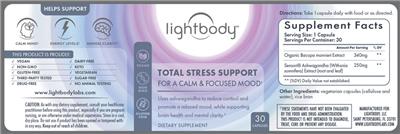
Helps Support Calm mind Energy levels Mental clarity
This product is proudly: Non-GMO Gluten-free Drug-free Dairy-free Sugar-free
Vegan Vegetarian
Third-party tested No animal testing
Total Stress Support for a calm & focused mood
Formula
Keto
Uses ashwagandha to reduce cortisol and promote a relaxed mood, while supporting brain health and mental clarity.
Precautions
Caution: As with any dietary supplement, consult your healthcare practitioner before using this product, especially if you are pregnant, nursing, or are otherwise under medical supervision.
Do not use if product has been opened or tampered with in any way.
Keep out of reach of children.
Storage
Store in a cool, dry place.
Seals/Symbols
Vegan
FDA Statement of Identity
Dietary Supplement
Suggested/Recommended/Usage/Directions
Directions: Take 1 capsule daily with food or as directed.
FDA Disclaimer Statement
These statements have not been evaluated by the Food and Drug Administration. This product is not intended to diagnose, treat, cure or prevent any disease.
Is this label outdated? Report a formula or label change and our pharmacy team will review it.
Total Stress Support by Lightbody label
The label scan from the NIH Dietary Supplement Label Database. Tap to enlarge.
Label images are published by the NIH Dietary Supplement Label Database for the version of this product on file. Always read your actual product label.
View the full label (PDF)The Ingredients in Total Stress Support by Lightbody
These are the 2 active ingredients this product is made of. Select any to open its full monograph.
Serving size1 Capsule(s) Dosage formCapsule Servings per container30 Amounts shown are per serving.
Most supplement products combine several ingredients, and a medication can interact with the product through any one of them. Each ingredient below shows whether it has known drug interactions.
Bacopa monnieri Extract
Interacts with932 drugs
Bacopa is an Ayurvedic herb most often used for memory and thinking. Some small studies suggest it may modestly help memory when taken regularly for s...
Bacopa monnieri Extract monograph & interactionsSensoril
Interacts with1,373 drugs
Ashwagandha is an Ayurvedic herb most often taken to help with stress, anxiety, and sleep, and some small studies suggest it may help, though the evid...
Sensoril monograph & interactionsOther (inactive) ingredients: Cellulose, Water, Rice Bran. These complete the product’s ingredient list but are not active constituents.
Total Stress Support by Lightbody Drug Interactions
HelloPharmacist Interaction Report
Total Stress Support by Lightbody contains two active ingredients, and both have documented interactions with medications.
The most serious concerns involve bacopa's potential to increase levels of drugs broken down by your liver (CYP450 enzymes), which could amplify their effects — this is rated Moderate severity and spans multiple drug families. Ashwagandha adds Moderate-severity risks with blood pressure medications, diabetes drugs, thyroid hormones, and immunosuppressants, plus rare but serious concerns about liver damage when combined with other drugs that stress the liver.
Read the full breakdown — every affected drug type, severity by severity
Backopa may also interfere with anticholinergic or cholinergic drugs (medications that affect nerve-signaling acetylcholine), and there's a documented case of someone experiencing serious symptoms after combining bacopa with cevimeline, a drug for dry mouth. Ashwagandha can increase drowsiness when combined with sedatives, anti-anxiety drugs, or benzodiazepines, and may lower blood sugar when taken with diabetes medications or lower blood pressure further with blood pressure drugs.
Backopa's effect on thyroid hormone is rated Minor. Neither ingredient has interaction data we could not assess — both have been checked.
Altogether, these interactions span 1,473 individual medications. Run your exact medications through the checker on this page before you start.
Check your own medications below · Editorial policy · How we use AI
Want to check YOUR meds against Total Stress Support?
Ask about interactions with your drugs in plain English — “Can I take it with lisinopril?” — and we find you the answer in seconds, ingredient by ingredient.
Go to the checkerIngredients driving the most interactions
Individual Drug Interactions
The ingredients in Total Stress Support interact with 1,496 drugs. Click any drug to see the details.
2 of the 2 ingredients in Total Stress Support interact with drugs. Each result below shows which ingredient is responsible. Sensoril Bacopa monnieri Extract
6-mercaptopurinePurinethol
How 6-mercaptopurine interacts with Total Stress Support — through 1 ingredient. Tap an ingredient for the detail:
SensorilHepatotoxic Drugs, Immunosuppressants Moderate
Interaction Summary
Theoretically, taking ashwagandha with hepatotoxic drugs might increase the risk of liver damage.
Read the full Sensoril + 6-mercaptopurine interactionAdo-trastuzumab EmtansineKadcyla
How Ado-trastuzumab Emtansine interacts with Total Stress Support — through 2 ingredients. Tap an ingredient for the detail:
Bacopa Monnieri ExtractCytochrome P450 3a4 (cyp3a4) Substrates Moderate
Interaction Summary
Theoretically, bacopa might increase the levels and adverse effects of CYP3A4 substrates.
Read the full Bacopa Monnieri Extract + Ado-trastuzumab Emtansine interactionSensorilCytochrome P450 3a4 (cyp3a4) Substrates Minor
Interaction Summary
Theoretically, ashwagandha might decrease the levels and clinical effects of CYP3A4 substrates.
Read the full Sensoril + Ado-trastuzumab Emtansine interactionAbacavir Sulfate, Dolutegravir, LamivudineTriumeq
How Abacavir Sulfate, Dolutegravir, Lamivudine interacts with Total Stress Support — through 1 ingredient. Tap an ingredient for the detail:
SensorilHepatotoxic Drugs Moderate
Interaction Summary
Theoretically, taking ashwagandha with hepatotoxic drugs might increase the risk of liver damage.
Read the full Sensoril + Abacavir Sulfate, Dolutegravir, Lamivudine interactionAbacavir, LamivudineEpzicom
How Abacavir, Lamivudine interacts with Total Stress Support — through 1 ingredient. Tap an ingredient for the detail:
SensorilHepatotoxic Drugs Moderate
Interaction Summary
Theoretically, taking ashwagandha with hepatotoxic drugs might increase the risk of liver damage.
Read the full Sensoril + Abacavir, Lamivudine interactionAbemaciclibVerzenio
How Abemaciclib interacts with Total Stress Support — through 2 ingredients. Tap an ingredient for the detail:
Bacopa Monnieri ExtractCytochrome P450 3a4 (cyp3a4) Substrates Moderate
Interaction Summary
Theoretically, bacopa might increase the levels and adverse effects of CYP3A4 substrates.
Read the full Bacopa Monnieri Extract + Abemaciclib interactionSensorilCytochrome P450 3a4 (cyp3a4) Substrates Minor
Interaction Summary
Theoretically, ashwagandha might decrease the levels and clinical effects of CYP3A4 substrates.
Read the full Sensoril + Abemaciclib interactionAbiraterone
How Abiraterone interacts with Total Stress Support — through 2 ingredients. Tap an ingredient for the detail:
SensorilCytochrome P450 3a4 (cyp3a4) Substrates, Hepatotoxic Drugs Moderate
Interaction Summary
Theoretically, ashwagandha might decrease the levels and clinical effects of CYP3A4 substrates.
Read the full Sensoril + Abiraterone interactionBacopa Monnieri ExtractCytochrome P450 3a4 (cyp3a4) Substrates Moderate
Interaction Summary
Theoretically, bacopa might increase the levels and adverse effects of CYP3A4 substrates.
Read the full Bacopa Monnieri Extract + Abiraterone interactionAbiraterone AcetateYonsa, Zytiga
How Abiraterone Acetate interacts with Total Stress Support — through 2 ingredients. Tap an ingredient for the detail:
SensorilHepatotoxic Drugs, Cytochrome P450 3a4 (cyp3a4) Substrates Moderate
Interaction Summary
Theoretically, taking ashwagandha with hepatotoxic drugs might increase the risk of liver damage.
Read the full Sensoril + Abiraterone Acetate interactionBacopa Monnieri ExtractCytochrome P450 3a4 (cyp3a4) Substrates Moderate
Interaction Summary
Theoretically, bacopa might increase the levels and adverse effects of CYP3A4 substrates.
Read the full Bacopa Monnieri Extract + Abiraterone Acetate interactionAbrocitinibCibinqo
How Abrocitinib interacts with Total Stress Support — through 2 ingredients. Tap an ingredient for the detail:
SensorilImmunosuppressants Moderate
Interaction Summary
Theoretically, taking ashwagandha might decrease the effects of immunosuppressants.
Read the full Sensoril + Abrocitinib interactionBacopa Monnieri ExtractCytochrome P450 2c19 (cyp2c19) Substrates, Cytochrome P450 2c9 (cyp2c9) Substrates Moderate
Interaction Summary
Theoretically, bacopa might increase the levels and adverse effects of CYP2C19 substrates.
Read the full Bacopa Monnieri Extract + Abrocitinib interactionAcalabrutinibCalquence
How Acalabrutinib interacts with Total Stress Support — through 2 ingredients. Tap an ingredient for the detail:
Bacopa Monnieri ExtractCytochrome P450 3a4 (cyp3a4) Substrates Moderate
Interaction Summary
Theoretically, bacopa might increase the levels and adverse effects of CYP3A4 substrates.
Read the full Bacopa Monnieri Extract + Acalabrutinib interactionSensorilCytochrome P450 3a4 (cyp3a4) Substrates Minor
Interaction Summary
Theoretically, ashwagandha might decrease the levels and clinical effects of CYP3A4 substrates.
Read the full Sensoril + Acalabrutinib interactionAcarboseGlucobay, Prandase, Precose
How Acarbose interacts with Total Stress Support — through 1 ingredient. Tap an ingredient for the detail:
SensorilAntidiabetes Drugs, Hepatotoxic Drugs Moderate
Interaction Summary
Theoretically, taking ashwagandha with antidiabetes drugs might increase the risk of hypoglycemia.
Read the full Sensoril + Acarbose interactionAcebutololRhotral, Sectral
How Acebutolol interacts with Total Stress Support — through 1 ingredient. Tap an ingredient for the detail:
SensorilHepatotoxic Drugs, Antihypertensive Drugs Moderate
Interaction Summary
Theoretically, taking ashwagandha with hepatotoxic drugs might increase the risk of liver damage.
Read the full Sensoril + Acebutolol interactionAcepromazineAtravet
How Acepromazine interacts with Total Stress Support — through 2 ingredients. Tap an ingredient for the detail:
Bacopa Monnieri ExtractAnticholinergic Drugs Moderate
Interaction Summary
Theoretically, concurrent use might decrease the effectiveness of both agents.
Read the full Bacopa Monnieri Extract + Acepromazine interactionSensorilCns Depressants Moderate
Interaction Summary
Theoretically, taking ashwagandha might increase the sedative effects of CNS depressants.
Read the full Sensoril + Acepromazine interactionAcetaminophenChildren's Tylenol, Children's Tylenol Meltaways, Tylenol, Tylenol Ex Strength
How Acetaminophen interacts with Total Stress Support — through 2 ingredients. Tap an ingredient for the detail:
Bacopa Monnieri ExtractCytochrome P450 1a2 (cyp1a2) Substrates Moderate
Interaction Summary
Theoretically, bacopa might increase the levels and adverse effects of CYP1A2 substrates.
Read the full Bacopa Monnieri Extract + Acetaminophen interactionSensorilCytochrome P450 1a2 (cyp1a2) Substrates, Hepatotoxic Drugs Moderate
Interaction Summary
Theoretically, ashwagandha might decrease the levels and clinical effects of CYP1A2 substrates.
Read the full Sensoril + Acetaminophen interactionAcetaminophen, AspirinGemnisyn
How Acetaminophen, Aspirin interacts with Total Stress Support — through 2 ingredients. Tap an ingredient for the detail:
SensorilHepatotoxic Drugs, Cytochrome P450 1a2 (cyp1a2) Substrates Moderate
Interaction Summary
Theoretically, taking ashwagandha with hepatotoxic drugs might increase the risk of liver damage.
Read the full Sensoril + Acetaminophen, Aspirin interactionBacopa Monnieri ExtractCytochrome P450 1a2 (cyp1a2) Substrates Moderate
Interaction Summary
Theoretically, bacopa might increase the levels and adverse effects of CYP1A2 substrates.
Read the full Bacopa Monnieri Extract + Acetaminophen, Aspirin interactionAcetaminophen, Aspirin, CaffeineExcedrin, Excedrin Extra Strength, Excedrin Migraine
How Acetaminophen, Aspirin, Caffeine interacts with Total Stress Support — through 2 ingredients. Tap an ingredient for the detail:
SensorilCytochrome P450 1a2 (cyp1a2) Substrates, Hepatotoxic Drugs +1 Moderate
Interaction Summary
Theoretically, ashwagandha might decrease the levels and clinical effects of CYP1A2 substrates.
Read the full Sensoril + Acetaminophen, Aspirin, Caffeine interactionBacopa Monnieri ExtractCytochrome P450 3a4 (cyp3a4) Substrates, Cytochrome P450 1a2 (cyp1a2) Substrates Moderate
Interaction Summary
Theoretically, bacopa might increase the levels and adverse effects of CYP3A4 substrates.
Read the full Bacopa Monnieri Extract + Acetaminophen, Aspirin, Caffeine interactionAcetaminophen, Brompheniramine, PhenylpropanolamineDimetapp Cold and Flu
How Acetaminophen, Brompheniramine, Phenylpropanolamine interacts with Total Stress Support — through 2 ingredients. Tap an ingredient for the detail:
SensorilHepatotoxic Drugs, Cytochrome P450 1a2 (cyp1a2) Substrates Moderate
Interaction Summary
Theoretically, taking ashwagandha with hepatotoxic drugs might increase the risk of liver damage.
Read the full Sensoril + Acetaminophen, Brompheniramine, Phenylpropanolamine interactionBacopa Monnieri ExtractCytochrome P450 1a2 (cyp1a2) Substrates Moderate
Interaction Summary
Theoretically, bacopa might increase the levels and adverse effects of CYP1A2 substrates.
Read the full Bacopa Monnieri Extract + Acetaminophen, Brompheniramine, Phenylpropanolamine interactionAcetaminophen, ButalbitalAxocet, Bancap, Bucet, Butex Forte, Esgic CF, Orbivan CF +5 more
How Acetaminophen, Butalbital interacts with Total Stress Support — through 2 ingredients. Tap an ingredient for the detail:
Bacopa Monnieri ExtractCytochrome P450 1a2 (cyp1a2) Substrates Moderate
Interaction Summary
Theoretically, bacopa might increase the levels and adverse effects of CYP1A2 substrates.
Read the full Bacopa Monnieri Extract + Acetaminophen, Butalbital interactionSensorilHepatotoxic Drugs, Cytochrome P450 1a2 (cyp1a2) Substrates Moderate
Interaction Summary
Theoretically, taking ashwagandha with hepatotoxic drugs might increase the risk of liver damage.
Read the full Sensoril + Acetaminophen, Butalbital interactionAcetaminophen, Butalbital, CaffeineEsgic, Esgic Plus, Fiogesic, Fioricet, Repan, Tecnal +1 more
How Acetaminophen, Butalbital, Caffeine interacts with Total Stress Support — through 2 ingredients. Tap an ingredient for the detail:
SensorilCytochrome P450 1a2 (cyp1a2) Substrates, Cytochrome P450 3a4 (cyp3a4) Substrates +1 Moderate
Interaction Summary
Theoretically, ashwagandha might decrease the levels and clinical effects of CYP1A2 substrates.
Read the full Sensoril + Acetaminophen, Butalbital, Caffeine interactionBacopa Monnieri ExtractCytochrome P450 1a2 (cyp1a2) Substrates, Cytochrome P450 3a4 (cyp3a4) Substrates Moderate
Interaction Summary
Theoretically, bacopa might increase the levels and adverse effects of CYP1A2 substrates.
Read the full Bacopa Monnieri Extract + Acetaminophen, Butalbital, Caffeine interactionAcetaminophen, Butalbital, Caffeine, CodeineEsgic with Codeine, Fioricet w/ Codeine
How Acetaminophen, Butalbital, Caffeine, Codeine interacts with Total Stress Support — through 2 ingredients. Tap an ingredient for the detail:
Bacopa Monnieri ExtractCytochrome P450 1a2 (cyp1a2) Substrates, Cytochrome P450 3a4 (cyp3a4) Substrates Moderate
Interaction Summary
Theoretically, bacopa might increase the levels and adverse effects of CYP1A2 substrates.
Read the full Bacopa Monnieri Extract + Acetaminophen, Butalbital, Caffeine, Codeine interactionSensorilCytochrome P450 1a2 (cyp1a2) Substrates, Cns Depressants +2 Moderate
Interaction Summary
Theoretically, ashwagandha might decrease the levels and clinical effects of CYP1A2 substrates.
Read the full Sensoril + Acetaminophen, Butalbital, Caffeine, Codeine interactionAcetaminophen, Butalbital, CodeineBancap w/ Codeine
How Acetaminophen, Butalbital, Codeine interacts with Total Stress Support — through 2 ingredients. Tap an ingredient for the detail:
SensorilCytochrome P450 1a2 (cyp1a2) Substrates, Hepatotoxic Drugs +1 Moderate
Interaction Summary
Theoretically, ashwagandha might decrease the levels and clinical effects of CYP1A2 substrates.
Read the full Sensoril + Acetaminophen, Butalbital, Codeine interactionBacopa Monnieri ExtractCytochrome P450 1a2 (cyp1a2) Substrates Moderate
Interaction Summary
Theoretically, bacopa might increase the levels and adverse effects of CYP1A2 substrates.
Read the full Bacopa Monnieri Extract + Acetaminophen, Butalbital, Codeine interactionAcetaminophen, Butalbital, Codeine PhosphatePhrenilin #3
How Acetaminophen, Butalbital, Codeine Phosphate interacts with Total Stress Support — through 2 ingredients. Tap an ingredient for the detail:
SensorilCns Depressants, Cytochrome P450 1a2 (cyp1a2) Substrates +1 Moderate
Interaction Summary
Theoretically, taking ashwagandha might increase the sedative effects of CNS depressants.
Read the full Sensoril + Acetaminophen, Butalbital, Codeine Phosphate interactionBacopa Monnieri ExtractCytochrome P450 1a2 (cyp1a2) Substrates Moderate
Interaction Summary
Theoretically, bacopa might increase the levels and adverse effects of CYP1A2 substrates.
Read the full Bacopa Monnieri Extract + Acetaminophen, Butalbital, Codeine Phosphate interactionAcetaminophen, Caffeine, Chlorpheniramine, Hydrocodone, PhenylephrineHycomine Compound
How Acetaminophen, Caffeine, Chlorpheniramine, Hydrocodone, Phenylephrine interacts with Total Stress Support — through 2 ingredients. Tap an ingredient for the detail:
Bacopa Monnieri ExtractCytochrome P450 1a2 (cyp1a2) Substrates, Cytochrome P450 3a4 (cyp3a4) Substrates +1 Moderate
Interaction Summary
Theoretically, bacopa might increase the levels and adverse effects of CYP1A2 substrates.
Read the full Bacopa Monnieri Extract + Acetaminophen, Caffeine, Chlorpheniramine, Hydrocodone, Phenylephrine interactionSensorilCns Depressants, Hepatotoxic Drugs +2 Moderate
Interaction Summary
Theoretically, taking ashwagandha might increase the sedative effects of CNS depressants.
Read the full Sensoril + Acetaminophen, Caffeine, Chlorpheniramine, Hydrocodone, Phenylephrine interactionAcetaminophen, Caffeine, CodeineGesic C15, Gesic C30, Gesic C8, Lenoltec 1, Lenoltec 2, Lenoltec 3 +1 more
How Acetaminophen, Caffeine, Codeine interacts with Total Stress Support — through 2 ingredients. Tap an ingredient for the detail:
SensorilCns Depressants, Cytochrome P450 3a4 (cyp3a4) Substrates +2 Moderate
Interaction Summary
Theoretically, taking ashwagandha might increase the sedative effects of CNS depressants.
Read the full Sensoril + Acetaminophen, Caffeine, Codeine interactionBacopa Monnieri ExtractCytochrome P450 1a2 (cyp1a2) Substrates, Cytochrome P450 3a4 (cyp3a4) Substrates Moderate
Interaction Summary
Theoretically, bacopa might increase the levels and adverse effects of CYP1A2 substrates.
Read the full Bacopa Monnieri Extract + Acetaminophen, Caffeine, Codeine interactionAcetaminophen, Caffeine, Codeine, SalicylamideCodalan No.1, Codalan No.2, Codalan No.3
How Acetaminophen, Caffeine, Codeine, Salicylamide interacts with Total Stress Support — through 2 ingredients. Tap an ingredient for the detail:
SensorilCytochrome P450 1a2 (cyp1a2) Substrates, Cns Depressants +2 Moderate
Interaction Summary
Theoretically, ashwagandha might decrease the levels and clinical effects of CYP1A2 substrates.
Read the full Sensoril + Acetaminophen, Caffeine, Codeine, Salicylamide interactionBacopa Monnieri ExtractCytochrome P450 3a4 (cyp3a4) Substrates, Cytochrome P450 1a2 (cyp1a2) Substrates Moderate
Interaction Summary
Theoretically, bacopa might increase the levels and adverse effects of CYP3A4 substrates.
Read the full Bacopa Monnieri Extract + Acetaminophen, Caffeine, Codeine, Salicylamide interactionAcetaminophen, Caffeine, DihydrocodeineDHC Plus, Panlor DC, Panlor SS
How Acetaminophen, Caffeine, Dihydrocodeine interacts with Total Stress Support — through 2 ingredients. Tap an ingredient for the detail:
SensorilHepatotoxic Drugs, Cns Depressants +2 Moderate
Interaction Summary
Theoretically, taking ashwagandha with hepatotoxic drugs might increase the risk of liver damage.
Read the full Sensoril + Acetaminophen, Caffeine, Dihydrocodeine interactionBacopa Monnieri ExtractCytochrome P450 1a2 (cyp1a2) Substrates, Cytochrome P450 3a4 (cyp3a4) Substrates Moderate
Interaction Summary
Theoretically, bacopa might increase the levels and adverse effects of CYP1A2 substrates.
Read the full Bacopa Monnieri Extract + Acetaminophen, Caffeine, Dihydrocodeine interactionAcetaminophen, Caffeine, IsomethepteneMigralam
How Acetaminophen, Caffeine, Isometheptene interacts with Total Stress Support — through 2 ingredients. Tap an ingredient for the detail:
SensorilCytochrome P450 3a4 (cyp3a4) Substrates, Hepatotoxic Drugs +1 Moderate
Interaction Summary
Theoretically, ashwagandha might decrease the levels and clinical effects of CYP3A4 substrates.
Read the full Sensoril + Acetaminophen, Caffeine, Isometheptene interactionBacopa Monnieri ExtractCytochrome P450 3a4 (cyp3a4) Substrates, Cytochrome P450 1a2 (cyp1a2) Substrates Moderate
Interaction Summary
Theoretically, bacopa might increase the levels and adverse effects of CYP3A4 substrates.
Read the full Bacopa Monnieri Extract + Acetaminophen, Caffeine, Isometheptene interactionAcetaminophen, Caffeine, PyrilamineMidol Max Strength Menstrual
How Acetaminophen, Caffeine, Pyrilamine interacts with Total Stress Support — through 2 ingredients. Tap an ingredient for the detail:
Bacopa Monnieri ExtractCytochrome P450 1a2 (cyp1a2) Substrates, Anticholinergic Drugs +1 Moderate
Interaction Summary
Theoretically, bacopa might increase the levels and adverse effects of CYP1A2 substrates.
Read the full Bacopa Monnieri Extract + Acetaminophen, Caffeine, Pyrilamine interactionSensorilCytochrome P450 3a4 (cyp3a4) Substrates, Cytochrome P450 1a2 (cyp1a2) Substrates +1 Moderate
Interaction Summary
Theoretically, ashwagandha might decrease the levels and clinical effects of CYP3A4 substrates.
Read the full Sensoril + Acetaminophen, Caffeine, Pyrilamine interactionAcetaminophen, Chlorpheniramine Maleate, Dextromethorphan HbrVicks Formula 44M Cough, Cold & Flu Relief
How Acetaminophen, Chlorpheniramine Maleate, Dextromethorphan Hbr interacts with Total Stress Support — through 2 ingredients. Tap an ingredient for the detail:
Bacopa Monnieri ExtractCytochrome P450 1a2 (cyp1a2) Substrates, Anticholinergic Drugs +1 Moderate
Interaction Summary
Theoretically, bacopa might increase the levels and adverse effects of CYP1A2 substrates.
Read the full Bacopa Monnieri Extract + Acetaminophen, Chlorpheniramine Maleate, Dextromethorphan Hbr interactionSensorilHepatotoxic Drugs, Cytochrome P450 1a2 (cyp1a2) Substrates +2 Moderate
Interaction Summary
Theoretically, taking ashwagandha with hepatotoxic drugs might increase the risk of liver damage.
Read the full Sensoril + Acetaminophen, Chlorpheniramine Maleate, Dextromethorphan Hbr interactionAcetaminophen, Chlorpheniramine, Codeine, PhenylephrineColrex
How Acetaminophen, Chlorpheniramine, Codeine, Phenylephrine interacts with Total Stress Support — through 2 ingredients. Tap an ingredient for the detail:
Bacopa Monnieri ExtractCytochrome P450 3a4 (cyp3a4) Substrates, Cytochrome P450 1a2 (cyp1a2) Substrates +1 Moderate
Interaction Summary
Theoretically, bacopa might increase the levels and adverse effects of CYP3A4 substrates.
Read the full Bacopa Monnieri Extract + Acetaminophen, Chlorpheniramine, Codeine, Phenylephrine interactionSensorilCytochrome P450 3a4 (cyp3a4) Substrates, Serotonergic Drugs +3 Moderate
Interaction Summary
Theoretically, ashwagandha might decrease the levels and clinical effects of CYP3A4 substrates.
Read the full Sensoril + Acetaminophen, Chlorpheniramine, Codeine, Phenylephrine interactionAcetaminophen, Chlorpheniramine, DextromethorphanCoricidin II Extra Strength Cold and Flu
How Acetaminophen, Chlorpheniramine, Dextromethorphan interacts with Total Stress Support — through 2 ingredients. Tap an ingredient for the detail:
SensorilCytochrome P450 1a2 (cyp1a2) Substrates, Serotonergic Drugs +2 Moderate
Interaction Summary
Theoretically, ashwagandha might decrease the levels and clinical effects of CYP1A2 substrates.
Read the full Sensoril + Acetaminophen, Chlorpheniramine, Dextromethorphan interactionBacopa Monnieri ExtractCytochrome P450 1a2 (cyp1a2) Substrates, Cytochrome P450 3a4 (cyp3a4) Substrates +1 Moderate
Interaction Summary
Theoretically, bacopa might increase the levels and adverse effects of CYP1A2 substrates.
Read the full Bacopa Monnieri Extract + Acetaminophen, Chlorpheniramine, Dextromethorphan interactionEach ingredient & the kinds of drugs it affects
For each ingredient in Total Stress Support with known interactions, here are the types of medications they can affect. Open any type for the detail — or search your exact drug in the checker above.
Sensoril
Antidiabetes Drugs
Theoretically, taking ashwagandha with antidiabetes drugs might increase the risk of hypoglycemia.
There is preliminary clinical evidence suggesting that ashwagandha might lower blood glucose levels. Theoretically, ashwagandha might have additive effects when used with antidiabetes drugs and increase the risk of hypoglycemia.
Antihypertensive Drugs
Theoretically, taking ashwagandha with antihypertensive drugs might increase the risk of hypotension.
Animal research suggests that ashwagandha might lower systolic and diastolic blood pressure. Theoretically, ashwagandha might have additive effects when used with antihypertensive drugs and increase the risk of hypotension.
Benzodiazepines
Theoretically, taking ashwagandha might increase the sedative effects of benzodiazepines.
There is preliminary evidence that ashwagandha might have an additive effect with diazepam (Valium) and clonazepam (Klonopin). This may also occur with other benzodiazepines.
Cns Depressants
Theoretically, taking ashwagandha might increase the sedative effects of CNS depressants.
Ashwagandha seems to have sedative effects. Theoretically, this may potentiate the effects of barbiturates, other sedatives, and anxiolytics.
Hepatotoxic Drugs
Theoretically, taking ashwagandha with hepatotoxic drugs might increase the risk of liver damage.
Ashwagandha has been linked to cases of acute hepatitis, liver failure, hepatic encephalopathy, autoimmune hepatitis, the need for liver transplantation, and death due to liver failure.
Immunosuppressants
Theoretically, taking ashwagandha might decrease the effects of immunosuppressants.
Ashwagandha has demonstrated immunostimulant effects in humans. Animal research has shown that ashwagandha can attenuate the immunosuppression caused by cyclophosphamide.
Thyroid Hormone
Ashwagandha might increase the effects and adverse effects of thyroid hormone.
Concomitant use of ashwagandha with thyroid hormones may cause additive therapeutic and adverse effects. Preliminary clinical research and animal studies suggest that ashwagandha boosts thyroid hormone synthesis and secretion. In one clinical study, ashwagandha increased triiodothyronine (T3) and thyroxine (T4) levels by 41.5% and 19.6%, respectively, and reduced serum TSH levels by 17.4% from baseline in adults with subclinical hypothyroidism.
Cytochrome P450 1A2 (Cyp1A2) Substrates
Theoretically, ashwagandha might decrease the levels and clinical effects of CYP1A2 substrates.
In vitro research shows that ashwagandha extract induces CYP1A2 enzymes.
Cytochrome P450 3A4 (Cyp3A4) Substrates
Theoretically, ashwagandha might decrease the levels and clinical effects of CYP3A4 substrates.
In vitro research shows that ashwagandha extract induces CYP3A4 enzymes.
Serotonergic Drugs
Some animal studies have reported that ashwagandha can enhance serotonergic transmission by altering certain serotonin (5-HT) receptors. However, there is no evidence to suggest that ashwagandha increases the risk of serotonin-related effects, and there have been no published case reports of serotonin syndrome when combined with other serotonergic drugs. Nevertheless, due to the lack of extensive studies on the matter and the fact that ashwagandha appears to affect serotonergic pathways, it would be prudent to exercise caution when combining it with drugs that affect serotonin. [References: - Effects of Withania somnifera (Ashwaga ndha) on Stress and the Stress-Related Neuropsychiatric Disorders Anxiety, Depression, and Insomnia. Curr Neuropharmacol. 2021 Sep 14; 19: 1468–1495. - A Prospective, Randomized Double-Blind, Placebo-Controlled Study of Safety and Efficacy of a High-Concentration Full-Spectrum Extract of Ashwagandha Root in Reducing Stress and Anxiety in Adults. https://www.ncbi.nlm.nih.gov/pmc/articles/PMC3573577/]
Bacopa monnieri Extract
Anticholinergic Drugs
Theoretically, concurrent use might decrease the effectiveness of both agents.
Bacopa seems to inhibit acetylcholinesterase and might increase acetylcholine levels, which could counteract the effects of anticholinergic drugs. Similarly, anticholinergic drugs might counteract the cholinergic effects of bacopa.
Cevimeline (Evoxac)
Theoretically, bacopa might increase the effects and adverse effects of cevimeline.
In one case, a 58-year-old female taking cevimeline long-term for Sjogren syndrome experienced hyperhidrosis, malaise, nausea, and tachycardia shortly after taking a single dose of bacopa. Symptoms resolved after two days. Cevimeline is metabolized by cytochrome P450 (CYP) 2D6 and CYP3A4, and researchers theorize that bacopa may have inhibited these isoenzymes. However, it is unclear if bacopa causes clinically significant inhibition of either CYP2D6 or CYP3A4.
Cholinergic Drugs
Theoretically, concurrent use of bacopa with other cholinergic drugs might have additive effects.
Bacopa seems to inhibit acetylcholinesterase and might increase acetylcholine levels. Theoretically, this could result in additive cholinergic effects when used with cholinergic drugs.
Cytochrome P450 1A2 (Cyp1A2) Substrates
Theoretically, bacopa might increase the levels and adverse effects of CYP1A2 substrates.
Research on the effects of bacopa extracts on CYP1A2 enzymes is conflicting. Some in vitro evidence shows that bacopa extract can moderately and non-competitively inhibit CYP1A2, while other in vitro evidence suggests that any effect is unlikely to be clinically significant.
Cytochrome P450 2C19 (Cyp2C19) Substrates
Theoretically, bacopa might increase the levels and adverse effects of CYP2C19 substrates.
In vitro evidence suggests that bacopa extract can moderately and non-competitively inhibit CYP2C19 enzymes. It is not known whether this is clinically significant.
Cytochrome P450 2C9 (Cyp2C9) Substrates
Theoretically, bacopa might increase the levels and adverse effects of CYP2C9 substrates.
Research on the effect of bacopa extracts on CYP2C9 enzymes is conflicting. Some in vitro evidence suggests that bacopa extract can moderately and non-competitively inhibit CYP2C9, while other in vitro evidence suggests that any effect is unlikely to be clinically significant.
Cytochrome P450 3A4 (Cyp3A4) Substrates
Theoretically, bacopa might increase the levels and adverse effects of CYP3A4 substrates.
Research on the effects of bacopa extracts on CYP3A4 enzymes is conflicting. Some in vitro evidence suggests that bacopa extract can moderately and competitively inhibit CYP3A4, while other in vitro evidence suggests that any effect is unlikely to be clinically significant.
Thyroid Hormone
Theoretically, bacopa might have additive effects when used with thyroid hormone.
Animal research suggests that bacopa increases thyroxine (T4) levels in mice by about 40%.
Brand information
Manufacturer and brand details for Total Stress Support, from the product label.
Lightbody
See all Lightbody products- Name
- Lightbody, LLC
- City
- Saint Petersburg
- State
- FL
- ZipCode
- 33701
- Web Address
- www.lightbodylabs.com
Total Stress Support by Lightbody: Common Questions
Does Total Stress Support by Lightbody interact with any medications?
How can one product interact with so many drugs?
Where does this information come from?
What is Sensoril?
Can I take this if I'm on blood pressure medication?
Will this make me drowsy?
Is it safe to take during pregnancy or while breastfeeding?
What are the most common side effects?
Does this product have any fillers?
Written and reviewed by the HelloPharmacist editorial staff. Our editorial policy
Not sure if Total Stress Support is safe with your meds?
Our pharmacists answer your medication & supplement questions — free.
Label information is sourced from the NIH Dietary Supplement Label Database and reflects the product version on file; always read your actual product label. This page is for education only and is not a substitute for professional medical advice. Confirm with your pharmacist or doctor before combining supplements and medications.
The Full Monographs Behind Total Stress Support’s Ingredients
Every ingredient we hold a full HelloPharmacist monograph for — uses, evidence, safety, and the complete interaction list.
Bacopa
Interacts with 932 drugsBacopa is an Ayurvedic herb most often used for memory and thinking. Some small studies suggest it may modestly help memory when taken regularly for several weeks, but the evidence is limite...
Read the full Bacopa monograph → Herb & supplement monographAshwagandha
Interacts with 1,373 drugsAshwagandha is an Ayurvedic herb most often taken to help with stress, anxiety, and sleep, and some small studies suggest it may help, though the evidence is still limited. It is generally w...
Read the full Ashwagandha monograph →Sources & How We Checked
Total Stress Support's label data comes from the NIH Dietary Supplement Label Database; the ingredient interaction data is from the Natural Medicines database, reviewed by our pharmacists.
- NIH Dietary Supplement Label Database (DSLD) — The official product label on file for this supplement.
- Natural Medicines (Therapeutic Research Center) — Evidence-graded clinical reference behind the ingredient interaction data.
Content is written and reviewed by licensed HelloPharmacist pharmacists. See our data sources and editorial standards for how this information is built and checked.
The 44 references behind this product’s interaction data
Every citation that drives the interaction findings for this product’s ingredients, from the evidence-graded Natural Medicines (TRC Healthcare) database. Open an ingredient to browse its citations — links open the study on PubMed or the publisher’s site.
Bacopa 12 references
- Stough C, Lloyd J, Clarke J, et al. The chronic effects of an extract of Bacopa monniera (Brahmi) on cognitive function in healthy human subjects. Psychopharmacology 2001;156:481-4..
- Yadav SK, Jain AK, Tripathi SN, Gupta JP. Irritable bowel syndrome: therapeutic evaluation of indigenous drugs. Indian J Med Res 1989;90:496-503..
- Morgan A, Stevens J. Does Bacopa monnieri improve memory performance in older persons? Results of a randomized, placebo-controlled, double-blind trial. J Altern Complement Med 2010;16:753-9.
- Kar, A., Panda, S., and Bharti, S. Relative efficacy of three medicinal plant extracts in the alteration of thyroid hormone concentrations in male mice. J Ethnopharmacol. 2002;81(2):281-285. PubMed
- Mukherjee, G. D. and Dey, C. D. Clinical trial on Brahmi. I. J.Exp.Med.Sci. 1966;10(1):5-11.
- Kar A, Pandit S, Mukherjee K, Bahadur S, Mukherjee PK. Safety assessment of selected medicinal food plants used in Ayurveda through CYP450 enzyme inhibition study. J Sci Food Agric 2017;97(1):333-40. doi: 10.1002/jsfa.7739. PubMed
- Kongkeaw C, Dilokthornsakul P, Thanarangsarit P, et al. Meta-analysis of randomized controlled trials on cognitive effects of Bacopa monnieri extract. J Ethnopharmacol 2014;151(1):528-35. PubMed
- Ramasamy S, Kiew LV, Chung LY. Inhibition of human cytochrome P450 enzymes by Bacopa monnieri standardized extract and constituents. Molecules 2014;19(2):2588-601. PubMed
- Prabhakar S, Vishnu VY, Modi M, et al. Efficacy of Bacopa monnieri (Brahmi) and donepezil in Alzheimer's disease and mild cognitive impairment: a randomized double-blind parallel phase 2b study. Ann Indian Acad Neurol 2020;23(6):767-73. PubMed
- Acquarulo B, Tandon P, Macica CM. Suspected cholinergic toxicity due to cevimeline hydrochloride and Bacopa monnieri interaction: a case report. J Med Case Rep 2022;16(1):253. PubMed
- Keegan AP, Stough C, Paris D, et al. Bacopa monnieri supplementation has no effect on serum brain-derived neurotrophic factor levels but beneficially modulates nuclear factor kappa B and cyclic AMP response element-binding protein levels in healthy elderl
- Yaworski AM, Blyumin M, Chang T, Mammen AL, Greene M. Necrotizing myopathy with elevated anti-HMGCR antibodies following exposure to the supplement Bacopa. Muscle Nerve 2023;67(2):E1-E3.
Ashwagandha 32 references
- McGuffin M, Hobbs C, Upton R, Goldberg A, eds. American Herbal Products Association's Botanical Safety Handbook. Boca Raton, FL: CRC Press, LLC 1997.
- Upton R, ed. Ashwagandha Root (Withania somnifera): Analytical, quality control, and therapuetic monograph. Santa Cruz, CA: American Herbal Pharmacopoeia 2000:1-25.
- Davis L, Kuttan G. Effect of Withania somnifera on cyclophosphamide-induced urotoxicity. Cancer Lett 2000;148:9-17. PubMed
- Davis L, Kuttan G. Suppressive effect of cyclophosphamide-induced toxicity by Withania somnifera extract in mice. J Ethnopharmacol 1998;62:209-14. PubMed
- Mishra LC, Singh BB, Dagenais S. Scientific basis for the therapeutic use of Withania somnifera (ashwagandha): a review. Altern Med Rev 2000;5:334-46. DOI
- Andallu B, Radhika B. Hypoglycemic, diuretic and hypocholesterolemic effect of winter cherry (Withania somnifera, Dunal) root. Indian J Exp Biol 2000;38:607-9.
- Kulkarni RR, Patki PS, Jog VP, et al. Treatment of osteoarthritis with a herbomineral formulation: a double-blind, placebo-controlled, cross-over study. J Ethnopharmacol 1991;33:91-5. PubMed
- Ahumada F, Aspee F, Wikman G, Hancke J. Withania somnifera exract. Its effects on arterial blood pressure in anaesthetized dogs. Phytother Res 1991;5:111-14.
- Panda S, Kar A. Withania somnifera and Bauhinia purpurea in the regulation of circulating thyroid hormone concentrations in female mice. J Ethnopharmacol 1999;67:233-39. PubMed
- Panda S, Kar A. Changes in thyroid hormone concentrations after administration of ashwagandha root extract to adult male mice. J Pharm Pharmacol 1998;50:1065-68. PubMed
- Sehgal, V. N., Verma, P., and Bhattacharya, S. N. Fixed-drug eruption caused by ashwagandha (Withania somnifera): a widely used Ayurvedic drug. Skinmed. 2012;10(1):48-49.
- Agnihotri AP, Sontakke SD, Thawani VR, Saoji A, Goswami VS. Effects of Withania somnifera in patients of schizophrenia: a randomized, double blind, placebo controlled pilot trial study. Indian J Pharmacol. 2013;45(4):417-8. PubMed
- Biswal BM, Sulaiman SA, Ismail HC, Zakaria H, Musa KI. Effect of Withania somnifera (Ashwagandha) on the development of chemotherapy-induced fatigue and quality of life in breast cancer patients. Integr Cancer Ther. 2013;12(4):312-22.
- Sharma AK, Basu I, Singh S. Efficacy and safety of Ashwagandha root extract in subclinical hypothyroid patients: a double-blind, randomized placebo-controlled trial. J Altern Complement Med. 2018 Mar;24(3):243-248. PubMed
- Durg S, Bavage S, Shivaram SB. Withania somnifera (Indian ginseng) in diabetes mellitus: A systematic review and meta-analysis of scientific evidence from experimental research to clinical application. Phytother Res. 2020;34(5):1041-1059.
- Björnsson HK, Björnsson ES, Avula B, et al. Ashwagandha-induced liver injury: A case series from Iceland and the US Drug-Induced Liver Injury Network. Liver Int. 2020;40(4):825-829. PubMed
- Tharakan A, Shukla H, Benny IR, Tharakan M, George L, Koshy S. Immunomodulatory Effect of Withania somnifera (Ashwagandha) Extract-A Randomized, Double-Blind, Placebo Controlled Trial with an Open Label Extension on Healthy Participants. J Clin Med 2021;1 PubMed
- Ireland PJ, Hardy T, Burt AD, Donnelly MC. Drug-induced hepatocellular injury due to herbal supplement ashwagandha. J R Coll Physicians Edinb. 2021;51(4):363-365. PubMed
- Kamal HI, Patel K, Brdak A, Heffernan J, Ahmad N. Ashwagandha as a unique cause of thyrotoxicosis presenting with supraventricular tachycardia. Cureus. 2022 Mar 25;14(3):e23494. PubMed
- Suryawanshi G, Abdallah M, Thomson M, Desai N, Chauhan A, Lim N. Ashwagandha-Associated Acute Liver Failure Requiring Liver Transplantation. Am J Ther 2023;30(1):e80-e83. PubMed
- Pusec CM, Wolsky R, Llerena C, Sura P. A Case of Supplement-Induced Hepatitis. Cureus 2022;14(10):e30433. PubMed
- Ajgaonkar A, Jain M, Debnath K. Efficacy and Safety of Ashwagandha (Withania somnifera) Root Extract for Improvement of Sexual Health in Healthy Women: A Prospective, Randomized, Placebo-Controlled Study. Cureus 2022;14(10):e30787. PubMed
- Haron MH, Dale O, Martin K, et al. Evaluation of the Herb-Drug Interaction Potential of Commonly Used Botanicals on the US Market with Regard to PXR- and AhR-Mediated Influences on CYP3A4 and CYP1A2. J Diet Suppl 2022. PubMed
- Lubarska M, Halasinski P, Hryhorowicz S, et al. Liver Dangers of Herbal Products: A Case Report of Ashwagandha-Induced Liver Injury. Int J Environ Res Public Health 2023;20(5):3921. PubMed
- Tóth M, Benedek AE, Longerich T, Seitz HK. Ashwagandha-induced acute liver injury: A case report. Clin Case Rep 2023;11(3):e7078.
- Bokan G, Glamocanin T, Mavija Z, et al. Herb-Induced Liver Injury by Ayurvedic Ashwagandha as Assessed for Causality by the Updated RUCAM: An Emerging Cause. Pharmaceuticals (Basel) 2023;16(8):1129. PubMed
- Patel PA, Sanborn E, Then R, Williams DM. Recurrent Reversible Cerebral Vasoconstriction Syndrome: A Report of Two Cases. Cureus 2023;15(8):e42992. PubMed
- Majeed M, Nagabhushanam K, Murali A, Vishwanathan DT, Mamidala RV, Mundkur L. A Standardized Withania somniferra (Linn.) Root Extract with Piperine Alleviates the Symptoms of Anxiety and Depression by Increasing Serotonin Levels: A Double-Blind, Randomize
- Philips CA, Valsan A, Theruvath AH, et al. Ashwagandha-induced liver injury-A case series from India and literature review. Hepatol Commun 2023;7(10):e0270. PubMed
- Hayashi M, Hamada H, Azuma SI, Hayashi K. Painless Thyroiditis by Withania somnifera (Ashwagandha). Cureus 2024;16(3):e55352. PubMed
- Vazirani S, Kothari A, Fujimoto J, Gomez M. Supplements Are Not a Synonym for Safe: Suspected Liver Injury From Ashwagandha. Fed Pract 2023;40(9):315-319. PubMed
- Patel M, Newell R, Hillier M, Ramalingam R. Herbal remedies as a potential cause of hypoadrenalism. Br J Hosp Med (Lond) 2024;85(6):1-4. PubMed
Parts of this content are provided by the Therapeutic Research Center, LLC.
DISCLAIMER: Currently this does not check for drug-drug interactions. This is not an all-inclusive comprehensive list of potential interactions and is for informational purposes only. Not all interactions are known or well-reported in the scientific literature, and new interactions are continually being reported. Input is needed from a qualified healthcare provider including a pharmacist before starting any therapy. Application of clinical judgment is necessary.
© 2021 Therapeutic Research Center, LLC