
Retin-A Tretinoin .25 mg/g Cream — NDC 0187-5160-45 (Billing 00187-5160-45)
This is a package of Retin-A Tretinoin .25 mg/g Cream from Bausch Health US, LLC, marketed since Oct 1988 and currently FDA-listed; retail pharmacies pay about $0.7203 per g (NADAC). It is the main listing for this product, which comes in 2 package sizes.
NDC database record
One package, one record: these facts belong to NDC 0187-5160-45 alone.
- Record
- FDA NDC Directory package listing · Human prescription drug
- Code segments
- 0187 labeler · 5160 product · 45 package
- Package marketed since
- Oct 30, 1988
- Sample package
- No — commercial package
- Listing certified through
- Dec 31, 2026
- Barcode (UPC)
- 0301875170455, 0301875172459
- Medicaid fills, this package
- 97,478 prescriptions in the last four reported quarters
- FDA record last changed
- Jul 24, 2026
Identity & classification
Regulatory identifiers FDA, NLM and CMS codes for this package
Drug-database identifiers Medi-Span GPI and First Databank GCN / HICL / AHFS classification
- GSN (GCN sequence number): 005799
- GCN: 22882
- GPI-14 (Medi-Span): 90050030003703
- HICL (First Databank): 002468
- AHFS class code: 10:00.00.00
- RxCUI (RxNorm): 106302
Where does this data come from?
- FDA openFDA NDC Directory · synced Oct 1, 2026
- FDA label on DailyMed · label index refreshed Oct 6, 2026
- RxNorm (NLM RxNav) · catalog refreshed Oct 1, 2026
- Medi-Span GPI (licensed)
- First Databank (licensed) · refreshed Oct 1, 2026
RxNorm drug class
This medicine belongs to the Retinoid class.
Where does this data come from?
- RxClass (NLM) · catalog refreshed Oct 1, 2026
Clinical
- It depends on the form. Creams, gels and lotions treat acne, and Renova eases fine facial wrinkles. The capsules treat a blood cancer called acute promyelocytic leukemia.
- Wash the area, pat dry, and apply a thin layer once daily, usually in the evening. Keep it away from your eyes, mouth, nose creases and mucous membranes. More does not work faster...
- Mild warmth or stinging, redness and peeling are common. If it becomes severe, call your prescriber, who may have you use less or pause. Acne can seem to flare early on, which is n...
- What side effects should I expect on the skin?
Patient education
Supplement & herbal interactions
Some supplements/herbs that may interact with Tretinoin — tap one for details:
Tretinoin may be associated with lower levels of 1 nutrient — worth a chat with your pharmacist, not a cause for alarm.
Where does this data come from?
- MedlinePlus (NLM) · refreshed Oct 1, 2026
- FDA label on DailyMed · label index refreshed Oct 6, 2026
Ask a licensed pharmacist directly — free, answered by our team.
Pricing
A drug doesn't have one price. Each row is a different public payment system, and none is what you'd pay at the counter — that depends on your insurance. The ⓘ on each row explains what it measures.
| Price system | Per g | Per package |
|---|---|---|
| Retail pharmacies payNADAC · weekly | $0.720 | $32.41 / 45 g |
| Medicaid paysCMS SDUD · 12 mo | $0.8599 | $38.70 / 45 g |
| Medicare drug plans payPart D · Q2 2026 | $0.4978 | $22.40 / 45 g |
Where does this data come from?
- CMS NADAC weekly file · file of Feb 21, 2024
- CMS ASP pricing files · refreshed Sep 20, 2026
- CMS Medicaid State Drug Utilization Data · through Q1 2026
- CMS Part D plan pricing files · refreshed Sep 24, 2026
- VA National Acquisition Center price file
Packaging — all sizes for this product
| Package NDC | Description | Per unit | Per pack | Marketing start | Marketing end | Status |
|---|---|---|---|---|---|---|
| 00187-5160-20 0187-5160-20 | 1 TUBE in 1 CARTON / 20 g in 1 TUBE | $0.7209 / g | $14.42 | 1988-10-30 | — | Active |
| 00187-5160-45 You're viewing this Main listing | 1 TUBE in 1 CARTON / 45 g in 1 TUBE | $0.7203 / g | $32.41 | 1988-10-30 | — | Active |
This pack has the lowest per-g cost of the 2 priced pack sizes ($0.7203 NADAC).
In Medicaid, this is the most-dispensed pack of this product — about 65% of fills over the last four reported quarters. See all packs ↓
Pack size FAQ
What quantity is in this package?
What NDC number is used to bill for this package of Retin-A Tretinoin .25 mg/g Cream?
Prices are the latest CMS NADAC pharmacy acquisition cost per NDC; per-pack figures are per-unit × pack quantity, shown only when the pack is denominated in the same measure NADAC prices.
Therapeutic equivalents
| Product | Labeler | Pack | NADAC/unit | TE | Status | Price vs. this |
|---|---|---|---|---|---|---|
| Tretinoin .25 mg/g 21922-0079-06 | Encube | 1 tube | $0.459 | AB | Availability likely | save 36% |
| Tretinoin .25 mg/g 00378-8082-20 | Mylan | 1 tube | $0.553 | AB | Availability likely | save 23% |
| Tretinoin .25 mg/g 00472-0117-20 | Actavis | 1 tube | $0.553 | AB | Availability likely | save 23% |
| Tretinoin .25 mg/g 00574-2225-20 | Padagis | 1 tube | $0.553 | AB | Availability likely | save 23% |
| Tretinoin .25 mg/g 16714-0270-01 | NORTHSTAR | 1 tube | $0.553 | AB | Availability likely | save 23% |
| Tretinoin .25 mg/g 51672-1407-00 | Sun | 1 tube | $0.553 | AB | Availability likely | save 23% |
| Tretinoin .25 mg/g 62332-0809-20 | Alembic | 1 tube | $0.553 | AB | Availability likely | save 23% |
| Retin-A .25 mg/gthis 00187-5160-45 | Bausch | 1 tube | $0.720 | AB | FDA listed | — |
| Retin-A .25 mg/g 00187-5170-15 | Bausch | 1 tube | $0.960 | AB | FDA listed | +33% |
| Tretinoin .25 mg/g 00378-8086-15 | Mylan | 1 tube | $3.550 | AB | Availability likely | +393% |
| Tretinoin .25 mg/g 59651-0713-14 | Aurobindo | 1 tube | $3.550 | AB | Availability likely | +393% |
| Tretinoin .25 mg/g 00574-2325-15 | Padagis | 1 tube | $3.550 | AB | Availability likely | +393% |
| Tretinoin .25 mg/g 21922-0057-04 | Encube | 1 tube | $3.550 | AB | Availability likely | +393% |
| Tretinoin .25 mg/g 46708-0809-20 | Alembic | 1 tube | — | AB | FDA listed | — |
| Tretinoin .25 mg/g 50090-0651-00 | A-S | 1 tube | — | AB | FDA listed | — |
| Tretinoin .25 mg/g 50090-3128-00 | A-S | 1 tube | — | AB | FDA listed | — |
| Tretinoin .25 mg/g 50090-7171-00 | A-S | 1 tube | — | AB | FDA listed | — |
| Tretinoin Cream .25 mg/g 62032-0414-20 | Obagi | 1 tube | — | AB | FDA listed | — |
| Tretinoin .25 mg/g 68071-3825-02 | NuCare | 1 tube | — | AB | FDA listed | — |
| Tretinoin .25 mg/g 68071-3888-02 | NuCare | 1 tube | — | AB | FDA listed | — |
| Tretinoin .25 mg/g 68071-3945-02 | NuCare | 1 tube | — | AB | FDA listed | — |
| Tretinoin .25 mg/g 68788-4069-02 | Preferred | 1 tube | — | AB | FDA listed | — |
| Tretinoin .25 mg/g 68788-8857-02 | Preferred | 1 tube | — | AB | FDA listed | — |
| Tretinoin .25 mg/g 72162-2135-02 | Bryant | 1 tube | — | AB | FDA listed | — |
| Tretinoin .25 mg/g 71335-2898-01 | Bryant | 1 tube | — | AB | FDA listed | — |
| Tretinoin .25 mg/g 67296-2287-04 | Redpharm | 1 tube | — | AB | FDA listed | — |
Where does this data come from?
- FDA openFDA NDC Directory · synced Oct 1, 2026
- FDA Orange Book · refreshed Oct 3, 2026
- CMS NADAC weekly file · file of Feb 21, 2024
Availability & generic status
FDA-approved generic versions are listed, and recent pricing/market data suggests they may be available — see Therapeutic equivalents.
Where does this data come from?
- FDA Orange Book · refreshed Oct 3, 2026
Inactive Ingredients / Excipients
Inactive ingredients, also called excipients, are components of the drug product other than the active ingredient. They may include fillers, dyes, coatings, preservatives, flavors, or other formulation ingredients.
🧪 Avoiding an ingredient? See Tretinoin inactive ingredients by manufacturer: every current product's list side by side, so you can ask your pharmacy for the version that does not list it.
💡 Tap an ingredient (hover on desktop) to see what it is and why it’s used.
-
UNII 1P9D0Z171K
BHT is a synthetic antioxidant that prevents fats and oils in medicines from breaking down and becoming rancid. It helps keep the product stable and effective during storage.
-
UNII 0RE8K4LNJS
Isopropyl myristate is an oily liquid made from coconut or palm oil. It's used in medicines as an emollient and penetration enhancer to help the medicine absorb through skin or improve spreadability in topical products.
-
UNII 13A4J4NH9I
A synthetic emulsifier derived from stearic acid and polyethylene glycol. It helps mix oil and water-based ingredients together in liquid medicines and creams to create a smooth, uniform product.
-
UNII X045WJ989B
Sorbic acid is a preservative derived from berries that prevents mold, yeast, and bacterial growth in medicines. It keeps the product stable and safe during storage.
-
UNII 4ELV7Z65AP
Stearic acid is a fatty acid derived from plant or animal sources. It acts as a binder and lubricant in tablets and capsules, helping them hold together and flow smoothly during manufacturing.
-
UNII 2KR89I4H1Y
Stearyl alcohol is a waxy, fatty substance derived from natural oils or made synthetically. It acts as an emulsifier and thickener in medicines, helping mix ingredients together and give the product the right texture.
-
UNII 059QF0KO0R
Water is a liquid solvent that dissolves and mixes ingredients together in liquid medicines, syrups, and injections. It helps distribute the active drug evenly throughout the product.
-
UNII TTV12P4NEE
Xanthan gum is a thickening and stabilizing ingredient made from fermented corn or other sugars. It's added to medicines to improve texture, prevent separation of liquids and solids, and help the product stay consistent.
8 inactive ingredients listed in the exact product block matched to this NDC.
Where does this data come from?
ingredient classCode="IACT" elements from the exact product block matched by this NDC. Label-section narrative from DailyMed / the openFDA label index is shown separately when available.- FDA label on DailyMed · label index refreshed Oct 6, 2026
- FDA openFDA NDC Directory · synced Oct 1, 2026
Inactive ingredient FAQ
Are inactive ingredients the same for every manufacturer?
Why might an inactive ingredient be missing?
Can inactive ingredients matter?
Manufacturer & labeler
More NDCs from Bausch Health US, LLC labeler code 00187
- Xerese Acyclovir and Hydrocortisone 50 mg/g; 10 mg/g Cream NDC 0187-5104-01
- Retin-A MICRO Tretinoin 1 mg/g Gel NDC 0187-5140-20
- Retin-A MICRO Tretinoin .4 mg/g Gel NDC 0187-5144-20
- Retin-A MICRO Tretinoin .6 mg/g Gel NDC 0187-5146-02
- Retin-A MICRO Tretinoin .8 mg/g Gel NDC 0187-5148-02
- Renova Tretinoin .2 mg/g Cream NDC 0187-5150-02
- Retin-A Tretinoin .5 mg/g Cream NDC 0187-5162-20
- Retin-A Tretinoin 1 mg/g Cream NDC 0187-5164-20
- Retin-A Tretinoin .25 mg/g Gel NDC 0187-5170-15
- Retin-A Tretinoin .1 mg/g Gel NDC 0187-5172-15
- Klaron sulfacetamide sodium 100 mg/mL Lotion NDC 0187-5198-04
- Noritate metronidazole 10 mg/60g Cream NDC 0187-5202-60
Where does this data come from?
- FDA openFDA NDC Directory · synced Oct 1, 2026
- Drugs@FDA
Full prescribing information FDA SPL
🎯 Indications and Usage ▾
INDICATIONS AND USAGE RETIN-A is indicated for topical application in the treatment of acne vulgaris. The safety and efficacy of the long-term use of this product in the treatment of other disorders have not been established.
⏱️ Dosage and Administration ▾
DOSAGE AND ADMINISTRATION RETIN-A Gel or Cream should be applied once a day, before retiring, to the skin where acne lesions appear, using enough to cover the entire affected area lightly. Gel: Excessive application results in “pilling” of the gel, which minimizes the likelihood of overapplication by the patient. Application may cause a transitory feeling of warmth or slight stinging.
In cases where it has been necessary to temporarily discontinue therapy or to reduce the frequency of application, therapy may be resumed or frequency of application increased when the patients become able to tolerate the treatment. Alterations of vehicle, drug concentration, or dose frequency should be closely monitored by careful observation of the clinical therapeutic response and skin tolerance. During the early weeks of therapy, an apparent exacerbation of inflammatory lesions may occur.
This is due to the action of the medication on deep, previously unseen lesions and should not be considered a reason to discontinue therapy. Therapeutic results should be noticed after 2 to 3 weeks but more than 6 weeks of therapy may be required before definite beneficial effects are seen. Once the acne lesions have responded satisfactorily, it may be possible to maintain the improvement with less frequent applications, or other dosage forms.
Patients treated with RETIN-A (tretinoin) acne treatment may use cosmetics, but the area to be treated should be cleansed thoroughly before the medication is applied (see PRECAUTIONS ).
⛔ Contraindications ▾
CONTRAINDICATIONS Use of the product should be discontinued if hypersensitivity to any of the ingredients is noted.
🤒 Adverse Reactions ▾
ADVERSE REACTIONS The skin of certain sensitive individuals may become excessively red, edematous, blistered, or crusted. If these effects occur, the medication should either be discontinued until the integrity of the skin is restored, or the medication should be adjusted to a level the patient can tolerate. True contact allergy to topical tretinoin is rarely encountered.
Temporary hyper- or hypopigmentation has been reported with repeated application of RETIN-A. Some individuals have been reported to have heightened susceptibility to sunlight while under treatment with RETIN-A. To date, all adverse effects of RETIN-A have been reversible upon discontinuance of therapy (see DOSAGE AND ADMINISTRATION ).
To report SUSPECTED ADVERSE REACTIONS, contact Bausch Health US, LLC at 1-800-321-4576 or FDA at 1-800-FDA-1088 or www.fda.gov/medwatch.
🔄 Drug Interactions ▾
Drug Interactions Concomitant topical medication, medicated or abrasive soaps and cleansers, soaps and cosmetics that have a strong drying effect, and products with high concentrations of alcohol, astringents, spices or lime should be used with caution because of possible interaction with tretinoin. Particular caution should be exercised in using preparations containing sulfur, resorcinol, or salicylic acid with RETIN-A. It also is advisable to “rest” a patient’s skin until the effects of such preparations subside before use of RETIN-A is begun.
🤰 Pregnancy ▾
Pregnancy Teratogenic Effects Oral tretinoin has been shown to be teratogenic in rats, mice, hamsters, and subhuman primates. It was teratogenic and fetotoxic in Wistar rats when given orally or topically in doses greater than 1 mg/kg/day (8 times the maximum human systemic dose adjusted for total body surface area). However, variations in teratogenic doses among various strains of rats have been reported.
In the cynomolgus monkey, which metabolically is closer to humans for tretinoin than the other species examined, fetal malformations were reported at doses of 10 mg/kg/day or greater, but none were observed at 5 mg/kg/day (83 times the maximum human systemic dose adjusted for total body surface area), although increased skeletal variations were observed at all doses. A dose-related increase in embryolethality and abortion was reported. Similar results have also been reported in pigtail macaques.
Topical tretinoin in animal teratogenicity tests has generated equivocal results. There is evidence for teratogenicity (shortened or kinked tail) of topical tretinoin in Wistar rats at doses greater than 1 mg/kg/day (8 times the maximum human systemic dose adjusted for total body surface area). Anomalies (humerus: short 13%, bent 6%, os parietale incompletely ossified 14%) have also been reported when 10 mg/kg/day was topically applied.
There are other reports in New Zealand White rabbits administered doses of greater than 0.2 mg/kg/day (3.3 times the maximum human systemic dose adjusted for total body surface area) of an increased incidence of domed head and hydrocephaly, typical of retinoid-induced fetal malformations in this species. In contrast, several well-controlled animals studies have shown that dermally applied tretinoin may be fetotoxic, but not overly teratogenic in rats and rabbits at doses of 1.0 and 0.5 mg/kg/day, respectively (8 times the maximum human systemic dose adjusted for total body surface area in both species).
With widespread use of any drug, a small number of birth defect reports associated temporally with the administration of the drug would be expected by chance alone. Thirty human cases of temporally associated congenital malformations have been reported during two decades of clinical use of RETIN-A. Although no definite pattern of teratogenicity and no causal association have been established from these cases, five of the reports describe the rare birth defect category holoprosencephaly (defects associated with incomplete midline development of the forebrain).
The significance of these spontaneous reports in terms of risk to the fetus is not known. Nonteratogenic Effects Topical tretinoin has been shown to be fetotoxic in rabbits when administered 0.5 mg/kg/day (8 times the maximum human systemic dose adjusted for total body surface area). Oral tretinoin has been shown to be fetotoxic, resulting in skeletal variations and increased intrauterine death in rats when administered 2.5 mg/kg/day (20 times the maximum human systemic dose adjusted for total body surface area).
There are, however, no adequate and well-controlled studies in pregnant women. Tretinoin should be used during pregnancy only if the potential benefit justifies the potential risk to the fetus.
🧒 Pediatric Use ▾
Pediatric Use Safety and effectiveness in pediatric patients below the age of 12 have not been established.
🧓 Geriatric Use ▾
Geriatric Use Safety and effectiveness in a geriatric population have not been established. Clinical studies of RETIN-A did not include sufficient numbers of subjects aged 65 and over to determine whether they respond differently from younger patients. GELS ARE FLAMMABLE. Note: Keep away from heat and flame. Keep tube tightly closed.
🆘 Overdosage ▾
OVERDOSAGE If medication is applied excessively, no more rapid or better results will be obtained and marked redness, peeling, or discomfort may occur. Oral ingestion of the drug may lead to the same side effects as those associated with excessive oral intake of Vitamin A.
🧬 Clinical Pharmacology ▾
CLINICAL PHARMACOLOGY Although the exact mode of action of tretinoin is unknown, current evidence suggests that topical tretinoin decreases cohesiveness of follicular epithelial cells with decreased microcomedo formation. Additionally, tretinoin stimulates mitotic activity and increased turnover of follicular epithelial cells causing extrusion of the comedones.
📦 How Supplied / Storage and Handling ▾
HOW SUPPLIED RETIN-A (tretinoin) is supplied as: RETIN-A Cream RETIN-A Gel NDC Code RETIN-A Strength/ Form RETIN-A Qty. NDC Code RETIN-A Strength/ Form RETIN-A Qty. 0187-5160-20 0.025% Cream 20 g 0187-5172-15 0.01% Gel 15 g 0187-5160-45 0.025% Cream 45 g 0187-5172-45 0.01% Gel 45 g 0187-5162-20 0.05% Cream 20 g 0187-5170-15 0.025% Gel 15 g 0187-5162-45 0.05% Cream 45 g 0187-5170-45 0.025% Gel 45 g 0187-5164-20 0.1% Cream 20 g 0187-5164-45 0.1% Cream 45 g Storage Conditions: RETIN-A Gel, 0.025% and 0.01%: store below 86°F.
RETIN-A Cream, 0.1%, 0.05%, and 0.025%: store below 80°F.
📦 Storage and Handling ▾
Storage Conditions: RETIN-A Gel, 0.025% and 0.01%: store below 86°F. RETIN-A Cream, 0.1%, 0.05%, and 0.025%: store below 80°F.
📋 Description ▾
DESCRIPTION RETIN-A Gel and Cream, containing tretinoin, are used for the topical treatment of acne vulgaris. RETIN-A Gel contains tretinoin (retinoic acid, vitamin A acid) in either of two strengths, 0.025% or 0.01% by weight, in a gel vehicle of butylated hydroxytoluene, hydroxypropyl cellulose and alcohol (denatured with tert -butyl alcohol and brucine sulfate) 90% w/w. RETIN-A (tretinoin) Cream contains tretinoin in one of three strengths, 0.1%, 0.05%, or 0.025% by weight, in a hydrophilic cream vehicle of stearic acid, isopropyl myristate, polyoxyl 40 stearate, stearyl alcohol, xanthan gum, sorbic acid, butylated hydroxytoluene, and purified water.
Chemically, tretinoin is all - trans -retinoic acid and has the following structure: Chemical Structure
⚠️ Precautions ▾
PRECAUTIONS General If a reaction suggesting sensitivity or chemical irritation occurs, use of the medication should be discontinued. Exposure to sunlight, including sunlamps, should be minimized during the use of RETIN-A, and patients with sunburn should be advised not to use the product until fully recovered because of heightened susceptibility to sunlight as a result of the use of tretinoin. Patients who may be required to have considerable sun exposure due to occupation and those with inherent sensitivity to the sun should exercise particular caution.
Use of sunscreen products and protective clothing over treated areas is recommended when exposure cannot be avoided. Weather extremes, such as wind or cold, also may be irritating to patients under treatment with tretinoin. RETIN-A (tretinoin) acne treatment should be kept away from the eyes, the mouth, angles of the nose, and mucous membranes.
Topical use may induce severe local erythema and peeling at the site of application. If the degree of local irritation warrants, patients should be directed to use the medication less frequently, discontinue use temporarily, or discontinue use altogether. Tretinoin has been reported to cause severe irritation on eczematous skin and should be used with utmost caution in patients with this condition.
Drug Interactions Concomitant topical medication, medicated or abrasive soaps and cleansers, soaps and cosmetics that have a strong drying effect, and products with high concentrations of alcohol, astringents, spices or lime should be used with caution because of possible interaction with tretinoin. Particular caution should be exercised in using preparations containing sulfur, resorcinol, or salicylic acid with RETIN-A. It also is advisable to “rest” a patient’s skin until the effects of such preparations subside before use of RETIN-A is begun.
Carcinogenesis, Mutagenesis, Impairment to Fertility In a 91-week dermal study in which CD-1 mice were administered 0.017% and 0.035% formulations of tretinoin, cutaneous squamous cell carcinomas and papillomas in the treatment area were observed in some female mice. A dose-related incidence of liver tumors in male mice was observed at those same doses. The maximum systemic doses associated with the administered 0.017% and 0.035% formulations are 0.5 and 1.0 mg/kg/day, respectively.
These doses are two and four times the maximum human systemic dose, when adjusted for total body surface area. The biological significance of these findings is not clear because they occurred at doses that exceeded the dermal maximally tolerated dose (MTD) of tretinoin and because they were within the background natural occurrence rate for these tumors in this strain of mice. There was no evidence of carcinogenic potential when 0.025 mg/kg/day of tretinoin was administered topically to mice (0.1 times the maximum human systemic dose, adjusted for total body surface area).
For purposes of comparisons of the animal exposure to systemic human exposure, the maximum human systemic dose is defined as 1 gram of 0.1% RETIN-A applied daily to a 50 kg person (0.02 mg tretinoin/kg body weight). Studies in hairless albino mice suggest that concurrent exposure to tretinoin may enhance the tumorigenic potential of carcinogenic doses of UVB and UVA light from a solar simulator. This effect has been confirmed in a later study in pigmented mice, and dark pigmentation did not overcome the enhancement of photocarcinogenesis by 0.05% tretinoin.
Although the significance of these studies to humans is not clear, patients should minimize exposure to sunlight or artificial ultraviolet irradiation sources. The mutagenic potential of tretinoin was evaluated in the Ames assay and in the in vivo mouse micronucleus assay, both of which were negative. In dermal Segment I fertility studies of another tretinoin formulation in rats, slight (not statistically significant) decreases in sperm count and motility were seen at 0.5 mg/kg/day (4 times the maximu… [Excerpted — this section continues on DailyMed.]
🍼 Nursing Mothers ▾
Nursing Mothers It is not known whether this drug is excreted in human milk. Because many drugs are excreted in human milk, caution should be exercised when RETIN-A is administered to a nursing woman.
📄 Carcinogenesis, Mutagenesis, Impairment of Fertility ▾
Carcinogenesis, Mutagenesis, Impairment to Fertility In a 91-week dermal study in which CD-1 mice were administered 0.017% and 0.035% formulations of tretinoin, cutaneous squamous cell carcinomas and papillomas in the treatment area were observed in some female mice. A dose-related incidence of liver tumors in male mice was observed at those same doses. The maximum systemic doses associated with the administered 0.017% and 0.035% formulations are 0.5 and 1.0 mg/kg/day, respectively.
These doses are two and four times the maximum human systemic dose, when adjusted for total body surface area. The biological significance of these findings is not clear because they occurred at doses that exceeded the dermal maximally tolerated dose (MTD) of tretinoin and because they were within the background natural occurrence rate for these tumors in this strain of mice. There was no evidence of carcinogenic potential when 0.025 mg/kg/day of tretinoin was administered topically to mice (0.1 times the maximum human systemic dose, adjusted for total body surface area).
For purposes of comparisons of the animal exposure to systemic human exposure, the maximum human systemic dose is defined as 1 gram of 0.1% RETIN-A applied daily to a 50 kg person (0.02 mg tretinoin/kg body weight). Studies in hairless albino mice suggest that concurrent exposure to tretinoin may enhance the tumorigenic potential of carcinogenic doses of UVB and UVA light from a solar simulator. This effect has been confirmed in a later study in pigmented mice, and dark pigmentation did not overcome the enhancement of photocarcinogenesis by 0.05% tretinoin.
Although the significance of these studies to humans is not clear, patients should minimize exposure to sunlight or artificial ultraviolet irradiation sources. The mutagenic potential of tretinoin was evaluated in the Ames assay and in the in vivo mouse micronucleus assay, both of which were negative. In dermal Segment I fertility studies of another tretinoin formulation in rats, slight (not statistically significant) decreases in sperm count and motility were seen at 0.5 mg/kg/day (4 times the maximum human systemic dose adjusted for total body surface area) and slight (not statistically significant) increases in the number and percent of nonviable embryos in females treated with 0.25 mg/kg/day (2 times the maximum human systemic dose adjusted for total body surface area) and above were observed.
A dermal Segment III study with RETIN-A has not been performed in any species. In oral Segment I and Segment III studies in rats with tretinoin, decreased survival of neonates and growth retardation were observed at doses in excess of 2 mg/kg/day (16 times the human topical dose adjusted for total body surface area).
📄 Patient Package Insert ▾
PATIENT INSTRUCTIONS Retin-A ® (tretinoin) Cream • Gel For Topical Use Only PATIENT INSTRUCTIONS Acne Treatment IMPORTANT Read Directions Carefully Before Using THIS LEAFLET TELLS YOU ABOUT RETIN-A (TRETINOIN) ACNE TREATMENT AS PRESCRIBED BY YOUR PHYSICIAN. THIS PRODUCT IS TO BE USED ONLY ACCORDING TO YOUR DOCTOR’S INSTRUCTIONS, AND IT SHOULD NOT BE APPLIED TO OTHER AREAS OF THE BODY OR TO OTHER GROWTHS OR LESIONS. THE LONG-TERM SAFETY AND EFFECTIVENESS OF THIS PRODUCT IN OTHER DISORDERS HAVE NOT BEEN EVALUATED.
IF YOU HAVE ANY QUESTIONS, BE SURE TO ASK YOUR DOCTOR. WARNINGS RETIN-A GELS ARE FLAMMABLE. AVOID FIRE, FLAME OR SMOKING DURING USE.
Keep out of reach of children. Keep tube tightly closed. Do not expose to heat or store at temperatures above 120°F (49°C).
PRECAUTIONS The effects of the sun on your skin. As you know, overexposure to natural sunlight or the artificial sunlight of a sunlamp can cause sunburn. Overexposure to the sun over many years may cause premature aging of the skin and even skin cancer.
The chance of these effects occurring will vary depending on skin type, the climate and the care taken to avoid overexposure to the sun. Therapy with RETIN-A may make your skin more susceptible to sunburn and other adverse effects of the sun, so unprotected exposure to natural or artificial sunlight should be minimized. Laboratory findings.
When laboratory mice are exposed to artificial sunlight, they often develop skin tumors. These sunlight-induced tumors may appear more quickly and in greater number if the mouse is also topically treated with the active ingredient in RETIN-A, tretinoin. In some studies, under different conditions, however, when mice treated with tretinoin were exposed to artificial sunlight, the incidence and rate of development of skin tumors was reduced.
There is no evidence to date that tretinoin alone will cause the development of skin tumors in either laboratory animals or humans. However, investigations in this area are continuing. Use caution in the sun.
When outside, even on hazy days, areas treated with RETIN-A should be protected. An effective sunscreen should be used any time you are outside (consult your physician for a recommendation of an SPF level which will provide you with the necessary high level of protection). For extended sun exposure, protective clothing, like a hat, should be worn.
Do not use artificial sunlamps while you are using RETIN-A. If you do become sunburned, stop your therapy with RETIN-A until your skin has recovered. Avoid excessive exposure to wind or cold.
Extremes of climate tend to dry or burn normal skin. Skin treated with RETIN-A may be more vulnerable to these extremes. Your physician can recommend ways to manage your acne treatment under such conditions.
Possible problems. The skin of certain sensitive individuals may become excessively red, swollen, blistered or crusted. If you are experiencing severe or persistent irritation, discontinue the use of RETIN-A and consult your physician.
There have been reports that, in some patients, areas treated with RETIN-A developed a temporary increase or decrease in the amount of skin pigment (color) present. The pigment in these areas returned to normal either when the skin was allowed to adjust to RETIN-A or therapy was discontinued. Use other medications only on your physician’s advice.
Only your physician knows which other medications may be helpful during treatment and will recommend them to you if necessary. Follow the physician’s instructions carefully. In addition, you should avoid preparations that may dry or irritate your skin.
These preparations may include certain astringents, toiletries containing alcohol, spices or lime, or certain medicated soaps, shampoos and hair permanent solutions. Do not allow anyone else to use this medication. Do not use other medications with RETIN-A which are not recommended by your doctor.
The medications you have used in the past might cause unnecessary redness or peeling. If… [Excerpted — this section continues on DailyMed.]
📄 Package Label / Principal Display Panel ▾
PRINCIPAL DISPLAY PANEL - 0.025% 45 g Cream Carton NDC 0187-5160-45 Retin-A ® Cream (tretinoin) 0.025% Each gram contains: Tretinoin 0.025%, stearic acid, isopropyl myristate, polyoxyl 40 stearate, stearyl alcohol, xanthan gum, sorbic acid, butylated hydroxytoluene, and purified water. For Topical Use Only Rx only Usual Dosage: See package insert. Store below 80°F. WARNING: Keep out of reach of children. Net Wt. 45 g carton1
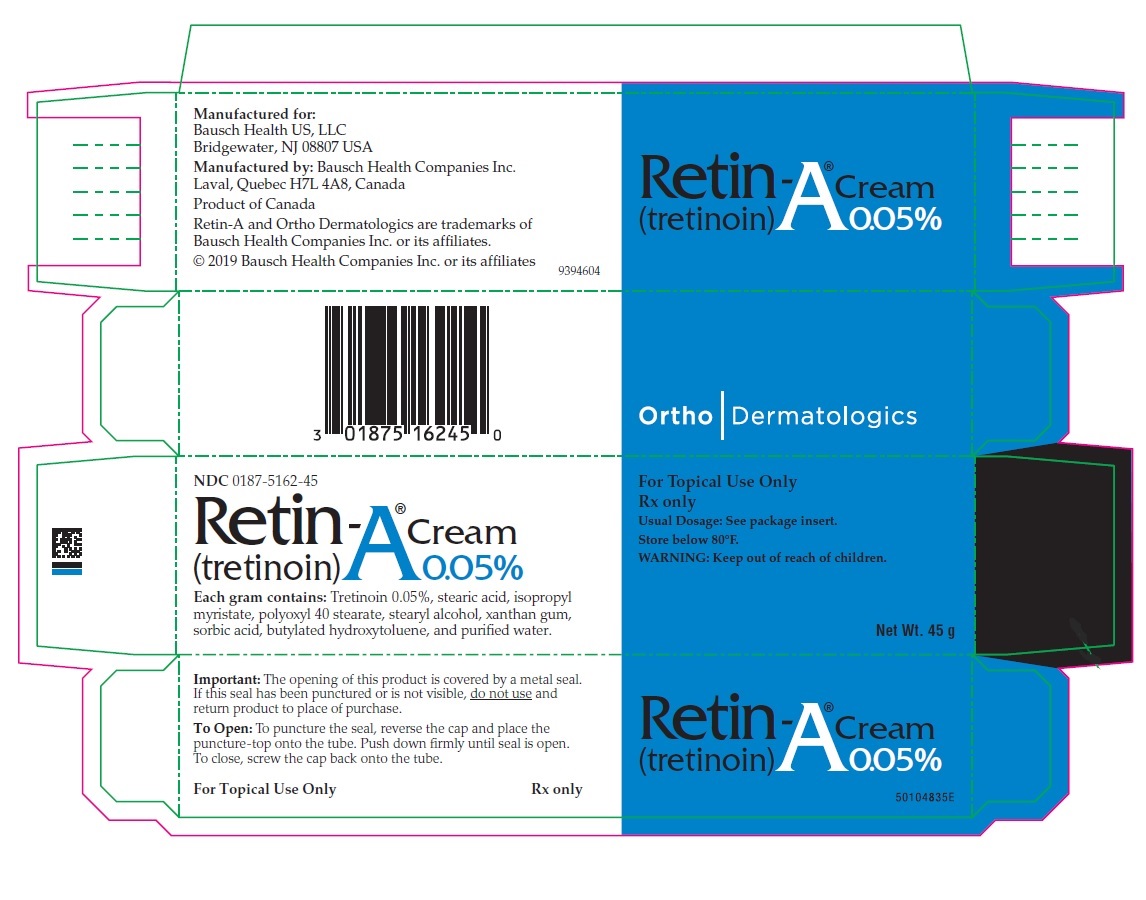
PRINCIPAL DISPLAY PANEL - 0.05% 45 g Cream Carton NDC 0187-5162-45 Retin-A ® Cream (tretinoin) 0.05% Each gram contains: Tretinoin 0.05%, stearic acid, isopropyl myristate, polyoxyl 40 stearate, stearyl alcohol, xanthan gum, sorbic acid, butylated hydroxytoluene, and purified water. For Topical Use Only Rx only Usual Dosage: See package insert. Store below 80°F. WARNING: Keep out of reach of children. Net Wt. 45 g carton2
PRINCIPAL DISPLAY PANEL - 0.1% 45 g Cream Carton NDC 0187-5164-45 Retin-A ® Cream (tretinoin) 0.1% Each gram contains: Tretinoin 0.1%, stearic acid, isopropyl myristate, polyoxyl 40 stearate, stearyl alcohol, xanthan gum, sorbic acid, butylated hydroxytoluene, and purified water. For Topical Use Only Rx only Usual Dosage: See package insert. Store below 80°F. WARNING: Keep out of reach of children. Net Wt. 45 g carton3
PRINCIPAL DISPLAY PANEL - 0.01% 45 g Gel Carton NDC 0187-5172-45 Retin-A ® Gel (tretinoin) 0.01% Each gram contains: Tretinoin 0.01%, butylated hydroxytoluene, hydroxypropyl cellulose and alcohol, (denatured with tert- butyl alcohol and brucine sulfate) 90% w/w. For Topical Use Only Rx only Usual Dosage: See package insert. Store below 86°F. WARNING: Keep out of reach of children. Net Wt. 45 g carton4
PRINCIPAL DISPLAY PANEL - 0.025% 45 g Gel Carton NDC 0187-5170-45 Retin-A ® Gel (tretinoin) 0.025% Each gram contains : Tretinoin 0.025%, butylated hydroxytoluene, hydroxypropyl cellulose and alcohol (denatured with tert- butyl alcohol and brucine sulfate) 90% w/w. For Topical Use Only Rx only Usual Dosage: See package insert. Store below 86°F. WARNING: Keep out of reach of children. Net Wt. 45 g carton5