
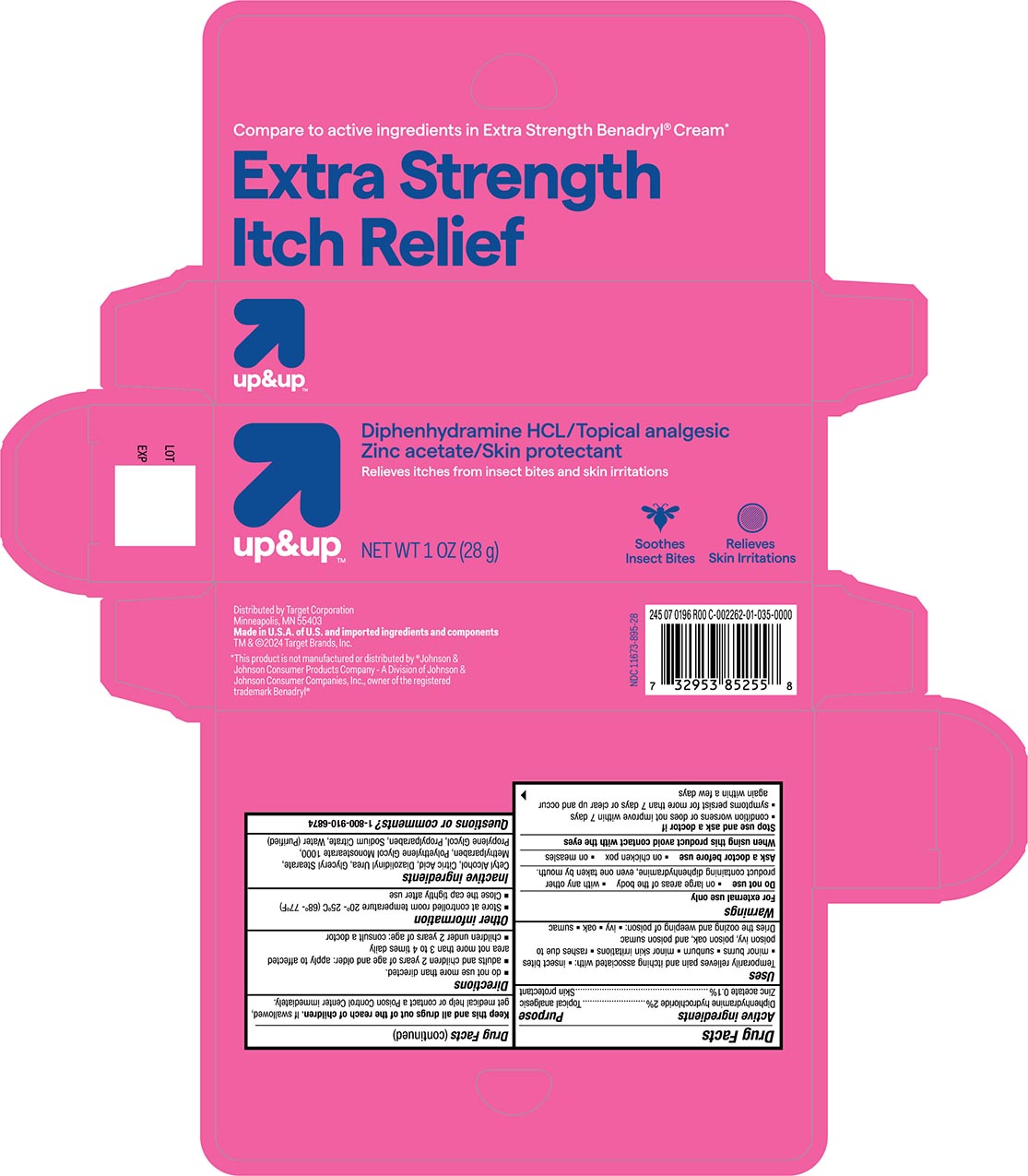
Anti-itch diphenhydramine hydrochloride and zinc acetate 20 mg/g; 1 mg/g Cream — NDC 11673-895-28 (Billing 11673-0895-28)
This is a package of Anti-itch diphenhydramine hydrochloride and zinc acetate 20 mg/g; 1 mg/g Cream from Target Corporation, marketed since Jan 2024 and currently FDA-listed. It is this product's only package size.
NDC database record
One package, one record: these facts belong to NDC 11673-895-28 alone.
- Record
- FDA NDC Directory package listing · Human OTC drug
- Code segments
- 11673 labeler · 895 product · 28 package
- Package marketed since
- Jan 31, 2024
- Sample package
- No — commercial package
- Listing certified through
- Dec 31, 2026
- Barcode (UPC)
- 0732953852558
- FDA record last changed
- Jul 24, 2026
Identity & classification
Regulatory identifiers FDA, NLM and CMS codes for this package
- RxCUI (RxNorm): 1087026
Where does this data come from?
- FDA openFDA NDC Directory · synced Oct 8, 2026
- FDA label on DailyMed · label index refreshed Oct 8, 2026
- RxNorm (NLM RxNav) · catalog refreshed Oct 1, 2026
- Medi-Span GPI (licensed)
- First Databank (licensed) · refreshed Oct 8, 2026
RxNorm drug class
This medicine belongs to the Histamine-1 Receptor Antagonist class.
Where does this data come from?
- RxClass (NLM) · catalog refreshed Oct 1, 2026
Clinical
This is a topical cream containing diphenhydramine hydrochloride and zinc acetate, marketed as an OTC monograph product. Diphenhydramine hydrochloride is an antihistamine commonly used in over-the-counter products to reduce itching and irritation when applied to the skin. Zinc acetate functions as an astringent and has mild antimicrobial properties often included in topical formulations. The combination is typically used to provide temporary relief of minor itching and skin discomfort.
Patient education
Supplement & herbal interactions
Where does this data come from?
- MedlinePlus (NLM) · refreshed Oct 8, 2026
- FDA label on DailyMed · label index refreshed Oct 8, 2026
Ask a licensed pharmacist directly — free, answered by our team.
Pricing
A drug doesn't have one price. Each row is a different public payment system, and none is what you'd pay at the counter — that depends on your insurance. The ⓘ on each row explains what it measures.
| Price system | Per g | Per package |
|---|---|---|
| Retail pharmacies payNADAC · weekly | Not in the retail survey — common for institutional, discontinued, or low-volume packs. | |
| Medicaid paysCMS SDUD · 12 mo | No recent Medicaid claims on file for this NDC — rare and low-volume NDCs are suppressed in the public data. | |
| Medicare drug plans payPart D · quarterly | No Part D plan price is available for this NDC in our data. | |
Where does this data come from?
- CMS NADAC weekly file
- CMS ASP pricing files · refreshed Sep 20, 2026
- CMS Medicaid State Drug Utilization Data · refreshed Oct 8, 2026
- CMS Part D plan pricing files · refreshed Sep 24, 2026
- VA National Acquisition Center price file
Packaging — all sizes for this product
| Package NDC | Description | Marketing start | Marketing end | Status |
|---|---|---|---|---|
| 11673-0895-28 You're viewing this Main listing | 1 TUBE in 1 CARTON / 28 g in 1 TUBE | 2024-01-31 | — | Active |
Therapeutic equivalents
| Product | Labeler | Pack | NADAC/unit | TE | Status | Price vs. this |
|---|---|---|---|---|---|---|
| good sense itch relief 2 g/100g; .1 g/100g 00113-0622-64 | L. | 1 tube | $0.058 | — | Availability likely | — |
| Banophen 2 g/100g; .1 g/100g 00904-5354-31 | Major | 1 tube | $0.058 | — | Availability likely | — |
| diphenhydramine hcl and zinc acetate 2 g/100g; .1 g/100g 45802-0358-03 | Padagis | 1 tube | $0.058 | — | Availability likely | — |
| GNP Extra Strength Anti-Itch Cream .1 g/100g; 2 g/100g 46122-0804-36 | Amerisource | 1 tube | $0.058 | — | Availability likely | — |
| leader anti itch 2 g/100g; .1 g/100g 70000-0388-01 | Cardinal | 1 tube | $0.058 | — | Availability likely | — |
| foster and thrive anti itch cream 2 g/100g; .1 g/100g 70677-1289-01 | Strategic | 1 tube | $0.058 | — | Availability likely | — |
| Anti-Itch 20 mg/g; 1 mg/g 24385-0210-03 | Amerisource | 1 tube | $0.130 | — | Discontinued | — |
| Diphenhydramine Hydrochloride and Zinc Acetate 20 mg/g; 1 mg/g 70677-1213-01 | STRATEGIC | 1 tube | $0.130 | — | FDA listed | — |
| Walgreens Anti Itch Cream 20 mg/g; 1 mg/g 00363-2315-28 | Walgreens | 1 tube | — | — | FDA listed | — |
| Dr. Sheffield Anti Itch Cream 20 mg/g; 1 mg/g 11527-0069-04 | Sheffield | 1 tube | — | — | FDA listed | — |
| Anti-itch 20 mg/g; 1 mg/gthis 11673-0895-28 | Target | 1 tube | — | — | FDA listed | — |
| Rite Aid Extra Strength Itch Stopping 1 mg/g; 20 mg/g 11822-6614-01 | Rite | 1 tube | — | — | FDA listed | — |
| signature care itch relief 2 g/100g; .1 g/100g 21130-0154-64 | Safeway | 1 tube | — | — | FDA listed | — |
| anti itch 2 g/100g; .1 g/100g 30142-0582-64 | Kroger | 1 tube | — | — | FDA listed | — |
| Shopko Anti-Itch 20 mg/g; 1 mg/g 37012-0089-02 | Shopko | 1 tube | — | — | FDA listed | — |
| itch relief 2 g/100g; .1 g/100g 37808-0622-64 | H | 1 tube | — | — | FDA listed | — |
| Anti-Itch Cream 1 mg/g; 20 mg/g 41226-0888-02 | Kroger | 1 tube | — | — | FDA listed | — |
| Anti Itch 2 g/100g; .1 g/100g 41250-0622-64 | Meijer | 1 tube | — | — | FDA listed | — |
| Equate Anti Itch 2 g/100g; .1 g/100g 49035-0622-64 | Wal-Mart | 1 tube | — | — | FDA listed | — |
| Diphenhydramine Hydrochloride and Zinc Acetate 20 mg/g; 1 mg/g 51672-2089-02 | Sun | 1 tube | — | — | FDA listed | — |
| CAREALL Anti-Itch 20 mg/g; 1 mg/g 51824-0088-01 | New | 35 g | — | — | FDA listed | — |
| Extra Strength Itch Stopping 20 mg/g; 1 mg/g 52000-0071-02 | Universal | 1 tube | — | — | FDA listed | — |
| Discount Drug Mart Extra Strength Itch Stopping 20 mg/g; 1 mg/g 53943-0258-01 | Discount | 1 tube | — | — | FDA listed | — |
| Family Wellness 2 g/100g; .1 g/100g 55621-0007-01 | Zhejiang | 1 tube | — | — | FDA listed | — |
| ItchZap 20 mg/g; 1 mg/g 57237-0352-28 | Rising | 1 tube | — | — | FDA listed | — |
| Itch Relief 2 g/100g; .1 g/100g 59779-0708-64 | CVS | 1 tube | — | — | FDA listed | — |
| Itch Relief Cream 2 g/100g; .1 g/100g 68016-0163-01 | Pharmacy | 1 tube | — | — | FDA listed | — |
| Anti-Itch Cream 2 g/100g; .1 g/100g 69396-0025-05 | Trifecta | 1 tube | — | — | FDA listed | — |
| Itch stopping Cream 2 g/100g; .1 g/100g 69396-0150-01 | Trifecta | 1 tube | — | — | FDA listed | — |
| itch relief 1 mg/g; 20 mg/g 69452-0449-37 | Bionpharma | 1 tube | — | — | FDA listed | — |
| Family Wellness 2 g/100g; .1 g/100g 69571-0005-02 | FRONT | 1 tube | — | — | FDA listed | — |
| CVS Extra Strength Itch Stopping 20 mg/g; 1 mg/g 69842-0321-28 | CVS | 1 tube | — | — | FDA listed | — |
| Benadryl Extra Strength Itch Stopping 20 mg/g; 1 mg/g 69968-0223-01 | Kenvue | 1 tube | — | — | FDA listed | — |
| TheraCare 2% Diphenhydramine Anti-Itch Cream 20 mg/g; 1 mg/g 71101-0014-01 | Veridian | 1 tube | — | — | FDA listed | — |
| Caring Mill Anti-Itch Cream 20 mg/g; 1 mg/g 71101-0055-01 | Veridian | 1 tube | — | — | FDA listed | — |
| Anti-Itch Cream 2 g/100g; .1 g/100g 83324-0039-01 | Chain | 1 tube | — | — | FDA listed | — |
| Savvy Itch Stopping 2 g/100g; .1 g/100g 83650-0102-01 | Savvy | 35.4 g | — | — | FDA listed | — |
Where does this data come from?
- FDA openFDA NDC Directory · synced Oct 8, 2026
- FDA Orange Book · refreshed Oct 3, 2026
- CMS NADAC weekly file
Availability & generic status
We did not find an FDA-approved generic match for this exact strength, form and route.
Where does this data come from?
- FDA Orange Book · refreshed Oct 3, 2026
Inactive Ingredients / Excipients
Inactive ingredients, also called excipients, are components of the drug product other than the active ingredient. They may include fillers, dyes, coatings, preservatives, flavors, or other formulation ingredients.
💡 Tap an ingredient (hover on desktop) to see what it is and why it’s used.
-
UNII XF417D3PSL
Anhydrous citric acid is a sour, crystalline powder derived from citric acid with water removed. In medicines, it acts as a buffer to control pH, adds tartness to improve taste, and helps tablets disintegrate.
-
UNII 936JST6JCN
Cetyl alcohol is a waxy, fatty substance derived from plant or animal sources. It acts as an emulsifier and thickener in medicines, helping blend oil and water components and giving products a smooth, creamy texture.
-
UNII H5RIZ3MPW4
A chemical preservative used to prevent bacterial and fungal growth in medicines. It helps extend shelf life and maintain product safety during storage and use.
-
UNII FCZ5MH785I
A waxy substance made from glycerin and stearic acid. It works as an emulsifier to help mix oil and water ingredients together, and as a thickener to give the medicine its proper texture and consistency.
-
UNII A2I8C7HI9T
Methylparaben is a preservative derived from benzoic acid that prevents growth of bacteria, fungi, and mold in medicines. It extends the product's shelf life and maintains safety during storage.
-
UNII H57W405143
Polyethylene glycol 10000 is a synthetic polymer made from ethylene oxide. It acts as a binder and lubricant in medicines, helping ingredients stick together and allowing tablets or capsules to move smoothly during manufacturing.
-
UNII 6DC9Q167V3
Propylene glycol is a clear liquid derived from petroleum or vegetable sources. It acts as a solvent, humectant, and preservative in medicines, helping dissolve active ingredients and maintain product stability.
-
UNII Z8IX2SC1OH
Propylparaben is a chemical preservative used to prevent bacterial and fungal growth in medicines and personal care products. It helps extend shelf life and maintain product safety during storage.
-
UNII 1Q73Q2JULR
Sodium citrate is a salt derived from citric acid. It works as a buffer to maintain the medicine's pH level and may also help improve taste or act as a preservative in the formulation.
-
UNII 059QF0KO0R
Water is a liquid solvent that dissolves and mixes ingredients together in liquid medicines, syrups, and injections. It helps distribute the active drug evenly throughout the product.
10 inactive ingredients listed in the exact product block matched to this NDC.
Label-section wording can be broader than the structured product block and may mention additional formulation ingredients.
Where does this data come from?
ingredient classCode="IACT" elements from the exact product block matched by this NDC. Label-section narrative from DailyMed / the openFDA label index is shown separately when available.- FDA label on DailyMed · label index refreshed Oct 8, 2026
- FDA openFDA NDC Directory · synced Oct 8, 2026
Inactive ingredient FAQ
Are inactive ingredients the same for every manufacturer?
Why might an inactive ingredient be missing?
Can inactive ingredients matter?
Manufacturer & labeler
More NDCs from Target Corporation labeler code 11673
- Up and Up Daytime Multi Symptom Severe Cold Nighttime Severe Cold and Cough acetaminophen, dextromethorphan hydrobromide, phenylephrine hydrochloride, diphenhydramine hydrochloride Kit NDC 11673-877-55
- 5-Symptom Digestive Relief Bismuth subsalicylate 262 mg Tablet NDC 11673-880-44
- Up and Up Cold and Hot Medicated Menthol 50 mg Patch NDC 11673-887-05
- Maximum Strength Hydrocortisone Anti-itch Hydrocortisone 1% 10 mg/g Cream NDC 11673-890-56
- Triple Antibiotic bacitracin zinc, neomycin sulfate, and polymyxin b sulfate 400 [USP'U]/g; 5000 [USP'U]/g; 3.5 mg/g Ointment NDC 11673-892-56
- Target Jock Itch Clotrimazole 1% 10 mg/g Cream NDC 11673-893-14
- up and up esomeprazole magnesium 20 mg Capsule, Delayed Release NDC 11673-898-01
- Up and Up anti diarrheal loperamide HCl 1 mg/7.5mL Suspension NDC 11673-900-34
- up and up extra strength antacid 750 Assorted Berry Antacid Tablets 750 mg Tablet, Chewable NDC 11673-902-24
- ULTRA STRENGHT PINK BISMUTH Bismuth subsalicylate 525 mg/15mL Suspension NDC 11673-907-08
- up and up naproxen sodium 220 mg Tablet, Film Coated NDC 11673-909-75
- UpandUp Clotrimazole 10 mg/g Cream NDC 11673-910-02
Where does this data come from?
- FDA openFDA NDC Directory · synced Oct 8, 2026
- Drugs@FDA
FDA label — Drug Facts FDA SPL
🎯 Indications and Usage ▾
Uses For temporary relief from pain and itching associated with : insect bites minor burns sunburn minor skin irritations rashes due to poison ivy, poison oak, and poison sumac Dries the oozing and weeping of poison ivy oak sumac
⏱️ Dosage and Administration ▾
Directions do not use more than directed adults and children 2 years of age and older; apply to affected areas not more than 3 to 4 times daily children under 2 years of age , consult a doctor
⚠️ Warnings ▾
Warnings For external use only Do not use on large areas of the body with any other product containing diphenhydramine , even one taken by the mouth. Ask a Doctor before use on chicken pox on measles When using this product avoid contact with eyes. Stop use and ask a doctor if conditions worsen or does not improve within 7 days symptoms persist for more than 7 days or clear up and occur agian within a few days
🧪 Active Ingredient ▾
Active Ingredients Diphenhydramine HCL 2% Zinc Acetate 0.1%
🧪 Inactive Ingredients ▾
Inactive ingredients Cetyl Alcohol, Citric Acid, Diazolldinyl Urea, Glyceral Stearate, Methylparaben, Polyethylene Glycol Monsterate 1000, Sodium Citrate, Water (Purified)
🎯 Purpose ▾
Purpose Topical analgesic Skin protectant
📄 Keep Out of Reach of Children ▾
Keep this and all drugs out of the reach of children. If swallowed get medical help or contact a Poison Control Center immediately.
📄 Other Information ▾
Other information Store at controlled room temperature 20°-25°C (68° - 77°F) Close the cap tightly after use
📄 Questions or Comments ▾
Questions or comments? 1-800-910-6874
📄 Package Label / Principal Display Panel ▾
Principal Display Panel Target Up&Up NDC 11673-865-28 Extra Strength Itch Relief Diphenhydramine HCL 2% / Zinc Aceate 0.1% Anti-itch cream NET WT 1 OZ (28g) 290890 Tube 590890 Carton
About this NDC listing & data coverage
What data is (and isn’t) available for this NDC — tap to expand
| NDC identity (package / product / labeler codes) | ✓ Available |
| Labeler | ✓ Available |
| Product & package description | ✓ Available |
| Marketing category & status | ✓ Available |
| Active ingredient / dosage form / route | ✓ Available |
| FDA label (SPL via DailyMed) | ✓ Available |
| Package photos | ✓ Available |
| Inactive ingredients (structured) | ✓ Available |
| NADAC pharmacy acquisition price (CMS) | — Not published for this NDC CMS publishes NADAC only for NDCs reported in its retail-pharmacy survey. |
| Orange Book / therapeutic-equivalence data | — Not published for this NDC Applies only to products approved under an NDA/ANDA; many listings are out of scope. |
| HCPCS J-code billing crosswalk | — Not published for this NDC Most self-administered / retail products have no J-code — that is normal. |
| Medicaid utilization (CMS SDUD) | — Not published for this NDC CMS reports utilization only for NDCs with Medicaid claims above its privacy threshold. |