
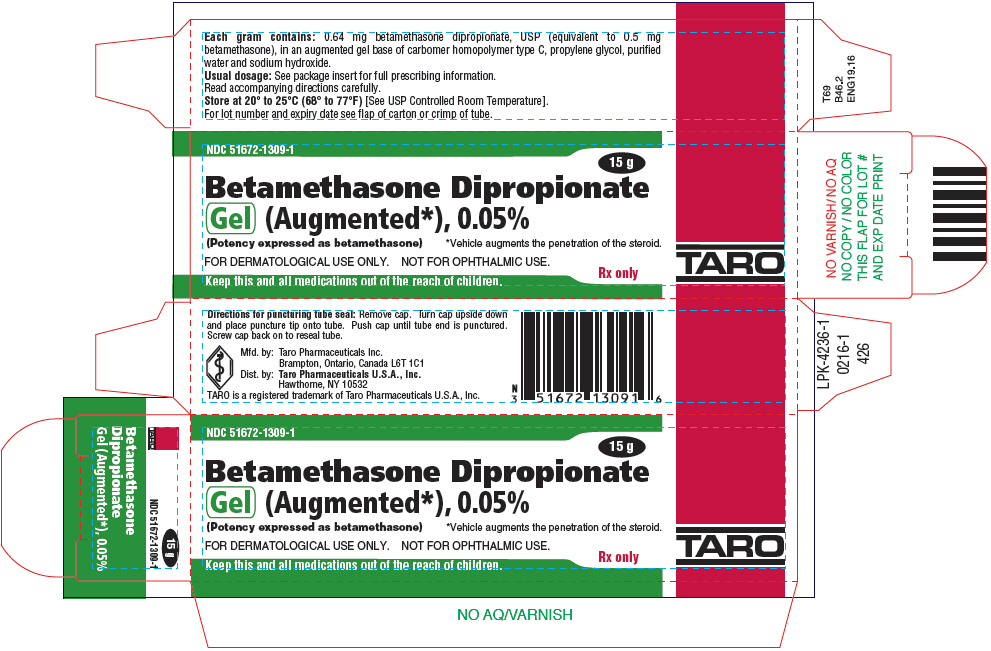
Betamethasone Dipropionate .5 mg/g Gel — NDC 51672-1309-1 (Billing 51672-1309-01)
This is a package of Betamethasone Dipropionate .5 mg/g Gel from Sun Pharmaceutical Industries, Inc., marketed since Dec 2003 and currently FDA-listed; retail pharmacies pay about $2.74 per g (NADAC).
NDC database record
One package, one record: these facts belong to NDC 51672-1309-1 alone.
- Record
- FDA NDC Directory package listing · Human prescription drug
- Code segments
- 51672 labeler · 1309 product · 1 package
- Package marketed since
- Dec 2, 2003
- Sample package
- No — commercial package
- Listing certified through
- Dec 31, 2026
- Barcode (UPC-A, from the NDC)
- 3 5167213091 6
- Medicaid fills, this package
- 11 prescriptions in the last four reported quarters
- FDA record last changed
- Jul 24, 2026
Identity & classification
Regulatory identifiers FDA, NLM and CMS codes for this package
Drug-database identifiers Medi-Span GPI and First Databank GCN / HICL / AHFS classification
- GSN (GCN sequence number): 016429
- GCN: 32091
- GPI-14 (Medi-Span): 90550020054005
- HICL (First Databank): 003304
- AHFS class code: 68:04.00.00
- RxCUI (RxNorm): 848208
Where does this data come from?
- FDA openFDA NDC Directory · synced Oct 1, 2026
- FDA label on DailyMed · label index refreshed Oct 6, 2026
- RxNorm (NLM RxNav) · catalog refreshed Oct 1, 2026
- Medi-Span GPI (licensed)
- First Databank (licensed) · refreshed Oct 1, 2026
RxNorm drug class
This medicine belongs to the Corticosteroid class.
Where does this data come from?
- RxClass (NLM) · catalog refreshed Oct 1, 2026
Clinical
Betamethasone topical is used to treat the itching, redness, dryness, crusting, scaling, inflammation, and discomfort of various skin conditions, including psoriasis (a skin disease in which red, scaly patches form on some areas of the body) and eczema (a skin disease that causes the skin to be dry and itchy and to sometimes develop red, scaly rashes). Betamethasone is in a class of medications called corticosteroids. It works by activating natural substances in the skin to reduce swelling, redness, and itching.
Read the full MedlinePlus article ↗- It calms inflammation and itching from steroid-responsive skin conditions. The spray is specifically for mild to moderate plaque psoriasis in adults. The valerate foam is for the s...
- Use a thin film or a few drops, as your product directs, once or twice a day. The spray is shaken first and used twice daily. Wash your hands afterward and keep it out of your eyes...
- Not for long. Several products limit use to about 2 weeks and the spray to 4 weeks. Stop when your skin is under control, and call your doctor if you see no improvement within 2 we...
- Mild burning, stinging, itching or dryness where you apply it is the most common. Skin thinning can happen with ongoing use. Call me or your doctor if you notice vision changes or...
Patient education
Supplement & herbal interactions
Some supplements/herbs that may interact with Betamethasone Dipropionate — tap one for details:
Betamethasone Dipropionate may be associated with lower levels of 8 nutrients — worth a chat with your pharmacist, not a cause for alarm.
Where does this data come from?
- MedlinePlus (NLM) · refreshed Oct 1, 2026
- FDA label on DailyMed · label index refreshed Oct 6, 2026
Ask a licensed pharmacist directly — free, answered by our team.
Pricing
A drug doesn't have one price. Each row is a different public payment system, and none is what you'd pay at the counter — that depends on your insurance. The ⓘ on each row explains what it measures.
| Price system | Per g | Per package |
|---|---|---|
| Retail pharmacies payNADAC · weekly | $2.740 | $41.09 / 15 g |
| Medicaid paysCMS SDUD · 12 mo | $2.56 | $38.39 / 15 g |
| Medicare drug plans payPart D · Q2 2026 | $2.09 | $31.32 / 15 g |
Where does this data come from?
- CMS NADAC weekly file · file of Sep 30, 2026
- CMS ASP pricing files · refreshed Sep 20, 2026
- CMS Medicaid State Drug Utilization Data · through Q1 2026
- CMS Part D plan pricing files · refreshed Sep 24, 2026
- VA National Acquisition Center price file
Packaging — all sizes for this product
| Package NDC | Description | Per unit | Per pack | Marketing start | Marketing end | Status |
|---|---|---|---|---|---|---|
| 51672-1309-01 You're viewing this | 1 TUBE in 1 CARTON / 15 g in 1 TUBE | $2.74 / g | $41.09 | 2003-12-02 | — | Active |
| 51672-1309-03 51672-1309-3 Main listing | 1 TUBE in 1 CARTON / 50 g in 1 TUBE | $2.09 / g | $104.73 | 2003-12-02 | — | Active |
Per g, this pack runs about 31% above the cheapest pack (NDC 51672-1309-03, $2.09 vs $2.74 NADAC).
This pack accounts for about 7.0% of this product's recent Medicaid fills; most go to a different pack size. See all packs ↓
Pack size FAQ
What quantity is in this package?
What NDC number is used to bill for this package of Betamethasone Dipropionate .5 mg/g Gel?
Prices are the latest CMS NADAC pharmacy acquisition cost per NDC; per-pack figures are per-unit × pack quantity, shown only when the pack is denominated in the same measure NADAC prices.
Therapeutic equivalents
| Product | Labeler | Pack | NADAC/unit | TE | Status | Price vs. this |
|---|---|---|---|---|---|---|
| Betamethasone Dipropionate .5 mg/g 45802-0376-32 | Padagis | 1 tube | $0.124 | AB | Availability likely | save 95% |
| Betamethasone Dipropionate .5 mg/g 68462-0290-17 | Glenmark | 15 g | $0.200 | — | FDA listed | save 93% |
| Betamethasone Dipropionate .5 mg/g 51672-1310-01 | Sun | 1 tube | $0.209 | AB | Availability likely | save 92% |
| Betamethasone Dipropionate .5 mg/g 45802-0021-46 | Padagis | 56.2 g | $0.292 | AB | Availability likely | save 89% |
| Betamethasone Dipropionate .5 mg/g 00472-0381-15 | Actavis | 1 tube | $0.460 | AB | Availability likely | save 83% |
| betamethasone dipropionate .5 mg/g 72578-0093-01 | Viona | 1 tube | $0.460 | AB | Availability likely | save 83% |
| Betamethasone Dipropionate .5 mg/g 00168-0056-15 | E. | 1 tube | $0.460 | AB | Discontinued | save 83% |
| Betamethasone Dipropionate .5 mg/g 45802-0505-14 | Padagis | 1 tube | $0.460 | AB | Availability likely | save 83% |
| Betamethasone dipropionate .5 mg/g 70710-1233-01 | Zydus | 1 tube | $0.465 | AB | Availability likely | save 83% |
| Betamethasone Dipropionate .5 mg/g 00713-0659-15 | Cosette | 1 tube | $0.465 | AB | Availability likely | save 83% |
| Betamethasone Dipropionate .5 mg/g 00472-0380-15 | Actavis | 1 tube | $0.465 | AB | Availability likely | save 83% |
| Betamethasone Dipropionate .5 mg/g 00168-0055-15 | E. | 1 tube | $0.465 | AB | Availability likely | save 83% |
| Betamethasone dipropionate .5 mg/g 16714-0996-01 | Northstar | 1 tube | $0.465 | AB | Availability likely | save 83% |
| Betamethasone Dipropionate .5 mg/g 51672-1274-01 | Sun | 1 tube | $0.465 | AB | Availability likely | save 83% |
| Betamethasone Dipropionate .5 mg/g 66993-0897-15 | Prasco | 1 tube | $0.578 | AB | Availability likely | save 79% |
| Betamethasone Dipropionate .5 mg/g 00472-0382-15 | Actavis | 1 tube | $0.588 | AB | Discontinued | save 79% |
| Betamethasone Dipropionate .5 mg/g 35573-0107-15 | Burel | 1 tube | $0.588 | AB | Availability likely | save 79% |
| Betamethasone dipropionate .5 mg/g 68180-0947-01 | Lupin | 1 tube | $0.588 | AB | Availability likely | save 79% |
| Betamethasone Dipropionate .5 mg/g 00168-0268-15 | E. | 15 g | $0.588 | AB | Availability likely | save 79% |
| Betamethasone Dipropionate .5 mg/gthis 51672-1309-01 | Sun | 1 tube | $2.740 | AB | Availability likely | — |
| betamethasone dipropionate .5 mg/g 70771-1550-01 | Zydus | 1 tube | — | AB | FDA listed | — |
| Betamethasone Dipropionate .5 mg/g 71205-0275-15 | Proficient | 1 tube | — | AB | FDA listed | — |
| Betamethasone Dipropionate .5 mg/g 50090-0235-00 | A-S | 1 tube | — | AB | FDA listed | — |
| Betamethasone Dipropionate .5 mg/g 50090-0236-00 | A-S | 1 tube | — | AB | FDA listed | — |
| Betamethasone Dipropionate .5 mg/g 50090-2182-00 | A-S | 1 tube | — | AB | FDA listed | — |
| Betamethasone dipropionate .5 mg/g 50090-4680-00 | A-S | 1 tube | — | AB | FDA listed | — |
| Betamethasone Dipropionate .5 mg/g 63629-8614-01 | Bryant | 1 tube | — | AB | FDA listed | — |
| Betamethasone Dipropionate .5 mg/g 59651-0699-14 | Aurobindo | 1 tube | — | AB | FDA listed | — |
| Betamethasone Dipropionate .5 mg/g 70518-4187-00 | REMEDYREPACK | 1 tube | — | AB | FDA listed | — |
| Diprolene .5 mg/g 78206-0124-01 | Organon | 1 tube | — | AB | FDA listed | — |
| Betamethasone dipropionate .5 mg/g 70771-1380-01 | Zydus | 1 tube | — | AB | FDA listed | — |
| Betamethasone Dipropionate .5 mg/g 71335-2715-01 | Bryant | 1 tube | — | AB | FDA listed | — |
| Betamethasone Dipropionate .5 mg/g 72162-1415-02 | Bryant | 1 tube | — | AB | FDA listed | — |
| Betamethasone Dipropionate .5 mg/g 68071-4556-03 | NuCare | 30 g | — | AB | FDA listed | — |
| Betamethasone dipropionate .5 mg/g 50090-6787-00 | A-S | 1 tube | — | AB | FDA listed | — |
| Betamethasone Dipropionate .5 mg/g 59651-0891-14 | Aurobindo | 1 tube | — | AB | FDA listed | — |
| Betamethasone Dipropionate .5 mg/g 76420-0858-15 | Asclemed | 1 tube | — | AB | FDA listed | — |
| Betamethasone Dipropionate .5 mg/g 50090-3276-00 | A-S | 1 tube | — | AB | FDA listed | — |
| Betamethasone Dipropionate .5 mg/g 63629-9324-01 | Bryant | 1 tube | — | AB | FDA listed | — |
| Betamethasone Dipropionate .5 mg/g 68788-7670-05 | Preferred | 1 tube | — | AB | FDA listed | — |
| Betamethasone Dipropionate .5 mg/g 50090-7517-00 | A-S | 50 g | — | AB | FDA listed | — |
| Betamethasone Dipropionate .5 mg/g 68788-9219-01 | Preferred | 1 tube | — | AB | FDA listed | — |
| Betamethasone Dipropionate .5 mg/g 72162-1405-02 | Bryant | 1 tube | — | AB | FDA listed | — |
| Betamethasone dipropionate .5 mg/g 50090-7525-00 | A-S | 1 tube | — | AB | FDA listed | — |
| Betamethasone Dipropionate .5 mg/g 51407-0273-15 | Golden | 1 tube | — | AB | FDA listed | — |
| Betamethasone Dipropionate .5 mg/g 63629-8613-01 | Bryant | 1 tube | — | AB | FDA listed | — |
| Betamethasone Dipropionate .5 mg/g 50090-5232-00 | A-S | 1 tube | — | AB | FDA listed | — |
| Betamethasone Dipropionate .5 mg/g 63629-9323-01 | Bryant | 1 tube | — | AB | FDA listed | — |
| Betamethasone Dipropionate .5 mg/g 68071-4814-05 | NuCare | 15 g | — | AB | FDA listed | — |
| Betamethasone dipropionate .5 mg/g 67296-2275-01 | Redpharm | 1 tube | — | AB | FDA listed | — |
Where does this data come from?
- FDA openFDA NDC Directory · synced Oct 1, 2026
- FDA Orange Book · refreshed Oct 3, 2026
- CMS NADAC weekly file · file of Sep 30, 2026
Availability & generic status
This product is an FDA-approved generic. Other versions of the same drug are listed under Therapeutic equivalents, least expensive first.
Where does this data come from?
- FDA Orange Book · refreshed Oct 3, 2026
Inactive Ingredients / Excipients
Inactive ingredients, also called excipients, are components of the drug product other than the active ingredient. They may include fillers, dyes, coatings, preservatives, flavors, or other formulation ingredients.
🧪 Avoiding an ingredient? See Betamethasone inactive ingredients by manufacturer: every current product's list side by side, so you can ask your pharmacy for the version that does not list it.
💡 Tap an ingredient (hover on desktop) to see what it is and why it’s used.
-
UNII 4Q93RCW27E
A synthetic polymer made from acrylic acid that's crosslinked for stability. It acts as a thickener and gelling agent in creams and gels, helping the medicine spread evenly and maintain its texture.
-
UNII 6DC9Q167V3
Propylene glycol is a clear liquid derived from petroleum or vegetable sources. It acts as a solvent, humectant, and preservative in medicines, helping dissolve active ingredients and maintain product stability.
-
UNII 55X04QC32I
A strong alkaline chemical used to adjust and maintain the pH balance of liquid medicines. It helps keep the medicine stable and ensures it stays effective during storage.
-
UNII 059QF0KO0R
Water is a liquid solvent that dissolves and mixes ingredients together in liquid medicines, syrups, and injections. It helps distribute the active drug evenly throughout the product.
4 inactive ingredients listed in the exact product block matched to this NDC.
Where does this data come from?
ingredient classCode="IACT" elements from the exact product block matched by this NDC. Label-section narrative from DailyMed / the openFDA label index is shown separately when available.- FDA label on DailyMed · label index refreshed Oct 6, 2026
- FDA openFDA NDC Directory · synced Oct 1, 2026
Inactive ingredient FAQ
Are inactive ingredients the same for every manufacturer?
Why might an inactive ingredient be missing?
Can inactive ingredients matter?
Manufacturer & labeler
More NDCs from Sun Pharmaceutical Industries, Inc. labeler code 51672
- Terconazole 8 mg/g Cream NDC 51672-1302-0
- Econazole Nitrate 10 mg/g Cream NDC 51672-1303-1
- Terconazole 4 mg/g Cream NDC 51672-1304-6
- Mometasone Furoate 1 mg/mL Solution NDC 51672-1305-3
- Alclometasone dipropionate .5 mg/g Cream NDC 51672-1306-1
- Clotrimazole and Betamethasone Dipropionate 10 mg/mL; .5 mg/mL Lotion NDC 51672-1308-3
- Betamethasone Dipropionate .5 mg/g Cream, Augmented NDC 51672-1310-1
- Mometasone Furoate 1 mg/g Ointment NDC 51672-1311-1
- Mupirocin 20 mg/g Ointment NDC 51672-1312-0
- Mometasone Furoate 1 mg/g Cream NDC 51672-1315-1
- Alclometasone Dipropionate .5 mg/g Ointment NDC 51672-1316-1
- Ciclopirox Olamine 7.7 mg/g Cream NDC 51672-1318-1
Where does this data come from?
- FDA openFDA NDC Directory · synced Oct 1, 2026
- Drugs@FDA
Full prescribing information FDA SPL
🎯 Indications and Usage ▾
INDICATIONS AND USAGE Betamethasone dipropionate gel (augmented) is a super-high potency corticosteroid indicated for the relief of the inflammatory and pruritic manifestations of corticosteroid-responsive dermatoses. Treatment beyond two consecutive weeks is not recommended, and the total dose should not exceed 50 g per week because of potential for the drug to suppress the hypothalamic-pituitary-adrenal (HPA) axis. This product is not recommended for use in pediatric patients under 12 years of age.
⏱️ Dosage and Administration ▾
DOSAGE AND ADMINISTRATION Apply a thin layer of betamethasone dipropionate gel (augmented) to the affected skin once or twice daily and rub it in gently and completely. Betamethasone dipropionate gel (augmented) is a super-high potency topical corticosteroid; therefore, treatment should be limited to two weeks, and amounts greater than 50 g per week should not be used. Betamethasone dipropionate gel (augmented) should not be used with occlusive dressings.
⛔ Contraindications ▾
CONTRAINDICATIONS Betamethasone dipropionate gel (augmented) is contraindicated in those patients with a history of hypersensitivity to any of the components of the preparation.
🤒 Adverse Reactions ▾
ADVERSE REACTIONS In controlled clinical trials, the total incidence of adverse events associated with the use of betamethasone dipropionate gel (augmented) was 10%. These included stinging or burning in 6% of patients, dry skin in 4% of patients, and pruritus in 2% of patients. Less frequently reported adverse reactions were irritation, skin atrophy, telangiectasia, erythema, cracking/tightening of the skin, follicular rash, and allergic contact dermatitis.
The following additional local adverse reactions are reported infrequently with topical corticosteroids, but may occur more frequently with super-high potency corticosteroids, such as betamethasone dipropionate gel (augmented). These reactions are listed in approximate decreasing order of occurrence: acneiform eruptions, hypopigmentation, perioral dermatitis, secondary infection, striae, and miliaria.
🤰 Pregnancy ▾
Pregnancy Teratogenic Effects Pregnancy Category C Corticosteroids have been shown to be teratogenic in laboratory animals when administered systemically at relatively low dosage levels. Some corticosteroids have been shown to be teratogenic after dermal application to laboratory animals. Betamethasone dipropionate has been shown to be teratogenic in rabbits when given by the intramuscular route at doses of 0.05 mg/kg.
This dose is approximately 26 times the human topical dose of betamethasone dipropionate gel (augmented) assuming human percutaneous absorption of approximately 3% and the use in a 70 kg person of 7 g per day. The abnormalities observed included umbilical hernias, cephalocele, and cleft palate. There are no adequate and well-controlled studies of the teratogenic potential of betamethasone dipropionate in pregnant women.
Therefore, betamethasone dipropionate gel (augmented) should be used during pregnancy only if the potential benefit justifies the potential risk to the fetus.
🧒 Pediatric Use ▾
Pediatric Use Data regarding use of betamethasone dipropionate gel (augmented) in pediatric patients are not available, so use of this product in patients under the age of 12 is not recommended. Because of a higher ratio of skin surface area to body mass, pediatric patients are at a greater risk than adults of HPA axis suppression when they are treated with topical corticosteroids. They are, therefore, also at greater risk of glucocorticosteroid insufficiency after withdrawal of treatment and of Cushing's syndrome while on treatment.
Adverse effects, including striae, have been reported with inappropriate use of topical corticosteroids in infants and pediatric patients. HPA axis suppression, Cushing's syndrome, and intracranial hypertension have been reported in pediatric patients receiving topical corticosteroids. Manifestations of adrenal suppression in pediatric patients include linear growth retardation, delayed weight gain, low plasma cortisol levels, and absence of response to ACTH stimulation.
Manifestations of intracranial hypertension include bulging fontanelles, headaches, and bilateral papilledema.
🧓 Geriatric Use ▾
Geriatric Use Clinical studies of betamethasone dipropionate gel (augmented) included 65 subjects who were 65 years of age and over and 15 subjects who were 75 years of age and over. No overall differences in safety or effectiveness were observed between these subjects and younger subjects, and other reported clinical experience has not identified differences in responses between the elderly and younger patients. However, greater sensitivity of some older individuals cannot be ruled out.
🆘 Overdosage ▾
OVERDOSAGE Topically applied betamethasone dipropionate gel (augmented) can be absorbed in sufficient amounts to produce systemic effects (see PRECAUTIONS ).
🧬 Clinical Pharmacology ▾
CLINICAL PHARMACOLOGY Like other topical corticosteroids, betamethasone dipropionate has anti-inflammatory, anti-pruritic, and vasoconstrictive properties. The mechanism of the anti-inflammatory activity of the topical steroids, in general, is unclear. However, corticosteroids are thought to act by the induction of phospholipase A 2 inhibitory proteins, collectively called lipocortins.
It is postulated that these proteins control the biosynthesis of potent mediators of inflammation, such as prostaglandins and leukotrienes, by inhibiting the release of their common pre-cursor, arachidonic acid. Arachidonic acid is released from membrane phospholipids by phospholipase A 2 . Pharmacokinetics The extent of percutaneous absorption of topical corticosteroids is determined by many factors including the vehicle and the integrity of the epidermal barrier.
Occlusive dressings with hydrocortisone for up to 24 hours have not been demonstrated to increase penetration; however, occlusion of hydrocortisone for 96 hours markedly enhances penetration. Topical corticosteroids can be absorbed from normal intact skin. In addition, inflammation and/or other disease processes in the skin may increase percutaneous absorption.
Studies performed with betamethasone dipropionate gel (augmented) indicate that it is in the super-high range of potency as compared with other topical corticosteroids.
📦 How Supplied / Storage and Handling ▾
HOW SUPPLIED Betamethasone Dipropionate Gel (Augmented), 0.05% is supplied as follows: 15 g NDC 51672-1309-1 50 g NDC 51672-1309-3 Store at 20° to 25°C (68° to 77°F) [See USP Controlled Room Temperature].
📦 Storage and Handling ▾
Store at 20° to 25°C (68° to 77°F) [See USP Controlled Room Temperature].
📋 Description ▾
DESCRIPTION Betamethasone dipropionate gel (augmented), 0.05%, contains betamethasone dipropionate, USP, a synthetic fluorinated corticosteroid for topical dermatologic use. Betamethasone dipropionate is included in a class of compounds consisting primarily of synthetic corticosteroids for use topically as anti-inflammatory and anti-pruritic agents. Chemically, betamethasone dipropionate is 9-fluoro-11β,17,21-trihydroxy-16β-methylpregna-1,4-diene-3,20-dione 17,21-dipropionate, with the molecular formula C 28 H 37 FO 7 , a molecular weight of 504.6, and the following structural formula: Betamethasone dipropionate is a white to creamy white, odorless crystalline powder, insoluble in water.
Each gram of betamethasone dipropionate gel (augmented) contains: 0.64 mg betamethasone dipropionate, USP (equivalent to 0.5 mg betamethasone), in an augmented gel base of carbomer homopolymer type C, propylene glycol, purified water and sodium hydroxide. Chemical Structure
💬 Information for Patients ▾
Information for Patients Patients using topical corticosteroids should receive the following information and instructions: The medication is to be used as directed by the physician. It is for external use only. Avoid contact with the eyes.
The medication should not be used for any disorder other than that for which it was prescribed. The treated skin area should not be bandaged or otherwise covered or wrapped so as to be occlusive. Patients should report to their physician any signs of local adverse reactions.
⚠️ Precautions ▾
PRECAUTIONS General Betamethasone dipropionate gel (augmented) should not be used in the treatment of rosacea or perioral dermatitis, and it should not be used on the face, groin, or in the axillae. Systemic absorption of topical corticosteroids can produce reversible hypothalamic-pituitary-adrenal (HPA) axis suppression with the potential for glucocorticosteroid insufficiency after withdrawal of treatment. Manifestations of Cushing's syndrome, hyperglycemia, and glucosuria can also be produced in some patients by systemic absorption of topical corticosteroids while on treatment.
At 7 g per day (applied once daily or as 3.5 g twice daily), betamethasone dipropionate gel (augmented) was shown to cause inhibition of the HPA axis following application for one, two or three weeks to diseased skin in some patients with psoriasis or atopic dermatitis. These effects were reversible upon discontinuation of treatment. Patients receiving betamethasone dipropionate gel (augmented) applied to large areas should be evaluated periodically for evidence of HPA axis suppression.
This may be done by using the ACTH-stimulation, morning plasma cortisol and urinary free-cortisol tests. Patients should not be treated with betamethasone dipropionate gel (augmented) for more than 2 weeks at a time, and amounts greater than 50 g per week should not be used because of the potential for the drug to suppress the HPA axis. If HPA axis suppression is noted, an attempt should be made to withdraw the drug, to reduce the frequency of application, or to substitute a less potent corticosteroid.
Recovery of HPA axis function is generally prompt and complete upon discontinuation of topical corticosteroids. Infrequently, signs and symptoms of glucocorticosteroid insufficiency may occur, requiring supplemental systemic corticosteroids. For information on systemic supplementation, see prescribing information for systemic corticosteroids.
Pediatric patients may be more susceptible to systemic toxicity from equivalent doses due to their larger skin surface to body mass ratios (see PRECAUTIONS - Pediatric Use ). If irritation develops, betamethasone dipropionate gel (augmented) should be discontinued and appropriate therapy instituted. Allergic contact dermatitis with corticosteroids is usually diagnosed by observing failure to heal rather than noting clinical exacerbation as with most topical products not containing corticosteroids.
Such an observation should be corroborated with appropriate diagnostic patch testing. If concomitant fungal and/or bacterial skin infections are present or develop, an appropriate antifungal or antibacterial agent should be used. If a favorable response does not occur promptly, use of betamethasone dipropionate gel (augmented) should be discontinued until the infection has been adequately controlled.
Information for Patients Patients using topical corticosteroids should receive the following information and instructions: The medication is to be used as directed by the physician. It is for external use only. Avoid contact with the eyes.
The medication should not be used for any disorder other than that for which it was prescribed. The treated skin area should not be bandaged or otherwise covered or wrapped so as to be occlusive. Patients should report to their physician any signs of local adverse reactions.
Laboratory Tests The following tests may be helpful in evaluating patients for HPA axis suppression: ACTH stimulation test, Morning plasma-cortisol test, Urinary free-cortisol test Carcinogenesis, Mutagenesis, Impairment of Fertility Long-term animal studies have not been performed to evaluate the carcinogenic potential of betamethasone dipropionate. Studies in rabbits, mice and rats using intramuscular doses up to 1, 33 and 2 mg/kg, respectively, resulted in dose related increases in fetal resorptions in the rabbits and mice.
Pregnancy Teratogenic Effects Pregnancy Category C Corticosteroids have been shown to be teratogenic in laborato… [Excerpted — this section continues on DailyMed.]
🍼 Nursing Mothers ▾
Nursing Mothers Systemically administered corticosteroids appear in human milk and could suppress growth, interfere with endogenous corticosteroid production, or cause other untoward effects. It is not known whether topical administration of corticosteroids could result in sufficient systemic absorption to produce detectable quantities in human milk. Because many drugs are excreted in human milk, caution should be exercised when betamethasone dipropionate gel (augmented) is administered to a nursing woman.
🧬 Pharmacokinetics ▾
Pharmacokinetics The extent of percutaneous absorption of topical corticosteroids is determined by many factors including the vehicle and the integrity of the epidermal barrier. Occlusive dressings with hydrocortisone for up to 24 hours have not been demonstrated to increase penetration; however, occlusion of hydrocortisone for 96 hours markedly enhances penetration. Topical corticosteroids can be absorbed from normal intact skin.
In addition, inflammation and/or other disease processes in the skin may increase percutaneous absorption. Studies performed with betamethasone dipropionate gel (augmented) indicate that it is in the super-high range of potency as compared with other topical corticosteroids.
📄 Carcinogenesis, Mutagenesis, Impairment of Fertility ▾
Carcinogenesis, Mutagenesis, Impairment of Fertility Long-term animal studies have not been performed to evaluate the carcinogenic potential of betamethasone dipropionate. Studies in rabbits, mice and rats using intramuscular doses up to 1, 33 and 2 mg/kg, respectively, resulted in dose related increases in fetal resorptions in the rabbits and mice.
📄 Package Label / Principal Display Panel ▾
PRINCIPAL DISPLAY PANEL - 15 g Tube Carton NDC 51672-1309-1 15 g Betamethasone Dipropionate Gel (Augmented*), 0.05% (Potency expressed as betamethasone) *Vehicle augments the penetration of the steroid. FOR DERMATOLOGICAL USE ONLY. NOT FOR OPHTHALMIC USE. Rx only Keep this and all medications out of the reach of children. TARO PRINCIPAL DISPLAY PANEL - 15 g Tube Carton