
Alfalfa Ingredients & Drug Interactions
by Pure Herbs
What is this page for?
First and foremost: checking Alfalfa against your medications. The heart of this page is the interaction checker and the full interaction report — how this product’s ingredients may interact with prescription and over-the-counter medicines you may be taking.
Around that, we add a pharmacist’s high-level view of the product as a whole — what’s inside, the evidence for its stated use, how transparent the label is, and what safety data exists — so you can see the full picture in one place. It’s educational information from our licensed clinical databases and the clinical staff at HelloPharmacist — not medical advice — and we don’t sell or endorse products. Our editorial policy
Alfalfa is a dietary supplement by Pure Herbs with 1 active ingredient. Its ingredients are commonly taken for high cholesterol, digestive complaints, menopausal symptoms.Based on those ingredients, 583 medications have a known interaction with it, the most serious rated major. The ingredients most likely to interact are Alfalfa. Use the checker below to test your specific medication, or read the full HelloPharmacist Interaction Report.
Check Your Meds Against Alfalfa by Pure Herbs
Ask about any prescription or over-the-counter medication and we check it for interactions with Alfalfa by Pure Herbs — and tell you which ingredient is responsible.
AI summaries are generated from our interaction database for education only — always confirm with your pharmacist. How we use AI
Ask the Pharmacist
A licensed pharmacist will answer your question by email — free, usually within 24 hours.
Got it — thank you!
A licensed pharmacist will answer within 24 hours. Keep an eye on your email (worth checking spam, just in case).
HelloPharmacist Scorecard of Alfalfa by Pure Herbs
Our pharmacy team’s full take, with four database checks built into the cards below — a summary of what is known, not a grade of the product itself.
What’s inside
Full disclosure
Pure Herbs Alfalfa is a single-ingredient supplement in capsule form. The active ingredient is alfalfa leaf, a plant traditionally used in herbal practice.
The capsules also contain gelatin as an inactive ingredient.
Does it work?
Couldn't assess
The evidence we hold doesn't establish alfalfa's effectiveness for any condition. Studies on its use for blood sugar control, cholesterol, digestive upset, and menopausal symptoms are rated as having insufficient reliable evidence.
That doesn't mean it doesn't work — it means the data we have isn't solid enough to say either way.
How safe is it?
Well-documented data
Alfalfa leaf in supplement form is generally well tolerated, but it hasn't been thoroughly studied for safety. The most common side effects are digestive: abdominal discomfort, diarrhea, flatulence, and increased stool bulk or frequency — especially in the first week of use.
Rarely, skin rashes (dermatitis) or a lupus-like syndrome have been reported with long-term use. During pregnancy, alfalfa in supplement amounts is rated possibly unsafe due to its estrogen-like activity.
During breastfeeding, there isn't enough reliable safety data, so talk with your pharmacist or doctor before use. Alfalfa as a food in small amounts is generally considered safe, but supplements and raw sprouts carry real risks for some people.
Meds to double-check
Major interaction found
Before you start, double-check this product with your pharmacist if you take blood thinners (warfarin especially — Major risk), birth control pills, hormone replacement therapy, medications that make you sun-sensitive, immunosuppressants, or diabetes medications (all Moderate risks). The blood thinner interaction is the most serious.
The bottom line
Scorecard at a glanceFully disclosed formula with no assessable stated purpose. Major medication interactions have been identified, and safety information is well characterized.
Alfalfa might appeal to someone interested in herbal supplements, but it's not a good fit if you take blood thinners, birth control, hormone therapy, immunosuppressants, or diabetes medications without a careful conversation with your pharmacist. If you're pregnant or breastfeeding, check with your doctor first.
Most people tolerate it okay, but digestive side effects are common early on.
Educational only — not medical advice; always confirm with your pharmacist. Our editorial policy · How we use AI
Assessment coverage: 1 of 1 active ingredient matched to our full ingredient reviews (monographs). Based on the product label dated Feb 23, 2025.
This Scorecard evaluates available label information, ingredient evidence, and known medication-safety considerations. It does not independently verify product identity, purity, potency, contamination, or manufacturing quality. How these ratings are computed
General information
Key facts about Alfalfa, straight from the product label.
| Brand | Pure Herbs |
|---|---|
| Net contents | 150 Capsule(s) |
| Market status | On market |
| Date entered into DSLD | Feb 23, 2025 |
| DSLD ID | 327238 |
| Product type | Botanical |
| Supplement form | Capsule |
| Dietary claims / uses | All Other |
| Intended target group(s) | Adult (18 - 50 Years), Women (not pregnant or lactating) |
Everything in this section is reproduced from the manufacturer’s own product label — it’s the label speaking, not HelloPharmacist. We show it so you can see exactly what the maker states; we don’t verify or endorse those statements.
Supplement Facts
The label details for Alfalfa by Pure Herbs, sourced from the NIH Dietary Supplement Label Database.
Tap any ingredient to jump to its full detail below.
These statements are the manufacturer’s wording, reproduced from the product label — the label is saying it, not HelloPharmacist. We don’t verify or endorse them.
Suggested/Recommended/Usage/Directions
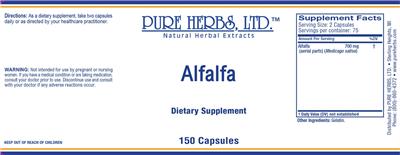
Directions: As a dietary supplement, take two capsules daily or as directed by your healthcare practitioner.
Precautions
Warning: Not intended for use by pregnant or nursing women. If you have a medical condition or are taking medication, consult your doctor prior to use.
Discontinue use and consult with your doctor if any adverse reactions occur.
Keep out of reach of children
Brand IP Statement(s)
Pure Herbs, Ltd. Natural Herbal Extracts
FDA Statement of Identity
Dietary Supplement
Is this label outdated? Report a formula or label change and our pharmacy team will review it.
Alfalfa by Pure Herbs label
The label scan from the NIH Dietary Supplement Label Database. Tap to enlarge.
Label images are published by the NIH Dietary Supplement Label Database for the version of this product on file. Always read your actual product label.
View the full label (PDF)The Ingredients in Alfalfa by Pure Herbs
This is the 1 active ingredient this product is made of. Select it to open its full monograph.
Serving size2 Capsule(s) Dosage formCapsule Servings per container75 Amounts shown are per serving.
Alfalfa
Interacts with583 drugs
Alfalfa is a nutrient-rich legume that people use for high cholesterol, menopause symptoms, and general wellness, but solid human evidence for most of...
Alfalfa monograph & interactionsOther (inactive) ingredients: Gelatin. These complete the product’s ingredient list but are not active constituents.
Alfalfa by Pure Herbs Drug Interactions
HelloPharmacist Interaction Report
Pure Herbs Alfalfa has documented interactions with several medication types, and the most serious is with blood thinners like warfarin (Coumadin).
Alfalfa is rich in vitamin K, which can reduce how well warfarin works to prevent clots — a Major severity concern that needs close monitoring.
Read the full breakdown — every affected drug type, severity by severity
Alfalfa also carries Moderate interactions with photosensitizing drugs (medications that increase sun sensitivity), birth control pills, hormone replacement therapy, immunosuppressants (drugs that lower immunity), and antidiabetes medications. With birth control and hormone therapy, the concern is that alfalfa's estrogen-like compounds may interfere with how these drugs work.
Immunosuppressants may become less effective because alfalfa appears to stimulate immune function. Antidiabetes drugs carry a risk of low blood sugar (hypoglycemia) if combined with alfalfa, since animal studies suggest alfalfa can lower blood glucose.
Altogether, these interactions span 577 individual medications. Use the medication checker below to look up your exact prescriptions before starting this supplement.
Check your own medications below · Editorial policy · How we use AI
Want to check YOUR meds against Alfalfa?
Ask about interactions with your drugs in plain English — “Can I take it with lisinopril?” — and we find you the answer in seconds, ingredient by ingredient.
Go to the checkerIngredients driving the most interactions
Individual Drug Interactions
The ingredients in Alfalfa interact with 583 drugs. Click any drug to see the details.
1 of the 1 ingredient in Alfalfa interact with drugs. Each result below shows which ingredient is responsible. Alfalfa
Adalimumab-adazHyrimoz
How Adalimumab-adaz interacts with Alfalfa — through 1 ingredient. Tap an ingredient for the detail:
AlfalfaImmunosuppressants Moderate
Interaction Summary
Theoretically, alfalfa might decrease the efficacy of immunosuppressive therapy.
Read the full Alfalfa + Adalimumab-adaz interactionAdalimumab-adbmCyltezo
How Adalimumab-adbm interacts with Alfalfa — through 1 ingredient. Tap an ingredient for the detail:
AlfalfaImmunosuppressants Moderate
Interaction Summary
Theoretically, alfalfa might decrease the efficacy of immunosuppressive therapy.
Read the full Alfalfa + Adalimumab-adbm interactionAdalimumab-afzbAbrilada
How Adalimumab-afzb interacts with Alfalfa — through 1 ingredient. Tap an ingredient for the detail:
AlfalfaImmunosuppressants Moderate
Interaction Summary
Theoretically, alfalfa might decrease the efficacy of immunosuppressive therapy.
Read the full Alfalfa + Adalimumab-afzb interactionAdalimumab-attoAmjevita
How Adalimumab-atto interacts with Alfalfa — through 1 ingredient. Tap an ingredient for the detail:
AlfalfaImmunosuppressants Moderate
Interaction Summary
Theoretically, alfalfa might decrease the efficacy of immunosuppressive therapy.
Read the full Alfalfa + Adalimumab-atto interactionAdalimumab-bwwdHadlima
How Adalimumab-bwwd interacts with Alfalfa — through 1 ingredient. Tap an ingredient for the detail:
AlfalfaImmunosuppressants Moderate
Interaction Summary
Theoretically, alfalfa might decrease the efficacy of immunosuppressive therapy.
Read the full Alfalfa + Adalimumab-bwwd interactionAdalimumab-fkjpHulio
How Adalimumab-fkjp interacts with Alfalfa — through 1 ingredient. Tap an ingredient for the detail:
AlfalfaImmunosuppressants Moderate
Interaction Summary
Theoretically, alfalfa might decrease the efficacy of immunosuppressive therapy.
Read the full Alfalfa + Adalimumab-fkjp interactionAlbiglutideTanzeum
How Albiglutide interacts with Alfalfa — through 1 ingredient. Tap an ingredient for the detail:
AlfalfaAntidiabetes Drugs Moderate
Interaction Summary
Theoretically, alfalfa might increase the risk of hypoglycemia when taken with antidiabetes drugs.
Read the full Alfalfa + Albiglutide interactionAlectinib HydrochlorideAlecensa
How Alectinib Hydrochloride interacts with Alfalfa — through 1 ingredient. Tap an ingredient for the detail:
AlfalfaPhotosensitizing Drugs Moderate
Interaction Summary
Theoretically, concomitant use of alfalfa with photosensitizing drugs might have additive effects.
Read the full Alfalfa + Alectinib Hydrochloride interactionAlefaceptAmevive
How Alefacept interacts with Alfalfa — through 1 ingredient. Tap an ingredient for the detail:
AlfalfaImmunosuppressants Moderate
Interaction Summary
Theoretically, alfalfa might decrease the efficacy of immunosuppressive therapy.
Read the full Alfalfa + Alefacept interactionAlemtuzumabCampath
How Alemtuzumab interacts with Alfalfa — through 1 ingredient. Tap an ingredient for the detail:
AlfalfaImmunosuppressants Moderate
Interaction Summary
Theoretically, alfalfa might decrease the efficacy of immunosuppressive therapy.
Read the full Alfalfa + Alemtuzumab interactionAlitretinoinPanretin
How Alitretinoin interacts with Alfalfa — through 1 ingredient. Tap an ingredient for the detail:
AlfalfaPhotosensitizing Drugs Moderate
Interaction Summary
Theoretically, concomitant use of alfalfa with photosensitizing drugs might have additive effects.
Read the full Alfalfa + Alitretinoin interactionAlogliptinNesina
How Alogliptin interacts with Alfalfa — through 1 ingredient. Tap an ingredient for the detail:
AlfalfaAntidiabetes Drugs Moderate
Interaction Summary
Theoretically, alfalfa might increase the risk of hypoglycemia when taken with antidiabetes drugs.
Read the full Alfalfa + Alogliptin interactionAlogliptin, MetforminKazano
How Alogliptin, Metformin interacts with Alfalfa — through 1 ingredient. Tap an ingredient for the detail:
AlfalfaAntidiabetes Drugs Moderate
Interaction Summary
Theoretically, alfalfa might increase the risk of hypoglycemia when taken with antidiabetes drugs.
Read the full Alfalfa + Alogliptin, Metformin interactionAlogliptin, PioglitazoneOseni
How Alogliptin, Pioglitazone interacts with Alfalfa — through 1 ingredient. Tap an ingredient for the detail:
AlfalfaAntidiabetes Drugs Moderate
Interaction Summary
Theoretically, alfalfa might increase the risk of hypoglycemia when taken with antidiabetes drugs.
Read the full Alfalfa + Alogliptin, Pioglitazone interactionAmiloride, HydrochlorothiazideAmil-Co, Amilzide, Moduret 25, Moduretic
How Amiloride, Hydrochlorothiazide interacts with Alfalfa — through 1 ingredient. Tap an ingredient for the detail:
AlfalfaPhotosensitizing Drugs Moderate
Interaction Summary
Theoretically, concomitant use of alfalfa with photosensitizing drugs might have additive effects.
Read the full Alfalfa + Amiloride, Hydrochlorothiazide interactionAminolevulinic Acid HydrochlorideAmeluz, Gleolan
How Aminolevulinic Acid Hydrochloride interacts with Alfalfa — through 1 ingredient. Tap an ingredient for the detail:
AlfalfaPhotosensitizing Drugs Moderate
Interaction Summary
Theoretically, concomitant use of alfalfa with photosensitizing drugs might have additive effects.
Read the full Alfalfa + Aminolevulinic Acid Hydrochloride interactionAmiodaroneCordarone, Pacerone
How Amiodarone interacts with Alfalfa — through 1 ingredient. Tap an ingredient for the detail:
AlfalfaPhotosensitizing Drugs Moderate
Interaction Summary
Theoretically, concomitant use of alfalfa with photosensitizing drugs might have additive effects.
Read the full Alfalfa + Amiodarone interactionAmitriptylineElavil
How Amitriptyline interacts with Alfalfa — through 1 ingredient. Tap an ingredient for the detail:
AlfalfaPhotosensitizing Drugs Moderate
Interaction Summary
Theoretically, concomitant use of alfalfa with photosensitizing drugs might have additive effects.
Read the full Alfalfa + Amitriptyline interactionAmitriptyline, ChlordiazepoxideLimbitrol DS
How Amitriptyline, Chlordiazepoxide interacts with Alfalfa — through 1 ingredient. Tap an ingredient for the detail:
AlfalfaPhotosensitizing Drugs Moderate
Interaction Summary
Theoretically, concomitant use of alfalfa with photosensitizing drugs might have additive effects.
Read the full Alfalfa + Amitriptyline, Chlordiazepoxide interactionAmitriptyline, PerphenazineEtrafon, Etrafon-A, Etrafon-Forte, Triavil
How Amitriptyline, Perphenazine interacts with Alfalfa — through 1 ingredient. Tap an ingredient for the detail:
AlfalfaPhotosensitizing Drugs Moderate
Interaction Summary
Theoretically, concomitant use of alfalfa with photosensitizing drugs might have additive effects.
Read the full Alfalfa + Amitriptyline, Perphenazine interactionAmlodipine Besylate, BenazeprilLotrel
How Amlodipine Besylate, Benazepril interacts with Alfalfa — through 1 ingredient. Tap an ingredient for the detail:
AlfalfaPhotosensitizing Drugs Moderate
Interaction Summary
Theoretically, concomitant use of alfalfa with photosensitizing drugs might have additive effects.
Read the full Alfalfa + Amlodipine Besylate, Benazepril interactionAmlodipine, CelecoxibConsensi
How Amlodipine, Celecoxib interacts with Alfalfa — through 1 ingredient. Tap an ingredient for the detail:
AlfalfaPhotosensitizing Drugs Moderate
Interaction Summary
Theoretically, concomitant use of alfalfa with photosensitizing drugs might have additive effects.
Read the full Alfalfa + Amlodipine, Celecoxib interactionAmoxapineAsendin
How Amoxapine interacts with Alfalfa — through 1 ingredient. Tap an ingredient for the detail:
AlfalfaPhotosensitizing Drugs Moderate
Interaction Summary
Theoretically, concomitant use of alfalfa with photosensitizing drugs might have additive effects.
Read the full Alfalfa + Amoxapine interactionAmphotericin, TetracyclineMysteclin-F
How Amphotericin, Tetracycline interacts with Alfalfa — through 1 ingredient. Tap an ingredient for the detail:
AlfalfaPhotosensitizing Drugs Moderate
Interaction Summary
Theoretically, concomitant use of alfalfa with photosensitizing drugs might have additive effects.
Read the full Alfalfa + Amphotericin, Tetracycline interactionAnifrolumab-fniaSaphnelo
How Anifrolumab-fnia interacts with Alfalfa — through 1 ingredient. Tap an ingredient for the detail:
AlfalfaImmunosuppressants Moderate
Interaction Summary
Theoretically, alfalfa might decrease the efficacy of immunosuppressive therapy.
Read the full Alfalfa + Anifrolumab-fnia interactionAntidiabetes, Dipeptidyl Peptidase-4 (dpp-iv) InhibitorGlyxambi
How Antidiabetes, Dipeptidyl Peptidase-4 (dpp-iv) Inhibitor interacts with Alfalfa — through 1 ingredient. Tap an ingredient for the detail:
AlfalfaAntidiabetes Drugs Moderate
Interaction Summary
Theoretically, alfalfa might increase the risk of hypoglycemia when taken with antidiabetes drugs.
Read the full Alfalfa + Antidiabetes, Dipeptidyl Peptidase-4 (dpp-iv) Inhibitor interactionAntithymocyte GlobulinThymoglobulin
How Antithymocyte Globulin interacts with Alfalfa — through 1 ingredient. Tap an ingredient for the detail:
AlfalfaImmunosuppressants Moderate
Interaction Summary
Theoretically, alfalfa might decrease the efficacy of immunosuppressive therapy.
Read the full Alfalfa + Antithymocyte Globulin interactionAripiprazoleAbilify, Abilify Maintena, Abilify Mycite
How Aripiprazole interacts with Alfalfa — through 1 ingredient. Tap an ingredient for the detail:
AlfalfaPhotosensitizing Drugs Moderate
Interaction Summary
Theoretically, concomitant use of alfalfa with photosensitizing drugs might have additive effects.
Read the full Alfalfa + Aripiprazole interactionAripiprazole LauroxilAristada, Aristada Initio Kit
How Aripiprazole Lauroxil interacts with Alfalfa — through 1 ingredient. Tap an ingredient for the detail:
AlfalfaPhotosensitizing Drugs Moderate
Interaction Summary
Theoretically, concomitant use of alfalfa with photosensitizing drugs might have additive effects.
Read the full Alfalfa + Aripiprazole Lauroxil interactionAspirin, Chlorpheniramine, PhenylpropanolamineAlka-Seltzer Plus Cold
How Aspirin, Chlorpheniramine, Phenylpropanolamine interacts with Alfalfa — through 1 ingredient. Tap an ingredient for the detail:
AlfalfaPhotosensitizing Drugs Moderate
Interaction Summary
Theoretically, concomitant use of alfalfa with photosensitizing drugs might have additive effects.
Read the full Alfalfa + Aspirin, Chlorpheniramine, Phenylpropanolamine interactionEach ingredient & the kinds of drugs it affects
For each ingredient in Alfalfa with known interactions, here are the types of medications it can affect. Open any type for the detail — or search your exact drug in the checker above.
Alfalfa
Warfarin (Coumadin)
Theoretically, alfalfa might reduce the anticoagulant activity of warfarin.
Alfalfa contains a large amount of vitamin K. This could theoretically interfere with the activity of warfarin.
Antidiabetes Drugs
Theoretically, alfalfa might increase the risk of hypoglycemia when taken with antidiabetes drugs.
Animal research suggests that alfalfa decreases blood sugar in diabetic mice. Also, in one case report, a diabetic patient experienced hypoglycemia after consuming alfalfa extract. Monitor blood glucose levels closely. Dose adjustments might be necessary.
Contraceptive Drugs
Theoretically, alfalfa might interfere with the activity of contraceptive drugs.
Alfalfa contains coumestrol, a phytoestrogen, and isoflavonoids, which have estrogenic effects.
Estrogens
Theoretically, alfalfa might interfere with hormone therapy.
Alfalfa contains coumestrol, a phytoestrogen, and isoflavonoids, which have estrogenic effects.
Immunosuppressants
Theoretically, alfalfa might decrease the efficacy of immunosuppressive therapy.
In vitro research and human case reports suggest that alfalfa may have immunostimulant effects.
Photosensitizing Drugs
Theoretically, concomitant use of alfalfa with photosensitizing drugs might have additive effects.
Animal research suggests that excessive doses of alfalfa may increase photosensitivity, possibly due to its chlorophyll content. It is unclear if this effect would be clinically relevant in humans.
Brand information
Manufacturer and brand details for Alfalfa, from the product label.
Pure Herbs
See all Pure Herbs products- Name
- Pure Herbs, Ltd.
- City
- Sterling Heights
- State
- MI
- Phone Number
- (800) 860-4372
- Web Address
- www.pureherbs.com
Alfalfa by Pure Herbs: Common Questions
Does Alfalfa by Pure Herbs interact with any medications?
How can one product interact with so many drugs?
Where does this information come from?
Does alfalfa actually work for lower blood sugar or high cholesterol?
What are the most common side effects?
Is alfalfa safe while I'm pregnant?
Can I take this while I'm breastfeeding?
What's in the capsule besides alfalfa?
I heard alfalfa can mess with blood thinners. Is that real?
Written and reviewed by the HelloPharmacist editorial staff. Our editorial policy
Not sure if Alfalfa is safe with your meds?
Our pharmacists answer your medication & supplement questions — free.
Label information is sourced from the NIH Dietary Supplement Label Database and reflects the product version on file; always read your actual product label. This page is for education only and is not a substitute for professional medical advice. Confirm with your pharmacist or doctor before combining supplements and medications.
The Full Monographs Behind Alfalfa’s Ingredients
Every ingredient we hold a full HelloPharmacist monograph for — uses, evidence, safety, and the complete interaction list.
Sources & How We Checked
Alfalfa's label data comes from the NIH Dietary Supplement Label Database; the ingredient interaction data is from the Natural Medicines database, reviewed by our pharmacists.
- NIH Dietary Supplement Label Database (DSLD) — The official product label on file for this supplement.
- Natural Medicines (Therapeutic Research Center) — Evidence-graded clinical reference behind the ingredient interaction data.
Content is written and reviewed by licensed HelloPharmacist pharmacists. See our data sources and editorial standards for how this information is built and checked.
The 32 references behind this product’s interaction data
Every citation that drives the interaction findings for this product’s ingredients, from the evidence-graded Natural Medicines (TRC Healthcare) database. Open an ingredient to browse its citations — links open the study on PubMed or the publisher’s site.
Alfalfa 32 references
- Newall CA, Anderson LA, Philpson JD. Herbal Medicine: A Guide for Healthcare Professionals. London, UK: The Pharmaceutical Press, 1996.
- The Review of Natural Products by Facts and Comparisons. St. Louis, MO: Wolters Kluwer Co., 1999.
- Leung AY, Foster S. Encyclopedia of Common Natural Ingredients Used in Food, Drugs and Cosmetics. 2nd ed. New York, NY: John Wiley & Sons, 1996.
- Kurzer MS, Xu X. Dietary phytoestrogens. Annu Rev Nutr 1997;17:353-81. PubMed
- Farber JM, Carter AO, Varughese PV, et al. Listeriosis traced to the consumption of alfalfa tablets and soft cheese [Letter to the Editor]. N Engl J Med 1990;322:338. PubMed
- Molgaard J, von Schenck H, Olsson AG. Alfalfa seeds lower low density lipoprotein cholesterol and apolipoprotein B concentrations in patients with type II hyperlipoproteinemia. Atherosclerosis 1987;65:173-9. PubMed
- Light TD, Light JA. Acute renal transplant rejection possibly related to herbal medications. Am J Transplant 2003;3:1608-9. PubMed
- Prete PE. The mechanism of action of L-canavanine in inducing autoimmune phenomena. Arthritis Rheum 1985;28:1198-200. PubMed
- Alcocer-Varela J, Iglesias A, Llorente L, Alarcon-Segovia D. Effects of L-canavanine on T cells may explain the induction of systemic lupus erythematosus by alfalfa. Arthritis Rheum 1985;28:52-7. PubMed
- Roberts JL, Hayashi JA. Exacerbation of SLE associated with alfalfa ingestion. N Engl J Med 1983;308:1361. DOI
- Feingold, R. M. Should we fear "health foods"? Arch Intern Med 7-12-1999;159(13):1502. PubMed
- Taormina, P. J., Beuchat, L. R., and Slutsker, L. Infections associated with eating seed sprouts: an international concern. Emerg.Infect.Dis 1999;5(5):626-634. PubMed
- Backer, H. D., Mohle-Boetani, J. C., Werner, S. B., Abbott, S. L., Farrar, J., and Vugia, D. J. High incidence of extra-intestinal infections in a Salmonella Havana outbreak associated with alfalfa sprouts. Public Health Rep. 2000;115(4):339-345. PubMed
- Mohle-Boetani J, Werner B, Polumbo M, and et al. From the Centers for Disease Control and Prevention. Alfalfa sprouts-- Arizona, California, Colorado, and New Mexico, February-April, 2001. JAMA 2-6-2002;287(5):581-582.
- Howard, M. B. and Hutcheson, S. W. Growth dynamics of Salmonella enterica strains on alfalfa sprouts and in waste seed irrigation water. Appl.Environ.Microbiol. 2003;69(1):548-553.
- Winthrop, K. L., Palumbo, M. S., Farrar, J. A., Mohle-Boetani, J. C., Abbott, S., Beatty, M. E., Inami, G., and Werner, S. B. Alfalfa sprouts and Salmonella Kottbus infection: a multistate outbreak following inadequate seed disinfection with heat and chl
- Strapp, C. M., Shearer, A. E., and Joerger, R. D. Survey of retail alfalfa sprouts and mushrooms for the presence of Escherichia coil O157:H7, Salmonella, and Listeria with BAX, and evaluation of this polymerase chain reaction-based system with experimen
- Akaogi, J., Barker, T., Kuroda, Y., Nacionales, D. C., Yamasaki, Y., Stevens, B. R., Reeves, W. H., and Satoh, M. Role of non-protein amino acid L-canavanine in autoimmunity. Autoimmun.Rev 2006;5(6):429-435. PubMed
- Burden and causes of foodborne disease in Australia: Annual report of the OzFoodNet network, 2005. Commun.Dis Intell. 2006;30(3):278-300.
- Shemesh, M., Lindner, H. R., and Ayalon, N. Affinity of rabbit uterine oestradiol receptor for phyto-oestrogens and its use in a competitive protein-binding radioassay for plasma coumestrol. J Reprod.Fertil. 1972;29(1):1-9. PubMed
- Elakovich, S. D. and Hampton, J. M. Analysis of coumestrol, a phytoestrogen, in alfalfa tablets sold for human consumption. J Agric.Food Chem. 1984;32(1):173-175. PubMed
- Malinow, M. R., Bardana, E. J., Jr., Pirofsky, B., Craig, S., and McLaughlin, P. Systemic lupus erythematosus-like syndrome in monkeys fed alfalfa sprouts: role of a nonprotein amino acid. Science 4-23-1982;216(4544):415-417. PubMed
- Malinow, M. R., McLaughlin, P., and Stafford, C. Alfalfa seeds: effects on cholesterol metabolism. Experientia 5-15-1980;36(5):562-564. PubMed
- Farnsworth, N. R. Alfalfa pills and autoimmune diseases. Am J Clin Nutr. 1995;62(5):1026-1028. DOI
- Herbert, V. and Kasdan, T. S. Alfalfa, vitamin E, and autoimmune disorders. Am J Clin Nutr 1994;60(4):639-640.
- Mahon, B. E., Ponka, A., Hall, W. N., Komatsu, K., Dietrich, S. E., Siitonen, A., Cage, G., Hayes, P. S., Lambert-Fair, M. A., Bean, N. H., Griffin, P. M., and Slutsker, L. An international outbreak of Salmonella infections caused by alfalfa sprouts grow
- Gray, A. M. and Flatt, P. R. Pancreatic and extra-pancreatic effects of the traditional anti- diabetic plant, Medicago sativa (lucerne). Br J Nutr. 1997;78(2):325-334.
- Van Beneden, C. A., Keene, W. E., Strang, R. A., Werker, D. H., King, A. S., Mahon, B., Hedberg, K., Bell, A., Kelly, M. T., Balan, V. K., Mac Kenzie, W. R., and Fleming, D. Multinational outbreak of Salmonella enterica serotype Newport infections due to
- Rubenstein AH, Levin NW, and Elliott GA. Manganese-induced hypoglycemia. Lancet 1962;1348-1351.
- Kaufman W. Alfalfa seed dermatitis. JAMA 1954;155(12):1058-1059. PubMed
- Ponka A, Andersson Y, Siitonen A, and et al. Salmonella in alfalfa sprouts. Lancet 1995;345:462-463. PubMed
- Puschner B, Chen X, Read D, Affolter VK. Alfalfa hay induced primary photosensitization in horses. Vet J. 2016 May;211:32-8. PubMed
Parts of this content are provided by the Therapeutic Research Center, LLC.
DISCLAIMER: Currently this does not check for drug-drug interactions. This is not an all-inclusive comprehensive list of potential interactions and is for informational purposes only. Not all interactions are known or well-reported in the scientific literature, and new interactions are continually being reported. Input is needed from a qualified healthcare provider including a pharmacist before starting any therapy. Application of clinical judgment is necessary.
© 2021 Therapeutic Research Center, LLC