
B6 Phosphate Ingredients & Drug Interactions
by Biotics Research Corporation
What is this page for?
First and foremost: checking B6 Phosphate against your medications. The heart of this page is the interaction checker and the full interaction report — how this product’s ingredients may interact with prescription and over-the-counter medicines you may be taking.
Around that, we add a pharmacist’s high-level view of the product as a whole — what’s inside, the evidence for its stated use, how transparent the label is, and what safety data exists — so you can see the full picture in one place. It’s educational information from our licensed clinical databases and the clinical staff at HelloPharmacist — not medical advice — and we don’t sell or endorse products. Our editorial policy
B6 Phosphate is a dietary supplement by Biotics Research Corporation with 3 active ingredients. Its ingredients are commonly taken for morning sickness in pregnancy, premenstrual syndrome (pms), preventing or treating b6 deficiency.Based on those ingredients, 210 medications have a known interaction with it, the most serious rated moderate. The ingredients most likely to interact are Vitamin B6. Use the checker below to test your specific medication, or read the full HelloPharmacist Interaction Report.
Check Your Meds Against B6 Phosphate by Biotics Research Corporation
Ask about any prescription or over-the-counter medication and we check it for interactions with B6 Phosphate by Biotics Research Corporation — and tell you which ingredient is responsible.
AI summaries are generated from our interaction database for education only — always confirm with your pharmacist. How we use AI
Ask the Pharmacist
A licensed pharmacist will answer your question by email — free, usually within 24 hours.
Got it — thank you!
A licensed pharmacist will answer within 24 hours. Keep an eye on your email (worth checking spam, just in case).
HelloPharmacist Scorecard of B6 Phosphate by Biotics Research Corporation
Our pharmacy team’s full take, with four database checks built into the cards below — a summary of what is known, not a grade of the product itself.
What’s inside
Full disclosure
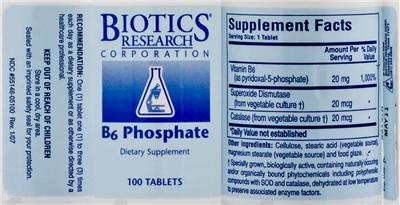
B6 Phosphate contains three active ingredients: Superoxide Dismutase, Catalase, and Vitamin B6. The product also includes inactive ingredients — cellulose, stearic acid, magnesium stearate, and food glaze — which serve as tablet binders and fillers.
Does it work?
Strong evidence
Vitamin B6 is effective for treating sideroblastic anemia and vitamin B6 deficiency, and it's effective for a rare genetic condition called pyridoxine-dependent epilepsy. The evidence is likely strong that it helps lower homocysteine (an amino acid in the blood).
It's possibly effective for pregnancy-related nausea and vomiting when used under a doctor's supervision. We have no established effectiveness data in our records for Superoxide Dismutase or Catalase.
How safe is it?
Well-documented data
Vitamin B6 is well tolerated at doses under 100 mg daily. At recommended amounts from food and standard supplements, it's considered safe.
However, high doses over time can damage nerves, causing a condition called sensory neuropathy — particularly with daily doses above 1000 mg or total lifetime doses of 1 gram or more, though nerve damage can occur at lower amounts too. Common side effects at therapeutic doses are mild: headache, nausea, heartburn, abdominal pain, and loss of appetite.
In pregnancy, vitamin B6 is rated likely safe, though some evidence suggests it might be possibly unsafe — talk with your doctor or pharmacist about whether it's right for you if you're pregnant. It's likely safe during breastfeeding.
We hold no pregnancy or breastfeeding safety data for Superoxide Dismutase or Catalase.
Meds to double-check
Moderate interaction found
Check with your pharmacist if you take blood pressure medications (antihypertensive drugs), the heart drug amiodarone, or seizure medications phenobarbital or phenytoin — vitamin B6 may affect how these work. If you take levodopa alone for Parkinson's, discuss this too.
High doses of vitamin B6 are the main concern with most of these interactions.
The bottom line
Scorecard at a glanceFully disclosed formula with strong clinical evidence behind its ingredients' uses. Moderate medication interactions have been identified, and safety information is well characterized.
B6 Phosphate may be worth considering if you have a vitamin B6 deficiency or one of the specific conditions it's proven effective for — your pharmacist or doctor can confirm. If you take blood pressure medicine, heart rhythm drugs, or seizure medications, you'll need to check this product with your pharmacist first.
Talk to us before you start.
Educational only — not medical advice; always confirm with your pharmacist. Our editorial policy · How we use AI
Assessment coverage: 1 of 3 active ingredients matched to our full ingredient reviews (monographs). Based on the product label dated Aug 23, 2013.
This Scorecard evaluates available label information, ingredient evidence, and known medication-safety considerations. It does not independently verify product identity, purity, potency, contamination, or manufacturing quality. How these ratings are computed
General information
Key facts about B6 Phosphate, straight from the product label.
| Brand | Biotics Research Corporation |
|---|---|
| Net contents | 100 Tablet(s) |
| Market status | On market |
| Date entered into DSLD | Aug 23, 2013 |
| DSLD ID | 21474 |
| Product type | Other Combinations |
| Supplement form | Tablet Or Pill |
| Dietary claims / uses | All Other |
| Intended target group(s) | Adult (18 - 50 Years) |
Everything in this section is reproduced from the manufacturer’s own product label — it’s the label speaking, not HelloPharmacist. We show it so you can see exactly what the maker states; we don’t verify or endorse those statements.
Supplement Facts
The label details for B6 Phosphate by Biotics Research Corporation, sourced from the NIH Dietary Supplement Label Database.
Supplement Facts
| Ingredient | Amount | % DV |
|---|---|---|
| Superoxide Dismutase | 20 mcg | -- |
| Catalase | 20 mcg | -- |
| Vitamin B6 | 20 mg | 1000% |
Other ingredients: Cellulose, Stearic Acid, Magnesium Stearate, Food Glaze
Tap any ingredient to jump to its full detail below.
These statements are the manufacturer’s wording, reproduced from the product label — the label is saying it, not HelloPharmacist. We don’t verify or endorse them.
Brand IP Statement(s)
Specially grown,.biologically active, containing naturally occuring and/or organically bound phytochemicals including polyphenolic compounds with SOD and catalase, dehydrated at low temperature to preserve associated enzyme factors.
(C) Copyright 2009
Suggested/Recommended/Usage/Directions
RECOMMENDATION: One (1) tablet one (1) to three (3) times each day as a dietary supplement or as otherwise directed by a healthcare professional.
Precautions
KEEP OUT OF REACH OF CHILDREN
Storage
Store in a cool, dry area.
General Statements
Sealed with an imprinted safety seal for your protection.
Exp. Date: MAY 11
General
Rev. 1/07
FDA Statement of Identity
Dietary Supplement
Is this label outdated? Report a formula or label change and our pharmacy team will review it.
B6 Phosphate by Biotics Research Corporation label
The label scan from the NIH Dietary Supplement Label Database. Tap to enlarge.
Label images are published by the NIH Dietary Supplement Label Database for the version of this product on file. Always read your actual product label.
View the full label (PDF)The Ingredients in B6 Phosphate by Biotics Research Corporation
These are the 3 active ingredients this product is made of. Select any to open its full monograph.
Serving size1 Tablet(s) Dosage formTablet Or Pill Amounts shown are per serving.
Most supplement products combine several ingredients, and a medication can interact with the product through any one of them. Each ingredient below shows whether it has known drug interactions.
Superoxide Dismutase
Catalase
Vitamin B6
Interacts with210 drugs
Vitamin B6 (pyridoxine) is an essential water-soluble vitamin that your body needs for metabolism, brain function, and making red blood cells. It is b...
Vitamin B6 monograph & interactionsOther (inactive) ingredients: Cellulose, Stearic Acid, Magnesium Stearate, Food Glaze. These complete the product’s ingredient list but are not active constituents.
B6 Phosphate by Biotics Research Corporation Drug Interactions
HelloPharmacist Interaction Report
B6 Phosphate by Biotics Research Corporation contains vitamin B6, which interacts with a number of medications.
The most serious concern is with blood pressure medications (antihypertensive drugs). Vitamin B6 may add to their effect, potentially lowering your blood pressure further than intended — something to watch if you're already on a medication for high blood pressure.
Read the full breakdown — every affected drug type, severity by severity
Vitamin B6 also interacts with the heart rhythm drug amiodarone (Cordarone), where high doses may worsen sun sensitivity. It can reduce the effectiveness of seizure medications phenobarbital (Luminal) and phenytoin (Dilantin) at high doses by speeding up how your body clears them.
Additionally, if you take levodopa alone for Parkinson's symptoms, vitamin B6 may lower its effect — though this doesn't happen if you're on the combination form (Sinemet with carbidopa).
We couldn't check two of the three ingredients in this product — Superoxide Dismutase and Catalase — because we hold no data for them. Altogether, these interactions span 208 individual medications.
Please check your exact medications with the search tool on this page before starting.
Check your own medications below · Editorial policy · How we use AI
Want to check YOUR meds against B6 Phosphate?
Ask about interactions with your drugs in plain English — “Can I take it with lisinopril?” — and we find you the answer in seconds, ingredient by ingredient.
Go to the checkerIngredients driving the most interactions
Individual Drug Interactions
The ingredients in B6 Phosphate interact with 210 drugs. Click any drug to see the details.
1 of the 3 ingredients in B6 Phosphate interact with drugs. Each result below shows which ingredient is responsible. Vitamin B6
AcebutololRhotral, Sectral
How Acebutolol interacts with B6 Phosphate — through 1 ingredient. Tap an ingredient for the detail:
Vitamin B6Antihypertensive Drugs Moderate
Interaction Summary
Theoretically, vitamin B6 may have additive effects when used with antihypertensive drugs.
Read the full Vitamin B6 + Acebutolol interactionAcetazolamideAk-Zol, Diamox
How Acetazolamide interacts with B6 Phosphate — through 1 ingredient. Tap an ingredient for the detail:
Vitamin B6Antihypertensive Drugs Moderate
Interaction Summary
Theoretically, vitamin B6 may have additive effects when used with antihypertensive drugs.
Read the full Vitamin B6 + Acetazolamide interactionAliskirenTekturna
How Aliskiren interacts with B6 Phosphate — through 1 ingredient. Tap an ingredient for the detail:
Vitamin B6Antihypertensive Drugs Moderate
Interaction Summary
Theoretically, vitamin B6 may have additive effects when used with antihypertensive drugs.
Read the full Vitamin B6 + Aliskiren interactionAmbrisentanLetairis, Volibris
How Ambrisentan interacts with B6 Phosphate — through 1 ingredient. Tap an ingredient for the detail:
Vitamin B6Antihypertensive Drugs Moderate
Interaction Summary
Theoretically, vitamin B6 may have additive effects when used with antihypertensive drugs.
Read the full Vitamin B6 + Ambrisentan interactionAmilorideAmilamont, Midamor
How Amiloride interacts with B6 Phosphate — through 1 ingredient. Tap an ingredient for the detail:
Vitamin B6Antihypertensive Drugs Moderate
Interaction Summary
Theoretically, vitamin B6 may have additive effects when used with antihypertensive drugs.
Read the full Vitamin B6 + Amiloride interactionAmiloride, HydrochlorothiazideAmil-Co, Amilzide, Moduret 25, Moduretic
How Amiloride, Hydrochlorothiazide interacts with B6 Phosphate — through 1 ingredient. Tap an ingredient for the detail:
Vitamin B6Antihypertensive Drugs Moderate
Interaction Summary
Theoretically, vitamin B6 may have additive effects when used with antihypertensive drugs.
Read the full Vitamin B6 + Amiloride, Hydrochlorothiazide interactionAmiodaroneCordarone, Pacerone
How Amiodarone interacts with B6 Phosphate — through 1 ingredient. Tap an ingredient for the detail:
Vitamin B6Amiodarone (cordarone) Moderate
Interaction Summary
Theoretically, vitamin B6 might increase the photosensitivity caused by amiodarone.
Read the full Vitamin B6 + Amiodarone interactionAmlodipineNorliqva
How Amlodipine interacts with B6 Phosphate — through 1 ingredient. Tap an ingredient for the detail:
Vitamin B6Antihypertensive Drugs Moderate
Interaction Summary
Theoretically, vitamin B6 may have additive effects when used with antihypertensive drugs.
Read the full Vitamin B6 + Amlodipine interactionAmlodipine BenzoateKaterzia
How Amlodipine Benzoate interacts with B6 Phosphate — through 1 ingredient. Tap an ingredient for the detail:
Vitamin B6Antihypertensive Drugs Moderate
Interaction Summary
Theoretically, vitamin B6 may have additive effects when used with antihypertensive drugs.
Read the full Vitamin B6 + Amlodipine Benzoate interactionAmlodipine BesilateIstin
How Amlodipine Besilate interacts with B6 Phosphate — through 1 ingredient. Tap an ingredient for the detail:
Vitamin B6Antihypertensive Drugs Moderate
Interaction Summary
Theoretically, vitamin B6 may have additive effects when used with antihypertensive drugs.
Read the full Vitamin B6 + Amlodipine Besilate interactionAmlodipine BesylateNorvasc
How Amlodipine Besylate interacts with B6 Phosphate — through 1 ingredient. Tap an ingredient for the detail:
Vitamin B6Antihypertensive Drugs Moderate
Interaction Summary
Theoretically, vitamin B6 may have additive effects when used with antihypertensive drugs.
Read the full Vitamin B6 + Amlodipine Besylate interactionAmlodipine Besylate, BenazeprilLotrel
How Amlodipine Besylate, Benazepril interacts with B6 Phosphate — through 1 ingredient. Tap an ingredient for the detail:
Vitamin B6Antihypertensive Drugs Moderate
Interaction Summary
Theoretically, vitamin B6 may have additive effects when used with antihypertensive drugs.
Read the full Vitamin B6 + Amlodipine Besylate, Benazepril interactionAmlodipine, CelecoxibConsensi
How Amlodipine, Celecoxib interacts with B6 Phosphate — through 1 ingredient. Tap an ingredient for the detail:
Vitamin B6Antihypertensive Drugs Moderate
Interaction Summary
Theoretically, vitamin B6 may have additive effects when used with antihypertensive drugs.
Read the full Vitamin B6 + Amlodipine, Celecoxib interactionAmmonium ChlorideAmmonium Chloride
How Ammonium Chloride interacts with B6 Phosphate — through 1 ingredient. Tap an ingredient for the detail:
Vitamin B6Antihypertensive Drugs Moderate
Interaction Summary
Theoretically, vitamin B6 may have additive effects when used with antihypertensive drugs.
Read the full Vitamin B6 + Ammonium Chloride interactionAprobarbital, Butabarbital, PhenobarbitalTriple Barbital
How Aprobarbital, Butabarbital, Phenobarbital interacts with B6 Phosphate — through 1 ingredient. Tap an ingredient for the detail:
Vitamin B6Phenobarbital (luminal) Moderate
Interaction Summary
High doses of vitamin B6 may reduce the levels and clinical effects of phenobarbital.
Read the full Vitamin B6 + Aprobarbital, Butabarbital, Phenobarbital interactionAprocitentanTryvio
How Aprocitentan interacts with B6 Phosphate — through 1 ingredient. Tap an ingredient for the detail:
Vitamin B6Antihypertensive Drugs Moderate
Interaction Summary
Theoretically, vitamin B6 may have additive effects when used with antihypertensive drugs.
Read the full Vitamin B6 + Aprocitentan interactionAspirin, Codeine Phosphate, PhenobarbitalPhenaphen
How Aspirin, Codeine Phosphate, Phenobarbital interacts with B6 Phosphate — through 1 ingredient. Tap an ingredient for the detail:
Vitamin B6Phenobarbital (luminal) Moderate
Interaction Summary
High doses of vitamin B6 may reduce the levels and clinical effects of phenobarbital.
Read the full Vitamin B6 + Aspirin, Codeine Phosphate, Phenobarbital interactionAtenololAtenix, Tenormin
How Atenolol interacts with B6 Phosphate — through 1 ingredient. Tap an ingredient for the detail:
Vitamin B6Antihypertensive Drugs Moderate
Interaction Summary
Theoretically, vitamin B6 may have additive effects when used with antihypertensive drugs.
Read the full Vitamin B6 + Atenolol interactionAtenolol, ChlortalidoneAtenixCo, Tenoret 50, Totaretic
How Atenolol, Chlortalidone interacts with B6 Phosphate — through 1 ingredient. Tap an ingredient for the detail:
Vitamin B6Antihypertensive Drugs Moderate
Interaction Summary
Theoretically, vitamin B6 may have additive effects when used with antihypertensive drugs.
Read the full Vitamin B6 + Atenolol, Chlortalidone interactionAtenolol, ChlorthalidoneTenoretic
How Atenolol, Chlorthalidone interacts with B6 Phosphate — through 1 ingredient. Tap an ingredient for the detail:
Vitamin B6Antihypertensive Drugs Moderate
Interaction Summary
Theoretically, vitamin B6 may have additive effects when used with antihypertensive drugs.
Read the full Vitamin B6 + Atenolol, Chlorthalidone interactionAtropine, Hyoscyamine, PhenobarbitalHypnaldyne
How Atropine, Hyoscyamine, Phenobarbital interacts with B6 Phosphate — through 1 ingredient. Tap an ingredient for the detail:
Vitamin B6Phenobarbital (luminal) Moderate
Interaction Summary
High doses of vitamin B6 may reduce the levels and clinical effects of phenobarbital.
Read the full Vitamin B6 + Atropine, Hyoscyamine, Phenobarbital interactionAtropine, Hyoscyamine, Phenobarbital, ScopolamineBarbidonna No. 2, Belladonna Phenobarbital
How Atropine, Hyoscyamine, Phenobarbital, Scopolamine interacts with B6 Phosphate — through 1 ingredient. Tap an ingredient for the detail:
Vitamin B6Phenobarbital (luminal) Moderate
Interaction Summary
High doses of vitamin B6 may reduce the levels and clinical effects of phenobarbital.
Read the full Vitamin B6 + Atropine, Hyoscyamine, Phenobarbital, Scopolamine interactionAtropine, Hyoscyamine, Scopolamine, PhenobarbitalBarbeloid, Donnatal #2, Donphen
How Atropine, Hyoscyamine, Scopolamine, Phenobarbital interacts with B6 Phosphate — through 1 ingredient. Tap an ingredient for the detail:
Vitamin B6Phenobarbital (luminal) Moderate
Interaction Summary
High doses of vitamin B6 may reduce the levels and clinical effects of phenobarbital.
Read the full Vitamin B6 + Atropine, Hyoscyamine, Scopolamine, Phenobarbital interactionAtropine, PhenobarbitalAnthrocol
How Atropine, Phenobarbital interacts with B6 Phosphate — through 1 ingredient. Tap an ingredient for the detail:
Vitamin B6Phenobarbital (luminal) Moderate
Interaction Summary
High doses of vitamin B6 may reduce the levels and clinical effects of phenobarbital.
Read the full Vitamin B6 + Atropine, Phenobarbital interactionAzilsartanEdarbi
How Azilsartan interacts with B6 Phosphate — through 1 ingredient. Tap an ingredient for the detail:
Vitamin B6Antihypertensive Drugs Moderate
Interaction Summary
Theoretically, vitamin B6 may have additive effects when used with antihypertensive drugs.
Read the full Vitamin B6 + Azilsartan interactionAzilsartan, ChlorthalidoneEdarbyclor
How Azilsartan, Chlorthalidone interacts with B6 Phosphate — through 1 ingredient. Tap an ingredient for the detail:
Vitamin B6Antihypertensive Drugs Moderate
Interaction Summary
Theoretically, vitamin B6 may have additive effects when used with antihypertensive drugs.
Read the full Vitamin B6 + Azilsartan, Chlorthalidone interactionBelladona Extract, PhenobarbitalChardonna-2
How Belladona Extract, Phenobarbital interacts with B6 Phosphate — through 1 ingredient. Tap an ingredient for the detail:
Vitamin B6Phenobarbital (luminal) Moderate
Interaction Summary
High doses of vitamin B6 may reduce the levels and clinical effects of phenobarbital.
Read the full Vitamin B6 + Belladona Extract, Phenobarbital interactionBelladonna Alkaloids, Ergotamine Tartrate, PhenobarbitalBel Tabs, Bellamine-S, Bellaphen-S, Duragal S, Phenarbal S, Spastrin
How Belladonna Alkaloids, Ergotamine Tartrate, Phenobarbital interacts with B6 Phosphate — through 1 ingredient. Tap an ingredient for the detail:
Vitamin B6Phenobarbital (luminal) Moderate
Interaction Summary
High doses of vitamin B6 may reduce the levels and clinical effects of phenobarbital.
Read the full Vitamin B6 + Belladonna Alkaloids, Ergotamine Tartrate, Phenobarbital interactionBelladonna Alkaloids, PhenobarbitalBarbidonna, Donnatal
How Belladonna Alkaloids, Phenobarbital interacts with B6 Phosphate — through 1 ingredient. Tap an ingredient for the detail:
Vitamin B6Phenobarbital (luminal) Moderate
Interaction Summary
High doses of vitamin B6 may reduce the levels and clinical effects of phenobarbital.
Read the full Vitamin B6 + Belladonna Alkaloids, Phenobarbital interactionBelladonna Extract, PhenobarbitalBelap
How Belladonna Extract, Phenobarbital interacts with B6 Phosphate — through 1 ingredient. Tap an ingredient for the detail:
Vitamin B6Phenobarbital (luminal) Moderate
Interaction Summary
High doses of vitamin B6 may reduce the levels and clinical effects of phenobarbital.
Read the full Vitamin B6 + Belladonna Extract, Phenobarbital interactionEach ingredient & the kinds of drugs it affects
For each ingredient in B6 Phosphate with known interactions, here are the types of medications it can affect. Open any type for the detail — or search your exact drug in the checker above.
Vitamin B6
Amiodarone (Cordarone)
Theoretically, vitamin B6 might increase the photosensitivity caused by amiodarone.
Despite initial case reports suggesting that pyridoxine may have a protective effect against amiodarone-induced photosensitivity, preliminary clinical research suggests that pyridoxine may actually exacerbate this adverse effect.
Antihypertensive Drugs
Theoretically, vitamin B6 may have additive effects when used with antihypertensive drugs.
Research in hypertensive rats shows that vitamin B6 can decrease systolic blood pressure. Similarly, clinical research in patients with hypertension shows that taking high doses of vitamin B6 may reduce systolic and diastolic blood pressure, possibly by reducing plasma levels of epinephrine and norepinephrine.
Phenobarbital (Luminal)
High doses of vitamin B6 may reduce the levels and clinical effects of phenobarbital.
Preliminary clinical evidence suggests that vitamin B6 200 mg daily can reduce plasma levels of phenobarbital, possibly by increasing metabolism. It is not known whether lower doses have any effect. Advise people taking phenobarbital to avoid high doses of vitamin B6.
Phenytoin (Dilantin)
High doses of vitamin B6 may reduce the levels and clinical effects of phenytoin.
Preliminary clinical evidence suggests that vitamin B6 200 mg daily can reduce plasma levels of phenytoin, possibly by increasing metabolism. It is not known whether lower doses have any effect. Advise people taking phenytoin to avoid high doses of vitamin B6.
Levodopa
Vitamin B6 may increase the metabolism of levodopa when taken alone, but not when taken in conjunction with carbidopa.
Vitamin B6 (pyridoxine) enhances the metabolism of levodopa, reducing its clinical effects. However, this interaction does not occur when carbidopa is used concurrently with levodopa (Sinemet). Therefore, it is not likely to be a problem in most people.
Brand information
Manufacturer and brand details for B6 Phosphate, from the product label.
Biotics Research Corporation
See all Biotics Research Corporation products- Name
- BIOTICS RESEARCH CORP.
- City
- Rosenberg
- State
- Texas
- Phone Number
- (281) 344-0909
B6 Phosphate by Biotics Research Corporation: Common Questions
Does B6 Phosphate by Biotics Research Corporation interact with any medications?
How can one product interact with so many drugs?
Where does this information come from?
Can I take this if I'm pregnant?
What does vitamin B6 actually do?
Are there any common side effects I should know about?
Can I take this if I'm breastfeeding?
Is this product tested for interactions?
Written and reviewed by the HelloPharmacist editorial staff. Our editorial policy
Not sure if B6 Phosphate is safe with your meds?
Our pharmacists answer your medication & supplement questions — free.
Label information is sourced from the NIH Dietary Supplement Label Database and reflects the product version on file; always read your actual product label. This page is for education only and is not a substitute for professional medical advice. Confirm with your pharmacist or doctor before combining supplements and medications.
The Full Monographs Behind B6 Phosphate’s Ingredients
Every ingredient we hold a full HelloPharmacist monograph for — uses, evidence, safety, and the complete interaction list.
Sources & How We Checked
B6 Phosphate's label data comes from the NIH Dietary Supplement Label Database; the ingredient interaction data is from the Natural Medicines database, reviewed by our pharmacists.
- NIH Dietary Supplement Label Database (DSLD) — The official product label on file for this supplement.
- Natural Medicines (Therapeutic Research Center) — Evidence-graded clinical reference behind the ingredient interaction data.
Content is written and reviewed by licensed HelloPharmacist pharmacists. See our data sources and editorial standards for how this information is built and checked.
The 32 references behind this product’s interaction data
Every citation that drives the interaction findings for this product’s ingredients, from the evidence-graded Natural Medicines (TRC Healthcare) database. Open an ingredient to browse its citations — links open the study on PubMed or the publisher’s site.
Vitamin B6 32 references
- Hansten PD, Horn JR. Drug Interactions Analysis and Management. Vancouver, WA: Applied Therapeutics Inc., 1997 and updates.
- Yates AA, Schlicker SA, Suitor CW. Dietary reference intakes: The new basis for recommendations for calcium and related nutrients, B vitamins, and choline. J Am Diet Assoc 1998;98:699-706. PubMed
- Geerling BJ, Dagnelie PC, Badart-Smook A, et al. Diet as a risk factor for the development of ulcerative colitis. Am J Gastroenterol 2000;95:1008-13. PubMed
- South M. Neonatal seizures after pyridoxine use -- reply. Lancet 1999;354:2083. PubMed
- Food and Nutrition Board, Institute of Medicine. Dietary Reference Intakes for Thiamin, Riboflavin, Niacin, Vitamin B6, Folate, Vitamin B12, Pantothenic Acid, Biotin, and Choline (2000). Washington, DC: National Academy Press, 2000. Available at: http://b
- Baxter P, Aicardi J. Neonatal seizures after pyridoxine use. Lancet 1999;354:2082-3. PubMed
- Bendich A, Cohen M. Vitamin B6 safety issues. Ann N Y Acad Sci 1990;585:321-30.
- Schaumburg H, Kaplan J, Windebank A. Sensory neuropathy from pyridoxine abuse. A new megavitamin syndrome. N Engl J Med 1983;309:445-8. PubMed
- Gordon N. Pyridoxine dependency: an update. Dev Med Child Neurol 1997;39:63-5. PubMed
- Lewis PJ. Pain in the hand and wrist. Pyridoxine supplements may help patients with carpal tunnel syndrome. BMJ 1995;310:1534. PubMed
- Kaufman G. Pyridoxine against amiodarone-induced photosensitivity (letter). Lancet 1984;1:51-2. PubMed
- Mulrow JP, Mulrow CD, McKenna WJ. Pyridoxine and amiodarone-induced photosensitivity. Ann Intern Med 1985;103:68-9. PubMed
- Kawada A, Kashima A, Shiraishi H, et al. Pyridoxine-induced photosensitivity and hypophosphatasia. Dermatology 2000;201:356-60.. PubMed
- Vasile A, Goldberg R, Kornberg B. Pyridoxine toxicity: report of a case. J Am Osteopath Assoc 1984;83:790-1. DOI
- Hansson O, Sillanpaa M. Pyridoxine and serum concentration of phenytoin and phenobarbitone. Lancet 1976;1:256. DOI
- Jansen T, Romiti R, Kreuter A, Altmeyer P. Rosacea fulminans triggered by high-dose vitamins B6 and B12. J Eur Acad Dermatol Venereol 2001;15:484-5..
- Chittumma P, Kaewkiattikun K, Wiriyasiriwach B. Comparison of the effectiveness of ginger and vitamin B6 for treatment of nausea and vomiting in early pregnancy: a randomized double-blind controlled trial. J Med Assoc Thai 2007;90:15-20.
- Hatzitolios, A., Iliadis, F., Katsiki, N., and Baltatzi, M. Is the anti-hypertensive effect of dietary supplements via aldehydes reduction evidence based? A systematic review. Clin Exp.Hypertens. 2008;30(7):628-639. PubMed
- Vasdev, S., Ford, C. A., Parai, S., Longerich, L., and Gadag, V. Dietary vitamin B6 supplementation attenuates hypertension in spontaneously hypertensive rats. Mol.Cell Biochem. 1999;200(1-2):155-162.
- de, Vogel S., Dindore, V., van, Engeland M., Goldbohm, R. A., van den Brandt, P. A., and Weijenberg, M. P. Dietary folate, methionine, riboflavin, and vitamin B-6 and risk of sporadic colorectal cancer. J Nutr 2008;138(12):2372-2378. PubMed
- Hagen, I., Nesheim, B. I., and Tuntland, T. No effect of vitamin B-6 against premenstrual tension. A controlled clinical study. Acta Obstet.Gynecol.Scand. 1985;64(8):667-670. PubMed
- Aybak, M., Sermet, A., Ayyildiz, M. O., and Karakilcik, A. Z. Effect of oral pyridoxine hydrochloride supplementation on arterial blood pressure in patients with essential hypertension. Arzneimittelforschung. 1995;45(12):1271-1273.
- Lal, K. J., Dakshinamurti, K., and Thliveris, J. The effect of vitamin B6 on the systolic blood pressure of rats in various animal models of hypertension. J Hypertens. 1996;14(3):355-363. PubMed
- Lauritzen CH, Reuter HD, Repges R, Bohnert K, and Schmidt U. Treatment of premenstrual tension syndrome with Vitex agnus castus. Controlled, double-blind study versus pyridoxine. Phytomed 1997;4(3):183-189. PubMed
- Fonseca VA, Lavery LA, Thethi TK, et al. Metanx in type 2 diabetes with peripheral neuropathy: A randomized trial. Am J Med 2013;126(2):141-9. PubMed
- Hankey GJ, Eikelboom JW, Yi Q, et al. Treatment with B vitamins and incidence of cancer in patients with previous stroke or transient ischemic attack: Results of a randomized placebo-controlled trial. Stroke 2012;43(6):1572-7. PubMed
- Hoyer-Kuhn H, Kohbrok S, Volland R, Franklin J, Hero B, Beck BB, Hoppe B. Vitamin B6 in primary hyperoxaluria I: first prospective trial after 40 years of practice. Clin J Am Soc Nephrol. 2014 Mar;9(3):468-77. PubMed
- Mahmoud A, Tabassum S, Al Enazi S, et al. Amelioration of levetiracetam-induced behavioral side effects by pyridoxine. A randomized double blind controlled study. Pediatr Neurol 2021;119:15-21. PubMed
- Gupta M, Gallante B, Bamberger JN, et al. Prospective randomized evaluation of idiopathic hyperoxaluria treatments. J Endourol 2021;35(12):1844-1851. PubMed
- Li H, Chen M, Liang S, et al. Excessive vitamin B6 during treatment is related to poor prognosis of patients with nasopharyngeal carcinoma: A U-shaped distribution suggests low dose supplement. Clin Nutr 2021;40(4):2293-2300. PubMed
- Tanigawa J, Nabatame S, Tominaga K, et al. High-dose pyridoxine treatment for inherited glycosylphosphatidylinositol deficiency. Brain Dev 2021;43(6):680-687. PubMed
- Committee on Practice Bulletins-Obstetrics. ACOG Practice Bulletin No. 189: Nausea And Vomiting Of Pregnancy. Obstet Gynecol. 2018;131(1):e15-e30. PubMed
Parts of this content are provided by the Therapeutic Research Center, LLC.
DISCLAIMER: Currently this does not check for drug-drug interactions. This is not an all-inclusive comprehensive list of potential interactions and is for informational purposes only. Not all interactions are known or well-reported in the scientific literature, and new interactions are continually being reported. Input is needed from a qualified healthcare provider including a pharmacist before starting any therapy. Application of clinical judgment is necessary.
© 2021 Therapeutic Research Center, LLC