
BioDophilus 25B Ingredients & Drug Interactions
by Zahler
What is this page for?
First and foremost: checking BioDophilus 25B against your medications. The heart of this page is the interaction checker and the full interaction report — how this product’s ingredients may interact with prescription and over-the-counter medicines you may be taking.
Around that, we add a pharmacist’s high-level view of the product as a whole — what’s inside, the evidence for its stated use, how transparent the label is, and what safety data exists — so you can see the full picture in one place. It’s educational information from our licensed clinical databases and the clinical staff at HelloPharmacist — not medical advice — and we don’t sell or endorse products. Our editorial policy
BioDophilus 25B is a dietary supplement by Zahler with 13 active ingredients. Its ingredients are commonly taken for digestive health and regularity, irritable bowel syndrome (ibs), diarrhea (including antibiotic-related).Based on those ingredients, 182 medications have a known interaction with it, the most serious rated moderate. The ingredients most likely to interact are Bifidobacterium longum, Bifidobacterium bifidum, Lactobacillus bulgaricus. Use the checker below to test your specific medication, or read the full HelloPharmacist Interaction Report.
Check Your Meds Against BioDophilus 25B by Zahler
Ask about any prescription or over-the-counter medication and we check it for interactions with BioDophilus 25B by Zahler — and tell you which ingredient is responsible.
AI summaries are generated from our interaction database for education only — always confirm with your pharmacist. How we use AI
Ask the Pharmacist
A licensed pharmacist will answer your question by email — free, usually within 24 hours.
Got it — thank you!
A licensed pharmacist will answer within 24 hours. Keep an eye on your email (worth checking spam, just in case).
HelloPharmacist Scorecard of BioDophilus 25B by Zahler
Our pharmacy team’s full take, with four database checks built into the cards below — a summary of what is known, not a grade of the product itself.
What’s inside
Low disclosure
BioDophilus 25B contains 13 active probiotic bacterial strains, including well-studied species like Lactobacillus acidophilus, Bifidobacterium longum, and Bifidobacterium bifidum, along with other Lactobacillus and Bifidobacterium species and Streptococcus thermophilus. These are live, beneficial bacteria intended to support digestive and immune health.
The capsule also contains two inactive ingredients: a vegetable capsule and microcrystalline cellulose (a binder).
Does it work?
Moderate evidence
The evidence for this product's probiotic strains is mixed. Lactobacillus acidophilus and Bifidobacterium bifidum are rated possibly effective for irritable bowel syndrome (IBS), antibiotic-associated diarrhea, and bacterial vaginosis.
Lactobacillus acidophilus is also possibly effective for Helicobacter pylori infection. For most other conditions tested — including allergies, asthma, anxiety, cognitive decline, and several others — the evidence we hold is insufficient to rate these ingredients reliably.
Streptococcus thermophilus has no reliable evidence for any of the conditions reviewed in our data.
How safe is it?
Well-documented data
The probiotic strains in this product are generally well tolerated in healthy people. The main caution is for those who are seriously ill, immune-compromised, or have indwelling catheters — rare cases of bacterial infection (bacteremia or sepsis) have been reported in critically ill patients and preterm infants using probiotics, though these are uncommon.
Gastrointestinal side effects (abdominal discomfort, bloating, flatulence, and rarely constipation) have been reported but are uncommon. For pregnancy and breastfeeding: Bifidobacterium longum, Bifidobacterium bifidum, Lactobacillus acidophilus, and Streptococcus thermophilus are all rated possibly safe in pregnancy.
Breastfeeding safety data for this product's ingredients are limited, so check with your doctor or pharmacist before using while nursing.
Meds to double-check
Moderate interaction found
Check any antibiotic drugs you take before starting this product — Moderate interactions are documented with the antibiotic class. The live organisms in this probiotic can be killed if taken at the same time as antibiotics, reducing the probiotic's effectiveness.
Space doses apart by a few hours and ask your pharmacist or doctor for personalized timing.
The bottom line
Scorecard at a glanceFormula with limited ingredient disclosure with some supporting evidence for its stated purpose. Moderate medication interactions have been identified, and safety information is well characterized.
BioDophilus 25B is a multi-strain probiotic best suited for people with IBS, antibiotic-associated diarrhea, or bacterial vaginosis — conditions where some of its strains have evidence of benefit. If you take antibiotics, space them several hours apart from this product.
Anyone who is seriously ill, immune-compromised, or has a central line should talk with their doctor first. Your pharmacist can help you time this product safely with your other medications.
Educational only — not medical advice; always confirm with your pharmacist. Our editorial policy · How we use AI
Assessment coverage: 5 of 13 active ingredients matched to our full ingredient reviews (monographs). Based on the product label dated May 23, 2014.
This Scorecard evaluates available label information, ingredient evidence, and known medication-safety considerations. It does not independently verify product identity, purity, potency, contamination, or manufacturing quality. How these ratings are computed
General information
Key facts about BioDophilus 25B, straight from the product label.
| Brand | Zahler |
|---|---|
| Barcode (UPC) | 779663111285 |
| Net contents | 120 Capsule(s) |
| Market status | On market |
| Date entered into DSLD | May 23, 2014 |
| DSLD ID | 33221 |
| Product type | Non-nutrient/non-botanical |
| Supplement form | Capsule |
| Dietary claims / uses | All Other, Structure/Function |
| Intended target group(s) | Adult (18 - 50 Years), Kosher, Gluten Free |
Everything in this section is reproduced from the manufacturer’s own product label — it’s the label speaking, not HelloPharmacist. We show it so you can see exactly what the maker states; we don’t verify or endorse those statements.
Supplement Facts
The label details for BioDophilus 25B by Zahler, sourced from the NIH Dietary Supplement Label Database.
Supplement Facts
| Ingredient | Amount | % DV |
|---|---|---|
| Lactobacillus salivarius | 0 NP | -- |
| Lactobacillus plantarum | 0 NP | -- |
| Lactobacillus paracasei | 0 NP | -- |
| Bifidobacterium animalis lactis | 0 NP | -- |
| Bifidobacterium longum | 0 NP | -- |
| Bifidobacterium bifidum | 0 NP | -- |
| Lactobacillus casei | 0 NP | -- |
| Lactobacillus brevis | 0 NP | -- |
| Lactobacillus bulgaricus | 0 NP | -- |
| Lactobacillus rhamnosus | 0 NP | -- |
| Streptococcus thermophilus | 0 NP | -- |
| Lactobacillus lactis | 0 NP | -- |
| Lactobacillus acidophilus | 0 NP | -- |
| Zahler's Proprietary Probiotic Blend | 500 mg | -- |
Other ingredients: Vegetable Capsule, Microcrystalline Cellulose
Tap any ingredient to jump to its full detail below.
These statements are the manufacturer’s wording, reproduced from the product label — the label is saying it, not HelloPharmacist. We don’t verify or endorse them.
General Statements
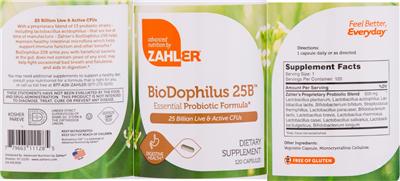
25 Billion Live & Active CFUs With a proprietary blend of 13 probiotic strains-including lactobacillus acidophilus-that are live at time of manufacture- Zahler's BioDophilus 25B helps maintain healthy intestinal microflora which helps support immune function and other benefits.
You may need additional supplements to support a healthy diet, consult your nutritionist for a formula that is right for you, or call us toll free at 877-ASK-ZAHLER (877-275-9245)
Essential Probiotic Formula
Formulation
Biodophilus 25B arms you with beneficial bacteria in the gut, does not contain yeast of any kind, may help fight occasional bad breath and flatulence, and aids in digestion.
FREE OF GLUTEN
FDA Disclaimer Statement
THESE STATEMENTS HAVE NOT BEEN EVALUATED BY THE FOOD AND DRUG ADMINISTRATION. THIS PRODUCT IS NOT INTENDED TO DIAGNOSE, TREAT, CURE OR PREVENT ANY DISEASE.
Formula
KOSHER PAREVE
UNDER STRICT SUPERVISION OF RABBI SH. STERN & THE ORTHODOX UNION
25 Billion Live & Active CFUs
Seals/Symbols
D
U
THIS PRODUCT WAS MANUFACTURED IN A GMP CERTIFIED FACILITY
MADE IN THE USA
advanced nutrition by ZAHLER(R)
DIGESTIVE HEALTH {capsule}
Storage
KEEP REFRIGERATED.
Precautions
KEEP OUT OF REACH OF CHILDREN.
Brand IP Statement(s)
BioDophilus 25B(TM) is a trademark of Advanced Nutrition by Zahler(R)
Feel Better Everyday(TM)
FDA Statement of Identity
DIETARY SUPPLEMENT
Suggested/Recommended/Usage/Directions
Directions: 1 capsule daily or as directed.
Is this label outdated? Report a formula or label change and our pharmacy team will review it.
BioDophilus 25B by Zahler label
The label scan from the NIH Dietary Supplement Label Database. Tap to enlarge.
Label images are published by the NIH Dietary Supplement Label Database for the version of this product on file. Always read your actual product label.
View the full label (PDF)The Ingredients in BioDophilus 25B by Zahler
These are the 13 active ingredients this product is made of. Select any to open its full monograph.
Serving size1 Capsule(s) Dosage formCapsule Servings per container120 Amounts shown are per serving.
Most supplement products combine several ingredients, and a medication can interact with the product through any one of them. Each ingredient below shows whether it has known drug interactions.
Zahler's Proprietary Probiotic Blend
- › Lactobacillus salivarius
- › Lactobacillus plantarum
- › Lactobacillus paracasei
- › Bifidobacterium animalis lactis
- › Bifidobacterium longum
- › Bifidobacterium bifidum
- › Lactobacillus casei
- › Lactobacillus brevis
- › Lactobacillus bulgaricus
- › Lactobacillus rhamnosus
- › Streptococcus thermophilus
- › Lactobacillus lactis
- › Lactobacillus acidophilus
Other (inactive) ingredients: Vegetable Capsule, Microcrystalline Cellulose. These complete the product’s ingredient list but are not active constituents.
BioDophilus 25B by Zahler Drug Interactions
HelloPharmacist Interaction Report
BioDophilus 25B by Zahler is a 13-ingredient probiotic capsule with documented interactions involving antibiotic drugs.
The most serious concern is with Bifidobacterium longum, Bifidobacterium bifidum, Lactobacillus bulgaricus, and Lactobacillus acidophilus — all of which may have reduced effectiveness (Moderate severity) if taken at the same time as antibiotics, because antibiotics can kill the live organisms in the product.
Read the full breakdown — every affected drug type, severity by severity
Although these are Moderate interactions, they're manageable: just space out your antibiotic and this probiotic by a few hours or more. Your doctor or pharmacist can advise on the best timing for your situation.
Altogether, these interactions span 182 individual medications.
We could not check several of the other bacterial strains in this product — Lactobacillus salivarius, Lactobacillus plantarum, Lactobacillus paracasei, Bifidobacterium animalis lactis, Lactobacillus casei, Lactobacillus brevis, Lactobacillus rhamnosus, and Lactobacillus lactis — because we hold no interaction data for them. That doesn't mean they have no interactions; it means we haven't reviewed them yet.
Run your complete medication list through the interaction checker on this page to see whether any of your drugs are affected.
Check your own medications below · Editorial policy · How we use AI
Want to check YOUR meds against BioDophilus 25B?
Ask about interactions with your drugs in plain English — “Can I take it with lisinopril?” — and we find you the answer in seconds, ingredient by ingredient.
Go to the checkerIngredients driving the most interactions
Individual Drug Interactions
The ingredients in BioDophilus 25B interact with 182 drugs. Click any drug to see the details.
4 of the 13 ingredients in BioDophilus 25B interact with drugs. Each result below shows which ingredient is responsible. Bifidobacterium longum Bifidobacterium bifidum Lactobacillus bulgaricus Lactobacillus acidophilus
AmikacinAmikin, Arikayce
How Amikacin interacts with BioDophilus 25B — through 4 ingredients. Tap an ingredient for the detail:
Bifidobacterium LongumAntibiotic Drugs Moderate
Interaction Summary
Theoretically, taking Bifidobacterium longum with antibiotic drugs might decrease the effectiveness of B.
Read the full Bifidobacterium Longum + Amikacin interactionLactobacillus BulgaricusAntibiotic Drugs Moderate
Interaction Summary
Theoretically, taking Lactobacillus delbrueckii with antibiotic drugs might decrease the effectiveness of L.
Read the full Lactobacillus Bulgaricus + Amikacin interactionLactobacillus AcidophilusAntibiotic Drugs Moderate
Interaction Summary
Theoretically, taking Lactobacillus acidophilus with antibiotic drugs might decrease the effectiveness of L.
Read the full Lactobacillus Acidophilus + Amikacin interactionBifidobacterium BifidumAntibiotic Drugs Moderate
Interaction Summary
Theoretically, taking Bifidobacterium.
Read the full Bifidobacterium Bifidum + Amikacin interactionAmoxicillinAmix, Amoram, Amoxident, Amoxil Capsules, Amoxil Injection, Galenamox +3 more
How Amoxicillin interacts with BioDophilus 25B — through 4 ingredients. Tap an ingredient for the detail:
Bifidobacterium LongumAntibiotic Drugs Moderate
Interaction Summary
Theoretically, taking Bifidobacterium longum with antibiotic drugs might decrease the effectiveness of B.
Read the full Bifidobacterium Longum + Amoxicillin interactionLactobacillus BulgaricusAntibiotic Drugs Moderate
Interaction Summary
Theoretically, taking Lactobacillus delbrueckii with antibiotic drugs might decrease the effectiveness of L.
Read the full Lactobacillus Bulgaricus + Amoxicillin interactionLactobacillus AcidophilusAntibiotic Drugs Moderate
Interaction Summary
Theoretically, taking Lactobacillus acidophilus with antibiotic drugs might decrease the effectiveness of L.
Read the full Lactobacillus Acidophilus + Amoxicillin interactionBifidobacterium BifidumAntibiotic Drugs Moderate
Interaction Summary
Theoretically, taking Bifidobacterium.
Read the full Bifidobacterium Bifidum + Amoxicillin interactionAmoxicillin VeterinaryBiomox
How Amoxicillin Veterinary interacts with BioDophilus 25B — through 4 ingredients. Tap an ingredient for the detail:
Lactobacillus AcidophilusAntibiotic Drugs Moderate
Interaction Summary
Theoretically, taking Lactobacillus acidophilus with antibiotic drugs might decrease the effectiveness of L.
Read the full Lactobacillus Acidophilus + Amoxicillin Veterinary interactionBifidobacterium BifidumAntibiotic Drugs Moderate
Interaction Summary
Theoretically, taking Bifidobacterium.
Read the full Bifidobacterium Bifidum + Amoxicillin Veterinary interactionBifidobacterium LongumAntibiotic Drugs Moderate
Interaction Summary
Theoretically, taking Bifidobacterium longum with antibiotic drugs might decrease the effectiveness of B.
Read the full Bifidobacterium Longum + Amoxicillin Veterinary interactionLactobacillus BulgaricusAntibiotic Drugs Moderate
Interaction Summary
Theoretically, taking Lactobacillus delbrueckii with antibiotic drugs might decrease the effectiveness of L.
Read the full Lactobacillus Bulgaricus + Amoxicillin Veterinary interactionAmoxicillin, Clavulanate PotassiumAugmentin, Augmentin '125/31 SF', Augmentin '250/62 SF', Augmentin XR, Augmentin-Duo 400/57, Clavulin
How Amoxicillin, Clavulanate Potassium interacts with BioDophilus 25B — through 4 ingredients. Tap an ingredient for the detail:
Lactobacillus BulgaricusAntibiotic Drugs Moderate
Interaction Summary
Theoretically, taking Lactobacillus delbrueckii with antibiotic drugs might decrease the effectiveness of L.
Read the full Lactobacillus Bulgaricus + Amoxicillin, Clavulanate Potassium interactionLactobacillus AcidophilusAntibiotic Drugs Moderate
Interaction Summary
Theoretically, taking Lactobacillus acidophilus with antibiotic drugs might decrease the effectiveness of L.
Read the full Lactobacillus Acidophilus + Amoxicillin, Clavulanate Potassium interactionBifidobacterium BifidumAntibiotic Drugs Moderate
Interaction Summary
Theoretically, taking Bifidobacterium.
Read the full Bifidobacterium Bifidum + Amoxicillin, Clavulanate Potassium interactionBifidobacterium LongumAntibiotic Drugs Moderate
Interaction Summary
Theoretically, taking Bifidobacterium longum with antibiotic drugs might decrease the effectiveness of B.
Read the full Bifidobacterium Longum + Amoxicillin, Clavulanate Potassium interactionAmoxicillin, Omeprazole Magnesium, RifabutinTalicia
How Amoxicillin, Omeprazole Magnesium, Rifabutin interacts with BioDophilus 25B — through 4 ingredients. Tap an ingredient for the detail:
Bifidobacterium BifidumAntibiotic Drugs Moderate
Interaction Summary
Theoretically, taking Bifidobacterium.
Read the full Bifidobacterium Bifidum + Amoxicillin, Omeprazole Magnesium, Rifabutin interactionBifidobacterium LongumAntibiotic Drugs Moderate
Interaction Summary
Theoretically, taking Bifidobacterium longum with antibiotic drugs might decrease the effectiveness of B.
Read the full Bifidobacterium Longum + Amoxicillin, Omeprazole Magnesium, Rifabutin interactionLactobacillus BulgaricusAntibiotic Drugs Moderate
Interaction Summary
Theoretically, taking Lactobacillus delbrueckii with antibiotic drugs might decrease the effectiveness of L.
Read the full Lactobacillus Bulgaricus + Amoxicillin, Omeprazole Magnesium, Rifabutin interactionLactobacillus AcidophilusAntibiotic Drugs Moderate
Interaction Summary
Theoretically, taking Lactobacillus acidophilus with antibiotic drugs might decrease the effectiveness of L.
Read the full Lactobacillus Acidophilus + Amoxicillin, Omeprazole Magnesium, Rifabutin interactionAmphotericin, TetracyclineMysteclin-F
How Amphotericin, Tetracycline interacts with BioDophilus 25B — through 4 ingredients. Tap an ingredient for the detail:
Lactobacillus AcidophilusAntibiotic Drugs Moderate
Interaction Summary
Theoretically, taking Lactobacillus acidophilus with antibiotic drugs might decrease the effectiveness of L.
Read the full Lactobacillus Acidophilus + Amphotericin, Tetracycline interactionBifidobacterium LongumAntibiotic Drugs Moderate
Interaction Summary
Theoretically, taking Bifidobacterium longum with antibiotic drugs might decrease the effectiveness of B.
Read the full Bifidobacterium Longum + Amphotericin, Tetracycline interactionLactobacillus BulgaricusAntibiotic Drugs Moderate
Interaction Summary
Theoretically, taking Lactobacillus delbrueckii with antibiotic drugs might decrease the effectiveness of L.
Read the full Lactobacillus Bulgaricus + Amphotericin, Tetracycline interactionBifidobacterium BifidumAntibiotic Drugs Moderate
Interaction Summary
Theoretically, taking Bifidobacterium.
Read the full Bifidobacterium Bifidum + Amphotericin, Tetracycline interactionAmpicillinOmnipen, Omnipen-N, Penbritin, Principen, Rimacillin
How Ampicillin interacts with BioDophilus 25B — through 4 ingredients. Tap an ingredient for the detail:
Bifidobacterium LongumAntibiotic Drugs Moderate
Interaction Summary
Theoretically, taking Bifidobacterium longum with antibiotic drugs might decrease the effectiveness of B.
Read the full Bifidobacterium Longum + Ampicillin interactionLactobacillus BulgaricusAntibiotic Drugs Moderate
Interaction Summary
Theoretically, taking Lactobacillus delbrueckii with antibiotic drugs might decrease the effectiveness of L.
Read the full Lactobacillus Bulgaricus + Ampicillin interactionLactobacillus AcidophilusAntibiotic Drugs Moderate
Interaction Summary
Theoretically, taking Lactobacillus acidophilus with antibiotic drugs might decrease the effectiveness of L.
Read the full Lactobacillus Acidophilus + Ampicillin interactionBifidobacterium BifidumAntibiotic Drugs Moderate
Interaction Summary
Theoretically, taking Bifidobacterium.
Read the full Bifidobacterium Bifidum + Ampicillin interactionAmpicillin, SulbactamUnasyn
How Ampicillin, Sulbactam interacts with BioDophilus 25B — through 4 ingredients. Tap an ingredient for the detail:
Lactobacillus AcidophilusAntibiotic Drugs Moderate
Interaction Summary
Theoretically, taking Lactobacillus acidophilus with antibiotic drugs might decrease the effectiveness of L.
Read the full Lactobacillus Acidophilus + Ampicillin, Sulbactam interactionBifidobacterium LongumAntibiotic Drugs Moderate
Interaction Summary
Theoretically, taking Bifidobacterium longum with antibiotic drugs might decrease the effectiveness of B.
Read the full Bifidobacterium Longum + Ampicillin, Sulbactam interactionLactobacillus BulgaricusAntibiotic Drugs Moderate
Interaction Summary
Theoretically, taking Lactobacillus delbrueckii with antibiotic drugs might decrease the effectiveness of L.
Read the full Lactobacillus Bulgaricus + Ampicillin, Sulbactam interactionBifidobacterium BifidumAntibiotic Drugs Moderate
Interaction Summary
Theoretically, taking Bifidobacterium.
Read the full Bifidobacterium Bifidum + Ampicillin, Sulbactam interactionAvibactam Sodium, CeftazidimeAvycaz
How Avibactam Sodium, Ceftazidime interacts with BioDophilus 25B — through 4 ingredients. Tap an ingredient for the detail:
Bifidobacterium BifidumAntibiotic Drugs Moderate
Interaction Summary
Theoretically, taking Bifidobacterium.
Read the full Bifidobacterium Bifidum + Avibactam Sodium, Ceftazidime interactionBifidobacterium LongumAntibiotic Drugs Moderate
Interaction Summary
Theoretically, taking Bifidobacterium longum with antibiotic drugs might decrease the effectiveness of B.
Read the full Bifidobacterium Longum + Avibactam Sodium, Ceftazidime interactionLactobacillus AcidophilusAntibiotic Drugs Moderate
Interaction Summary
Theoretically, taking Lactobacillus acidophilus with antibiotic drugs might decrease the effectiveness of L.
Read the full Lactobacillus Acidophilus + Avibactam Sodium, Ceftazidime interactionLactobacillus BulgaricusAntibiotic Drugs Moderate
Interaction Summary
Theoretically, taking Lactobacillus delbrueckii with antibiotic drugs might decrease the effectiveness of L.
Read the full Lactobacillus Bulgaricus + Avibactam Sodium, Ceftazidime interactionAzithromycinAzasite, Zithromax, Zmax
How Azithromycin interacts with BioDophilus 25B — through 4 ingredients. Tap an ingredient for the detail:
Lactobacillus BulgaricusAntibiotic Drugs Moderate
Interaction Summary
Theoretically, taking Lactobacillus delbrueckii with antibiotic drugs might decrease the effectiveness of L.
Read the full Lactobacillus Bulgaricus + Azithromycin interactionBifidobacterium LongumAntibiotic Drugs Moderate
Interaction Summary
Theoretically, taking Bifidobacterium longum with antibiotic drugs might decrease the effectiveness of B.
Read the full Bifidobacterium Longum + Azithromycin interactionBifidobacterium BifidumAntibiotic Drugs Moderate
Interaction Summary
Theoretically, taking Bifidobacterium.
Read the full Bifidobacterium Bifidum + Azithromycin interactionLactobacillus AcidophilusAntibiotic Drugs Moderate
Interaction Summary
Theoretically, taking Lactobacillus acidophilus with antibiotic drugs might decrease the effectiveness of L.
Read the full Lactobacillus Acidophilus + Azithromycin interactionAztreonamAzactam
How Aztreonam interacts with BioDophilus 25B — through 4 ingredients. Tap an ingredient for the detail:
Lactobacillus AcidophilusAntibiotic Drugs Moderate
Interaction Summary
Theoretically, taking Lactobacillus acidophilus with antibiotic drugs might decrease the effectiveness of L.
Read the full Lactobacillus Acidophilus + Aztreonam interactionBifidobacterium LongumAntibiotic Drugs Moderate
Interaction Summary
Theoretically, taking Bifidobacterium longum with antibiotic drugs might decrease the effectiveness of B.
Read the full Bifidobacterium Longum + Aztreonam interactionLactobacillus BulgaricusAntibiotic Drugs Moderate
Interaction Summary
Theoretically, taking Lactobacillus delbrueckii with antibiotic drugs might decrease the effectiveness of L.
Read the full Lactobacillus Bulgaricus + Aztreonam interactionBifidobacterium BifidumAntibiotic Drugs Moderate
Interaction Summary
Theoretically, taking Bifidobacterium.
Read the full Bifidobacterium Bifidum + Aztreonam interactionBacampicillinPenglobe
How Bacampicillin interacts with BioDophilus 25B — through 4 ingredients. Tap an ingredient for the detail:
Bifidobacterium LongumAntibiotic Drugs Moderate
Interaction Summary
Theoretically, taking Bifidobacterium longum with antibiotic drugs might decrease the effectiveness of B.
Read the full Bifidobacterium Longum + Bacampicillin interactionLactobacillus AcidophilusAntibiotic Drugs Moderate
Interaction Summary
Theoretically, taking Lactobacillus acidophilus with antibiotic drugs might decrease the effectiveness of L.
Read the full Lactobacillus Acidophilus + Bacampicillin interactionBifidobacterium BifidumAntibiotic Drugs Moderate
Interaction Summary
Theoretically, taking Bifidobacterium.
Read the full Bifidobacterium Bifidum + Bacampicillin interactionLactobacillus BulgaricusAntibiotic Drugs Moderate
Interaction Summary
Theoretically, taking Lactobacillus delbrueckii with antibiotic drugs might decrease the effectiveness of L.
Read the full Lactobacillus Bulgaricus + Bacampicillin interactionBacitracinBaci-IM, Baciguent, Bacitracin Ointment
How Bacitracin interacts with BioDophilus 25B — through 4 ingredients. Tap an ingredient for the detail:
Bifidobacterium LongumAntibiotic Drugs Moderate
Interaction Summary
Theoretically, taking Bifidobacterium longum with antibiotic drugs might decrease the effectiveness of B.
Read the full Bifidobacterium Longum + Bacitracin interactionLactobacillus BulgaricusAntibiotic Drugs Moderate
Interaction Summary
Theoretically, taking Lactobacillus delbrueckii with antibiotic drugs might decrease the effectiveness of L.
Read the full Lactobacillus Bulgaricus + Bacitracin interactionBifidobacterium BifidumAntibiotic Drugs Moderate
Interaction Summary
Theoretically, taking Bifidobacterium.
Read the full Bifidobacterium Bifidum + Bacitracin interactionLactobacillus AcidophilusAntibiotic Drugs Moderate
Interaction Summary
Theoretically, taking Lactobacillus acidophilus with antibiotic drugs might decrease the effectiveness of L.
Read the full Lactobacillus Acidophilus + Bacitracin interactionBenznidazoleBenznidazole
How Benznidazole interacts with BioDophilus 25B — through 4 ingredients. Tap an ingredient for the detail:
Lactobacillus AcidophilusAntibiotic Drugs Moderate
Interaction Summary
Theoretically, taking Lactobacillus acidophilus with antibiotic drugs might decrease the effectiveness of L.
Read the full Lactobacillus Acidophilus + Benznidazole interactionBifidobacterium LongumAntibiotic Drugs Moderate
Interaction Summary
Theoretically, taking Bifidobacterium longum with antibiotic drugs might decrease the effectiveness of B.
Read the full Bifidobacterium Longum + Benznidazole interactionLactobacillus BulgaricusAntibiotic Drugs Moderate
Interaction Summary
Theoretically, taking Lactobacillus delbrueckii with antibiotic drugs might decrease the effectiveness of L.
Read the full Lactobacillus Bulgaricus + Benznidazole interactionBifidobacterium BifidumAntibiotic Drugs Moderate
Interaction Summary
Theoretically, taking Bifidobacterium.
Read the full Bifidobacterium Bifidum + Benznidazole interactionBismuth Subsalicylate, Metronidazole, TetracyclineHelidac
How Bismuth Subsalicylate, Metronidazole, Tetracycline interacts with BioDophilus 25B — through 4 ingredients. Tap an ingredient for the detail:
Bifidobacterium BifidumAntibiotic Drugs Moderate
Interaction Summary
Theoretically, taking Bifidobacterium.
Read the full Bifidobacterium Bifidum + Bismuth Subsalicylate, Metronidazole, Tetracycline interactionBifidobacterium LongumAntibiotic Drugs Moderate
Interaction Summary
Theoretically, taking Bifidobacterium longum with antibiotic drugs might decrease the effectiveness of B.
Read the full Bifidobacterium Longum + Bismuth Subsalicylate, Metronidazole, Tetracycline interactionLactobacillus AcidophilusAntibiotic Drugs Moderate
Interaction Summary
Theoretically, taking Lactobacillus acidophilus with antibiotic drugs might decrease the effectiveness of L.
Read the full Lactobacillus Acidophilus + Bismuth Subsalicylate, Metronidazole, Tetracycline interactionLactobacillus BulgaricusAntibiotic Drugs Moderate
Interaction Summary
Theoretically, taking Lactobacillus delbrueckii with antibiotic drugs might decrease the effectiveness of L.
Read the full Lactobacillus Bulgaricus + Bismuth Subsalicylate, Metronidazole, Tetracycline interactionCapreomycinCapastat
How Capreomycin interacts with BioDophilus 25B — through 4 ingredients. Tap an ingredient for the detail:
Bifidobacterium LongumAntibiotic Drugs Moderate
Interaction Summary
Theoretically, taking Bifidobacterium longum with antibiotic drugs might decrease the effectiveness of B.
Read the full Bifidobacterium Longum + Capreomycin interactionLactobacillus BulgaricusAntibiotic Drugs Moderate
Interaction Summary
Theoretically, taking Lactobacillus delbrueckii with antibiotic drugs might decrease the effectiveness of L.
Read the full Lactobacillus Bulgaricus + Capreomycin interactionBifidobacterium BifidumAntibiotic Drugs Moderate
Interaction Summary
Theoretically, taking Bifidobacterium.
Read the full Bifidobacterium Bifidum + Capreomycin interactionLactobacillus AcidophilusAntibiotic Drugs Moderate
Interaction Summary
Theoretically, taking Lactobacillus acidophilus with antibiotic drugs might decrease the effectiveness of L.
Read the full Lactobacillus Acidophilus + Capreomycin interactionCarbenicillin Indanyl SodiumGeocillin
How Carbenicillin Indanyl Sodium interacts with BioDophilus 25B — through 4 ingredients. Tap an ingredient for the detail:
Lactobacillus AcidophilusAntibiotic Drugs Moderate
Interaction Summary
Theoretically, taking Lactobacillus acidophilus with antibiotic drugs might decrease the effectiveness of L.
Read the full Lactobacillus Acidophilus + Carbenicillin Indanyl Sodium interactionBifidobacterium BifidumAntibiotic Drugs Moderate
Interaction Summary
Theoretically, taking Bifidobacterium.
Read the full Bifidobacterium Bifidum + Carbenicillin Indanyl Sodium interactionLactobacillus BulgaricusAntibiotic Drugs Moderate
Interaction Summary
Theoretically, taking Lactobacillus delbrueckii with antibiotic drugs might decrease the effectiveness of L.
Read the full Lactobacillus Bulgaricus + Carbenicillin Indanyl Sodium interactionBifidobacterium LongumAntibiotic Drugs Moderate
Interaction Summary
Theoretically, taking Bifidobacterium longum with antibiotic drugs might decrease the effectiveness of B.
Read the full Bifidobacterium Longum + Carbenicillin Indanyl Sodium interactionCefaclorCeclor, Ceclor CD
How Cefaclor interacts with BioDophilus 25B — through 4 ingredients. Tap an ingredient for the detail:
Bifidobacterium LongumAntibiotic Drugs Moderate
Interaction Summary
Theoretically, taking Bifidobacterium longum with antibiotic drugs might decrease the effectiveness of B.
Read the full Bifidobacterium Longum + Cefaclor interactionLactobacillus AcidophilusAntibiotic Drugs Moderate
Interaction Summary
Theoretically, taking Lactobacillus acidophilus with antibiotic drugs might decrease the effectiveness of L.
Read the full Lactobacillus Acidophilus + Cefaclor interactionBifidobacterium BifidumAntibiotic Drugs Moderate
Interaction Summary
Theoretically, taking Bifidobacterium.
Read the full Bifidobacterium Bifidum + Cefaclor interactionLactobacillus BulgaricusAntibiotic Drugs Moderate
Interaction Summary
Theoretically, taking Lactobacillus delbrueckii with antibiotic drugs might decrease the effectiveness of L.
Read the full Lactobacillus Bulgaricus + Cefaclor interactionCefadroxilCef-Tab, Duricef, Ultracef
How Cefadroxil interacts with BioDophilus 25B — through 4 ingredients. Tap an ingredient for the detail:
Lactobacillus BulgaricusAntibiotic Drugs Moderate
Interaction Summary
Theoretically, taking Lactobacillus delbrueckii with antibiotic drugs might decrease the effectiveness of L.
Read the full Lactobacillus Bulgaricus + Cefadroxil interactionBifidobacterium LongumAntibiotic Drugs Moderate
Interaction Summary
Theoretically, taking Bifidobacterium longum with antibiotic drugs might decrease the effectiveness of B.
Read the full Bifidobacterium Longum + Cefadroxil interactionLactobacillus AcidophilusAntibiotic Drugs Moderate
Interaction Summary
Theoretically, taking Lactobacillus acidophilus with antibiotic drugs might decrease the effectiveness of L.
Read the full Lactobacillus Acidophilus + Cefadroxil interactionBifidobacterium BifidumAntibiotic Drugs Moderate
Interaction Summary
Theoretically, taking Bifidobacterium.
Read the full Bifidobacterium Bifidum + Cefadroxil interactionCefamandoleMandol
How Cefamandole interacts with BioDophilus 25B — through 4 ingredients. Tap an ingredient for the detail:
Lactobacillus AcidophilusAntibiotic Drugs Moderate
Interaction Summary
Theoretically, taking Lactobacillus acidophilus with antibiotic drugs might decrease the effectiveness of L.
Read the full Lactobacillus Acidophilus + Cefamandole interactionBifidobacterium LongumAntibiotic Drugs Moderate
Interaction Summary
Theoretically, taking Bifidobacterium longum with antibiotic drugs might decrease the effectiveness of B.
Read the full Bifidobacterium Longum + Cefamandole interactionLactobacillus BulgaricusAntibiotic Drugs Moderate
Interaction Summary
Theoretically, taking Lactobacillus delbrueckii with antibiotic drugs might decrease the effectiveness of L.
Read the full Lactobacillus Bulgaricus + Cefamandole interactionBifidobacterium BifidumAntibiotic Drugs Moderate
Interaction Summary
Theoretically, taking Bifidobacterium.
Read the full Bifidobacterium Bifidum + Cefamandole interactionCefazolinAncef
How Cefazolin interacts with BioDophilus 25B — through 4 ingredients. Tap an ingredient for the detail:
Bifidobacterium BifidumAntibiotic Drugs Moderate
Interaction Summary
Theoretically, taking Bifidobacterium.
Read the full Bifidobacterium Bifidum + Cefazolin interactionLactobacillus AcidophilusAntibiotic Drugs Moderate
Interaction Summary
Theoretically, taking Lactobacillus acidophilus with antibiotic drugs might decrease the effectiveness of L.
Read the full Lactobacillus Acidophilus + Cefazolin interactionBifidobacterium LongumAntibiotic Drugs Moderate
Interaction Summary
Theoretically, taking Bifidobacterium longum with antibiotic drugs might decrease the effectiveness of B.
Read the full Bifidobacterium Longum + Cefazolin interactionLactobacillus BulgaricusAntibiotic Drugs Moderate
Interaction Summary
Theoretically, taking Lactobacillus delbrueckii with antibiotic drugs might decrease the effectiveness of L.
Read the full Lactobacillus Bulgaricus + Cefazolin interactionCefdinirOmnicef
How Cefdinir interacts with BioDophilus 25B — through 4 ingredients. Tap an ingredient for the detail:
Lactobacillus BulgaricusAntibiotic Drugs Moderate
Interaction Summary
Theoretically, taking Lactobacillus delbrueckii with antibiotic drugs might decrease the effectiveness of L.
Read the full Lactobacillus Bulgaricus + Cefdinir interactionBifidobacterium LongumAntibiotic Drugs Moderate
Interaction Summary
Theoretically, taking Bifidobacterium longum with antibiotic drugs might decrease the effectiveness of B.
Read the full Bifidobacterium Longum + Cefdinir interactionLactobacillus AcidophilusAntibiotic Drugs Moderate
Interaction Summary
Theoretically, taking Lactobacillus acidophilus with antibiotic drugs might decrease the effectiveness of L.
Read the full Lactobacillus Acidophilus + Cefdinir interactionBifidobacterium BifidumAntibiotic Drugs Moderate
Interaction Summary
Theoretically, taking Bifidobacterium.
Read the full Bifidobacterium Bifidum + Cefdinir interactionCefditoren PivoxilSpectracef
How Cefditoren Pivoxil interacts with BioDophilus 25B — through 4 ingredients. Tap an ingredient for the detail:
Lactobacillus AcidophilusAntibiotic Drugs Moderate
Interaction Summary
Theoretically, taking Lactobacillus acidophilus with antibiotic drugs might decrease the effectiveness of L.
Read the full Lactobacillus Acidophilus + Cefditoren Pivoxil interactionBifidobacterium LongumAntibiotic Drugs Moderate
Interaction Summary
Theoretically, taking Bifidobacterium longum with antibiotic drugs might decrease the effectiveness of B.
Read the full Bifidobacterium Longum + Cefditoren Pivoxil interactionLactobacillus BulgaricusAntibiotic Drugs Moderate
Interaction Summary
Theoretically, taking Lactobacillus delbrueckii with antibiotic drugs might decrease the effectiveness of L.
Read the full Lactobacillus Bulgaricus + Cefditoren Pivoxil interactionBifidobacterium BifidumAntibiotic Drugs Moderate
Interaction Summary
Theoretically, taking Bifidobacterium.
Read the full Bifidobacterium Bifidum + Cefditoren Pivoxil interactionCefepimeMaxipime
How Cefepime interacts with BioDophilus 25B — through 4 ingredients. Tap an ingredient for the detail:
Bifidobacterium BifidumAntibiotic Drugs Moderate
Interaction Summary
Theoretically, taking Bifidobacterium.
Read the full Bifidobacterium Bifidum + Cefepime interactionLactobacillus AcidophilusAntibiotic Drugs Moderate
Interaction Summary
Theoretically, taking Lactobacillus acidophilus with antibiotic drugs might decrease the effectiveness of L.
Read the full Lactobacillus Acidophilus + Cefepime interactionBifidobacterium LongumAntibiotic Drugs Moderate
Interaction Summary
Theoretically, taking Bifidobacterium longum with antibiotic drugs might decrease the effectiveness of B.
Read the full Bifidobacterium Longum + Cefepime interactionLactobacillus BulgaricusAntibiotic Drugs Moderate
Interaction Summary
Theoretically, taking Lactobacillus delbrueckii with antibiotic drugs might decrease the effectiveness of L.
Read the full Lactobacillus Bulgaricus + Cefepime interactionCefiderocol Sulfate TosylateFetroja
How Cefiderocol Sulfate Tosylate interacts with BioDophilus 25B — through 4 ingredients. Tap an ingredient for the detail:
Bifidobacterium LongumAntibiotic Drugs Moderate
Interaction Summary
Theoretically, taking Bifidobacterium longum with antibiotic drugs might decrease the effectiveness of B.
Read the full Bifidobacterium Longum + Cefiderocol Sulfate Tosylate interactionBifidobacterium BifidumAntibiotic Drugs Moderate
Interaction Summary
Theoretically, taking Bifidobacterium.
Read the full Bifidobacterium Bifidum + Cefiderocol Sulfate Tosylate interactionLactobacillus BulgaricusAntibiotic Drugs Moderate
Interaction Summary
Theoretically, taking Lactobacillus delbrueckii with antibiotic drugs might decrease the effectiveness of L.
Read the full Lactobacillus Bulgaricus + Cefiderocol Sulfate Tosylate interactionLactobacillus AcidophilusAntibiotic Drugs Moderate
Interaction Summary
Theoretically, taking Lactobacillus acidophilus with antibiotic drugs might decrease the effectiveness of L.
Read the full Lactobacillus Acidophilus + Cefiderocol Sulfate Tosylate interactionCefiximeSuprax
How Cefixime interacts with BioDophilus 25B — through 4 ingredients. Tap an ingredient for the detail:
Lactobacillus AcidophilusAntibiotic Drugs Moderate
Interaction Summary
Theoretically, taking Lactobacillus acidophilus with antibiotic drugs might decrease the effectiveness of L.
Read the full Lactobacillus Acidophilus + Cefixime interactionBifidobacterium BifidumAntibiotic Drugs Moderate
Interaction Summary
Theoretically, taking Bifidobacterium.
Read the full Bifidobacterium Bifidum + Cefixime interactionBifidobacterium LongumAntibiotic Drugs Moderate
Interaction Summary
Theoretically, taking Bifidobacterium longum with antibiotic drugs might decrease the effectiveness of B.
Read the full Bifidobacterium Longum + Cefixime interactionLactobacillus BulgaricusAntibiotic Drugs Moderate
Interaction Summary
Theoretically, taking Lactobacillus delbrueckii with antibiotic drugs might decrease the effectiveness of L.
Read the full Lactobacillus Bulgaricus + Cefixime interactionCefmetazoleZefazone
How Cefmetazole interacts with BioDophilus 25B — through 4 ingredients. Tap an ingredient for the detail:
Bifidobacterium LongumAntibiotic Drugs Moderate
Interaction Summary
Theoretically, taking Bifidobacterium longum with antibiotic drugs might decrease the effectiveness of B.
Read the full Bifidobacterium Longum + Cefmetazole interactionBifidobacterium BifidumAntibiotic Drugs Moderate
Interaction Summary
Theoretically, taking Bifidobacterium.
Read the full Bifidobacterium Bifidum + Cefmetazole interactionLactobacillus AcidophilusAntibiotic Drugs Moderate
Interaction Summary
Theoretically, taking Lactobacillus acidophilus with antibiotic drugs might decrease the effectiveness of L.
Read the full Lactobacillus Acidophilus + Cefmetazole interactionLactobacillus BulgaricusAntibiotic Drugs Moderate
Interaction Summary
Theoretically, taking Lactobacillus delbrueckii with antibiotic drugs might decrease the effectiveness of L.
Read the full Lactobacillus Bulgaricus + Cefmetazole interactionCefonicidMonocid
How Cefonicid interacts with BioDophilus 25B — through 4 ingredients. Tap an ingredient for the detail:
Lactobacillus BulgaricusAntibiotic Drugs Moderate
Interaction Summary
Theoretically, taking Lactobacillus delbrueckii with antibiotic drugs might decrease the effectiveness of L.
Read the full Lactobacillus Bulgaricus + Cefonicid interactionBifidobacterium BifidumAntibiotic Drugs Moderate
Interaction Summary
Theoretically, taking Bifidobacterium.
Read the full Bifidobacterium Bifidum + Cefonicid interactionBifidobacterium LongumAntibiotic Drugs Moderate
Interaction Summary
Theoretically, taking Bifidobacterium longum with antibiotic drugs might decrease the effectiveness of B.
Read the full Bifidobacterium Longum + Cefonicid interactionLactobacillus AcidophilusAntibiotic Drugs Moderate
Interaction Summary
Theoretically, taking Lactobacillus acidophilus with antibiotic drugs might decrease the effectiveness of L.
Read the full Lactobacillus Acidophilus + Cefonicid interactionCefoperazoneCefobid
How Cefoperazone interacts with BioDophilus 25B — through 4 ingredients. Tap an ingredient for the detail:
Lactobacillus AcidophilusAntibiotic Drugs Moderate
Interaction Summary
Theoretically, taking Lactobacillus acidophilus with antibiotic drugs might decrease the effectiveness of L.
Read the full Lactobacillus Acidophilus + Cefoperazone interactionBifidobacterium BifidumAntibiotic Drugs Moderate
Interaction Summary
Theoretically, taking Bifidobacterium.
Read the full Bifidobacterium Bifidum + Cefoperazone interactionBifidobacterium LongumAntibiotic Drugs Moderate
Interaction Summary
Theoretically, taking Bifidobacterium longum with antibiotic drugs might decrease the effectiveness of B.
Read the full Bifidobacterium Longum + Cefoperazone interactionLactobacillus BulgaricusAntibiotic Drugs Moderate
Interaction Summary
Theoretically, taking Lactobacillus delbrueckii with antibiotic drugs might decrease the effectiveness of L.
Read the full Lactobacillus Bulgaricus + Cefoperazone interactionCefotaximeClaforan
How Cefotaxime interacts with BioDophilus 25B — through 4 ingredients. Tap an ingredient for the detail:
Bifidobacterium LongumAntibiotic Drugs Moderate
Interaction Summary
Theoretically, taking Bifidobacterium longum with antibiotic drugs might decrease the effectiveness of B.
Read the full Bifidobacterium Longum + Cefotaxime interactionLactobacillus BulgaricusAntibiotic Drugs Moderate
Interaction Summary
Theoretically, taking Lactobacillus delbrueckii with antibiotic drugs might decrease the effectiveness of L.
Read the full Lactobacillus Bulgaricus + Cefotaxime interactionLactobacillus AcidophilusAntibiotic Drugs Moderate
Interaction Summary
Theoretically, taking Lactobacillus acidophilus with antibiotic drugs might decrease the effectiveness of L.
Read the full Lactobacillus Acidophilus + Cefotaxime interactionBifidobacterium BifidumAntibiotic Drugs Moderate
Interaction Summary
Theoretically, taking Bifidobacterium.
Read the full Bifidobacterium Bifidum + Cefotaxime interactionEach ingredient & the kinds of drugs it affects
For each ingredient in BioDophilus 25B with known interactions, here are the types of medications they can affect. Open any type for the detail — or search your exact drug in the checker above.
Bifidobacterium longum
Antibiotic Drugs
Theoretically, taking Bifidobacterium longum with antibiotic drugs might decrease the effectiveness of B. longum.
Since B. longum preparations usually contain live and active organisms, simultaneously taking antibiotics might kill a significant number of the organisms. Tell patients to separate administration of antibiotics and B. longum preparations by at least 2 hours.
Bifidobacterium bifidum
Antibiotic Drugs
Theoretically, taking Bifidobacterium. bifidum with antibiotic drugs might decrease the effectiveness of B. bifidum.
Since B. bifidum preparations usually contain live and active organisms, simultaneously taking antibiotics might kill a significant number of the organisms. Tell patients to separate administration of antibiotics and B. bifidum preparations by at least 2 hours.
Lactobacillus bulgaricus
Antibiotic Drugs
Theoretically, taking Lactobacillus delbrueckii with antibiotic drugs might decrease the effectiveness of L. delbrueckii.
Lactobacillus delbrueckii preparations usually contain live and active organisms. Therefore, simultaneously taking antibiotics might kill a significant number of the organisms. Tell patients to separate administration of antibiotics and L. delbrueckii preparations by at least two hours.
Lactobacillus acidophilus
Antibiotic Drugs
Theoretically, taking Lactobacillus acidophilus with antibiotic drugs might decrease the effectiveness of L. acidophilus.
L. acidophilus preparations usually contain live and active organisms. Therefore, simultaneously taking antibiotics might kill a significant number of the organisms. Tell patients to separate administration of antibiotics and L. acidophilus preparations by at least two hours.
Brand information
Manufacturer and brand details for BioDophilus 25B, from the product label.
Zahler
See all Zahler products- Name
- Advanced Nutrition by Zahler(R)
- City
- Brooklyn
- State
- NY
- ZipCode
- 11230
- Phone Number
- 212.444.9936
- Web Address
- www.zahlers.com
BioDophilus 25B by Zahler: Common Questions
Does BioDophilus 25B by Zahler interact with any medications?
How can one product interact with so many drugs?
Where does this information come from?
Does this probiotic work for diarrhea?
Can I take this with my antibiotics?
Is this safe if I'm pregnant or breastfeeding?
What are the inactive ingredients?
Are there any common side effects?
Is this safe for someone with a weakened immune system?
Written and reviewed by the HelloPharmacist editorial staff. Our editorial policy
Not sure if BioDophilus 25B is safe with your meds?
Our pharmacists answer your medication & supplement questions — free.
Label information is sourced from the NIH Dietary Supplement Label Database and reflects the product version on file; always read your actual product label. This page is for education only and is not a substitute for professional medical advice. Confirm with your pharmacist or doctor before combining supplements and medications.
The Full Monographs Behind BioDophilus 25B’s Ingredients
Every ingredient we hold a full HelloPharmacist monograph for — uses, evidence, safety, and the complete interaction list.
Bifidobacterium Longum
Interacts with 182 drugsBifidobacterium longum is a 'friendly' bacterium found naturally in the human gut and used as a probiotic. It is generally well tolerated and is most studied for digestive issues, though evi...
Read the full Bifidobacterium Longum monograph → Herb & supplement monographBifidobacterium Bifidum
Interacts with 182 drugsBifidobacterium bifidum is a 'friendly' bacteria (probiotic) that naturally lives in the human gut and is taken to support digestion and gut balance. Some evidence suggests probiotics may he...
Read the full Bifidobacterium Bifidum monograph → Herb & supplement monographLactobacillus Delbrueckii
Interacts with 182 drugsLactobacillus delbrueckii is a 'friendly' bacterium used in food fermentation and sold as a probiotic, often as part of multi-strain products. It is generally considered safe for healthy peo...
Read the full Lactobacillus Delbrueckii monograph → Herb & supplement monographStreptococcus Thermophilus
Streptococcus thermophilus is a friendly bacterium used as a probiotic, often combined with other strains in yogurt and supplements. It is generally well tolerated in healthy people and may...
Read the full Streptococcus Thermophilus monograph → Herb & supplement monographLactobacillus Acidophilus
Interacts with 182 drugsLactobacillus acidophilus is a 'friendly' bacterium used as a probiotic to support gut and vaginal health. It is generally well tolerated in healthy people, and there is reasonable evidence...
Read the full Lactobacillus Acidophilus monograph →Sources & How We Checked
BioDophilus 25B's label data comes from the NIH Dietary Supplement Label Database; the ingredient interaction data is from the Natural Medicines database, reviewed by our pharmacists.
- NIH Dietary Supplement Label Database (DSLD) — The official product label on file for this supplement.
- Natural Medicines (Therapeutic Research Center) — Evidence-graded clinical reference behind the ingredient interaction data.
Content is written and reviewed by licensed HelloPharmacist pharmacists. See our data sources and editorial standards for how this information is built and checked.
The 73 references behind this product’s interaction data
Every citation that drives the interaction findings for this product’s ingredients, from the evidence-graded Natural Medicines (TRC Healthcare) database. Open an ingredient to browse its citations — links open the study on PubMed or the publisher’s site.
Bifidobacterium Longum 21 references
- Ha GY, Yang CH, Kim H, Chong Y. Case of sepsis caused by Bifidobacterium longum. J Clin Microbiol 1999;37:1227-8.
- Pierce A. The American Pharmaceutical Association Practical Guide to Natural Medicines. New York: The Stonesong Press, 1999:19.
- Xiao JZ, Takahashi S, Odamaki T, et al. Antibiotic susceptibility of bifidobacterial strains distributed in the Japanese market. Biosci Biotechnol Biochem. 2010;74(2):336-42. PubMed
- Rautava S, Kainonen E, Salminen S, Isolauri E. Maternal probiotic supplementation during pregnancy and breast-feeding reduces the risk of eczema in the infant. J Allergy Clin Immunol. 2012;130(6):1355-60. PubMed
- Pruccoli G, Silvestro E, Pace Napoleone C, Aidala E, Garazzino S, Scolfaro C. Are probiotics safe? Bifidobacterium bacteremia in a child with severe heart failure. Infez Med. 2019;27(2):175-178.
- Pellonperä O, Vahlberg T, Mokkala K, et al. Weight gain and body composition during pregnancy: a randomised pilot trial with probiotics and/or fish oil. Br J Nutr. 2020 Nov 4:1-11. PubMed
- Pellonperä O, Mokkala K, Houttu N, et al. Efficacy of fish oil and/or probiotic intervention on the incidence of gestational diabetes mellitus in an at-risk group of overweight and obese women: A randomized, placebo-controlled, double-blind clinical trial PubMed
- Shahriari A, Karimi E, Shahriari M, Aslani N, Khooshideh M, Arab A. The effect of probiotic supplementation on the risk of gestational diabetes mellitus among high-risk pregnant women: A parallel double-blind, randomized, placebo-controlled clinical trial PubMed
- Esaiassen E, Hjerde E, Cavanagh JP, Simonsen GS, Klingenberg C; Norwegian Study Group on Invasive Bifidobacterial Infections. Bifidobacterium bacteremia: Clinical characteristics and a genomic approach to assess pathogenicity. J Clin Microbiol. 2017;55(7) PubMed
- Enomoto T, Sowa M, Nishimori K, et al. Effects of bifidobacterial supplementation to pregnant women and infants in the prevention of allergy development in infants and on fecal microbiota. Allergol Int 2014;63(4):575-85. PubMed
- US Food and Drug Administration (FDA). Dear Healthcare Provider Letter: Warning Regarding Use of Probiotics in Preterm Infants. September 2023. Available at: https://www.fda.gov/media/172606/download?attachment. Accessed November 1, 2023.
- Pillai A, Tan J, Paquette V, Panczuk J. Does probiotic bacteremia in premature infants impact clinically relevant outcomes? A case report and updated review of literature. Clin Nutr ESPEN. 2020;39:255-259. PubMed
- Sabaté JM, Iglicki F. Effect of Bifidobacterium longum 35624 on disease severity and quality of life in patients with irritable bowel syndrome. World J Gastroenterol 2022;28(7):732-744.
- Malaguarnera M, Greco F, Barone G, Gargante MP, Malaguarnera M, Toscano MA. Bifidobacterium longum with fructo-oligosaccharide (FOS) treatment in minimal hepatic encephalopathy: a randomized, double-blind, placebo-controlled study. Dig Dis Sci 2007;52(11) PubMed
- Zbinden A, Zbinden R, Berger C, Arlettaz R. Case series of Bifidobacterium longum bacteremia in three preterm infants on probiotic therapy. Neonatology 2015;107(1):56-9.
- Tamaki H, Nakase H, Inoue S, et al. Efficacy of probiotic treatment with Bifidobacterium longum 536 for induction of remission in active ulcerative colitis: A randomized, double-blinded, placebo-controlled multicenter trial. Dig Endosc 2016;28(1):67-74.
- Bertelli C, Pillonel T, Torregrossa A, et al. Bifidobacterium longum bacteremia in preterm infants receiving probiotics. Clin Infect Dis 2015;60(6):924-7. PubMed
- Esaiassen E, Cavanagh P, Hjerde E, Simonsen GS, Støen R, Klingenberg C. Bifidobacterium longum subspecies infantis bacteremia in 3 extremely preterm infants receiving probiotics. Emerg Infect Dis 2016;22(9):1664-6.
- Tena D, Losa C, Medina MJ, Sáez-Nieto JA. Peritonitis caused by Bifidobacterium longum: case report and literature review. Anaerobe 2014;27:27-30. PubMed
- Sangkanjanavanich S, Pradubpongsa P, Mitthamsiri W, Sangasapaviliya A, Boonpiyathad T. Bifidobacterium infantis 35624 efficacy in patients with uncontrolled asthma: A randomized placebo-controlled trial. Ann Allergy Asthma Immunol 2022;129(6):790-792. PubMed
- Wilson HL, Ong CW. Bifidobacterium longum vertebrodiscitis in a patient with cirrhosis and prostate cancer. Anaerobe 2017;47:47-50. PubMed
See these in context on the Bifidobacterium Longum monograph →
Bifidobacterium Bifidum 7 references
- Pierce A. The American Pharmaceutical Association Practical Guide to Natural Medicines. New York: The Stonesong Press, 1999:19.
- Xiao JZ, Takahashi S, Odamaki T, et al. Antibiotic susceptibility of bifidobacterial strains distributed in the Japanese market. Biosci Biotechnol Biochem. 2010;74(2):336-42. PubMed
- Rerksuppaphol S, Rerksuppaphol L. Randomized controlled trial of probiotics to reduce common cold in schoolchildren. Pediatr Int. 2012;54(5):682-7. PubMed
- Karamali M, Dadkhah F, Sadrkhanlou M, et al. Effects of probiotic supplementation on glycaemic control and lipid profiles in gestational diabetes: a randomized, double-blind, placebo-controlled trial. Diabetes Metab 2016;42(4):234-41. PubMed
- Badehnoosh B, Karamali M, Zarrati M, et al. The effects of probiotic supplementation on biomarkers of inflammation, oxidative stress and pregnancy outcomes in gestational diabetes. J Matern Fetal Neonatal Med. 2018 May;31(9):1128-1136.
- Pruccoli G, Silvestro E, Pace Napoleone C, Aidala E, Garazzino S, Scolfaro C. Are probiotics safe? Bifidobacterium bacteremia in a child with severe heart failure. Infez Med. 2019;27(2):175-178.
- Esaiassen E, Hjerde E, Cavanagh JP, Simonsen GS, Klingenberg C; Norwegian Study Group on Invasive Bifidobacterial Infections. Bifidobacterium bacteremia: Clinical characteristics and a genomic approach to assess pathogenicity. J Clin Microbiol. 2017;55(7) PubMed
See these in context on the Bifidobacterium Bifidum monograph →
Lactobacillus Delbrueckii 9 references
- Pierce A. The American Pharmaceutical Association Practical Guide to Natural Medicines. New York: The Stonesong Press, 1999:19.
- Rossi F, Amadoro C, Gasperi M, Colavita G. Lactobacilli infection case reports in the last three years and safety implications. Nutrients. 2022;14(6):1178. PubMed
- Ranchal P, Gupta R, Goldberg R, A Lobo S, Pascual A, El Khoury MY. Penicillin-sensitive Lactobacillus jensenii bacteremia. Am J Ther 2021;28(2):e250-e252. PubMed
- Grazioli-Gauthier L, Rigamonti E, Leo LA, Martinetti Lucchini G, Lo Priore E, Bernasconi E. Lactobacillus jensenii mitral valve endocarditis: Case report, literature review and new perspectives. IDCases 2022;27:e01401. PubMed
- Toprak NU, Bozan T, Yilmaz S, Buyukbayrak EE, Tigen ET. Polymicrobial bacteremia due to Lactobacillus jensenii and Veillonella montpellierensis in a pregnant patient; case report and review of literature. Anaerobe 2022;75:102576. PubMed
- Chazan B, Raz R, Shental Y, Sprecher H, Colodner R. Bacteremia and pyelonephritis caused by Lactobacillus jensenii in a patient with urolithiasis. Isr Med Assoc J 2008;10(2):164-5.
- Neonakis IK, Skamagkas I, Stafylaki D, Maraki S. Lactobacillus delbrueckii urinary tract infection in a male patient: a case report. Germs 2022;12(2):304-307. PubMed
- Maillet F, Passeron A, Podglajen I, Ranque B, Pouchot J. Lactobacillus delbrueckii urinary tract infection in a male patient. Med Mal Infect 2019;49(3):226-228. PubMed
- Darbro BW, Petroelje BK, Doern GV. Lactobacillus delbrueckii as the cause of urinary tract infection. J Clin Microbiol 2009;47(1):275-7.
See these in context on the Lactobacillus Delbrueckii monograph →
Streptococcus Thermophilus 21 references
- Saxelin M, Chuang NH, Chassy B, et al. Lactobacilli and bacteremia in southern Finland 1989-1992. Clin Infect Dis 1996;22:564-6. PubMed
- Tynkkynen S, Singh KV, Varmanen P. Vancomycin resistance factor of Lactobacillus rhamnosus GG in relation to enterococcal vancomycin resistance (van) genes. Int J Food Microbiol 1998;41:195-204. PubMed
- Klein G, Zill E, Schindler R, et al. Peritonitis associated with vancomycin-resistant Lactobacillus rhamnosus in a continuous ambulatory peritoneal dialysis patient; organism identification, antibiotic therapy, and case report. J Clin Microbiol 1998;36:
- Kalima P, Masterton RG, Roddie PH, et al. Lactobacillus rhamnosus infection in a child following bone marrow transplant. J Infect 1996;32:165-7. PubMed
- Goldin BR. Health Benefits of probiotics. Br J Nutr 1998;80:S203-7. DOI
- Rautio M, Jousimies-Somer H, Kauma H, et al. Liver abscess due to Lactobacillus rhamnosus strain indistinguishable from L. rhamnosus strain GG. Clin Infect Dis 1999;28:1159-60.
- MacGregor G, Smith AJ, Thakker B, Kinsella J. Yoghurt biotherapy: contraindicated in immunosuppressed patients? Postgrad Med J 2002;78:366-7. PubMed
- Land MH, Rouster-Stevens K, Woods CR, et al. Lactobacillus sepsis associated with probiotic therapy. Pediatrics 2005;115:178-81.
- De Groote MA, Frank DN, Dowell E, et al. Lactobacillus rhamnosus GG bacteremia associated with probiotic use in a child with short gut syndrome. Pediatr Infect Dis J 2005;24:278-80. PubMed
- Vahabnezhad E, Mochon AB, Wozniak LJ, Ziring DA. Lactobacillus bacteremia associated with probiotic use in a pediatric patient with ulcerative colitis. J Clin Gastroenterol. 2013;47(5):437-9. PubMed
- Dolatkhah N, Hajifaraji M, Abbasalizadeh F, Aghamohammadzadeh N, Mehrabi Y, Abbasi MM. Is there a value for probiotic supplements in gestational diabetes mellitus? A randomized clinical trial. J Health Popul Nutr. 2015;33:25. PubMed
- Pruccoli G, Silvestro E, Pace Napoleone C, Aidala E, Garazzino S, Scolfaro C. Are probiotics safe? Bifidobacterium bacteremia in a child with severe heart failure. Infez Med. 2019;27(2):175-178.
- Sendil S, Shrimanker I, Mansoora Q, Goldman J, Nookala VK. Lactobacillus rhamnosus bacteremia in an immunocompromised renal transplant patient. Cureus. 2020;12(2):e6887. PubMed
- Albarillo FS, Shah U, Joyce C, Slade D. Lactobacillus rhamnosus Infection: A single-center 4-year descriptive analysis. J Glob Infect Dis. 2020;12(3):119-123. PubMed
- Pasala S, Singer L, Arshad T, Roach K. Lactobacillus endocarditis in a healthy patient with probiotic use. IDCases. 2020;22:e00915. PubMed
- Agrawal S, Tuchman ES, Bruce MJ, Theodorou ME. Fatal Lactobacillus endocarditis in a patient with transcatheter aortic valve replacement. BMJ Case Rep. 2020;13(11):e236835.
- Antoun M, Hattab Y, Akhrass FA, Hamilton LD. Uncommon pathogen, Lactobacillus, causing infective endocarditis: Case report and review. Case Rep Infect Dis. 2020;2020:8833948. PubMed
- Rossi F, Amadoro C, Gasperi M, Colavita G. Lactobacilli infection case reports in the last three years and safety implications. Nutrients. 2022;14(6):1178. PubMed
- Franko B, Vaillant M, Recule C, Vautrin E, et al. Lactobacillus paracasei endocarditis in a consumer of probiotics. Med Mal Infect. 2013;43(4):171-3. PubMed
- Campbell RE, Miller A, Afroze A. Native valve endocarditis secondary to Lactobacillus paracasei bacteremia. Consultant. 2020;60(9):27-8. DOI
- Kato K, Funabashi N, Takaoka H, et al. Lactobacillus paracasei endocarditis in a consumer of probiotics with advanced and severe bicuspid aortic valve stenosis complicated with diffuse left ventricular mid-layer fibrosis. Int J Cardiol. 2016;224:157-161. PubMed
See these in context on the Streptococcus Thermophilus monograph →
Lactobacillus Acidophilus 15 references
- Pierce A. The American Pharmaceutical Association Practical Guide to Natural Medicines. New York: The Stonesong Press, 1999:19.
- Begtrup LM, de Muckadell OB, Kjeldsen J, Christensen RD, Jarbøl DE. Long-term treatment with probiotics in primary care patients with irritable bowel syndrome--a randomised, double-blind, placebo controlled trial. Scand J Gastroenterol 2013;48(10):1127-35 PubMed
- Chatterjee S, Kar P, Das T, Ray S, Gangulyt S, Rajendiran C, Mitra M. Randomised placebo-controlled double blind multicentric trial on efficacy and safety of Lactobacillus acidophilus LA-5 and Bifidobacterium BB-12 for prevention of antibiotic-associated
- Shavakhi A, Tabesh E, Yaghoutkar A, Hashemi H, Tabesh F, Khodadoostan M,Minakari M, Shavakhi S, Gholamrezaei A. The effects of multistrain probiotic compound on bismuth-containing quadruple therapy for Helicobacter pylori infection: a randomized placebo-c
- Karamali M, Dadkhah F, Sadrkhanlou M, et al. Effects of probiotic supplementation on glycaemic control and lipid profiles in gestational diabetes: a randomized, double-blind, placebo-controlled trial. Diabetes Metab 2016;42(4):234-41. PubMed
- Badehnoosh B, Karamali M, Zarrati M, et al. The effects of probiotic supplementation on biomarkers of inflammation, oxidative stress and pregnancy outcomes in gestational diabetes. J Matern Fetal Neonatal Med. 2018 May;31(9):1128-1136.
- Kumar S, Kumar R, Rohilla L, Jacob N, Yadav J, Sachdeva N. A high potency multi-strain probiotic improves glycemic control in children with new-onset type 1 diabetes mellitus: A randomized, double-blind, and placebo-controlled pilot study. Pediatr Diabete
- Shahriari A, Karimi E, Shahriari M, Aslani N, Khooshideh M, Arab A. The effect of probiotic supplementation on the risk of gestational diabetes mellitus among high-risk pregnant women: A parallel double-blind, randomized, placebo-controlled clinical trial PubMed
- Xiao SD, Zhang DZ, Lu H, et al. Multicenter, randomized, controlled trial of heat-killed Lactobacillus acidophilus LB in patients with chronic diarrhea. Adv Ther. 2003;20(5):253-60.
- Rossi F, Amadoro C, Gasperi M, Colavita G. Lactobacilli infection case reports in the last three years and safety implications. Nutrients. 2022;14(6):1178. PubMed
- Ozer M, Goksu SY, Shahverdiani A, Mustafa M. Lactobacillus acidophilus-induced endocarditis and associated splenic abscess. Case Rep Infect Dis 2020;2020:1382709.
- Sadrin S, Sennoune S, Gout B, et al. A 2-strain mixture of Lactobacillus acidophilus in the treatment of irritable bowel syndrome: A placebo-controlled randomized clinical trial. Dig Liver Dis 2020;52(5):534-540. PubMed
- Stoffer JN, Slingsby TJ, Giuliari GP. Lactobacillus acidophilus endophthalmitis after intravitreal bevacizumab injection requiring intraocular lens explantation. Can J Ophthalmol 2022;57(1):e21-e22. PubMed
- Cukovic-Cavka S, Likic R, Francetic I, Rustemovic N, Opacic M, Vucelic B. Lactobacillus acidophilus as a cause of liver abscess in a NOD2/CARD15-positive patient with Crohn's disease. Digestion 2006;73(2-3):107-10.
- Hui J, Ren Y, Wang Y, Han Q. Lactobacillus acidophilus endophthalmitis postcataract operation: A case report with a literature review. Ocul Immunol Inflamm 2023.
See these in context on the Lactobacillus Acidophilus monograph →
Parts of this content are provided by the Therapeutic Research Center, LLC.
DISCLAIMER: Currently this does not check for drug-drug interactions. This is not an all-inclusive comprehensive list of potential interactions and is for informational purposes only. Not all interactions are known or well-reported in the scientific literature, and new interactions are continually being reported. Input is needed from a qualified healthcare provider including a pharmacist before starting any therapy. Application of clinical judgment is necessary.
© 2021 Therapeutic Research Center, LLC