
Butterbur Extract Powder 150 mg Ingredients & Drug Interactions
What is this page for?
First and foremost: checking Butterbur Extract Powder 150 mg against your medications. The heart of this page is the interaction checker and the full interaction report — how this product’s ingredients may interact with prescription and over-the-counter medicines you may be taking.
Around that, we add a pharmacist’s high-level view of the product as a whole — what’s inside, the evidence for its stated use, how transparent the label is, and what safety data exists — so you can see the full picture in one place. It’s educational information from our licensed clinical databases and the clinical staff at HelloPharmacist — not medical advice — and we don’t sell or endorse products. Our editorial policy
Butterbur Extract Powder 150 mg is a dietary supplement by BulkSupplements.com with 1 active ingredient. Its ingredients are commonly taken for migraine prevention, hay fever (allergic rhinitis), asthma symptoms.Based on those ingredients, 87 medications have a known interaction with it, the most serious rated moderate. The ingredients most likely to interact are Butterbur Whole Herb Extract. Use the checker below to test your specific medication, or read the full HelloPharmacist Interaction Report.
Check Your Meds Against Butterbur Extract Powder 150 mg by BulkSupplements.com
Ask about any prescription or over-the-counter medication and we check it for interactions with Butterbur Extract Powder 150 mg by BulkSupplements.com — and tell you which ingredient is responsible.
AI summaries are generated from our interaction database for education only — always confirm with your pharmacist. How we use AI
Ask the Pharmacist
A licensed pharmacist will answer your question by email — free, usually within 24 hours.
Got it — thank you!
A licensed pharmacist will answer within 24 hours. Keep an eye on your email (worth checking spam, just in case).
HelloPharmacist Scorecard of Butterbur Extract Powder 150 mg by BulkSupplements.com
Our pharmacy team’s full take, with four database checks built into the cards below — a summary of what is known, not a grade of the product itself.
What’s inside
Full disclosure
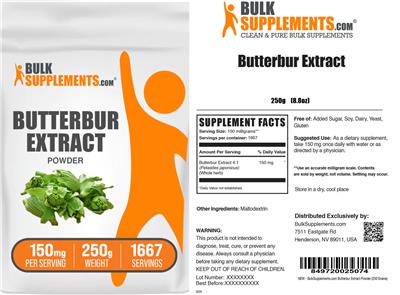
This powder contains one active ingredient: butterbur whole herb extract at 150 mg per serving. Butterbur has been used traditionally for migraine and allergy relief, and the extract concentrates its active compounds.
The only other ingredient listed is maltodextrin, an inactive filler that helps with texture and absorption.
Does it work?
Moderate evidence
Butterbur shows possibly effective evidence for migraine headache prevention and for allergic rhinitis (hay fever) symptoms. That means it's got some research backing it, but the evidence isn't ironclad—more studies would help pin down exactly how well it works for each condition and which people benefit most.
How safe is it?
Well-documented data
Butterbur is generally well tolerated, though some people report belching, diarrhea, drowsiness, fatigue, headache, itchy eyes, rash, and stomach upset. More seriously, butterbur naturally contains liver-damaging compounds (pyrrolizidine alkaloids), so raw products are off-limits; only PA-free standardized extracts should be used.
Rare liver injury has been reported even with PA-free products, so this isn't a supplement to take long-term without checking in with your doctor. During pregnancy, the safety data advises against butterbur.
While breastfeeding, there isn't enough safety data, so it's best to avoid it. If you're planning pregnancy or nursing, talk with your pharmacist or doctor before starting.
Meds to double-check
Moderate interaction found
If you take any medications that speed up your liver's CYP3A4 pathway—certain steroids, some anticonvulsants, and other inducers—check with your pharmacist before starting butterbur. The interaction is Moderate and theoretical, but worth confirming your specific drugs aren't on the list.
The bottom line
Scorecard at a glanceFully disclosed formula with some supporting evidence for its stated purpose. Moderate medication interactions have been identified, and safety information is well characterized.
Butterbur may help with migraines and hay fever, and it's generally well tolerated at typical doses. However, liver safety is a real concern—use only PA-free products, avoid it in pregnancy and breastfeeding, and check your medications first if you take CYP3A4 inducers.
Talk to your pharmacist about whether this is right for you, especially if you have liver issues or take multiple drugs.
Educational only — not medical advice; always confirm with your pharmacist. Our editorial policy · How we use AI
Assessment coverage: 1 of 1 active ingredient matched to our full ingredient reviews (monographs). Based on the product label dated Apr 24, 2025.
This Scorecard evaluates available label information, ingredient evidence, and known medication-safety considerations. It does not independently verify product identity, purity, potency, contamination, or manufacturing quality. How these ratings are computed
General information
Key facts about Butterbur Extract Powder 150 mg, straight from the product label.
| Brand | BulkSupplements.com |
|---|---|
| Barcode (UPC) | 849720025074 |
| Net contents | 250 Gram(s); 8.8 Ounce(s) |
| Market status | On market |
| Date entered into DSLD | Apr 24, 2025 |
| DSLD ID | 330484 |
| Product type | Botanical |
| Supplement form | Powder |
| Dietary claims / uses | All Other, Structure/Function |
| Intended target group(s) | Adult (18 - 50 Years), Gluten Free, Dairy Free |
Everything in this section is reproduced from the manufacturer’s own product label — it’s the label speaking, not HelloPharmacist. We show it so you can see exactly what the maker states; we don’t verify or endorse those statements.
Supplement Facts
The label details for Butterbur Extract Powder 150 mg by BulkSupplements.com, sourced from the NIH Dietary Supplement Label Database.
Supplement Facts
| Ingredient | Amount | % DV |
|---|---|---|
| Butterbur Whole Herb Extract | 150 mg | -- |
Other ingredients: Maltodextrin
Tap any ingredient to jump to its full detail below.
These statements are the manufacturer’s wording, reproduced from the product label — the label is saying it, not HelloPharmacist. We don’t verify or endorse them.
Formula
Butterbur Extract Powder 150 mg per serving
Brand IP Statement(s)
BulkSupplements.com Clean & pure bulk supplements
Formulation
Free of: Added sugar, soy, dairy, yeast, gluten
Suggested/Recommended/Usage/Directions
Suggested use: As a dietary supplement, take 150 mg once daily with water or as directed by a physician.
General Statements
Use an accurate milligram scale.
New
Storage
Contents are sold by weight, not volume. Settling may occur. Store in a dry, cool place
FDA Disclaimer Statement
Warning: This product is not intended to diagnose, treat, cure, or prevent any disease.
Precautions
Always consult a physician before taking any dietary supplement.
Keep out of reach of children.
Is this label outdated? Report a formula or label change and our pharmacy team will review it.
Butterbur Extract Powder 150 mg by BulkSupplements.com label
The label scan from the NIH Dietary Supplement Label Database. Tap to enlarge.
Label images are published by the NIH Dietary Supplement Label Database for the version of this product on file. Always read your actual product label.
View the full label (PDF)The Ingredients in Butterbur Extract Powder 150 mg by BulkSupplements.com
This is the 1 active ingredient this product is made of. Select it to open its full monograph.
Serving size150 mg Dosage formPowder Servings per container1667 Amounts shown are per serving.
Butterbur Whole Herb Extract
Interacts with87 drugs
Butterbur is a plant extract most studied for preventing migraines and easing hay fever symptoms, and some standardized products show promise. However...
Butterbur Whole Herb Extract monograph & interactionsOther (inactive) ingredients: Maltodextrin. These complete the product’s ingredient list but are not active constituents.
Butterbur Extract Powder 150 mg by BulkSupplements.com Drug Interactions
HelloPharmacist Interaction Report
Butterbur Extract Powder by BulkSupplements.com has one documented interaction type we need to flag.
The butterbur itself contains pyrrolizidine alkaloids (PAs)—compounds that your liver breaks down—and theoretically, drugs that speed up that breakdown (called CYP3A4 inducers) might push those alkaloids toward toxic forms. That's a Moderate concern.
Altogether, these interactions span 85 individual medications.
Read the full breakdown — every affected drug type, severity by severity
The tricky part: this interaction is theoretical rather than proven in humans. Still, if you take any CYP3A4 inducers—medications that rev up that liver pathway—run them through our checker below before you start butterbur.
And here's the real safeguard: only use a PA-free standardized product, as raw butterbur can damage your liver on its own. This product should be PA-free, but verify the label.
Check your own medications below · Editorial policy · How we use AI
Want to check YOUR meds against Butterbur Extract Powder 150 mg?
Ask about interactions with your drugs in plain English — “Can I take it with lisinopril?” — and we find you the answer in seconds, ingredient by ingredient.
Go to the checkerIngredients driving the most interactions
Individual Drug Interactions
The ingredients in Butterbur Extract Powder 150 mg interact with 87 drugs. Click any drug to see the details.
1 of the 1 ingredient in Butterbur Extract Powder 150 mg interact with drugs. Each result below shows which ingredient is responsible. Butterbur Whole Herb Extract
AminoglutethimideCytadren
How Aminoglutethimide interacts with Butterbur Extract Powder 150 mg — through 1 ingredient. Tap an ingredient for the detail:
Butterbur Whole Herb ExtractCytochrome P450 3a4 (cyp3a4) Inducers Moderate
Interaction Summary
Theoretically, CYP3A4 inducers might increase the toxicity of butterbur.
Read the full Butterbur Whole Herb Extract + Aminoglutethimide interactionAmoxicillin, Omeprazole Magnesium, RifabutinTalicia
How Amoxicillin, Omeprazole Magnesium, Rifabutin interacts with Butterbur Extract Powder 150 mg — through 1 ingredient. Tap an ingredient for the detail:
Butterbur Whole Herb ExtractCytochrome P450 3a4 (cyp3a4) Inducers Moderate
Interaction Summary
Theoretically, CYP3A4 inducers might increase the toxicity of butterbur.
Read the full Butterbur Whole Herb Extract + Amoxicillin, Omeprazole Magnesium, Rifabutin interactionApalutamideErleada
How Apalutamide interacts with Butterbur Extract Powder 150 mg — through 1 ingredient. Tap an ingredient for the detail:
Butterbur Whole Herb ExtractCytochrome P450 3a4 (cyp3a4) Inducers Moderate
Interaction Summary
Theoretically, CYP3A4 inducers might increase the toxicity of butterbur.
Read the full Butterbur Whole Herb Extract + Apalutamide interactionAprepitantCinvanti, Emend
How Aprepitant interacts with Butterbur Extract Powder 150 mg — through 1 ingredient. Tap an ingredient for the detail:
Butterbur Whole Herb ExtractCytochrome P450 3a4 (cyp3a4) Inducers Moderate
Interaction Summary
Theoretically, CYP3A4 inducers might increase the toxicity of butterbur.
Read the full Butterbur Whole Herb Extract + Aprepitant interactionAprobarbital, Butabarbital, PhenobarbitalTriple Barbital
How Aprobarbital, Butabarbital, Phenobarbital interacts with Butterbur Extract Powder 150 mg — through 1 ingredient. Tap an ingredient for the detail:
Butterbur Whole Herb ExtractCytochrome P450 3a4 (cyp3a4) Inducers Moderate
Interaction Summary
Theoretically, CYP3A4 inducers might increase the toxicity of butterbur.
Read the full Butterbur Whole Herb Extract + Aprobarbital, Butabarbital, Phenobarbital interactionAprocitentanTryvio
How Aprocitentan interacts with Butterbur Extract Powder 150 mg — through 1 ingredient. Tap an ingredient for the detail:
Butterbur Whole Herb ExtractCytochrome P450 3a4 (cyp3a4) Inducers Moderate
Interaction Summary
Theoretically, CYP3A4 inducers might increase the toxicity of butterbur.
Read the full Butterbur Whole Herb Extract + Aprocitentan interactionArmodafinilNuvigil
How Armodafinil interacts with Butterbur Extract Powder 150 mg — through 1 ingredient. Tap an ingredient for the detail:
Butterbur Whole Herb ExtractCytochrome P450 3a4 (cyp3a4) Inducers Moderate
Interaction Summary
Theoretically, CYP3A4 inducers might increase the toxicity of butterbur.
Read the full Butterbur Whole Herb Extract + Armodafinil interactionAspirin, Codeine Phosphate, PhenobarbitalPhenaphen
How Aspirin, Codeine Phosphate, Phenobarbital interacts with Butterbur Extract Powder 150 mg — through 1 ingredient. Tap an ingredient for the detail:
Butterbur Whole Herb ExtractCytochrome P450 3a4 (cyp3a4) Inducers Moderate
Interaction Summary
Theoretically, CYP3A4 inducers might increase the toxicity of butterbur.
Read the full Butterbur Whole Herb Extract + Aspirin, Codeine Phosphate, Phenobarbital interactionAtropine, Hyoscyamine, PhenobarbitalHypnaldyne
How Atropine, Hyoscyamine, Phenobarbital interacts with Butterbur Extract Powder 150 mg — through 1 ingredient. Tap an ingredient for the detail:
Butterbur Whole Herb ExtractCytochrome P450 3a4 (cyp3a4) Inducers Moderate
Interaction Summary
Theoretically, CYP3A4 inducers might increase the toxicity of butterbur.
Read the full Butterbur Whole Herb Extract + Atropine, Hyoscyamine, Phenobarbital interactionAtropine, Hyoscyamine, Phenobarbital, ScopolamineBarbidonna No. 2, Belladonna Phenobarbital
How Atropine, Hyoscyamine, Phenobarbital, Scopolamine interacts with Butterbur Extract Powder 150 mg — through 1 ingredient. Tap an ingredient for the detail:
Butterbur Whole Herb ExtractCytochrome P450 3a4 (cyp3a4) Inducers Moderate
Interaction Summary
Theoretically, CYP3A4 inducers might increase the toxicity of butterbur.
Read the full Butterbur Whole Herb Extract + Atropine, Hyoscyamine, Phenobarbital, Scopolamine interactionAtropine, Hyoscyamine, Scopolamine, PhenobarbitalBarbeloid, Donnatal #2, Donphen
How Atropine, Hyoscyamine, Scopolamine, Phenobarbital interacts with Butterbur Extract Powder 150 mg — through 1 ingredient. Tap an ingredient for the detail:
Butterbur Whole Herb ExtractCytochrome P450 3a4 (cyp3a4) Inducers Moderate
Interaction Summary
Theoretically, CYP3A4 inducers might increase the toxicity of butterbur.
Read the full Butterbur Whole Herb Extract + Atropine, Hyoscyamine, Scopolamine, Phenobarbital interactionAtropine, PhenobarbitalAnthrocol
How Atropine, Phenobarbital interacts with Butterbur Extract Powder 150 mg — through 1 ingredient. Tap an ingredient for the detail:
Butterbur Whole Herb ExtractCytochrome P450 3a4 (cyp3a4) Inducers Moderate
Interaction Summary
Theoretically, CYP3A4 inducers might increase the toxicity of butterbur.
Read the full Butterbur Whole Herb Extract + Atropine, Phenobarbital interactionBelladona Extract, PhenobarbitalChardonna-2
How Belladona Extract, Phenobarbital interacts with Butterbur Extract Powder 150 mg — through 1 ingredient. Tap an ingredient for the detail:
Butterbur Whole Herb ExtractCytochrome P450 3a4 (cyp3a4) Inducers Moderate
Interaction Summary
Theoretically, CYP3A4 inducers might increase the toxicity of butterbur.
Read the full Butterbur Whole Herb Extract + Belladona Extract, Phenobarbital interactionBelladonna Alkaloids, Ergotamine Tartrate, PhenobarbitalBel Tabs, Bellamine-S, Bellaphen-S, Duragal S, Phenarbal S, Spastrin
How Belladonna Alkaloids, Ergotamine Tartrate, Phenobarbital interacts with Butterbur Extract Powder 150 mg — through 1 ingredient. Tap an ingredient for the detail:
Butterbur Whole Herb ExtractCytochrome P450 3a4 (cyp3a4) Inducers Moderate
Interaction Summary
Theoretically, CYP3A4 inducers might increase the toxicity of butterbur.
Read the full Butterbur Whole Herb Extract + Belladonna Alkaloids, Ergotamine Tartrate, Phenobarbital interactionBelladonna Alkaloids, PhenobarbitalBarbidonna, Donnatal
How Belladonna Alkaloids, Phenobarbital interacts with Butterbur Extract Powder 150 mg — through 1 ingredient. Tap an ingredient for the detail:
Butterbur Whole Herb ExtractCytochrome P450 3a4 (cyp3a4) Inducers Moderate
Interaction Summary
Theoretically, CYP3A4 inducers might increase the toxicity of butterbur.
Read the full Butterbur Whole Herb Extract + Belladonna Alkaloids, Phenobarbital interactionBelladonna Extract, PhenobarbitalBelap
How Belladonna Extract, Phenobarbital interacts with Butterbur Extract Powder 150 mg — through 1 ingredient. Tap an ingredient for the detail:
Butterbur Whole Herb ExtractCytochrome P450 3a4 (cyp3a4) Inducers Moderate
Interaction Summary
Theoretically, CYP3A4 inducers might increase the toxicity of butterbur.
Read the full Butterbur Whole Herb Extract + Belladonna Extract, Phenobarbital interactionBelladonna, Ergotamine Tartrate, Phenobarbital
How Belladonna, Ergotamine Tartrate, Phenobarbital interacts with Butterbur Extract Powder 150 mg — through 1 ingredient. Tap an ingredient for the detail:
Butterbur Whole Herb ExtractCytochrome P450 3a4 (cyp3a4) Inducers Moderate
Interaction Summary
Theoretically, CYP3A4 inducers might increase the toxicity of butterbur.
Read the full Butterbur Whole Herb Extract + Belladonna, Ergotamine Tartrate, Phenobarbital interactionBelladonna, Ergotamine, PhenobarbitalBellergal-S
How Belladonna, Ergotamine, Phenobarbital interacts with Butterbur Extract Powder 150 mg — through 1 ingredient. Tap an ingredient for the detail:
Butterbur Whole Herb ExtractCytochrome P450 3a4 (cyp3a4) Inducers Moderate
Interaction Summary
Theoretically, CYP3A4 inducers might increase the toxicity of butterbur.
Read the full Butterbur Whole Herb Extract + Belladonna, Ergotamine, Phenobarbital interactionBelladonna, PhenobarbitalBellophen, Susano
How Belladonna, Phenobarbital interacts with Butterbur Extract Powder 150 mg — through 1 ingredient. Tap an ingredient for the detail:
Butterbur Whole Herb ExtractCytochrome P450 3a4 (cyp3a4) Inducers Moderate
Interaction Summary
Theoretically, CYP3A4 inducers might increase the toxicity of butterbur.
Read the full Butterbur Whole Herb Extract + Belladonna, Phenobarbital interactionBellafoline, PhenobarbitalBelladenal, Belladenal-S
How Bellafoline, Phenobarbital interacts with Butterbur Extract Powder 150 mg — through 1 ingredient. Tap an ingredient for the detail:
Butterbur Whole Herb ExtractCytochrome P450 3a4 (cyp3a4) Inducers Moderate
Interaction Summary
Theoretically, CYP3A4 inducers might increase the toxicity of butterbur.
Read the full Butterbur Whole Herb Extract + Bellafoline, Phenobarbital interactionButabarbital, Phenobarbital, SecobarbitalS.B.P.
How Butabarbital, Phenobarbital, Secobarbital interacts with Butterbur Extract Powder 150 mg — through 1 ingredient. Tap an ingredient for the detail:
Butterbur Whole Herb ExtractCytochrome P450 3a4 (cyp3a4) Inducers Moderate
Interaction Summary
Theoretically, CYP3A4 inducers might increase the toxicity of butterbur.
Read the full Butterbur Whole Herb Extract + Butabarbital, Phenobarbital, Secobarbital interactionButalbital, Phenobarbital, SecobarbitalTribarb
How Butalbital, Phenobarbital, Secobarbital interacts with Butterbur Extract Powder 150 mg — through 1 ingredient. Tap an ingredient for the detail:
Butterbur Whole Herb ExtractCytochrome P450 3a4 (cyp3a4) Inducers Moderate
Interaction Summary
Theoretically, CYP3A4 inducers might increase the toxicity of butterbur.
Read the full Butterbur Whole Herb Extract + Butalbital, Phenobarbital, Secobarbital interactionCamphor, Hyoscyamine, Passif, Phenobarbital, Scopolamine, ValerianNevrotose #3
How Camphor, Hyoscyamine, Passif, Phenobarbital, Scopolamine, Valerian interacts with Butterbur Extract Powder 150 mg — through 1 ingredient. Tap an ingredient for the detail:
Butterbur Whole Herb ExtractCytochrome P450 3a4 (cyp3a4) Inducers Moderate
Interaction Summary
Theoretically, CYP3A4 inducers might increase the toxicity of butterbur.
Read the full Butterbur Whole Herb Extract + Camphor, Hyoscyamine, Passif, Phenobarbital, Scopolamine, Valerian interactionCarbamazepineCarbatrol, Carnexiv, Equetro, Tegretol, Tegretol XR
How Carbamazepine interacts with Butterbur Extract Powder 150 mg — through 1 ingredient. Tap an ingredient for the detail:
Butterbur Whole Herb ExtractCytochrome P450 3a4 (cyp3a4) Inducers Moderate
Interaction Summary
Theoretically, CYP3A4 inducers might increase the toxicity of butterbur.
Read the full Butterbur Whole Herb Extract + Carbamazepine interactionCenobamateXcopri
How Cenobamate interacts with Butterbur Extract Powder 150 mg — through 1 ingredient. Tap an ingredient for the detail:
Butterbur Whole Herb ExtractCytochrome P450 3a4 (cyp3a4) Inducers Moderate
Interaction Summary
Theoretically, CYP3A4 inducers might increase the toxicity of butterbur.
Read the full Butterbur Whole Herb Extract + Cenobamate interactionDabrafenibTafinlar
How Dabrafenib interacts with Butterbur Extract Powder 150 mg — through 1 ingredient. Tap an ingredient for the detail:
Butterbur Whole Herb ExtractCytochrome P450 3a4 (cyp3a4) Inducers Moderate
Interaction Summary
Theoretically, CYP3A4 inducers might increase the toxicity of butterbur.
Read the full Butterbur Whole Herb Extract + Dabrafenib interactionDeferasiroxExjade, Jadenu
How Deferasirox interacts with Butterbur Extract Powder 150 mg — through 1 ingredient. Tap an ingredient for the detail:
Butterbur Whole Herb ExtractCytochrome P450 3a4 (cyp3a4) Inducers Moderate
Interaction Summary
Theoretically, CYP3A4 inducers might increase the toxicity of butterbur.
Read the full Butterbur Whole Herb Extract + Deferasirox interactionDehydrocholic Acid, Homatropine Methylbromide, PhenobarbitalG.B.S.
How Dehydrocholic Acid, Homatropine Methylbromide, Phenobarbital interacts with Butterbur Extract Powder 150 mg — through 1 ingredient. Tap an ingredient for the detail:
Butterbur Whole Herb ExtractCytochrome P450 3a4 (cyp3a4) Inducers Moderate
Interaction Summary
Theoretically, CYP3A4 inducers might increase the toxicity of butterbur.
Read the full Butterbur Whole Herb Extract + Dehydrocholic Acid, Homatropine Methylbromide, Phenobarbital interactionDexamethasoneDecadron, Dexone, Dextenza, Dexycu, Hemady, Hexadrol +1 more
How Dexamethasone interacts with Butterbur Extract Powder 150 mg — through 1 ingredient. Tap an ingredient for the detail:
Butterbur Whole Herb ExtractCytochrome P450 3a4 (cyp3a4) Inducers Moderate
Interaction Summary
Theoretically, CYP3A4 inducers might increase the toxicity of butterbur.
Read the full Butterbur Whole Herb Extract + Dexamethasone interactionDicyclomine, PhenobarbitalBentyl w/ Pb
How Dicyclomine, Phenobarbital interacts with Butterbur Extract Powder 150 mg — through 1 ingredient. Tap an ingredient for the detail:
Butterbur Whole Herb ExtractCytochrome P450 3a4 (cyp3a4) Inducers Moderate
Interaction Summary
Theoretically, CYP3A4 inducers might increase the toxicity of butterbur.
Read the full Butterbur Whole Herb Extract + Dicyclomine, Phenobarbital interactionEach ingredient & the kinds of drugs it affects
For each ingredient in Butterbur Extract Powder 150 mg with known interactions, here are the types of medications it can affect. Open any type for the detail — or search your exact drug in the checker above.
Butterbur Whole Herb Extract
Cytochrome P450 3A4 (Cyp3A4) Inducers
Theoretically, CYP3A4 inducers might increase the toxicity of butterbur.
The pyrrolizidine alkaloid (PA) constituents found in some butterbur products are substrates of CYP3A4. Theoretically, drugs that induce CYP3A4 might increase the conversion of PAs to toxic metabolites.
Brand information
Manufacturer and brand details for Butterbur Extract Powder 150 mg, from the product label.
BulkSupplements.com
See all BulkSupplements.com products- Name
- BulkSupplements.com
- Street Address
- 7511 Eastgate Rd
- City
- Henderson
- State
- NV
- ZipCode
- 89011
- Web Address
- BulkSupplements.com
Butterbur Extract Powder 150 mg by BulkSupplements.com: Common Questions
Does Butterbur Extract Powder 150 mg by BulkSupplements.com interact with any medications?
How can one product interact with so many drugs?
Where does this information come from?
Can I take this if I'm pregnant or breastfeeding?
What side effects might I notice?
Does this product have pyrrolizidine alkaloids (liver toxins) in it?
What is butterbur actually used for?
How long can I safely take this?
Is this the same as raw butterbur?
Written and reviewed by the HelloPharmacist editorial staff. Our editorial policy
Not sure if Butterbur Extract Powder 150 mg is safe with your meds?
Our pharmacists answer your medication & supplement questions — free.
Label information is sourced from the NIH Dietary Supplement Label Database and reflects the product version on file; always read your actual product label. This page is for education only and is not a substitute for professional medical advice. Confirm with your pharmacist or doctor before combining supplements and medications.
The Full Monographs Behind Butterbur Extract Powder 150 mg’s Ingredients
Every ingredient we hold a full HelloPharmacist monograph for — uses, evidence, safety, and the complete interaction list.
Sources & How We Checked
Butterbur Extract Powder 150 mg's label data comes from the NIH Dietary Supplement Label Database; the ingredient interaction data is from the Natural Medicines database, reviewed by our pharmacists.
- NIH Dietary Supplement Label Database (DSLD) — The official product label on file for this supplement.
- Natural Medicines (Therapeutic Research Center) — Evidence-graded clinical reference behind the ingredient interaction data.
Content is written and reviewed by licensed HelloPharmacist pharmacists. See our data sources and editorial standards for how this information is built and checked.
The 7 references behind this product’s interaction data
Every citation that drives the interaction findings for this product’s ingredients, from the evidence-graded Natural Medicines (TRC Healthcare) database. Open an ingredient to browse its citations — links open the study on PubMed or the publisher’s site.
Butterbur 7 references
- Danesch U, Rittinghausen R. Safety of a patented special butterbur root extract for migraine prevention. Headache 2003;43:76-8.. PubMed
- Chojkier M. Hepatic sinusoidal-obstruction syndrome: toxicity of pyrrolizidine alkaloids. J Hepatol 2003;39:437-46. PubMed
- Roeder E. Medicinal plants in Europe containing pyrrolizidine alkaloids. Pharmazie 1995;50:83-98.
- Wang YP, Yan J, Fu PP, Chou MW. Human liver microsomal reduction of pyrrolizidine alkaloid N-oxides to form the corresponding carcinogenic parent alkaloid. Toxicol Lett 2005;155:411-20. PubMed
- Pothmann R, Danesch U. Migraine Prevention in Children and Adolescents: Results of an Open Study With a Special Butterbur Root Extract. Headache 2005;45:196-203.. PubMed
- Oelkers-Ax R, Leins A, Parzer P, et al. Butterbur root extract and music therapy in the prevention of childhood migraine: an explorative study. Eur J Pain 2008;12:301-13. PubMed
- Schapowal A. Butterbur Ze339 for the treatment of intermittent allergic rhinitis: dose-dependent efficacy in a prospective, randomized, double-blind, placebo-controlled study. Arch Otolaryngol.Head Neck Surg. 2004;130:1381-86. PubMed
Parts of this content are provided by the Therapeutic Research Center, LLC.
DISCLAIMER: Currently this does not check for drug-drug interactions. This is not an all-inclusive comprehensive list of potential interactions and is for informational purposes only. Not all interactions are known or well-reported in the scientific literature, and new interactions are continually being reported. Input is needed from a qualified healthcare provider including a pharmacist before starting any therapy. Application of clinical judgment is necessary.
© 2021 Therapeutic Research Center, LLC