
Core Cilantro Blend Ingredients & Drug Interactions
by Energetix
What is this page for?
First and foremost: checking Core Cilantro Blend against your medications. The heart of this page is the interaction checker and the full interaction report — how this product’s ingredients may interact with prescription and over-the-counter medicines you may be taking.
Around that, we add a pharmacist’s high-level view of the product as a whole — what’s inside, the evidence for its stated use, how transparent the label is, and what safety data exists — so you can see the full picture in one place. It’s educational information from our licensed clinical databases and the clinical staff at HelloPharmacist — not medical advice — and we don’t sell or endorse products. Our editorial policy
Core Cilantro Blend is a dietary supplement by Energetix with 4 active ingredients. Its ingredients are commonly taken for digestive upset and gas, appetite stimulation, mild antimicrobial (topical).Based on those ingredients, 1,274 medications have a known interaction with it, the most serious rated major. The ingredients most likely to interact are Uva Ursi leaf Extract, Cilantro extract, Yellow Dock Root Extract. Use the checker below to test your specific medication, or read the full HelloPharmacist Interaction Report.
Check Your Meds Against Core Cilantro Blend by Energetix
Ask about any prescription or over-the-counter medication and we check it for interactions with Core Cilantro Blend by Energetix — and tell you which ingredient is responsible.
AI summaries are generated from our interaction database for education only — always confirm with your pharmacist. How we use AI
Ask the Pharmacist
A licensed pharmacist will answer your question by email — free, usually within 24 hours.
Got it — thank you!
A licensed pharmacist will answer within 24 hours. Keep an eye on your email (worth checking spam, just in case).
HelloPharmacist Scorecard of Core Cilantro Blend by Energetix
Our pharmacy team’s full take, with four database checks built into the cards below — a summary of what is known, not a grade of the product itself.
What’s inside
Low disclosure
Core Cilantro Blend contains four active botanical extracts: cilantro extract, uva ursi leaf extract, yellow dock root extract, and European goldenrod aerial parts extract. The product is delivered as a liquid in a base of purified water and ethyl alcohol (an inactive preservative).
Does it work?
Couldn't assess
The evidence for these ingredients is limited. Cilantro extract has insufficient reliable evidence for anorexia, anxiety, constipation, diabetes, diarrhea, and indigestion.
Uva ursi is rated possibly ineffective for urinary tract infections and lacks sufficient evidence for bronchitis and benign prostate enlargement. Yellow dock has no effectiveness ratings in the data we hold.
Goldenrod similarly shows insufficient evidence for benign prostate enlargement, dental plaque, kidney stones, and urinary tract infections. None of these ingredients have strong established effectiveness for their traditional uses.
How safe is it?
Well-documented data
Cilantro is generally well tolerated in food amounts for most people, though medicinal doses and essential oil should be avoided without medical guidance. Rare cases of anaphylaxis and contact dermatitis have been reported in sensitive individuals, particularly those with occupational exposure.
Uva ursi is generally well tolerated in low doses short-term, but can be toxic at high doses or with prolonged use; it may cause nausea, vomiting, diarrhea, and stomach upset. Yellow dock is well tolerated in food amounts when properly prepared, but raw leaves or high doses can cause kidney stones, low blood calcium, and respiratory effects.
Goldenrod is often well tolerated short-term but has limited human safety data; allergic contact dermatitis and respiratory allergy have been reported in sensitive individuals. Do not use uva ursi, yellow dock, or goldenrod during pregnancy or breastfeeding — safety data are insufficient or the ingredients may cause harm.
Meds to double-check
Major interaction found
Before taking Core Cilantro Blend, double-check if you use diuretics or digoxin (major concern with yellow dock), warfarin or other blood thinners (moderate concern), antihypertensive or antidiabetes drugs (cilantro), CNS depressants or sedatives (cilantro), photosensitizing drugs, lithium, or medications affected by liver metabolism pathways (CYP2C19, CYP3A4, or glucuronidation). If you're unsure whether your medications fit any of these categories, use the checker below.
The bottom line
Scorecard at a glanceFormula with limited ingredient disclosure with no assessable stated purpose. Major medication interactions have been identified, and safety information is well characterized.
This blend is for adults with no major medical conditions or medications, though the interaction profile is broad. Anyone taking diuretics, heart medications, blood thinners, blood pressure drugs, blood sugar medications, sedatives, or medications metabolized by the liver should check their specific drugs with the tool on this page before using.
Talk to your pharmacist, especially if you're pregnant, nursing, or have kidney or liver problems.
Educational only — not medical advice; always confirm with your pharmacist. Our editorial policy · How we use AI
Assessment coverage: 4 of 4 active ingredients matched to our full ingredient reviews (monographs). Based on the product label dated Jul 24, 2025.
This Scorecard evaluates available label information, ingredient evidence, and known medication-safety considerations. It does not independently verify product identity, purity, potency, contamination, or manufacturing quality. How these ratings are computed
General information
Key facts about Core Cilantro Blend, straight from the product label.
Everything in this section is reproduced from the manufacturer’s own product label — it’s the label speaking, not HelloPharmacist. We show it so you can see exactly what the maker states; we don’t verify or endorse those statements.
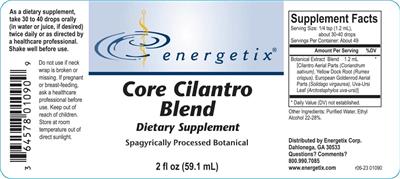
Supplement Facts
The label details for Core Cilantro Blend by Energetix, sourced from the NIH Dietary Supplement Label Database.
Supplement Facts
| Ingredient | Amount | % DV |
|---|---|---|
| Botanical Extract Blend | 1.2 mL | -- |
| Cilantro extract | 0 NP | -- |
| Uva Ursi leaf Extract | 0 NP | -- |
| Yellow Dock Root Extract | 0 NP | -- |
| European Goldenrod aerial parts extract | 0 NP | -- |
Other ingredients: Water, Purified, Ethyl Alcohol
Tap any ingredient to jump to its full detail below.
These statements are the manufacturer’s wording, reproduced from the product label — the label is saying it, not HelloPharmacist. We don’t verify or endorse them.
Suggested/Recommended/Usage/Directions
As a dietary supplement, take 30 to 40 drops orally (in water or juice, if desired) twice daily or as directed by a healthcare professional. Shake well before use.
Precautions
Do not use if neck wrap is broken or missing.
If pregnant or breast-feeding, ask a healthcare professional before use.
Keep out of reach of children.
Storage
Store at room temperature out of direct sunlight.
FDA Statement of Identity
Dietary Supplement
Formulation
Spagyrically processed botanical
Is this label outdated? Report a formula or label change and our pharmacy team will review it.
Core Cilantro Blend by Energetix label
The label scan from the NIH Dietary Supplement Label Database. Tap to enlarge.
Label images are published by the NIH Dietary Supplement Label Database for the version of this product on file. Always read your actual product label.
View the full label (PDF)The Ingredients in Core Cilantro Blend by Energetix
These are the 4 active ingredients this product is made of. Select any to open its full monograph.
Serving size1.2 mL Dosage formLiquid Servings per container49 Amounts shown are per serving.
Most supplement products combine several ingredients, and a medication can interact with the product through any one of them. Each ingredient below shows whether it has known drug interactions.
Botanical Extract Blend
Other (inactive) ingredients: Water, Purified, Ethyl Alcohol. These complete the product’s ingredient list but are not active constituents.
Core Cilantro Blend by Energetix Drug Interactions
HelloPharmacist Interaction Report
Core Cilantro Blend by Energetix contains four active ingredients, and together they interact with a substantial number of medications.
The most serious concern is yellow dock root extract, which carries Major-severity interactions with diuretics and digoxin (a heart medication). Yellow dock can worsen potassium loss when combined with water pills, and may increase digoxin toxicity if used long-term or in large amounts.
Read the full breakdown — every affected drug type, severity by severity
Cilantro extract has Moderate interactions with sedating medications (CNS depressants), blood pressure drugs (antihypertensives), blood sugar medications (antidiabetes drugs), and photosensitizing drugs used for certain skin conditions — it may add to sedation, lower blood pressure further, raise low blood sugar risk, or trigger sun sensitivity. Uva ursi leaf extract also carries Moderate interactions with several drug-metabolizing pathways (CYP2C19 and CYP3A4 substrates), lithium, and drugs that acidify the urine, as well as a Minor interaction with P-glycoprotein substrates.
Yellow dock has an additional Moderate interaction with warfarin (a blood thinner), where its laxative effect may increase bleeding risk. European goldenrod has a Moderate interaction with diuretics, potentially strengthening their effects.
Altogether, these interactions span 1,258 individual medications. Use the medication checker on this page to look up your specific prescriptions before starting.
Check your own medications below · Editorial policy · How we use AI
Want to check YOUR meds against Core Cilantro Blend?
Ask about interactions with your drugs in plain English — “Can I take it with lisinopril?” — and we find you the answer in seconds, ingredient by ingredient.
Go to the checkerIngredients driving the most interactions
Individual Drug Interactions
The ingredients in Core Cilantro Blend interact with 1,274 drugs. Click any drug to see the details.
4 of the 4 ingredients in Core Cilantro Blend interact with drugs. Each result below shows which ingredient is responsible. Uva Ursi leaf Extract Cilantro extract Yellow Dock Root Extract European Goldenrod aerial parts extract
Acetaminophen, Caffeine, PyrilamineMidol Max Strength Menstrual
How Acetaminophen, Caffeine, Pyrilamine interacts with Core Cilantro Blend — through 3 ingredients. Tap an ingredient for the detail:
Yellow Dock Root ExtractDiuretic Drugs Major
Interaction Summary
Theoretically, yellow dock might increase the risk of hypokalemia when taken with diuretics.
Read the full Yellow Dock Root Extract + Acetaminophen, Caffeine, Pyrilamine interactionUva Ursi Leaf ExtractGlucuronidated Drugs, Cytochrome P450 3a4 (cyp3a4) Substrates Moderate
Interaction Summary
Theoretically, uva ursi may increase levels of drugs metabolized by glucuronidation.
Read the full Uva Ursi Leaf Extract + Acetaminophen, Caffeine, Pyrilamine interactionEuropean Goldenrod Aerial Parts ExtractDiuretic Drugs Moderate
Interaction Summary
Theoretically, goldenrod might increase the effects and adverse effects of diuretic drugs.
Read the full European Goldenrod Aerial Parts Extract + Acetaminophen, Caffeine, Pyrilamine interactionAcetaminophen, Pamabrom, PyrilamineMidol Max Strength PMS, Pamprin, Pamprin ES
How Acetaminophen, Pamabrom, Pyrilamine interacts with Core Cilantro Blend — through 3 ingredients. Tap an ingredient for the detail:
Yellow Dock Root ExtractDiuretic Drugs Major
Interaction Summary
Theoretically, yellow dock might increase the risk of hypokalemia when taken with diuretics.
Read the full Yellow Dock Root Extract + Acetaminophen, Pamabrom, Pyrilamine interactionEuropean Goldenrod Aerial Parts ExtractDiuretic Drugs Moderate
Interaction Summary
Theoretically, goldenrod might increase the effects and adverse effects of diuretic drugs.
Read the full European Goldenrod Aerial Parts Extract + Acetaminophen, Pamabrom, Pyrilamine interactionUva Ursi Leaf ExtractGlucuronidated Drugs Moderate
Interaction Summary
Theoretically, uva ursi may increase levels of drugs metabolized by glucuronidation.
Read the full Uva Ursi Leaf Extract + Acetaminophen, Pamabrom, Pyrilamine interactionAcetazolamideAk-Zol, Diamox
How Acetazolamide interacts with Core Cilantro Blend — through 3 ingredients. Tap an ingredient for the detail:
Yellow Dock Root ExtractDiuretic Drugs Major
Interaction Summary
Theoretically, yellow dock might increase the risk of hypokalemia when taken with diuretics.
Read the full Yellow Dock Root Extract + Acetazolamide interactionCilantro ExtractPhotosensitizing Drugs, Antihypertensive Drugs +1 Moderate
Interaction Summary
Theoretically, coriander might increase the risk of photosensitivity when taken with photosensitizing drugs.
Read the full Cilantro Extract + Acetazolamide interactionEuropean Goldenrod Aerial Parts ExtractDiuretic Drugs Moderate
Interaction Summary
Theoretically, goldenrod might increase the effects and adverse effects of diuretic drugs.
Read the full European Goldenrod Aerial Parts Extract + Acetazolamide interactionAmiloride, HydrochlorothiazideAmil-Co, Amilzide, Moduret 25, Moduretic
How Amiloride, Hydrochlorothiazide interacts with Core Cilantro Blend — through 3 ingredients. Tap an ingredient for the detail:
Yellow Dock Root ExtractDiuretic Drugs Major
Interaction Summary
Theoretically, yellow dock might increase the risk of hypokalemia when taken with diuretics.
Read the full Yellow Dock Root Extract + Amiloride, Hydrochlorothiazide interactionCilantro ExtractAntihypertensive Drugs, Photosensitizing Drugs Moderate
Interaction Summary
Theoretically, coriander might increase the risk of hypotension when taken with antihypertensive drugs.
Read the full Cilantro Extract + Amiloride, Hydrochlorothiazide interactionEuropean Goldenrod Aerial Parts ExtractDiuretic Drugs Moderate
Interaction Summary
Theoretically, goldenrod might increase the effects and adverse effects of diuretic drugs.
Read the full European Goldenrod Aerial Parts Extract + Amiloride, Hydrochlorothiazide interactionAmmonium ChlorideAmmonium Chloride
How Ammonium Chloride interacts with Core Cilantro Blend — through 3 ingredients. Tap an ingredient for the detail:
Yellow Dock Root ExtractDiuretic Drugs Major
Interaction Summary
Theoretically, yellow dock might increase the risk of hypokalemia when taken with diuretics.
Read the full Yellow Dock Root Extract + Ammonium Chloride interactionCilantro ExtractAntihypertensive Drugs Moderate
Interaction Summary
Theoretically, coriander might increase the risk of hypotension when taken with antihypertensive drugs.
Read the full Cilantro Extract + Ammonium Chloride interactionEuropean Goldenrod Aerial Parts ExtractDiuretic Drugs Moderate
Interaction Summary
Theoretically, goldenrod might increase the effects and adverse effects of diuretic drugs.
Read the full European Goldenrod Aerial Parts Extract + Ammonium Chloride interactionAtenolol, ChlortalidoneAtenixCo, Tenoret 50, Totaretic
How Atenolol, Chlortalidone interacts with Core Cilantro Blend — through 3 ingredients. Tap an ingredient for the detail:
Yellow Dock Root ExtractDiuretic Drugs Major
Interaction Summary
Theoretically, yellow dock might increase the risk of hypokalemia when taken with diuretics.
Read the full Yellow Dock Root Extract + Atenolol, Chlortalidone interactionEuropean Goldenrod Aerial Parts ExtractDiuretic Drugs Moderate
Interaction Summary
Theoretically, goldenrod might increase the effects and adverse effects of diuretic drugs.
Read the full European Goldenrod Aerial Parts Extract + Atenolol, Chlortalidone interactionCilantro ExtractAntihypertensive Drugs, Photosensitizing Drugs Moderate
Interaction Summary
Theoretically, coriander might increase the risk of hypotension when taken with antihypertensive drugs.
Read the full Cilantro Extract + Atenolol, Chlortalidone interactionAtenolol, ChlorthalidoneTenoretic
How Atenolol, Chlorthalidone interacts with Core Cilantro Blend — through 3 ingredients. Tap an ingredient for the detail:
Yellow Dock Root ExtractDiuretic Drugs Major
Interaction Summary
Theoretically, yellow dock might increase the risk of hypokalemia when taken with diuretics.
Read the full Yellow Dock Root Extract + Atenolol, Chlorthalidone interactionCilantro ExtractAntihypertensive Drugs, Photosensitizing Drugs Moderate
Interaction Summary
Theoretically, coriander might increase the risk of hypotension when taken with antihypertensive drugs.
Read the full Cilantro Extract + Atenolol, Chlorthalidone interactionEuropean Goldenrod Aerial Parts ExtractDiuretic Drugs Moderate
Interaction Summary
Theoretically, goldenrod might increase the effects and adverse effects of diuretic drugs.
Read the full European Goldenrod Aerial Parts Extract + Atenolol, Chlorthalidone interactionAzilsartan, ChlorthalidoneEdarbyclor
How Azilsartan, Chlorthalidone interacts with Core Cilantro Blend — through 3 ingredients. Tap an ingredient for the detail:
Yellow Dock Root ExtractDiuretic Drugs Major
Interaction Summary
Theoretically, yellow dock might increase the risk of hypokalemia when taken with diuretics.
Read the full Yellow Dock Root Extract + Azilsartan, Chlorthalidone interactionCilantro ExtractAntihypertensive Drugs, Photosensitizing Drugs Moderate
Interaction Summary
Theoretically, coriander might increase the risk of hypotension when taken with antihypertensive drugs.
Read the full Cilantro Extract + Azilsartan, Chlorthalidone interactionEuropean Goldenrod Aerial Parts ExtractDiuretic Drugs Moderate
Interaction Summary
Theoretically, goldenrod might increase the effects and adverse effects of diuretic drugs.
Read the full European Goldenrod Aerial Parts Extract + Azilsartan, Chlorthalidone interactionBenazepril, HydrochlorothiazideLotensin HCT
How Benazepril, Hydrochlorothiazide interacts with Core Cilantro Blend — through 3 ingredients. Tap an ingredient for the detail:
Yellow Dock Root ExtractDiuretic Drugs Major
Interaction Summary
Theoretically, yellow dock might increase the risk of hypokalemia when taken with diuretics.
Read the full Yellow Dock Root Extract + Benazepril, Hydrochlorothiazide interactionCilantro ExtractPhotosensitizing Drugs, Antihypertensive Drugs Moderate
Interaction Summary
Theoretically, coriander might increase the risk of photosensitivity when taken with photosensitizing drugs.
Read the full Cilantro Extract + Benazepril, Hydrochlorothiazide interactionEuropean Goldenrod Aerial Parts ExtractDiuretic Drugs Moderate
Interaction Summary
Theoretically, goldenrod might increase the effects and adverse effects of diuretic drugs.
Read the full European Goldenrod Aerial Parts Extract + Benazepril, Hydrochlorothiazide interactionBendroflumethiazideAprinox, Naturetin, Neo-NaClex
How Bendroflumethiazide interacts with Core Cilantro Blend — through 3 ingredients. Tap an ingredient for the detail:
Yellow Dock Root ExtractDiuretic Drugs Major
Interaction Summary
Theoretically, yellow dock might increase the risk of hypokalemia when taken with diuretics.
Read the full Yellow Dock Root Extract + Bendroflumethiazide interactionEuropean Goldenrod Aerial Parts ExtractDiuretic Drugs Moderate
Interaction Summary
Theoretically, goldenrod might increase the effects and adverse effects of diuretic drugs.
Read the full European Goldenrod Aerial Parts Extract + Bendroflumethiazide interactionCilantro ExtractAntihypertensive Drugs, Photosensitizing Drugs Moderate
Interaction Summary
Theoretically, coriander might increase the risk of hypotension when taken with antihypertensive drugs.
Read the full Cilantro Extract + Bendroflumethiazide interactionBendroflumethiazide, NadololCorzide
How Bendroflumethiazide, Nadolol interacts with Core Cilantro Blend — through 3 ingredients. Tap an ingredient for the detail:
Yellow Dock Root ExtractDiuretic Drugs Major
Interaction Summary
Theoretically, yellow dock might increase the risk of hypokalemia when taken with diuretics.
Read the full Yellow Dock Root Extract + Bendroflumethiazide, Nadolol interactionCilantro ExtractAntihypertensive Drugs, Photosensitizing Drugs Moderate
Interaction Summary
Theoretically, coriander might increase the risk of hypotension when taken with antihypertensive drugs.
Read the full Cilantro Extract + Bendroflumethiazide, Nadolol interactionEuropean Goldenrod Aerial Parts ExtractDiuretic Drugs Moderate
Interaction Summary
Theoretically, goldenrod might increase the effects and adverse effects of diuretic drugs.
Read the full European Goldenrod Aerial Parts Extract + Bendroflumethiazide, Nadolol interactionBendroflumethiazide, PotassiumCentyl K, Neo-NaClex-K
How Bendroflumethiazide, Potassium interacts with Core Cilantro Blend — through 3 ingredients. Tap an ingredient for the detail:
Yellow Dock Root ExtractDiuretic Drugs Major
Interaction Summary
Theoretically, yellow dock might increase the risk of hypokalemia when taken with diuretics.
Read the full Yellow Dock Root Extract + Bendroflumethiazide, Potassium interactionCilantro ExtractPhotosensitizing Drugs Moderate
Interaction Summary
Theoretically, coriander might increase the risk of photosensitivity when taken with photosensitizing drugs.
Read the full Cilantro Extract + Bendroflumethiazide, Potassium interactionEuropean Goldenrod Aerial Parts ExtractDiuretic Drugs Moderate
Interaction Summary
Theoretically, goldenrod might increase the effects and adverse effects of diuretic drugs.
Read the full European Goldenrod Aerial Parts Extract + Bendroflumethiazide, Potassium interactionBendroflumethiazide, Rauwolfia SerpentinaRauzide
How Bendroflumethiazide, Rauwolfia Serpentina interacts with Core Cilantro Blend — through 3 ingredients. Tap an ingredient for the detail:
Yellow Dock Root ExtractDiuretic Drugs Major
Interaction Summary
Theoretically, yellow dock might increase the risk of hypokalemia when taken with diuretics.
Read the full Yellow Dock Root Extract + Bendroflumethiazide, Rauwolfia Serpentina interactionCilantro ExtractPhotosensitizing Drugs, Antihypertensive Drugs Moderate
Interaction Summary
Theoretically, coriander might increase the risk of photosensitivity when taken with photosensitizing drugs.
Read the full Cilantro Extract + Bendroflumethiazide, Rauwolfia Serpentina interactionEuropean Goldenrod Aerial Parts ExtractDiuretic Drugs Moderate
Interaction Summary
Theoretically, goldenrod might increase the effects and adverse effects of diuretic drugs.
Read the full European Goldenrod Aerial Parts Extract + Bendroflumethiazide, Rauwolfia Serpentina interactionBenzthiazideExna
How Benzthiazide interacts with Core Cilantro Blend — through 3 ingredients. Tap an ingredient for the detail:
Yellow Dock Root ExtractDiuretic Drugs Major
Interaction Summary
Theoretically, yellow dock might increase the risk of hypokalemia when taken with diuretics.
Read the full Yellow Dock Root Extract + Benzthiazide interactionCilantro ExtractAntihypertensive Drugs, Photosensitizing Drugs Moderate
Interaction Summary
Theoretically, coriander might increase the risk of hypotension when taken with antihypertensive drugs.
Read the full Cilantro Extract + Benzthiazide interactionEuropean Goldenrod Aerial Parts ExtractDiuretic Drugs Moderate
Interaction Summary
Theoretically, goldenrod might increase the effects and adverse effects of diuretic drugs.
Read the full European Goldenrod Aerial Parts Extract + Benzthiazide interactionBisoprolol, HydrochlorothiazideZiac
How Bisoprolol, Hydrochlorothiazide interacts with Core Cilantro Blend — through 3 ingredients. Tap an ingredient for the detail:
Yellow Dock Root ExtractDiuretic Drugs Major
Interaction Summary
Theoretically, yellow dock might increase the risk of hypokalemia when taken with diuretics.
Read the full Yellow Dock Root Extract + Bisoprolol, Hydrochlorothiazide interactionCilantro ExtractAntihypertensive Drugs, Photosensitizing Drugs Moderate
Interaction Summary
Theoretically, coriander might increase the risk of hypotension when taken with antihypertensive drugs.
Read the full Cilantro Extract + Bisoprolol, Hydrochlorothiazide interactionEuropean Goldenrod Aerial Parts ExtractDiuretic Drugs Moderate
Interaction Summary
Theoretically, goldenrod might increase the effects and adverse effects of diuretic drugs.
Read the full European Goldenrod Aerial Parts Extract + Bisoprolol, Hydrochlorothiazide interactionBumetanideBurinex
How Bumetanide interacts with Core Cilantro Blend — through 3 ingredients. Tap an ingredient for the detail:
Yellow Dock Root ExtractDiuretic Drugs Major
Interaction Summary
Theoretically, yellow dock might increase the risk of hypokalemia when taken with diuretics.
Read the full Yellow Dock Root Extract + Bumetanide interactionCilantro ExtractPhotosensitizing Drugs, Antihypertensive Drugs Moderate
Interaction Summary
Theoretically, coriander might increase the risk of photosensitivity when taken with photosensitizing drugs.
Read the full Cilantro Extract + Bumetanide interactionEuropean Goldenrod Aerial Parts ExtractDiuretic Drugs Moderate
Interaction Summary
Theoretically, goldenrod might increase the effects and adverse effects of diuretic drugs.
Read the full European Goldenrod Aerial Parts Extract + Bumetanide interactionBumetanide, PotassiumBurinex K
How Bumetanide, Potassium interacts with Core Cilantro Blend — through 3 ingredients. Tap an ingredient for the detail:
Yellow Dock Root ExtractDiuretic Drugs Major
Interaction Summary
Theoretically, yellow dock might increase the risk of hypokalemia when taken with diuretics.
Read the full Yellow Dock Root Extract + Bumetanide, Potassium interactionCilantro ExtractPhotosensitizing Drugs Moderate
Interaction Summary
Theoretically, coriander might increase the risk of photosensitivity when taken with photosensitizing drugs.
Read the full Cilantro Extract + Bumetanide, Potassium interactionEuropean Goldenrod Aerial Parts ExtractDiuretic Drugs Moderate
Interaction Summary
Theoretically, goldenrod might increase the effects and adverse effects of diuretic drugs.
Read the full European Goldenrod Aerial Parts Extract + Bumetanide, Potassium interactionCaffeine, Potassium Salicylate, SalicylamideTrim-Elim
How Caffeine, Potassium Salicylate, Salicylamide interacts with Core Cilantro Blend — through 3 ingredients. Tap an ingredient for the detail:
Yellow Dock Root ExtractDiuretic Drugs Major
Interaction Summary
Theoretically, yellow dock might increase the risk of hypokalemia when taken with diuretics.
Read the full Yellow Dock Root Extract + Caffeine, Potassium Salicylate, Salicylamide interactionUva Ursi Leaf ExtractCytochrome P450 3a4 (cyp3a4) Substrates Moderate
Interaction Summary
Theoretically, uva ursi may decrease the metabolism of CYP3A4 substrates.
Read the full Uva Ursi Leaf Extract + Caffeine, Potassium Salicylate, Salicylamide interactionEuropean Goldenrod Aerial Parts ExtractDiuretic Drugs Moderate
Interaction Summary
Theoretically, goldenrod might increase the effects and adverse effects of diuretic drugs.
Read the full European Goldenrod Aerial Parts Extract + Caffeine, Potassium Salicylate, Salicylamide interactionCandesartan Cilexetil, HydrochlorothiazideAtacand HCT
How Candesartan Cilexetil, Hydrochlorothiazide interacts with Core Cilantro Blend — through 3 ingredients. Tap an ingredient for the detail:
Yellow Dock Root ExtractDiuretic Drugs Major
Interaction Summary
Theoretically, yellow dock might increase the risk of hypokalemia when taken with diuretics.
Read the full Yellow Dock Root Extract + Candesartan Cilexetil, Hydrochlorothiazide interactionCilantro ExtractAntihypertensive Drugs, Photosensitizing Drugs Moderate
Interaction Summary
Theoretically, coriander might increase the risk of hypotension when taken with antihypertensive drugs.
Read the full Cilantro Extract + Candesartan Cilexetil, Hydrochlorothiazide interactionEuropean Goldenrod Aerial Parts ExtractDiuretic Drugs Moderate
Interaction Summary
Theoretically, goldenrod might increase the effects and adverse effects of diuretic drugs.
Read the full European Goldenrod Aerial Parts Extract + Candesartan Cilexetil, Hydrochlorothiazide interactionCaptopril, HydrochlorothiazideAcezide, Capozide
How Captopril, Hydrochlorothiazide interacts with Core Cilantro Blend — through 3 ingredients. Tap an ingredient for the detail:
Yellow Dock Root ExtractDiuretic Drugs Major
Interaction Summary
Theoretically, yellow dock might increase the risk of hypokalemia when taken with diuretics.
Read the full Yellow Dock Root Extract + Captopril, Hydrochlorothiazide interactionCilantro ExtractAntihypertensive Drugs, Photosensitizing Drugs Moderate
Interaction Summary
Theoretically, coriander might increase the risk of hypotension when taken with antihypertensive drugs.
Read the full Cilantro Extract + Captopril, Hydrochlorothiazide interactionEuropean Goldenrod Aerial Parts ExtractDiuretic Drugs Moderate
Interaction Summary
Theoretically, goldenrod might increase the effects and adverse effects of diuretic drugs.
Read the full European Goldenrod Aerial Parts Extract + Captopril, Hydrochlorothiazide interactionChlorothiazideDiuril
How Chlorothiazide interacts with Core Cilantro Blend — through 3 ingredients. Tap an ingredient for the detail:
Yellow Dock Root ExtractDiuretic Drugs Major
Interaction Summary
Theoretically, yellow dock might increase the risk of hypokalemia when taken with diuretics.
Read the full Yellow Dock Root Extract + Chlorothiazide interactionCilantro ExtractAntihypertensive Drugs, Photosensitizing Drugs Moderate
Interaction Summary
Theoretically, coriander might increase the risk of hypotension when taken with antihypertensive drugs.
Read the full Cilantro Extract + Chlorothiazide interactionEuropean Goldenrod Aerial Parts ExtractDiuretic Drugs Moderate
Interaction Summary
Theoretically, goldenrod might increase the effects and adverse effects of diuretic drugs.
Read the full European Goldenrod Aerial Parts Extract + Chlorothiazide interactionChlorothiazide, MethyldopaAldochlor, Aldoclor 150, Aldoclor 250
How Chlorothiazide, Methyldopa interacts with Core Cilantro Blend — through 3 ingredients. Tap an ingredient for the detail:
Yellow Dock Root ExtractDiuretic Drugs Major
Interaction Summary
Theoretically, yellow dock might increase the risk of hypokalemia when taken with diuretics.
Read the full Yellow Dock Root Extract + Chlorothiazide, Methyldopa interactionCilantro ExtractAntihypertensive Drugs, Photosensitizing Drugs Moderate
Interaction Summary
Theoretically, coriander might increase the risk of hypotension when taken with antihypertensive drugs.
Read the full Cilantro Extract + Chlorothiazide, Methyldopa interactionEuropean Goldenrod Aerial Parts ExtractDiuretic Drugs Moderate
Interaction Summary
Theoretically, goldenrod might increase the effects and adverse effects of diuretic drugs.
Read the full European Goldenrod Aerial Parts Extract + Chlorothiazide, Methyldopa interactionChlorothiazide, ReserpineDiupres
How Chlorothiazide, Reserpine interacts with Core Cilantro Blend — through 3 ingredients. Tap an ingredient for the detail:
Yellow Dock Root ExtractDiuretic Drugs Major
Interaction Summary
Theoretically, yellow dock might increase the risk of hypokalemia when taken with diuretics.
Read the full Yellow Dock Root Extract + Chlorothiazide, Reserpine interactionCilantro ExtractPhotosensitizing Drugs, Antihypertensive Drugs Moderate
Interaction Summary
Theoretically, coriander might increase the risk of photosensitivity when taken with photosensitizing drugs.
Read the full Cilantro Extract + Chlorothiazide, Reserpine interactionEuropean Goldenrod Aerial Parts ExtractDiuretic Drugs Moderate
Interaction Summary
Theoretically, goldenrod might increase the effects and adverse effects of diuretic drugs.
Read the full European Goldenrod Aerial Parts Extract + Chlorothiazide, Reserpine interactionChlorthalidoneHygroton, Thalitone
How Chlorthalidone interacts with Core Cilantro Blend — through 3 ingredients. Tap an ingredient for the detail:
Yellow Dock Root ExtractDiuretic Drugs Major
Interaction Summary
Theoretically, yellow dock might increase the risk of hypokalemia when taken with diuretics.
Read the full Yellow Dock Root Extract + Chlorthalidone interactionCilantro ExtractAntihypertensive Drugs, Photosensitizing Drugs Moderate
Interaction Summary
Theoretically, coriander might increase the risk of hypotension when taken with antihypertensive drugs.
Read the full Cilantro Extract + Chlorthalidone interactionEuropean Goldenrod Aerial Parts ExtractDiuretic Drugs Moderate
Interaction Summary
Theoretically, goldenrod might increase the effects and adverse effects of diuretic drugs.
Read the full European Goldenrod Aerial Parts Extract + Chlorthalidone interactionChlorthalidone, ClonidineClorpres, Combipres
How Chlorthalidone, Clonidine interacts with Core Cilantro Blend — through 3 ingredients. Tap an ingredient for the detail:
Yellow Dock Root ExtractDiuretic Drugs Major
Interaction Summary
Theoretically, yellow dock might increase the risk of hypokalemia when taken with diuretics.
Read the full Yellow Dock Root Extract + Chlorthalidone, Clonidine interactionEuropean Goldenrod Aerial Parts ExtractDiuretic Drugs Moderate
Interaction Summary
Theoretically, goldenrod might increase the effects and adverse effects of diuretic drugs.
Read the full European Goldenrod Aerial Parts Extract + Chlorthalidone, Clonidine interactionCilantro ExtractAntihypertensive Drugs, Photosensitizing Drugs Moderate
Interaction Summary
Theoretically, coriander might increase the risk of hypotension when taken with antihypertensive drugs.
Read the full Cilantro Extract + Chlorthalidone, Clonidine interactionCryptenamine, MethyclothiazideDiutensen
How Cryptenamine, Methyclothiazide interacts with Core Cilantro Blend — through 3 ingredients. Tap an ingredient for the detail:
Yellow Dock Root ExtractDiuretic Drugs Major
Interaction Summary
Theoretically, yellow dock might increase the risk of hypokalemia when taken with diuretics.
Read the full Yellow Dock Root Extract + Cryptenamine, Methyclothiazide interactionCilantro ExtractAntihypertensive Drugs, Photosensitizing Drugs Moderate
Interaction Summary
Theoretically, coriander might increase the risk of hypotension when taken with antihypertensive drugs.
Read the full Cilantro Extract + Cryptenamine, Methyclothiazide interactionEuropean Goldenrod Aerial Parts ExtractDiuretic Drugs Moderate
Interaction Summary
Theoretically, goldenrod might increase the effects and adverse effects of diuretic drugs.
Read the full European Goldenrod Aerial Parts Extract + Cryptenamine, Methyclothiazide interactionCyclothiazideAnhydron, Fluidil
How Cyclothiazide interacts with Core Cilantro Blend — through 3 ingredients. Tap an ingredient for the detail:
Yellow Dock Root ExtractDiuretic Drugs Major
Interaction Summary
Theoretically, yellow dock might increase the risk of hypokalemia when taken with diuretics.
Read the full Yellow Dock Root Extract + Cyclothiazide interactionCilantro ExtractAntihypertensive Drugs Moderate
Interaction Summary
Theoretically, coriander might increase the risk of hypotension when taken with antihypertensive drugs.
Read the full Cilantro Extract + Cyclothiazide interactionEuropean Goldenrod Aerial Parts ExtractDiuretic Drugs Moderate
Interaction Summary
Theoretically, goldenrod might increase the effects and adverse effects of diuretic drugs.
Read the full European Goldenrod Aerial Parts Extract + Cyclothiazide interactionDeserpidine, HydrochlorothiazideOreticyl, Oreticyl Forte
How Deserpidine, Hydrochlorothiazide interacts with Core Cilantro Blend — through 3 ingredients. Tap an ingredient for the detail:
Yellow Dock Root ExtractDiuretic Drugs Major
Interaction Summary
Theoretically, yellow dock might increase the risk of hypokalemia when taken with diuretics.
Read the full Yellow Dock Root Extract + Deserpidine, Hydrochlorothiazide interactionCilantro ExtractAntihypertensive Drugs, Photosensitizing Drugs Moderate
Interaction Summary
Theoretically, coriander might increase the risk of hypotension when taken with antihypertensive drugs.
Read the full Cilantro Extract + Deserpidine, Hydrochlorothiazide interactionEuropean Goldenrod Aerial Parts ExtractDiuretic Drugs Moderate
Interaction Summary
Theoretically, goldenrod might increase the effects and adverse effects of diuretic drugs.
Read the full European Goldenrod Aerial Parts Extract + Deserpidine, Hydrochlorothiazide interactionDeserpidine, MethyclothiazideEnduronyl, Enduronyl Forte
How Deserpidine, Methyclothiazide interacts with Core Cilantro Blend — through 3 ingredients. Tap an ingredient for the detail:
Yellow Dock Root ExtractDiuretic Drugs Major
Interaction Summary
Theoretically, yellow dock might increase the risk of hypokalemia when taken with diuretics.
Read the full Yellow Dock Root Extract + Deserpidine, Methyclothiazide interactionCilantro ExtractPhotosensitizing Drugs, Antihypertensive Drugs Moderate
Interaction Summary
Theoretically, coriander might increase the risk of photosensitivity when taken with photosensitizing drugs.
Read the full Cilantro Extract + Deserpidine, Methyclothiazide interactionEuropean Goldenrod Aerial Parts ExtractDiuretic Drugs Moderate
Interaction Summary
Theoretically, goldenrod might increase the effects and adverse effects of diuretic drugs.
Read the full European Goldenrod Aerial Parts Extract + Deserpidine, Methyclothiazide interactionDigoxinDigitek, Lanoxicaps, Lanoxin
How Digoxin interacts with Core Cilantro Blend — through 2 ingredients. Tap an ingredient for the detail:
Yellow Dock Root ExtractDigoxin (lanoxin) Major
Interaction Summary
Theoretically, yellow dock might increase the risk of digoxin toxicity when used long-term or in large amount.
Read the full Yellow Dock Root Extract + Digoxin interactionUva Ursi Leaf ExtractP-glycoprotein Substrates, Glucuronidated Drugs Moderate
Interaction Summary
Theoretically, uva ursi may alter the levels of drugs transported by P-glycoprotein.
Read the full Uva Ursi Leaf Extract + Digoxin interactionEach ingredient & the kinds of drugs it affects
For each ingredient in Core Cilantro Blend with known interactions, here are the types of medications they can affect. Open any type for the detail — or search your exact drug in the checker above.
Uva Ursi leaf Extract
Cytochrome P450 2C19 (Cyp2C19) Substrates
Theoretically, uva ursi may decrease the metabolism of CYP2C19 substrates.
In vitro, uva ursi appears to inhibit cytochrome CYP2C19. This effect has not been reported in humans.
Cytochrome P450 3A4 (Cyp3A4) Substrates
Theoretically, uva ursi may decrease the metabolism of CYP3A4 substrates.
In vitro, uva ursi appears to inhibit CYP3A4. This effect has not been reported in humans.
Glucuronidated Drugs
Theoretically, uva ursi may increase levels of drugs metabolized by glucuronidation.
In vitro, uva ursi extract appears to strongly inhibit UDP-glucuronosyltransferase (UGT) 1A1 (UGT1A1). However, uva ursi extract does not appear to inhibit UGT1A1 in animal models. This effect has not been reported in humans.
Lithium
Theoretically, uva ursi may increase lithium levels, necessitating a decrease in dose.
Uva ursi may have diuretic properties. Diuretics may increase lithium reabsorption with sodium in the proximal tubule of the kidney. Theoretically, uva ursi might reduce excretion and increase levels of lithium.
Urinary Acidifying Agents
Effects of uva ursi in the urinary tract may be reduced by urinary acidifying agents.
Uva ursi seems to work best in alkaline urine. Theoretically, taking uva ursi with medications known to acidify the urine may decrease any effects of uva ursi on the urinary tract.
P-Glycoprotein Substrates
Theoretically, uva ursi may alter the levels of drugs transported by P-glycoprotein.
In vitro, uva ursi appears to inhibit the multi-drug transporter protein, P-glycoprotein. This effect has not been reported in humans.
Cilantro extract
Antidiabetes Drugs
Theoretically, coriander might increase the risk of hypoglycemia when taken with antidiabetes drugs.
Evidence from animal research suggests that coriander fruit and coriander extract can reduce blood glucose levels. Monitor blood glucose levels closely. Dose adjustments might be necessary.
Antihypertensive Drugs
Theoretically, coriander might increase the risk of hypotension when taken with antihypertensive drugs.
Evidence from animal research suggests that coriander fruit can lower blood pressure.
Cns Depressants
Theoretically, coriander might cause additive sedative effects when taken with CNS depressants.
Evidence from animal research suggests that coriander fruit extract has sedative effects.
Photosensitizing Drugs
Theoretically, coriander might increase the risk of photosensitivity when taken with photosensitizing drugs.
Evidence from in vitro research suggests that coriandrin, a constituent of coriander, has photosensitizing effects.
Yellow Dock Root Extract
Digoxin (Lanoxin)
Theoretically, yellow dock might increase the risk of digoxin toxicity when used long-term or in large amount.
When yellow dock is used chronically or in large amounts, hypokalemia may occur. This might increase the toxic effects of digoxin.
Diuretic Drugs
Theoretically, yellow dock might increase the risk of hypokalemia when taken with diuretics.
When yellow dock is used chronically or in large amounts, hypokalemia may occur, and overuse of yellow dock might compound diuretic-induced potassium loss.
Warfarin (Coumadin)
Theoretically, the laxative effects of yellow dock might increase the effects of warfarin, including the risk of bleeding.
The anthraquinones in yellow dock have a mild stimulant laxative effect. Consuming excessive amounts can cause diarrhea. Diarrhea can increase the effects of warfarin, increase international normalized ratio (INR), and increase the risk of bleeding.
European Goldenrod aerial parts extract
Diuretic Drugs
Theoretically, goldenrod might increase the effects and adverse effects of diuretic drugs.
In vitro and animal research suggests that goldenrod has diuretic effects.
Brand information
Manufacturer and brand details for Core Cilantro Blend, from the product label.
Energetix
See all Energetix products- Name
- Energetix Corp.
- City
- Dahlonega
- State
- GA
- ZipCode
- 30533
- Phone Number
- 800.990.7085
- Web Address
- www.energetix.com
Core Cilantro Blend by Energetix: Common Questions
Does Core Cilantro Blend by Energetix interact with any medications?
How can one product interact with so many drugs?
Where does this information come from?
Can I take this while I'm pregnant?
Is it safe to breastfeed while taking this?
What does each ingredient in this blend do?
Can I take this long-term?
Are there any side effects?
Written and reviewed by the HelloPharmacist editorial staff. Our editorial policy
Not sure if Core Cilantro Blend is safe with your meds?
Our pharmacists answer your medication & supplement questions — free.
Label information is sourced from the NIH Dietary Supplement Label Database and reflects the product version on file; always read your actual product label. This page is for education only and is not a substitute for professional medical advice. Confirm with your pharmacist or doctor before combining supplements and medications.
The Full Monographs Behind Core Cilantro Blend’s Ingredients
Every ingredient we hold a full HelloPharmacist monograph for — uses, evidence, safety, and the complete interaction list.
Coriander
Interacts with 717 drugsCoriander (also called cilantro) is a common cooking herb and spice that has long been used in traditional medicine for digestive complaints. As a food it is generally safe for most people,...
Read the full Coriander monograph → Herb & supplement monographUva Ursi
Interacts with 804 drugsUva ursi is a traditional herb used mainly for urinary tract infections, and its leaves contain a compound called arbutin that may have antimicrobial effects in the urine. Evidence in people...
Read the full Uva Ursi monograph → Herb & supplement monographYellow Dock
Interacts with 78 drugsYellow dock is a traditional herb used mostly as a mild laxative and a digestive and skin tonic. Good-quality human studies are lacking, so its benefits are largely unproven, and its natural...
Read the full Yellow Dock monograph → Herb & supplement monographGoldenrod
Interacts with 75 drugsGoldenrod is a flowering plant traditionally used as an herbal diuretic and for urinary tract health. Human evidence is limited, and while it is generally well tolerated, people with certain...
Read the full Goldenrod monograph →Sources & How We Checked
Core Cilantro Blend's label data comes from the NIH Dietary Supplement Label Database; the ingredient interaction data is from the Natural Medicines database, reviewed by our pharmacists.
- NIH Dietary Supplement Label Database (DSLD) — The official product label on file for this supplement.
- Natural Medicines (Therapeutic Research Center) — Evidence-graded clinical reference behind the ingredient interaction data.
Content is written and reviewed by licensed HelloPharmacist pharmacists. See our data sources and editorial standards for how this information is built and checked.
The 34 references behind this product’s interaction data
Every citation that drives the interaction findings for this product’s ingredients, from the evidence-graded Natural Medicines (TRC Healthcare) database. Open an ingredient to browse its citations — links open the study on PubMed or the publisher’s site.
Coriander 12 references
- Brinker F. Herb Contraindications and Drug Interactions. 2nd ed. Sandy, OR: Eclectic Medical Publications, 1998.
- Swanston-Flatt SK, Day C, Bailey CJ, Flatt PR. Traditional plant treatments for diabetes. Studies in normal and streptozotocin diabetic mice. Diabetologia 1990;33:462-4. PubMed
- Gray, A. M. and Flatt, P. R. Insulin-releasing and insulin-like activity of the traditional anti-diabetic plant Coriandrum sativum (coriander). Br.J Nutr. 1999;81(3):203-209.
- Kanerva, L. and Soini, M. Occupational protein contact dermatitis from coriander. Contact Dermatitis 2001;45(6):354-355. PubMed
- Emamghoreishi, M., Khasaki, M., and Aazam, M. F. Coriandrum sativum: evaluation of its anxiolytic effect in the elevated plus-maze. J Ethnopharmacol. 1-15-2005;96(3):365-370. PubMed
- Ebo, D. G., Bridts, C. H., Mertens, M. H., and Stevens, W. J. Coriander anaphylaxis in a spice grinder with undetected occupational allergy. Acta Clin Belg. 2006;61(3):152-156. PubMed
- Eidi, M., Eidi, A., Saeidi, A., Molanaei, S., Sadeghipour, A., Bahar, M., and Bahar, K. Effect of coriander seed (Coriandrum sativum L.) ethanol extract on insulin release from pancreatic beta cells in streptozotocin-induced diabetic rats. Phytother.Res
- Jabeen, Q., Bashir, S., Lyoussi, B., and Gilani, A. H. Coriander fruit exhibits gut modulatory, blood pressure lowering and diuretic activities. J Ethnopharmacol. 2-25-2009;122(1):123-130. PubMed
- van Toorenenbergen, A. W. and Dieges, P. H. Immunoglobulin E antibodies against coriander and other spices. J Allergy Clin Immunol. 1985;76(3):477-481. PubMed
- Ashwood-Smith, M. J., Warrington, P. J., Jenkins, M., Ceska, O., and Romaniuk, P. J. Photobiological properties of a novel, naturally occurring furoisocoumarin, coriandrin. Photochem.Photobiol. 1989;50(6):745-751. PubMed
- Sastre, J., Olmo, M., Novalvos, A., Ibanez, D., and Lahoz, C. Occupational asthma due to different spices. Allergy 1996;51(2):117-120. PubMed
- Beikert FC, Anastasiadou Z, Fritzen B, Frank U, Augustin M. Topical treatment of tinea pedis using 6% coriander oil in unguentum leniens: a randomized, controlled, comparative pilot study. Dermatology. 2013;226(1):47-51. PubMed
Uva Ursi 8 references
- Newall CA, Anderson LA, Philpson JD. Herbal Medicine: A Guide for Healthcare Professionals. London, UK: The Pharmaceutical Press, 1996.
- Schulz V, Hansel R, Tyler VE. Rational Phytotherapy: A Physician's Guide to Herbal Medicine. Terry C. Telger, transl. 3rd ed. Berlin, GER: Springer, 1998.
- Brinker F. Herb Contraindications and Drug Interactions. 2nd ed. Sandy, OR: Eclectic Medical Publications, 1998.
- Wang L, Del Priore LV. Bull's-eye maculopathy secondary to herbal toxicity from uva ursi. Am J Ophthalmol 2004;137:1135-7. PubMed
- Beaux, D., Fleurentin, J., and Mortier, F. Effect of extracts of Orthosiphon stamineus Benth, Hieracium pilosella L., Sambucus nigra L. and Arctostaphylos uva-ursi (L.) Spreng. in rats. Phytother.Res 1999;13(3):222-225.
- de Arriba SG, Naser B, Nolte KU. Risk assessment of free hydroquinone derived from Arctostaphylos Uva-ursi folium herbal preparations. Int J Toxicol. 2013;32(6):442-453.
- Park JB, Kim D, Min JS, et al. Identification and characterization of in vitro inhibitors against UDP-glucuronosyltransferase 1A1 in uva-ursi extracts and evaluation of in vivo uva-ursi-drug interactions. Food Chem Toxicol. 2018;120:651-661. PubMed
- Chauhan B, Yu C, Krantis A, et al. In vitro activity of uva-ursi against cytochrome P450 isoenzymes and P-glycoprotein. Can J Physiol Pharmacol. 2007;85(11):1099-107.
Yellow Dock 8 references
- Newall CA, Anderson LA, Philpson JD. Herbal Medicine: A Guide for Healthcare Professionals. London, UK: The Pharmaceutical Press, 1996.
- Foster S, Tyler VE. Tyler's Honest Herbal: A Sensible Guide to the Use of Herbs and Related Remedies. 3rd ed., Binghamton, NY: Haworth Herbal Press, 1993.
- The Review of Natural Products by Facts and Comparisons. St. Louis, MO: Wolters Kluwer Co., 1999.
- McGuffin M, Hobbs C, Upton R, Goldberg A, eds. American Herbal Products Association's Botanical Safety Handbook. Boca Raton, FL: CRC Press, LLC 1997.
- Ellenhorn MJ, et al. Ellenhorn's Medical Toxicology: Diagnoses and Treatment of Human Poisoning. 2nd ed. Baltimore, MD: Williams & Wilkins, 1997.
- Gruenwald J, Brendler T, Jaenicke C. PDR for Herbal Medicines. 1st ed. Montvale, NJ: Medical Economics Company, Inc., 1998.
- Brinker F. Herb Contraindications and Drug Interactions. 2nd ed. Sandy, OR: Eclectic Medical Publications, 1998.
- Latif A, Fichadiya H, Abid F, Capo G. Herbal Teas and Thrombocytopenia: A Curious Case of Yellow Dock and Burdock-Induced Thrombocytopenia. Eur J Case Rep Intern Med 2022;9(3):003247. PubMed
Goldenrod 6 references
- Robbers JE, Tyler VE. Tyler's Herbs of Choice: The Therapeutic Use of Phytomedicinals. New York, NY: The Haworth Herbal Press, 1999.
- Uter, W., Nohle, M., Randerath, B., and Schwanitz, H. J. Occupational contact urticaria and late-phase bronchial asthma caused by compositae pollen in a florist. Am J Contact Dermat. 2001;12(3):182-184. DOI
- Chodera, A., Dabrowska, K., Sloderbach, A., Skrzypczak, L., and Budzianowski, J. [Effect of flavonoid fractions of Solidago virgaurea L on diuresis and levels of electrolytes]. Acta Pol.Pharm 1991;48(5-6):35-37.
- Chodera, A., Dabrowska, K., Bobkiewicz-Kozlowska, T., Tkaczyk, J., Skrzypczak, L., and Budzianowski, J. [Effect of leiocarposide on experimental urinary calculi in rats]. Acta Pol.Pharm 1988;45(2):181-186.
- Chodera, A., Dabrowska, K., Skrzypczak, L., and Budzianowski, J. [Further studies on the diuretic effect of leiocarposide]. Acta Pol.Pharm 1986;43(5):499-503.
- Chodera, A., Dabrowska, K., Senczuk, M., Wasik-Olejnik, A., Skrzypczak, L., Budzianowski, J., and Ellnain-Wojtaszek, M. [Diuretic effect of the glycoside from a plant of the Solidago L. genus]. Acta Pol.Pharm 1985;42(2):199-204.
Parts of this content are provided by the Therapeutic Research Center, LLC.
DISCLAIMER: Currently this does not check for drug-drug interactions. This is not an all-inclusive comprehensive list of potential interactions and is for informational purposes only. Not all interactions are known or well-reported in the scientific literature, and new interactions are continually being reported. Input is needed from a qualified healthcare provider including a pharmacist before starting any therapy. Application of clinical judgment is necessary.
© 2021 Therapeutic Research Center, LLC