
Digeryxin OTC Ingredients & Drug Interactions
What is this page for?
First and foremost: checking Digeryxin OTC against your medications. The heart of this page is the interaction checker and the full interaction report — how this product’s ingredients may interact with prescription and over-the-counter medicines you may be taking.
Around that, we add a pharmacist’s high-level view of the product as a whole — what’s inside, the evidence for its stated use, how transparent the label is, and what safety data exists — so you can see the full picture in one place. It’s educational information from our licensed clinical databases and the clinical staff at HelloPharmacist — not medical advice — and we don’t sell or endorse products. Our editorial policy
Digeryxin OTC is a dietary supplement by Innovus Pharmaceuticals with 16 active ingredients. Its ingredients are commonly taken for lactose intolerance, gas and bloating after dairy, diarrhea from dairy foods.Based on those ingredients, 1,101 medications have a known interaction with it, the most serious rated moderate. The ingredients most likely to interact are BioPerine Black Pepper extract, Astragalus membranaceous (root) extracts, Panax notoginseng (root) extract. Use the checker below to test your specific medication, or read the full HelloPharmacist Interaction Report.
Check Your Meds Against Digeryxin OTC by Innovus Pharmaceuticals
Ask about any prescription or over-the-counter medication and we check it for interactions with Digeryxin OTC by Innovus Pharmaceuticals — and tell you which ingredient is responsible.
AI summaries are generated from our interaction database for education only — always confirm with your pharmacist. How we use AI
Ask the Pharmacist
A licensed pharmacist will answer your question by email — free, usually within 24 hours.
Got it — thank you!
A licensed pharmacist will answer within 24 hours. Keep an eye on your email (worth checking spam, just in case).
HelloPharmacist Scorecard of Digeryxin OTC by Innovus Pharmaceuticals
Our pharmacy team’s full take, with four database checks built into the cards below — a summary of what is known, not a grade of the product itself.
What’s inside
Low disclosure
Digeryxin OTC contains 16 ingredients, 11 of which are digestive enzymes: lactase (breaks down milk sugar), lipase (breaks down fats), and proteases (break down proteins), along with several others that help digest different food components. It also includes BioPerine (a black pepper extract meant to aid absorption), Panax notoginseng (a traditional herbal extract), and Astragalus (another herbal extract).
The remaining ingredients are inactive fillers and the capsule material itself.
Does it work?
Strong evidence
The evidence in our data is limited. Lactase is rated effective for lactose intolerance, but the other ingredients—lipase, protease, Panax notoginseng, and Astragalus—either have insufficient evidence to rate their effectiveness or, in the case of the proteases and most other enzymes, no effectiveness ratings on file.
Panax notoginseng is possibly effective for angina and stroke, and possibly ineffective for heart attack. You won't find strong proof here that this blend works for general digestion or the conditions makers often claim it treats.
How safe is it?
Well-documented data
Most of the digestive enzymes in this product are generally well tolerated, though protease may cause digestive upset or allergic reactions in some people. Lactase is likely safe in pregnancy and lactation based on available data.
However, Panax notoginseng is rated likely unsafe in pregnancy and should be avoided if you're pregnant or breastfeeding. Astragalus lacks enough safety data for pregnancy or breastfeeding, so it's best avoided in both.
BioPerine (black pepper) at food levels is likely safe in pregnancy, but the concentrated supplement form hasn't been well studied. Panax notoginseng can cause dry mouth, nausea, vomiting, nervousness, and insomnia orally.
Astragalus has occasionally been linked to dizziness and rash. Rare allergic reactions to protease and phytase have occurred with occupational exposure.
Meds to double-check
Moderate interaction found
Before taking this product, have your doctor or pharmacist check whether you take any seizure medications (especially phenytoin/Dilantin), blood thinners like warfarin, heart or blood pressure drugs (propranolol, atorvastatin), HIV or TB medications (nevirapine, rifampin), immunosuppressants (cyclosporine, cyclophosphamide), diabetes drugs, lithium, or any drug that depends on caffeine metabolism. All of these are documented Moderate interactions with ingredients in this product.
No interactions are documented in our data for the digestive enzymes alone (lactase, lipase, and protease), but several other enzyme components we could not check.
The bottom line
Scorecard at a glanceFormula with limited ingredient disclosure with clinical evidence supporting its stated purpose. Moderate medication interactions have been identified, and safety information is well characterized.
This is a multi-enzyme digestive supplement with herbal additions. If you're not pregnant or breastfeeding and don't take seizure drugs, blood thinners, heart medications, diabetes drugs, or immunosuppressants, it may be worth a try—but the evidence that it actually improves digestion is unclear.
If you take any prescription medication, check your exact drugs against the interactions listed here or use the search tool before you start. Talk with your doctor or pharmacist about whether it fits your situation.
Educational only — not medical advice; always confirm with your pharmacist. Our editorial policy · How we use AI
Assessment coverage: 9 of 16 active ingredients matched to our full ingredient reviews (monographs). Based on the product label dated Sep 22, 2022.
This Scorecard evaluates available label information, ingredient evidence, and known medication-safety considerations. It does not independently verify product identity, purity, potency, contamination, or manufacturing quality. How these ratings are computed
General information
Key facts about Digeryxin OTC, straight from the product label.
| Brand | Innovus Pharmaceuticals |
|---|---|
| Barcode (UPC) | 357483001605 |
| Net contents | 60 Capsule(s) |
| Market status | On market |
| Date entered into DSLD | Sep 22, 2022 |
| DSLD ID | 270232 |
| Product type | Other Combinations |
| Supplement form | Capsule |
| Dietary claims / uses | All Other, Structure/Function |
| Intended target group(s) | Adult (18 - 50 Years) |
Everything in this section is reproduced from the manufacturer’s own product label — it’s the label speaking, not HelloPharmacist. We show it so you can see exactly what the maker states; we don’t verify or endorse those statements.
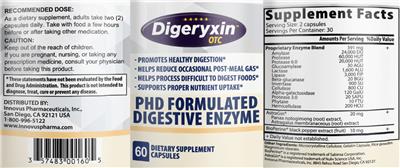
Supplement Facts
The label details for Digeryxin OTC by Innovus Pharmaceuticals, sourced from the NIH Dietary Supplement Label Database.
Supplement Facts
| Ingredient | Amount | % DV |
|---|---|---|
| Lactase | 0 NP | -- |
| Lipase | 0 NP | -- |
| Protease | 0 NP | -- |
| Beta-Glucanase | 0 NP | -- |
| Cellulase | 0 NP | -- |
| Phytase | 0 NP | -- |
| Hemicellulase | 0 NP | -- |
| Amylase | 0 NP | -- |
| Glucoamylase | 0 NP | -- |
| Alpha-Galactosidase | 0 NP | -- |
| Invertase | 0 NP | -- |
| Proprietary Enzyme Blend | 391 mg | -- |
| BioPerine Black Pepper extract | 10 mg | -- |
| Protease 3.0 | 0 NP | -- |
| Protease 6.0 | 0 NP | -- |
| AstraGin | 20 mg | -- |
| Panax notoginseng (root) extract | 0 NP | -- |
| Astragalus membranaceous (root) extracts | 0 NP | -- |
Other ingredients: Microcrystalline Cellulose, Gelatin Capsule, Rice powder, Magnesium Stearate
Tap any ingredient to jump to its full detail below.
These statements are the manufacturer’s wording, reproduced from the product label — the label is saying it, not HelloPharmacist. We don’t verify or endorse them.
Suggested/Recommended/Usage/Directions
Recommended dose: As a dietary supplement, adults take two (2) capsules daily. Take with food a few hours before or after taking other medication.
Precautions
Caution: Keep out of the reach of children.
If you are pregnant, nursing, or are taking any prescription medicine, consult your physician before taking this product.
FDA Disclaimer Statement
These statements have not been evaluated by the Food and Drug Administration. This product is not intended to diagnose, treat, cure or prevent any disease.
Formulation
Promotes healthy digestion Helps reduce occasional post-meal gas Helps process difficult to digest foods Supports proper nutrient uptake
Formula
PHD formulated digestive enzyme
FDA Statement of Identity
Dietary Supplement
Brand IP Statement(s)
BioPerine is a registered trademark of Sabinsa Corporation. AstraGin is a registered trademark of Nuliv Science USA, Inc.
General Statements
Innovus Pharmaceuticals, Inc. 8845 Rehco Road San Diego, CA 92121
Is this label outdated? Report a formula or label change and our pharmacy team will review it.
Digeryxin OTC by Innovus Pharmaceuticals label
The label scan from the NIH Dietary Supplement Label Database. Tap to enlarge.
Label images are published by the NIH Dietary Supplement Label Database for the version of this product on file. Always read your actual product label.
View the full label (PDF)The Ingredients in Digeryxin OTC by Innovus Pharmaceuticals
These are the 16 active ingredients this product is made of. Select any to open its full monograph.
Serving size2 Capsule(s) Dosage formCapsule Servings per container30 Amounts shown are per serving.
Most supplement products combine several ingredients, and a medication can interact with the product through any one of them. Each ingredient below shows whether it has known drug interactions.
Proprietary Enzyme Blend
- › Lactase
- › Lipase
- › Protease
- › Beta-Glucanase
- › Cellulase
- › Phytase
- › Hemicellulase
- › Amylase
- › Glucoamylase
- › Alpha-Galactosidase
- › Invertase
- › Protease 3.0
- › Protease 6.0
BioPerine Black Pepper extract
Interacts with1,019 drugs
Black pepper is a common kitchen spice that is generally safe in the amounts used in food. Its extract, piperine, is mostly added to supplements to he...
BioPerine Black Pepper extract monograph & interactionsOther (inactive) ingredients: Microcrystalline Cellulose, Gelatin Capsule, Rice powder, Magnesium Stearate. These complete the product’s ingredient list but are not active constituents.
Digeryxin OTC by Innovus Pharmaceuticals Drug Interactions
HelloPharmacist Interaction Report
Digeryxin OTC by Innovus Pharmaceuticals contains several digestive enzymes and herbal extracts, and it does interact with medications—primarily through its BioPerine Black Pepper extract, Panax notoginseng, and Astragalus content.
The most serious interaction we've documented is Moderate in severity: BioPerine may increase blood levels of phenytoin (Dilantin), a seizure medication, potentially doubling its concentration in your bloodstream.
Read the full breakdown — every affected drug type, severity by severity
BioPerine's piperine compound can raise blood levels of several other medications, all rated Moderate severity: propranolol (a heart/blood pressure drug), nevirapine (an HIV medication), rifampin (a tuberculosis antibiotic), cyclosporine (an immunosuppressant), pentobarbital (a sedative), atorvastatin (a cholesterol drug), and theophylline (a breathing medication). It may also slow how your body clears these drugs or increase their effects.
Panax notoginseng may lower levels of caffeine-metabolizing drugs (CYP1A2 substrates), increase bleeding risk when combined with warfarin (a blood thinner), raise aspirin levels, and reduce caffeine's effects—all Moderate interactions. Astragalus may interfere with immunosuppressants and cyclophosphamide (a chemotherapy drug), raise lithium levels, or increase low blood sugar (hypoglycemia) risk with diabetes medications—also all Moderate.
We could not check Beta-Glucanase, Cellulase, Hemicellulase, Amylase, Glucoamylase, Alpha-Galactosidase, or Invertase for interactions. Altogether, these interactions span 1,102 individual medications.
Use the search tool below to check your exact prescriptions before starting this product.
Check your own medications below · Editorial policy · How we use AI
Want to check YOUR meds against Digeryxin OTC?
Ask about interactions with your drugs in plain English — “Can I take it with lisinopril?” — and we find you the answer in seconds, ingredient by ingredient.
Go to the checkerIngredients driving the most interactions
Individual Drug Interactions
The ingredients in Digeryxin OTC interact with 1,101 drugs. Click any drug to see the details.
3 of the 16 ingredients in Digeryxin OTC interact with drugs. Each result below shows which ingredient is responsible. BioPerine Black Pepper extract Astragalus membranaceous (root) extracts Panax notoginseng (root) extract
6-mercaptopurinePurinethol
How 6-mercaptopurine interacts with Digeryxin OTC — through 1 ingredient. Tap an ingredient for the detail:
Astragalus Membranaceous (root) ExtractsImmunosuppressants Moderate
Interaction Summary
Theoretically, astragalus might interfere with immunosuppressive therapy.
Read the full Astragalus Membranaceous (root) Extracts + 6-mercaptopurine interactionAdo-trastuzumab EmtansineKadcyla
How Ado-trastuzumab Emtansine interacts with Digeryxin OTC — through 1 ingredient. Tap an ingredient for the detail:
Bioperine Black Pepper ExtractCytochrome P450 3a4 (cyp3a4) Substrates Moderate
Interaction Summary
Theoretically, black pepper might increase levels of drugs metabolized by CYP3A4.
Read the full Bioperine Black Pepper Extract + Ado-trastuzumab Emtansine interactionAbciximabReoPro
How Abciximab interacts with Digeryxin OTC — through 1 ingredient. Tap an ingredient for the detail:
Bioperine Black Pepper ExtractAnticoagulant/antiplatelet Drugs Moderate
Interaction Summary
Theoretically, black pepper might increase the risk of bleeding when taken with antiplatelet or anticoagulant drugs.
Read the full Bioperine Black Pepper Extract + Abciximab interactionAbemaciclibVerzenio
How Abemaciclib interacts with Digeryxin OTC — through 1 ingredient. Tap an ingredient for the detail:
Bioperine Black Pepper ExtractCytochrome P450 3a4 (cyp3a4) Substrates Moderate
Interaction Summary
Theoretically, black pepper might increase levels of drugs metabolized by CYP3A4.
Read the full Bioperine Black Pepper Extract + Abemaciclib interactionAbiraterone
How Abiraterone interacts with Digeryxin OTC — through 1 ingredient. Tap an ingredient for the detail:
Bioperine Black Pepper ExtractCytochrome P450 3a4 (cyp3a4) Substrates Moderate
Interaction Summary
Theoretically, black pepper might increase levels of drugs metabolized by CYP3A4.
Read the full Bioperine Black Pepper Extract + Abiraterone interactionAbiraterone AcetateYonsa, Zytiga
How Abiraterone Acetate interacts with Digeryxin OTC — through 1 ingredient. Tap an ingredient for the detail:
Bioperine Black Pepper ExtractCytochrome P450 3a4 (cyp3a4) Substrates Moderate
Interaction Summary
Theoretically, black pepper might increase levels of drugs metabolized by CYP3A4.
Read the full Bioperine Black Pepper Extract + Abiraterone Acetate interactionAbrocitinibCibinqo
How Abrocitinib interacts with Digeryxin OTC — through 2 ingredients. Tap an ingredient for the detail:
Astragalus Membranaceous (root) ExtractsImmunosuppressants Moderate
Interaction Summary
Theoretically, astragalus might interfere with immunosuppressive therapy.
Read the full Astragalus Membranaceous (root) Extracts + Abrocitinib interactionBioperine Black Pepper ExtractAnticoagulant/antiplatelet Drugs Moderate
Interaction Summary
Theoretically, black pepper might increase the risk of bleeding when taken with antiplatelet or anticoagulant drugs.
Read the full Bioperine Black Pepper Extract + Abrocitinib interactionAcalabrutinibCalquence
How Acalabrutinib interacts with Digeryxin OTC — through 1 ingredient. Tap an ingredient for the detail:
Bioperine Black Pepper ExtractCytochrome P450 3a4 (cyp3a4) Substrates, P-glycoprotein Substrates Moderate
Interaction Summary
Theoretically, black pepper might increase levels of drugs metabolized by CYP3A4.
Read the full Bioperine Black Pepper Extract + Acalabrutinib interactionAcarboseGlucobay, Prandase, Precose
How Acarbose interacts with Digeryxin OTC — through 2 ingredients. Tap an ingredient for the detail:
Bioperine Black Pepper ExtractAntidiabetes Drugs Moderate
Interaction Summary
Theoretically, black pepper might increase the risk of hypoglycemia when taken with antidiabetes drugs.
Read the full Bioperine Black Pepper Extract + Acarbose interactionAstragalus Membranaceous (root) ExtractsAntidiabetes Drugs Moderate
Interaction Summary
Theoretically, taking astragalus with antidiabetes drugs might increase the risk of hypoglycemia.
Read the full Astragalus Membranaceous (root) Extracts + Acarbose interactionAcenocoumarolSintrom
How Acenocoumarol interacts with Digeryxin OTC — through 1 ingredient. Tap an ingredient for the detail:
Bioperine Black Pepper ExtractAnticoagulant/antiplatelet Drugs Moderate
Interaction Summary
Theoretically, black pepper might increase the risk of bleeding when taken with antiplatelet or anticoagulant drugs.
Read the full Bioperine Black Pepper Extract + Acenocoumarol interactionAcetaminophenChildren's Tylenol, Children's Tylenol Meltaways, Tylenol, Tylenol Ex Strength
How Acetaminophen interacts with Digeryxin OTC — through 2 ingredients. Tap an ingredient for the detail:
Panax Notoginseng (root) ExtractCytochrome P450 1a2 (cyp1a2) Substrates Moderate
Interaction Summary
Theoretically, taking Panax notoginseng might reduce the levels and clinical effects of CYP1A2 substrates.
Read the full Panax Notoginseng (root) Extract + Acetaminophen interactionBioperine Black Pepper ExtractCytochrome P450 1a2 (cyp1a2) Substrates Minor
Interaction Summary
Theoretically, black pepper might decrease levels and clinical effects of drugs metabolized by CYP1A2.
Read the full Bioperine Black Pepper Extract + Acetaminophen interactionAcetaminophen, AspirinGemnisyn
How Acetaminophen, Aspirin interacts with Digeryxin OTC — through 2 ingredients. Tap an ingredient for the detail:
Bioperine Black Pepper ExtractCytochrome P450 1a2 (cyp1a2) Substrates, Anticoagulant/antiplatelet Drugs Moderate
Interaction Summary
Theoretically, black pepper might decrease levels and clinical effects of drugs metabolized by CYP1A2.
Read the full Bioperine Black Pepper Extract + Acetaminophen, Aspirin interactionPanax Notoginseng (root) ExtractCytochrome P450 1a2 (cyp1a2) Substrates, Aspirin Moderate
Interaction Summary
Theoretically, taking Panax notoginseng might reduce the levels and clinical effects of CYP1A2 substrates.
Read the full Panax Notoginseng (root) Extract + Acetaminophen, Aspirin interactionAcetaminophen, Aspirin, CaffeineExcedrin, Excedrin Extra Strength, Excedrin Migraine
How Acetaminophen, Aspirin, Caffeine interacts with Digeryxin OTC — through 2 ingredients. Tap an ingredient for the detail:
Bioperine Black Pepper ExtractAnticoagulant/antiplatelet Drugs, Cytochrome P450 3a4 (cyp3a4) Substrates +1 Moderate
Interaction Summary
Theoretically, black pepper might increase the risk of bleeding when taken with antiplatelet or anticoagulant drugs.
Read the full Bioperine Black Pepper Extract + Acetaminophen, Aspirin, Caffeine interactionPanax Notoginseng (root) ExtractCytochrome P450 1a2 (cyp1a2) Substrates, Aspirin +1 Moderate
Interaction Summary
Theoretically, taking Panax notoginseng might reduce the levels and clinical effects of CYP1A2 substrates.
Read the full Panax Notoginseng (root) Extract + Acetaminophen, Aspirin, Caffeine interactionAcetaminophen, Brompheniramine, PhenylpropanolamineDimetapp Cold and Flu
How Acetaminophen, Brompheniramine, Phenylpropanolamine interacts with Digeryxin OTC — through 2 ingredients. Tap an ingredient for the detail:
Panax Notoginseng (root) ExtractCytochrome P450 1a2 (cyp1a2) Substrates Moderate
Interaction Summary
Theoretically, taking Panax notoginseng might reduce the levels and clinical effects of CYP1A2 substrates.
Read the full Panax Notoginseng (root) Extract + Acetaminophen, Brompheniramine, Phenylpropanolamine interactionBioperine Black Pepper ExtractCytochrome P450 1a2 (cyp1a2) Substrates Minor
Interaction Summary
Theoretically, black pepper might decrease levels and clinical effects of drugs metabolized by CYP1A2.
Read the full Bioperine Black Pepper Extract + Acetaminophen, Brompheniramine, Phenylpropanolamine interactionAcetaminophen, ButalbitalAxocet, Bancap, Bucet, Butex Forte, Esgic CF, Orbivan CF +5 more
How Acetaminophen, Butalbital interacts with Digeryxin OTC — through 2 ingredients. Tap an ingredient for the detail:
Panax Notoginseng (root) ExtractCytochrome P450 1a2 (cyp1a2) Substrates Moderate
Interaction Summary
Theoretically, taking Panax notoginseng might reduce the levels and clinical effects of CYP1A2 substrates.
Read the full Panax Notoginseng (root) Extract + Acetaminophen, Butalbital interactionBioperine Black Pepper ExtractCytochrome P450 1a2 (cyp1a2) Substrates Minor
Interaction Summary
Theoretically, black pepper might decrease levels and clinical effects of drugs metabolized by CYP1A2.
Read the full Bioperine Black Pepper Extract + Acetaminophen, Butalbital interactionAcetaminophen, Butalbital, CaffeineEsgic, Esgic Plus, Fiogesic, Fioricet, Repan, Tecnal +1 more
How Acetaminophen, Butalbital, Caffeine interacts with Digeryxin OTC — through 2 ingredients. Tap an ingredient for the detail:
Bioperine Black Pepper ExtractCytochrome P450 1a2 (cyp1a2) Substrates, Cytochrome P450 3a4 (cyp3a4) Substrates Moderate
Interaction Summary
Theoretically, black pepper might decrease levels and clinical effects of drugs metabolized by CYP1A2.
Read the full Bioperine Black Pepper Extract + Acetaminophen, Butalbital, Caffeine interactionPanax Notoginseng (root) ExtractCytochrome P450 1a2 (cyp1a2) Substrates, Caffeine Moderate
Interaction Summary
Theoretically, taking Panax notoginseng might reduce the levels and clinical effects of CYP1A2 substrates.
Read the full Panax Notoginseng (root) Extract + Acetaminophen, Butalbital, Caffeine interactionAcetaminophen, Butalbital, Caffeine, CodeineEsgic with Codeine, Fioricet w/ Codeine
How Acetaminophen, Butalbital, Caffeine, Codeine interacts with Digeryxin OTC — through 2 ingredients. Tap an ingredient for the detail:
Bioperine Black Pepper ExtractCytochrome P450 2d6 (cyp2d6) Substrates, Cytochrome P450 3a4 (cyp3a4) Substrates +1 Moderate
Interaction Summary
Theoretically, black pepper might increase levels of drugs metabolized by CYP2D6.
Read the full Bioperine Black Pepper Extract + Acetaminophen, Butalbital, Caffeine, Codeine interactionPanax Notoginseng (root) ExtractCaffeine, Cytochrome P450 1a2 (cyp1a2) Substrates Moderate
Interaction Summary
Theoretically, taking Panax notoginseng may decrease the levels and clinical effects of caffeine.
Read the full Panax Notoginseng (root) Extract + Acetaminophen, Butalbital, Caffeine, Codeine interactionAcetaminophen, Butalbital, CodeineBancap w/ Codeine
How Acetaminophen, Butalbital, Codeine interacts with Digeryxin OTC — through 2 ingredients. Tap an ingredient for the detail:
Panax Notoginseng (root) ExtractCytochrome P450 1a2 (cyp1a2) Substrates Moderate
Interaction Summary
Theoretically, taking Panax notoginseng might reduce the levels and clinical effects of CYP1A2 substrates.
Read the full Panax Notoginseng (root) Extract + Acetaminophen, Butalbital, Codeine interactionBioperine Black Pepper ExtractCytochrome P450 1a2 (cyp1a2) Substrates, Cytochrome P450 2d6 (cyp2d6) Substrates Moderate
Interaction Summary
Theoretically, black pepper might decrease levels and clinical effects of drugs metabolized by CYP1A2.
Read the full Bioperine Black Pepper Extract + Acetaminophen, Butalbital, Codeine interactionAcetaminophen, Butalbital, Codeine PhosphatePhrenilin #3
How Acetaminophen, Butalbital, Codeine Phosphate interacts with Digeryxin OTC — through 2 ingredients. Tap an ingredient for the detail:
Bioperine Black Pepper ExtractCytochrome P450 2d6 (cyp2d6) Substrates, Cytochrome P450 1a2 (cyp1a2) Substrates Moderate
Interaction Summary
Theoretically, black pepper might increase levels of drugs metabolized by CYP2D6.
Read the full Bioperine Black Pepper Extract + Acetaminophen, Butalbital, Codeine Phosphate interactionPanax Notoginseng (root) ExtractCytochrome P450 1a2 (cyp1a2) Substrates Moderate
Interaction Summary
Theoretically, taking Panax notoginseng might reduce the levels and clinical effects of CYP1A2 substrates.
Read the full Panax Notoginseng (root) Extract + Acetaminophen, Butalbital, Codeine Phosphate interactionAcetaminophen, Caffeine, Chlorpheniramine, Hydrocodone, PhenylephrineHycomine Compound
How Acetaminophen, Caffeine, Chlorpheniramine, Hydrocodone, Phenylephrine interacts with Digeryxin OTC — through 2 ingredients. Tap an ingredient for the detail:
Panax Notoginseng (root) ExtractCytochrome P450 1a2 (cyp1a2) Substrates, Caffeine Moderate
Interaction Summary
Theoretically, taking Panax notoginseng might reduce the levels and clinical effects of CYP1A2 substrates.
Read the full Panax Notoginseng (root) Extract + Acetaminophen, Caffeine, Chlorpheniramine, Hydrocodone, Phenylephrine interactionBioperine Black Pepper ExtractCytochrome P450 2d6 (cyp2d6) Substrates, Cytochrome P450 3a4 (cyp3a4) Substrates +1 Moderate
Interaction Summary
Theoretically, black pepper might increase levels of drugs metabolized by CYP2D6.
Read the full Bioperine Black Pepper Extract + Acetaminophen, Caffeine, Chlorpheniramine, Hydrocodone, Phenylephrine interactionAcetaminophen, Caffeine, CodeineGesic C15, Gesic C30, Gesic C8, Lenoltec 1, Lenoltec 2, Lenoltec 3 +1 more
How Acetaminophen, Caffeine, Codeine interacts with Digeryxin OTC — through 2 ingredients. Tap an ingredient for the detail:
Panax Notoginseng (root) ExtractCaffeine, Cytochrome P450 1a2 (cyp1a2) Substrates Moderate
Interaction Summary
Theoretically, taking Panax notoginseng may decrease the levels and clinical effects of caffeine.
Read the full Panax Notoginseng (root) Extract + Acetaminophen, Caffeine, Codeine interactionBioperine Black Pepper ExtractCytochrome P450 2d6 (cyp2d6) Substrates, Cytochrome P450 1a2 (cyp1a2) Substrates +1 Moderate
Interaction Summary
Theoretically, black pepper might increase levels of drugs metabolized by CYP2D6.
Read the full Bioperine Black Pepper Extract + Acetaminophen, Caffeine, Codeine interactionAcetaminophen, Caffeine, Codeine, SalicylamideCodalan No.1, Codalan No.2, Codalan No.3
How Acetaminophen, Caffeine, Codeine, Salicylamide interacts with Digeryxin OTC — through 2 ingredients. Tap an ingredient for the detail:
Bioperine Black Pepper ExtractCytochrome P450 2d6 (cyp2d6) Substrates, Cytochrome P450 3a4 (cyp3a4) Substrates +1 Moderate
Interaction Summary
Theoretically, black pepper might increase levels of drugs metabolized by CYP2D6.
Read the full Bioperine Black Pepper Extract + Acetaminophen, Caffeine, Codeine, Salicylamide interactionPanax Notoginseng (root) ExtractCaffeine, Cytochrome P450 1a2 (cyp1a2) Substrates Moderate
Interaction Summary
Theoretically, taking Panax notoginseng may decrease the levels and clinical effects of caffeine.
Read the full Panax Notoginseng (root) Extract + Acetaminophen, Caffeine, Codeine, Salicylamide interactionAcetaminophen, Caffeine, DihydrocodeineDHC Plus, Panlor DC, Panlor SS
How Acetaminophen, Caffeine, Dihydrocodeine interacts with Digeryxin OTC — through 2 ingredients. Tap an ingredient for the detail:
Panax Notoginseng (root) ExtractCytochrome P450 1a2 (cyp1a2) Substrates, Caffeine Moderate
Interaction Summary
Theoretically, taking Panax notoginseng might reduce the levels and clinical effects of CYP1A2 substrates.
Read the full Panax Notoginseng (root) Extract + Acetaminophen, Caffeine, Dihydrocodeine interactionBioperine Black Pepper ExtractCytochrome P450 2d6 (cyp2d6) Substrates, Cytochrome P450 3a4 (cyp3a4) Substrates +1 Moderate
Interaction Summary
Theoretically, black pepper might increase levels of drugs metabolized by CYP2D6.
Read the full Bioperine Black Pepper Extract + Acetaminophen, Caffeine, Dihydrocodeine interactionAcetaminophen, Caffeine, IsomethepteneMigralam
How Acetaminophen, Caffeine, Isometheptene interacts with Digeryxin OTC — through 2 ingredients. Tap an ingredient for the detail:
Panax Notoginseng (root) ExtractCaffeine, Cytochrome P450 1a2 (cyp1a2) Substrates Moderate
Interaction Summary
Theoretically, taking Panax notoginseng may decrease the levels and clinical effects of caffeine.
Read the full Panax Notoginseng (root) Extract + Acetaminophen, Caffeine, Isometheptene interactionBioperine Black Pepper ExtractCytochrome P450 1a2 (cyp1a2) Substrates, Cytochrome P450 3a4 (cyp3a4) Substrates Moderate
Interaction Summary
Theoretically, black pepper might decrease levels and clinical effects of drugs metabolized by CYP1A2.
Read the full Bioperine Black Pepper Extract + Acetaminophen, Caffeine, Isometheptene interactionAcetaminophen, Caffeine, PyrilamineMidol Max Strength Menstrual
How Acetaminophen, Caffeine, Pyrilamine interacts with Digeryxin OTC — through 2 ingredients. Tap an ingredient for the detail:
Panax Notoginseng (root) ExtractCaffeine, Cytochrome P450 1a2 (cyp1a2) Substrates Moderate
Interaction Summary
Theoretically, taking Panax notoginseng may decrease the levels and clinical effects of caffeine.
Read the full Panax Notoginseng (root) Extract + Acetaminophen, Caffeine, Pyrilamine interactionBioperine Black Pepper ExtractCytochrome P450 1a2 (cyp1a2) Substrates, Cytochrome P450 3a4 (cyp3a4) Substrates Moderate
Interaction Summary
Theoretically, black pepper might decrease levels and clinical effects of drugs metabolized by CYP1A2.
Read the full Bioperine Black Pepper Extract + Acetaminophen, Caffeine, Pyrilamine interactionAcetaminophen, Chlorpheniramine Maleate, Dextromethorphan HbrVicks Formula 44M Cough, Cold & Flu Relief
How Acetaminophen, Chlorpheniramine Maleate, Dextromethorphan Hbr interacts with Digeryxin OTC — through 2 ingredients. Tap an ingredient for the detail:
Bioperine Black Pepper ExtractCytochrome P450 1a2 (cyp1a2) Substrates, Cytochrome P450 2d6 (cyp2d6) Substrates +1 Moderate
Interaction Summary
Theoretically, black pepper might decrease levels and clinical effects of drugs metabolized by CYP1A2.
Read the full Bioperine Black Pepper Extract + Acetaminophen, Chlorpheniramine Maleate, Dextromethorphan Hbr interactionPanax Notoginseng (root) ExtractCytochrome P450 1a2 (cyp1a2) Substrates Moderate
Interaction Summary
Theoretically, taking Panax notoginseng might reduce the levels and clinical effects of CYP1A2 substrates.
Read the full Panax Notoginseng (root) Extract + Acetaminophen, Chlorpheniramine Maleate, Dextromethorphan Hbr interactionAcetaminophen, Chlorpheniramine, Codeine, PhenylephrineColrex
How Acetaminophen, Chlorpheniramine, Codeine, Phenylephrine interacts with Digeryxin OTC — through 2 ingredients. Tap an ingredient for the detail:
Bioperine Black Pepper ExtractCytochrome P450 2d6 (cyp2d6) Substrates, Cytochrome P450 3a4 (cyp3a4) Substrates +1 Moderate
Interaction Summary
Theoretically, black pepper might increase levels of drugs metabolized by CYP2D6.
Read the full Bioperine Black Pepper Extract + Acetaminophen, Chlorpheniramine, Codeine, Phenylephrine interactionPanax Notoginseng (root) ExtractCytochrome P450 1a2 (cyp1a2) Substrates Moderate
Interaction Summary
Theoretically, taking Panax notoginseng might reduce the levels and clinical effects of CYP1A2 substrates.
Read the full Panax Notoginseng (root) Extract + Acetaminophen, Chlorpheniramine, Codeine, Phenylephrine interactionAcetaminophen, Chlorpheniramine, DextromethorphanCoricidin II Extra Strength Cold and Flu
How Acetaminophen, Chlorpheniramine, Dextromethorphan interacts with Digeryxin OTC — through 2 ingredients. Tap an ingredient for the detail:
Panax Notoginseng (root) ExtractCytochrome P450 1a2 (cyp1a2) Substrates Moderate
Interaction Summary
Theoretically, taking Panax notoginseng might reduce the levels and clinical effects of CYP1A2 substrates.
Read the full Panax Notoginseng (root) Extract + Acetaminophen, Chlorpheniramine, Dextromethorphan interactionBioperine Black Pepper ExtractCytochrome P450 2d6 (cyp2d6) Substrates, Cytochrome P450 1a2 (cyp1a2) Substrates +1 Moderate
Interaction Summary
Theoretically, black pepper might increase levels of drugs metabolized by CYP2D6.
Read the full Bioperine Black Pepper Extract + Acetaminophen, Chlorpheniramine, Dextromethorphan interactionAcetaminophen, Chlorpheniramine, Dextromethorphan HydrobromideCoricidin HBP Maximum Strength Flu
How Acetaminophen, Chlorpheniramine, Dextromethorphan Hydrobromide interacts with Digeryxin OTC — through 2 ingredients. Tap an ingredient for the detail:
Bioperine Black Pepper ExtractCytochrome P450 3a4 (cyp3a4) Substrates, Cytochrome P450 1a2 (cyp1a2) Substrates +1 Moderate
Interaction Summary
Theoretically, black pepper might increase levels of drugs metabolized by CYP3A4.
Read the full Bioperine Black Pepper Extract + Acetaminophen, Chlorpheniramine, Dextromethorphan Hydrobromide interactionPanax Notoginseng (root) ExtractCytochrome P450 1a2 (cyp1a2) Substrates Moderate
Interaction Summary
Theoretically, taking Panax notoginseng might reduce the levels and clinical effects of CYP1A2 substrates.
Read the full Panax Notoginseng (root) Extract + Acetaminophen, Chlorpheniramine, Dextromethorphan Hydrobromide interactionAcetaminophen, Chlorpheniramine, Dextromethorphan, PhenylpropanolamineMulti Symptom Cold Relief
How Acetaminophen, Chlorpheniramine, Dextromethorphan, Phenylpropanolamine interacts with Digeryxin OTC — through 2 ingredients. Tap an ingredient for the detail:
Bioperine Black Pepper ExtractCytochrome P450 2d6 (cyp2d6) Substrates, Cytochrome P450 3a4 (cyp3a4) Substrates +1 Moderate
Interaction Summary
Theoretically, black pepper might increase levels of drugs metabolized by CYP2D6.
Read the full Bioperine Black Pepper Extract + Acetaminophen, Chlorpheniramine, Dextromethorphan, Phenylpropanolamine interactionPanax Notoginseng (root) ExtractCytochrome P450 1a2 (cyp1a2) Substrates Moderate
Interaction Summary
Theoretically, taking Panax notoginseng might reduce the levels and clinical effects of CYP1A2 substrates.
Read the full Panax Notoginseng (root) Extract + Acetaminophen, Chlorpheniramine, Dextromethorphan, Phenylpropanolamine interactionEach ingredient & the kinds of drugs it affects
For each ingredient in Digeryxin OTC with known interactions, here are the types of medications they can affect. Open any type for the detail — or search your exact drug in the checker above.
BioPerine Black Pepper extract
Anticoagulant/Antiplatelet Drugs
Theoretically, black pepper might increase the risk of bleeding when taken with antiplatelet or anticoagulant drugs.
In vitro research shows that piperine, a constituent of black pepper, seems to inhibit platelet aggregation. This has not been reported in humans.
Antidiabetes Drugs
Theoretically, black pepper might increase the risk of hypoglycemia when taken with antidiabetes drugs.
Animal research shows that piperine, a constituent of black pepper, can reduce blood glucose levels. Monitor blood glucose levels closely. Dose adjustments might be necessary.
Atorvastatin (Lipitor)
Theoretically, black pepper might increase blood levels of atorvastatin.
Animal research shows that taking piperine, a constituent of black pepper, 35 mg/kg can increase the maximum serum concentration of atorvastatin three-fold. This has not been reported in humans.
Cyclosporine (Neoral, Sandimmune)
Theoretically, black pepper might increase the effects and side effects of cyclosporine.
In vitro research shows that piperine, a constituent of black pepper, increases the bioavailability of cyclosporine. This has not been reported in humans.
Cytochrome P450 2D6 (Cyp2D6) Substrates
Theoretically, black pepper might increase levels of drugs metabolized by CYP2D6.
In vitro research suggests that some constituents of black pepper inhibit CYP2D6. This has not been reported in humans.
Cytochrome P450 3A4 (Cyp3A4) Substrates
Theoretically, black pepper might increase levels of drugs metabolized by CYP3A4.
In vitro research and pharmacokinetic simulation data suggest that piperine, a constituent of black pepper, as well as the pepper fruit seem to inhibit CYP3A4. This has not been reported in humans.
Lithium
Theoretically, black pepper might increase blood levels of lithium due to its diuretic effects. The dose of lithium might need to be reduced.
Black pepper is thought to have diuretic properties.
Nevirapine (Viramune)
Black pepper might increase blood levels of nevirapine.
Clinical research shows that piperine, a constituent of black pepper, increases the plasma concentration of nevirapine. However, no adverse effects were observed in this study.
P-Glycoprotein Substrates
Theoretically, black pepper might increase levels of P-glycoprotein substrates.
In vitro research shows that piperine, a constituent of black pepper, seems to inhibit P-glycoprotein.
Pentobarbital (Nembutal)
Theoretically, black pepper might increase the sedative effects of pentobarbital.
Animal research shows that piperine, a constituent of black pepper, increases pentobarbital-induced sleeping time.
Phenytoin (Dilantin)
Black pepper might increase blood levels of phenytoin.
Clinical research shows that piperine, a constituent of black pepper, seems to increase absorption, slow elimination, and increase levels of phenytoin. Taking a single dose of black pepper 1 gram along with phenytoin seems to double the serum concentration of phenytoin. Consuming a soup with black pepper providing piperine 44 mg/200 mL of soup along with phenytoin also seems to increase phenytoin levels when compared with consuming the same soup without black pepper.
Propranolol (Inderal)
Black pepper might increase blood levels of propranolol.
Clinical research shows that piperine, a constituent of black pepper, seems to increase absorption and slow elimination of propranolol.
Rifampin (Rifadin)
Black pepper might increase blood levels of rifampin.
Clinical research shows that piperine, a constituent of black pepper, seems to increase absorption and serum levels of rifampin.
Theophylline
Black pepper might increase blood levels of theophylline.
Clinical research shows that piperine, a constituent of black pepper, seems to increase absorption and slow elimination of theophylline.
Amoxicillin (Amoxil, Trimox)
Theoretically, black pepper might increase the effects and side effects of amoxicillin.
Animal research shows that taking piperine, a constituent of black pepper, with amoxicillin increases plasma levels of amoxicillin. This has not been reported in humans.
Carbamazepine (Tegretol)
Theoretically, black pepper might increase blood levels of carbamazepine, potentially increasing the effects and side effects of carbamazepine.
One clinical study in patients taking carbamazepine 300 mg or 500 mg twice daily shows that taking a single 20 mg dose of purified piperine, a constituent of black pepper, increases carbamazepine levels. Piperine may increase carbamazepine absorption by increasing blood flow to the GI tract, increasing the surface area of the small intestine, or inhibiting cytochrome P450 3A4 (CYP3A4) in the gut wall. Absorption was significantly increased by 7-10 mcg/mL/hour. The time to eliminate carbamazepine was also increased by 4-8 hours. Although carbamazepine levels were increased, this did not appear to increase side effects. In vitro research also shows that piperine can increase carbamazepine levels by 11% in a time-dependent manner.
Cytochrome P450 1A2 (Cyp1A2) Substrates
Theoretically, black pepper might decrease levels and clinical effects of drugs metabolized by CYP1A2.
In vitro research suggests that black pepper induces CYP1A2. This has not been reported in humans.
Astragalus membranaceous (root) extracts
Antidiabetes Drugs
Theoretically, taking astragalus with antidiabetes drugs might increase the risk of hypoglycemia.
Clinical research in humans shows that astragalus might have hypoglycemic effects. Theoretically, taking astragalus, especially in combination with other hypoglycemic agents, might increase the risk of hypoglycemia.
Cyclophosphamide
Theoretically, astragalus might interfere with cyclophosphamide therapy.
Evidence regarding the effect of astragalus on immunosuppression caused by cyclophosphamide is conflicting. Some animal research suggests that astragalus reverses cyclophosphamide-induced immunosuppression. However, other animal research shows no effect.
Immunosuppressants
Theoretically, astragalus might interfere with immunosuppressive therapy.
Astragalus seems to stimulate immune function. Theoretically, taking astragalus might decrease the effects of immunosuppressive therapy.
Lithium
Theoretically, astragalus might increase levels and adverse effects of lithium.
Animal research suggests that astragalus has diuretic properties. Theoretically, due to this diuretic effect, astragalus might reduce excretion and increase levels of lithium.
Panax notoginseng (root) extract
Aspirin
Theoretically, taking Panax notoginseng concomitantly with aspirin may increase the risk of adverse effects from both products.
Animal research shows that taking Panax notoginseng extract with aspirin increases blood levels of salicylic acid by approximately 50% and blood levels of Panax notoginseng by 75% to 196%. This effect may be due to increased absorption of both products.
Caffeine
Theoretically, taking Panax notoginseng may decrease the levels and clinical effects of caffeine.
Animal research shows that administering Panax notoginseng intravenously for 7 days before intraperitoneal injection of caffeine can decrease maximal blood levels of caffeine by 37%. This interaction is attributed to the ability of Panax notoginseng to increase the activity of cytochrome P450 1A2 (CYP1A2) enzymes.
Cytochrome P450 1A2 (Cyp1A2) Substrates
Theoretically, taking Panax notoginseng might reduce the levels and clinical effects of CYP1A2 substrates.
Animal research shows that administering Panax notoginseng intravenously for 7 days before intraperitoneal injection of caffeine can decrease maximal blood levels of caffeine by 37%. This interaction was attributed to the ability of Panax notoginseng to increase the activity of CYP1A2.
Warfarin (Coumadin)
Theoretically, taking Panax notoginseng concomitantly with warfarin may increase the risk of bleeding.
Animal research shows that taking Panax notoginseng concomitantly with warfarin increases plasma warfarin levels, prothrombin time, and international normalized ratio when compared with control. In vitro research also suggests that Panax notoginseng may downregulate expression of cytochrome P450 3A4 enzymes, which may affect warfarin metabolism.
Brand information
Manufacturer and brand details for Digeryxin OTC, from the product label.
Innovus Pharmaceuticals
See all Innovus Pharmaceuticals products- Name
- Innovus Pharmaceuticals, Inc.
- City
- San Diego
- State
- CA
- ZipCode
- 92121
- Phone Number
- 1-800-996-5122
- Web Address
- www.innovuspharma.com
Digeryxin OTC by Innovus Pharmaceuticals: Common Questions
Does Digeryxin OTC by Innovus Pharmaceuticals interact with any medications?
How can one product interact with so many drugs?
Where does this information come from?
Does this actually help me digest food better?
Can I take this while pregnant?
Can I take this while breastfeeding?
What side effects might I experience?
Is this safe for a 17-year-old?
What is BioPerine, and why is it in here?
Written and reviewed by the HelloPharmacist editorial staff. Our editorial policy
Not sure if Digeryxin OTC is safe with your meds?
Our pharmacists answer your medication & supplement questions — free.
Label information is sourced from the NIH Dietary Supplement Label Database and reflects the product version on file; always read your actual product label. This page is for education only and is not a substitute for professional medical advice. Confirm with your pharmacist or doctor before combining supplements and medications.
The Full Monographs Behind Digeryxin OTC’s Ingredients
Every ingredient we hold a full HelloPharmacist monograph for — uses, evidence, safety, and the complete interaction list.
Lactase
Lactase is a digestive enzyme supplement that helps people who lack enough natural lactase break down lactose, the sugar in milk and dairy. It can reduce gas, bloating, cramping, and diarrhe...
Read the full Lactase monograph → Herb & supplement monographLipase
Lipase is a digestive enzyme that helps your body break down dietary fats. It is well established as part of prescription pancreatic enzyme therapy for people who cannot make enough of their...
Read the full Lipase monograph → Herb & supplement monographProteolytic Enzymes (proteases)
Proteolytic enzymes are proteins that help break down other proteins, and common examples include bromelain (from pineapple), papain (from papaya), trypsin, chymotrypsin, and pancreatin. Peo...
Read the full Proteolytic Enzymes (proteases) monograph → Herb & supplement monographPhytase
Phytase is an enzyme that breaks down phytic acid (phytate) found in grains, beans, nuts, and seeds, which can free up minerals like iron, zinc, and calcium for absorption. It is widely used...
Read the full Phytase monograph → Herb & supplement monographBlack Pepper
Interacts with 1,019 drugsBlack pepper is a common kitchen spice that is generally safe in the amounts used in food. Its extract, piperine, is mostly added to supplements to help the body absorb other ingredients (li...
Read the full Black Pepper monograph → Herb & supplement monographPanax Notoginseng
Interacts with 207 drugsPanax notoginseng (sanqi or tienchi ginseng) is a traditional Chinese herb most often used to help with bleeding, bruising, and circulation. Human evidence for these uses is limited and most...
Read the full Panax Notoginseng monograph → Herb & supplement monographAstragalus
Interacts with 208 drugsAstragalus is a root used for centuries in traditional Chinese medicine, mainly to support the immune system and help the body cope with stress. While early studies are interesting, strong h...
Read the full Astragalus monograph →Sources & How We Checked
Digeryxin OTC's label data comes from the NIH Dietary Supplement Label Database; the ingredient interaction data is from the Natural Medicines database, reviewed by our pharmacists.
- NIH Dietary Supplement Label Database (DSLD) — The official product label on file for this supplement.
- Natural Medicines (Therapeutic Research Center) — Evidence-graded clinical reference behind the ingredient interaction data.
Content is written and reviewed by licensed HelloPharmacist pharmacists. See our data sources and editorial standards for how this information is built and checked.
The 69 references behind this product’s interaction data
Every citation that drives the interaction findings for this product’s ingredients, from the evidence-graded Natural Medicines (TRC Healthcare) database. Open an ingredient to browse its citations — links open the study on PubMed or the publisher’s site.
Lactase 1 reference
- Laukkanen A, Ruoppi P, Remes S, Koistinen T, Mäkinen-Kiljunen S. Lactase-induced occupational protein contact dermatitis and allergic rhinoconjunctivitis. Contact Dermatitis. 2007;57(2):89-93. PubMed
Lipase 1 reference
- Casper C, Hascoet JM, Ertl T, et al. Recombinant bile salt-stimulated lipase in preterm infant feeding: A randomized phase 3 study. PLoS One. 2016;11(5):e0156071. PubMed
Proteolytic Enzymes (proteases) 3 references
- Weeks JA, Harper RA, Simon RA, Burdick JD. Assessment of sensitization risk of a laundry pre-spotter containing protease. Cutan Ocul Toxicol. 2011;30(4):272-9. PubMed
- Marquès LI, Lara S, Abós T, Bartolomé B. Occupational rhinitis due to pepsin. J Investig Allergol Clin Immunol. 2006;16(2):136-7. DOI
- Cartier A, Malo JL, Pineau L, Dolovich J. Occupational asthma due to pepsin. J Allergy Clin Immunol. 1984;73(5 Pt 1):574-7. PubMed
See these in context on the Proteolytic Enzymes (proteases) monograph →
Phytase 7 references
- Lei XG, Weaver JD, Mullaney E, Ullah AH, Azain MJ. Phytase, a new life for an "old" enzyme. Annu Rev Anim Biosci. 2013;1:283-309. PubMed
- Smuts CM, Matsungo TM, Malan L, et al. Effect of small-quantity lipid-based nutrient supplements on growth, psychomotor development, iron status, and morbidity among 6- to 12-mo-old infants in South Africa: a randomized controlled trial. Am J Clin Nutr. 2 PubMed
- van Heemst RC, Sander I, Rooyackers J, et al. Hypersensitivity pneumonitis caused by occupational exposure to phytase. Eur Respir J. 2009;33(6):1507-9. PubMed
- Baur X, Melching-Kollmuss S, Koops F, Strassburger K, Zober A. IgE-mediated allergy to phytase -- a new animal feed additive. Allergy. 2002;57(10):943-5. PubMed
- Doekes G, Kamminga N, Helwegen L, Heederik D. Occupational IgE sensitisation to phytase, a phosphatase derived from Aspergillus niger. Occup Environ Med. 1999;56(7):454-9. PubMed
- Brnic M, Hurrell RF, Songré-Ouattara LT, et al. Effect of phytase on zinc absorption from a millet-based porridge fed to young Burkinabe children. Eur J Clin Nutr. 2017;71(1):137-141. PubMed
- Koshy JC, Sharabi SE, Feldman EM, Hollier LH Jr, Patrinely JR, Soparkar CN. Effect of dietary zinc and phytase supplementation on botulinum toxin treatments. J Drugs Dermatol. 2012;11(4):507-12.
Black Pepper 29 references
- Leung AY, Foster S. Encyclopedia of Common Natural Ingredients Used in Food, Drugs and Cosmetics. 2nd ed. New York, NY: John Wiley & Sons, 1996.
- Brinker F. Herb Contraindications and Drug Interactions. 2nd ed. Sandy, OR: Eclectic Medical Publications, 1998.
- Bano G, Amla V, Raina RK, et al. The effect of piperine on pharmacokinetics of phenytoin in healthy volunteers. Planta Med 1987;53:568-9. PubMed
- Bano G, et al. Effect of piperine on bioavailability and pharmacokinetics of propranolol and theophylline in healthy volunteers. Eur J Clin Pharmacol 1991;41;615-7. PubMed
- Cohle SD, Trestrail JD III, Graham MA, et al. Fatal pepper aspiration. Am J Dis Child 1988;142:633-6. PubMed
- Bhardwaj RK, Glaeser H, Becquemont L, et al. Piperine, a major constituent of black pepper, inhibits human P-glycoprotein and CYP3A4. J Pharmacol Exp Ther 2002;302:645-50. PubMed
- Velpandian T, Jasuja R, Bhardwaj RK, et al. Piperine in food: interference in the pharmacokinetics of phenytoin. Eur J Drug Metab Pharmacokinet 2001;26:241-7. PubMed
- Pattanaik S, Hota D, Prabhakar S, et al. Pharmacokinetic interaction of a single dose of piperine with steady-state carbamazepine in epilepsy patients. Phytother Res 2009;23:1281-6.
- Munakata, M., Kobayashi, K., Niisato-Nezu, J., Tanaka, S., Kakisaka, Y., Ebihara, T., Ebihara, S., Haginoya, K., Tsuchiya, S., and Onuma, A. Olfactory stimulation using black pepper oil facilitates oral feeding in pediatric patients receiving long-term en
- Myers, B. M., Smith, J. L., and Graham, D. Y. Effect of red pepper and black pepper on the stomach. Am J Gastroenterol 1987;82(3):211-214.
- Raghavendra, R. H. and Naidu, K. A. Spice active principles as the inhibitors of human platelet aggregation and thromboxane biosynthesis. Prostaglandins Leukot.Essent.Fatty Acids 2009;81(1):73-78. PubMed
- Subehan, Usia, T., Kadota, S., and Tezuka, Y. Mechanism-based inhibition of human liver microsomal cytochrome P450 2D6 (CYP2D6) by alkamides of Piper nigrum. Planta Med 2006;72(6):527-532.
- Kasibhatta, R. and Naidu, M. U. Influence of piperine on the pharmacokinetics of nevirapine under fasting conditions: a randomised, crossover, placebo-controlled study. Drugs R.D. 2007;8(6):383-391. PubMed
- Usia, T., Iwata, H., Hiratsuka, A., Watabe, T., Kadota, S., and Tezuka, Y. CYP3A4 and CYP2D6 inhibitory activities of Indonesian medicinal plants. Phytomedicine. 2006;13(1-2):67-73. PubMed
- Mujumdar, A. M., Dhuley, J. N., Deshmukh, V. K., Raman, P. H., Thorat, S. L., and Naik, S. R. Effect of piperine on pentobarbitone induced hypnosis in rats. Indian J Exp.Biol. 1990;28(5):486-487.
- Panda, S. and Kar, A. Piperine lowers the serum concentrations of thyroid hormones, glucose and hepatic 5'D activity in adult male mice. Horm.Metab Res. 2003;35(9):523-526. PubMed
- Lawless, H. and Stevens, D. A. Effects of oral chemical irritation on taste. Physiol Behav. 1984;32(6):995-998. PubMed
- Hiwale, A. R., Dhuley, J. N., and Naik, S. R. Effect of co-administration of piperine on pharmacokinetics of beta-lactam antibiotics in rats. Indian J Exp.Biol. 2002;40(3):277-281.
- Han, Y., Chin Tan, T. M., and Lim, L. Y. In vitro and in vivo evaluation of the effects of piperine on P-gp function and expression. Toxicol.Appl.Pharmacol. 8-1-2008;230(3):283-289. PubMed
- Sharma, P., Varma, M. V., Chawla, H. P., and Panchagnula, R. In situ and in vivo efficacy of peroral absorption enhancers in rats and correlation to in vitro mechanistic studies. Farmaco 2005;60(11-12):874-883. PubMed
- Aher, S., Biradar, S., Gopu, C. L., and Paradkar, A. Novel pepper extract for enhanced P-glycoprotein inhibition. J Pharm.Pharmacol. 2009;61(9):1179-1186. PubMed
- Zutshi, R. K., Singh, R., Zutshi, U., Johri, R. K., and Atal, C. K. Influence of piperine on rifampicin blood levels in patients of pulmonary tuberculosis. J Assoc.Physicians India 1985;33(3):223-224.
- Marotta, R. B. and Floch, M. H. Diet and nutrition in ulcer disease. Med Clin North Am 1991;75(4):967-979. PubMed
- Subehan, Usia, T., Iwata, H., Kadota, S., and Tezuka, Y. Mechanism-based inhibition of CYP3A4 and CYP2D6 by Indonesian medicinal plants. J Ethnopharmacol. 5-24-2006;105(3):449-455. PubMed
- Gimenez L, Zacharisen M. Severe pepper allergy in a young child. WMJ. 2011 Jun;110(3):138-9.
- Ren T, Yang M, Xiao M, Zhu J, Xie W, Zuo Z. Time-dependent inhibition of carbamazepine metabolism by piperine in anti-epileptic treatment. Life Sci. 2019;218:314-323. PubMed
- Thomas AB, Choudhary DC, Raje A, Nagrik SS. Pharmacokinetics and pharmacodynamic herb-drug interaction of piperine with atorvastatin in rats. J Chromatogr Sci 2021;59(4):371-80. PubMed
- Haron MH, Dale O, Martin K, et al. Evaluation of the Herb-Drug Interaction Potential of Commonly Used Botanicals on the US Market with Regard to PXR- and AhR-Mediated Influences on CYP3A4 and CYP1A2. J Diet Suppl 2022. PubMed
- Lin F, Hu Y, Zhang Y, Zhao L, Zhong D, Liu J. Predicting Food-Drug Interactions between Piperine and CYP3A4 Substrate Drugs Using PBPK Modeling. Int J Mol Sci 2024;25(20):10955. PubMed
Panax Notoginseng 15 references
- Huang KC. The Pharmacology of Chinese Herbs. 2nd ed. New York, NY: CRC Press, LLC 1999:101-102.
- Bensky D, Gamble A, Kaptchuk T. Chinese Herbal Medicine Materia Medica. Seattle, WA: Eastland Press, 1996:359-60.
- Chan LY, Chiu PY, Lau TK. An in-vitro study of ginsenoside Rb(1)-induced teratogenicity using a whole rat embryo culture model. Hum Reprod 2003;18:2166-8..
- Du XF, Yin XP, Zhang GL, Shi HJ, Shao MH. Interstitial granulomatous drug reaction to a Chinese herb extract. Eur J Dermatol. 2012 May-Jun;22(3):419-20. PubMed
- Liu R, Qin M, Hang P, Liu Y, Zhang Z, Liu G. Effects of Panax notoginseng saponins on the activities of CYP1A2, CYP2C9, CYP2D6 and CYP3A4 in rats in vivo. Phytother Res. 2012 Aug;26(8):1113-8.
- Shang Q, Xu H, Liu Z, Chen K, Liu J. Oral Panax notoginseng Preparation for Coronary Heart Disease: A Systematic Review of Randomized Controlled Trials. Evid Based Complement Alternat Med. 2013;2013:940125.
- Tian Z, Pang H, Du S, Lu Y, Zhang L, Wu H, Guo S, Wang M, Zhang Q. Effect of Panax notoginseng saponins on the pharmacokinetics of aspirin in rats. J Chromatogr B Analyt Technol Biomed Life Sci. 2017 Jan 1;1040:136-143. PubMed
- Xu D, Huang P, Yu Z, Xing DH, Ouyang S, Xing G. Efficacy and Safety of Panax notoginseng Saponin Therapy for Acute Intracerebral Hemorrhage, Meta-Analysis, and Mini Review of Potential Mechanisms of Action. Front Neurol. 2015 Jan 7;5:274. PubMed
- Yang X, Xiong X, Wang J. Sanqi panax notoginseng injection for angina pectoris. Evid Based Complement Alternat Med. 2014;2014:963208. PubMed
- Yin Z, Ma L, Xu J, Xia J, Luo D. Pustular drug eruption due to Panax notoginseng saponins. Drug Des Devel Ther. 2014 Jul 16;8:957-61. PubMed
- Song H, Wang P, Liu J, Wang C. Panax notoginseng Preparations for Unstable Angina Pectoris: A Systematic Review and Meta-Analysis. Phytother Res. 2017 Jun 20.
- Tian Z, Pang H, Zhang Q, et al. Effect of aspirin on the pharmacokinetics and absorption of panax notoginsengsaponins. J Chromatogr B Analyt Technol Biomed Life Sci. 2018 Jan 2;1074-75.
- Li C, Xu T, Zhou P, et al. Post-marketing safety surveillance and re-evaluation of Xueshuantong injection. BMC Complement Altern Med. 2018;18(1):277. PubMed
- Liu L, Shen XJ, Xue LJ, Yao SK, Zhu JY. Submucosal hematoma with a wide range of lesions, severe condition and atypical clinical symptoms: A case report. World J Clin Cases 2021;9(20):5683-5688. PubMed
- Qian J, Chen W, Wu J, et al. Effects and Mechanism of Action of Panax notoginseng Saponins on the Pharmacokinetics of Warfarin. Eur J Drug Metab Pharmacokinet 2022;47(3):331-342. PubMed
Astragalus 13 references
- Upton R, ed. Astragalus Root: Analytical, quality control, and therapeutic monograph. Santa Cruz, CA: American Herbal Pharmacopoeia. 1999:1-25.
- Khoo KS, Ang PT. Extract of astragalus membranaceus and ligustrum lucidum does not prevent cyclophosphamide-induced myelosuppression. Singapore Med J 1995;36:387-90.
- Chu DT, Wong WL, Mavligit GM. Immunotherapy with Chinese medicinal herbs. II. Reversal of cyclophosphamide-induced immune suppression by administration of fractionated Astragalus membranaceus in vivo. J Clin Lab Immunol 1988;25:125-9.
- Sun Y, Hersh EM, Lee SL, et al. Preliminary observations on the effects of the Chinese medicinal herbs Astragalus membranaceus and Ligustrum lucidum on lymphocyte blastogenic responses. J Biol Response Mod 1983;2:227-37..
- Ma J, Peng A, Lin S. Mechanisms of the therapeutic effect of astragalus membranaceus on sodium and water retention in experimental heart failure. Chin Med J (Engl) 1998;111:17-23.
- Matkovic Z, Zivkovic V, Korica M, et al. Efficacy and safety of Astragalus membranaceus in the treatment of patients with seasonal allergic rhinitis. Phytother Res 2010;24:175-81.
- Zhang, J. G., Yang, N., He, H., Wei, G. H., Gao, D. S., Wang, X. L., Wang, X. Z., and Song, G. Y. [Effect of Astragalus injection on plasma levels of apoptosis-related factors in aged patients with chronic heart failure.]. Chin J Integr.Med 2005;11(3):18 PubMed
- Chen, H. W., Lin, I. H., Chen, Y. J., Chang, K. H., Wu, M. H., Su, W. H., Huang, G. C., and Lai, Y. L. A novel infusible botanically-derived drug, PG2, for cancer-related fatigue: a phase II double-blind, randomized placebo-controlled study. Clin Invest PubMed
- Tian H, Lu J, He H, et al.The effect of Astragalus as an adjuvant treatment in type 2 diabetes mellitus: A (preliminary) meta-analysis. J Ethnopharmacol. 2016;191:206-215. doi: 10.1016/j.jep.2016.05.062. PubMed
- Hong KF, Liu PY, Zhang W, Gui DK, Xu YH. The Efficacy and Safety of Astragalus as an Adjuvant Treatment for Type 2 Diabetes Mellitus: A Systematic Review and Meta-Analysis. J Integr Complement Med 2023. PubMed
- Chan KW, Kwong ASK, Tsui PN, et al. Add-on astragalus in type 2 diabetes and chronic kidney disease: A multi-center, assessor-blind, randomized controlled trial. Phytomedicine 2024;130:155457. PubMed
- Han X, Yu T, Chen X, Du Z, Yu M, Xiong J. Effect of Astragalus membranaceus on left ventricular remodeling in HFrEF: a systematic review and meta-analysis. Front Pharmacol 2024;15:1345797. PubMed
- Jing P, Hongzheng H, Zhenqi WU, Meijuan Z, Zuojing LI, Gang C. Long-term efficacy and safety of Huangqi ()-based Traditional Chinese Medicine in diabetic peripheral neuropathy: a Meta-analysis of randomized controlled trials. J Tradit Chin Med 2024;44(2):
Parts of this content are provided by the Therapeutic Research Center, LLC.
DISCLAIMER: Currently this does not check for drug-drug interactions. This is not an all-inclusive comprehensive list of potential interactions and is for informational purposes only. Not all interactions are known or well-reported in the scientific literature, and new interactions are continually being reported. Input is needed from a qualified healthcare provider including a pharmacist before starting any therapy. Application of clinical judgment is necessary.
© 2021 Therapeutic Research Center, LLC