
EAA + BCAA Orange by Pure Power Ingredients, Side Effects and Drug Interactions
Dietary Supplement Powder Other Combinations
UPC 8 10094 21341 1 Match it to the barcode on your bottle

Medically reviewed by Dr. Brian Staiger, PharmD, BCPS
Also reviewed by the HelloPharmacist Editorial Team
Updated Details about this page
- Label on file from the NIH Dietary Supplement Label Database, dated Mar 25, 2025.
- The interaction, evidence and safety records come from the Natural Medicines database, which we license, read against this label by our own system; the pharmacy team’s sections are written from those records.
- Dr. Brian Staiger, PharmD, BCPS, is a clinical pharmacist and pharmacotherapy specialist.
- Editorial policy Our sources
AI is used only to summarize verified clinical information, never the open internet. Our AI policy
Summary: The HelloPharmacist Team’s Take
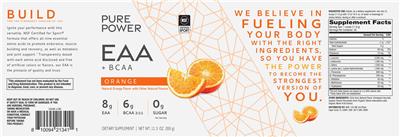
- Form
- Powder
- Serving Size
- 11.6 g
- Servings
- 30 per container
- Container Holds
- 12.3 Ounces; 350 g
What’s in it, whether it interacts with your drugs, its side effects, whether it works, and what our pharmacists would want you to know before you start it.
- What is EAA + BCAA Orange?A supplement from Pure Power with eleven active ingredients, in powder form.
- Active Ingredients 2 minerals and 9 amino acids: Sodium 40 mgPotassium 70 mgL-Leucine 3000 mgL-Isoleucine 1500 mgL-Valine 1500 mgL-Lysine 1000 mgL-Threonine 600 mgDL-Phenylalanine 250 mgL-Histidine 50 mgL-Methionine 50 mgL-Tryptophan 50 mg Eleven active ingredients. Each one can interact with drugs or cause side effects on its own, so we check every one. The full Supplement Facts
- Drug Interactions 615 drugs have a documented interaction with this supplement; the most serious is rated major. Of those, 361 are single drugs and 254 are combination products (two or more drugs in one), each listed under its own name. Based on the 7 of its 11 ingredients we could check. Ask your pharmacist first if you take a drug in any of these categories, the most serious of the 14 on record:
- Major · 248 drugs
- Nmda AntagonistsMajor · 3 drugs
- Moderate · 184 drugs
- Moderate · 172 drugs
- Possible Side EffectsNausea 6 ingredientsStomach upset 4 ingredientsDrowsiness 2 ingredientsHeadache 2 ingredientsVomiting 2 ingredientsStomach pain +9 moreCombined from six of its eleven active ingredients. Not studied in this exact product.
- Well documented Why
Does EAA + BCAA Orange work?
What It Is Marketed For
- Performance
- Muscle building
- Recovery
- Metabolic
- Joint support
From the claims on the product’s label.
The Closest Use the Research Grades
Lysine
There isn’t enough good research to say either way.
Its ingredients have stronger research for other uses:
- Potassium
- Potassium
- Lysine
- Cholera Histidine
- Neural tube birth defects Methionine
- Cardiovascular disease (CVD) Potassium
These grades are for each ingredient, not this exact product, and never a promise it will work for you.
What the research says- Full Why
- AllergensNone of its ingredient names point to a major food allergen, and the label text we have carries no allergen statement
- Barcode (UPC)8 10094 21341 1Match it to the barcode on your bottle to be sure this is your product. Not your product? Search for it here
Who Might Consider It
- People looking for performance, muscle building, recovery, metabolic and joint support, which is what it is marketed for. For athletic performance, the closest use the research grades, there is not enough good research to say either way.
- People who want it for hypertension, kidney stones (nephrolithiasis), herpes labialis (cold sores), cholera or another graded use: the other uses with research behind them. See each grade
- This product may interest you if you want an amino acid supplement and take no medications that interact with it.
Who Should Be Careful
- Be especially careful if you take blood pressure medicines, potassium-sparing diuretics, lithium, sedatives, or antidepressants, or if you have kidney or liver disease.
- If you are pregnant or breastfeeding, talk it over with your own doctor or pharmacist before starting.
More Before You Take It Show both answersHide Pregnancy and Breastfeeding The Label’s Directions
-
Pregnant or breastfeeding?
- Pregnancy and Breastfeeding Sodium
- ! When used orally in higher doses.
- Pregnancy L-Tryptophan
- ! When used orally in medicinal amounts because it may cause respiratory depression in utero.
- Breastfeeding L-Tryptophan
- When used orally in amounts commonly found in foods.
- Pregnancy and Breastfeeding Lysine
- Insufficient reliable information available; avoid using.
-
How does the label say to take it?
“Suggested use: Adults, as a dietary supplement, mix one (1) scoop (11.6 g) with 12 to 16 fl. oz. of water or beverage of choice, before, during or after a workout.”
The maker’s words. Your pharmacist or doctor may advise differently.
Everything the label says
From the label dated Mar 25, 2025: 7 of its 11 active ingredients were checked against our records; the other four are not in them yet. A summary of what is known, not a grade or a test of the product. How these ratings are computed
Ask Anything About This Supplement
Name a drug you take, or ask about side effects, ingredients or pregnancy.
AI answers come from this label and our own records, never the open internet. AI can make mistakes, so always check with your doctor or pharmacist. How we use AI
Ask the Pharmacist
A licensed pharmacist will answer your question by email — free, usually within 24 hours.
Got it — thank you!
A licensed pharmacist will answer within 24 hours. Keep an eye on your email (worth checking spam, just in case).
What’s Inside EAA + BCAA Orange by Pure Power
Eleven Active Ingredients, Each Checked on Its Own
A supplement is often several ingredients in one bottle, and each one can interact with drugs or cause side effects on its own. We check every one of them against our records.
- SodiumDrug interactions on record, most serious: Moderate
- PotassiumDrug interactions on record, most serious: Moderate
- L-LeucineNot in our interaction records yet
- L-IsoleucineNot in our interaction records yet
- L-ValineNot in our interaction records yet
- L-LysineNo drug interactions on record
- L-ThreonineDrug interactions on record, most serious: Major
- DL-PhenylalanineNot in our interaction records yet
And 3 more, each with its own card below.
Why this rating?
The label gives an exact amount for every one of its eleven active ingredients, so you know how much of each you get in each serving. This rates what the label tells you, not the quality of the product.
Supplement Facts
| Amount Per Serving | % Daily Value | |
|---|---|---|
| Calories | 5 Calories | † |
| Total Carbohydrates | 1 g | 1% |
| Total Sugars | † | |
| Sodium | 40 mg | 2% |
| Potassium | 70 mg | 1% |
| L-Leucine | 3000 mg | † |
| L-Isoleucine | 1500 mg | † |
| L-Valine | 1500 mg | † |
| L-Lysine | 1000 mg | † |
| L-Threonine | 600 mg | † |
| DL-Phenylalanine | 250 mg | † |
| L-Histidine | 50 mg | † |
| L-Methionine | 50 mg | † |
| L-Tryptophan | 50 mg | † |
Other ingredients: Citric Acid, Natural Flavors, Himalayan Sea Salt, Steviol Glycosides, Monk Fruit Extract
† Daily Value not established.
Daily Values for adults and children 4 or more years of age.
As the label prints it, from the NIH Dietary Supplement Label Database.
Each Ingredient and Its Drug Interactions
Tap one for more about it and its full guide. A drug can interact with this supplement through any one of them.
This is an amino acid powder with 11 active ingredients: sodium, potassium, L-leucine, L-isoleucine, L-methionine, L-valine, L-histidine, L-threonine, L-tryptophan, L-lysine, and DL-phenylalanine.
- The EAA and BCAA labels refer to groups of these amino acids.
-
Sodium 40 mg Interacts with 205 drugs
Sodium is an essential mineral and electrolyte your body needs to balance fluids, support nerves, and help muscles work.
- Most people in modern diets get more than enough—often too much—from food, so supplements are rarely needed except for specific medical reasons like dehydration or low blood sodium.
- Talk to your doctor or pharmacist before deliberately adding sodium, especially if you have high blood pressure, heart, or kidney problems.
The full Sodium guide: uses, dosage and safety Every Sodium drug interaction
-
Potassium 70 mg Interacts with 62 drugs
Potassium is an essential mineral your body needs for nerve signals, muscle function, and a steady heartbeat, and most people get enough from a balanced diet rich in fruits and vegetables.
- Potassium supplements can help when blood levels are truly low, but too much potassium can be dangerous, especially for people with kidney problems.
- Always talk with your pharmacist or doctor before taking a potassium supplement.
The full Potassium guide: uses, dosage and safety Every Potassium drug interaction
-
L-Leucine 3000 mg We know this ingredient, but hold no drug interaction record for it yet, so it was not checked
-
L-Isoleucine 1500 mg We know this ingredient, but hold no drug interaction record for it yet, so it was not checked
-
L-Valine 1500 mg We know this ingredient, but hold no drug interaction record for it yet, so it was not checked
-
L-Lysine 1000 mg Interacts with 1 drug
Form on the label: L-Lysine Hydrochloride
Lysine is an essential amino acid your body cannot make on its own, so it must come from food or supplements.
- People most often take extra lysine to try to prevent or shorten cold sores, but the evidence is mixed and far from conclusive.
- For most healthy people who eat enough protein, supplements are likely unnecessary, but they are generally considered low-risk at typical doses.
The full Lysine guide: uses, dosage and safety Every Lysine drug interaction
-
L-Threonine 600 mg Interacts with 3 drugs
Threonine is an essential amino acid your body needs but cannot make, so you must get it from food or supplements.
- Most people get plenty from a normal diet, and high-quality evidence for taking it as a separate supplement is limited.
- If you are considering threonine supplements, talk with your pharmacist or doctor first.
The full Threonine guide: uses, dosage and safety Every Threonine drug interaction
-
DL-Phenylalanine 250 mg We know this ingredient, but hold no drug interaction record for it yet, so it was not checked
-
L-Histidine 50 mg No known drug interactions
Histidine is an essential amino acid your body needs to build proteins and to make compounds like histamine and carnosine.
- Most people get enough from a normal diet, and good-quality research supporting histidine supplements for specific health conditions is limited.
- If you are considering a supplement, talk with a pharmacist or doctor first.
-
L-Methionine 50 mg No known drug interactions
Methionine is an essential amino acid that your body needs for protein building and many basic chemical reactions.
- Most people get enough from a normal diet, and supplements are generally not needed unless directed by a healthcare provider.
- High doses can cause side effects, so talk to your pharmacist or doctor before using methionine supplements.
-
L-Tryptophan 50 mg Interacts with 394 drugs
L-tryptophan is an essential amino acid the body uses to make serotonin and melatonin, and people take it to support sleep and mood.
- The evidence for supplement use is limited and mixed, and there are real safety concerns, so talk to a pharmacist or doctor before trying it.
The full L-Tryptophan guide: uses, dosage and safety Every L-Tryptophan drug interaction
Other Ingredients (Inactive)
The capsule or tablet itself, fillers, coatings and flavors. Not part of the drug interaction check; the allergen check below reads them.
- Citric Acid
- Natural Flavors
- Himalayan Sea Salt
- Steviol Glycosides
- Monk Fruit Extract
Allergens in EAA + BCAA Orange
None of its ingredient names point to a major food allergen, and the label text we have carries no allergen statement.
Not named in the ingredients
- Milk
- Egg
- Fish
- Shellfish
- Tree nuts
- Peanuts
- Wheat or other gluten grains
- Soy
- Sesame
From the label text and ingredient names on file; we do not test products. With a serious allergy, check your bottle and ask the maker or your pharmacist.
What the Label Says
The maker’s own words, from the label. We do not verify or endorse them.
- General statements
-
“Build for the strongest version of you”
“We believe in fueling your body with the right ingredients, so you have the power to become the strongest version of you.”
- Formulation
-
“Transparently dosed with each amino acid disclosed and free of artificial colors or flavors, our EAA is the pinnacle of quality and trust.”
“0 g Sugar”
2 more from the label
“Ignite your performance with this versatile, NSF Certified for Sport formula that offers all nine essential amino acids to promote endurance, muscle building and recovery, as well as metabolic and joint support. Transparently dosed with each amino acid disclosed and free of artificial colors or flavors, our EAA is the pinnacle of quality and trust.”
“Natural orange flavor with other natural flavors 8 g EAA 6 g BCAA 2:1:1 Per serving”
- Seals and symbols
-
“NSF Certified Sport”
- FDA Statement of Identity
-
“Dietary Supplement”
The EAA + BCAA Orange Label on File
The label scan on file at the NIH Dietary Supplement Label Database, dated March 2025. Always read the label on the bottle you have.
Product Facts
- Brand
- Pure Power
- Barcode (UPC)
- 810094213411
- Net contents
- 12.3 Ounces; 350 g
- Market status
- On market
- Date entered into DSLD
- Mar 25, 2025
- DSLD ID
- 327158
- Product type
- Other Combinations
- Supplement form
- Powder
- Dietary claims / uses
- Nutrient, All Other, Structure/Function
- Intended target group(s)
- Adult (18 - 50 Years), Sugar Free
Is this label outdated? Report a formula or label change and our pharmacy team will review it.
EAA + BCAA Orange by Pure Power Side Effects
Why this rating?
We look for three kinds of safety information on each ingredient: side effects reported in studies, a pregnancy and breastfeeding rating, and a safety write-up from our pharmacy team. Of the seven ingredients we could check, six have side-effect reports, all seven have a pregnancy rating and all seven have a safety write-up.
So this rates how much is known, not whether EAA + BCAA Orange is right for you.
Reported with seven of its ingredients
- Most often
- Nausea, stomach upset, drowsiness, headache, vomiting and stomach pain
- !Rare but serious
- Worsened cardiovascular disease, high blood pressure and cerebral edema See details
HelloPharmacist Team Summary: EAA + BCAA Orange by Pure Power Side Effects
For most people, the ingredients in EAA + BCAA Orange from Pure Power are generally well tolerated.
- The side effects you are most likely to notice are nausea and stomach upset, mostly from potassium and L-lysine, and drowsiness, mostly from L-tryptophan and L-methionine, so see how it affects you before driving.
- The rare but serious concerns are high blood potassium from the potassium and too much serotonin activity from L-tryptophan, which can show up as fast heartbeat, agitation, or confusion, and if you notice these, call your doctor right away.
- Anyone with kidney or liver disease, anyone who is pregnant or breastfeeding, and anyone taking blood pressure, sedating, or antidepressant medication should talk with their own doctor or pharmacist before starting.
Side Effects, Ingredient by Ingredient
A supplement’s side effects come from its ingredients. Here is what is reported with each one.
Potassium
Most reported
- Stomach upset
- Nausea
- Vomiting
- Gas
Lysine
Most reported
- Stomach pain
- Nausea
- Diarrhea
Threonine
Most reported
- Nausea
- Upset stomach
- Headache
Histidine
Most reported
- Stomach upset
- Nausea
- Headache
Methionine
Most reported
- Nausea
- Vomiting
- Drowsiness
- Irritability
L-Tryptophan
Most reported
- Drowsiness
- Nausea
- Stomach upset
- Dry mouth
Sodium has side-effect reports, but no list of the most common ones. Read them in the Sodium guide
EAA + BCAA Orange Warnings: Who Should Be Careful
EAA + BCAA Orange has eleven active ingredients, and each can carry warnings of its own. We checked the seven in our ingredient guides, and each warning below names the ingredient it comes from. L-Leucine, L-Isoleucine and L-Valine and one more are not in our guides yet, so ask your pharmacist about them. If any of these apply to you, talk to your doctor or pharmacist before you start it.
- Sodium3 warnings below
- Potassium3 warnings below
- Lysine3 warnings below
- Threonine2 warnings below
- Histidine2 warnings below
- Methionine3 warnings below
- L-Tryptophan2 warnings below
- L-LeucineNot in our guides yet
- L-IsoleucineNot in our guides yet
- L-ValineNot in our guides yet
- DL-PhenylalanineNot in our guides yet
-
Blood Pressure
- SodiumYou should be especially cautious with added sodium if you have high blood pressure, heart failure, kidney disease, or liver disease, or if your doctor has told you to follow a low-salt diet.
- PotassiumPeople who should be especially careful or avoid potassium supplements unless a doctor directs them include those with kidney disease, people taking certain blood pressure or heart medicines that raise potassium, and those with conditions affecting adrenal or hormone function.
-
Liver Disease
- LysinePeople with kidney disease or liver disease should be cautious and talk to their doctor before using amino acid supplements, since these organs help process them.
- ThreoninePeople with kidney or liver disease should be cautious, because these organs process amino acids, and high amino acid loads may be harder for them to handle.
- HistidinePeople with certain rare metabolic disorders, kidney disease, or liver disease should be especially careful and only use amino acid supplements under medical supervision.
- MethionineThose with liver or kidney disease should also be careful and check with a doctor first.
- L-TryptophanPeople taking medicines that affect serotonin, those with liver or kidney problems, and anyone with a history of serotonin-related illness should be especially careful and check with a healthcare provider first.
-
Kidney Disease or Kidney Stones
- PotassiumPotassium supplements can cause dangerously high blood levels in some people, especially those with kidney disease.
-
If You Take Other Drugs
- HistidineAs with any supplement, talk with your pharmacist or doctor before starting, especially if you have a health condition or take other medicines.
- MethionineAlways talk with a pharmacist or doctor before starting methionine, especially if you take other medicines or have a health condition.
- L-TryptophanAlways talk to a pharmacist or doctor before starting it, especially if you take prescription medication.
-
Other Cautions
- PotassiumSupplements are different and require more caution, because they can raise blood potassium quickly.
- LysineTo be safe, avoid supplemental lysine unless your doctor recommends it.
- ThreonineIf you have any chronic health condition, check with your doctor or pharmacist before starting.
- MethioninePeople with certain inherited disorders that affect how the body handles amino acids (such as homocystinuria) should avoid methionine supplements.
-
What the Label Warns
- “Keep out of reach of children.”
- “Do not use if safety seal is torn or damaged.”
- “If you are nursing, pregnant, taking medication or have a medical condition, consult your physician before taking this product.”
The maker’s wording, from the product label.
-
Pregnant or Breastfeeding
Each ingredient’s rating for pregnancy and for breastfeeding, and what it covers.
Pregnancy and Breastfeeding The record rates both the same
-
When used orally and appropriately.
Sodium is safe in amounts that do not exceed the CDRR intake level of 2.3 grams daily.
-
When used orally in higher doses.
Higher intake can cause hypertension.
Also, both the highest and the lowest pre-pregnancy sodium quintile intakes are associated with an increased risk of hypertensive disorders of pregnancy, including gestational hypertension and pre-eclampsia, and the delivery of small for gestational age (SGA) infants when compared to the middle intake quintile.
Pregnancy
-
When used orally in amounts commonly found in foods.
-
When used orally in medicinal amounts because it may cause respiratory depression in utero.
Avoid using in amounts greater than those found in foods.
Breastfeeding
-
When used orally in amounts commonly found in foods.
There is insufficient reliable information available about the safety of larger medicinal amounts; avoid using.
Show 5 more ingredients
Pregnancy and Breastfeeding The record rates both the same
-
Insufficient reliable information available; avoid using.
Pregnancy and Breastfeeding The record rates both the same
-
Insufficient reliable information available; avoid using.
Pregnancy and Breastfeeding The record rates both the same
-
When used orally in dietary amounts of 40-80 mEq daily.
A tolerable upper intake level (UL) has not been established for healthy individuals.
Pregnancy and Breastfeeding The record rates both the same
-
When used orally in the amounts found in foods.
There is insufficient reliable information available about the safety of histidine when used in larger amounts during pregnancy or lactation.
Pregnancy and Breastfeeding The record rates both the same
-
When used orally in amounts commonly found in food.
There is insufficient reliable information available about the safety of methionine in medical doses during pregnancy and lactation; avoid using.
Our pharmacy team’s notes
- L-TryptophanL-tryptophan has a Possibly Unsafe pregnancy rating, and our pharmacists advise avoiding it in pregnancy.
- In pregnancy, potassium and methionine are rated Likely Safe, but their safety notes advise caution with supplement doses.
- Talk with your own doctor about any of these during pregnancy or breastfeeding.
Ratings and the words beside them are from the Natural Medicines database, which we license.
-
Rare but Serious Side Effects
-
!
Sodium
Rarely, a sudden large intake of salt—or a rapid change in blood sodium during treatment—can be very serious and even life-threatening.
For Sodium, our pharmacists say too much is linked to high blood pressure and heart strain, and a sudden large salt intake can be very serious.
Orally: Worsened cardiovascular disease, hypertension, kidney disease.
-
!
Potassium
The most serious risk is high blood potassium (hyperkalemia).
High potassium levels can cause arrhythmia, heart block, hypotension, and mental confusion.
-
!
Threonine
Serious side effects are not well documented, but because high-dose, long-term use has not been carefully studied, unexpected effects are possible.
-
!
Methionine
Cerebral edema, hepatic encephalopathy. In infants, intravenous methionine has been linked to liver toxicity.
-
!
L-Tryptophan
More serious concerns include the possibility of too much serotonin activity, which can cause symptoms such as agitation, fast heartbeat, sweating, shivering, or confusion.
Orally: L-tryptophan has been associated with the neurological disorder eosinophilia-myalgia syndrome (EMS). However, almost all cases were traced to L-tryptophan produced by a single manufacturer in Japan and are likely related to contamination.
When to get help: a serious allergic reaction, with trouble breathing or swelling of the face, lips or throat, needs emergency care: call 911. For any other side effect that worries you, call your doctor or pharmacist.
These reports describe each ingredient, not studies of this exact product. Not medical advice: a side effect you notice after starting a supplement is worth a word with your pharmacist or doctor.
EAA + BCAA Orange by Pure Power Drug Interactions
We checked all eleven active ingredients in this supplement against every drug in our records. A drug can interact with it through any one of them. Four of them are not in our interaction records yet.
A major interaction on record
3 of 3, on a scale from Minor or none to Major.Why this rating?
We rate this by the most serious interaction on record, not by how many there are. For Lysine, L-Tryptophan, Potassium, Threonine and Sodium, the most serious is rated major, which means the combination is best avoided, or used only under close supervision. Some involve kinds of drugs where a small change can matter, such as lithium.
615 drugs are on the full list. What matters is whether one you take is on it, so check yours with the interaction checker on this page.
Five of its eleven active ingredients have drug interactions on record: Sodium, Potassium, Lysine, Threonine and L-Tryptophan.
- Interacts with
- 205 drugs
- Most serious
- Moderate
- Sodium has Moderate interactions with antihypertensive drugs, corticosteroids, lithium, tolvaptan, sodium phosphates, didanosine, and sodium-containing drugs.
- Interacts with
- 62 drugs
- Most serious
- Moderate
- Potassium has Moderate interactions with potassium-sparing diuretics, ACE inhibitors, and angiotensin receptor blockers (ARBs), which can raise the risk of high blood potassium (hyperkalemia).
- Interacts with
- 1 drug
- Most serious
- Minor
- L-lysine has a Minor interaction with 5-HT4 agonists.
Show two more ingredients
- Interacts with
- 3 drugs
- Most serious
- Major
- The most serious finding is a Major interaction between L-threonine and NMDA antagonists (a class of brain-acting drugs).
- Threonine might reduce how well these drugs work, because it raises brain glycine levels that help activate NMDA receptors.
- Interacts with
- 394 drugs
- Most serious
- Major
- L-tryptophan also carries a Major interaction with CNS depressants (drugs that slow the brain, such as sedatives), since the two can add up to drowsiness and fatigue.
- L-tryptophan has a Moderate interaction with serotonergic drugs, which may raise the risk of serotonin syndrome.
From the HelloPharmacist Team
Stepping back from the single ingredients, here is the picture across the whole supplement.
- EAA + BCAA Orange from Pure Power can interact with medications through its sodium, potassium, L-threonine, L-tryptophan, and L-lysine content.
- L-methionine and L-histidine were checked, and no interactions are documented for them, though that is not a guarantee none exist.
- We have no interaction information for L-leucine, L-isoleucine, L-valine, or DL-phenylalanine, so we could not check those.
Summarized by the HelloPharmacist pharmacy team from the interaction records below. How it is written How we use AI
Why EAA + BCAA Orange Interacts, Ingredient by Ingredient
A product interacts through its ingredients. Each card: how many drugs, the most serious rating, and the kinds of drugs it affects most (tap a kind for what it means).
The ingredients driving the most interactions
-
L-Tryptophan 394 drugs
Most serious: Major2 interaction records on file
The kinds of drugs it affects most
- 248 drugs
- 184 drugs
Every L-Tryptophan drug interaction, 2 records The L-Tryptophan records cite 18 references, listed in the L-Tryptophan guide.
-
Sodium 205 drugs
Most serious: Moderate7 interaction records on file
The kinds of drugs it affects most
- 172 drugs
- 23 drugs
- Sodium-containing Drugs 7 drugs
- Sodium Phosphates 2 drugs
Every Sodium drug interaction, 7 records The Sodium records cite 43 references, listed in the Sodium guide.
-
Potassium 62 drugs
Most serious: Moderate3 interaction records on file
The kinds of drugs it affects most
- 23 drugs
- 23 drugs
- 17 drugs
Every Potassium drug interaction, 3 records The Potassium records cite 12 references, listed in the Potassium guide.
-
L-Threonine 3 drugs
Most serious: Major1 interaction record on file
The kinds of drugs it affects most
- Nmda Antagonists 3 drugs
Every Threonine drug interaction, 1 record The Threonine records cite 4 references, listed in the Threonine guide.
-
L-Lysine 1 drug
Most serious: Minor1 interaction record on file
The kinds of drugs it affects most
- 5-HT4 Agonists 1 drug
Every Lysine drug interaction, 1 record The Lysine records cite 7 references, listed in the Lysine guide.
The Breakdown by Severity
Each drug counted once, at its most serious rating. Tap a tile to list those drugs.
Find Your Drug
Type a drug or brand name to see whether it is on the list.
- Only drugs with a documented interaction are listed, the most serious first.
- A drug with no known interaction is not listed, but searching its name tells you so.
- Open a drug to see which ingredient is responsible. Of those, 361 are single drugs and 254 are combination products (two or more drugs in one), each listed under its own name.
-
PregabalinLyrica, Lyrica CR Major
The ingredient responsible:
-
L-Tryptophan Major Pregabalin is in the CNS Depressants category.
Theoretically, concomitant use of L-tryptophan with CNS depressants might cause additive sedative effects.
The full L-Tryptophan + Pregabalin interaction
-
-
LamotrigineLamictal Major
The ingredient responsible:
-
L-Tryptophan Major Lamotrigine is in the CNS Depressants category.
Theoretically, concomitant use of L-tryptophan with CNS depressants might cause additive sedative effects.
The full L-Tryptophan + Lamotrigine interaction
-
-
AmitriptylineElavil Major
The ingredient responsible:
-
L-Tryptophan Major Amitriptyline is in these CNS Depressants, Serotonergic Drugs categories.
Theoretically, concomitant use of L-tryptophan with CNS depressants might cause additive sedative effects.
The full L-Tryptophan + Amitriptyline interaction
-
-
ClonazepamCeberclon, Klonopin, Rivotril Major
The ingredient responsible:
-
L-Tryptophan Major Clonazepam is in the CNS Depressants category.
Theoretically, concomitant use of L-tryptophan with CNS depressants might cause additive sedative effects.
The full L-Tryptophan + Clonazepam interaction
-
-
GabapentinGralise, Neurontin Major
The ingredient responsible:
-
L-Tryptophan Major Gabapentin is in the CNS Depressants category.
Theoretically, concomitant use of L-tryptophan with CNS depressants might cause additive sedative effects.
The full L-Tryptophan + Gabapentin interaction
-
-
DiazepamDiastat AcuDial, Valium, Valium injection, Valtoco Major
The ingredient responsible:
-
L-Tryptophan Major Diazepam is in the CNS Depressants category.
Theoretically, concomitant use of L-tryptophan with CNS depressants might cause additive sedative effects.
The full L-Tryptophan + Diazepam interaction
-
-
AlprazolamNiravam, Xanax Major
The ingredient responsible:
-
L-Tryptophan Major Alprazolam is in the CNS Depressants category.
Theoretically, concomitant use of L-tryptophan with CNS depressants might cause additive sedative effects.
The full L-Tryptophan + Alprazolam interaction
-
-
Lithium Carbonate (prescription Drug)Eskalith, Lithium Carbonate Major
The 2 ingredients responsible:
-
L-Tryptophan Major Lithium Carbonate (prescription Drug) is in these Serotonergic Drugs, CNS Depressants categories.
Theoretically, combining L-tryptophan with serotonergic drugs might cause additive serotonergic effects.
The full L-Tryptophan + Lithium Carbonate (prescription Drug) interaction -
Sodium Moderate
Altering dietary intake of sodium might alter the levels and clinical effects of lithium.
The full Sodium + Lithium Carbonate (prescription Drug) interaction
-
-
LevetiracetamElepsia XR, Keppra, Spritam Major
The ingredient responsible:
-
L-Tryptophan Major Levetiracetam is in the CNS Depressants category.
Theoretically, concomitant use of L-tryptophan with CNS depressants might cause additive sedative effects.
The full L-Tryptophan + Levetiracetam interaction
-
-
LorazepamAtivan Major
The ingredient responsible:
-
L-Tryptophan Major Lorazepam is in the CNS Depressants category.
Theoretically, concomitant use of L-tryptophan with CNS depressants might cause additive sedative effects.
The full L-Tryptophan + Lorazepam interaction
-
-
DiphenhydramineAllerdryl, Benadryl, Benadryl cream, Benadryl spray, Compoz and 10 more Major
The ingredient responsible:
-
L-Tryptophan Major Diphenhydramine is in the CNS Depressants category.
Theoretically, concomitant use of L-tryptophan with CNS depressants might cause additive sedative effects.
The full L-Tryptophan + Diphenhydramine interaction
-
-
AcetazolamideAk-Zol, Diamox Major
The 2 ingredients responsible:
-
L-Tryptophan Major Acetazolamide is in the CNS Depressants category.
Theoretically, concomitant use of L-tryptophan with CNS depressants might cause additive sedative effects.
The full L-Tryptophan + Acetazolamide interaction -
Sodium Moderate Acetazolamide is in the Antihypertensive Drugs category.
Theoretically, a high intake of dietary sodium might reduce the effectiveness of antihypertensive drugs.
The full Sodium + Acetazolamide interaction
-
-
CetirizineCetirizine, Quzyttir, Zyrtec Major
The ingredient responsible:
-
L-Tryptophan Major Cetirizine is in the CNS Depressants category.
Theoretically, concomitant use of L-tryptophan with CNS depressants might cause additive sedative effects.
The full L-Tryptophan + Cetirizine interaction
-
-
CarbamazepineCarbatrol, Carnexiv, Equetro, Tegretol, Tegretol XR Major
The ingredient responsible:
-
L-Tryptophan Major Carbamazepine is in these CNS Depressants, Serotonergic Drugs categories.
Theoretically, concomitant use of L-tryptophan with CNS depressants might cause additive sedative effects.
The full L-Tryptophan + Carbamazepine interaction
-
-
AripiprazoleAbilify, Abilify Maintena, Abilify Mycite Major
The ingredient responsible:
-
L-Tryptophan Major Aripiprazole is in these Serotonergic Drugs, CNS Depressants categories.
Theoretically, combining L-tryptophan with serotonergic drugs might cause additive serotonergic effects.
The full L-Tryptophan + Aripiprazole interaction
-
-
Magnesium Sulfate (prescription Drug)Bilagog, Magnesium Sulfate Major
The ingredient responsible:
-
L-Tryptophan Major Magnesium Sulfate (prescription Drug) is in the CNS Depressants category.
Theoretically, concomitant use of L-tryptophan with CNS depressants might cause additive sedative effects.
The full L-Tryptophan + Magnesium Sulfate (prescription Drug) interaction
-
-
TopiramateEprontia, Qudexy XR, Topamax, Trokendi XR Major
The ingredient responsible:
-
L-Tryptophan Major Topiramate is in the CNS Depressants category.
Theoretically, concomitant use of L-tryptophan with CNS depressants might cause additive sedative effects.
The full L-Tryptophan + Topiramate interaction
-
-
Codeine PhosphateCodeine Major
The ingredient responsible:
-
L-Tryptophan Major Codeine Phosphate is in the CNS Depressants category.
Theoretically, concomitant use of L-tryptophan with CNS depressants might cause additive sedative effects.
The full L-Tryptophan + Codeine Phosphate interaction
-
-
MethadoneDolophine Major
The ingredient responsible:
-
L-Tryptophan Major Methadone is in these CNS Depressants, Serotonergic Drugs categories.
Theoretically, concomitant use of L-tryptophan with CNS depressants might cause additive sedative effects.
The full L-Tryptophan + Methadone interaction
-
-
OxycodoneOxecta, OxyContin, OxyIR, OxyNeo, Percolone and 1 more Major
The ingredient responsible:
-
L-Tryptophan Major Oxycodone is in the CNS Depressants category.
Theoretically, concomitant use of L-tryptophan with CNS depressants might cause additive sedative effects.
The full L-Tryptophan + Oxycodone interaction
-
-
Codeine SulfateCodeine Sulfate Major
The ingredient responsible:
-
L-Tryptophan Major Codeine Sulfate is in the CNS Depressants category.
Theoretically, concomitant use of L-tryptophan with CNS depressants might cause additive sedative effects.
The full L-Tryptophan + Codeine Sulfate interaction
-
-
HydrocodoneHydrocodone, Zohydro ER Major
The ingredient responsible:
-
L-Tryptophan Major Hydrocodone is in the CNS Depressants category.
Theoretically, concomitant use of L-tryptophan with CNS depressants might cause additive sedative effects.
The full L-Tryptophan + Hydrocodone interaction
-
-
ZopicloneApo-Zopiclone, Co Zopiclone, Dom-Zopiclone, Imovane, Mylan-Zopiclone and 2 more Major
The ingredient responsible:
-
L-Tryptophan Major Zopiclone is in the CNS Depressants category.
Theoretically, concomitant use of L-tryptophan with CNS depressants might cause additive sedative effects.
The full L-Tryptophan + Zopiclone interaction
-
-
Zolpidem TartrateAmbien Major
The ingredient responsible:
-
L-Tryptophan Major Zolpidem Tartrate is in the CNS Depressants category.
Theoretically, concomitant use of L-tryptophan with CNS depressants might cause additive sedative effects.
The full L-Tryptophan + Zolpidem Tartrate interaction
-
-
ZolpidemAmbien CR, Intermezzo, Sublinox Major
The ingredient responsible:
-
L-Tryptophan Major Zolpidem is in the CNS Depressants category.
Theoretically, concomitant use of L-tryptophan with CNS depressants might cause additive sedative effects.
The full L-Tryptophan + Zolpidem interaction
-
-
TramadolQdolo, Ultram, Zytram XL Major
The ingredient responsible:
-
L-Tryptophan Major Tramadol is in these CNS Depressants, Serotonergic Drugs categories.
Theoretically, concomitant use of L-tryptophan with CNS depressants might cause additive sedative effects.
The full L-Tryptophan + Tramadol interaction
-
-
Valproic AcidDepacon, Depakene, Valproate Major
The ingredient responsible:
-
L-Tryptophan Major Valproic Acid is in these CNS Depressants, Serotonergic Drugs categories.
Theoretically, concomitant use of L-tryptophan with CNS depressants might cause additive sedative effects.
The full L-Tryptophan + Valproic Acid interaction
-
-
Sodium ValproateEpilim Major
The ingredient responsible:
-
L-Tryptophan Major Sodium Valproate is in these Serotonergic Drugs, CNS Depressants categories.
Theoretically, combining L-tryptophan with serotonergic drugs might cause additive serotonergic effects.
The full L-Tryptophan + Sodium Valproate interaction
-
-
Hydrocodone BitartrateHysingla, Vantrela ER Major
The ingredient responsible:
-
L-Tryptophan Major Hydrocodone Bitartrate is in the CNS Depressants category.
Theoretically, concomitant use of L-tryptophan with CNS depressants might cause additive sedative effects.
The full L-Tryptophan + Hydrocodone Bitartrate interaction
-
-
Gamma Hydroxybutyrate (prescription Drug)GHB Major
The ingredient responsible:
-
L-Tryptophan Major Gamma Hydroxybutyrate (prescription Drug) is in the CNS Depressants category.
Theoretically, concomitant use of L-tryptophan with CNS depressants might cause additive sedative effects.
The full L-Tryptophan + Gamma Hydroxybutyrate (prescription Drug) interaction
-
Does It Work? EAA + BCAA Orange by Pure Power
How it rates in the research so far, then each ingredient on its own. A grade is the research so far, never an endorsement.
What It Is Marketed For
- Performance
- Muscle building
- Recovery
- Metabolic
- Joint support
From the claims on the product’s label.
Closest match for what it is marketed for
Lysine for athletic performance
There isn’t enough good research to say either way.
Our pharmacy team’s notes on this supplement
- Ratings vary by ingredient.
- Lysine is Possibly Effective for cold sores (herpes labialis), methionine is Possibly Effective for neural tube birth defects, and histidine is Possibly Effective for cholera.
- Most other listed uses are rated Insufficient Reliable Evidence To Rate.
The Evidence, Ingredient by Ingredient
Each card holds our notes on one ingredient, then its uses graded effective, likely effective or possibly effective.
Lysine
From our Lysine guide
- The most popular reason people use lysine is for cold sores and other herpes outbreaks.
- Some small studies suggest lysine might help reduce how often outbreaks happen or how long they last, but the results are inconsistent.
Research suggests a benefit for
- Herpes labialis (cold sores)
Threonine
Our pharmacy team’s notes on Threonine
- Threonine is Possibly Ineffective for ALS, and tryptophan is Possibly Ineffective for depression.
No use is graded effective, likely effective or possibly effective for it yet.
Every graded use, in the Threonine guidePotassium
From our Potassium guide
- This can happen with certain water pills (diuretics), prolonged vomiting or diarrhea, or some medical conditions.
Research suggests a benefit for
- Hypertension and kidney stones (nephrolithiasis)
- Cardiovascular disease (CVD)
Not counted here: two graded uses are for conditions treated by a doctor or in a hospital (hypokalemia and stroke).
Every graded use, in the Potassium guideHistidine
From our Histidine guide
- Histidine is studied and used for several conditions, but the evidence for most uses is limited or preliminary.
Research suggests a benefit for
- Cholera
Methionine
From our Methionine guide
- People take methionine for several reasons, but the strength of the evidence varies a lot depending on the use.
Research suggests a benefit for
- Neural tube birth defects
L-Tryptophan
From our L-Tryptophan guide
- People most often use L-tryptophan for sleep, low mood or depression, and anxiety.
- Some also use it for premenstrual symptoms or to help control appetite.
No use is graded effective, likely effective or possibly effective for it yet.
Every graded use, in the L-Tryptophan guideSodium
Our pharmacy team’s notes on Sodium
- Sodium has no effectiveness rating.
Research suggests a benefit for
- Amphotericin B nephrotoxicity
Not counted here: one graded use is for Sodium injected or put on the skin (cystic fibrosis), not for a product like this one.
Every graded use, in the Sodium guideThe grades are the Natural Medicines database’s, which we license; tap a grade for what it means. They are about each ingredient, not this exact product.
About Pure Power
Manufacturer and brand details for EAA + BCAA Orange, from the product label.
Pure Power has 17 products in our supplement database, all of them on the market, with labels on file since 2025. Our database is built from the NIH’s Dietary Supplement Label Database and our pharmacy team’s own additions, so it covers the labels filed there, not every product the brand sells.
- Name
- NHP
- Street Address
- 125 SW 3rd Place
- City
- Cape Coral
- State
- FL
- ZipCode
- 33991
- Phone Number
- (877) 985-2696
EAA + BCAA Orange by Pure Power: Common Questions
Does EAA + BCAA Orange by Pure Power interact with any drugs?
What are the side effects of EAA + BCAA Orange by Pure Power?
Who should be careful taking EAA + BCAA Orange by Pure Power?
Can EAA + BCAA Orange by Pure Power affect the liver?
Can EAA + BCAA Orange by Pure Power affect the kidneys?
How can EAA + BCAA Orange by Pure Power interact with so many drugs?
Where does the information about EAA + BCAA Orange by Pure Power come from?
Is it OK to take EAA + BCAA Orange by Pure Power during pregnancy?
Does L-lysine work for cold sores?
Does L-threonine help with ALS?
What else is in EAA + BCAA Orange by Pure Power besides the amino acids?
Written and reviewed by the HelloPharmacist Editorial Team. Our editorial policy
Still Have a Question About EAA + BCAA Orange?
Our pharmacists answer drug and supplement questions, free, by email.
Label information is sourced from the NIH Dietary Supplement Label Database and reflects the product version on file; always read your actual product label. This page is for education only and is not a substitute for professional medical advice. Confirm with your pharmacist or doctor before combining supplements and drugs.
Who Reviews This Page
The pharmacist behind it, and how it is checked.
Dr. Brian Staiger, PharmD, BCPS
Clinical pharmacist and founder of HelloPharmacist
A licensed pharmacist for more than 13 years, he built the system behind this page: it reads the label on file, matches each active ingredient to its record in the Natural Medicines database, checks those records against every drug we cover, and our pharmacy team writes the take and the interaction summary from those records.
- 13+ Years in PharmacyRetail and clinical pharmacy, medication safety and healthcare administration.
- Board Certified (BCPS)A pharmacotherapy specialist, certified by the Board of Pharmacy Specialties.
- Herbalist TrainingCertificates in medical ethnobotany, for the herbs and supplements people take.
Where This Page Comes From
EAA + BCAA Orange’s label data comes from the NIH Dietary Supplement Label Database; the ingredient interaction data is from the Natural Medicines database, reviewed by our pharmacists.
- NIH Dietary Supplement Label Database (DSLD)
- The official product label on file for this supplement.
- Natural Medicines (Therapeutic Research Center)
- The evidence-graded clinical reference behind the ingredient interaction, evidence and safety records, which we license.
- HelloPharmacist Editorial Team
- Content is reviewed by the HelloPharmacist Editorial Team, the pharmacists on our staff and those we contract. See our data sources and editorial standards for how this information is built and checked.
- The Pharmacy Team’s Take and Summaries
- Generated from HelloPharmacist’s pharmacist-curated databases and editorial rules. Clinical methodology reviewed by Dr. Brian Staiger, PharmD, BCPS. Last generated Oct 31, 2026. How we use AI
- The ratings in the Quick Summary
- They summarize available label information, ingredient evidence and known drug-safety records: a summary of what is known, not a grade of the product itself. They do not verify product identity, purity, potency, contamination or manufacturing quality. How these ratings are computed
The References Behind the Interaction Records
Every citation the ingredients’ records rest on is listed in that ingredient’s guide, in context: Sodium, 43 references; Potassium, 12 references; Lysine, 7 references; Threonine, 4 references; Histidine, 3 references; Methionine, 12 references; L-Tryptophan, 18 references .
Parts of this content are provided by the Therapeutic Research Center, LLC.
DISCLAIMER: Currently this does not check for drug-drug interactions. This is not an all-inclusive comprehensive list of potential interactions and is for informational purposes only. Not all interactions are known or well-reported in the scientific literature, and new interactions are continually being reported. Input is needed from a qualified healthcare provider including a pharmacist before starting any therapy. Application of clinical judgment is necessary.
© 2021 Therapeutic Research Center, LLC
Keep Exploring
- Supplement interaction checkerCheck any supplement or product against your drugs
- Drug–drug interactionsCheck two or more of your drugs against each other
- Browse drugs A to ZEvery drug we have checked against herbs and supplements
- NDC and pricing lookupFind a drug’s NDCs, packaging and costs
- Ask a pharmacistA free, personal answer from our licensed team